'Chances
pp. 31-33 · Read in the full issue
Coming' To
W. Samoa
From R. F. Rankin, in Apia
Popular New Zealand High
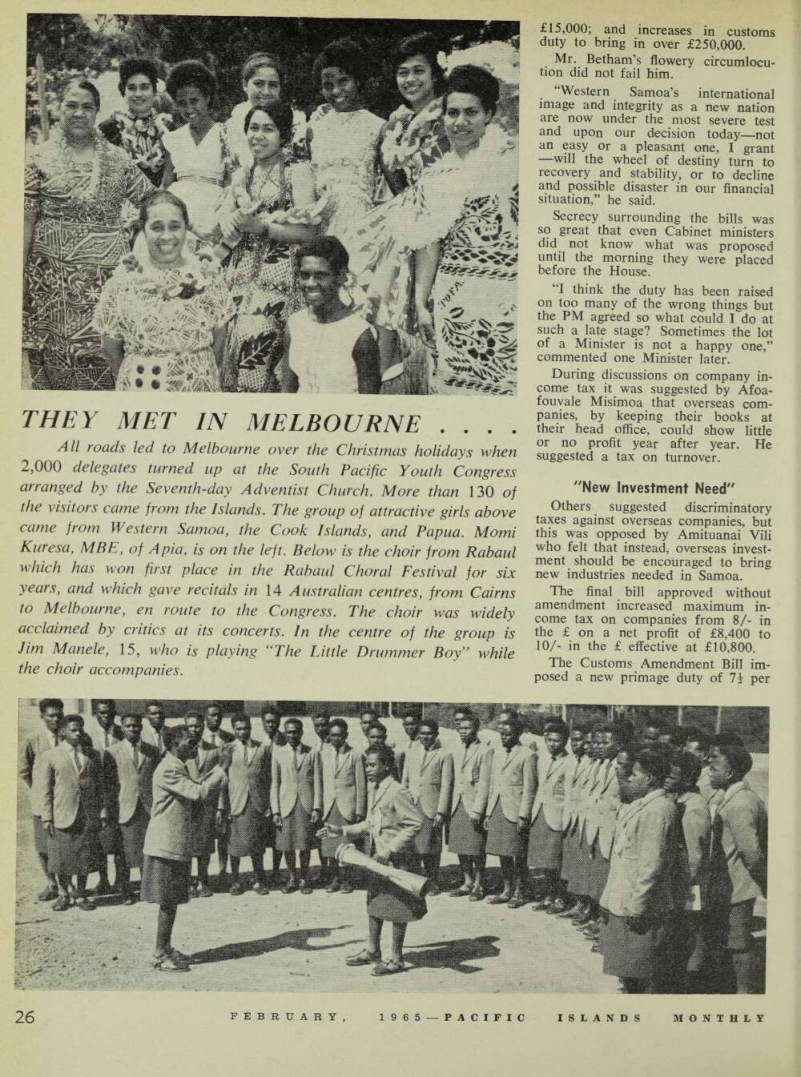
Commissioner Mr. J. B. (Jack) Wright is to retire early this year, and in a radio speech sponsored
by the Economic Development
Secretariat the other day he did some plain speaking that found favour in many circles around
Apia.
“T ET us face facts,” said Mr.
Wright. “Such is the pressure of population in terms of available land that, as sure as night follows day, there are going to be changes in Samoa whether we like it or not.”
Mr. Wright claimed that he had heard it said among some people that Samoans should not support economic development because it would destroy their old way of life.
“It could be argued with equal if not greater force and logic that Samoan custom will perish the sooner if we do not throw our weight behind the Government in an endeavour to increase the national income of Samoa,” said Mr. Wright, adding that no one in his right senses would advocate throwing overboard all that was good in Samoan custom.
He said that many of the things now regarded as an integral part of Samoan custom, such as church openings, and fetes, weddings and christenings, etc., were completely dependent on money.
“And to earn money one, un fortunately, has to work. And, as the population grows one has to work harder and harder,” he said.
Mr. Wright pointed out that: • Every day there are 12 more young Samoan mouths to feed. • In 20 years the population could more than double to 300,000. • By the end of the century the population could be half a million. • The average cash income from copra, cocoa and bananas per head has been calculated at only £B/15/- a year compared with £695 per head of the farming community in New Zealand.
“It is perfectly clear that an average cash income of £B/15/- a head is an extremely low amount
for a country with the political am bition of Samoa. But if positive measures are not taken to deal with the situattion it could become worse and not better,” said Mr. Wright.
If standards were not to drop and enough money was to be found to finance schools, hospitals, roads and things that Samoans have become used to, from now on the economy would have to be planned.
Mr. Wright said that Samoa must have a land policy which will entitle the Samoan people to farm, with adequate reward to the individual, every inch of cultivable land.
It must farm this maximum area of land with a minimum number of people.
It must develop profitable in dustries other than farming to ab sorb people who are not engaged in agriculture.
He called for co-operation with the Government in implementing de velopment plans. And with his long years of experience in Samoa, he added cryptically, “Plans are of no use unless they are carried out.”
Taxes Go Up While the public was still digesting the words of Mr. Wright, in a remarkably successful political manoeuvre, the Minister of Finance, Mr. G. F. D. Betham, in a single day rushed through Parliament three bills netting him an expected ad ditional revenue of some £280,000.
With their critical senses ap parently lulled by the spirit of Christmas and a salary increase the week before of 25 per cent, to £5OO a year, members of Samoa’s Parlia ment with unheard of haste approved an increase in business licences from £2 to £3 a year; an increase in com pany income tax to bring in about
All Eyes On
Samoan Beetle
Survey
South Pacific copra pro ducers, together with those in Africa and Asia, are taking a close interest in the current campaign in Western Samoa against the menace of the coco nut rhinoceros beetle, which destroys palms.
The campaign is a five-year one involving $1 million and is being sponsored by FAO/
Spc.
Head of the project is Dr.
C. P. Hoyt, and aiding him are ecologist Dr. D. Hinckley; entomologist, A. Catley; a German insect pathologist K.
Marschall; and two scientists in Africa and Asia. In Samoa, beetles are kept under natural conditions in an effort to dis cover more about their habits.
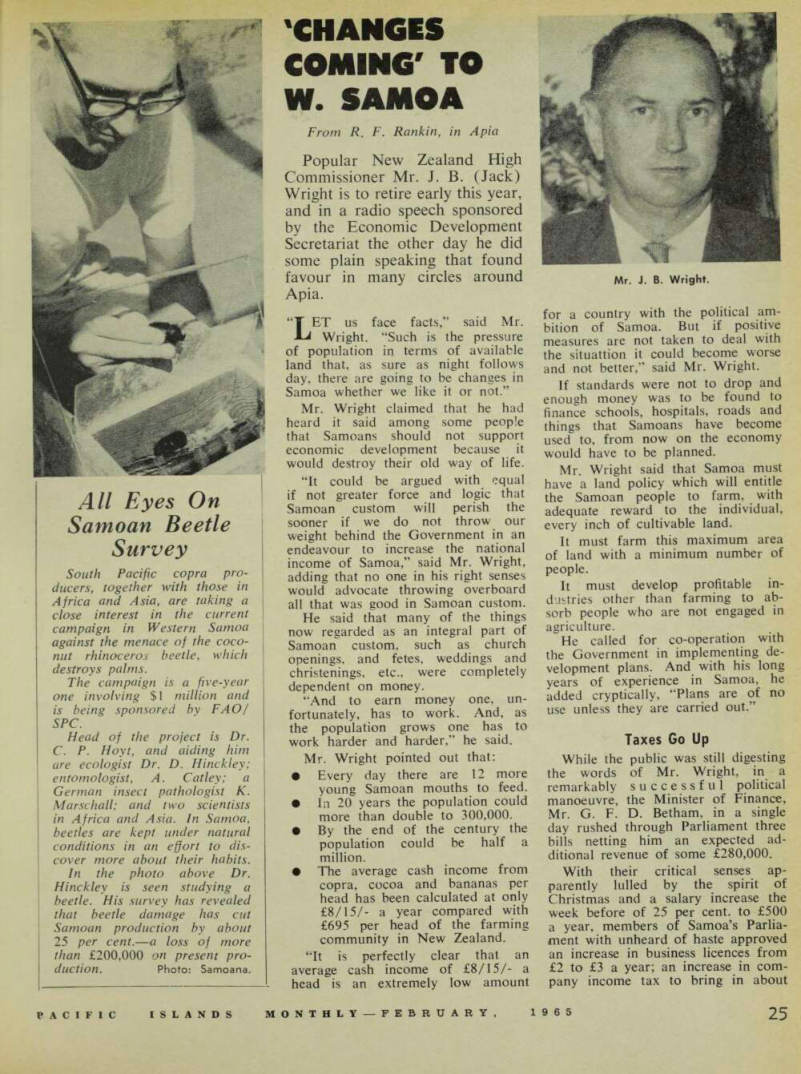
In the photo above Dr.
Hinckley is seen studying a beetle. His survey has revealed that beetle damage has cut Samoan production by about 25 per cent. —a loss of more than £200,000 on present pro duction. Photo: Samoana.
Mr. J. B. Wright.
£15,000; and increases in customs duty to bring in over £250,000.
Mr. Betham’s flowery circumlocu tion did not fail him.
“Western Samoa’s international image and integrity as a new nation are now under the most severe test and upon our decision today— not an easy or a pleasant one, I grant —will the wheel of destiny turn to recovery and stability, or to decline and possible disaster in our financial situation,” he said.
Secrecy surrounding the bills was so great that even Cabinet ministers did not know what was proposed until the morning they were placed before the House.
“I think the duty has been raised on too many of the wrong things but the PM agreed so what could I do at such a late stage? Sometimes the lot of a Minister is not a happy one,” commented one Minister later.
During discussions on company in come tax it was suggested by Afoa fouvale Misimoa that overseas com panies, by keeping their books at their head office, could show little or no profit year after year. He suggested a tax on turnover.
"New Investment Need"
Others suggested discriminatory taxes against overseas companies, but this was opposed by Amituanai Vili who felt that instead, overseas invest ment should be encouraged to bring new industries needed in Samoa.
The final bill approved without amendment increased maximum in come tax on companies from 8/- in the £ on a net profit of £8,400 to 10/- in the £ effective at £lO,BOO.
The Customs Amendment Bill im posed a new primage duty of lh per
THEY MET IN MELBOURNE . . . .
All roads led to Melbourne over the Christmas holidays when 2,000 delegates turned up at the South Pacific Youth Congress arranged by the Seventh-day Adventist Church. More than 130 of the visitors came from the Islands. The group of attractive girls above came from Western Samoa, the Cook Islands, and Papua. Momi Kuresa, MBE, of Apia, is on the left. Below is the choir from Rabaul which has won first place in the Rabaul Choral Festival for six years, and which gave recitals in 14 Australian centres, from Cairns to Melbourne, en route to the Congress. The choir was widely acclaimed by critics at its concerts. In the centre of the group is Jim Manele, 15, who is playing “The Little Drummer Boy” while the choir accompanies.
cent, on practically all goods im ported and raised duty on beer, cigarettes, luxury goods, and pro ducts lending themselves to local manufacture.
Petrol is up 5d a gallon to 4/3 and beer and cigarettes are expected to go up about 5d from the present 2/10 a bottle and 2/3 a packet of 20.
Duty on dressed timber has gone up 50 per cent, and on cameras, watches, jewellery, perfume and radiograms it has been increased from (Commonwealth) and 45 (general) to 45 and 60 per cent.
Motor vehicles are up likewise.
Duty has also been raised about 5 per cent, on beverages, cabin bread, coffee, confectionery, eggs, fresh and frozen fish, and meat. The many people planning to buy TV sets ex pected to be on sale in Apia shops shortly as a result of nightly telecasts from Pago Pago are taking a second thought with duty at 33£ and 45 per cent.
Some Relief On the other hand the new rates have brought long sought relief to sportsmen and some farmers. The duty on sporting goods, barbed wire and mesh wire for fencing and fish traps, and refrigerators and deep freezers has been reduced.
The additional funds were needed, said Mr. Betham, to wipe out the budget deficit of about £250,000 and to provide funds for the 1965 de velopment programme.
The public, still in the dark about development, and disillusioned with so much talk and so little effective action in increasing national income over the past three years, has not been enthusiastic over the new sacri fices it has been asked to make.
There is a willingness to accept sacrifice provided it proves worth while—it is not yet convinced that this is so in the present case.
And, as a postscript to the three financial bills, Prime Minister Mataafa moved a motion dis enfranchising babies.
In Samoan electorates the vote is restricted to matai (chiefs) but with a by-election coming up early in the New Year, and in an endeavour to secure more votes, there have been many new matai titles granted in that electorate.
“Many of these titles have been given mere infants,” said Mataafa.
After very little discussion the House approved the Prime Minister’s motion restricting the vote in Samoan electorates to matai over the age of 21.