There's A Tax
pp. 33-35 · Read in the full issue
To Suit Everyone
In Fiji Now
By a Staff Writer
Fiji’s new pay-as-you-earn
income tax system for wage and salary earners came into effect
on January 1 and, as expected,
without any noticeable trouble.
Observers believe that deficien cies in the system, if any, are unlikely to show up for at least 18 months.
ALONG with the new PAYE system, there are new methods of calculating tax —and a couple of new taxes.
The result, in tax collections, could be spectacular, not because individual taxpayers will be taxed more, but because the new Basic Tax, deducted at the source of all income, will pull in a great many people who formerly have been able to escape the net of the tax-gatherer.
Basic tax of 6d in the £ is levied on the total or gross income of all income earners and on the net profit of companies. Employers will deduct the amount from the wages of their employees, unless the employee earns £3/1/6 per week or less, in which event the employer pays the amount (1/6), himself but is allowed this sum as a deduction in his own income-tax return.
In addition to Basic Tax, Normal Tax is levied on chargeable income —that is, the income that is left after certain allowances and deduc tions are made from total income.
The deductions include £320 personal allowance and other allowances for wife, children, dependents, for educa tion of children, insurance premiums and contributions to approved funds.
Rate of Normal Tax, for a charge able income not exceeding £4,750, is at the rate of 1/3 in the £ plus as many times .012 d as there are £’s in the chargeable income. For example, a taxpayer with a charge able income of £l,OOO, would pay at the rate per £ of 1/3 plus 1,000 times .012 d; in other words at the rate of 2/3 in the £—a total of £ll2/10/-.
Where chargeable income exceeds £4,750 the rate is 6/- in the £.
For those lucky people whose chargeable income exceeds £2,000
there is an additional tax—Surtax.
This begins at the rate of 1/- in the £ on chargeable incomes between £2,000 and £4,000 and rises to 67in the £ on incomes over £20,000.
Corrnany Tax and Dividend Tax Companies, generally, pay 6d in the £ Basic Tax on net profits; and Normal Tax of ,5/9 in the £ on chargeable income—which brings the total tax back to the pre-1965 rate of 6/3 in the £. There is no Surtax, A new tax, introduced for the first time from January 1, 1965, is Dividend Tax. This tax, of 5 per cent., is to be charged on all divi dends paid to shareholders of a company. The company concerned will deduct the tax from the divi dends of individual shareholders and remit it to the Department of Inland Revenue. Dividends thus taxed will
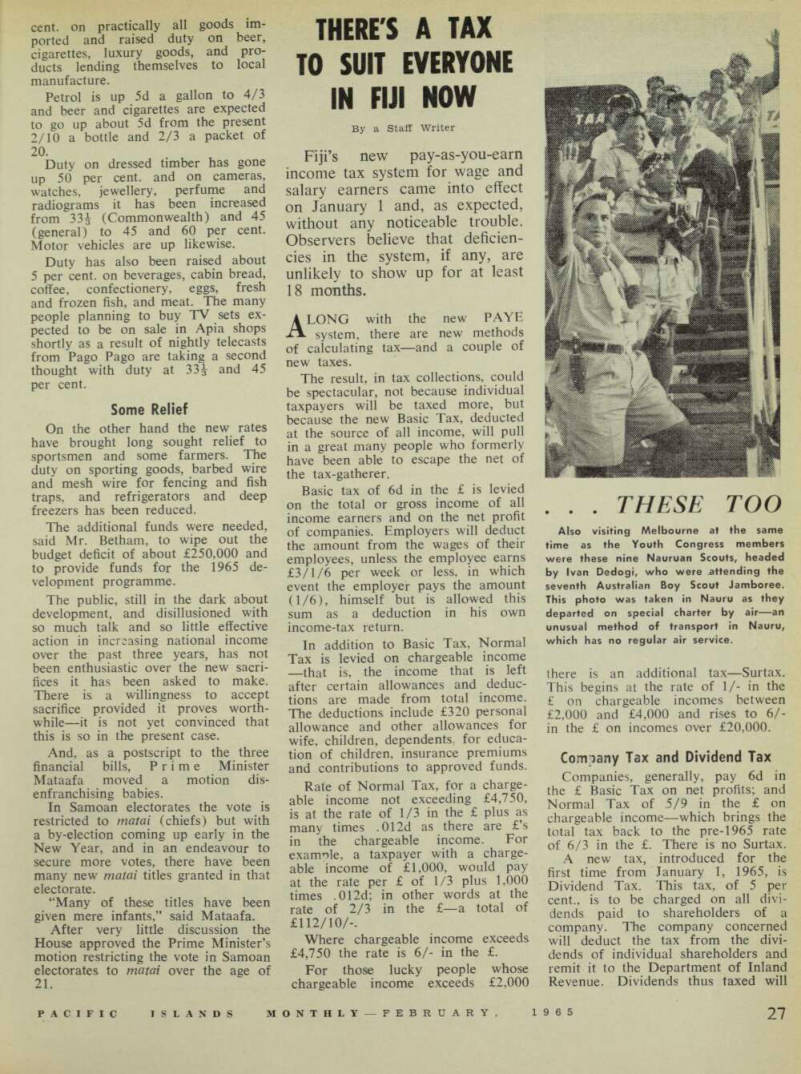
. . . These Too
Also visiting Melbourne at the same time as the Youth Congress members were these nine Nauruan Scouts, headed by Ivan Dedogi, who were attending the seventh Australian Boy Scout Jamboree.
This photo was taken in Nauru as they departed on special charter by air—an unusual method of transport in Nauru, which has no regular air service.
(from previous page)
not be liable to Basic Tax, Normal Tax or Surtax in the hands of share holders; nor will it be taken into account in calculating the rate of tax chargeable upon the other income of shareholders.
The new taxes and the manner of collection is based on a report of the Fiscal Review Committee in 1964.
They are designed not so much for collecting more revenue (although this could be the result), as spread ing tax more equitably over the Fiji community. The new system won’t penalise honest taxpayers—to the contrary, the revised scale of allow ances and deductions is exceedingly generous—but it will affect people who to date have evaded tax.
How PAYE Works The PAYE system in the initial stages affects only wage and salary earners, whose Basic Tax, Normal Tax and Surtax are all deducted at the source. The employer having made the deduction from the salaries
of his employees pays the amount directly into the Department of In land Revenue in the following month.
This is a cash transaction—there is no provision for group certificates or tax-stamps, as in the Australian pay as-you-earn system.
Having tax deducted at its source does not absolve the individual tax payer from each year putting in a tax return from which the Depart ment calculates whether the taxpayer has paid too much on his year’s income, or not enough.
So far there seems to be no pro vision for getting at taxpayers whose income is derived from salary and in vestment by way of “provisional tax” on the latter, as in the Australian system. Hie Australian system is an arbitrary method of calculation by the Taxation Department of what additional income the taxpayer is likely to earn in the current year.
The tax, on this, must be paid in a lump sum, in advance.
In Fiji, it seems, taxpayers who
earn money other than salary pay the additional tax after they have received their assessments.
Provisional tax will, however, affect self-employed persons in Fiji although in the initial stages of PAYE the system has not been ex tended to them.
A new method of payment of tax by companies has also been intro duced. Companies now have to make two advance payments of tax to be assessed on the preceding year’s income. By the last day of the company’s financial year, the company must pay 25 per cent, of the tax on its estimated income for the preceding year. Three months after the end of its financial year (when it knows its actual income for the preceding year), it must make a payment of 50 per cent, of its tax, less the first payment made.
Company Method
For example, if a company esti mates at the end of its financial year that it has made a profit of £3,000 m the preceding year, it makes an advance payment of 25 per cent, of the tax thereon—in this case,
later, when final figures are in, it is shown that the company, in fact, made £4,000 profit.
Tax on this would amount to £1,250 and the 50 per cent, second advance payment would be £625, less the first advance payment of £234/7/6—that is, £390/12/6.
Although there are problems with the PAYE system in Fiji—a Colony with thousands of small businesses, extraordinarily mixed community of different social and business back grounds, and an army of spasmodic workers—it is a system under which the Department of Inland Revenue is scarcely likely to lose.
Fiji citizens may expect to see a rapidly expanding department and a small army of inspectors—if this form of taxation follows the same pattern as elsewhere—but in effect the department is also putting every employer of labour to work for it and the extra revenue should be con siderable.
The bulk of the ordinary people, Fijians and Indians, will pay nothing more than the basic tax of 6d in the £ —but everyone who earns anything will pay something, which certainly was not the case before.
The new system retains Tax Reserve Certificates which taxpayers may pur chase in advance against tax assess ments not covered by deductions from salary and which can be used only to pay income tax but are interest-bearing to the extent of 2i per cent, per annum. It also retains the necessity for getting a tax clear ance before leaving the country— something which both Australia and New Zealand cut out several years ago as being unprofitable.