Multi-Racial Schools
p. 29 · Read in the full issue
Pose Fiji Problem
From a Suva Correspondent
If there is one topic which is discussed even more than politics or sport in Fiji today, it is education. From the clubs and cocktail parties in city and towns to the gatherings around the tanoas, or large kava bowls, in the villages, con versation invariably comes back to the question of schools and education.
FOR Fiji is education-conscious and proud of it. How many more countries can boast that, despite the fact education is only for the fee-payers, more than 80 per cent of its children attend school?
Today, there are 564 primary schools in the Colony with a total roll of 84,587 and 57 post-primary schools with a roll of 7,281 students.
Most of these schools enter students for the Cambridge Certificate Examination, while nine provide courses for the New Zealand University Entrance Examination.
At the end of 1963 the total school roll was 38,713 Fijians, 46,116 Indians, 3,231 Europeans and 1,330 Chinese, with the remain ing hotch-potch of other races con tributing 2,478. The sum total represents 81.5 per cent, of the Colony’s children between the ages of 6 and 13.
But problems are developing, and they will continue to develop with the changing political situation. The major difficulty is that the population of the Colony is multi-racial with the two major groups, Fijian and
Indian. Education is becoming a rubber ball, to be tossed from one political group to another. Political bargaining and scheming is colour ing educational thinking.
It has been advocated by some that integration of the various races can best be achieved by multi-racial schools, with English as the medium of instruction from Class 1 onwards.
Apart altogether from the political angle, say some educationists not unexpectedly, multi-racial schools should be the rule where feasible, and, in this respect, the Roman Catholic Mission has given the lead.
But one big hurdle is that, with few exceptions, there cannot be multi-racial schools except in urban areas, as there are large areas of Fiji populated by only one race.
"Vociferous"
The matter of English as the medium of instruction was raised at a recent meeting of school managers at Suva but there were strong arguments against it. Some were advanced by the Director of Education, Mr. Gordon Rodger, and some from the Fijians who saw a connection between a common language and an integrated school, which they did not want.
The English language and multi racial schools got mixed up together and on the last day of the con ference the Fijians—who, through a spokesman, had earlier apologised for their diffidence in speaking on various subjects, and had left the job of ordering their lives to their chiefs—became very vociferous.
On the first day of the conference, the Fijians had been interspersed all over the hall, but on the final day they formed a solid enclave in anticipation of trouble. When the matter of multi-racial schools came up, they vigorously opposed two resolutions, defeating the first and causing a stalemate in the second,
so that the Member for Social Services, Mr. A. D. Patel, who had called the conference and had, pre sumably, chosen the subjects for debate, wisely allowed the matter to drop.
Put simply, the Fijians claimed that with integrated schools their customs would suffer.
But would they? At least one educationist in Fiji thinks they wouldn’t. In the British Isles, he says, where the schools are “inte grated” and where English is used, the national pride and customs of Welsh, Irish and Scot have not been adversely affected.
Furthermore, he adds, it is doubt ful whether the schools are the custodians of native customs. The home and village life are much more powerful factors in influencing a people’s way of life.
It would also seem that a fresh analysis of the whole meaning of education is needed in Fiji.
It is too often felt here that education is the key to a white collar job. But in a Colony like Fiji the number of jobs available is limited and, after parents have spent relatively large sums of money on the education of their children, in the hope that they will obtain good positions in Government, or with business firms, there is a great danger of frustration all round when the jobs don’t eventuate. The defeated scholar often turns round and buys a taxi.
But nobody believes that the Fijian attitude is the last that will be said on the matter of English and multi racial schools.
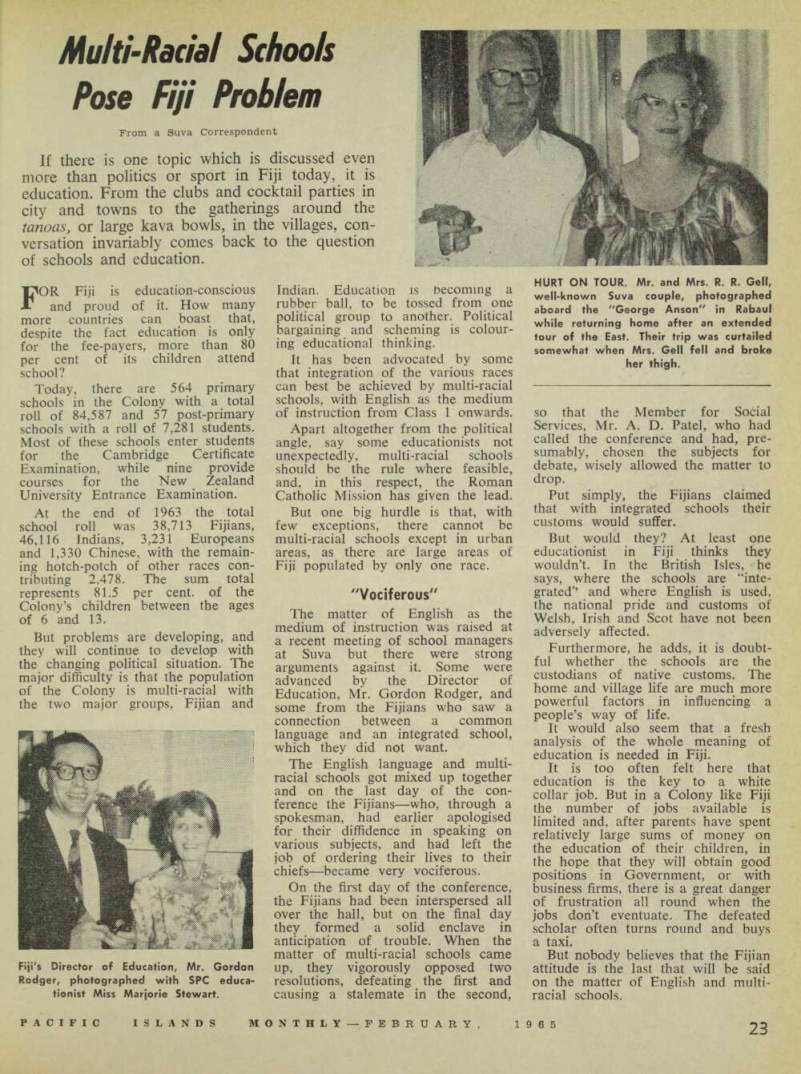
Fiji's Director of Education, Mr. Gordon Rodger, photographed with SRC educa tionist Miss Marjorie Stewart.
HURT ON TOUR. Mr. and Mrs. R. R. Cell, well-known Suva couple, photographed aboard the "George Anson" in Rabaul while returning home after an extended tour of the East. Their trip was curtailed somewhat when Mrs. Cell fell and broke
her thigh.