Spending
pp. 43-47 · Read in the full issue


The World Bank Report On P-Ng
New Guinea Must Concentrate On Practical Spending
By a Staff Writer
The Administration of Papua and New Guinea was under sharp criticism—more implied than direct—in December in the report of the economic mission which was sent to the Territory by the International Bank for Reconstruction and Development at the request of the Australian Government.
THE Bank’s mission comprised 10 members from six countries.
It assembled in May, 1963, and was in Australia and New Guinea from June to September, 1963.
This never has been officially acknowledged: but it is understood that the mission submitted its draft report to Canberra in June, 1964, and that the Australian Government, having read the Bank experts’ criticism of past performances in P-NG, felt that the thing could be politically dangerous. Parts of the report went back to Washington for redrafting.
Even as it is, the report in broad outline inferentially accuses the Australian Government and its Department of Territories and its Administration of muddled thinking and a lack of realism in its planning and activities in the period since World War 11. It places squarely upon Canberra and Port Moresby the responsibility of largely revising its thinking and planning in relation to the economic future of the Ter ritory.
Recommendation The mission, having been asked by Canberra “to produce a plan to stimulate economic growth and raise living standards in the Territory,” recommends that Australia under takes on expenditure of £50,000,000 a year in the Territory for the next five years.
This would double Australia’s rate of expenditure there—it already makes an expenditure of £25,000,000 a year in grants. The mission says that Australia should provide each year £35,000,000 and should insist that the Territory provide £14,000,000 from its own resources.
Some observers will point out that Australia’s annual contribution al ready is fantastically high in some
other directions. Why £250 millions in five years, anyway?
Although it has kept clear of political planning, this mission ap parently has accepted the view of the Foot Report that P-NG should become self-governing and self-sup porting within a very few years, and therefore will require a great deal of finance and a large reservoir of trained manpower.
The mission insists that the future of the country must lie in the development of agriculture and of forestry. It says that the early export potential consists of copra, coffee, cocoa and rubber. It argues that primary production can be added to substantially by quick development of tea-growing, pyre thrum-growing and cattle-growing.
It says that if there is to be in creased development along these
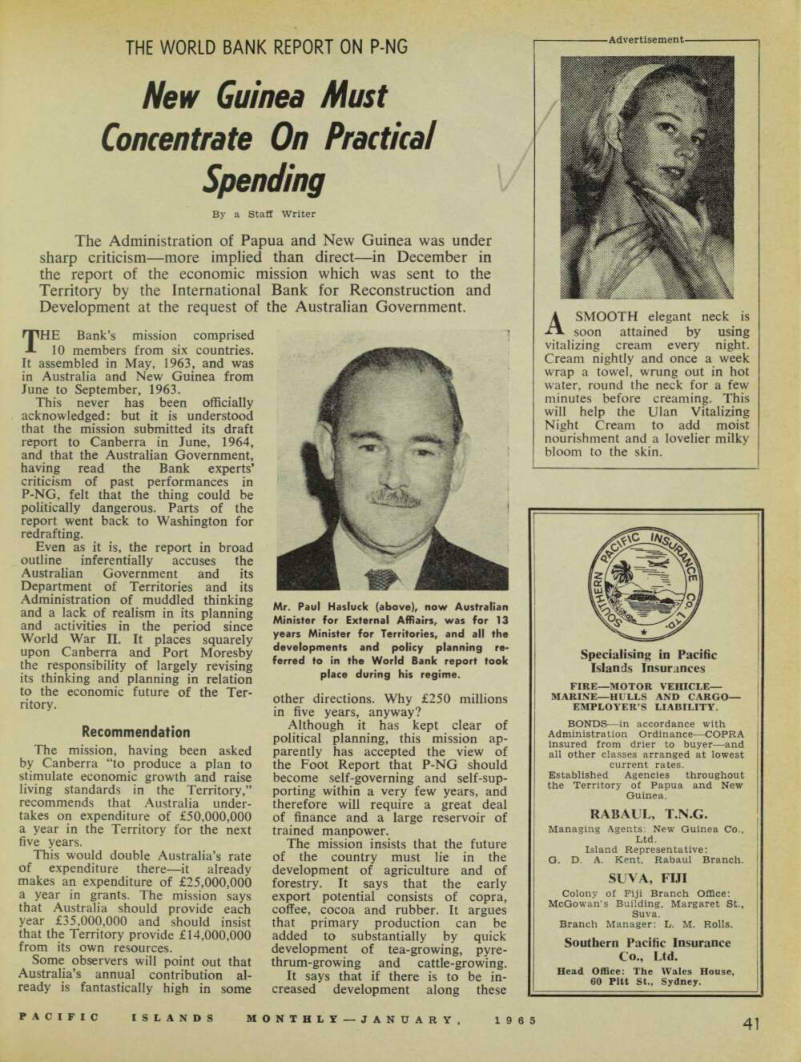
Mr. Paul Hasluck (above), now Australian Minister for External Affiairs, was for 13 years Minister for Territories, and all the developments and policy planning re ferred to in the World Bank report took place during his regime.
lines it is essential that additional land be made available for Euro peans and recommends a system under which suitable land in selected areas could be leased by Europeans directly from the New Guinean owners. How can we reconcile Mr.
Hasluck’s New Guinea land policies with this? What will UN’s Com mittee of 24 say about it?
The report is definitely against any expansion of the education system by way of new primary schools. But it argues that if suitable personnel is to be available for work in steadily expanding industries, and in the public service, urgent steps must be taken to expand facilities in technical and higher education.
The mission says that future administration must, if it is to achieve its ends, adhere strictly to three basic principles, namely: • A concentration of effort in areas and activities where the pro spective return could be the highest. • The selection of standards suitable to the Territory and which the Territory could afford economic ally. • The fostering among New Guineans of a greater sense of responsibility.
The indication clearly is that the mission wants to see more expert planning in making men and money available in certain areas to do certain things—and avoidance in future of the wasteful across-the board policy which has developed in the past as the result of the Administration having ample money, and ample European staff, and muddled policies whereby to shape the use of both.
The mission insists that in planning expenditure, priority be given to roads, coastal shipping, and the im provement of ports; that available funds be spent primarily on the development of agriculture, forestry, transport, tourism, and technical and secondary education. The Administra-
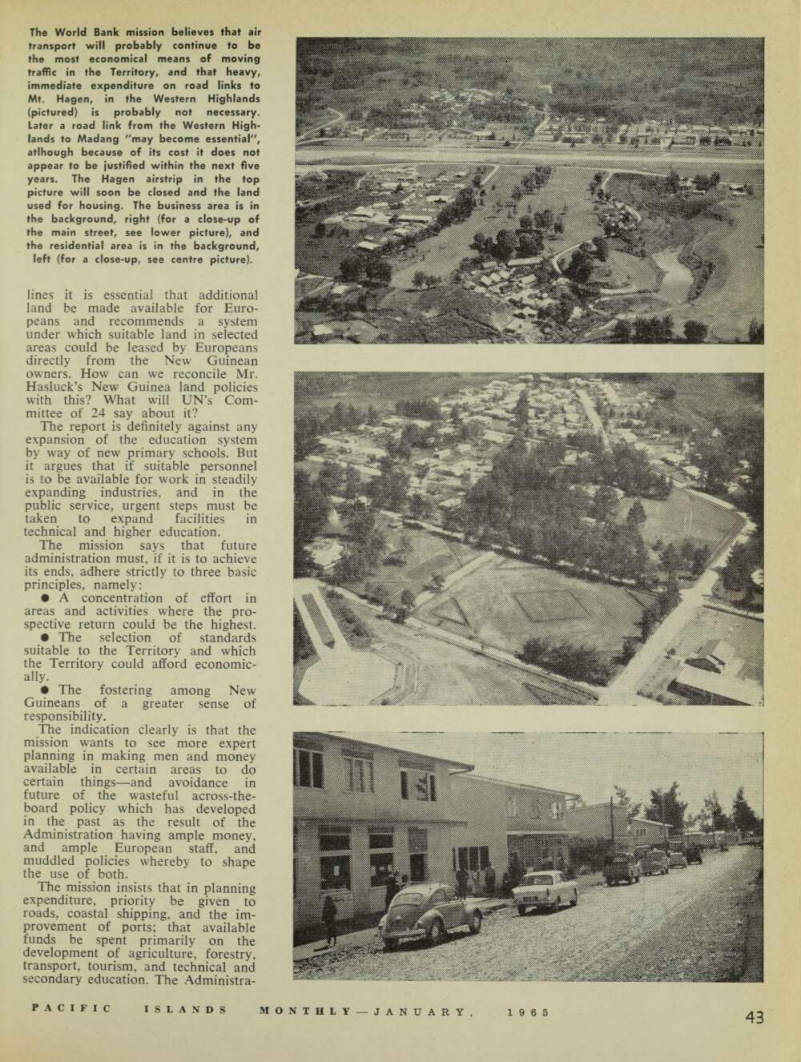
The World Bank mission believes that air transport will probably continue to be the most economical means of moving traffic in the Territory, and that heavy, immediate expenditure on road links to Mt. Hagen, in the Western Highlands (pictured) is probably not necessary.
Later a road link from the Western High lands to Madang "may become essential", atlhough because of its cost it does not appear to be justified within the next five years. The Hagen airstrip in the top picture will soon be closed and the land used for housing. The business area is in the background, right (for a close-up of the main street, see lower picture), and the residential area is in the background, left (for a close-up, see centre picture).
tion should curb all other spending, especially on general administration.
The mission says that there has been far too much spending under the heading of what it calls “bene volent paternalism”—such as housing for administration personnel, new hospitals, court buildings and housing, none of which could be supported by the Territory’s own resources under present conditions.
The report concedes the necessity of placing more administrative responsibility in the hands of the native people—but under planned conditions which will provide an economy to take care of those costs.
It must be recognised that the need for European skills and example, in relation to both administration and industrial enter prises, will exist for a long time.
Thus, steps should be taken to encourage the Europeans to remain in the Territory.
The mission acknowledges that the development plans it has out lined, will call for a great deal of money, under conditions which at the beginning at any rate would not offer much attraction to overseas investors.
The mission accordingly recom mends the establishment of a
Most Territory coffee estates are vulner able because they are a single crop enter prise, the World Bank mission reports.
Diversification is needed. Biggest coffee acreage in the Territory is in the Eastern Highlands (10,598 acres) and the next is in the Western Highlands (5,253 acres).
Half the Western Highlands acreage has been planted by New Guineans and the mission says that coffee production by indigenes is "one of the top success stories of the Territory". Above, Tony Beirne, manager of Sigri Plantation, Western Highlands, prepares to take a consignment of coffee to the airstrip.
development finance corporation with wide powers, which would provide at least £20,000,000, mainly from the Australian Government, for the purposes indicated, and this presum ably is in addition to the £250,000,000 already envisaged.
The mission recommends early attention to peanut-growing, oil-palm planting, and banana production; while cattle farming should be built up to a total of 300,000 head within ten years, and about half the cattle herds should be owned by New Guineans. It urges the establishment of dairying in the Highlands.
The mission believes that forestry could be built up from a production of 80,000,000 log super feet per annum now, to about 300,000,000 log super feet annually by about 1970.
"Cut Down On Hospitals"
About five years ago Mr. Hasluck, in an uncompromising speech, in sisted that there must be a vast extension of hospital services in the Territory.
The World Bank mission takes the opposite view—it says that this kind of “benevolent paternalism” is no longer appropriate in the Territory.
It says that hospitals and education programmes in the recent past have been more in accord with the standards of highly developed countries overseas, and are quite unrealistic in P-NG. Too much expenditure on primary education is to be avoided until such time as the country’s resources have been developed to a point where it can support such amenities; but that no time should be lost in educating a native elite to undertake administra tion and development.
The mission says that the develop ment of Papua and New Guinea is essentially the responsibility of Aus tralia and Australia must face up to it.
However, if there has been vagueness in Canberra, there also is vagueness in the World Bank mission’s report.
There is no outline of the calcula tions it used to reach its recom mendation that £50,000,000 a year should be spent on development for the next five years. If there is to be development on the scale indicated, a great deal of skilled man-power is needed—the report does not in dicate how this is to be provided.
Apparently, Australia and P-NG are expected to find within the next five years something over £100,000,000 more than they have provided in the last five years; and, in addition, we are to supply some £20,000,000 for a finance corporation.
Does the mission suppose that Australia will find all this money?
The only reason why it should do so would lie in the political dangers which are developing in the Territory following the Foot Report and the Indonesian take-over of West New Guinea. But the mission carefully avoids any reference to either.
Actually there is nothing very much that is new in the mission report—except that a band of experts now has put into very plain and frank language a great deal of the criticism directed against the Canberra-Port Moresby set-up during the past decade. It will be interesting to see what happens now.
New Guinea is entitled to hope that the Port Moresby administration will not carry on in the same way, with some modifications in policy but very little alteration in methods.
• See report by Ray Melrose,
p. 47.
The World Bank mission cannot see fish pond culture being quickly successful as a means of providing fish for High landers. Sources of fish foods need to be developed and pond fish culture, the mission says, "has not been readily ac cepted by the native people". But the mission says marine fisheries could be better developed. These fish ponds are at Mendi, in the Southern Highlands.
Beyond the line of trees the airstrip cuts through the picture.