Tokelauans Want
p. 41 · Read in the full issue
To Stick With
New Zealand
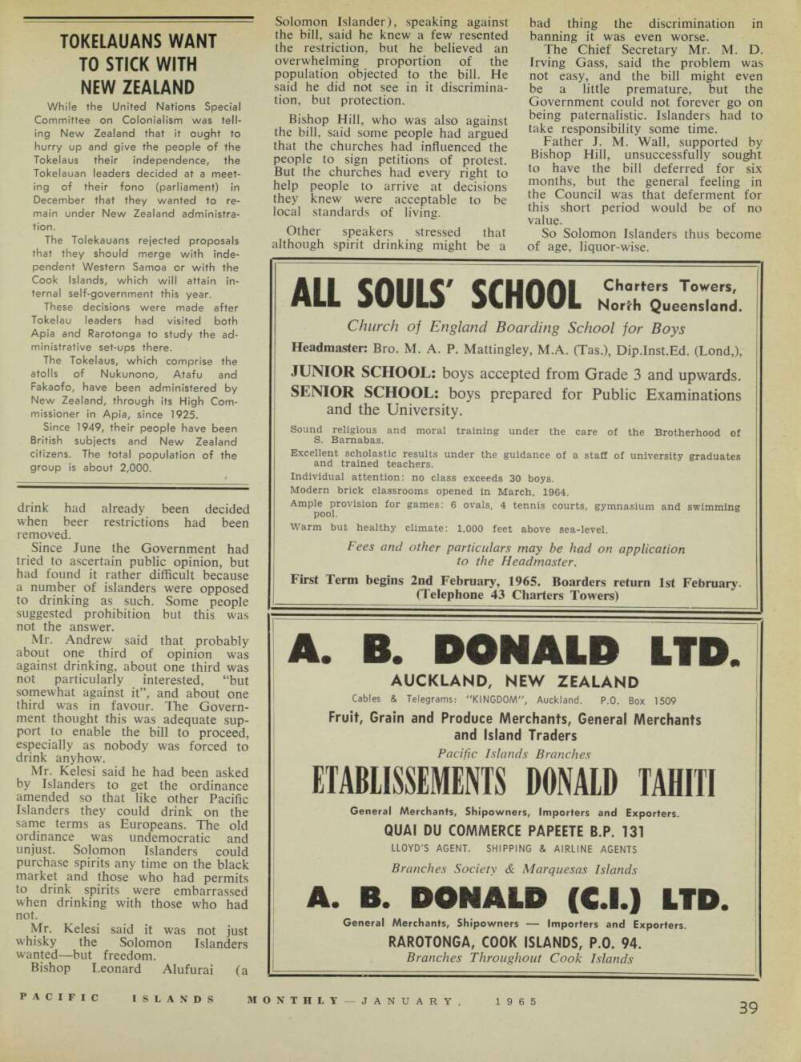
While the United Nations Special Committee on Colonialism was tell ing New Zealand that it ought to hurry up and give the people of the Tokelaus their independence, the Tokelauan leaders decided at a meet ing of their fono (parliament) in December that they wanted to re main under New Zealand administra tion.
The Tolekauans rejected proposals that they should merge with inde pendent Western Samoa or with the Cook Islands, which will attain in ternal self-government this year.
These decisions were made after Tokelau leaders had visited both Apia and Rarotonga to study the ad ministrative set-ups there.
The Tokelaus, which comprise the atolls of Nukunono, Atafu and Fakaofo, have been administered by New Zealand, through its High Com missioner in Apia, since 1925.
Since 1949, their people have been British subjects and New Zealand citizens. The total population of the group is about 2,000.
Solomon Islander), speaking against the bill, said he knew a few resented the restriction, but he believed an overwhelming proportion of the population objected to the bill. He said he did not see in it discrimina tion, but protection.
Bishop Hill, who was also against the bill, said some people had argued that the churches had influenced the people to sign petitions of protest.
But the churches had every right to help people to arrive at decisions they knew were acceptable to be local standards of living.
Other speakers stressed that although spirit drinking might be a
bad thing the discrimination in banning it was even worse.
The Chief Secretary Mr. M. D.
Irving Gass, said the problem was not easy, and the bill might even be a little premature, but the Government could not forever go on being paternalistic. Islanders had to take responsibility some time.
Father J. M. Wall, supported by Bishop Hill, unsuccessfully sought to have the bill deferred for six months, but the general feeling in the Council was that deferment for this short period would be of no value.
So Solomon Islanders thus become of age, liquor-wise.