Not Be Enough
pp. 49-53 · Read in the full issue
World Bank Report
£50M A Year
By RAY MELROSE, Sydney financial expert who recently made a survey of P-NG economy for
Pim.
One thing is certain about
the plan recommended by
the World Bank mission for
the development of New
Guinea—if it is imple
mented to the full, it will cost a great deal more than
the commonly accepted
figure of £50.2 million a year. rR a start, the mission report merely advances this figure as a tentative one, plucked more or less from a very generous arc of sky.
It is evident from the wording of this section of the report that the figures offered are conservative and, as stated, “do not purport to be a firm recommendation on total expendi tures”.
In addition, says the mission, some cost aspects may rise if there is delay in implementing the detailed recommendations. As this report has been in Canberra since June, and there is still a deep silence on the Government’s feelings about it, there ’is no doubt that delay has already occurred and is continuing.
Credit Programme
Then, of course, there is the cost of the credit programme outlined by the World Bank mission and estimated to cost £2O million over the next five years. Once again, the estimates which went to make up that total are only very rough ones which, by general consent, are very much on the low side in the conditions existing today.
A further factor is the continuing inflation affecting wage levels in Aus tralia and New Guinea today, and the big premiums that have to be paid to attract labour and senior personnel to an area such as the Territory in the prevailing conditions of overfull employment.
If I may indulge, like the World Bank mission, in a little bit of sky plucking myself, I would put the total
cost of such a five-year programme
at something like an annual rate of £7O million a year at least, plus whatever the Commonwealth Govern ment spends on defence establish ments and other similar items outside the normal Territory budget.
Most of this spending will, of course, occur in the late 1960’5, assuming that the plan is imple mented. And, also of course, it goes without saying that this will result in an even greater boom than the Territory is now experiencing.
In its general form the report of the World Bank mission is very much as was expected throughout the Territory, and as was forecast in the survey of Papua-New Guinea’s economic potential published in PlM’s November issue.
As a final document it brings together many of the submissions that were made to the mission by interested parties on its tour through the Territory. There is not a great . deal that is new or revolutionary, apart from the very vital matter of emphasis.
The mission has seen the whole problem through eyes that are un clouded by on-the-spot difficulties, or the political necessities of the day.
What it recommends is surely attain able within the time space laid down but it will take a lot more money.
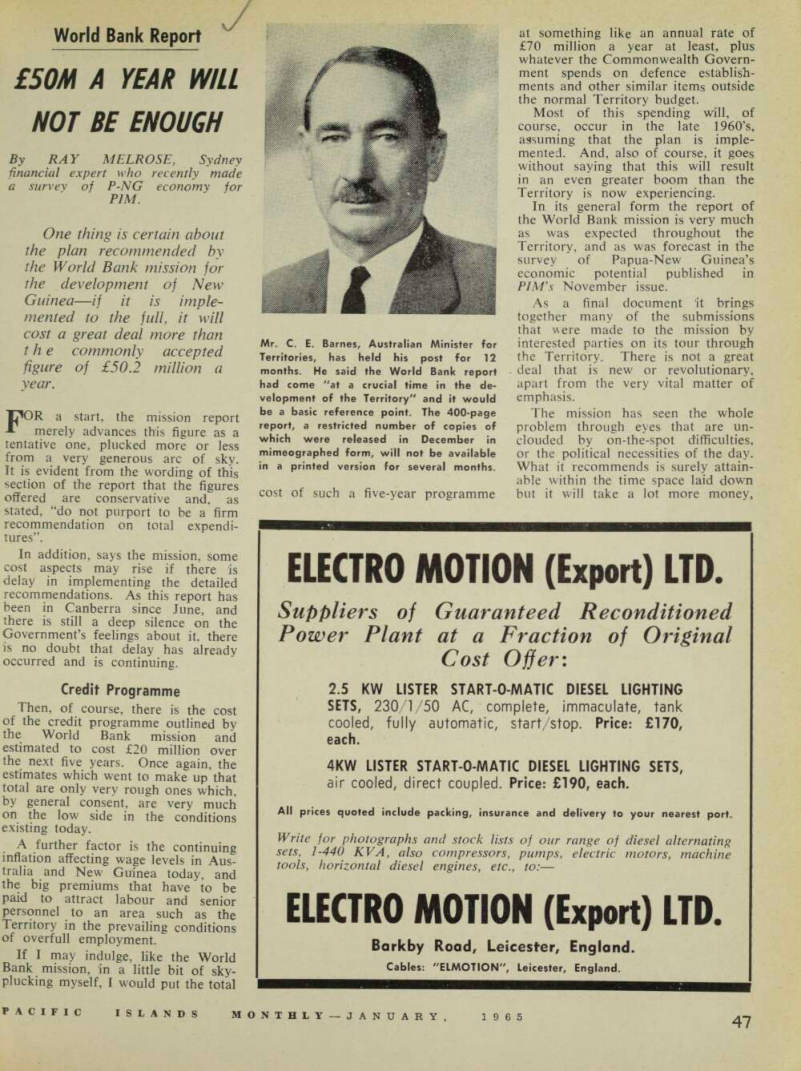
Mr. C. E. Barnes, Australian Minister for Territories, has held his post for 12 months. He said the World Bank report had come "at a crucial time in the de velopment of the Territory" and it would be a basic reference point. The 400-page report, a restricted number of copies of which were released in December in mimeographed form, will not be available in a printed version for several months.
a lot more decisiveness and a lot more courage to implement than the mission has foreseen.
I feel that the people of New Guinea deserve an early statement from the Commonwealth Government about its intentions on this report and the important considerations flowing from it. As the mission so rightly observed, a confident outlook about the future would be aided by “a clearly defined development policy and programme”.
Without a clear indication of what the Government intends to do in implementing this programme, or
otherwise, both the investor and the expatriate Australian working in the Territory are left up in the air as to whether we will face up to the “heavy responsibility” placed upon us by the mission’s report, One area in which I believe the Administration will have the greatest reluctance to implement the recom mendations of the mission is in the matter of land tenure. Yet, in a sense, this is the area which holds the key to the whole future of the smooth development of the economy of the island.
In many centres, new develop
ment is hamstrung by the fact that land is either unavailable or it is necessary to go through months of official handling before a block is made available. In other areas, land that could make an invaluable contri bution to the production and wealth of the community is tied up by archaic tribal laws through which it seems impossible to find a way.
On this problem the World Bank says “where the Administration needs to acquire land it should not hesitate to do so through legal procedures in the event that the owners are reluctant to sell or lease to the Administration”. The report also urges that native owners should be allowed to lease land direct to Euro peans, subject to Administration approval.
It is not enough, as one prominent newspaperman in Australia suggested, that the report should invigorate thinking about the development of the Territory. What is needed is action—strong, direct, and un equivocal so that residents and the world will know where Australia stands on this matter.
With all its shortcomings—and any such document, composed even by a council of Solomons, must have many of them—the mission report does give a firm charter for the development of the Territory.
It is a charter to which we must pay considerable heed for it will be come the book of reference in the United Nations for assessing what
we are doing in the Trust Territory.
Any shortcomings in our per formance, as related to the World Bank mission recommendations, will most surely be taken down and used against us in the deliberations of the Trusteeship Council.
In quite a number of its recom mendations the report runs strongly against what has been regarded as top policy by the Administration.
The reversal of attitude on hospitals and education is one prime example.
After saying how impressed it had been with the standard of medical services in the Territory, the mission reported: “The development of curative health services, and in par ticular of hospital beds to popula tion, has been more in line with those found in some countries of Europe than with those found in the less developed countries.
“Considering the state of develop ment and the wide dispersal of population, the projection of primary Education throughout the Territory is also more in keeping with the standards of highly developed Eountries.
“It is quite unlikely, even on the most optimistic estimates, that con ;inued development along these lines :an even in the long term be supported by the resources of the Ferritory itself.”
Although one can feel profound sympathy for the Administration in his matter, the mission’s judgment s obviously a sound one. On the Dther hand, it is quite evident that if services of a high standard had not seen provided, the Administration would have similarly been in line :or criticism on the reverse count.
It can only be hoped that, in the lew circumstances propounded by he Bank mission, the trend away from new primary school develop
ment and curative medicine does not, in itself, become a fixed policy which will invite criticism in the future.
In the field of education, the Bank mission report can only be interpreted as asking the Administration to set up an elite corps at the expense of mass education. With the short-term view of prompt independence in mind, this is probably a necessary policy in order to provide as quickly as possible the people who will run the newly independent State.
But it will be a poor outlook for the State, and little help to its new administrators, if a large proportion of its subjects is to be illiterate. This
is, perhaps, the greatest contradiction to be found in the report. It may have appeal to the economist but it has . , none at . all to the humanist or political realist.
In quite a number of areas and commodities, the mission has agreed with Administration plans in principle but has also called for greater energy and the achievement of bigger targets, For instance, the report calls for the creation of a national cattle herd of 300,000 head within 10 years, as compared with the Administration plan for 50,000 head in five years, Again, in the projections for forestry operations, the Administra tion had been budgeting on pro
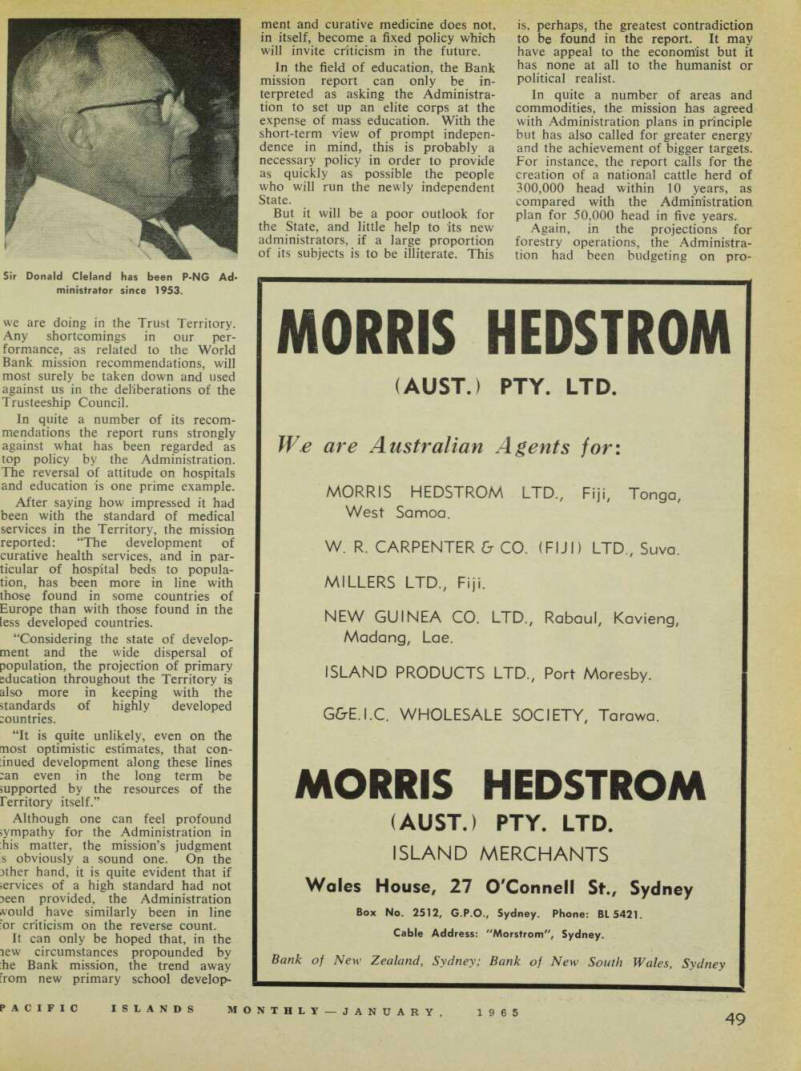
Sir Donald Cleland has been P-NG Ad ministrator since 1953.
duction of 180 million super feet by 1968/69, whereas the mission report has upgraded this figure to 300,000 super feet.
In a statement covering all its proposed production programmes, the mission says that the projections “are not hard and fast, but are guides which are capable of being exceeded under a vigorous admini stration”.
In one area, at least, the report is either guilty of seriously muddled thinking or, at least, the form in which it has been published is con fused. After giving its version of the costs of the proposed programme, the mission says, in effect, that New Guinea should step up its contri bution to the total cost.
At the same time it says that taxes are low, and must remain so as an incentive and, indeed, that further tax concessions should be granted to encourage the establishment of new industries.
Along with these statements, the Bank mission warns against raising too much in loan money within the country, pointing out that these loans, naturally, have to be serviced in the future.
Increased Share Within the general area of these limitations, it is hard to see just what scope has been left the New Guinea Administration to raise the extra money needed to pay for its in creased share of development costs.
Unfortunately, if the Bank mission had any thoughts on this subject, they have not appeared in the pub lished version of the report.
The report makes it plain that substantial numbers of extra personnel will be needed to carry out important parts of its planning but then says it has prepared its budget within the limitations imposed by the manpower position.
In effect it has said to the Admini stration “this is a minimum pro gramme—this is the amount of money and the number of personnel you will need—here are suggestions on how you will get the men and go about the task”.
It is now Australia’s responsibility to find the money and the men and do the job. Anything less would invite censure by the United Nations and irretrievable loss in the Terri tory itself.
O Aerial Survey: Aerial
photographs were to be taken of Fairfax Harbour in December to be used in preparing contour plans for future expansion of Port Moresby.