For Roads, Wharves
pp. 34-35 · Read in the full issue
Needed Ur6Bntly: Money
Roads and efficient means of communication are the greatest need of the Territories. Without them all the great ex pansion plans will be strangled by high costs and the impossi bility of arranging dependable transport at all times of all seasons.
SO vital is this necessity, so urgent is the requirement, that there seems every reason for an approach to the World Bank to provide funds for the construction of trunk roads in the area bounded by Lae, Madang and Highland points such as Goroka and Mt. Hagen.
It is known that the World Bank has been bitterly critical of the slow ness of economic development and has called for more and better roads as an integral part of the desired speed-up.
It is surely appropriate to ask the Bank to back up its judgment by doing the job it was constituted to do and has done in so many other parts of the world—providing money to carry out tasks of which it approves as likely to develop a country.
The blueprint for the needed roads is already there—there is, in fact, a road through from Lae to Mt. Hagen and beyond but it needs improve ment; another needs to go from Lae along the Ramu River to Madang; and others should go from the Ramu Road through gaps in the mountains to places such as Mt. Hagen.
This would join up all the impor tant points of what will unquestion ably be the richest province in the country, give them all access to two great seaports, and cut present crippling freight costs in half.
Hagen Moving Fast
It would also encourage the development of new timber stands, open up new country for develop ment, and result in a big trucking industry, probably run largely by the indigenous people.
Much work has already been done.
It is possible to drive from Lae to Mt. Hagen if you are hardy and all the crude bridges are intact. The road in many places is incredibly rough and narrow, is unsealed, but is termed an all-weather road.
Construction costs are enormous— -60 miles cost £H million and the next 40 miles will cost £li million.
Costs of maintenance also are high —other local experience suggests as much as £l,OOO a year for each mile of road.
A road is also being pushed along the Ramu towards Madang, while much of a road that could connect Madang with Mt. Hagen has also been formed. However, this has not been part of an overall plan for such a road and there still remains the difficult and costly problems of surveying a pass road through the mountains, and building a high level bridge over the Ramu River.
Some such road access from Madang to connect the Western and Southern Highlands is, however, an obvious necessity to cope with the big production expected to come from the tea plantations, and the other producing facilities of this vast district.
Mt. Hagen is the fastest-expand ing town in the Highlands and it needs this road to Madang to achieve a freight advantage that will not be possible if its produce has to take the long way through Goroka to Lae. The desirable form of develop ment appears to be that Madang should serve as the seaport for the
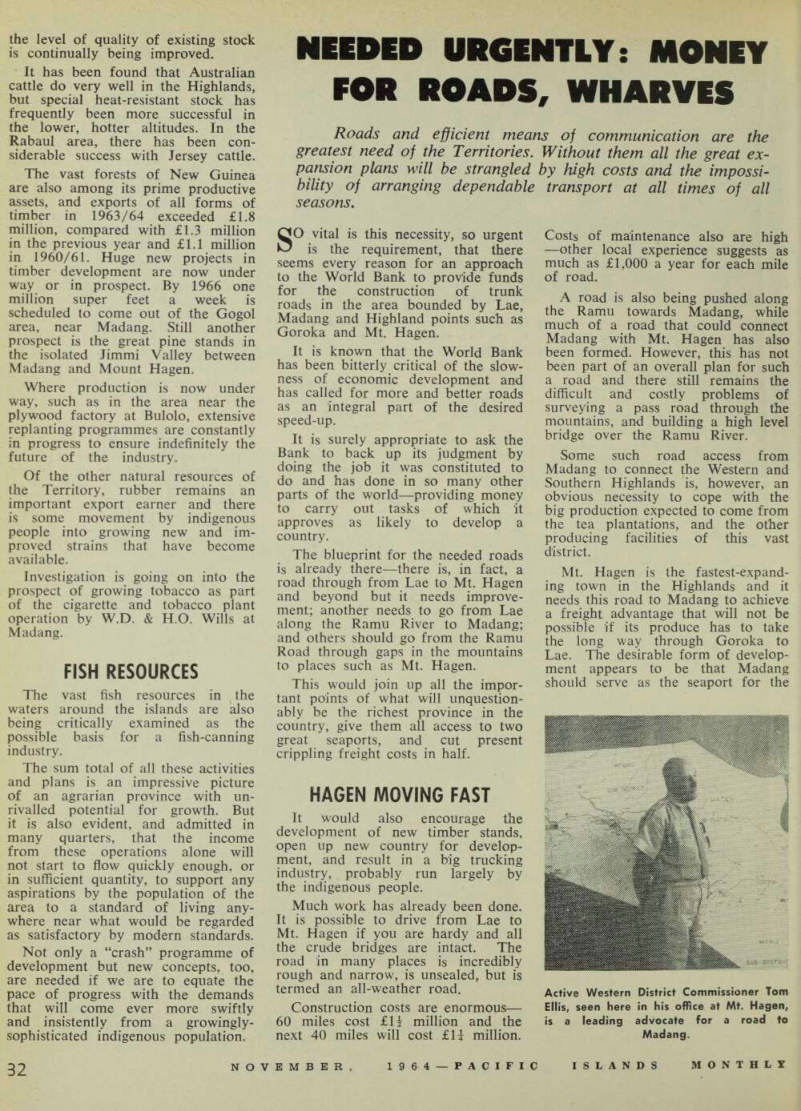
Active Western District Commissioner Tom Ellis, seen here in his office at Mt, Hagen, is a leading advocate for a road to
Madang.
Western and Southern Highlands, while Lae serves the Eastern High lands and the big industrial complex that is destined to grow up around the Markham Valley area.
These developments will involve construction of new berthing facilities at both Lae and Madang and the installation of modern cargo handling equipment at both centres. Airports, too, will need to be developed to take jet-age aircraft; some work along these lines is now occurring at Lae and Mt. Hagen.
The proposition advanced by this survey is that the World Bank should make available sufficient funds, under normal government guarantees, to ensure that the necessary roadwork is carried out and to a standard that will eliminate the huge annual main tenance bill that is inevitable with present construction standards.
Research suggests that the economics of the roads are soundly based in the light of the new development they will generate.
Timber royalties, alone, are likely to pay for the Madang-Mt. Hagen Road in less than 10 years. Other big projects, such as sugar-growing, are planned for the Jimmi Valley, which the road would open up.
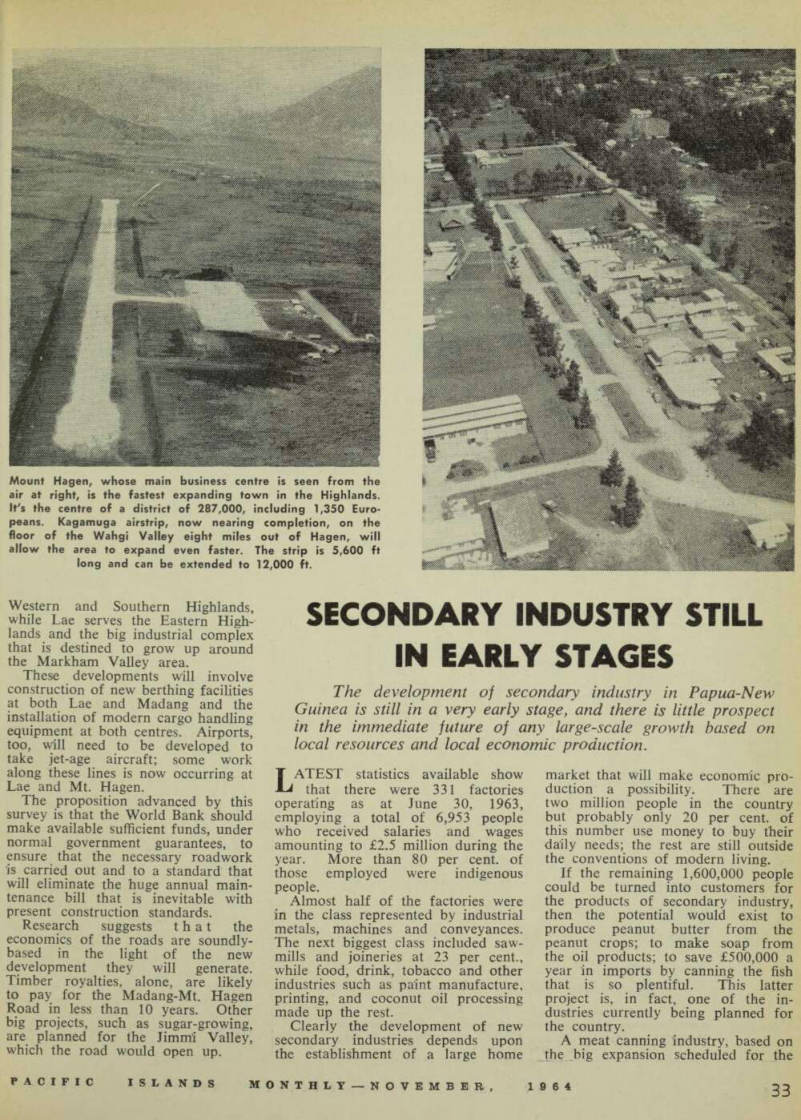
Mount Hagen, whose main business centre is seen from the air at right, is the fastest expanding town in the Highlands.
It's the centre of a district of 287,000, including 1,350 Euro peans. Kagamuga airstrip, now nearing completion, on the floor of the Wahgi Valley eight miles out of Hagen, will allow the area to expand even faster. The strip is 5,600 ft long and can be extended to 12,000 ft.