Rural Activities Will
pp. 31-34 · Read in the full issue

Continue As Mainstay
Rural pursuits and production, which so far have been the mainstay of the economy, will remain the basis of economic development in Papua-New Guinea in the foreseeable future. At present they provide more than 80 per cent, of the country’s exports.
The great majority of inhabitants live off their own land and paid rural employment is provided for about 50,000 indigenous people. Copra, cocoa and coffee make up the greater part of the total, with cocoa and coffee rising strongly each year, and copra slowly starting to recover ground after a standstill in plantings in recent years.
THE increasing importance of cocoa is well illustrated by the rise in exports from £1.6 million in 1960/61 to £3.4 million in 1963/64.
This is a rise based mainly on in creasing production rather than rising world prices. Present plans envisage very substantial increases in produc tion over the next five years.
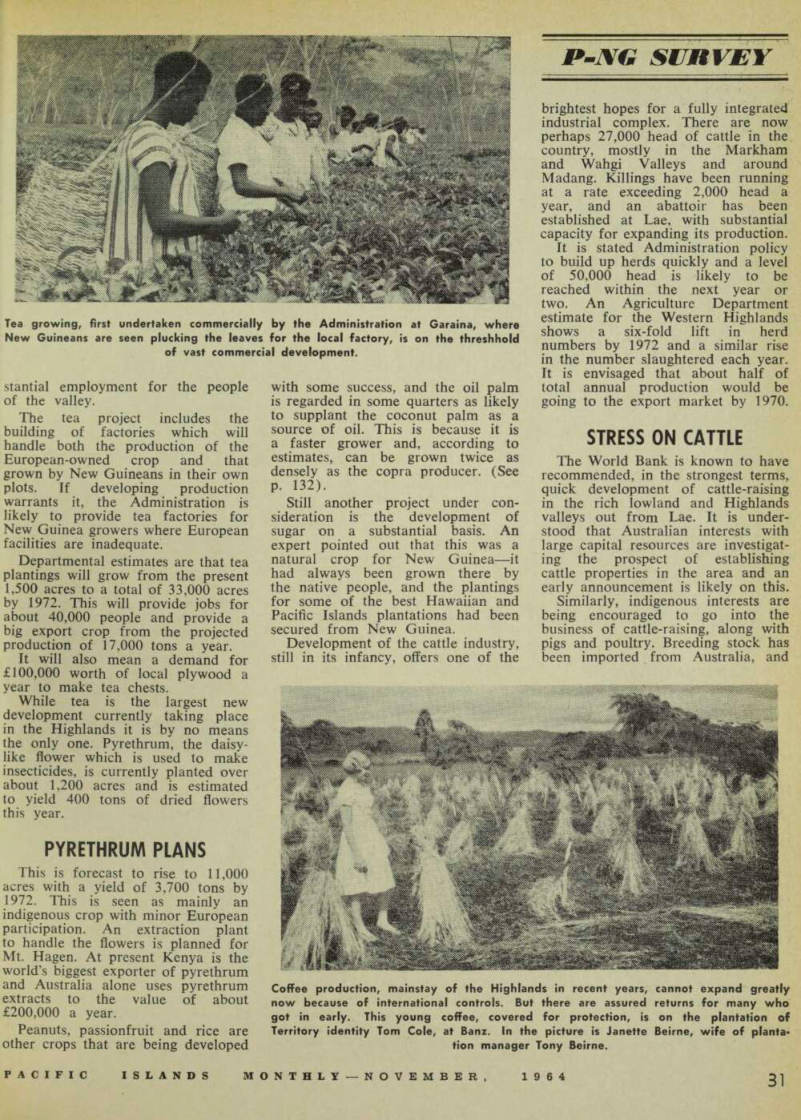
Coffee production has also in creased enormously in the current decade and for 1963/64 brought in about £2.7 million in export income compared with £l.l million in 1960/61. Plantings on European owned plantations are being developed under rigid control but indigenous planters, who currently produce about half of the country’s coffee crop, are under no such con trol. Forecasts suggest that the present overall production rate will be doubled within the next seven years.
Tea Planting
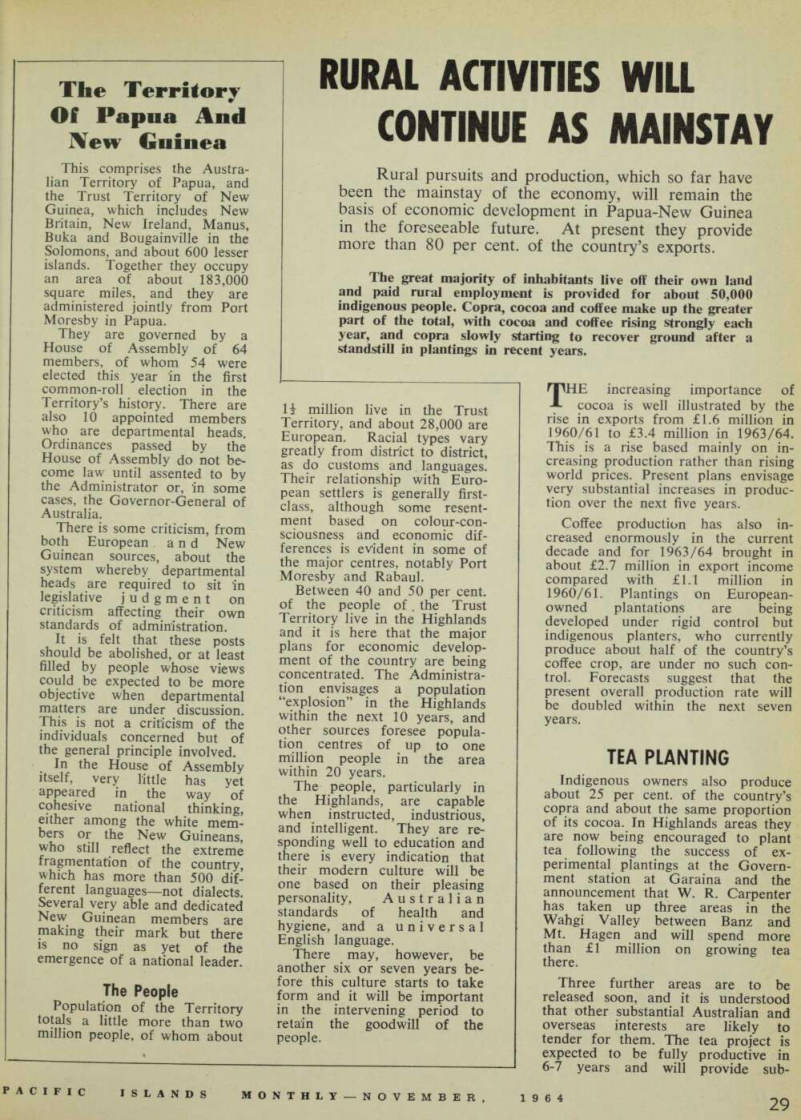
Indigenous owners also produce about 25 per cent, of the country’s copra and about the same proportion of its cocoa. In Highlands areas they are now being encouraged to plant tea following the success of ex perimental plantings at the Govern ment station at Garaina and the announcement that W. R. Carpenter has taken up three areas in the Wahgi Valley between Banz and Mt. Hagen and will spend more than £1 million on growing tea there.
Three further areas are to be released soon, and it is understood that other substantial Australian and overseas interests are likely to tender for them. The tea project is expected to be fully productive in 6-7 years and will provide sub-
stantial employment for the people of the valley.
The tea project includes the building of factories which will handle both the production of the European-owned crop and that grown by New Guineans in their own plots. If developing production warrants it, the Administration is likely to provide tea factories for New Guinea growers where European facilities are inadequate.
Departmental estimates are that tea plantings will grow from the present 1,500 acres to a total of 33,000 acres by 1972. This will provide jobs for about 40,000 people and provide a big export crop from the projected production of 17,000 tons a year.
It will also mean a demand for £lOO,OOO worth of local plywood a year to make tea chests.
While tea is the largest new development currently taking place in the Highlands it is by no means the only one. Pyrethrum, the daisy like flower which is used to make insecticides, is currently planted over about 1,200 acres and is estimated to yield 400 tons of dried flowers this year.
Pyrethrum Plans
This is forecast to rise to 11,000 acres with a yield of 3,700 tons by 1972. This is seen as mainly an indigenous crop with minor European participation. An extraction plant to handle the flowers is planned for Mt. Hagen. At present Kenya is the world’s biggest exporter of pyrethrum and Australia alone uses pyrethrum extracts to the value of about £200,000 a year.
Peanuts, passionfruit and rice are other crops that are being developed
with some success, and the oil palm is regarded in some quarters as likely to supplant the coconut palm as a source of oil. This is because it is a faster grower and, according to estimates, can be grown twice as densely as the copra producer. (See p. 132).
Still another project under con sideration is the development of sugar on a substantial basis. An expert pointed out that this was a natural crop for New Guinea—it had always been grown there by the native people, and the plantings for some of the best Hawaiian and Pacific Islands plantations had been secured from New Guinea.
Development of the cattle industry, still in its infancy, offers one of the
brightest hopes for a fully integrated industrial complex. There are now perhaps 27,000 head of cattle in the country, mostly in the Markham and Wahgi Valleys and around Madang. Killings have been running at a rate exceeding 2,000 head a year, and an abattoir has been established at Lae, with substantial capacity for expanding its production.
It is stated Administration policy to build up herds quickly and a level of 50,000 head is likely to be reached within the next year or two. An Agriculture Department estimate for the Western Highlands shows a six-fold lift in herd numbers by 1972 and a similar rise in the number slaughtered each year.
It is envisaged that about half of total annual production would be going to the export market by 1970.
Stress On Cattle
The World Bank is known to have recommended, in the strongest terms, quick development of cattle-raising in the rich lowland and Highlands valleys out from Lae. It is under stood that Australian interests with large capital resources are investigat ing the prospect of establishing cattle properties in the area and an early announcement is likely on this.
Similarly, indigenous interests are being encouraged to go into the business of cattle-raising, along with pigs and poultry. Breeding stock has been imported from Australia, and
Tea growing, first undertaken commercially by the Administration at Garaina, where New Guineans are seen plucking the leaves for the local factory, is on the threshhold of vast commercial development.
Coffee production, mainstay of the Highlands in recent years, cannot expand greatly now because of international controls. But there are assured returns for many who got in early. This young coffee, covered for protection, is on the plantation of Territory identity Tom Cole, at Banz. In the picture is Janette Beirne, wife of planta tion manager Tony Beirne.
the level of quality of existing stock is continually being improved.
It has been found that Australian cattle do very well in the Highlands, but special heat-resistant stock has frequently been more successful in the lower, hotter altitudes. In the Rabaul area, there has been con siderable success with Jersey cattle.
The vast forests of New Guinea are also among its prime productive assets, and exports of all forms of timber in 1963/64 exceeded £l.B million, compared with £1.3 million in the previous year and £l.l million in 1960/61. Huge new projects in timber development are now under way or in prospect. By 1966 one million super feet a week is scheduled to come out of the Gogol area, near Madang. Still another prospect is the great pine stands in the isolated Jimmi Valley between Madang and Mount Hagen.
Where production is now under way, such as in the area near the plywood factory at Bulolo, extensive replanting programmes are constantly in progress to ensure indefinitely the future of the industry.
Of the other natural resources of the Territory, rubber remains an important export earner and there is some movement by indigenous people into growing new and im proved strains that have become available.
Investigation is going on into the prospect of growing tobacco as part of the cigarette and tobacco plant operation by W.D. & H.O. Wills at Madang.
Fish Resources
The vast fish resources in the waters around the islands are also being critically examined as the possible basis for a fish-canning industry.
The sum total of all these activities and plans is an impressive picture of an agrarian province with un rivalled potential for growth. But it is also evident, and admitted in many quarters, that the income from these operations alone will not start to flow quickly enough, or in sufficient quantity, to support any aspirations by the population of the area to a standard of living any where near what would be regarded as satisfactory by modern standards.
Not only a “crash” programme of development but new concepts, too, are needed if we are to equate the pace of progress with the demands that will come ever more swiftly and insistently from a growingly sophisticated indigenous population.