Secondary Industry Still
pp. 35-36 · Read in the full issue
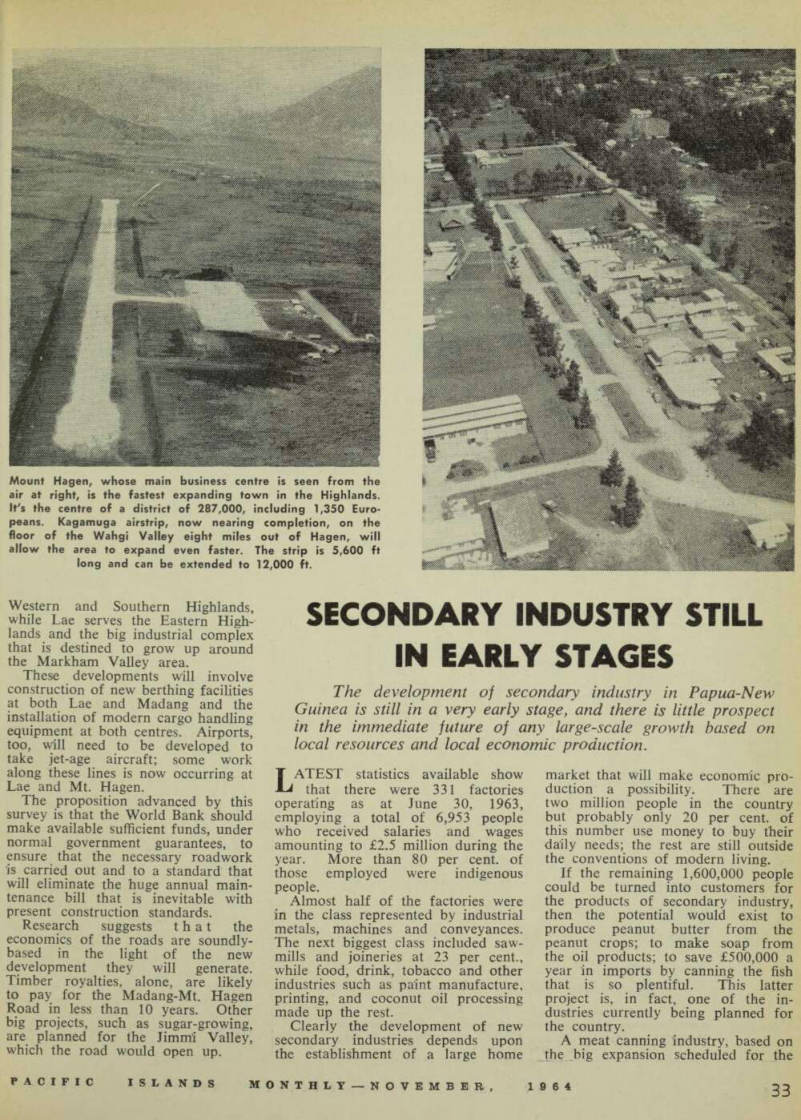
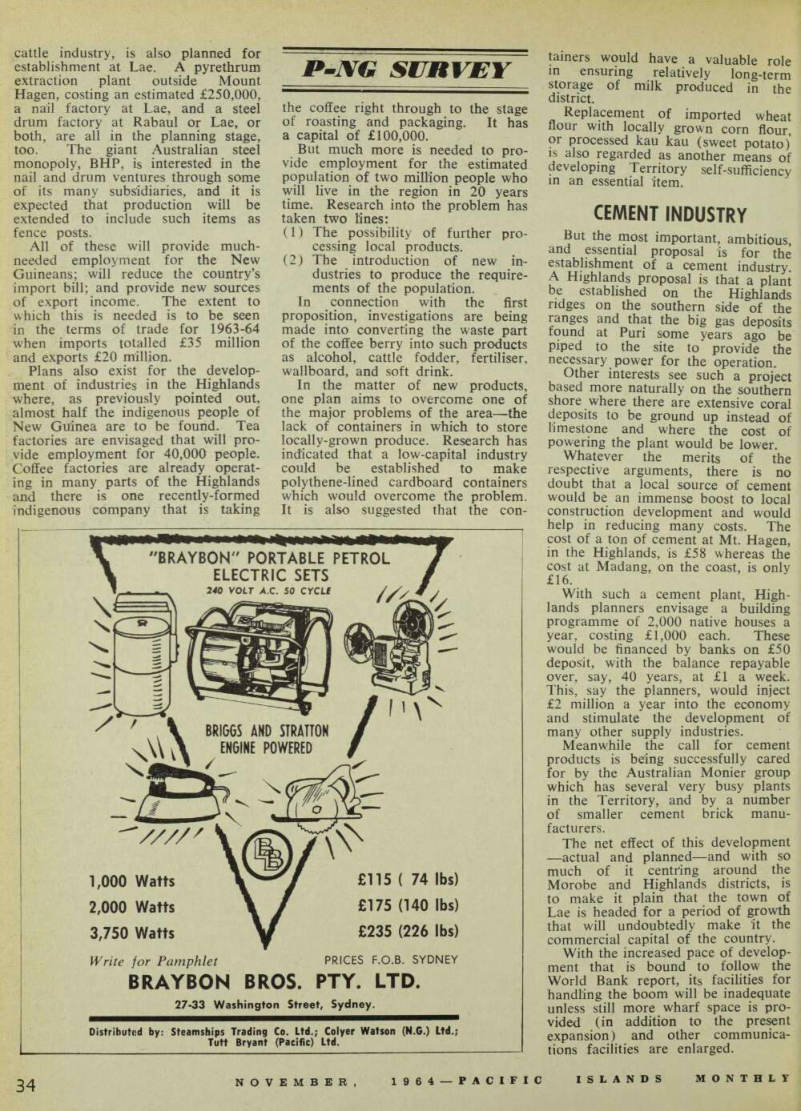
In Early Stages
The development of secondary industry in Papua-New Guinea is still in a very early stage, and there is little prospect in the immediate future of any large-scale growth based on local resources and local economic production.
LATEST statistics available show that there were 331 factories operating as at June 30, 1963, employing a total of 6,953 people who received salaries and wages amounting to £2.5 million during the year. More than 80 per cent, of those employed were indigenous people.
Almost half of the factories were in the class represented by industrial metals, machines and conveyances.
The next biggest class included saw mills and joineries at 23 per cent., while food, drink, tobacco and other industries such as paint manufacture, printing, and coconut oil processing made up the rest.
Clearly the development of new secondary industries depends upon the establishment of a large home
market that will make economic pro duction a possibility. There are two million people in the country but probably only 20 per cent, of this number use money to buy their daily needs; the rest are still outside the conventions of modern living.
If the remaining 1,600,000 people could be turned into customers for the products of secondary industry, then the potential would exist to produce peanut butter from the peanut crops; to make soap from the oil products; to save £500,000 a year in imports by canning the fish that is so plentiful. This latter project is, in fact, one of the in dustries currently being planned for the country.
A meat canning industry, based on the big expansion scheduled for the
cattle industry, is also planned for establishment at Lae. A pyrethrum extraction plant outside Mount Hagen, costing an estimated £250,000, a nail factory at Lae, and a steel drum factory at Rabaul or Lae, or both, are all in the planning stage, too. The giant Australian steel monopoly, BHP, is interested in the nail and drum ventures through some of its many subsidiaries, and it is expected that production will be extended to include such items as fence posts.
All of these will provide much needed employment for the New Guineans; will reduce the country’s import bill; and provide new sources of export income. The extent to which this is needed is to be seen in the terms of trade for 1963-64 when imports totalled £35 million and exports £2O million.
Plans also exist for the develop ment of industries in the Highlands where, as previously pointed out, almost half the indigenous people of New Guinea are to be found. Tea factories are envisaged that will pro vide employment for 40,000 people.
Coffee factories are already operat ing in many parts of the Highlands and there is one recently-formed indigenous company that is taking
the coffee right through to the stage of roasting and packaging. It has a capital of £lOO,OOO.
But much more is needed to pro vide employment for the estimated population of two million people who will live in the region in 20 years time. Research into the problem has taken two lines: (1) The possibility of further pro cessing local products. (2) The introduction of new in dustries to produce the require ments of the population.
In connection with the first proposition, investigations are being made into converting the waste part of the coffee berry into such products as alcohol, cattle fodder, fertiliser, wallboard, and soft drink.
In the matter of new products, one plan aims to overcome one of the major problems of the area—the lack of containers in which to store locally-grown produce. Research has indicated that a low-capital industry could be established to make polythene-lined cardboard containers which would overcome the problem.
It is also suggested that the con
tamers would have a valuable role in ensuring relatively long-term storage of milk produced in the district.
Replacement of imported wheat flour with locally grown corn flour, or processed kau kau (sweet potato) is also regarded as another means of developing Territory self-sufficiency m an essential item.
Cement Industry
But the most important, ambitious, and essential proposal is for the establishment of a cement industry.
A Highlands proposal is that a plant be established on the Highlands ridges on the southern side of the ranges and that the big gas deposits found at Puri some years ago be piped to the site to provide the necessary power for the operation.
Other interests see such a project based more naturally on the southern shore where there are extensive coral deposits to be ground up instead of limestone and where the cost of powering the plant would be lower.
Whatever the merits of the respective arguments, there is no doubt that a local source of cement would be an immense boost to local construction development and would help in reducing many costs. The cost of a ton of cement at Mt. Hagen, in the Highlands, is £5B whereas the cost at Madang, on the coast, is only £l6.
With such a cement plant, High lands planners envisage a building programme of 2,000 native houses a year, costing £l,OOO each. These would be financed by banks on £5O deposit, with the balance repayable over, say, 40 years, at £1 a week.
This, say the planners, would inject £2 million a year into the economy and stimulate the development of many other supply industries.
Meanwhile the call for cement products is being successfully cared for by the Australian Monier group which has several very busy plants in the Territory, and by a number of smaller cement brick manu facturers.
The net effect of this development —actual and planned—and with so much of it centring around the Morobe and Highlands districts, is to make it plain that the town of Lae is headed for a period of growth that will undoubtedly make it the commercial capital of the country.
With the increased pace of develop ment that is bound to follow the World Bank report, its facilities for handling the boom will be inadequate unless still more wharf space is pro vided (in addition to the present expansion) and other communica tions facilities are enlarged.