Solar Eclipse
p. 87 · Read in the full issue
Will Put
Tiny Manuae
On The Map
By a Staff Writer
Manuae, a tiny atoll in the lslands, which has not >een the scene of a single news
worthy incident since Captain
discovered it nearly two enturies ago, will be a centre of ntense scientific interest next ear. 3N the morning of May 30, 1965, a total eclipse of the sun will ie visible from Manuae—and, for all tactical purposes, from nowhere Ise.
Because astronomers and other cientists are always interested in iewing total solar eclipses, the Cook slands Administration has already eceived many inquiries about setting ip observatories on Manuae; and it 5 expected that several advance parties ►f scientists will visit the island before his year is out.
Manuae is 124 miles north-east of larotonga. It is one of two islands n a group known as the Hervey slands, the other being Teau-O-Tu.
Captain Cook gave the group the lame Hervey Islands in September, 773, in honour of Captain Hervey, ater Earl of Bristol, and a Lord of he Admiralty. Unable to find an mchorage, Cook did not land; but he evisited the islands on his third r oyage to the Pacific in 1777.
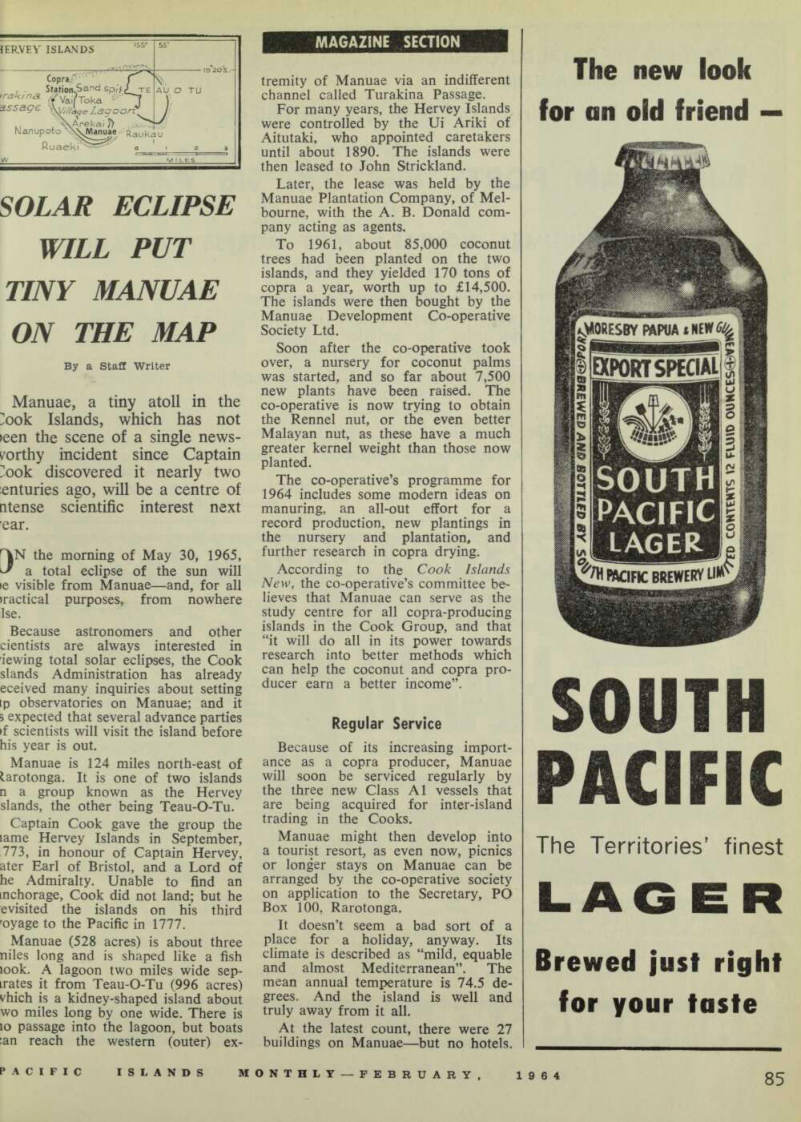
Manuae (528 acres) is about three niles long and is shaped like a fish look. A lagoon two miles wide sep irates it from Teau-O-Tu (996 acres) vhich is a kidney-shaped island about wo miles long by one wide. There is 10 passage into the lagoon, but boats :an reach the western (outer) ex
tremity of Manuae via an indifferent channel called Turakina Passage.
For many years, the Hervey Islands were controlled by the Ui Ariki of Aitutaki, who appointed caretakers until about 1890. The islands were then leased to John Strickland.
Later, the lease was held by the Manuae Plantation Company, of Mel bourne, with the A. B. Donald com pany acting as agents.
To 1961, about 85,000 coconut trees had been planted on the two islands, and they yielded 170 tons of copra a year, worth up to £14,500.
The islands were then bought by the Manuae Development Co-operative Society Ltd.
Soon after the co-operative took over, a nursery for coconut palms was started, and so far about 7,500 new plants have been raised. The co-operative is now trying to obtain the Rennel nut, or the even better Malayan nut, as these have a much greater kernel weight than those now planted.
The co-operative’s programme for 1964 includes some modem ideas on manuring, an all-out effort for a record production, new plantings in the nursery and plantation, and further research in copra drying.
According to the Cook Islands New, the co-operative’s committee be lieves that Manuae can serve as the study centre for all copra-producing islands in the Cook Group, and that “it will do all in its power towards research into better methods which can help the coconut and copra pro ducer earn a better income”.
Regular Service
Because of its increasing import ance as a copra producer, Manuae will soon be serviced regularly by the three new Class A 1 vessels that are being acquired for inter-island trading in the Cooks.
Manuae might then develop into a tourist resort, as even now, picnics or longer stays on Manuae can be arranged by the co-operative society on application to the Secretary, PO Box 100, Rarotonga.
It doesn’t seem a bad sort of a place for a holiday, anyway. Its climate is described as “mild, equable and almost Mediterranean”. The mean annual temperature is 74.5 de grees. And the island is well and truly away from it all.
At the latest count, there were 27 buildings on Manuae—but no hotels.