Headhenters
pp. 89-90 · Read in the full issue
The Month S New Reading
Life Among The
The man who took over from martyred missionary James Chalmers, killed by the headhunters of the Papuan Delta 63 years ago, and who lived with the same cannibals for the next 30 years, has now produced his own record of those early days.
rwill be a surprise to many that the Rev. Benjamin T. Butcher is still alive and able to add his own significant contribution to the recent spate of New Guinea stories, but at 86, Ben Butcher is still a man of vitality and enthusiasm. He lives these days in the Blue Mountains area outside of Sydney and visits Sydney regularly—the last time in December to attend the funeral of his old friend H. Leonard Murray, a former Administrator of Papua.
Leonard Murray wrote the fore word to Ben Butcher’s book, We Lived With Headhunters, but missed seeing the book by only a day or two.
James Chalmers, Oliver Tomkins and 11 Papuans who were with them, were killed in 1901, when Mr.
Butcher was in an English theo logical college. He had known both men personally and decided that their deaths were a challenge to him so he volunteered for service with the London Missionary Society.
When he arrived in 1905, Dr.
W. G. Lawes was still in the country and Sir Hubert Murray’s arrival was still two years off.
He picked himself a headquarters among the Delta swamps of Aird Hills and with virtually nothing but his enthusiasm he set to work to bring The Message to cannibals who had never before seen a white man —and some who had eaten the last white man they had seen.
He gives the day-to-day details of his methods of winning confidence.
He shows clearly time and again that his common-sense and his propensity to treat the savages as human beings who have much to impart as well as much to learn won him more friends than enemies.
It was sufficient in that area in those days merely to make friends, for consolidation could come much later. He was no narrow-minded Bible basher, but a man who thought he could help and who helped in practical ways—by building boats and houses; by setting up small in dustries and in agricultural pursuits.
One can’t help comparing We Lived With Headhunters with the biography of another famous missionary of those days, the Methodist William Bromilow, of Dobu, whose book Twenty Years Among Primitive Papuans, published in the 1920’5, was a disappointment to fellow missionaries who had hoped Bromilow could impart the methods
behind his success. But Bromilow’s book was ghosted for him, and the essential details were lost. Butcher’s story is not lost.
Old Ways Are Gone For Pacific students, not the least of the points of interest in Ben Butcher’s book are his descriptions of the old ways and old ceremonies which have now (inevitably, says Butcher) died out through the influ ence of the white men. He seldom spoke up against any of these old ceremonies but preferred to put them to his own use. As a result he may well have been the only white man to have been invited to the Buguru ceremony of the Delta, in which a a bride, the night before her marriage, was taken by numerous men of the village entitled to enjoy her charms because of various kin ship ties.
Ben Butcher warned against this ceremony—telling the natives that because of VD passed on by Euro peans they ran the risk of wiping themselves out. And this is what almost happened in that particular area.
We Lived With Headhunters will go down on the list of Pacific books which have to be on the bookshelf because of their significance.
Under The Mountain
WALL, by Peter Matthiessen, is a chronicle of the day-to-day life of the Kurelu people of West New Guinea’s Baliem Valley, written by a
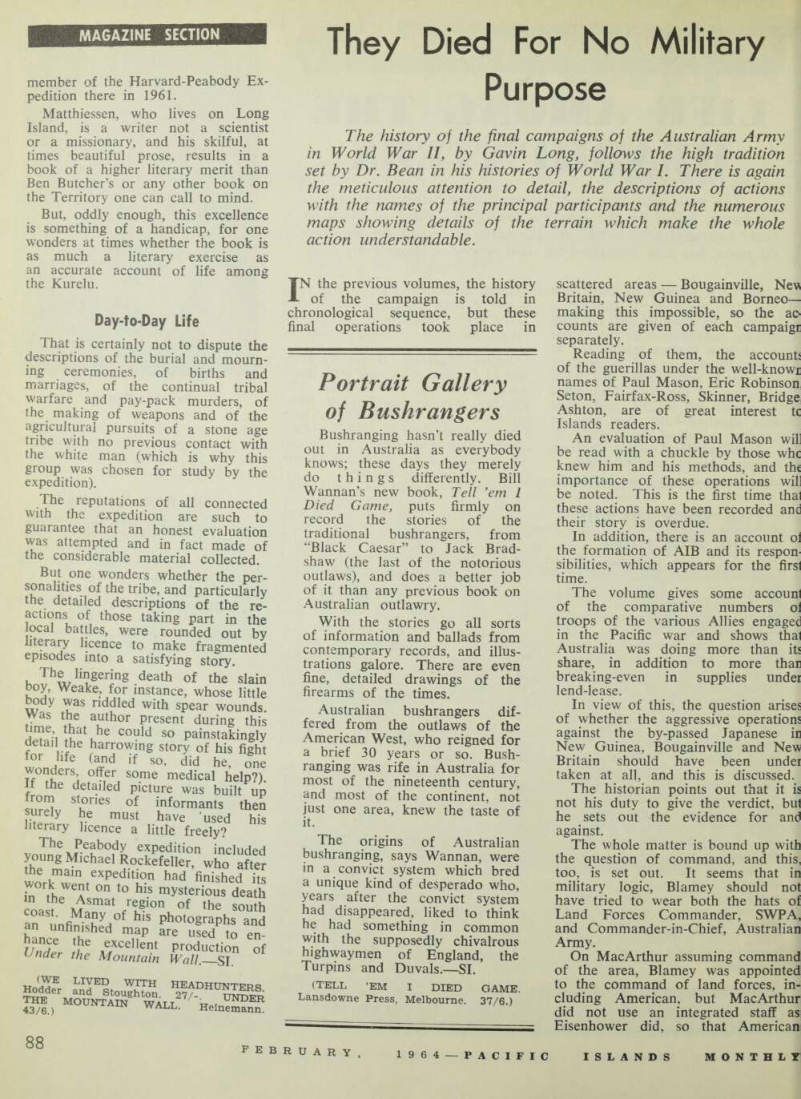
Rev. Ben Butcher.
member of the Harvard-Peabody Ex pedition there in 1961.
Matthiessen, who lives on Long Island, is a writer not a scientist or a missionary, and his skilful, at times beautiful prose, results in a book of a higher literary merit than Ben Butcher’s or any other book on the Territory one can call to mind.
But, oddly enough, this excellence is something of a handicap, for one wonders at times whether the book is as much a literary exercise as an accurate account of life among the Kurelu.
Day-to-Day Life
That is certainly not to dispute the descriptions of the burial and mourn ing ceremonies, of births and marriages, of the continual tribal warfare and pay-pack murders, of the making of weapons and of the agricultural pursuits of a stone age tribe with no previous contact with the white man (which is why this group was chosen for study by the expedition).
The reputations of all connected with the expedition are such to guarantee that an honest evaluation was attempted and in fact made of the considerable material collected.
But one wonders whether the per sonalities of the tribe, and particularly the detailed descriptions of the re actions of those taking part in the local battles, were rounded out by literary licence to make fragmented episodes into a satisfying story.
The lingering death of the slain boy, Weake, for instance, whose little body was riddled with spear wounds.
Was the author present during this e ’i !? at u he could 80 Painstakingly detail the harrowing story of his fight * or J lfe (and if so ’ did he, one wonders offer some medical help?).
If the detailed picture was built up st ,? ries of informants then surely he must have 'used his literary licence a little freely? vnT^\^ e K b °i d D ex P editi on included young Rocke f e i ler , who the mam expedition had finished its th^A 1 ° n t 0 hIS knolls death in the Asmat region of the south an aS unfi M - a £V f his Photographs and hance fi .h‘p h m n P are Used to en ’ nance the excellent production of Under the Mountain Walt. SI.
HoS and E Stoughton DHU SS S '