Monthly
Pacific Islands Monthly
February, 1964
Vol, 35. No. 2.
he New/s lagazine Of The South Pacific
Established 1930
stered at C.P.0., Sydney, and at P. 0., i, for transmissien by post as a Newspaper.
OUR COVER: The last batch of Tonkines* in Vila, New Hebrides, to be repatriatec to North (Communist) Vietnam sailed fron Vila in the British liner "Eastern Queen' on December 24. Some of the departinc "Tonks" were a lot less cheerful thar those seen in the cover picture, as the} left the New Hebrides with very uncertair feelings about the future. The "Easterr Queen" also repatriated the last Tonkinese from Santo. Photo: Reece Discombe.
Advertisements & other items, pp. 2-6 (3 items)
■Slands Monthly February, 1964
Trans-Australia Airlines
WHEN IN AUSTRALIA FLY TAA
Trans-Australia Airlines operates the largest single domestic airline in the British Commonwealth, serving 140 cities and centres throughout Australia and Papua/ New Guinea. TAA’s modern aircraft connect with all incoming and outgoing International flights. This year TAA will provide the speed and comfort of pure jet travel within Australia with the introduction of Boeing . 727 T-Jets.
TAA Fly-away Holidays. TAA offers a huge range of packaged Fly-away Holidays to the most popular holiday resorts throughout Australia and Papua/New Guinea.
And TAA takes care of everything— travel bookings by air, road, rail or sea. accommodation, sight-seeing tours—even theatre tickets!
Contact your nearest Travel Agent or Trans-Australia Airlines Office.
TAA
THE FRIENDLY WAY
Trans-Australia Airlines
J|AA449!^63
Triple-wrapped
packets
*5 a- & <9 V O v <c <0 O * rv v * % A & a
delicious buttered
or plain
Qrnotts
FAMOUS
Biscuits
There is no Substitute for Quality K 303
o
relaxing
There’s no cure quite like a few days at one of New Zealand’s fine resort hotels like The Hermitage at Mount Cook.
Finest food, highest luxury, incredible scenery. \
TAKE
ATONIC
TRIP
NOW
take to TEAL<
( Runaround the fishing circuit. Big-game in the North of New Zealand, trout near Taupo. REJUVENATING. ht
viy.
Z\ C±^>\ <s> TRANQUILLISE yourself in New Zealand where it's always holiday season.
TEAL will whip up your holiday prescription whileu-wait mountains, geysers, hot-pools and all.
You can hire a self-drive car for as little as £8 a week. Go where you want to when you want to. ■i A heady holiday spirit has got into TEAL—now specialising in individually prescribed or pre-packaged tours for ladies and gentlemen of touristic discrimination (who have to trip to budget just the same).
My wys
h
NEW ZEALAND'S
INTERNATIONAL
AIRLINE
IN ASSOCIATION WITH
Q ANT AS AND 8.0. A.
PLAYER’S
GOLD LEAF
KING SIZE FILTER
cleaner .. . unique process seals in cleanliness fresher .. . produced right here to international standards more enjoyable . . . because the same blend of Super Grade Tobaccos that have made Player’s GOLD LEAF a top filter brand in England have been matched in local production. m mmmi m
KING SIZE
ling size filter
FOR
20
FILTER
THE CLEAN CIGARETTE ... WITH THE FRESHER FLAVOUR V244-9/63
HAVE YOU
NOTICED
HOW MUCH
BETTER
GILBEY’S
r
GIN
IS!
So why mix with others? i
GILBEY’S
GIN
‘Cific Islands Monthly February, 1964
Pacific Islands
Monthly
A product of Pacific Publications Pty., Ltd., 29 Alberta St., Sydney.
Publisher: R. W. ROBSON.
Editors:
Judy Tudor Stuart Inder
Manager: SELWYN HUGHES.
Telephones: Aaa 9197, Ma7Ioi, Aaa 4369.
G.P.O. Box 3408, Sydney.
Telegraphic Address: PACPUB, Sydney.
Annual Subscription Rates:
(Aust. currency; includes surface postage) Pacific Is. —P.-N.G., Fiji, Samoa, Norfolk, Nauru, 8.5.1., Cook Is., Tonga, G.&E. Grp., Niue, New Hebrides, and Br. Pacific Is £1 4 t French Pacific Territories £1 7 C Australia and N.Z £1 10 C U.K., British Commonwealth and Foreign (40/ Stg.) £2 10 C U.S.A. and U.S. Pacific Territories (S7.OC U.S.) £3 12 Single Copies (postage extra) ... 2 <
Branch Office In Papua-Ng
Pacific Publications (N 6) Ltd., Theatre Building, Fourth St., LAE. Tel.: 2577. Miss Pal Robertson, Manager.
Branch Offices In Fiji:
Suva: Fiji Times Building, 20 Gordon St.
Tel.: 5601.
Lautoka: Fiji Times Office, Vidilo St. Tel.: 420
Representative In N.Z.:
J. D. Whitcombe, C.P.O, Box 2229, Queer Street, Auckland. Tel.: 70409.
Representative In Hawaii:
C. C. Spencer, 203 Yap Bldg., 3465 Waialae Ave., Honolulu. Tel.: 775538.
Representative In U.S.A.;
R. G. Craib, 153 Laidley St., San Franciscc 31, San Francisco, California. Tel.: Missior 8-1075.
Representatives In U.K.:
S. R. Warman, 73 Cheapside, London, E.C.2 Tel.: City 2355.
H. A. Mackenzie, 4A Bloomsbury Square, London, W.C.I. Tel.: Holborn 3779.
MELBOURNE OFFICE; Newspaper House, 247 Collins St. Tel.: 63.7053.
AGENTS: All main trading firms and store: in the Pacific Islands.
Pacific Publications Pty. Ltd. is the Australiar agent for THE FIJI TIMES.
In This Issue
Neral
Services in Record Mess 11 Ineysider in London 57 i-Shells for Captain Bligh 83 jorts on Pacific Towns 91 TA Conference 114 wv Year Honours 118 n to Beat Rhinoceros Beetle 122
Ok Islands
mders Survey Problems Ahead ... 55 otonga Hotel Proposal 63 ar Eclipse to be Seen at Manuae 85 ngaia Harbour Plan 97 •ean Fishermen Lost 105 I w Governor, New Political Plan .. 7 e for Sydney Show 15 ig Wait for Air Passengers 18 een Mother to Visit Fiji 33 nforting Development Figures 35 jht of Slum Dwellers 37 dent Pottery Discovered 49 a/ Hotel Plans 65 tana Shipments 113 ord Sugar Season 123
Nch Polynesia
iti to be Scientific Centre 39 /v Hotel for Punaauia 63 »k on the Pritchard Affair 89 Many Ships for Papeete 99
Bert And Ellice Islands Colony
>le Station Up for Sale 8 w Life on Wagina for GEIC People 13 mmer in Unusual Accident 115
Ocean Island Labour Dispute 116 Butaritari High Chieftainship 116 Unexpected Bomb Found at Tarawa .. 116
Lord Howe Island
Flying Boat Leased 115
New Caledonia
Well-Known Chauffeur Retires 19 Dangerous Dependence on Mining 113 Severe Drought 113 DC4 Aircraft for French Navy 114 Air Taxi Service 115 Mining Research Bureau Closes 123
New Hebrides
Air Mishaps 13 Advisory Council Criticises Budget 25 The Battle for Influence 45 Pigeon Flies from Antarctic 113 New Buildings 123
Norfolk Island
Local Language 15 View on finances 20 New Hotel Planned 63 Record Number of Air Passengers 116 Freight Rates 122
Papua-New Guinea
300 Candidates for Election 9 Horrie Niall Elected Unopposed 10 Border Survey Not Yet Resumed 12 Two Air Mishaps 13 More Conus Gloria Maris Shells 15 Tragic George Ellis 17 Mushroom Madness 17 Big Rabaul Weddings 18
Ownership of Hotels 19 New "Wonder'’ Malaria Drug 39 Anger Over Housing Shortage 41 Complaints on Liquor 51 Plans for Fourth Moresby Hotel 53 Death of "Jimmy" James 71 The Tanks Go Through! 81 Fred Archer's Tankard 82 Rev. Ben Butcher's Book 87 Air Survey of Timber Stands 113 Aviation Statistics 114 Road-Building Figures 114 First Native Army Officers Home 115 Rabaul-Kokopo Telephone Service 116 Scheme May Underwrite Investment 121 Airline Tours 131
Pitcairn Island
New Education Officer 117
Solomon Islands
Legislative Council Proposal 50
Oscar Svensen, Pioneer Planter 77 Start on Yacht Club 109 Copra Agreement With Japan 122 Rice-Growing Plan 123
Tonga
Overseas Tour for Prince Tungi 11 Tongans Deported from US 19 Radio Chief Leaves 56
United States Trust Territory
Major Revision of Code 115
West New Guinea
Book by Peter Matthiessen 87
Western Samoa
Prime Minister Holes in One 17 Harbour Plans for Apia, Asau 95 Regional UN Office 113 Tupau Tamasese Title Dispute 115 Legislative Assembly Election Plans 116 Break with Unilever 122
DEPARTMENTS: Commentary, 12; Tropicalities, 15; Letters to the Editors, 19; Territories Talk-Talk, 29; Magazine Section, 77; New Books, 87; Shipping, 95; From the Islands Press, 111; In a Nutshell, 113; People, 117; Commerce, 121; Deaths of Islands People, 129; Travel Talk, 131; Shipping and Airways Information, 134.
Advertisements & other items, p. 8 (2 items)
6
FEBRUARY. 1964—PACIFIC ISLANDS MONTHLI
your light and power requirements^
I wmsm ***
for
The illustrated Braybon diesel set has sufficient capacity to operate all domestic appliances within the requirements of the average household, plus portable power tools including 9" electric saw, as well as electric motors fitted to pumps, shearing heads, etc., up to i HP capacitor start 1425 RPM.
Equipped with the Lister diesel engine, the Braybon self contained Diesel plant is designed for long life and maximum efficiency and economy.
Plants of Braybon manufacture have been built and in service for 30 years and are recognised as being of the highest standard and construction. Out units are operating in the Antarctic Region for the Australian Government as well as throughout Australia, the Pacific islands and the Far East. Plants are available up to 100 KVA capacity.
FOR FURTHER INFORMATION PLEASE WRITE
DISTRIBUTED BY
TUTT BRYANT (PACIFIC) LTD
COLYER WATSON (N. G. ) LTD.
manufacturers
BRAYBON BROS PTY T n
PTY. LTD. 27-33 WASHINGTON ST.
TELEGRAMS: "BRAYBONIAN", SYDNEY
SYDNEY, AUSTRALI
Fiji Starts New Year
With New Governor And New Political Plan
From a Suva Correspondent Fiji has taken the first step towards in ternal self-government. On January 17 the unofficial members of the Legislative Council unanimously passed a resolution calling on the Government to introduce the “Member system” of government as soon as practic able. The official members, as is usual when constitutional matters are discussed, refrained from taking part in the debate, and also from voting.
Ratu K. K. T. Mara, a leading Fijian chief, who moved the motion, said “It will not be far-fetched to put it alongside the great Deed of Cession
IN Indian member, Mr. A. I. N.
Deoki, who seconded the lotion, said the occasion was one of 16 most momentous in the history Fiji* Under the Member system the overnor will invite unofficial embers of the Executive Council ► undertake supervisory functions 'er groups of Government departents There might be a Member ir Natural Resources, a Member T Social Services, and so on.
The Members will have no tecutive authority, but all policy afters relating to their departments ill be referred to them. They will ive a big say in policy-making, and ill be expected to take an active terest in all asnects of the work
: the deoartmentsTn thdr oortfoUrT
P Hnuu If Wnrlrc p . . .
Policy questions coming in from apartments, which are at present ft with m the Secretariat, will be
t 0 tbe . Members.
hey can take policy matters to f ST Council and they will ' expected to pilot through the egislative Council bills dealing with On IfnnnSmint vr u un appointment, Members will be quired to give an undertaking to 'CePt collective responsibility. In ie Executive Council they will be a 6 tf!°f^ PreSS • T WS xecutive ro,mr?l' e m C a e t b °? ce - !he xecutive Council makes a decision 16 Members Wlll b e bound by it.
If they do not wish to be bound they will have to resign.
The Government would thus be able to reduce the official side of th® Legislative Council. The official majority would always be available, but a number of official members would not be required to take their seats.
The Government, recognising that the work will take up a considerable portion of the time of Members, considers that a suitable salary will have to be paid to compensate them for loss of earnings. One unofficial member, privately, puts a suitable salary at £4,000 a year.
Ministers Eventually t-u e b cvenruaiiy f The Government hopes that in time, the Member system will develop into a full Ministerial system with executive responsibility.
The Government plans to retain the posts of Colonial Secretary (who may become Chief Secretary), Financial Secretary and Attorney- General, and they would rank as Ministers. Thus there would be an executive or Cabinet of ex-officio, official and unofficial ministers.
However, that is a long way off, and a Ministerial system will only be developed in the light of experience of the Member system.
Although the unofficial members unanimous in their vote at ' h ®. Januar y s . lttin s- several of them held reservations. The European members were more or less content
t 0 , wjth wh t th Fiji d ° g wun wndl ine riJians ’ whethpr the Fiiians rpallv we re undeserved in the rv ew was to ouestion Two of l ° l l ue ? tl< ? n - T *° of ' not s f. eak , ,n th . e debate, fwo rears aeo expressed very strone vTew'Taboutfnt m V ‘ 8 views about the future. *1 R^ tI L- ? enaia °J ie r stai i ed 4 h !i LeBl * la u tive Council during the Budget debate i n December, 1961, by saying: “When the time comes—and I hope the time will not come soon for some new form of Government to replace the present system—then I would like to say here that the Fijians would like the composition of the Legislative Council to be reviewed, and I would also like to have it recorded here that the running of this Colonv must be handed § over to the Fijians. By that I mean administratively and politically”
Ratu George Cakobau the second silent Fijian, had at’ that fime echoed Ratu Penaia’s words He said in 1961: “I have‘nothing against independence; let indepen® dence come. But when that independence comes—l should like
Fiji's new Governor, Sir Derek Jakeway, takes the oath of office administered by Fiji's Acting Chief Justice, Mr. Justice Hammett, in Suva on January 17. He is Fiji's 20th Governor since cession in 1874.
Photo: Stan Whippy
this recorded in this House—let the British Government return Fiji to the Fijians in the state and in the same spirit with which the Fijians gave Fiji to Great Britain”.
Many Views
Acknowledgement that there were indeed many views beneath the surface was made by a European member at the January sitting, Mr.
J. N. Falvey. He said, in effect, that the different viewpoints would become more obvious when the details of the system came to be worked out.
Fijian Ravuama Vunivalu said he had irrevocable proof that a foreign influence was at work in Fiji trying to create a wedge between the various races.
He said that people all over the world were asking why the Fijians did not want independence.
My answer to that, my personal answer, is that with our growing population, the comparative lack of development of the land, and with more than 10,000 school-leavers every year, there is bound to be a blow up, however you like to term - »is bound to come , Ravuama said. fn J h s e WiH rtainly be problems for the new Governor, Sir Derek Jakeway, in choosing his Members.
By what yardstick will they be chosen*? Presumably all racial groups will be represented. w p G m e . neral opinion in Fiji is that the Member system will at least give
some indication of the capabilities of the people of Fiji to govern them selves.
The smaller Cook Islands adopted the system some months ago in preparation for full Cabinet govern ment, Western Samoa went through the same system a few years ago, be fore independence, and Papua-New Guinea seems to be the next big terri tory to follow suit, although P-NG people are not nearly as advanced as those in Fiji.
Governor's Arrival Fiji’s new Governor, Sir Derek Jakeway, arrived in Fiji the day after the Legislative Council meeting, and in his first public statement, immedi ately after he took the oath, promised to do all in his power to help the Colony towards internal self-government.
“I believe that it is right that the people of the Colony should play a greater part in their own Govern ment,” he said. “I can assure you that I and the officers of my Govern ment will do everything in our power to assist you towards this end, so that constitutional progress, in accordance with the wishes of the people of the Colony, may be to the benefit of all.”
Sir Derek repeated that the Sec retary of State for the Colonies, at present Mr. Duncan Sandys, intended to convene a constitutional con ference in 1964 or 1965 to discuss Wlth representatives of the people of Fiji what form further con
stitutional progress towards interr self-government might take, wh still retaining the present strong lin with the Crown of which the peoi of Fiji were so rightly proud.
Sir Derek, who has never been Fiji before, soon showed that he h done his homework. He knew great deal about the Colony and problems.
He described the 1964-68 develc ment plan as a “bold challenge”, “I am confident that the plan w bring material progress to the peop of the Colony and I assure you r Government will do all it can speed up its implementation,” said.
He warned that there might difficult times ahead, but he w confident that with goodwill ai harmony between the various rac the difficulties could be surmount to the benefit of all.
Speaker's Welcome
The Speaker, Mr. Maurice Sco welcoming Sir Derek and Lai Jakeway, said it was the ardent desi of the people to co-operate with ti new Governor for the good of tl islands. He said it was fortuna there was someone of Sir Derel calibre and experience appointed guide and help Fiji over the peril of change.
Fiji felt she had special probler which had not occurred and did n occur in other Colonies, and tho problems demanded very speci consideration.
Cable Station Up For
Sale At £75,000
rE Fanning Island cable station, which became re dundant when the final links of the new COMPAC cable were opened in December between Sydney and Vancouver, is up for sale for £A75,000 or the best offer.
The station is owned by Cable and Wireless Ltd,, of London. It consists of instrument buildings and em ployees’ houses on a 40-acre site. (Two of the build ings are seen in the accompanying photograph.) As the cable station is on Crown land, anyone who buys it will have to negotiate a lease with the Gilbert and Ellice Islands Colony authorities, who administer Fanning Island.
The main drawback to buying the station is that it is a long way away from anywhere. Honolulu, the nearest big centre, is more than 1,000 miles distant to the north.
However, the isolation of Fanning Island and the fact that it has a big, shallow, fish-filled lagoon, could make the cable station attractive to businessmen who see
money in it as a potential away-from-it-all hotel. / similar defunct cable station—on Norfolk Island, whicl is 930 miles from Sydney—has already been turned int< a hotel.
The last staff members of the station—lo European and about 50 Gilbertese—left the island in January fo Christmas Island, from where they were to be repatri ated. The last manager w'as an Australian, Mr. R. H Payne. Originally, the staff comprised 31 European and 200 Gilbertese.
Fanning Island’s only inhabitants now are the em ployees of Fanning Island Plantations Ltd. (a sub sidiary of Burns, Philp) which has about 3,100 acre of land under coconuts. This property is not for sale
First All-In Election
300 Candidates For First All-In Election
There were jew surprises contained in the list of nominees for Papua-New Guinea’s new House of Assembly when nomina tions closed on January 6. As expected, most of the old legis lature’s elected members have nominated for re-election, but few of the nominated members will seek to retain their seats.
CiNLY two of the Legislative Council’s elected members are lot offering themselves as candidates, tfr. J. L. Chipper, of Rabaul, and Jougainville’s Mr. Paul Mason.
Mr. B. E. Fairfax-Ross, Mrs, R. I. lates, Fr. J. G. McGhee, Dr.
Reuben Taureka, Mr. Ephraim übilee, Miss Alice Wedega and Mr. tfaneto Kuradal are the seven lominated members from the old louse who are not contesting their ilaces.
Of these Dr. Taureka was the only urprise absentee from the list of lominations.
He is not standing because he /ishes to pursue his career in nedicine and nomination and lection to the House of Assembly /ould have meant his resignation rom the Public Service.
Surprise Absentee
Influential Kerema, Albert Maori Liki, is another who has surprised y failing to nominate. It had been ddely expected he would resign his osition as an Administration welfare officer to contest the akekamu open electorate which ikes in his home village of Kikori.
Most of the interest in the ominations has centred about those ew to central politics, or those ;eking to return to them after an bsence.
For instance, there is Major Don arrett, who is contesting the West lazelle special electorate in an Sort to return to the legislature fter an absence of many years.
Then there’s Wewak’s elder olitician Simogun Peta who is try ig to return to the legislature after similar respite from central politics.
Among those taking their first tilt t the House are the New Guinea arty’s Mr. Charles Kilduff, a Port loresby Barrister; Mr. Dennis Junior) Buchanan, a light aircraft perator from Goroka who will ppose Mr. lan Downs, and Koitaki lanter Mr. Colin Sefton, who will ave 11 opponents for the Moresby pen electorate.
Three of the most intriguing ominations are those of former cult
leaders Yali, of Madang, and Paliau, of Manus, and present leader of a cult on Buka, Francis Hagai. All are contesting open seats.
Paliau, formerly the leader of a troublesome magico-religious cargo cult on Manus in the immediate post-war years, is now the president of a Local Government Council.
Yali, from the Saidor area of Madang, is a former police sergeant and wartime Coastwatcher, who won a very big following after the war.
He disappeared from the scene when sentenced to six years jail.
Already people in electorates surrounding the one that Yali will stand for have expressed disatisfac tion because they will not be allowed to vote for their old leader!
Close observers say both Yali and Paliau are almost certain of election.
Francis Hagai is one of the leaders of the Hahalis Welfare Society on Buka Island, whose 3,500 native adherents refuse to conform to social tenets and want to run their lives independently of everyone else. They have created many problems for the Administration and for the missions.
Hagai, too, has served a gaol sentence.
Cult Activities Hagai is being opposed in the election by the leader of the Buka Local Government Council, Anton Kearei, who at one time was being openly accused on Bougain ville of having himself been mixed up with cult activities. He at one time studied for the priesthood.
Perhaps the most closely con tested electorates will be the Moresby open, the Central special, the Milne Bay open and the West Papua special.
In the Moresby open, Papua and New Guinea Workers’ Association president Oala Oala-Rarua will contest the seat with three Europeans —Colin Sefton, Bill Stansfield and Tapini businessman John Martin— as well as four fellow Motuans and four Goilalas.
Before nominations were an nounced Oala-Rarua was considered
a good thing. He had been endorsed by the Fairfax Local Government Council and a number of his likely opponents had assurred him they would not stand in opposition.
But the nomination list showed Hanuabadan Willie Gavera and three others had not kept their promises.
Mrs, Ana Frank Gaudi from Oala-Rarua’s home village of Pari had nominated and so had Bill Dihm, a Seventh-day Adventist adherent from Kila Kila, and ex Sgt.-Major Daera Ganiga, of Hanuabada.
It now seems certain the Motuan vote will be split sufficiently to give either a Goilala or European candidate victory.
The Goilala area provides the Moresby open electorate with its biggest individual block of voters, 17,000. Already there has been criticism from both natives and Europeans on the definition of the electorate.
Anthropologist Dr. Murray Groves, who is visiting P-NG, says, “It will be tragic if the sophisticated urban people of Port Moresby in this election fail to get a voice in the House.
“For years they have tried to find a political outlet but each attempt has been frustrated. If they fail this time they will certainly blame the electoral system. They will
NOUMEA WEDDING: Miss Katherine Forsyth, daughter of Mr. W. D. Forsyth, Secretary-General of the South Pacific Commission, and Mrs. Forsyth, was mar ried in Noumea on December 23 to Mr.
Emilio Ortiz, an Air-France pilot, whose parents live in Nice, France. The recep tion was held in the Secretary-General's apartment at SPC headquarters. The couple are seen here just before leaving by air for Paris, where they will make their home.
believe deliberate efforts have been made to keep their representative out of government.”
In the Central special LMS missionary Rev. Percy Chatterton, who came to the Territory in 1923, seems to hold the best chance.
He is opposed by Baraina trade store owner and Catholic lay preacher Mr. Ron Brennan; Port Moresby barrister Mr. Charles Kilduff, the member of the New Guinea Party who recently contested (unsuccessfully) the West Sydney seat in the Federal elections; Mrs.
Kay Ashcroft-Smith the wife of a Port Moresby public servant, Tapini planter Mr. “Andy” Ander son who was formerly an ADO, and Mr. Bert Pikett, a Sogeri business man.
Before nominations were declared Mr. Brennan was thought to have the best chance because he looked likely to take the Goilala vote. But now, with Mr. Anderson sure to split the Goilala vote, Mr. Chatterton’s position seems secure.
Senior Papuan politician Mr.
John Guise will contest the Milne Bay open electorate with long-time Milne Bay businessman Mr, Bob
Bunting, Mr. Asineru Dickson and Mr. Albert Munt.
Mr. Dickson, a Kwato Mission adherent who has worked with Administration for many years, is tipped to take a good slice of the votes John Guise may otherwise have expected. This could well put Mr. Bunting in a favourable position.
Mr. Guise himself recognises it’s going to be a closely fought seat.
He said in Port Moresby recently he would not be surprised if Mr.
Bunting won.
Ex-Legislative Councillor Mr. Ron Slaughter, a Yule Island business man, chose to stand for West Papua special in preference to the Central special electorate in which he would have opposed Mr. Chatterton.
He is opposed by Mr. Ronald Thomas Dalton Neville, who re signed his position as ADO at Tan to contest the seat. The concentra tion of voters in this electorate is around the area in which Mr. Neville has been well-known to the native people for a number of years.
Mr. Slaughter is scarcely known to the people of his electorate other than those who live on the coast.
Among those who were expected to nominate but didn’t was Mr.
Mick Leahy, pioneer planter. His electorate is the South Markham special, but it is understood he decided not to nominate against Lloyd Hurrell, the sitting member, who Mr. Leahy considers has done an excellent job.
Mr. Hurrell has two oponents— Markham planter Mick Casey and Kainantu hotel owner Graham Gilmore.
Will Europeans Succeed?
The big question at present is whether any Europeans will succeed against natives in Open electorates.
Opinion on this question is divided.
Many Native Affairs officers say that where there are native can didates representing a number of tribal groups within one electorate the voting will be split enough to give a European candidate victory on the preferences.
But there are grave doubts that more than a fraction of native voters will use the preference system.
Already John Guise’s constituents have said they find the preference system too difficult to understand and that they will mark only one name.
The fact there are 299 candidates for the 54 seats means the electoral education campaign will be extended
even further, believes Chief Elector; Officer Mr. R. R. Bryant.
“This number of candidates wi have an important effect on tl people’s understanding of tl election,” he says.
Mr. Bryant says the number ( candidates indicates the success ( the electoral education campaig carried out in the field for the pa five months.
So far the election machinei seems to be working as planne< although printing of the Commo Roll and electoral map is still ui finished.
Electoral education patrols ai now engaged following the route to be taken by mobile polling tearr to check the timetables drawn u in Mr. Bryant’s office.
Before the first polling day, Eel ruary 15, mock elections will ha\ been carried out in more than 8,00 villages and hamlets.
Advertisements & other items, p. 11 (1 item)
9
ACIFIC ISLANDS MONTHLY FEBRUARY, 1964
New^r^and S^ ton ’ Marfim
299 Candidates
For 54 Seats
A TOTAL of 299 candidates will contest 54 seats in P-NG’s new 64-member House of Assembly at the February-March elections. The remaining 10 members will be officials.
There are 61 European candidates, 31 of whom are contesting 10
special electorates for Europeans
only. The remaining 30 will take their chances against 238 native candidates in the 44 open electorates. d * s on . a comm on roll, N mi? Rrst ’ contains almost a million names.
The 30 Europeans competing against native candidates in the 44 open electorates are: pen Chuave: Brian Heagney. Esa’Ala Jack'smnh 015 ilk i nson - Finschhafen; Jack Bmith Fly R lve r: Arthur Wyborn J ° hn W ells - Gulf: Keith Tetle?.' Gumine: Graham Pople. Hagen- John S?,r n ’ Ke ‘ th Lev >'- Kalnamm Barr?
G?uld y ' r?f'S dl: BIU James Gould. Lakekamu: Kevin Kassman JenhcoU ®J? irley T Back - Markham: Bruce Jephcott, Tom Lae. Milne Bay; Albert Munt, Bob Bunting. Mini- Brian Co rr igan lan Parsons. Moresby BUI
New^r^and S^ ton ’ Marfim
CedricSHebel % Murray. Popondetta: Hall nw'.u Ramu: Watson Griffith 2s
He’s First
Man In!
Recipient of the blue ribbon as first elected member of the P-NG House of Assembly was Mr. H. L. (Home) Niall whose nomination for the North Markham special electorate was unopposed when nominations closed on January 6. His was the only electorate not con tested.
Mr. Niall was, until the previous day, the Morobe District Commissioner. He had just handed over his post to Mr. Alan Timperley to go on retirement. He was given a remarkable farewell on New Years Dav when thousands of natives gave him a sing-sing.
Mr. Niall has been a P-NG Government officer since 1927, which makes him one of the real old hands. Besides his Parliamentary salary he will also be drawing a sum as adviser to a big New Guinea firm. Salary for an elected member of the House will be £950 a year, plus extra expenses during sittings, but it will be more if he is given the new post of Speaker of the House, which he has been tipped to get. There probably could not be a better choice.
Advertisements & other items, p. 12 (1 item)
10
FEBRUARY. 1964 PACIFIC ISLANDS MONTHL'
Following Row With France
Air Services In Record Mess Following Row With France
The aviation row between Australia, New Zealand and France, which began in December with the cancellation of TEAL and Qantas traffic rights in Tahiti ( PIM, Jan., p. 9), grew worse in January when further disagreements led to the cancellation of air services between Sydney and Noumea.
CHE row has caused incalculable inconvenience, expense and loss f income to Islands people, as avellers have had to make costly, mnd-about trips to get to their estinations; profitable air-freighted ade has been lost; and people in le tourist industry have lost many f their customers.
The services that have been mcelled were all weekly. They ere: • TEAL’s service from Auckland » Tahiti via Nadi (Fiji) and Pago ago (American Samoa). • The Qantas service from /dney to Tahiti via Nadi. • The UTA (formerly TAI) rvice from Sydney to Noumea, hich was part of UTA’s round-the □rld service. • The Qantas service from 'dney to Noumea. • The UTA service between oumea and Auckland.
Two of the airlines affected— EAL and Qantas —are owned by e New Zealand and Australian overnments respectively. UTA is privately-owned French airline bsidised by the French Govern ent.
The cancellation of the TEAL id Qantas services to Tahiti is a tback to people in Tahiti engaged the tourist industry. TEAL, lich had operated the service since '5l, carried something like 100 ssengers to that island a month, d most of them spent at least a ;ek there.
On the other hand, the Qantas rvice to Tahiti, which was only augurated on November 22 and lich only lasted until the end of
Noumea Services Soon:
As PIM went to press, it was an nounced that weekly air services between Sydney and Noumea would resume “within the next few weeks”. Qantas will operate a turbo-prop Electra on the route, and UTA will charter space on it.
the year, had not had time to have much impact on Tahiti’s tourist trade. But its potential as a carrier of tourists to Tahiti was consider able.
The cancellation of the Sydney- Noumea services means that people in New Caledonia dependent on the tourist trade for a living have been cut off from many of their potential customers.
It also means that people in New Caledonia wishing to travel to Aus tralia and NZ must fly via Vila (New Hebrides) and Nadi (Fiji). New Hebrides people must also go via Nadi.
How long Islands people will have to put up with the present situation is anyone’s guess as there is no sign yet that Australia, New Zealand and France can find a formula for patch ing up their differences.
Particularly in New Caledonia has there been a strong reaction to the cancellation of air services, with criticism being levelled equally against French and Australian Gov ernments. It is felt there that the Territory has to suffer because of political disputes in high places.
However, the trade involved for all concerned is too great for the row to go on indefinitely.
The main reason for the row is that Qantas was never happy with agreements made between Australia and France in 1960 which gave UTA an unequal share of trade into and out of Australia compared with the trade Qantas obtained into and out of French territories. Some observers criticise Australia for concluding the agreements in the first place and say the French were not to blame for this state of affairs.
Between 1960 and the end of 1962, UTA’s Australian traffic was worth £2 million sterling while Qantas earned only £250,000 in French territory in the same period.
Australia therefore pressed for a more equitable arrangement and France, after much delay, suggested that this should be done at the beginning of 1962. (Over)
The result was that in September last year France and Australia agreed provisionally that UTA should not have the right to pick up or set down passengers in Sydney on its Noumea-Paris service via Saigon. And Qantas was given traffic rights in Tahiti.
In a matter of weeks after the September agreement, France realised that UTA’s loss of Aus tralian traffic meant that its round the-world service was uneconomical.
It was, in fact, France’s turn to realise that it had got the worst end of the deal.
Tahiti Rights
It therefore cancelled TEAL’s Tahiti traffic rights partly, it seems, in the hope that this would induce Australia to come to TEAL’s aid, and that when it did, UTA would be able to bargain for the return of traffic rights in and out of Aus tralia. (The French action was also inspired, no doubt, by its desire to have something to exchange for trans-Tasman rights when Auck land’s international airport at Mangere opens in 1965), As Australia did not lift a finger to help TEAL, France (having learned that Qantas aimed to go through to Mexico) then cancelled the Tahiti rights of Qantas in the hope that a promise of their restora tion would get UTA back into the profitable Sydney-Noumea trade.
But this move did not come off, either, for although Australia was willing to let UTA participate in the Noumea-Sydney trade, it was only on certain conditions.
The conditions were that both Qantas and UTA should maintain the Noumea-Sydney service with non-jet aircraft.
France agreed to this plan, but later stated that UTA did not have any non-jet aircraft to use. It there fore proposed that UTA should con
tinue using jet planes, but with the number of passengers between Sydney and Noumea restricted to 35.
Australia turned this plan down as it would have meant that UTA would have continued its Sydney- Tahiti round-the-world service while France denied rights to Qantas in Tahiti.
But in an effort to keep the Sydney-Noumea service going, Aus tralia put forward two new proposals to France. These were that: • The September, 1963, air arrangements between Australia and France should be reinstated. • Qantas should charter a non jet aircraft to UTA so that both companies could operate a regional service between Sydney and Noumea with non-jet aircraft.
Pending a reply to these proposals the French authorities told Qanta on January 15 that no more Qanta flights were authorised betweei Sydney and Noumea.
At the same time, UTA’s flight into Sydney were cancelled. How ever that airline is continuing it round-the-world service by calling a Darwin to refuel en route fron Paris to Noumea.
FOOTNOTE: The Mexicai Director-General of Civil Aviation Mr. A. Acuna Ongay, said ii Sydney on January 20 that Qanta; had been granted the right to operah a service through Mexico t( London. At the same time, a Qanta; spokesman said his airline expectec to start the service in September— preferably through Tahiti. If thi; was not possible, it would go througl Honolulu.
Border Survey Not Yet Resumei
The Australian Minister for Terri tories, Mr. C. E. Barnes, said ii Port Moresby in January that th< Australian survey of the P-NG West New Guinea border would no be resumed until it was knowi whether Indonesia would co-operate He said there had been two recen incidents. On the first occasion In donesians removed border marker put up by Australians, and on th( second, an Indonesian patrol resistec an Australian attempt to restore th( markers.
Built For Two:
These two girls, Ann Hoare (left) and Beryl Christian, are riding what is be lieved to be Nor folk Island's first tandem. It was built by Ann's father from two old bikes.
Tonga's Prince
Overseas Tour For
Tungi
The British Commissioner and Consul in Tonga, Mr. E. J. Coode and Mrs. Coode (pictured above) were among those who farewelled Tonga's Premier, Prince Tungi, when he left Nukualofa on an overseas tour on December 26.
Prince Tungi was accompanied by his wife. Princess Mata'aho, and children. Prince Taufa'ahau and Princess Pilolevu.
The family was to separate in San Francisco—Prince Tungi and Prince Taufa'ahau going to Switzerland, where the young Prince will continue his studies; and Princess Mata'aho and Princess Pilolevu going to Houston, Texas, to stay with a former British Agent and Consul in Tonga, Mr.
J. E. Windrum, and Mrs. Windrum.
On his return from Europe, Prince Tungi will make a 30-day tour of the US as guest of the State Department. He will then meet Princess Mata'aho and their daughter in Texas and they will all travel together as far as Hono lulu.
From there Prince Tungi expects to go to Japan for the Tonga Copra Board to investigate the purchase of machinery for the manufacture of fibre board.
Princess Mata'aho and Princess Pilolevu will return to Tonga from Honolulu via Pago Pago.
During Prince Tungi's absence, his brother. Prince Fatafehi Tu’ipelehake, is Acting Premier.
Prince Fatafehi is also Regent as a result of the absence in New Zealand of his mother. Queen Salote. —Photo: August Hettig.
Advertisements & other items, p. 13 (1 item)
11
ACIFIC ISLANDS MONTHLY FEBRUARY, 1964
Commentary
Dictators Are Always
Dictators
THOSE who remember the last visit of the United States Attorney- General, Mr. Robert Kennedy, to Indonesia could well be having mis givings about his recent peregrina tions in South East Asia.
On his first visit to Indonesia, just at a time when Dr. Soekarno was stepping up his demands against the Dutch, he found that Indonesia “had a case” in West New Guinea. The rest is now history.
According to all reports, Mr.
Kennedy is now inclined to think that Indonesia has another case for its “confrontation” of Malaysia. He is said, on his second visit with Dr. Soekarno (in mutually tolerant Japan), to have “fallen under the charm” of the Indonesian dictator
and to be agreeably surprised to fin< him “so reasonable”.
If there is any truth in this it ma; be excused on the score that botl Mr. Kennedy and the United State are young in diplomacy and not mud used to dictators. They seeming! have still yet to learn that the Di Soekarnos of the world will pay li] service to just about anything so lon as they ultimately get what the want.
What, after all is there to hav a peace conference about? Tfi trouble is of Indonesia’s making an< the only point at issue is whethe Indonesia is to go on opposing th continued existence of Malaysia, o not. It is unlikely that Di Soekarno will back down at thi stage without handsome concession from the other side, and more con cessions to Dr. Soekarno now wil simply mean more trouble fo someone else, at some future date.
Wagina For
New Life On
Geic People
From a Special Correspondent The last of the population of Tull and Gardner Islands in the Irought-stricken Phoenix Grouo >f the Gilbert and Ellice Islands rolony will settle into their new lome in the Solomons in
: ebruary.
rHEY were to leave their islands in the Tonga Copra Board’s latest essel, the MV Niuvakai, in January.
Tie 2,200-ton Niuvakai was chartered y the GEIC Government to make lie move to Wagina Island in the hortland group of the Solomons.
The Tongan vessel moved the first alf of the population of the two ilands in late November—early De ember.
Captain G. Douglas, GEIC Marine uperintendent, accompanied the rst wave to see that all went well, nd the second sailing was to be ccompanied by Mr. W. F. Newton.
The village site clearing in the ense forest of Wagina looked tiny rom seaward when the first wave rrived and some of the Phoenix slanders on Niuvakai must have 'ondered what they were coming to. >nce ashore, however, they found rat there was enough room for every amily to build its own home.
In the meantime everyone is living in “long houses”, but the first lot of settlers have to build their own houses in time to move out of the long houses before the second wave arrived. After enough houses are ready, families will have to start clearing more bush for their gardens.
It is going to be really hard work.
Although the Phoenix Islands have had fair rain over the last few months, and a few trees are starting to produce nuts again, the fact re mains that a high proportion of the trees have died completely, and there is no doubt that the settlers can now look forward to a much better life in their new home.
The embarkation of the settlers went off well, in excellent weather.
Vast quantities of timber and gal vanised roofing, collected over the years, were included in the hold baggage, and some very mysterious objects which could have been any thing from catalytic cracking units to artificial satellites, as well as large cooking pots with holes, were loaded.
Over 40 canoes were stacked in the hold on top of all this loot. The passengers themselves occupied the after tween decks (well ventilated with powerful blower and exhaust fans) with about a third on the hatch cover itself under a good awning.
Embarkation took almost 2\ days at Hull and one day at Gardner, while discharge was completed in two days at Wagina.
Good weather accompanied the whole exercise and everyone enjoyed the trip—including Nei Niuvakai, who was bom on the voyage!
the Vila Aero Club's Super Emeraude may be a complete write off following its dive into Vila Harbour after colliding with power lines between [?]ririki Island and the [?]ainland on Decem ber 24. The plane seen above just after he accident) was [?]oiloted by Mr. Philip Delacroix and was [?]arrying Mr. Claude Nitride as a passen [?]er. Both men were licked up unhurt by [?] Burns Philp launch, [?]hich towed the [?]lane to Iririki [?]here it was leached. -Photos: Reece Discombe.
The New Hebrides
Air M ishaps In The New Hebrides And P-NG
The New Hebrides has been hav ing more than its quota of aviation mishaps lately.
FIRSTLY, on December 24, the Vila Aero Club’s Super Emeraude two-seater aircraft crashed into Vila Harbour (see pictures this page).
Then, during the first week-end in January, Mr, M. Thevenin, burst a tyre and damaged the propeller of his new Cessna plane while landing on his Pentecost plantation airstrip.
And finally, the Drover aircraft of New Hebrides Airways had magneto trouble (which caused much ado for little purpose) after an official party of four flew from Vila to Pentecost to inspect Mr. Thevenin’s plane.
The “hoo-ha” over the magneto started when the Drover pilot, Mr.
Paul Burton, radioed Vila on reach ing Pentecost that the Drover had engine trouble and needed a new magneto.
A spare magneto was promptly rustled up and put aboard the Melanesian Mission launch Patteson. which sailed for Pentecost next morning.
Meanwhile, Mr. Burton made temporary repairs to the Drover engine, and decided to fly down to Vila to pick up the new magneto.
Leaving his four passengers at Pentecost, Mr. Burton got back to Vila about half an hour after the Patteson sailed for that island. The MV Bourgoyne was therefore sent after the Patteson to bring her back.
The Bourgoyne, however, was too 5-low to catch the Patteson. So the Patteson reached Pentecost with one magneto for the use of one plane that wasn’t there.
Meanwhile, in Vila, Mr. Burton installed another magneto in his plane, flew to Pentecost, picked up his passengers, and brought them back to Vila.
Two P-NG Crashes P-NG had two air crashes in January. On January 10, a helicopter carrying a Lands Department survey team, crashed into the Bismarck Ranges, about 300 miles north-west of Port Moresby, injuring the pilot; and on January 2, a single-engine Cessna, crashed into the sea off Aitape when its engine failed. The Cessna’s pilot, Mark Dignam, was rescued by a native after he had been in the sea for six hours.
Advertisements & other items, pp. 15-20 (3 items)
13
ACIFIC ISLANDS MONTHLY FEBRUARY. 1964
Morris
HEDSTROM
LIMITED
HEAD OFFICE: SUVA, FIJI
LONDON OFFICE
Morris Hedstrom Limited Barclay's Bank Buildings, 73 Cheapside,
LONDON, E.C.2.
AUSTRALIAN REPRESENTATIVE
Morris Hedstrom (Aust.) Pty. Limited Wales House, 27 O'Connell Street,
SYDNEY
REGISTERED CABLE ADDRESS:
DEUMBA—SUVA, MORRISHED—LEVUKA, AAORSTROM
SYDNEY, SUVAAAARK—LONDON, MORRISCO
NUKUALOFA, DEUBA—APIA, CODES: ALL
For Friendly Service and complete satisfaction it's Morris Hedstrom Ltd. in
General Merchants
Produce Buyers
Importers and Exporters
Ship Owners
Plantation Owners Commission and Insurance Agents
AGENTS & DISTRIBUTORS FOR:
Adhesive Tapes, Ltd.
Bush Radios, Ltd.
Bowater—Scott Corporation, Ltd.
China Navigation Co.
John Dewar Gr Sons, Ltd.
Electrolux Limited.
Evinrude Outboard Motors.
Ford Motor Co.
General Electric Co. Ltd.
Goodyear Tyre £r Rubber Co.
Guinness Exports, Ltd.
Medley, Thomas £r Co, Ltd.
Imperial Chemical Industries, Ltd.
Matson Navigation Company.
Mobil Oil Australia Pty. Ltd.
Max Factor Gr Co. Inc.
Parker Pen Company.
Ransomes, Simms & Jefferies, Ltd.
Rootes, Ltd.
Smiths English Clocks, Ltd.
Tanqueray Gordon Gr Co. Ltd.
Taubmans, Ltd.
Yorkshire Imperial Metals Ltd.
Morris Hedstrom Limited are
LLOYD'S AGENTS
in Fiji and Samoa
FIJI - SAMOA - TONGA
TropicalitieS
Though we don’t profess to be conchologists, it seems to us that the experts ought to make a revaluation of the Conus gloria maris market. We have a sneaking suspicion that these rare shells are about as rare as coconut palms in Fiji.
TO U will remember the shells first L got into the news a couple of onths ago when Mrs. Ann ppleton, of Rabaul, NG, found one id offered it for sale around the □rid. The shell market was reported be in ecstasy over the discovery.
But no sooner had this got some iblicity than George Edwards, of e Duke of York Islands, near abaul, revealed that he had a bigger id better gloria maris —in fact he id had it for five years. This •ecimen is now in the Australian useum, Sydney, where Mr. Edwards mated it, amid more ecstasy.
It so happens that we were having talk in Rabaul the other day with e hero of the Polurrian disaster, st mate Harry Hoehler (who is rrently master of a small trading ssel) when he remarked that he, o, had a gloria maris.
Oh, no! we said. Not another one!
Yes, said Harry, he had bought it long other shells from a Bougain- Ue woman at Teop Island “for a w shillings”. He had recognised e shell after seeing a photograph one in the newspaper.
Harry’s gloria is 5T inches long— hich means it beats Mrs. Appleton’s 3i inches and George Edward’s ell at 4| inches.
And that’s not all. We pass on
the details of a letter we got the other day from J. K. Aaron, C/- Methodist Mission, Teop, via Wakunai, Bougainville, which says, (we quote): “I would like to ask to whom these shells, the Conus gloria maris, are to be selled? We already got some and are ready to sell. I would appreciate very much if you could send me address of shell collectors or if you collect it by yourself I’ll like to hear from you on return mail please”.
Any Conus gloria maris shell collectors still interested are welcome to worry Mr. Aaron about it by return mail, please. We’ve got problems of our own.
Da Nufka Se Tow In Em
Moo-oo—And All That
ALTHOUGH increasing air services are rapidly making Norfolk Island less and less remote from the outside world, the island is still suffi ciently isolated and unstandardised to retain a language of its own.
This language, a mixture of Tahi tian, West Country English, English baby-talk and degenerate English, is spoken by the descendants of the Bounty mutineers.
Among themselves, many of the islanders use the language almost ex clusively; and their children are so fluent in it that their mainlander teachers are apt to despair at ever teaching them correct English.
One of these days, no doubt, an American university professor will hear about Norfolkese, and, endowed with a scholarship, will descend on the island with tape recorders and notebooks to write a thesis about it.
Meanwhile, Norfolk Island’s Sun shine Club, which raises funds to care for the island’s old people, has made a contribution towards the study of Norfolkese by including three pages of local words and phrases in a 54-page cookery book it has just published at 5/- a copy.
Here are a few samples of the language: Da lettle sullen se wylie up in ar pine. (That little child is stuck in that pine.) Yorlie how waw aha. (You are stuck up, i.e. conceited.) Da nufka se tow in em moo-00. (Over)
NO!
NO!
NO!
OT ANOTHER ONE! Mrs. Ann Appleton as the first, then there came Mr. George lwards, and now it's Mr. Harry Hoehler.
That kingfisher has settled in the ax.) The recipes in the Sunshine Club’s Dokery book mainly make use f fruits and vegetables common on lorfolk Island, such as avocados, ananas, chokos, guavas, passion •uit, sweet potatoes, etc.
Some of the recipes have probably een handed down more or less un hanged from the 12 Tahitian women ho accompanied the Bounty mtineers to Pitcairn in 1790.
Quite a few of the recipes, anyway, lade our mouth water just reading lem.
mother Side to the
ragic George Ellis
PATROL Into Yesterday, the autobiography of Papua-New fuinea’s Director of Native Affairs, as developed into something of a sst seller in Australia. Published nly three weeks before Christmas, ocks were soon exhausted in some laces. In New Guinea further ipplies had to be air-freighted up. bw the publishers, F. W. Cheshire, I Melbourne, are negotiating to ablish the book in America, Old New Guinea hands have ropped us a number of notes about irious tales in Keith McCarthy’s X)k, and most hope out loud that is success spurs him to further forts.
From the celebrated Edward aylor, pre-war District Officer, who aw lives in retirement in Ballina, SW, there comes a note about eith McCarthy’s story on that agic Assistant District Officer, eorge Ellis. As McCarthy’s book ilates, Ellis was found shot dead :ter leading his police in a lutiny.
Writes Ted Taylor; “Keith is on ic beam in sizing up George Ellis, ho was a most peculiar chap. But icre was another side to him. I new him exceptionally well, fficially and otherwise. He was one f my ADO’s in New Britain and also i Morobe in 1923.
“As a matter of fact Ellis was te first New Guinea officer to nntact the Kukukukus. This was i the Upper Watut area near laindi in 1923, where he had a :rap with them. I was District fficer at Morobe at this time.
“Ellis had a good World War I ;cord, and when free from official uties, when going through Rabaul r on leave, he was a different tan —a most charming, generous, ntertaining host, and quite a social lion at parties. ‘Kassa’ Townsend
spoke well of him as ADO in the Sepik.”
Let’s hope Keith McCarthy’s success also whets the appetite of some more budding New Guinea authors, so that they too can put on record the events and per sonalities of a time in New Guinea that has fast disappeared. ‘Kassa’
Townsend has gone, but Ted Taylor and Eric Feldt are two who could tell some good stories of those days.
On the unofficial side, Fred Archer is one of a big band who would have something interesting to say on various aspects of Territory life.
On the Trail of the
Mushroom Madness
THOSE “magic mushrooms” of the Ne.v Guinea Highlands, have won a lot of publicity in Australia, since we last mentioned them in November—most of it nonsense.
“Mushroom madness” was first described 10 years ago by Dr. Marie Reay, now of the Australian National University, Canberra, who found that some Kuma natives of the Mini River who ran amok had attributed their behaviour to the eating of a mushroom-like fungus.
People in that area eat the fungus all year round but only at a certain time of the year does the fungus cause temporary insanity, and then only in some people.
Dr. Reay had noted that the men seemed to have control of their actions and that, in fact, all their odd behaviour could have been de signed as an occasional safety valve to let off their high spirits.
She told us in Canberra the other day (she will be in New Guinea again in February) that she
personally believes the mushrooms have nothing to do with these activities of the Kuma people.
Being a careful scientist Dr. Reay is not ready to be positive about this view without first having the mushrooms scientifically checked and the Kuma people looked at medically during one of their hysterical states.
The mushroom check is well on the way. Some overseas scientists, including an expert on the magic mushrooms of Mexico, gathered Highlands mushrooms towards the end of last year, collecting 400 local species, including a number previously unknown. They are still being analysed.
Dr. Reay was also among the Kuma at the same time but didn’t see any further manifestations of hysteria. But next time something occurs, which is expected to be soon, some of the medical people are going to take a first-hand look!
He's a Tropical General
]%|AJOR-GENERAL J. S. Ander
sen, who has just been appointed to take command of the Australian Army’s field force, the Ist Pentropic Division, has the tropics in his blood. He was born at Samarai, Papua, in 1912.
When we asked the Army for more details of his background, we found that the General’s middle name, Strathford, gave the clue. His father was a sea captain who had planting
interests on Strathford Island, whic is in the Louisiade Archipelago < the Milne Bay District. The famil lived there for many years.
And what, you ask, is the 1 Pentropic Division?
Briefly, it replaces the old-tyf Army organisation with its large formations and cumbersom structure. It’s a new concept c a five unit organisation specially di signed for tropical warfare. I five battle groups are each capabl of independent operation, “Pentropic” is compounded froi penta (from the Greek penti meaning five) and tropic.
There are two Pentropic divisior in the Australian Army.
Heel-Kicking in Nadi
ONE of the consequences of tf Australia-NZ-France air ro (see p. 11) is that people taking th round-about air route from Noume to Sydney via Nadi have to kick the: heels in the Nadi Airport termini building until they make their coi nections—unless they have visas fc Fiji.
One batch of 30 visa-less passengei spent 12 unhappy hours in th terminal building in January, Ther was quite a local stink about it bi Officialdom wouldn’t unbend and le them through those pearly gates t a nearby hotel.
THE BIGGEST: Rabaul, New Guinea, had its two biggest weddings ever within three weeks of each other in December. More than 1,000 guests attended the recep tion following the marriage of Vincent Chan, 22, son of wealthy Bernard Chan, to Helen Chan, daughter of Mrs. Chan Cheung. Later, 1,200 attended the reception which followed the wedding of Rabaul sportsman Jackson Seeto to Miss Lucy Yip (pictured above). Both Jackson Seeto and the bride's brother, Charlie Yip (at right, in picture) represented P-NG in the South Pacific Games.— Photo: Chin H. Meen.
Little Grass Bure In The West
Sydney people in March are to have a genuine Fiji bure on their doorstep. J
TT will be exhibited at the famous annual Royal Easter Show, together with an English inn, a Japanese tea house and a Swiss chalet—part of a Qantas display.
Fiji’s Barry Philp has accepted the job of erecting the bure, and he * ells us he will fl y his to P Eijian foreman to Sydney to do the job.
Parts of the bure will be nre fabricated in Fiji, and Sydney people will be seeing the real thine P 8 g ' And to round off the Fijian atmosphere the Fiji Police Band will come over, too—thanks to the Fiji Government, the Fiji Visitors’
Bureau and various local donors.
Advertisements & other items, pp. 17-18 (2 items)
15
ACIFIC ISLANDS M O N T H L Y P E B R U A R Y , 1964
International Ab-120
4-WHEEL DRIVE HAULS BIG LOADS ANYWHERE
IDEAL FOR OFF-HIGHWAY USE...
International AB-120 (4 x 4), a leader in the 4-wheel-drive field takes driver, two passengers and over one ton of payload through the toughest off-highway conditions to your work site.
The AB-120 (4 x 4) goes anywhere, over the
roughest country gives you the riding
comfort of a sedan.
For full information about this all-purpose vehicle contact your local International Harvester Distributor today!
SOLOMON ISLANDS: Solomon Motors Ltd., Honiara.
NEW GUINEA: Colyer Watson (New Guinea) Ltd., Rabau New Guinea Goldfields Ltd., Wau.
N.G.G. Trading Company, Lae.
PAPUA: Steamships Trading Company Ltd., Port Moresby and Samarai.
FIJI: Niranjan's Service Station, Suva.
TAHITI: Hintze & Company, Papeete.
NEW HEBRIDES: Kerr Bros. Pty. Ltd., Sydney.
NEW CALEDONIA: Agence Automobile, Noumea.
INTERNATIONAL HARVESTER COMPANY OF AUST. PTY, LTD., SOUTH MELBOURNI FEX 117/H 1043/Fp/pi M
WORKS: DANDENON6, GEELONG, PORT MELBOURNE
Was Flame’s
a Record
Is Western Samoa’s Fiame Mataafa the first Prime Minister to hole in one?
Samoa’s Finance Minister, Mr.
Fred Betham, thinks he might be.
Mataafa and Betham were playing golf together in Apia on December 27 when the Prime Minister aced his No. 4 wood tee shot on the eighth 225 yard-hole. On the seventh, he had holed a long putt for a birdie.
The champagne shot was duly honoured with sparkling cham pagne at the 19th.
Advertisements & other items, pp. 19-20 (1 item)
Write Songs?
Advertisement
Beautiful Eyes
Be lovelier still, by letting your eyes reward you with a new glowing depth of beauty.
First essential, be sure that the eyes themselves are bright and clear. If there is redness or dullness, this can be cleared with a good eye lotion. And then, very important is the choice of your eye make-up—get good advice on the shades that suit you best and on correct application to ensure just the delicate touch.
Now, having drawn attention to your most attractive feature, your eyes, be sure the delicate skin around them is soft, smooth and line-free—otherwise the eyes could be ageing. To achieve this, pat in moist oil of ulan by day and at night, give this tender skin vitalising treatment with ulan vitalising night cream. You will be amazed how much a little extra eye care will add to your beauty. ... Margaret Merril.
WRITE SONGS?
Have your song or composition professionally harmonised and arranged ready for publication, tfrom manuscript or tape £6.6.0. Lyrics set to music.
TOM STERNE. BOX 731, G.P.0..
SYDNEY.
Introducing
CORRASCOPE FILMS
in Beautiful Colour!
50 ft. (8 mm.) £Stg.2/5/- 100 ft. (16 mm.) £Stg.s/15/-
175 DIFFERENT SUBJECTS
Japan Hong Kong Philippines Veitnam Bangkok Singapore Borneo Ceylon India Teheran Greece France Italy Spain Switzerland Netherlands England U.S.A. Panama Peru Bolivia Honolulu Tahiti Fiji; Etc.
Catalogues Upon Request
FILMO DEPOT
313 Marina House, Hong Kong.
POWDER BEFORE
HOLIDAYING
When you return from your holiday your home will be absolutely cockroach-free if you powder the floors before you go away. Pea Beu non-poisonous, odourless cockroach powder should be used because cockroaches will roam around in it unsuspectingly and be wiped out.
Specialising in Pacific
Islands Insurances
FIRE—MOTOR VEHICLE—
MARINE—HULLS AND CARGO—
EMPLOYER’S LIABILITY.
BONDS—in accordance with Administration Ordinance—COPßA insured from drier to buyer—and all other classes arranged at lowest current rates.
Established Agencies throughout the Territory of Papua and New Guinea.
RABAUL, T.N.G.
Managing Agents: New Guinea Co Ltd.
Island Representative: G. D. a. Kent, Rabaul Branch.
SUVA, FIJI
Coiony of Fiji Branch Office: McGowan’s Building, Margaret St Suva.
Branch Manager: L. M. Rolls.
Southern Pacific Insurance
Co., Ltd.
HCad The Wa,es House, 60 Pitt St., Sydney.
Ownership Of P-NG
Hotels May Be Clarified Soon
Not much has been heard in cent months about the develop ed of the situation created in ew Guinea last year by the re ganisation of the group of com mies called HAM AC Ltd. But ere may be some changes in ' 64 . i NUMBER of assets controlled by the companies within the \MAC group were disposed of in rious ways.
The most important asset probably is the chain of hotels—Cecil, Lae; iroka Hotel; Wau Hotel—known Morobe Hotels Limited. This entually came into the control of irns Philp interests, through a iceivership approved by the preme Court. The hotels have en well managed by BP nominees, d are definitely profitable; and it reported that the time is approach l when their profits will have :ared up the Burns Philp debt, and ly may pass into some other ntrol.
It is a complex situation.
It was reported last year that crests connected with Sangara tnited and Sandy Creek Limited irmerly New Guinea gold-mining rporations) would come into the :ture once the Receivership was charged; and that the well-known tsmopolitan Hotel, in Rabaul, is some way affected by the situa n.
Interest in Sangara Reports from New Guinea in tiuary said that a Sydney finance rporation, which is under the rewd guidance of a man well own in New Guinea, had recently quired a substantial interest in ngara and that he—or his com ny might presently appear, •ough Sangara, as a party interested the future of the New Guinea tels.
New Guinea people, generally, pe that, from among these vague d hush-hush reports, some finite plan for the development of tels will emerge which can take re of a steadily growing volume business and tourist traffic. Some w hotels have taken shape in the irritory recently, but none on a lie likely to attract tourists.
Ernest's Hamburg
Went Along, Too
From Fred Dunn in Noumea As much a part of the Noumea townscape as the cathedral, Ernest Baoue is posssessed of an Old World courtliness that would set him apart in any community.
Tastefully dressed in black and often wearing an elegant homburg, he looks like some superior civil servant or even the United Nations representa tive of some latter-day nation.
For 25 years, Ernest chauf fered, nay, escorted the sisters of the Little Sisters of the Poor on their many daily rounds of Noumea.
Now, the inconveniences of age and the craziness of modern Noumean traffic have driven him into retirement, and Ernest, originally from a North New Caledonian tribe, has ceded the wheel to a younger man.
As an appreciation of his long service, the Mother Provincial of the Little Sisters recently took Ernest to Sydney for a visit.
It is Ernest’s first trip to Australia, and for the next month or two he will stay at the Little Sisters’ homes in Randwick and Drummoyne.
Ernest has taken his hom burg with him.
Ernest Baoue.
For Wandering
Letters To The Editors
For Wandering Tongans, Home Life Was Humdrum
Sir, —PIM readers, especially
those in Tonga, may be in terested in the following report from the San Francisco Examiner of December 28. It tells of Tongan students who have reached this shore without immi
gration papers.
THEY were given all the chances of defending their cases, the Judge Monroe Kroll even offered to get them a lawyer without them hav ing to pay. The Government has treated the boys very well indeed and has gone as far as it can to help them.
I am a US Immigration and Naturalisation Service interpreter here. I used to be with the Tongan Government as mechanical engineer, then with the Suva City Council as Superintendent of Parks and Gardens.
Here is what the Examiner says:
Back To Little Grass
Shacks: Fugitives From
Paradise Must Go.
They had soft-sounding Polynesian names and were uncomfortable in jackets and trousers and their native Tonga was a world away.
They sat dejectedly at a deporta tion hearing here yesterday—four of 50 Tongans who entered the United States illegally in past months.
And government aides and news men at the deportation proceedings, who long had heard of Tonga as an idyllic South Pacific islands paradise, wondered: Why?
Why exchange the swaying palms, booming surf and easy living for a cold new world, far from where the trade winds blow?
The four up for deportation proceedings yesterday explained readily—but glumly through a United States Immigration and Naturalisa tion Service interpreter, Cecil G.
Smith.
Tonga, east of Fiji and south of Samoa, they said, belied the blazing green South Pacific tourist posters.
There were no opportunities, no advancement, just humdrum routine, collecting copra as their fathers and grandfathers had done.
The first names of the four showed
the missionary influence of Tonga.
They gave their names as Maumalanga (“Attends Church”) Metui, 24; Sailosi (the biblical name of Saul) Amalani, 25; Langi (“Heaven”) Lui, 18; and Malanga (“Speaker of Sermonsf’) Kanongata’a, 21, Special Inquiry Officer Monroe Kroll ordered Kanongata’a deported, and continued the others to Monday. . .Of the 50 Tongans being rounded up by the Immigration and Naturalistion Service for entering illegally, most made it only as far as Honolulu.
Fifteen reached the West Coast.
Of the 15, four were up for deportation yesterday; two have been deported; two, ordered deported, are appealing; seven are being sought, most of them in the Bay area.
Yours etc.,
C. G. Smith
San Francisco, California.
A Norfolk View on Finances Sir,—l was recently shown the article in January PIM, “Fortunes go Begging on Prosperous Norfolk Island”, by Robert Langdon. It is a pity your representative does not do the president of our Norfolk Island Council the courtesy of call ing more frequently upon him— then it is possible such fatuous state ments on p. 43 in respect to Government subsidies might be avoided. [. , . Unless Norfolk’s
tourist industry is developed, the island is doomed as a place to live on in anything but primitive fashion. In fact, without a Commonwealth Government subsidy (£32,500 last year) and without revenue from postage stamp sales (£23,500), Norfolk Islanders would probably have had to pack up long ago and move either to Australia or New Zealand]. Anyone who can add up can see we have been a good customer to Australia, having spent approximately £3 million in that market alone in the past 15 years.
Others can reasonably deduce from Australian statistics the Aus tralian tax component within this S um, which is irrefutably not less than £600,000 revenue for the Aus tralian Government and much of it foreign currency. i n twice that period, or 30 years, we h a d received a return in grants amounting to £566,476, a large portion of which has gone into the old colonial buildings and resump n °f l an d f° r the wartime air strip.
A glance at the 1960-61 Annual Report (for under 500 adults) shows that we are far from insolvent, hav ing balanced expenditure from revenue without the “grant” and in addition had £81,923 accumulated funds to our name. Furthermore without the heavy “overheads” (salaries alone now exceed £50,000 p.a.) to a great extent brought about
by Territories departmental requii ments with which we are loade we have never been near insolven in recent times—your remarks thei fore as to “packing up” are she< idle nonsense.
I see other equally incorrect stal ments dealing with freight charg in the same article, and trust th this is not the commencement another era of wild unfounded stat ments in your press.
Yours, etc.,
W. N. Selby Newbal[?]
Norfolk Island.
In Reply to Mr. Syme Sir, —Mr. Ronald Syme, wl corrects my spelling {PIM, Dec., 49) is apparently unaware that always use the Tahitian word Popi when referring to Europeans in n writing. In speech, however, I wou use the word of the local language Papaa in Rarotongan, Haole Hawaiian, Papalangi in Samoa and Alolangi in Puka-Pukan. Popi has, for me, happy connotatior However, if Mr. Syme insists, I w think of him as a Papaa, a woi that recalls early memories n altogether pleasant.
Noo Wakalelei,
Johnny Frisbie Hebenstrei
Popoville, Dunedin, NZ.
P.S. I was tempted to write th note in Rarotongan but wanted be sure Mr. Symes got the poir Alas, perhaps even in English he w: not!
Advertisements & other items, p. 21 (1 item)
19
1 A C I F I C ISLANDS MONTHLY FEBRUARY, 1964
Schooner Missing In
Eastern Pacific
Dr. James Sunseri, AAD, of 1147 Delynn Way, San Jose, California, has written to PIM asking yachtsmen and others in the Eastern Pacific to be or the look-out for the 52 ft. schoonei "Astrea", which left Puerto Vallarta Mexico, on June 30 last year foi the Marquesas and Tahiti and has noi been seen or heard from since.
The crew members are: Phil O Hayes, owner - skipper, aged 33 Jonathan Allen, 26; Allen's wife, Ruth Pyra Allan, 19; Jimmp Sunseri, 22, and Jerry Spatz, 20.
Dr. Sunseri says the "Astrea" ma> have been blown off course in French Polynesia, and may have beer wrecked on an uninhabited island He says a "substantial reward" wil be paid for factual information or the whereabouts of "Astrea" and/oi her crew.
Advertisements & other items, pp. 22-26 (3 items)
20
FEBRUARY. 1964 PACIFIC ISLANDS MONTHL
Philips
n
PHIttPS
$
qualify products j
PHILIPS
designed for
your ,
r ' Representatives in the South Pacific area B'H.B. Trading Co. Ltd., Port Moresby, Rabaul, Lae British Solomons Trading Corporation, Honiara, British S Burns Philp (New Guinea} Ltd., branches in Papua and Burns Philp (New Hebrides) Ltd., Vila and Luganvltfe.
Burns Philp (South Sea) Co. Ltd., Nuku Alofa. Vavau and H Burns Philp (South Sea) Co. Ltd., Pago Pago. Eastern Sang Max Haleck, Pago Pago, Eastern Samoa. 11" si: Burns Philp (South Sea) Co. ltd., Apia, Western Samoa. ' , :4 m M Burns Philp (South Sea) Co. Ltd., Norfolk Island- g 1i 1 Compto.rs Frangais des Nouvelles Hebrides, Vijaiand Lugsa^e.
Etablissements Ballande Noumea. New Caledonia Fiji Trading Co. Ltd., Suva, .Fiji islands.
Gilbert & Ellice Islands Colony Wholesale R. ). A, Ingram, Rarotonga, Cook Islands.
Socifctd Franco Oceanienne, Papeete. Tahiti.
British Phosphate Commissioners, Christmas Is ELECTRONIC VALVeI • * RECORD CHANGERS « HOLD APPLIANCES •X- R AVAR P ARAT US . DRY SHAVERS * HOUSE FLUORESCENT LAMPS • • WELDIN G MACHINES «
EQWPMENT.AUTOMATICA^f^
(See advertisement on page 96.
try,
Islands I
Iquio T
, Hi t,s ■ agfc?«s
laaMiMSi
. • -■ Q 5 a j»* » % tv i c y 32
IQUIO t
2& 2* 20 "v
PINT
1 6 V
The
answer
is more
than a
lemon
M, What is the secret of true, sparkling, lasting lemona flavour? The answer is more than a lemon. Beautii tree-fresh lemons are just the beginning of the stoi The House of Bush, drawing upon its 110 yee of experience and its world-wide resouro has perfected Australia’s finest and largest ran of soluble essences, including the famo Lemon Essence 55, to suit every requiremei Bush Technical Service is available to Bottle throughout Australia for the selection particular flavours to suit individu requirements and with help in ai technical problem you may encounP Ask us for samples and literatui S7 — \ * I 3-V- Nm J - BUSH & CO. (AUSTRALIA) Head Office; 3-23 Nepean Highway, Mentone, Victoria State Branches: Sydney, Adelaide, Brisbane Perth
THE GREATEST NAME
IN CIGARETTES
0 0 6
ROTHMANS KING SIZE
really satisfies
i •• ■ 3 k
Advisory Council
Slates New Hebrides Budget
The 19 6 4 Condominium iudget was withdrawn and ra ised after members of the New
[ebrides Advisory Council had
Irongly criticised it in a debate t the beginning of the seventh sssion of the council in Vila in December. The Budget was pre mted again later in the session.
ACCORDING to a local observer, there was a feeling of tension, r en of apprehension, when members ithered for the opening of the ssion. This, he says, was because ey had been staggered to see that e Budget was nearly £lOO,OOO gher than that of the preceding ;ar, when they received their copies ; the Budget the previous week.
Some members felt so strongly >out the increased figure that they ere all for rejecting the Budget ithout discussion.
However, after hearing the joint •eech of the British and French esident Commissioners, which augurated the session and outlined e Budget proposals, and after Iking the matter over at lunch nong themselves, the members :cided that the responsible thing to ) was to discuss each Budget oposal critically.
The Resident Commissioners had ade it clear in their speech that ey knew that some of their Budget oposals would not be popular, and ey did their best to convince every le that all the proposed items of :penditure really were necessary, and at the required revenue had to be iund within the Group.
The Resident Commissioners’ udget proposals not only included creases in revenue under various jads, but also new methods of isessing certain duties.
Export Duty
For example, a change was quested in the system of assessing :port duty on agricultural products i that duty should be calculated on true f.o.b. value determined as :actly as possible after the sale of ie product. proposal evoked considerable scussion. No one was really jposed to it, but it was criticised jcause the change would produce a ;venue increase of about £B,OOO,
which would mean a corresponding loss to producers.
The question of copra grading was also discussed at length. It was generally agreed that arrangements must be made and facilities provided to enable a system of grading to be introduced, and for copra of good quality to receive an adequate price. , a proposal to institute a proportional trading licence similar to that in use in New Caledonia.
While it was recognised that this would apply in the first instance to
the importing firms, it was agreed that the firms would automatically pass on the increased charges to consumers, and thereby raise the cost of living.
Discussion on the items of expenditure produced criticism against h £ F in the Public Works ti t for the running of condominium vessels, the cost of the , recently-established copra research st . a f lon at Santo > and . the leave P r ,°visions for Condominium personnel, As a result of the debate, the
iudget was withdrawn and revised, he revised Budget included several cononlies, and also provided for an icrease in the education subsidy ■om the proposed £36,000 to 38,000.
Changes in Budget
The revised Budget included the
allowing changes:
• Export duty on copra will be harged at the rate of 5£ per cent, n the weight of copra landed in le port to which it is shipped, instead f 6 per cent, on the amount shipped hich was subject to certain deduc ons. This calculation will be based n the f.o.b. value of the copra and ot on the “mercuriale” as was reviously the case.
It is expected that if 34,000 tons f copra are exported in 1964 the Condominium will collect £Stg.B,ooo lore in export duty that under the resent system. This amounts to 5/10i a ton or A4id a bag of opra. The method of collecting xport duty on coffee and cocoa will e changed in the same way. • The number of businesses and rofessions which must pay licence jes has gone up to 60. Most people ho used to pay a fee of £Stg.3o ill now have to pay £Stg.so. • Anyone who imports or exports >r the purpose of his business or rofession will need the new nporter’s/exporter’s licence. This ill cost £l2O. If the value of the cencee’s exports or imports or both Dmbined exceeds £Stg.s,ooo an dditional charge of 1.2 per cent, ill be made on the amount in excess f £Stg.s,ooo.
The additional 1.2 per cent, repre
sents an addition of under 3d in the £ on the landed cost of imports. • Import duty has been abolished on copra sacks, fencing wire, mosquito nets and netting; and the duty on tea, sugar, sawn timber, paint and other building materials has gone down from 15 to 10 per cent. • Import duty has been increased by Stg.3/4 a litre on pernod and similar drinks and by Al/9 a bottle on whisky, gin, brandy, etc.
Import duty has also been increased on the cheaper brands of cigarettes but has been reduced on the dearer brands, so that the duty on all brands is now identical.
• Import duty on textiles has been adjusted so that all cloth will carry a duty of 20 per cent. The result is that the cheapest cottons will be about a penny (Australian) a yard dearer, and the good quality ones, threepence to fourpence a yard dearer. • Port entry dues have been in creased from fourpence (Sterling) to sixpence a net registered ton. • Dog licences, which have not been collected for many years will be collected in Vila and Santo in 1964. The fee, previously Stg.lo/has been raised to Stg.£l.
Local councils will also be empowered to collect this tax outside Vila and Santo. One aim of this tax is to reduce the number of dogs in the Group. • The vehicle tax for all vehicles has been increased by £Stg.loA for 1964. • Amusement slot machines, previously free of tax, will now be taxed at the rate of £Stg.3s for poker machines and £Stg.2s for pin tables and games such as football.
SPACE SHIP IN VILA: Anyone in Vila seeing this vehicle from a distance at Christmas time would have been excused For thinking that the Martians had landed.
However, a closer inspection would have revealed that Father Christmas had come to town in the space ship and that he was distributing toys freely. The whole business was arranged by the New Hebrides trading firm, Hebrida.
Photo: Claude Mitride.
Advertisements & other items, pp. 27-30 (3 items)
25
ACIFIC ISLANDS MONTHLY FEBRUARY. 1964
Coleman
For safe, economical COOKING . . .
Kerosene Mon-Pressure Stoves
Busy housewives will appreciate the economy and ease of cooking on a Coleman kerosene stove . . . brought to the Pacific Islands by Robert Gillespie's. These well-known stoves are manufactured from heavy-gauge steel . . . precision made, and provide many years of truly economical cooking. Grates are warp-proof . . . fuel bowl and bottle designed to prevent tipping . . . and burners and fuel pipe are aligned to ensure accurate, successful cooking at all times. Three smart models available: No. 3418-—one-burner stove illustrated; No. 342B —two burners; No. 344—three-burner stove mounted on a strong stand which has a handy shelf for pots, pans and other utensils. Coleman non-pressure stoves are easily serviced and spare parts are readily available.
Representatives for the Pacific Islands: Robert Gillespie Pty. Ltd. Robert Gillespie (N.G.) Ltd. Pearce & Co., Ltd. 22 Young St., Sydney Rabaul, Port Moresby, Suva 334 Queen St., Brisbane Lae, Madang Cable: "Robergill".
Cole*°?
Coleman
Established Cable Address:
1870 “ WEYSEAS , SYDNEY ”
Place yourselves in the hands of Specialists for your requirements in
FRESH FRUIT & VEGETABLES
POTATOES & ONIONS
★ We invite your inquiries
WEYMARK & SON (Overseas) Pty. Ltd.
14-18 STEAMMILL STREET, SYDNEY, N.S.W.
first NON-IRRITANT Aerosol!
Kilts flies, mosquitoes, fleas, carpet beetles, silverfish, ants, etc., and resistant cockroaches.
INSECT
KILLER
HUM) KfISOWTO
SSS
Flick Niitrax is a new, more effective insecticide with a fast fumigating vapour action. There’s more power in Niitrax because the vapour spreads throughout the room, even killing insects not exposed to the direct spray.
Flick Niitrax is non-irritating—it will not affect even the most sensitive nose or throat. Use it in the bedroom, nursery, living room, kitchen, etc., without fear of residues or irritating odours.
Contact Flick Pest Control for expert personal atttention.
Inspections are free, treatments guaranteed. For your nearest RESIDENT Flick Man enquire through; NEW Guinea—Steamships Trading Co.; P. L. James & Co., Rabaul; A. Woodward, Wewak; New Guinea Co., Lae and Madang. FIJI—W. A. Flick & Co., Bank of N.S.W.
Building, Phone 3425. NEW CALEDONIA—Societe Havralse Caledonienne, Noumea. And BURNS PHILP BRANCHES everyhewere.
NUVAN(R)— trade mark of CIBA Ltd., Basle, Switzerland.
"Remember—one Flick and they're gone!"
m Uh
FRAMELESS ALUMINIUM BUILDINGS
roof t anS g beam o s m whfchs ePly w^fs® cladding auhe sam^w 6 as b °2? structural members and REQUIRED. me • • ’ NO SEPARATE FRAME IS
AGENCY ENQUIRIES WELCOMED
econo products company
« division of Tulloch Limited
Simple Construction
Pre-fabrication and standardisation c parts means speedy erection by unslcille labour with simple tools supplied.
COOLER, More Hygienic Aluminium sheets reflect sun's rays . . building 10% cooler . . . smooth sur face finish wipes clean with damp cloth
Structural Strength
Standard sheet has compression strengt to 3 tons . . . tested to withstand mos exacting tropical conditions.
Maintenance Free Corrosion and fire resistant; immune t white ants, rot, vermin . . . eliminate maintenance.
Maximum Transportability
Up to 5 complete buildings can b carried on a 5-ton truck . . . can b transported by air to remote sites to emergency housing.
Plan Flexibility
Flexible modular system makes altera tions and additions simple ... building readily dismantled and re-erected.
CONCORD ROAD, RHODES.
N.S.W., AUSTRALIA. 7-3047
KINKELDER Spraying Equipment
Produced by Leading European Specialists in Plant Protection There is a model for
EVERY
PLANTATION,
CROP,
BUDGET and Most makes of Tractors With the "KINKELDER" LOW VOLUME mist blowing system you can SAVE UP TO 40% on your Spraying Costs— Write for free brochure describing this system to: Sole Distributors for Pacific Islands —
KERR BROTHERS PTY. LIMITED
4 O'Connell Street, Sydney P.O. Box 3838, G.P.0., Sydney. Cable Address; "Carefulness".
THE MOST ECONOMICAL CRAWLER IN ITS CLASS -J!
* low initial cost
low operating cost with big profits
time and cost saved in easy transport
between jobs
maximum width (blade angled) only
IV B%"
most efficient tractor for the logging
industry (135 h.p. Rolls-Royce diesel)
INTERNATIONAL BTD-20
Photos show BTD-20 operating under extreme conditions in the South Pacific area. H m ' ’ I m V'
DISTRIBUTORS
SOLOMON ISLANDS: Solomon Motors Ltd., Honiara.
NEW GUINEA: Colyer'Watson (New Guinea) Ltd., Rabaul.
New Guinea Goldfields Ltd., Wau.
N.G.G. Trading Company, Lae.
PAPUA: Steamships Trading Company Ltd., Port Moresby and Samarai.
FIJI: Niranjan's Service Station, Suva.
TAHITI: Hintze & Company, Papeete.
NEW HEBRIDES: Kerr Bros. Pty. Ltd., Sydney.
NEW CALEDONIA: Agence Automobile, Noumea.
COMPANY 0F AUST. pty. LTD., SOUTH MELBOURNE. WORKS: DANDENONG, GEELONG, PORT MELBOURNE
27
ACIFIC ISLANDS MONTHLY FEBRUARY, 1964
Territories TALK-TALK
There is no doubt that being a hospital inmate has its advantages, as I have found out over the past few months.
Between times of having injections and being meticulously tidied up for Matron’s’ inspections there is ample opportunity for reading and silent contemplation.
|3HE inimitable and understanding - Stuart Inder paid me a visit ound Christmas time and handed e Keith McCarthy’s new book, itrol Into Yesterday, which I was )le to browse through quietly and oroughly enjoyed, though at times thought the writer when dealing ith certain incidents was inclined have “tongue on cheek”.
I hope Keith follows his Patrol ith another volume, written when i has retired from the Establish ed, and needs not tread so warily.
However ... It is a valuable cord of conditions and events iring the pre-War II period in MG, giving a fair idea of the fflculties of administering the erritory under its own steam and ithout the generosity—to the tune : millions of pounds—of the Aus alian taxpayer.
Nobody knows better than Keith [cCarthy exactly what “working on shoe-string” entailed.
The illustrations were exceptionally >od. I was disappointed, however, at he did not include some of his vn sketches and cartoons. J. K. Me a natural-born black-and-white list with a highly-developed sense : humour and I hope in his next X)k he will include some of his own rawings and give the record a eater personal touch, for Keith is personality above all else.
I have in mind the several cartoons i sketched for the eruption issues of
The Rabaul Times back in 1937.
One in particular created much amusement at the time. It was headed “Geographical Suggestion” and depicted New Britain’s several volcanoes. The captions ran: “If we call this the Son . , . and this the Mother . . . and this the Father . . . and this the Daughter. . . .”
Then, showing the recently erupted Vulcan, “Don’t you agree this should be called the Bastard! (Nobody wanted it, you know).”
Apropos the Rabaul eruption I notice that Keith, in describing the
With Tolala
evacuation of the Rabaul population (p. 175) says: “The big Macdhui was called up by radio and was soon heading for Rabaul to lend a hand”.
Just to keep the record straight it was not the Macdhui but Montoro that was contacted somewhere around Kavieng, I think it was, and it did a wonderful job of work.
The Rabaul Eruption My authority for the correction is the first eruption issue of The Rabaul Times, which was a six-page folio roneoed issue which I arranged to run off at the Catholic Mission, Vuna pope, and dated June 4, 1937. It
contained a detailed description of the eruption and the events follow ing. I quote a portion, which is of historical importance: At approximately 1.30 p.m. (on the day following the eruption) after the Europen women and patients from the Namanula Hospital had embarked, a loud explosion, followed by dense clouds of black smoke, rising from behind Mount Mother, heralded the fact that another volcano had broken out, in the vicinity of the Matupi crater. This made the situa tion more serious as the dust from the clouds would fall directly on the township.
It was at this juncture that the “Montoro” hove in sight and the good ship was most welcome as she came along at full speed with life boats over the side and the master (Captain Mitchie) is to be congratula ted for the prompt manner in which he quickly got into action and took on board the remaining Europeans and over 5,000 natives, men, women and children (to say nothing of dogs, baskets or a couple of cockatoos)!
The original number of natives had been greatly increased by the late afternoon owing to Matupi natives evacuating their island after the crater eruption.
By sundown the last boatload was on board and “Montoro” steamed out for Kokopo. It was on this vessel that many had their first meal for the day and the ship’s staff worked with a will which was greatly
These old photos from "Tolala's" scrap book were taken in Rabaul during the 1937 eruption. They show residents on the beach at Nodup waiting to be evacu ated to Kokopo aboard the "Montoro", seen at left. Among those seen on the beach in the righthand picture are (from left), R. Melrose, "Tolala", H. C. Mc- Pherson and M. Nagle. In the background in sun helmet is W. B. Ball, acting Police
Superintendent.
7 predated by the tired, nerve cked refugees.
On Sunday evening the ‘Golden ear’ and the fleet of schooners rived off Kokopo where every ■eparation was made by the atholic Mission to receive the fugees and the patients from amanula.
The ‘Montoro’ arrived during the ening and stood off until the orning when the work of dis nbarking commenced.
Shortly after the arrival of the iontoro’ a meeting was held on lard, convened by District Officer augh and official arrangements ade for quartering, rations and the neral supervision of details. All cal stores were commandeered; ficials deputed to their various ities and some organisation brought bear on the situation which was serious one.
At 12.30 p.m. a Guinea Airways ane flew over the town, with Pilot
Turner bringing His Honour the Administrator and Mr. C. R. Field (Director of Public Works) from Lae, where they departed at 8.35 a.m.
After circling the town once a perfect landing was made on the new ’drome at Taliligap.
On his arrival His Honour decided immediately to proceed to Rabaul by the Tnduna Star’ which left at 2.20 p.m..
This was the upheaval that started the cry: “Abandon Rabaul!”
But the town lived again, only to be bombed out of existence dur ing the 1942-44 blitz, and yet . . . it rose again bigger and brighter than ever. Rabaul’s experiences during its fifty-odd years have been unique and, at times, most uncomfortable.
I know.
Let’s hope its strenuous days are over now.
For Aid Lang Syne
An old-time friend dropped me a few lines from NG during Christmas and commiserated with me over my ailment and encouragingly told me not to worry if I were unable to write my usual Talk-Talk.
“You must not forget,” he wrote, “we are now living in the future NOT the past of which you are so fond of recalling in your column.
Don’t forget but there are few now of your vintage in NG, nor are they particularly interested in what has been. They are concentrating on what is to be.”
All very true no doubt; and yet there are still some old-timers, scattered far and wide, who derive a certain pleasure in travelling back along Memory’s Trail recalling past incidents.
It does not necessarily curtail their progressive outlook, but they can obtain a more realistic conception of the present by comparisons with the past.
From England there came word
[?]Rgotten: The
[?]abaul Amateur Turf [?]lub has gone into [?]ermanent recess [?]d the track is [?]ergrown. The cost [?] feed, the short [?]e of horses and [?]her problems all [?]ntributed to the [?]mise of the club, [?]hich had been re [?]irmed after the [?]ar in 1956. Natives [?}e still contesting [?}e ownership of the [?]nd at Vulcan [?]here the track is situated.
Mr. Keith McCarthy.
>m old-time Rabaul resident, Mrs. icy Brodie, whose artistic work d been well received in Paris and London ( PIM, Dec., 1962, p. 1).
She hopes to return to Australia Drtly and will probably settle in isbane. She had been travelling tensively on the Continent and is a en worker for the Toe H organisa n. Her daughter Joan lives in ibaul, and son Ken is in the my. . . .
Another old NG link was Captain ugkist, making Christmas contacts th old acquaintances in NG whom met when he was Chief Officer
on the NDL steamer Bremerhaven back in the 1930’5.
He was writing from Port Swettenham, Malaysia, and is master of the NDL MV Ravenstein. His name, Klugkist, when translated from the German, means Wise Box, therefore, following an old German custom prevalent in NG in their time he was dubbed “Savvybox”, the pidgin version. (I remember at one time I had a German medical, assis tant down in Bougainville whose name was Meer-Katz; his friends called him “Pussy belong salt water”).
Ludwig Klugkist had an uncle, who was “Savvybox” also, and he was master of the NDL steamer Coblenz during the Pre-War I years, 1911-14.
In those days the NDL steamers on the Sydney-Japan run called at Rabaul, Madang, Maron, Yap, Angaur, Manila and Hong Kong. (Maron was not among the “Forgotten Isles” 50 years ago)!
The nephew writes that recently he has received from his uncle’s effects an album in which most of the Coblenz passengers had signed their names and he mentions E. P.
Calder, J. B. O. Mouton, Karl Hoerler, Schoenian, Julius Engle brecht, Governor Dr. Hahl, G.
Pralle, G. Taeufert, the writer Norbert Jacques and J. Mirow.
An Unmentioned Detail Much ink has been spilled in the Australian Press on speculating over the outcome of the Papua and New Guinea future House of Assembly: the manifold difficulties of the elections; the great step towards self determination and a hundred other results beneficial and otherwise have all been high-lighted.
There is, however, one little (but all-important) point which I have not seen mentioned in this publicity campaign and that is the matter of the Royal Assent, which has been known to have been disallowed on occasions even in the best of circles, and the fact that there are many more native members as against “ex patriates” won’t alter the situation.
How the illiterate member for some Highlands constituency will react in such an event remains to be seen.
Youngsters Show Their Style: Hagai
Administration Primary School, Port Moresby, is the largest primary school in Papua-New Guinea, with an enrolment of nearly 1,000 children. The school operates staggered hours so everyone can receive an education. The Headmistress, Miss E.
J. Walker, has been in the Territory since 1947, Here, some of the children at their end of the year break-up enjoy a dancing display, varying from traditional Papuan and Samoan dances to The Stomp. —P-NG Official Photo.
Advertisements & other items, pp. 31-35 (4 items)
29
ACIFIC ISLANDS MONTHLY FEBRUARY, 1964
30
FEBRUARY, 1964 PACIFIC ISLANDS MONTHL
Brockhoff
i m *«
i an
M
SALADA
A crisp, light, golden cracker with a slight touch of salt to bring out the full flavour of all spreads , toppings, and cheese.
CHOCOLATE
ROYALS
A shortcake biscuit base topped with marshmallow and covered with pure, dark chocolate. A milk chocolate variety also available with pink marshmallow and raspberry jam. & m
FIESTA
CREAMS
Eight delicious pure fruit flavours.
Orange, Chocolate, Custard, Black Currant, Coffee, Coconut , Lemon and Vanilla. ft m
JAM TRUMPS
Pull flavoured pure fruit jams sandniched between crunchy biscuits.
With novel “playing card ” symbols.
there', WSM
VARIETY
A
and
in these new and different biscuits
from
BROCKHOFF
Make friends with the wonderful range of delicious biscuits from Brockhoff ... so many varieties to choose from, and all made from the most wholesome ingredients of the finest quality. Whatever the occasion, there’s a Brockhoff biscuit to please you! Here are just a few to choose from.
I» f r
* MOCKHOFF '*|||
? ,(& ORANGE CAKES
mf Australia's finest biscuits baked oven-crisp by Brockhoff.
Wrapped in MXXT/A , the most moisture-proof “Cellophane” in the world.
Look for the baker on the packet.
BROCKHOFF’S BISCUITS pty. ltd.
53-71 Huntingdale Road, BurwoodE.l3 Victoria, Australia.
Cables Brockbick ” Melbourne Telephone 28-0222. <>44s
The UNITED
Insurance Co. Ltd.
(Inc. In New South Wales)
&oshl€&
FIRE, MARINE AND ACCIDENT
INSURANCES EXPERTLY
ARRANGED
PAPUA AND NEW GUINEA
Branch; 18a Central Are., La*.
Q. V. Spurrier. Manager.
FIJI
Branch; McGowan Building, Cnr. Margaret & Gumming Sts., Suva.
H. McVey, Manager.
YOUR NEXT
LEAVE
Modern up to the minute homes between Dee Why and Palm Beach available to Island Residents for Holidays. Write for information to:—
J. T. STAPLETON
PTY. LTD.,
ESTATE AGENTS ,
133 PITT STREET, SYDNEY.
BL 5305, BL 1737
or any of the Branch Offices located at Dee Why, Narrabeen, Mona Vale, Avalon or Palm Beach.
BRITISH SOLOMONS TRADING CO. LTD.
P.O. BOX 94, HONIARA. GiZO. AUKI.
GUADALCANAL. WESTERN SOLOMONS. MALAITA.
Wholesale and Retail Merchants, Shipowners, Airline,
Shipping, Customs and Insurance Agents. Importers and Exporters of all Island Commodities and Produce.
CABLES: "TRADE"
v
AUSTRALIA:
D. A. Gubbay Pty. Ltd., 149 Castlereagh Street,
SYDNEY.
OVERSEAS
JAPAN:
Mitsui & Co., P.O. Box 822,
TOKYO.
AGENTS;
U.S.A.:
Mitsui & Co., 465 California Street,
SAN FRANCISCO 4.
UNITED KINGDOM;
Morris Hedstrom, 73 Cheapside,
LONDON, E.C.2.
INTERNATIONAL AIR TRANSPORT ASSOCIATION REPRESENTATIVES FOR;
Qantas T.A.A. Ansett-A.N.A. Fiji Airways T.A.I.
AGENTS FOR THE FOLLOWING;
Austin Motor Export Corp. Ltd.
Shell Oil Co.
British Solomons Forestry Co. Ltd.
Kauri Timber Co. Ltd.
British Phosphate Commission.
Messageries Maritime.
Honda Scooters and Motorcycles.
General Steamships Co.
Shaw Savill & Albion Co. Ltd.
Philips Electrical Co.
Royal Interocean Lines.
Canon Cameras.
Johnson Outboard Motors. 8.5.1. P. Copra Board.
China Navigation Co. Ltd.
Burns Philp & Co. Ltd.
Bank Line Ltd.
Australia West Pacific Line.
Time and Life International.
Karlander Line (Gizo).
P.O. Orient Line.
Daiwa Line.
Holland Australia Line C.S.R. Building Materials.
Lloyds (Sub-Agents).
Mikimoto Pearls.
Toshiba Radios, etc.
Tarax Soft Drinks.
B.M.C. (Aust.).
Martell Brandy.
Sony Radios, etc.
Noritake China,
AUSTRALIA-WEST
PACIFIC LINE
g« ■ m ■
Linking
PACIFIC ISLANDS
M.V “SAMOST
with the FAR EAST and AUSTRALIA
managing agents in AUSTRALIA particulars na obtained from: Australian HSTi” m Lro - IJ -“ Brldge ISLAND AGENTS: Mad an/(New GuinSKT"? 1 !^ 8 ; ® right & Co - Qubb S a P v° r n t nri i o it€d /xT Honiara (Solomon Is ands)— L T a f Guinea)—A. H. Bunting Ltd. Eabaul (New Britain)—Tow sssS'&ssl vss?fJs?vs* L sa, “■ , ,Ne - Hrtrta “>- D . and Ho »g Kong-podwell & Co. Ltd. Manila-l Everett Steamship Corporation.
saucer newspaper tMM
POWDER
To rid your home of cockroaches, set this simple trap in all rooms where they are observed. If jam is not readily available for the saucer, use food bait. The powder must not have an insecticide poison smell otherwise the insects will become suspicious and it must have a permanent action so it can be relaid each night. Therefore Pea Beu powder is recommended. Cockroaches walking over the powder, will retire to their hideouts and die. Also sprinkle the Pea Beu in drawers and back of range, frig, and radio.
31
ACIFIC ISLANDS MONTHLY FEBRUARY, 1964
Queen Mother To
Visit Fiji
Queen Elizabeth, the Queen Mother, will make a brief visit to : iji early in February on her way From England to Australia to attend fhe third Festival of Arts in Adelaide in March.
She is expected to arrive at Nadi about 9.30 a.m. on February 10 by Qantas jet, and to leave from Lautoka For Australia via New Zealand in the Royal yacht "Britannia" at 5 p.m. the same day.
Advertisements & other items, pp. 35-36 (2 items)
33
ACIFIC ISLANDS MONTHLY FEBRUARY, 1964
Power-Matched Partners With More Work Power
SJi m / / Xm. *t mm - ■**
Wmm
zm ■ 9a {#s I sum m < r* > »*■ ■4 ■■» S < *V. C^-' ■ 88RS
'•.«f^. v ST*
i MF564 Disc Plough, 2, 3 and 4-disc sizes, 26 and 28-inch discs. & ■ Kfi 6^7? olb " rs - strai § ht or arched MFSBI Offset Disc Harrow 10 14 16 bars for a wide range of attachments. 20-disc sizes, 20 and 22-inch discs.
MFS3B Tiller 9, 11, 13-tine sizes the most versatile field tiller of them all.
W&
POWER-MATCHED PARTNERS WITH MORE WORK POWER
Hitch a Massey-Ferguson implement to either the MF3S or the MF6S tractor and you’ll have a top team for the field. These tractors and the full line of power-matched MF implements are winning more new owners every day. Ask any owner he’ll tell you he likes the lugging power and economy of MF tractors . . . he’ll tell you there's nothing like the Ferguson System for precise, accurate implement control.
Go ahead with the leaders in farm mechanisation . . . standardise on Massey-Ferguson tractors and matched equipment.
SEE YOUR MASSEY-FERGUSON DISTRIBUTOR
[?]omforting Development
[?]igures For [?]iji's New Governor
Of all the documents which vaited the arrival of Fiji's new overnor (Sir Derek Jakeway), in nuary, none could have had greater terest and significance than a mmary of Fiji’s developmental tivities prepared at the end of ecember by the Colony’s Develop ed Commissioner, Mr. Basil ogers. 3HE past year has been one of • some administrative and political •sets in Fiji; but Mr. Rogers, arriv g in mid-year from Africa, marched aight into the job. The Govern ent generally appears to have given m plenty of co-operation, and the itistics speak for themselves.
Land development is vital to Fiji’s ogress. As at the end of 1963 i less than 785 farms had been bdivided, and farmers had started >rk on most of them—36o in the arthern Division, 324 in the estern and 101 in Central.
Encouraged by the coconut sub ly, landowners have thinned and sared some 12,000 acres; new mtings are in hand over 5,500 res; and there is replanting pro dding on 1,500 acres.
There are plans for the establishm ent of the cocoa industry and a leme for a cocoa subsidy is before e Colonial Office.
Because land development is bject to both capital and enterprise ing available, there is an interesting mcussion going on between the denial Office and the International ink of Reconstruction and ivelopment. A bank man may soon to Fiji to investigate.
Wide Interests Private enterprise by December is showing wide interest in Fiji— ie new hotels were being planned constructed; a plan for a beef nnery was under consideration— t it involved some sort of promise at there would be beef to can; achinery has been ordered for a mall pineapple cannery; new fruit Iping machinery already installed Sigatoka was handling a passion ait crop; Japanese interests are oposing to develop a copper mine Udu Point; plans for two plywood neer factories were under close nsideration; the Carpenter interests ;re inclined to accept Lord Silsoe’s commendation and resume the
lanufacture of margarine; a rope ictory to handle Fiji’s hemp pro action was under consideration; and he spectacular results of planting inus Carribea in Macuata” had lade a CDC paper pulp mill a Dssibility—which in turn would of mrse involve a heavy planting rogramme.
In addition, there still are distinct Dssibilities of developing a Japanese shing industry, and an extended /erseas market for bananas.
Advertisements & other items, pp. 37-38 (3 items)
35
’ ACIFIC ISLANDS MONTHLY FEBRUARY, 1964
Sale
NOW
ON
The World's Standard Reference Book on the
Islands of the Pacific.
PACIFIC ISLANDS YEAR BOOK
and WHO'S WHO
792 pages of comprehensive reference information on commerce, facilities, tourist data, etc. Includes new section of over 1,500 biographies of people important in the Pacific Islands World.
Special sections deal with: Population of the Pacific Territories; Early History of the Pacific; Political Changes in 1949-63; The South Pacific Commission; The Peoples of the Pacific; Pacific Radio Network; Shipping and Air Services; Brief History and Chronology of War in the Pacific —1941-45.
EVERY TERRITORY AND ISLANDS GROUP IS DESCRIBED IN DETAIL.
There is a COMPLETE DIRECTORY of all the Christian Missions operating in the Pacific. A special section lists the facilities at Islands Ports. There is a GEOGRAPHICAL INDEX AND A GENERAL INDEX—the inclusion of the latter giving the YEAR BOOK increased value as a handy work of reference.
Five detailed, large fold-out maps and 80 sectional maps.
PRICE: 50/- per copy, plus 2/9 postage, packing, etc. (5/- to foreign countries), or $7.00 U.S. (including postage).
PACIFIC PUBLICATIONS Pty. Ltd.
(9th Edition) —Published October, 1963 Available from the publishers: Technipress House, 29 Alberta St. (G.P.0., Box 3408),
Sydney, Australia.
Or from Islands Stores and Booksellers.
THE PERFECT FLOUR
From the Finest Wheat ...
Comes the Finest Flour
• WHITE ROSE BAKERS EXTRA
• SNOWSTREAM STARCH REDUCED
• WHEATMEALS OF ALL GRADES
• SHARPS
3* . *•«* * - 4V t « % • « • rf ♦ • V • • ”, I ' fi WHITE ROSE FLOUR MILLING CO. PTY. LTD HAMILTON STREET, HOMEBUSH POSTAL ADDRESS, BOX 57, P.O. HOMEBUSH CABLES: 'WHITEROSE' HOMEBUSH SYDNEY PHONE 760-155 (10 LINES)
36
FEBRUARY, 1964 PACIFIC ISLANDS MONTHLI
Dwellers
Plight Of
Fiji's Slum
The inevitable results of an icrease in population that is ister than the development of country’s natural resources is sen now in Fiji, where there is
n increasing tendency on the
art of some sections of the eople to crowd together in sub tandard houses. 7*OR example, there is a consider ■ able settlement, mostly of Indians, ut beyond the public cemetery area 1 Lautoka. All sorts of shacks have een built there. The people, mostly idians, have “squatted” there without ght or permission, and it would be ifflcult to shift them.
These photographs show the sub andard type of houses which have een placed haphazard on this land, /hile the houses, or shacks, are of ny material that came to hand, and ithout such amenities as water apply or electric light or sanitation, ley are for the most part clean and dy; and the swarms of children who ve there are well fed and well cared ar.
Most of the shacks appear to have aod gardens nearby, and places for dwls and, in some cases, pigs.
The Lautoka Town Council, co perating with the Government and le canemillers, who own part of the md, are trying to organise better ousing conditions, under better con ol, for these people; but the ever icreasing population, with its roblems of unemployment or very aw wages, tend to defeat all plans, t is said that there are at least ,000 people, mostly Indians, living in tiis sub-standard settlement.
There are similar settlements in 'ther Fiji towns.
Advertisements & other items, pp. 39-40 (2 items)
37
’ A C I F I C ISLANDS MONTHLY FEBRUARY, 1964
Timbrock
mm • A 1 1 a «
EXP.7.121A
Timbrock can be fixed easily and quickly by one man
Always White-ant Proofed
TIMBROCK
THE BUILDER’S BOARD
s.
AfiBROCK/ a dark hardboard made from quality Australian hardwood. Large range of sheet sizes, from 6' to 12' lengths in 4 and 4 6 widths. Standard or oil-tempered boards in natural and paint-primed (Readi-cote) surfaces, in textured and
- -w I 3UI I
FOR LINING WALLS smoot ' l n ' s Lies. Ask for a free brochure.
Made by CSR BUILDING MATERIALS
Division of the Colonial Sugar Refining Co. Ltd.
JV W n ,he Colonial Su9or Refini "9 Co- Ltd
available at leading
ISLAND MERCHANTS
BBILDIRG
MATERIALS
-ii tlf tf&M ImJU
Malarial Drug
New Hope Seen In “Wonder”
A new drug, which may repre sent a major advance in the
world fight against malaria, is
soon to be given a field trial in New Guinea.
STATING this in Port Moresby in January the P-NG Director of Public Health, Dr. R. F. R. Scragg, said the trial would be conducted on Tolokiwa Island, 50 miles off the western tip of New Britain.
The Department of Public Health would conduct the trial in association with the American company which had developed the drug. The drug, known as C. I. 501, was administered by injection, and was designed to give protection against malaria for about a year. Present anti-malarials taken orally gave protection only for about a week.
Dr. Scragg said that one of the main objects of the field trial in the Territory was to determine exactly the length of protection given. The Tolokiwa trial would be one of four conducted throughout the world, and would begin in March.
The Health Department’s Research Medical Officer for Malaria, Dr. K.
Reichmann, who would be in charge
of the trial, had been to the United States recently to discuss the trial with the company.
Dr. Scragg compared the probable importance of C. I. 501 with that of penicillin.
He said the introduction of the drug to Papua and New Guinea might mean that the present system of spray ing against malaria-carrying mos quitoes could be abandoned. Wide spread use of the drug could virtu ally eliminate malaria among the people so there would be none to be transmitted by mosquitoes.
The present widespread malarial eradication campaign in the Terri tory, using spraying and mass drug administration, started in 1961 after
four years’ preliminary work. The senior Malariology Specialist, Dr. J.
J. Saave, said in January that at the end of June, 1963, a total of 386,000 people had been protected from malaria by these methods, or one of every six persons in the Territory.
At present, various stages of anti malarial protection had been estab lished for the people of the Milne Bay, New Guinea Islands region, also parts of the Sepik and the Eastern and Western Highlands.
On Kiriwina Island, in the Milne Bay District, where malaria eradica tion started in January, 1962, with spraying and mass drug administra tion, there had been no cases of malaria since May, 1963.
"Scientific Centre
Tahiti To Be
Of The Pacific"
The French Minister in charge of Scientific Development, Mr. Gaston Palewski, announced in January that Tahiti was to be developed "as the scientific centre of the Pacific".
Mr. Palewski, who was on a tour of French territories in the Pacific, said a complex of scientific labora tories would be built and important work would be carried out in Tahiti.
He gave no details.
He said all branches of science would be represented, but the de velopment would be planned so as not to interfere with the island's natural charms.
Mr. Palewski accompanied the French Defence Minister, Mr. Pierre Messmer, on an inspection of French nuclear test installations at Mururoa Atoll, 775 miles south-east of Tahiti.
Advertisements & other items, pp. 41-42 (2 items)
Hellaby’S
€ & w
CANNED MEATS
" CROWN "
ff
PACIFIC
*RO M
ARROW
HtlUfiP m n CO
I• |• .• i i•. iii;: ■iiligglHHH • |||i|||i| m
li»i:i«li :
Oft
HOUSE
PAINT
This kind of house
This kind of paint
When painting make it worthwhile . . . beautify and protect outside with mould-resistant DULUX Linseed OH House Paint. nm P a ' n *' n S' s satisfaction of a job well done and the compliments that follow. People who use th nm iiy i - m ° St peop^are ones va *ue Quality and take pride in their homes. They know that when ey use UULUX Linseed Oil House Paint they’re protecting their homes with a paint designed specially for tropical and 'nthi PICa . Condltlons - A special additive makes it mould-resistant and its formulation is designed so that it clings t, i y n , r ess, y to rou B* l sawn timber—no trouble with high spots when you use DULUX Linseed Oil House Paint.
Bamboo, Island Blue. Reef Aqua. Tropic Sand, Palm. Jacaranda, Melon. 812709L08
MADE BY BALM PAINTS PTY. LTD.
backed by the largest paint research
FACILITIES IN THE SOUTHERN HEMISPHERE.
mm
40
FEBRUARY, 1964 PACIFIC ISLANDS MONTHLI
Over Housing
P-Ng Anger
Shortage
Papua-New Guinea Treasurer Mr. A. P. J. Newman was in for a torrid two hours when on the night of January 8 he walked into St. John’s Hall, Boroko, Port Moresby, to face 100 of
the Territory’s angriest public
servants.
HE had been invited there to answer questions on the Admin istration’s plans for reducing the ever growing list of its employees who are without permanent houses.
The meeting ended with allegations of “blatant dishonesty” and sugges tions that the Minister for Territories be sued.
The Public Service Association had been asked to convene the meeting by the 76 dissatisfied home-seekers on the official housing lists. And to the last man the entire housing list turned up!
Public Service Association pre sident Mr. Peter Lalor opened pro ceedings by saying the 76 on the housing list had 168 dependents and that if claims made by Department of Territories in its advertisements for staff had been fulfilled, there would be no one on the housing list with seniority dating to before mid -1962.
But in fact, said Mr. Lalor, there were 22 on the list who were em ployed prior to that date and who were still waiting for houses.
"Key" People
Yet numbers of other public servants were brought to the Terri tory with housing immediately guaranteed. If there were no such thing as “guaranteed accommodation’ the position would be much better, he said.
Mr. Newman replied that there were two limiting factors—funds and building potential.
And he argued strongly that the private building contractors did not have the potential to undertake as much housing work as was required.
Mr. Lalor argued back just as strongly that this was not so.
PSA had been in touch with Chambers of Commerce throughout the Territory and each had ridiculed the suggestion the building pro
gramme in each of their areas could not be handled by local builders.
A number of speakers asked Mr.
Newman who declared “key” per sonnel, and if the policy of guarantee ing accommodation to certain posi tions to aid recruitment from Aus tralia would be continued.
Only the Administrator made the decision about “key” personnel, Mr.
Newman answered.
Disgruntled
The guaranteed housing policy had been created to bring to the Terri tory as soon as possible the engineers and draftsmen urgently needed by the two constructing authorities so they could expand their operation sufficiently to meet the increased de mands being made on them.
He could not say whether this policy would continue.
“I just do not know,” the Treasurer said. But he hinted he may oppose its continuance.
Twenty-one of the disgruntled home-seekers put their views to Mr.
Newman and in every case said they felt they had been duped into coming to the Territory by Department of Territories advertisements and re cruitment officers who were “either blatantly dishonest or plain ignorant.”
Most speakers said recruitment officers told them to disregard the advertisements which said housing would be available after 18 months in the Territory.
One man, the father of five, said a recruitment officer told him, “You’ll get a house well before that—any way, leave houses are easy to find.”
Mr. Newman said he would “speak most forcibly to the highest authority in efforts to have the position cor rectly represented.”
Out of the meeting came three things: • A resolution calling on the PSA executive to investigate the pos sibility of suing the Minister for Territories for false representation of the conditions of service in the Terri tory, • An assurance from the Treasurer that 100 new housing units would be available in Port Moresby by the end of June. • A PSA executive meeting with Territories Minister Barnes on Fri day, January 10. However, this meeting did not take the matter any further.
The shortage of Administration houses in Port Moresby has had a
tremendous effect on housing avail ability generally. Another factor in the present scarcity of houses to rent or buy is the presence of the 100man US Air Force geodetic survey team based there.
In many cases the Americans are paying <£4o a week for a house.
Many houses which a year ago were offered for sale at relatively low prices were withdrawn from the market when the Americans arrived and rented at high prices.
Administration officers say fewer leave houses are now being offered to homeless fellow officers. They say this is because of stories of damaged homes and belongings more and
more officers are telling on their re turn from leave.
Few suggestions for easing the position were offered at the PSA meeting and other than the 100 new houses Mr. Newman promised there seems no solution to the problem for a long time.
People with many years’ experi ence of the infamous housing list say that for every ten new homes offered only three names are struck from the housing list.
The other homes go mostly to approved transfers.
Similar situations exist in Madang (where PSA officials say the situa tion is desperate), Lae and Rabaul.
Advertisements & other items, pp. 43-46 (1 item)
Song
Nicholson’s - best in music, instruments, records.
POPULAR
ALBUMS
Choose front these and many other
wonderful song albums at Nicholson’s
...also sheet copies, instrumental,
classical and educational music.
MUSIC OF HAWAll—Ainahau, Akahi Hoi.
Aloha Oe, Awaiaulu, Hawaii Ponoi, Hawaiian Waltz, Honesadala. etc. 8/6 SONGS FOR EVERYONE—Addio A Napoli, Alouette, Bard of Armagh, etc. 6/6
FAVOURITE SONGS FOR GUITAR—Adios
Muchachos, Alice Blue Gown, etc. 2/6 FAMOUS SONG ALBUM—Avalon, Grandfather’s Clock, etc. 4/- FAMOUS SONGS—Alabama Coon, Bohunkus, Golden Stair, etc. 4/- FAMOUS SACRED SONGS—Adeste Fideles, Agnus Dei, Ave Maria, etc. 4/6 MEMORIES OF SONG —Ain’t Vve uol Fun, Dreams Of Long Ago, Get Happy, 4/6 JOVIAL SONGS FOR FESTIVE OCCASIONS—AIoha Oe, And When I Die, Are We Downhearted?, Auld Lang Syne, Australia Will Be There, etc. 4/6 HYMNS OF THE PEOPLE—Abide With Me, All Hail The Power, etc. 4/- GRANDMA’S SONGS—AIoha Oe, Arrow and the Song, Australia Will Be There, By The Watermelon Vine, Lindy Lou, etc. 5/- GRANDAD’S SONGS—After the Ban, Alice, Where Art Thou, etc 5/ MOST POPULAR IRISH SONGS—Mother Machree, Eileen Alannah, etc. 4/- GOOD OLD TIMERS—BIaze Away, B.ue Danube Waltz, etc. 6/- SONGS OF MEXlCO—Adelita, Adios Muchachos, Ay! Ay! Ay!, Carmela, Cielito Lindo, El Cerfiro, La Borrachita, La Cucaracha, etc. 4/6 HAWAIIAN SONG FOLIO No. I—Don’t Sing Aloha, Dreamy Honolulu, Dry Your Eyes, Goodbye Hawaii, Hawaiian Love Song, Hawaiian Serenade, etc. 3/6
MUSIC OF
v ' 7 o r man W HAWAIIAN SONG FOLIO No. 2—Ramona, Hello, Aloha, Blue Hawaii, It Happened In Monterey, Beautiful Hawaiian Love, Honolulu Moon, etc. 4/6 HAWAIIAN SONG FOLIO No. 3—Yaaka Hula Kickey Dula, The Japanese Sandman, etc. 4/- HAWAiiAN SONG FOLIO No. 4—Lazy Honolulu, My Hawaiian Flower, Sweet Lei Lehua, etc. 4/6 Mail Orders —please add 6d. postage. iiiii pnr IT£>.
GEORGE STREET, SYDNEY. TELEPHONE 25-1641
S.l
YOU GET THE BEST AT IMCHOLSOWS
Nothing
quite
liiiiiili
Mrs *** There really is nothing quite like Erinmore’s rich, satisfying flavour.
It comes from a century-old blending process SECRET to the makers of Erinmore.
Treat yourself to a tin of Erinmore today - taste the rich flavour of this cool, slow-burning tobacco!
erinmore
FLAKE AND MIXTURE IN VACUUM TINS
PLAIN AND
SELF RAISING
FLOUR,
CU/c 4#/
ESTABLISHED 1868
Agents for Fiji, Tonga and Samoa: C. SULLIVAN (PACIFIC ISLANDS) LTD., Suva, Fiji
TURNERS & GROWERS LTD.
AUCTIONEERS FRUIT & PRODUCE MERCHANTS
AUCKLAND, NEW ZEALAND
WE SPECIALISE IN THE EXPORT TO THE TROPICS
OF NEW ZEALAND PRODUCE, POTATOES, ONIONS,
APPLES AND FRUITS IN SEASON
All Inquiries to our Export Organisation;
Turners Supply Company Limited
Box 1370 Cables: Auckland, N.Z. ‘Tusco”, Auckland.
BE IT BIG-
m or
-BE IT SMALL
1.75 KVA
DUNUTE
42 KVA
HAS THE ANSWER TO ALL POWER PROBLEMS with over 200 MODELS—AC & DC —Single & 3 Phase Dunlite are power plant specialists—and for 30 years have been the leading manufacturers. Dunlite plants bring to your property all the advantages of a city power supply; they are simple to operate, easy to maintain, thoroughly reliable, and economical in operation. Conservatively rated and robustly constructed for longer life and greater efficiency, every Dunlite plant is a compact, single unit design—safer to use, and is thoroughly run-in, fully load tested, and tropic proofed.
HOW TO CHOOSE YOUR PLANT
New, informative Dunlite brochure.
When you are deciding on a new plant you need to check that the plant of your choice has all the features you need. The new Dunlite brochure shows step by step what to look for in a plant, the required size of your equipment, and the application that is possible from each type of plant.
WRITE DUNLITE FOR A FREE COPY
POWER FREE
FROM THE WIND
. . . WITH
DUNLITE WIND
DRIVEN PLANTS
Dunlite wind - driven
lighting/power plants
are suitable for all con-
DUNLITE BELT
DRIVEN ALTERNATORS
Can be coupled to existing stationary engine to operate all A.C. appliances, motors, etc. Simplicity to install —easy to maintain. In 1-10 KVA single phase, 10-60 KVA 3-phase. £Bl 4 £lOO 16 £164 10 £196 14 £l9B 16 £217 14 ... , |. dre suiraoie tor all con- T 32%n' m nn S^ nd are absolu,e| y reliab '*- Available I A 32, 50, no volt capacity— 3oo to 1,500 watts.
ALSO MANUFACTURERS OF:
Wrile for free literature and expert advice. • Petrol or diesel AC and DC plants. • Belt driven AC and DC alternators and generators. • DC electric motors. • AC power packs.
DUNLITE
ELECTRICAL COMPANY LIMITED
Frome Street (formerly Tavistock Street), Adelaide, South Australia.
Telegrams/Cables: "DUNLITECO", Adelaide.
Distributed by:
RURAL SERVICES PTY. LTD., 65 Ipswich Rd., Woolloongabba, Brisbane.
STEAMSHIPS TRADING CO. LTD., Port Moresby.
N.G.G. TRADING COMPANY LTD., Lae.
NEW BRITAIN ELECTRICAL CO., Rabaul.
COLYER WATSON (N.G.) LTD., Goroka.
nujrraiia. g titv.iMv.ML vu., Kaoaui.
I Telegrams/Cables: "DUNLITECO", Adelaide. I COLYER WATSON (N.G.) LTD., Goroka. *** ■■■ ■■ mam mmm mm mmm mmm mam mama mam mmm atm iamm maa am am
They Say!
The Battle for Influence In the New Hebrides Tired Old Britain Marches Backwards, They Say!
France has completely re newed its Pacific policy and is giving all its Pacific people a new hope. The New Hebrides are stirring, and moving in the direction of France. “Tired”
England, meanwhile, is marching
backwards!
THESE are the views of the New Caledonian magazine Corail, in an article in its issue of November 28. The article is a commentary on one in PIM in September entitled “France Goes All Out to Win Influence in the New Hebrides”.
The PIM article, by a staff writer, pointed out that although the New Hebrides was an Anglo-French Condominium, France was doing far more than Britain to influence the native people. It added that French interests there were expanding and consolidating.
The PIM article started a controversy which is still continuing.
The points it made have been hotly disputed or enthusiastically cheered according to the position, nationality or outlook of people concerned.
The Corail article is headed: “Pacific Islands Monthly accuses France”, and it states that PIM is disturbed “by the forces engaged by France” in the battle for influence in the New Hebrides against the “defunct empire of England”.
After summarising the contents of PI M's September article, Corail says that the article’s excesses, its insinua tions and its statistics are “bitter proof’ of Great Britain’s present policy towards its old colonies com pared with the new political approach of “presence Francaise”.
Corail goes on: “Since the fanatical resistance of the Boers, the first to hold the invincible empire in check, British power has never stopped declining.
“What does Britain have left now?
Fiji, Mauritius, the Virgin Islands, New Hebrides, West Samoa, a few bases, etc. ... In short, nothing much. [The Virgin Islands are actually American possessions and Western Samoa is independent.—Ed .
Pim].
“What is more, it does not try to do anything on the grand scale.
Tired, dismembered, and humiliated after the Common Market talks.
England is marching backwards. It creates federations, and gets out. . . .
“Meanwhile, France has completely renewed its Pacific policy, ... It is giving all its people of the Pacific a new hope, a great confidence in the future. ...
“A complete squadron will soon cruise in our waters; already there is talk of several battle ships like the Clemenceau. With the atomic base, there will undoubtedly be a reinforced military set-up accompanied by investments and metropolitan emigration propitious to the economic development of New Caledonia and Tahiti. . . .
“Aided by Paris, the (French) Residency in Vila is doing a great job with a dynamic and ambitious team. The Hebrides are stirring, and it is in the direction of France that
they are moving, I believe we can congratulate ourselves on it, and the bitterness of the editor of the Pacific Islands Monthly prompts us to do this.”
Mr. Lamberty's Views Following publication of the Corail article, Mr. E. W. Lamberty, of Santo, New Hebrides, sent PIM a copy of a letter which he said he wrote to the editor of Corail but which the magazine had not pub lished.
Mr. Lamberty also wrote PIM a letter in reply to Mr. D. J. Gubbay’s letter on the New Hebrides which PIM published in November (p. 41).
Mr. Lamberty, who is neither British nor French—he was born in Holland—has been a planter in the New Hebrides since 1955.
During the war, he served in the French Foreign Legion in Norway and Africa, and won the Croix de Guerre and Silver Star. This war
ervice, he claims, has enabled him to get to know the French very veil”, and he makes no bones about tating that the French are “trying nore and more to take the New lebrides over”.
"Short Memory"
Replying to Corail, Mr. Lamberty aid in his letter to its editor that he magazine seemed to have a very hort memory, “It is thanks to the British Empire,” ic said, “that there is now a General le Gaulle in France. In 1940, he did lot object to being lodged and fed iy those same Britishers that he did lot want in the Common Market in 963.
“lf New Caledonia rallied to de jaulle in 1940, it was partly thanks □ British help, and, above all, be ause the guns of the Australian miser Hobart, gave protection to jovernor Sautot.
“In those days there was nothing o stop the Biitish from taking bsolute possession of the New lebrides because the French had still lot decided whether to say ‘Heil litler’ of ‘Vive de Gaulle.’ ”
Mr. Lamberty said that the British lad parted with their colonies in he grand manner, not like the Tench with kicks in the bottom.
“While Queen Elizabeth can always isit her former colonies,” he went m, “I would like to see de Gaulle valk around in Indo-China, Tunisia, dorocco or Algeria.”
Mr. Lamberty added: “If the New lebrides are to count for their future lefence on French squadrons, they ould find themselves in a similar >osition to that of 1940 when the
French Navy was so zealous that it was against the Allies”.
Having told Corail what he thinks, Mr. Lamberty in his letter to PIM has some additional acid comments to make about Mr. Gubbay’s views, which were published in November.
He particularly comments on Mr.
Gubbay’s statement that the “Aus tralian and British navies have yet a lot to learn on peacetime social gatherings”.
Mr. Lamberty writes: “Having fought alongside these two navies during the last war and having received quite a few shells from the French Navy during the same war, may I state here that the French Navy has still yet to learn a lot about wartime activities.
“In 1940, in view of the French Navy’s conduct, nothing prevented England from taking over the New Hebrides entirely. So looking back on those days, it is a bit out of place for the French Navy to try to impose on us now the ‘presence Francaise’.
“Mr. Gubbay correctly stated that Mr. 110 was also invited to London, but he forgot to mention that the French Government refused to let Mr. 110 travel from Paris to London, but informed the British Administra tion that Mr. 110 would have to go back first to the New Hebrides and then only could he travel to London, “The British had offered to pay for all his supplementary expenses from Paris via London, but this was rejected by the French Administra tion.
“As for ‘not thinking British or
French’, as Mr. Gubbay put it, it is a well known fact that it is nearly impossible for a Britisher to buy French land in the New Hebrides, and if one can get a lease from the Societe Francaise des Nouvelles Hebrides, one of their petty stipula tions is that the French flag only may be flown on that land.
“It may be, as Mr. Gubbay said, that Australia has done little for the New Hebrides, but, after all, it is Great Britain’s ‘baby’ and that Gov ernment has been, and still is, pouring a lot of money each year into the territory.”
Advertisements & other items, pp. 47-48 (2 items)
A luxury talc to keep you
v Ar
°LE Y
/ Hc »-'sh Ml C p ow d ER CB*.
V-
A luxury talc to keep you
cool on the hottest day
Yardley Talcum Powder pampers your skin, soothes it, makes you feel so fresh, keeps you so nice to be near with its own subtle temptation ... its own very special fragrance. Choose from Yardley April Violets, Red Roses.
Freesia, English Lavender.
24 energy breakfasts like this in
every packet of "Weet-Bix
m m m 1 1
BIX
A & ** Here is the energy food youngsters need straight from Austraha’s golden wheatfields! Toasted to tempting crispness. Served in a second and rich m true grain flavour, they keep your energy level up for hours! Great value, too, with 24 man-sized breakfasts m each large packet...about l|d. a serving!
You will find big, fullcolour picture plates foi your boys and girls ir every packet. Watch packets, too, for specia “surprise" offers.
Serve
WEET-BIX for teizperifio* energy
W2E
46
FEBRUARY, 1964 PACIFIC ISLANDS MONTHLI
Cries As
A Little Girl Cries As Last Viets Leave
The last load of Vietnamese to be repatriated to North Vietnam from the New Hebrides sailed in the British liner "Eastern Queen" at the end of December. The liner picked up 302 Viets in Vila and 72 in Santo. She also took about 180 from New Caledonia.
The pictures above, taken by Reece Discombe, depict scenes in Vila on December 24 as the Viets assembled at the Customs wharf to go aboard the "Eastern Queen".
At right, a young man carries a bundle of possessions to the wharf; centre, a couple of youths display a portrait of the North Vietnam President, Ho Chi Minh; and left, a weeping girl covers her eyes with a handkerchief as she walks for the last time on New Hebridean territory.
Advertisements & other items, p. 50 (2 items)
48
FEBRUARY, 1964 PACIFIC ISLANDS MONTHLI
Myadec
For a healthier, happier
life in the tropics..
r.
V*
ONE MYADEC
CAPSULE DALLY
HELPS MAINTAIN
NORMAL HEALTH!
Hot, humid conditions in the tropics cause heat exhaustion. High temperatures and steaming humidity combine to make the body perspire more freely, with resultant loss of important vitamins and minerals.
This daily deficiency is further aggravated by today’s modern methods in the storage and cooking of foodstuffs, which actually destroy part of its natural vitamin-mineral content.
One Myadec capsule daily, for just 9d. a day, supplies factors essential for resistance to infection and for maintenance of normal appetite. These factors are also important for healthy nerve tissue and improving digestion.
Promote maximum good health in the tropics. Ask your chemist or supplier of Parke-Davis pharmaceuticals for Myadec the carefully compounded 9-vitamin, 11-mineral capsule.
PARKE-DAVIS
MYADEC
VITAMIN-MINERAL CAPSULES
Bottles of 30 Capsules .. , 22/6 * Bottles of 100 Capsules . .
M k 60/-
MYADEC
CAPSULES
m mm fm 00*8* or « atm**
PAM, DAVIS & GO.
On Early
New Light On Early Fiji
The discovery of pieces of >ottery and other ancient craft vork in the sands at the mouth
)f the Sigatoka River, Fiji, leads
At. J. B. Palmer, curator of the 7 iji Museum, to advance a heory that at least that part of
7 iji was populated by Poly
lesians about 500 BC. 9E is supported by Mr. R. C.
Green, Senior Lecturer in Pre listory, University of Auckland, nd Mr. Jack Golson, who is in harge of archaeology at the Aus ralian National University, Can ierra.
On an excavation expedition early n December, Mr. Palmer found iie c e s of a flat-bottomed dish, pparently rolled out on davo saves, and other fragments moulded m a matting base.
The fragments were of clay mould dth a coarse angular sand temper nd were finished off by smoothing /ith the finger. Another piece was hafted coal coconut scraper, which /as, Mr. Palmer said, typical of iastera Polynesia, and in particular f Mangareva in the Gambiers.
Mr. Palmer considers the flat •ottomed dish is too brittle to carry teavy weights of food, and thinks hat such utensils were placed in front if a high chief, with the food then ilaced on it. It also could have been ised for cooking over a slow burn ng fire.
The Theory
Elaborating on his theory that the rea was populated by Polynesians on heir eastern trek about 500 BC, Mr. ’aimer said that in 1947 Professor i. W. Gifford, of the University of California, excavated at Navatu, near lakiraki, and Vuda, near Lautoka, nd found nothing similar to the ►igatoka discoveries.
Gifford, who wrote a book on rchaeological discoveries in Fiji, put he date of his discoveries about 50 IC, working it out by the radio-car >on system.
Mr. Palmer suggests that his dis overies may mark one of the settle nents of the Polynesians from either he New Hebrides or New Caledonia n Fiji, and thence to Tonga, for imilar pottery has been found in all hose island groups.
Dr. R. C. Suggs, a noted archaeologist from the United States, found pottery in the Marquesas which he dated at 120 BC, and said it was very close to pottery found in Tonga and other parts of the western boundary of what is now known as Polynesia.
Working back from the Marquesas from 120 BC and the time it would take the migrants to uproot them selves and seek new homes, Mr.
Green tentatively arrived at a date of about 500 BC for inhabitation of the Sigatoka area, by Polynesians.
Mr. Palmer says that the signific ance of the discovery is not only in terms of Polynesian settlement, but for the first time a possible date of the entry of food plants, such as the coconut. There must have been coco nuts to make the scraper necessary.
In the dish mould, reassembled at Auckland, leaf impressions showed the possible introduction of bananas.
The Polynesians would have entered before the Melanesians.
Mr. Palmer plans to return to the Sigatoka sands on another excavation expedition. He went there originally because of reference to the area by Gifford, although Gifford only visited the site, and did not dig.
He said that Golson first called attention to the new theory about five years ago, and this has been elab orated by Green in a recent article.
Mr. Palmer said he suspects that
The piece of pottery (top) shows the marks of dalo leaves which were used as a base during mould ing. The piece of clay on the left of the bottom picture shows a matting de sign, and the other piece depicts a Poly nesian incised deco ration. The three pieces were found at the mouth of the Sigatoka River, Fiji, and throw new light on Fiji's history.
Photo: Stan Whippy.
the Polynesians touched the Yasawas or Lautoka before moving on to Sigatoka, although there is no evidence. He also thinks that when they left Fiji they touched somewhere in the Lau Group before going on to Tonga.
Big Population
Mr. Palmer also suspects there was quite a big population in the Sigatoka area, not only near the mouth of the river where he found his pottery, but also well up the Sigatoka Valley. He flew over the area recently as the guest of Fiji Airways.
One of the pilots, Captain Joe Rudenko, a Dutchman who was an
amateur archaeologist in Indonesia before joining Fiji Airways, noticed on his regular flights over Fiji ancient agricultural terraces on hillsides in the valley.
When Mr. Palmer flew over, Cap tain Rudenko pointed out the terraces, and Mr. Palmer noted that they were to terraces in the New Hebrides and New Caledonia, Mr. Palmer described the terrace finds as unique and very important, They indicated the presence of skilled agriculturists at an early date. They could be linked with the discovery of the pottery, and could also date back to about 500 BC.
The terraces were apparently fo earth conservation and to make th best use of rainfall. They were i: steep spurs and in remote am apparently inaccessible spots.
Mr. Palmer said he would expec to find such terraces near the set but not miles inland. An explans tion could be that the makers wer harried and pursued by other people They could also reflect a perio when Fiji’s climate was different. 1 they were agricultural terraces the could have been abandoned becaus of the climatic change.
Mr. Palmer plans to visit the are later this year to make an on-thc spot investigation.
FOOTNOTE: Pieces of crocken adzes and ashes of fires of 1,90 years ago were dug up at Vailelc Western Samoa, in December by Mi R. C. Green and an anthropologies team sponsored by the Aucklan University and Hawaii’s Bisho Museum. Other finds include mound ranging from 20 to several hundre feet across on which Mr .Gree believes the ancient Samoans bur their houses, Mr. Green expect to be at Vailele for six month*.
Advertisements & other items, pp. 51-52 (1 item)
A
To cherish a clear, youthful complexion, areas where age signs first begin to show should be given extra rich nourishment at night.
Massage gently with Ulan vitalising Night Cream along the deeper expression lines in an upward and outward movement.
Be very careful with the delicate skin tissues around the eyes.
SINCt I 914*
S. E. Tatham & Co. Pty. Ltd.
414 COLLINS STREET, MELBOURNE, AUSTRALIA
Cables: “SET” Telephone: 60-1125 Australian Buying & Shipping Agents for Gilbert & Ellice Islands Colony Wholesale Society
Pacific Islands Agents
For many leading Australian manufacturers of
• CONFECTIONERY • BISCUITS
• CANNED MEATS • FLOUR & RICE
• MILK PRODUCTS • SOAP PRODUCTS
etc., etc.
Resident Representatives in
PAPUA and NEW GUINEA
FIJI, TONGA and SAMOA
BRITISH SOLOMON ISLANDS
GILBERT & ELLICE ISLANDS
FRENCH TERRITORIES
Associate Company
S. E. TATHAM (Fiji) LTD.
Suva G.P.O. Box 671 Lautoka P.O. Box 366 Our watchword is SERVICE!
Meeting On the BSII
Political Steps
From a Honiara Correspondent A LOT of people here ar interested in finding out ju: what the general reaction is to th Government proposal to elect for th first time eight unofficial members t the Solomon Islands Legislativ Council.
Nobody really has much idea, bi there will be a testing of publi opinion in late January when a Selec Committee of the council sits i Honiara to take evidence from th public.
Individuals and representatives c large bodies have been invited t unburden themselves.
The decision to establish the Selec Committee was made in the Legisls tive Council in December, after ther had been protests from unofficis members who considered the term of reference for the committee wer too limited. The terms were nc changed but there is a general hop that enough of the public’s view wr be forthcoming to make the gathei ing of information worthwhile.
At present Legco members ar appointed.
New Guinea Drinkers Don’T
Have It So Good
From a Port Moresby Correspondent, and AAP-Reuter Twelve months after the introduction of liquor to P-NG natives there are growing complaints in several areas about drinking conditions.
People in both Rabaul and Port Moresby say that the towns have too many native drinkers and not enough bars to hold them.
3ABAUL has two hotels and the LV Rabaul Town Advisory Council ays it ought to have a third, toether with licensed restaurants to ater for natives. The council has Iso suggested that storekeepers hould be able to sell single bottles, Dr many native drinkers, who have 3 buy a carton, use all their wages nd often drink the lot in one sitting nyhow. Wives and children go ungry.
Tolai women have recently marched irough Rabaul in protest against the rinking conditions. They said their icn folk should be taught how to rink intelligently or else they should e r> b u 111 drinking.
Rabaul police have had to crack own recently on methylated spirit rmkers and some suppliers have sugested that the spirit should be dulterated by the addition of quinine cfore U is sold.
In Port Moresby, which has three ;°tels for a population of 35,000 here has also been a request (to he Liquor Licensing Commission) or another hotel.
Sittings of the commission have ecently helped to bring many native brmking problems into focus, and howii many Europeans throughout he Territory that the drink problem s not as simple as it might first lave looked when prohibition was ifted in November, 1962.
The commission has heard applica tions for extra liquor outlets in large urban centres, aimed mainly at giving the native population greater access to alcohol.
During these sittings groups of native women have demonstrated against greater availability, and have demanded the reintroduction of native prohibition, Police have told of increased “tribal brawling”, increases in petty thievery, and attacks on police, Missions have warned of the de moralising effects of alcohol on their converts,
Far Ranging
Police Commissioner Normoyle says, although serious incidents dur ing the past year or so have been rare, the social effects have been far ranging.
The basic wage rate in the Terri tory’s urban centres is about £3 a week. A native base rate labourer or houseboy faced with the upkeep of a wife and two children plus a liking for alcohol has found the problem in many cases almost too much for him to bear, In some cases wives and children have been neglected, essential items of clothing for families are just no longer available, and sometimes the wives and children have been forced to return to the villages so they can get enough to eat.
On the credit side there has been a growing awareness among the natives themselves of the effects of alcohol and a growing social consciousness brought about by its problems.
Native welfare associations have shown greater maturity in looking after the rights and interests of the people in their areas.
Moves have been made in some areas to get the base rate wage in creased to cope with the growing cost of living, or the growing cost of “luxury” living.
Missionaries, and to a lesser extent police and welfare workers, believe the change has been too sudden for a relatively unsophisticated people to absorb without harm.
And they feel that as further licence concessions are granted in outlying areas the problem will grow.
But they readily admit that not to allow drinking rights would smack of “racialism”.
Anti-Liquor, Anti-Smoking
IN New Guinea, as elsewhere in the South Seas, temperance societies are growing.
The most active temperance move ment in P-NG, the Society for the Encouragement of Voluntary Abstinence, is soon to get a full-time secretary from Sydney, Pastor L.
A. Dyason.
Already SEVA has two full-time employees, Mr. G. Maskelyne who
Saturday afternoon scene in one of Rabaul's two hotels.
Only one European was drinking in this bar when the photo was taken. But it certainly doesn't seem overcrowded.
works from Port Moresby, and Mr.
R. Skerman based at Rabaul.
Both officers move among the people carrying out “liquor education campaigns”, and encouraging abstinence.
Finance for the movement comes mainly from the Queensland Temperance Union, but the Admimsu p pleme nts this income with Discussion on the first day of the Papua Ekalesia Assembly (formerly the LMS) was devoted almost entirely to the drink question. Most Assembly members said they did not favour prohibition for church members, but were in favour of the continued encouragement of voluntary abstinence.
The Assembly referred to “dread ful” things that were happening in villages because of drink and decided that Administration should be kept fully aware of the hardship it was causing in many cases.
Assembly members supported the work of temperance societies. n , ortJvp in Tahiti (he Cooks both SamoaSj Tonga an d KjL Generally they are affiliated with th « Australian Temperance Society, whose secretary is Pastor E H Steed ? f the Seventh-day Adventist Church u Syd " ey V Pa . stor t S ' eed V w- the Church s Director of Public Relations, The temperance societies are currently making a big drive for membership, The Cook Islands Society recently
organised a Temperance Week, another is promised for Western Samoa this year and there are plans to have one in New Guinea. In the Temperance Week in the Cooks a crowd of 3,000 to 4,000 people saw parades and demonstrations. One banner read, “Go Steedy on the Bust Beer”.
Pastor Steed, who was present ai the Temperance Week, and who latei went on to Western Samoa, saic Samoa’s Prime Minister, Fiame Mataafa, as honorary president ol the Samoa Temperance Society, hac
agreed not to serve any alcohol at any official or social function for which he was responsible.
The various temperance societies are also making a drive against smok ing in the Islands, particularly in Fiji and New Guinea, where there are rigarette factories.
Pastor Steed said in January: The tobacco firms are attempting to quickly expand their South Seas markets, for they know the axe will fall on cigarette smoking in the metro politan countries because of the wide publicity about links with cancer.
They are introducing cigarettes to thousands of new victims who haven’t got enough education to understand scientific and medical aspects of smoking”.
Samoan Home Brew During the pre-Christmas period, Apia police made an all-out drive against home brewers and boot leggers.
The Commissioner of Police, Alphonse Philipp, said that raids were being made on an average of 50 premises each week and that illegal liquor was being found in half the raids.
“About 25 per cent, of the home brewers manage to destroy the evid ence before the police can confiscate it,” he said. The use of radio-tele phones installed in police vehicles has proved a big help in these raids.
The Commissioner said he did not think that there was even one village
in Samoa where some person was not brewing beer. He said brewing was on the increase and that recently many trading stations had started sell ing small amounts of Customs beer on the sly. ‘The police are doing their best to see the law is carried out,” he said.
Under Samoan law a Liquor Board issues “medicinal permits” for liquor on a basis of race, and finance and social position. Nobody can drink without a permit. It is generally acknowledged that the police are fighting a losing battle.
An official American Government
report linking smoking with lung cancer, released in January, gave the anti-smoking drive in the Islands a helping hand. Prohibitionists made good use of it as a weapon.
In Fiji, Health Department officers said the best advice they could give was “don’t smoke”. They said they accepted that cigarette smoking caused lung cancer and other illnesses, as mentioned in the American report, but they also accepted the report of the Royal College of Physicians, pub lished two or three years ago.
Officers said that in 1962 nine cases of cancer of the throat and lungs were admitted to Fiji hospitals.
Pastor E. H. Steed.
Advertisements & other items, pp. 53-54 (1 item)
at Forty
(Advertisement)
Be Beautiful
The secret of a youthfully radiant complextion, even when first youth is past, is simple daily care. Start your personal beauty care at night by removing all make-up with a nourishing milk cleanser. Next work in a layer of rich ulan vitalising night cream massaging gently in a circular movement —always upwards and outwards—tissuing off any surplus. In the morning after brisk patting with toning lemon delph skin freshener give your skin the benefit of moist oil care and protection all through the day. Smooth on a film of oil of ulan before you make up—it will guard against the drying effect of weather and cosmetic pigments and feed your skin with lastingly youthful beauty. ... Margaret Merril.
BURNS PHILP (New Hebrides) LTD.
REGISTERED Office: VILA, NEW HEBRIDES
Branch office at SANTO
Exporters, Importers and General Merchants
Commission, Shipping and Customs Agents
Representatives for BURNS PHILP TRUST CO. LTD., QUEENS- LAND INSURANCE CO. LTD., and LLOYD’S OF LONDON, Agents for SOCIETE DES PETROLES SHELL DES ILES FRANCAISES DU PACIFIQUE, and numerous overseas manufacturers of all classes of merchandise.
Sydney Agents: BURNS, PHILP & CO., LTD., 7 Bridge St.
San Francisco Agents: BURNS-PHILP CO. OP SAN FRANCISCO INC., 311 California St.
London Agents: BURNS, PHILP & CO., LTD., 35 Crutched Friars, E.C.3.
i rjjjjj t ru-j j / Jirrrrr/j For
RUM
at its best... say
frigate
9th 3 fended. % Ve B ? > p “ nder * >roo, ‘ ln quarts, pints & Sox. flasks.
BLENDED AND BOTTLED BY JOHN WALKER AND SONS LTD.
ZZ2X2ZI±Z2Z
Ll i T r S t * r t r *'r~7~TT S 5
Moresby Hotel
Plans For Fourth
Papuan Airline Transport Ltd. has announced its inten tion to build a £160,000 hotel near the Port Moresby airport, which would give Port Moresby four hotels.
But an application to the Lands Board for the conversion of an agricultural lease already held by Patair to a hotel site has failed.
The board said it could not make a hotel site available in the area without giving other interested parties an opportunity to tender for it.
Manager of Patair, Mr. Cliff Jackson, has since said Patair is preparing an appeal against the board’s decision and that he is confident of its success.
Latest development in the proposals has been an Ansett Transport Industries announce ment that it was negotiating to join Patair in the project.
Following this announcement Mr. Jackson said it was now likely up to £250,000 would be spent on the hotel.
The idea of a hotel in the Six-Mile and Jackson’s Airport area is popular with the 500 or so native workers who live in the area.
They say it would relieve the pressure on the Boroko Hotel, three miles closer to Port Moresby, as well as provid ing them with drinking facilities close at hand.
The Port Moresby police have not yet publicly disclosed their views on a hotel being sited in the area but are believed to be in favour of the principle.
Advertisements & other items, pp. 55-56 (1 item)
A. B. Donald Ltd.
THE STEEL TUBE AGE
Steel tube is, almost without exception, the best way to convey things. Oil, gas, chemicals, wires, voices and water —all can be carried equally well.
Steel tube is, also, a most versatile structural medium, especially suited to humid climates with its resistance to corrosion when ends are properly sealed.
Stewarts and Lloyds are also distributors for galvanised iron, electrodes and welding equipment—John Valves and Saunders Diaphragm Valves.
STEWARTS AND LLOYDS
(DISTRIBUTORS) PTY. LIMITED
For enquiries and supplies, contact any of the following merchants: New Guinea: Burns Philp, Steamships Trading, Colyer Watson, New Guinea Co., Rabaul Metal Industries.
Fiji Agent: Burns Philp (S.S.) Co. Ltd., Suva.
A. B. DONALD LTD.
AUCKLAND NEW ZEALAND
Cables and T'grams.: "KINGDOM" Auckland. P.O. Box 1509.
Fruit, Grain and Produce Merchants. General Merchants. Shipowners and Island Traders.
PACIFIC ISLANDS BRANCHES
General Merchants (Wholesale & Retail) & Shipowners Importers & Exporters
ETABLISSEMENIS DONALD TAHITI
QUAI DU COMMERCE, PAPEETE. Telegraphic address: "DONALD, PAPEETE"
Branches throughout the Marquesas Islands
A. B. DONALD LTD.
RAROTONGA COOK ISLANDS
Branches throughout the Cook Islands
HMBeerinG
LAE : PORT MORESBY
CATERPILLAR
REGD. TRADE MARK
SALES • PARTS • SERVICE
TRAXCAVATOR
Regd. Trade Mark Also available Caterpillar 933 & 977 Traxcavator -» .r- **
HASTINGS DEERING (NEW GUINEA) PTY. LTD.
Are You a Regular Subscriber?
PACIFIC ISLANDS MONTHLY
.; • , ke ® ps y° u . abreast of news and developments in all the Wh « Tem 2r. es - Rec P gnised as THE News-Magazine of the events senH $ enH M proV l de . S a . COmplete covera 9 e of affairs and nrnnl 3 ) «f d .k P e .- tS I he l£ significance against the wider background of the entire Pacific scene.
Place your order with:
PACIFIC PUBLICATIONS PTY
Techmpress House, 29 Alberta St., Sydney, Australia, G.P.O
ANNUAL SEAMAIL
SUBSCRIPTION RATES:
British Pacific Islands, 24/- Aust.; Australia and New Zealand, 30/- Aust.; French Pacific Territories, 27/- Aust.; U.S.A. and U.S. Pacific Territories, $7 U.S.; Elsewhere, 50/- Aust. (40/- Stg.).
LTD.
Box 3408, Sydney
Survey The
Cook Islanders
Problems Ahead
From a Rarotonga Correspondent Hard on the heels of the recent announcement that the Cook Islands are to have in ternal self-government in 1965 comes the New Look in politics in the Cooks, ALMOST overnight comes the re alisation that the art of admin istration requires a lot of skill when you have to carry out the details yourself. Somehow the problems be come a little larger and the details a little more thought-provoking and urgent when the responsibilities are moved on to your own shoulders from a disembodied group of bureaucrats who owe allegiance only to bigger bureaucrats, and unsympathetic and stupid politicians, in Wellington.
It’s only a short time since Western Samoa found itself in the same posi tion, with the result that Samoa is easily the territory in the South Pacific most sensitive to criticism to day.
On several occasions Prime Min ister Fiame Mataafa has shown his displeasure at criticism of his Gov ernment’s policies and has even threatened darkly to control the Press. Some of his Ministers support his views—some of whom were most vocal in their criticism of New Zea land policies when New Zealand had the responsibility of running Samoa.
Breathing Space
Breathing space is what the Samoan politicians—and many African politicians insist they want—breath ing space, without criticism, in which to get their country working. But unfortunately they never say for how long they want their critics to pull their punches.
The realisation that there are wolves ready to tear into the policies of the emerging Cook Islands shone through every paragraph of the New Year message given to the people of the Cooks by the newly appointed Leader of Government Business, Mr. D. C. Brown (who is tipped to be first Chief Minister of the Cooks.) Mr. Brown asked for support.
He said: “A transitional government is a government caught between two tides, the old and the new, the past and the future, and as the result of which it may either ride safely to shore on the incoming waves, or be dashed to pieces on the exposed edges of the reef.
“Now the Government which I have the honour to lead, has neither wish nor any intention, of breaking up on the reef of political failure, ‘There is a parallel between us here today and our ancestors who left these shores 500 years ago.
“When the long canoes pulled out of Ngatangiia, they sailed into un
charted seas with no instruments of navigation other than the compass of faith and the chronometer of de termination ... a faith that even before the voyage began, it would end in success, and a determination to achieve that success.
Voices Raised “But is it unreasonable to assume that when days and nights had passed without sight of the new homeland, there were not some voices raised to question the leaders? Those of faint heart, who argued that it would be better to change course, even to re turn to Ngatangiia? Or critics, who argued without offering a bettei
plan? And some perhaps who even secretly coveted their leader’s positi on ?
“I think it is reasonable to assume that there were such people 500 years ago, because they are still with us today. But we are now in the more fortunate position of being able to chart a course with every expectation of reaching our destination.” £ 4 Mr. Brown said he felt the first duty of a government was to make work and a home available to all.
The Cook Islands would be operating on a limited budget and the problem was not how to spend money but on what to spend it. The more
that was set aside for economic de velopment the less there was to spend on social services and on agriculture.
The Government had never to for get the needs of the outer glands and it was because of this he had selected in his Cabinet men represent ing the lower and northern groups Mr. Brown added that members of his shadow Government would speak once every month on the Cook i s i an ds Radio about the work of the departments in their charge, Mr R j Dashwood, in charge of Health, Social Development, Broadcasting, Justice, Police and Prisons, made the first broadcast on New Year’s Eve.
Advertisements & other items, pp. 57-58 (2 items)
55
PACIFIC ISLANDS M O N T H L Y P E B R U A R Y , 1964
Everything
Keeping
Under Control
When you hand over responsibility to Burns Philp Trust, you know instinctively that everything will be kept under control. Experienced Trust Officers will keep a watchful eye on your affairs, ready to act promptly in your best interests at all times. Already they safeguard assets valued at more than £46,000,000.
There are many kinds of responsibility that you can confidently hand over to Burns Philp Trust. You will find them outlined in a very useful 20-page brochure supplied free on request. Copies are available at any branch of Burns Philp (South Sea) Limited, Burns Philp (New Guinea) Limited, Burns Philp (New Hebrides) Limited, or from the Trust Company’s nearest office. lOR.V James Bums joscpn MilcfieU P. I. W. Black tru. Priestley Let MANAGER: L. S. Parker
SECRETARY: E. R. Overion. KA.S.A.
BURNS PHILP TRUST
COMPANY LIMITED
Executor • Administrator • Trustee • Attorney • Agem Head Office. ? Bridge sire. uue> ieiegrapmc Address: “BURNSTRUST”, Sydney. Box 543 qpc Tel.; 2-0547 Also Registered Offices at Melbourne, Bnsoane. Port Moresbt Papuai, and Vila (New Hebrldesi.
Canoerra Agent: Burns Philp Trustee Company (Canberra) Ltd. .antitrust Building, East Row, Canberra City, A.C.T that N s The
MORRIS HEDSTROM
(AUST.) PTY. LTD.
We are Australian Agents for:
MORRIS HEDSTROM LTD,, Fiji, Tonga,
West Samoa.
W. R. CARPENTER & CO. (FIJI) LTD., Suva.
MILLERS LTD., Fiji.
NEW GUINEA CO. LTD., Rabaul, Kavieng, Madang, Lae.
ISLAND PRODUCTS LTD., Port Moresby.
G.&E.I.C. WHOLESALE SOCIETY, Tarawa.
MORRIS HEDSTROM
(AUST.) PTY. LTD.
ISLAND MERCHANTS
Woles House, 27 O'Connell St., Sydney Box No. 2512, G.P.0., Sydney. Phone: 8L5421.
Cable Address: "Morstrom", Sydney.
Bank of New Zealand, Sydney: Bank of New South Wales, Sydney
Friendly Islands
Man Behind The Call Of The Friendly Islands
From a Nukualofa Correspondent Mr. R. Geoff Haggett, the man who has seen Station ZCO grow from a new baby to a lusty infant with a voice that can be heard for thousands of miles, goes back to New Zealand in late January.
HIS place as manager of the Tonga Broadcasting Commission will be taken by Mr. R. E. Lavin, who is a friend of Mr. Haggett.
Mr. Haggett arrived in Tonga in February, 1961. The new station was opened on July 4 that year.
As Tonga has no newspapers the radio station quickly became a vital part of local life. A considerable part of broadcast time is devoted to news, school broadcasts and Government and community service programmes.
But the musical programmes are noted for their brightness too, and as “The Call of the Friendly Islands”, ZCO is listened to regularly in the Samoas, the Cooks, Fiji, the Gilbert and Ellice and New Zealand, As many as 5,000 letters have been re ceived in a month from listeners.
ZCO, although Government-con trolled, accepts advertising and the number of sponsors has been grow ing.
Apia businessman Mr. E. F. Paul left Western Samoa in mid-January for a five-week business trip to Aus tralia and New Zealand.
Mr. GeofF Haggett.
Express) modifies well-known English expressions
Honouring the dignity of new nations, Cummings (of the London Daily Express) modifies well-known English expressions
Sydneysider Goes Walkabout In London
All The Questions In
Black And White
To get any sort of Press coverage in London you have to be eccentric, crazy, a freedom-fighter, a revolutionary or a re tired call-girl. To he normal—and this applies to countries even more than to individuals—is to be out of it.
IN the past few weeks Australia has got a newspaper mention only twice—after the November 30 elec tions when most papers conceded about six double-column inches; and a few weeks ago when the editor of The Tailor and Cutter had something to say about the way Australian men dressed. (Some Aussies living in Lon don rang him to suggest that he jump in the Thames).
New Zealand has fared even worse —about four single-column inches for their elections but a much more generous allocation when a young man in the South Island poisoned his girl-friend with a love-potion.
Even Malayasia and Soekarno, which have preoccupied Australasian newspapers for months, get only an occasional airing on page six. As far as the rest of the Pacific is concerned it could, for all the UK cares, have cracked off and fallen into the inky deep long, long ago.
In one way a few weeks in this country is a salutary process that
shrinks all our problems Down Under to what might be their correct propor tion.
No one in the UK, it appears, has ever heard of Papua-New Guinea so probably we are just kidding our selves when we feel that the rest of the world is watching, agog, to see how Australia manages affairs in that Territory.
Kenya in the News Nor is anyone here (outside the Colonial Office), aware that Fiji has population-land problems or, in fact, that it exists at all. The BSIP, G & EIC, New Hebrides, etc., are so far off the map to be completely unknown but even if anyone were aware that these blown-away specks of Empire were still intact, it isn’t likely that the average Englishman would care.
But if the Austral-Pacific regions belong to the vast unknown, Africa gets the full treatment here. Pre and post independence in Kenya in mid-
December filled the newspapers and radio-TV networks. Every utterance of that wily old fox, Jomo Kenyatta, has been reported verbatim; every twitch of his fly-whisk recorded on film and video-tape.
Kenyatta has, in fact, had a bigger and more sustained UK Press in 1963 than any other personality. It isn’t that everyone has forgotten that, less than 10 years ago, he was imprisoned for his Mau Mau activities, either.
It is simply that this isn’t held against him any more. It is, of course, traditional that native leaders in former British Colonies should have served some time in gaol, and Mau Mau crimes against Europeans now are apt to be lumped in with the other “natural nationalistic aspirations for self-determination”.
Britain has already gone half-way towards taking the Kenyatta line that
“Heil, Nkrumah! All the judges are safely in the White Maria”
"Wretched girl!
Never whiten my doorstep again!”
"Alas, the white sheep of the flock ”
"...no blackness like Bomo blackness! BOMO washes blacker! "
Reproduced by permission of the “Daily Express”
there weren’t any Man Man terrorists —just “freedom fighters”.
The art of turning the other Colonial cheek has been developed so effectively in Britain that not even the pro-Commonwealth Daily Express was unduly hurt when the British Government apologised to the Uganda Government, in December, because a group of British living in that former colony had had the “bad taste” to have a private, “Sanders of the River” party to celebrate Kenya independence and the shedding of the white man’s burden.
The European has little credit in Africa these days. So little that BBC commentators, sent to Kenya to cover independence, were right on key when they referred sarcastically to the fact that of all the white settlers who were anti-independence two years ago, two-thirds still remain in the country.
White settlers still remain in Kenya because they can’t get out. Their land, which is usually their only asset, is unsaleable under existing circum stances and they hang on in the hope that the Government might eventually acquire it for the resettle ment of Africans.
Under new legislation, unless a farm is occupied it can be declared vacant and cut up for resettlement without compensation.
The BBC coverage of events in Kenya on the eve of independence was one of the Corporation’s more lop-sided efforts. As a place where it is no longer possible to speak one’s mind without fear of reprisals, and with the expulsion from Uganda of a dozen of the people who took part in the white man’s burden party fresh in their minds, no white Kenyan was prepared to do more than a verbal shuffle when faced with a BBC micro phone.
The man who came nearest to the truth was a spokesman for some hundreds of ex-servicemen settlers.
Guarantees Worthless These are not old Imperialists from way-back, or third or fourth genera tion white Kenyans, but were en couraged by the British Government to take up land in Kenya only after the 1939-45 war. Numerous verbal guarantees were given these people— many of whom are still paying off their land—but the guarantees now don’t appear to be worth a row of pyrethrum.
Because they have invested money and about 15 years of their lives in Kenya most are reluctant now to walk out and leave what they have created to fall into the laps of the expectant and ever-ready Africans, This reluctance, easy enough for
other colonials to understand, is be yond the comprehension of most BBC commentators and apparently beyond the concern of the average stay-at home Englishman who, these days, believes that everyone who was fool enough to establish himself beyond the British Isles is expendable.
In these last days of disintegration it’s hard to understand how the British ever consciously acquired an Empire, anyway.
It must all have been, you’d think, a series of glorious and inglorious accidents, although 18th and 19th century weather might have had some thing to do with it.
Today the English need look like shapeless bundles of old clothes only when they venture outside in winter.
Inside, with the central heating and all the lights turned full up, you can dismiss the dismal, semi-liquid grey winter-world outside, where the thermometer pushes itself to the re luctant mid-thirties. But before central heating, winter must have been hell sheer enough to force even the home-loving English to cast an occasional thought away from their fog-bound island to places where the sun was less likely to set.
The Invasion There must be some correlation be tween the present-day comforts of home, over-full employment and an affluent society and the complacency with which the Britisher watches his old empire fold up. In many respects, of course, his old empire has come to him.
As more and more countries throw off the “yoke of British imperialism”, more and more West Indians, Africans, Indians and Pakistanis fore sake the new freedom at home and crowd into the UK. There they take up the menial slack in buses, railway stations, hospitals and all public utilities.
Without them London services would grind to a halt. The white Englishman has now got over his first shock of this invasion and in the two years since I was last here, a proliferating stock of black-and-white jokes indicates that the peculiar British sense of humour is being brought to bear on the situation.
In Darkest London One story goes that on the upper deck of a No. 9 bus all the customers were coloured, except one traveller.
The West African conductor went up to the paleface and said: “Dr. Living stone I presume?”
Then there’s the one about the woman who asked the bus conductor
—West Indian this time—just where she should alight for a certain street, He told her but she was still doubtful and asked the white Londoner sitting next her the same question—and got the same answer.
“Now,” said the conductor, “you’ve got the answer in Black-and-White.”
To celebrate Kenyan independence, the Daily Express came out with a whole series of cartoons —black varia tions on old, white English themes.
Maybe it is all a sign that, in the UK at least, it is again permissible to refer to the fact that some people are born white and some black and a hint that the sooner we get over being self-conscious over this fact the better.
Tailpiece on Fashion
LONDON girls’ skirts get shorter and shorter and shorter and now reach barely to the top of the kneecap.
In the kind of season that saw the Serpentine frozen over a week before Christmas this is apt to produce chilblains where chilblains have no right to be. To ameliorate the situa tion, boots have been getting higher and higher and higher and some now have knees built into them and go part way up the thigh, after the fashion of the Horseguards. Horse guards, however sit on horses; they don’t attempt to walk in their yard long boots.
Men’s fashions have gone to the other extremity and the latest from Bond Street (if not exactly Savile Row) is the high fur (or beaver or astrakhan) hat—something like Mr.
Khrushchev wears in a Moscow winter, with West African overtones.
There are more eccentrics to the square yard in London than anywhere else on earth and no where does the male wear outlandish fashions with more aplomb.
A friend of mine swears that he was walking down Bayswater Road one night in a slight fog when a blonde woman hove up out of the mist with a cheetah on a lead. When I asked him what he did, he answered like a true Londoner: “Nothing, I walked straight on.”
The other day in the street, in day light, I met a man with one of these tall, fur hats and a Chihuahua dog, like a large-sized rat, cuddled up to his neck between his shoulder and his hat. Unlike my London friend who did nothing about the cheetah but passed right on, I stood and stared. Now, more than ever in this country, it becomes increasingly dif ficult to distinguish the male—in his fur hat, high heels, long hair and fancy pants—from the female.
Advertisements & other items, pp. 60-64 (1 item)
Bryant & May’S
YOU KNOW THEY
ALWAYS LIGHT
BUY THE QUALITY YOU TRUST!
Bryant & May's Crown matches are a quality known and trusted for years throughout the Pacific Islands. Every strike is a certain light ecause the match heads and waterproof striker are specially mad© or tropical conditions. Don't accept substitutes.
ALWAYS INSIST ON
BRYANT & MAY’S
QUALITY SAFETY MATCHES
E 2
LOCK UP WITH
(&&/uo&ocC
was 8
for top security. •
Don’t take risks when your valuable
and often irreplaceable possessions are
at stake. Invest in a first class padlock—
a Lockwood —for “top security”.
Up to 78,000 different key combinations
ensures that only your key will open your padlock. The shackles are of casehardened steel or all brass, and are
available in various lengths. Most
Lockwood pin-tumbler padlocks can be
“master-keyed”.
N d ERMORT ,
ifTII LOCKS.
Pit rxril Precision, depei
rJ J| /I securit
mil M ° ving so VVLJ I brass Over 30 a [•if I „ (£b I Pbcations in a f]*l J Available as
‘master-key’ syster
No.
C 100 No 201
SCREEN
door TOU( latch.
Just push door open, pujj lt to do E asy to install a features strong sn night latches.
Sturdy, reliable mcchaimm. Avail able with or without snib. Nos. 100. 201 and 206 illustrated.
* os 300, 300/101 LATCH
Sturdy. Attractlever handles. w U
STREAM LATCHES.
Many popular du ™ble fimshee.
No. 211 illustrated. No. 200 Nar rostile” also available.
PNEUMATIC CLOSER NO
401. For all doors up to 40 lbs. weight.
NO’s 403. 404 HYDRAULIC
CLOSERS.
For all doors. Brackets and arms for every installation.
OGDEN INDUSTRIES PTY. LIMITED
Edward Street, Huntingdale, Victoria.
Largest manufacturers of cylinder locks in the Southern Hemisphere.
ANSETTANA
GOLDEN ORCHID SERVICE
winnrit.
FINEST SERVICE TO THE MAINLAND
Flying to the mainland? One ticket is all you need when you fly Ansett- ANA. Just walk into any Ansett-ANA or Ansett MAL office and they’ll take care of everything. You get one ticket and it takes you from any point in Papua/New Guinea to any port on Ansett-ANA’s vast mainland system.
You’ll enjoy the luxury of big Ansett- ANA DC6B airliners three flights weekly to Brisbane and Sydney. Plus speedy prop-jet Friendship services to Cairns and Townsville.
From reservation to destination, you’re in good hands all the way when you'fly Ansett-ANA .. . with extra service, extra attention, extra experience.
ANSETTANA
GOLDEN ORCHID SERVICE
Corner 4th St. and Coronation Drive Lae. Phone 2291 Champion Parade, Port Moresby. Phone 2113 hands <7/ / Ol
Rid Kidneysof
PoisoflS&Adds
If you suffer from Rheumatism, Sleepless Nights, Leg Pains, Backache, Lumbago, Nervousness, Headaches and Colds, Dizziness. Circles Under Eyes, Swollen Ankles, Loss of Appetite or Energy, you should know that your system Is being poisoned because germs are impairing the vital process of your kidneys.
Ordinary medicines can’t help much, because you must kill the germs which cause these troubles, and blood can’t be pure till kidneys function normally.
Stop troubles by attacking cause with Cystex—the new scientific discovery which starts benefit In 2 hours. Cystex must prove entirely satisfactory and be exactly the medicine you need or money back is guaranteed. Get Cystex from your chemist or store today.
f ieby Eczema
OuicklyCurbed
Don’t let ugly, disfiguring Pimples, Eczema, Acne, Ringworm, Psoriasis, Blackheads or Itching. Cracking, Peeling. Burning Skin Troubles make life miserable and spoil your fun.
Don’t be embarrassed and feel inferior because of a bad skin.
Now every chemist has a new American Hospital Discovery called Nixoderm that stops the itch in 7 minutes, kills germs and fungus and in 24 hours begins to heal the skin clear, soft and smooth. No matter how long you have suffered or what you have tried, get Nixoderm from your chemist to-day under positive guarantee to return your money if not entirely satisfied
Mill
Minted
If you cough, wheeze, can’t breathe or sleep well due to Asthma, Catarrh or Bronchitis attacks, get MENDACO from your chemist or store today.
MENDACO works through the blood and bronchial tubes to dissolve and remove offending phlegm congestion. Then your cough is curbed, you can breathe freely, sleep like a baby, and regain natural energy.
Satisfaction or money back is guaranteed. Save this notice.
BABY NEEDS THIS HELP
TO KEEP HAPPY & WELLI
Unhappy babies can’t tell you what makes them cry with pain and discomfort. Even the most attentive mother sometimes is at a loss to knowhow to comfort her little one. So frequently it’s teething trouble that causes crankiness, feverishness and other distressing symptoms. You can relieve these troublesome upsets by giving your baby Fisher’s Teething Powders. Since 1876 mothers all over Australia have found Fisher’s Teething Powders the most effective and soothing aid to baby’s sore gums, digestive disturbances and intestinal upsets duo to teething. The original Formula is further improved in accordance with the latest medical knowledge.
Another great virtue of Fisher’s Teething Powders is their safety. They do not contain Calomel.
Opiates, Bromides or any harmful substances. Even if the babe by mischance should eat several, they could do no harm.
By giving your baby a Fisher’s Teething Powder as needed, you not only keep the little one happy and well, but save yourself all those upsets and nervous tensions that beset a mother when her baby suffers distress. Be sure to get a supply of Fisher’s Teething Powders from your chemist or store. Only 2/6 for 20. If you have any difficulty buying Fisher’s Teething Powders, write direct to Fisher & Co., Manufacturing and Pharmaceutical, Chemists, 554 George Street, Sydney., Australia.
Attention , Essence Users!
BLUE ARK" ESSENCES WILL PRODUCE
A BETTER PRODUCT
Established 1882 Unsurpassed for— i G * o •A 1 k/ r O *9 U V °U R
★ AERATED WATERS AND CORDIALS
★ SYRUPS
★ CONFECTIONERY
★ CAKES, BISCUITS AND PASTRY
Orders should be placed through your usual Islands’ Agents
ALFRED LAWRENCE
& COMPANY PTY. LTD.,
437 Kent Street, Sydney, Australia World-wide Suppliers of Essences and Edible Colours
Growing Importance
New Hotels Point To Growing Importance Of Tourism
Proposals announced in De cember to build new hotels on Norfolk Island, Tahiti and Fiji, and an appeal from the Cook Islands Government inviting any one interested to build one on
Rarotonga (PIM, Jan. p. 8)
have provided further evidence of the growing importance of tourism in the South Pacific.
THE new hotel at Norfolk Island will be built at Kingston. It will be of three storeys and will incorporate the ruins of two convict buildings, one of which is believed to have been the house of the Superintendent of Convicts, and the other, the house of a commissioned officer.
The prime movers in the hotel scheme are Mr. D. M. Fegan, a Sydney company director, and Mr.
N. H. Mclntyre, a solicitor in the Sydney legal firm of Parish, Patience and Mclntyre. They propose to form a company, which will be incorpora ted on Norfolk Island, to build and run the hotel.
Their present plans are to provide accommodation for 60 guests initially, and to increase this eventually to cater for 100 guests.
It is envisaged that the hotel will eventually have a staff of 20.
Preliminary plans for the hotel were prepared by Mr, Peter McCallum, an architect in the Sydney firm of E. A. and T. M. Scott. The plans were approved by Mr. Paul Hasluck just before he gave up his Territories portfolio in December for that of Defence.
Further plans will be submitted to the new Territories Minister, Mr.
C. E. Barnes, before tenders for building the hotel are called in Aus tralia and New Zealand.
Harmony
Mr. Fegan told PIM in January: “The Minister is concerned to see that the new parts of the hotel blend in with the old colonial buildings.
But we have been given a free hand as far as the interior is concerned.
“It is proposed to retain the exteriors of the ruined buildings as
nearly as possible in the state they now are.
“In the ruins of the Convict Superintendent’s House, there are cooking ovens in the wall, and we propose to use them as a barbecue for serving meals at the side of a swimming pool which will be in an inside courtyard.
“On the ground floor we propose to have a room displaying historical relics; and in the ruins of the officer’s house there will be what we have tentatively called The Tavern.
This will be an intimate type of cocktail bar.
“On the main floor will be the tentatively-named Colony Bar—a big bar-lounge that will serve the dining room and the lounge itself.
“All bedrooms will have their own bathrooms (or showers) and toilets.
There will be single rooms, double rooms and suites.
“Other features planned are a single-lane bowling alley and games room; and a big room suitable for conventions.”
Mr. Fegan said the hotel would be favoured by having a golf course, beaches and places of historic interest handy; and by commanding a fine view, “We also propose to develop marina facilities so that, weather
Top picture shows Norfolk Island's new Kingfisher Hotel, which was formerly the cable station. Below are the ruins of a convict building that will be incorporated in another hotel to be built on Norfolk.
permitting, people can go out and fish,” he said.
Norfolk Goes Ahead The building of this new hotel at Kingston will give Norfolk Island three hotels—the others being the Paradise Hotel (52 beds) and the newly-opened Kingfisher Airtel (70 beds). A private hotel, Glen Lyon, which can accommodate 20 guests, and a number of smaller guest houses and serviced flats complete the list of Norfolk’s present hostelries.
It all amounts to a tourist boom for small Norfolk, which for years has had hopes of getting into the tourist market, but until the last year or two has had little success. It is unlikely now ever to look back.
Tahiti Hotel The building of the new hotel in Tahiti will begin in May, and will be completed by the end of 1965.
The hotel will be at Punaauia, about 20 miles from Papeete, and will have 160 beds.
Plans for building the hotel were announced in Papeete in December by Mr. Gerard Blitz, director-general of the Club Mediterrannee, a French travel club which offers cheap pack age holidays in various parts of the world to its 300,000 members. (The Club Mediterranee already operates a 160-bed hotel at Tiahura on the north-west corner of Moorea, Tahiti’s sister isle).
Mr. Blitz said the new hotel would be built by the Societe Hoteliere du Pacifique Sud, in which the Club Mediterranee held 50 per cent, of the shares, and the Bank of Indo-China 10 per cent.
Rarotonga Proposal
In inviting inquiries from any person or group interested in the erection of a modern hotel of good standard in Rarotonga, the Cook Islands Government says: “Rarotonga is regarded by almost all who visit it as one of the most beautiful islands of the Pacific. It is only 20 miles in circumference, but bas mountains rising to almost 2,000 feet, bush-clad valleys and large expanses of lagoon surrounding practically the whole island.
“Boating, golf, bowls, tennis, foot ball, sailing and swimming are avail able while the hula and drum dancing of these islands is known throughout the Pacific. The island exports large quantities of oranges, mandarins, tangerines and grapefruit as well as tomatoes and other tropical products.
“With a population of 9,000 people, Rarotonga serves the whole Cook Group of 15 islands spread over
almost 1,000 miles of ocean and supporting 19,000 people.
“The Cook Islands Government at present owns the only hotel in Rarotonga. This hotel is situated within a short distance of the wharf and less than a mile and a half from the airstrip. It looks out across the sea.
“A weekly air service now operates from Western Samoa to connect with world airlines operating through Nadi and Pago Pago. In addition, the New Zealand Government steamer Moana Roa, which carries 40 passengers, operates a monthly service, while Matson ships call on the voyage south from Tahiti every three weeks.
“The Government would be prepared to consider the allocation of the present hotel site to enable a modern hotel to be built in its place. It would also consider mak ing a substantial secured loan or the purchase of shares in such a project.
“Persons or companies interested should communicate with the Sec retary to the Government, Raro tonga.”
New Fiji Plans The plans announced in December ( PIM, Dec., p. 122) for another major development in Fiji’s tourist industry are reported to represent the largest single investment in the
industry, possibly in the region of a million dollars.
Fiji Resorts Ltd., a company registered in Fiji in November with a nominal capital of £lOO,OOO, will start a massive development pro gramme on Yanuca Island, situated just off the south-west coast of the colony’s main island of Viti Levu, about 40 miles from the international airport at Nadi.
Yanuca is in one of Fijis most picturesque regions and holds every thing visualised in the glossy magazine descriptions of a South
Seas tropical paradise—with tall,
waving palms, fine white sandy beaches lapped by crystal clear water and tempered with a constant SE trade wind.
And the natives are reported to be friendly.
On about 50 acres of this island, the company proposes to build a first-class hotel with facilities for skindiving, waterskiing, sailing activities in a large adjacent lagoon, golf, tennis, bowls and horse-riding.
The company has engaged Mr.
George Wimberly, of Honolulu, to prepare designs for the new project and the first drawings are already in Fiji for consideration.
Design of the hotel will incorporate much of the Fijian style of architecture with emphasis on the bure (thatched hut) lines, adapted to suit modern trends.
It will feature a large centralised hotel section with reception, catering and servicing sections, supported by beach chalets set among the coconut groves along the beaches.
Fijian Owned
The island is owned by Fijians in the area and leased to the company who, in consideration of a lease, are allowing for Fijian representation on the board of management as well as an equity holding in the company.
Several villages in the area will provide a source of staff and labour for the new project and the company visualises the employment of about 100 of them after training in the tourist hotel field.
Two directors of the company, Mr.
Peter Slimmer and Mr. Patrick Doyle, are already closely associated with hotels in Fiji.
Both are actively engaged in the management of the Skylodge Hotel at Nadi airport (itself at present under going extensive alterations), and are major shareholders in its operating company, South Pacific Hostings Ltd., and also have interests in the New Mocambo Hotel.
These two hotels run at near peak occupancy figures.
No details of the financing of the
Yanuca project were released but a Lautoka correspondent says it can be assumed that capital would be readily available from overseas, especially from the United States, where most of the finance for the Skylodge and New Mocambo originated.
Fiji's "Gold Coast"
Fiji’s main island’s south coast is rapidly becoming the “Gold Coast” of the Colony with Yanuca the third tourist resort project development announced in 1963.
The Reef Lodge at Korotogo is due to open soon, and will provide accommodation for over 50 in modern comfort.
This is only about eight miles towards Suva from Yanuca, and another six miles further is the site of Barry Philps’ Trade Winds Bay tourist project.
With the well-established Korolevu Hotel within a stone’s-throw of them all, Fiji will be able to offer in the very near future four world-standard
tourist resorts in the space of a few miles of coast-line.
Still in the offing is yet another project at Natadola, a few miles to the west of Yanuca, owned by Northern Hotels Ltd., who have toyed with the idea of developing the area for many years. It has one of the finest beaches in Fiji.
With a new Hotels Aid Scheme in the offing from the Fiji Government, the Colony’s hotel development for the tourist industry seems assured for some time to come. But it will bring nearer the problem that the Govern ment must face in doing something to improve the main roads in the area, which are now little more than dirt tracks.
Commented the Lautoka corres pondent: “Probably the government takes the view that most of these new projects will have their own swimming pools and that the traveller can wash off the dust he’s gathered en route simply by peeling off and diving in!”
Advertisements & other items, pp. 65-72 (1 item)
Mungo Scott Pty. Ltd.
Established 1894
AUSTRALIAN
cc LU CC
[superb] *
SYDNEY
AUSTRALIA
FLOUR MILLERS
SUMMER HILL, NEW SOUTH WALES
Cables & Telegraphic Address; SUPERB, Sydney
EXPORTERS ... Catering to the South Pacific
C. SULLIVAN (EXPORT) PTY. LTD.
66 Pitt Street, Sydney (Corner of O'Connell and Pitt Streets) Telephone: 8L5071 (6 lines). Telegrams and Cables: CHASULL, Sydney.
C. SULLIVAN (Queensland) PTY. LTD. 318 Adelaide Street, Brisbane Telephone: 84958. Telegrams and Cables: CHASULL, Brisbane.
C. SULLIVAN (N.Z.) LTD.
Windsor House, Queen Street, Auckland Telephone: 43-307, Telegrams and Cables; CHASULL, Auckland.
Offices at: London, San Francisco, Hong Kong, and at Suva and Lautoka, Fiji; Rabaul and Lae, New Guinea.
BUYERS OF ISLANDS PRODUCE
fresh ... sparkling ... cooling
RESCH’S
SPECIAL EXPORT
PILSENER
Specially brewed for tropical climates ... never affected by even the hottest temperatures . . . refreshing . . . cooling . . . invigorating.
Turn grass into lawn easier with a ’64
mCTM
Obtainable from: SUVA MOTORS LTD., Suva, Lautoka.
ISLANDS PRODUCTS LTD., Port Moresby.
NEW GUINEA CO. LTD., Rabaul, Madang, Lae, Kavieng, Kokopo
lE>II3STTSI3a!
tkve ftiof7&/...Jh0/mQQ /
• Low initial cost, running costs, labour cost and fuel consumption. • Strong construction, excellent design, for dependable running in any tropical weather. • Easy to erect, operate and maintain. • Runs on oil or solid fuel, with either natural or power driven draught.
There’s a CHULA COPRA DRYER TO SUIT YOUR PLANTATION Please write for full details and the name of your nearest agent.
TYNESIDE FOUNDRY & ENGINEERING CO. LTD.
ST. PETER’S FOUNDRY. WALKER ROAD. NEWCASTLE UPON TYNE
ft :
we have been providing efficient I
I ’ f,c :; ' f- -h-rij ■> -si esife-. . 1 ? C & / . ’■> •i- - -imf
riNG
f ■ :f 'f ' ■ vW Wii a r« WE specialise in the requirements of the Pacific Islands.
The experience of 70 years blended with the vigour of youth offers YOU a world-wide buying and selling network which cannot be excelled.
Since 1890
A COMPREHENSIVE & PROGRESSIVE
BANKING SERVICE THROUGHOUT THE
SOUTH WEST PACIFIC
Your enquiry will be welcomed at any of the following A.N.Z. Bank Branches Port Moresby: Champion Parade. Lae: Cnr. Coronation Drive and 7th St.
Rabaul: Mango Avenue. Suva: Victoria Parade. Lautoka: Naviti Street
ANZ
W
AN*Z BANK
AUSTRALIA AND NEW ZEALAND BANK LIMITED
AUSTRALIA AND NEW ZEALAND SAVINGS BANK LIMITED
CHEQUE ACCOUNTS SAVINGS ACCOUNTS ANZ
You can Depend on CRAMMOND
CTR
TRANSISTOR POWERED
TRANSCEIVER
P.M.G. approved throughout Australia Papua and New Guinea Width: 17 in.
Height: 10 in.
Depth: 11 in.
Weight: 30 lbs.
Designed and Engineered by
CRAMMOND RADIO
MNFG. CO. PTY. LTD.,
463 Vulture Street,
BRISBANE, QUEENSLAND.
Territory Distributors
AMALGAMATED ELECTRONICS LTD.
PORT MORESBY
To Islands Cordial-makers . . . Pastrycooks . . . Confectioners . . . Canners .
GOLD
BADGE
BRAND
FOLLOW THE EXAMPLE OF
AUSTRALIA'S LEADING FOOD PROCESSORS
WHO FOR 30 YEARS HAVE CONSISTENTLY USED
GOLD BADGE
FINE QUALITY
ESSENCES and EDIBLE COLOURS
industries.^ pecia * ists Producing highly concentrated soluble essences for the food mvi e your enquiries, either direct or through your usual buying channels.
KEITH HARRIS & CO. LTD.
AND
CO. LTD.
Samples are available for manufacturers Sefton Road, Thornleigh, N.S.W.
Cables: Kehar, Sydney 1015 Ann Street, Valley N. 1., Qld.
Cables: Keharbris, Brisbane
m 0. i ■M US
FAM
OR £
Victoria
Bitter
Drink a beer that’s really beer Victoria Bitter. Enjoy its clean, keen, cold taste. Linger over its full-bodied sparkle and get a lift that makes you glad you’re thirsty. Victoria Bitter is a man’s drink which refreshes like nothing else can. Try it. You’ll understand, at once, why Australians and people the world over who know good beer drink “Vic”.
BREWED BY THE FAMOUS CARLTON <fe UNITED BREWERIES LTD., MELBOURNE.
ITS AUSTRALIA’S INDEED THE WORLD'S BEST BEER C 8307.».
Trade Enquiries
Invited
Distributors:
WM. BRECKWOLDT
& co.
Rabaul, P.O. Box 222 Honiara, P.O. Box 136 Apia, P.O. Box 47 Suva, P.O. Box 369 For New Caledonia and New Hebrides please contact:
H.M.S. WRIGHT
B.P. 352, Noumea, New Caledonia
GASOLINE GENERATOR
ultra light weight
compact
powerful
115 or 230 Volts alternating current 1000 Watts continuous duty / cm
Gillespie’s Anchor Flour is milled from selected high quality Australian wheats and is entoleted for purity. Its consistent high quality has made it the best-known, most asked-for brand of flour in the Islands. (Entoletion is a speci a 1 purifying process which reduces the risk of insect infection.)
GILLESPIES
NCHOR
FLOUR
GILLESPIE BROS. PTY. LTD., ANCHOR FLOUR MILLS, SYDNEY Cable Address: Gillespie, Sydney.
James Of
Good-Citizen
Port Moresby
Dies At 70
A friendly, clear-thinking man
of plain commonsense and un
questionable probity, E. A.
James was the kind of man who enriches any community in which he lives. He contributed very much to Port Moresby and, in his later years, to the Territory of Papua and New Guinea.
“TIMMY” James died in Brisbane J in late December, aged 70.
Ernest Alfred James was a Londoner, and he gained his accoun tancy certificates in London before, at the age of 22, he joined the staff of Papua’s very modest Treasury, in Port Moresby, in 1915.
He was not a man who was happy in close association with bureaucracy; but he stayed on there through the difficult World War I years, and the post-war period, before he left the Treasury in 1924 to put up his shingle as a public accountant and auditor.
His practice was small—Papua then was a very small place—but he acquired accounts then which re mained with him for the rest of his professional life.
All his life, Jimmy James was deeply interested in public affairs.
Someone had established a news paper, The Papuan Courier, in Port Moresby, and the new public accountant learned that the “plant” —a few cases of type, an old flat bed press, a platen, and enough bits and pieces to produce a broadsheet, billheads and letterheads —was for sale.
Obviously there was mighty little profit in it; but here was a chance for a young man with ideas to sound an independent voice in a country run as a complete bureaucracy, under the dictatorial Hubert Murray .
So public-accountant James became editor-and-publisher James, and in the next 15 years, in that latter capacity, he became widely known.
He was no wild man of journalism —rather, he was a quiet and patient editor who knew how to keep up the pressure and bide his time.
His relations with Sir Hubert Murray, and the bureaucrats generally, were harmonious, and he gave the community the kind of pub lishing and printing service that it needed at that time, under those conditions.
He was a wise commentator, and he did much to shape the judgments of the bureaucrats. He made no fortune out of either his accountancy practice or his newspaper; but he was a leading and respected citizen.
The Japanese invasion in 1942 did not reach the main parts of Papua, but it completely disrupted the old Territory’s life. Everyone incapable of bearing arms was sent away to Australia and the armed services took over everything, including all busi ness premises in Port Moresby. That included The Papuan Courier, which they closed with some enthusiasm, for it was embarrassingly critical.
Evacuation That period of evacuation— December, 1941-April, 1942—was marked by a period of civil confusion in Australia I never shall forget.
Thousands of people had been brought hurriedly from Papua and New Guinea, and dumped in Queens land and New South Wales; and few of these people had a fixed address, or any idea of how they were going to Jive, or what had happened to their relations and their property left behind in the Territories.
Literally overnight, the Pacific Islands Monthly lost the addresses of a very large section of its regular subscribers. Then, as more and more called at our Sydney office, we began to compile a register of evacuees.
That gave me an idea.
We would form a Papua and New Guinea Residents Association, with an executive authorised to deal on
behalf of the evacuees with Canberra, and all the numerous bodies which now were responsible for the admini stration of affairs in the occupied and non-occupied Territories.
The hundreds of evacuees who did not know what to do then, could carry their problems and questions to the Association, and the latter would represent them, as individuals.
We formed the Association and then we looked around for the king pin—a chief executive officer who would sew up the organisation and get on with the job.
He was right at hand—Jimmy
James—and in the next couple of years, in that capacity he did a splendid job. He should, of course, have been doing a war-time job in the Territories. But, as I have many times observed, military administra tors are rarely bright; and so Mr.
James was overlooked, and was avail able to do a job of incalculable value for the evacuees.
By 1945 the Japs were on the way home, and Canberra was apply ing itself to the problems of assessing and allocating war damage. Now, of course, officialdom could see Jimmy James, and he was a natural
as Deputy Controller of the War Damage Commission, a job he held until 1947.
The plant of The Papuan Courier, at the war’s end, was a heap of junk; and Mr. James made no attempt to re-establish his newspaper and print ing business. He settled back in Port Moresby as the head of E. A. James and Co., public accountants, and he became the consultant and adviser of many corporations, and a director of several companies.
It was now that he developed his greatest public usefulness, as an elected member of the combined Territory’s Legislative Council. He was in that post from 1951 and, if the electors had been consulted, he would have remained there until his death —for he could be depended upon always to speak out, literally without fear or favour, for the non-official classes.
He was one of a gallant little band of elected members who saw the shape being given to the future Papua-New Guinea by the Canberra planners and who, in season and out, fought these insidious advances.
Mr. James took his stand un compromisingly in opposition to the method by which a Territory income tax was introduced, and, when that came into operation, he resigned from the Council, to the very great regret of all, including officials.
He now was in his late sixties; his Territory interests gave him a secure income; and so, to please his family, he gradually withdrew his residence from Port Moresby to Yeronga, Brisbane, where he died.
Mr. James in 1919, married Miss Vera Bussell, who took a prominent part in Port Moresby’s social life, between the wars. After she died, Mr. James in 1955 married Miss May Ross, who was associated with him in his more active days of public life, and who survives him. There was a daughter of the first marriage.
~R. W. Robson.
Many tributes by Territorians were paid to Mr. James in January.
The Administrator, Sir Donald Cleland, said Mr. James had repre sented the people of his electorate fearlessly and “with forthright alert ness”. He had made a substantial contribution to the Legislative Coun cil.
The chairman of the Port Moresby Town Advisory Council, Mr. Craig Kirke, described him as “a loved and respected civic leader”, whose efforts, “as with most pioneers”, were not always recognised in his lifetime.
Advertisements & other items, pp. 73-78 (2 items)
71
PACIFIC ISLANDS M O N T H L Y P E B R U A R Y , 1964
Yorkshire
THE
INSURANCE
CO. LTD.
(Incorporated in England)
ALL CLASSES OF
INSURANCE
Including
Fire Accident Guarantee —Motor • Workers Marine
PAPUA AND NEW GUINEA BRANCH
James Arcade, Cuthbertson St., Port Moresby.
Manager, K. S. Ewing.
CHIEF ISLAND REPRESENTATIVES
Port Moresby . . . E. A. James & Co.
Rabaul A.S.P. (N.G.) Ltd.
Lae Paul Hyman Madang . . . Rabaul Trading Co. Ltd.
Manus ... Edged & Whiteley Ltd.
Honiara, 8.5.1. P. . . E. V. Lawson, Ltd.
Suva ... Williams & Gosling Ltd.
Noumea R. Laubreaux Norfolk Island . . . Martin's Agencies Apia E. A. Coxon & Co.
OlaidsMadeYounb
Vigour Renewed
WITHOUT OPERATION
If you feel old before your time or suffer from nerves, brain and physical weakness, you will find new happiness and health in an American medical discovery which restores youthful vim and vigour auicker than gland operation. It is a simple home treatment in tablet form, discovered by an American doctor. Absolutely harmless and easy to take, but the newest and most powerful invigorator known to science. It acts directly on your glands, nerves and vital organs, builds new, pure blood, and works so fast that you can see and feel new body power and vigour in 24 to 48 hours. Because of its natural action on glands and nerves, your power and memory often improve amazingly.
And this amazing new gland and vigour restorer, called VI- Stim, has been tested and proved by thousands in America, and is now available at all chemists here. Get Vi-Sttm from your chemist to-day. Put it to the test. See the big improvement in 24 hours. Take the full bottle under the guarantee that it must make you full of vim, vigour and energy, and feel 10 to 20 years younger, or money back.
Vi-Stim
To restore i Vim and I Vigour
SUVA f LAUTOKA
For all your Canvas Goods
AWNINGS
BOAT COVERS
CANOPIES
HATCH COVERS
WATER BUCKETS
SEA ANCHORS
LIFE BELTS
TENTS
ICE BAGS
HAVERSACKS
MAIL BAGS
SAMPLE BAGS
SAILS
LIFE JACKETS
Quality Canvas and Workmanship
Made to measure—made to last
FREE QUOTATIONS AND ADVICE
MILLERS LIMITED, Suva & Lautoka, Fiji
G.P.O. Box 296, Suva. Cables: „ lomba „
THE CHINA NAVIGATION CO. LTD
(A British Company incorporated within the United Kingdom) Passenger Liners:
M.S. "SHANSI"
M.S. "SOOCHOW"
M.S. "ANKING"
M.S. "ANSHUN"
1 s 3 \
Regular services
Australia, Papua Guinea. between and New
ScwUt
W Regular monthly service with the modern motorships:
"CHENGTU"
"CHUNGKING"
"HERBJORN"
(Cargo only)
Connecting Japan, Hong Kong, New Guinea, Solomon Islands, New Hebrides, New Caledonia, Fiji and Tonga, returning Japan direct.
For further particulars please apply to Agents or refer to the weekly advertisements in the “South Pacific Post
AGENTS:
PAPUA; Steamships Trading Co. Ltd., Port Moresby, Samarai.
Cables: "Steamships".
NEW GUINEA: Colyer Watson (N.G.) Ltd., Lae, Madang, Rabaul.
Cables: "Colyeram".
KAVIENG: New Guinea Co. Ltd. WEWAK: lan A. Simpson Ltd.
NOUMEA: Etablissements Ballande Rue de L'Alma, Boite Postale 18, Noumea.
HONIARA: British Solomons Trading Co. Ltd.
VILA: Les Comotoirs Francaise des Nouvelles-Hebrides.
JAPAN: Butterfield & Swire (Japan) Ltd., Tokyo, Yokohama, Osaka, Kobe. Cables: "Swire".
FIJI: Morris Hedstrom Ltd.
SANTO: Les Comptoirs Francaise oes Nouvelles-Hebrides.
APIA: Morris Hedstrom Ltd.
NUKUALOFA: Morris Hedstrom Ltd.
TAHITI: Establissements Donald.
EASTERN MANAGERS: Butterfield & Swire Ltd., 9 Connaught Road Central, Hong Kong. Cables: "Swire".
General Agents in Australia
SWIRE & YUILL PTY. LTD
'SWIRE HOUSE", 8 SPRING ST
SYDNEY.
CABLES; "SWIRESHIP". 27-4701
Choose your
size from
the
Electrolux
new economy line
\ 0 \ A
NEW COMPRESSOR REFRIGERATORS
For homes with electricity. These elegant models are fitted with extremely economical cooling units which compress electricity costs to the minimum. • Full range of models • Low priced • Economical to run • Luxuriously equipped • Efficient • Renowned for reliability
KEROSENE REFRIGERATORS
For perfect cooling in non-electrified areas. Electrolux kerosene refrigerators are completely silent and have no moving parts to wear out rr that really economises on eelctricity a nd kerosene Models re^r '® erators wb ' cb caters for everybody—with both compressor mode you need—in the size tha l t Ze you al Lan^ t fn Ul tL e F| JlP t Pe d, plenfy ° f SpaCe for food and lar 9 e bottles - You'll find exactly wh< y wanT m the Electrolux new economy line.
Distributed by:
W. R. CARPENTER & CO. LTD.
kicw an d their agents .
NEW GUINEA CO. LTD
RABAUL, MADANG, LAE, KAVIENG, KOKOPO
BURNS PHILP (N.H.) LTD., Vila, Santo
ISLAND PRODUCTS LTD.
PORT MORESBY.
E. V. LAWSON, Honiara
Electrolux
Kerosene
Deep Freezer
Elecfrolux kerosene-operated deep freezer conserves up to 100 lb. dry weight of pre-frozen packaged foods for many weeks in tropical ambient temperatures as high as 100 deg. Fahr. (38 deg. Cent.) or even higher, provided there is a drop at night. Even fresh foods (meat, game, fish, vegetables, butter, etc.) may be kept for several weeks or many times longer in C 80 than in an ordinary refrigerator.
Uses no ice or electricity. The Electrolux C 80 operates anywhere by kerosene, economically and with high efficiency. *
Anywhere
in the Tropics . .
I ( A ' m Z*A mM & S 4k Hi*, % \ \
NEW GUINEA CO. LTD.
Rabaul, Madang, Lae, Kavieng, Kokopo 5.C.1.E., Noumea
BURNS PHILP (N.H.) LTD.,
Vila, Santo
ISLAND PRODUCTS LTD.
Port Moresby
E. V. LAWSON LTD ,
Honiara
BURNS PHILP (SOUTH SEA) CO. LTD.
GENERAL MERCHANTS AND
SHIPPING, CUSTOMS AND FORWARDING AGENTS
Fiji :—
SUVA.
LSVUKA.
lAUTOKA,
iABASA
SAVU SAVU. TAVSUNj
BA.
SIGATOKA.
TAVUA,
RDTUMA ISLAND
BRANCHES
Samoa—
APIA.
PAGO PAGO.
Tonga
NUKUALOFA.
HAAPAI.
VAVAU
NORFOLK ISLAND.
NIUE ISLAND.
Agents for:—
QUEENSLAND INSURANCE CO. LTD.
BURNS PHILP TRUST CO. LTD.
SHELL COMPANY (P. 1.) LTD.
Shipping Agents for:
THE NEW ZEALAND SHIPPING CO. LTD.
(Regular First Class. One Class and Tourist Class Passenger Service from NEW ZEALAND PORTS to UNITED KINGDOM, via PANAMA.)
SHAW SAVILL & ALBION CO. LTD.
(Regular First Class. One Class and Tourist Class Passenger w ? a rVIC DA S M f A?A m A NEW ZEALAND PORTS to the UNITED KINGDOM, via PANAMA; and via AUSTRALIAN PORTS and SOUTH
AFRICA.)
PORT LINE LTD.
(One Class Passenger Service from NEW ZEALAND PORTS
to UNITED KINGDOM, via PANAMA.)
BANK LINE LIMITED
fP fI r!f? E , N , ER ? L x STEAMSH,P CORPORATION LTD. (Pacific Islands Transport Line. M.V. "Thor I" and M V Thorsisle".)
BLUE STAR LINE
(Regular One Class Passenger Service to UNITED KINGDOM.)
, r , „ CUNARD LINE
ra »sssa
COMPAGNIE DES MESSAGERIES MARITIMES
f?om ar FRENCH C OCEAnTa to°''mAßSElLLEs'^"^^^') 65
BRITISH INDIA STEAM NAVIGATION CoTtd
fßeaiilar . ROYAL ,n TEROCEAN LINES
AGENTS AND REPRESENTATIVES
FOR:—
N.V. Appelton Pty. Ltd. (Naco Sunsash Louvres).
Ardath Tobacco Co.
Bradford Insulation Industries Pty. Ltd.
Brush International Ltd.
A. J. Caley & Sons.
Dunlop Rubber Co. Ltd.
General Motors-Holden's Ltd.
Hercules Cycle & Motor Co. Ltd.
Charles Hope Ltd. (Cold Flame Refrigerators).
Huntley & Palmers Ltd.
Joseph Lucas (Exp.) Ltd.
Massey-Ferguson (Export) Ltd.
S. Maw Son & Sons (Surgical Dressings).
McAlpine Refrigeration Ltd.
McLeay Duff & Co.
Mullard (Overseas) Ltd.
O'Cedar Ltd.
Robinson, Thomas & Son Pty. Ltd.
S.F. Appliances Ltd.
Slazengers (Aust.) Pty. Ltd.
Sleepmakers Pty. Ltd.
Standard Motor Co.
Stewart & Lloyds (Aust.) Pty. Ltd.
INTERNATIONAL AIR TRANSPORT ASSOCIATION REPRESENTATIVES for
TRANSPORTS^AFRiFN-fTirclr' RWAYS LT °' TASMAN EMPIRE AIRWAYS LTD.
S INTERCONTINENTAL ALITALIA PAN AMERICAN AIRWAYS
REGISTERED OFFICE: SUVA. FIJI
Magazine Section
Pacific Islands Monthly
Norwegian Sea Captain Played Big
Part In Developing The Solomons
By a Staff Writer
When Captain Oscar Svensen, a pioneer planter in the Solomons, settled in those islands in 1888, he lived in a house on stilts 16 ft. above the ground as a precaution against attacks by the wild natives of the Group.
CAPTAIN Svensen’s son, who, confusingly, is also Captain Dscar Svensen, told me of this aspect if his father’s colourful past in fanuary after he had read a para graph in the “Yesterday” column of he December issue of PIM.
The “Yesterday” paragraph recalled hat Captain Svensen, Snr., had died n Brisbane in November, 1943, at he age of 81.
It prompted Captain Svensen, Jnr. [who lived in the Solomons before ;he war, but who now lives in Sydney) to dig out some of his 'ather’s old papers and bring them nto PlM’s office in case we might ie interested.
We certainly were interested, for they lifted the veil on a period of Solomon Islands history that very few people know anything about.
Among the papers that Captain Svensen, Jnr., produced were a tattered and yellowing clipping from a Brisbane newspaper of July 20, 1922, of an interview with his father, and a prospectus, issued in 1911, of Mamara Plantations Ltd., in which his father once had substantial holdings.
Life Story
These papers, together with the recollections of Captain Svensen, Jnr., enabled me to piece together the life story of Captain Svensen, Snr., who played a significant role in the development of the Solomons.
Captain Svensen was born in Larvik, Norway, in 1862. Of sea faring stock, he went to sea as soon as he left school, and by the age Df 19 he was master of a vessel trading between the Baltic and North Sea.
In the early 1880’s, adventure lured him to Queensland where he
got a job on the newly-launched Government yacht Lucinda. He later worked for the Brisbane Steam Ferry Co.
His connection with the Solomons began in 1888 after he sailed to the Ellice Group in the schooner Thistle with a cargo of coal.
On the way back, the schooner called for a cargo of islands produce at Marau Sound, on the southern end of Guadalcanal (it was then spelt “Guadalcanal’), and Captain Svensen started trading, with his brother and a Mr. Nerdrum as partners.
The natives in the area had a reputation for fierceness—an ex-
Government agent of a Queensland recruiting schooner having been killed there a short time previously—so Captain Svensen and his partners built their first house on stilts 16 ft above the ground.
Their trading station was estab lished on Crawford Island in Marau Sound; and in the 40-ton ketch Siskin, they traded along the coasts of Guadalcanal, Malaita and St.
Christoval, and out to the island of Sikaiana, getting copra, ivory nuts, and turtle shell in exchange for calico, knives, tobacco and other goods.
Only White Men “When we commenced opera tions,” Captain Svensen told the Brisbane paper, “there were in the Group Captain Sam Keating at Aola, who had a small schooner; W. Pope, who was employed by Captain Keating; Lars Neilsen, with a trading station at Gavutu; W, Macdonald, at Aola; and an old German named Voight on Neil Island. They were the only white men at the eastern end of the group.
There were no whites at Cape Marsh (Russell Group), but Sam Atkinson, with the schooner Lady Ena, traded from Marovo Lagoon.
He was the only one at the western end.
“At that time Queensland and Fiji recruiting vessels were pretty frequent visitors, and nearly all of them called in Marau Sound. So we were not cut off from the world altogether.
“The first lot of copra we sent to Sydney brought £B/5A a ton, and ivory nuts about £5. Freights to Sydney were £2/10/- a ton.
“The regular traders were the schooner Thistle, owned by Captain Hawkins, and a brigantine owned
Captain Oscar Svensen as he was after he had moved from the Solomons to Brisbane in 1912. In the Solomons, Captain Svensen was usually known as "Captain Marau" after Marau Sound where he established his first trading station.
>y Kelly and Woodhouse, and sailed >y Captain Rosin.
“We had little trouble with the latives, but we took strict pre cautions against surprise.
“One boat’s crew did .get killed n New Georgia. They went ashore o get water and had to go a little vay into the bush. The natives imbushed and killed them.
“That was the only misfortune of he kind which happened in con lection with our trading. We never *ent ashore except on Savo and one )r two other well-known places vithout an armed boat’s crew.”
Brother Died Within six months of their landing n the Group, Captain Svensen’s mother died. Then a brother of Mr. sferdrum joined the partnership, but ic also died within six months.
Anally, in 1897, Mr. Nerdrum be came tired of life in the Islands and idd his interest in the partnership o Captain Svensen.
Meanwhile, in 1896, the British
jovernment had proclaimed a
jrotectorate over the Solomons —and t was in this year that Captain Svensen and his partner started fCaukau Plantation.
“When we went to the Solomons,”
Captain Svensen recalled in 1922, “it vas with the intention of starting is planters in addition to trading, but laving very little capital, we could lot do anything for a few years.
“In 1896, when we started Kaukau Plantation, our plan was to grow coconuts, with Liberian coffee as a catch crop. Coffee beans were worth 45/- a cwt. at the time, and the Liberian coffee grew to perfection on the coastal country.
“We got seeds from Ceylon and had 30,000 to 40,000 young plants in the nursery ready for planting out.
We also had 150 acres of land cleared and partly planted in coco nuts.
“The manager of the plantation was a Swiss from New Caledonia, generally known as ‘Joe’. A party of natives came down and killed him and two boys on the plantation.
“The remainder of the boys cleared out to the head station at Marau Sound, and informed us of the attack. The matter was reported to the Resident Commissioner (Mr.
Woodford), and a number of traders joined him in an expedition to deal with the perpetrators of the crime. ‘Two of the coast natives who instigated the murders were arrested, and one got shot while trying to escape. The other was tried and
hanged. An attempt was made to get to the bushmen who had done the actual killing, but they got warning of the party and beyond burning a few houses, nothing was done.”
After this affray, Kaukau Planta tion remained idle until 1900.
Meanwhile, Captain Svensen bought two properties on Guadalcanal from the insolvent estate of Kelly, Williams and Woodhouse, of Sydney. These properties were Aola (150 acres) and Lunga (40,000 acres).
In 1900, an American, Alec Rabeuth, who had joined Captain Svensen as partner, planted the whole 150 acres at Aola with coconuts; and in October of that year began plant ing the Lunga property.
“Those two plantations,” Captain Svensen recalled in Brisbane, “were actually the first two continuous ones started in the Solomons. We had previously planted coconuts on the island of 30 acres in Marau Sound, and also on the small island of Gavutu, while a small island had been also planted in Rubiana (now spelt Roviana) Lagoon; but they were only around trading stations to keep them clear.
“In the meantime, I had extended the trading business and had bought the island of Gavutu (near Tulagi) where I made my head station. I also bought Ugi trading station from the trustees of the Stevens estate, after the death of Charley Ohlsen, and established trading stations at Santa Ana, Santa Cruz, Rubiana, Leueneuwa, and in the Shortlands.
“At that time I exported more than half the produce of the Group, for 1 had the larger part of the trading in my hands.
“To carry on the work I had the schooners Sikiana, 80 tons; Leueneuwa, 80 tons; Ruby, 30 tons; Lily, 20 tons; Viking, 12 tons; several cutters and some boats.
“Gavutu was the main distributing and collecting centre for all my trading.
“I started planting coconuts on Kaukau again, and in addition to Aola and Lunga plantations, I bought land from the native chiefs at Pepesala in the Russell Group, and commenced planting there.
Only Other Plantations “In 1904, the only other plantations in the Group were Sam Atkinson’s at Awa in the Shortlands, and Norman Wheatley’s at Rubiana.
“In 1906, I sold out the whole of my trading and planting business ta Levers Pacific Plantations Ltd. as a going concern, and Gavutu became the headquarters in the Group for that firm.
“lust at that time a number of traders entered into planting. W.
Pope started a plantation at Domma, on Guadalcanal Fred Erickson began in the Russell Group; Joe Binskin at Baga; and Frank Wickham at Gizo.
“Darbyshire arrived in the Group in 1905 and started Penduffryn, on Guadalcanal on land he bought through me. Afterwards Harding joined him as a partner, but they
The natives of the Solomons were still wild and woolly (and something like this) when Captain Svensen established his first trading station in the Group in 1888.
were only a few years in the Group when they sold out to the Solomon Islands Development Company.”
After selling out to Levers, Captain Svensen started another plantation at Santa Ysabel near Maringe Lagoon; and, with a partner called J. T. d’Oliveyra, he bought a plantation on Guadalcanal from the Melbourne Solomon Islands Pty. Ltd. With additions, the Guadalcanal property afterwards became known as Mamara Plantations Ltd.
In 1910, Captain Svensen sold the Santa Ysabel property, which had been partly planted with coconuts and rubber (Hevea brasiliensis) , to a Brisbane company called the Solomon Islands Rubber Plantations Ltd. In the following year, another Brisbane company bought Mamara Plantations Ltd. as a going concern.
Captain Svensen then owned only Domma plantation, which he had bought from W. Pope; but he was the main shareholder in and a direc tor of the two companies which bought the other two properties.
He left the Solomons in 1912 to settle in Brisbane, and was made Norwegian Consul there in 1918. In 1927, he was awarded the Royal (Norwegian) Order of St. Olaf, Ist Class, for his services as Consul.
Married Captain Svensen was married in 1900 to Miss Henriette Schroder, a Norwegian girl, and they had seven daughters and one son. Captain Svensen’s widow, who is now in her eighties, still lives in Brisbane; while one daughter, Inga (Mrs. Ernie Palmer, of Gizo) keeps the Svensen “flag” flying in the Solomons.
One of Mrs. Svensen’s treasured possessions is a 400-year-old grand father clock which was sent out from France by the Marist Mission as a gift to her husband for helping the mission to gain a permanent foothold in the Solomons.
Although the Marists tried to establish themselves in the Solomons as far back as 1845, it was not until 1898—with Captain Svensen’s help—that they managed to do so permanently.
The first Marist station was at Gavutu, an island owned by Captain Svensen, but a transfer was soon Guadalcanal!” 8 A °' a Pr ° Perty ° n Later again, Captain Svensen bought the small islet of Rua Sura from the natives, and the first missionary, Father Bouillon was installed there. From Rua Sura the
present Marist Mission stations in the Solomons were eventually established, Captain Svensen also has the honour of being the first person to plant tobacco in the Solomons. This tobacco still thrives and is smoked by the natives.
Another crop that Captain Svensen experimented with successfully was cotton. After trying several varieties with indifferent results, Captain Svensen and his partner d Ohveyra developed a hybrid of No. 2 and a Sea Island variety which by 1922 was widely known m several cottongrowing countries.
Called Mamara after the property where it was developed, the hybrid yields a fine, silky cotton, with a staple not quite as long as Sea Island, It is a heavy bearer and grows to bushes not more than five feet high.
Other crops that Captain Svensen raised successfully were vanilla, broom millet and maize (which produced three crops a year, and was profitably exported to Sydney).
But all crops were sooner or later dropped in favour of coconuts, which proved by far the most profitable.
One aspect of Captain Svensen’s career that he never enlarged on much was his discovery of copper ore in the Solomons. According to his son, who saw the samples many years ago, it assayed very high.
“I know where my father found this copper,” Captain Svensen, Jnr., says, “but I’m not telling anyone, as I hope to exploit the deposit one of these days myself.”
Captain Svensen, Jnr., lived in the Solomons from 1933 to 1940 look ing after his father’s interests in Solomon Islands Rubber Plantations Ltd., Mamara Plantation Ltd. and the Domma property.
During the war, he was an officer in the Solomon Islands Labour Corps.
Captain Svensen, Jnr., and his sisters inherited their father’s Solomons interests on his death in 1943. These interested were sold to Mr, R. C. Symes in the early 1950’5.
Advertisements & other items, pp. 80-82 (1 item)
\fl\wnaSa/N,
m Qmm mmm m ■
W. H. GROVE
& SONS LTD.
Established 1896
P.O. BOX 490, AUCKLAND,
NEW ZEALAND.
ISLAND
MERCHANTS
REPRESENTING
MANUFACTURERS
THROUGHOUT THE
PACIFIC ISLANDS
In Fiji as
W. H. GROVE & SONS
(FIJI) LTD.
m
MAR'NE
PWNt
The &
a b
ENAMELS
DECK PAINTS
VARNISHES
ANTI-FOULING
\fl\wnaSa/N,
e Constant research, years of experience and sheer technical “know-how” back all International Marine Paint Products!
Above or below the waterline, there's an International Paint to protect your boat from harmful parasites, destructive growths and the corrosive action of the sea.
When you buy International Marine Products, you buy essential protection for your craft . . . used by over one-third of world shipping.
Ask for International “Tropex” or “Singapore” antifoulings . . . Interlux Marine Gloss, varnishes and deck paints . . . Lagoline Enamels.
MADE BY
MARINEX?AINTS .
> INTERNATIONAL MAJORA PAINTS PTY. LTD.
. PJuillip Street, Concord, N.S.W. ustralian unit of Internationa! Paints Ltd.—the world's foremost authority on protective coatings for marine and structural purposes
THE TANKS GO THROUGH!
An Epic of Sanitary Administration Dedicated to all those stalwart young men of Native Affairs who seem so worried about their Agency Function of installing tanks. officials of New Guinea are a dedicated band Who fertilise with toil and sweat a harsh and rugged land, Though some can't carry cigarettes and some of them get canned Their devotion is stupendous, their morale is simply grand; But one problem is endemic, from Mount Hagen to the sea, From Ait ape to Bougainville, from the Fly to Morobe: It fills with care their strenuous days, and sleeplessly at nights They ponder on the Plumbing, and whose job it is by rights: Is it Health or is it Comworks? from DC to APO They are waiting for direction, for a lead where they should go: When they get it, won't they show us! and a grateful people's thanks Shall roll along a Sepik lined with lovely Septic Tanks!
B u l. a lead is what they wait for from the folk in Moresby Town: Who will raise the banner boldly, daring high authority's frown?
With Gunther as our leader and Kaad as handyman We will see that every hamlet gets a nice new garbage can, Till Horry Niall at UNO can point with glowing pride To Australia's cultural effort, all those Tanks by Sepik side!
With Gunther man bilong im Tank, bigpela numba won We shall revel in the dawning of a self-determined sun; Then no longer undeveloped nor a prey to UNO's scorn A newer flag shall be unfurled, the newest nation born; We shall blazon on our banners as a symbol of our rank A brightly gleaming emblem, a Million-gallon Tank!
While a new and mighty anthem sings the pride of P-NG, From two million throats reverberates from Goroka to the sea: It will write a glorious chapter in the page of history When WHAT ABOUT THE PLUMBER? shall set the People free!
TANCRED
Pacific memories
NEW GUINEA: This bronze eagle, now at Mount Hagen, was an the grave of Curt von Hagen, a German pioneer of NG, who was killed near Madang by a native. The eagle was lost for a time during the war. Looking at it is Highlands planter Lloyd Hurrell.
OCEAN ISLAND: These two rough blocks of stone commemorate (left) the war dead, including the native people who were forcibly removed from Ocean Island by the Japanese and who died in exile, and European officials who were murdered, and (right) the camp site of Sir Albert Ellis when he was first prospecting Ocean Island in May, 1900. At that spot the British flag was first flown.—Lower photos: Australian News and Information.
FIJI: This stone cairn and plaque is in one corner of Albert Park, Suva, where Sir Charles Kingsford Smith's plane "Southern Cross" put down during the first Pacific air crossing. The air craft passed over this spot before alighting.
NEW GUINEA; This lighthouse in Madang, is also a memorial to those coastwatchers who gave their lives behind the Japanese lines during the Pacific war.
Yesterday
When PIM was published in February, 1944, Australia and New Zealand had just signed an agreement which provided for joint action on all matters arising out of war or post-war conditions affecting their common interests. Such matters in cluded defence, trade, air transport, migration, etc. The two countries also agreed to work in harmony with a South Pacific Regional Council, which was to be established.
OTHER items in the issue of PIM of 20 years ago were: Australian troops had overcome strong Japanese resistance in the rugged country above the Waria River on the New Guinea main land and had made gains in the Ramu Valley. * * ♦ After heavy attacks by US aircraft carriers and warships, American forces began invading the Marshall Islands on February 1, 1944. * * * With the departure of American troops, Western Samoa’s boom prosperity was on the wane.
Reporting this, PlM’s Apia correspondent said; “There is less war work, less laundry and less purchasing of curios; and the prospects are that, owing to the Pacific war moving to remoter regions, things will become worse —or rather, return to normal in the near future”. * * * According to a Sydney report, the Colonial Sugar Refining Company was thinking of with drawing from Fiji because war conditions and “the bad behaviour” of a large section of Fiji’s Indian sugar-growers had severely dislocated the sugar in dustry there. * * * After four eventful years as the Melanesian Mission’s medical officer at the central hospital Fauabu, BSIP, Dr. J. D. Thomson had resigned to take a private practice in Christchurch, NZ. * * * An announcement in Tahiti that Miss Alice Levy had given Queen Pomare s Bible to a committee to
sell for the benefit of the Fighting French War Fund caused such a fuss that the priceless volume was withdrawn from sale. The Bible, the first copy of the book to be printed in Tahitian, was presented to Queen Victoria by its translator, the Rev. Henry Nott, in the 1830’s.
Queen Victoria, in turn, presented it to Tahiti’s Queen Pomare.
Later, no one knows how, the Bible passed out of the hands of the Pomare family and, eventually, into the hands of Miss Levy. ♦ * * Two boys and two girls, the children of British residents in Fiji, were drowned on a picnic in Nukualofa. The children were members of a party of 30 boys and girls who were returning to Fiji from New Zealand for the Christmas holildays. The children were: Pamela Corbett, 11; Patricia Brown, 13; Peter Gittins, 11; and David Small, 9. * ♦ * The Allies dropped 722 tons of bombs on Japanese posts in the New Guinea area on two days in
February, destroying 67 planes
and between 50 and 100 large barges. * * * Solomon Islanders could literally smell out the Japanese, not only in their bivouac areas, but coming along a trail, according to an American officer at a “South Pacific base”. “Without native hdp, we would not get far”, the officer claimed. “They can spot with certainty a trail and say if it is Japs who have used it, and how long— two hours, or two days —before”.
Tale Of A
Tankard
Old New Guinea-hand Fred Archer, formerly the owner of Jame Island, off the coast of Buka, Bougainville, and now a Rabaul resident, tells the tale of a silver tankard.
IN the picture above, the tankard is held by Giwa, who is also part of the story.
Fred Archer took the tankard to New Guinea in 1932 when returning from leave in Australia. It had been in his family for generations, but it was considered an unimportant possession, and it was suggested to him that, as it had a hinged lid on it, it should have its uses as a receptacle for shaving water in the mornings.
When it was cleaned up and its marks stood forth clearly, it began to look as if it had both antiquity and some value. A check made by an expert in antiques brought the information that it was probably a Charles II tankard, made in London in 1666, and that it was 20 ounces of silver.
The maker of this tankard had also made an historic christening font now in St. Paul’s Cathedral. So greater care was then taken of it!
When the Japanese swooped down and took Rabaul in January, 1942, things began to look serious, and so Fred Archer one night buried the tankard, some other valuables and a quantity of silver coins, with the aid of a trusted servant named Ugi, and soon after left for Bougainville
mountains, which seemed to offer advantages and to be more healthy than Buka. The servant decided to stay with his family on Buka and take a chance.
After the surrender of the Japanese forces at Sohano, Buka Passage, in September, 1945, at the end of the fighting, Fred at once sent a native scout to contact Ugi, and in a couple of days he came along— lame, sick and sorry, and covered with sores, but still alive.
He had been accused of sending
to Ooastwatchers!
and had been marked for execution but had, by a iucky break, escaped -. , , Frightened Ugi told Fred that he still had some of the articles buried, and all the cash, but had lost the tankard somehow. He had been frightened to leave the plant on the island and so had dug it up and taken it to a fresh hiding place on Buka itself. He was quickly attended to by Army doctors, and fed properly and given food to take back to his wife and family. A few days later he came
back with most things that were buried, but the tankard could not be traced.
Its whereabouts remained a mystery until one day a patrol near Buka saw a naked pikinini sitting in a small stream, scooping up sand with a blackened and squat utensil and emptying it out again. The clank of the lid as it closed drew attention to it. It was the tankard,
Former Glory
A r, QVrnorit . ,
‘bot'h^appy^and^the'
” a “ h b °‘ h h^%^J h I *J* n P rd
wife-Siarua anTc,^
—were with Fred at the time and Giwa cheerfully set about cleaning the vessel and restoring its former shine, as it had been one of her house jobs to look after it in its pre-war days. Finally it stood forth m its former glory T and very little tlle worse for its wartime adventures, A brief mention in PIM about that time of the incident caught the attention of former war correspondent William Courtney, and he made a story out of it for the London Daily Mirror.
In this article he referred to “the descendants of Fred Archer being able to add another chapter to the tankard’s long history”. (To this Fred took exception and wrote William Courtney, pointing out that he was a bachelor and had always led a reasonably respectable life)!
Recently, Fred took the tankard to Sydney to find out more about its worth, and referred it to well known Sydney authority on old silver, Mr.
Stanley Lipscombe.
He pronounced it to be a genuine Charles II tankard in a good state of preservation and probably now worth some £5OO or more.
Another Tankard Strangley enough, Mr. Lipscombe had another silver tankard in his possession that was made by the same London silversmith in 1685.
Mr. Lipscombe placed the two tankards side by side on a table at his rooms, and remarked how unusual it was that these two—made in England in different reigns—Charles II and James ll—should come to gether in Sydney nearly 300 years later.
Sea-Shells For “Breadfruit” Bligh
Although most people are familiar with Captain Bligh’s part in the mutiny on the Bounty and of his subsequent career as Governor of New South Wales, it is not generally known that Bligh lived the last five years of his life in London and that there are two memorials to him there.
One memorial is a plaque on a building in Lambeth Road; the other is Bligh’s tomb (pictured) in Lambeth Churchyard.
After Bligh returned to England from Australia in 1810, he lived in a manor house at Farningham, Kent. But on the death of his wife in 1812, he sold this house and moved to London.
His London home was at what was then called No. 3, Durham Place, but it is now No. 100 Lambeth Road. The house is almost opposite the Imperial War Museum which, as the Bedlam Hospital, was being built in 1815 during Bligh’s occupation.
The plaque on the wall of the house, commemorating Bligh’s resi dence, was placed there by the London County Council.
Bligh was promoted to the rank of Rear-Admiral while he was living in Kent, and he became a Vice-Admiral in 1814. He died in 1817.
Bligh’s tomb in Lambeth Churchyard is close to the London residence of the Archbishop of Canterbury. After a long period of neglect, it was repaired in 1888; but one handle of the Greek urn surmounting it has, unfortunately, been broken off.
During one of the coldest days last winter, I visited the tomb and was surprised to find that an attractive necklace of white sea-shells had been placed on it.
Who made this touching little gesture, I wonder? A visiting Tongan sailor, perhaps? Or was it a descendant of one of the mutineers who
sailed away to far-distant Pitcairn?
R. A. Lever.
Advertisements & other items, p. 86 (1 item)
Bank Commonwealth
T m 3&
Choose your own golden chariot
Travel in your own car, perhaps. Or choose a comfortable coach, a suitable train, the airline you favour, the ship of your dreams.
You’ll need money, here and there; it’s our business to make your money available anywhere m the world. You may need information about projected tours and forward bookingsany one of a hundred reliable travel offices will provide it, free of charge.
Point is, we don’t sell trips, or tours, or accommodation. We give travellers banking service— full-time, all the time: efficient: everywhere in Australia: everywhere overseas.
With letters of introduction, letters of credit, travellers’ cheques, to provide money just when and where you need it. With safe, easy savings bank withdrawals at any one of our 800 branches and 8,000 agencies.
Ask your own travel agent about the Commonwealth Banks’ services for travellers.
C 8.34.86
Bank Commonwealth
AUSTRALIA’S MOST HELPFUL BANK
Solar Eclipse
Will Put
Tiny Manuae
On The Map
By a Staff Writer
Manuae, a tiny atoll in the lslands, which has not >een the scene of a single news
worthy incident since Captain
discovered it nearly two enturies ago, will be a centre of ntense scientific interest next ear. 3N the morning of May 30, 1965, a total eclipse of the sun will ie visible from Manuae—and, for all tactical purposes, from nowhere Ise.
Because astronomers and other cientists are always interested in iewing total solar eclipses, the Cook slands Administration has already eceived many inquiries about setting ip observatories on Manuae; and it 5 expected that several advance parties ►f scientists will visit the island before his year is out.
Manuae is 124 miles north-east of larotonga. It is one of two islands n a group known as the Hervey slands, the other being Teau-O-Tu.
Captain Cook gave the group the lame Hervey Islands in September, 773, in honour of Captain Hervey, ater Earl of Bristol, and a Lord of he Admiralty. Unable to find an mchorage, Cook did not land; but he evisited the islands on his third r oyage to the Pacific in 1777.
Manuae (528 acres) is about three niles long and is shaped like a fish look. A lagoon two miles wide sep irates it from Teau-O-Tu (996 acres) vhich is a kidney-shaped island about wo miles long by one wide. There is 10 passage into the lagoon, but boats :an reach the western (outer) ex
tremity of Manuae via an indifferent channel called Turakina Passage.
For many years, the Hervey Islands were controlled by the Ui Ariki of Aitutaki, who appointed caretakers until about 1890. The islands were then leased to John Strickland.
Later, the lease was held by the Manuae Plantation Company, of Mel bourne, with the A. B. Donald com pany acting as agents.
To 1961, about 85,000 coconut trees had been planted on the two islands, and they yielded 170 tons of copra a year, worth up to £14,500.
The islands were then bought by the Manuae Development Co-operative Society Ltd.
Soon after the co-operative took over, a nursery for coconut palms was started, and so far about 7,500 new plants have been raised. The co-operative is now trying to obtain the Rennel nut, or the even better Malayan nut, as these have a much greater kernel weight than those now planted.
The co-operative’s programme for 1964 includes some modem ideas on manuring, an all-out effort for a record production, new plantings in the nursery and plantation, and further research in copra drying.
According to the Cook Islands New, the co-operative’s committee be lieves that Manuae can serve as the study centre for all copra-producing islands in the Cook Group, and that “it will do all in its power towards research into better methods which can help the coconut and copra pro ducer earn a better income”.
Regular Service
Because of its increasing import ance as a copra producer, Manuae will soon be serviced regularly by the three new Class A 1 vessels that are being acquired for inter-island trading in the Cooks.
Manuae might then develop into a tourist resort, as even now, picnics or longer stays on Manuae can be arranged by the co-operative society on application to the Secretary, PO Box 100, Rarotonga.
It doesn’t seem a bad sort of a place for a holiday, anyway. Its climate is described as “mild, equable and almost Mediterranean”. The mean annual temperature is 74.5 de grees. And the island is well and truly away from it all.
At the latest count, there were 27 buildings on Manuae—but no hotels.
Advertisements & other items, pp. 87-88 (1 item)
Pacific
The new look for on old friend
MORESBY PAPUA* NEW %
EXPORT SPECIAL
=5 mm*
PACIFIC BREWERY
SOUTH
PACIFIC
The Territories’ finest
LAGER
Brewed just right
for your tuste
NEDERLAND LINE ROYAL DUTCH MAIL ROYAL ROTTERDAM LLOYD
AMSTERDAM, HOLLAND ROTTERDAM, HOLLAND
Regular sailings by Fast, Modern, Cargo Vessels from
EUROPEAN PORTS and U.K. via PANAMA
to
PAPEETE, NOUMEA, HONIARA, PORT MORESBY, RABAUL
LAE and MADANG
other Ports called at subject to sufficient inducement.
Vessels are equipped with refrigerated and (deep) freezing cargo space.
Also equipped with facilities for self-loading and discharge of heavy cargo of up to 240 tons.
Most vessels are equipped with comfortable, air-conditioned, passenger accommodation.
For further particulars apply to Agents — ETS. DONALD TAHITI, AGENCE MARITIME PENTECOST, BURNS PHILP (NEW GUINEA) LTD., Papeete. Noumea. Port Moresby and Lae.
WM. BRECKWOLDT & CO., NEW GUINEA COMPANY LTD., Honiara. Rabaul and Madang.
required, irs impolsibSe to V E VaT a^V U S G 'd
as* ttww ss SSs *«
The PORTABLE OUTDOORS COOKER at a sensible price!
Twin independent burners for fast cooking. Twin tanks for double capacity. Steel case, when opened, acts as triple-wind shield. Rustproof. Noisy or silent burners as required. Small or large porcelain enamel ovens also available separately. HANOI —the lowest priced QUALITY Twin Burner Portable! ettei- buy HAND!! Available at leading stores or direct from manufacturers
HAW PI WORKS
Compo Road, Rocklea, rhon* 47 2121
BRISBANE QUEENSLAND AUSTRALIA
Headhenters
The Month S New Reading
Life Among The
The man who took over from martyred missionary James Chalmers, killed by the headhunters of the Papuan Delta 63 years ago, and who lived with the same cannibals for the next 30 years, has now produced his own record of those early days.
rwill be a surprise to many that the Rev. Benjamin T. Butcher is still alive and able to add his own significant contribution to the recent spate of New Guinea stories, but at 86, Ben Butcher is still a man of vitality and enthusiasm. He lives these days in the Blue Mountains area outside of Sydney and visits Sydney regularly—the last time in December to attend the funeral of his old friend H. Leonard Murray, a former Administrator of Papua.
Leonard Murray wrote the fore word to Ben Butcher’s book, We Lived With Headhunters, but missed seeing the book by only a day or two.
James Chalmers, Oliver Tomkins and 11 Papuans who were with them, were killed in 1901, when Mr.
Butcher was in an English theo logical college. He had known both men personally and decided that their deaths were a challenge to him so he volunteered for service with the London Missionary Society.
When he arrived in 1905, Dr.
W. G. Lawes was still in the country and Sir Hubert Murray’s arrival was still two years off.
He picked himself a headquarters among the Delta swamps of Aird Hills and with virtually nothing but his enthusiasm he set to work to bring The Message to cannibals who had never before seen a white man —and some who had eaten the last white man they had seen.
He gives the day-to-day details of his methods of winning confidence.
He shows clearly time and again that his common-sense and his propensity to treat the savages as human beings who have much to impart as well as much to learn won him more friends than enemies.
It was sufficient in that area in those days merely to make friends, for consolidation could come much later. He was no narrow-minded Bible basher, but a man who thought he could help and who helped in practical ways—by building boats and houses; by setting up small in dustries and in agricultural pursuits.
One can’t help comparing We Lived With Headhunters with the biography of another famous missionary of those days, the Methodist William Bromilow, of Dobu, whose book Twenty Years Among Primitive Papuans, published in the 1920’5, was a disappointment to fellow missionaries who had hoped Bromilow could impart the methods
behind his success. But Bromilow’s book was ghosted for him, and the essential details were lost. Butcher’s story is not lost.
Old Ways Are Gone For Pacific students, not the least of the points of interest in Ben Butcher’s book are his descriptions of the old ways and old ceremonies which have now (inevitably, says Butcher) died out through the influ ence of the white men. He seldom spoke up against any of these old ceremonies but preferred to put them to his own use. As a result he may well have been the only white man to have been invited to the Buguru ceremony of the Delta, in which a a bride, the night before her marriage, was taken by numerous men of the village entitled to enjoy her charms because of various kin ship ties.
Ben Butcher warned against this ceremony—telling the natives that because of VD passed on by Euro peans they ran the risk of wiping themselves out. And this is what almost happened in that particular area.
We Lived With Headhunters will go down on the list of Pacific books which have to be on the bookshelf because of their significance.
Under The Mountain
WALL, by Peter Matthiessen, is a chronicle of the day-to-day life of the Kurelu people of West New Guinea’s Baliem Valley, written by a
Rev. Ben Butcher.
member of the Harvard-Peabody Ex pedition there in 1961.
Matthiessen, who lives on Long Island, is a writer not a scientist or a missionary, and his skilful, at times beautiful prose, results in a book of a higher literary merit than Ben Butcher’s or any other book on the Territory one can call to mind.
But, oddly enough, this excellence is something of a handicap, for one wonders at times whether the book is as much a literary exercise as an accurate account of life among the Kurelu.
Day-to-Day Life
That is certainly not to dispute the descriptions of the burial and mourn ing ceremonies, of births and marriages, of the continual tribal warfare and pay-pack murders, of the making of weapons and of the agricultural pursuits of a stone age tribe with no previous contact with the white man (which is why this group was chosen for study by the expedition).
The reputations of all connected with the expedition are such to guarantee that an honest evaluation was attempted and in fact made of the considerable material collected.
But one wonders whether the per sonalities of the tribe, and particularly the detailed descriptions of the re actions of those taking part in the local battles, were rounded out by literary licence to make fragmented episodes into a satisfying story.
The lingering death of the slain boy, Weake, for instance, whose little body was riddled with spear wounds.
Was the author present during this e ’i !? at u he could 80 Painstakingly detail the harrowing story of his fight * or J lfe (and if so ’ did he, one wonders offer some medical help?).
If the detailed picture was built up st ,? ries of informants then surely he must have 'used his literary licence a little freely? vnT^\^ e K b °i d D ex P editi on included young Rocke f e i ler , who the mam expedition had finished its th^A 1 ° n t 0 hIS knolls death in the Asmat region of the south an aS unfi M - a £V f his Photographs and hance fi .h‘p h m n P are Used to en ’ nance the excellent production of Under the Mountain Walt. SI.
HoS and E Stoughton DHU SS S '
The ( Mountain Wall. Helnes
The Dinkum Oil
on Australia
If you want to know the story behind The Man with the Donkey or the Flying Pieman or the Death of Ned Kelly; if you’ve forgotten the traditional words of The Overlander, On the Road to Gundagai; if you want the good oil on Buckley’s Chance or how they came to be called Drongos, or what the Rum Rebellion was; if you want to know anything at all about the yams, ballads, legends and traditional anecdotes of Aus tralia, then Bill Wannan’s The Australian is a good book to have on the shelf.
It’s filled with old Australian corn, gathered together over the years from thousands of sources, and all credited, even when they are Trad.
The first edition of Wannan’s collection was brought out 10 years ago, but this fourth edition is revised, enlarged and better than ever. Apart from being prime bedside reading, the book should help to settle many arguments.
(The Australian. Rigby Ltd.
25/-.)
Purpose
They Died For No Military Purpose
The history of the final campaigns of the Australian Army in World War 11, by Gavin Long, follows the high tradition set by Dr. Bean in his histories of World War I. There is again the meticulous attention to detail, the descriptions of actions with the names of the principal participants and the numerous maps showing details of the terrain which make the whole action understandable.
IN the previous volumes, the history of the campaign is told in chronological sequence, but these final operations took place in
scattered areas Bougainville, Nev Britain, New Guinea and Borneo— making this impossible, so the ao counts are given of each campaigr separately.
Reading of them, the account: of the guerillas under the well-knowr names of Paul Mason, Eric Robinson Seton, Fairfax-Ross, Skinner, Bridge Ashton, are of great interest tc Islands readers.
An evaluation of Paul Mason wil be read with a chuckle by those who knew him and his methods, and the importance of these operations wil be noted. This is the first time thai these actions have been recorded anc their story is overdue.
In addition, there is an account oi the formation of AIB and its respon sibilities, which appears for the first time.
The volume gives some account of the comparative numbers oi troops of the various Allies engager in the Pacific war and shows that Australia was doing more than its share, in addition to more thar breaking-even in supplies undei lend-lease.
In view of this, the question arises of whether the aggressive operations against the by-passed Japanese ir New Guinea, Bougainville and New Britain should have been undei taken at all, and this is discussed.
The historian points out that it is not his duty to give the verdict, but he sets out the evidence for and against.
The whole matter is bound up with the question of command, and this, too, is set out. It seems that in military logic, Blarney should not have tried to wear both the hats of Land Forces Commander, SWPA, and Commander-in-Chief, Australian Army.
On MacArthur assuming command of the area, Blarney was appointed to the command of land forces, in cluding American, but MacArthur did not use an integrated staff as Eisenhower did, so that American
nd Australian forces suffered a eparation from the top.
For that matter, Blarney did not ise an integrated staff for his com nand of land forces, either.
Politically, MacArthur preferred to ise American forces for the libera ion of the Philippines, leaving the Australians to take over the peri aeters in the New Guinea area.
He did not require any aggressive ction to be taken, being content to it the Japs “wither on the vine”, but Hotted more forces than were ufficient for this purpose.
Blarney’s contention was that these apanese forces might recover their ffensive power; that Australian roops, left merely holding a peri leter would lose their aggressive ualities and that it was necessary 3 push out against them. (He /anted it both ways in his reasoning -how the Japanese would retain heir own aggression was not xplained).
The war historian does record rom time to time that the troops /ere “browned off”, knew they were ghting a battle which would make o difference to the end of the war, onceding that their bravery and fficiency under these conditions was /orthy of the highest praise.
The Borneo operations fall nearly mder this description, but not quite.
Wien they were planned, it was not nown when the Japanese would urrender, and had operations con inued until the next year the oil nd the ports might have been useful.
But, in all, it can be said that more ban 1,000 Australians were killed for o military purpose.
A by-product of these campaigns /as the rescue of many prisoners of /ar, civilians and natives who were uffering hardship as a result of apanese occupation.
Most, if not all, of this could ave been done without the hard ghting, by using AIB and ANGAU arties operating from the perimeters, bis releasing troops for more pro uction, which was badly needed.
The lesson of the command tructure seems to be that we are small country in population and esources, and will always be a lesser illy. Under these circumstances, it 5 better to have one homogenous orce under our own commander, /ho will act under the commander ppointed by the predominant •artner. —EßlC FELDT. (THE PINAL CAMPAIGNS. Australian 7ar Memorial. Our copy from Angus nd Robertson Ltd. 35/-.)
Portrait Gallery
of Bushrangers
Bushranging hasn’t really died out in Australia as everybody knows; these days they merely do things differently. Bill Wannan’s new book, Tell ’em 1 Died Game, puts firmly on record the stories of the traditional bushrangers, from “Black Caesar” to Jack Brad shaw (the last of the notorious outlaws), and does a better job of it than any previous book on Australian outlawry.
With the stories go all sorts of information and ballads from contemporary records, and illus trations galore. There are even fine, detailed drawings of the firearms of the times.
Australian bushrangers dif fered from the outlaws of the American West, who reigned for a brief 30 years or so. Bush ranging was rife in Australia for most of the nineteenth century, and most of the continent, not just one area, knew the taste of it.
The origins of Australian bushranging, says Wannan, were in a convict system which bred a unique kind of desperado who, years after the convict system had disappeared, liked to think he had something in common with the supposedly chivalrous highwaymen of England, the Turpins and Duvals.—Sl.
(Tell ’Em I Died Game.
Lansdowne Press, Melbourne. 37/6.)
Lively Account Of Battle
For Power In Tahiti
No European Powers have ever gone to war against each other over the possession of any of the islands in the South Pacific. But back in the 1840’s, England and France came very near to it.
THE trouble started when two French Roman Catholic priests landed on Tahiti in 1836 with the idea of establishing a mission.
Tahiti at that time had not been claimed by any foreign Power, but English Protestant missionaries from the London Missionary Society had been established on the island, except for a short break, since 1797.
In those 40 years, they had become the island’s lawgivers and advisers to Tahiti’s Royal Pomare family; and one of them, George Pritchard, who occupied the mission station at Papeete, the chief port, was a man of considerable influence.
Not surprisingly, the missionaries were jealous of the important positions they held and of the sway they held over the natives. So when the French Catholic priests arrived,
they did not take kindly to what they regarded as an invasion of their preserve.
More than that, they got the Tahitian sovereign, Queen Pomare IV, to order the priests to be expelled; and when the priests refused to go, they saw to it that they were thrown out.
It happened, however, that the priests had been staying in the house of a Belgian merchant called Moerenhout, who, besides being a Roman Catholic, was Consul for the United States.
Moerenhout, in his official capacity, wrote a highly-coloured account of the priests’ expulsion to the French Consul-General in Chile, and, he, in turn, passed on the story to the French Government, The result was that the French
“He says it's called The Twist and that it's something new for Tahiti! 7 '
Jovernment sent a gunboat to Tahiti i exact “a full reparation” for the scandalous treatment” towards its riests. This the gunboat’s com lander obtained.
He also bullied Queen Pomare into igning a treaty of perpetual friend tup with France, and into accepting loerenhout as French Consul— loerenhout having been dismissed :om his American consular post fter Pritchard had laid a complaint bout him.
A short time later, Pritchard got imself appointed consul for Great ritain; and from then on, he and loerenhout did their durndest to get ritain and France, respectively, to lake Tahiti a protectorate.
Britain, however, was not in the :ast interested in tiny, far-off Tahiti; nd as France was, the French naval fficer Du Petit-Thouars had no ifficulty in 1842 in concocting ifficient excuses for taking Tahiti nder France’s wing.
Pritchard happened to be absent om Tahiti at this time. But when ews of Du Petit-Thouars’ action
reached him in Sydney, he persuaded the captain of a British gunboat to take him home post haste.
The captain of the gunboat, one John Toup Nicholas, was so scandalised by the methods Du Petit- Thouars had used to justify his estab lishment of the protectorate that he took it on himself to stay in Tahiti for the next five months to protect the Queen —he being firmly convinced that the British Government would not recognise the French action.
But Toup Nicholas guessed wrong.
Although the British Foreign Sec retary admitted that the protectorate had been established through a com bination of “corrupt intrigue and intimidation”, he ordered British naval officers and Pritchard to accept the protectorate as a fait accompli.
The Foreign Secretary’s letter to Pritchard was still on its way to Tahiti when Pritchard was involved in an incident that landed England in real trouble.
This was in 1844 when the French, having kicked Queen Pomare out and having declared Tahiti a French colony, arrested Pritchard for allegedly inciting the natives to insurrection.
Pritchard was locked in a block house and kept incommunicado for several days. Finally, the French delivered him to a British man-of-war on condition that he was taken out of the Society Islands and never brought back.
When Pritchard eventually reached England and told the story of his arrest and deportation, Englishmen got so angry that they were all for going to war and wiping France off
the map. Frenchmen, for their part, felt very much the same way, and for a week or two, it looked as if war was inevitable.
But after much diplomatic manoeuvring between Britain and France, a settlement honorable to the British Government (although not to many members of the French Parlia ment) was agreed upon, and war was avoided. . . .
It is this story of the 19th century struggle for power in Tahiti that Charlotte Haldane, an author of several biographies, tells in her book Tempest Over Tahiti. She tells it very well, but certainly not for the first time as her dust jacket blurb claims.
However, Miss Haldane’s book is the first full-length account in English of this famous Anglo-French squabble, and it is well worth a place on the shelves of South Pacific history
specialists.-
RL.
(TEMPEST OVER TAHITI. Published by Constable, London. 37/3. Our copy from Thomas C. Lothian Pty. Ltd., 1 Fleming Place, Melbourne.)
Queen Pomare IV.
Advertisements & other items, p. 92 (2 items)
90
FEBRUARY, 1964 PACIFIC ISLANDS M O N T H L I
Boac Flies Both Ways
TO EUROPE AND THE WORLD
>’•■'"■my >w**v* ***>*: ? ~'..>a:: i ■;■■ i ■ • - , .
' - " ' ’n'vyiS - ■ l ■■■ M iL^gr From New Guinea, join BOAC direct services at Darwin, Brisbane or Sydney. Jet westwards to Europe and Britain via the Orient. From the Solomons, fly eastward to Britain and Europe via the U.S.A. Join BOAC Rolls Royce 707 services at Honolulu, San Francisco or Los Angeles.
F°} full details of BOAC Jet Services, Stopovers, Tour Facilities and Pay Later Plan, see your Travel Agent, Airline or BOAC.
ALL OVER
THE WORLD
TAKES GOOD
CARE OF YOU
BRITISH OVERSEAS AIRWAYS
CORPORATION with Air India, Qantas and Teal
A13.AU.84.855c
Of English
The Handy Facts Of English
Hhe Facts Of English, Is,
L we were rather astonished to sad, the first reference book of nglish ever to be produced especially >r Australia. If it is, the authors, onald Ridout and L. H. Christie are ititled to pat themselves on the ack for producing such a practical ad intelligent book as the first one i the field.
Mr. Ridout is a successful writer F English text books and Mr. hristie is Senior English Master at :otch College, Melbourne, and stween them they offer clear, easy > find guidance on the main points f our language likely to require aecking by every day users. They ave in fact produced something of condensed simplified Fowler, with number of additions of their own, icluding a useful selection of Aus alian slang terms.
The authors are not pedants, with rim views on splitting infinitives, [f by splitting an infinitive”, they ly, “we can avoid awkwardness and mbiguity, we are perfectly justified”.
The book lists numbers of words, milar in meaning or spelling which re regularly used, and outlines their :cepted usage (which, the authors oint out in their practical way, is not ecessarily the original meaning).
(The Facts Op English. F. W.
heshire. 21/-.)
Reports On Pacific
Port Towns
PUBLICATION by Bishop Museum Press, Honolulu, of the results of a symposium presented at the Tenth Pacific Science Congress, on Pacific port towns and cities, is of special interest to the many people confronted with the problems of urbanisation.
The nine papers were edited, with a foreword, by Alexander Spoehr, Chancellor of the East-West Centre, University of Hawaii.
The papers include: Pacific Island Towns and the Theory of Growth, by Cyril Belshaw (University of British Columbia); Noumea, New Caledonia, by Jean Guiart (Ecole Pratique des Hautes Etudes, Sorbonne); the Urban Fijians of Suva, by R. R. Nayacakalou (London School of Economics); Papeete, Tahiti, by Douglas L. Oliver (Harvard University); Aspects de la Con figuration Ethnique et Socio economique de Papeete, by Michel Jullien (Office de la Recherche Scientifique et Technique d’Outre- Mer); Urbanisation in the Tahitian Household, by Paul Kay (Harvard University); A Preliminary Report on Chinese Social and Economic Organisation in the Society Islands, by Richard Moench (Harvard University). The price is $3.50.
Advertisements & other items, p. 93 (1 item)
91
MAGAZINE SECTION
ACIFIC ISLANDS MONTHLY FEBRUARY, 1964
The Latest in Brief
VENUS HALF-CASTE, by Leonard Mann. An unglamourised story of life in a big Australian city seen through the eyes of a part-Aborigine girl. As Australia’s race-relation problems, within her own shores, are virtually nil in comparison with other countries, it’s a story that could have been more easily placed in Notting hill Gate, London or the American South. (Hodder and Stoughton Ltd. 22/6.)
Bushranger Of The Skies,
by Arthur Upfield. It was first published in 1940 and now reprinted but the passage of time hasn’t dated this typical Napoleon Bonaparte story. If anything, Upfield was a bit ahead of his time as the villain of this pre-war piece was already riding the Central Australian range in a light aircraft. On the whole, good outback Australian stuff. (Angus and Robertson Ltd. 18/9.)
Conquistadors In North
AMERICA, by Paul Horgan. The story of the colonisation and
exploration of the North American continent by the Spaniards. In the 200 years after Columbus they conquered Mexico and sent ex peditions into what are now Cali fornia, Colorado, Arizona, and Texas.
Others got as far north as Kansas and as far east as Tennassee. (Macmillan. 31/-.)
Blizzard And Fire, Is An
account of a year at the Australian base at Mawson, Antarctica, told through letters home by John Bechervaise, who was in charge of the Australian scientific expedition there in 1959. It is an interesting chronicle, helped with good pictures.
Mr. Bechervaise is at home with words, and many things happened that year for him to write about, including two fires and a decent blizzard or two. (Angus and Robertson. 27/6.)
The Girls Of Slender
MEANS is the latest by English writer Muriel Spark, who has given us some weird, but excellent, short novels, including The Ballad of Beckham Rye. In her usual airy-fairy style Miss Spark tells the story of the odd collection of girls and the old maids who live in a London hostel during the war. It is a slight tale, not much more than a short story, and perhaps it is just a little too slight and a little too short for the price. Better value next time, please Miss Spark. (Macmillan, London. 21/9.) THE SHADY TREE started out to be a book by that remarkable Australian bushman and raconteur Bill Harney, but he hadn’t finished the job when he died at the end of 1962. His friend, newspaperman Douglas Lockwood, finished the job for him, and in fact rewrote the early chapters, too. He did the rewriting not because Bill Harney couldn’t write a good book—he certainly proved often enough that he could— but because Lockwood knew he couldn’t recapture Harney’s style.
Ihe result is that these stories of Harney s outback life are neither Harney nor Lockwood, but the book is good reading for all that. (Rigby Ltd. 30/-.)
For Those Who
Play The Game
All Australians and most New Zealanders buy books on cricket and this month there are two more to add to the collection— die late A. G. (Johnnie) Moyes’ r/z f Changing Face of Cricket, and Don Bradman’s How to Blay Cricket.
The Don’s book is about the art of cricket—batting, bowling, fielding— explained by a man who ought to know.- Excel
lent for schoolboys especially.
There are plenty of illustrations.
Johnnie Moyes’ book (which has a foreword by Sir Donald) is a distillation by Moyes of his personal experiences of the cricket greats and his knowledge of the historical characteristics ot the game. A chatty book full of interest for fans. cricbStp CH t NGING p ACE op Sydney. ' 27 Robert son, CRICKET. Rigby Limited AdeTald*
Smaller Fry
Something For The Smaller Fry
and Fireman, by Caroll Odell, is a story in pictures andl text for older children wanting toi know just how the Australian fire: brigades do their job. Many of the; illustrations are Press photographs of real fires and help tell a graphic story of the fire brigade at work., It is ideal for the school library. (FIRES AND FIREMAN. Angus andl Robertson Ltd. 21/-,) COLIN THIELE has written am unusual tale about Storm Boy „ who lives on the wild sandhills near the Murray River’s mouth, Southi Australia, and who befriends a pelican named Mr. Percival. Black: and white drawings by John Baily are: in sympathy with the wild and lonely background. Early teens will find it fascinating. (STORM BOY. Rigby Ltd. 17/6.) FROM the same publisher as Storm Boy comes an unusual picture book in the Alcheringa TV Series called The Boomerang-Maker. It is the work of Frank and Betty Few— Frank Few is Walt Disney’s photo correspondent in Australia—and the brief text and the full page photo graphs illustrate the making of a boomerang by Nambruk for his two children, Kirri and Jeenga. This book is good stuff for anybody old enough to be read to.
(The Boomerang Maker. Rigby
Ltd. 15/-.) qne Sunday Morning Early is a book of modern verse for the children by Irene Gough, prettily illustrated by Noela Young. It’s for all ages. There are poems about Tabbies, The People Upstairs, Our House and Adelaide, and one called Jets. It goes: Listen-listen The planes go over! (Silent the bees In the clouds of clover) Faster than sound, Miles in the sky Like bees about Heaven The bright jets fly.
(One Sunday Morning Early. Ure
Smith, Sydney. 19/6.)
Advertisements & other items, p. 94 (1 item)
92
MAGAZINE SECTION
FEBRUARY, 1 9 6 4 - P A C I F I C ISLANDS MONTHLY
People Nearly
When Sydney
Starved
In the past 13 months or so,
ohn Cobley, a Sydney doctor,
las achieved a kind of fame that alls to very few people in Aus ralian journalism. He has had iis name in the paper —Sydney’s
~)aily Telegraph —every day.
CHE reason for this unusual distinction is that the Telegraph as been serialising a book which he ompiled on Sydney’s first year. The ook, Sydney Cove 1788, is a ascinating day-by-day record of life a Australia’s first settlement. It was ompiled by setting down, under the ate on which it occurred, every appening noted by every con smporary author, then deleting the edundancies.
Dr. Cobley has now published a econd volume along exactly the same ines as the first, the only difference icing that the new volume, Sydney love 1789-1790, covers two years in oughly the same number of pages ,s were needed for 1788. 300 Lashes The years 1789 and 1790 were not ;ood years to be in Sydney.
From about the middle of 1788, here had been anxiety over pro- Tsions; and by 1789, the food hortage was so serious that everyone vas put on short rations. By 1790, he colonists were almost starving.
The food ration in 1790 was so ow that the convicts could only be >ut to work in the mornings, and he theft of food was such a serious )ffence that offenders were punished vith up to 300 lashes.
Relief finally came on the evening )f June 3, 1790, when the transport Lady Juliana hove in sight. The jxcitement that her arrival caused vas set down by the diarist Captain Watkin Tench, of the Marines, in one of the most moving passages in the early literature of Australia.
Sydney Cove 1789-1790 is a warm, human document besides an invaluable reference book; and it is good to know that Dr. Cobley has decided to continue compiling his daily records of life in Sydney down to March, 1803, when Australia’s first daily newspaper started.—RL. (SYDNEY COVE, 1789-1790. Published by Angus and Robertson. 50/-.)
Best of the Paperbacks
THE TREND IS UP, by Anthony West, is described as a block-buster from America—a “powerful and urgent novel about people living and loving on a great wave of good fortune”. They had no real love so naturally they were all mixed up, (Four Square; 7/6).
For Esme With Love And
SQUALOR, by J. D. Salinger, is about his odd Glass family, who are a crowd of neurotics as far as any body over here can tell, although they apparently have a big follow ing in America. If you missed hear ing just how Seymour suicided, then the story is here. (Four Square; 4/-).
Harrison High, By John
Farris, has sold a million copies— presumably because it deals with life in the raw at an American co educational school. Night-time neck ing resu 1 ts in day-time study problems. (Four Square; 5/6).
THE DROUGHT, by John Creasy, science-fiction thriller, with the usual missing scientist, and a world drought as the spur for the forces of good to find him before it is Too Late. (Four Square; 4/-).
The October Country, By
Ray Bradbury, is more science fiction, this time in a series of short stories. Bradbury fans will enjoy it. (Four Square; 4/-).
A FOREST OF EYES, by Victor Canning, is espionage stuff-danger ous mission, a Yugoslav island, beautiful girl, etc. Well-written, moves fast. (Four Square; 5/6).
The Sky At Night, By
astronomer Terry Maloney, is a practical guide to astronomy and the mysteries of the sky, written for amateurs. Illustrated, it’s a handy book to own, especially for cruising yachtsmen. (Four Square; 5/6).
THE DISMISSAL, by Jurgen Thorwald, is the true story of a famous German surgeon, Ferdinand Sauerbruch, whose patients died on the operating table because he was deranged. By the author of The Triumph of Surgery. (Four Square; 5/6).
EXIT DYING, by Harry Olesker.
More murder, more sex, in New York. (Four Square; 4/-.)
The Stars Are Dark, A Peter
Cheyney thriller which has been selling well now since 1943. (Fontana; 4/-.) THE HOLLOW, by Agatha Christie, with detective Hercule Poirot solving a murder at a swimming pool. (Fontana; 5/6.) BLOODY SUNDAY, by James Gleeson, is another true story, this one about the Irish “troubles” and the Sunday in 1920 when British secret service agents were massacred in Dublin. (Four Square; 4/-.)
World Without Dreams,
by Rodney Garland. The call-girl business, as a novel. Setting, London. (Four Square, 4/-.)
Bony And The Kelly
GANG, by Arthur Upheld, wherein some modern Kellys set themselves against authority in the NSW hills. (Pan; 4/-.)
Death At The Bar. A Vin
tage Ngaio Marsh (1939) but one of her best-known numbers. (Fon tana; 5/6.) (Fontana and Pan distributed by William Collins (Overseas) Ltd.; Four Square by Tudor Distributors Pty. Ltd., Sydney.)
Paperbacks For
The Youngsters
Paperbacks for the youngsters are the latest idea—and a very good one. There are many stories for children which lend themselves to this cheaper treatment. Straight-out adventure tales don’t all require expensive paper and bindings and high-class illustrations.
Collins (Overseas) Ltd. In
January and February released in Australia the first batch of titles in the Armada Paperback series, selling for 4/-. (In Britain they sell for 2/6.) Authors include Capt. W.
E. Johns, Enid Blyton, Monica Edwards. There are for instance more than 20 titles available in the “Biggies” series by Johns and another dozen or so by Enid Blyton. The paperbacks have coloured covers, good clear type and most have black and white drawings.
Advertisements & other items, p. 96 (1 item)
Taikoo Dockyard
HONG KONG
! ♦¥ ■■ ■ M.
R ill 111 H Above*. AA.V.
"HERVAR", one of two motor cargo vessels built for Messrs Bruusgaard Kiosterud Drammen, Norway.
SHIP AND ENGINE
BUILDERS AND REPAIRERS
(DOXFORD AND SULZER LICENSEES)
SALVAGE OPERATORS
Left: M.V.
"TARAWERA",
all refrigerated motor cargo vessel built for the Union Steam Ship Co. of New Zealand Ltd.
Right; "LUNG SHAN", one of two bunkering vessels built to the order of Shell Tankers Ltd., for use in Hong Kong, supplying fuel and lubricating oils to ships at harbour moorings.
AUSTRALIA:
SWIRE & YUILL RTY. LTD.
/# Swire House", 8 Spring St.,
SYDNEY
General Representatives:
NEW ZEALAND:
C. W. F. HAMILTON & CO. LTD.
Lunns Road, Middleton,
CHRISTCHURCH
Pacific Shipping And Yachts
Yachts
Samoa Gets Cracking On New Harbours
With the departure from Apia on Christmas day of UN technical expert, Director of Works B. Claussen, for New York, the long dreams of deepwater harbours for Apia and Asau, Western Samoa, entered the first stage of reality. In New York he signed a letter of intent with the firm of Merrit, Chapman Scott for construction to start early in the New Year.
final decision was taken two L weeks earlier as a result of an Ter by the New Zealand Govern ed to guarantee a £1,000,000 loan ir Samoan harbour development lised on the New Zealand money arket.
As a result of this offer Western imoa will be able to borrow the oney at a substantially lower rate of terest and easier repayment terms ian offering from the United States here Works Minister, Mr. F, C, F. elson, tried to negotiate finance last jptember.
It is generally felt in official circles i Apia that it was the negotiations >r finance in the U.S. that prompted ew Zealand to come forward with
its offer, largely as a matter of self respect.
“After all,” said one politician, “it doesn’t look too good for a country only two years independent to be starting a £1,000,000 harbour pro ject, when nothing was done for the previous 42 years under NZ admin istration.”
The harbour project will be a joint venture of two U.S. firms, and Fletcher Construction Co. from New Zealand. Total cost is estimated at £1,200,000 and the wharves are ex pected to be finished within 22 months after the signing of the contract. Of the total cost, Samoa will pay only £200,000 until the wharves are actu ally in use. ‘This is unquestionably a major step forward in our development and will have a tremendous impact on the success of our first five-year develop ment programme,” said the Minister of Finance, G. F. D. Betham.
It is now expected that the full five-year development programme will be implemented in 1965.
O “Cook’S Tour” Plan:
Captain Alan Villiers, who hopes to retrace the first Pacific voyage of Captain James Cook, will outline his plans at the Pacific Area Travel Association conference in Sydney in March.
Captain Villiers, a veteran of the last big sailing ships, plans to build a replica of Cook’s Endeavour, to be sailed from England to Australia in time for the 200th anniversary of Cook’s discovery of the east coast of Australia.
Captain Villiers has written several
books on ships and the sea.
Recently, he prepared a compre hensive feature on Australia for the National Geographic Magazine.
He has assisted in an advisory capacity in the production of several films, and he commanded the whaling ship Pequod for the filming of “Moby Dick”.
Several years ago, he sailed a replica of the Mayflower from England to the United States.
• French Ship At
NORFOLK: The French naval vessel Dunkerquoise called at Norfolk Island in December in the course of an oceanographic survey. Her skipper, Commander Brossett, declared open ship for two hours and invited residents aboard for an inspection. The same evening, he entertained a large party of residents on board.
• First Visit To Suva: The
sleek Italian luxury liner Guglielmo Marconi made a big impression on Suva on December 27 when she arrived from Tonga on her maiden voyage. The vessel is of 28,000 tons.
Aboard her as navigational adviser
Captain Villiers.
yas the Suva Harbour Master, Captain E. James, who had flown to fonga the previous day.
The Marconi carried 1,700 pas engers, mostly Australians, and also darconi’s widow, Marchioness Cristina Marconi, and daughter ilettra.
It was the first call by a Lloyd- Tiestino Line vessel to Suva.
Captain Francesco La Rosa said he short Pacific cruise was such i success that if more time could ie found between the express Italyrun, other cruises to the slands were possible.
• Safety With New Life
ACKET: A new life-jacket made to specification set by the British Itandards Institution after 18 months’ esearch, turns an unconscious man in to his back in five seconds.
It supports his head, keeping the nouth well clear of the water, and nclines the body backwards. The urvivor is presented face on to he approaching waves, and rides vith them. In this way his body notion never gets out of phase with he waves and his head is not ingulfed.
All this is achieved by the cientific distribution of the buoyancy vhich must total a minimum of 30 b. The life-jackets take no more han 30 seconds to put on and ecure.
Two British firms are to produce he jackets. They are RFD Company, Lane, Godaiming, Surrey, ind the Vacuum Reflex Ltd., 2C Jandbury Road, London, N. 17.
• Mission Ship Lost: The
10 ft Methodist Mission ship Handalay was wrecked on January i on a reef at Pigeon Point, Bougain ville.
The Mandalay was sailing between \ropa Plantation and Kieta, on Bougainville, when she ran aground ust before daylight.
First reports said nine Solomon Island native crew members and four nassengers, all believed to be natives, ‘ought their way ashore through leavy seas when the ship stuck fast >n the reef. No one was hurt.
A later report said there were 18 people on board.
The ship took a heavy pounding irom seas before help arrived from nearby plantations and an attempt was made to beach her.
However, she could not be pulled right up on to the beach so it was decided to strip her.
Her engine and many fittings were
removed before the waves finally broke her up.
The Mandalay was a famous New Zealand racing ketch about 30 years ago.
The Methodist Mission operated her between Bougainville and the
Bsip.
• Loan For Mangaia
Harbour Plan: The Cook
Islands Executive Committee has approved an interest-free loan of £3,300 to the Mangaia Island Council to improve the harbour of that island.
The sum of £2,100 will be avail able for the deepening of the harbour, while £1,200 will be allocated for a concrete road alongside the harbour.
The Island Council will raise the harbour levy from 2/6 to 5/- a ton, and will place a charge of 3d on each case of produce leaving the island. This will enable the loan to be paid off at an annual rate of not less than £5OO.
As primary production on the island, particularly pineapples, is increasing, a better harbour will be of much benefit.
Mangaia, the southernmost island in the Cook Group, is 110 miles south-east of Rarotonga.
• Search For More La
PEROUSE RELICS: Vila engineer and marine salvage expert Reece Discombe left Vila by ship for Vanikoro, BSIP, early in January to
make yet another search for relics of the French navigator La Perouse, whose ships Astralope and Boussole were wrecked at Vanikoro in 1788.
Discombe has made four previous trips to Vanikoro for La Perouse relics, the last two being in 1962.
On his first trip in 1962—in June— he discovered what he believed to be the wreck of the Boussole while div ing in 40 ft. of water on the outer edge of Vanikoro’s reef.
In the following December, he re trieved a lead ingot from this site which positively confirmed his belief, as the ingot bore the same arsenal markings as ingots recovered from the Astrolabe. Discombe thus solved a 174-year-old maritime mystery, as no one had previously been com pletely sure that Boussole had been wrecked at Vanikoro.
Among the objects from the Boussole that Discombe has seen and photographed on the sea bed are brass wheels, lead ingots, iron rods and six anchors ranging in length from eight to 15 ft. Discombe hopes to raise some of these objects during his current trip.
With the aid of two metal de tectors, he also plans to make a search on land for relics of La Perouse’s expedition. Quite a num ber of such relics, including coins and musket balls, have been found at Vanikoro over the years, particu larly at Peu, the headquarters of the Kauri Timber Company.
The relics at Peu were apparently
This anchor, which belonged to La Perouse's ship "Boussole", has been on the sea bed at Vanikoro for 176 years. Vila marine salvage expert Reece Discombe dis covered and photographed it in about 40 ft. of water in 1962. He hopes to bring it to the surface soon. (See below.)
eft there by survivors of the Astro abe and Boussole, who lived on the dand for several months after their hips were wrecked. These men cut [own a number of trees in the icinity to build a boat and eventu lly sailed away in it. They were lever heard of again.
Although the search for La ’erouse relics will be the most in sisting part of Discombe’s visit to 7anikoro, his main object is to alvage a cargo of brass that was sttisoned from the ship Milos several 'ears ago. On this mission, he will ic partnered by Mr. Geoffrey Seagoe, >f Vila, whose son Laurence, a lydney University student, will also ;o along.
Messrs. Discombe and Seagoe have bartered the inter-island vessel Neptune for their salvage job. The Neptune, a steel vessel which can arry up to 30 tons of cargo, norm illy freights cargo between Vila, imae, Tongoa, Ambrym and Male :ula.
• Floating Gasworks: The
dV Arago, a 500-ton ship which was pecially built in France two or three 'ears ago for carrying butane and »ropane gas, and ammonia in bulk, las gone into service between Aus ralian and Pacific Islands ports. She vill call at Sydney, Brisbane, North Queensland ports, Papua-New Guinea, 'Jew Caledonia and the New iebrides. The ship’s Sydney agents ire F. H. Stephens Pty. Ltd.
• Chain Of Accidents: The
veil-known inter-island trading vessel Zarla Manus, which was looked on >y some people as the pride of New Britain, was wrecked five miles from labaul on December 27 while trying o help another vessel, the Margaret, hat had gone aground.
The Margaret, in turn, had gone iground 100 yards from the shore vhile trying to rescue the 70-ton anding barge Dolphin 11, belonging o Nonga Sawmills, which had mapped her deep water moorings md had drifted on to the reef op josite the sawmills.
The Margaret, which is owned by he Catholic Mission at Kavieng, :ame to grief when a tow rope con lected to the Dolphin II fouled her propeller as she tried to drag the jarge free on December 26.
When the Carla Manus went to the aid of the Margaret, her propeller ivas also fouled by a tow rope that had been connected to the Margaret.
At this point, the similarity in the dories of the two vessels ends, for 3n December 27, the Margaret managed to get off the reef with the
help of about 50 natives and her own power, but the Carla Manus did not.
Mechanics later began dismantling the engine with the idea of beaching the Carla Manus. Although badly damaged, it was hoped that she might sail again.
The Carla Manus, of 78 tons gross, is owned by Mr. Jack Thurston. The ship is uninsured. Mr. Thurston valued her at £25,000. See picture of stranding on p. 109.
• “Frog” Evans Retires:
Captain J. H. Evans who has been a fixture around Madang, New Guinea, for the last nine years retired as Harbour Master and Pilot on January 11. Before Madang he was stationed at Rabaul and at one time had the job of liquidating the Administra tion’s inter-island fleet of trading vessels a post-war nationalistic brainstorm of the late Eddie Ward, then Territories Minister.
Captain and Mrs. Evans were to leave for Hong Kong in mid-January on MV Milos, and will then spend about a year in Europe before settling in Western Australia.
• Too Many Ships For
PAPEETE: Ten or 12 years ago, the arrival of a ship in Papeete was such a novelty that half the popula tion used to go down to the water front to stand and stare whenever one tied up. In those days, Papeete averaged about one ship a week as Tahiti then had no tourist traffic worth mentioning, and the world’s shipping fleets were still under strength following the war.
Nowadays, with the development of Tahiti as a tourist centre and as a forward base for technicans for the Mururoa nuclear testing site, Papeete gets so many ships that they now attract little attention—except when there are so many of them that there is no room for them to tie up.
This was the situation several times over Christmas and the New Year.
On Saturday, December 21, for
Captain "Frog" Evans.
sample, there were five ships in le harbour together Thorsisle, aracem, Euphrate, Oceanian and l emuera and only room for three f them at the wharf.
Later in the month, the port was till so crowded that the Shaw, Savill nd Albion liner Southern Cross, diich was due to put into Papeete dth 1,170 passengers, was forced to ive Tahiti a miss. She went straight n to her next port, Suva, where she pent two days instead of her usual ne.
News that the Southern Cross was 3 stay two days in Suva caused some did rumours in Suva before she actu lly got there. It was said that, in nture, the liner would not call at 'apeete, that she would stay longer i Suva, and that the change in :hedule had something to do with olitics, etc.
However, the master of the outhern Cross, Captain A. H. Baber, oon killed the rumours on his rrival in Suva.
“We didn’t call at Papeete for the imple reason that there was no erth available,” he said.
Captain Baber said his ship left tie United Kingdom a day behind chedule and, after leaving Panama,
the port authorities at Papeete radioed to ask if the Southern Cross could arrive a day earlier than planned.
“When I said this was impossible, I was told that there would be no berth available for us at Papeete,” the captain went on.
“When we arrived off Papeete, a Matson liner and a cargo vessel were already at the main berth and an other ship was berthed at the old wharf.
“I was asked if I could anchor out in the stream and let the passen gers come ashore, but, as there was not sufficient swinging room if I had anchored, I had to decline.
“We took two passengers and mail on board and then sailed for Suva.”
The captain added that when he made an announcement to the passen gers that they would not be putting in at Papeete, many of them ex pressed disappointment, and said they
IN HONOLULU: "Townsend Cromwell" (left) a new 158 ft., all-steel ship built for the Honolulu area, Bureau of Commercial Fisheries, US Fish and Wild Life Service arrived at her home port of Honolulu on Christmas Day. She was built in Morgan City, Louisiana, at a cost of $1.2 million. Tied up behind the "Townsend Crom well" is the "Charles H. Gilbert", another vessel of the Bureau of Commercial Fisheries which returned to Honolulu on December 13 after a 10-week South Pacific cruise to study tuna in the waters around the New Hebrides, New Caledonia, Fiji and Samoa. — Photo: Warren Roll.
iad been looking forward for a long ime to a visit to Tahiti.
Such disappointment will probably ie expressed by quite a few more ruise passengers before the next ouple of years are out. But by the nd of that time, everyone should et a look in again.
The end of 1966 is the scheduled ompletion date for a £2i million lan to develop Papeete’s port facili ies ( PIM, Dec., p. 95). The plan nvisages the construction of 2,000 dditional feet of wharf space.
• Suva Reef Mishap: Mr.
'im Hurley’s motor ship Malawai scaped almost undamaged after pending nearly 12 hours on the main uva reef early in January.
The ship, commanded by Captain ,uke, was entering the main Suva 'assage when she went aground with full load of timber. Her cargo was nloaded at low water, and she got ff the reef when the tide came in gain.
E Burns Philp Ship Sold:
Tie Burnside, BP’s 24 - year - old assenger-freighter, which has been perating a service between Sydney nd Singapore, was sold recently. It i understood that the sale price was i the vicinity of £120,000 and that ie buyers are Asian interests.
The Burnside was seen in New ruinea once in a while—when BP trips on the regular New Guinea Lin were in dock. She operated the ydney-Singapore service with the :P motorship Braeside, which will ontinue the service alone.
Waterside gossip in January was sking just how long the Braeside rould continue alone because one rip is not a service. Originally, iree BP vessels operated this service, nd two were not enough to keep it oing strictly to schedule.
• In Inter-Island Service:
'he MV Rendy, owned by James P.
'urry, of Apia, Western Samoa, has egun a weekly service between Apia nd Pago Pago, American Samoa, Captained by Chief Toleafoa, the [endy arrives in Pago each Monday lorning and leaves for Apia the ame afternoon. She is licensed to arry 62 passengers plus general argo. • MUSEUM PIECES: Honolulu 5 currently in the grip of “museum iece” fever—two famous ships of he sailing era being given a new ife there. One ship is the Falls f Clyde, the other is the Essex.
The Falls of Clyde, which is to be restored and re-rigged as she was when she was launched in Glasgow in 1878, was saved from beiLg used as a breakwater in Canada last year after shiplovers in Hawaii and the mainland United States subscribed $18,950 to buy her ( PIM, August, p. 99). On being restored, she will become part of the Bishop Museum, The Falls of Clyde arrived in Honolulu, November 17, towed by the Navy tug Moctobi. Her rusty hull, peeling paint and rotting super structure were all that many of the several hundred persons who greeted her could see, but many on the restoration committee could already see her as the sleek sailing vessel of the Indian trade and a fledgling of the Matson Line. When restored, she will be the only four-masted, full-rigged ship afloat.
The other museum piece, the Essex, is being built at Kapalama ship repair yard in Honolulu. She is being modelled on the lines of a New Bedford whaler of a century or so ago, and will be 70 ft long with a beam of 17 ft.
Designed by Naval architect Ernie Simmerer, the Essex will lack only a bottom. She will be permanently berthed on concrete at the new Oceanarium of Sea Life Park, Makapuu Point, now under con struction.
The completed hull will make its one and only voyage through Hono lulu streets on a house-moving rig.
Visitors boarding the Essex will go below to concrete “holds” where portholes will enable them to view marine life.
FOOTNOTE: The original whaler
Essex was stove in and sunk by a whale while fishing near the Equator, north of the Marquesas Islands, in 1820. The ship’s crew, fearful of putting into the cannibal Marquesas, made for the coast of South America, some 3,000 miles away, in three boats. On reaching Henderson Island, near Pitcairn, some of the crew refused to go on.
Those who did were eventually re duced to drawing lots to decide who should be killed for food. The crew of one boat, which reached Valparaiso, gave news of the men who had stayed on Henderson Island, and a British ship, the Surry, picked them up en route to Sydney. The story of the Essex was later the basis for Herman Melville’s novel Moby Dick.
• For New Guinea Trade:
The 340-ton motor vessel Darega, which was formerly engaged in the
On the Rocks
Many people in Fiji affection ately remember the Burns Philp motor vessel "Yanawai" which, for a long time, ran very efficiently on the Suva-Vanua Levu-Taveuni ser vice. She was later transferred from Fiji to the New Hebrides and, shortly afterwards —in March, 1962 —she was caught in a sudden storm off the inhospitable coast of Aoba. Unable to get her engines started, the vessel dragged her anchors until thrown against the rocks where she was holed. This photo shows how she looks now. —Photo; Rob Wright.
iss Strait trade, has begun trading tween P-NG ports.
She arrived in Port Moresby from elbourne on January 11 with a ;w Zealand author, Barry John ump, who had been rescued, half irving, from an island off the North leensland coast.
Darega sailed for Rabaul with a rgo ex-Melbourne on January 14. e is skippered by her owner ptain R. H. Houfe, of Frankston, ctoria.
• Fishing Boat Drama; An
ensive air-sea search in January the waters around Rakahanga, 10k Islands, failed to locate the ;w of a Korean fishing boat which s wrecked 25 miles off Rakahanga December 28.
The search began after two sea :n from the fishing boat got ashore Rakahanga after swimming from raft. The wrecked boat was the san-based No. 2 Jinam, which was der charter to a Japanese fishing tnpany operating out of Pago go.
The two survivors are Moon In e, an apprentice engineer, and ung Miung-Jin, the ship’s engineer, io reached Rakahanga on New ar’s Day.
Because of language difficulties, :y were unable to give a coherent :ount of what had happened until interpreter was obtained about week later.
Meanwhile, on January 3 (Fiji le), the RNZAF sent a flying-boat im Laucala Bay to search for other ■vivors. No trace of any ship ecked men was seen.
Early in the following week, two nderlands from Laucala Bay and ps in the area made a further, successful search after the two •vivors had given a clearer account what had befallen them through interpreter.
The survivors said that their ship d sunk early in the morning of :cember 30 and that the crew of had escaped on a bamboo raft, lis was 1 ft under water when i 23 men were on it, so glass ats were attached to it to give it oyancy.
The raft drifted to the NNW side Rakahanga and early next 3rning the men on the raft saw ikahanga and Manihiki.
They rigged a sail of raincoats and file some of them paddled, others am alongside towards Rakahanga.
About 11 a.m. on December 31, ? two survivors and two others r t the raft wearing life jackets and irted to swim towards Rakahanga. le two survivors arrived about 8 tl, but the other two apparently
drowned on the way. The sur vivors said that the only equipment on the raft consisted of two or three rubber capes. There was no food or water, and no fish hooks. All the crew were wearing singlets and shorts.
The RNZAF was somewhat handicapped in its searches for survivors because there are no
refuelling facilities at Manihiki (about 20 miles from Rakahanga), where the flying-boats stayed over night each time they went out. After leaving Laucala Bay they had to stop at Satapuala, Western Samoa, to refuel.
• Dismissed From Survey
SHIP: Commander Frank William Hunt, captain of the naval survey ship HMS Cook, was found guilty of two offences under the Naval Disciplinary Acts and was dismissed from his ship by a Royal Naval court martial in Singapore in January.
The court also severely repri manded the captain, a member of the Order of the British Empire with 22 years of surveying experience.
Commander Hunt was found guilty of negligently hazarding HMS Cook and causing her to be stranded on a coral reef off Fiji on October 1.
He was acquitted of two other charges of failing to take prompt action to trim or lighten the ship after she was stranded, and of failing to order the maximum boiler power available in his first attempt to get the ship clear after she had stranded.
• Mail Launch For Bsip:
The BSIP Marine Department’s new fast mail and passenger launch, Aruligo, which arrived from the United Kingdom in December, is quite a speedster. During her trials she did up to 15 knots. She will be used between Gizo Government station and the airfields at Munda and Barakoma.
The loss of the Korean tuna boat "No. 2 Jinam" about 25 miles from Rakahanga in the Northern Cook Islands in December recalls the epic voyage earlier last year of the "Te Aroa", a 17 ft. boat, which was blown off course while making the 20-mile crossing from Rakahanga to Mani hiki. More than two months later, the "Te Aroa" reached Erromanga, New Hebrides, about 2,200 miles away. Three of the seven men who were in the boat at the beginning of the voyage survived.
This picture shows the "Te Aroa" just before she left Manihiki for Rakahanga last August on a food-gathering mission.
It was on the return voyage that the vessel was blown away.—Photo: J. Murray Henderson.
• SUN DANCER, 36 foot yacht, s at Thursday Island early in iuary with a crew of four young rmans on their way to New Guinea a crocodile shooting expedition.
Skipper and navigator is Arthur :nkhoff, lone sailor, wanderer and venturer, who lost his 30 ft cutter \ty after hitting Wharton Reef, ne 250 miles north of Cairns, last le. ( PIM, August, p. 107.) Menkhoff, on that occasion, was 0 on his way to do some crocodile >oting. With him were two mtrymen whom he had met in irns a short time before. They 1 pooled their resources for the codile-shooting expedition.
Menkhoff left his home port of vious expedition are with him on 5 one. They are Siegfried tschaulat, 31, and Horst Kasber, fhe fourth member of the party ped them raise the money to buy 7 Dancer.
Vlenkhoff, left his home port of mburg in April, 1961. He was ompanied by a friend to Panama, ; from there he sailed alone to irns via the Galapagos, Pacific mds and New Zealand.
Vhen Salty struck Wharton Reef, nkhoff and his companions had ucky escape as they were 15 miles m shore, and when they loaded tie gear in the dinghy and set for it, they were almost immedi ly swamped by a wave and the ghy went to the bottom.
Remembering the numerous sharks y had seen about the reef, the men im hurriedly back to Salty, ich had remained with a foot or ) of freeboard above the water, day, the Port Leeuwin, which ises that way once every four nths to tend an unmanned light the reef, picked them up. • LADY STIRLING, a large w Zealand yacht, was at Lord we Island early in January and s due to return home about the idle of the month. Also at Lord we over the holiday period was a Iney yacht, Dawn Mist, or some 'h name, whose crew of three— :ording to Signal, the island’s leoed news sheet—“became quite popular as a result of their general laviour”.
• TAHITI, 30 ft Tahiti ketch, with owner Lorrin A. Smith and crew member Nick Mikami, arrived in Honolulu 32 days out of Papeete on November 5, 1963.
Smith bought the Tahiti in 1951 and has made a total of 10 round trips to the South Pacific. He was in Auckland in 1956. Of the 13 boats he has owned, he built all but the last three.
Nick Mikami, his crew, is the only Japanese yachtsman to have circled the globe under sail. He did this aboard Dr, Earle Reynolds’ Phoenix in the 1940’5. The voyage took three years. Nick was also aboard the Phoenix when Dr. Reynolds sailed her into the H-bomb testing zone in 1958. • CEST LA VIE, Lyall Price’s 23 ft sloop, reached Brisbane from Tahiti in December. Crewing was Nobett Torea, of Tahiti.
• St. Yves D’Armour, 70 Ft
French fishing yawl, arrived in Sydney on January 15 on a voyage round the world that began at Etel, Brittany, in 1960. On board were Robert le Serrec, 36, his wife Raymonde, 34, their daughters Annaich, 7, and Gwenole, 3, and a son, Yves, 2; and two American crew members, Marcus Rinderman, 36, and Douglas Fraser, 23.
The two youngest children of Mr. and Mrs. le Serrec were born in ports during the voyage— Gwenole at Casablanca, and Yves at Nassau. Both were taken to sea when only a few weeks old.
The St. Yves d’Armour was in Suva last November. She then went on to New Caledonia before sailing to Sydney.
Mr. le Serrec planned to stay in Sydney a fortnight and then go on to Brisbane. From there, he will return to France via Indonesia, South Africa and the Azores.
• Red Boomer, 42 Ft
Fremantle ketch, arrived in Port Moresby in December and will stay until some time in July. Aboard are skipper Bob McNeil, his wife Yvonne, and daughter Yvette. They are accompanied by John Drew, also of Fremantle, and Miss Colleen Dewhurst, of Colac, Victoria.
Mr. McNeil says Red Boomer will remain in Port Moresby until after his wife’s second baby is born in June. Meanwhile, all aboard except Mrs. McNeil have taken temporary employment with the Administration. • SARI MARAIS, 45 ft ketch, single-handed by Royce Hubert, of Portland, Oregon, arrived in Port Moresby in December. Mr. Hubert is on a cruise round the world. The cruise started in the Virgin Islands in May, 1960, and, in the Pacific, has taken in most island groups south of the Equator. • EUROPE, 75 ft French yacht with a crew of four, arrived in Tahiti early in January in the course of a cruise round the world. The yacht, which is registered in St. Malo, began the cruise in Monaco and has visited the Balearic Islands, Gibraltar, the Canary Islands, Barbados, the Antilles, Trinidad and Curacao. The crew will pay their way (they hope) by making television and movie films, and writing articles and a book. • CYTHERA, Mr. Peter Fenton’s 50 ft steel yacht, which was stolen from Lord Howe Island last April and which was damaged at Norfolk Island when the Colorado del Mar collided with her in arresting the thieves, has been repaired in Sydney.
Mr. Fenton, his wife, and daughter Penny are living on the yacht at Rushcutters Bay. Mr. Fenton is trying to raise funds to fight a writ of £lO,OOO issued by the owners of the Colorado del Mar. • VALKYRIE, John Goetzche’s 32 ft ketch, which we last reported in Suva in August, reached Whangarei, New Zealand, via Kadavu, on September 21. A month later, a correspondent reports, she looked like being there for some time.
Lorrin Smith and Nick Mikami aboard the Tahiti ketch "Tahiti" in Honolulu in De cember.—Photo: Warren Roll.
• LA RAILLEUSE, a French Letch, which was dismasted in November gales near Cocos Island )ff the Gulf of Panama, completed epairs at Pedregal, North Panama, ind left for Easter Island the day ifter Christmas.
The yacht, skippered by Eric Des Champs, is under charter to Dr. brands Mazier, a French anthro jologist, author and adventurer, vhose books have been published n English as well as French. After esearches and film taking at Easter sland, La Railleuse will go on to [Tahiti for July’s Bastille Day cele >rations.
Others on board are Dr. Mazier’s ovely Tahitian wife Tela, who is a Yench movie star and correspondent or a Paris magazine; the yacht’s ngineer, Bob Terry; Georges, a Yench crew member; and Puck, a log. • DORA : A Christmas card, landed to an Ecuadorean warship in he Galapagos Islands, and mailed rom Guayaquil, Ecuador, has irought us news of the 47 ft French r awl Dora, sailed by Josef, Madeleine and little Brigitte Merlot.
Dora, which crossed from the Mediterranean, through the West ndies and the Canal, “gunkholed” ilong the Gulf of Panama and the Ycific coast of Colombia and Ecuador before heading out with the lumboldt current to the Galapagos. >he plans to leave there shortly for Yench Oceania, then on around the vorld. • PAISANO, 61 ft ketch, from Yinceton, New Jersey, passed hrough the Panama Canal recently ;n route to Tahiti.
Other yachts which have cleared Jalboa for South Pacific ports in ecent months include the Danae 11, >f France, with the Goche family »ound round the world from Dakar; md the 46 ft ketch Saint Briac, of Cannes, France, with Didier and lernadotte Depret on a circum lavigating honeymoon. • GOLDEN HIND, 36 ft ketch vith Lyle and Norma Graham, and heir teenage sons Michael and Lee, vere reported in Balboa, US Canal 'one in December, after spending just >ver a year cruising in the South md North Pacific. During their :ruise, the Grahams visited the Marquesas, Tuamotus, Society and Hook Islands, Samoa and Hawaii.
Lyle and his sons are keen to go m another cruise as soon as they can
salt a few dollars away, but Norma says she has had enough. • CREWCUT, 23 ft cutter, with Dennis Lobb, 21, and Yvonne Dahl, 20, reached Rabaul in January on a cruise through the Islands that began in New Zealand last March.
Mr. Lobb, a shipping clerk of New Plymouth, NZ, built Crewcut himself in his own backyard. With Miss Dahl, he has sailed the cutter to Lord Howe Island, Sydney, up the Aus tralian coast to Cairns, then on to Samarai, Lae and Rabaul.
The pair are planning to visit the Solomons next, and possibly the New Hebrides and New Caledonia before returning to New Zealand. • LADY LEE, 42 ft ketch of Long Beach, California, is reported to be heading for the South Pacific soon with Fred and Doris Murphy.
• Better Sailing
Weather Hoped For: The
High Commissioner for the Western Pacific, Sir David Trench, laid the foundation stone of Honiara’s Point Cruz Yacht Club in January, and the Rev. Canon C. E. B. Wood blessed the stone after it had been laid.
The commodore of the club, Mr.
C. D. Wright, said at the ceremony that the club had been formed as a meeting place for people with common interests in yachting and marine matters. The members, them selves, had carried out most of the work on the club site, except for the concrete foundations and floor.
The club now had enough money from donations and interest-free loans from members to complete the building.
Heavy rain fell throughout the stone-laying ceremony, and Sir David Trench, declaring the foundation stone well and truly laid, said that although he knew nobody would mind getting wet, he wished the club better sailing weather in future.
THE RABAUL SCENE: The barge, "Dolphin II", ashore near Nonga, Rabaul, with the "Carla Manus" seen at the rear, stuck on the reef. "Carla Manus" has since been abandoned. See p. 99. Centre picture shows the MV "Roybank", latest of the long line of Bank vessels, seen on her maiden voyage to Rabaul. She is air conditioned and was built in Belfast.
Below, new master of BP's 6,600 ton "Bulolo", Captain Brett Hilder, on his first visit to Rabaul in regular command of her. During Christmas Day at sea later it was noted that Father Christmas' beard looked very much like the one normally
worn by Captain Hilder.
In The News This Month
•ago ruligo strea itrolabe tom mssole raeside irnside irla Manus Est La Vie Carles H. Gilbert florado del Mar jok rewcut rthera anae II awn Mist olphin II ora unkerquoise ndeavour uphrate nrope olden Hind uglielmo Marconi a Railieuse ady Lee
Lady Stirling Malawai Mandalay Margaret Mariner© Mayflower Milos Neptune No. 2 Jinam Oceanien Paisano Pamir Phoenix Red Boomer Remuera Rendy Saint Briac Saracem Sari Marais Sun Dancer Tahiti Te Aroa Thorsisle Townsend Cromwell Valkyrie Valrosa Yanawai
Advertisements & other items, pp. 97-112 (9 items)
95
ACIFIC ISLANDS MONTHLY FEBRUARY, 1964
96
FEBRUARY, 1964 PACIFIC ISLANDS MONIHLIi
on the bright side of life:
/r/)/'* ‘
PHILIPS
•s \
PHILIPS
\ u. 9 AG 9115
PHILIPS FOR ENTERTAINMENT! It’s
slogan that is used all over the world. What a fine range of products Philips have for the purpose of providing pleasure!
Record changers, record players and complete electrophones, portable transistorized gramophones.
Tape recorders in a wide range, from handy portable recorders to semi-professional equipment, including stereo recorders.
A superb range of Philips radio sets, beautifully styled, in a variety of colours, outstanding for reliability.
That reliability, so characteristic of all Philips equipment, adds to your pleasure.
H4X3SA
EL 3586
PHI LI PS for lasting value
84X35T For Philips'Agents/Distributors, see page 20.
1 •II
M. V. NA VAKA
Operating in the [Sew Hehride Powered by
w GARDNER
DIESEL EISGIISE
FOR IMMEDIATE DELIVERY
GARDNER 6LX Series HO b.h.p. at 1,300 r.p.m.
G 9B D ? ER oi W UL erieS GARDNER 6L38 Series 9 ♦ A .. : * P * 150 bh P- at 1.000 2 to 6 cylinders. rpm
MARINE
PROPULSION
MARINE
AUXILIARY
DIESEL
ENGINES
- The GARDNER BL3B Marine Diesel Engine, 200 b.h.p. at 1,000 r.p.m.
STOCKS OF SPARE PARTS AND REPLACEMENTS FOR ALL GARDNER MARINE
DIESEL ENGINES—IMMEDIATELY AVAILABLE.
ole Agents for N.5.W., Papua, New Guinea and So „th West Pacific Islands ~,ew viuinea and bouth West Pacific Islands
PERRIER & DICKINSON
Telegrams: "FERREOUS", Sydnev PT Y I Ttt SALES SERVICE SPARE PARTS- 1 T * Teleph.ns: 43-1315.
Herbert Street, ArtarmonNS .• POSTAL ADDRESS: N S W » Australia P.O. Box 21, Artarmon, N.S.W., Australia
For All Island Boats
Halvorsen and Kessler Pty. Ltd.
(Successors to Bjarne Halvorsen Ltd.) Bradley Avenue, North Sydney, N.S.W., Australia • Please write for details and prices of the faster, more capacious "L" type cargo vessels in lengths from 50 ft. to 70 ft.
POSTAL ADDRESS: CABLE ADDRESS:
Box 508, North Sydney. Berrysboat, Sydney.
HONGKONG AND WHAMPOA DOCK
COMPANY LIMITED
(Founded 1863 )
KOWLOON DOCKS, HONG KONG
SHIPBUILDERS
SHIP REPAIRERS
FIVE BUILDING BERTHS
FOUR DRY DOCKS
PAR
M.L. "The Lady Maurine". Twin Screw Teakwood Launch for Hong Kong Government. Delivered 1953.
Cable Address: Kowloondocks, Hongkong
Representatives in
AUSTRALIA
GOLLIN & CO,, LTD.,
40-50 Clarence Street, Sydney, N.S.W.
NEW ZEALAND
PLUNKET & FALCONER LTD.,
64 Fort Street, Auckland, C.l.
ENQUIRIES WELCOME
either direct or through our Representatives
STuarT
Marine Diesel Engines
Best yet in the 9-11 h.p. range These outstanding performers designed by Stuart Turner Ltd., England, have proved all claims for their low fuel consumption, easy hand or electric starting, and tough reliability at all times. Supplied with all standard installation equipment including propeller shaft and coupling stern tube with bearings and propeller for fishing vessels, pleasure craft, etc. Detailed specifications available upon request. a
. . . and the STUART
Marine Auxiliary Plant
For marine generating plants in 300, 500 and 700 watt capacities for battery charging or direct running without batteries, D.C. o* A.C. in all usual voltages. A drive can be taken through clutch and chain to a general service or bilge pump.
Depend on STUART Service, Sales and Spare Parts from the Marine Engine Supply House of
PERRIER & DICKINSON PTY. LTD.
Herbert Street, Artarmon, N.S.W. Telephone: 43-1215.
Postal Address: P.O. Box 21, Artarmon, N.S.W. Cables; "FERREOUS", Sydney
“HIRI’S” CUMMINS
ENGINE surveyed for
less than £100!
CUMMINS
using less than £43
in replacement parts
after 3,000 hours'
operation
(under TP & NG Commonwealth Survey) |\ Jk At her first annual survey the Port Moresby-based island vessel “Hiri” needed only the following overhaul costs to her Cummins NH-220-M Diesel* Top oyerhau! gasket set, £l3/5/4; 6 injector cups, £29/5/-; labour (28 hours), £56/-/-.
These low maintenance costs after a year’s operation, together with the Cummins Diesel well-known fuel economy, offer further proof that Cummins engines are the best buy for any marine application. With marine ratings up to 875 b.h.p. in conventional 4cycle design and with 12 months’ or 3,600 hours’ warranty, Cummins Diesels are gaining increasing acceptance among operators of fishing craft, work boats and small cargo vessels. and J Series engines are manufactured by Cummins Diesel Australia at Ringwood, Victoria
CUMMINS DIESEL SALES & SERVICE
AUSTRALIA'S LEADING MARINE SPECIALISTS
SINCE 1878
■¥• Present a New Look for 1964 ■¥■ 20 f.-22 f.,-24 f t . KOPSEN WORKBOATS
Practically any size to order
A rugged workboat superbly built especially for Island conditions.
Only the best material used.
Diesel or petrol engine installed. 2 ton storage space.
Plus 10 passengers.
Beam approximately 8 ft., draft 2 ft.
(Write for details—coupon below)
The new look 22 ft. Kopsen workboat an improved model.
THERE ARE OVER 20 NOW IN OPERATION
NEW "TRITON'’ LINES FOR 1964
"TRITON"
BOAT HOOK
A newly designed boathook in alloy with a nylon covered head for easier pickups and protection for your deck. Very attractive white nylon. Lightweight, strong. Three sizes: 4 ft., 6 ft. and 8 ft. long.
"TRITON" S/S
MARLIN SPIKE
First grade stainless steel spike incorporating shackle key opener and Available lanyard hole, in a leather replaces pouch. pliers.
It US;
"TRITON"
MOORING CLEAT
The easy way to moor your boat. Just slip the rope loop through the hole and over the cleat top and you're fast. A newly developed plated design. finish. strong.
Chrome Modern,
"TRITON"
PENNANT STAFFS
Lightweight alloy staffs with removable pennant holder.
Beautifully finished. Sizes to take pennants 18 in., 12 in., 10 in., 8 in. Racing flags 8 in. and 6 in. 0 O EO p g
"KOPSEN"
MARINE HATCH
A waterproof hatch. Ideal for bulkheads, doors or engine covers. Four colours in Nylon Screw-in lid including waterproof lip.
ONLY 15/6 EACH.
NORSEMAN" SWAGELESS
"TRITON" CLUB
WALL PLAQUES
Now available witt your class boat made ft scale. Enclosed in gold wreath. Club anr boat name includeo Club shields availabl and models separate! also.
TERMINALS
COUPON
further details:— A new U.K. invention that makes talurite splicing obsolete. Do yourself in s/s fork or eye models—Lloyd's approved.
NAME
ADDRESS
Please post ( ) "Triton" Products ( Kopsen Manne Hatch ( ) "Norseman" (
W. KOPSEN
& CO.
PTY. LTD
376-382 KENT ST., SYDNEY
Phone: 29-6331 (11 lines)
Cobles: "KOPSEN" Sydney
CAPTAIN W. L. KENNEDY
(Established 1931)
SHIPBROKERS, BUSINESS €r REAL ESTATE
32-34 Bridge Street, Sydney
Phone: BU 3797. Cables: “CAPKEN.” Sydney.
DIESEL CARGO VESSEL, 115 x 25, engine aft, good crew accommodation, hold capacity 10,000 cu. ft., 2 holds/hatches, hydraulic winch. This vessel has been maintained in full Commonwealth Class. Owner will sell for £22,500 or consider serious offer or would consider a bare boat charter at a reasonable rate.
CARGO VESSEL, 85 x 20, built 1947, main engine BL3 Gardner diesel, installed new 1960, large hold 4,500 cu. ft., el. winch, 4 single cabins, 2 twin cabins and master’s cabin. This vessel is in Survey and is in excellent condition.
For quick sale owners will accept £12,000.
TRADING KETCH, 45 x 15 x 5.3, built 1955, SLW Gardner diesel, well kept and with good equipment, £6,600.
NEAR NEW WORKBOAT, 39 x 12 x 5, 90 h.p. diesel 3/1 reduction gear, 4 berths, toilet and galley on leek. Well maintained, £6,500.
NEAR NEW LAUNCH, 25 x 9.6, large cockpit, 4 cyl. marine diesel, 2/1 reduction gear, el. start, 2 berth, galley, etc., £2,600. 18 ft. HALF CABIN LAUNCH, twin cylinder marine engine, near new, £525.
We shall be pleased to obtain independent Surveys of any craft we offer and subsequently arrange delivery either on ship’s deck or sea as desired.
■ A ' '■ . ?
I & i * i’: K»Ji r f ■a m H 1 - IS ei : ?
'V m : m-L r A:- - ■i n Ballina, Richmond River , N.S.W.
WOOD AND STEEL SHIP BUILDING
SHIP REPAIRS
AND ALL FORMS OF MARINE
AND GENERAL ENGINEERING
Cargo Copra, island vessels, fishing boats and yachts, cargt
winches and windlasses, etc.
QUOTATIONS INVITED
Ships slipped up to 300 tons
Owned by:
S. G. WHITE PTY. LIMITED
WORKS:
10 Lookes Ave., Balmain, N.S.W Phones: W 82170, W 82171, W 82119 Diesel and General Engineers
SYDNEY
CITY OFFICE:
30 Grosvenor St., Sydney Phone: BU 5062
For work boats and pleasure boats
I
CHOOSE AN ECONOMICAL GM DIESEL
For every pound of engine weight, a GM Diesel gives you more power than you get from a heavier engine. And with quick acceleration forward and reverse, a GM Diesel increases the maneuverability of your boat, decreases the time and fuel wasted with a less responsive engine. Every engine in'the GM family of Diesels, from 20 to 2400 h.p., is noted for its low-cost operation, long life and easy maintenance —all to put money in your pocket. Come in and see us about your specific power requirements.
Distributors:
TUTT BRYANT (PACIFIC) LIMITED
PORT MORESBY. GOROKA. LAE. RABAUL
INDUSTRIAL & DOMESTIC EQUIPMENT COMPANY
(Division of General Motors-Holden’s Pty. Ltd.) MELBOURNE.
Offices: Sydney, Brisbane, Adelaide.
DIESEL
ROWER
GMD47/PI
You enjoy all the goodness of a gallon of whole milk in every pound of
KRAFT CHEESE
AUSTRALIA’S FINEST PROCESSED CHEESE
m m & a & MM A Pt: m as m a« Kraft Cheese is made under the most hygienic conditions from creamy, dairy-fresh milk. It takes one gallon of whole milk to make every pound of Kraft Cheese —that is why it is the ideal food for health, strength and energy. Kraft Cheese can be used in so many different and exciting ways sandwiches, salads, grilling and cooking. You can Available in Boz. and 11b. blue cartons always rely on Kraft quality, so insist on Kraft Cheese obtainable everywhere in the familiar blue carton. Kraft Cheese is also available in blue cans and for quickspreading sandwiches and savouries look for Kraft Spreads in the re-usable glasses 4 delicious flavoursl •CR373
98
February in*-, « .
101
PACIFIC SHIPPING
•ACIFIC ISLANDS MONTHLY FEBRUARY. 1964
103
PACIFIC SHIPPING
’ A C I F I C ISLANDS MONTHLY FEBRUARY, 1964
105
PACIFIC SHIPPING
ACIFIC ISLANDS MONTHLY FEBRUARY, 1964
raising Yachts
107
ICIFIC ISLANDS MONTHLY FEBRUARY, 1964
110
FEBRUARY, 1964 PACIFIC ISLANDS MONTHLTS
from the islands Press
WESTERN SAMOA must have had more reports (on it by experts) per head of population than any other country in the world, but the percentage actually implemented must be proportion ately smaller than any other country.
Voters must be a little tired of paying for reports which only gather dust in Ministerial offices. —Editorial in “Samoa Bulletin”, Apia.
WITH the coming of 1964, there are more things to consider, more things to hope for in American Samoa.
Big hopes are set on tourists for 1964, but too little has been done to prepare the place and people. The next 12 months should be filled with activities on hotels, development of sightseeing spots, and the training of admini strative and guiding personnel.
And there should be thoughts about the society. The rising rate of marriages is being met by an increased rate of divorces. As more and more youngsters find jobs, patrons of the local bars in crease. Editorial in “Samoa News”, Pago Pago.
IHAVE been living in New Zealand for a few years and I am able to tell you what I know about living conditions there as far as our Niuean friends are concerned.
If one of them wants to own a house, he has to work jolly hard to get it. There are taxes and rates of all sorts to pay. For example, you have to pay for water, electricity, gas, etc. That is not all. You have to furnish the house at a heavy cost.
To live in rooms and flats at rental costs is even dearer, especially for married people with children.
True enough, wages are much higher than what you get here in Niue, but the cost of living is very high indeed.
Here in Niue, you can gather a few sticks for firewood, cook your own food, ride your own bicycle to work, with no house tax and no water rates to pay.
What would be your choice?
To stay on the island where life is easy or to go away and live in another country where you earn good money and have to spend it all on debts, etc.?— Letter from M. D. Fasi in the ‘‘Niue News letter”.
DURING the Christmas and New Year holidays, parents are often tempted to join drink ing, dancing and picnic parties day and night, leaving baby and small children for bigger children to care for.
To Mum and Dad it’s a grand Christmas celebration, but to the children it’s a misery. ... It is not only unfair to the children, it is also breaking the LAW.
The Cook Islands Protection of Children Ordinance, 1954, says: “Any person, who, having the custody, control or charge of a child, being a boy under the age of 14 years or being a girl under the age of 16 years, wilfully ill treats, neglects, abandons or exposes in a manner likely to cause such a child unnecessary suffering or injury to its health, is liable to imprisonment for one year or to a fine of one hundred pounds”.— Public notice in the “Cook Islands News”.
SOME people have suggested the name Paradesia to be the name for Papua-New Guinea.
Well, it sounds very nice . . . but I should say Australia is not called Koalaland because it is the land of Koala bears.— Letter from Sam Na’aru in the “South Pacific Post”, Port Moresby.
Dear Customers: Please
accept our apologies for the rather inferior quality of the current batch of potatoes. Mind you, we have had worse—but it must be rather annoying to have to throw quite a chunk of each potato away.
Fresh potatoes have always been a problem here. We either carry them or we don’t—but we feel we should, because they are an important part of our diets.
Much as we have experimented —with the help of scientific
institutes in Australia (CSIRO) and UK—we have not been successful in finding a way to keep spuds reasonably fit for periods exceeding six to seven weeks.
The potatoes you are eating now are eight weeks old and showing signs of age.
As you know, we are having slight birth pains in connection with our direct Australia-Tarawa shipping service. Advertisement inserted by the GEIC Wholesale Society in “Colony Information Notes”, a GEIC newsletter.
NOT many people in Fiji are likely to have missed the significant point that the adoption by the Legislative Council of the proposed “member system” came only a day before the arrival of the new representative of the Sovereign. [The new Governor, Sir Derek Jakeway, arrived in Fiji on January 18].
In the last year or two Fiji has acquired a certain degree of celebrity overseas as “the British Colony that insists on remaining a colony”.
It cannot be questioned that many people of all races have come to a realisation that in the circumstances of the world of 1964 changes must come, but it is equally certain that the responsible people of the Colony are implacably opposed to being arbitrarily pushed into political paths which reason and instinct tell them would lead to disaster.
There is no place in Fiji for people like the Sukarnos, the lagans and the Nkrumahs, who have played ducks and drakes with their unhappy countries till such terms as “liberation” and “independence” and “self deter mination” have ceased to have any real meaning.
Regardless of race, the average man-in-the-street looks on the “member system” as the thin end of the wedge of internal self government an admirable objective as long as it involves no trend towards an over-riding of factors which make Fiji unique among dependent territories.— Editorial in “The Fiji Times”.
Advertisements & other items, pp. 113-114 (2 items)
111
‘ACIFIC ISLANDS MONTHLY FEBRUARY, 1964
problem!
i P; ■7 What is your
IS LANTANA A PEST?
..BLACK END?
...RICE YELLOWS?
r Chemicals are the cure!
Further information about Lane's weedkillers, fungicides, insecticides, fertilizers and disinfectants can be obtained from Mr. A. H. Cates (Telephone Suva 4867), from W. R. Carpenter and Company (Fiji) Limited or by writing directly to Lane's Pty. Limited, P.O. Box 59, Bankstown, N.S.W., Australia. All are at your service.
W. R. CARPENTER & CO. (FIJI) LTD Rodwell Rd., Suva, G.P.O. Box 299 Telephone: SUVA 3801 Nede St., Lautoka Telephone: LAUTOKA 7
Nutshell
In A Nutshell
• The dangerous dependence of •4ew Caledonia’s economy on the nining industry has again been de nonstrated by export figures released ecently for the first 11 months of 963. They show that New Caledonia’s mineral exports for the >eriod were worth more than £l5 nillion compared with only £340,000 or agricultural products (mainly offee and copra). The mineral ex torts included nickel ore, chrome ore, ron ore and smelted nickel in vari es forms. Australia bought iron »re to the value of more than e 275,000. • The British Trust for Ornithology las written to thank a New Hebridean tolice constable for reporting the inding of a dead Cape pigeon, with . ring on its leg, at Tanna last Sep ember, The bird, a kind of petrel, vas ringed as a nestling last Feb uary by the British Antarctic Survey t Signy Island in the Antarctic. The British Trust heard about the bird iter the constable took it to the British District Agent, Mr. John .eaney. The Trust said the report vas the most important it had ever tad from the Pacific.
I • Shipments of bananas from Fiji o New Zealand in 1963 totalled .96,299 cases, valued at about
£230,000. In the previous year, the number of cases was 149,934. • The first helicopter survey of timber stands in Papua-New Guinea has been completed in the Gogol River area, near Madang.
Carried out by normal methods, the survey would have taken at least six months. Using a helicopter, the Department of Forests completed it within 10 days.
About 130,000 acres were sur veyed.
Forestry officers estimate that the area contains about 150 million super feet of Kwila, a very durable hard wood. Tenders for the area will be called by the Department this year. 9 New Caledonia was in the throes of a severe drought in Jan uary. As a result fires were raging in many country districts; water re strictions were in force in Noumea; part of the generating equipment at the Yate River hydro-electric station was shut down for lack of water; and meat was expected to become scarce. • UN official Harry Spence hopes to have the new Regional UN Office for the South-West Pacific established in Apia in late March.
Two UN people will be on his staff; the rest of his staff will be recruited locally. In addition to the 10 UN technical experts already at work in Western Samoa in agriculture, education, health, public works and statistics, another eight UN employees will be at work in the territory in 1964.
These will include a senior develop ment economist, a fiscal economist to make a 3-4 months study of taxation
[?]N The Ring:
[?]ongan heavyweight [?]oxer George Mahoni [?]eturned to Nuku alofa from Auckland [?]n December to take [?]p a challenge by another local heavy weight, Paula [?]Ta'ufo'ou. But Ma honi (left) was al ways in command, and beat Ta'ufo'ou on a TKO in the 10th round. Photo: Hettig.
and government revenues, a teacher training expert, and two tropical agricultural instructors. • More than 400 travel men from 27 countries will converge on Aus tralia in February and March for the 13th Annual Pacific Area Travel Association Conference and Work shop.
They will join 200 Australian delegates to discuss all aspects of travel in the Pacific in what will be
one of the world’s biggest tourist forums ever held.
The conference runs from March 2 to 6 at the Menzies Hotel, Sydney.
A PATA Workshop will precede the conference at the Southern Cross Hotel, Melbourne, from February 27 to 28. (PATA is an organisation to develop, promote and facilitate travel to, from and within the areas of the Pacific. Its members represent 23 governments, 27 airlines, 10 shipping
companies, 299 travel agencies, 90 hotels, 23 publishing houses and 40 other firms and organisations with travel interests in the Pacific.) • Reporting statistics on the regular air services in Papua-New Guinea for the year ended June 30, 1963, the Chief Statistician, Mr.
C. L. Walters said recently that regular air routes in the Territory now totalled 12,615 miles.
During 1962-63, aircraft had flown nearly two million miles, he said.
Planes were in operation for almost 15.000 hours and carried more than 103.000 passengers.
The aggregate distance flown by these passengers on Territory routes last year was over 24 million miles. • During the 1962-63 financial year, 600 miles of vehicular roads were built in Papua-New Guinea.
This increased the total trafficable roads to 7,092 miles in all parts of the territory.
The districts with the highest mileages are Eastern Highlands, 1,027 miles; Sepik, 834; Morobe, 823; and Central District, 814 miles. • The French Navy in the Pacific was due to receive a DC4 aircraft in January. The plane will be based at Tontouta (the international airport that serves Noumea). An announce ment said the plane would be used “for transporting troops and for carrying the High Commissioner and other important officials on missions.”
A second DC4 for the Navy is ex pected later in the year. • A move which may lead to the establishment of a Pacific Province of the Anglican Church was made at a recent meeting of the South Pacific Anglican Council held at Honiara, BSIP. The council comprises representatives from the Dioceses of Polynesia, Melanesia, New Guinea and the Torres Strait Mission of the Diocese of Carpentaria.
The formation of a Pacific Province, which has been mooted for many years, would co-ordinate the work of the dioceses and would be more realistic for them in deal ing with the development of the South Pacific Anglican Church. • The Registrar of Co-operatives in the Gilbert and Ellice Islands Colony, who has accumulated a large stock of handcrafts, including model canoes, new types of fan and mats from the Southern Gilberts, has hopes that the Colony will develop a profit able export trade in these articles.
• Airlines of NSW will put a new flying-boat into service between Syd ney and Lord Howe Island next Easter. The new aircraft, a Sunder land, was secured on lease from the Royal New Zealand Air Force in De cember and will replace the Pacific Chieftain, which was wrecked in a storm at Lord Howe last July. A party of Ansett engineers visited Lord Howe Island in early December to salvage portions of the wrecked fly ing-boat for use in the conversion.
After salvage operations were com plete the remains of the aircraft were towed out to sea for disposal. • Three small New Hebridean girls, all aged about five, were drowned at Santo just before Christmas when they went in for a bathe in the Segond Channel. They were apparently swept away by a current. One child was the daughter of Mr. Timothy Bila, senior clerk in the British District Agency, Santo. • A boy, who was swimming with his girl friend in the lagoon at Tarawa, GEIC, was involved in an unusual accident recently. The two lovers were supporting themselves on floats from Japanese fishing nets when the girl dived under the boy and released the float she was hold ing. The float shot up through the water and smashed the float support ing the boy. The result? The boy’s abdomen badly gashed by broken glass and a stitching job for the Colony Hospital.
• The discussions between the two factions disagreeing over the conferment of the Tupua Tamasese title in Western Samoa resulted in a stalemate, and the case has been filed with the Lands and Titles Court for settlement. It is expected to be reached soon. • New Caledonia’s internal air line, Transpac, which recently cele brated its eighth year of service and carried its 100,000 th passenger, has begun an air taxi service with light planes.
The service is available to a number of centres in the country that have no air strips capable of using the regular de Havilland Herons and Dragons, which compose the Trans pac fleet.
The planes Transpac is using in the taxi service are a Morane Rallye and a Piper Cherokee. A two motor plane capable of carrying five passengers is to be added to the fleet during the year. • The first major revision of the Code of the United States Trust Territory of the Pacific Islands is being made in Saipan, Mariana Islands. The High Commissioner, Mr. M. Coding, has called for a major revision and reorganisation of the laws of the Trust Territory to meet the social, economic, and political development of the people of Micronesia. • The people of Papua-New Guinea speak one-quarter of the
HOME FOR A SPELL: Back on leave in Papua-New Guinea in December, and accept ing congratulations for having made history, were 2nd Lieutenant Ted Diro and 2nd Lieutenant Patterson Balive, who are the first P-NG natives to graduate as commissioned officers of the Australian Army (PIM, Jan. p. 10). Both are aged 20. Diro comes from Rigo, Papua, and Balive from a village near Talasea, New Britain. The two officers will soon return to Australia for further training, but at the end of the year they expect to be posted back to the Pacific Islands Regiment, which up to now has had alt European officers. — Official P-NG photo.
world’s known languages, according to the Rev. Leo Buckman.
Mr. Buckman, who is secretary of the British and Foreign Bible Society for Papua Guinea, said this in an address at the Port Moresby Rotary Club recently.
He said there were more than 700 known languages in the Territory, not including dialects or place talk.
Of these, only 36 had been translated. • Following an explosion of a 4i oz pressure can of “Perfect Net” hair spray in Brisbane in January, causing burns to a young woman, the spray was withdrawn from sale in Aus tralia and in Papua-New Guinea stores. Apparently some of this size can were faulty. A chemical reaction resulted in the production of hydro chloric acid. • At the end of December, serious labour disputes among the phosphate workers at Ocean Island were re ported officially to be threatening the economy of the GEIC. The Phosphate Commission and GEIC labourers had reached a deadlock over conditions, O So bad is the telephone service between Kokopo and Rabaul, NG (a distance of 23 miles) that the Kokopo Town Council in January unani mously agreed to request that last year’s fees be refunded to sub scribers. One councillor said he had found it quicker to drive to Rabaul and back than get a phone call through. • A dispute over the succession of High Chieftainship at Butaritari, in the GEIC, has been resolved by the GEIC Resident Commissioner, Mr. V. J. Andersen, after a visit.
The islanders have agreed to aban don the hereditary system, and lands formerly owned by the High Chief will be distributed. • Workmen erecting an aircraft beacon at Betio, Tarawa, were shocked to find a 450 lb unexploded bomb near Police Headquarters. An appeal was made to the RNZAF to send up a bomb disposal expert to deal with it, • Elections for Western Samoa’s Legislative Assembly will be held on April 4. Electoral rolls will close on February 7, Parliament will be dis solved on February 8, and nomina tions for the elections will close on February 28. • Increased air services brought a record number of 371 passengers to Norfolk Island in December. Of these, 201 came from Australia and 170 from New Zealand.
Advertisements & other items, pp. 115-118 (1 item)
Queensland
CLEAR FRECKLE-FREE
BEAUTY
A skin clear and lovely without blemishes and spots can be yours after using a special beautifying lemon butter. This cream which refines, tones and nourishes gives the complexion new freckle-free beauty. Ask your chemist for Lemon Delph Complexion Butter.
QUEENSLAND
INSURANCE
CO. LTD.
(Incorporated 1886 in Australia) Assets Exceed £20,000,000.
Head Office:
QUEENSLAND INSURANCE
BUILDING, 80-82 PITT STREET,
SYDNEY.
Specialists in South Sea Fire, Marine & Accident Insurance Apply to:— FlJl—Branch Office, Suva: R.
Quartermaine, Manager and at
LAUTOKA BA LEVUKA
LABASA
Burns Philp (South Seas) Co.
Limited.
NOUMEA—W. Johnston.
VlLA—Burns Philp (New Hebrides) Limited.
SANTO—Burns Philp (New Hebrides) Limited.
PAPUA & NEW GUINEA
PORT MORESBY—R. D. Kennedy,
Manager for Papua & New Guinea.
PORT MORESBY—SAMARAI—LAE
—MADANG—RABAUL—
KAVIENG.
Burns Philp (New Guinea) Limited.
Resident Officer at Rabaul: R. P. Hiley.
Resident Officer at Lae; K. J. Clark.
HONIARA (8.5.1. P.);
Wm. Breckwoldt & Company.
PAGO PAGO:
Burns Philp (South Sea) Co. Ltd.
OTHER SOUTH SEA ISLANDS:
Burns Philp (South Sea) Co. Ltd.
Also at any of the Company’s Offices in Australia or N.Z.
r * it PH A HEALTHY CHILD . . .
THANKS TO GLAXO BABY FOOD
Glaxo milk-food gave me the right start to a healthy, happy childhood.
It’s pure, nourishing and easily , There’s no check to baby s steady progress with Glaxo.
PERFECT MILK-FOOD FOR BABY
1.8 ®*u 5B GLAXO LABORATORIES (N.Z.) LTD., PALMERSTON NORTH, N.Z
A'VWV.'.WV \
Advertisement
Lemons That Bring
Beauty
Give your complexion radiant loveliness with a special type of beauty lemon. It has remarkable properties for beautifying the complexion as it clears, refines and tones the skin to youthful loveliness. It melts out plugged pores, closing them to a beautifully fine texture and gives the skin a glorious bloom. It also helps to clear spots and to quell a greasy nose. This beauty lemon is available from chemists and toilet counters in freshener form.
Ask for Lemon Delph Freshener.
AYWUN POULTRY FARM
Buyers in Papua and New Guinea for a reliable supply of top quality day-old chicks from first class stock.
Old established hatchery, stock acclimatised to the Tropics. Day old pullets, mixed sexes if preferred also S.P.B. Meat Chicks available in quantity all the year round. Send for price list.
We are an S.P.B. franchised hatchery Aywun Poultry Farm, Anderson Street, Cairns, North Queensland, Australia.
Don’t be Vague ask for
Haig
Haig - *
THE
OLDEST
NAME IN
SCOTCH
WHISKY
n K Ml I . . . because there is a glass and a half ®f pure, fresh, full-cream milk in every half pound of Cadbury’s Dairy Mitt Ch™»«»lafr
MD2S/2FC/9
People
DUE to the initiative of Fiji Gov ernment Archivist Mr. A. I.
Diamond, Sydney’s Mitchell Library s to obtain the original journals of Commodore James Graham Good ;nough, who played an important ole in the early history of Fiji. The ournals, which fill nine volumes, date rom May, 1854, to August, 1875, vhen Commodore Goodenough was nortally wounded by a poisoned irrow in the Solomons.
After Mr. Diamond had learned hat the Goodenough journals were in he possession of his grand laughter, Miss Cecilia Goodenough, n London, he wrote to the Mitchell library suggesting that the library’s agent should get in touch vith her.
The result was that Miss Good mough presented the journals and rther papers of her grandfather to he library. The library has now lecided to make a microfilm copy >f them for the Fiji Central Archives n appreciation of Mr. Diamond’s nitiative and assistance. * ♦ * Mr. J. H. Forster, accompanied by lis wife, was due to arrive at Pitcairn island from New Zealand on De
cember 30 to take over as Education Officer and Government Adviser from Mr. S. A. Kinder. Mr. Kinder had held the job for the previous two years, during which his wife gave birth to a son, David, who has the honour of being the only “outsider” to be born on Pitcairn for about 50 years. * * * Mr. J. M. G. Halsted, the new British Council representative in Fiji, arrived in Suva in December. He had served at Rangoon for the previous two years. Earlier, he served in Hungary, Pakistan, Ethiopia and Iran. He joined the British Council in 1947. * * ♦ Dr. R. R. Nayacakalou, 36, has become the first Fijian to be made a lecturer at Sydney University. He has been appointed lecturer in anthropology, but he will not take up his appointment until March next year as the university has agreed to his being seconded by the Fiji Gov ernment for a year after he leaves Hawaii in February.
Dr. Nayacakalou is at present a visiting scholar at the University of Hawaii, where he is doing research into urbanisation and other social changes in the Pacific.
He graduated from the University of New Zealand as Bachelor of Arts in 1952 and gained his degree of
Sydney Visitors:
Recent visitors to the Polynesian Asso
ciation in Sydney,
while holidaying in NSW, were this happy group (top) from Norfolk Island Richard Snell, Denis Reilly, Miss Trudy Christian, and George Le Cren and (below) Mr. and Mrs.
J. A. Foster, of Suva.
Mr. Foster is a solicitor's clerk in Fiji.—Tele-Photos.
Master of Arts with first-class honours in anthropology in 1955.
Last year he received the degree of Doctor of Philosophy at London University.
He has specialised in the social anthropology of the South Pacific area and particularly in problems of social and economic change. He has written occasional articles for PIM. * * * There was one knighthood for South Pacific British territories in the New Year Honours List, and the list generally was smaller than in other years. The knighthood went to Mr. Justice Alan Mann, Chief Justice of Papua-New Guinea since 1957 (Knight Bachelor).
Other honours for Papua-New Guinea were: Mr. B. E. Fairfax- Ross, MLC and businessman (CBE); Dr. Joan Refshauge, recently retired from the P-NG Department of Health (OBE); Rev. David Ure, secretary of the LMS and Papuan Ekalesia (OBE).
The list for the Western Pacific High Commission area comprised Mr. A. L. Abraham, former BSIP Police Chief (OBE), and MBE’s for Mr. M. Burabeti, a GEIC magistrate; Mr, I. T. Uriam, Senior Copra Inspector in the GEIC; Mr. Geoff Wilson, for many years manager of Burns Philp in the New Hebrides and now manager of the company’s Labasa, Fiji, branch; and Mr. Keith Woodward, Assistant Secretary of the British Residency in the New Hebrides. The British Empire Medal was bestowed on Mr. Esau Hide, a BSIP Higher Clerical Officer.
The Fiji list comprised Mr. D. M.
Dr. R. R. Nayacakalou.
N. McFarlane, Suva barrister and solicitor and former Mayor of Suva (CBE); Mr. D. T. Lloyd, Director of Lands since 1955, and Mr. L.
R. Martin, Suva businessman and first chairman of the South Pacific Games Council (both OBE’s); and Ratu Timoci Vosailagi, paramount chief of Nadroga; Mr. Freddy leli, District Officer, Rotuma; and Mr.
Abdul Lateef, Suva barrister and solicitor (all MBE’s). * * * Mr. Charles Birchmeier as from January has become Oflficer-in- Charge of the South Pacific Com mission’s Publications Bureau in Sydney, and Editor of Commission publications. The Publications Bureau is a new title given an amalgamation of the SPC’s Sydney Literature Bureau, its Editorial and Publications Officer and its Sydney Office. Mr. Birchmeier has been with the Sydney Literature Bureau since 1955. * * * Former Rabaul (NG) barrister and solicitor and MLC, Mr. Dudley Jones, has now settled down in a new practice in Townsville, Queens land. Islands residents still seek his services. He has been briefed to go to the Solomons in February on an interesting law case there.
Mr. C. R. Lambert, who retired as Secretary to the Department of Territories in November, has agreed to temporarily continue in the post to help the new Minister for Terri tories, Mr. C. E. Barnes, become acquainted with the Department.
Mr. Lambert accompanied Mr.
Barnes to Port Moresby in January when Mr, Barnes made his first visit to the Territory since his appoint ment.
Planning a visit to Western Samoa, where their son, Michael, is engaged to marry Miss Calmar Annandale, of Apia, are Mr. and Mrs. L. Betts of Sydney, here photographed at a Polynesian Association gathering.— Tele-Photos.
Advertisements & other items, pp. 119-122 (2 items)
w
je> i rr Beautiful hair styles are now being made to look more attractive with the “Peek-in” Glow of beauty.
The rich delightful translucence you see when looking into the depths of amber or a precious stone—it is not a glitter—not a shimmer or polish, but something far more beautiful. It is a glow that enables you to look into the hair and see its loveliness at depth. r> It leaves the hair silkily soft, yet more manageable more youthful, cleaner and radiant and your hair gleams with rich glowing highlights and deep down natural beauty. It imparts a rich lustre that lives deeply down in the waves, to reveal the beauty of the hair and style in their fullest glory.
Discovered by Delph of London the “Peek-in” Glow shampoo clears the hair of lacquer and shellac in just one shampoo. Available from chemists and cosmetic counters, there is “Clear” suitable for all types of hair, “Creamed” for excessively dry or soft hair and “Medicated”, rich in natural oil to eliminate dandruff and promote sound scalp health. (Advertisement)
\CCA
is'*
bov
!«%5^
IccaninNY
PREPARED WAX
FLOOR POLISH
»R UM. FLOORS, FURNITURE. LEATHER « MOTOR CARS Twice the shine in half the time"
Piccaninny imparts a glow of youth and beauty to floor surfaces that might otherwise soon begin to show their age. There is nothing more perfect for linoleum or natural wood floors.
Piccaninny's tough wax skin protects surfaces from tropical moisture, wear and tear saves you hours of work and gives Twice the Shine in Half the Time!
ASK FOR
PICCANINNY !
BROWN STAIN FLOOR ROUSH
I For Jarrah, Cedar, Stained Floors & Woodwork Piccaninny Polishes are manufactured by
PICCANINNY MANUFACTURING CO.
Rood, Manly, N.S.W., Australia
MALLEYS
LIQUID PETROLEUM
CAS WASH BOILER
operated by safe, dean, non- Efficient—Economical —Safe poisonous, portable gas, this Malleys wash boiler gives efficient, economical service.
Low installation costs. Instant lighting—simply turn the tap and light. Capacity 12 gallons Finished in vitreous porcelain enamel in Cream, Green or White. 33£ in. high x 22\ in. wide x 25\ in. deep. Approved by Australian teal Authorities.
Suitable for all liquefied petroleum gases.
I'mim
KEROSENE
WASH BOILER
Uses only 1J Pints of low-cost kerosene to boil a full copper of clothes in less than 45 minutest No installation costs.
No moving parts to wear out.
No pressure or pumping. Approximately 12 gallon capacity. Beautifully finished in Cream porcelain enamel. 0
iAMUWI
Steaming hot water in minutes
KEROSENE
BATH
HEATER
Provide gallons of hot water for only a few pence.
Easy to install, regulate and clean.
Works on high and low water pressure systems. Compact design, only 11 in. diameter. Two-tone Cream and Bronze baked enamel finish, or chrome-plated on copper. Available with or without shower.
Order through your usual Islands’ Agents
BUILT BETTER TO SERVE YOU BEST
Sydney • Melbourne • Brisbane • Adelaide V 194
SMART WAY TO BE THRIFTY
USE
Cane-ite
FOR WALLS AND CEILINGS
V mivmm Mil
For good looks, with unique properties
of insulation and noise reduction
IDILDIRG
MATERIALS
t\lrn l omU \)eWre\
CSR9SBC
\Vhether building or remodelling omce, store or home, the effective, thrifty way to beautify is with Cane-ite Insulating Board.
Cane-ite forms an effective barrier against heat... keeps your premises cool. Cane-Jte is white-ant proofed and is light and easy to handle Choose Cane-ite in suede textured Standard, Primed or pre-painted Ivory . . . for low cost, good looks and comfort.
Sheet sizes: Widths, 3', 4 Lengths, 6', 7', B', 9', 10', 12'.
Thickness, 1". Ask for free illustrated folders.
Available at leading island merchants Manufactured by
CSR BUILDING MATERIALS
1 Bent Street, Sydney, Australia
119
ACIFIC ISLANDS MONTHLY FEBRUARY, 1964
Pacific Commerce and Produce
New Scheme May Underwrite Some P-NG Investment
Legislation now being framed in Canberra may go part way towards underwriting some Australian investment in Papua-New Guinea.
CHE proposals were outlined in the policy speech of Mr. John IcEwen, Deputy Prime Minister, linister for Trade and leader of the mstralian Country Party before the ist Australian general elections on fovember 30. Mr. McEwen has nee amplified the proposals.
It is proposed that manufacturing nd commercial activities established verseas, including Papua-New ruinea, by Australian companies will e insurable by the Government gainst non-commercial risks —that war risks, riots, nationalisation, onfiscation and similar perils that, all )o often, have overtaken private nterprise in newly independent Asian nd African countries since World II.
The scheme will be similar to those Iready operated by the Governments f the United States, Germany and apan in respect of their own ationals. It is proposed (although 11 proposals will have to get Cabinet pproval before being presented to ’arliament), that cover for about 80 er cent, of new capital investment dll be available at a premium of bout i of 1 per cent.; and that loss f remission of earnings up to 10 er cent, of capital invested will Iso be insurable at a further i of per cent.
Who Benefits Primarily, the insurance scheme dll be for new Australian invest nent overseas and it will be based m the premise that manufacturers dll amortise their investment over ipproximately 20 years.
Manufacturers already established n overseas countries may come into he insurance plan also but each ;ase will be considered individually, f, for example, a manufacturer has >een established overseas for a dozen rears and has been earning good jrofits, it might be considered that he manufacturer’s own amortisation
arrangements give him sufficient pro tection.
The main idea behind the scheme is to provide outlets for Australian exports—e.g., an Australian woollen mill in Pakistan would consume Australian wool; or an Australian flour mill in Fiji would consume Australian wheat. To this extent the insurance plan is an extension of various incentives given by the Australian Department of Trade (now to be called the Australian Department of Trade and Industry), to Australian exporters in the last two or three years.
What is new about the proposals is the inclusion of Papua-New Guinea. Before an Australian manu facturer can set up a manufacturing plant abroad he has to have the approval of the Australian exchange control section of the Treasury and this gives the Commonwealth Gov ernment final discretionary powers over what manufacturing industries are set up overseas.
Papua-New Guinea, however, comes within the Australian currency bloc and the Commonwealth Govern ment has no control over the in dividual who wants to set up any sort of business whether it be a milk bar or a cement factory.
Some Points Not Known Whether something will be written into the proposed legislation giving the Commonwealth Government power to choose which new investors in P-NG it will insure and which it will not is not known at this stage.
Old-established private enterprise in the Territory will be on the same footing as old-established Australian enterprise anywhere else overseas: each case will be considered on its merits.
Because of the possibility of self government in P-NG, and all that can mean these days, the Territory has been in the economic doldrums for the last four or five years. The
new insurance scheme, when it comes into operation, will at least remove most of the risks and most of the excuses Australian manufacturers have had for not setting up branches in P-NG.
The new insurance scheme will be administered by the Overseas Export Insurance Corporation, of the Aus tralian Dept, of Trade and Industry.
In late January Departmental officers were working on the new scheme prior to submitting proposals to Commonwealth legal draughtsmen who are already working at top pressure on new legislation promised during the last election campaign.
As the new insurance scheme was part of Mr. McEwen’s policy speech, and as such is provided for in the next Budget, it is expected that the new legislation will come before Parliament in the next session and be in operation by the second half of this year.
Questions about security of invest ment in Papua-New Guinea were asked the New Minister for Terri tories, Mr. C. E. Barnes, when in January he made his first visit to P-NG since his appointment.
He replied that P-NG offered far more stability for outside investment than either South America or Africa.
In Asia there were not so many in vestment opportunities, with the exception of Malaysia.
Mr. Barnes said the future of P-NG must be based on its agriculture and the big problem was markets.
There were markets to the Territory’s north, particularly in Red China and Japan. The standard of living was increasing in these countries.
He said important exports to the north in future years could be beef and timber as well as copra and other tropical products.
Mr. C. E. Barnes.
BSIP To Sell More
Copra to Japan
THE 1963 contract between the BSIP Copra Board and the Mitsui Company for the sale of 3,000 tons of Protectorate copra was completed in January when the MV Herbjorn loaded the last 350 tons for Japan.
The manager of the Copra Board, Mr. D. S. Corner, said that the contract with Mitsui for 1964 had not yet been signed, but it had been verbally agreed with the company that the Board will sell 5,000 tons of copra FOB in the Solomons to Mitsui this year. The price agreed for 1964 is 2/6 sterling per ton higher than the 1963 contract price.
The overseas copra market price had remained firm at 198.5 dollars from December 20 until January 3, the latest date for which the Copra Board had received quotations.
Copra production in the Pro- C c Ct ,°™ te * n 1963 amounted to tons. This is a record year, 1,500 tons over last year’s produc tion and 1,300 tons over the former production record in 1962.
Western Samoa Breaks
With Unilever
TN a major marketing decision, the A Western Samoa Copra Board an nounced at the end of 1963 that it was not going to renew its five-year o d contract with Unilever, London, but that it was going to sell the bulk ?o^ amoa i copra Production during 1964 on the open market.
The decision was taken following discuss.ons in London in Septembe? by Secretary of the Copra Board H M? a TtT homSen ’ with UK buyers c.vi om l en said that Samoa con wh?ch i hat the tCrms of the contract, which was negotiated in 1957 were « date - He said the break was made because Unilever refused to consider improved prices and highe? asked‘ U for by faS.*' been dudnir Sa hf, 1 i at n e got the im P r ession UnileL warctose dl t S n CUSsions ,hat the effect*? ‘ hr °“^lea?of
been buying Samian Sunder
Philippines P cop S ra ba on d ° f “• 8K rin 3 8 2^ 6 L Weste ™ h s -°"
-rtcet amf Hgg S ?o"
Western Samoa’s copra has estab
lished its reputation as good copra in the United Kingdom and on the Continent, and it is much in demand.
I do not anticipate any trouble dis posing of all our copra on the open market —in the United Kingdom, Europe or elsewhere,” said Mr.
Thomsen.
He said that in the light of the Silsoe report on the copra industry in Fiji recommending a more unified voice in South Pacific produce marketing, it was possible other terri tories might later follow Samoa’s ex ample.
Mr. Thomsen recommended marketing unification in 1961 when, in a report to the Financial Secretary in Samoa, he said he felt the Uni lever attitude was close to exploita tion of underdeveloped countries.
The only contract made by Samoa for 1964 has been for the supply of 3,500 tons to Abels in New Zealand. The Bank line freight agreement has also been renewed at an increase of 22/6 a ton to 187/6.
Samoa’s 1963 exports of copra were 14,997 tons valued at £850,000.
This compares with 12,805 tons worth £645,907 for 1962. Mr.
Thomsen attributed improved produc tion figures to the higher local buy ing price based on £62 a ton at the end of the year.
Total banana exports for the year were just over 685,000 cases com pared with 760,835 cases for 1962.
Cocoa production, which reached 5,258 tons worth £1,165,802 in 1962, was expected to be down.
New Plan to Beat
Rhinoceros Beetle
I) R - Charles Peterson Hoyt has TZ . been made manager of the joint United Nations Special Fund and South Pacific Commission project aimed at controlling and eventually eradicating the coconut pest Oryctes rhinoceros and related insects. w/ Th T? SPCs Secretary-General, Mr.
W. D. Forsyth, announced this in January.
Dr. Hoyt, an American, is a gradu ate of Stanford University, Cali toma, and since 1955 has been with tne South Pacific Commission as En tomologist in charge of its rhinoceros beetle project.
He has worked in Malaya and Africa as well as in the Pacific.
The new joint project has been conceived as an expanded and accel erated attack on rhinoceros beetle and smifiar pests in the South Pacific. these seriously threaten the copra industry both in territories where they are established and in others to which they they could spread.
The new project, which will g ( under way almost immediately, n suited from an approach by the SP< to the Special Fund of the Unite Nations three years ago.
The Special Fund has allocate $558,000, which will be matched b: the five participatng Governments c the South Pacific Commission (Auj tralia, France, New Zealand, th United Kingdom and the Unite; States), which between them will cor tribute $344,000 in cash, while th Governments of New Zealand an.
Western Samoa will provide service and facilities equivalent to $75,000 The project will be based oi Western Samoa and will be sprea< over five years.
Norfolk Freight Rates
I>URNS PHILP’S shipping depart " ment was a bit upset in Januar over a statement in PIM for tha month that the freight rate between Norfolk Island and Australia i; £l7/10/- a ton. The figure was given to a PIM writer on Norfolk Island, but BP’s say the correct figure is £l2 a ton for general cargo,
ecord Fiji Sugar Season:
rospects Bright for 1964
HHE Fiji cane crushing season L which ended on January 9 estab shed a record. The four mills, at autoka, Rarawai (Ba), Labasa and mang (Rakiraki), crushed 2,336,894 ►ns of cane. The previous record as 2,313,102 tons in 1959.
The output of raw sugar was about 30,000 tons, about 20,000 tons lore than the previous record set i 1959. At a conservative estimate le 1963 crop will be worth £l5 lillion, for the British Common ealth Sugar Agreement price, under r hich Fiji sells about 130,000 tons f raw sugar, is more than £FSO.
And the world price is much
higher than the Commonwealth price, and has been for more than 12 months.
The world sugar market is a seller’s market now, and looks like staying that way, at least until the end of this year. Another record crop, barring a hurricane or some other natural disaster, is in sight for Fiji this year, and with a world de mand for sugar for several reasons, no sharp drop in prices appears likely.
Cuba cannot recover from the 1963 hurricane for another two years at least, if ever. Brazil has had a bad drought, and Australia lost a lot of sugar in a bad fire at a terminal at Townsville last year. Those are just some of the factors which will help to keep prices in sellers’ favour for 1964 at least.
South Pacific Sugar Mills Ltd., a subsidiary of the CSR Co. Ltd., which operates the four mills in Fiji, said that the 1963 crop had been well cultivated and more fertiliser than ever before had been used.
Farmers and harvester gangs had kept up a steady supply of cane to the mills, except for one brief spell of wet weather.
The four mills crushed con tinuously since May 9, and all are now preparing for the 1964 season.
SPSM is now engaged on an expan sion programme which will enable even bigger tonnages of cane to be crushed in future.
The tonnages of cane crushed at each mill in 1963-64 was: Lautoka, 1,084,927, finished January 9; Rarawai, 735,512, finished January 7; Labasa, 364,515, finished January 5; Penang, 151,940, finished November 24.
Bureau Closes
THE Bureau de Recherche Geo logique et Miniere (Bureau of Geological and Mining Research), a French Government organisation which has been working in New Caledonia since 1952, is ceasing activities in New Caledonia and also in Tahiti. Reasons given are “economic”.
Some 87 employees (engineers and labourers) will be affected. Engineers in New Caledonia and Tahiti will return to France.
The organisation has done a tremendous amount of work in New Caledonia. Prospecting has been done in nearly every corner of the territory.
BSIP Rice Plan
Gets Under Way
THE Commonwealth Development Company in Honiara, BSIP, has leased 115 acres of land near Ilu, and intends to use 45 acres for dry rice, 45 acres for wet rice, and the rest for planting oil palms.
The manager, Mr. R. Johnson, said recently that about 30 acres of land had already been ploughed for dry rice planting; a tractor is expected from Fiji within the next few weeks to pull up stumps.
NEW LOOK; Vila, New Hebrides, is get ting quite a modern, well-groomed look about it these days as new buildings go up here and there. These two, in the main street, are (left) Societe Hebrida's self-service store, which opened late last year, and (right) the new Hotel Vate, which will be open for business early this year.
Photos: Reece Discombe.
The Stock Market
Sydney Sales Prices
Oil And Mining Shares
Sydney Stock Exchange share price in dex for “Ordinaries” on Jan. 20 was 374.46, on December 19, it was 357.92.
Bali Plantations .
Dec. 19 5/9 Jan. 20 6/3 Burns Philp . . . 86/3 99/- Burns Philp (SS) 56/- 61/- Choiseul Plntn. . 92/- 89/-
C.S.R. Co
Dylup, Plantations . 75/3 7/6 80/- 10/- Fiji Industries . 14/6 17/1 Hackshall’s . . . 18/9 19/6 Kerema Rubber . 2/11 3/9 Koitaki Rubber . 15/7 17/6 Lolorua Rubber . 8/6 8/9 Makurapau Plntn. 4/9 4/6 Mariboi Rubber . . 5/6 6/6 Pacific Is. Timbers . 2/3 2/4 Palgrave 2/9 2/6 Vz Plantation Holdings . 3/5 3/6 Queensland Insurance 118/- 107/6 Rubberlands ... 5/- 3/6 Sandy Creek ... 6d 6d Sangara ... lOd 9d Sogeri Rubber . . . 7/3 7/6 Sthn. Pac. Insurance 32/6 33/6 Steamships Trading . 14/- 14/9 W. R. Carpenter . . 32/6 36/- Watkins Consolidated 3/3 3/1
Dec. 4, Dec. 19, Jan. 20, 1958 1963 1964 Emperor . . b9/- s7/6 s7/6 Loloma . . b30/- s20/6 s20/6 Bulolo G.D. b32/- s51/- S 62/- N.G.G. Ltd. b2/3 S2/10 s3/- Oil Search . b9/9 s2/- s2/l Ent. of N.G. slid s3d s3d Pac. I. Mines — b5/5 s6/- Ditto Opt. . — s3/5 s3/7 Papuan Apin. b4/6 s6/2 s6/- Placer Dev. b91/- s230/- s235/- 1 Timor Oil . n.q. slOd slOd
Exchange Rates
FlJl.—Through BANK OF NSW, ANZ ANK and BANK OF NZ. Australia on iji, basis £lOO Fiji; Buying, £Alll/2/6; elling, £ All 3. Fiji-London, basis £lOO ondon: B. £llO/15/-; S. £ll2. NZ-Fiji, asis £lOO NZ: B, £lll/11/9; S. illO/4/3.
SAMOA.—Through BANK OF NZ. Aus •alia on Samoa, basis £lOO Samoa; T. . B. £AI23/12/6; S. £AI24/10/9. Samoa ondon, basis £lOO London: B. £99/7/6; . £lOl/10/-. Samoa-NZ, basis £lOO NZ: . £100; S. £lOO/10/-. Samoa-Fiji basis >lOO Samoa: B. £111; S. £llO.
NORFOLK IS. —Commonwealth Bank uotes exchange rate Australia-Norfolk sland: 5/- per £AIOO.
Papua-Ng. Commonwealth Bank
Pt. Moresby, Lae, Rabaul, Goroka, Bulolo, lavieng, Madang, Wewak), BANK OF fSW (branches; Port Moresby, Lae, Bulolo, (abaul, Madang, Samarai, Goroka, gencies: Wau, Boroko, Kokopo), ANZ iANK (Port Moresby, Lae, Rabaul) and
(Ational Bank Of A/Asia. Port
loresby, Lae) quote exchange rate lUstralia-Papua-NG; 10/- per £AIOO.
French Pacific Colonies.—Pacific
rancs (CPF) are used in New Cale onia, New Hebrides, and Fr. Polynesia.
'RENCH BANK (Comptoir National FEscompte de Paris, Sydney), in Nov., 963, quoted; Selling, Noumea, 196 Pac. rancs to £ Aust.; Papeete 196 (nom.) •ac. francs to £ Aust.; 247 Pac. francs o £ Stg., 96.5 Pac. francs to US $; loumea 18 Pac. francs to 1 French ranc (conversion rate: 1 Pac. franc quals 0.055 French franc), Paris-London; Selling 13.711 francs to £Stg.
Advertisements & other items, p. 125 (1 item)
A. B. S. White & Co.
Stock and Sharebrokers
H. S. LLOYD, E. C. S. WHITE, O. B. LLOYD, J. L. KING,
K. H. WATERHOUSE, P. C. WOLFE.
MEMBERS OF THE SYDNEY STOCK EXCHANGE
16 O’Connell Street, Sydney. 181 Church Street, Parramatta.
BL 6111 635-5078
CABLES & TELEGRAMS: “WHITLOYD”, SYDNEY.
Produce Prices
(Unless otherwise stated, quotations are in Australian currency. Aust. £ equals approximately 16/- Stg., NZ, or W.
Samoa; 18/- Fiji; 20/- Tonga, Solomons & WPHC areas; 196 Pac. Frs.; $U52.25.)
Copra
PAPUA-NEW GUINEA:—AII production is delivered to Copra Marketing Board, controlled by six members, including three planters’ representatives; and the Board directs distribution and sales, and makes payments to the producers. Production goes mainly to (a) Unilever, In UK, (b) Australia for local consumption, (c) crushing-mill in Rabaul, and (d) Japan (surplus as available). Prices generally tally with ruling rate in Philippines, with premiums for hot-air dried.
P-NG Board’s Tentative Purchase Prices for copra delivered main ports are: Hot-Air Dried, £6l/10/- per ton; FMS, £6O/-/- per ton; Smoke-Dried, £59/-/- per ton.
FIJI:—No Government control—pro ducers sell where they wish. Bulk of copra goes to crushing-mills in Suva FM‘ £FS4/5/ C - eS WerB: HAD £PS6/15/ -’
WESTERN 'SAMOA:—Official Copra Board takes all production, sells same and makes payments to producers. It goes mainly to Abels Ltd., NZ crushers, and the open market. Local price re
grade 7 W&S £56/12/6 Samoan. first
„™ A: Sal , es are under Government ° f P f OdUCtion goes to V n .? er arrangement with Unilever controlled by Philippines prices, and p lit on to open market. P ls ; : All Production marketed through official BSI Copra Board at P q lC6s base <* on Philippines rate. Output goes to Unilever, UK; to Australian market 81 balan ° e on to the open market. Local price in January was -3rd g g?ade *£%'/'/ 2nd i L rade ’ £5 B/10/-; nnrtcF £56/-/ - per ton, f.0.b., BSIP P °ott-Di?m niara ’ Yandina and Gizo) GILBERT AND ELLlCE;—Production
marketed in Europe through official Copra Board, at prices based on Philippines rates less freight, etc.
NEW HEBRIDES:—The latest copra price available was approximately £4l/-/- (8,200 Pac. francs). French price at that time was 955 francs per metric ton, c.i.f., Marseilles.
COOK IS.: —Copra goes to Abels, Ltd., of Auckland, who operate the only NZ copra crushing mill. Price paid is average London price for previous three months, less handling charges. Price for first quarter, Jan.-Mar., 1964, is £NZ6I/0/l Ist grade, £NZS9/15/1 standard grade— both f.0.b., Rarotonga.
Other Produce
COCOA:—lslands prices are usually based on the rates for Ghana cocoa which on Jan. 20 was £Stg.2oB/15/- per ton, c.i.f., Sydney.
P.-N.G.: Sydney buyers on Jan. 21 re ported: Quote No. 1: In store, Rabaul, export quality £2lO per ton, or on wharf Sydney, according to quality: £220- £230; quote No. 2: Best quality, on wharf Syd., £235-£240, in store, N.G. ports, £220 (for UK, Continent and USA shipments).
W. SAMOA:—Nominal prices quoted In Sydney, Jan. 8, were: Grade 1, £Stg.2ls; grade 2, £Stg.2os, f.0.b., Apia.
COFFEE.—P.-N.G.: January 21, good quality A grade, per lb, 4/- to 4/2; B grade, 3/9 to 4/-; C grade, 2/9 to 3/6, c.i.f., Sydney.
Overseas c.i.f. coffee prices were re ported on January 7 as Kenya AA £Stg.39l - £Stg.46s, A £Stg.36l - £ 5tg.445, B £Stg.36l- £Stg.4os, C £ Stg.36l- £Stg.376; Bugisu AA £Stg.37s, A £Stg.36s, B £Stg.34s; Tanganyika AA £ 5tg.375, A £Stg.36s, B £Stg.34s; Uganda Robusta (standard) £Stg.32o.
PEANUTS. P.-N.G.: Sydney agents reported Jan. 21—f.0.b., Lae; Kernels— l/7 te ib Spanlsh 1/5 lb - Virginia bunch RUBBER.—P.-N.G. price is based on Singapore rate, which on Jan. 16 was: JJ 0- 1( Spot, 63 Straits cents per lb (21.97 d Aust.).
VANILLA BEANS.—Victor Karp Tulk & Co., Sydney, reported Jan. 16: White and
yellow label processed, standard packs 30/-, green label 29/-, c.i.f,, Sydney.
RICE (Aust.): Prices until May 1 1964 —P.-N.G.: Dry brown and dressec 112 lb bags, 5 tons and ovei £5B/10/- per ton, f.o.w. Vitamised an enriched white, 112 lb bags, 5 tons an over, £65/-/- f.o.w. Other Pac. Islands Dry, white or brown, etc., £67/10/- (an quantity), f.0.w., Sydney or Melbourne.
PEARL SHELL.—Quotations for Ans tralian M.O.P. Shell on January 21 b' Sydney independent shell agents were Sound £750, D £5OO, E £3OO, El £l9O (in store Sydney). Cook Islands Penrhyn £NZ42S (approx.), f.0.b.. Raro tonga.
TROCHUS.—Sydney buyers on Jan. 2; indicated the following quotations t Islands producers: No. 1. Papua nominally £9O-£95 per ton, f.0.b., Papuar ports; N.G.—£9o, c.i.f., Sydney; 8.5.1.- £9O-£95, f.0.b., Honiara. No. 2. —Papas £llO per ton; N.G., 8.5.1. £lOO pel ton.
GREEN SNAIL SHELL.—Sydney buyer; quoted on Jan. 21: No. 1: £283 pe] ton, f.0.b., Islands port. No. 2: £3O( (best quality), on wharf, Sydney; or £3OJ f.0.b., Islands port.
CROCODILE SKINS.—On January 21 Sydney buyers quoted for 12 in. and over first grade quality as follows: P.-N.G 24/6 per in., f.o.b. P-NG ports, smal scale (salt water); large scale (frest water) 16/- per In. 8.5.1. 24/6 (smal scale) del. Sydney.
PAPUAN GUM: £B2/15/- f.o.b. Islands port, £95 del. Sydney or Melbourne.
BECHE-DE-MER; Chang Sing Loong Co., Suva, quote F 2- (4 in. to 7 in.) to F3/- (9 in. to 11 in.) lb for well processed commercial varieties.
SHARK FINS: Suva merchants offer F4/6 per lb for well-dried fins of com mercial quality. Sydney buyers quote 6/to 8/- lb., ex-store Sydney, according to quality.
London and US Quotations
Copra: LONDON, Jan. 18, Philippines, in bulk, $196.75 US (equal to £Stg.7o/6/-) per long ton, c.i.f., UK/Nth. European ports. Malayan, 1% oil, NQ. UK/Nth.
European ports. CEYLON: NQ.
Coconut Oil: LONDON, Jan. 18, Ceylon, 1% in bulk £Stg. 104/15/- per ton, c.i.f., UK/North European ports. Straits, 3V 2 %, NQ c.i.f.
Rubber: LONDON, Jan. 16, c.i.f., RSS No. 1 Spot, 19 J /4d Stg. lb, April c.i.f. 19-9/16d Stg. lb, Jan. c.i.f., 18 7 /sd Stg. lb. (£1 Australian is equal to about 2.2 US Dollars or 10 V£> Rupees.)
Trading Notes
FACTORY FOR LAE: Concrete In dustries (Monier) Limited is to open a new plant at Lae this year. The company’s managing director, Mr. K.
B. C. Milburn, announced this in December. He said two subsidiaries— Concrete Industries (NG) Pty. Ltd. and Monier Quarries Ltd.—already operated quarries and a plant at Port Moresby.
The Port Moresby plant manufactures concrete pipes, masonry blocks and pre cast concrete building components.
Mr. Milburn said the new plant would start producing reinforced concrete pipes and then develop other products “as the occasion and demand arise”.
Pacific Island Mines Limited:
Negotiations on a joint venture operation at Misima are in progress, according to a January report from the company.
Since completion of the Umuna adit, surface and underground operations have been resumed.
Advertisements & other items, pp. 126-130 (2 items)
Ventura Trading Co. Pty. Ltd.
247 GEORGE STREET, SYDNEY
Island Merchants and Buying Agents
SOLE AGENTS FOR:
• ARMSTRONG SIDDELEY DIESEL ENGINES
• ajax liquid alarm relays ENGINES
• NORMAN PETROL ENGINES
• 2 GNEDIN ENGIN E TESTING EQUIPMENT • hollandia canned fish Highesr'prLe^okaine^for*oicoa r^offe a e ie sh e M U ' re I! ienlS and merchandise on consignment. ’ Coffee, Shell and other produce handlec Write direct to our Islands Export Manager over 35 years experience in the Islands.
CABLES: VENTURA SYDNEY
The Quality Names
IN FOOD
all tested best for the tropics!
LOOK FOR THEM IN YOUR STORE NOW fk
KINKARA TEA
•Hie f U» O »*s f it’s fresher! 25n»
"SSS H &
A r.
SUJ,
f o* Me a r j s tLp «Ai Sl M C *G
Ik V .. 1 % AV ■ : m iM .'Z
Jl6k
The airline with people in mind
passengers, when V nu u ° you eater . for the Personal, exacting tastes of 100 cocktail-drinking you get bottled cocktaih^h 01 ?/ •’T*!' 1 Sf>aCe 3nd storage? Most airlines pre-mix their drinks: They take evervthmsr I be to ° dry or to ° sweet for - vour ta ste. Not so with Qantas. and "liking. 171 lt is'whh dd " ks Upstairs ’ to y <™ part.cular taste tion. Freshly prepared food wp7 aSpeCt of Qantas service. Friendly, courteous atten- First-class passengers ala SC!Ve Antlcipatlon of y° ur needs. V-Jet comfort .. . and for bone china Retv n 6 menu ’ meals served fine Whether you traveTplstlrE?’ S ° CketteS f °‘' inflight comfort you in mind ,11 m*• 1 Econ omy, near or far, Qantas have you mmd all the tune. Ask your Travel Agent: he’ll tell you.
QANTAS
43 YEARS OF DEPENDABLE SERVICE
India. 8.0.A.C.. S.A
Who put the cat in the cat-cracker?
This is hardly the right kind of cat for a cat-cracker a catcracker being an important piece of oil refinery plant for making better petrol. The word “cat” is short for catalyst, a material which “cracks” heavy molecules and produces a petrol of high anti-knock quality.
Shell, as a rule, use an aluminium “cat” in the form of very fine powder like talc tons of it—and out of Shell’s catcrackers come highly refined, super-charged ingredients which help make Super Shell the crack-a-jack petrol it is.
It’s got to be good to be Shell
SHELL
QC6349FP
STEAMSHIPS TRADING COMPANY LTD.
General Merchants, Wholesalers and Retailers, Shipowners, Shipping, Customs, Insurance Agents, Stevedores, Sawmillers Shipwrights and Engineers, Aerated Water Manufacturers, Cold Stores, Rubber, Coconut and Cocoa Planters.
HEAD OFFICE: PORT MORESBY, PAPUA
BRANCHES IN : MADANG POPONDETTA LAE RABAUL
SAMARAI GOROKA MOUNT HAGEN
I
COLYER WATSON (NEW GIINEA)
a wholly owned subsidiary
LIMITED
REPRESENTING:
SHIPPING:
The China Navigation Co. Ltd.
The Karlander Line
AIRWAYS:
Ansett-A.N.A.
Trans-Australia Ansett-AA.A.L.
Airways
INSURANCE:
National Mutual Life Association of Australasia Harvey Trinder (N.G.) Ltd. (Insurances at Lloyd's of London)
AUTOMOTIVE & MACHINERY DIVISION:
Armstrong-Holland Pty. Ltd.
British Seagull Co. Ltd.
Carrier Air Conditioning Pty. Ltd.
Crossley Brothers Ltd.
Deutz Plant & Equipment (Aust.) Pty. Ltd.
International Harvester Co. of (Aust.) Pty. Ltd.
Mono Pumps (Aust.) Pty. Ltd.
Outboard Marine International Prince Motors Ltd.
Rootes Ltd. (Export Division) Villiers Engineering Co. Ltd.
Willys-Overland Export Corp.
SHIPYARD & ENGINEERING DIVISION:
Beaufort (Air-Sea) Equipment Ltd.
Hong Kong Steel Ropes Ltd.
Matthews Fire Alarm Pty. Ltd.
Orange Steel Tank Co. Pty. Ltd.
Rolls-Royce of Australia Ltd.
Sidney Williams & Co. (Pty.) Ltd.
FREEZER & COLD STORE:
Farbwerke Hoeghst A.G.
J- C. Hutton Pty. Ltd.
International Canners Pty. Ltd Peters-Arctic Sales Division
MERCHANDISE DIVISION:
A.R.C. Engineering (N.S.W.) Pty. Ltd.
Braemar Engineering Co. (Old.) Pty. Ltd.
Burnie Board & Timbers Pty. Ltd.
Butterick Patterns Cottees Ltd.
C.S.R. Building Materials Cyclax (Australia) Pty. Ltd.
Cyclone Co. of Aust. Ltd.
Dorf Taps Pty. Ltd.
Dylon International Ltd.
Email Ltd.
E. Sachs & Co. Ltd.
Eterna (S.A.) Fesq & Co. Ltd. (Red Mill Rum) G. Gramp & Sons Ltd.
Gillespie Bros. Pty. Ltd.
Glenloth Wines Ltd.
Hanimex Pty. Ltd.
Harrison Crosfield (A.N.Z.) Ltd.
Henry H. York & Co. Pty. Ltd.
James Buchanan & Co. Ltd.
J. J. Cash & Sons Pty. Ltd.
John Lysaght (Aust.) Ltd.
Julius Marlow Pty. Ltd.
Lightburn & Co. Ltd.
Mildara Winery Ltd.
Minnesota Mining & Manufacturing (Aust.) Pty. Ltd Mobil Oil Australia Ltd.
N.V. Appleton Pty. Ltd.
Oliver Sports Goods Ltd.
Phoenix Biscuit Co. Pty. Ltd.
Pope Products Ltd.
Swift & Co. Ltd. (Heatane Gas) Taubmans Exports Pty. Ltd.
Turnbull Distributors Pty. Ltd.
Vogue Patterns W. D. & H. O. Wills (Aust.) Ltd.
William Green & Sons (Grenson) Ltd.
William Rhodes Ltd.
Wunderlich Ltd.
AERATED WATER FACTORY:
Jusfrute Ltd.
COFFEE & COCOA MACHINERY:
E. H. Bentall & Co. Ltd.
BUYING ENQUIRIES * d S ! DNEY Brisbane London VU/K/tS. N 197 ClJre?ce be str o ppt Ltd -' Nelson & Robertson Pty. Ltd., Whiteaway, Bickley & Bell Ltd., Clarence Street. Sydney. Stanley Street, South Brisbane. 4-7 Chisw4ll St.. London, 8.C.1.
Deaths Of Islands People
Mr. J. D. Stevenson Mr. John D. Stevenson, an executive jngineer in the Fiji Public Works De- Dartment, died at Suva on December 19 at the age of 57. He had been stationed at Labasa as District En gineer.
Mr. Stevenson went to Fiji in 1946 from Sydney, where he had held a aosition with the Water Board. He icld posts in various districts before ie was posted to Labasa in 1954.
Mr. J. H. H. Millett Mr. John Horatio Hamlet Millett, Australian-born, but who had a long career in Fiji commerce, died at Auckland on Christmas Eve at the age of 83. He had been in ill-health For some time.
Mr. Millett arrived in Fiji in No vember, 1907, to work for A. M.
Brodziak and Co. Suva immediately attracted him so he decided to stay there, and two years after his arrival he married a Miss Reading, a mem ber of a well known Suva family.
He became a member of the Suva Municipal Council and as chairman of the Works Committee, laid the foundation of development which was to follow later. A shrewd business man, he saw to it that the council used the public money to the best advantage. He tackled drainage and street and footpath construction as priorities and took steps to put in hand permanent works to replace the old system of patching up.
Mr. Millett was also a pioneer of the Suva power system, an under taking which, today, returns a hand some profit each year to the Suva City Council.
Mr. Millett had had a lot of ex perience on Australian goldmining fields, and soon became interested in the possibilities of a gold industry in Fiji when he found gold colours in a creek to the west of Suva Harbour.
In the early days at Vatukoula he pegged out a claim and worked a mine there for some time. He also prospected extensively along the Wai manu River, and for Australian in terests inspected areas at Mt. Kasi and Yanawai.
Later in his life Mr. Millet im ported a herd of 60 Jersey cattle to set up the dairy industry at Navua after the sugar mill there closed.
Butter from that factory won a second prize at a show in Hawaii and was placed third, behind Holland and Britain, at a London exhibition.
He helped to establish the banana export industry which, in its heyday.
was sending 200,000 cases a month to Australia and New Zealand.
Mr. Millet played a prominent part in the foundation of the Defence Club at Suva and the Suva Bowling Club.
To later generations in Fiji, Mr.
Millett was best known as licensee of the Melbourne Hotel, which was built in 1881 by Mr. John Reading, his wife’s father.
Mr. Millett left Fiji several months ago, planning to live in Australia. He visited two of his sons there and then went to New Zealand, where two daughters and another son live. His wife died about 18 months ago.
Mr. M. H. Helsen Mr. Maurice H. Helsen, well known in South Pacific commerce for many years, and a former French Consular Agent in Fiji, died in Fiji on Jan uary 21 aged 54.
Mr. Helsen was born in London of French parentage and joined Burns Philp (SS) Co. Ltd. at Vila in 1937. The next year he went to the company’s Wallis Island branch, and in 1945 he was transferred to Apia. He served in Vavau in 1947.
From 1948 to 1950, Mr. Helsen was at Levuka, and in 1950 he be came manager of the Suva branch. In Suva, Mr, Helsen joined the board of Burns Philp (SS) Co. Ltd., and boards of associate companies.
He left Burns Philp in 1960 to take up coconut planting at Wainunu, Vanua Levu.
Mr. Helsen served one term as president of the Suva Chamber of Commerce, and it was he who sug gested that a Federation of Chambers of Commerce be formed in the Colony. That body is now the re cognised leader of commerce in Fiji.
Mr. Helsen is survived by his widow and three daughters, Mrs, Margaret Scrivener (Sydney), Mrs.
Gaetane Michael (Suva) and Miss Aliane Helsen, who is at school in Auckland.
Sister Marie Leaute Sister Mary Leon Leaute, of the Missionary Sisters of the Society of Mary, died in mid-December at Tanagai, on Guadalcanal in the Solomons, at the age of 79.
Born in France, Sister Mary Leon made her religious profession in Sep tember, 1906, and in December of that year arrived in the Solomons and never returned to her homeland.
Fifty-four years were spent in the Protectorate, and three of the war years in New Caledonia. For 33 years she was at Tangarare, and 18 years were spent at Visale. Sister Mary Leon spent her last three years at Tanagai, near Honiara, as she was not in good health. She was buried in the missionary cemetery at Visale.
Mr. Bruce Francis Mr. Bruce Francis, the son of Mr. and Mrs. C, G. Francis, of Rere Plantation, in the Solomons, died sud denly in Sydney on December 20 from a cerebral haemorrhage. He had lived at Rere Point for a number of years and had many friends in the Protectorate.
Mr. E. A. James The death occurred in Brisbane in late December of Mr. E. A. James, widely known P-NG businessman and former MLC. See p. 71 for a tribute.
Miss Ida Emily Leeson The death occurred in Sydney on January 22 of Miss Ida Emily Leeson, who was well known to Pacific scholars as Mitchell Librarian from 1932 to 1944 and later as librarian at the School of Pacific Administration in Sydney. She was 78.
Advertisements & other items, pp. 131-132 (2 items)
Pacific Consultants
Consulting Engineers and Architects Vita House, 412 Lower Khyber Pass Road, Auckland, New Zealand.
Reports, Design, Supervision in the field of Civil, Mechanical and Structural Engineering. Highways, Bridges, Harbours, Quarries, Aerodromes, Soil Mechanics, Public Health, Water and Sewerage, River Control, Factories, Buildings, etc.
Principals ROBERT L JAMES, B.Sc., M.1.C.E., A.M.I. Struct. E., M.N.Z.I.E.
J. BRUCE WALLACE, 8.E., A.M.1.C.E., M.N.Z.I.E.
J. DON DUNNING, A.M.1.C.E., A.M.I. Struct. E., A.M.1.W.E., M.N.Z.I.E.
Cables; "PASCON". 'Phone: AUCKLAND 549-995.
LET US HELP PLAN A
“SNOW” HOLIDAY FOR YOU!
Bookings arranged Ski Equipment Hired out!
Mick Simmons offers you the best Ski Accommodation Booking Service with facilities to book in the Main Skiing Areas at a number of first-class Lodges and Hotels in each area.
Facilities available range from Luxury Accommodation in Australia’s finest Ski Hotels to relatively inexpensive accommodation at well-appointed Lodges. Every Lodge is centrally heated and the rooms are extremely modern and comfortable. During the Ski Season (June to October) only bookings per week for the desired number of weeks are accepted. The usual arrangement fM for a week ’ s accommodation to extend from Saturday to Saturday. Illustrated information and pamphlets giving all details are available. Bookings must be secured by deposit of approximately £5 per person per week. Ski instruction available at all centres listed below. BOOKINGS MAY BE MADE FOR Thredbo: Leo’s Lodge.
Christiania Lodge. Perisher: Perisher View Lodge-Motel. Corroboree Lodge, Sundeck Hotel, The Man from Snowy River Hotel. Omaru Lodge, Marritz Inn. Kosciusko: Sponars Lakeside Inn. Smiggins Hole: Royal Coachman, Wilson’s Valley: The Ski Rider Hotel-Motel.
Falls Creek; (Vic.) Nelse Lodge, Arundel Lodge. Kiandra: Kiandra Chalet (Weekends only).
SEND FOR FREE SKI CATALOGUE READY APRIL!
FULL RANGE OF SKI WEAR AND EQUIPMENT TROUT FISHING HOLIDAY TO THE SNOWY OR LAKE EUCUMBENE with Mick Simmons B for any°of^he^abovp^ist^i 00 ]^ of th ® Snow y area or Lake Eucumbene you may book accommodation our Jindabyne branch along with other fkhino ° dges ’ hotels and Motels. Trout fishing rods and reels are available for hire at swimming are available also to enZ 1 es f sones wblch T ou ma V require to purchase. A golf course, horseriding and io ensure a Jioliday of unequalled charm in Australia’s Alpine Playground r *
»»«* CATCH
i
PROFUSELY ILLUSTRATED CATALOGUES
FREE AND POST FREE , . . SEND COUPON BELOW!
Mick Simmons Ltd; Box 18, P.O. Haymarket, N.S.W. AUSTRALIA Please send me (Mark which Catalogues you want) •84 Page Fishing ( ) • 116 Page Sporting ( )® 36 Page Marine ( )• 24 Page Snow Ski ( ).
Published April 1964.
NAME
address
FOR GUNS « SKINDIVING EQUIPMENT • SPORTING GOODS • FISHING TACKLE • TOYS • BOATS • MERCURY MOTORS • SKI WEAR • SPORTING BOOKS
130
FEBRUARV , „ „ ,
R Y ’ 1964 PACIFIC ISLANDS MONTHLY
Seeing P-NG The Easy Way
Travel Talk
Are you one of those people who would like to have a look around Papua-New Guinea without going to the bother of making detailed hotel and travel arrangements? If so, then either of two big Australian airlines operating there, Ansett- ANA and TAA, can help you.
>OTH airlines offer escorted lours J in P-NG which enable travellers i see the country “without tears”.
Ansett-ANA has so far organised le tour for this year and another ill probably be announced later.
AA has plans for five.
The Ansett-ANA tour, which lasts ne days and starts in Sydney on pril 23, is of particular interest to ustralian ex-servicemen who fought i New Guinea in World War 11.
The TAA tours are each of 16 ays, and start in Sydney on May 15, ily 10, July 24, August 28 and ;ptember 11.
Ansett-ANA Tours The nine-day Ansett-ANA tour 3sts £l6O/17/6 tourist class and 171/2/6 first class. These figures iclude full accommodation and ghtseeing tours. Details of the )ur are:— April 23: Leave Sydney by air for ort Moresby.
April 24: Arrive Port Moresby to ;ay at the Papua Hotel on the nights f the 24th, 25th and 26th. Visit ative markets and villages.
April 25: Dawn service at lomana War Cemetery followed by mzac Day march.
April 26: Visit Sogeri rubber lantation and Rouna Falls; have inch at Rouna Hotel; visit Kokoda 'rail.
April 27: Leave Port Moresby at a.m, for Lae; arrive 8 a.m. ourney by road to Bulolo; have anch at Pine Lodge Hotel; inspect Clinkii pine plantation, plywood actory, etc., and stay overnight at Mne Lodge.
April 28: Full day tour to Wau.
See gold sluicing and dredging en route. Visit McAdam Park, etc., and return to Bulolo.
April 29: Leave Bulolo by road for Lae, arriving there in time for lunch. Afternoon free. Stay over night at Hotel Cecil, and on next two nights.
April 30: Harbour drive in Lae, visits to cocoa plantations, botanical gardens, etc. In afternoon, visit Lae War Cemetery, May 1: Free, May 2: Leave Lae by air for Sydney.
For those who would like to stay in New Guinea a week longer, Ansett-ANA has arranged an extension tour costing £6l/10/-.
This includes air travel and ac commodation only. Details of the extension tour are:— May 2: Leave Lae by air for Rabaul, arriving at noon. Afternoon free. Stay overnight and on night of the 3rd at Ascot Hotel.
May 3: Sightseeing in Rabaul.
May 4: Leave Rabaul by air for Lae to connect with flight to Madang. Arrive Madang at 10.55 a.m. Afternoon free. Stay over night at Madang Hotel.
May 5: Morning free in Madang.
Leave by air at 2 p.m. for Goroka, arriving 2.45 p.m. Stay this and next night at Goroka Hotel. , -c May 6 - Free - May 7: Leave Goroka at 3.50 p.m. for Lae, arriving 4.40 p.m. Stay overnight at Hotel Cecil, May 8: Leave Lae at 9.15 a.m. by air for Sydney.
TAA Tours The approximate costs of the 16day TAA tours will be £231 for first class air travel and £221 for tourist class. The figures include the costs of accommodation and sightseeing trips.
All the TAA tours will begin in Sydney on a Friday, and all follow the same schedule. Highlights of the tours are: Ist day (Friday): Leave Sydney by air at 9.45 p.m. for Port Moresby. 2nd day; Arrive Port Moresby, have morning tea at Hotel Papua, and go on by air to Lae. 3rd day: Launch cruise from Lae to Salamaua and return. 4th day (Monday): Morning visit to cocoa plantation; afternoon tour of Lae, including war cemetery and gardens. sth day; Leave Lae by air for Goroka. In afternoon, visit passion fruit factory and native village. Stay overnight in Goroka. 6th day: In Goroka. Visit native market. Fly from Goroka to Madang. 7th day (Thursday): Launch cruise of Madang Harbour.
Bth day: Morning tour of Baitabag. Leave Madang by air for Mt. Hagen. 9th day: Visit native market and attend native sing-sing in Mt. Hagen.
10th day (Sunday): Road trip t( Baiyer River, including visit t mission station. 11th day: Visit Mt. Hagen coffe: plantation. Fly from Mt. Hagen fc Lae, 12th day: Leave Lae by road fa Bulolo, stopping en route at Gabensi village. 13th day (Wednesday): Visi Klinkii pine mills in morning; maki round trip by road to Wau in after noon. 14th day: Fly from Bulolo tc Port Moresby, and transfer to Hote Papua. Afternoon tour of area in eluding native market. 15th day: Tour to Rouna Falls. 16th day (Saturday): Fly fron Moresby to Brisbane and Sydney.
Off The Beaten Track In New Zealand AS in any other country with j growing tourist industry, it i: now pretty difficult to get off the beaten track in New Zealand.
Most of the tourism is orientatec to the visitor with a limited amoun of time at his disposal, who naturally goes for the big-name tourist spots Foremost amongst these, of course is Rotorua—a must on any tourist’s itinerary. As a thermal region where anyone is likely to have a boiling mud pool or a geyser at the bottom of the garden it is well worth the price of admission.
But tourists with more discrimina tion, time and imagination will find a lot in this Rotorua district apart from spouting steam, boiling water, churning mud, and reek of sulphura ted-hvdrogen, and the Maori native life that goes with it.
Rotorua is the centre for a chain of lakes that come in all sizes, shapes and colours.
Around some of these is some of the loveliest natural bush scenery in the Dominion—thick rain-forests of rimu and beech with a solid under brush of ferns, vines and shrubs that, as reserves, have survived the axe of the pioneer pakeha who has con verted most of the rest of the country into lawn-like farms.
One of the most attractive of the Rotorua lakes is Okataina, about 15 miles in distance and a century in time from Rotorua.
The lake, with the surrounding forest-clad hills, was given as a reserve by the Maori owners to the Government about 80 years ago and the area has remained completely un spoiled. The only human habitation is the Okataina Tourist Lodge, owned and operated by the Beamish-White family.
The Lodge can accommodate 12,
single and double rooms each with h, etc., and central heating. :ommodation and meals cost und £NZ3/15/- per person per r. fhere is a cocktail bar and the pitality is of the personal family d. fhe lake has some of the finest lit fishing—its rainbow trout iraging 6-7 lbs. 3oth fly and trolling fishing is mitted and gear, licences, boats 1 tuition are available at the lodge, fhe Lodge also hires out a fleet drive-yourself speedboats or row boats; and a 40 mph cabin iser is available for short cruises r 6 per person for 20-25 minutes), fhe drive-yourself speedboats (two ters) cost 22/6 a half hour; four ters, 40/- per half hour. Water ing is 30/- per half hour (includ gear).
Victor boats for trout fishing can hired at £3/10/- per day; and a ve yourself cabin cruiser at £6 per f.
Until two years ago the Lodge i a fine sandy beach at its front 3r. But due to one of those torua underground mysteries, the el of the lake has risen about feet since then.
This has demolished the beach, which is the Lodge’s souvenir shop, and is laying bare a number of relics of the Maoris who inhabited the islands and foreshores before they moved out 80 years ago.
Bookings and inquiries for Lodge accommodation, boats, fishing, water skiing and casual meals can be made at any time by phone from Rotorua by asking the exchange to put you on to Beamish-White, Lake Okataina.
Postal address: Beamish-White, Lake Okataina, Rotorua, NZ. (All currency quoted is NZ).
Abroad
Try Moscow En Route
To Europe
SOUTH Pacific travellers looking for a change on their next trip to Europe might consider flying by way of Moscow. It can be done direct from Sydney on the one air line, Air India.
An Air India Boeing 707 flies from Sydney to Moscow each week leaving Sydney at 10.30 a.m. on Wednesdays. Economy class, round trip fare from Sydney to London, via Perth, Singapore, Madras, Bombay, Delhi and Moscow is £ASB9. From Fiji the flight would cost you £A653.
You would need to travel by one of the other airlines on the Nadi/ Sydney sector, although this won’t always be so as Air India is expected this year to extend its services to Fiji, where quite a number of its present passengers originate.
The only other airline on the Delhi/ Moscow sector is the Russian one.
One of the advantages of Sydney- Moscow-London flight is the easy access to the Scandinavian countries.
You don’t need a visa in the Soviet Union these days unless you intend to stop over more than 24 hours, but visitors’ visas are not hard to get, as there has been a consider able thawing of the Cold War, and the Soviet is actually welcoming visitors.
Hotel tariffs in Moscow range from a daily £A6 to £AI6, depending on standards and the time of the year.
Advertisements & other items, pp. 133-135 (1 item)
England • U.S.A. - Europe
CANADA - SOUTH AMERICA -
SOUTH AFRICA - JAPAN
Bramair will arrange steamer and air reservations on all principal services for travel anywhere.
BOOK NOW FOR 1964 AND 1965.
No service fees charged.
STEAMER AIR RAIL
GREYHOUND RESERVATIONS
COMPLETED.
Individual itineraries —a specialty— prepared FREE.
Tour Planning, Maps and Brochures Supplied.
Book Now With
BRAMAIR INTERNATIONAL
PTY. LTD.
Incorporating James Burness (Travel) Pty. Ltd. 188 Goulburn Street, Sydney, N.S.W.
Phone; 26-1601.
OFFICIAL PASSENGER BOOKING AGENTS
L jtHi/ cvu/ cvlcmt to- htcoveX' cu
new Luut hotel uv^LjJ.nOA^
Sydney has a new hotel created for your delight in the tradition of the world's great "little" hotels.
It is called The Town House.
Not really small—its fourteen storeys contain 103 rooms-with-a-view. Large enough to provide everything you require from charming modern decor to instant service: small enough to be concerned with the individual comforts and wishes of every guest. To the smallest detail, the appointments of The Town House are thoughtful, impeccable. Every room has a beautifully appointed bathroom, individually controllable and silent air-conditioning, television, radio, moodmusic, refrigerated cocktail unit. Less tangible but equally important assets of this distinguished hotel include an atmosphere of quiet good-living and a staff dedicated to your comfort.
Tariffs? Reasonable.
Drop us a note and we'll send you our brochure.
THE
/>Wfl
EUZABETH BAY ROAD, SYDNEY
(A stones throw from the Alamein Fountain in King’s Cross) Managing Director: Harry Sebel General Manager: Henry Rose Telephone: 35-3241 Cables: “Welcomguest," SYDNEY TH2.84
ANNOUNCEMENT
We are pleased to advise our many
friends throughout the Pacific Islands
that we have recently been appointed
Booking Agents for all major Airlines
and Overseas Passenger Vessels.
PASSPORTS, TRAVEL AND HOTEL BOOKINGS
ARE ALL ARRANGED WITHOUT CHARGE
For All Your Travel Requirements Consult the
ON & ROBERTSON TRAVEL SERVICE
197 Clarence Street, Sydney, OR Our Territory Agents: RABAUL TRADING CO. LTD., LAE—MADANG—RABAUL
information
shipping and Airways information
Shipping Time-Tables
sailings between Sydney, Noumea, Vila, Pt. Sandwich (occasionally), and Santo!
Next Sydney sailings: Feb. 28, Mar 20.
Details from Messageries Maritimes 36 Grosvenor St., Sydney (BU 2654).
Sydney-NZ-Fiji-Tahiti
Panama-UK
Southern Cross and Northern Star each make four round-the-world voyages per year, two west-bound, then two east bound, calling at Fiji and Tahiti every Northern Star: From Southampton (UK), via South Africa at Sydney Mar 4-6, Wellington Mar. 9-11, Suva Mar. 15 Papeete Mar. 19-20, thence via Panama to Southampton, arr. Apr. 13.
Southern Cross: From Southampton (UK), via Panama, Tahiti Mar. 27-28 Fiji Apr. 2, Wellington Apr. 6-8 arr’
Sydney Apr. 11, thence via South Africa to Southampton, arr. May 18.
Details from Shaw Savill Line, 8a Castlereagh St., Sydney (BW 1828).
Sydney-Norfolk Is.
New Caledonia
Colorado del Mar and Milos del Mar (owned by Societe Maritime Cale domenne, Noumea) carrying cargo only f™ ke regular three weekly voyage from Sydney or Melbourne to Lord Howe Is., Norfolk Is., New Caledonia (Noumea).
Next sailing: Colorado del Mar from Sydney Feb. 21 (approx.).
Details from F. H. Stephens Pty. Ltd 13 Bridge St., Sydney (27-3605). y
Sydney-Norfolk Is.-New
Hebrides-BSI-Bougainville
*iv MT L T , UIag J leaves Sydney about every six weeks for Norfolk Is., Vila Santo Next a s a vd? P d v BSI -r ° rtS ’ Bougalnv Ule ports! (approl ) y Sailmgs: Mar - 12 > Apr. 24 7 Rridaf 2? m Burns, Philp and Co. Ltd., 7 Bridge Street, Sydney (B 0547).
Sydney-Papua-New Guinea
Brisbane Ula Pt Sydney for Alexishnfpr. M . oresb y’ Lae, Madang, Sydnev f M. W f eW o k Rabaul - Pt. Moresby, (approx) N 4 Sydney sailln g: Feb. 25
ks 3 s-st
All sailings are approximate and may vary by as much as two weeks.
Sydney-Fiji
MV Rona (4,500 tons) leaves Sydney approximately every three weeks for Suva and Lautoka with cargo and passengers.
Next Sydney sailing: Feb. 20 (approx.).
Details from Colonial Sugar Refining Co Ltd., 9 Bent St., Sydney (B 0151).
Sydney-Fiji-Tonga-Samoa
Union Steam Ship Co. maintains monthly services from Melbourne and Sydney (periodically from Adelaide) to Lautoka, Suva (including transhipments for Vavau and Niue), Apia and Nuku alofa.
Next sailing: Waiana Mar. 6 (approx.). D xrP et T a ?i from Union Steam Ship Co. of 247 *. George Street, Sydney (B 0528), or other branches and agents
Sydney-Fiji-Vancouver
Shipowners Ltd., of Suva yeariv U with P th at T t sarvice three times route th th Lakemba alon S the above (aSx.) aUing fr ° m Sydney: Mid-March
Sydney-New Caledonia-
New Hebrides-Fr. Polynesia
25° 2 C fi ean - n: Pa P ee te Apr. 15-18, Vila Anr Noumea Apr 27-in o .T pr - May 3. v JO, arr. Sydney ■fywSj Noumea* May & 29 June°’l V " a Sydney June 6. y ■ June 1. arr.
Next outwards voyages. ex-Sydney: May 8-Tl New Noumea Noumea May ig ay 12-18 - Taiohae June 1-6 ’ Papeete May 25-29.
June 9- e i2, D New S H(sfrtdM 6 ’ Noumea Noume g une 20 p ap b e r e S- Ju^n2 e 6 3 13-19.
Polynesia maintains monthly passenger
Bulolo sails about every six weeks Sydney, Brisbane, Pt. Moresby, Samara Lae, Madang, Rabaul, Samarai, P Moresby, Brisbane, Sydney. Next Sydne sailing: Mar. 3 (approx.).
Montoro sails from Melbourne fc Sydney, Brisbane, Pt. Moresby, Samara.
Rabaul, Kavieng, Wewak, Madang, Lae Pt. Moresby, Sydney. Next Sydney sailing Mar. 10 (approx.).
Burnside and Braeside sail abou every four weeks from Sydney fo Singapore and call (if cargo induce ment offering) at Pt. Moresby (Papua, and Indonesian ports. Next Sydne sailing: Braeside Mar. 7.
Details from Burns, Philp and Co. Ltd 7 Bridge Street, Sydney (80547).
Soochow; Leaves Sydney about ever: four weeks for Brisbane, Rabaul Kavieng, Madang, Lae, Pt. Moresby Sydney. Next Sydney sailing: Mar. i: (approx.).
Shansi: Leaves Sydney every foui weeks for Brisbane, Pt. Moresby, Samarai Lae, Madang, Rabaul, Sydney. Nexl Sydney sailing: Feb. 28.
Details from New Guinea Australia Line (Swire and Yuill Pty., Ltd., agents), £ Spring Street, Sydney (BU4701).
Slitan: Leaves Sydney approximately every five weeks for Brisbane, Pt. Moresby, Lae, Madang, Wewak, Sydney. Next Sydney sailing: Feb. 28 (approx.).
Sletta: Leaves Sydney approximately every five weeks for Brisbane, Rabaul, Wewak, Madang, Lae, Sydney. Next Sydney sailing: Feb. 21 (approx.).
Details from Karlander NG Line (P.
H. Stephens Pty., Ltd., agents), 13 Bridge Street, Sydney (BU8311).
Austasia Line’s vessel Matupi runs between Australian ports (turn round at Adelaide) and Papua-New Guinea.
Matupi: Dep. Melbourne Feb. 14, Sydney Feb. 21, Brisbane Feb. 24, Pt. Moresby Feb. 29, Lae Mar. 5, Madang Mar. 7, Rabaul Mar. 10.
Details from Blue Star Line (Aust.) Pty., Ltd., 17-19 Bridge St., Sydney (BU1271).
Sydney - P NG - Far East Australia-West Pacific Line’s Motor vessels maintain services between Aus tralia and Hong Kong via Islands ports.
Southbound vessels call at: NG. BSI (quarterly). New Hebrides (irregularly), and Australian ports. Northbound vessels from Sydney call regularly at NZ ports.
PlM's shipping and airways schedules are up to the minute. They are revised each month just before publication from information supplied by the shipping and airways com panies.
elos: From Hong Kong and Manila, Rabaul Mar. 9-10, Madang Mar.
L 2 Lae Mar. 13-15, Brisbane Mar.
SI, Sydney Mar. 23-25, thence laide and Melbourne. [ilos: From Adelaide and Melbourne, . Sydney Mar. 13, Brisbane Mar. 16, ice Rabaul, Lae, Madang, Hong Kong, lila, Madang, Lae, Rabaul, Honiara, likoro, Brisbane, arr. May 2, Sydney, laide, Melbourne. letails from Wilh. Wilhelmsen Agency.
Bridge St., Sydney (BU 6301). hina Navigation Co. Ltd. vessels :ing and Anshun call at Ft. Moresby, iua, on their way north from Sydney Hong Kong. Next vessel; .nking; Dep. Sydney Feb. 22 for Bris e Feb. 24-25, Pt. Moresby Feb. 29r. 3, thence Manila and Hong Kong, letails from Swire and Yuill Pty. Ltd., nts, 8 Spring St., Sydney (BU 4701). iominion Navigation Co. Ltd. (UK) sels maintain monthly service between [ney and Japan (via Manila, Hong ig and Keelung), return via Guam I Rabaul.
Jeorge Anson: Dep. Sydney Mar. 7, Brisbane Mar. 9, Manila Mar. 21, ag Kong Mar. 24, Japan Apr. 2, Guam :. 13, Rabaul Apr. 18, Sydney Apr. 25.
Yancis Drake: Dep. Sydney Apr. 8, . Brisbane Apr. 10, Manila Apr. 22, ag Kong Apr. 25, Japan May 4, am May 15, Rabaul May 20, Sydney y 27. letails from H. C. Sleigh Ltd., 115 rk Street, Sydney. Tel. (2-0253).
Sydney-Tahiti-Europe
Nederland Line Royal Dutch Mail’s anje sails irregularly from Sydney for rope, via NZ, Papeete and Panama nal; occasionally calls are made also Suva. tfext northbound Tahiti call: From iney, at Papeete June 13-14.
Last voyage, to be removed from •vice.
Details from Royal Interocean Lines, 261 orge St., Sydney (2-0573).
Sydney-(or NZ)-North
America
Cargo vessels operated by the Union earn Ship Co., maintain two-monthly rvice across the Pacific, from Mel urne and Sydney to Vancouver and USA rts. Occasionally calls are made at ,nning Island.
Waihemo: Dep. Sydney mid-March pprox.) for Fiji (opt.) and Vancouver.
Details from Union Steam Ship Co. of S Ltd., 247 George Street, Sydney 10528); or other branches and agents.
!urope-Tahiti-New Caledonia
Bsi-P-Ng-West Ng
A regular service from the Continent id UK, via Panama, to Tahiti, New iledonia, BSI, P-NG and West NG is lerated jointly by Nederland Line Royal utch Mail and Royal Rotterdam Lloyd.
Schelde Lloyd (NL): From Continent id London, arr. Papeete Mar. 2, Noumea !ar. 10, Honiara Mar. 13, Pt. Moresby !ar. 16, Rabaul Mar. 19, Lae Mar. 20, !adang Mar. 22, Alexishafen Mar. 23, rewak Mar. 24, Kota Baru Mar. 25, lak, Manokwari, Sorong.
Details from Royal Interocean Lines, B 1 George St., Sydney (2-0573).
Europe-Tahiti-New Hebrides-
New Caledonia-Australia
Messageries Maritimes cargo vessels run monthly between Prance and Noumea via East Africa and Australia. From Sydney, vessels go to Brisbane and Noumea; re turn to France via Australian coastal ports.
Next sailings from Sydney; Velay Mar. 3 (Noumea Mar. 18); Ventoux Apr. 6 (Noumea Apr. 15).
Other MM vessels run between France and Sydney, via Panama Canal and Pacific ports.
Next vessel: Iraquaddy (Papeete July 17, Vila July 24, Noumea July 26, Australia Aug. 2).
Details from Messageries Maritimes, 36 Grosvenor St., Sydney (BU 2645).
Far East-Fiji-NZ-Sydney
Royal Interocean Lines operate a service from Singapore to Fiji, NZ, and Aus tralia, with three vessels (Van Cloon, Van Noort and Van Neck) calling periodically at Suva and/or Lautoka.
Van Cloon calls at Lautoka Mar. 1 Suva Mar. 2; Van Noort calls at Lautoka Mar. 27, Suva Mar. 28.
Details from Royal Interocean Lines 261 George St., Sydney (2-0573). • PlM's shipping and airways timetables are correct to time of publication.
Far East-P-NG-BSI-New
Hebrides-Fiji-New Caledonia
China Navigation Co., Ltd., vessels maintain monthly service from Japan southwards through P-NG, BSI, New Hebrides, Fiji and N. Caledonia, usually return to Japan direct.
Herbjorn: From Japan and Hong Kong, due Kavieng Feb. 12, Rabaul Feb, 15, Wewak Feb. 18, Madang Feb. 21, Lae Feb. 24, Pt. Moresby Mar. 2, Vila Mar. 5, Suva/Lautoka Mar. 9, Noumea Mar. 15, thence to Japan, arr. Apr. 5.
Chungking: From Japan and Hong Kong, due Kavieng Mar. 11, Rabaul Mar. 14, Madang Mar. 17, Lae Mar. 20, Pt.
Moresby Mar. 29, Santo Apr. 2, Vila Apr. 5, Suva/Lautoka Apr. 8, Noumea Apr. 14, thence to Japan, arr. May 3.
Details from China Navigation Co., Ltd. (Swire and Yuill Pty., Ltd., agents), 8 Spring St., Sydney (BU4701).
Japan-Samoa-Tonga-Fiji-
N. Cal.-N. Heb.-BSI
The Daiwa Navigation Co. Ltd. runs a regular service from Japan, calling at Guam, Apia, Pago Pago, Nukualofa (opt.), Levuka, Suva, Lautoka, Noumea, Vila, Santo, Honiara, thence returning to Japan.
Current voyage: Daiei dep. Japan Jan. 21, returning Mar. 31.
New Zealand-Cook Is.
NZGS Moana Roa (40 passengers) makes approximately monthly voyages from
Auckland (NZ) to Rarotonga (C« Islands), with calls at Niue and soc other Cook Islands when cargo warran Details from NZ Department of Isla Territories, Wellington (Tel. 45-117) any office of Union SS Co. of NZ, Lt.
NZ-Fiji-Tonga-Samoa
Tofua maintains a service from Aut land to Suva, Nukualofa, Vavau, Nil Pago Pago, Apia, Suva and return Auckland. Next Auckland sailings: M 10, Apr. 7.
Matua maintains a service fr» Auckland to Lautoka, Suva, Nukualoi Apia, Suva, and return to Aucklan Next Auckland sailings: Feb. 25, Mar. : Details from Union Steam Ship C of NZ, Quay and Commerce Sts., Auc land. (Tel.: 49-430).
NZ-New Caledonia - P-NG-
Far East
Crusader Shipping Co.’s cargo vesse; running between NZ and the Far Ea: call at New Caledonia and Papua, and, some instances, Guam. Next voyages: Port Adelaide: Dep. Auckland Mar. for Noumea Mar. 7, Pt. Moresby Ms 11, thence Singapore, Pt. Swettenhai Manila. Hong Kong and Shanghai » inducement).
Port Montreal: Dep. Auckland Mar. ; for Guam (arr. Mar. 19) and thence o to Japan.
Details from Shaw, Savill Line, agent 101 Queen St., Auckland. (Tel.: 30-310
Australia-NZ-Fiji-Canada-USA
USA-Eastern Pacific-NZ-Sydney-Central Pacific-Hawaii
New Zealand-Tahiti
lew Zealand Shipping Co. Ltd. vessels, irating between NZ and UK, via lama, make a call every two months Tahiti, northbound and southbound.
Jext northbound voyage; Ruahine, ). Wellington Feb. 22, due Papeete ). 27. lext southbound voyage: Rangitoto m London, due Papeete Feb. 26.
Details from NZ Shipping Co. Ltd., stomhouse Quay, Wellington, NZ.
Drusader Shipping Co. Ltd., Wellington, , makes a call every two months jprox.) at Papeete on north-bound rages of its West Coast Nth. American vice. Next voyage: Knight Templar ?. Auckland Mar. 21 (approx.), at peete Mar. 27 (approx.).
Tonga-Fiji-Samoa
Fonga Shipping Agency operates a rgo and passenger service between kualofa and Fiji (Suva, Lautoka, ington, Rotuma) with MV Aoniu. Calls i also made as required at Apia (W. moa) and Pago Pago (Am. Samoa), rn-round in Suva is usually two days, d the Agents there are W. R. Carpenter iji) Ltd.
UK-Panama-Samoa-Fiji
The Fiji Direct Service is maintained Conference vessels, sailing at regular mthly intervals out of London, via ,nama, for Apia, Suva and Lautoka, sthell, Gwyn and Co., Ltd., act as Load g Brokers in London.
Next sailings, ex-London; Feb. 27, ar. 26.
UK-Papua-NG-BSI
Bank Line operates a direct service from irope to P-NG and BSI, vessels going
on to Australia for cargo-loading and returning to UK via Suez. Next vessels; Forresbank: From Continent and London, arr. Pt. Moresby Feb. 27, Samarai Feb. 29, Lae Mar. 2, Madang Mar. 4, Wewak Mar. 5, Rabaul Mar, 8, Honiara Mar. 12.
Marabank: From Continent and London, arr. Pt. Moresby Mar. 20, Samarai Mar. 23, Lae Mar. 24, Madang Mar. 27, Wewak Mar. 29, Kavieng Mar. 31, Rabaul Apr. 1, Honiara Apr. 5.
Details from Bank Line (A/asia.) Pty.
Ltd., 269 George St., Sydney (BU2041).
USA-Tahiti-Am. Samoa-Fiji-
Australia
Matson-Oceanic Line operates a five weeks passenger-cargo service from Los Angeles with the Sonoma, Sierra and Ventura. Terminal ports, in Australia, vary with cargoes offering. Vessels call at Papeete, Pago Pago, Suva, Sydney.
Brisbane, etc.
Next trans-Pacific sailings: From Bris bane, Sierra Mar. 5 (approx.); Ventura Mar. 30 (approx.).
Details from Matson Lines, 82 Elizabeth St., Sydney (8U4272).
American Pioneer Line ships on US Atlantic Coast-Panama-Sydney service make periodical calls at Tahiti on south bound voyage. Next Papeete calls: Pioneer Glen Mar. 11; Pioneer Surf Apr. 8.
Details from Wilh. Wilhelmsen Agency. 13 Bridge St., Sydney (BU 6301).
USATahiti-Samoa-Fiji-
New Caledonia
Pacific Islands Transport Line’s vessels Thorsisle and Thor I maintain approx mately six weeks service from West Coast Nth. American ports to Pacific Islands.
Thorsisle: Dep. San Francisco Feb. 20.
Los Angeles Feb. 24, arr. Papeete Mar. 6, Pago Pago Mar. 12, Apia (open), Suva Mar. 19, Noumea Mar. 22, Pago Pago Mar. 27 for Los Angeles, arr. Apr. 9, San Francisco Apr. 12.
Thor I: Dep. San Francisco Mar. 27, Los Angeles Apr. 1, arr. Papeete Apr. 11.
Pago Pago Apr. 17, Apia (open) Apr. 21, Suva Apr. 25, Noumea Apr. 28, dep. Pago Pago May 5 for Los Angeles, arr. May 18, San Francisco May 21.
Details from General Steamship Cor poration Ltd., 1 Bush St., San Francisco, USA and Islands Agents.
Orcades
Oriana
Canberra
Oriana
>Ney
:kland 'A
Folulu
Rcouver
F Francisco
J Angeles
r A depart arr/dep arr/dep arr/dep arr/dep arr/dep arr/dep arr/dep arr/dep Feb. 19 Feb. 22 Feb. 25 Mar. 1 Mar. 6-7 Mar. 9-10 Mar. 11 Mar. 16 Mar. 23 Mar. 6 Mar. 9 Mar. 12 Mar. 16 Mar. 20-21 Mar. 23-24 Mar. 25 Mar. 29 thence May 3 May 6 May 12 May 16-17 May 19-21 May 22 thence via West Indies June 21 June 24 June 27 July 1 July 5-6 July 9-10 July 11 thence via West Indies
Jkland
arr/dep Mar. 26 to UK* to UK to UK
)Ney
arrive Mar. 29 * Via Far East and European ports, arr. Southampton May 3. ails from P. and O.-Orient Lines of Aust. Pty., Ltd., 55 Hunter St., Sydney (2-0317)
Mariposa
Monterey
Mariposa
Monterey
I Francisco
depart Feb. 27 Mar. 18 Apr. 12 May 3
3 Angeles
arr/dep Feb. 28 Mar. 19 Apr. 13 May 4
Ra Bora
arr/dep Mar. 7 Mar. 27 Apr. 21 May 12
3 Eete
arr/dep Mar. 8-10 Mar. 28-31 Apr. 22-24 May 13-15
Rotonga
arr/dep Mar. 11 Apr. 1 Apr. 25 May 16
3Kland
arr/dep Mar. 16-17 Apr. 6-7 Apr. 30-May 1 May 21-22
Dney
arr/dep Mar. 20-23 Apr. 10-13 May 4-7 May 25-28
Dmea
arr/dep Mar. 26 Apr. 16 May xo May 31 /A arr/dep Mar. 28 Apr. 18 May 12 June 2
Jafoou
arr/dep Mar. 29 Apr. 19 May 13 June 3
Jo Pago
arr/dep Mar. 29 Apr. 19 May 13 June 3
Nolulu
arr/dep Apr. 3-4 Apr. 24-25 May 18-19 June 8-9
1 Francisco
arrive Apr. 9 Apr. 30 May 24 June 14 Details from Matson Lines, 50 Young St., Sydney. (BU 4272)
Advertisements & other items, pp. 137-144 (6 items)
135
ACIFIC ISLANDS MONTHLY FEBRUARY, 1964
Japan / South Pacific
DIRECT SERVICE
M.V. "DAIEI", Voy. No. 14
JAPAN January 11 GUAM February 9 APIA February 23 PAGO PAGO February 24 ‘NUKUALOFA February 27 LEVUKA March 1-2 SUVA March 3 LAUTOKA March 4-5 •NOUMEA March 9 VILA March 12 SANTO March 13 •HONIARA March 17 JAPAN March 31 * Subject to inducement.
SUBJECT TO ALTERATION WITH OR WITHOUT NOTICE.
NEXT SAILING
M.V. "DAISEI MARU"
The Daiwa Navigation Co., Ltd.
OSAKA: "DAILINE" TOKYO: "FUNEDAILINE"
AGENTS:
GUAM: Atkins and Kroll (Guam) Ltd.
APIA: Burns Philp (South Sea) Company, Ltd.
PAGO PAGO: B. F. Kneubuhl.
NUKUALOFA: Tonga Shipping Agency.
SUVA: Banno Oceania Ltd.
LAUTOKA: Banno Oceania Ltd.
NOUMEA: Agence Maritime Pentecost.
SANTO: South Pacific Fishing Co. (N.H.) Pty. Ltd.
VILA: Burns Philp (New Hebrides) Ltd.
HONIARA: British Solomons Trading Corp.
The "Pacific's Most Modern Cargo ..,
Consign refrigerated and general cargo by Crusader, for fast, efficient delivery to leading Pacific Ports.
Regular services connect
NEW ZEALAND, PACIFIC ISLANDS, NEW GUINEA,
JAPAN, SINGAPORE. MALAYA, INDONESIA,
HONG KONG. MANILA.
Apply to Managing Agents—
SHAW SAVILL & ALBION CO. LTD.
Branches and Agents throughout the Pacific. £ * %
SHIPPING
CO
LTD
□ * If I I i T < . r - ¥ i-m* 53 ■»» ■ «' *
UNION STEAM SHIP CO. OF N.L
LIMITED
Serving the Pacific since 1875.
Regular Sailings by Modern Vessels
From Melbourne and Sydney (periodically Adelaide) to Lautoka, Suva (including transhipments for Vavau and Niue), Apia and Nukualofa.
Also from Auckland to Lautoka, Suva, Nukualofa, Vavau, Niue, Pago Pago and Apia.
Ship your cargo by a Union Company Vessel.
BRANCHES AT ALL MAIN AUSTRALIAN, NEW ZEALAND AND ISLAND PORTS.
137
ACIFIC ISLANDS MONTHLY— FEBRUARY, 1964
aSrJWHgftS
AIRWAYS TIME-TABLES
TRANS PACIFIC SERVICES
Australia-Fiji-Hawaii-USA
BY QANTAS EMPIRE AIRWAYS
(Boeing 707 V-Jets)
NORTHBOUND
Tues., Thurs. and Sun.: Sydney (dep. 7 p.m.), Nadi (arr. 12.50 a.m., dep. 1.35 a.m.), Honolulu, San Francisco.
Mon., wed. and Sat.: Sydney (dep. 7 p.m.), Nadi (arr. 12.50 a.m., dep. 1.35 a.m.), Honolulu, San Francisco.
New York.
Pri.: Sydney (dep. 7 p.m.), Nadi (arr. 12.50 a.m., dep. 1.35 a.m.), Honolulu.
San Francisco (extends to Vancouver alternate weeks; from Sydney. Feb 14, 28, Mar. 13, 27, Apr. 10, 24 etc.).
SOUTHBOUND
Mon., Wed. and Pri.; New York, San Francisco, Honolulu, Nadi (arr 410 a.m., dep. 5 a.m.), Sydney (arr. 7.05 a.m.).
Tues., Thurs. and Sun.: San Francisco, Honolulu, Nadi (arr. 4.10 a.m., dep. 5 a.m.), Sydney (arr. 7.05 a.m.).
Sat.: San Francisco (service begins from Vancouver alternate Sats.; Feb. 15 29, Mar. 14, 28, Apr. 11, 25, etc )’
Honolulu, Nadi (arr. 4.10 a.m., dep 5 a-m.), Sydney (arr. 7.05 a.m.). ter .? a i ional Dateline is crossed be tween Nadi and Honolulu.)
by CANADIAN PACIFIC AIRLINES
(Bristol Britannia and DCS Jet)
NORTHBOUND
AJt. Sat. (Feb. 22, Mar. 7. 21 Anr Brlt fl B nni tc,) i Dep ‘ Sydne y 11 a.m. by p.m.? f ° r Auckland (arr. 4.50 Weekly from Auckland, dep 535 tor , Nadl v.m.ep 10.35 p.m.), Honolulu (arr Sat 10 a.m., dep. Sun. 10 a.m by DCS) p V S on,Cr ' tor. Mon 1 8 25
SOUTHBOUND
Weekly from Amsterdam den 2 Ho e nolulu at (arr y Sun® io°3 s ancou Y er .
aSrJWHgftS
Nadi-Honolulu.)
Dateline crossed between
Australia-Fiji (or Am. Samoa)
Hawaii-USA
BT PAN AMERICAN AIRWAYS
(Intercontinental Jet Clippers)
northbound
nlo *** 530 to Honolulu and 2 Los^Ana 6 ?' 11,59 P- m -K Thurs., 5.15 p.m Angeles - arr - Sat.!
Pago D (arr S l d so e5 ’ a , or PaB ° and Los Xn&
SOUTHBOUND
Tues., Thurs.: Dep. Los Angeles 8 p.m. for Honolulu, Nadi (arr. 4.45 a.m., Thurs., Sat., dep. 5.30 a.m.), and Sydney (arr. Thurs., Sat. 7.45 a.m.).
Sat.: Dep. Los Angeles 8 p.m. for Honolulu, Pago Pago (arr. 4.45 a.m., dep. 5.30 a.m.), and Sydney (arr. 8.20 a.m. Mon.). (International Dateline crossed between Nadi-Honolulu, and Sydney-Pago Pago.)
AUSTRALIA-NEW ZEALAND
Auckland-Brisbane
QANTAS-TEAL with Electra Mk. ITs Sat.: Dep. Auckland 11 a.m., arr. Bris bane 1.20 p.m.
Sun : Dep. Brisbane 1 p.m., arr. Auck land 6.55 p.m.
Auckland-Melbourne
QANTAS-TEAL with Electra Mk. ll’s Mon., Wed., Fri.; Dep. Auckland 8.30 a.m., arr. Melbourne 11.30 a.m.
Tues., Thurs., Sat.: Dep. Melbourne 12 30 p.m., arr. Auckland 7 p.m.
Christchurch-Melbourne
QANTAS-TEAL, with Electra Mk. ll’s Tues., Turs., Sun.: Dep. Christchurch 9 a.m., arr. Melbourne 11.40 a m Sat ; : , ,P ep - Christchurch 7 p.m., arr.
Melbourne 9.40 p.m.
Mon., Wed., Sun.: Dep. Melbourne 12 30 p.m., arr. Christchurch 6.40 p.m.
Sydney-Auckland
QANTAS-TEAL, with Electra Mk. ll’s.
Dai^: «P ep- Auckland 9 a.m., arr. Sydney. n. 05 a.m.
Dai 6 y 45 D p m Sydney 1 p m -’ arr - Auckland w ed. Thurs., Fri., Sun.: Dep. Auckland arr - Sydney 3.35 p.m.
"Vis s& s /r* 430 pm "
Sat land e l:3o Sy p dn m ey 945 am • arr Auck - Sat - : Dep ‘ Auckland 4.30 p.m arr Sydney 6.35 p.m.
U S r y S dney De i P o.os A^i land 8 P “- arr ' “tetadS S" 67 12 30 BOAC, with Comet TV’s MOn AucC„ r : 2 .?| P p S m ydDay 9 « a “- «■ ly'dney 10 De a P m AUCkland 830 *■“-
Sydney-Christchurch
QANTAS-TEAL, with Electra Mk. ll’s Mom. Tues., Wed., Thurs Fri Sat • chu P rch y 6 dn p y m l2 - 15 Pm ’ arr - ’ Chrls ‘ :
Sydney-Wellington
QANTAS-TEAL, with Electra Mk. n>.
D a '“- »• Sydnfy^e.so^ Blo ' l 430
• PlM's airways schedules are arranj alphabetically from point of depart! under five main headings: Trs Pacific Services, Australia-New 2 land, Australia-Pacific Islands, ln‘ Territory Services and Internal S vices.
Tues., Sat.: Dep. Sydney 12.30 a.m., a Wellington 6.25 a.m. Dep. Wellingt 8 a.m., arr. Sydney 10.20 a.m.
Wellington-Brisbane
TEAL, with Electra Mk. II Sun.: Dep. Wellington 9.15 a.m a Brisbane 12.05 p.m.
Sat.: Dep. Brisbane 2.15 p.m a Wellington 8.35 p.m.
Wellington-Melbourne
TEAL, with Electra Mk. II Sat.: Dep. Wellington 8.45 a.m a' Melbourne 11.45 a.m.
Fri.; Dep. Melbourne 12.30 p.m.. ai Wellington 7 p.m.
AUSTRALIA-PACIFIC ISLAND
Sydney-Brisbane-Honolulu
By Qantas Empire Airways, with Boeing 707 V-Jets
NORTHBOUND
Weekly from Sydney, dep. 5 p.m. evei Sat., arr. Brisbane 6.15 p.m., de] Brisbane 7 p.m., arr. Honolulu 7.3 a.m. Sat.
SOUTHBOUND
Weekly from Honolulu, dep. 2.30 p n every Sat., arr. Brisbane 7.30 p.n Sun., dep. Brisbane 8.15 p.m. an Sydney 9.35 p.m.
Sydney-lord Howe Is.
Airlines of N.S.W. (Sandringham Flyinr boats).
Return flight from Rose Bay base ever; Tues. and Sat. Departure time fron Sydney is dependent on time of higl tide at Lord Howe Is.
Sydney-Norfolk Is.
QANTAS, with Skymaster DC4 Aircraft Fri.: Dep. Sydney 8 a.m., arr. NI 2.4 f p.m. Plight extends NI-Auckland-NI (See “Inter-Territory Services”).
Sun.: Dep. NI 2.15 p.m., Sydney arr. 6.1 f p.m.
Sydney-Papua-New Guinea
Trans Australia Airlines and Ansett-ANA, operate from Sydney to Lae and return with DC6B’s. TAA runs the service Mondays, Wednesdays, Fridays and Saturdays; Ansett-ANA Sundays, Tues days, Thursdays and Fridays.
NORTHBOUND
TAA; Mon., Wed., Sat. dep. Sydney 9.45 p.m., arr. Brisbane 11.50 p.m. Dep.
Brisbane 12.40 a.m. next day, arr. Pt.
Moresby 6.10 a.m., dep. Pt. Moresby 7 a.m., arr. Lae 8 a.m.
Fri.: Dep. Sydney 9.30 p.m., arr.
Brisbane 11.35 p.m., dep. Brisbane 12.25 p.m. Sat., arr. Pt. Moresby 6 a.m., dep. Pt. Moresby 6.45 a.m., arr.
Lae 7.45 a.m. jett-ANA; Sun., Tues., Thurs., Fri. dep. Sydney 9.45 p.m., arr. Brisbane 11.45 p.m., dep. Brisbane 12.40 a.m. next day, arr. Pt. Moresby 6.10 a.m., dep. Pt. Moresby 7 a.m., arr. Lae 8 a.m.
SOUTHBOUND
sett-ANA: Dep. Lae Wed., Fri., Sat., Sun., 9.15 a.m., arr. Pt. Moresby 10.15 a.m., dep. Pt. Moresby 11 a.m., arr.
Brisbane 4.10 p.m., dep. Brisbane 4.50 p.m., arr. Sydney 6.55 p.m.
A: Tues., Thurs., Sun. dep. Lae 9.15 a.m., arr. Pt. Moresby 10.15 a.m., dep.
Pt. Moresby 11 a.m., arr. Brisbane 4.15 p.m., dep. Brisbane 4.50 p.m., arr. Sydney 6.55 p.m.
Sat.; Dep. Lae 9.30 a.m., arr. Pt.
Moresby 10.30 a.m., dep. Pt. Moresby 11.15 a.m., arr. Brisbane 4.30 p.m., dep. Brisbane 5.05 p.m., arr. Sydney 7.10 p.m.
Qld.-Papua-New Guinea
iA. with Fokker Friendship Prop-Jet Mon.: Dep. Townsville 12.50 p.m., Cairns, arr. 1.45 p.m., dep. 2.50 p.m., arr. Pt. Moresby 5.10 p.m. (Feb. 17, Mar. 2, 16, 30. Apr. 13. 27, etc.), t. Wed.: Dep. Lae 12.30 p.m., Pt.
Moresby arr. 1.30 p.m., dep. 2.15 p.m., Cairns arr. 4.35 p.m., dep. 5.35 p.m., arr. Townsville 6.30 p.m. (Feb. 19, Mar. 4, 18, Apr. 1, 15, 29, etc.).
CAIRNS-PT. MORESBT-CAIRNS
isett, with Fokker Friendship Prop-Jet t. Sat.: Dep. Cairns 3.35 p.m., arr. Pt.
Moresby 5.55 p.m. (Feb. 22, Mar. 7, 21, Apr. 4, 18, etc.), t. Sun.; Dep. Pt. Moresby 9.05 a.m., arr. Cairns 11.25 a.m. (Feb. 23, Mar. 8, 22, Apr. 5, 19, etc.).
NTER-TERRITORY SERVICES
Fiji-Am. Samoa
PAA, with DC7C Aircraft in.; Dep. Nadi 12 noon, cross Inter national Dateline, arr. Pago Pago 4.05 p.m. Sat.
'.on.: Dep. Pago Pago 4 p.m., cross International Dateline, arr. Nadi 6.10 p.m. Tues.
Fiji-Am. Samoa-Tahiti-NZ
TEAL, with Electra Mk. 11. un.; Dep. Auckland 8.30 p.m., arr. Nadi 12.15 a.m. Mon. Dep. Nadi 3.30 a.m., cross International Dateline, arr. Pago Pago Sun. 7.10 a.m., dep. 7.45 a.m., arr. Papeete Sun. 12.50 p.m.
Ion.; Dep. Papeete 7 a.m., arr. Pago Pago 10.25 a.m., dep. 11 a.m., cross Interna tional Dateline, arr. Nadi Tues. 12.40 p.m. Dep. Nadi 1.30 p.m., arr. Auck land 5.20 p.m.
NOTE: Pago Pago/Papeete/Pago Pago ectors will terminate after the operation x Papeete Feb. 10.
Fiji-New Hebrides-BSI
Fiji Airways, Ltd., with Heron Aircraft ilon. and alternate Thurs. (Feb. 20, Mar. 5, 19, etc.); Dep. Suva 9 a.m., Nadi arr. 9.40 a.m., dep. 10.25 a.m., Vila arr. 1 p.m. Next day (Tues. or
Fri ) dep. Vila 8 a.m., Santo arr. 9.15 a.m., dep. 9.45 a.m., Honiara arr. 1.40 p.m.
Wed. and alt. Sat. (Feb. 22, Mar. 7, 21, etc.): Dep. Honiara 6.45 a.m., Santo, arr. 10.40 a.m., dep. 11.10 a.m., Vila, arr. 12.25 p.m., dep. 1.10 p.m., Nadi, arr. 5.45 p.m., dep. 6.30 p.m., Suva, arr. 7.15 p.m.
Fiji-New Zealand
PAA, with DC7C Aircraft Sat., Thurs.; Dep. Nadi 6 a.m. for Auckland, arr. 10.45 a.m.
Sat. Thurs.: Dep. Auckland 5.30 p.m. for Nadi, arr. 10.15 p.m.
TEAL, with Electra Mk. ll’s.
Daily (except Mon.)*: Dep. Auckland 8.30 p.m., arr. Nadi 12.15 a.m.
Tues.: Dep. Nadi 1.30 p.m., arr. Auckland 5.20 p.m.
Thurs., Sat.; Dep. Nadi 5.45 a.m., arr.
Auckland 9.35 a.m.
Sun., Wed., Fri.: Dep. Nadi 8.45 a.m., arr. Auckland 12.35 p.m. • Wed., Fri., flights ex-Auckland, and Thurs., Sat., flights ex-Nadi are operated by Qantas under charter to TEAL.
Fiji-Tonga
Fiji Airways, Ltd., with Heron Aircraft Alt. Thurs. (Feb. 27, Mar. 12, 26): Dep. Suva 7 a.m., arr. Nukualofa 11.15 a.m.
Alt. Sat. (Feb. 22. Mar. 7. 21); Dep.
Nukualofa 9.30 a.m., arr. Suva 11.45 a.m.
Alt. Sat. (Feb. 15, 29, Mar. 14, 28): Dep.
Suva 7 a.m., arr. Nukualofa 11.15 a.m., dep. Nukualofa 12.30 p.m., arr.
Suva 2.45 p.m.
Details from Fiji Airways, Ltd., Victoria Arcade, Suva.
Fiji-Western Samoa
Fiji Airways, Ltd., with Heron Aircraft Alt. Thurs. (Feb. 27, Mar. 12, 26, Apr. 9, 23, etc.): Dep. Suva 7.45 a.m., cross International Dateline, arr. Apia 1.25
p.m., Wed. (Feb. 26. Mar. 11, 25, Apr. 8, 22, etc.).
Alt. Thurs. (Feb. 27, Mar. 12, 26, Apr. 9, 23, etc.): Dep. Apia 10 a.m., cross International Dateline, arr. Suva 1.40 p.m., Fri. (Feb. 28, Mar. 13, 27, Apr. 10, 24, etc.).
New Caledonia-Fiji-Tahifi-USA
UTA-Air France with DCS Jet Wed.: Dep. Noumea 9.25 a.m. for Nadi (arr. 12.10 p.m., dep. Thurs. 1.50 а. cross International Dateline, Papeete (arr. Wed. 7.55 a.m., dep.
Fri. and alt. Wed. 8.15 a.m., Los Angeles, arr. 6.10 p.m.). Immediate connection by Boeing non-stop to Paris.
Sat.: Dep. Los Angeles 1 a.m., Papeete (arr. Sat. and alt. Thurs. 7.30 a.m., dep. Sun. 1 a.m.), cross International Dateline, Nadi (arr. Mon. 3.45 a.m., dep. 5.25 a.m.), Noumea, arr. Mon. б. a.m.
New Caledonia-New Hebrides
UTA, with DC4 Aircraft Mon., Thurs.: Dep. Noumea 8 a.m. for Vila (arr. 9.55 a.m., dep. 10.30 a.m.), Santo (arr. 11.45 a.m., dep. 1.15 p.m.), Vila (arr. 2.30 p.m., dep. 3.05 p.m.), Noumea (arr. 5 p.m.).
New Caledonia-NZ
UTA, with DC4 Aircraft Fri.: Dep. Noumea 8.30 a.m. for Auckland, arr. 3.10 p.m.
Fri.: Dep. Auckland 5 p.m. for Noumea arr. 10 p.m.
New Caledonia-Wallis Island
UTA, with DC4 Aircraft Monthly service (second Saturday) Sat. (Mar. 14. Apr. 11, etc.): Dep.
Noumea 11 p.m. for Wallis Is. (arr.
Sun. 6.30 a.m.).
Tues. (Mar. 10, Apr. 7, etc.): Dep.
Wallis Is. 4.45 p.m., Noumea arr. 10.15 p.m.
Norfolk Is.-New Zealand
TEAL, by Qantas Skymaster (Charter) Fri.: Dep. NI 4 p.m., Auckland, arr. 7.45 p.m.
Sat., Feb. 22: Dep. NI 2.15 p.m., arr.
Auckland 6 p.m.
Sun. and alt. Sat. (Feb. 22, Mar. 7, 21, etc.): Dep. Auckland 10 a.m., arr.
NI 1 p.m.
P-NG-Solomons
TAA, with Fokker Prop-Jet and DCS.
Alt. Mon.: Dep. Lae (DCS) 6 a.m. for Rabaul, Buka, Munda, Yandina, Honiara, arr. 4.20 p.m. (Feb. 24 Mar. 9, 23, Apr. 6, 20, etc.).
Alt. Wed.: Dep. Honiara (DC3) 7.30 a.m. for Yandina, Munda, Buka, Rabaul, Lae, arr. 3.45 p.m. (Feb. 26, Mar. 11, 25, Apr. 8, 22, etc.).
Alt. Tues.: Dep. Lae (Fokker) 9 a.m for Rabaul, Buka. Munda, Honiara’ arr. 4.20 p.m. (Feb. 18, Mar. 3, 17 31, Apr. 14, 28, etc.).
Alt. Wed.: Dep. Honiara (Fokker) 645 a.m. for Munda, Buka, Rabaul, Lae arr. 12 noon (Feb. 19, Mar. 4 18 Apr. 1, is, 29, etc.).
P-NG - West NG
TAA, with DCS Aircraft AU i. TU oo (P * eb - 18 ’ Mar - 3 - 17 > 31 - Apr.
I*’ 28 > « c,): Dep - Lae 10 a.m. for Madang, Wewak, Kota Baru, arr 235 p.m.
Alt - ls < F . eb ; 19; Mar. 4, 18. Apr. 1. 15, 29, etc.): Dep. Kota Baru 11.35
a.m. for Wewak, Madang, Lae, arr. 5.05 p.m.
BIAK (WEST NG)-LAE
Garuda Indonesian Airways (DCS).
Alt. Tues. (Feb. 25, Mar. 10, 24, Apr. 4, 18, etc.): Dep. Biak 6.15 p.m..
Kota Baru, arr. 8.25 a.m., dep. a.m., arr. Lae 1.30 p.m.
Alt. Wed. (Feb. 26, Mar. 11, 25, Apr. 5, 19, etc.): Dep. Lae 9.15 a.m., Kota Baru, arr. 12.15 p.m., dep. 1 p.m., arr. Biak 3.10 p.m.
Tahiti-Hawaii
UTA, with DCS Jet Aircraft Alt. Thurs. (Feb. 20, Mar. 5, 19, Apr. 2, 16, 30, etc.): Dep. Papeete 4 p.m. for Honolulu, arr. 9.35 p.m.
Alt. Thurs. (Feb. 20, Mar. 5, 19, Apr. 2 16, 30, etc.): Dep. Honolulu 11.55 p.m. for Papeete, arr. alt. Fri. 5.20 a.m.
Tahiti-USA
UTA, with DCS Jet Aircraft Fri. and alt. Wed. (Feb. 26, Mar. 11 25, Apr. 8, 22, etc.): Dep. Papeete 8.15 a.m. for Los Angeles, arr. 6.10 p.m.
Sat. and alt. Thurs. (Feb. 27 Mar 12 26, Apr. 9, 23, etc.): Dep. Los Angeles 1 a.m. for Papeete, arr. 7.30 a.m.
Pan American Airways, with Intercontinental Jet Clippers Sat : Dep. Los Angeles 9 a.m., dep.
Honolulu 1.45 p.m., arr. Papeete 7.10 p.m.
Sun.: Dep. Papeete 9.15 a.m t Honolulu 4.15 p.m., arr. Los Ang 11.15 p.m.
W. Samoa-Am. Samoa
Polynesian Airlines Ltd., with DCS Aircraft Between Western Samoa and ArnerU Samoa—flight time: 45 minutes.
Dep. Faleolo (W. Samoa): Sun. 7 a 3 p.m.; Mon. 9.15 a.m., 2 p.m.; V 8 a.m.; Thurs. 3 p.m.; Sat. 3 p.n Dep. Pago Pago (American Samoa): £ 8.15 a.m., 4.30 p.m.; Mon. 10.30 a 3.15 p.m.; Wed. 9.15 a.m.; Thi 4.30 p.m.; Sat. 4.30 p.m.
W. Samoa-Cook Islands
Polynesian Airlines Ltd., with DCS Between Western Samoa and Ci Islands (Aitutaki and Rarotonga).
Dep. Faleolo 8 a.m. each Friday a Aitutaki 2 p.m., dep. 2.30 p.m., a Rarotonga 3.35 p.m.
Dep. Rarotonga 7 a.m. every Sat., a Aitutaki 8.05 a.m., dep. Aitutaki 8 a.m., arr. Faleolo 1.20 p.m.
W. Samoa-Fiji
Polynesian Airlines Ltd., with DCS Alt. Wed. (Feb. 19, Mar. 4, 18, etc Dep. Faleolo 11 a.m., arr. Naus< (Suva) next day 2.10 p.m. Di Nausori alt. Fri. (Feb. 21, Mar. 20, etc.) 8 a.m., arr. Faleolo a Thurs. (Feb. 20, Mar. 5, 19, etc.) 1. p.m.
Agents: Gold Star Transport Co. Lt Apia; R. E. Pritchard, Pago Pago.
INTERNAL SERVICES
Fiji
Fiji Airways, Ltd., with Heron and Drover Aircraft va-Nadi-Suva: Two flights daily (Wed., Fri. and Sun. morning timetables 30 mins, earlier): Dep. Suva 8 a.m., arr Nadi 8.45 a.m., dep. Nadi 9.15 a.m., arr. Suva 10.05 a.m.; and dep. Suva 3 p.m., arr. Nadi 3.45 p.m., dep. Nadi 4.10 p.m., arr. Suva 5 p.m.—all Heron flights. va-Nadi: Dep. (Drover) Suva alt. Wed. 3.05 p.m., arr. Nadi 3.55 p.m. (Feb. 26, Mar. 11, 25, Apr. 8, 22, etc.). di-Suva: Dep. (Drover) Nadi alt. Thurs. 6.15 a.m., arr. Suva 7.05 p.m, (Feb. 27, Mar. 12, 26, Apr. 9, 23, etc.). va-Labasa-Suva; Dep. 11 a.m. Wed., Thurs., Fri. and Sat. va-Labasa-Savusavu-Labasa-Suva: Dep. 11 a.m. Tues. va-Savusavu-Matei-Suva; Dep. 11 a.m.
Mon. iva-Ura-Savusavu-Suva: Dep. 7.20 a.m., Wed. ,va - Savusavu - Labasa - Savusavu - Suva: Dep. 11 a.m. Thurs., Sat., Sun. iva-Ura-Suva; Dep. 7.20 a.m., Sun. iva-Labasa-Matei-Labasa-Suva: Dep. 11 a.m. Mon. iva-Matei-Labasa-Matei-Suva: Dep. 11 a.m. Fri. iva-Savusavu-Suva: Dep. 11 a.m., Wed.
Details from Fiji Airways, Ltd., Victoria :cade, Suva.
French Polynesia
RAI, with DC4 Aircraft Services to the Leeward Group (Isles ms le Vent), Society Islands, on., Sat.: Dep. Papeete 8 a.m., Raiatea, arr. 8.55 a.m., dep. 9.20 a.m., Bora Bora, arr. 9.40 a.m. nes.; Dep. Papeete 7 a.m., Raiatea, arr. 8 a.m., dep. 8.20 a.m., Bora Bora, arr. 8.40 a.m. r ed.: Dep. Papeete 8 a.m., Huahine, arr. 8.50 a.m., dep. 9.10 a.m., Raiatea, arr. 9.30 a.m., dep. 9.50 a.m., Bora Bora, arr. 10.10 a.m. burs.: Dep. Papeete 8 a.m., Bora Bora, arr. 9.10 a.m. ri.: Dep. Papeete 8.45 a.m., Raiatea, arr. 9.40 a.m., dep. 10.50 a.m.. Bora Bora, arr. 10.25 a.m. (on., Fri., Sat.: Dep. Bora Bora 4 p.m., Raiatea, arr. 4.20 p.m., dep. 4.45 p.m., Papeete, arr. 5.35 p.m. ues.: Dep. Bora Bora 9 a.m., Rangiroa, arr. 11 a.m., dep. 3.15 p.m., Papeete, arr. 4.45 p.m. /ed.: Dep. Bora Bora 2.45 p.m., Raiatea, arr. 3.05 p.m., dep. 3.20 p.m., Huahine, arr. 3.40 p.m., dep. 3.55 p.m., Papeete, arr. 4.45 p.m. ■burs.: Dep. Bora Bora 5.30 p.m., Papeete, arr. 6.40 p.m.
Details from RAI, Quai Bir Hakeim, ’apeete, or any UTA office.
New Caledonia
?RANSPAC, with Herons and/or Dragons loumea-Mare; Tues. dep. Noumea 2.30 p.m. for Mare, Noumea, arr. 4.30 p.m.
Fri. dep. Noumea 2 p.m. for Mare, Noumea, arr. 4 p.m.
Toumea-Lifou; Tues., Wed., Fri. dep.
Noumea 8 a.m. for Lifou, Noumea,
arr. 10 a.m. Sat. dep. Noumea 8.15 a.m. for Lifou, Noumea, arr. 10.15 a.m.
Noumea-Isle of Pines: Mon., Wed., Fri., Sat. dep. Noumea 10.45 a.m. for Isle of Pines, Noumea, arr. 12 noon.
Tues., Thurs. dep. Noumea 8.15 a.m. for Isle of Pines, Noumea, arr. 9.50 a.m. Sun. dep. Noumea 8 a.m. for Isle of Pines, Noumea, arr. 5.30 p.m.
Noumea-Ouvea; Tues. dep. Noumea 10.45 a.m., Noumea, arr. 2 p.m. Sat. dep.
Noumea 8 a.m., Noumea, arr. 10 a.m.
Noumea-Houailou-Poindimie: Wed., Fri. dep. Noumea 1 p.m. for Houallou and Poindimie, Noumea, arr. 4.10 p.m.
Noumea-Kone-Koumac; Mon., Thurs. dep.
Noumea 1.15 p.m. for Kone and Koumac, Noumea, arr. 4.15 p.m.
New Hebrides
New Hebrides Airways, with Drover.
Mon., Fri.: Dep. Vila 8.30 a.m. for Tanna, arr. 9.15 a.m., dep. 3.30 p.m., arr. Vila 4.45 p.m. (Usually a flight is made from Tanna to either Aneityum, Futuna, Anlwa or Erromanga before the scheduled departure for Vila).
Tues.: Dep. Vila 8.30 a.m. for Tongoa, arr. 9.05 a.m., dep. 10 a.m., Vila, arr. 10.35 a.m. (with extension to Pentecost and Santo on demand).
Details from New Hebrides Airways, Vila.
Papua-New Guinea
Operated by TAA PT. MORESBY-LAE (Fokker Prop-Jet) Alt. Tues.; Dep. Pt. Moresby 6.40 a.m., arr. Lae 7.40 a.m. (Feb. 18, Mar. 3, 17, 31, Apr. 14, 28, etc.).
LAE-RABAUL-LAE (Fokker Prop-Jet) Alt. Tues. Dep. Lae 9 a.m., Rabaul arr. 10.55 a.m. (Feb. 18, Mar. 3, 17, 31, Apr. 14, 28, etc.).
Alt. Wed.: Dep. Rabaul 10.10 a.m., Lae arr. 12 noon (Feb. 19, Mar. 4, 18, Apr. 15, 29, etc.).
PORT MORESBY-DARD (DCS)
Alt. Fri.; Dep. Pt. Moresby 8.45 a.m. for Daru, returning same day via Balimo, arr. 2.25 p.m. (Feb. 21, Mar. 6, 20, Apr. 3, 17, etc.).
PT. MORESBY-WEST. PAPUA (Catalina)
Wed.: Dep. Pt. Moresby 8 a.m. for Kerema, Baimuru, Kikori, Paibuna, Kerema, Pt.
Moresby, arr. 3.25 p.m.
Alt. Thurs.: Dep. Pt. Moresby 7 a.m. for Daru, D’Albertis Junction, Lake Murray, arr. 1.25 p.m. (Feb. 13, 27, Mar. 12, 26, Apr. 9, 23, etc.), Alt. Fri.; Dep. Lake Murray 7 a.m. for Daru, Pt. Moresby, arr. 11.40 a.m. (Feb. 14, 28, Mar. 13, 27, Apr. 10, 24, etc.).
PT. MORESBY-EAST PAPUA (Catalina)
Alt. Mon.; Dep. Pt. Moresby 8 a.m. for Samarai, Esa-Ala, Samarai, Pt.
Moresby, arr. 4.30 p.m. (Feb. 24, Mar. 9, 23, Apr. 6, 20, etc.).
Fourth Mon.: Dep. Pt. Moresby 8 a.m. for Samarai, Deboyne, Samarai, Pt.
Moresby, arr. 4.30 p.m. (Mar. 2, 30, etc.).
Fourth Mon.; Dep. Pt. Moresby 8 a.m. for Samarai. Pt. Moresby, arr. 4.30 p.m. (Feb. 17, Mar. 16, etc.).
LAE-M AD ANG-WEWAK-M ANUS
KAVIENG-RABAUL SERVICE (DCS)
Mon., Fri.: Dep. Lae 7.30 a.m. for Madang, Wewak, Manus, Kavieng, Rabaul, arr. 4.05 p.m.
Mon.: Dep. Rabaul 7.30 a.m. lor Kavieni.
Manus, Wewak, arr. 12.50 p.m.
Sat.: Dep. Lae 9 a.m., for Madang, Wewak, arr. 11.55 a.m.
Sun., Tues.: Dep. Wewak 6 a.m. for Madang, Lae, arr. 8.45 a.m.
Wed.: Dep. Kavieng 6.30 a.m. for Rabaul, arr. 7.35 a.m.
Tues.: Dep. Rabaul 12.45 p.m. for Kavieng, arr. 1.50 p.m.
CENTRAL HIGHLANDS (DCS)
Wed.; Dep. Madang 9.40 a.m. for Wabag.
Wapenamunda, Baiyer R., Hagen, Banz, Minj, Goroka, Lae, arr. 3.55 p.m.
Thurs.: Dep. Lae 9.40 a.m. for Goroka, Minj. Banz, Hagen, Baiyer R., Wapena munda, Wabag, Madang, arr. 4 p.m.
Sun.: Dep. Mt. Hagen 7.20 a.m. for Banz (opt.), Lae, arr. 9 a.m.
Sun.; Dep. Lae 9.40 a.m. for Goroka.
Minj, Banz, Mt. Hagen, arr. 12.45 p.m.
PT. MORESBY-POPONDETTA-LAE (DCS)
Sat.: Dep. Pt. Moresby 11.30 a.m. for Kokoda (opt.), Popondetta, Garaina, Lae, arr. 2.05 p.m.
Sat.; Dep. Lae 7.40 a.m. for Garaina, Popondetta, Kokoda (opt.), Pt. Moresby, arr. 10.15 a.m.
PT. MORESBY-WAU-BULOLO-LAE (DCS)
Thurs., Sun.: Dep. Pt. Moresby 10.45 a.m. for Wau, Bulolo, Lae, arr. 1.20 p.m.
Thurs.. Sun.: Dep. Lae 7.30 a.m. for Bulolo, Wau, Pt. Moresby, arr. 10 a.m.
MADANG-GOROKA-LAE (DCS)
Tues.: Dep. Lae 9.40 a.m. for Goroka, Minj, Banz, Hagen, Madang, arr. 2.10 p.m.
Mon.: Dep. Madang 11.30 a.m. for Hagen, Banz, Minj, Goroka, Lae, arr. 3.55 p.m.
PT. MORESBY-GOROKA-MADANG (DCS)
Sun., Tues., Thurs.; Dep. Pt. Moresby 8 a.m. for Goroka, Madang, arr. 10.50 a.m.
Sun., Tues., Thurs.; Dep. Madang 7.30 a.m. for Goroka, Pt. Moresby, arr. 10.20 a.m.
LAE-RABAUL-LAE (DCS)
Tues., Thurs., Sun.; Dep. Lae 9.30 a.m., arr. Rabaul 12.05 p.m.
Sun., Tues., Thurs.: Dep. Rabaul 6 a.m., arr. Lae 8.35 a.m.
Sat.; Dep. Rabaul 9 a.m. for Jacqulnot Bay, Hoskins, Talasea, Kandrlan, Cape Gloucester (on request), Pinschhafen, Lae, arr. 2.10 p.m.
Thurs.: Dep. Lae 10 a.m. for Pinschhafen, Kandrian, Talasea, Hoskins, Jacquinot Bay, Rabaul, arr. 3.10 p.m.
LAE-FINSCHHAFEN-LAE (Cessna)
Tues.: Dep. Lae 7 a.m. for Pinsch hafen, Lae, arr. 8.15 a.m.
RABAUL-BUIN-RABAUL (DCS)
Wed., Fri.; Dep. Rabaul 8 a.m. for Buka, Wakunai, Aropa, Buln, Kieta, Wakunai, Buka, Rabaul, arr. 3.20 p.m.
Operated by Ansett-Mandated Air Lines with DCS’s (unless otherwise shown) Mon.: Dep. Lae 6.30 a.m. for Goroka, Madang, Rabaul, arr. 11.35 a.m.
Dep. Goroka 7.45 a.m. for Kainantu, Lae, Wau, Pt. Moresby, Wau. Lae, Goroka, Mt. Hagen, arr. 5 p.m.
Tues.: Dep. Rabaul 7 a.m. for Wewak, Madang, Goroka, Lae, arr. 3 p.m.
Wed.: Dep. Lae 6.30 a.m. for Goroka, Madang, Wewak, Momote, Kavieng, Rabaul, arr. 4 p.m.
Dep. Lae 8.55 a.m. for Goroka, Madang, Wewak, arr. 12.15 p.m.
Dep Lae 9.20 a.m. for Rabaul, arr, 12 noon.
Dep. Rabaul 5.45 a.m. for Lae, arr. 8.25 a.m.
Dep. Madang 7 a.m. for Goroka, Lae, arr. 8.45 a.m.
Dep. Mt. Hagen 6.30 a.m. for Banz.
Goroka, Wau, Pt. Moresby, Wau, Lae, Goroka, Madang, arr. 3.45 p.m.
Dep. (Piaggio) Wewak 6.15 a.m. for Goroka, Wewak, Vanimo, Wewak, arr. 2.45 p.m.
Dep. Madang 8 a.m. for Mt. Hagen, Banz, Minj, Madang, arr. 11.45 a.m.
Dep. (Piaggio) Goroka 8.15 a.m. for Mt. Hagen, arr. 8.50 a.m.
Dep. (Piaggio) Mt. Hagen 6.30 a.m. for Banz. Goroka, arr. 7.30 a.m.
Dep. (Piaggio) Wewak 8.30 a.m. for Lumi, Nuku, Wewak, arr. 11.05 a.m.
Dep. (Piaggio) Wewak 1 p.m. for Maprik, Yangoru, Wewak, arr. 2.45 p.m.
Dep. (Piaggio) Mt. Hagen 9.30 a.m for Mendi, Erave, lalibu, Kagua, Mt Hagen, arr. 12 noon.
Thurs.: Dep. Madang 7.30 a.m. for Goroka, Wau. Pt. Moresby, Wau Goroka, arr. 2.30 p.m.
Dep. Rabaul 7 a.m. for Kavieng, Momote, Wewak. Madang, Goroka Lae arr. 4.40 p.m.
Dep. (Cessna or Piaggio) Mt. Hagen 1.30 p.m. for Banz, Minj, Goroka, arr. 2.50 p.m.
Dep. (Piaggio) Wewak 8.30 a.m. foi Telefomin, Wewak, arr. 11.40 a.m.
Dep. (Cessna) Wewak 8.30 a.m. for Aitape. Sissano, Vanimo. Dagua Wewak, arr. 12.15 p.m. g Dep (Cessna or Piaggio) Wewak 3 P.m. for Angoram. Wewak. arr. 4 p.m.
PrI V : i r P ep- Lae 855 a.m. for Goroka Madang, arr. 10.35 a.m l^ n l ?n^t l ! Pia^ gio l Lae 905 am - *>r Goroku, Minj, Banz, Mt.
Wabag, Mt. Hagen, arr. 1.10 12 D £oon Lae 920 am ‘ for Rabaul ’ arr.
L». eP a, r W S k a 6 m 15 am ' Madan^ t,a? CP arr' P 1 S° r ° ka 730 am ' fOT 8.2“ e a.^ abaul 5 ' 45 am ' for Lae ' ««•
l!l e n° ra .“ or
Dep. Goroka 7.45 a.m. for Wau, Pt.
Moresby, Wau, Lae, Goroka, arr. 2.40 p.m.
Dep. Madang 8 a.m. for Mt. Hagen, Banz, Minj, Goroka, Minj, Banz, Mt.
Hagen, Madang, arr. 3.30 p.m.
Dep. (Piaggio) Mt. Hagen 9.30 a.m. for Mendi, Kagua, Erave, lalibu, Mt.
Hagen, arr. 12 noon.
Sat.: Dep. Lae 8.55 a.m. for Goroka, Madang, arr. 10.35 a.m.
Dep. Lae 9.20 a.m. for Rabaul, arr 12 noon.
Dep. Madang 7 a.m. for Goroka, Lae, arr. 8.45 a.m.
Dep. Rabaul 5.45 a.m. for Lae, arr 8.25 a.m.
Dep. Rabaul 6.30 a.m. for Kavieng, Momote, Wewak, Madang, Goroka Lae’ arr. 4.40 p.m.
Dep. (Piaggio) Wewak 8.30 a.m. for Ambunti, Burui, Wewak, arr. 10 05 a.m.
Papuan Airlines Transport Ltd. (“Patair”) Local services operated in Papua by Papuan Airlines Transport Ltd • Mon.; Dep. (DC3) Pt. Moresby 7.30 am for Popondetta, Kokoda, Pt. Moresby arr. 10.10 a.m.
Dep. (Piaggio) Pt. Moresby 8.30 a m for Rorona, Aroa, Kairuku, Bereina' Woitape, Tapini, Bereina, n, ar , u . ku ’ Aroa (opt.), Rorona (opt.), Pt. Moresby, arr. 1.30 p.m.
Dep. (Piaggio) Pt. Moresby 6.30 a m for Tapini, Woitape (opt.), Pt. Moresby. * ®- m - (20 min - later if call made at Woitape).
TU6 f P- 61 ?' , fDr:3) Pt - Moresby 8.30 a.m. for Kokoda, Popondetta, Pt. Moresby arr. 11 a.m.
Dep. (DC3) Pt. Moresby 7.30 a.m ? a /n U ’ Balimo - Daru - Pt. Moresby, arr. 1.50 p.m. (Piaggio) Pt. Moresby 11 a.m for Cape Rodney. Paili (opt.) Pt' n rr ’ p 2 ' so pm - (20 min.' later if call made at Paili).
Dep. (Piaggio) Pt. Moresby 830 ar? 1 ’ i f n™ WOitape ’ Tapini ’ Pt - Moresby, <*rr. iU.JO a.m. fnP eP r) fPia Sgi°) Pt. Moresby 1.45 p.m. for Rorona (opt.), Aroa (opt.).
Kairuku, Bereina, Pt. Moresby, arr at 3 Rnrnn' ? ln ‘ later if Call made at Rorona and Aroa).
Wed.: Dep. (DCS) Pt. Moresby 7.30 a.:, for Popondetta, Kokoda, Pt. Moresfcf arr. 10.10 a.m.
Dep. (Piaggio) Pt. Moresby 8.30 a.i. for Tapini, Woitape, Pt. Moresby, ai 10.30 a.m.
Dep. (Piaggio) Pt. Moresby 1.45 p.i. for Rorona, Aroa, Kairuku, H Moresby, arr. 3.35 p.m.
Dep. (DCS) Pt. Moresby 11.15 a.i for Bereina, Pt. Moresby, arr. 2 p.i Thurs.: (Piaggio) Dep. Pt. Moresby 8.:. a.m. for Woitape, Tapini, Pt. Moresbd arr. 10.30 a.m.
Dep. (Piaggio) Pt. Moresby 1.45 p.n for Rorona (opt.), Aroa (opt.; Kairuku, Bereina, Pt. Moresby, an 3.35 p.m. (35 min. later if call mat. at Rorona and Aroa).
Alt. Thurs. (Feb. 10, 27, Mar. 12, 26, etc..
Dep. (DCS) Pt. Moresby 7 a.m. f< Popondetta, Embi, Wanigela, Vivigam Losuia, Popondetta, Pt. Moresby, an 1.45 p.m. (Feb. 20, Mar. 5, 19, etc.): De; (DCS) Pt. Moresby 7 a.m. fo' Popondetta, Pt. Moresby, arr. 9 a.m.
Fri.: Dep. (DCS) Pt. Moresby 7.30 a.m for Popondetta, Pt. Moresby, arr. 9.2; a.m.
Dep. (DCS) Pt. Moresby 10.30 a.m for Gurney, Pt. Moresby, arr. 2 p.m Dep. (Piaggio) Pt. Moresby 11 a.m for Cape Rodney, Paili, Pt. Moresb;. arr. 1.10 p.m.
Dep. (Piaggio) Pt. Moresby 8.30 a.m for Tapini, Woitape, Pt. Moresby, arr 10.30 a.m.
Dep. (Piaggio) Pt. Moresby 1.45 p.m for Rorona, Aroa, Kairuku, Pl< Moresby, arr. 3.35 p.m.
Dep. (DCS) Pt. Moresby 2.30 p.m for Bereina, Pt. Moresby, arr. 4.35 p.m Sat.: Dep. (DC3) Pt. Moresby 7.30 a.m for Popondetta, Kokoda, Pt. arr. 10.10 a.m.
Dep. (Piaggio) Pt. Moresby 8.30 a.nn for Woitape, Tapini, Pt. Moresby, arn 10.30 a.m.
London to Suva & Lautoka
FIJI DIRECT SERVICE
VIA PANAMA
Regular Sailings every four weeks
London to Suva & Lautoka
Through Bills of Lading to LABASA - LEVUKA - APIA - PAGO PAGO
NUKUALOFA - VAVAU - NIUE
For further particulars apply to BETHELL, GWYN & CO. LTD. BURNS PHILP Beaufort House, Gravel Lane, (SOUTH SEA) CO. LTD.
London, E.l. Suva
Linking the PACIFIC ISLANDS with
m m . ■ . . ■
WEST INDI
AUSTRALIA and
(200,5) t (T )° UriSt) linerS ’ Southern Cross (2000° Tons) and Northern Star (24,000 air-conditioned with the latest m amenities.
ES, NEW ZEALAND,
SOUTH AFRICA
tor full particulars apply ’OT, 01 Sf' e . u ddresS: Burphil. ‘
ssrMS£r*af-
Around the world east or west bound via Panama and South Africa calling Fiji, Tahiti, Balboa, Curacao, Trinidad, U.K., Las Palmas, Cape Town, Durban, Fremantle, Melbourne, Sydney, New Zealand. Occasional calls, Miami (Pt. Everglades), Bermuda, Lisbon.
SHAW SAVILL LINE
PACIFIC ISLANDS TRANSPORT ITNE
Owners: Thor Dahls Hvalfangerselskap A/S - Sandefjord. Norway
Motor Vessels "THORSISLE" and "THOR I"
°° r F 'S£, “&^ s 3fSJ3r ** and TAHITI - SAMOA - TONCA - FIJI NEW CALEDONIA
NEW HEBRIDES NEW GUINEA
GENERAL STEAMSHIP CORPORATION LTD.
, R . c General Agents PAPEETE “ S A g ence tree Marit?me n California, U.S.A nationale Tahiti. Inter- SYDNEY— Birt & Co. (Pty) Ltd PAGO PAGO-G. H. C. Reid & Co. Dk!, “ ' ' AD,* „ * Kfi,a * CO.
LtdT S Philp (South Sea ) Company,
--NOUMEA—Etablissements Ballande.
SYDNEY— Birt & Co. (Ptv) Ltd SUVA—Burns Philp (South Sea) Company LAE/RABAUL—Sums p hi p (New Guinea P °Hebr^des" COmpt ° irS Francais des Nouvelle
140
FEBRUArv
Y ’ 1964 PACIFIC ISLANDS MONTHLIi
Pacific Air Fares
(Approx. First Class)
From Sydney
(Aust. currency)
Toc
Single R etui £ s. d. £ SI Moresby . . . . 48 14 0 92 5c Lae 60 4 0 115 5f Rabaul . . . . 70 9 0 135 15c Noumea . . . . 56 18 0 108 3< Honiara . 92 4 0 179 5i Norfolk Is. . 27 10 0 52 5, Lord Howe . . 16 9 0 32 181 Nadi 85 9 0 162 8; Suva 91 5 0 175 0i Auckland . . . 54 10 0 103 11 Pago Pago . . . 121 4 0 278 4; Honolulu ... 282 12 0 536 19 San Francisco . 350 9 0 665 18 Papeete ... 181 5 0 344 8 FROM AUCKLAND (NZ currency) ' ro- Nadi 43 0 0 81 4 Norfolk Is. . . . 20 15 0 39 9 Papeete ... 114 10 0 217 11 Noumea ... 45 10 0 86 19
From Suva
(Fiji currency) TO i— Nadi 5 16 0 12 12 Nukualofa . . . 18 10 0 45 3 Apia 25 0 0 47 10 Honiara ... 67 10 0 128 5 Vila 30 13 0 58 5 Santo 39 14 0 75 9
From Nadi
(Fiji currency) TO- Pago Pago . . . 31 15 0 60 7 Noumea ... 35 11 0 67 11 Papeete ... 87 5 0 165 16
Advertisements & other items, pp. 144-145 (3 items)
142
RUARY. 1964 PACIFIC ISLANDS MONT H L II
143
ACIFIC ISLANDS MONTHLY FEBRUARY, 1964
The Fiji Times
PENFRIENDS
AUSTRALIAN BOY, 10 years, would like penfriend interested in collecting Butterflies, Moths or Silkworms. Also mother same interests. Prefer someone from Islands. Write: 24 Dillwynnia Grove, Heathcote, N.S.W.
BOOKS, MAGAZINES
ALL BOOKS AND JOURNALS ON AUS-
TRALASIA AND THE PACIFIC BOUGHT
AND SOLD. Catalogues issued and sent free on application. Correspondence invited. Berkelouw, 114 King St,, Sydney.
Telephone: BW 7874.
LATEST AUSTRALIAN BOOKS! Minerva
Reef, by Ruhen, 25/- + 1/11. New Guinea: The Last Unknown, by Souter, 42/- + 3/8. Early Artists of Australia, by Rienits, 105/- + 3/11. Patrol into Yesterday, by McCarthy, 42/- + 3/4. Free catalogues. Write to: The Salon Bookshop, 26 Eddy Road, Chatswood, N.S.W., Australia.
ACCOMMODATION
IN THE HEART OF SUVA, opposite Carnegie Library. 259 Victoria Parade,
SOUTH PACIFIC GUEST HOUSE you
will love it. New and sparkling, luxurious beds, hot and cold water in every unit.
Tariff 30/-. includes breakfast. ’Phone: 3394, P.O. Box 100, Suva, Fiji.
HIRE OR BUY your Volkswagen for southern leave from Doug Elphinstone or Bob Wilson, 254 Condamine Street, Manly Vale, Sydney, Aust. Telephone: XJ 5108.
TRADE ENQUIRIES
C. S. & JOHNSON YOUNG CO., Box 423, Hong Kong. Exporting consumer goods. Mail order welcome. Importing fungus, pearl shell, shark fin.
MAIL ORDER. Whatever you might want from Hong Kong (Photographic and Cine Equipment. Transistor Radios, Household Appliances, Chinese Brocades, Plastic Flowers, Cultured Pearls, etc.) we can supply you. Right prices and personal care assured. Please write us for quotations. Filmo Depot Ltd., 313 Marina House, Hong Kong. Established in Hong Kong since 1936.
WANTED TO BUY —Good Quality Sea Shells and Mineral Specimens from Pacific area. Contact: South Pacific Traders, Box 127, Broadway, Sydney, Australia,
The Pacific Islands Society
(Founded 1937) Visitors from the Pacific Islands to Sydney, or persons interested in Islands affairs, are invited to communicate with the Honorary Secretary of the above Society which was formed to constitute a social and cultural centre for those interested in the Pacific Islands.
Regular meetings and social gatherings, with lectures, are held at the Feminist Club Rooms, 7th Floor, 77 King St., Sydney, on the last Thursday of each month, at 8 p.m.
Address for correspondence:—
THE PACIFIC ISLANDS SOCIETY,
Box 2434, G.P.0., Sydney.
Classified Advertisements
»er line, 4/6; Minimum rate, 4 lines.
FOR SALE
SETS, 26 ft. diesel general purpose t 2 way radio, £1,750. 32 ft. diesel •kboat £2,000. 48 ft. x 16 ft. x 3 ft. n. wooden cargo boat, diesel, lifts 23 s, in survey, £4,750. Steel cargo ship, jel, lifts 400 tons, in survey, £43,000 FLEETS, Rowe’s Bldg., 235 Edward eet, Brisbane, Queensland. Cable; jEETS”, Brisbane. jL, hire or charter 72 ft. diesel /ered landing barges. 75 ton D.W., ton cubic. Marine Contractors Pty. .. Box 1034, Darwin, N.T., Aust.
VMOAN SONGS OF LOVE AND
NCING”. 33-1/3 LP record containing of the most melodic Samoan songs— orded in Apia. £2/10/- Samoan rency, post paid. Samoa Records, P.O. c 139, Apia, Western Samoa.
IPBROKERS (AUCKLAND) LTD. Sale
1 Purchase Brokers for Island isenger and trading craft, tugs, lighters i pleasure craft. Box 1679, Auckland. l>les: “Shipsales”. F. B. Blakey, Agent, one 4850, Suva.
RUGANINI”, 51 ft. x 15 ft. 6 in. x t. Tasmanian Hardwood Diesel Crayfish it, which could be easily and quickly iverted for other work such as iwning, longlining or Pacific Island »ply. Designed by well known British rk boat designer and built 1961 by Ison Bros., Tasmania. Very heavily istructed, a maximum sized boat for • length. Freon Freezer 400 cub. feet, i tank 500 cub. feet. Powered by rcedes Benz 204/B 115 B.H.P. Marine jsel. Range about 1,000 miles. Pye ver Transceiver, Furuno Echo Sounder, acious accommodation aft for 4, could increased. Ketch rigged, terylene sails, fine seaboat fit for anything, cruising ;ed 8 knots. Lying Hobart. Apply; indell, Woodbridge, Tasmania. Price 16,000 Sterling or equivalent U.S.A. liars or Australian Pounds.
,TRA MODERN HOME UNIT for two
heart of Sydney, for private sale, cellent front position on Bth floor, posite Qantas and T.A.A. Fixtures and tings as new. Dignified surroundings, mual outgoings £lBO. Price £5,975. iquiries to: “Owner”, Box 3408, G.P.0., dney.
STAMPS
)P PRICES PAID FOR ISLAND
'AMPS. Current issues, old accumulations sed or unused), covers, collections, pen Seas Stamps Pty. Ltd., Sterling reet. Dubbo, N.S.W., Aust.
E PAY THE BEST PRICE for Pacific and stamps, obsolete or current, singles, o’s, I,ooo’s, for private sale or auction, elbourne Stamp Auctions, 377 Bourke Melbourne.
"A FAMILY IN FIJI"
A delightful description of life on a small isolated coconut plantation on a beautiful island in the South Seas.
Price: 18/9, plus 1/3 posted (2/3 to foreign countries) or $2.50 U.S. (including postage).
PACIFIC PUBLICATIONS
PTY. LTD.
29 Alberta St. (G.P.0., Box 3498), Sydney, Australia.
WHITES PICTORIAL REFERENCE
OF NEW ZEALAND
A superb complete visual reference of New Zealand of over 400 pages of whole page representative aerial views of cities, towns and counties, with informative and useful text and
maps. DE LUXE PRESENTATION
BINDING ENZ7/7A.
Coloured enlargements of New Zealand views available in all sizes —send for full price list.
WHITES AVIATION LTD.
C.P.O. Box 2040, AUCKLAND,
New Zealand.
THE FIJI TIMES
Established 1869 Published Every Morning Except Sunday, The Fiji Times is the only English Language Daily Newspaper in the Southern Pacific Islands. It is Distributed by Fiji Airways and Road Bus Services, Every Day, all over Fiji.
Details of this Effective Advertising Medium and of Shanti Dut (Hindi weekly) and Nai Lalakai (Fijian weekly) may be obtained at the Australian Office— PACIFIC PUBLICATIONS PTY. LTD., 29 Alberta Street, Sydney, and 247 Collins Street, Melbourne.
Proprietors: FIJI TIMES AND HERALD LTD.
20 Gordon St., Suva, Fiji NORTH-WEST BRANCH—VidiIo Street, Lautoka.
Index to Advertisers
Adams Industries 17, 18, 33, 49,51, 113, 115, 117 Ansett-A.N.A. 60 A. N.Z. Bank Ltd 67 Arnott, Wm. Pty. Ltd. . . 1 Aywun Poultry Farm .. .. 115 Ballina Slipway & Eng. Co. 106 B. Paints Pty. Ltd. . . 40 Bethel I, Gwyn & Co. Ltd. 139 8.0.A.C 90 Bramair International Pty.
Ltd 131 Braybon Bros. Pty. Ltd. .. 6 Breckwoldt & Co. Wm. .. 70 British Solomons Trading Co. Ltd 32 Brockhoff's Biscuits Pty. Ltd. 30 Brunton & Co 43 Bryant & May Pty. Ltd. .. 58 B. .. 52, 55, 76, cov. iii Bush, W. J. & Co. (Aust.) Pty. Ltd 22 Cadbury-Fry-Pascall Pty. Ltd. 116 Carlton & United Breweries Ltd 69 Carpenter, W. R., & Co. Ltd. 74, 75, cov. iv Carreras (Overseas) Ltd. .. 42 Classified Advertisements .. 143 Commonwealth Bank of Aust 84 Crammond Radio Co 68 Crusader Shipping Co. . . 136 C. Co. Ltd., The .. 38, 120 Cummins Diesel Sales & Service (Aust.) Pty. Ltd. 102 Cystex 61 D’aiwa Shipping Line .. .. 135
Donald, A. 8., Ltd 53 Dunlite Electrical Co. Ltd. . 44 Econo Products Company .. 26 Ferrier & Dickinson Pty.
Ltd 98, 101 Fiji Times & Herald Ltd. .. 143 Filmo Depot Ltd 17 Fisher & Co 62 Flick, W. A. & Co. Pty. Ltd. 26 Frigate Rum 52 Gaston Johnston Corp. .. 144 General Motors-Holdens Pty.
Ltd 108 Gilbey, W. & A., Ltd. 4 Gillespie Bros. Pty. Ltd. .. 70 Gillespie, R., Pty. Ltd. . . 25 Glaxo Labs (NZ) Ltd. .. 114 Grove, W. H. & Sons Ltd 78 Haig, John & Co. Ltd. .. 115 Halvorsen & Kessler Pty.
Ltd 99 Handi-Works Co 86 Harris, Keith & Co. Ltd. .. 68 Hastings Deering Ltd. . . 54 Hellaby, R. & W„ Ltd. .. 39 Hong Kong & Whampoa Dock Co. Ltd 100 International Harvester Co 16, 28 International Majora Paints Pty. Ltd 78 Kennedy, Capt. W. L. . .. 105 Kerr Bros. Pty. Ltd 27 Kopsen & Co. Pty. Ltd. .. 104 Kraft Foods Ltd. .. 110,147
Lane's Pty. Ltd 112 Lawrence, Alfred, & Co. P/L 62 Love, J. R., & Co. Pty. Ltd. 125 Mai leys Ltd 119,146 Massey Ferguson (Aust.) Ltd. 34 Mendaco 61 Mick Simmons Ltd 130 Millers Ltd 72 Morris Hedstrom Ltd. . 14, 56 Mungo Scott Pty. Ltd. . . 63 Nederland Line & Royal Rotterdam Lloyd .. 86 Nelson & Robertson Pty. Ltd. 133 Nestle Co. (Aust.), The 21, 24 N.G. Aust. Line 73 Nicholson's Pty. Ltd 41 Nixoderm 61 Ogden Industries Pty. Ltd. 59 Pacific Islands Society .. 143 Pacific Islands Transport Line 142 Parke, Davis & Co 48 Philips 20, 96 Piccaninny Manufacturing Co. 118 Qantas 126 Qld. Insurance Co. Ltd. .. 113 Robert James & Associates 129 Rothmans of Pall Mall (Aust.) Ltd . ; 23 Sanitarium Health Food Co. 46 Shaw Savill & Albion Co.
Ltd 140 Shell Co. of Aust. Ltd. .. 127 South Pacific Brewery . . 85 Stapleton, J. T., Pty. Ltd. .. 31
Steamships Trading Co. e Ltd It Sterne, T Sthn. Pac. Ins. Co Stewarts & Lloyds (Dist.) Pty. Ltd ; .
Sullivan Ltd T.A.A cov. .
Taikoo Dockyard .. * Tait, W. S. & Co. P/L .. » Tatham, S. E., & Co. P/L l
T.E.A.L
The Town House i; Tooth & Co. Ltd « Turners Supply Co. Ltd. .. * Tyneside Foundry & En gineering Co. Ltd t Union Steam Ship Co. of N.Z. Ltd 1C United Insurance Co. Ltd. C Ventura Trading Co. P/L .. 12 Victa Mowers 6 Vi-Stim X Walpamur Co. (NG) Ltd., The 1A Weymark Pty. Ltd 2 Whites Aviation 1a White, A. B. S., & Co. .. 12 White Rose Flour Milling Co.
Ltd 2 Wills, W. D. & H. 0. (Aust.) Ltd Wilhelmsen, W., Agency P/L 2 Wunderlich Ltd . . 14.
Yardley of London (Aust.) Pty. Ltd a Yorkshire Insurance Co. Ltd. 7!
Advertisements & other items, pp. 146-152 (6 items)
144
EBRUARY, 1964 PACIFIC ISLANDS MONTH II
Burns, Philp & Co. Ltd.
EASY WAY TO KILL
COCKROACHES, ANTS,
FLEAS, BEDBUGS, TICKS
JOHNSTON'S
NO-ROACH
Scientists recommend that you control cockroaches, ants, and other insects the modern way • • • with Johnston's No-Roach.
Brushed just where you want it, the colourless, odourless coating kills -these pests. In just a few days your home is cleared of crawling insects, and the coating remains effective for months to kill any strays. Easy to use.
Sanitary. Available in 8 oz. and n . .. Jf 16 oz. bottles.
Distributed by
BURNS, PHILP & CO. LTD.
KILLS
IpACHES-AMTS
IT'S NEW! SAFE TO
BREATHE MOSQUITO
AEROSOL
JOHNSTON'S
HADABUG
Press a button and clear the room of all mosquitoes and flies.
Hadabug is safe to breathe, it's non-toxic and quick acting. And Hadabug is pleasantly scented as well. It's safe to use around children and pets, and wonderful to keep handy in the bedroom for a good night's sleep.
PAPUA-NEW GUINEA
NEW HEBRIDES-AM. SAMOA
SAIFS Arckir NtW HbBKIDES-AM. SAMOA
, JOHNSTON, 88 Hopetoun Ave., Vaucluse, N.S.W., Ausf 4 wr
ET KOJTOOW
S MOSOUITOfS
H||{ rum n nuc ro use nm food Fi*im
►ITS
ilu
QUALITY PAINTS
ALL COLOURS
ill
QUALITY PAINTS
FOR EVERY PURPOSE
FOR EVERY SURFACE
Made in New Guinea by
THE WALPAMUR CO. (N.G.) LTD
LAWES ROAD, KONEDOBU, PORT MORESBY
Telephone: 4420 wpiso
STAINLESS STEEL SINKS
keep their loveliness for a lifetime
Made from high-quality nickel-chrome steel, they simply cannot rust or become discoloured.
Bowl and drainer are formed in one piece, with rounded corners no ledges or corners to collect grease or to harbour germs. Flat-top fluting gives extra convenience and safety the smallest glass won’t tip over. Gentle slope towards bowl ensures positive drainage Deep recesses prevent water spill-over. Choose a Malleys Emerald sink to make your kitchen a brighter place!
IN A FULL RANGE OF POPULAR
SIZES AND TYPES
CENrRE BOWL MODELS in 4 ft, 4 ft 6 in., 5 ft 5 ft. 6 in. and 6 ft. lengths. ’ * E N d bowl MODELS (with choice of left or righthand bowl) tn 4 ft. and 4 ft. 6 in. lengths ft°lengths° Wl MODEIS iD sft > 5 ft ' 6 6 6 h ,T) e °lS 2 in 0 l l ?g S - ,0r all C *** (except models LTSs * 1 I2i *• A ‘>
CENTRE BOWL
mll d.-i
Spotless stainless steel tubs that will never terntsh, never mark your clothes, housed in a handsome steel cabinet, beautifully finished in last of S a° V h n 'H aked enamel GiVCS the advan tage of a handy storage cupboard for scan powders, etc. Complete with chromium-plated ©
END BOWL
DOUBLE BOWL
STAINLESS STEEL LAUNDRY UNITS
ADD GLAMOUR AND CONVENIENCE
TO YOUR LAUNDRY
MALLEYS
TWIN-TUB
42" wide x 20" front to back * 34 1/6" high
SINGLE-TUB
15" wide x 17" front to back X 34V2" high built better to serve you best Sydney . Melbourne • Brisbane e Adelaide
ORDER THROUI
YOUR USUAI
ISLANDS' A6EN
Enjoy VEGEMITE
nature’s richest source of
VITALITY
' S'i Spreads so smoothly on toast tor a delicious breakfast.
Here’s the wonderful way to get the fresh supply of Vitamin B you and your family need every day for happy vitality. Delicious Vegemite is a pure concentrated yeast extract, and yeast is nature’s richest source of precious “B” group vitamins. Vegemite gives you Vitamin B 1 for healthy nerves, B 2 for firm body tissue, and Niacin for good digestion. Keep up your good health and vitality ... be sure to enjoy your Vegemite daily . . . on toast, in sandwiches and as a soup or gravy flavouring.
KR374/B
DURABESTOS'
NEW
STYLES
IN « rr
WALLING
si— u 9 #^*c. sg mm.
NOW!
—lovelier homes at lower cost
Good news! You can now choose Wunderlich Autoclaved “Durabestos” in four distinctive styles.
Economical to buy, inexpensive to erect and totally unaffected by white ants or weather.
ILOG CABIN for the long, spacious look in today’s homes. Quickly and easily erected, immune to the elements. 2 d *JRAWALL vertically * grooved sheets reflect sunshine and shadow in ever-changing patterns to •* ve your home an air of distinction. 3RIBWALL gives a board and batten appearance —one fixing operation for a sheet 3' 1 '/j* wide.
Easily sheathed to timber frames—ideal for interiors or exteriors. 4W EAT H E R B OAR D traditional weather board styling but fireproof, so you save on insurance premiums. Lengtbs< B', 9' and 10'.
” DURABESTOS " WALLING
Mpppfpclered end supplied b, Asbestos-cement . . . / ✓ leaflets available am application to WunderM Ud., Box 474, G.F.0., Sydney. and Showroom: 393 Cleveland Street. Redfern. 69-0366
FEBRUARY
1964 PACIFIC
83.CACI
ISLANDS
MO N 1
IRNS PHILP (New Guinea) LTD.
ENERAL MERCHANTS, SHIPPING & CUSTOMS AGENTS
Head Office: Port Moresby, Papua Cable Address: BURPHIL
KAVIENG
WEWAK
RABAUL
/) KOKOPO *1
c -JUlf
MADANG
GOROKA
53
KAINANTU LAE
BULOLO *
WAU
POPONDETTA Q
DARU
<D
PORT MDHESBYX
BOROKO
SAMARA!
• Branches and Shopping Centres.
IPPING AGENTS FOR:
Bank Line Ltd Burns Philp Gr Co. Ltd.
Cogedar Line.
Campagnie Des Messageries Maritimes.
Crusader Shipping Co. Ltd.
Cunard Steamships Co. Ltd.
Nederland Line Royal Dutch Mail.
P. & 0. Orient Lines.
Royal Rotterdam Lloyd.
The Indo-China Steam Navigation Co. Ltd.
I LINE AGENTS FOR:
Ansett-A.N.A.
Trans-Australia Airlines.
Qantas Empire Airways.
International Air Transport Representatives.
AVEL DEPARTMENT
Consult our experienced personnel for planning world wide travel.
OVERSEAS AGENTS
Burns Philp & Co. Ltd., all Australian States.
Burns Philp & Co. Ltd., London.
Burns Philp & Co. of San Francisco.
Trade Enquiries Invited
AGENTS FOR
Burns Philp Trust Co. Ltd.
Queensland Insurance Co. Ltd.
Lloyds of London Stewarts & Lloyds Distributors Pty. Ltd.
DISTRIBUTORSHIPS
INCLUDE
Beresford Pumps British Paints Buckingham & Carnatic Textiles Canon Cameras "Cecoco" Machinery Conditional Air Curtain Doors Evans Deakin Electrical Generator: International Majora Paints "John" Valves Joseph Lucas Electrical & C.A.V.
Equipment Land Rovers & Rover Cars Massey-Ferguson Tractors and Equipment Mikimoto Pearls National Radios & Appliances Noritake Chinaware Pioneer Chain Saws Rover Power Mowers Sunbeam Appliances Tempair Air Conditioners Vauxhall Cars & Bedford Trucks
EXPORTERS OF
Coffee & Cocoa Beans, Peanuts, Rubber & Trocas Shell.
SHOPPING CENTRE
IT
pi rA* II i n u s K 1
CAPITAL £10,000,000
ASSOCIATED
COMPANIES:
NEW GUINEA:
New Guinea Co. Ud., Rabaul, Madang, Lae, Kavieng, Coconut Products Ltd., Rabaul
PAPUA:
Island Products Ltd., Port Moresby.
FIJI:
W. R. Carpenter & Co. (Fiji) Ltd Morris Hedstrom Ltd., Suva.
Suva Motors Ltd., Suva.
Island Industries Ltd., Suva.
Established 1914
GENERAL MERCHANT!
Forty-eight years of Development and Service in the Pacific Islands Wholesalers and Retailers.
Buyers for Island trade of all classes of merchandise from World Markets.
Buyers of Island Produce: Copra, Cocoa and Coffeebeans, etc.
Agents for Australia!
European and America Manufacturers includin Electrolux, Chrysler, Fore McCallum's Whisky, Viet Mowers, Enfield Engine'
BUYING ENQUIRIES
LONDON: Morris Hedstrom Ltd., 73 Cheapside, London, E.C.2.
SYDNEY: Morris Hedstrom (Australia) Pty. Ltd., 27 O'Conm St., Sydney.
CARPENTER & CO. LTD
27 O'Connell St., Sydney, Australia Cable Address:
"CAMOHE"
Telephone; BL 5421 Postal Address: G.P.O. Box 168, Sydne
145
ACIFIC ISLANDS MONTHLY FEBRUARY, 1964
147
ACIFIC ISLANDS MONTHLY FEBRUARY, 1964
148
Published by PACTPic PUBLICAT Printed in Australia by thes2v ol?'Vir 2 i 9 ». Alberta Street, Sydney. (Telephone: MA 9197). Wholly set up and! oyaney and Melbourne Publishing Co. Pty. Ltd., 29 Alberta Street, Sydney.
- Ac,Fic ,Slands »O Nthi V- Pebruary , 1964
Page scans (152)
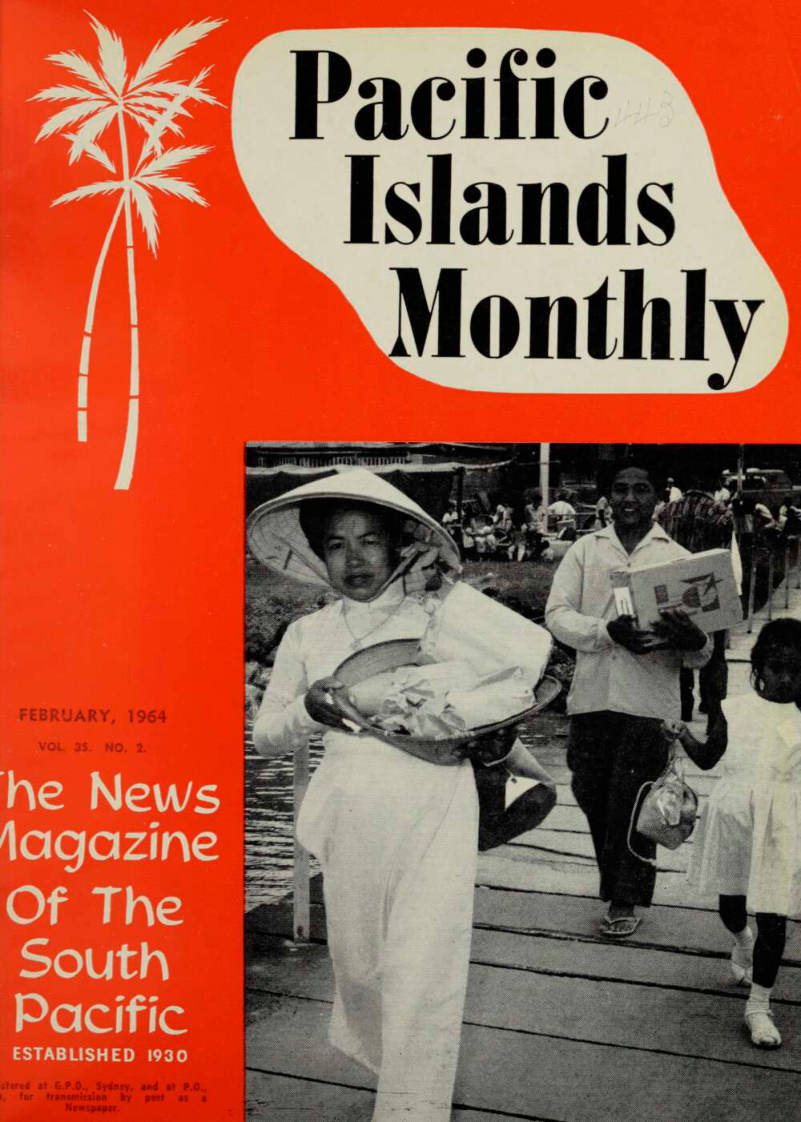 1
1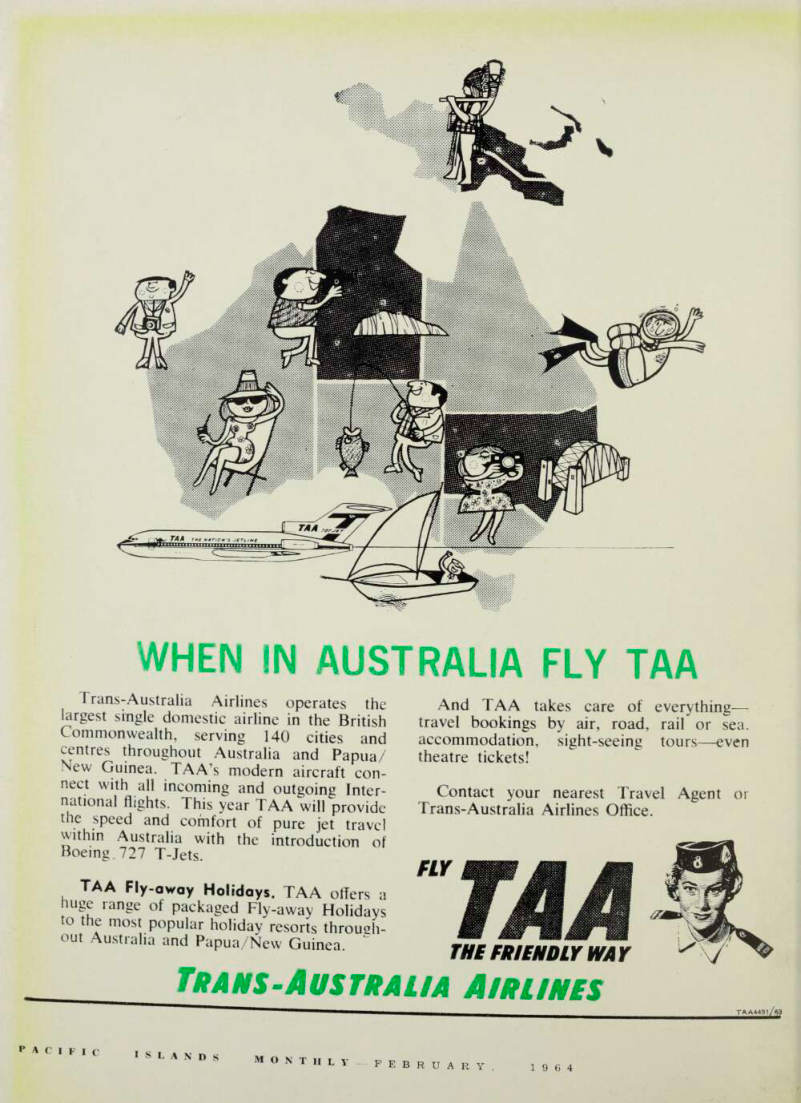 2
2 3
3 4
4 5
5 6
6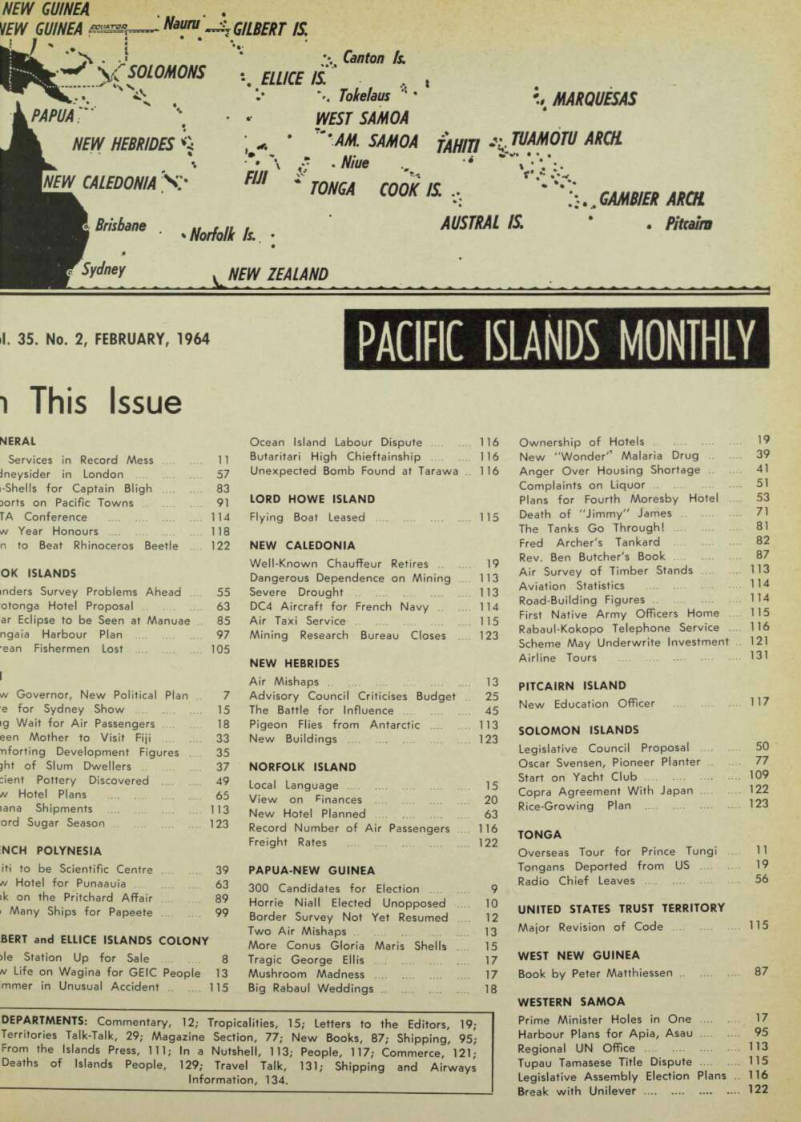 7
7 8
8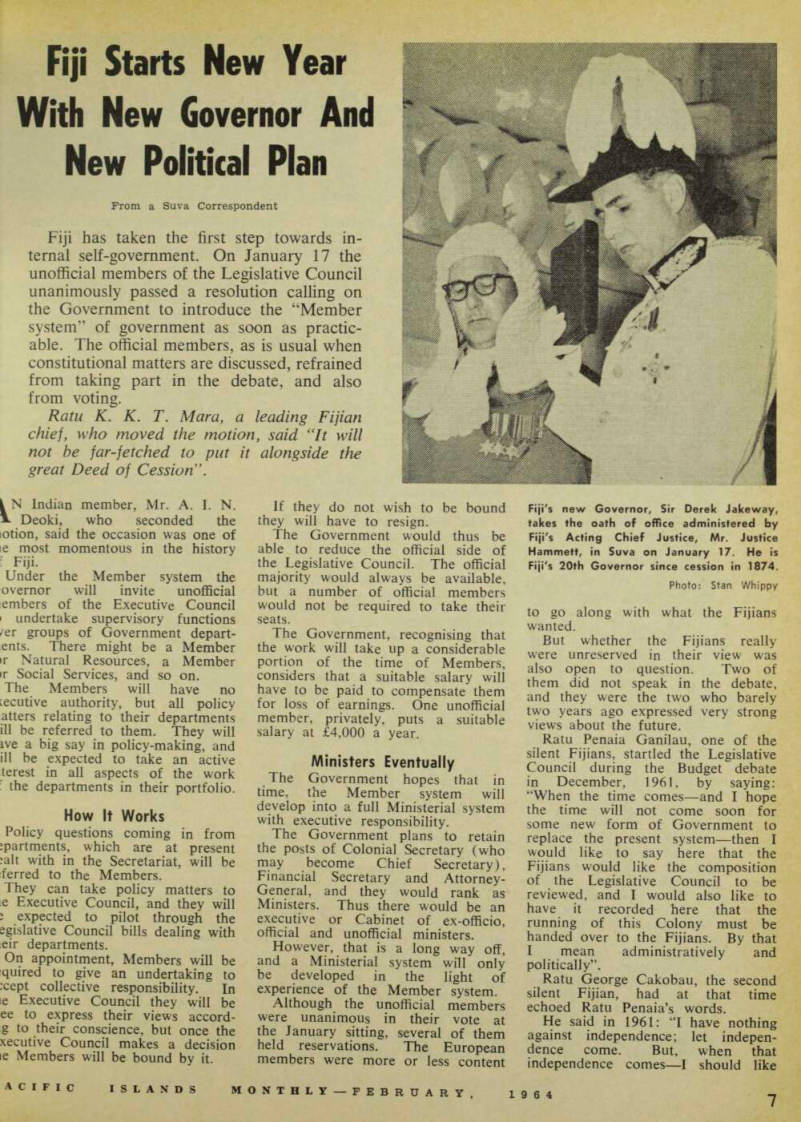 9
9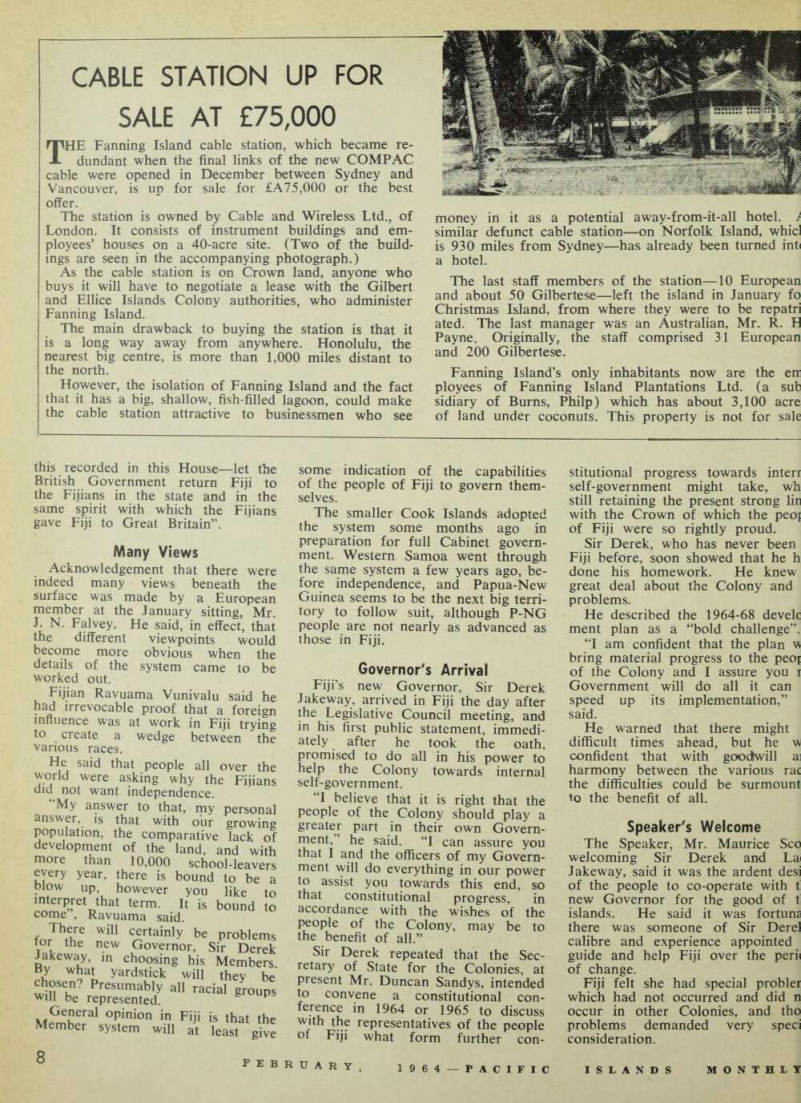 10
10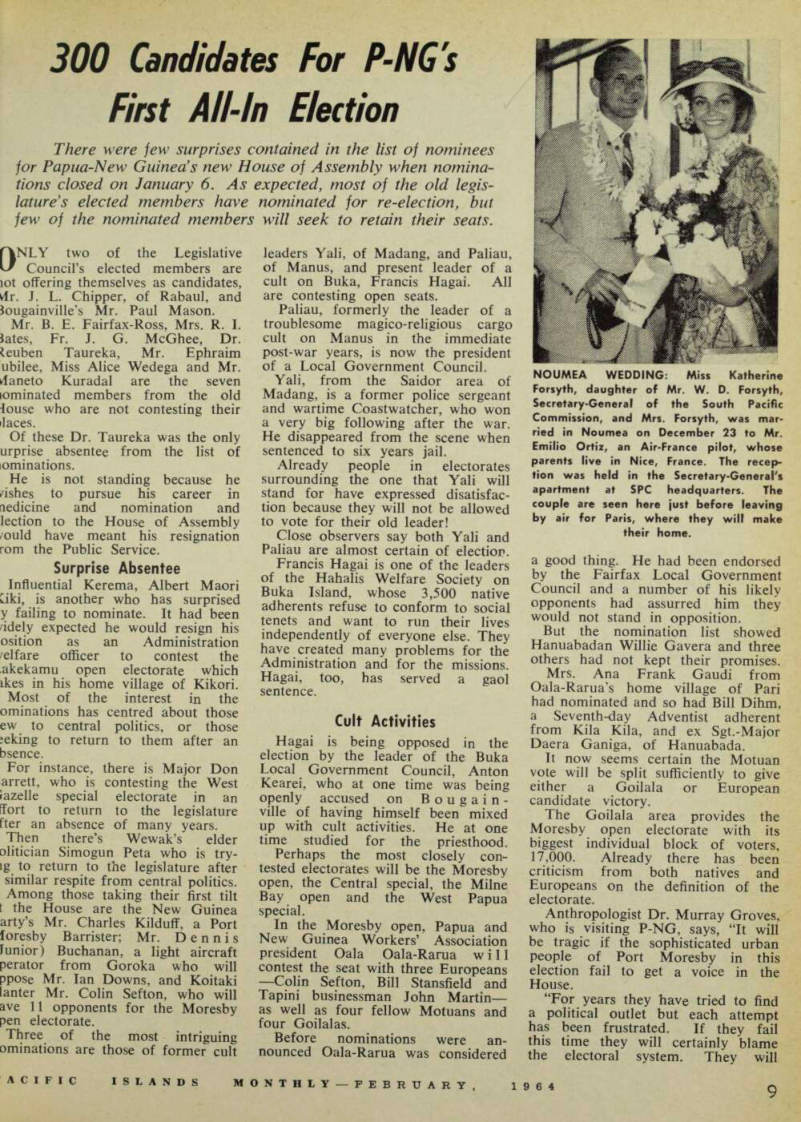 11
11 12
12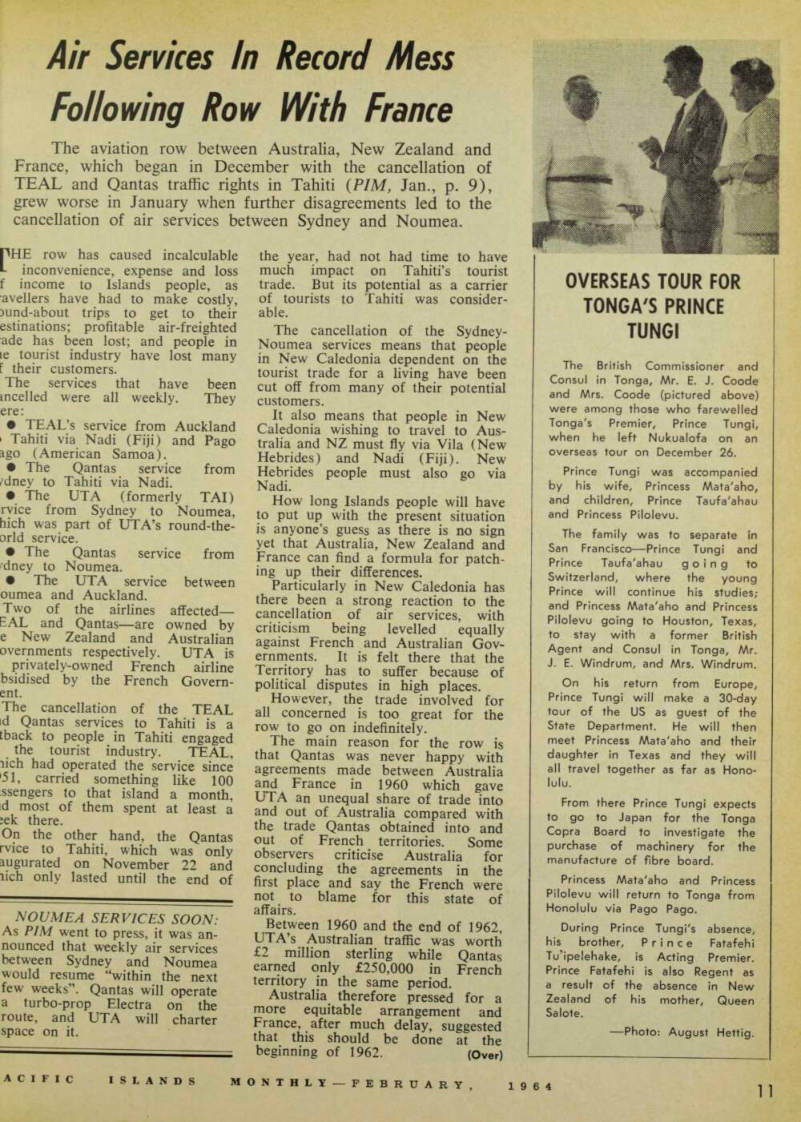 13
13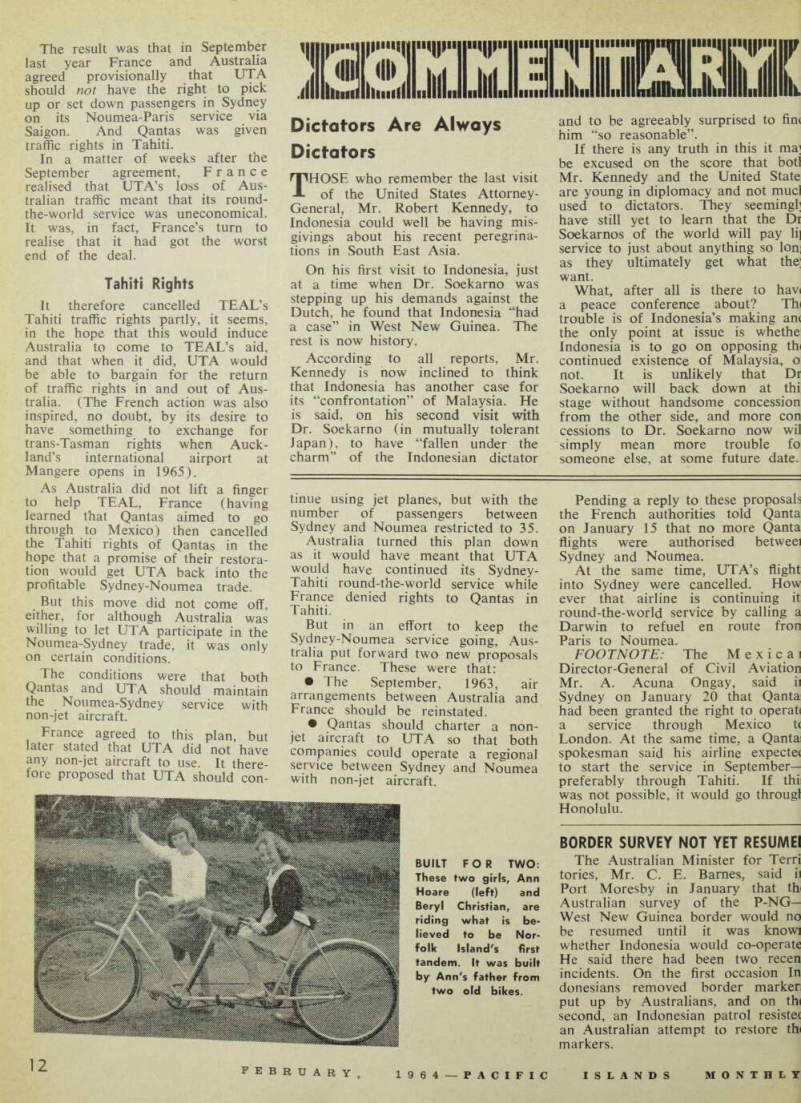 14
14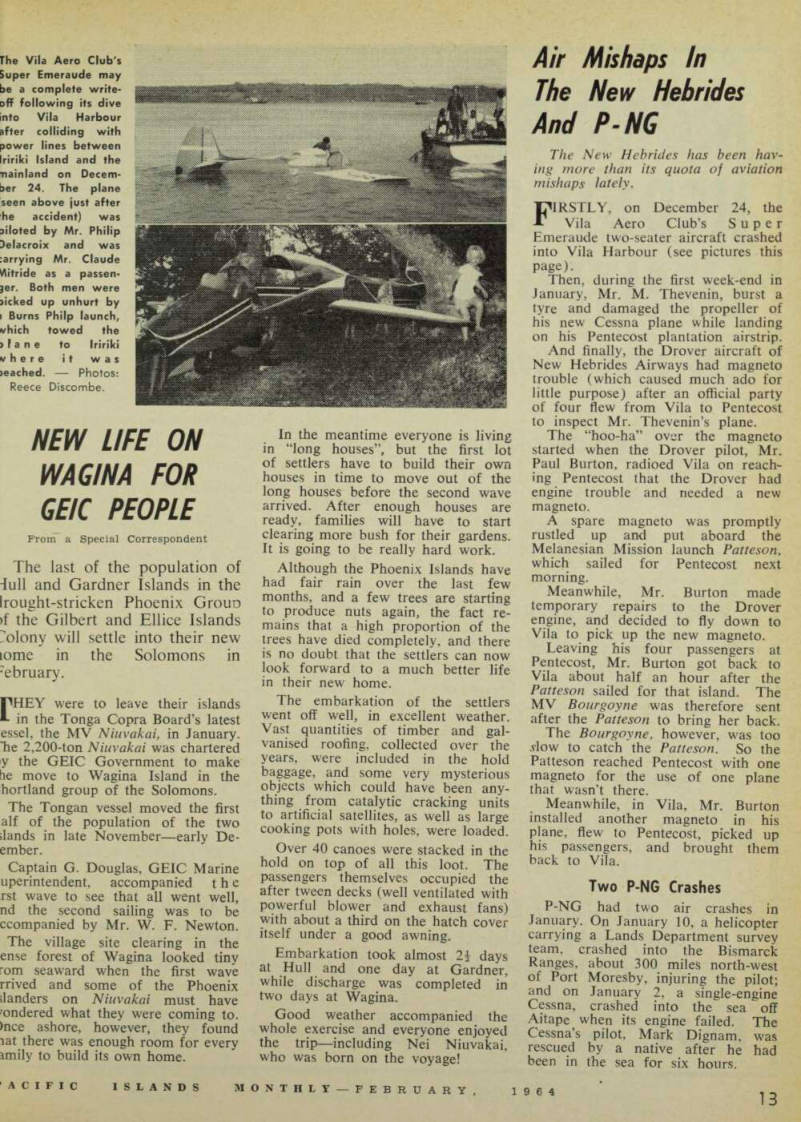 15
15 16
16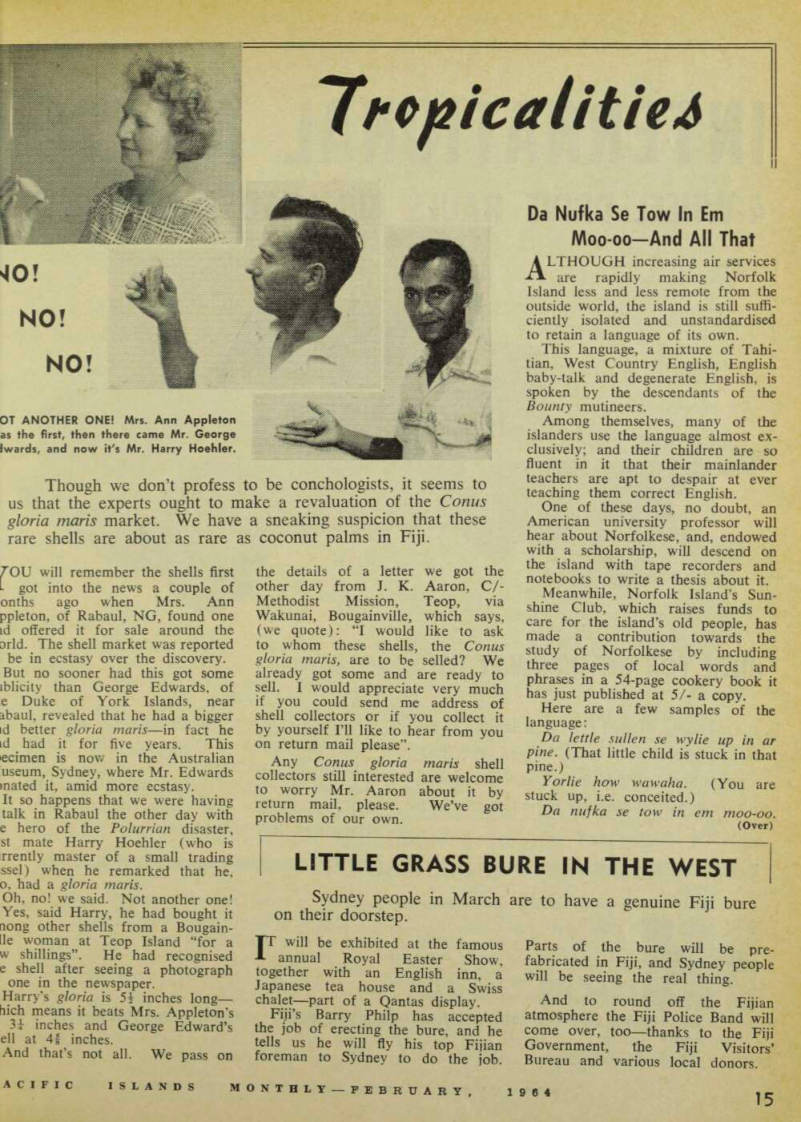 17
17 18
18 19
19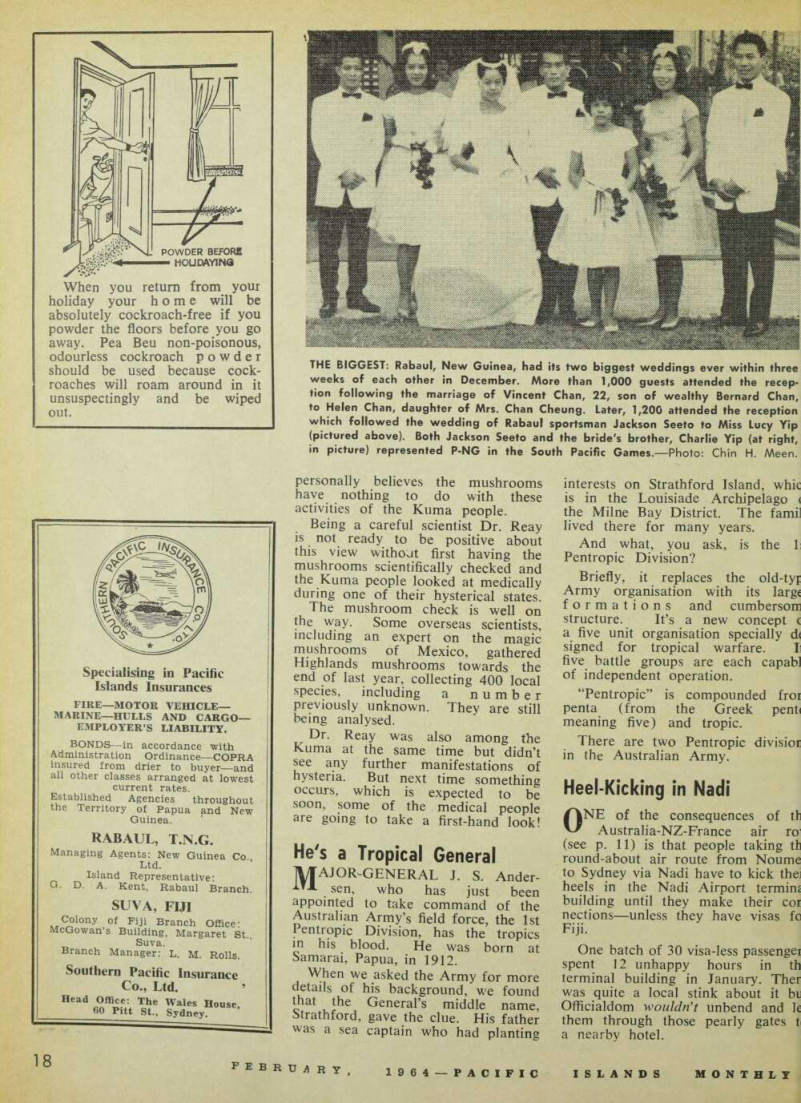 20
20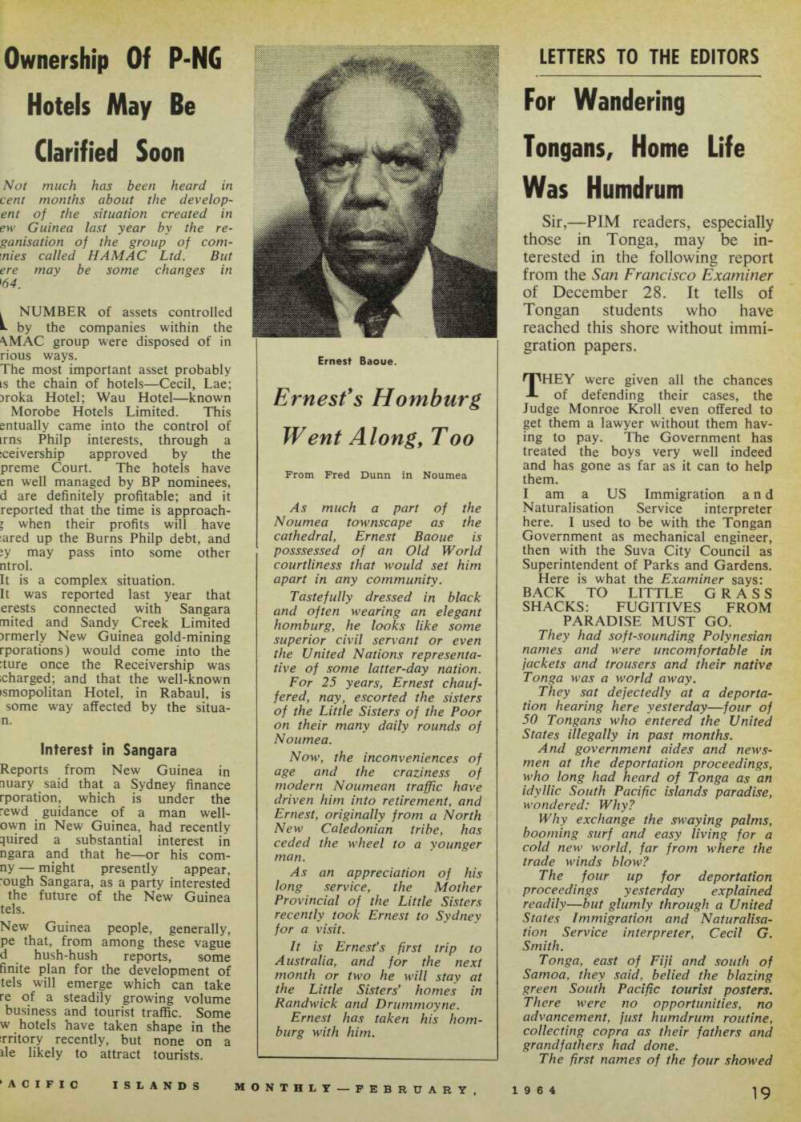 21
21 22
22 23
23 24
24 25
25 26
26 27
27 28
28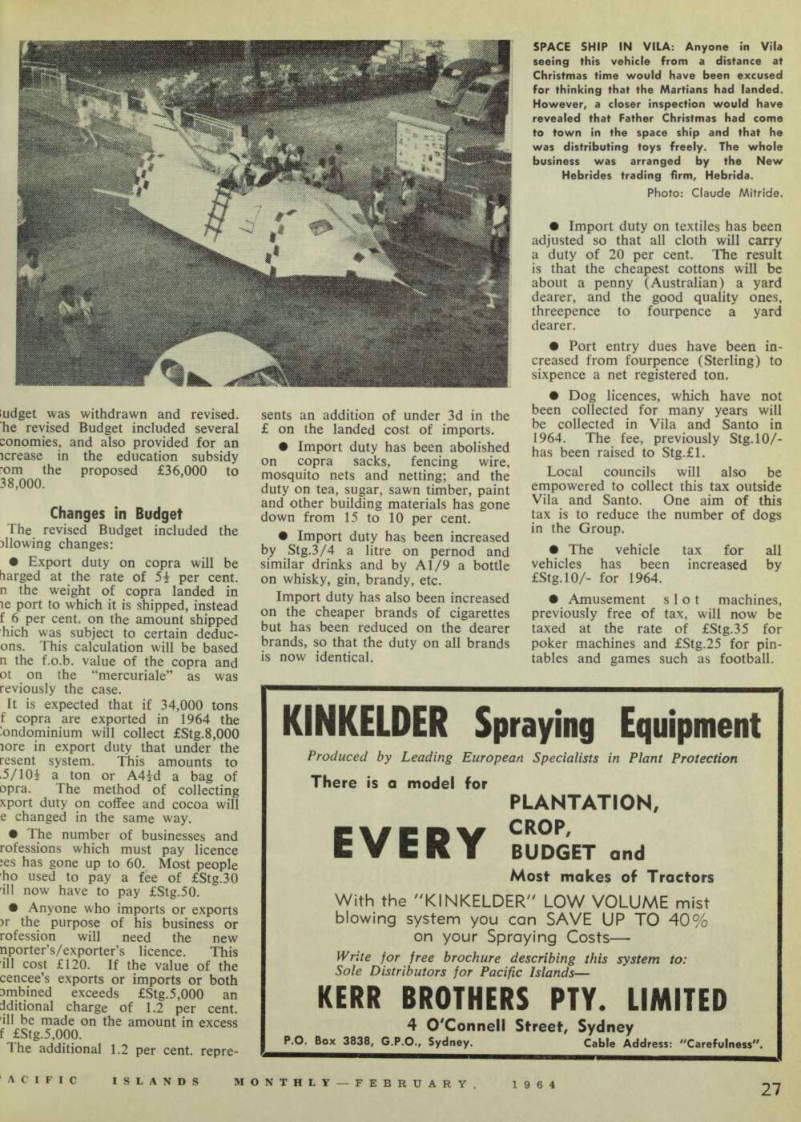 29
29 30
30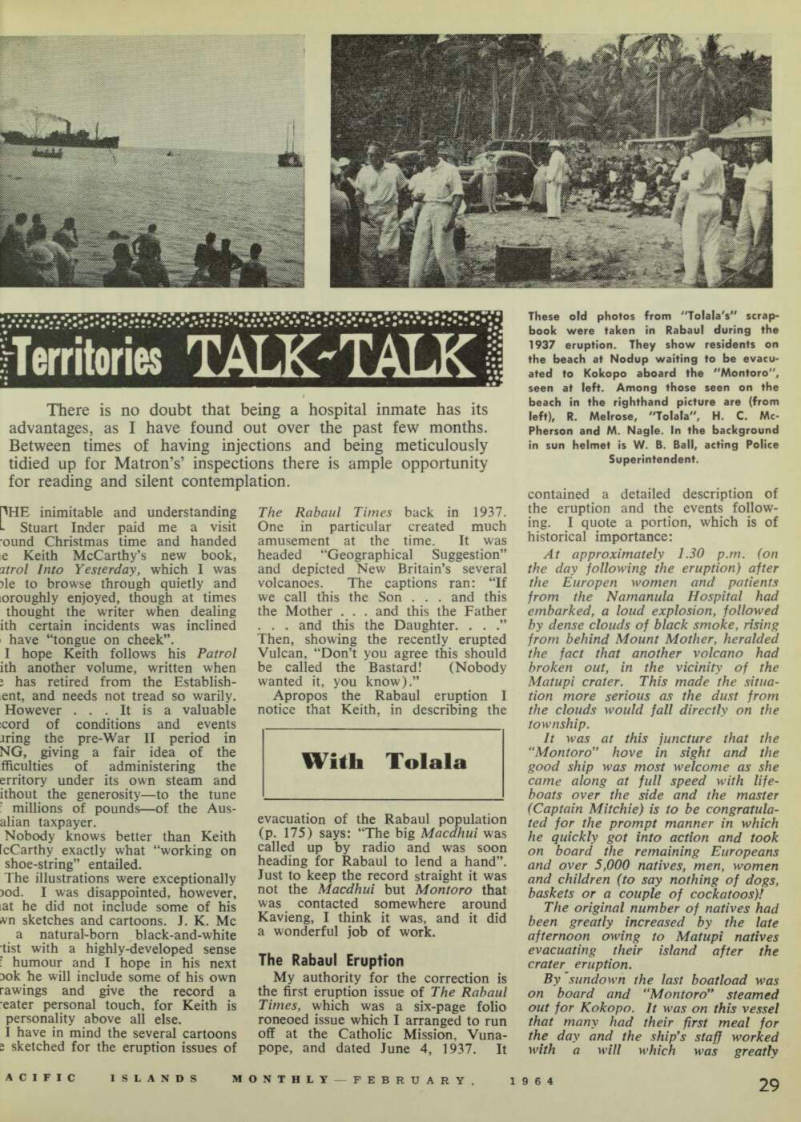 31
31 32
32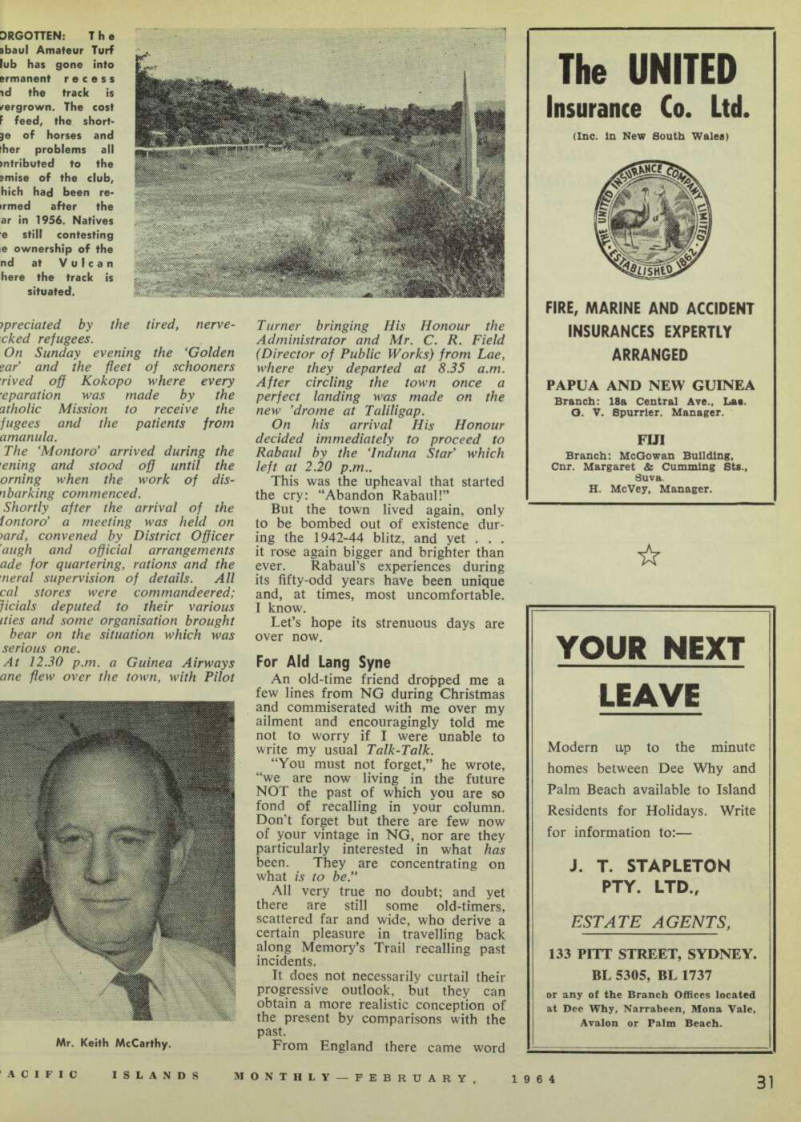 33
33 34
34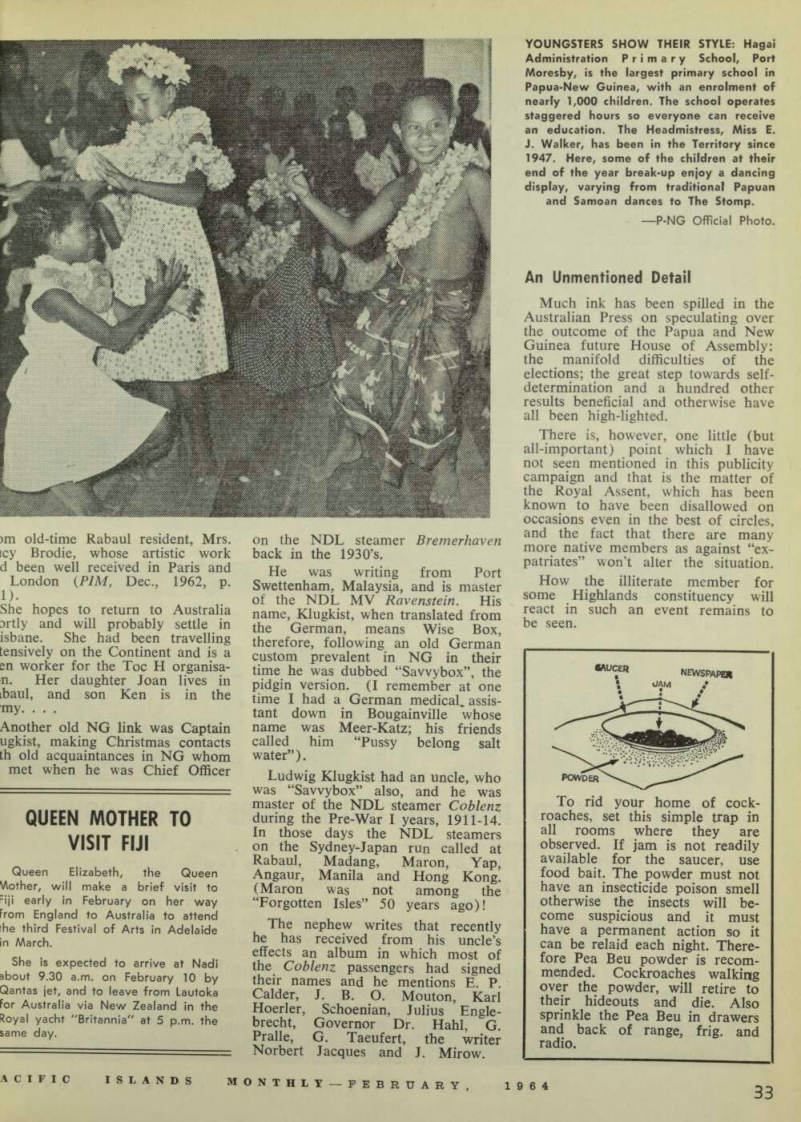 35
35 36
36 37
37 38
38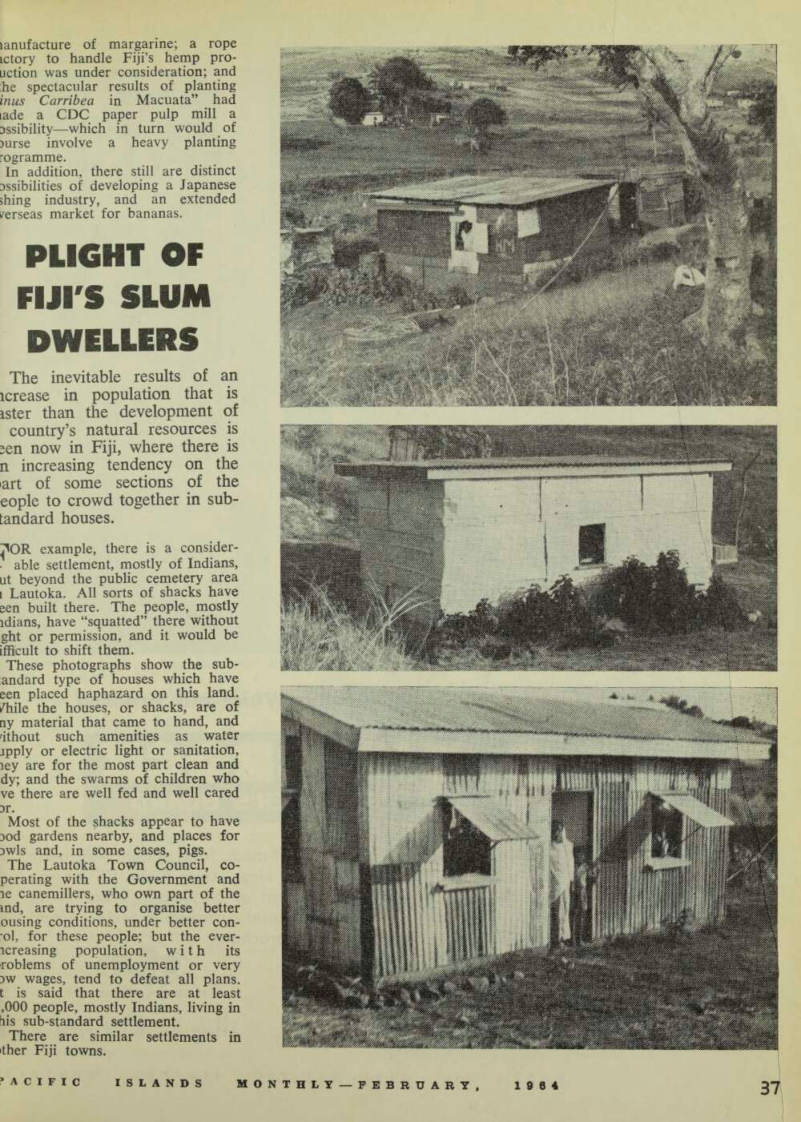 39
39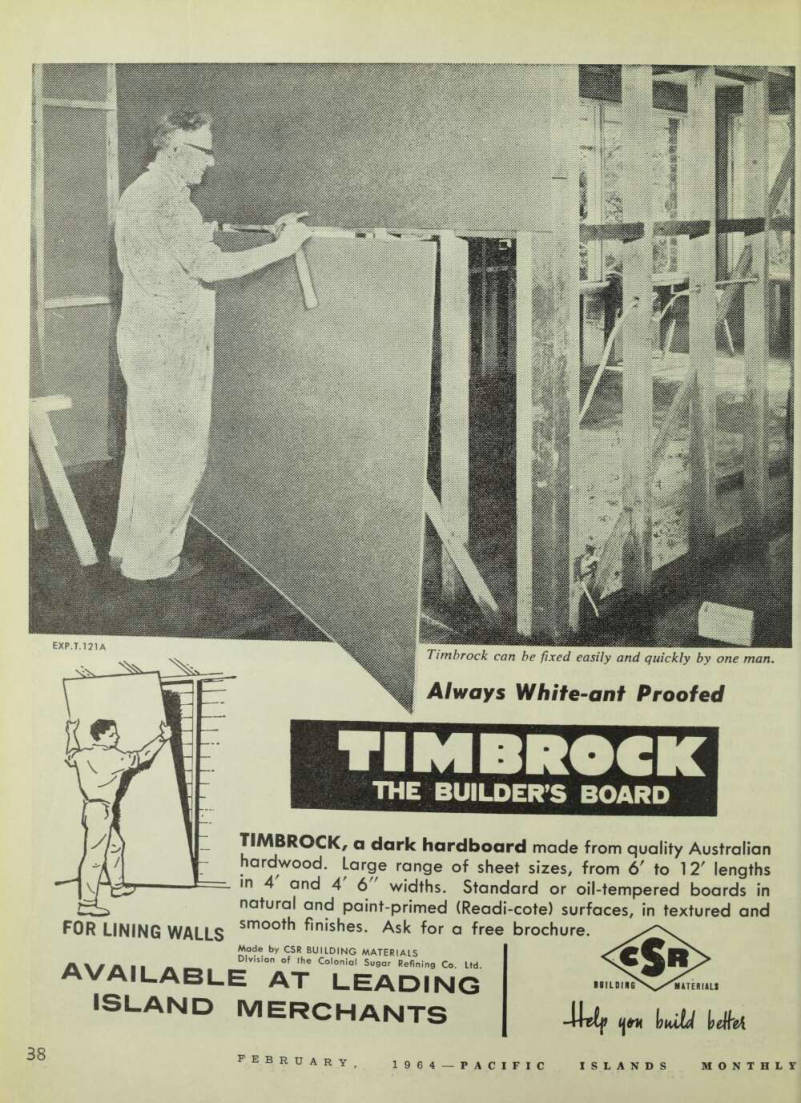 40
40 41
41 42
42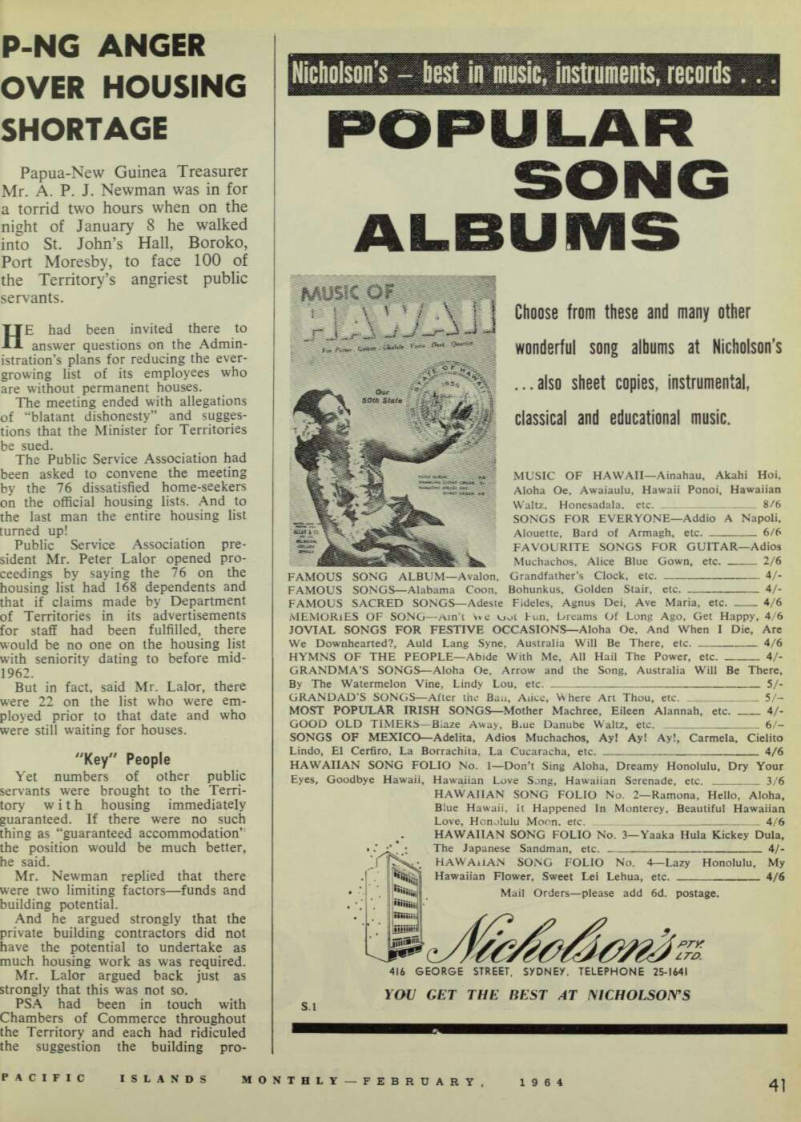 43
43 44
44 45
45 46
46 47
47 48
48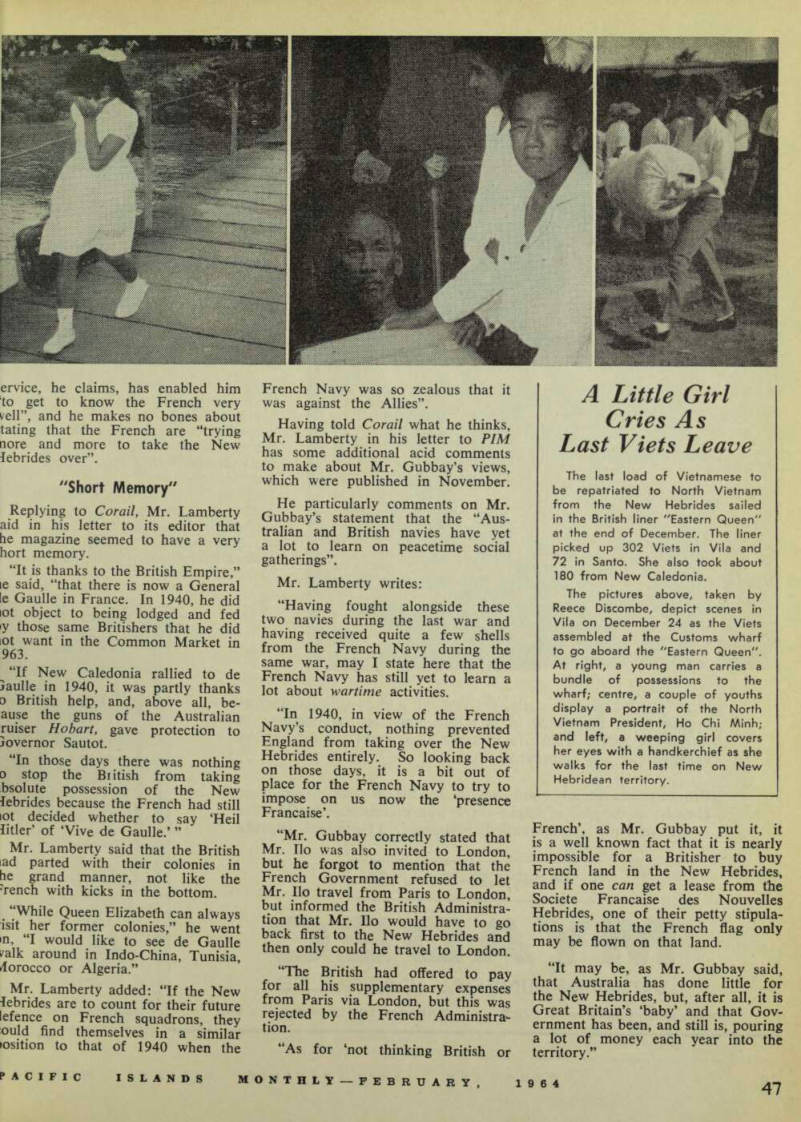 49
49 50
50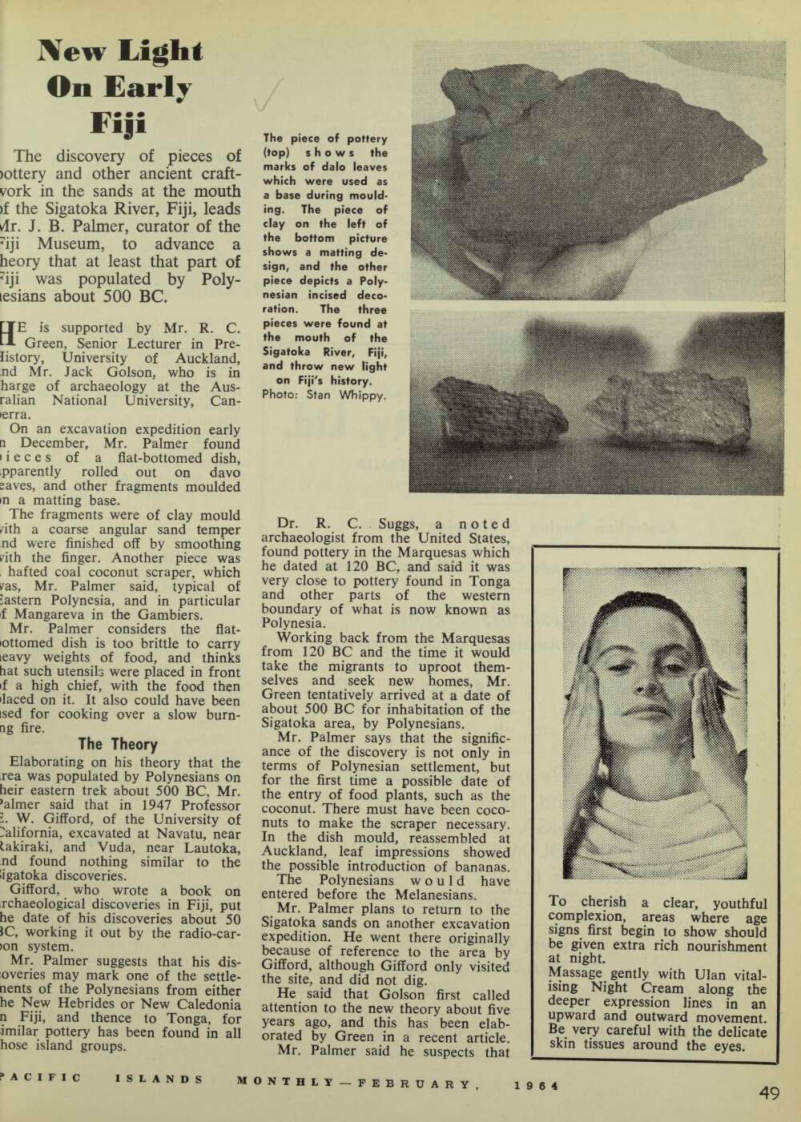 51
51 52
52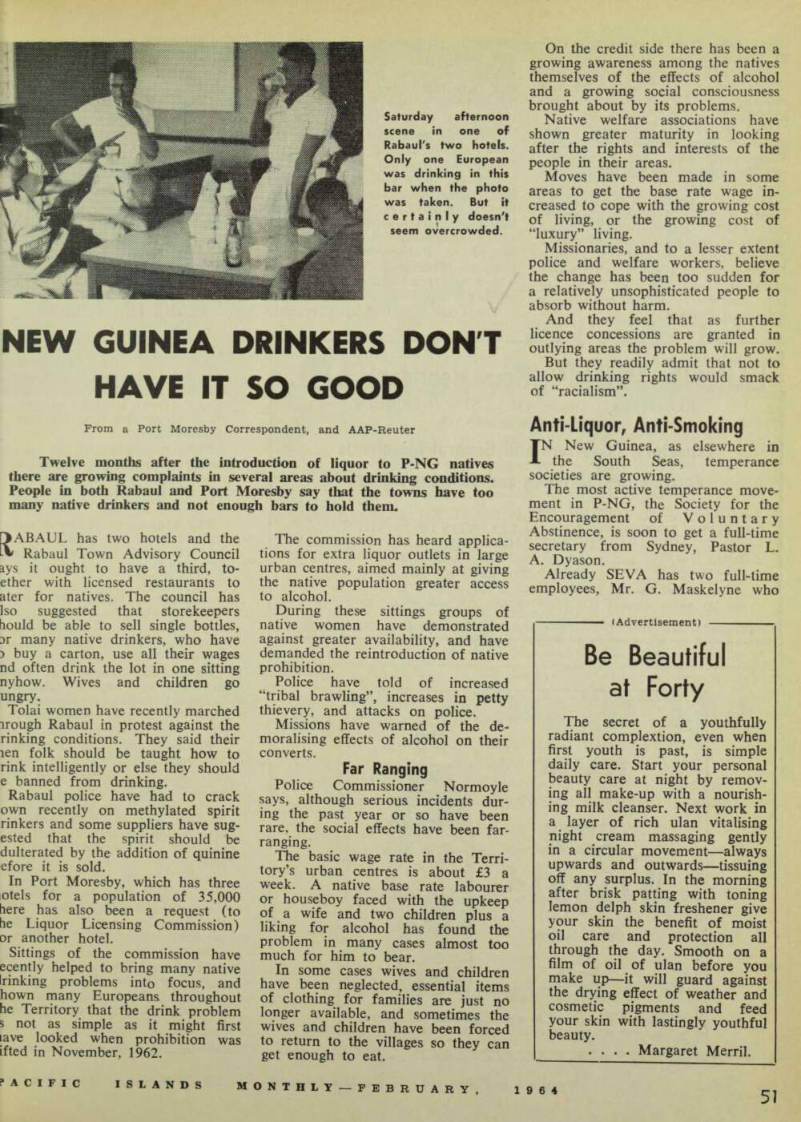 53
53 54
54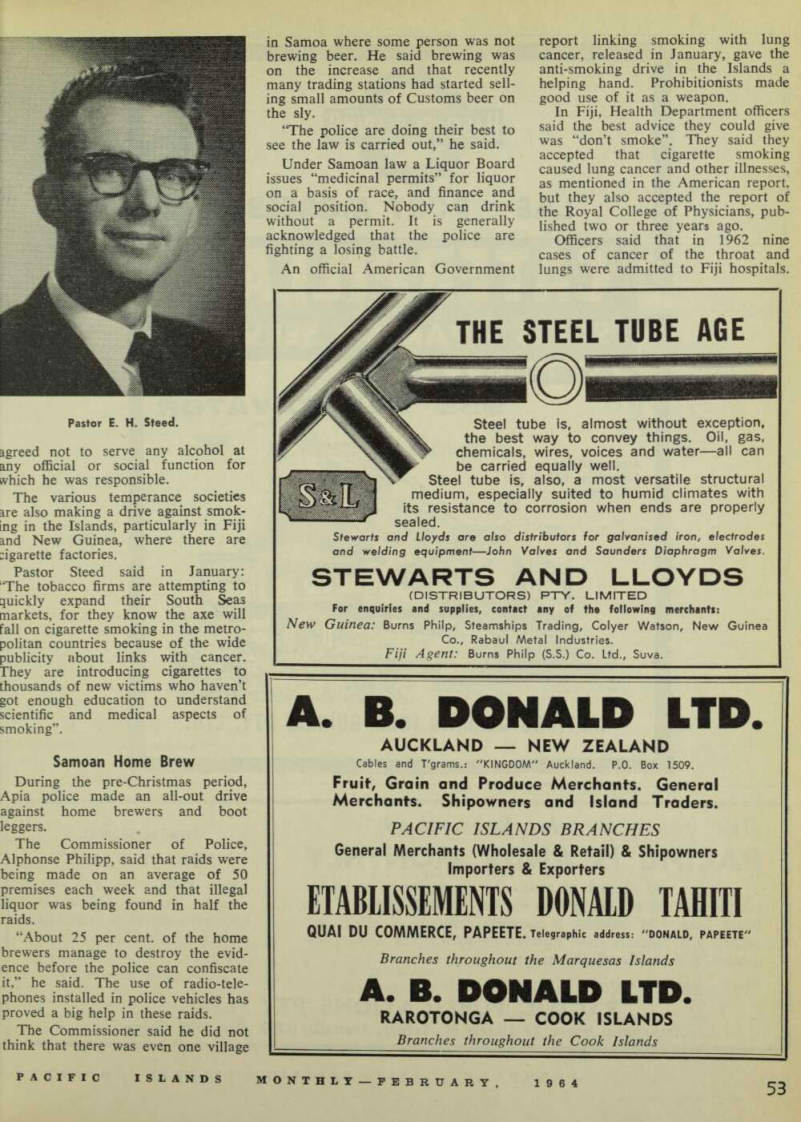 55
55 56
56 57
57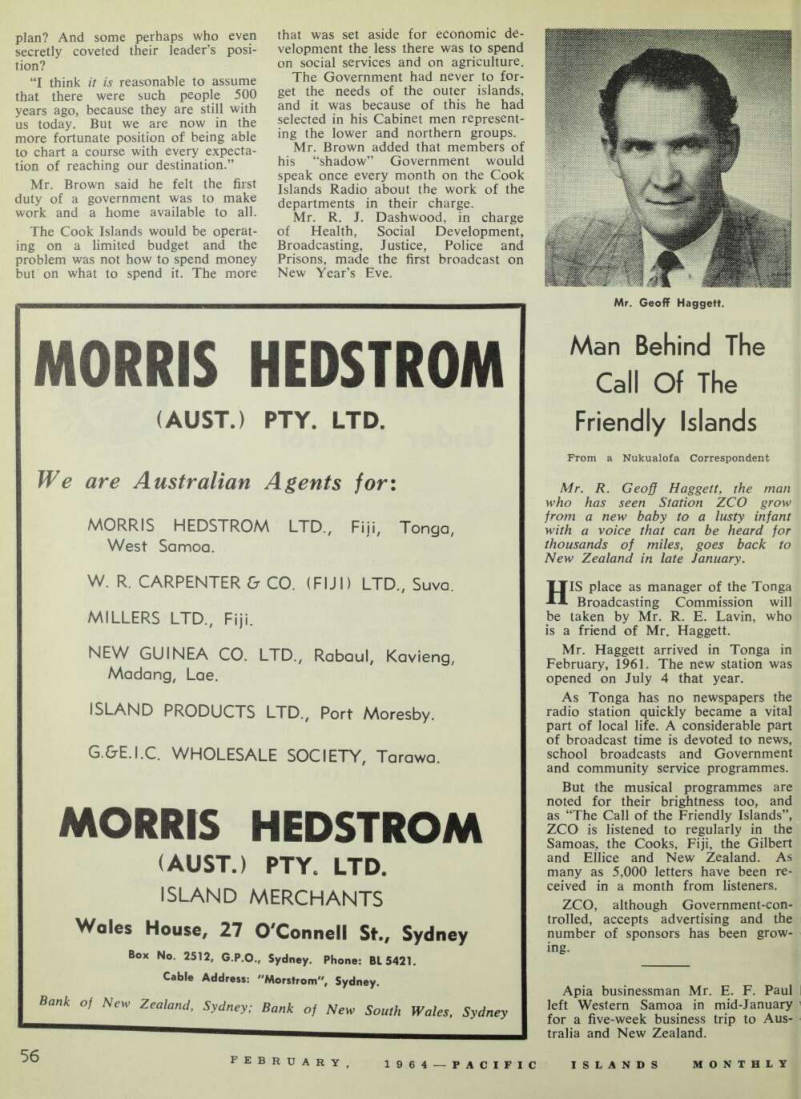 58
58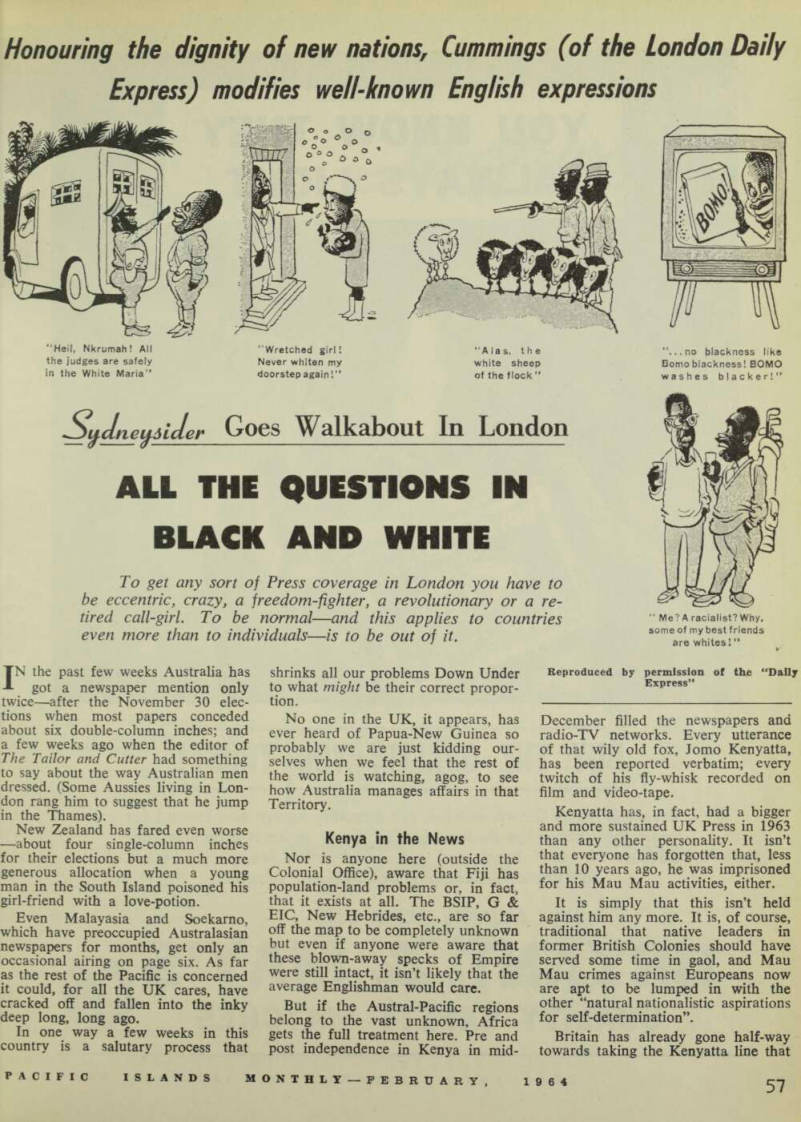 59
59 60
60 61
61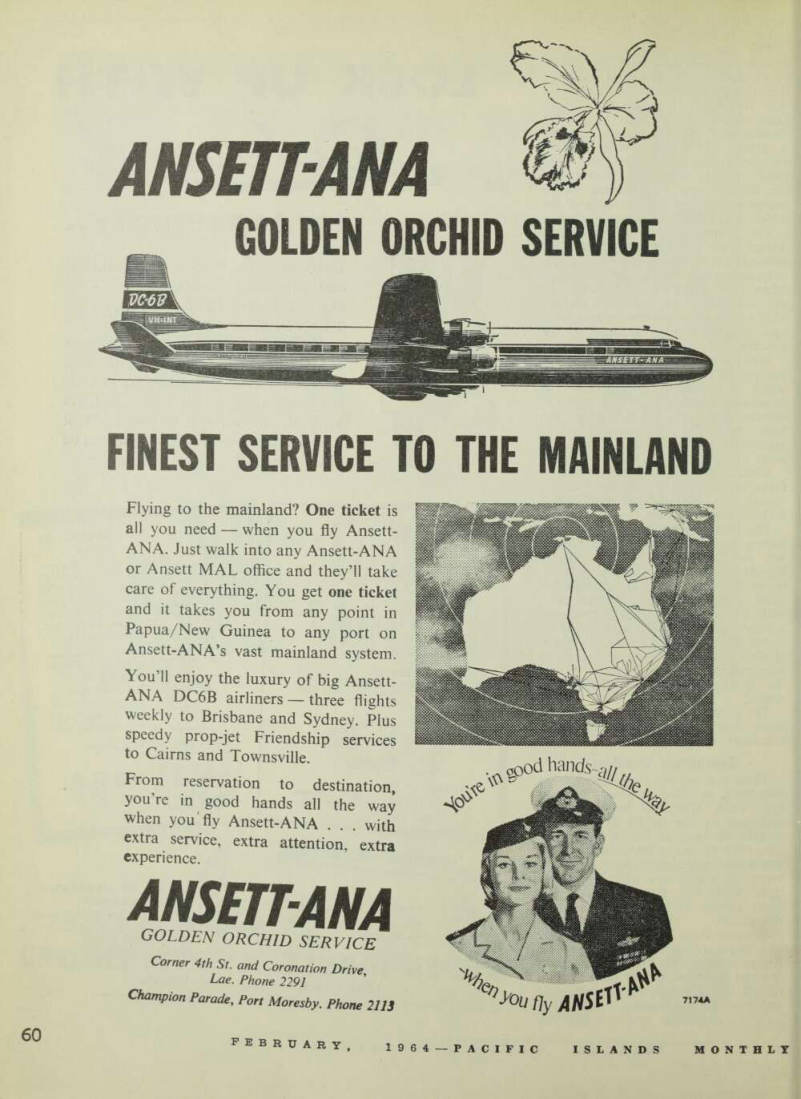 62
62 63
63 64
64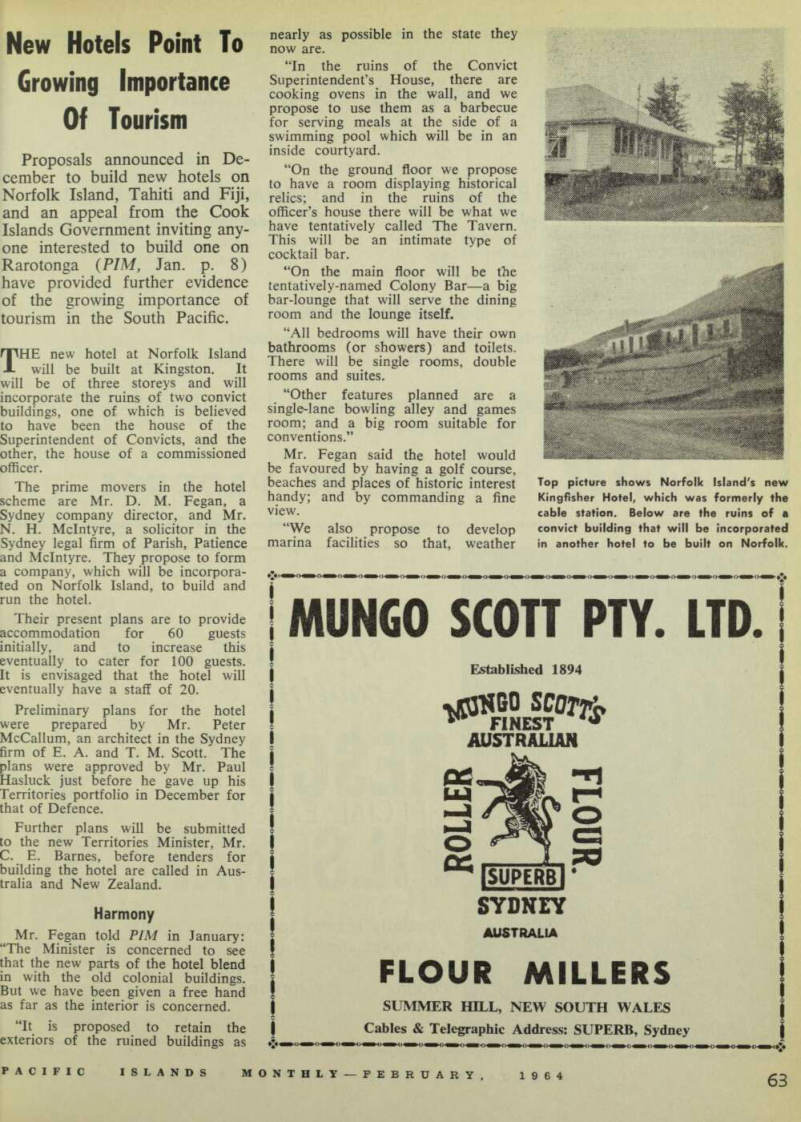 65
65 66
66 67
67 68
68 69
69 70
70 71
71 72
72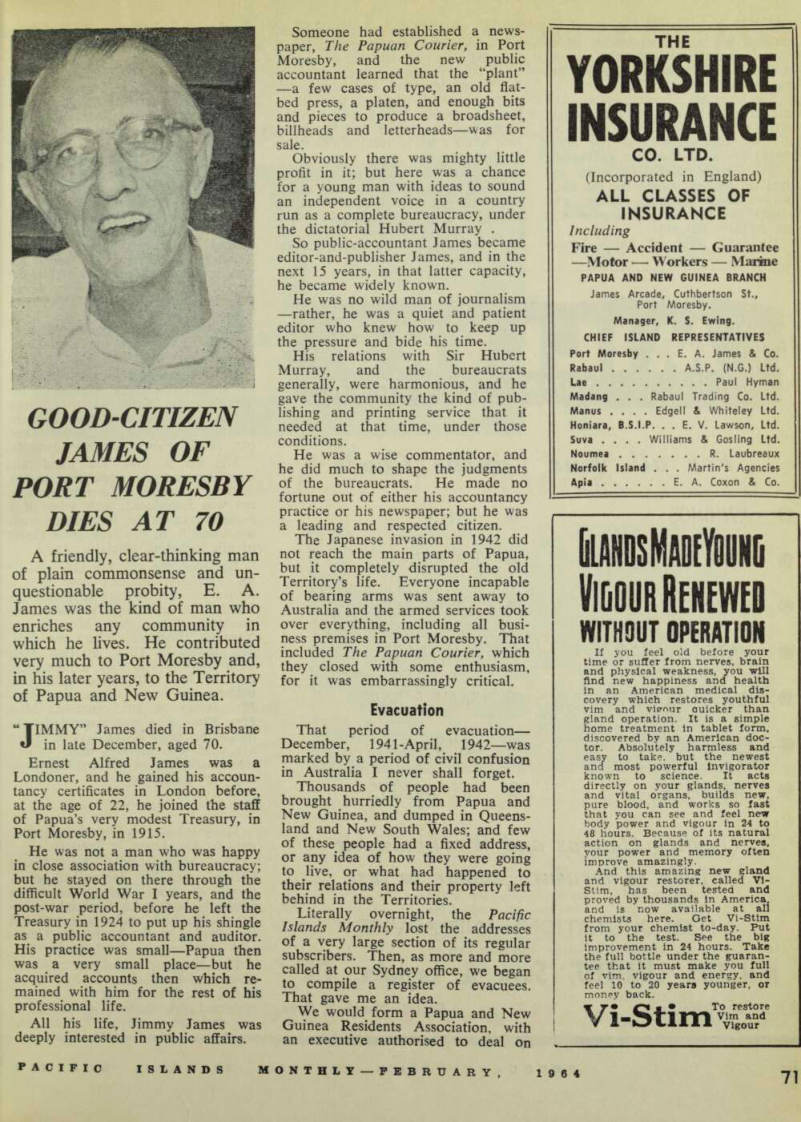 73
73 74
74 75
75 76
76 77
77 78
78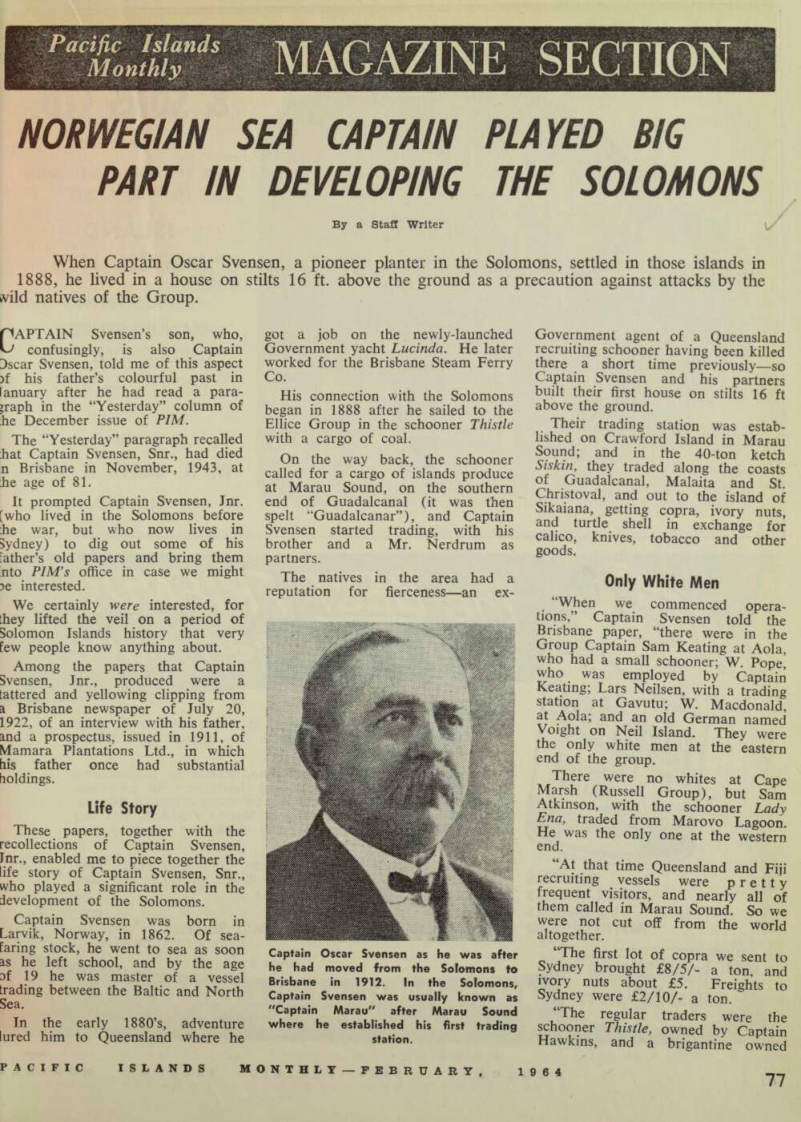 79
79 80
80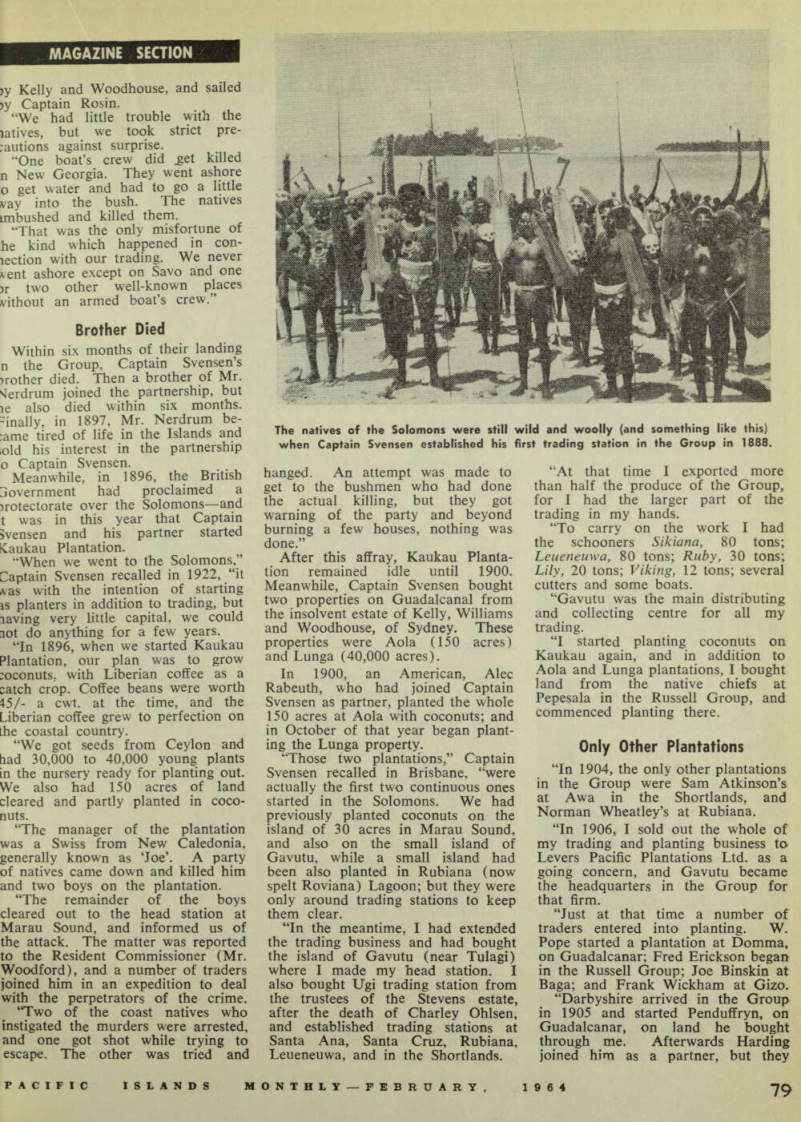 81
81 82
82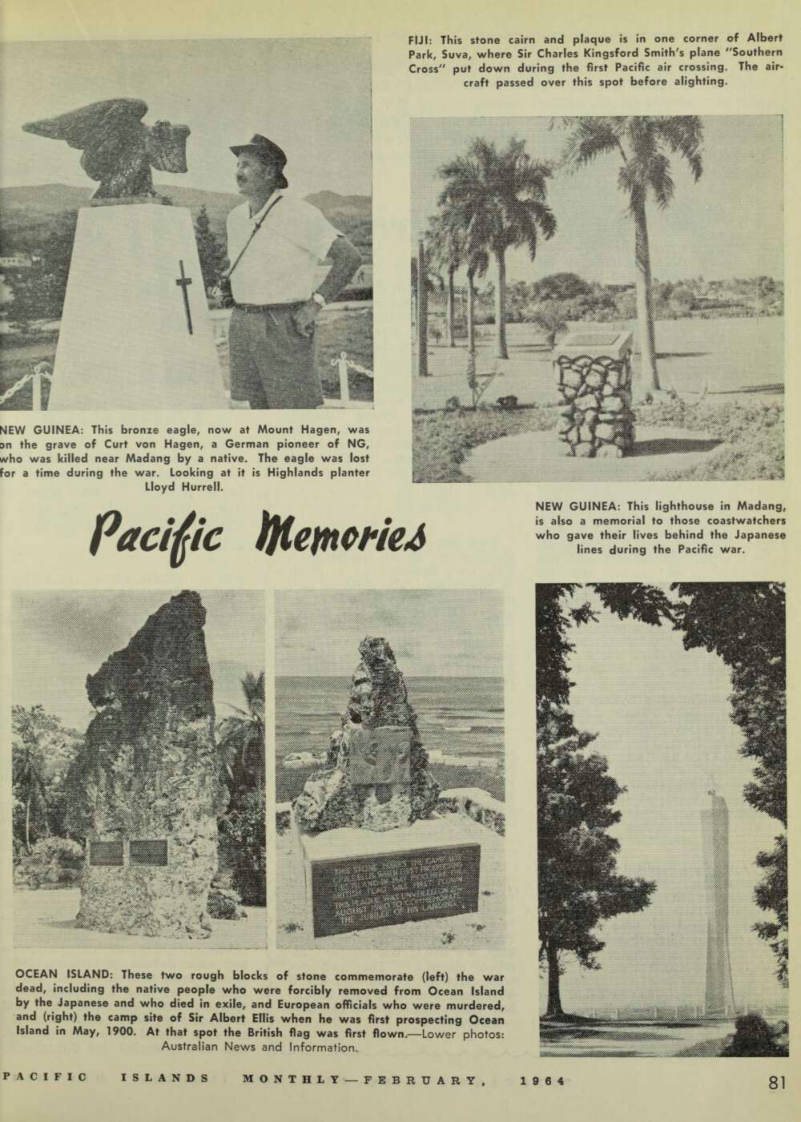 83
83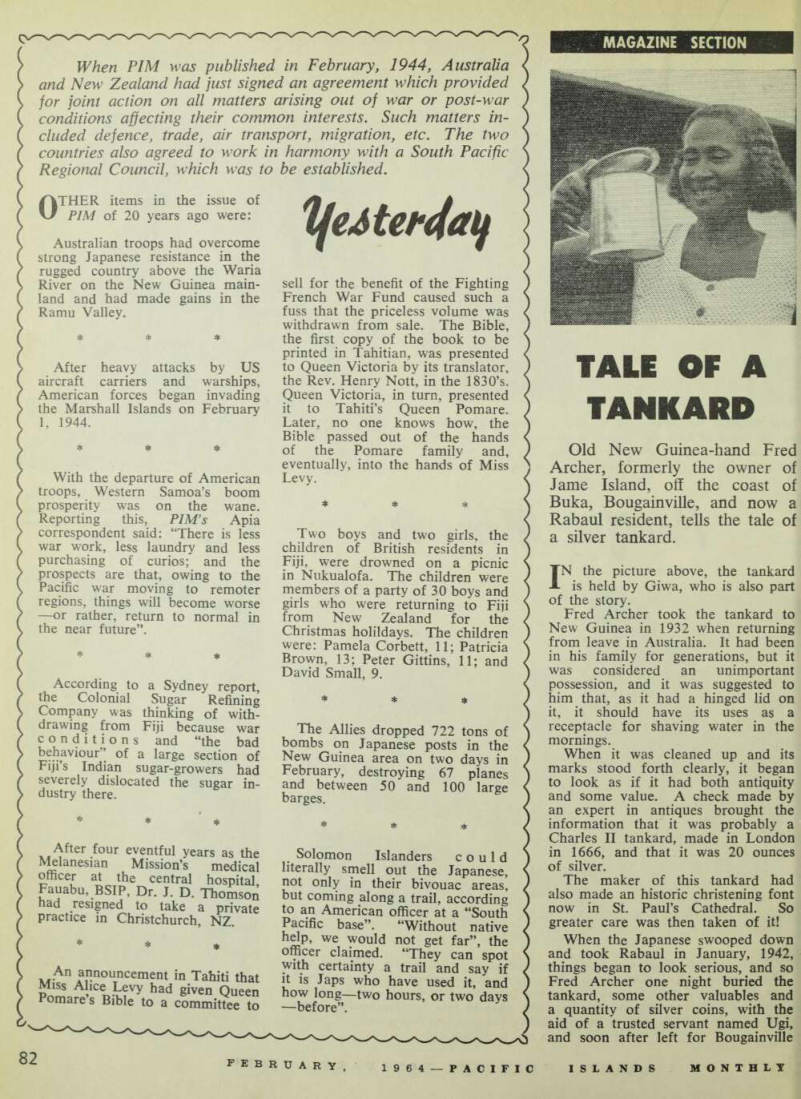 84
84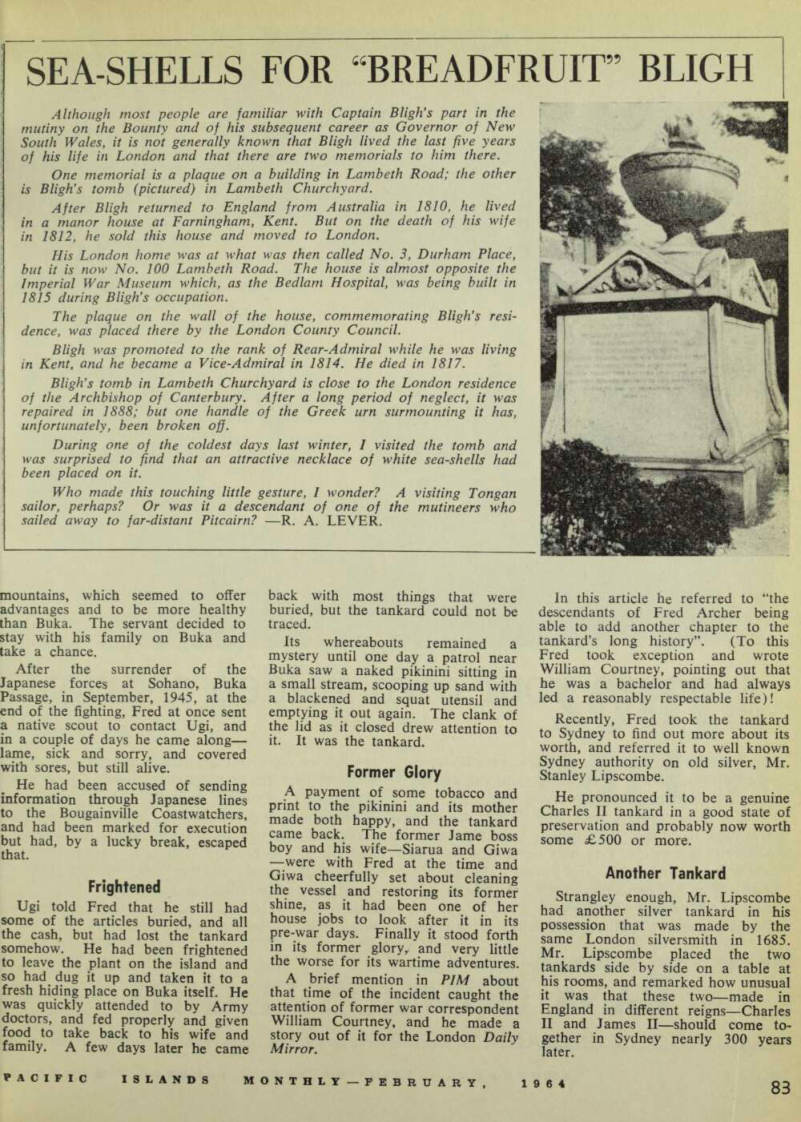 85
85 86
86 87
87 88
88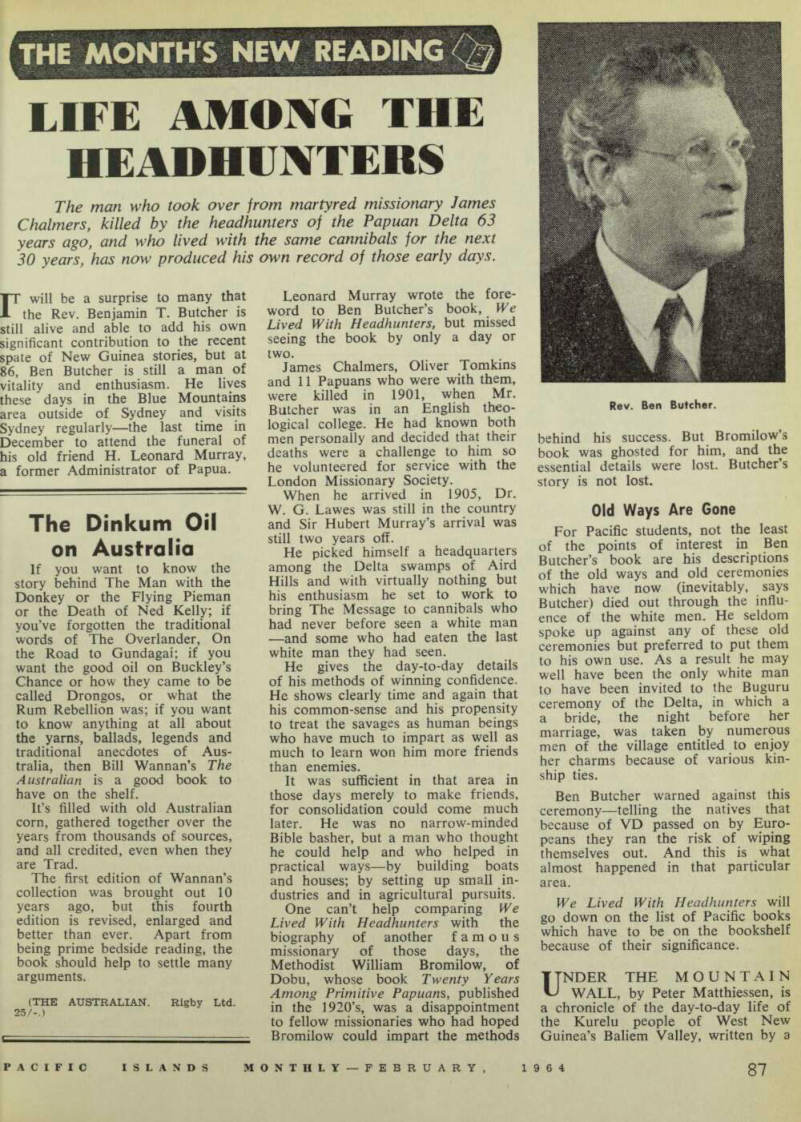 89
89 90
90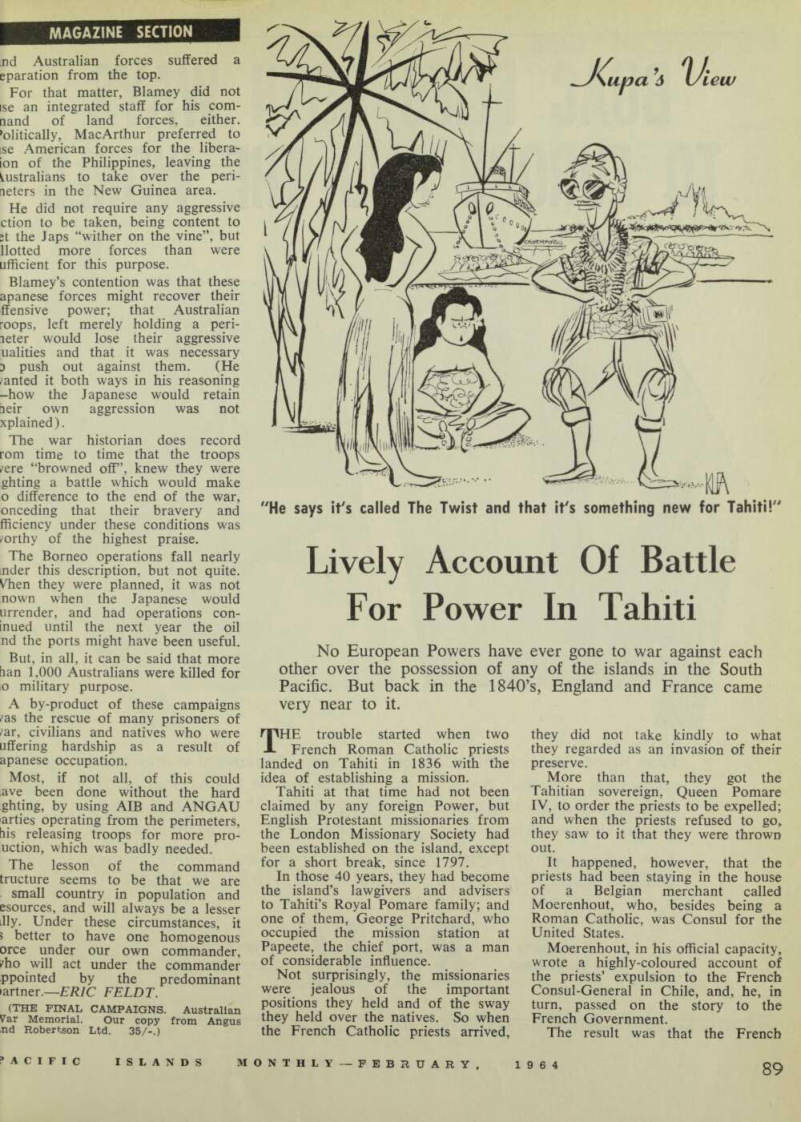 91
91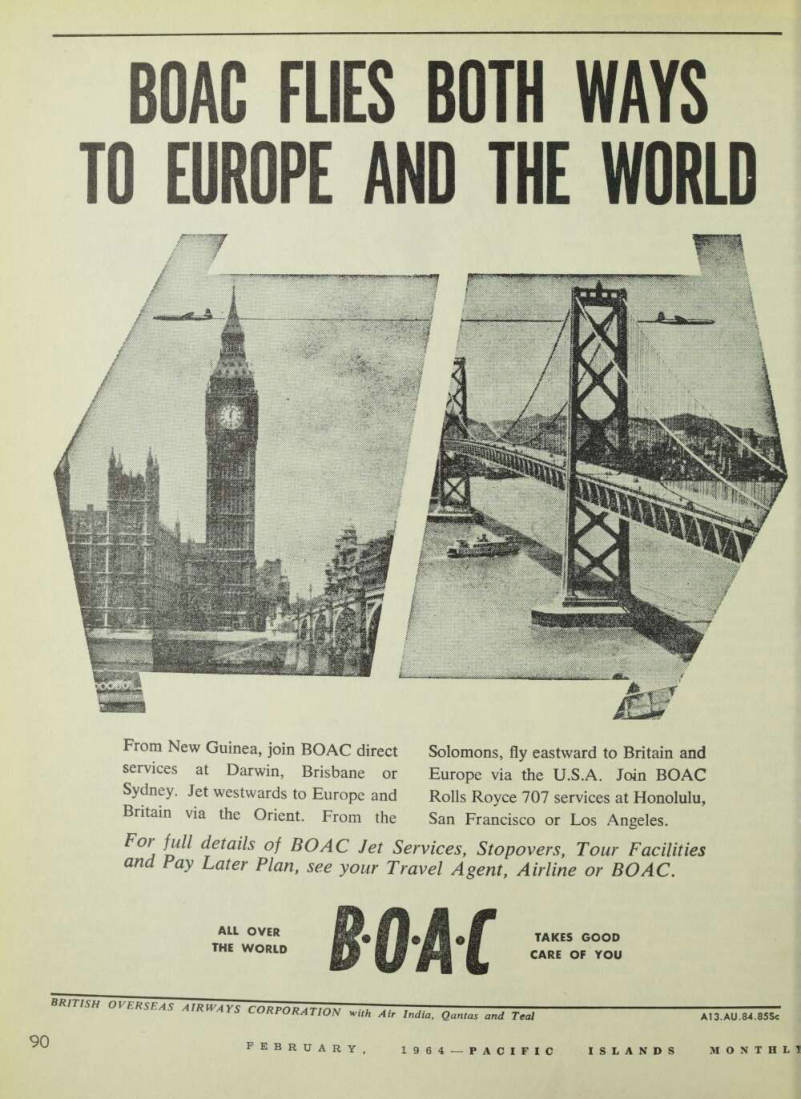 92
92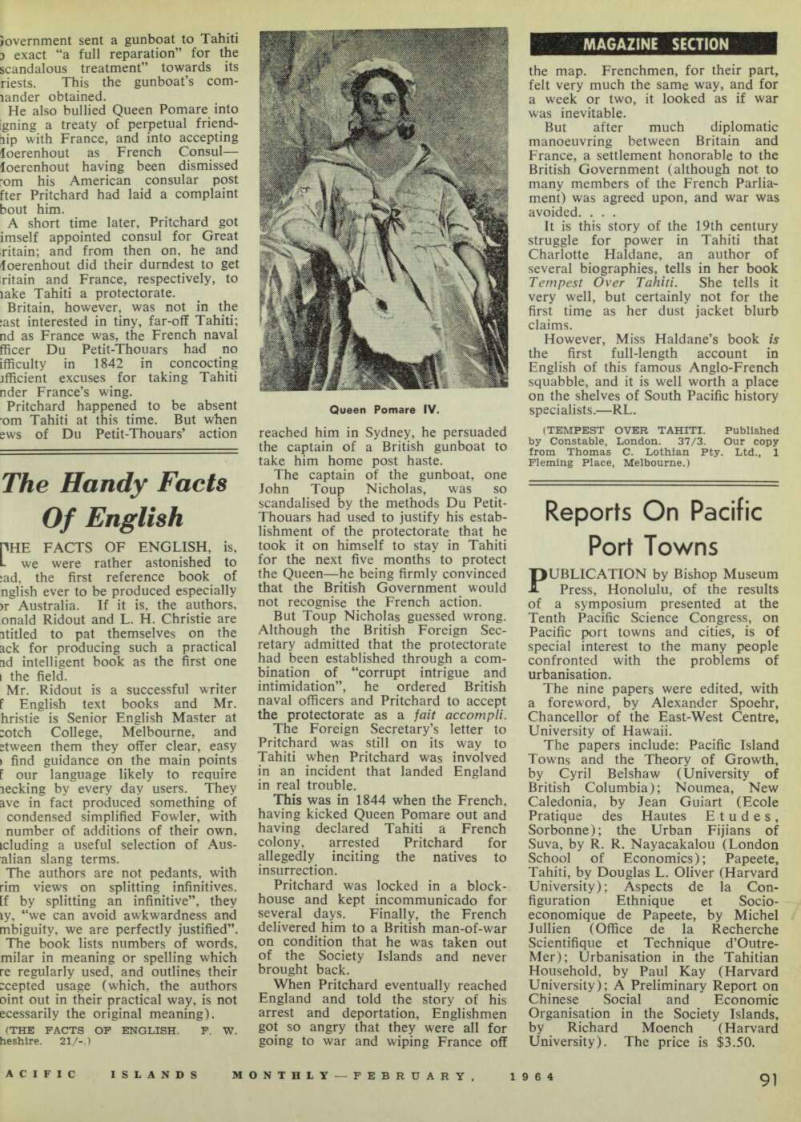 93
93 94
94 95
95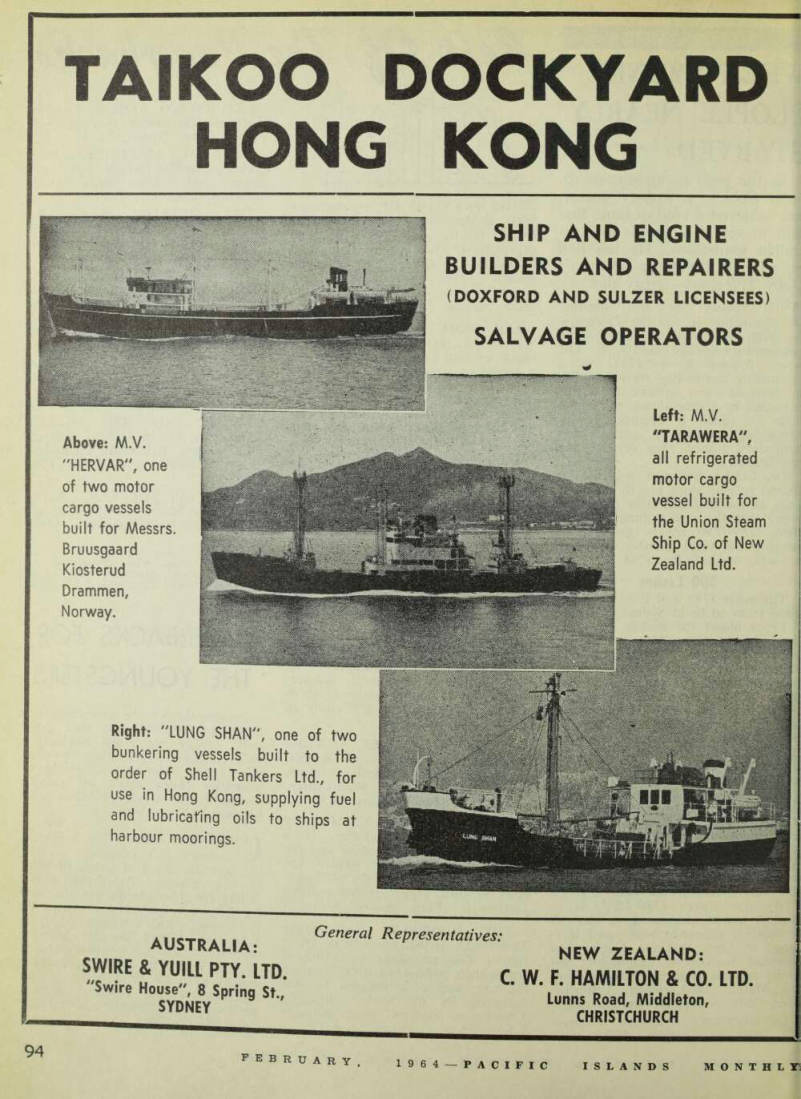 96
96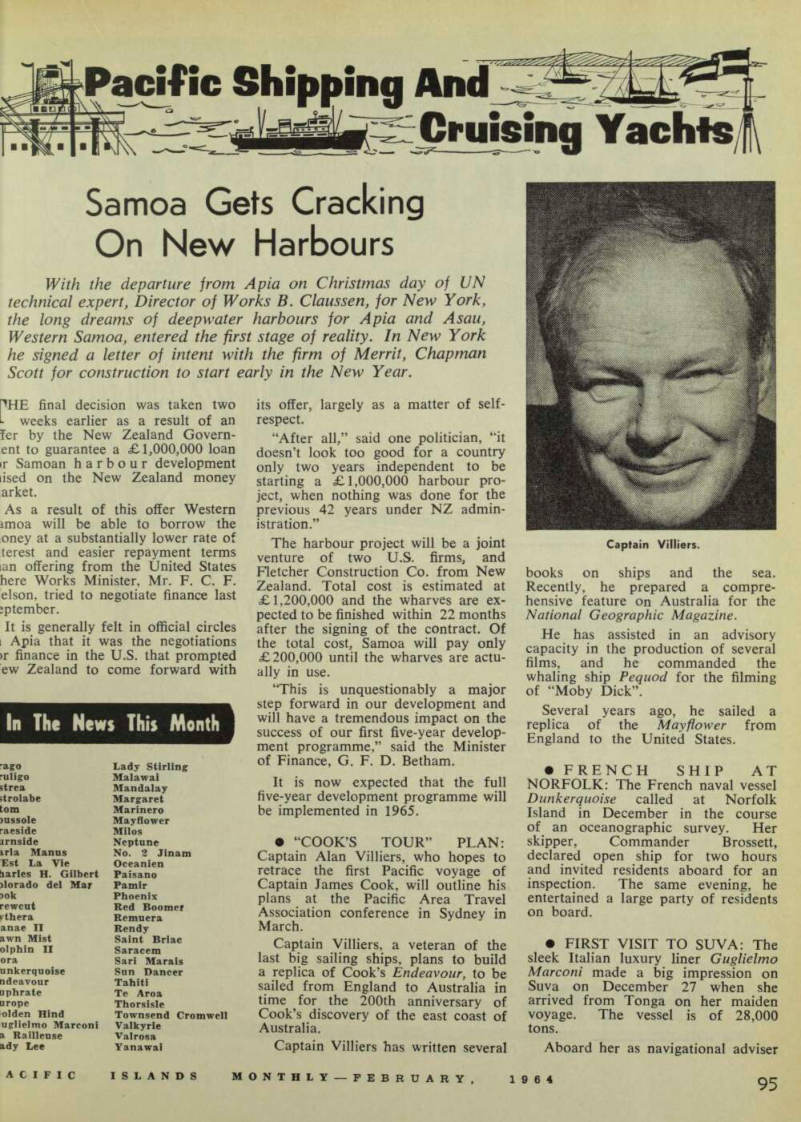 97
97 98
98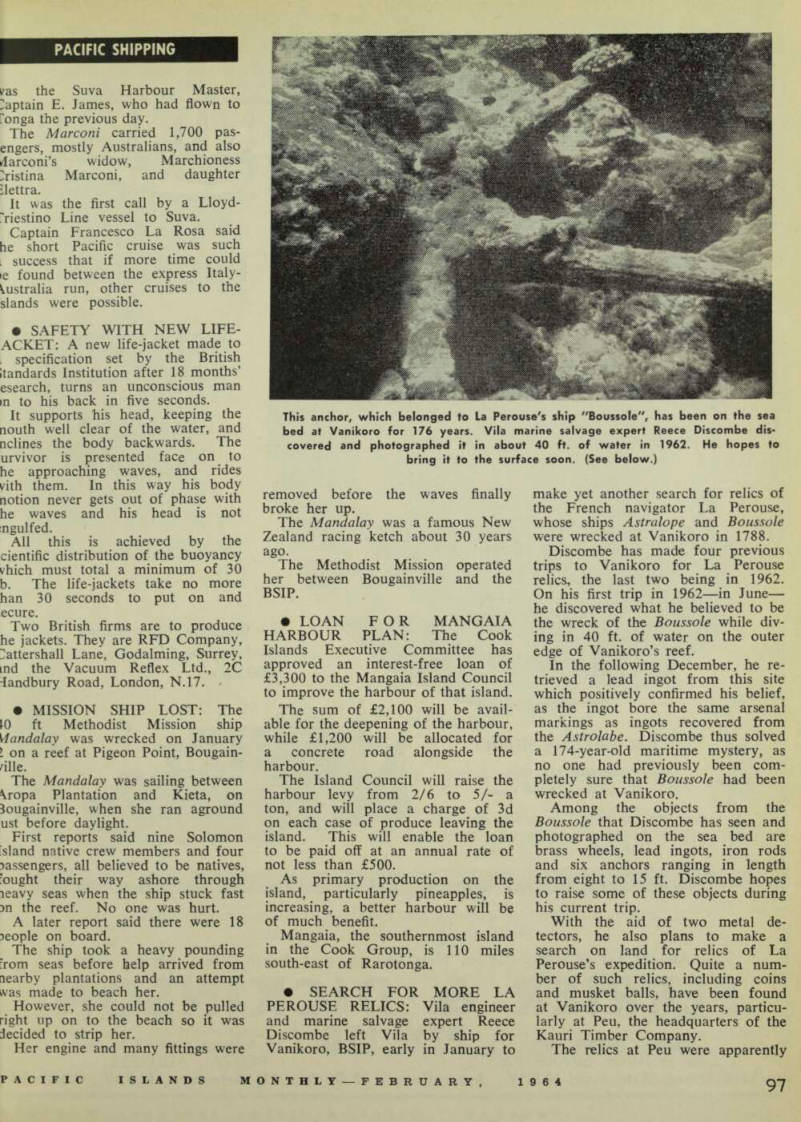 99
99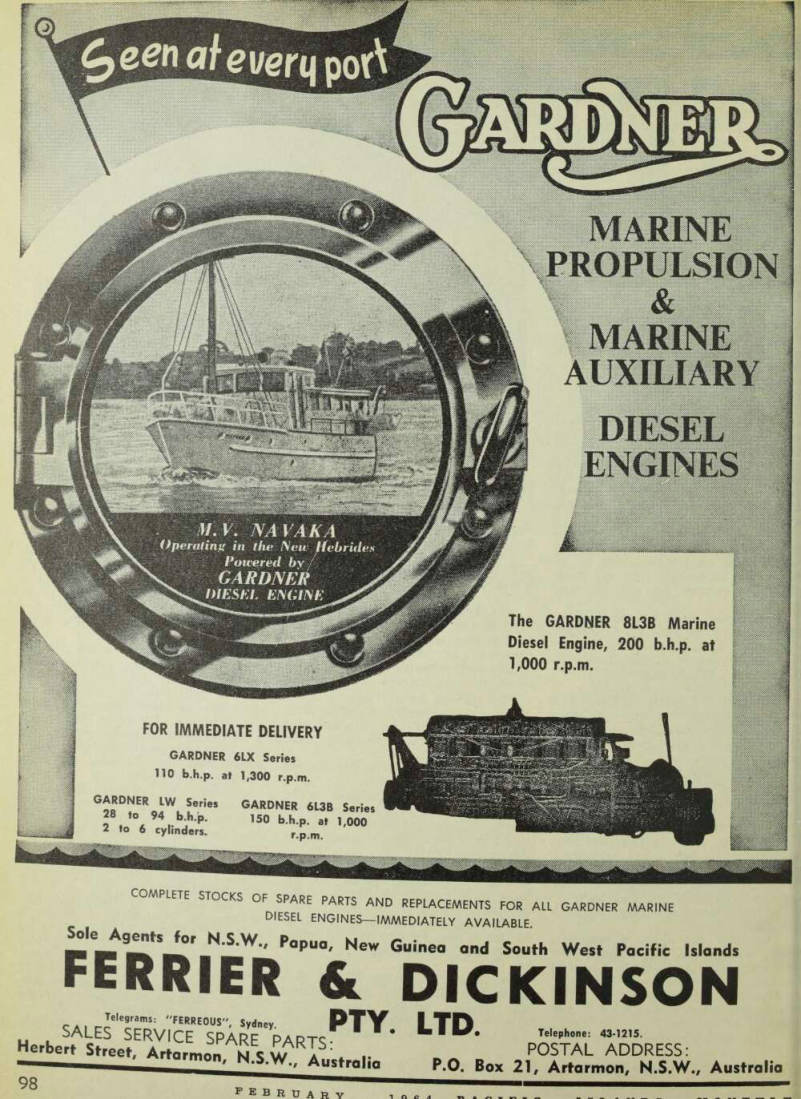 100
100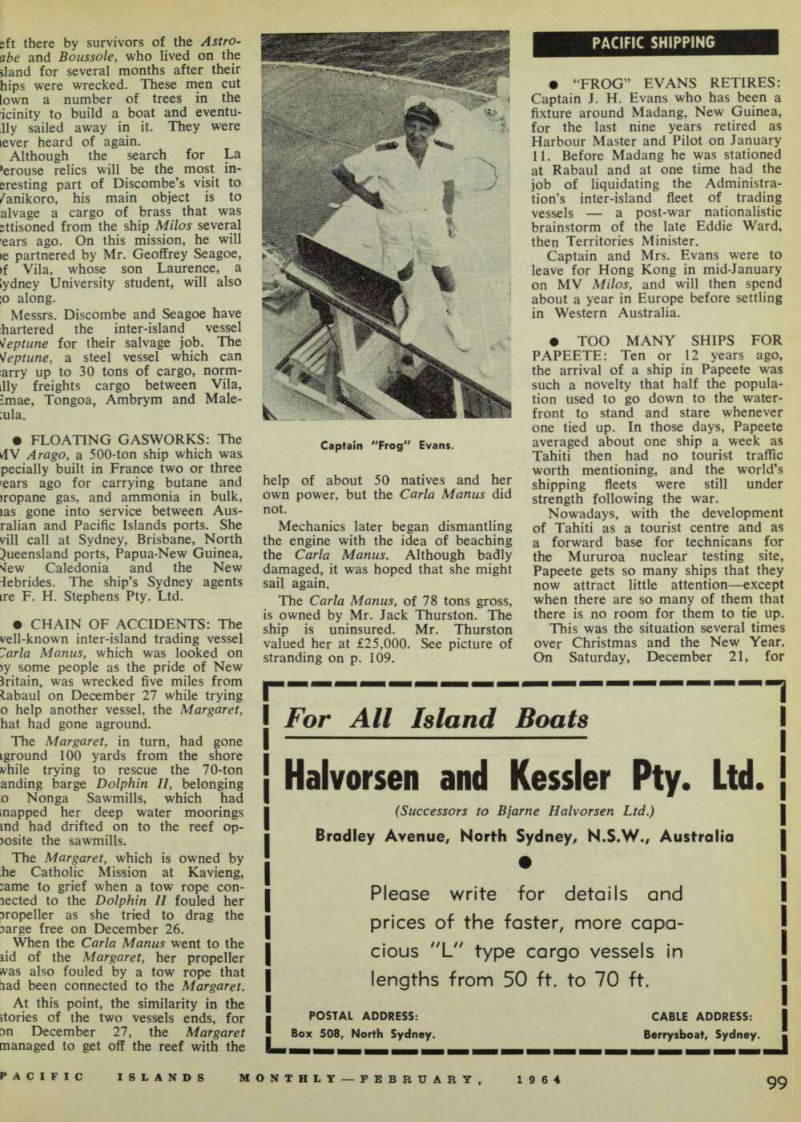 101
101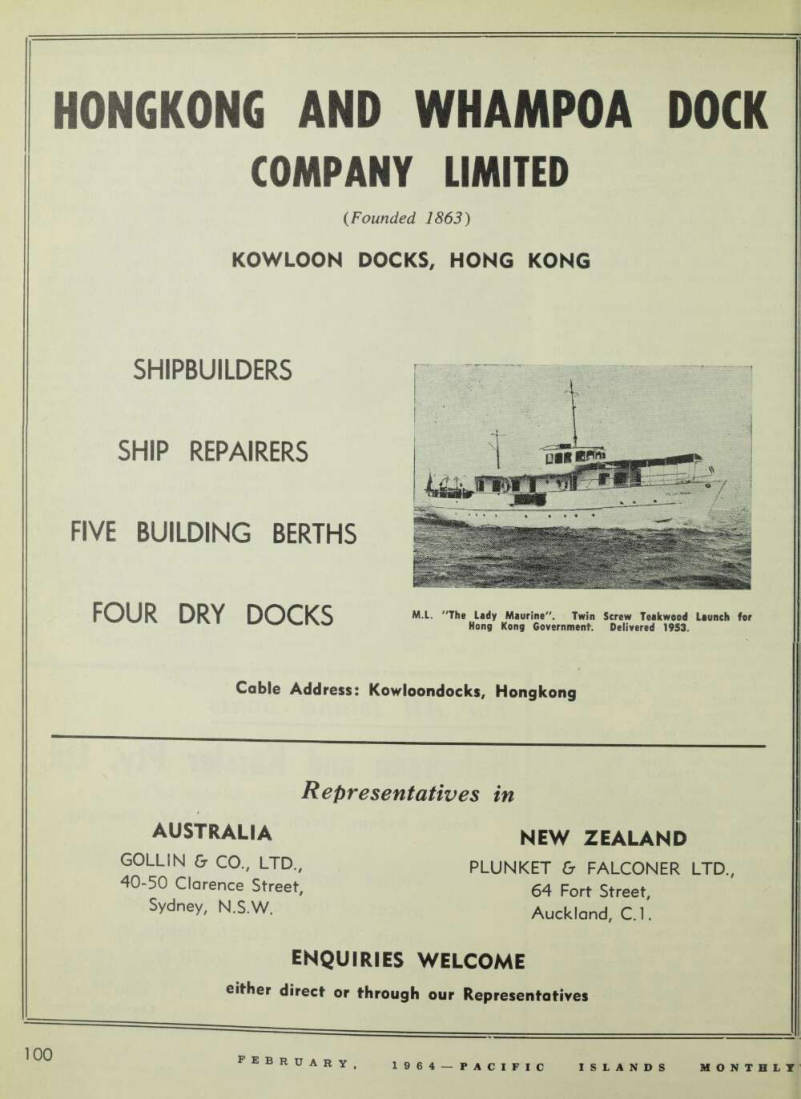 102
102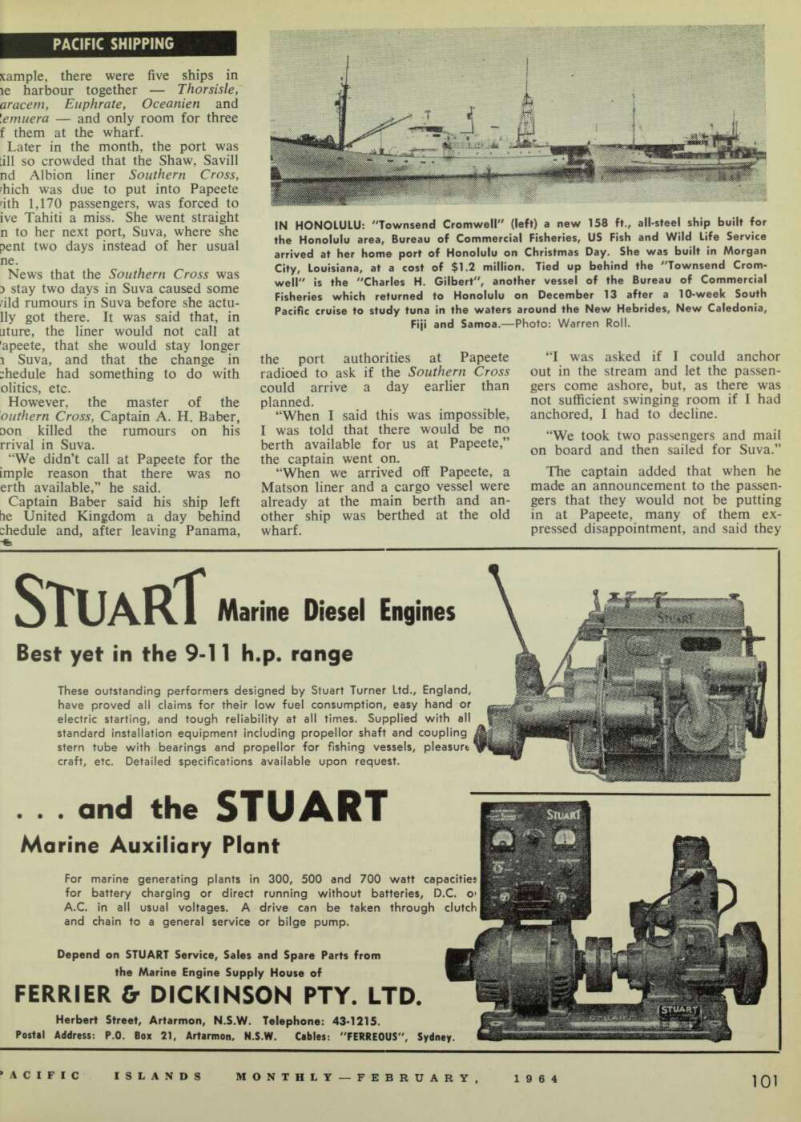 103
103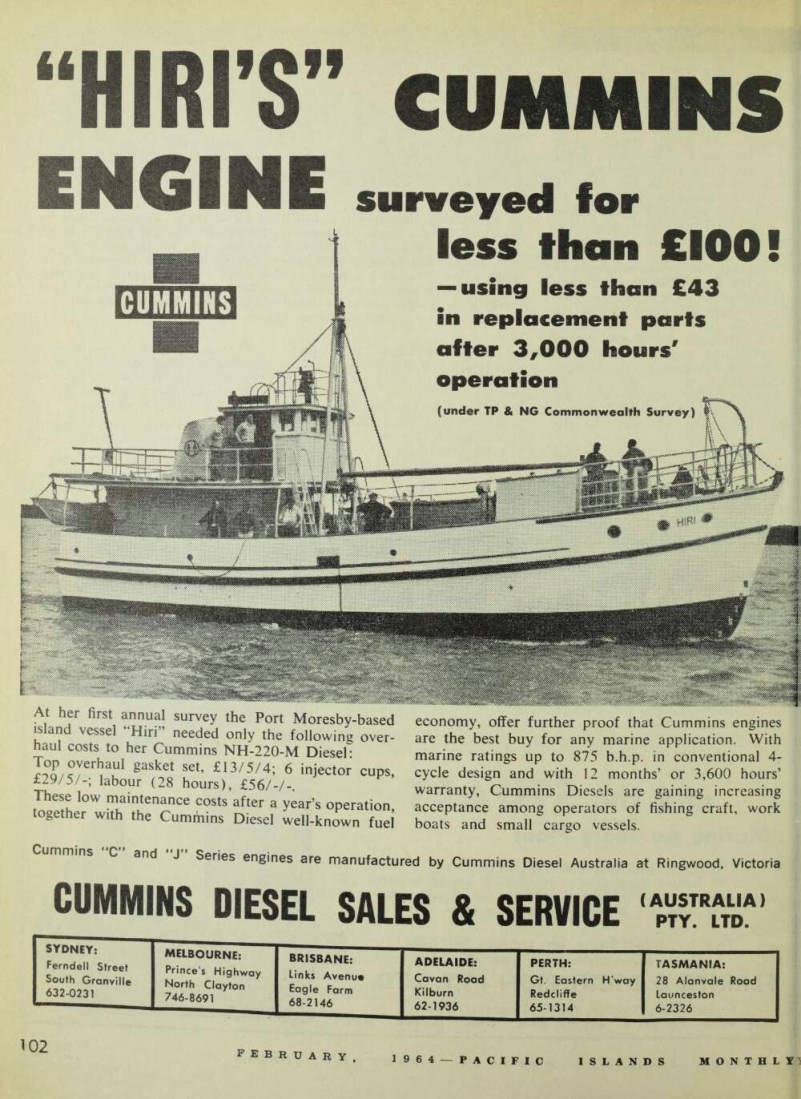 104
104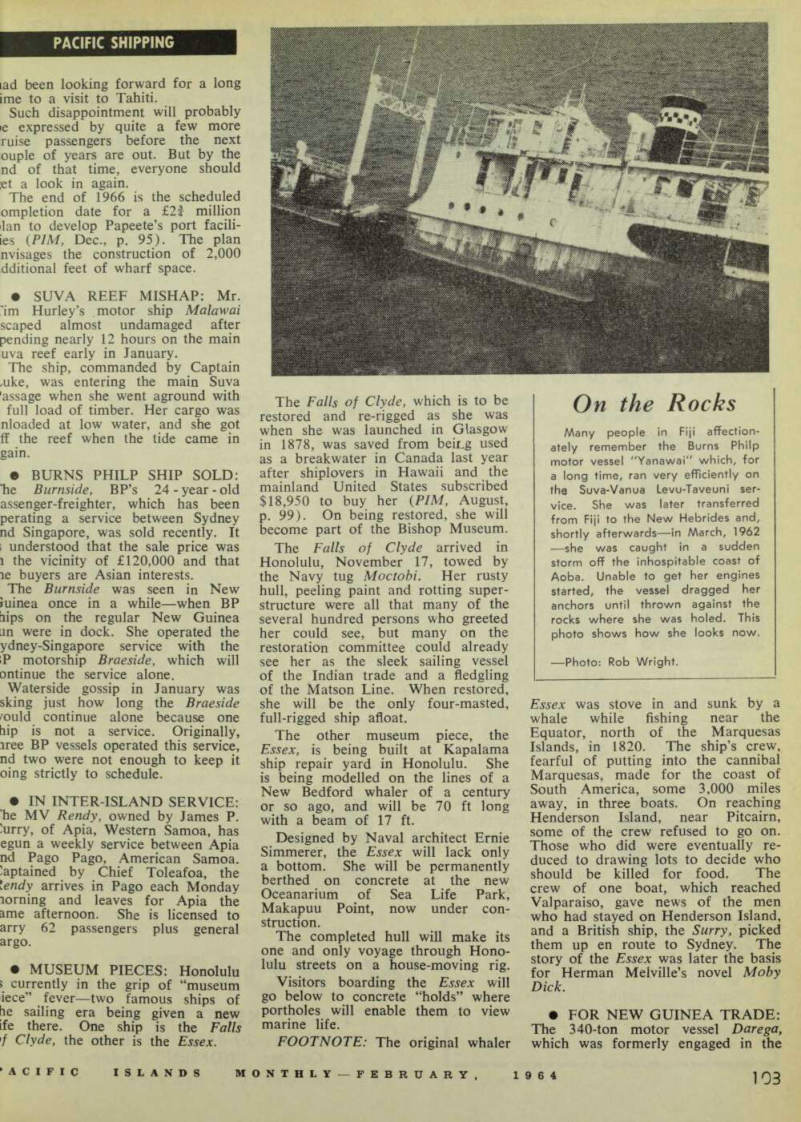 105
105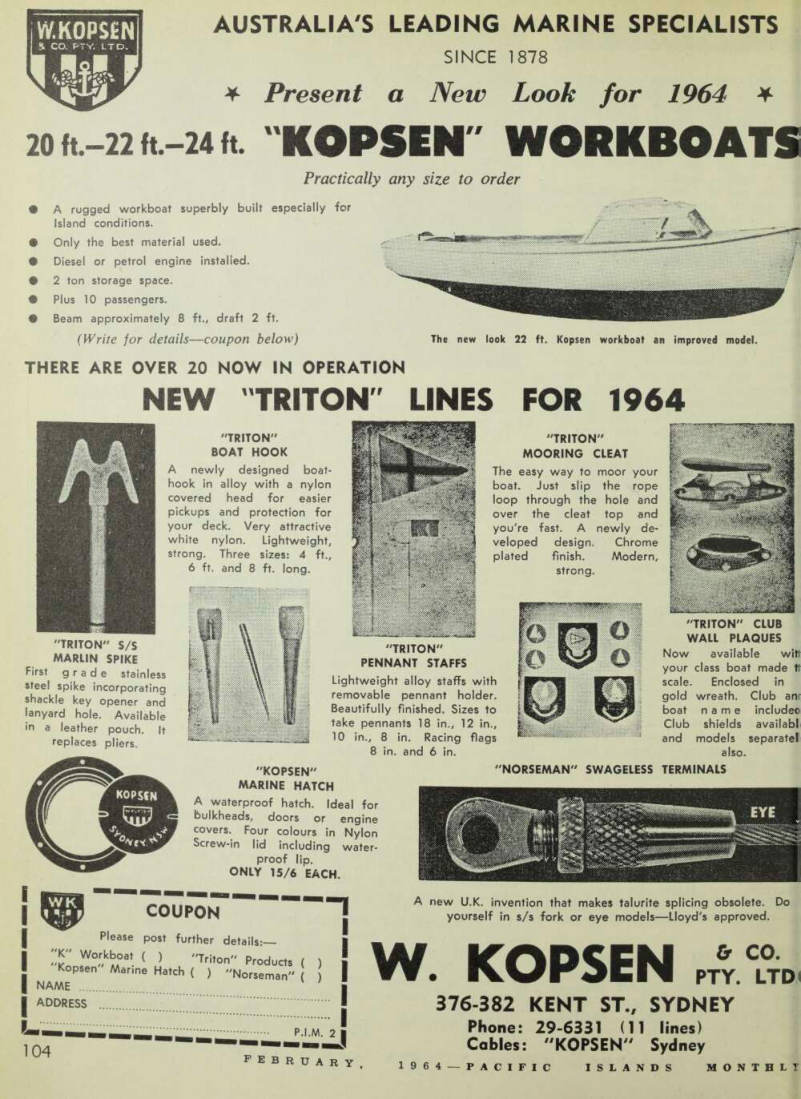 106
106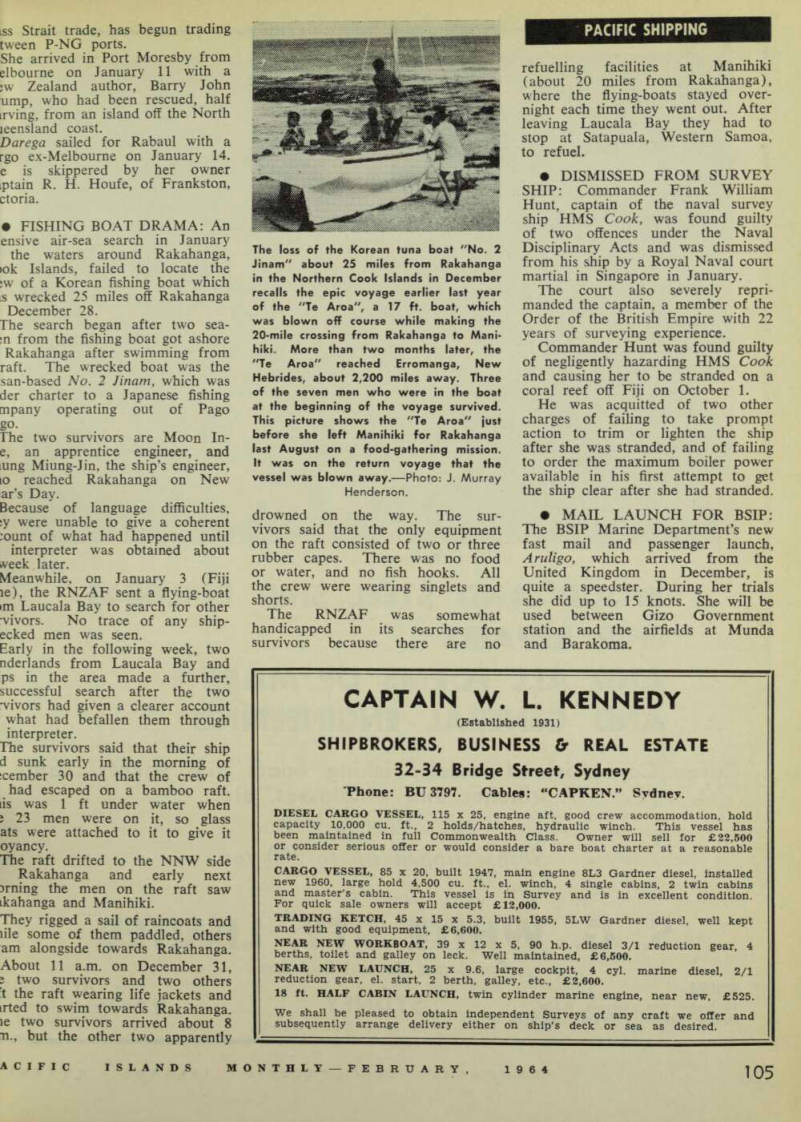 107
107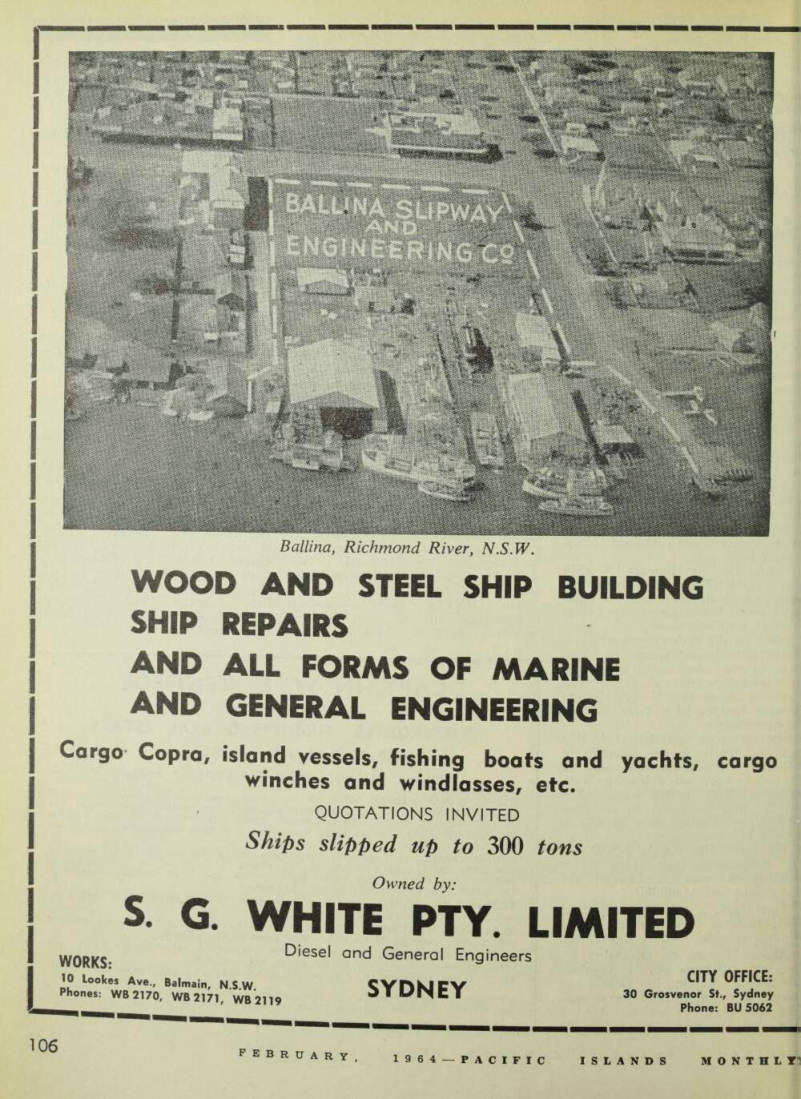 108
108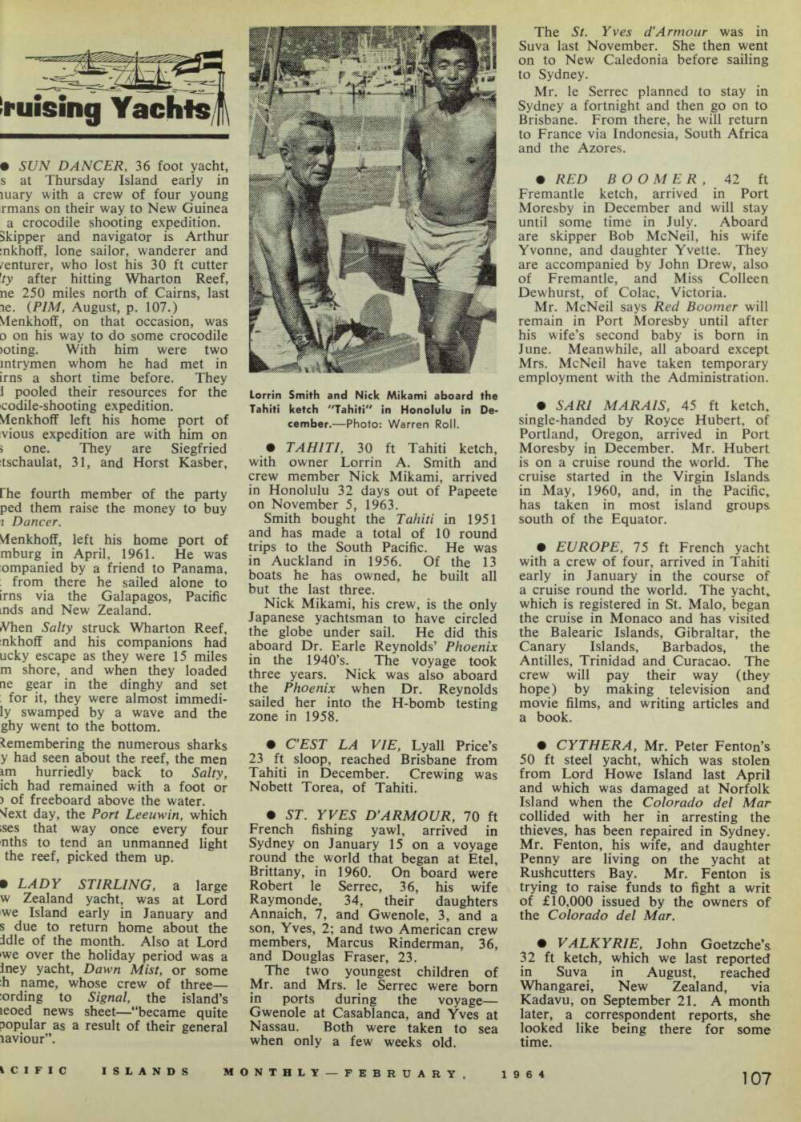 109
109 110
110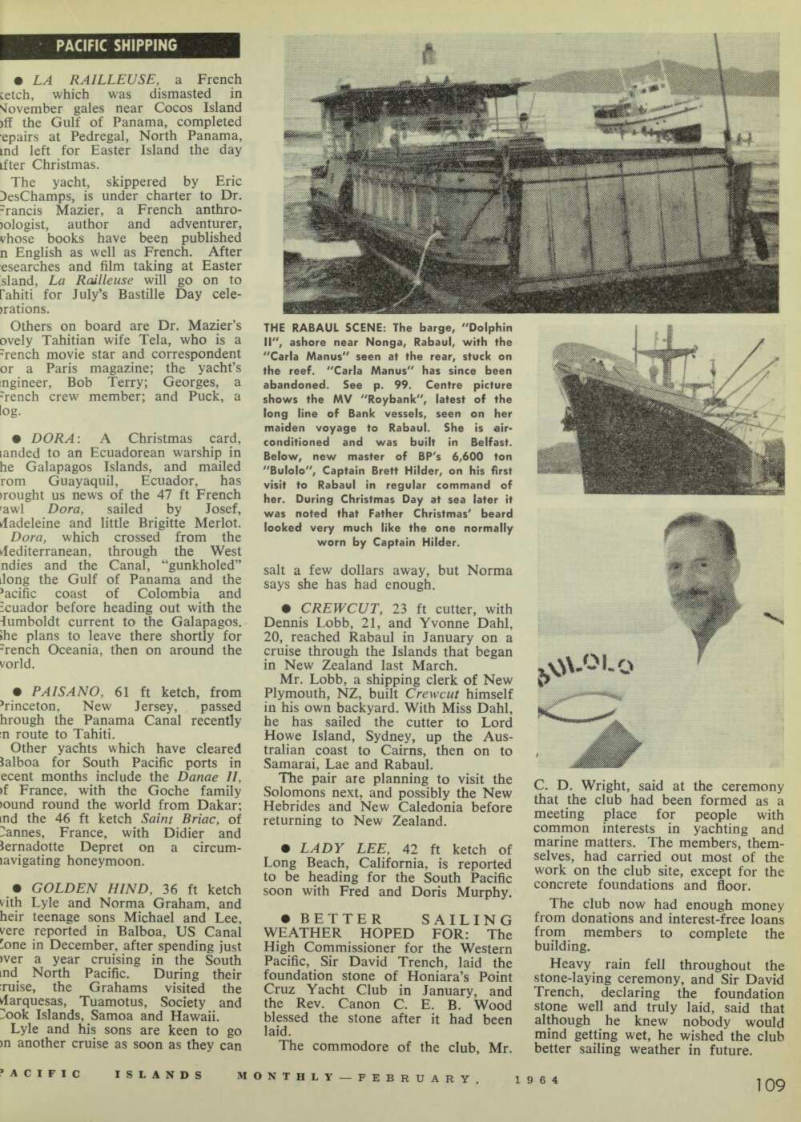 111
111 112
112 113
113 114
114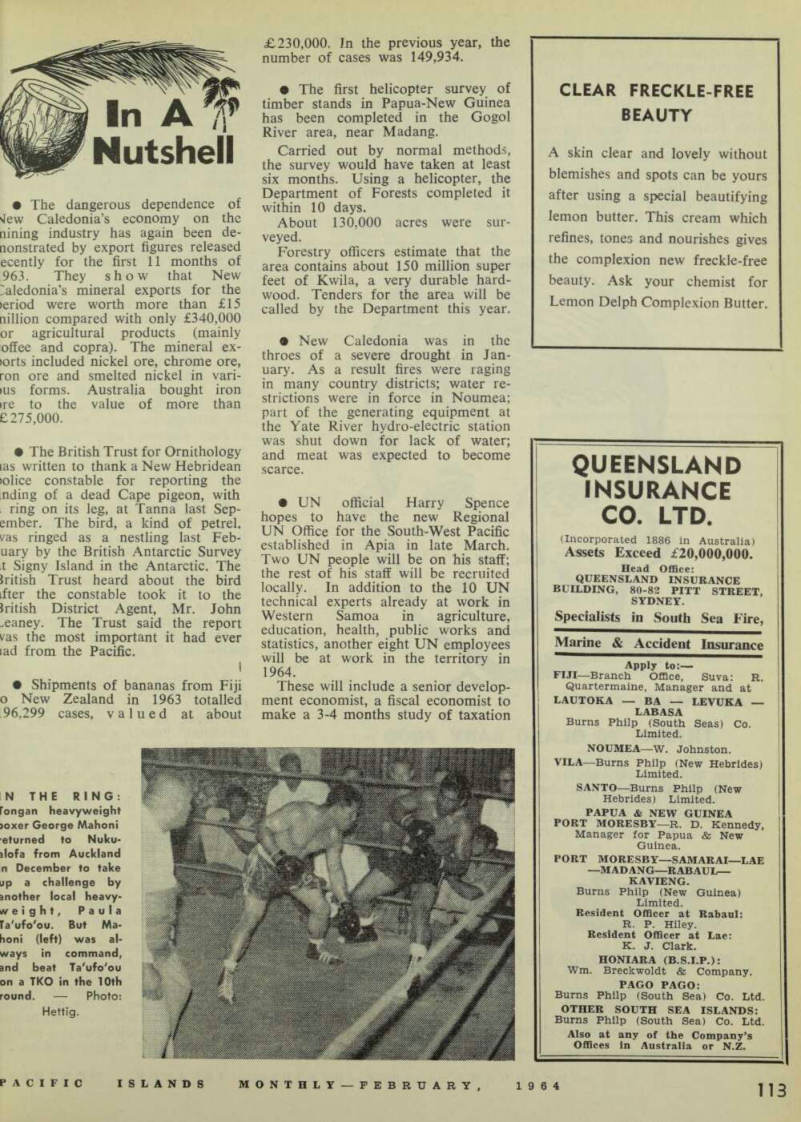 115
115 116
116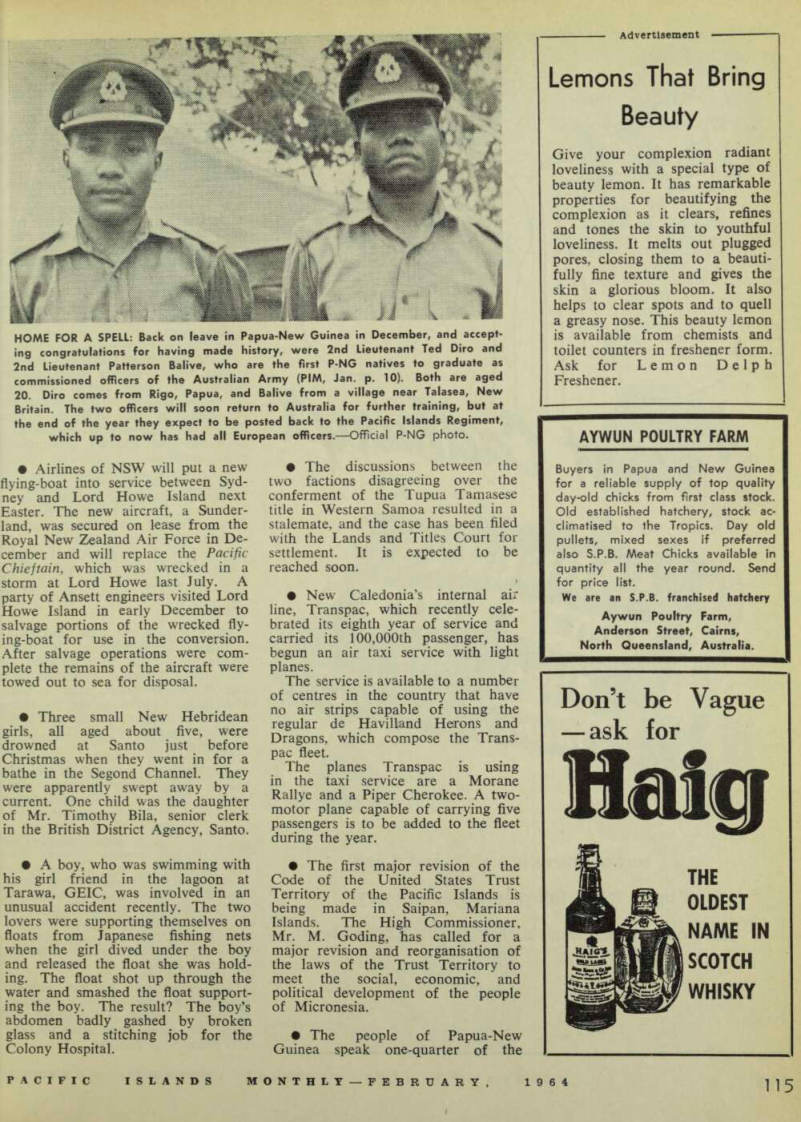 117
117 118
118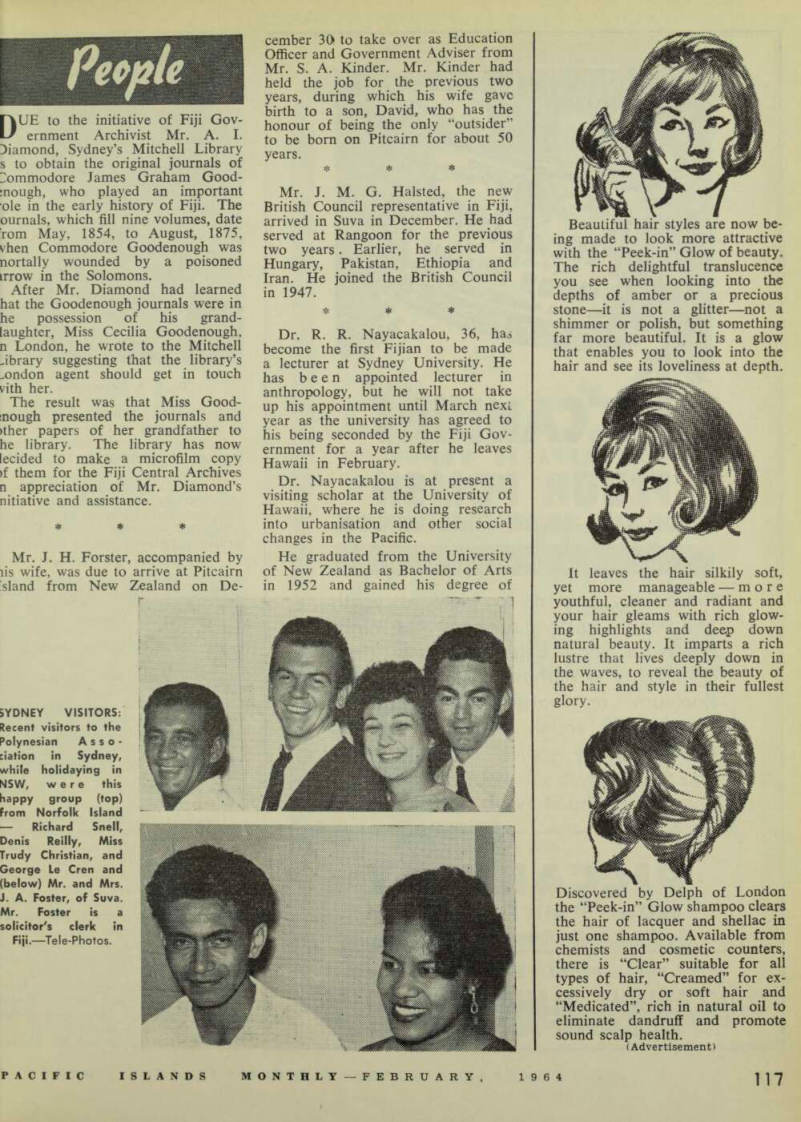 119
119 120
120 121
121 122
122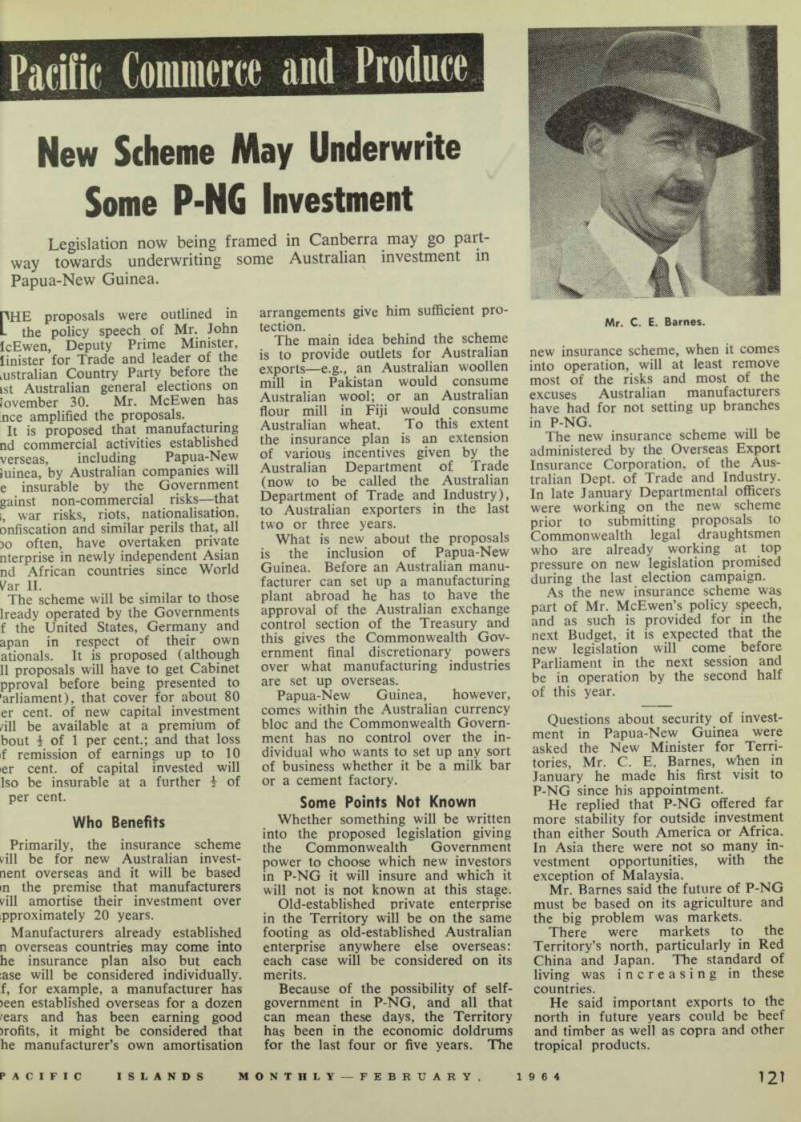 123
123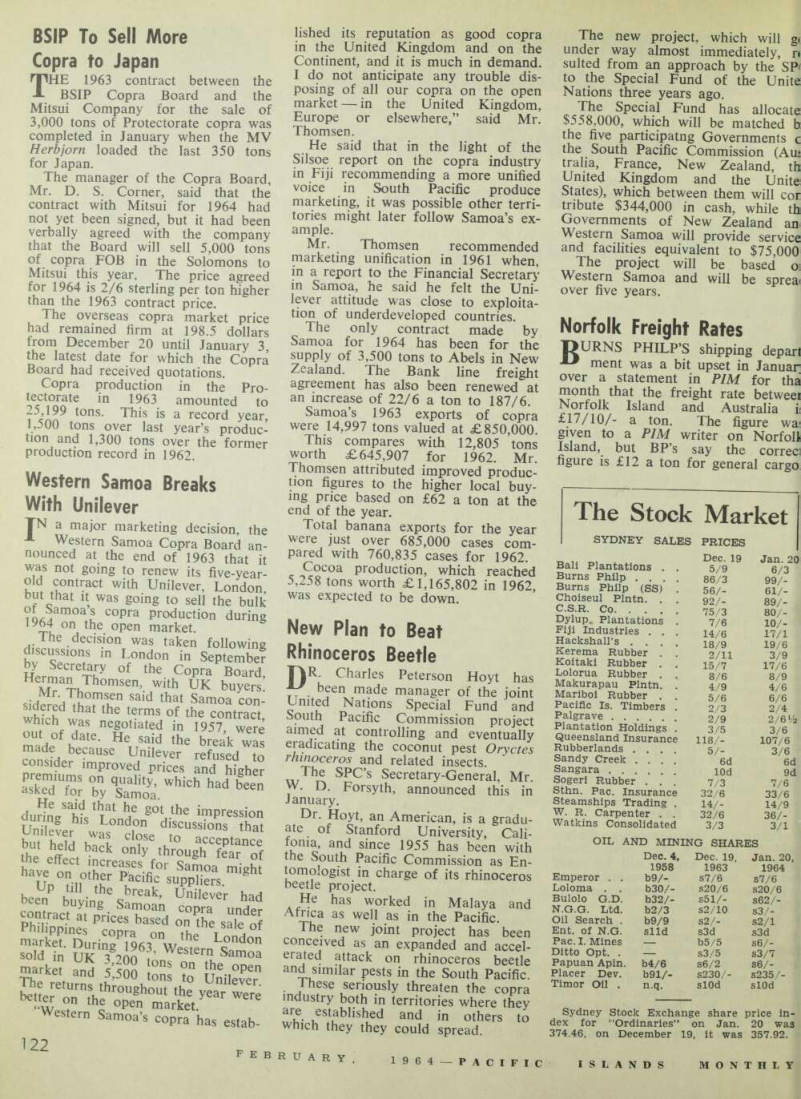 124
124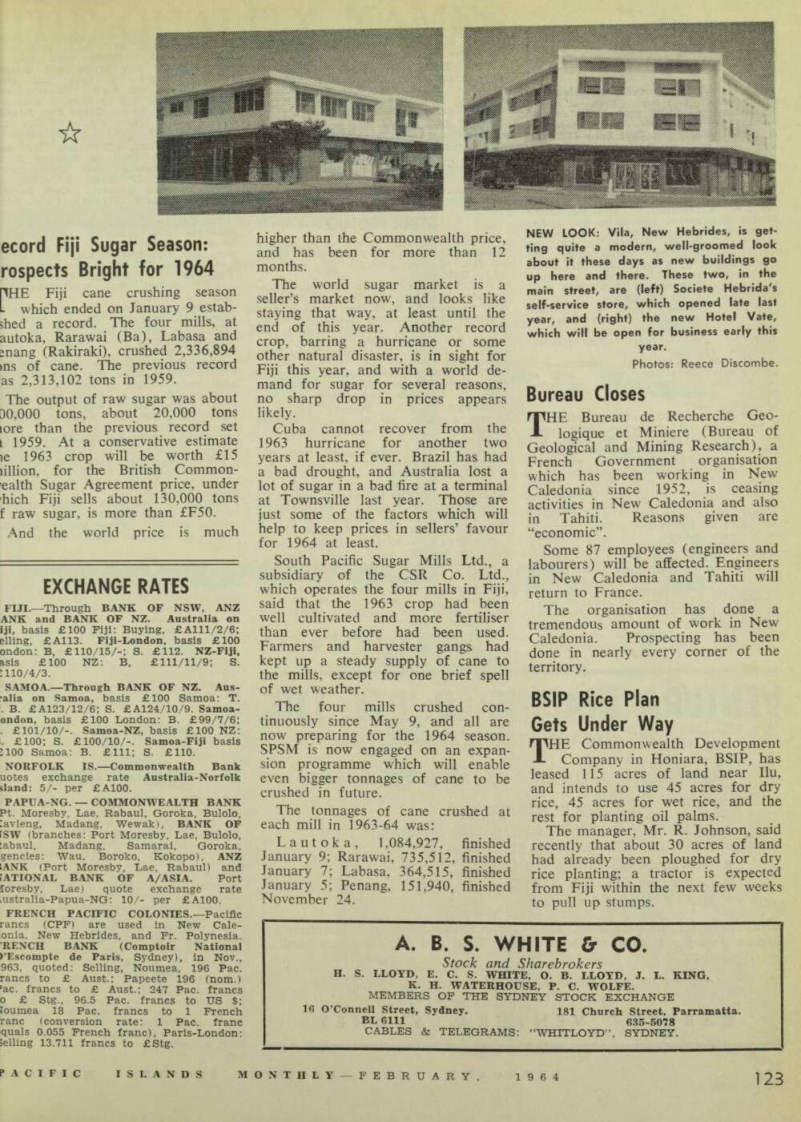 125
125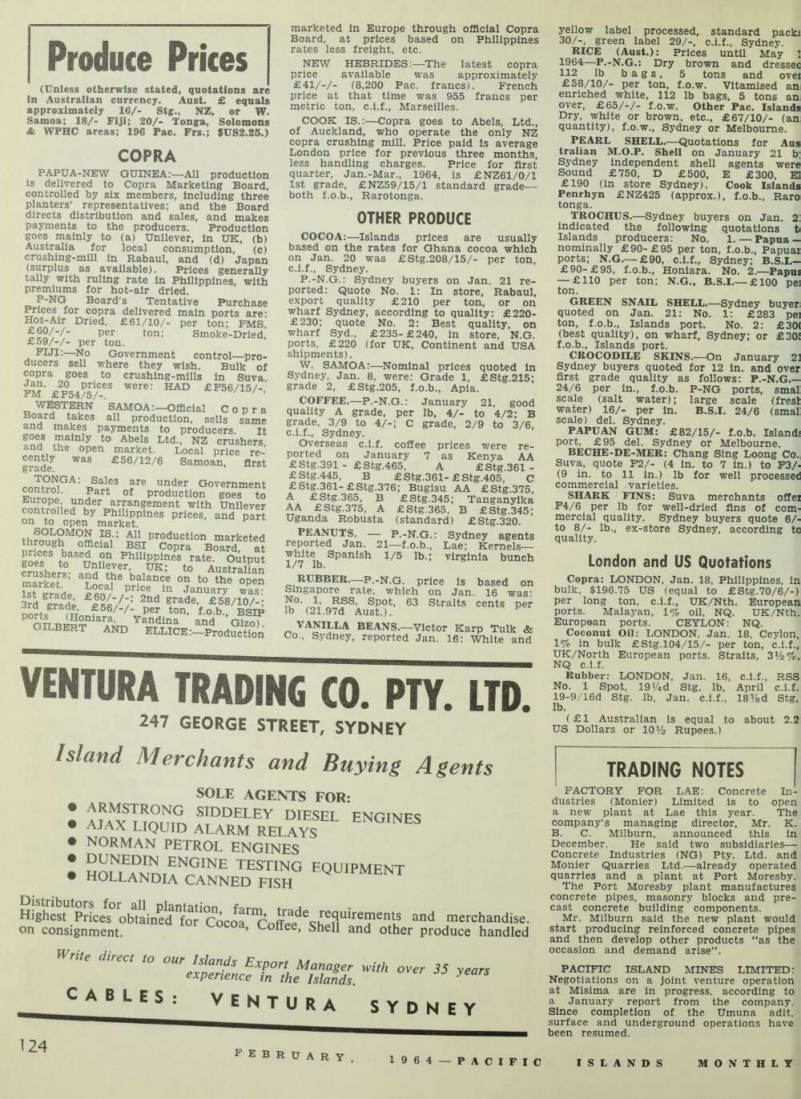 126
126 127
127 128
128 129
129 130
130 131
131 132
132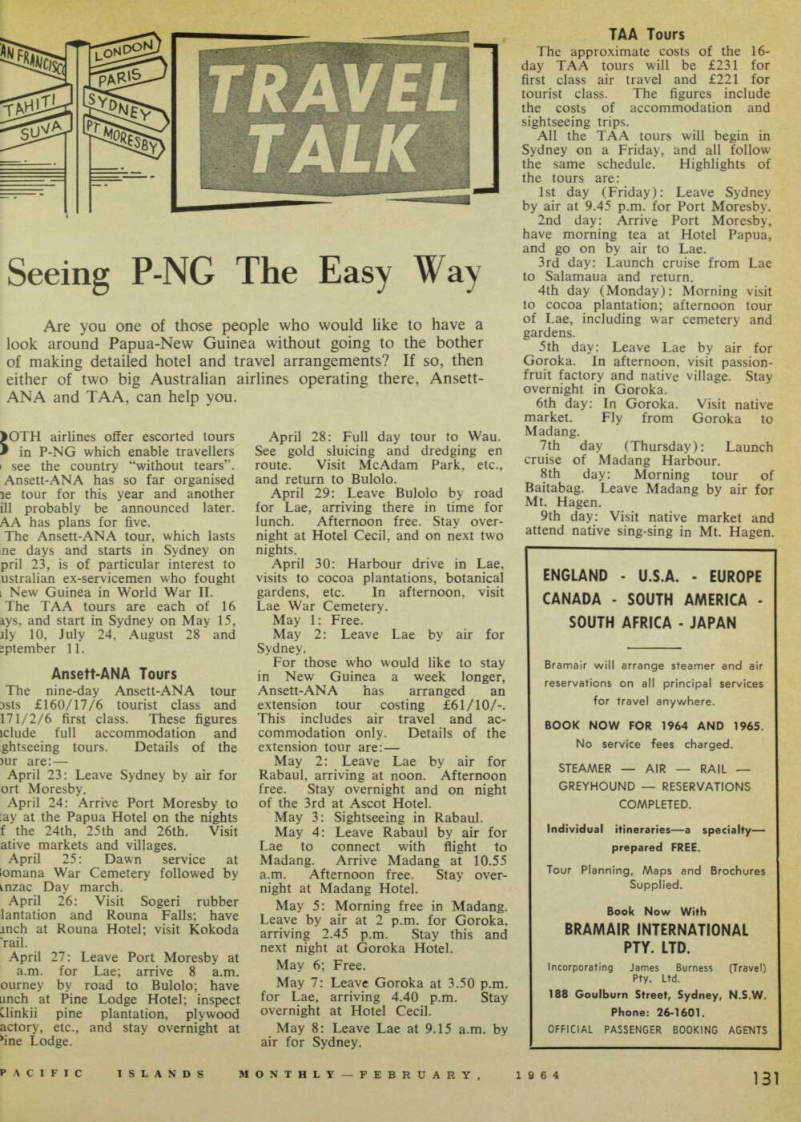 133
133 134
134 135
135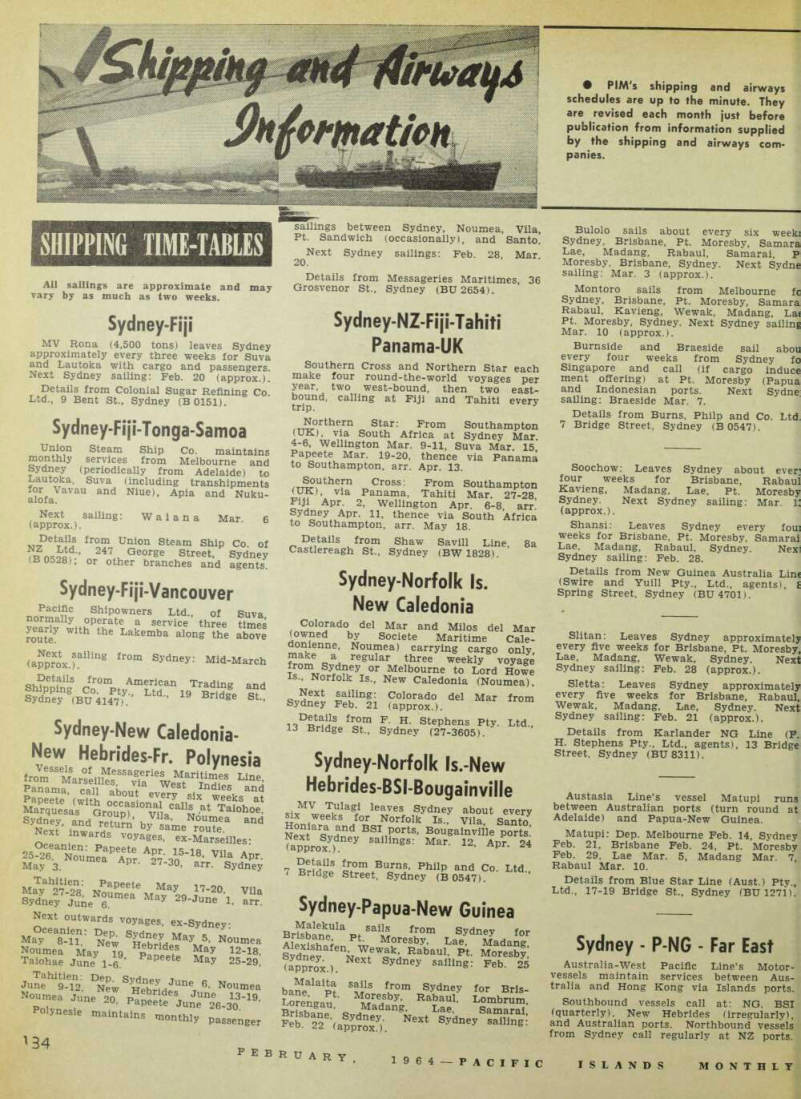 136
136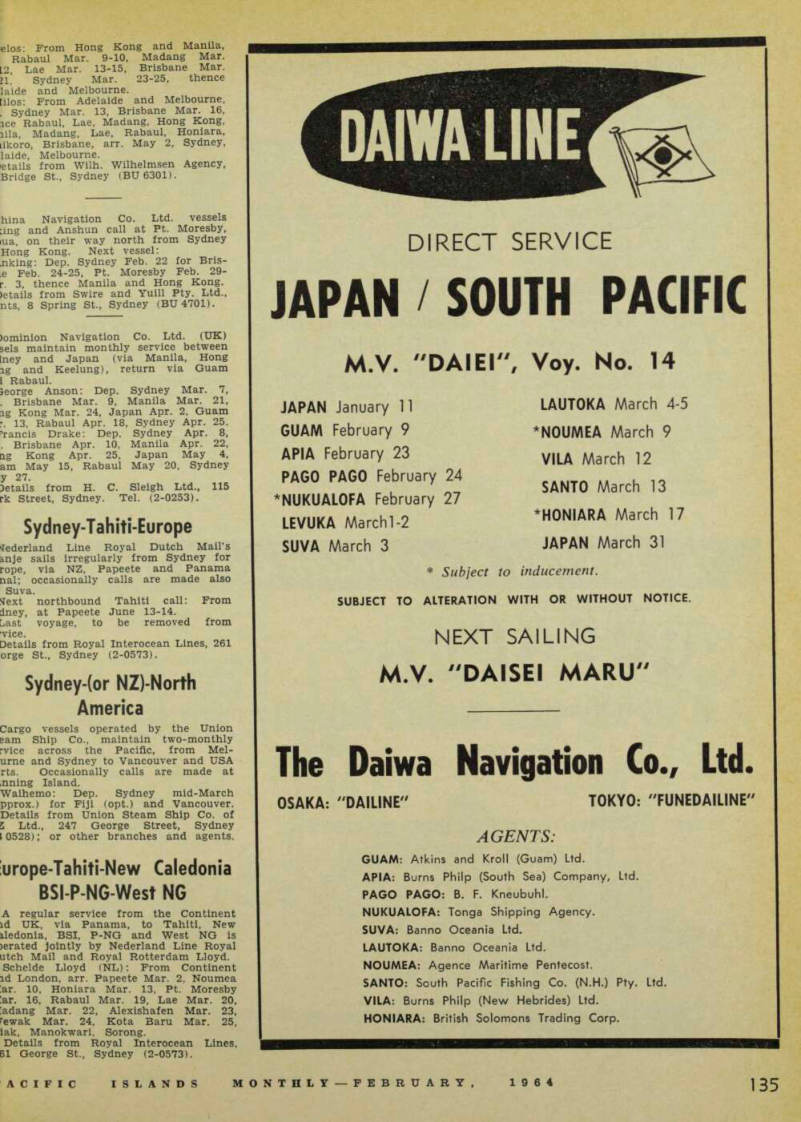 137
137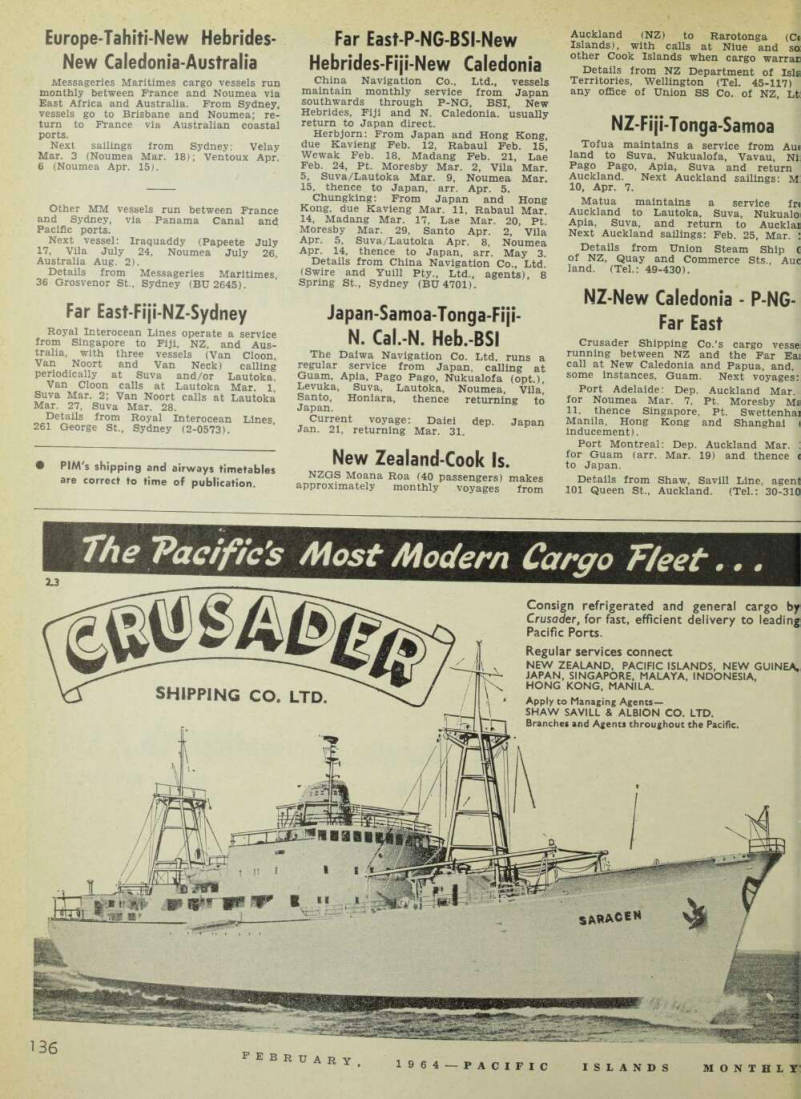 138
138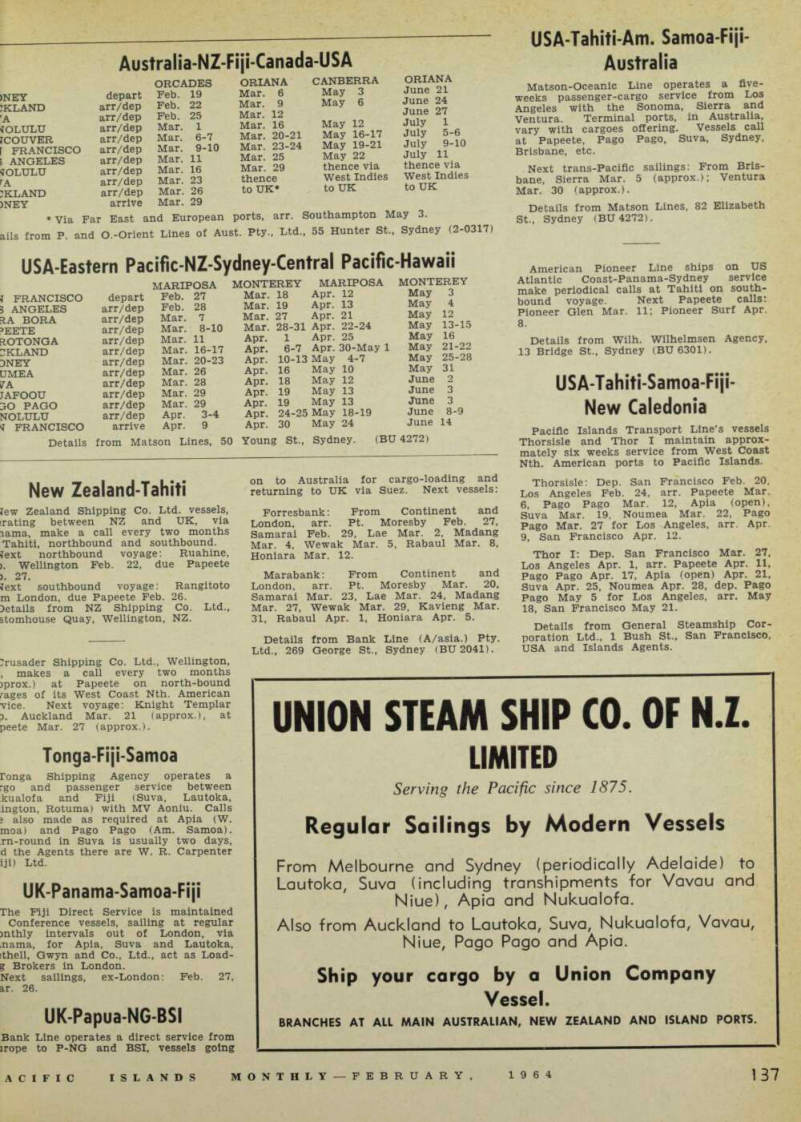 139
139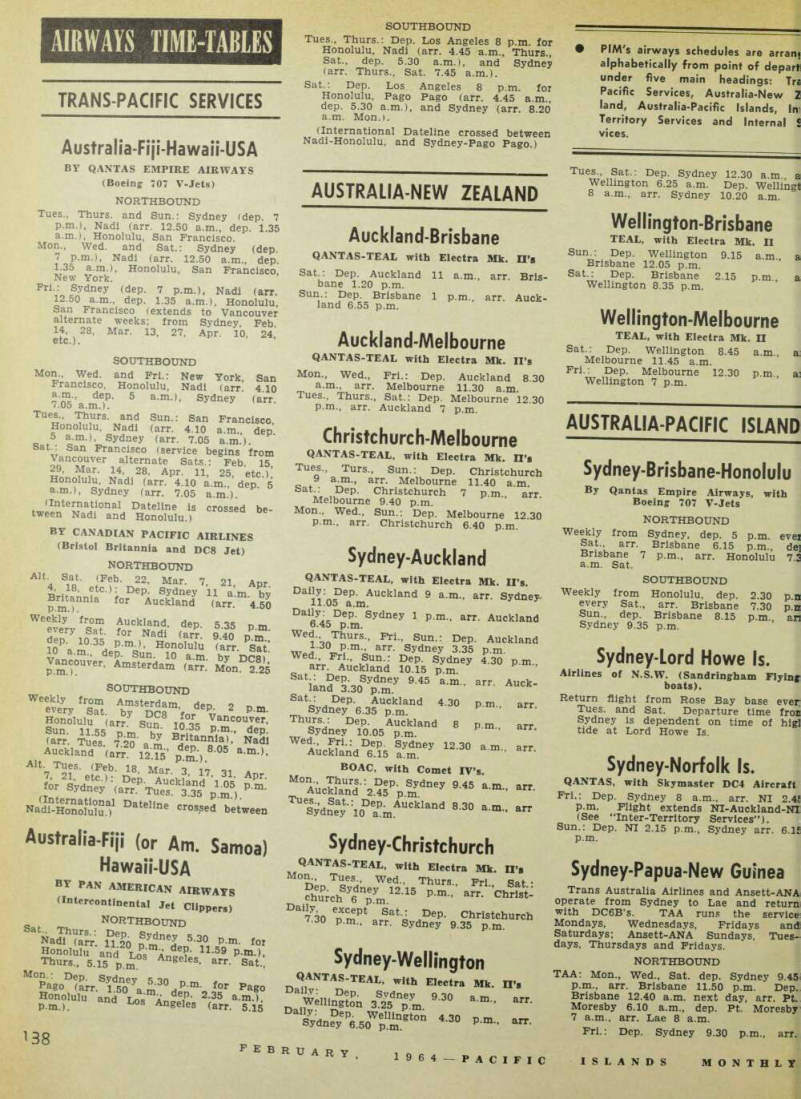 140
140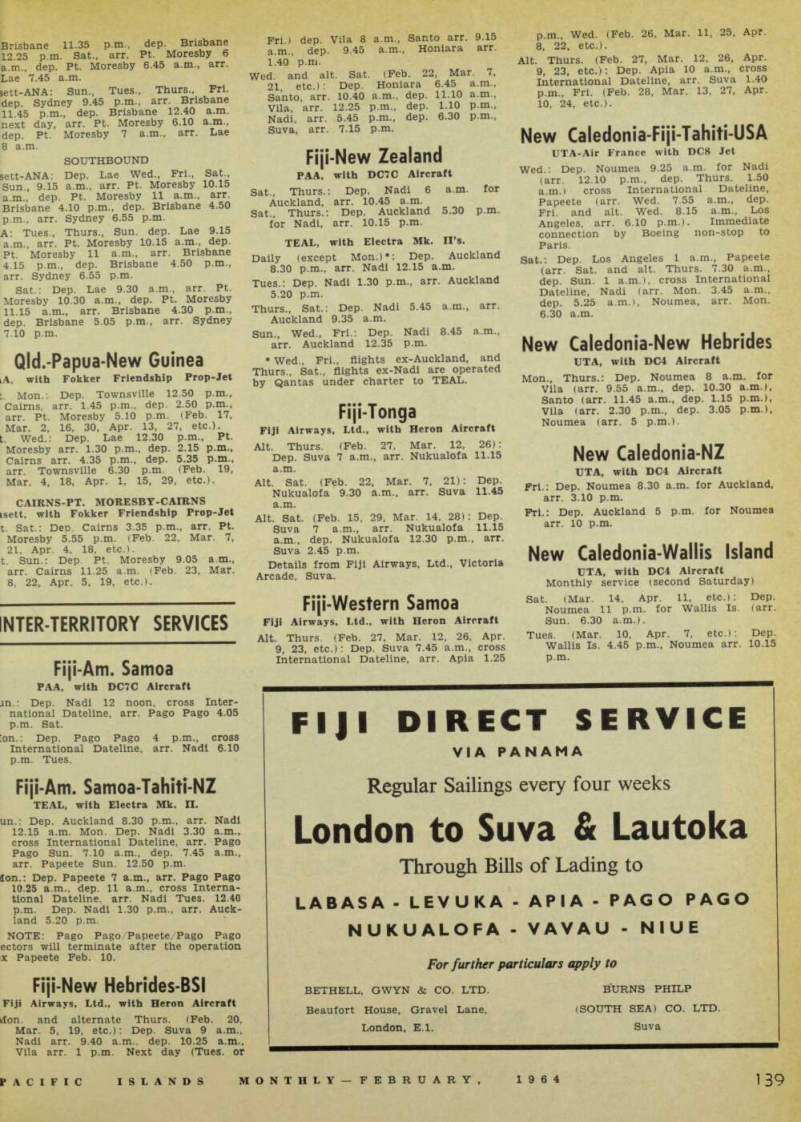 141
141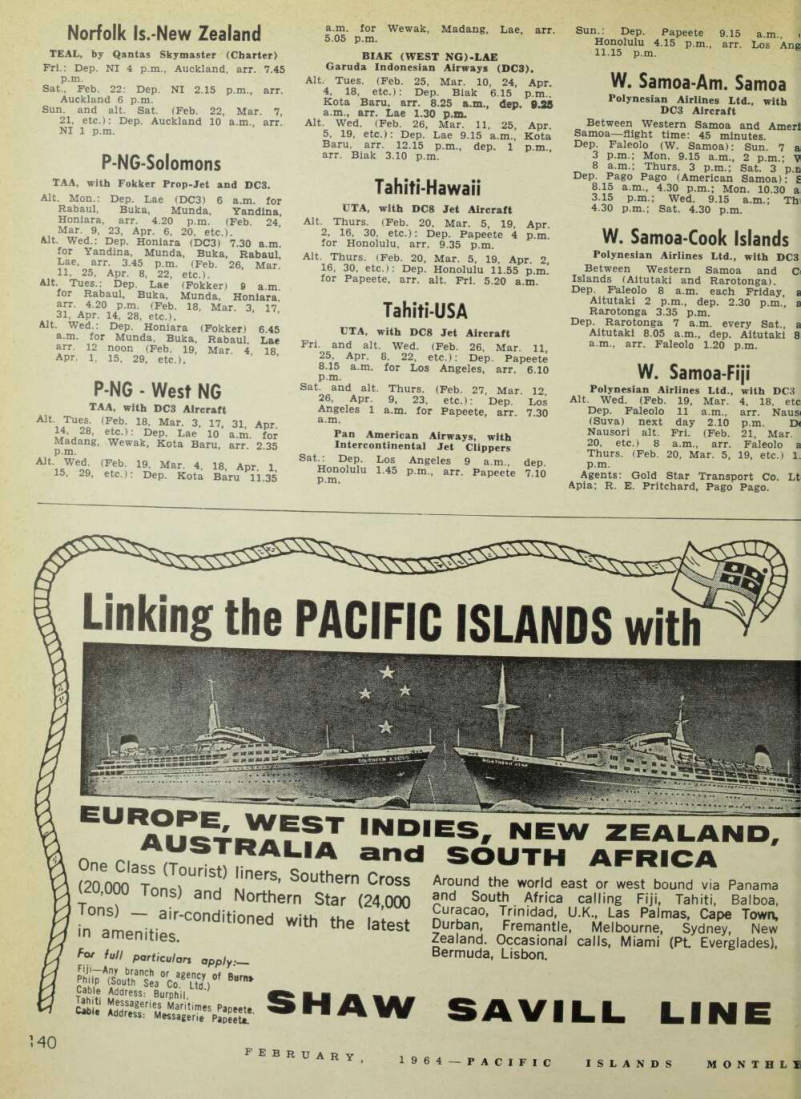 142
142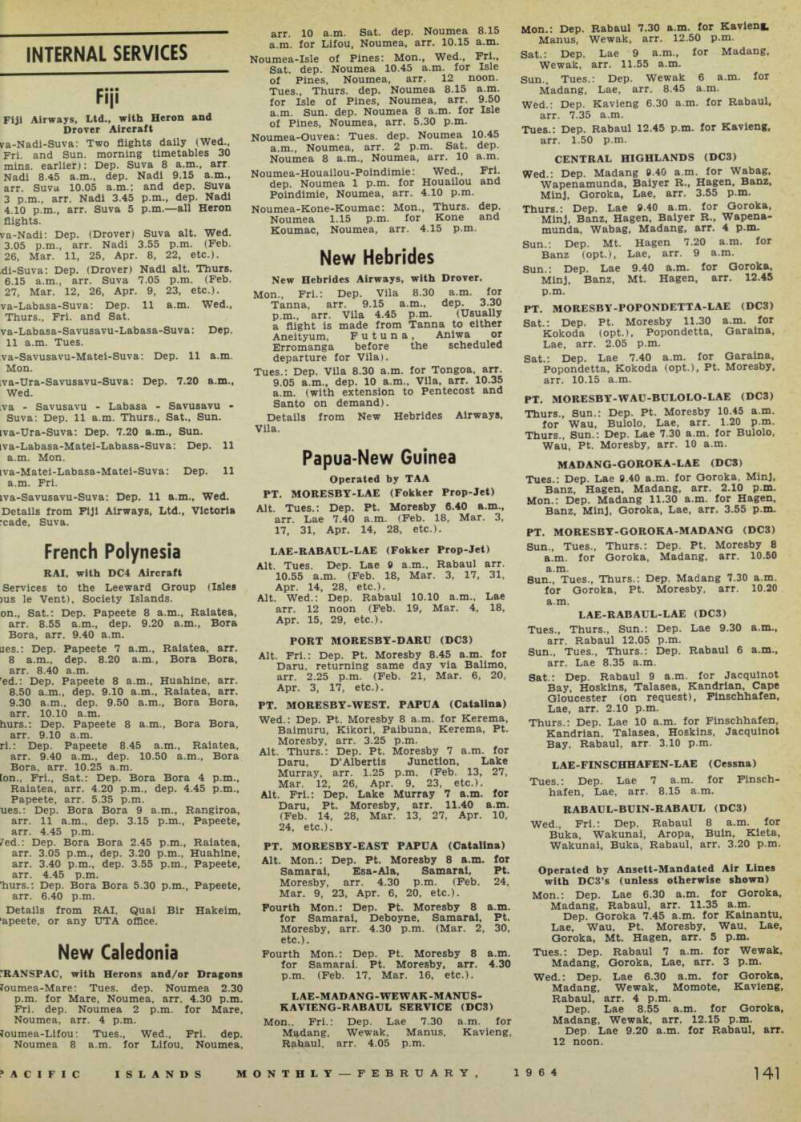 143
143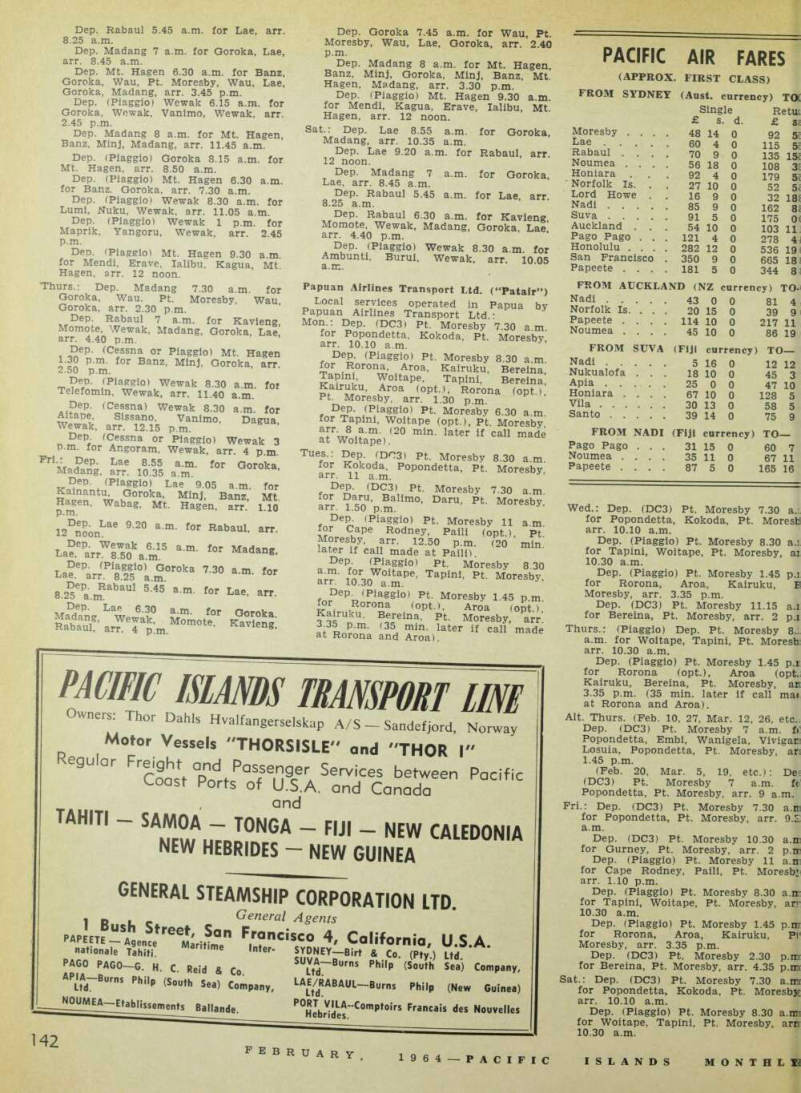 144
144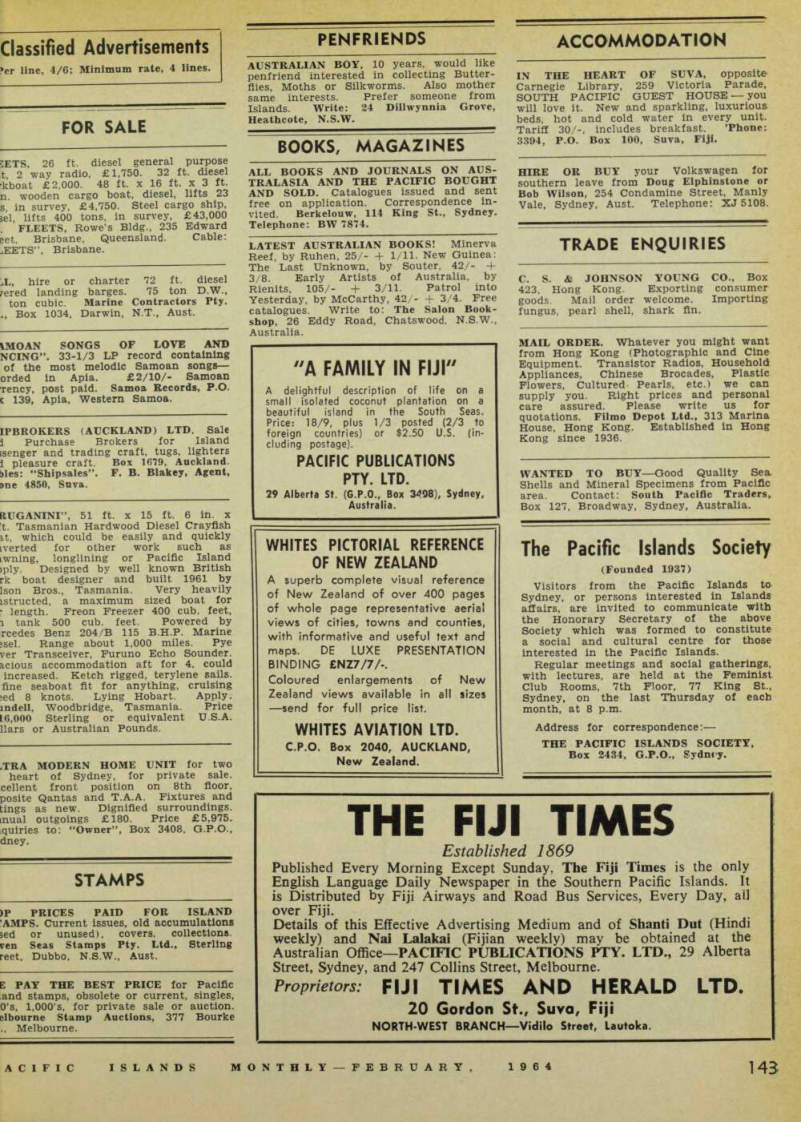 145
145 146
146 147
147 148
148 149
149 150
150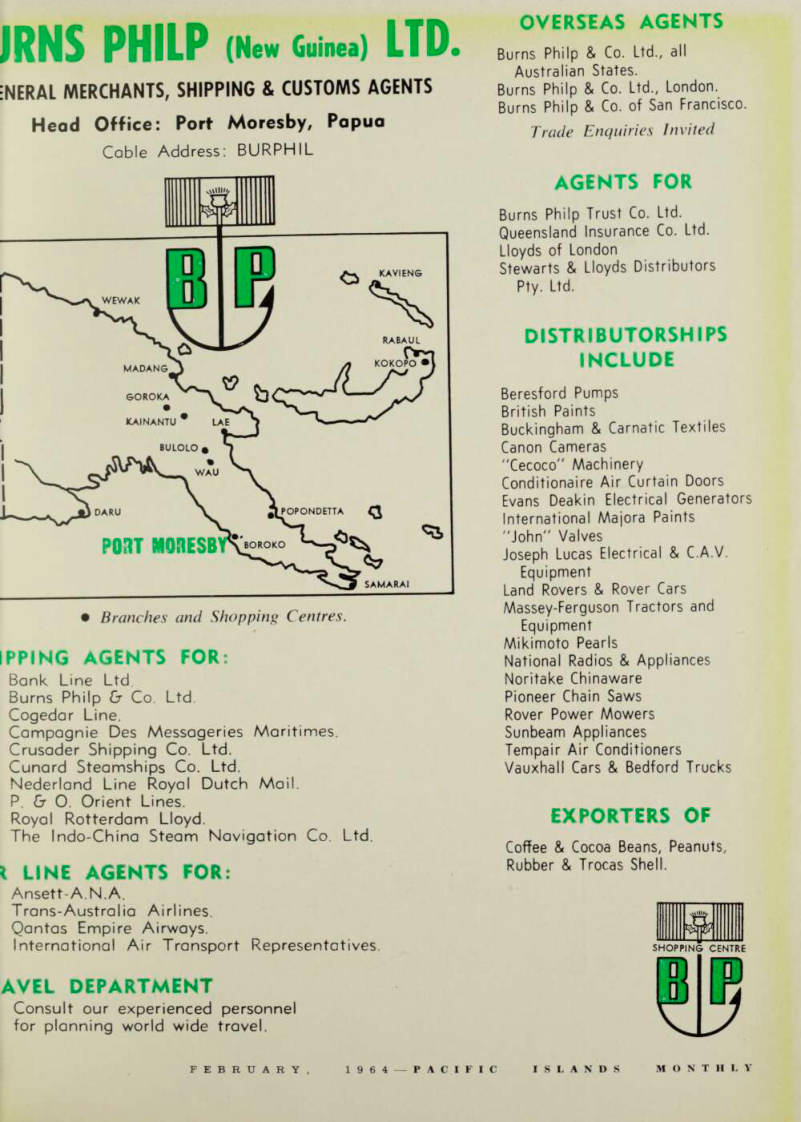 151
151 152
152