Sea-Shells For “Breadfruit” Bligh
p. 85 · Read in the full issue
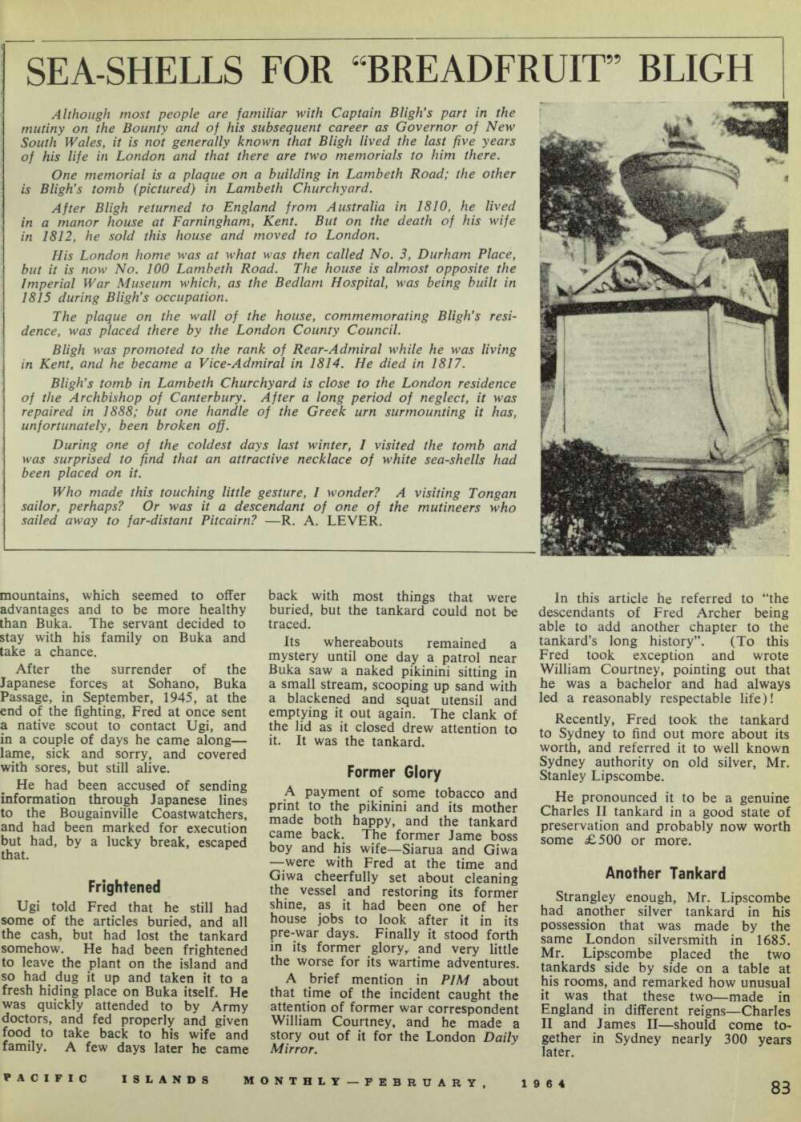
Although most people are familiar with Captain Bligh’s part in the mutiny on the Bounty and of his subsequent career as Governor of New South Wales, it is not generally known that Bligh lived the last five years of his life in London and that there are two memorials to him there.
One memorial is a plaque on a building in Lambeth Road; the other is Bligh’s tomb (pictured) in Lambeth Churchyard.
After Bligh returned to England from Australia in 1810, he lived in a manor house at Farningham, Kent. But on the death of his wife in 1812, he sold this house and moved to London.
His London home was at what was then called No. 3, Durham Place, but it is now No. 100 Lambeth Road. The house is almost opposite the Imperial War Museum which, as the Bedlam Hospital, was being built in 1815 during Bligh’s occupation.
The plaque on the wall of the house, commemorating Bligh’s resi dence, was placed there by the London County Council.
Bligh was promoted to the rank of Rear-Admiral while he was living in Kent, and he became a Vice-Admiral in 1814. He died in 1817.
Bligh’s tomb in Lambeth Churchyard is close to the London residence of the Archbishop of Canterbury. After a long period of neglect, it was repaired in 1888; but one handle of the Greek urn surmounting it has, unfortunately, been broken off.
During one of the coldest days last winter, I visited the tomb and was surprised to find that an attractive necklace of white sea-shells had been placed on it.
Who made this touching little gesture, I wonder? A visiting Tongan sailor, perhaps? Or was it a descendant of one of the mutineers who
sailed away to far-distant Pitcairn?