Tale Of A
pp. 84-85 · Read in the full issue
Tankard
Old New Guinea-hand Fred Archer, formerly the owner of Jame Island, off the coast of Buka, Bougainville, and now a Rabaul resident, tells the tale of a silver tankard.
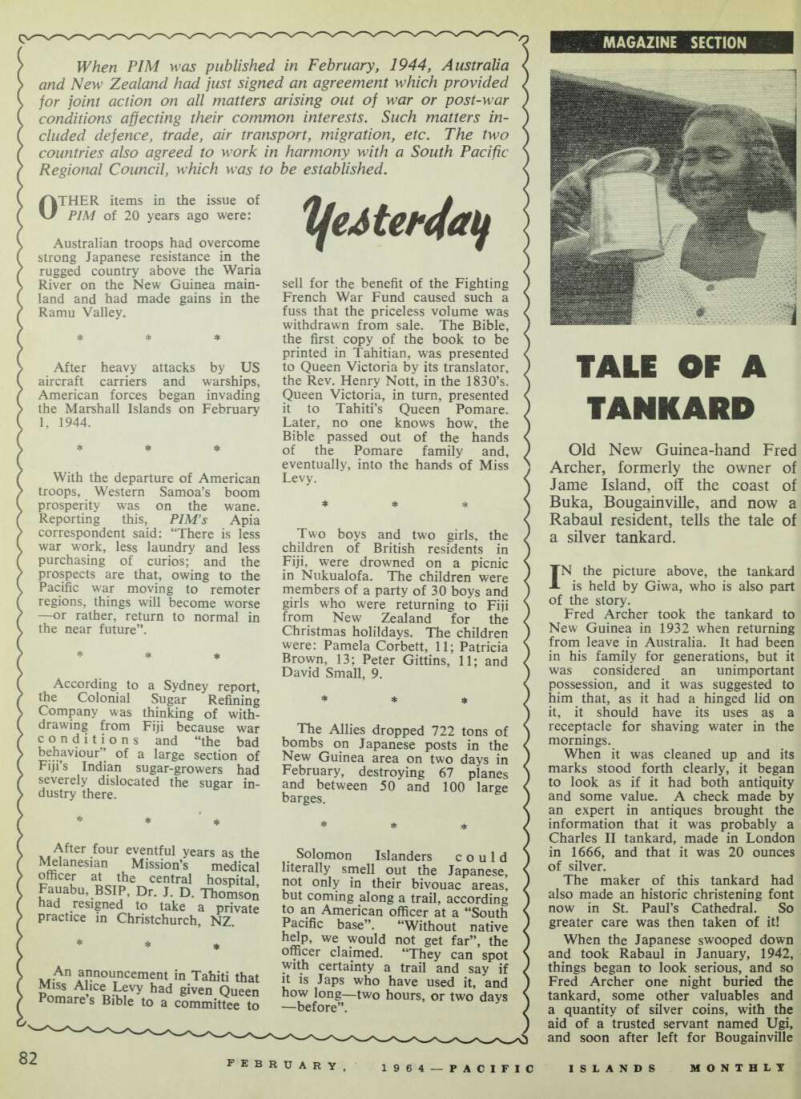
IN the picture above, the tankard is held by Giwa, who is also part of the story.
Fred Archer took the tankard to New Guinea in 1932 when returning from leave in Australia. It had been in his family for generations, but it was considered an unimportant possession, and it was suggested to him that, as it had a hinged lid on it, it should have its uses as a receptacle for shaving water in the mornings.
When it was cleaned up and its marks stood forth clearly, it began to look as if it had both antiquity and some value. A check made by an expert in antiques brought the information that it was probably a Charles II tankard, made in London in 1666, and that it was 20 ounces of silver.
The maker of this tankard had also made an historic christening font now in St. Paul’s Cathedral. So greater care was then taken of it!
When the Japanese swooped down and took Rabaul in January, 1942, things began to look serious, and so Fred Archer one night buried the tankard, some other valuables and a quantity of silver coins, with the aid of a trusted servant named Ugi, and soon after left for Bougainville
mountains, which seemed to offer advantages and to be more healthy than Buka. The servant decided to stay with his family on Buka and take a chance.
After the surrender of the Japanese forces at Sohano, Buka Passage, in September, 1945, at the end of the fighting, Fred at once sent a native scout to contact Ugi, and in a couple of days he came along— lame, sick and sorry, and covered with sores, but still alive.
He had been accused of sending
to Ooastwatchers!
and had been marked for execution but had, by a iucky break, escaped -. , , Frightened Ugi told Fred that he still had some of the articles buried, and all the cash, but had lost the tankard somehow. He had been frightened to leave the plant on the island and so had dug it up and taken it to a fresh hiding place on Buka itself. He was quickly attended to by Army doctors, and fed properly and given food to take back to his wife and family. A few days later he came
back with most things that were buried, but the tankard could not be traced.
Its whereabouts remained a mystery until one day a patrol near Buka saw a naked pikinini sitting in a small stream, scooping up sand with a blackened and squat utensil and emptying it out again. The clank of the lid as it closed drew attention to it. It was the tankard,
Former Glory
A r, QVrnorit . ,
‘bot'h^appy^and^the'
” a “ h b °‘ h h^%^J h I *J* n P rd
wife-Siarua anTc,^
—were with Fred at the time and Giwa cheerfully set about cleaning the vessel and restoring its former shine, as it had been one of her house jobs to look after it in its pre-war days. Finally it stood forth m its former glory T and very little tlle worse for its wartime adventures, A brief mention in PIM about that time of the incident caught the attention of former war correspondent William Courtney, and he made a story out of it for the London Daily Mirror.
In this article he referred to “the descendants of Fred Archer being able to add another chapter to the tankard’s long history”. (To this Fred took exception and wrote William Courtney, pointing out that he was a bachelor and had always led a reasonably respectable life)!
Recently, Fred took the tankard to Sydney to find out more about its worth, and referred it to well known Sydney authority on old silver, Mr.
Stanley Lipscombe.
He pronounced it to be a genuine Charles II tankard in a good state of preservation and probably now worth some £5OO or more.
Another Tankard Strangley enough, Mr. Lipscombe had another silver tankard in his possession that was made by the same London silversmith in 1685.
Mr. Lipscombe placed the two tankards side by side on a table at his rooms, and remarked how unusual it was that these two—made in England in different reigns—Charles II and James ll—should come to gether in Sydney nearly 300 years later.