James Of
pp. 73-74 · Read in the full issue
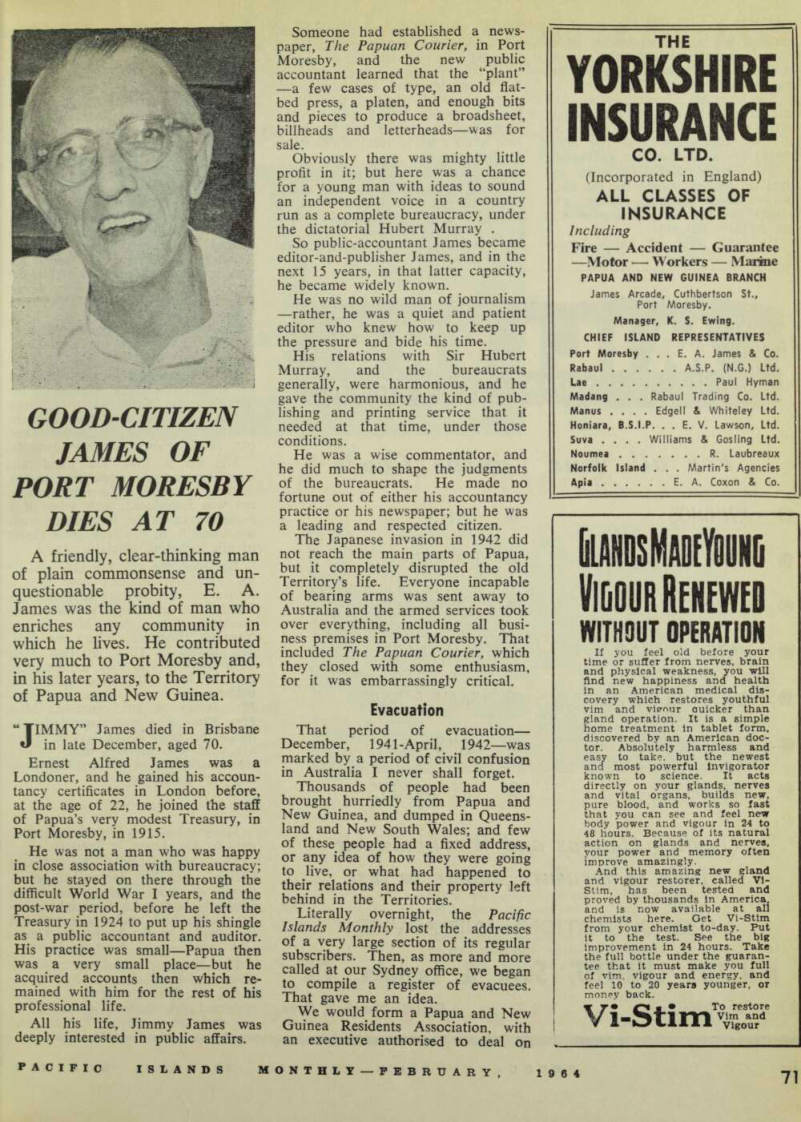
Good-Citizen
Port Moresby
Dies At 70
A friendly, clear-thinking man
of plain commonsense and un
questionable probity, E. A.
James was the kind of man who enriches any community in which he lives. He contributed very much to Port Moresby and, in his later years, to the Territory of Papua and New Guinea.
“TIMMY” James died in Brisbane J in late December, aged 70.
Ernest Alfred James was a Londoner, and he gained his accoun tancy certificates in London before, at the age of 22, he joined the staff of Papua’s very modest Treasury, in Port Moresby, in 1915.
He was not a man who was happy in close association with bureaucracy; but he stayed on there through the difficult World War I years, and the post-war period, before he left the Treasury in 1924 to put up his shingle as a public accountant and auditor.
His practice was small—Papua then was a very small place—but he acquired accounts then which re mained with him for the rest of his professional life.
All his life, Jimmy James was deeply interested in public affairs.
Someone had established a news paper, The Papuan Courier, in Port Moresby, and the new public accountant learned that the “plant” —a few cases of type, an old flat bed press, a platen, and enough bits and pieces to produce a broadsheet, billheads and letterheads —was for sale.
Obviously there was mighty little profit in it; but here was a chance for a young man with ideas to sound an independent voice in a country run as a complete bureaucracy, under the dictatorial Hubert Murray .
So public-accountant James became editor-and-publisher James, and in the next 15 years, in that latter capacity, he became widely known.
He was no wild man of journalism —rather, he was a quiet and patient editor who knew how to keep up the pressure and bide his time.
His relations with Sir Hubert Murray, and the bureaucrats generally, were harmonious, and he gave the community the kind of pub lishing and printing service that it needed at that time, under those conditions.
He was a wise commentator, and he did much to shape the judgments of the bureaucrats. He made no fortune out of either his accountancy practice or his newspaper; but he was a leading and respected citizen.
The Japanese invasion in 1942 did not reach the main parts of Papua, but it completely disrupted the old Territory’s life. Everyone incapable of bearing arms was sent away to Australia and the armed services took over everything, including all busi ness premises in Port Moresby. That included The Papuan Courier, which they closed with some enthusiasm, for it was embarrassingly critical.
Evacuation That period of evacuation— December, 1941-April, 1942—was marked by a period of civil confusion in Australia I never shall forget.
Thousands of people had been brought hurriedly from Papua and New Guinea, and dumped in Queens land and New South Wales; and few of these people had a fixed address, or any idea of how they were going to Jive, or what had happened to their relations and their property left behind in the Territories.
Literally overnight, the Pacific Islands Monthly lost the addresses of a very large section of its regular subscribers. Then, as more and more called at our Sydney office, we began to compile a register of evacuees.
That gave me an idea.
We would form a Papua and New Guinea Residents Association, with an executive authorised to deal on
behalf of the evacuees with Canberra, and all the numerous bodies which now were responsible for the admini stration of affairs in the occupied and non-occupied Territories.
The hundreds of evacuees who did not know what to do then, could carry their problems and questions to the Association, and the latter would represent them, as individuals.
We formed the Association and then we looked around for the king pin—a chief executive officer who would sew up the organisation and get on with the job.
He was right at hand—Jimmy
James—and in the next couple of years, in that capacity he did a splendid job. He should, of course, have been doing a war-time job in the Territories. But, as I have many times observed, military administra tors are rarely bright; and so Mr.
James was overlooked, and was avail able to do a job of incalculable value for the evacuees.
By 1945 the Japs were on the way home, and Canberra was apply ing itself to the problems of assessing and allocating war damage. Now, of course, officialdom could see Jimmy James, and he was a natural
as Deputy Controller of the War Damage Commission, a job he held until 1947.
The plant of The Papuan Courier, at the war’s end, was a heap of junk; and Mr. James made no attempt to re-establish his newspaper and print ing business. He settled back in Port Moresby as the head of E. A. James and Co., public accountants, and he became the consultant and adviser of many corporations, and a director of several companies.
It was now that he developed his greatest public usefulness, as an elected member of the combined Territory’s Legislative Council. He was in that post from 1951 and, if the electors had been consulted, he would have remained there until his death —for he could be depended upon always to speak out, literally without fear or favour, for the non-official classes.
He was one of a gallant little band of elected members who saw the shape being given to the future Papua-New Guinea by the Canberra planners and who, in season and out, fought these insidious advances.
Mr. James took his stand un compromisingly in opposition to the method by which a Territory income tax was introduced, and, when that came into operation, he resigned from the Council, to the very great regret of all, including officials.
He now was in his late sixties; his Territory interests gave him a secure income; and so, to please his family, he gradually withdrew his residence from Port Moresby to Yeronga, Brisbane, where he died.
Mr. James in 1919, married Miss Vera Bussell, who took a prominent part in Port Moresby’s social life, between the wars. After she died, Mr. James in 1955 married Miss May Ross, who was associated with him in his more active days of public life, and who survives him. There was a daughter of the first marriage.
~R. W. Robson.
Many tributes by Territorians were paid to Mr. James in January.
The Administrator, Sir Donald Cleland, said Mr. James had repre sented the people of his electorate fearlessly and “with forthright alert ness”. He had made a substantial contribution to the Legislative Coun cil.
The chairman of the Port Moresby Town Advisory Council, Mr. Craig Kirke, described him as “a loved and respected civic leader”, whose efforts, “as with most pioneers”, were not always recognised in his lifetime.