Growing Importance
pp. 65-69 · Read in the full issue



New Hotels Point To Growing Importance Of Tourism
Proposals announced in De cember to build new hotels on Norfolk Island, Tahiti and Fiji, and an appeal from the Cook Islands Government inviting any one interested to build one on
Rarotonga (PIM, Jan. p. 8)
have provided further evidence of the growing importance of tourism in the South Pacific.
THE new hotel at Norfolk Island will be built at Kingston. It will be of three storeys and will incorporate the ruins of two convict buildings, one of which is believed to have been the house of the Superintendent of Convicts, and the other, the house of a commissioned officer.
The prime movers in the hotel scheme are Mr. D. M. Fegan, a Sydney company director, and Mr.
N. H. Mclntyre, a solicitor in the Sydney legal firm of Parish, Patience and Mclntyre. They propose to form a company, which will be incorpora ted on Norfolk Island, to build and run the hotel.
Their present plans are to provide accommodation for 60 guests initially, and to increase this eventually to cater for 100 guests.
It is envisaged that the hotel will eventually have a staff of 20.
Preliminary plans for the hotel were prepared by Mr, Peter McCallum, an architect in the Sydney firm of E. A. and T. M. Scott. The plans were approved by Mr. Paul Hasluck just before he gave up his Territories portfolio in December for that of Defence.
Further plans will be submitted to the new Territories Minister, Mr.
C. E. Barnes, before tenders for building the hotel are called in Aus tralia and New Zealand.
Harmony
Mr. Fegan told PIM in January: “The Minister is concerned to see that the new parts of the hotel blend in with the old colonial buildings.
But we have been given a free hand as far as the interior is concerned.
“It is proposed to retain the exteriors of the ruined buildings as
nearly as possible in the state they now are.
“In the ruins of the Convict Superintendent’s House, there are cooking ovens in the wall, and we propose to use them as a barbecue for serving meals at the side of a swimming pool which will be in an inside courtyard.
“On the ground floor we propose to have a room displaying historical relics; and in the ruins of the officer’s house there will be what we have tentatively called The Tavern.
This will be an intimate type of cocktail bar.
“On the main floor will be the tentatively-named Colony Bar—a big bar-lounge that will serve the dining room and the lounge itself.
“All bedrooms will have their own bathrooms (or showers) and toilets.
There will be single rooms, double rooms and suites.
“Other features planned are a single-lane bowling alley and games room; and a big room suitable for conventions.”
Mr. Fegan said the hotel would be favoured by having a golf course, beaches and places of historic interest handy; and by commanding a fine view, “We also propose to develop marina facilities so that, weather
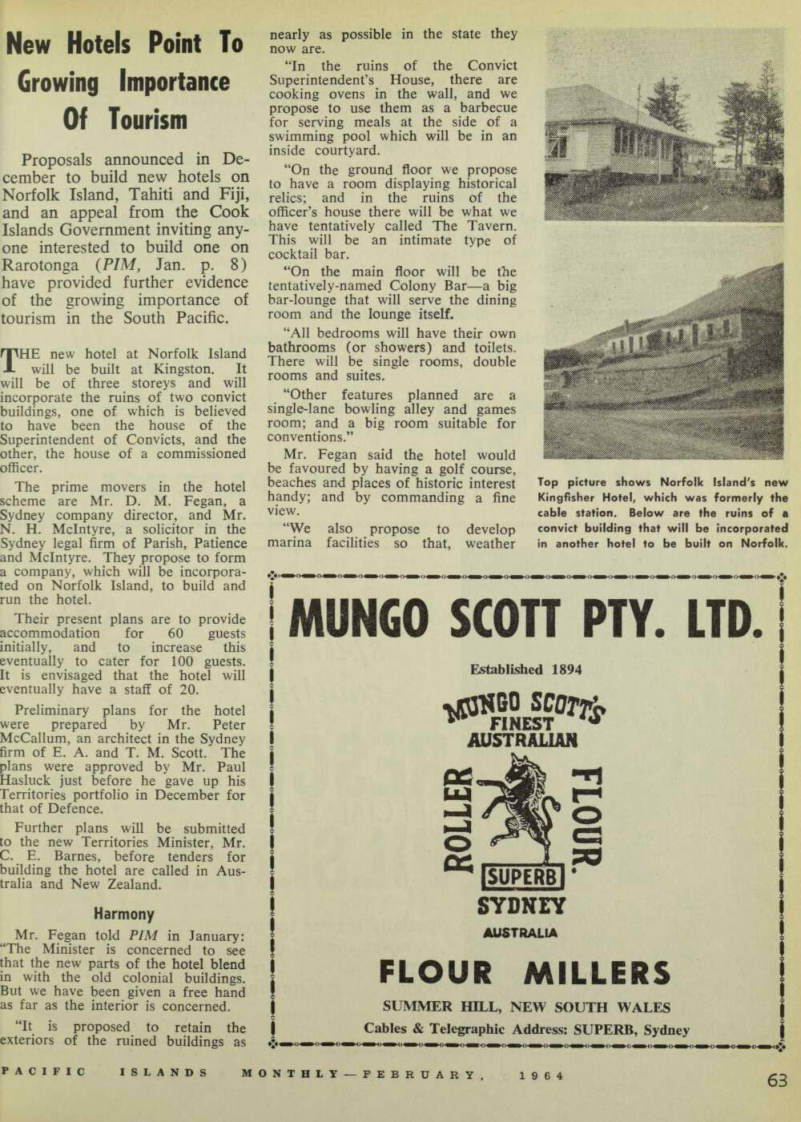
Top picture shows Norfolk Island's new Kingfisher Hotel, which was formerly the cable station. Below are the ruins of a convict building that will be incorporated in another hotel to be built on Norfolk.
permitting, people can go out and fish,” he said.
Norfolk Goes Ahead The building of this new hotel at Kingston will give Norfolk Island three hotels—the others being the Paradise Hotel (52 beds) and the newly-opened Kingfisher Airtel (70 beds). A private hotel, Glen Lyon, which can accommodate 20 guests, and a number of smaller guest houses and serviced flats complete the list of Norfolk’s present hostelries.
It all amounts to a tourist boom for small Norfolk, which for years has had hopes of getting into the tourist market, but until the last year or two has had little success. It is unlikely now ever to look back.
Tahiti Hotel The building of the new hotel in Tahiti will begin in May, and will be completed by the end of 1965.
The hotel will be at Punaauia, about 20 miles from Papeete, and will have 160 beds.
Plans for building the hotel were announced in Papeete in December by Mr. Gerard Blitz, director-general of the Club Mediterrannee, a French travel club which offers cheap pack age holidays in various parts of the world to its 300,000 members. (The Club Mediterranee already operates a 160-bed hotel at Tiahura on the north-west corner of Moorea, Tahiti’s sister isle).
Mr. Blitz said the new hotel would be built by the Societe Hoteliere du Pacifique Sud, in which the Club Mediterranee held 50 per cent, of the shares, and the Bank of Indo-China 10 per cent.
Rarotonga Proposal
In inviting inquiries from any person or group interested in the erection of a modern hotel of good standard in Rarotonga, the Cook Islands Government says: “Rarotonga is regarded by almost all who visit it as one of the most beautiful islands of the Pacific. It is only 20 miles in circumference, but bas mountains rising to almost 2,000 feet, bush-clad valleys and large expanses of lagoon surrounding practically the whole island.
“Boating, golf, bowls, tennis, foot ball, sailing and swimming are avail able while the hula and drum dancing of these islands is known throughout the Pacific. The island exports large quantities of oranges, mandarins, tangerines and grapefruit as well as tomatoes and other tropical products.
“With a population of 9,000 people, Rarotonga serves the whole Cook Group of 15 islands spread over
almost 1,000 miles of ocean and supporting 19,000 people.
“The Cook Islands Government at present owns the only hotel in Rarotonga. This hotel is situated within a short distance of the wharf and less than a mile and a half from the airstrip. It looks out across the sea.
“A weekly air service now operates from Western Samoa to connect with world airlines operating through Nadi and Pago Pago. In addition, the New Zealand Government steamer Moana Roa, which carries 40 passengers, operates a monthly service, while Matson ships call on the voyage south from Tahiti every three weeks.
“The Government would be prepared to consider the allocation of the present hotel site to enable a modern hotel to be built in its place. It would also consider mak ing a substantial secured loan or the purchase of shares in such a project.
“Persons or companies interested should communicate with the Sec retary to the Government, Raro tonga.”
New Fiji Plans The plans announced in December ( PIM, Dec., p. 122) for another major development in Fiji’s tourist industry are reported to represent the largest single investment in the
industry, possibly in the region of a million dollars.
Fiji Resorts Ltd., a company registered in Fiji in November with a nominal capital of £lOO,OOO, will start a massive development pro gramme on Yanuca Island, situated just off the south-west coast of the colony’s main island of Viti Levu, about 40 miles from the international airport at Nadi.
Yanuca is in one of Fijis most picturesque regions and holds every thing visualised in the glossy magazine descriptions of a South
Seas tropical paradise—with tall,
waving palms, fine white sandy beaches lapped by crystal clear water and tempered with a constant SE trade wind.
And the natives are reported to be friendly.
On about 50 acres of this island, the company proposes to build a first-class hotel with facilities for skindiving, waterskiing, sailing activities in a large adjacent lagoon, golf, tennis, bowls and horse-riding.
The company has engaged Mr.
George Wimberly, of Honolulu, to prepare designs for the new project and the first drawings are already in Fiji for consideration.
Design of the hotel will incorporate much of the Fijian style of architecture with emphasis on the bure (thatched hut) lines, adapted to suit modern trends.
It will feature a large centralised hotel section with reception, catering and servicing sections, supported by beach chalets set among the coconut groves along the beaches.
Fijian Owned
The island is owned by Fijians in the area and leased to the company who, in consideration of a lease, are allowing for Fijian representation on the board of management as well as an equity holding in the company.
Several villages in the area will provide a source of staff and labour for the new project and the company visualises the employment of about 100 of them after training in the tourist hotel field.
Two directors of the company, Mr.
Peter Slimmer and Mr. Patrick Doyle, are already closely associated with hotels in Fiji.
Both are actively engaged in the management of the Skylodge Hotel at Nadi airport (itself at present under going extensive alterations), and are major shareholders in its operating company, South Pacific Hostings Ltd., and also have interests in the New Mocambo Hotel.
These two hotels run at near peak occupancy figures.
No details of the financing of the
Yanuca project were released but a Lautoka correspondent says it can be assumed that capital would be readily available from overseas, especially from the United States, where most of the finance for the Skylodge and New Mocambo originated.
Fiji's "Gold Coast"
Fiji’s main island’s south coast is rapidly becoming the “Gold Coast” of the Colony with Yanuca the third tourist resort project development announced in 1963.
The Reef Lodge at Korotogo is due to open soon, and will provide accommodation for over 50 in modern comfort.
This is only about eight miles towards Suva from Yanuca, and another six miles further is the site of Barry Philps’ Trade Winds Bay tourist project.
With the well-established Korolevu Hotel within a stone’s-throw of them all, Fiji will be able to offer in the very near future four world-standard
tourist resorts in the space of a few miles of coast-line.
Still in the offing is yet another project at Natadola, a few miles to the west of Yanuca, owned by Northern Hotels Ltd., who have toyed with the idea of developing the area for many years. It has one of the finest beaches in Fiji.
With a new Hotels Aid Scheme in the offing from the Fiji Government, the Colony’s hotel development for the tourist industry seems assured for some time to come. But it will bring nearer the problem that the Govern ment must face in doing something to improve the main roads in the area, which are now little more than dirt tracks.
Commented the Lautoka corres pondent: “Probably the government takes the view that most of these new projects will have their own swimming pools and that the traveller can wash off the dust he’s gathered en route simply by peeling off and diving in!”