Express) modifies well-known English expressions
pp. 59-63 · Read in the full issue
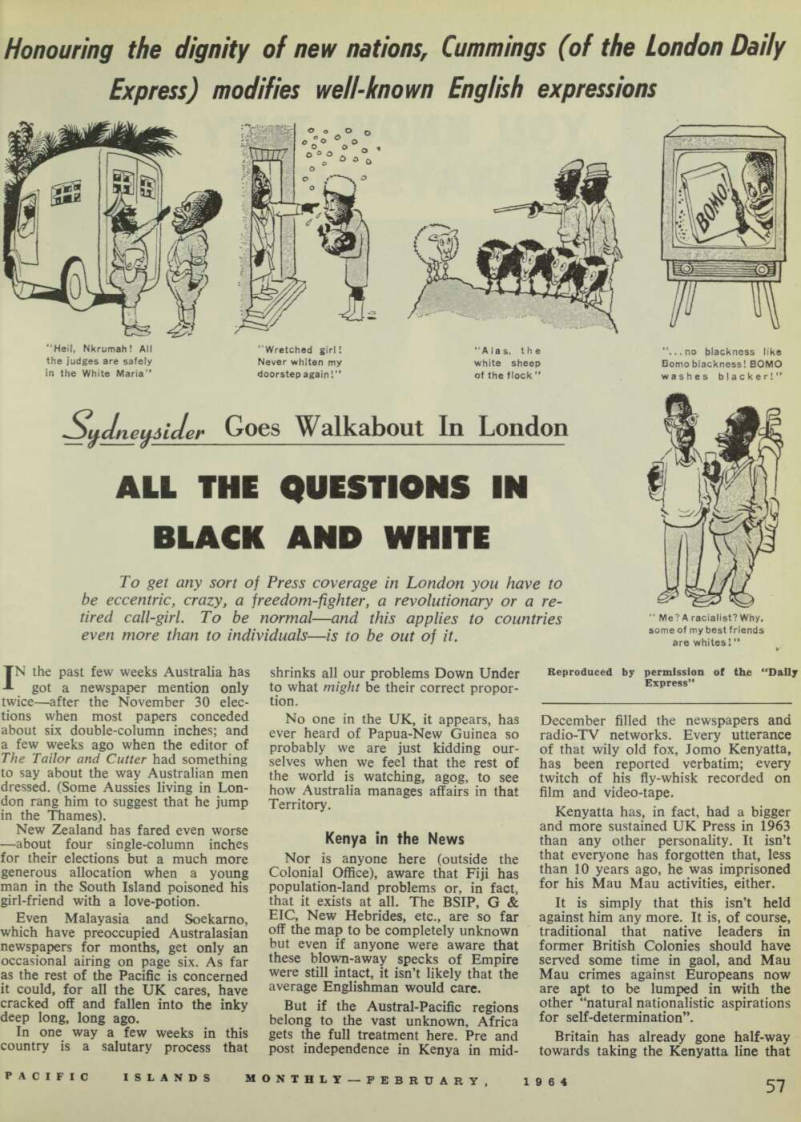
Honouring the dignity of new nations, Cummings (of the London Daily Express) modifies well-known English expressions
Sydneysider Goes Walkabout In London
All The Questions In
Black And White
To get any sort of Press coverage in London you have to be eccentric, crazy, a freedom-fighter, a revolutionary or a re tired call-girl. To he normal—and this applies to countries even more than to individuals—is to be out of it.
IN the past few weeks Australia has got a newspaper mention only twice—after the November 30 elec tions when most papers conceded about six double-column inches; and a few weeks ago when the editor of The Tailor and Cutter had something to say about the way Australian men dressed. (Some Aussies living in Lon don rang him to suggest that he jump in the Thames).
New Zealand has fared even worse —about four single-column inches for their elections but a much more generous allocation when a young man in the South Island poisoned his girl-friend with a love-potion.
Even Malayasia and Soekarno, which have preoccupied Australasian newspapers for months, get only an occasional airing on page six. As far as the rest of the Pacific is concerned it could, for all the UK cares, have cracked off and fallen into the inky deep long, long ago.
In one way a few weeks in this country is a salutary process that
shrinks all our problems Down Under to what might be their correct propor tion.
No one in the UK, it appears, has ever heard of Papua-New Guinea so probably we are just kidding our selves when we feel that the rest of the world is watching, agog, to see how Australia manages affairs in that Territory.
Kenya in the News Nor is anyone here (outside the Colonial Office), aware that Fiji has population-land problems or, in fact, that it exists at all. The BSIP, G & EIC, New Hebrides, etc., are so far off the map to be completely unknown but even if anyone were aware that these blown-away specks of Empire were still intact, it isn’t likely that the average Englishman would care.
But if the Austral-Pacific regions belong to the vast unknown, Africa gets the full treatment here. Pre and post independence in Kenya in mid-
December filled the newspapers and radio-TV networks. Every utterance of that wily old fox, Jomo Kenyatta, has been reported verbatim; every twitch of his fly-whisk recorded on film and video-tape.
Kenyatta has, in fact, had a bigger and more sustained UK Press in 1963 than any other personality. It isn’t that everyone has forgotten that, less than 10 years ago, he was imprisoned for his Mau Mau activities, either.
It is simply that this isn’t held against him any more. It is, of course, traditional that native leaders in former British Colonies should have served some time in gaol, and Mau Mau crimes against Europeans now are apt to be lumped in with the other “natural nationalistic aspirations for self-determination”.
Britain has already gone half-way towards taking the Kenyatta line that
“Heil, Nkrumah! All the judges are safely in the White Maria”
"Wretched girl!
Never whiten my doorstep again!”
"Alas, the white sheep of the flock ”
"...no blackness like Bomo blackness! BOMO washes blacker! "
Reproduced by permission of the “Daily Express”
there weren’t any Man Man terrorists —just “freedom fighters”.
The art of turning the other Colonial cheek has been developed so effectively in Britain that not even the pro-Commonwealth Daily Express was unduly hurt when the British Government apologised to the Uganda Government, in December, because a group of British living in that former colony had had the “bad taste” to have a private, “Sanders of the River” party to celebrate Kenya independence and the shedding of the white man’s burden.
The European has little credit in Africa these days. So little that BBC commentators, sent to Kenya to cover independence, were right on key when they referred sarcastically to the fact that of all the white settlers who were anti-independence two years ago, two-thirds still remain in the country.
White settlers still remain in Kenya because they can’t get out. Their land, which is usually their only asset, is unsaleable under existing circum stances and they hang on in the hope that the Government might eventually acquire it for the resettle ment of Africans.
Under new legislation, unless a farm is occupied it can be declared vacant and cut up for resettlement without compensation.
The BBC coverage of events in Kenya on the eve of independence was one of the Corporation’s more lop-sided efforts. As a place where it is no longer possible to speak one’s mind without fear of reprisals, and with the expulsion from Uganda of a dozen of the people who took part in the white man’s burden party fresh in their minds, no white Kenyan was prepared to do more than a verbal shuffle when faced with a BBC micro phone.
The man who came nearest to the truth was a spokesman for some hundreds of ex-servicemen settlers.
Guarantees Worthless These are not old Imperialists from way-back, or third or fourth genera tion white Kenyans, but were en couraged by the British Government to take up land in Kenya only after the 1939-45 war. Numerous verbal guarantees were given these people— many of whom are still paying off their land—but the guarantees now don’t appear to be worth a row of pyrethrum.
Because they have invested money and about 15 years of their lives in Kenya most are reluctant now to walk out and leave what they have created to fall into the laps of the expectant and ever-ready Africans, This reluctance, easy enough for
other colonials to understand, is be yond the comprehension of most BBC commentators and apparently beyond the concern of the average stay-at home Englishman who, these days, believes that everyone who was fool enough to establish himself beyond the British Isles is expendable.
In these last days of disintegration it’s hard to understand how the British ever consciously acquired an Empire, anyway.
It must all have been, you’d think, a series of glorious and inglorious accidents, although 18th and 19th century weather might have had some thing to do with it.
Today the English need look like shapeless bundles of old clothes only when they venture outside in winter.
Inside, with the central heating and all the lights turned full up, you can dismiss the dismal, semi-liquid grey winter-world outside, where the thermometer pushes itself to the re luctant mid-thirties. But before central heating, winter must have been hell sheer enough to force even the home-loving English to cast an occasional thought away from their fog-bound island to places where the sun was less likely to set.
The Invasion There must be some correlation be tween the present-day comforts of home, over-full employment and an affluent society and the complacency with which the Britisher watches his old empire fold up. In many respects, of course, his old empire has come to him.
As more and more countries throw off the “yoke of British imperialism”, more and more West Indians, Africans, Indians and Pakistanis fore sake the new freedom at home and crowd into the UK. There they take up the menial slack in buses, railway stations, hospitals and all public utilities.
Without them London services would grind to a halt. The white Englishman has now got over his first shock of this invasion and in the two years since I was last here, a proliferating stock of black-and-white jokes indicates that the peculiar British sense of humour is being brought to bear on the situation.
In Darkest London One story goes that on the upper deck of a No. 9 bus all the customers were coloured, except one traveller.
The West African conductor went up to the paleface and said: “Dr. Living stone I presume?”
Then there’s the one about the woman who asked the bus conductor
—West Indian this time—just where she should alight for a certain street, He told her but she was still doubtful and asked the white Londoner sitting next her the same question—and got the same answer.
“Now,” said the conductor, “you’ve got the answer in Black-and-White.”
To celebrate Kenyan independence, the Daily Express came out with a whole series of cartoons —black varia tions on old, white English themes.
Maybe it is all a sign that, in the UK at least, it is again permissible to refer to the fact that some people are born white and some black and a hint that the sooner we get over being self-conscious over this fact the better.
Tailpiece on Fashion
LONDON girls’ skirts get shorter and shorter and shorter and now reach barely to the top of the kneecap.
In the kind of season that saw the Serpentine frozen over a week before Christmas this is apt to produce chilblains where chilblains have no right to be. To ameliorate the situa tion, boots have been getting higher and higher and higher and some now have knees built into them and go part way up the thigh, after the fashion of the Horseguards. Horse guards, however sit on horses; they don’t attempt to walk in their yard long boots.
Men’s fashions have gone to the other extremity and the latest from Bond Street (if not exactly Savile Row) is the high fur (or beaver or astrakhan) hat—something like Mr.
Khrushchev wears in a Moscow winter, with West African overtones.
There are more eccentrics to the square yard in London than anywhere else on earth and no where does the male wear outlandish fashions with more aplomb.
A friend of mine swears that he was walking down Bayswater Road one night in a slight fog when a blonde woman hove up out of the mist with a cheetah on a lead. When I asked him what he did, he answered like a true Londoner: “Nothing, I walked straight on.”
The other day in the street, in day light, I met a man with one of these tall, fur hats and a Chihuahua dog, like a large-sized rat, cuddled up to his neck between his shoulder and his hat. Unlike my London friend who did nothing about the cheetah but passed right on, I stood and stared. Now, more than ever in this country, it becomes increasingly dif ficult to distinguish the male—in his fur hat, high heels, long hair and fancy pants—from the female.