Magazine Section
pp. 79-82 · Read in the full issue
Pacific Islands Monthly
Norwegian Sea Captain Played Big
Part In Developing The Solomons
By a Staff Writer
When Captain Oscar Svensen, a pioneer planter in the Solomons, settled in those islands in 1888, he lived in a house on stilts 16 ft. above the ground as a precaution against attacks by the wild natives of the Group.
CAPTAIN Svensen’s son, who, confusingly, is also Captain Dscar Svensen, told me of this aspect if his father’s colourful past in fanuary after he had read a para graph in the “Yesterday” column of he December issue of PIM.
The “Yesterday” paragraph recalled hat Captain Svensen, Snr., had died n Brisbane in November, 1943, at he age of 81.
It prompted Captain Svensen, Jnr. [who lived in the Solomons before ;he war, but who now lives in Sydney) to dig out some of his 'ather’s old papers and bring them nto PlM’s office in case we might ie interested.
We certainly were interested, for they lifted the veil on a period of Solomon Islands history that very few people know anything about.
Among the papers that Captain Svensen, Jnr., produced were a tattered and yellowing clipping from a Brisbane newspaper of July 20, 1922, of an interview with his father, and a prospectus, issued in 1911, of Mamara Plantations Ltd., in which his father once had substantial holdings.
Life Story
These papers, together with the recollections of Captain Svensen, Jnr., enabled me to piece together the life story of Captain Svensen, Snr., who played a significant role in the development of the Solomons.
Captain Svensen was born in Larvik, Norway, in 1862. Of sea faring stock, he went to sea as soon as he left school, and by the age Df 19 he was master of a vessel trading between the Baltic and North Sea.
In the early 1880’s, adventure lured him to Queensland where he
got a job on the newly-launched Government yacht Lucinda. He later worked for the Brisbane Steam Ferry Co.
His connection with the Solomons began in 1888 after he sailed to the Ellice Group in the schooner Thistle with a cargo of coal.
On the way back, the schooner called for a cargo of islands produce at Marau Sound, on the southern end of Guadalcanal (it was then spelt “Guadalcanal’), and Captain Svensen started trading, with his brother and a Mr. Nerdrum as partners.
The natives in the area had a reputation for fierceness—an ex-
Government agent of a Queensland recruiting schooner having been killed there a short time previously—so Captain Svensen and his partners built their first house on stilts 16 ft above the ground.
Their trading station was estab lished on Crawford Island in Marau Sound; and in the 40-ton ketch Siskin, they traded along the coasts of Guadalcanal, Malaita and St.
Christoval, and out to the island of Sikaiana, getting copra, ivory nuts, and turtle shell in exchange for calico, knives, tobacco and other goods.
Only White Men “When we commenced opera tions,” Captain Svensen told the Brisbane paper, “there were in the Group Captain Sam Keating at Aola, who had a small schooner; W. Pope, who was employed by Captain Keating; Lars Neilsen, with a trading station at Gavutu; W, Macdonald, at Aola; and an old German named Voight on Neil Island. They were the only white men at the eastern end of the group.
There were no whites at Cape Marsh (Russell Group), but Sam Atkinson, with the schooner Lady Ena, traded from Marovo Lagoon.
He was the only one at the western end.
“At that time Queensland and Fiji recruiting vessels were pretty frequent visitors, and nearly all of them called in Marau Sound. So we were not cut off from the world altogether.
“The first lot of copra we sent to Sydney brought £B/5A a ton, and ivory nuts about £5. Freights to Sydney were £2/10/- a ton.
“The regular traders were the schooner Thistle, owned by Captain Hawkins, and a brigantine owned
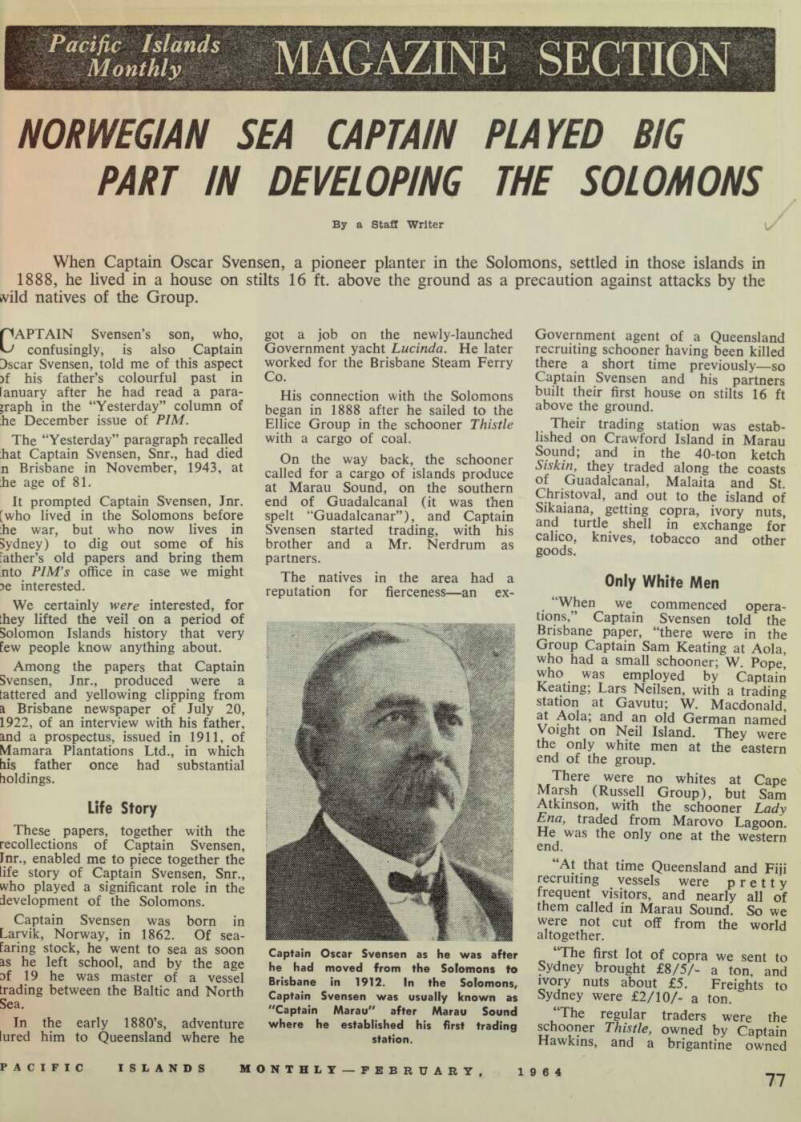
Captain Oscar Svensen as he was after he had moved from the Solomons to Brisbane in 1912. In the Solomons, Captain Svensen was usually known as "Captain Marau" after Marau Sound where he established his first trading station.
>y Kelly and Woodhouse, and sailed >y Captain Rosin.
“We had little trouble with the latives, but we took strict pre cautions against surprise.
“One boat’s crew did .get killed n New Georgia. They went ashore o get water and had to go a little vay into the bush. The natives imbushed and killed them.
“That was the only misfortune of he kind which happened in con lection with our trading. We never *ent ashore except on Savo and one )r two other well-known places vithout an armed boat’s crew.”
Brother Died Within six months of their landing n the Group, Captain Svensen’s mother died. Then a brother of Mr. sferdrum joined the partnership, but ic also died within six months.
Anally, in 1897, Mr. Nerdrum be came tired of life in the Islands and idd his interest in the partnership o Captain Svensen.
Meanwhile, in 1896, the British
jovernment had proclaimed a
jrotectorate over the Solomons —and t was in this year that Captain Svensen and his partner started fCaukau Plantation.
“When we went to the Solomons,”
Captain Svensen recalled in 1922, “it vas with the intention of starting is planters in addition to trading, but laving very little capital, we could lot do anything for a few years.
“In 1896, when we started Kaukau Plantation, our plan was to grow coconuts, with Liberian coffee as a catch crop. Coffee beans were worth 45/- a cwt. at the time, and the Liberian coffee grew to perfection on the coastal country.
“We got seeds from Ceylon and had 30,000 to 40,000 young plants in the nursery ready for planting out.
We also had 150 acres of land cleared and partly planted in coco nuts.
“The manager of the plantation was a Swiss from New Caledonia, generally known as ‘Joe’. A party of natives came down and killed him and two boys on the plantation.
“The remainder of the boys cleared out to the head station at Marau Sound, and informed us of the attack. The matter was reported to the Resident Commissioner (Mr.
Woodford), and a number of traders joined him in an expedition to deal with the perpetrators of the crime. ‘Two of the coast natives who instigated the murders were arrested, and one got shot while trying to escape. The other was tried and
hanged. An attempt was made to get to the bushmen who had done the actual killing, but they got warning of the party and beyond burning a few houses, nothing was done.”
After this affray, Kaukau Planta tion remained idle until 1900.
Meanwhile, Captain Svensen bought two properties on Guadalcanal from the insolvent estate of Kelly, Williams and Woodhouse, of Sydney. These properties were Aola (150 acres) and Lunga (40,000 acres).
In 1900, an American, Alec Rabeuth, who had joined Captain Svensen as partner, planted the whole 150 acres at Aola with coconuts; and in October of that year began plant ing the Lunga property.
“Those two plantations,” Captain Svensen recalled in Brisbane, “were actually the first two continuous ones started in the Solomons. We had previously planted coconuts on the island of 30 acres in Marau Sound, and also on the small island of Gavutu, while a small island had been also planted in Rubiana (now spelt Roviana) Lagoon; but they were only around trading stations to keep them clear.
“In the meantime, I had extended the trading business and had bought the island of Gavutu (near Tulagi) where I made my head station. I also bought Ugi trading station from the trustees of the Stevens estate, after the death of Charley Ohlsen, and established trading stations at Santa Ana, Santa Cruz, Rubiana, Leueneuwa, and in the Shortlands.
“At that time I exported more than half the produce of the Group, for 1 had the larger part of the trading in my hands.
“To carry on the work I had the schooners Sikiana, 80 tons; Leueneuwa, 80 tons; Ruby, 30 tons; Lily, 20 tons; Viking, 12 tons; several cutters and some boats.
“Gavutu was the main distributing and collecting centre for all my trading.
“I started planting coconuts on Kaukau again, and in addition to Aola and Lunga plantations, I bought land from the native chiefs at Pepesala in the Russell Group, and commenced planting there.
Only Other Plantations “In 1904, the only other plantations in the Group were Sam Atkinson’s at Awa in the Shortlands, and Norman Wheatley’s at Rubiana.
“In 1906, I sold out the whole of my trading and planting business ta Levers Pacific Plantations Ltd. as a going concern, and Gavutu became the headquarters in the Group for that firm.
“lust at that time a number of traders entered into planting. W.
Pope started a plantation at Domma, on Guadalcanal Fred Erickson began in the Russell Group; Joe Binskin at Baga; and Frank Wickham at Gizo.
“Darbyshire arrived in the Group in 1905 and started Penduffryn, on Guadalcanal on land he bought through me. Afterwards Harding joined him as a partner, but they
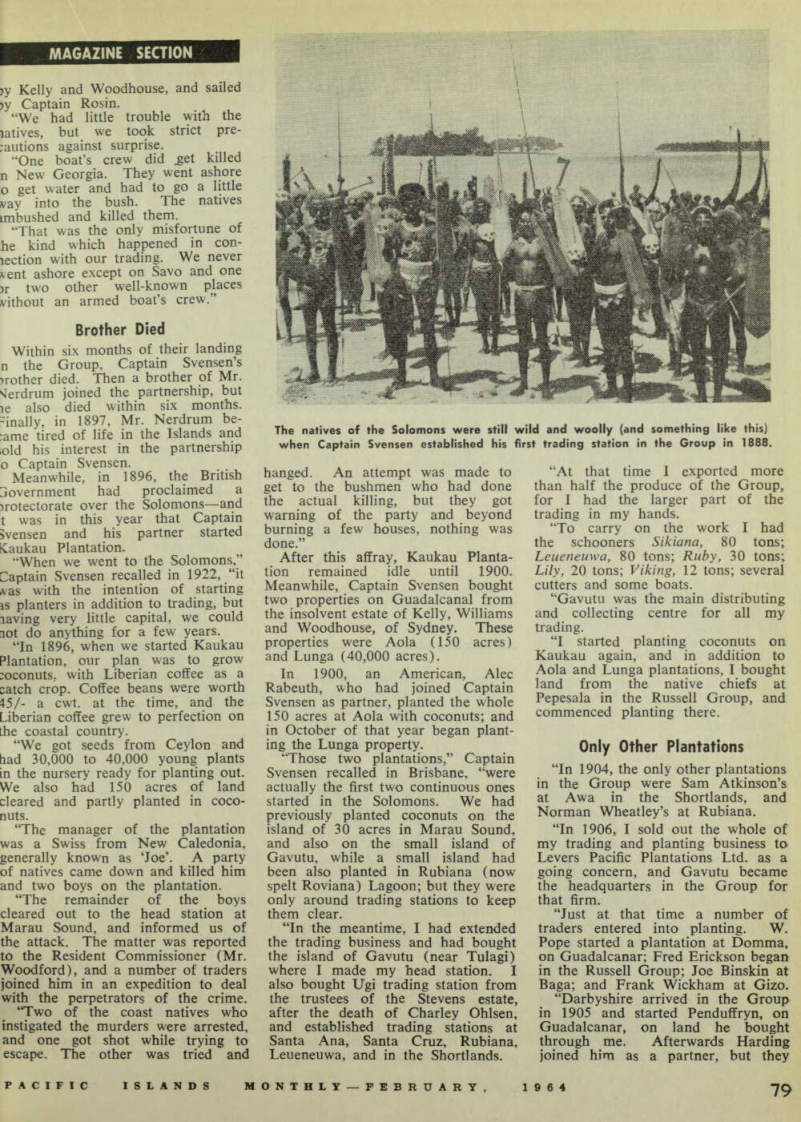
The natives of the Solomons were still wild and woolly (and something like this) when Captain Svensen established his first trading station in the Group in 1888.
were only a few years in the Group when they sold out to the Solomon Islands Development Company.”
After selling out to Levers, Captain Svensen started another plantation at Santa Ysabel near Maringe Lagoon; and, with a partner called J. T. d’Oliveyra, he bought a plantation on Guadalcanal from the Melbourne Solomon Islands Pty. Ltd. With additions, the Guadalcanal property afterwards became known as Mamara Plantations Ltd.
In 1910, Captain Svensen sold the Santa Ysabel property, which had been partly planted with coconuts and rubber (Hevea brasiliensis) , to a Brisbane company called the Solomon Islands Rubber Plantations Ltd. In the following year, another Brisbane company bought Mamara Plantations Ltd. as a going concern.
Captain Svensen then owned only Domma plantation, which he had bought from W. Pope; but he was the main shareholder in and a direc tor of the two companies which bought the other two properties.
He left the Solomons in 1912 to settle in Brisbane, and was made Norwegian Consul there in 1918. In 1927, he was awarded the Royal (Norwegian) Order of St. Olaf, Ist Class, for his services as Consul.
Married Captain Svensen was married in 1900 to Miss Henriette Schroder, a Norwegian girl, and they had seven daughters and one son. Captain Svensen’s widow, who is now in her eighties, still lives in Brisbane; while one daughter, Inga (Mrs. Ernie Palmer, of Gizo) keeps the Svensen “flag” flying in the Solomons.
One of Mrs. Svensen’s treasured possessions is a 400-year-old grand father clock which was sent out from France by the Marist Mission as a gift to her husband for helping the mission to gain a permanent foothold in the Solomons.
Although the Marists tried to establish themselves in the Solomons as far back as 1845, it was not until 1898—with Captain Svensen’s help—that they managed to do so permanently.
The first Marist station was at Gavutu, an island owned by Captain Svensen, but a transfer was soon Guadalcanal!” 8 A °' a Pr ° Perty ° n Later again, Captain Svensen bought the small islet of Rua Sura from the natives, and the first missionary, Father Bouillon was installed there. From Rua Sura the
present Marist Mission stations in the Solomons were eventually established, Captain Svensen also has the honour of being the first person to plant tobacco in the Solomons. This tobacco still thrives and is smoked by the natives.
Another crop that Captain Svensen experimented with successfully was cotton. After trying several varieties with indifferent results, Captain Svensen and his partner d Ohveyra developed a hybrid of No. 2 and a Sea Island variety which by 1922 was widely known m several cottongrowing countries.
Called Mamara after the property where it was developed, the hybrid yields a fine, silky cotton, with a staple not quite as long as Sea Island, It is a heavy bearer and grows to bushes not more than five feet high.
Other crops that Captain Svensen raised successfully were vanilla, broom millet and maize (which produced three crops a year, and was profitably exported to Sydney).
But all crops were sooner or later dropped in favour of coconuts, which proved by far the most profitable.
One aspect of Captain Svensen’s career that he never enlarged on much was his discovery of copper ore in the Solomons. According to his son, who saw the samples many years ago, it assayed very high.
“I know where my father found this copper,” Captain Svensen, Jnr., says, “but I’m not telling anyone, as I hope to exploit the deposit one of these days myself.”
Captain Svensen, Jnr., lived in the Solomons from 1933 to 1940 look ing after his father’s interests in Solomon Islands Rubber Plantations Ltd., Mamara Plantation Ltd. and the Domma property.
During the war, he was an officer in the Solomon Islands Labour Corps.
Captain Svensen, Jnr., and his sisters inherited their father’s Solomons interests on his death in 1943. These interested were sold to Mr, R. C. Symes in the early 1950’5.