Why Not Some U.K. Flag-Waving
pp. 59-63 · Read in the full issue
In The New Hebrides, Too?
By A Long-Time Resident in the New Hebrides
Having read the article in the September issue of PIM (p. 41) and Mr. D. J. Gubbay’s reply in November (p. 41) on French influence in the New Hebrides, I am unable to under stand Mr. Gubbay’s statement that the magazine has done damage to British-French amity or to Australian residents and interests in the New Hebrides.
"LWEN if one does not agree with
everything in the September
article, one must admit that a lot of the article is quite true, and it has had the effect, at least, of causing people to sit up and take a bit of notice or interest in a territory which seems to have been at the end of a back alley for many years.
I am sorry I cannot supply my name for publication, but many of us are not in the same fortunate posi tion as Mr. Gubbay, who, as the head of his own business, can speak for himself quite fearlessly. Those who are employed by the Condominium Government or either of the two
national governments, by the Mis sions or private enterprise, often find themselves in a delicate situation, as Mr. Gubbay understands very well.
Nevertheless, I would like to com ment sincerely on some of the issues raised.
WARSHIPS-. Mr. Gubbay seems to be confusing his appreciation of cock tail parties, pomp and circumstance with the fact that any visit by any warship is neither more nor less than a flag-waving opportunity.
This does not mean that we should all rise in wrath and slay the French, but rather that the British should start to pay a bit more attention to
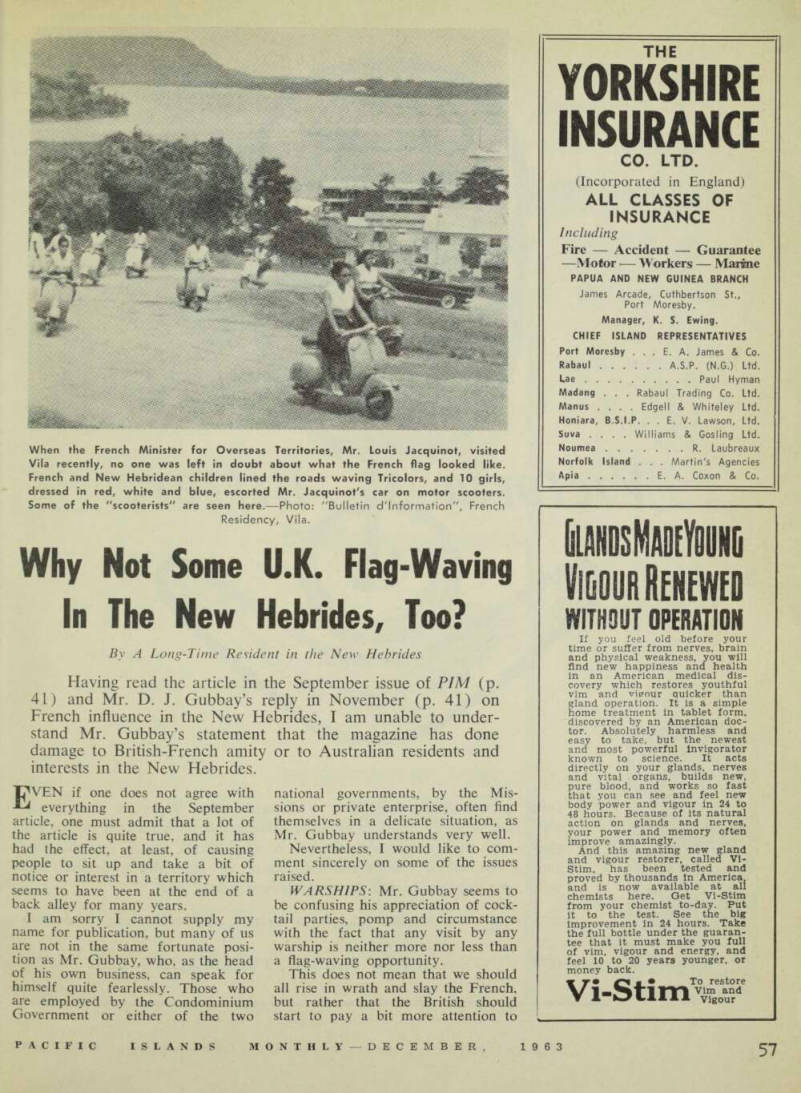
When the French Minister for Overseas Territories, Mr. Louis Jacquinot, visited Vila recently, no one was left in doubt about what the French flag looked like.
French and New Hebridean children lined the roads waving Tricolors, and 10 girls, dressed in red, white and blue, escorted Mr. Jacquinot's car on motor scooters.
Some of the "scooterists" are seen here.-Photo: "Bulletin d'Information", French Residency, Vila.
the territory and do some flag-waving of their own.
Without this flag-waving, how is the ordinary, uneducated New Hebri dean, whose soul both governments are apparently trying to capture, go ing to decide which is the better nation and who is doing more for him?
EDUCATION : I am unable to un derstand what Mr. Gubbay finds in bad taste in the remarks made by PIM on education. The article drew attention to the expansion of educa tion facilities by the French, and the implication was: What are the British doing to meet this expansion?
It seems basic that, if you educate a man, you have more chance of hav ing him on your side later—that is when he has become an adult—than if you take a comparative stranger.
It seems natural to expect that New Hebrideans educated in Frefch schools are going to absorb more French culture than they would by going to a British mission school.
BANKING : Mr. Gubbay’s state ments on this subject also tell only half the story. It is quite true that all dollars accumulated and exported during the war were sent to Australia.
Australia undoubtedly had the benefit of the several million dollars of foreign exchange so deposited, but the agreement is that the New Heb rides can draw up to the amount of dollars sent to Australia.
In effect, therefore, if Australia benefited by $8 million foreign ex change, the New Hebrides has the right to draw against Australia’s foreign exchange credits to the tune of $8 million.
Sore Point It is a sore point with the French that this foreign exchange went to Australia, but where else could it have gone in 1942, 1943 and 1944 after all France was still occupied?
Mr. Gubbay’s statement that the Commonwealth Savings Bank has ap pointed collecting agents with no in vestment in the New Hebrides is pure poppycock. The collecting agents comprise Burns Philp, the only large British firm in the group; well-known planter and businessman Mr. R. U.
Paul, of Tanna; and several Protes tant mission stations. All named have extensive investments in the New Hebrides.
The reasons why the Common wealth Trading Bank has not moved into the New Hebrides, or, for that matter, any other trading bank, are probably known only to the banks themselves. I suggest, however, that the convertibility of local (Bank of Indo-China) francs is the major ob- Stade. (Over)
AUSTRALIA : I quite agree with Mr. Gubbay that Australia, the prin cipal beneficiary in the New Hebrides, has done precious little to help the archipelago. But who knows that the article in PIM may not stir up some Australian politician to take a bit more interest in the place?
In this case, does Mr. Gubbay con sider that the article is still damaging to British-French amity and the situa tion of Australian residents and in terests in the New Hebrides?
Mr. Gubbay will surely remember that, before the war, Australia took sufficient interest in the New Heb rides to keep a solicitor in Vila to look after its interests.
Lack of Interest This representation no longer ap plies, and one forms the opinion that, as far as Australia is concerned, the New Hebrides is something in the nature of an illegitimate child which it would be better to pension off to an orphanage and forget about.
Perhaps the PIM article and Mr.
Gubbay’s reply may do something to change this relationship, and—who knows—the four points he raises for consideration may even be studied by some public servant in a position to do something about rendering the as sistance suggested.
The suggestion that there is a feel ing within all segments of the com munity of the New Hebrides that in that Group they think neither French nor British is very good reading.
The reasons behind such thinking are, in the main, quite mercenary.
Both nationalities are well aware of the fact that they never had it so good as they have under a dual ad ministration. For that reason neither side, below administrative level at least, wants to see any change because each realises if the Group became en tirely British or entirely French controlled, the Administration would be a lot tougher than it is at present, particularly in considerations of re venue and in the application of the laws as they are written.
Mr. Gubbay says that, in substance, our plans must and should be the
same. How can they ever be the same?
While both Administrations are working towards the social and poli tical evolution of the New Hebridean to enable him to govern himself, they are going down two completely dif ferent streets to reach that goal.
The elite corps which will form the nucleus of any eventual self governing body will think British or think French in its attitude towards laws, education and reaction to countries outside the New Hebrides according to which Administration is more successful in educating it.
One cannot blame the French for their all-out drive in education, par
ticularly in trying to capture the mind of the New Hebridean and have him think like a Frenchman. There is nothing reprehensible in this.
Thinking British residents in the New Hebrides wish the British Ad ministration would do a little more along the same lines.
In effect it is, but mainly it has been through mission channels.
The result is that the scholar thinks the mission is teaching him—not the British Administration which is mak ing some of the funds available for that teaching.
• See "Fears of French Dominion", p. 67.