Ringing London Will Be Easy
pp. 57-58 · Read in the full issue
Colourful Chapter Closes On Fanning Island
Ringing London Will Be Easy As Ringing The Man Next Door
From December 3, people in the main South Pacific centres will be able to talk by telephone with people in places as far away as Ottawa, London, Sydney or Auckland with as much ease as if they were ringing the man next door.
DECEMBER 3 is the date on which Queen Elizabeth II will officially open a new telecommunications sys tem between Sydney and London.
The opening of the system will fol low the completion recently of the last two links in the Commonwealth Pacific Cable (COMPAC) from Syd ney to Vancouver. These links are be tween Suva and Honolulu, and Hono lulu and Vancouver.
In Vancouver, the COMPAC cable is linked with a trans-Canada land line, and this, in turn, joins up with CANTAT, a submarine cable from Canada’s Atlantic coast to London.
The new telecommunications sys tem provides channels for 80 simul taneous, two-way telephone conver sations of high quality; and each channel can alternatively be used for up to 60 telegraph or teleprinter channels or for the transmission of picturegrams, or music, or voice broadcasts.
South Pacific Affects South Pacific towns linked with either Suva, Honolulu, Auckland or Sydney by radio-telephone can be hooked up to the new system. Thus, a person in Rarotonga, Cook Islands, can speak to someone in Ottawa, Canada, through Auckland.
CANTAT, the trans-Atlantic cable, has been open since November, 1961.
The first link in the COMPAC cable—from Sydney to Auckland— was opened in July, 1962; and the second link—from Auckland to Suva —was opened last December.
The completed COMPAC cable re places the first trans-Pacific cable which began operating in December, 1902.
This cable originally linked Van couver with Australia and New Zea land through relay stations at Fan ning Island, Suva and Norfolk Island.
The cable split at Suva—one section going to Southport, Queensland, via Norfolk Island; the other going from Suva to New Zealand.
The opening of the Suva-Auckland
section of COMPAC last December resulted in the closure of the Norfolk Island relay station after exactly 60 years; and now the opening of the Suva-Honolulu and Honolulu-Van couver sections of COMPAC will close the Fanning Island station.
Fanning Island is one of four iso lated atolls (the others are Palmyra, Washington and Christmas) which extend for 400 miles in a north-west to south-east direction due south of Hawaii. Palmyra, the nearest of the four to the Honolulu, is 1,070 miles away.
Fanning's Colourful History
Great Britain took possession of Fanning Island in 1888 after realising its potential as a cable relay station.
Washington and Christmas are also British possessions but Palmyra is American.
When the Fanning Island cable station was opened in 1902, quite a sizeable staff was required to man it, as each message had to be manually copied and retransmitted along the next section of cable. However, the staff was considerably reduced after an automatic regenerator system was introduced in the 1920’5.
In recent years, full staff was 11 Europeans (mainly Australians) and a few Gilbertese; but for most of this year, only six Europeans, plus the Gilbertese have manned the station.
The last six Europeans will leave Fanning by ship for Christmas Island early in January, and will fly from there to Australia.
No information was available in Sydney in November on what would become of the cable station and em ployees’ houses after the departure of the .Europeans. !But the buildings, which are owned Qable and Wireless Ltd., of Great Britain, will probably be put up for auctibn.
The buildings could be of interest to Fanning Island Plantations Ltd. (a subsidiary of Burns' Philp), which
has about 3,100 of the island’s 8,500 acres under coconuts; or some Ameri can hotel tycoon might see in them a ready-made, away-from-it-all hotel. (About a year ago, an American organisation was talking of building such a hotel on Palmyra Island, but PIM has not heard if anything came of the idea.) During Fanning Island’s 60 years as a relay station, the trans-Pacific cable service was seriously dislocated only once. This was in the first few weeks of World War I, when men
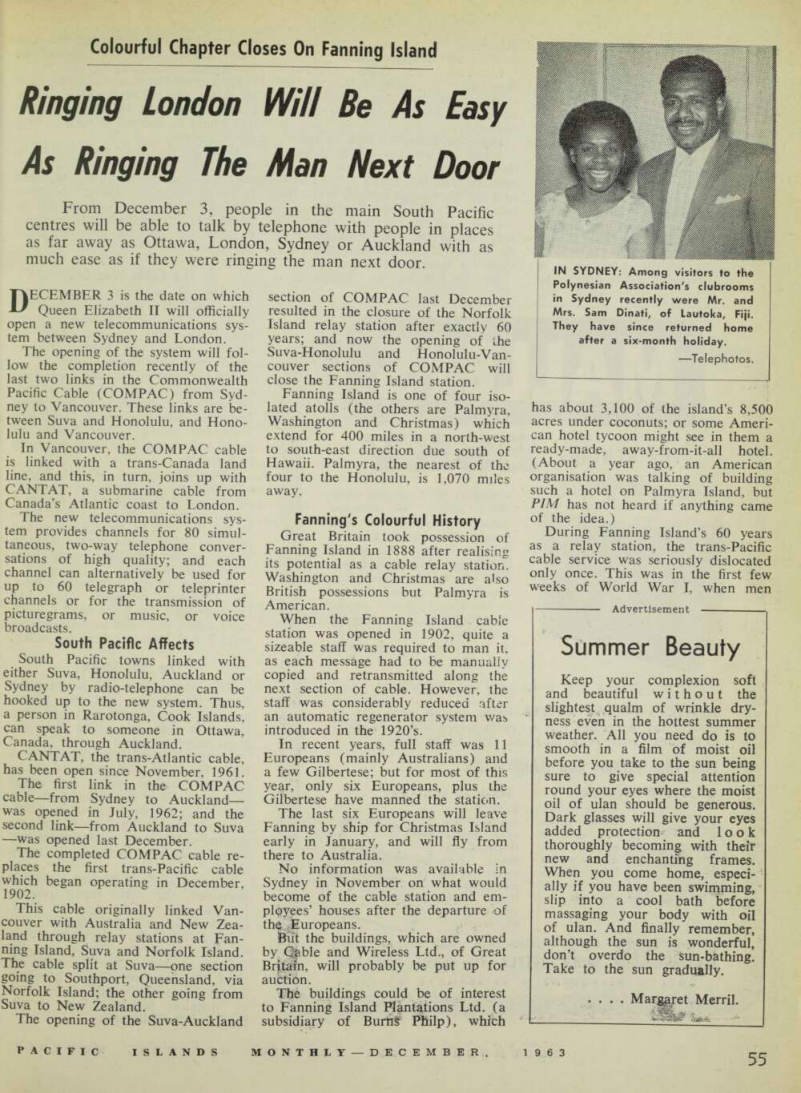
IN SYDNEY: Among visitors to the Polynesian Association's clubrooms in Sydney recently were Mr. and Mrs. Sam Dinati, of Lautoka, Fiji.
They have since returned home after a six-month holiday.
Telephotos.
from the German cruiser Nurnberg raided the island and smashed the equipment.
The island’s cable station staff sighted the Nurnberg off the atoll at 10 a.m. on September 7, 1914. As no ship was expected, and as Fanning normally had a visitor only once every three or four months in those days, her approach was awaited with some misgiving.
Misgiving turned to alarm as the Nurnberg steamed with unusual speed towards the shore, and the station staff made out that she was a war ship.
Meanwhile, in the cable office, a pre-arranged signal was ready to be
flashed to Suva and Vancouver in case an enemy approached.
Eventually, the cable superinten
dent, Mr. A. Smith, made out the warship’s colours. They were the red, white and blue of the French tri colour.
Everyone heaved a sigh of relief.
When the warship slowed down at the anchorage, and a boat was put over the side, Mr. Smith hurried away to warn his wife to prepare a suitable reception for the French officers.
Everyone else, except those on duty, made their way expectantly to the wharf. Mr. Smith was there, too, when the boat drew near.
As she did so, the muzzle of a
machine-gun appeared over the gun wale, and an order was barked out in English; “Hands up!”
Having caught everyone completely off guard, the officer in charge of the landing party told Mr. Smith that no one would be harmed so long as they did not resist.
Then he detailed some sailors to stand guard over Mr. Smith and his men while he and the others marched to the cable office. There, the cable staff on duty were also caught off guard and the Germans systematically wrecked the delicate instruments of the station.
The Cable Was Cut After all working equipment in sight had been destroyed, the Ger mans took the papers from the super intendent’s safe, cut the cables in shallow water, and hauled the se vered ends wide apart at sea.
The German officer then apologised for having to carry out such an un pleasant duty, offered to buy some fowls, admitted gloomily that the Nurnburg would probably soon be sunk, and sailed back with his party to his ship.
The cable station officers waited anxiously for the Nurnburg to disap pear; then they prepared to dig up a secret cache of spare instruments — buried for such an emergency as had occurred—that would enable them to restore communications with Van couver and Suva.
However, in less than half an hour, the Germans returned. They had learned about the cache from a docu ment taken from the superintendent’s safe! It had been put there for safety!
The Last Straw!
After unearthing and smashing the secret instruments, and also appro priating £7OO in gold that had been buried in the same place, the Ger mans sailed off again.
However, despite the Germans’ ef forts, the cable staff managed to re pair the damage within two weeks and re-establish communication with Suva. This involved diving in shark infested waters in search of the severed cable ends, raising them and using makeshift methods to rejoin them.
As soon as Suva learned what had happened, the cable repair steamer Isis was sent to Fanning from Auck land to make permanent repairs.
Meanwhile, the Nurnburg made her way from the Pacific into the Atlantic, where, on December 8, 1914, the German officer’s prophesy was fulfilled —the warship being sunk by Admiral Sturdee’s fleet in the Battle of the Falklands.