Recover Quickly
pp. 65-67 · Read in the full issue

Manihiki Castaways
After Grim Ordeal
The three Cook Islanders who ended a nightmarish, 2,000-mile drift voyage from Rakahanga (Northern Cooks) to Erromanga (New Hebrides) on October 17, were flown home from Vila in November after only nine days in hospital.
THE men were members of the crew of the 17 ft boat Te Aroa, which was blown off course in a storm while making the 20-mile cross ing from Rakahanga to their home island of Manihiki on August 15. (PIM, Nov., p. 10).
Three other crew members died before the boat reached Erromanga on October 17, and a fourth died at Erromanga. The three survivors were taken to Vila on October 24 and admitted to the Paton Memorial Hospital.
They began their flight home by Fiji Airways on November 2, spend ing a day or so at Lautoka before going on to Samoa to pick up a plane for Rarotonga.
In Lautoka, they were admitted to the local hospital while awaiting their aircraft connection.
A Lautoka Hospital doctor who examined them found they were suffering no obvious ill effects of their ordeal, and said they had recovered surprisingly quickly. The men were then peeling from sunburn, but the main effects of the burn seemed to have worn off.
Walking Without Help
During their stay in Lautoka, they were allowed to leave the hospital for a drive through the town and its environs.
Teehu and Tupou were able to walk up the hospital ramp without assistance—in fact they helped to push Toka, who was in a wheelchair.
Toka would have walked unaided also, except for a bandage low on his left leg, and swollen feet.
Toka had never flown in a plane before his trip to Lautoka and was
The three men are Teehu Makimare, 29, married with one child; Toka Tube, 35, married with five children; and Tupou Papai, 33, married with three children. They had made a remarkable recovery after their ordeal.
very nervous before boarding the plane in Vila.
Only a handful of people went to Vila’s Bauer Airfield to see the three men off —PlM correspondent Reece Discombe and his family, and Mr. John Yaxley, of the British Office, This was in contrast to the interest shown in the three men during their stay in Paton Memorial Hospital— gifts of money, food and clothing having flowed in from both European and Melanesian well-wishers.
Nothing But Sleep
Reece Discombe says that during their first three or four days in Vila, all that the men wanted to do was sleep; but they soon picked up as a result of the attention lavished on them by the hospital staff and after receiving messages from home, In less than a week, they were teaching their fellow-patients and the hospital staff various Cook Islands songs and dances, including the famous Tamure.
Teehu, the only member of the trio who speaks English, gave a PIM representative in Lautoka an account of his and his companions’ ordeal.
He said that he and his companions were in sight of Manihiki on August 15 when the storm broke which
started their drift voyage. The storm lasted for two days.
On the morning of the 16th, the storm capsized their boat, throwing all seven men into the water. Three of them—Enoka Dean, Kita Marsters and Tom Tangimetua—were injured.
Teehu said he swam to where Kita and Tom were struggling in the water, and pulled them to the boat. They were too weak to hold on to the boat, so he put them on the sail while he went for the captain, Enoka, who was also having difficulty staying afloat. c , /Vlast snapped Meanwhile, the raging storm snapped the mast off, and when he returned to the boat with Enoka, the mast, the sail and the two men who had been on the sail were out of sight. The two men were not seen again.
Helped by Tupou, Teehu turned the boat side on to the waves and, after a terrific struggle, they managed to right it. Enoka was in a bad way and his condition deteriorated rapidly, He died early that night, The remaining four men kept his body on board until next morning when they cast it overboard during a lull in the storm, saying prayers
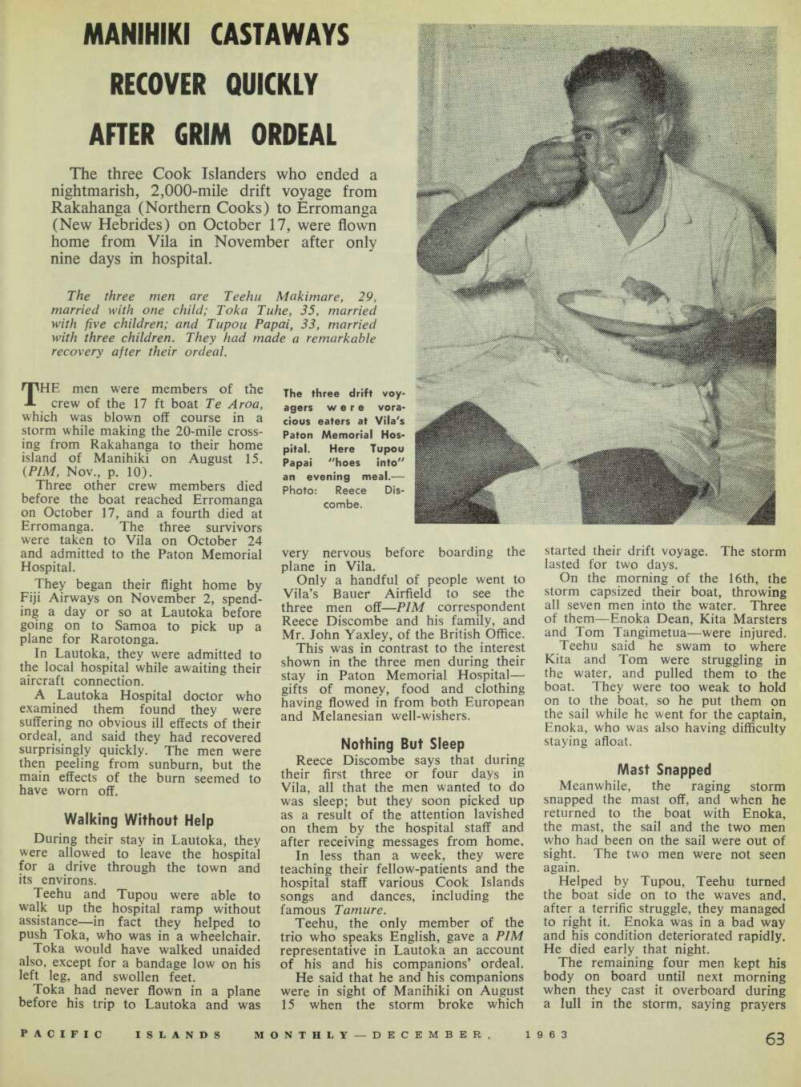
The three drift voy agers were vora cious eaters at Vila's Raton Memorial Hos
pital. Here Tupou
Papai "hoes into" an evening meal. — Photo: Reece Dis combe.
and singing hymns as they did so.
Teehu then took over as captain.
Teehu said the Te Aroa capsized twice more during the voyage, leaving the four survivors without food and water. Eight days after they lost all their food, they picked up a float ing coconut, which lasted them for two days.
They found another coconut about four weeks later, and that one lasted them for two and a half days. Their only other food was flying fish, which occasionally fluttered into the boat.
Teehu said he and his companions took it in turns to sleep, and sang hymns each day to keep up their morale all being Seventh-day Adventists.
According to an account that Teehu gave to Mr. Yaxley soon after he arrived in Vila, the four men who survived after the Te Aroa first capsized tried to make a sail out of what was left of their clothing. This was very difficult because the mast was beyond repair.
"Each morning when we woke up,” Teehu went on, “we picked up the flying fish which had landed on board during the night. There were usually about four or five. We also collected rain water in pieces of canvas.
“During all our time at sea we only saw land once. This was a large flat-topped island. I have no idea where it was or what it was called.
“On the same day that we saw land, and again on another day, we also saw aeroplanes, though I do not know whether they were the planes that were sent out to look for us.
“About three weeks after we capsized—it was October 17 I think— we saw land, and, luckily we were driven on to the reef. Later I was told the place was called Port Narevin on the island of Erromanga.
“The Te Aroa stuck on the reef and we got ashore as best we could.
Immediately we were on dry land I tried to get some food for the others.
I got a coconut but had nothing to cut it with. I tried with my teeth, but the nut was too hard.
“After a few hours we saw a man fishing. We went towards him but he was frightened of us. I told him not to be frightened and that we ( were his friends.
“When he saw that we would not hurt him he was not frightened and he took us to his village and gave us food and clothes. He told us his name was Peter and we stayed with him for about three days. Then we went to Dillon’s Bay on board a ship owned by a Frenchman. ‘At Dillon’s Bay we met Matthew,
who had been a Government Medical Dresser. He looked after us but un fortunately one of our party, Taia Tauraka, died. Now there were only three out of the original seven who had set out from Manihiki two months before.
“On October 23 we went on board the Air Wave which had called in at Dillon’s Bay and which was going to Vila. Mr. Field, the captain, sent a message to Vila to tell them that we were coming. The next day, early in the morning, we arrived in Vila.”
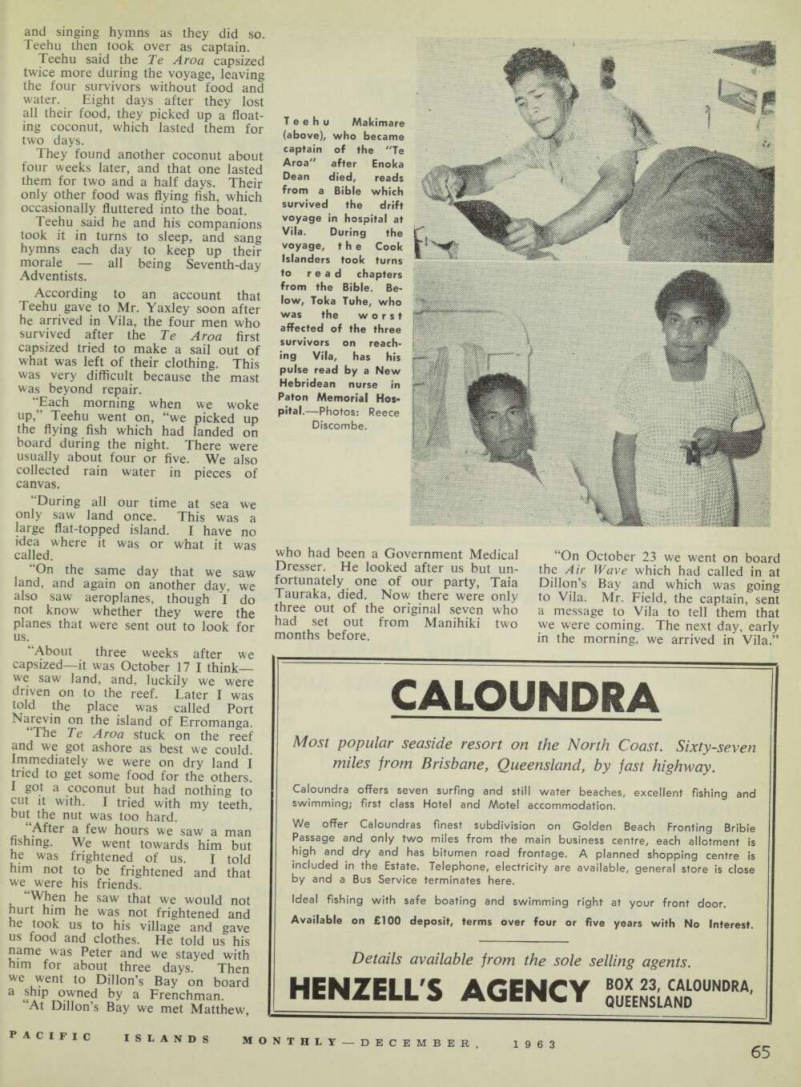
Teehu Makimare (above), who became captain of the "Te Aroa" after Enoka Dean died, reads from a Bible which survived the drift voyage in hospital at Vila. During the voyage, the Cook Islanders took turns to read chapters from the Bible. Be low, Toka Tube, who was the worst affected of the three survivors on reach ing Vila, has his pulse read by a New Hebridean nurse in Paton Memorial Hos pital.—Photos: Reece Discombe.