Territories TALK-TALK
pp. 49-53 · Read in the full issue

With Tolala
With Soekarno turning somersaults and handsprings in “West ian” and his apparent aspirations for his own brand of neo lonialism, I am surprised that our own P-NG Administration is ► more careful in safeguarding the interests of those people in our irritory who live at no great distance from the West New Guinea irder. A discontented people may soon become fertile soil upon lich an acquisitive neighbour may sow seeds of unrest.
|F particular interest was an article in the Times-Courier, headed Forgotten’ People Seek Adminis tion Aid”. It tells of an interview th the Administrator in Rabaul of ee Wuvulu Islanders who claim ;y have been “sadly neglected”.
Wuvulu, if I remember correctly, is other name for Maty (or Matty) and, and forms part of the Western ands. The “punch-line” in this story 5 in the geographic description en in the NGT-C : The Western Islands, which have more than once been referred to by New Guinea Islands Legco Member Paul Mason as “the For gotten Islands”, are situated 125 iniles north of Wewak and equi distant to West New Guinea. [The italics are mine.) Ihe Western Islanders were asking means to market their copra; de goods at reasonable prices; ter medical attention; at least one ministration native school-teacher; >roper water supply; some system organised welfare service; a wire , set; anti-malarial measures, and y also desired to come under We < (125 miles distant) and not as present under Manus (330 miles wi ly contrast, it was pointed out, islands of Mortlock (140 miles) I Tasman (350 miles) east of lano, Bougainville, had regular ts from trading vessels, had seven ive teachers in the two groups, dical orderlies with supplies and eless receivers.
Sir Donald Cleland was reported have “listened sympathetically”
I said he would see what he could 4ew Guinea readers of reports of h deputations will be able to make ir own evaluation of Sir Donald’s larks. iut surely a man with Sir Donald’s iwledge and intelligence must rea what a potential danger cell is i group of neglected people, “equi
distant to West New Guinea” as they are to Wewak.
Being of the more docile, peace loving Polynesian type, and not im bued with the pugnacious, “direct ac tion” propensities of the Hahalis Bukas (who defied the Government in their fight for their rights and subsequently had a moral victory) these Western Islanders are more or less left out on a limb. Isn’t it realised what “fertile soil” they present in the cold war of international intrigue?
On the other hand the international boundary adjacent to the Mortlocks/ Tasmans is between T-NG and the BSIP, and there is constant (unoffi cial) communication between the Tas mans and Ontong Java (Lord Howe), evert as there is between Buin and the Shortlands.
There is no need to guard against potential “danger cells” to the south ward boundary, but surely the north
western boundaries call for careful attention.
Or are neglected people in this area deemed “expendable”?
Another Potential Cell While on the subject of these “danger cells”, as I am now terming them (with the modification “poten tial”), one must not overlook the offi cial attitude which has occasioned much heart-burning amongst the mixed race people of New Guinea, regarding their application for naturalisation.
Although, perhaps, not numerically strong, the mixed race is nevertheless an important section in a multi-racial community, especially at this time of desired integration and assimilation, for it forms a liaison between the colours. It is as though its members wore bi-focal lenses. They can see both sides of the picture.
As a contented section of the com munity they can be invaluable but thwarted in their desire to become naturalised, they could become “fer tile soil” for wagers of the cold war, and we must not delude ourselves by thinking that there will be no cold
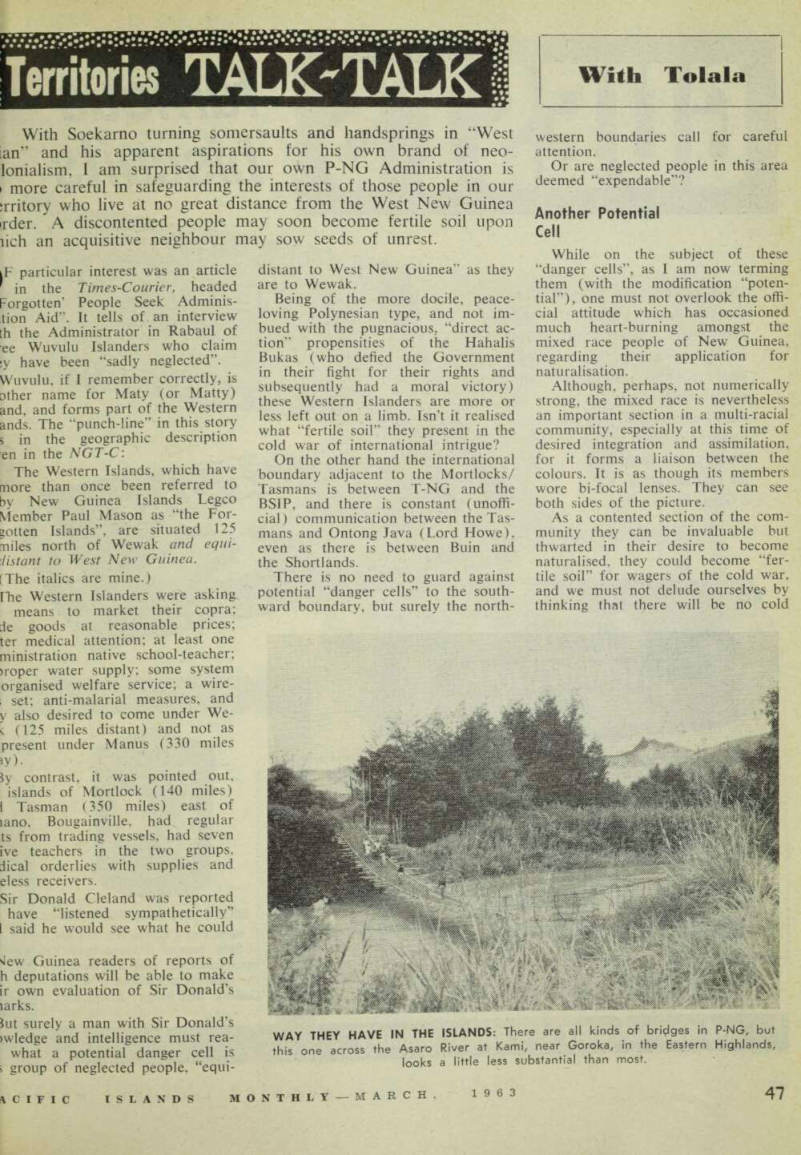
WAY THEY HAVE IN THE ISLANDS: There are all kinds of bridges in P-NG, but this one across the Asaro River at Kami, near Goroka, in the Eastern Highlands, looks a little less substantial than most.
r. As sure as God made little >les, it’ll come. In fact, it’s knock at the door already. }n the other hand, the Adminis tion must guard against possible ckmail by malcontents using this trument to attain their own ends, s a difficult period. But these situa is arise when primitives become icated in social and political con ons. It’s the price of progress '63 vintage). i Gift of lech lefore leaving this topic of mixed e folk let us glance at some of the ss headlines occasioned by the bosity of one, John Guise, MLC East Papua, who is nothing if not al, and rates headlines at the drop the hat.
“The Guiding Mr. Guise” heads article in a Melbourne paper and jrs to him as “church-goer, orator I thinker, is seen by many as the mate national leader ... As an tor he is superb. . ..”
Shift on Control ‘Needed’,” says a ible-column head in Sydney’s lly Telegraph, reporting his ABC est of Honour talk in February. . .
Guise’s Strong Speech,” the South ■ific Post prints in a double column : on the front page, also reporting broadcast talk. neither applaud nor deplore the orted statements by John Guise, has a perfect liberty to express his ti opinions. The point at the ment is that people of mixed races not, or should not be disregarded, ncidentally John Guise did not ak any particular new ground in plea for “policy-making” being asferred from Canberra to the •ritory. This has been a leit-motiv •ressed by public-spirited, thinking idents of New Guinea—of every our —for a considerable period, ing back to the thirties, fhe trouble in those days was that was not “news” for the Press; nor s there a political and Press policy boost the ego of the dark races, the simple reason that the Afro ian influence in international poli ; had not then been born. \nd whether John Guise, in some his other broadcast remarks, is ex sssing the general opinion of all his leagues in the Council, I wouldn’t DW.
Fhere is one point which he should t forget and that is the old adage 3ut “who pays the piper calls the le”.
The sting in Mr. Guise’s broadcast was undoubtedly in the tail: (a) “The only way in which all doubts [regarding P-NG becoming a mere pawn in international politics] is for the Australian Government to make an absolutely clear statement that it intends to preserve the unity of Papua and New Guinea as one country till we ourselves assume full control of our destiny”
And what happens then? (b) “In a modern world, as we all know, there are other nations.
with other beliefs, who are only too ready to cash in on the opportunities provided by discontent.”
How true! (c) “The sails of this bucking ship of state are billowing with the winds of goodwill blowing towards us from the people of Australia and the free world. . .”
Was this a happy metaphor? A southerly wind blowing them whither? Northward? We hope not.
One thing is certain: We shall be hearing more about John Guise in the days to come. (Over)
Information Wanted I quite realise this is no “Miss; Persons Bureau”, but perhaps reao could help me to solve three ques that have been put to me and hr me beaten. (1) E. L. Mauseth writing fn Alden, Minnesota, USA, wants ; information regarding an old idem “Yankee Ned”. His home base T Yorke Island, NW of the Thurs* Island group, but he travelled abr through the South Seas buying pe;; and placer gold dust. Lived to be; and died in 1920. (2) Any information dealing w a Captain William Chatfield, of British East India Company, w came to Goulburn in 1840, wentj Camden and Campbelltown (NS’; area in the 1860’s, remaining uj 1880. Died 1902. (3) Information as to the wh© abouts of any relatives of Harry V* liam Hamilton, who died in the I 1 1920’5. Harry was the founder of I Rabaul Times in 1925. Prior to tj he was Government Printer in Rabc and was a member of the AN&MI He was also a Boer War veteran, was married and had (to my kno ledge) a daughter, both wife s daughter lived in Sydney in 1920’s and visited him in Rabc about 1926.
End of Research Departm© Thank you.
Jock Maclean Is 69 There are not many of the old-ti i residents of the Bainings on Rabif who do not know of Jock Made;; of Rangarere. This month he c© brates his 79th birthday.
He has decided, apparently, to I come a bit retrospective and fro his present home at Woody Poii< Queensland, I have received sou clippings from the Stornoway Gaze a (Scotland) and the Redcliffe Hen (Queensland) which give some id) of the life, packed with adventu and variety, led by this old Scot.
He was born in the bleak Our Hebrides; found himself later tropical New Britain after havii served in the 3rd. Bn. Seaforth Hig landers in Scotland; had a period sea in the Mediterranean fruit traoi then joined the Scots Guards in 19£ in London.
After three years with the Guam he went to Australia and there joinn the Royal Australian Artillery. A J then away to Papua coconut-plantii and pearl-diving. At the outbreak
Var I he walked over the Owen Stan ds from Buna to Moresby to recruit, le served with the 26th. Bn. AIF in : rance and returned to New Guinea i 1920. [He was with the Expropriation ioard and it was at this period of his areer when I met up with him and is charming Luxembourg wife, r hose sister was Baroness von lannsfield.] In 1926 he purchased Rangarere lantation in the Bainings and ex ;nded his interests later in that area ffiich included plantations and a gold line.
Came War II and this phase of his fe is described in the Redcliffe lerald which published extracts from is war diary: Of the retreating sol iers from Rabaul, following the apanese landing there; of their es ape by pinnace and eventual arrival t Buna after sundry adventures.
Little wonder now that Jock en >ys relaxing in the Queensland sun.
“I have been keeping fairly well ” e writes me. “Of course I have ar iritis and a tropical sore on the nkle, otherwise I am fit.”
They breed ’em tough in the Outer [ebrides to say nothing of the dis ipline in the peace-time Guards of le early 1900’s! nother Scot Before we leave the topic of this ardy race from north of the Tweed, must mention another Scot whose ace looked up at me from the pages f the New Guinea Times-Courier. it first I thought it was Nino Culotta, f Weird Mob fame, but it was none ther than McGregor Dowsett on a isit to his old stamping-ground, Rabaul.
He was the founder and ever nergetic worker for New Guinea’s Caledonian Society in the Bad Old )ays of Pre-War 11.
McGregor Dowsett was a person ality, not only in Rabaul but through
out the Territory. Nor was his status necessarily created by his bank ac count. The Caledonian Society, which he so ardently fostered, became a well-known medium for its charitable work, besides organising many a suc cessful social function.
Jim (although he usually received his full name of McGregor Dowsett) made life much brighter for many an inmate of Namanula Hospital when he brought in large bunches of roses from his North Coast gardens.
Last time I had heard of him was from a fellow passenger on Bulolo in 1955, who told me then that McG. D. was a member of the Geelong (Vic.) City Council.
May his shadow never grow less.
Arts and Crafts Mr. Stuart King, an arts teacher in Port Moresby, has urged that the native people should extend village industries. In other words, to make the things their parents made and for which they should have a natural adaptability.
From his photo in the South Paci fic Post, Mr. King, with his tousled hair, does not give the impression of living in an ivory tower; but he has the right idea and it is to be hoped that officialdom gives its imprimatur to his suggestion for the encourage ment of native arts and crafts.
It is something which the Terri tory can cash-in on for years to come —if only it is properly exploited.
From Manus to Bougainville there are hundreds of native craftsmen— men and women—working their looms, making their baskets, weaving anklets and armbands, fashioning pipes and saucepans, all of which could become valuable items of trade and tourist attractions.
As I mentioned not so many moons ago: Where are the Sticks of Aua, with their whale-bone centres and mother-of-pearl inlays? Or the tor toiseshell rings from Matupi Island?
Where the woven mats from Tasman and Mortlocks? The Buin baskets?
The hard-wood carvings from the Sepik? Are they laying catalogued in American museums, picked up by itinerant anthropologists and ethno logists?
Have we thrown away the heritage of these primitive peoples and be come concerned only in civilising them to our way of life so that they forget their own arts and crafts, and thus leave us no trace of their own culture?
Let’s hope not.
Jock Maclean.