The Queen
pp. 55-63 · Read in the full issue
In Fiji
'Staggering' Welcome
From Correspondents in Suva and Lautoka
When for only the second time in 10 years the Queen saw Fiji in February there was no doubt as to who her most loyal subjects were. The depth of reverence with which the Fijian people greeted her and Prince Philip astounded visitors.
ALTHOUGH the Queen was in fact merely en route to her major tour of New Zealand and Australia, and spent only an hour in the Nadi-Lautoka side of the island and less than a day in the capital, the extent and the quality of the Fijian preparations to wel come her were staggering. Many of the big party of overseas news men who covered her arrival made it clear in their reports that Fiji obviously was not one of the colonies hell-bent for independence from the Crown, The Royal couple reached Nadi by BOAC jet from London at 7 p.m. on February 2—21 hours behind schedule after being delayed by bad weather in Canada and Hawaii.
They drove the 14 miles to Lautoka where they boarded the waiting Royal yacht Britannia, which had been sent ahead, and made the overnight voyage to Suva for the concluding day of their Fiji visit.
In the Nadi-Lautoka area it was the Fijians with their simplicity and sincerity who stole the show. There was a specially remarkable demon-
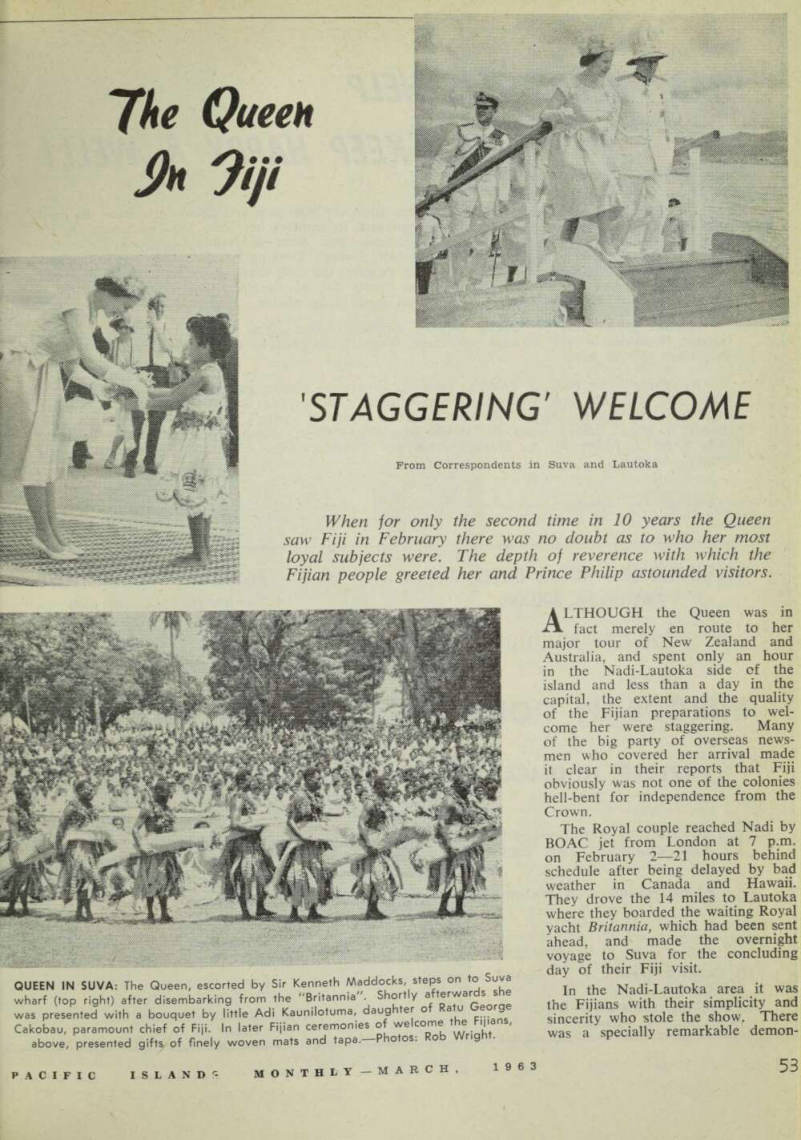
QUEEN IN SUVA: The Queen, escorted by Sir Kenneth Maddocks, steps on to Suva wharf (top right) after disembarking from the “Britannia . Shorty afterwards she was presented with a bouquet by little Adi Kaunilotuma, daughter of Ratu George Cakobau, paramount chief of Fiji. In later Fijian ceremonies of we lcome the Fijians, above, presented gifts of finely woven mats and tapa. Photos: Rob Wright.
stration by the historic village of Viseisei, through which the Royal car passed en route to Lautoka.
Viseisei, which is the legendary landing place of the first Fijian migration to the island, worked from dawn to dusk for days before the Queen’s arrival, preparing for the brief minute or two which the Queen took to drive through the village at six miles an hour in a closed car.
Everything had to be “just so”. There had been rehearsal upon rehearsal.
The village’s chieftainess, stately and dignified Adi Mere Tavaiqia, revered in her own right by the people of the district, took charge of the welcome preparations for this, the first and last opportunity most of her people would have of seeing a reigning Queen of England.
On the arrival of the Royal car, brilliantly costumed warriors moved out from the roadside carrying bamboo flares and escorted it through the village.
Fanfare Adi Mere’s own drum, used only on occasions associated with her movements, had been sounded to herald the approach of the Royal entourage and a fanfare of warning to the assembled population had been given on a large seashell.
The entire roadside of the village was lined with more warriors in full dress, each carrying a bamboo flare, and on the kerb groups of villagers, again in full costume, were formed into tableux depicting aspects of Fijian life.
Amidst it all, stood Adi Mere, regally dressed as befitting a chieftainess of the Fijian race, ac companied by her ladies-in-waiting and persons of her household.
At Lautoka itself it was very much the same story. On the outskirts of the town, a group of warriors, again carrying bamboo flares, joined the Royal procession and ran alongside the car to the town square as an escort.
As the Queen alighted from her
os: Wright.
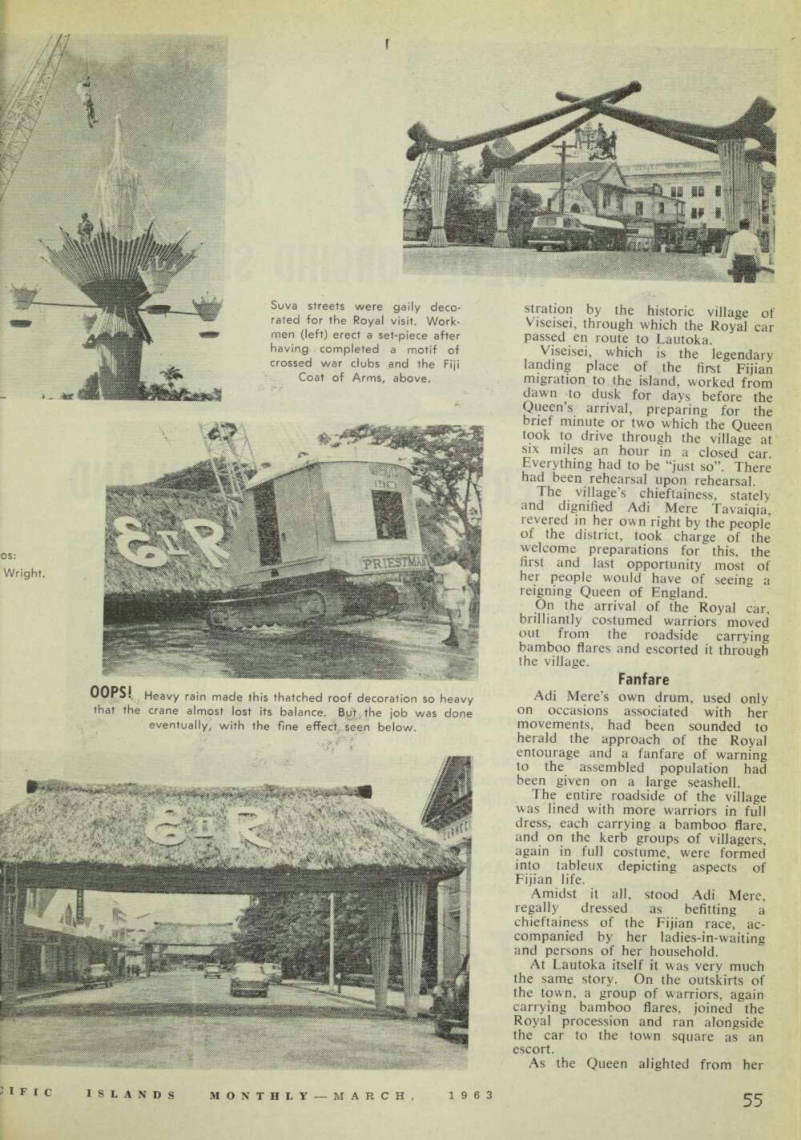
OOPS! Heavy rain made this thatched roof decoration so heavy that the crane almost lost its balance. But the job was done eventually, with the fine effect seen below.
Suva streets were gaily deco rated for the Royal visit. Work men (left) erect a set-piece after having completed a motif of crossed war clubs and the Fiji Coat of Arms, above.
ir to receive the Mayor, Cr. R. B. igleton, and his councillors, it was Fijian choir of hundreds that raised > voice in a joyful anthem of wel >me (it could be heard at the wharf, ore than a mile away). It was a ijian reed fan that backed the agnificient bouquet of flowers pre nted to her on behalf of the people ; Lautoka by an 8-year-old Indian rl Satish Kuar.
Again it was hundreds of Fijian ardors in full dress who lined the ile-long road to the wharf, never illiantly lit in normal times, each an holding aloft his flaming imboo torch to illuminate the ueen’s progress and make sure the iver of the gleaming Rolls Royce d not stray into the multitude of )t-holes flanking the road.
It was nearly all Fijian, from the lards at the reception pavilion in e Lautoka town square; to the ampeters of the Fiji Police Force do sounded a fanfare on silver impels to herald her arrival; from e choirs singing her praises and rewelling her at the wharf with Isa ?/, the haunting song of farewell lown to thousands of tourists, and the thousands who trekked two iys from the interior and sailed in 3m the remotest island for that one ief glimpse.
Rarely has Suva’s reef-fringed irbour seen such a spectacle as that e next morning, Sunday, when the 3yal yacht sailed through the main issage and into the harbour. It was the middle of the rainy season it it was sunny Queen’s weather.
The Britannia, with its escort of yachts and power boats from the Royal Suva Yacht Club, steamed slowly to her moorings off the King’s Wharf with the echoes of the Fiji Military Force’s 21-gun salute still rolling in the hills, There was an enormous crowd watching as the Governor, Sir Kenneth Maddocks, and Lady Maddocks accompanied by the ADC and the matanivanua (spokesman) went out to greet the Queen and Prince Philip. Sir Kenneth had first welcomed the Queen at Nadi the previous night, i ,„,i lnvlted t 0 Land Eight Fijian chiefs followed and in their traditional dress performed on board the Britannia the solemn ceremony of cavuikelekele (invitation to land).
After Ratu Etuwate Mataitini had presented the tabua (whale’s tooth) the party returned to the wharf and five minutes later the Queen and Duke set foot on land. Then she heard the great Fijian welcome “Ni mata vinaka mai”, reserved for persons of the highest rank.
Heading the list of those presented to the Queen on the wharf was the Chief Justice of Fiji, Mr. Justice Mac Duff, the Speaker, Mr. Maurice Scott, members of the executive council, the Mayor of Suva, C. A.
Stinson, and Mrs. Stinson, and members and officials of the Council.
Although nobody knew it, tragedy was at hand at that stage. Councillor
This bedroom, with a sitting room attached, was set aside at Government House, Suva, to give the Royal couple an opportunity to rest during their brief, but busy, visit to the capital. Photo: Rob Wright.
J. B. Singh took the Queen’s hai in greeting and talked to her. Minul later, but the Queen was never tol Councillor Singh, slightly indispos previously, collapsed. He died Suva’s hospital shortly afterwards.
Suva’s main streets, decorated wi set-pieces of war clubs and arch of thatch and bamboo, were lined deep with a crowd which from Suv; normal population of about 40,0 had swollen to 100,000.
As the Queen and Prince Phi passed in an open car smiling a acknowledging their welcome th must have again noticed what th experienced on the road to Lautoka the quietly majestic welcome of t Fijians, that deep silence with whi the island people honour Royalty.
The Indians, gay in sport shi and saris, clapped gravely; and t Europeans gave voice to th emotions.
At Albert Park, a kaleidoscope colour, more than 14,000 scho children were congregated. After brief religious service conducted the Rev. H. W. Figgess, Anglic Vicar-General of the Diocese Polynesia, and the Rev. Setar Tuilavoni, head of the Method Church in Fiji, the Queen and Prir Philip, in a specially convert Land-Rover, drove round the park, and out of the ranks of the childn
Lusty Cheers
The youngsters let themselves with lusty cheers and waving fU and from the attitude of Prince Phi it was plain that he was enjoyi himself.
From there the Royal party drc to the nearby grounds of Gove: ment House, where the Fijians, c playing that almost religic reverence accorded to Royal extended to their Queen their homa with age-old ceremonial.
Seated in a Royal pavilion ma from bamboo and leaves the Ro; couple, the Governor and otl members of the Royal party, watch with interest as the Fijians perform their various symbolical tasks deep, solemn silence.
From a large leaf, Adi Li Lalabalavu, wife of Ratu K. K.
Mara, splashed sea-water over bows of a canoe placed on the lav Thus she represented symbolics the passage of a canoe over the to a safe landing.
A tabua was laid on the bow the canoe by Adi Samanu Cakobau, eldest daughter of paramount chief, and when whale’s tooth was laid before Queen’s official spokesman, R: Rusiate Komaitai, it signalled the e of the Qalowaqa ceremony.
Then the Vunivalu of Bau hints*
i George Cakobau, with his iors, chiefly costumed, and with ecklace of boars’ tusks, slowly nted the pavilion steps and 2d before the Queen a large a. nd so the Fijian ceremonies con jd in the noon-tide heat with and television cameras whirring, thousands watching, venty-two men staggered under weight of the enormous yaqona kava) root as it was placed on mats of masi in front of the al pavilion. lis was followed by the yaqona Dony, the solemn mixing of the ina in the tanoa (bowl), linating in the presentation to the m by the cup-bearer of the first (coconut cup) of the liquid, uickly and without pause the ;n drank the kava. When it was puke’s turn she glanced sideways im, a hint of amusement on her as if she was thinking, “Now four turn!” le last of the ceremonies was presentation of the food, a large et of the island’s fruits and
roots and a roast pig which measured seven feet from its snout to its tail. 1 u D tor the first and only time the huge crowd heard the Queen ' i . 1 thank you warmly for the ceremonies of welcome which you aye just performed in accordance Wlth y°” r custom, she said.
My husband and I are very happy to return to these lovely islands and *°. he renew our acquaintance whh the people of Fiji, whose loyalty and devotion to the British Crown has been demonstrated on so many
OC u^i° ns ’ •
Your islands face many difficult problems, but without doubt these
problems will be overcome if they are approached in the spirit of tolerance and understanding, and with the determination to find solu tions which will contribute to the good of all.
“I shall always watch the progress of Fiji with keen interest and shall pray for the happiness and prosperity of its people.”
The luncheon in a specially built shelter in the Government grounds was seen by only a few, the members of Legislative Council and leaders in Fiji. Only a small group saw the investiture that followed in Gov ernment House when the Queen made the awards to those she had
Queen carried out an investiture in [?] rnment House, personally presenting [?] ds to those she had named in New [?] and Birthday Honours Lists. Here [?] .-Col. H. M. Boulton receives the QBE [?] il.) from the hands of the Queen.
Photo: Rob Wright.
med in the New Year and Birthday )nours lists.
As the Duke, wearing an open eked undress bush jacket, with Imiral’s insignia, leaned against a lar—only a spectator like the rest the Queen gave the insignia of the corations to their recipients.
At a steady six miles an hour the »yal car took the Queen and the ike back to the Britannia.
Despite the long ceremonies, the amy humid heat and some fatigue lich she must have been feeling, ; Queen stood with the Duke all ; way, as the car passed through ; Government House grounds be een rows of uniformed youth or nisations, and through the streets the city.
All along the route the people d gathered to catch their last impse of the couple.
For many of the girls the Duke is a romantic figure. As he stood 11, distinguished and handsome in s white uniform with the gold signia of an Admiral of the Fleet, : must have heard some of the rlish remarks of appreciation.
As the Britannia inched away from e wharf the Queen and Duke ipeared on the upper deck and aved the last farewell to Suva and iji.
[?] e of the first bouquets the Queen re [?]ved in the Colony was this one from [?] ractive Satish Kuar, eigh - year - old [?] ghter of a Lautoka councillor. The [?] sentation was made in Lautoka the [?] ht the Queen and Duke arrived at Nadi.
Photo: Rob Wright.