Tourism
pp. 45-46 · Read in the full issue
Sourpuss "Sydneysider"
Tonga Talks Back On
• A Tongan who has contributed to PIM before, S. A. Fanamanu, springs to the defence of Tonga in the face of what he took to be a blow below the belt by Sydneysider in a Walk about article ("Tonga Tourist is not Amused"), January, 1963.
The expressed views of the one-day-know-it-all who visits Tonga and becomes an authority overnight, has now become too monotonous and nauseating. One can easily judge that these views are highly seasoned with the more established ones of local critics who are sentenced and banished from civilisation to serve their terms, very much to
their regret, in Tonga.
THE Tongans had quite an ex perience with thousands of soldiers and sailors who landed to defend the islands during World War 11. They introduced into the islands innovations that threw not only our religious beliefs into chaos, but treated our traditional social structures, which had survived for hundreds of years, as a joke, and our customs as nothing. In the so called higher places, it was felt very, very keenly. And to date it still lingers as an unpleasant memory.
Tonga is not yet in the market for attracting tourists’ dollars. Tonga realises only too well that it has not the facilities to offer for the comfort of tourists, since it depends almost entirely on its agricultural strength in limited areas of arable land.
The Tongans have lived simply for hundreds of years; they would love to possess and enjoy all the modern facilities that are consistent with civilised living, but our development is conditioned by our meagre re sources.
Fiji has its natural resources as well as the competition of com mercial enterprises and the financial backing of the British Crown. Tahiti has the financial and trade-backing of a mother country and plenty of arable land, plus its heart-throbbing entertainment attractions. Tonga has
only its own resources and its traditions.
The Tongans still very strongly adhere to their customs because they are their racial inheritance, and it grows with them throughout all the years of their social development.
We cannot possibly throw that out overnight in order that a tourist should get his eight-hour sleep; a tourist, moreover, who is out to see the world with only one object in mind—his personal comfort.
My version of a tourist is some one who will not expect the com forts of his city to be found in Islands ports. He is someone who, with a spirit of adventure, is out to enjoy the finer points in life; to meet new people; to observe new customs; to try little discomforts that linger in memories, and such like. That is what I would expect of a tourist from any of the civilised centres who visits the smaller developing islands of the South Seas.
If a city person expects to be served and accommodated in the Islands as in his own city, then his sense of direction is at fault. He should go north to the comforts and the bright lights of Europe and the United States, but not south where he will be bound to meet with grumpy people, and a lack of his customary comforts.
Europeans who have spent years in Tonga have come to love the island so much that they make it their home. Some are married to Tongan girls and have children who are now contributing in no small
measure to the development of the country and the improvement of the health and status of the people.
Europeans who are in residence have this place for their leisure. I am most curious to know what it is that these remaining Europeans have given up saying anything about.
Government has made an effort to make the European expatriate officers and their families enjoy life here at the expense of taking away lands registered by Tongans as their own homes. One has only to look at the golf links, the tennis courts, the cocktail parties and clubs to see that the picture painted of European life in Tonga is not as grim as Sydney sider made out.
Mrs. Bella Riechelmann has kept a little candle light burning for years for tourists with the true spirit of a traveller. When she retires it will be with great honour and with memories of tourists, especially those who are out to tell others how to put on their shirts properly.
People's Party Can't Cope
The so-called “People’s Party” is certainly heard in any session of the Tonga Legislative Assembly, but people’s representatives are elected by popular vote. Their intellectual capacities cannot possibly cope with Tonga’s problems that extend to over seas transactions, so, to that end, their opinions must be adjusted to the current overseas trends in trade, etc., through clarifications of relevant points but not by authoritative demand from chiefs or government.
The number of university gradm in the whole of Tonga can still! counted on your fingers. Nonee these few represents the people most of them are employed by G ernment.
The presence of Mr. B. L. Au in Tonga, a fine architect and of the Philippines’ top notch gineers, is a glaring fact on asset side of the administrau ledger, since water is one item t is most vital to human developmti Tonga is still developing, and it is to reach the stage of a swimnr pool, with its health hazards. Wht wrong with the blue waters of Pacific Ocean?
Ironically, Prince Tungi was first Tongan to be graduated fn the world-famed University Sydney and in spite of all the offhi designations enumerated by Sydrv sider, he is being paid only as Premier. He was a resident Sydney in many of his most receptr years. He was brought up ami the modern complexities of modJ living right in the heart of the o of Sydney. He is the product one of the highest academic stitutions of Australia, and in activities reflects what Australia H taught him. In him and his ministJ we have entrusted the over development of Tonga.
My views are by no means exposition of sensitiveness criticisms—but rather an express! of loyalty to principles. • Fair enough comment, sa “Sydneysider”, except that, in sps of the heading that landed on tk particular article, she wasn’t in Tom as “a tourist who is out to see t world with only one object in mi\ —his personal comfort”. Or even a tourist. Maybe—after 20 years these peregrinations—it is a case the spirit of adventure, that Panama c speaks about as being essential the enjoyment of the finer points [lslands] life, getting a bit frayed the edges. And not much fun in t\ “little discomforts”, either.
Mrs. Riechelman hasn’t be*, “keeping a little candle light burni\ for tourists”, but tending somethiX about the dimensions of a searo light. If she gives up, then travelled who have to go to Tonga on essentiX business will have to give up, tcs If some good fairy could waft tA building of the Rainmaker Hotel Pago (which is about 60 years moo modern than Beach House), over Nukualofa and combine it with MP Riechelman’s friendly service am excellent food, no one would have bother about any fancy tourist hofa for Tonga for years to come.
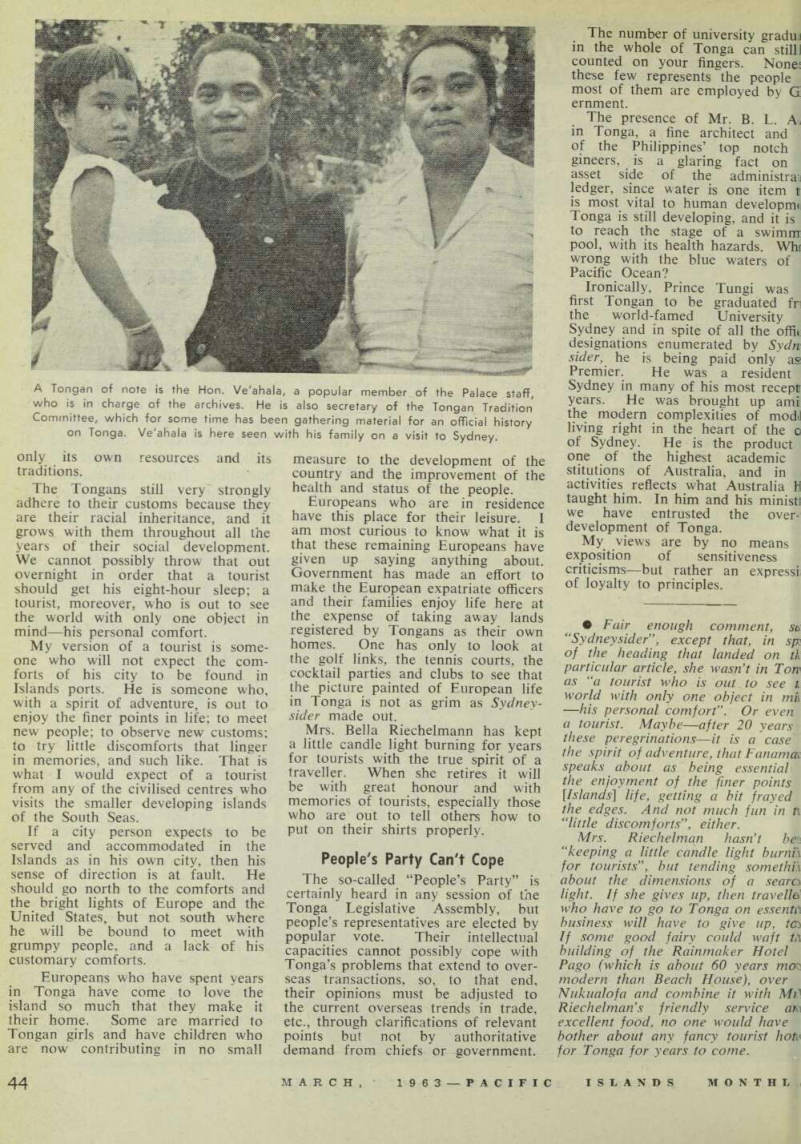
A Tongan of note is the Hon. Ve'ahala, a popular member of the Palace staff, who is in charge of the archives. He is also secretary of the Tongan Tradition Committee, which for some time has been gathering material for an official history on Tonga. Ve'ahala is here seen with his family on a visit to Sydney.