New High In Fiji’s
pp. 31-33 · Read in the full issue

Retirement of Development Commissioner
New High In Fiji’s Deplorable Record
By a Staff Writer
The time-wasting, muddled policies of the British Colonial Office in relation to the government of Fiji are illustrated in the history of the events which led to the announcement, in January, of a new Develop ment Commissioner in Fiji.
rwas apparent, three decades ago, that Fiji’s increasing population if Fijians and Indians soon would iutstrip the economic machinery irovided in the Colony for feeding tie people. More than 10 years go, the Legislative Council appealed irgently to the Colonial Office for ttention to this matter.
The Colonial Office, several years fterwards, appointed a Commission nder the wise and experienced Sir dan Burns, GCMG, to examine the 'olony’s natural resources and popu ition trends “to recommend how le development of the Colony and s resources should proceed”.
The Burns Report issued late in 959 was a most comprehensive, aluable document; and, if its 124 jcommendations had been promptly nd effectively implemented, the icial and political dangers then ireatening Fiji might have been verted.
But the Fiji Government—which merely the characterless hand laiden of the British Colonial iffice —made a slow and uncertain pproach to the whole task of putting le Burns Plan into operation.
The Plan demanded firm, resolute :tion on two major points—re rganisation of governmental mach-
inery so as to rid the Colony of a double administration (one for the Fijians and one for the rest) and the establishment of a Natural Re sources Council to take charge of the vital matter of development.
The Government simply ran away from the demand that the Colony’s administration be rearranged and streamlined. It would not face up to Fijian opposition.
The Burns Commission, recom mending the appointment of a Development Commissioner, said: “We attach much importance to this position and we consider that no pains should be spared to obtain the right person who, we suggest, should initially be appointed on contract for 10 years”. The Commission ex plained that 10 years would be
Mr. E. R. Bevington is retir ing in April from the office of Development Commissioner in Fiji, after filling the post for only about 18 months.
Mr. W. B. Rogers, of Tangan yika, has been appointed to the position.
necessary if there was to be effective continuity of planning and policy.
It was generally expected that a man of outstanding experience in the sphere of commercial organisation would become Development Com mhsoner. Instead, the Colonial Office late in 1961 appointed Mr. E.
R. Bevington, then Finance Secretary of Fiji.
Mr. Bevington is a man of out standing ability in the fields of gov ernmental administration, but he never had been a director of big enterprises which could live only through economic justification; and he never had operated outside the sheltered cloisters of the Colonial Office.
He threw himself, with extra ordinary energy and self-sacrificing devotion to duty, into the terrifying task of creating an organisation which would develop Fiji’s natural resources quickly and in such a way as to provide for the increasing
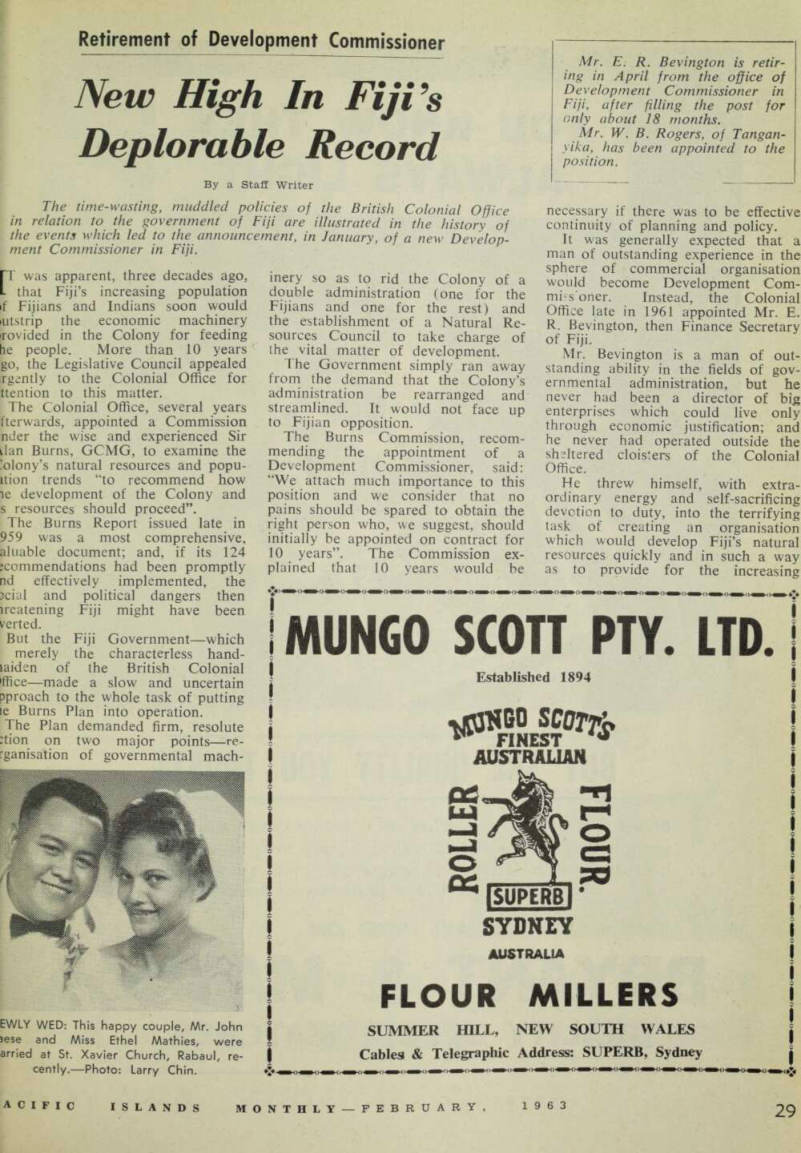
EWLY WED: This happy couple, Mr. John aese and Miss Ethel Mathies, were arried at St. Xavier Church, Rabaul, re cently.—Photo: Larry Chin.
apulation; but he soon was beating is head against difficulties and irriers that were the result of his ati Jack of experience in the world big commerce and big finance.
Few were surprised when it was lown late in 1962 that Mr. Beving n had decided to retire; but many ere very sorry, because Mr. jvington is a likeable person, and :served a bet er ending to his quite stinguished career as a civil rvant. The blame lies not with r. Bevington, but with the very apid people who selected the rong type of man for an extremely iportant job.
Mr. Bevington goes on pre tirement leave in April. He has id over 25 years in the British alonial Service, and he now is only *• A good man wasted.
From Tanganyika
Fiji’s new Development Com issioner is Mr. W. B. Rogers, aged !, of Tanganyika. Only time will ow whether he is fitted for this fficult job in Fiji, where he not ily has to take hold of what has icome a complex system of velopmental instrumentalities, but
also has to see the economic, social and political problems of Fiji with sufficient clarity to allow him to fit urgent developmental plans to Fiji’s now uncertain future. It is a big responsibility, and it calls for a man of unusual talents.
Mr. Rogers unquestionably has quality. His war service was so distinguished that he was a Colonel on the staff of Bth Army Head quarters at the age of 29. After his discharge from the Army he had eight years in commercial manage ment, in England, Europe and South Africa. He joined the British Colonial Service in Tanganyika in
1950; held important posts there in the next eight years and, in 1959, became the Trade Representative of Tanganyika in the Federation of Rhodesia and Nyassaland. He was educated at Charterhouse College and his decorations include the OBE and the ERD.
Many months must elapse before Mr. Rogers reaches Fiji and becomes established in a job and in a country that now are completely unfamiliar to him.
Is it any wonder that old observers in Fiji, examining Colonial Office history, feel something akin to despair?
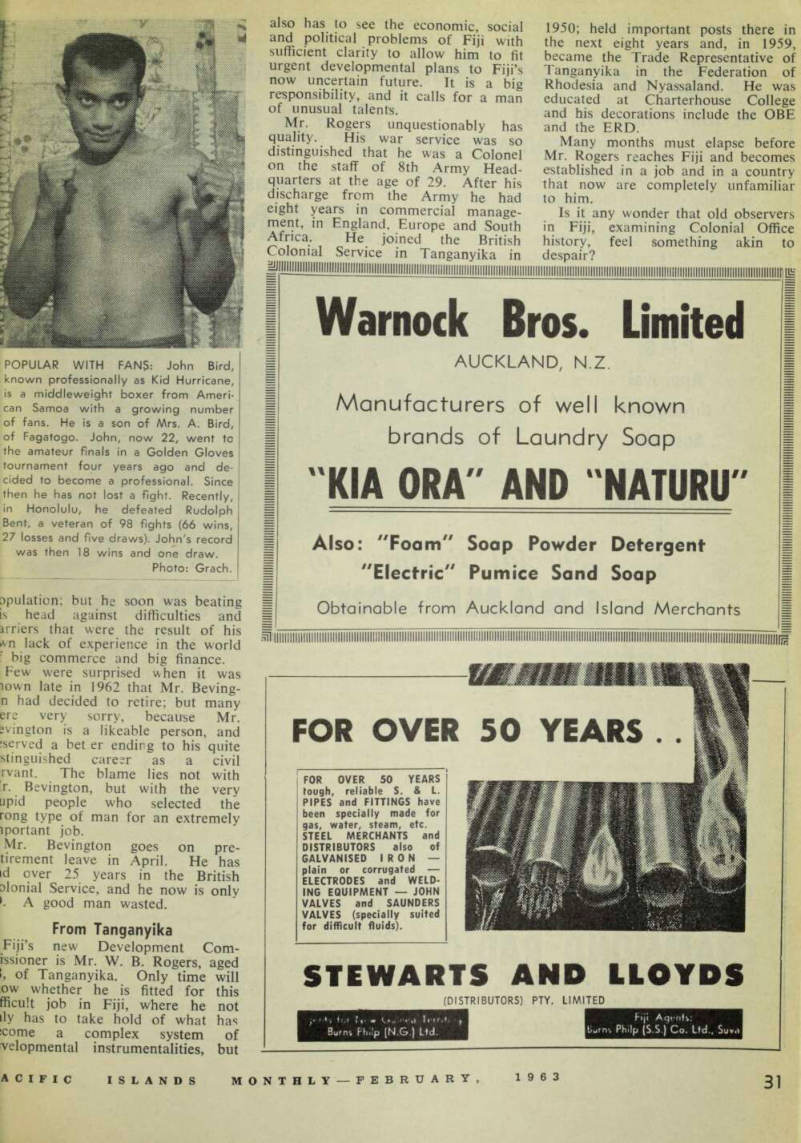
Popular With Fans: John Bird,
known professionally as Kid Hurricane, is a middleweight boxer from Ameri can Samoa with a growing number of fans. He is a son of Mrs. A. Bird, of Fagatogo. John, now 22, went to the amateur finals in a Golden Gloves tournament four years ago and de cided to become a professional. Since then he has not lost a fight. Recently, in Honolulu, he defeated Rudolph Bent, a veteran of 98 fights (66 wins, 27 losses and five draws). John's record was then 18 wins and one draw.
Photo: Grach.