Trustram Eve To
pp. 27-29 · Read in the full issue
Inquire Into Fiji
Copra Industry
By a Staff Writer in Sydney
January 25.
It is reported today—unoffici
iy, but I believe with authority -that at the request of the
itish Colonial Office, Sir
alcolm Trustram Eve, QC, will
me from London to examine ; condition of the copra in stry in the Colony.
RUSTRAM EVE is the dis tinguished jurist who in 1960-61 the British Commission which ex ined the sugar industry in Fiji. As result of his report, a special board 5 set up to guide and direct the ar industry in Fiji, and supervise relationship between the miller ; Colonial Sugar Refining Co. Ltd.) I the farmers—mostly Indians— -3 grew the cane. As a result of at then was arranged, the CSR tned a new company, South Pacific ;ar Mills Ltd., and transferred to ill its milling and transport equip it. ince then, the sugar industry in has been free from industrial ible, and it concluded, in Decem one of its most successful crush seasons. he Fiji scene was looked over sfully this month by the British onial Under-Secretary, Mr. Nigel ler, and Mr. Marnham, who is official in charge of the Pacific ion of Colonial Office Territories.
Fair Price of Copra he official party heard representa s by coconut planters on the rela ship between Fiji’s copra-produ and W. R. Carpenter & Co. Ltd., :h owns and operates the big a-crushing mill in Suva, he mill buys from the planters all copra which the planters care to 'er to the mill’s wharf in Suva, pays promptly at rates which are >unced every Monday, and which uate generally in accordance with world market. planters are not compelled to to Carpenters; but, in fact, a very ; Proportion of their copra does o the mill. planters—or a section of them, my rate—have complained that rates paid by Carpenters are not
enough. This viewpoint was placed before the official party a few days ago at Savusavu.
Mr. W, G. Johnson, who is the Fiji director in charge of the Carpen ter mill, was in Savusavu, and he challenged the claims made by the planters. He said that the Carpenter interests would be quite prepared to submit figures to an independent authority, to show that the rates paid to the planters for their copra com pared favourably with rates received by Islands planters elsewhere, when all relative costs were taken into con sideration.
Under-Secretary Fisher apparently took up Mr. Johnson on that one; but, to the astonishment of those con cerned, he proposed that Sir Trustram Eve be engaged to make the inquiry.
General opinion was that the en gagement of Trustram Eve savoured of the employment of a whale to chase a mackerel. Sir Trustram Eve might have been a suitable man to survey the big sugar industry, where millions are involved, and which affects most of the Indian rural popu lation. By comparison, the Carpenter copra mill is a small thing, and the inquiry could have been made by a well-qualified, independent accoun tant.
However, at this writing, Mr. Nigel Fisher is back in London, and it ap pears that the job has been offered to Sir Trustram Eve, and the latter has accepted.
Government and Australian
Corporations
Opinion here is that this is the do ing of the retiring Governor of Fiji and of his closest adviser on econo mic projects, the retiring Develop ment Commissioner.
It is no secret that these high offi cials dislike the big Australian cor porations, which between them con
trol and operate a very large section of the Colony’s economy.
It is a peculiar feature of the Fiji politico-economic set-up that while the government is directed as a vir tual dictatorship by the British Colo nial Office, a large section of the economy is controlled by Australian interests, who have no voice whatever in the government.
It was assumed that when the Fiji Government, following the recom mendations of the Burns Report (early 1960), appointed a Develop ment Commissioner, one of that Commissioner’s first acts would be to establish liaison with the Australian corporations interested in Fiji, and seek their co-operation in the neces sary planning and implementation of plans.
It is regarded as a significant thing that that Development Commissioner has made no move whatever to estab lish liaison with the Australian trad ing corporations.
I believe that there have been dis cussions at a high official level be tween the Colonial Sugar Company and the top Government people in Fiji; but I never have heard of any meetings between the heads of Burns Philp (South Seas) Ltd. and W. R.
Carpenter & Co. Ltd., both of which have huge interests in the Colony.
They Have Never Met Before writing this I telephoned the chairman of the Carpenter group, Mr. R. B. Carpenter, who directs the various Carpenter interests registered in Fiji—the Carpenter stores, the Car penter shipping line, Morris Hed strom Ltd., and all its subsidiaries.
“Have you ever been consulted by the Governor or the Development Commissioner of Fiji about economic affairs in that Colony?” I asked.
“No”, said Mr. Carpenter.
“But at least you have met Sir Kenneth Maddocks?” I persisted.
“I have never met Sir Kenneth Maddocks,” he replied; and, when I tried to pursue the matter, he ter minated the conversation.
But at least I learned the vital fact. (Over)
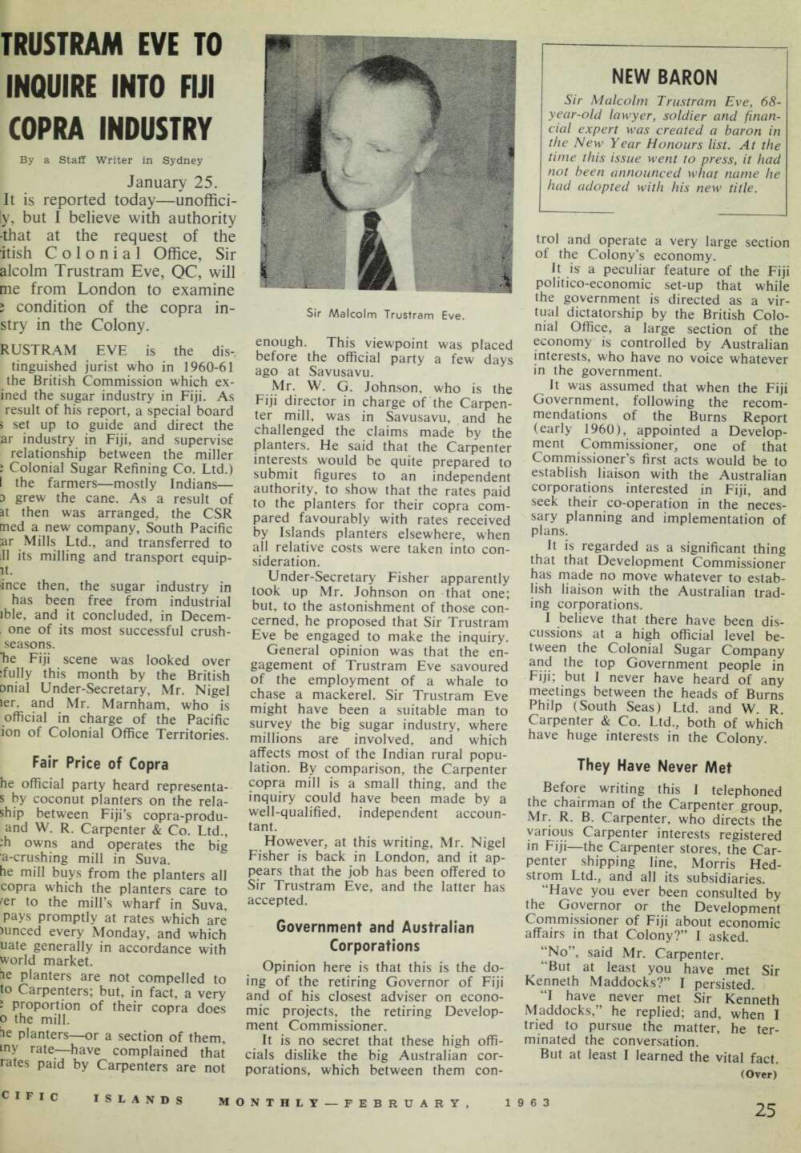
Sir Malcolm Trustram Eve.
Die Governor, who has been there ive years, and the Development Commissioner, who has held office or over a year, have never been in ormal communication with the active lead of the Carpenter interests.
I do not know—but I strongly sus iect that there is a similar relation hip—or lack of it—between the turns Philp interests and the head f the Fiji Government.
The opinion is increasingly held, in ssponsible places, that the policies of le British Colonial Office, in relation ) the future of various British Colonies, are either Socialist, or eftist, or plain anti-corporation.
More and more, since World War [, the Colonial Office bureaucrats p e giving the impression that they ish to shackle, or remove, the big jmpanies who have been respon se, in the past, for most of the real :onomic development in the denies, and replace them with little aders and planters.
That kind of development, in Fiji elsewhere, needs substantial capi- I, used under conditions which pre nt waste and inefficiency. Where uld we look for that capital? Cer inly, not from the British Colonial fice.
It is my opinion, based on years experience, that a continuation of s British Colonial Office policies ;n recently in Fiji could drive the istralian corporations out of the flony. The latter could do better in 3sperous and expanding Australia.
Then, who would provide the very ge capital necessary if Fiji is to developed to take care of that rtling population increase?
Fhe Colony’s now uncertain poli al outlook makes it unlikely that estors in any European country uld be attracted. Fiji is neither big )ugh nor developed enough to pro le capital for herself. iVhere, then? India? India would interested, maybe—but India has ivy preoccupations elsewhere. fapan? Has anyone, lately, seen the aificance of the Japanese money t has gone into Solomons and New brides in the past couple of years? e pages 10 and 13). s it not time that someone in high hority—higher than the British lomal Office—studied the results, aal and probable, of the short ited. bureaucratic muddling that taken place in Fiji in recent rs?
Suva, Jan. 29
t now appears that the Govern atal Authority in Suva wished to iounce that Trustram Eve had
been “invited” to investigate the copra industry by the millers and growers.
The Carpenter interests flatly de clined. They said they had not asked for any investigation. The growers were at liberty, of course, to do what they pleased. But if the Trustram Eve investigation were to extend to the milling of copra in Fiji, they (Car penters) would make available the figures which would show how the copra purchase-price formula was calculated. They said they would not disclose to anyone the details of mill operation or coconut-oil marketing— that was obviously the private busi ness of the company.
Officialdom then asked the Savu savu planters to hold a meeting and “invite” Trustram Eve to investigate; and they did this during the January 26-27 weekend.
But the fact that Trustram Eve had been invited to investigate, and had accepted, was known and dis cussed in Suva on January 24 and 25.
Fiji naturally is asking why the Government itself would not take the responsibility of inviting Trustram Eve to make the inquiry.
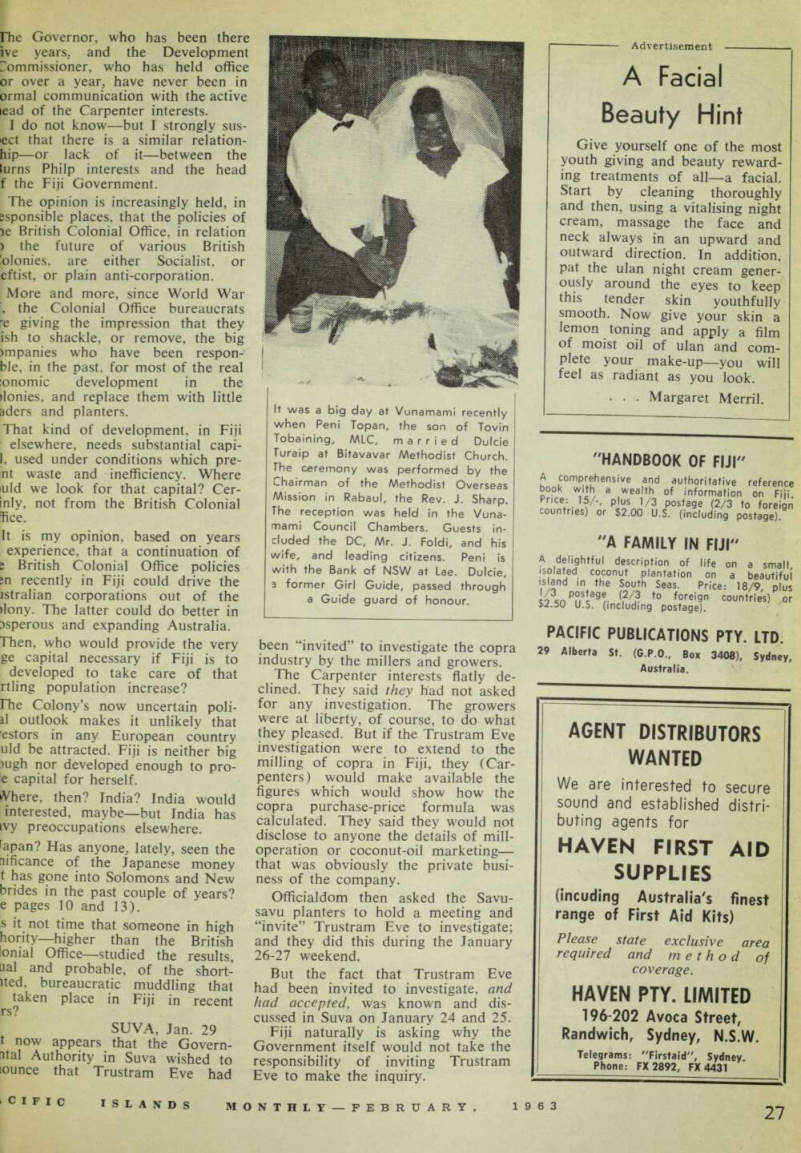
It was a big day at Vunamami recently when Peni Topan, the son of Tovin Tobaining, MLC, married Dulcie Turaip at Bitavavar Methodist Church.
The ceremony was performed by the Chairman of the Methodist Overseas Mission in Rabaul, the Rev. J. Sharp.
The reception was held in the Vuna mami Council Chambers. Guests in cluded the DC, Mr. J. Foldi, and his wife, and leading citizens. Peni is with the Bank of NSW at Lae. Dulcie, a former Girl Guide, passed through a Guide guard of honour.