Tropicalities
pp. 19-25 · Read in the full issue
*obably one of the last chances anyone will 'er have of acquiring a beautiful , fruitful and lucrative ?ehold South Pacific island occurred in December hen Mrs. G. M. Hennings, offered Naitauha for sale.
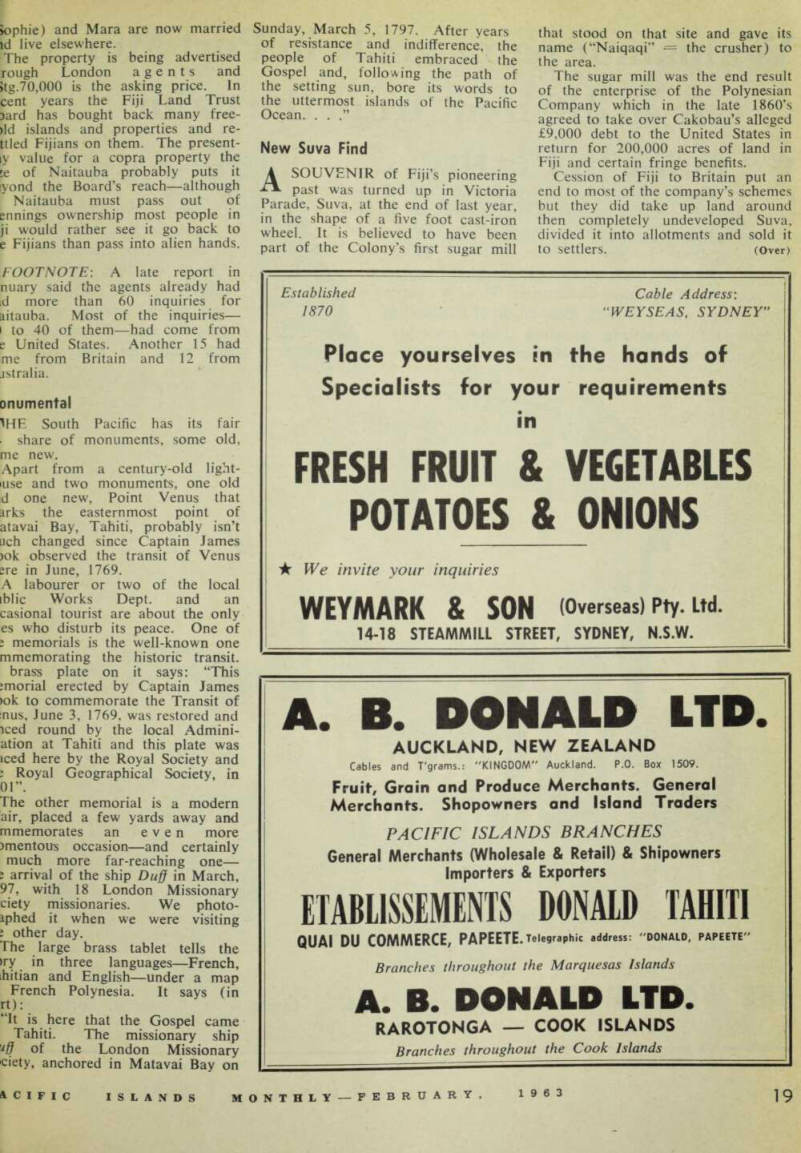
TAITAUBA is three square miles « of green in the blue Koro Sea, u Group, Fiji, 20 miles from inua Balavu and maybe 180 from va. In its best years it can pro ce anything up to 300 tons of pra and is pretty near self support l in meat, dairy produce, vege )les, fish and fruit. It has coral id beaches and rises to over 600 in the centre.
Three generations of Hennings ve lived there, going back well over years and the present occupant Mrs. Elizabeth Hennings, widow Gustav Mara Hennings who died d was buried there in 1955, in ; 87th year.
The Hennings family has been as :iated with Levuka and the Lau ■ over 100 years. If Naitauba now es to a stranger, or what is more ibably, a company, it will be the d of another era in Fiji history.
Gustav Mara Hennings was known oughout Fiji as Gus, and it is th him that Naitauba will always associated. He was the son of illiam Hennings, one of four ithers who settled in Fiji from :rmany about 1860, and Adi Mere, Lauan lady of high rank. Gus
managed to combine in his person all the attributes of a cultivated European gentleman and those of a Fijian chief.
Naitauba today has no indigenous population although it once supported several native villages. The story is that the people were banished by their chief for some misdemeanour
or transferred elsewhere by Chief Ma’afu at a time when he was trying to encourage European settlement in Lau.
The island was once owned by the English statesman, Joseph Chamber lain, one-time Colonial Secretary. It is said that, in the course of a world tour, he called at Fiji, then in its infancy as a British Colony, and possibly as a gesture to his belief in the British Empire, instructed an agent to “buy him an island”.
Naitauba was the island purchased, but Chamberlain had gone on his way by then, to acquire other possessions in other parts of the Empire. He never visited Naitauba but some coffee trees that grow in the island’s interior basin are descended from bushes he sent from one of his properties in Africa.
During Fiji’s cotton boom that followed the American Civil War, this crop was planted on Naitauba but when the boom burst it was cut out and coconuts were planted. It has been worked as a coconut planta tion ever since.
The island was first leased by Mr.
Chris Hennings, brother of William, and later purchased. When Chris died the property was left to his nephew Gus. It was while Gus was in Germany in 1912, settling Chris’ daughter in school, that he met and married Miss Elizabeth Vogel, who will probably be the last person bearing the Hennings name to live on Naitauba.
Her three daughters, Liz, Beau
Part of Naitauba showing the homestead clearing.
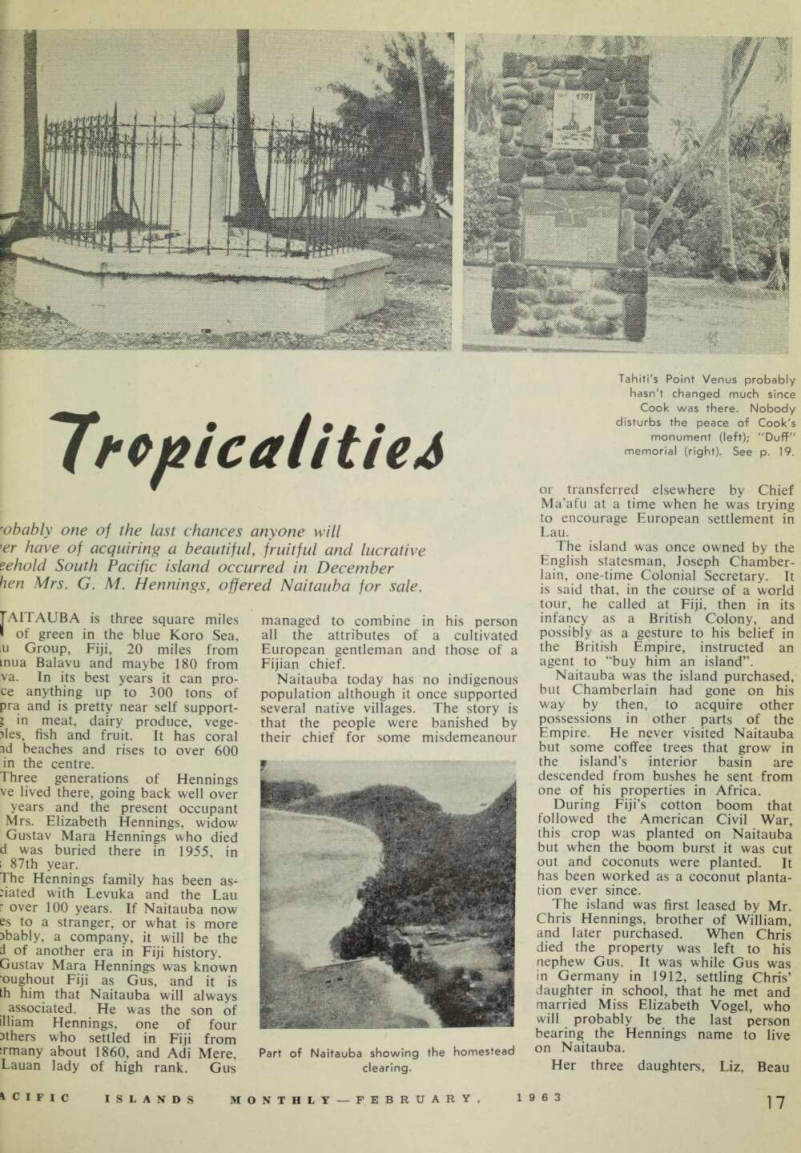
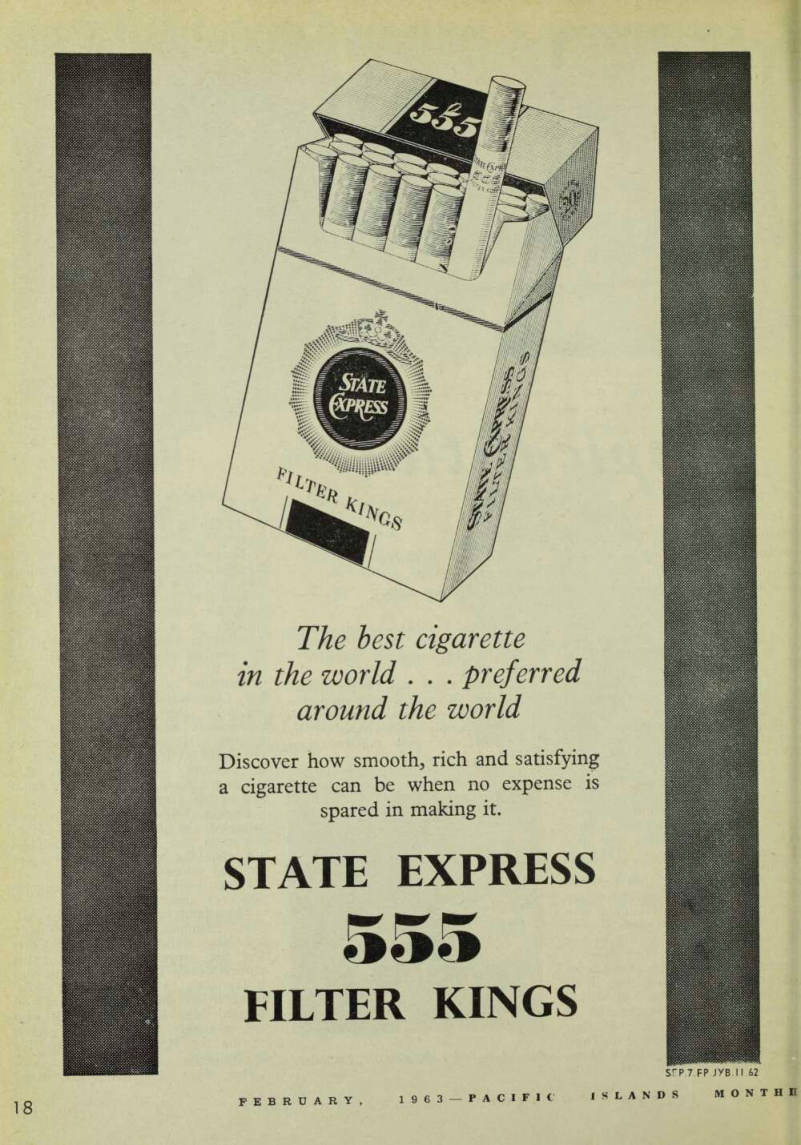
Tahiti's Point Venus probably hasn't changed much since Cook was there. Nobody disturbs the peace of Cook's monument (left); "Duff" memorial (right). See p. 19.
Jophie) and Mara are now married id live elsewhere.
The property is being advertised rough London agents and Jtg.70,000 is the asking price. In cent years the Fiji Land Trust lard has bought back many free ild islands and properties and re ttled Fijians on them. The present ly value for a copra property the se of Naitauba probably puts it yond the Board’s reach —although Naitauba must pass out of ennings ownership most people in ji would rather see it go back to e Fijians than pass into alien hands.
FOOTNOTE-. A late report in nuary said the agents already had id more than 60 inquiries for aitauba. Most of the inquiries— i to 40 of them—had come from e United States. Another 15 had me from Britain and 12 from jstralia. onumental IHE South Pacific has its fair • share of monuments, some old, me new.
Apart from a century-old light iuse and two monuments, one old d one new, Point Venus that arks the easternmost point of atavai Bay, Tahiti, probably isn’t uch changed since Captain James >ok observed the transit of Venus ere in June, 1769.
A labourer or two of the local iblic Works Dept. and an casional tourist are about the only es who disturb its peace. One of ? memorials is the well-known one mmemorating the historic transit. brass plate on it says: “This ;morial erected by Captain James ►ok to commemorate the Transit of ;nus, June 3, 1769, was restored and iced round by the local Admini ation at Tahiti and this plate was iced here by the Royal Society and : Royal Geographical Society, in 01”.
The other memorial is a modern air, placed a few yards away and mmemorates an even more imentous occasion—and certainly much more far-reaching one— j arrival of the ship Duff in March, 97, with 18 London Missionary ciety missionaries. We photo iphed it when we were visiting J other day.
The large brass tablet tells the >ry in three languages—French, ihitian and English—under a map French Polynesia. It says (in rt) : “It is here that the Gospel came Tahiti. The missionary ship 'iff of the London Missionary ciety, anchored in Matavai Bay on
Sunday, March 5, 1797. After years of resistance and indifference, the people of Tahiti embraced the Gospel and, following the path of the setting sun, bore its words to the uttermost islands of the Pacific Ocean. . , New Suva Find A SOUVENIR of Fiji’s pioneering past was turned up in Victoria Parade, Suva, at the end of last year, in the shape of a five foot cast-iron wheel. It is believed to have been part of the Colony’s first sugar mill
that stood on that site and gave its name (“Naiqaqi” = the crusher) to the area.
The sugar mill was the end result of the enterprise of the Polynesian Company which in the late 1860’s agreed to take over Cakobau’s alleged £9,000 debt to the United States in return for 200,000 acres of land in Fiji and certain fringe benefits.
Cession of Fiji to Britain put an end to most of the company’s schemes but they did take up land around then completely undeveloped Suva, divided it into allotments and sold it to settlers. (Over)
The settlers tried to grow sugar id the sugar mill was erected on a e mid-way along what is now ctoria Parade, Suva’s chief business Droughfare. A man called Leicester lith, who came from Barbados, ilt the mill in 1872.
However, sugar-growing around va was not successful and either cause of inexperience or because the wet climate, sugar making by ; mill was also a failure. The lole enterprise was abandoned by 75.
Apart from the now seldom-used me of Naiqaqi for this part of ctoria Parade, and the old iron leel found lately, the only reminder the Polynesian Company now re lining in Suva is the suburb of orak.
Most of the shareholders in the lynesian Company were from ;lbourne, Victoria, and when they nned Suva they named the hilly :a back from the port after Mel jrne’s most desirable suburb.
Foorak, Suva, never lived up to I example set by Toorak, Mel jrne, however. It is one of the ist crowded and slummiest parts of /a.
Fhe discovery of the cast-iron eel was made while workers for Chek Kee Construction Co. of /a, which won the contract for Iding the Fiji Development Co.’s v offices in Victoria Parade, were :avating for the foundations. ritish" Football MERICAN SAMOA is just about - as American as a South Sea md can be. The High School kids I themselves “freshmen” or phomores” or “seniors”—but their lericanism doesn’t extend to foot 1. When we asked some mgsters playing on Saturday ernoon outside the magnificent v High School in Pago—what y played, they said it was “British”
football. It was, too—Rugby Union.
We were told that the village teams were “practising all the time”, with their eyes on a team for the South Pacific Games in August.
Some of the players in our picture were wearing sandals; others were bare-foot. Neither side wore uni form (the full-back wore tight matador pants and nothing else), but the players didn’t seem to have any trouble distinguishing foe from friend.
Paintings and Fish-traps
LIKE a lot of other people we were interested in the story that Emile Atai, son of Gauguin, was following in his famous father’s footsteps and was going to hold an exhibition of his paintings.
While in Papeete recently we asked about it.
“We are arranging for Emile to get some paints and some canvas,” we were told. “When he gets them he will paint—then, perhaps, an exhibition.”
But, we wanted to know, can he paint?
“His painting is terrible!” said our informant. “Emile is a simple, fat man who makes fish-traps—small fish-traps, you understand, that the tourists buy for souvenirs. He paints like a man who makes fish-traps. It
is what you call a ‘gimmick’ but some people will love it and they will, of course, be getting ‘genuine Gauguins’.”
Somewhat morosely he added: 'Who is to say, these days, what is great art and what is not?”
Emile was three when his father died and he is supposed to have had a Gauguin half-sister of the painter’s later, Marquesan period. So far as we know she doesn’t make even souvenir fish-traps.
Papua's Old Flag
WITH all this talk of nationalism there has been some interest expressed in Papua lately about the possibilities of the Territory flying its own flag again. Papua, of course, doesn’t come under the United Nations, although thanks to the post war development of a central govern ment many people seem to think it does—especially some people in the United Nations.
Many old-timers still remember Papua's old flag, but for those who don't here it is. This particular photograph was sent to us by the Rev. R. E. S. Taylor, of Port Macquarie, NSW, who owns the original flag.
Mr. Taylor was in Papua between 1917 and 1930 and while stationed at Dobu Island, off Papua’s east coast, he was visited twice by Sir Hubert and Leonard Murray. In 1931 Mr. Taylor wrote to Leonard Murray, who was then Sir Hubert’s private secretary, and asked him if he might have the flag that had flown at the masthead of the famous old government vessel Laurabada, during Sir Hubert’s equally famous travels throughout the Territory. These days it is a prized memento of 13 happy years Mr. Taylor spent in the Terri tory.
The Papuan flag is the Union Jack in its usual dimensions, with a wreath of green laurel leaves tied at the base with a bow of blue ribbon.
All this is on a white background, encircling the word Papua in black, with the Crown above it.
Papua's old flag. This tattered example has a history of its own.
Down for a scrum at this British foot ball game in American Samoa. See story below.
[pansion for NHA?
ITT were taking a closer interest ▼ in little New Hebrides Airways e other day. There appear to be me developments there that could lild up into a story.
We got to talking when we heard at NHA’s only aircraft—a Drover— auld go to Fiji in March for its nual overhaul and that this would ean the airline’s services in the jw Hebrides would be suspended r about three weeks.
The Drover, which was recently ught from Fiji Airways, makes aeduled flights from Vila to Tanna Mondays and Thursdays. Usually also makes a flight from Tanna those days to either Aneityum, ituna, Aniwa or Erromanga. On ner days it is available for charter.
According to Mr. Paul Burton, TVs pilot and one of its big wheels nerally, the airline will seek further pital soon to finance plans for ex nsion. The airline is a private tnpany registered in Vila. It has a minal capital of £.50,000, of lich about £27,000 has been sub ibed. The controlling shareholder Australian planter Bob Paul, of nna, and there are about 300 live shareholders.
“At the moment, we do not have y French financial interests, but should have,” Mr. Burton told us Vila.
“Our idea of the company is that should be French, British and live. Therefore we will be seeking Bnch capital for our expansion. We )uld not have any difficulty getting Bnch capital.”
Mr. Burton said that during the two years the airline planned to ild strips—in some cases in con iction with the Condominium Gov iment —at Malekula, Aoba, North atecost, Epi and Ambrym.
It then hoped to extend its services ough the Banks and Torres oups to Vanikoro in the southern lomons to link up with internal vices in the BSIP. ‘Within these two years, we will id another two planes,” Mr. rton said. “We intend to get overs if we can.” in January, the big New Hebrides istruction firm, Societe Hebridaise mtreprises et de Travaux (SHET) s repairing one of the airline’s ips at Tanna.
Later, it was to do repair work at : recently-opened, but now un viceable, airstrip at Tongoa and :n at Malekula.
Fhe manager of SHET, Mr. sorges Deleplanque, told us that
his firm had no financial interest in New Hebrides Airways, but that it felt a “moral duty” to assist the air line because it was doing valuable pioneering work in the Group.
In the world of business, this seems a rather unusual reason for providing assistance, although it is undoubtedly to SHET’S own ad vantage to keep the strips in the New Hebrides open and to help the air line extend its services.
Whether SHET would like to in vest in the airline, only its directors know. But we know that one com pany that has previously been in terested in a financial tie-up with NHA is not interested now. This company is the New Caledonia air line, Transpac.
Another feature of New Hebrides Airways’ financial affairs that puzzles us is: Where did it obtain the money to buy its Drover aircraft? Until a few weeks ago, the airline had leased
the Drover from Fiji Airways, Then, suddenly, it produced the necessary thousands to buy it.
The airline, of course, may have provided the money from its own resources. But we think this would have been unlikely.
The Big Banana Deal THERE are some people in the Pacific who think this Japanese banana deal involving Fiji, Western Samoa and Tonga, is going to blow up in everybody’s face —and they could be right.
Western Samoa has already had a few unpleasantries with New Zea land over the deal. New Zealand thinks Samoa might cut down sup plies to NZ if the Japanese market develops the way the Japanese have promised it will.
Now Fiji is finding herself in the same position. The Kiwi’s told the Fijians the other day they didn’t like Fiji’s action in cutting the supply of bananas to New Zealand in De cember so the Colony could send a shipment to Japan, The New Zealanders pointed out that if Fiji wanted to develop other markets in addition to her 100-year old New Zealand market she should increase production so there would be enough bananas for everyone.
Meanwhile there are rumblings around the South Seas suggesting that Ecuador may sell bananas on the Japanese market at a price lower than anybody’s, including Formosa’s, and that the Japanese might well give them encouragement. In other words: The Japanese interest in South Seas bananas could be a flash in the pan, and hopes of riches may not be realised. Nevertheless, some Japanese interests certainly see the possibilities of two-way trade with the South Seas and for that reason alone they may persevere.
Mr. Bob Paul, the controlling shareholder in New Hebrides Airways, is an Australian planter living on Tanna. This photograph, taken a couple of years ago, shows him standing beside NHA's first plane, a Dragon Rapide.