New Radio Development
pp. 35-41 · Read in the full issue


The Fight For The Air-Waves
P-NG On Threshold Of Dramatic New Radio Development
From a Special Correspondent in New Guinea All down the centuries in Papua-New Guinea, the far ridge, the next valley, or the other side of the river has meant enemy soil, dangerous ground. Over a long period of time, distrust and suspicion became second nature, qualities as neces sary to survival as a sturdy bow-wrist and a strong right arm.
And in an island population of hundreds of tiny insular com munities, where co-operation was unthinkable and communi cation impossible, where families, clans and tribes lived and died within the most rigid geographical and cultural confines, it was hardly surprising that ignorance festered.
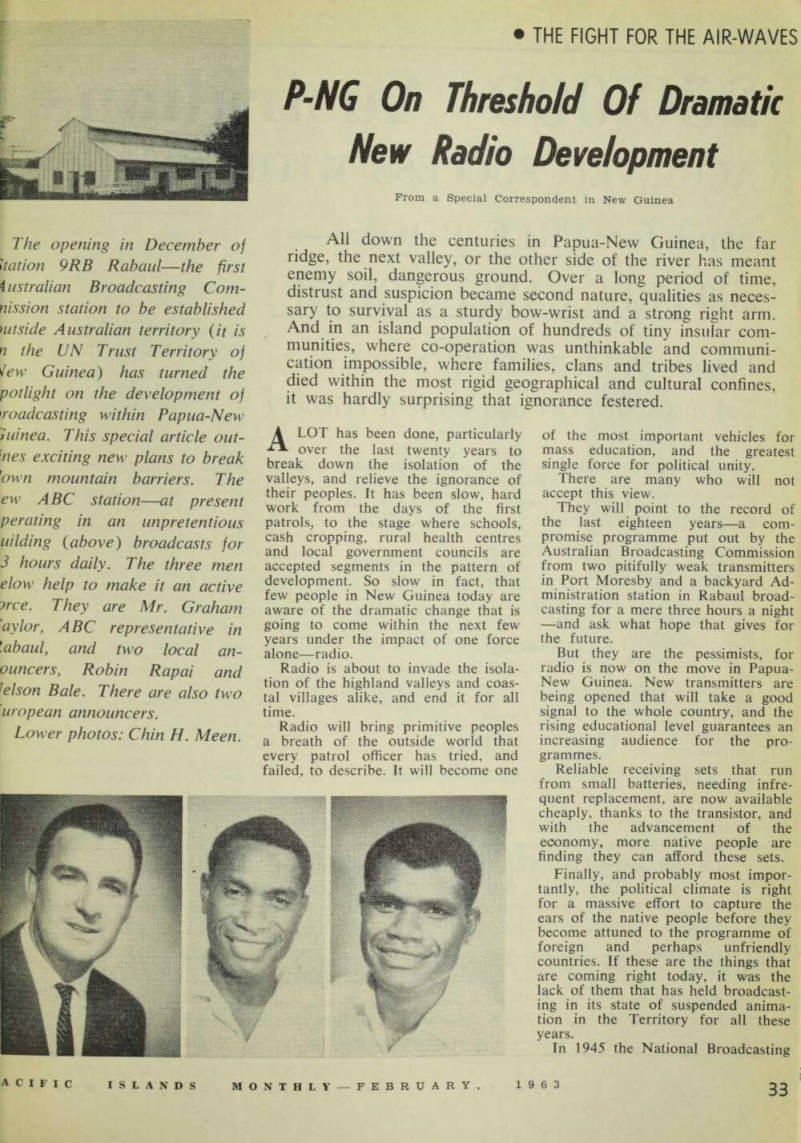
The opening in December of Station 9RB Rabaul—the first 4 ustralian Broadcasting Com nission station to be established mtside Australian territory (it is n the UN Trust Territory of tew Guinea ) has turned the potlight on the development of ' roadcasting within Papua-New juinea. This special article out nes exciting new plans to break 'own mountain barriers. The ew ABC station—at present perating in an unpretentious uilding (above) broadcasts for 3 hours daily. The three men elow help to make it an active ?rce. They are Mr. Graham 'aylor, ABC representative in \abaul, and two local an ouncers, Robin Rapai and J elson Bale. There are also two uropean announcers.
Lower photos: Chin H. Meen.
A LOT has been done, particularly over the last twenty years to break down the isolation of the valleys, and relieve the ignorance of their peoples. It has been slow, hard work from the days of the first patrols, to the stage where schools, cash cropping, rural health centres and local government councils are accepted segments in the pattern of development. So slow in fact, that few people in New Guinea today are aware of the dramatic change that is going to come within the next few years under the impact of one force alone—radio.
Radio is about to invade the isola tion of the highland valleys and coas tal villages alike, and end it for all time.
Radio will bring primitive peoples a breath of the outside world that every patrol officer has tried, and failed, to describe. It will become one
of the most important vehicles for mass education, and the greatest single force for political unity.
There are many who will not accept this view.
They will point to the record of the last eighteen years—a com promise programme put out by the Australian Broadcasting Commission from two pitifully weak transmitters in Port Moresby and a backyard Ad ministration station in Rabaul broad casting for a mere three hours a night —and ask what hope that gives for the future.
But they are the pessimists, for radio is now on the move in Papua- New Guinea. New transmitters are being opened that will take a good signal to the whole country, and the rising educational level guarantees an increasing audience for the pro grammes.
Reliable receiving sets that run from small batteries, needing infre quent replacement, are now available cheaply, thanks to the transistor, and with the advancement of the economy, more native people are finding they can afford these sets.
Finally, and probably most impor tantly, the political climate is right for a massive effort to capture the ears of the native people before they become attuned to the programme of foreign and perhaps unfriendly countries. If these are the things that are coming right today, it was the lack of them that has held broadcast ing in its state of suspended anima tion in the Territory for all these years.
In 1945 the National Broadcasting
Service (the combination of the Post master-General’s Department provid ing transmitters, and the ABC provid ing programmes), took over the puny 500 watt transmitter the Army had established in caves at the 5-Mile, to broadcast to the troops in the base area of Port Moresby.
It was some years before any ad vance was made, and a 2,000 watt shortwave transmitter, VLT6, was in stalled to reach out to the rest of the island.
Under ideal conditions, this equip ment provided quite a good signal for most of the Territory, but unfortu nately conditions were often far from ideal. Storms, sunspots, local and overseas interference, and of course ;he massive mountain chain running down the centre of the island of New Guinea, conspired to leave the out rf-Moresby listener often frustrated, md impotently twiddling the knobs )f his set.
But while a broadcast service was ?eing provided for some 20,000 pub ic servants, business people and tettlers, the Australian government vas ill-inclined to spend more than accessary on it. So the National Broadcasting Service had to muddle )n, in its crumbling wartime build ngs, with its obsolete broadcast trans nitter and with inadequate staff and ; acilities.
So-called “News' 7 All this time, the only programme pecially directed to the native popu ation was a conglomeration of ‘news”, Government propaganda irticles and sentimental music that vent under the patronising title of the ‘Native Peoples Session”.
This session was produced as a lackage deal by the Administration’s Broadcast Section, then a branch of he Department of the Administrator, md broadcast in a time-slot made ivailable by the ABC. The Adminis ration officers preparing the session lad little or no knowledge of broad :asting techniques, and the ABC ould or would not provide specialist ifficers to help.
That this session did so little harm vas due entirely to the smallness of ts audience.
Up till the end of the fifties, carcely a native in the Territory out ide Port Moresby owned a radio, [he audience for the Native Peoples iession came from the small groups hat gathered around the station radio m missions and at patrol posts, and n some council houses. While the ession undoubtedly had a novelty in erest for many, its regular listeners vere the very few who had had some chooling.
Discrimination in broadcasting has ended only in the last couple of years, as the ABC slowly took over the pro duction of all programmes requiring specialised treatment for native au diences, and integrated them with its other programmes.
But if the internal Administration was relinquishing control of the pro grammes for native people broadcast by the ABC, it was not bowing out of the broadcasting field. At the end of 1961, it launched Radio Rabaul, the trial horse in a brilliantly conceived scheme of dirt-cheap regional broadcasting.
The idea was to press into service at night the shortwave transmitters in the main centres that are used for telegraphic communication with out stations during the day. The only capital equipment therefore required was a small air-conditioned window less building for a studio, and domestic-type record-playing equip ment.
The fact was that the Administra tion had become increasingly con cerned that programmes from the NBS transmitters in Port Moresby were not reaching enough of the Ter ritory, and that there would be too
great a delay in the plans to pro vide more powerful equipment.
It has been Radio Rabaul that has proved that the new era in New Guinea broadcasting has arrived. It was a local station in the right place it the right time.
The Tolais could well afford radios, md given a programme they could tear without complicated aerial sys ems, they flocked to buy sets. The jrogrammes, largely of popular re corded music, did little to educate, Hit they did not repel, either. Edu cation, and discrimination in listen ng, could come later.
Evaluating the success of Radio labaul, the Administration quickly lecided to push on with an extension )f its programme.
A similar station is to go on the lir at Wewak, in the Sepik, by darch, another at Kerema in the julf District by September, and yet mother at Samarai later.
Many Problems
Technical investigations have 'roved that many more such stations ould be opened.
Radio Rabaul has not all been •lain sailing though.
The transmitter used is designed or morse, not broadcasting, and the [uality of the transmission is poor, breakdowns are frequent because nuch of the equipment was not built or constant broadcast use.
Transmitting on a shortwave fre gency, Radio Rabaul has been heard ar and wide, well beyond the area t was intended to serve, the Gazelle This has brought criti
cism rather than praise, because the Bukas and New Irelanders, under standably, don’t want to be talked to in Kuanua, the language of the Tolais.
Radio Rabaul had been announced as a temporary station until the ABC could provide permanent facilities, but it has now been made clear that the station will continue for the pre sent, at least. Ostensibly this has come as the result of “pressure” from the Tolais, themselves.
However, the Government has clearly determined not to abandon its interest in broadcasting in what has always been a turbulent area. The de cision to keep Radio Rabaul on the air has met with some criticism in Rabaul, where several people have suggested that the facilities could now better be employed in another area of the Territory.
Meanwhile the ABC-PMG team is at last getting off the ground with its expansion plans. The first new re gional broadcast station opened in Rabaul in mid-December. At present its transmitter and studios are housed in an old building in Malaguna Road, once a church and later a copra store, but it is putting out a full range of ABC programmes, including some specially prepared in Kuanua.
A quarter of a million pounds are to be spent in Rabaul on a big studio block on Namanula Hill, and a trans mitter building at Kurakakaul on the Keravat Road will house more powerful transmitters.
In Port Moresby, the old wartime 9PA transmitter has at last been
Radio broadcasting in Papua-New Guinea has for years been handicapped by the most rugged territory in the South Pacific, and among the most rugged in the world. Great mountain chains and gorges make reception difficult without power ful transmitters. This is a typical Highlands scene, taken at Omkolai, 5,500 ft. up on a mountain side, where the airstrip has a slope of one in seven. A sheer gorge of 1,500 ft. to the Wahgi River is on one side.
ensioned off. On December 28, a ew 2,000 watt transmitter went on le air from a modern building at Sard’s Strip, improving reception in a area from Rigo to the Kokoda >othills.
A new studio block costing almost 200,000 is under construction.
Two new shortwave transmitters, ich of 10,000 watts are being as imbled, and will be operating by ily. It’s planned to have them on the r continuously, on two different fre jencies, bringing an end to recep- Mi troubles almost everywhere. As le PMG engineer put it, “With these /o units, we should be able to anket the Territory.”
Just how necessary a blanket cover going to be was revealed recently a meeting of the Kokopo Town dvisory Council, when members oke of propaganda danger of oadcasts from such sources as adio Peking. One member said he id found that a native school acher had swallowed Red China’s irsion of the Cuba affair, and was ;ing it to explain the situation to s charges.
Dangers
Stations in both West New Guinea id Indonesia also come in strongly night in Papua-New Guinea, and e Administration is clearly demon rating its fear of the potential ingers from these sources by open g its second station at Wewak.
However, the Administration may :t regret embarking on its pro amme of local shortwave stations.
V encouraging native people to buy
shortwave sets, it is giving them the t° P earin g voices from outside d fu ernt °. ry as as f rom within.
Bu i there * s n< ? t urnil ?g back. . u Administration is well launched on its campaign to build a radio empire founded on the district station, but has yet to show that it can weld these stations into a service providing much more than local request sessions.
It must consider itself a frontier service, developing a taste for radio that will be satisfied by the variety of programmes only the ABC can provide. The National Broadcasting Service is now moving to meet the needs of the times, but it has much to do in providing more local stations
in the broadcast band. It must move quickly to develop its network.
The unfortunate experiences of countries like Malaya, where radio exists only as a vehicle for the propa ganda of the government in power, have highlighted the need for a strong independent and objective broadcast ing service as a guarantee of free dom in emerging nations. This is the most important role of the ABC in Papua-New Guinea, But above all these considerations, what is important is that Papua-New Guinea should have the benefit of clear-sighted political direction from Australia that broadcasting must con tinue to be pushed ahead as a matter of urgency.