Fiji Milk Plant Exports
pp. 27-29 · Read in the full issue
To The Islands
From a Suva Correspondent
The only sterilised milk processing plant in Australia, New Zealand or the Pacific Islands is doing better and better busi ness from its headquarters in the Rewa Valley of Fiji, not far irom Suva.
IE plant was established a little more than three years ago and ■' handles about 900 gallons of ;c a day and has sent trial ship its to American and Western ioa, where it is competing with .1 milk at the same price, he sterilising plant is operated by Rewa Co-operative Dairy Co. , whose manager, Mr. N. Ralph, n Australian. he idea of introducing sterilised c to Fiji originated in the mind the late Mr. W. J. Gatward, a evu dairy farmer and hotelkeeper, 1955. The indications then were there was a demand for a milk :h did not need refrigeration, as e were many people in Fiji who d not afford refrigerators, terilised milk can keep indefinitely lout refrigeration so long as you not open the bottle. Once it is :aled it must go into a refrigerator is to keep. he promoters convinced the Agri ural and Industrial Loans Board the scheme was sound, and red a loan of £50,000 from that ce. The Tailevu dairy farmers, are the major shareholders, con ited another £30,000. site was chosen at Nabua, about miles from Suva on the King’s
Road. There a modern factory, with the latest English sterilisation equip ment imported from New Zealand, was erected. The factory was opened in August, 1959, and soon sterilised milk was available in Suva and the surrounding areas.
In the initial stages the company ran up against prejudice because the flavour of the milk was something new.
But that was only a minor problem.
The company claims that sterilisation in no way impairs the quality, but actually makes the milk more palat able. It is often recommended for babies who cannot digest ordinary milk.
Mr. Ralph says: “The fact is that people, after they have used sterilised milk for a fortnight, will use nothing else.”
The company draws its milk for processing from Tailevu, the Navuso Agricultural College and some farmers close to the factory. Five days a week a 1,000-gallon tanker calls at the Tailevu farms for the milk. (Navuso and local farmers deliver their own milk).
The farmers, who milk three times a day, keep the milk at an average temperature of 40 deg. Fahr. till it is picked up. Any milk over 50 deg. is
rejected. By the time the milk reaches the factory it might have risen one or two degrees, but no more.
At the factory the milk is pumped from the tanker into a holding vat.
As it varies considerably in butter fat content it is standardised in a stainless steel standardising separator to 3.4 per cent. fat.
The milk is then heated to about 100 deg. Fahr. and filtered to remove any foreign matter, such as dust.
From the filter it is further heated to about 195 deg., and passed into the homogeniser, which is a high pressure pump forcing the milk through two special valves at 2,500 lb per square inch pressure. This breaks up the fat into small globules and prevents it from rising to the top again in the finished product.
After homogenisation the milk is raised to 275 deg. Fahr., cooled to 174 deg. and then sent to the hot milk storage plant to await bottling.
The bottling process is important, for the bottles must be vacuum filled.
A modern machine handles this. Once filled and crated, the bottles go into a steriliser, where the temperature is raised to 250 deg. Fahr. for 10 minutes, and then cooled.
During the cooling process the crates of bottles are rotated and air is blown over them by a series of fans. This agitation during cooling is to prevent skin formation on the top of the milk. After about 15 minutes the bottles are taken out of the cooler and stacked ready for delivery.
The Riant is capable of handling 2,000 gallons of milk a day by work ing shifts. However, that happy stage may be years away, even though the Tailevu farmers took over the CSR Company dairy herds at Lautoka and Penang and moved them to Tailevu.
The main outlets are in the Suva- Nausori areas, but the company also distributes milk in north-west Viti
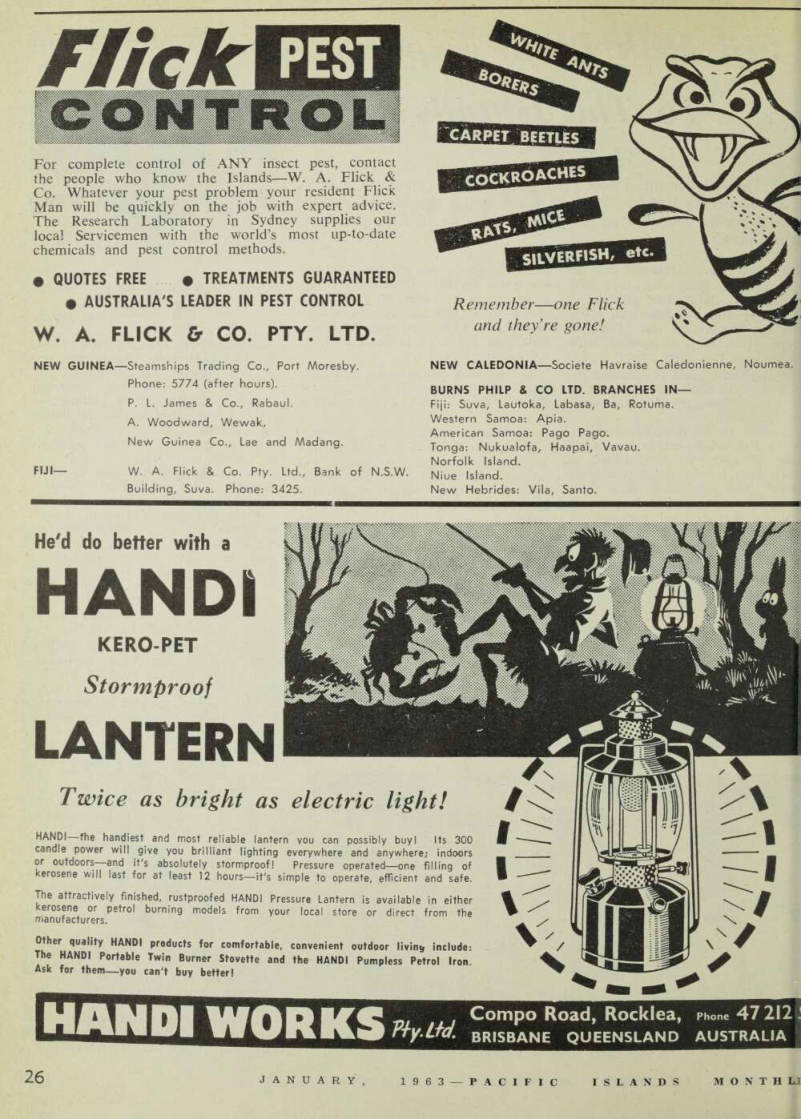
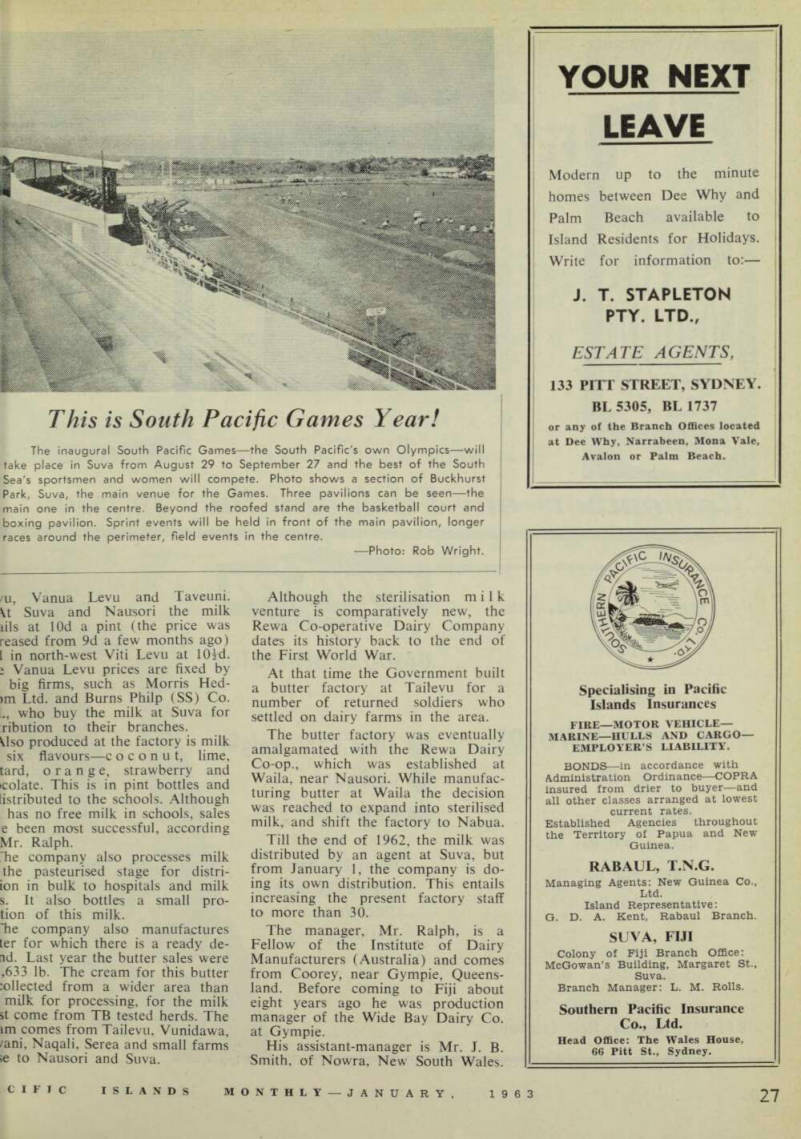
?e picture at left shows crated bottled milk coming out of the steriliser. At right is the milk filling machine.—Photos: Stan Whippy.
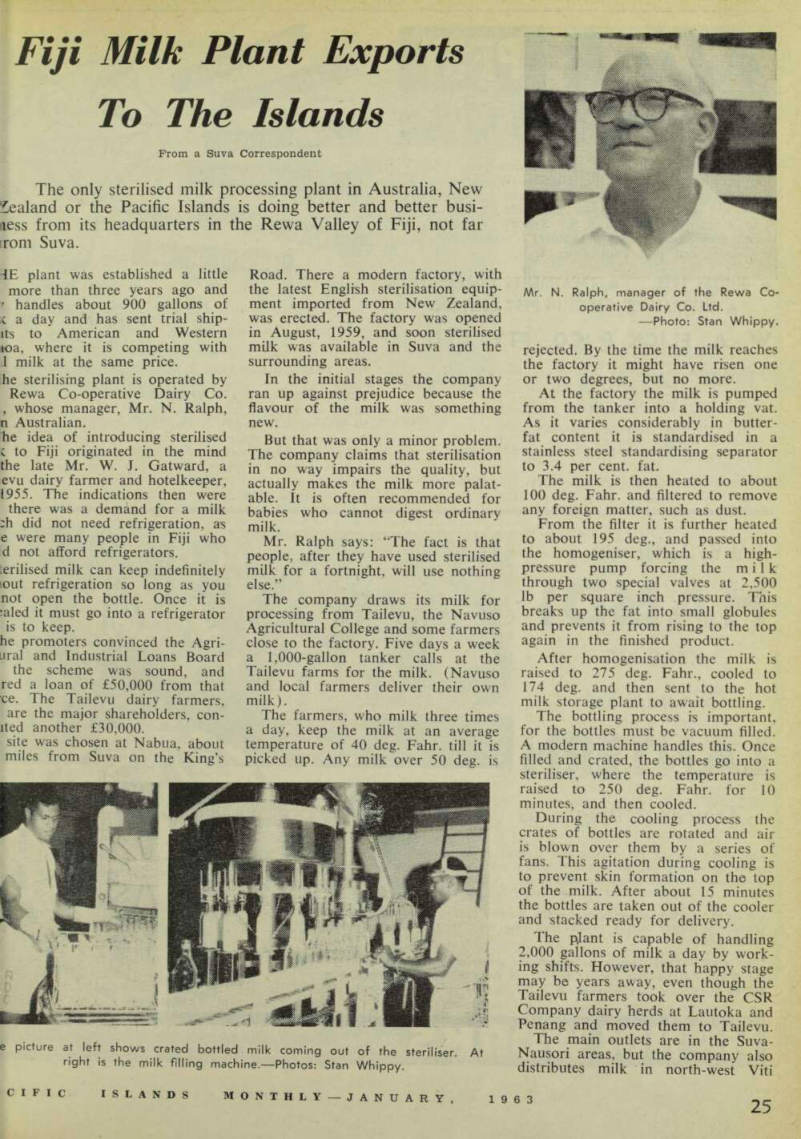
Mr. N. Ralph, manager of the Rewa Co operative Dairy Co. Ltd. —Photo: Stan Whippy.
m, Vanua Levu and Taveuni.
Vt Suva and Nausori the milk iils at lOd a pint (the price was reased from 9d a few months ago) I in north-west Viti Levu at KHd. ; Vanua Levu prices are fixed by big firms, such as Morris Hed >m Ltd. and Burns Philp (SS) Co.
L, who buy the milk at Suva for ribution to their branches.
Uso produced at the factory is milk six flavours—c ocon u t, lime, tard, orange, strawberry and icolate. This is in pint bottles and listributed to the schools. Although has no free milk in schools, sales e been most successful, according Mr. Ralph.
'he company also processes milk the pasteurised stage for distri ion in bulk to hospitals and milk s. It also bottles a small pro tion of this milk.
Tie company also manufactures ter for which there is a ready de id. Last year the butter sales were ,633 lb. The cream for this butter reflected from a wider area than milk for processing, for the milk st come from TB tested herds. The un comes from Tailevu, Vunidawa, 'ani, Naqali, Serea and small farms »e to Nausori and Suva.
Although the sterilisation milk venture is comparatively new, the Rewa Co-operative Dairy Company dates its history back to the end of the First World War.
At that time the Government built a butter factory at Tailevu for a number of returned soldiers who settled on dairy farms in the area.
The butter factory was eventually amalgamated with the Rewa Dairy Co-op., which was established at Waila, near Nausori. While manufac turing butter at Waila the decision was reached to expand into sterilised milk, and shift the factory to Nabua.
Till the end of 1962, the milk was distributed by an agent at Suva, but from January 1, the company is do ing its own distribution. This entails increasing the present factory staff to more than 30.
The manager, Mr. Ralph, is a Fellow of the Institute of Dairy Manufacturers (Australia) and comes from Coorey, near Gympie, Queens land. Before coming to Fiji about eight years ago he was production manager of the Wide Bay Dairy Co. at Gympie.
His assistant-manager is Mr. J. B.
Smith, of Nowra, New South Wales.
This is South Pacific Games Year!
The inaugural South Pacific Games —the South Pacific's own Olympics—will take place in Suva from August 29 to September 27 and the best of the South Sea's sportsmen and women will compete. Photo shows a section of Buckhurst Park, Suva, the main venue for the Games. Three pavilions can be seen—the main one in the centre. Beyond the roofed stand are the basketball court and boxing pavilion. Sprint events will be held in front of the main pavilion, longer races around the perimeter, field events in the centre. —Photo: Rob Wright.