Monthly
Pacific Islands
January, 1963
VOL. xxxm. NO. 6.
Eed at G.P.0., Sydney, and at P. 0., for transmission b> post as a Newspaper
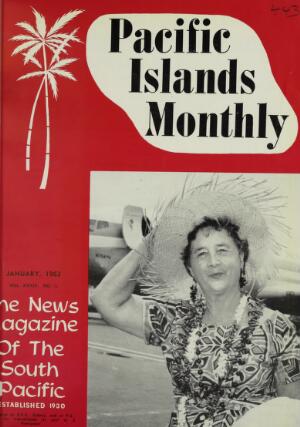
THE COVER: That s a smiling face that's known throughout the South Seas. It belongs to Mrs. Aggie Grey, of Apia, Western Samoa, who was in Sydney in December as guest of Pan American Airways to mark the inaugural Tafuna- S y dne y jet service. With her came a big bunch of fellow VlP's. You'll find the details ms.de, together with a note on page 18 about how Aggie was not Michener's Bloody Mary.
Advertisements & other items, pp. 2-4 (3 items)
See Australia with TAA
Wherever you want to go . Whatever you want to do..
LAE I
'PORT MORESBY,
(TOWNSVILLE-'
ALICE SPRINGS
HU
BRISBANE
See more, enjoy more,
do more than on any holiday before,
and even save money!
Save on TAA Tourist Class Fares. You can fly TAA from Port Moresby to Brisbane and back for only £69.6.0.
Regular TAA Sunbird services from Lae and Port Moresby to Australia connect with flights to all States linking the Territory to more than 90 ports throughout Australia.
Money saving TAA budget holidays. There are dozens to choose from in such famous places as the Gold Coast, Central Australia, the Barrier Reef Islands.
TAA Travel Service makes ail your holiday arrangements . . . plans personal itineraries and tours . . . arranges accommodation and local tours at your destination.
AIDE
'CANBERRA
MELBOURNE
—x Contact your nearest TAA Travel Adviser: A selected list from the many interesting sporting, social and business meetings scheduled during 1963.
Fourth Cricket Test (Australia v. England). Adelaide. 25th-30th January, 1963.
Fifth Cricket Test. Sydney. 15th-20th February, 1963.
Australian Swimming Championships Perth. 16th-22nd February., 1963.
International Trade Fair,'Melbourne. 27th February-16th March, 1963.
Australian Surf Carnival Warrnambool, Victoria. lOth-llth March, 1963.
Apex 28th Association Convention Geelong, Victoria. Easter, 1963.
Women’s Commonwealth Golf Series Royal Melbourne.
Bth-10th August, 1963.
TAA will arrange your air travel, accommodation and tickets to these events.
PORT MORESBY:
Len Vaughan, Cnr. Cuthbertson and Douglas Sts.. ’Phone 2101.
RABAUL:
Max Knop, “Augusta House’
Mango Avenue. ’Phone 2702.
GOROK A:
Bernie Gamble, Goroka Airport. ’Phone 8.
LAE;
Tony Dewiss, Coronation Drive ’Phone 2311.
MADANG:
Henry Ohlmus, Kaislan Avenue, ’Phone 78 or 166.
FLY TAA SUNBIRD SERVICES
throughout the Territory of Papua New Guinea—and to Australia.
T AA2B3p/fi?
KEEP FOOD and DRINKS COLD
and FRESH WITH A . . .
IT':
Coleman
“Snowlite” COOLERS
Coleman’s range of plastic-lined coolers are now available through Robert Gillespie’s. Solid Therma Lock styrene insulation all round keeps food colder . . . longer. The exclusive “Royalite” plastic-base covering prevents rust, scuffing, leaks or stain . . . adds strength and resists dents. Wipes clean instantly. The plastic “Royalite” interior is strong and smooth and has no joins. All coolers are constructed from heavy gauge steel, welded and riveted for extra strength and longlife. Deep tray for dry food storage. Choose from three attractive baked enamel colours: green, patio pink, or aqua. Coolers are available with the Mag-Lock latch or Bail handle. The Mag-Lock latch is a magnetic device which is popular on many modern refrigerators.
The Bail handle locks upright in an easy-to-carry positioi;.
Representatives for the Pacific Islands: £-7
iisis
BERT GILLESPIE PTY. LTD.
22 Young St., Sydney
334 Queen St., Brisbane Cable: "Robergill".
ROBERT GILLESPIE (N.G.) LTD.
Rabaul, Port Moresby
Lae, Madang
PEARCE & CO., LTD,
Suva
FIJI AIRWAYS
ANNOUNCE
ONCE-WEEKLY
SERVICE SUVA
- HONIARA
via Nadi Vila Santo and return
Commencing March 4th, 1963
Until the commencement of this regular once-weekly return service in March, Fiji Airways will continue to operate their present 3 return services every 4 weeks.
Fiji Airways also operate the following return air services: Weekly Suva to Nukualofa; Fortnightly Direct Suva to Apia; Charter Flights can also be arranged.
FIJI AIRWAYS also operate Regul Scheduled Flights within the F Group. For further particulars cc tact Fiji Airways, Suva —Burns Phil Vila and Santo —Trading Compart Honiara —Union S.S. Co., Apiai E. M. Jones, Nukualofa —and Travel Agents.
FLY DIRECT to where you want to go-save time and money-fly wii
AIRWAYS LIMITED
VICTORIA ARCADE
SUVA
PHONE P.O. BOX 112,
4035 SUVA
Cable Address: FIJIAIR SUVA.
1
CIFIC ISLANDS MONTHLY— JANUARY, 1963
2
JANUARY, 1963 PACIFIC ISLANDS MONTHI
Pacific Islands Monthly
A News Magazine Circulating in Australia, New Zealand And The Pacific Islands
Publisher: R. W. ROBSON.
Editors:
Iudy Tudor Stuart Inder
Manager: SELWYN HUGHES.
Elephones: Ma9197, Aaa 7101,
Aaa 4369.
G.P.O. Box 3408, Sydney,
graphic Address: PACPUB, Sydney.
Annual Subscription Rates:
Ujst. currency; includes surface postage) frc Is— P.-N.G., Fiji, Samoa, Norfolk, luru, B.S.I., Cook Is., Tonga, G.&E. p., Niue, New Hebrides, and . Pacific Is £1 40 :h Pacific Territories and West w Guinea £1 70 ■alia and N.Z £1 10 C British Commonwealth and Foreign >/- Stg.) £2 10 0 i. and U.S. Pacific Territories r -00 U.S.) £3 13 e Copies (postage extra) 2 6
1Ranch Office In Papua-Ng
ic Publications (NG) Ltd., Theatre ing. Fourth St., LAE. Tel.: 2577. lAiss Pat Robertson, Manager.
Branch Offices In Fiji:
Fiji Times Building, 20 Gordon St Tel.: 4043. ka: Fiji Times Office, Vidilo St Tel.: 420.
Representative In N.Z.:
). Whitcombe, P.O. Box 5179, Auckland.
Epresentative In Hawaii:
Spencer, 203 Yap Bldg., 3465 Je Ave., Honolulu. Tel.: 775538.
Representative In U.S.A.:
Craib, Box 1455, San Francisco alifornia. Tel.: Mission 8-1075.
Representatives In U.K.:
Ashburn, 13 Rood Lane, London, 3. Tel.: Mincing Lane 8633.
Mackenzie, 4A Bloomsbury Square
)n, W.C.1. Tel.: Holborn 3779.'
lURNE OFFICE: Newspaper House, 7 Collins St. Tel.: 63.7053.
S; All main trading firms and )res m the Pacific Islands.
Publications Pty. Ltd., is the han agent for THE FIJI TIMES.
Contents
No. 6. Vol. Xxxiii.
January, 1963
Fijians Demand a Voice in Their Future 5 Noumea's Young Tennis Hopeful 6 Cook Islands Will Have Self- Government "Soon" 7 Doubts Grow on NG's "Open Slather" Drinking 7 Complicated Politics of French Poly nesia 9 Papuan Church is Self-Governing Now 10 New Wreckage of La Perouse Vessel Discovered 11 Pacific VlP's in Sydney 11
Commentary 13
Dramatic End to Tahiti Tuna Ex pedition 14 The Editor's Mailbag 15 TROPICALITIES: An Old Department with a New Look 17 Vanikoro Wreckage Was Not from the "Kobenhavn" 23 Fiji Milk Plant Exports to the Islands 25 Islands Markets Must Be Followed Up 29 Duty Free Goods in Fiji Now 33 Technical Education for P-NG Girls 35 NZ Clears the Way for Cabinet Government in the Cooks 37 Australians Will Try NG Tea 39
Flashback on 1962 45
Territories Talk-Talk 53
Sydneysider Goes Walkabout 61 Request for Fiji Tourist Survey 67 Pitcairn Protests Over AAangareva Missile Site 69 Fiji's Birthrate Increase Disturbs Government 71
Magazine Section 81
Book Reviews 89 Pacific Shipping 97 Significant Progress in the New Hebrides 117 NG Berthing Priorities To Go 119 Any Threat to P-NG Would Be from Communism 121 NG Border Airstrip Extended 122 BSIP Round-up 123 Hope for New Industry on Norfolk Island 124 Many Places Benefit from New Cable 125
From The Islands Press 127
Crowded Fiji Itinerary for Queen 127 ASOPA's 1962 NG Awards 129 In a Nutshell 130 people ;;; i 34 Deaths of Islands People 137
Travel Talk 133
Shipping and Airways Timetables 141 Commerce and Produce 149
Advertisements & other items, pp. 5-6 (3 items)
A Product of Pacific Publications Pfy. Ltd., 29 Alberta Street, Sydney
4
JANUARY, 1963 PACIFIC ISLANDS MONT
Gloss-Masd
MANUFACTURED TO WITHSTAND AL
TROPICAL CONDITION
British Paints limite
GLOSS-maSD
y
BRILLIANT GLOSS ENAMEL
•Is?
ISSSsiiS ii" ® ri *ish Paints Limi' ed Shis. * * a/9/LL//)trf .di: 1 . !sk?
S« *Sr£Fs greatest' S«V5j
COLOUR RANOE
■UHIUII
One coat covers any colour.
For interior and exterior use.
Gloss-Masta is specially manufactured to stand up to the rigorous tropical climates. It dries overnight with a brilliant, luxurious, porcelain-like finish that looks and wears like baked enamel. In fact Gloss-* Masta sets a new standard of exceptional brilliance ... the more you wash it the better it looks Gloss-Masta completely withstands boiling water, steam, grease and all cooking fumes.
So very easy to use . . . Gloss-Masta comes to you in the world's greatest colour range ... ask foi your Gloss-Masta colour card at the nearest British Paints Limited depot or store.
mpußPSfr
Undercoat 4
* Surfaeer X
ALL PURPOSE
UNDERCOAT
for
paints and enamels
SOLD AND RECOMMENDED BY-.
MAXIMUM RESISTANCE TO MOULD
AND FUNGUS IMPORTANT:
For maximum protection against fungus am mould growth always treat new or previousll painted surfaces with British Paints Limited‘l anti-mould solution.
NEW GUINEA;
Burns Philp (New Guinea) Limited; Wau Burns Philp (New Guinea) Limited: Bulolo Burns Philp (New Guinea) Limited: Lae Burns Philp (New Guinea) Limited; Madang Burns Philp (New Guinea) Limited: Goroka Burns Philp (New Guinea) Limited: Wewak Burns Philp (New Guinea) Limited: Kavieng Burns Philp (New Guinea) Limited: Rabaul Burns Philp (New Guinea) Limited: Kokopo Burns Philp (New Guinea) Limited: Daru Burns Philp (New Guinea) Limited: Kainantu Kam Hong: Lae Scotts New Guinea: Lae Tang Mow: Wewak Laurie Chan: Rabaul Wong You: Buka Passage—Bougainville
PAPUA;
Burns Philp (New Guinea) Limited: Port Moresby Burns Philp (New Guinea) Limited; Boroko Burns Philp (New Guinea) Limited: Samarai Burns Philp (New Guinea) Limited; Popondetta
HONIARA:
A. C. Blair Ltd.: Honiara Ho Kee: Honiara
FIJI:
Burns Philp (South Sea) Co. Ltd.: SJ Burns Philp (South Sea) Co. Ltd.: Li.
NORFOLK ISLAND:
Burns Philp (South Sea) Co. Ltd.: Norfolk Island
Something Definite' Wanted:
Fijians Demand Voice In Their Own Future
From our Suva Correspondent A resolution of the Legislative Council of Fiji, adopted on December 13, that “there should be no change in Fiji’s present constitution until the Fijian people express their desire for further constitutional changes”, came as a surprise.
It was moved, practically without consultation with anyone, by [avuama Vunivalu. Ravuama is one of a group of half a dozen youngish iijians, well-educated and taking a keen, growing interest in Fiji’s future; nd he is particularly outspoken in relation to the political danger inherent i the rapid growth of the immigrant race, the Indians.
lIS Fijian group appears to have been unfavourably impressed by nt events. One was the manner which Britain and Australia re ned inert while the United ions, under United States pressure, wed the Indonesians to push the ch out of West New Guinea, tout making any provision for the re security of the indigenous race, Papuans. hat (say the Fijians) could hap in Fiji. nother event was the action of Governor, at the opening of the on, in urging that the people of should prepare for self-govern t. Did that mean that Britain is ig to rid herself of her responsi ies in Fiji? tie third factor was the Gov t’s announcement that Under etary for the Colonies Nigel er is coming to Fiji in January
to move things along. Fiji has known a succession of British Ministers who came, talked lengthily and made vague promises to the Fijians, and then disappeared into other spheres.
The British Colonial Office is in a state of change—and the people of Fiji do not know what is likely to happen to them.
Ravuama’s motion was designed to force something definite in the shape of a policy statement. He supported it in a very effective, courteous and logical speech, the burden of which was: Has the position of the Fijians, vis-a-vis the British Crown, changed?
If it has, please tell us frankly and clearly, and when we get over the shock we will be able to adjust our selves to a new situation, and adjust policy and actions.
At first, it was feared that the motion would trigger off a racial storm. But Ravuama’s speech was so
tactful, and so well reasoned, that— with one exception—he was not ac tively opposed by the Indian mem bers.
Ratu K. K. T. Mara, another lead ing Fijian, seconded the motion. In another speech notable for clarity and logic, he appealed to the Governor to give them some clearer indication of what is likely to happen.
Indians are Co-operative Of the four Indian members, three (Messrs. Deoki, Madhaven and L.
Lakshman) accepted most of the Fijian arguments, and appealed for greater understanding of their own position as Fiji-born citizens.
They sought co-operation with the Fijians in facing the problems of the uncertain political future. But they explained that they could not vote for the motion, unless it said “the people of Fiji” (which would have covered all races).
Dr. A. H. Sahu Khan, declared that the motion was based on racial ism, and was untimely—they already had all the assurances they needed from the British Government, he said.
The Fijians and the European members expressed sharp antagonism to the suggestion that Britain might permit the United Nations to deal in some way with the situation in Fiji.
The motion was carried by nine votes (Messrs. Falvey, Gibson, Ker mode, Cayser, and Moore, and
Polo Club
Revived
Phillips Ganley, 14, receives the Julie West Cup from Lady Maddocks, wife of the Governor of Fiji, at the opening meeting of the re vived Riding and Polo Club of Suva.
The cup is for horse manship. Mr. Maurice Scott, club president, looks on. - Photo: Stan Whippy.
Ravuama Vunivalu.
Ravuama Vunivalu, Ratu P. K. Gani lau, Ratu K. K. T. Mara, and Semesa Sikivou) to four (the four Indian members).
European sentiment probably was summed up effectively by Mr. C. W.
Cayzer.
“We don't want freedom (so called) or constitutional changes pushed on us until we are ready for them,” said Mr. Cayzer. “We must be on our guard, that we are not in fluenced by the insensate demands going on in the world today for ‘liberation whether you want it or not’.
“The world has seen too much, in the last few years, of countries being given so-called freedom, when some of them did not want it, and certainly in most cases were not fit for it.
“That tendency is flaring up all over the world today and, frankly, I am sometimes ashamed of being an Australian, when I think that the Australian Government and the Aus tralian people were too weak to utter a stronger protest against the murder and rape of West New Guinea.
“The fruits of that are already be ing reaped in the demand that the agreed conditions should be waived in favour of Indonesia, and also in problems cropping up at the other end of the archipelago.”
Mr. Cayzer said that when he was a youngster the world still was under the peaceful influence of Queen Vic toria, and Britain really meant some thing.
“But now we have a yelping pack of newly-emerged countries which are completely incapable of running their own affairs, let alone interfering with the affairs of other nations, and we should resist any inclusion in their ac tivity,” he said.
“The United Nations is an ideal but, human nature being what it is, it does not work. When dealing with welfare, health services and that sort of thing I have nothing but praise for it; but when it starts interfering with the control of other countries, and their business, I feel nauseated.”
Mr. Cayzer called United Nations an “anatomical monstrosity with no teeth”, compared it with the pre-crea tion verse in Genesis, and said, “It is without form and void.
“That is the United Nations. I want none of it. I hope this Colony will be spared interference by the United Nations.”
No More Concessions Ravuama told the council that the Fijians would not yield any further concessions about their rights. After having seen developments in other territories, they saw a sort of conflict between the general assurances that have been given to them from time to time, and what they now regard as pressure brought about by high powered politics, affecting the future of the Fijian people. He told the Council that the motion was designed to get, from those responsible for Fiji, re-affirmation of their acceptance of the trust which the Fijian people had placed in them.
Ravuama claimed that the Fijian people had not been kept fully in formed by the Colonial office of its plans for the political future of the Colony, The purpose behind his motion was to bring out views and ideas which would give some indica tion of the kind of future the children of the present generation might ex pect.
“Without an authoritative statement —and that statement must come from the Government—the Fijian people will continue to wonder, to seek, to ask, but not to find,” he said.
But his plea was in vain. The Gov ernment closed up and said nothing, apart from the Colonial Secretary quoting passages from the Governor’s address of November 23.
All the official members abstained from voting. The Colonial Secretary, Mr. P. D. Macdonald, made it clear at the outset that the Government was not going to get involved in the debate. Critical people could say that was typical of the lack of strong leadership in Fiji.
Advertisements & other items, p. 7 (1 item)
5
JIFIC ISLANDS MONTHLY JANUARY, 1963
Move—Up
Copra On The Move—Up
Probably the best Christmas present Pacific Islands copra planters received was news of rises in UK copra market prices in December.
In the week before Christmas, quotations had risen from £Stg.6o/3/- on November 6 to £Stg.62 / 10/- (equivalent to £A7B/2/6), and prices to pro ducers in the Islands (particularly Fiji and BSI) had advanced ac cordingly.
In the New Hebrides, in time with the rise in the Marseilles price . copra prices went from £A42/10/- to £A47/15/-.
P-NG Copra Marketing Board chairman, Mr. I. McDonald, said in December that a decline of some 200,000 tons in world pro duction was expected in 1962-63 and there was now a tendency to wards a sellers’ market.
Young Tennis
Hopeful In
Noumea
From Fred Dunn, in Noumea A New Caledonian nati; named Wanaro N’Godrella tipped as a potential Wimbled
tennis champion.
HE may be offered a scholars in Australia to improve chances.
Wanaro was discovered by an A tralian professional tennis cos John Hillerbrand, when on a visit Noumea.
Said Mr. Hillerbrand: “This plas astonishes me by his control of ball. His possibilities are unlimii It would not surprise me if one • he won the Wimbledon champh ship.”
He said he would like to tt Wanaro in hand for about a year..- Noumea sporting authorities ares tempting to arrange a scholarship} enable Wanaro to take advantages the offer. The authorities are organising a tennis coaching scffr to be headed by Mr. Hillerbrand, are encouraging parents to send tit children. This follows recognition! the excellent results achieved by A tralian and NZ coaches here.
Wanaro N'Godrella shows his paces Photo: "Corail"
Advertisements & other items, p. 8 (1 item)
6
JANUARY, 1 9 6 3 -PACIFIC ISLANDS MONTH
Political Steps
comise in UN
NZ Outlines Political Steps For Cook Is.
he 25,000 people of the Cook Niue Islands would be self erning within three years, New land promised the United Nations December.
IE New Zealand delegate to the Trusteeship Committee, Mr. H.
Roberts, said that the steps to ■determination had been worked by New Zealand in consultation i the islanders and had been nimously approved by the islands’
Matures.
Ir. Roberts’s speech followed isations by the Burmese delegate 'in Maung, that New Zealand was mnor colonial Power” which had “ practically nothing to increase individual capacity of the Pacific ids she administered, tr. Roberts said that in 1963, zutive Councils would operate, se membership, apart from the dent Commissioner would be •en by the Legislative Assemblies.
“ P- 37).
Commissioner Withdraws hen. in 1964, the Resident Com loner and the remaining official ibers would be withdrawn from i Legislative Assembly and :utive Council. fhe latter will then become fully fed cabinets, responsible to each mbly for the administration and I government of the territory,” laid. le New Zealand delegate con ;d: “When the constitutional :ture has thus been completed, nil be for the people of each tory to decide their future, he problems of administration 3 small a group are made much ; difficult by the inescapable and nportant facts of South Pacific raphy,” Mr. Roberts added.
'he islands are scattered over a on square miles of ocean. This tes its customs and often its very tal outlook, bounded by the reef h rings each island, o overcome this isolation is aps the greatest task facing an
mistering authority.”
Doubts Grow In P-Ng On
New Deal For Fiji’s Men As...
"Open Slather " Drinking
As 1962 drew to a close, there were growing doubts in Papua-New Guinea about the wisdom of “open slather” drink ing for natives, while in Fiji many people were wondering what would happen after New Year’s Day when new legislation would be in force giving males of all races freedom to drink what they liked.
IN New Guinea, where natives have had full drinking rights on licensed premises since November 2, outspoken statements by several lead ing citizens in December indicated that everyone was not as happy about the new liquor set-up as Territories Minister, Mr. Hasluck, professed to be after 62 natives were charged with drunkenness in late November, New Britain’s Director of Catholic Education, Rev. Father John O’Han lon, said the introduction of native drinking in P-NG was not nearly as trouble free as might appear on the surface.
Father O’Hanlon, who was a mem ber of the Liquor Inquiry Commis sion which resulted in an interim ordinance lifting the ban on native drinking, said this in a letter to the New Britain District Advisory Coun cil.
Father O’Hanlon claimed that drinking conditions in hotels were be coming “disgusting”. Sales to natives
of basic foodstuffs were dropping, hotel property was being stolen, natives were using food money to buy liquor, and the degeneration of drink ing conditions in hotels were driving white people into private clubs.
“In other words,” he said, “the native who battled so hard to get into our bars now finds himself in undis puted possession. Surely his victory is hollow now he finds himself alone with his compatriots.”
In Port Moresby, the Papuan presi dent of the Fairfax Local Govern ment Council, Toua Kapena, said that some people in Hanuabada village were drinking so heavily that they were always borrowing money.
Several women had reported that their husbands were spending up to half their weekly wages in hotel bars as soon as they received their pay.
Although it had always been the custom to lend money, food or any thing else, many people were now re fusing to lend money as they realised
Not alcohol, but a hot cup of tea for this bright group of students of the Papuan Medical College, Port Moresby, here seen at their annual Speech Day function.
it would only encourage their friends to drink, Mr. Kapena added that mission aries, health, education and welfare officers should conduct a campaign throughout the Territory to educate the natives about the harmful effects of liquor.
Another native leader, Pastor Reatau Mea, of the Papua Ekalesia, told a meeting of about 350 people at an anti-drink meeting at Hanua bada that liquor threatened the life of the whole of Papua and New Guinea.
Meanwhile, the P-NG Director of the Department of Information, Mr.
L. Newby, announced that social and sports organisations throughout the Territory would be asked to co operate with the Administration and missions in temperance education programmes.
He said this after representatives of missions and organisations interested in the promotion of sane drinking had a two-day meeting convened by the Administration in Port Moresby.
The representatives agreed that there were ample grounds for co operation between the Administra tion, missions and voluntary organisations, and that an education programme should be based on the right of the individual to make his own decision about drinking; an in tellectual rather than an emotional approach; and an aim to present facts accurately and conservatively.
The meeting proposed that the Ad ministration should prepare and dis seminate factual information about alcohol.
The meeting agreed it was pre ferable for organisations to combine in a temperance programme, rather than to work separately.
Another development during De cember was the publication of the Liquor Inquiry Commission’s report.
The report, which was issued on December 13, urged that drinking hours should be restricted in the Ter ritory’s hotels and clubs.
It said that the European popula tion in the Territory should “be pre pared to accept a limitation of privi leges it has previously enjoyed”. The Commission proposed that a new ordinance should limit trading hours in hotels and private clubs to 12 hours —from 10 a.m. to 10 p.m., and from 11 a.m. to 1 p.m. and 4 p.m. to 7 p.m. on Sundays.
At present, hotel bars are open from 9 a.m. to 11 p.m. daily except Sunday when they are open for short periods. Private clubs are open every day from 10 a.m. to midnight.
The Liquor Commission, which was headed by Judge F. R. Nelson, of Melbourne, had seven members, two of whom were natives.
The Commission supported a pro posal that a new type of licence —a tavern licence—should be introduced permitting the sale of intoxicants to the public without the necessity to provide bedroom and dining room accommodation.
Other Developments
The Commission also proposed canteen licences.
It added that a licensee should have power to close a bar at his dis cretion.
Other events on the liquor front in the Territory during the month were: © The fining of 62 natives in Port Moresby on December 3 for drunken ness on the night of November 29. • An announcement by the Ac ting Administrator, Dr. J. T. Gun ther, that he had decided on a partial relaxation of restrictions on liquor advertising, which had previously been limited to the publication of price lists.
The fining of 62 natives for drv kenness followed the rowdiest scei in Port Moresby since natives H been permitted to drink. Most them were picked up in the vicim of the Hotel Papua, almost direa
opposite the police station, and w*
locked up for the night.
When Mr. Hasluck was asked the House of Representatives whetl; there had been “a spate of drunk; ness charges” against Papuans, said he was not quite sure what cc stituted a spate, but “a very succo: ful party” had been held and people had been “arrested and loci: up for their own protection”.
Mr. Hasluck went on: “They to the occurrence quite happily, anoi think the person who suffered rm discomfort was the Assistant Co missioner of Police, who was 10l awake all night by their singing.
“The next morning, all exo about 13, whose bail was forfeit! appeared in court and were fined 1 each. It was generally felt, I thir that a good time was had by all.
“This single instance of meis making, arising out of a new-foic liberty, certainly does not, in view, warrant unusual concern; we believe that as the people beco: accustomed to their new opportunir
You can drink in New Guinea hotels
on Sundays - some
thing you can't do in Australia. These two men found a pleas ant corner of the Hotel Cecil, Lae, to indulge their new freedom. - Photo: Pat Robertson.
;;y will learn to restrain themselves :d act with temperance.
“We feel that the number of parties lit end this way will be no greater an the number of parties that end in dmilar way on the Australian main nd.”
Iln his announcement on liquor ad rtising in the Territory, Dr. Gunther id that restrictions were being re ;ced followed “representations by vertising interests and assessment developments since the introduc n of the Liquor Ordinance on Dvember 2”.
IDr. Gunther said advertisements iuld now be permitted which did more than include: The name of the liquor, manu facturer, where available, in what sizes, prices.
Modest claims in English as to the qualities of the liquor.
Pictures of the containers, label, and liquor in glasses.
Background pictures of a scenic nature but not of people in social situations.
Restrictions would not be lifted on vertisements which suggested that nk was a prerequisite for a arantee of social and material ad icement.
Advertising in Papuan and New linean languages would be pro fited.
Dr. Gunther said the restrictions to continued would guard against ad vising which put pressure on 3ple, who did not drink liquor, to e up drinking.
Fiji Position
[n Fiji the legislation which will ne into force on New Year’s Day ing males of all races freedom drink what they like was passed the Legislative Council last July.
Previously, Fijians and Indians re restricted to beer only for con nption on licensed premises. fhe Government had planned to e liquor for all sexes, but when the islation was under discussion the ian and Indian members objected Migly. Thus, Fijian and Indian men will still have to secure a mit to drink, but for European men there is no restriction—except t they may not drink in hotel bars.
Jnder the new legislation, whole ; licences will be converted into ■licences, which means that liquor i now be sold by the single bottle, iviously, sales had to be made in > of not less than two gallons.
New High Commissioner M. Laurent Pechoux has returned to France after four years’ service as French High Commissioner in the Pacific. His replacement will be M.
Camille Biros, a former Secretary- General to the Government in New Caledonia, where he was popular.
Advertisements & other items, p. 9 (1 item)
7
CIFIC ISLANDS MONTHLY JANUARY, 1963
This Might Be You!
The British Solomon Islands have for months been circulating posters like these, aimed at warning native drinkers of the dangers of alcohol.
This one, which was produced by the SPC Literature Production Training Centre, pictures under nourished children and warns: The price of one case of beer equals one bag of rice, or 12 Ib of fresh meat and five calicoes.
Advertisements & other items, p. 10 (1 item)
8
JANUARY, 1963 PACIFIC ISLANDS MONTH
The Complicated
Politics Of
Polynesia
From Judy Tudor in Papeete The French have taught French Polynesia their own brand of com plicated politics and, in many respects, French Polynesians have improved on the chaos. To this extent then, the recent election of M. Alfred Poroi as new Senator to France, as described in the December PIM (p. 73) is only half the story.
THE victory of M. Poroi can justly be described as popular but it certainly isn’t popular with everyone and certainly not with the party led by Mr, Tony Bambridge.
Before the French Polynesian elec tions of October 14, for the local Assemblee Territoriale, the Poroi and Bambridge interests were united in the political party known as UNR, generally regarded as conservative.
Before the elections the UNR split on the question of representation in the French Senate and they faced the electors as the UTD, led by M. Poroi and the UT led by M. Bambridge.
The result was that the RDPT, which has been variously described as every thing from “Communist” to “im mature” in its time, is now the party with the biggest representation in the new Assemblee, although no party now holds a clear majority.
The Assemblee has 30 members and after the October election it was made up as follows:
Rdpt 14
UT 8
Utd 5
Independents 3 The UT is stronger in the outer islands than the UTD but the latter was much stronger in the muni cipalities—M. Poroi has been Mayor of Papeete for 20 years and M.
Marcel Hart, also a UTD man, has been Mayor of Uturoa, Raiatea, for some years. (He is also one of the present Vice-Presidents of the As semblee Territoriale.) The UTD’s strength in the right places therefore resulted in M. Poroi emerging
triumphant as the new Senator. (Senate election is not by universal suffrage but by the Assemblee mem bers and a similar number of other office holders).
The discussion of local politics with outsiders is, on the whole, not a popular pastime in French Polynesia.
And not very profitable to the out sider, either.
The views of local participants are likely to be coloured by their loyal ties; the opinion of foreigners domi ciled there, which might be regarded as reasonably unbiassed, is unforth coming as a general rule in that too much opinion about such matters is unlikely to endear them to the authorities. The official view, on the other hand, is that as local politics are largely influenced by Polynesian family considerations, religion and re gional loyalties they are thus likely to be “immature” in the Western sense; and that there is no desire for “inde pendence” whatsoever, one reason for this being French Polynesia’s unviable economy and the large amounts of money France pours in there.
"Practical People"
If you point out that other countries whose economies were just as vulnerable have been swept by nationalism and have achieved an in dependent state, it is waved aside— and probably with some justification.
It is possible that French Polynesians have a much better idea than most just on which side their bread is buttered.
As much as you can get a con census of opinion in Tahiti, few in or out of official circles see anything very significant in the fact that the RDPT is now the biggest single party in the Assemblee, and the conserva tives are split in two. The referendum of September, 1958, in which French Polynesia decided to remain French, still holds good.
The RDPT is at present led by M. Jacques Taurua and seems to have lost a great deal of its fire since the muddled but vigorous leadership of ex-Senator Pouvaana a Oopa. It still regards itself as the “people’s party” but its greatest unifying force is the desire to have Pouvaana released from the exile in France to which he was banished in 1959 for his now famous attempt at insurrection.
It is agreed by everyone not in the party, however, that the RDPT hasn’t got Buckley’s chance of having Pouvaana returned to Polynesia. It is alleged, moreover, that he is quite well and content under minimum sur veillance in France at the country’s expense, and that he even has matri monial intentions there.
Advertisements & other items, p. 11 (1 item)
9
CIFIC ISLANDS MONTHLY— JANUARY, 1963
Church Self-Governing
Significant Step: Papuan Church Self-Governing
The Papua Ekalesia—the first church to reach autonomy within Papua-New Guinea —will continue to move towards union with other churches in the Territory.
MOVES towards union have in the past been made by the London Missionary Society, which has “fathered” the new Papuan church, and these efforts will be discontinued, even though the Papua Ekalesia has its own self-governing Assembly as authority.
The Papua Ekalesia came into existence in P-NG on November 21 —the 88th anniversary of the land ing in Port Moresby in 1874 of Dr.
William Lawes, Pa p u a’s first missionary and European resident.
Dr. Lawes brought with him LMS experience on Niue Island, and also the word “ekalesia”, which is a
Samoan version of the Greek word meaning assembly of people.
The word has now gone into the languages of Papua, so that thousands of Christians regard it as being synonymous with church. “Are you an ekalesia?” means “Are you a member of the church?” For this reason it was regarded as a fitting choice as the name of the new Papuan church.
The governing body of the Papua Ekalesia comprises about 30 Papuans, 20 Europeans and some South Sea islanders.
The LMS in Papua has now virtu ally ceased to exist, except as a legal entity. The Rev. D. E. Ure, secretary of the LMS, has become the secretary treasurer of the Papua Ekalesia.
First chairman of the Assembly is the Rev. Percy Chatterton, a missionary with long experience in Papua. The vice-chairman is a Papuan, Rev. Reatau Mea, Workers from overseas are now servants of the Papua Ekalesia.
At least 50,000 people are associ ated with the Papua Ekalesia, which operates training centres, schools and hospitals. It is getting help from many churches including the Presby terian Church, the Congregational Church of Samoa and the Nauru Protestant Church.
The LMS founders in 1795 de clared it as a fundamental principle that the society would not send any particular form of church order to missionary fields.
The LMS has been in the Pacii since 1797, when 30 missionarii arrived in Tahiti from England the Duff —the first Protestant mil sionaries to leave England for ai foreign country. A leading light the formation of the LMS, Rev. E Thomas Haweis, had been an e; thusiastic reader of the voyages Cook, Wallis and Bligh, and he f« the South Seas were a good startiii point.
A big party of church leaders fra the Pacific and abroad took part the inauguration of the Papn Ekalesia in Port Moresby.
They included the general sect tary of the LMS, London, R© Maxwell O. Janes; the secretary the LMS in Australia and M Rev. Norman F. Cocks, of Sydno and the Rev. Vavae Toma, of We Samoa, who is secretary of the Coc tinuation Committee set up by a ge eral conference of churches held Apia in 1961. This body among othi things is establishing a central the logical college in the South Seas, Suva.
The vice-chairman of the Papua Ekale: is a Papuan —Rev. Reatau Mea.
From left to right in this photograph, taken in Port Moresby in November at the inauguration of the Papuan Ekalesia, are: Rev. Percy Chatterton (chairman of the As sembly); Rev. Donald Duncan (secretary Overseas Missions Committee, Presbyterian Church of New Zealand); Rev. Maxwell O. Janes (general secretary, LMS London); Rev. Vavae Toma (secretary of Continuation Committee of Conference of Churches and Missions in South Pacific, 1961); Rev. G. Lindsay Lockley (principal, Cromwell College, University of Queensland).
Indonesian Flag
Flies In Wng
The Indonesian flag was flown in West New Guinea on January 1, and will now fly alongside the United Nations flag until May 1, when the UN will formally hand over control of the former Dutch territory to Indonesia. rpHE UN permitted the flag to A fly as a symbolic gesture to President Soekarno, so he could fulfil an earlier “pledge” to take West New Guinea by the end of 1962.
However, Indonesia’s campaign to actually have full control by January 1 failed. Holland in December rejected the request of a four-man delegation from WNG that the transfer “should be made by December 31 because WNG was stagnating under UN administra tion”. The delegation, led by a Papuan member of the NG Council, H. J. Bonay, claimed to represent Papuan opinion.
In Port Moresby in December the managing director of Delta Con structions, Mr. D. A. Clamp, said he had submitted a claim for £l,OOO to the UN in WNG for hav ing “wasted his time”. At UN request he had tendered for con struction work there but his tenders had been “leaked” to an Indonesian firm, who had finally got the job.
Advertisements & other items, p. 12 (1 item)
10
JANUARY, 1963 PACIFIC ISLANDS MONTHL
Remains Of Historic Ship
Exciting Vanikoro Discovery
Remains Of Historic Ship Found After 175 Years
Special to “Pacific Islands Monthly”
After it had lain on the seabed at Vanikoro in the Southern olomons for 175 years, Mr. Reece Discombe, a deep-sea diver and igineer of Vila, New Hebrides, has discovered the wreck of La erouse’s ship Boussole.
HHE Boussole, one of the most L famous ships in Pacific history, as lost in a storm at Vanikoro about pril, 1788, while La Perouse was on voyage of exploration in the Paci : for the French Government.
Remains of his other ship, the strolabe, which was also wrecked Vanikoro, were found about 135 ;ars ago.
The finding of the remains of the oussole corresponds almost exactly ith the 175th anniversary of La grouse’s arrival at Botany Bay— ily two days after Governor Arthur fillip had arrived with the First leet.
He sailed again about March 10, 7 88, and was never seen by white en again. No clue to his fate was scovered until 1826 when an Irish aman. Captain Peter Dillon, lanced upon articles of European igin at Tikopia, which the Tiko ans told him they had got from :arby Vanikoro.
"Sunk in Deep Water"
Captain Dillon visited Vanikoro e following year and recovered imerous articles washed ashore Dm La Perouse’s ships.
He was also told by the natives at the two ships had been wrecked a storm many years earlier; that le had gone down in fairly shallow iter inside the reef; that the other id sunk in deep water outside the ef; and that most of the men who ;re not drowned or eaten by sharks ;re massacred when they came hore.
Later that year, the French naviga r Dumont D’Urville recovered ichors, cannon and other items from e inner wreck (presumed to be the strolabe)-, but until Mr. Discombe’s scovery, no one had succeeded in iding the remains of the Boussole.
Mr. Discombe first became in rested in searching for the Boussole 1958 when he went to Vanikoro
with an expedition to search for fur ther remains of La Perouse. He took part in a second expedition in 1959.
Numerous relics from the Astrolabe were recovered on both occasions.
Mr. Discombe was at Vanikoro again in June last year to investigate the possibility of salvaging a cargo of jettisoned brass, and it was then that he tentatively established the where abouts of the Boussole.
Diving outside the reef, he found a gap in the reef about 20 to 30 ft wide in which were anchors, cannon, pieces of copper and iron and lead ingots in water up to 100 ft deep.
He could not make a thorough in vestigation until December when he was in Vanikoro again to salvage the jettisoned brass, and he now has no doubt that the wreckage is that of the Boussole.
In a letter to PIM, he said; “Every thing is buried in coral, which has to be blasted all the way. I have brought back (to Vila) quite interesting relics.
“I rigged up a barge to fish out some anchors and cannons, but could not get to the wreck because of the seas.
“I have found a gold coin, but it is still in the coral. I also found some silver, possibly a snuff outfit, etc.
“I am sure that the ship is broken in half as there are huge coral encrusted pieces in 100 ft of water, which all requires blasting.”
South Pacific Vip’S In Sydney
Sydney in December was visited by the largest number of South Seas VIP’s ever to have arrived at the one time. They came from American and Western Samoa and Fiji and stayed for periods up to a week, touring the city and near-city beauty spots, visiting the theatre and nightclubs and attending functions in their honour.
The VIP’s were guests of Pan American Airways to mark the inauguration of a weekly 707 service between the US and Sydney via Tafuna, American Samoa. This service does not call at Nadi. A big party of VIP’s also arrived from Honolulu and the mainland US.
The Islands’ group included the Governor of American Samoa, Mr. H. Rex Lee, and Mrs. Lee; the Lieutenant-Governor, Mr. Owen Aspinall, and Mrs. Aspinall; the Prime Minister of Western Samoa, Fiame Mataafa; and the Mayor of Suva, Mr. Charles Stinson, and Mrs. Stinson. In the photo, Mr. Lawrence Vass, US Consul-General in Sydney, is seen at a function at the Chevron Hilton Hotel talking to Chief Leiato, of American Samoa, Secretary of Samoan Affairs, Governor and Mrs. Lee and Chief Tamotu Mulitauaopele. See also Tropicalities, p. 17, and People, p. 134.
Advertisements & other items, pp. 13-14 (3 items)
11
ACIFIC ISLANDS MONTHLY JANUARY, 1963
12
JANUARY, 1963 PACIFIC ISLANDS MONTH L
Hedstrom
General Merchants
Produce Buyers
Importers and Exporters
Ship Owners
Plantation Owners Commission and Insurance Agents
AGENTS & DISTRIBUTORS FOR:
Adhesive Topes, Ltd.
Bush Radios, Ltd.
Bowater —Scott Corporation, Ltd.
China Navigation Co.
John Dewar Gr Sons, Ltd.
Electrolux Limited.
Evinrude Outboard Motors.
Ford Motor Co.
General Electric Co. Ltd.
Goodyear Tyre Gr Rubber Co.
Guinness Exports, Ltd.
Medley, Thomas Gr Co. Ltd.
Imperial Chemical Industries, Ltd.
Matson Navigation Company.
Mobil Oil Australia Pty. Ltd.
Max Factor Gr Co. Inc.
Parker Pen Company.
Ransomes, Simms Gr Jefferies, Ltd.
Rootes, Ltd.
Smiths English Clocks, Ltd.
Tanqueray Gordon Gr Co. Ltd.
Taubmans, Ltd.
Yorkshire Imperial Metals Ltd.
Morris Hedstrom Limited are
LLOYD'S AGENTS
in Fiji and Samoa
MORRIS
HEDSTROM
LIMITED
HEAD OFFICE: SUVA, FIJI
LONDON OFFICE
Morris Hedstrom Limited Barclay's Bank Buildings, 73 Cheapside,
LONDON, E.C.2.
AUSTRALIAN REPRESENTATIVE
Morris Hedstrom (Aust.) Pty. Limited Wales House, 27 O'Connell Street,
SYDNEY
REGISTERED CABLE ADDRESS:
DEUMBA—SUVA, MORRISHED—LEVUKA, MORSTROAA
SYDNEY, SUVAMARK—LONDON, MORRISCO
NUKUALOFA, DEUBA—APIA, CODES: ALL
For Friendly Service and complete satisfaction it's Morris Hedstrom Ltd. in
V9NO! - vowvs - iru
Commentary
irazy Politics
i the Northwest
♦EHIND Brunei is Indonesia; and * the threat of Indonesia to the ure security of Australia now is owing steadily.
That is another way of saying that donesia is a menace to the whole the South Pacific, because Indo sia is the southward-pointing spear ad of Asian anti-European national i; and Australia’s influence— icther Australia likes it or not—is minant in the South Pacific.
The Indonesians, a chattering, dis ited, non-aggressive type of Malay, ver have been regarded very iously by the West—and there is reason now why they should ther us, except that they number arly 100,000,000, and they are be ; actively encouraged by anti ;stern factors to dream in terms of pire. The Philippines Republic is ng similarly encouraged.
The sudden outbreak of pro-Malay >ellion in the tiny, oil-rich, British rtected State of Brunei is part of : pattern. In territory, Brunei is eligible. But it is of vital impor ice to Britain, because the volume oil produced there is, next to nada, greater than that in any other tish country.
Britain has three territories (North rneo, Brunei and Sarawak) in rneo, lying right alongside Indo ;ian Borneo; and Britain now is ming the new Federation of llaysia, which will throw those ee little countries into one admini ative unit, with Malaya and Singa *e. The Government of Brunei, ich traditionally is directed by a tan, has accepted the Federation a; but the underground agents of mmunism had no difficulty, jarently, in creating an organisation fighting nationalists in Brunei, fhe British will suppress the revolt hey cannot afford to jeopardise ir oil supply—and the next 'elopment, probably, will be a yell m Djakarta, that God’s chosen itector of the Malays, President jkarno, demands freedom for the vn-trodden serfs of Brunei. \nd let no one be surprised if ishington supports President Soe no in this!
Some commentators see something my in the picture of poverty cken Indonesia reaching out for pire in New Guinea and in Borneo; the dream is being actively en
couraged—each for its own diplo matic purpose—by the Communist Powers and the United States.
President Soekarno, ever since the Bandoeng demonstration in 1955, has seen the world in three political divisions—Western, Communist and Afro-Asian—with himself as leader of the Afro-Asians. He plans a re gional alliance covering East Indies, part of Southeast Asia, Borneo, Philippines and New Guinea.
Normally, the world would ignore Soekarno, and leave him to fry in the economic desert he has created for himself in Indonesia.
But Americans and Russians, each fearing that the other may get an advantage there, keep pouring “aid” funds into Djakarta. And, it was an nounced only in December that Aus tralia had given Indonesia £lOO,OOO for some technical project under the Colombo Plan, although it is apparent that Australia, sooner or later, will have to check the thrusting Indo nesians in the centre of New Guinea.
It’s a crazy world.
No Trade Without
Communication
SIX months after it happened, the pros and cons of the 1962 New Zealand trade mission to the Pacific Islands are still being argued in New Zealand and in some of the Pacific Islands—including Tahiti (see p. 29).
Traders and NZ’s own Trade Corres pondent there are of the opinion that whatever good was done in Tahiti at the time of the mission’s visit has subsequently been undone by “com plete lack of shipping” between NZ and Papeete.
Perhaps a fairer comment would be “lack of adequate use of the faci lities” by importers and exporters, be cause shipping does exist between these two points. Some follow-up liaison work in this department is in dicated.
Tahiti’s drive for tourists means that the Territory is in the market for food to feed them and New Zea land’s meat, butter, cheese, eggs and dairy produce are well liked in Tahiti.
About 150-200 tons of freezer cargo from NZ is imported each month— and most of it reaches Tahiti the long way round by Matson vessels which drag it all the way from Auckland to the American West Coast, then all the way back to Papeete.
The Matson liners’ refrigerated,
food-carrying capacity is limited and there is little room for expanding ex ports through this medium.
The New Zealand Shipping Co., whose vessels call at Papeete, has shown little or no interest in carrying freezer to Tahiti so long as it can get cargoes right through to Europe.
It might reconsider this attitude if it could get priorities to the main mail wharf at Papeete but the French authorities are unlikely to grant any thing of the sort, especially when it is at the expense of their own ship ping lines.
Tahiti, which had about 700 tourists five years ago, an expected 10,000 in 1962 and more on the way, will increasingly be in the market for temperate-zone foodstuffs and other commodities. As things stand at the moment, Australia is in a better posi tion to deliver the goods, and the opinion amongst traders in Tahiti at present is that NZ trade cannot ex pand until NZ does something about providing better shipping facilities.
One indication that the market is there is the fact that luxury goods— including flowers, strawberries, cherries, etc. —are being airfreighted to Papeete from NZ in increasing consignments.
Everything being equal, French Polynesia would probably rather buy from NZ than from Australia. In 1961, NZ imports from French Poly nesia amounted to 148,438,000 Pac.
Fes.—mostly for phosphate. Aus tralia, in the same year, imported goods only to the value of 13,691,000 Pac. Fes. In 1961 French Polynesia imported goods valued at 51,319,000 Pac. Fes. from NZ but goods to the value of 74,977.000 Pac. Fes. from Australia.
Discussions on Norfolk's
Political Future
THE Administrator of Norfolk Island, Major-General R. H.
Wordsworth, and members of the Norfolk Island Council, have recently been engaged in a series of meetings aimed at getting agreement on a form of Government for the island accept able to both the Federal Government and to local people. The meetings have been confidential.
Some Norfolk Islanders believe that if agreement is reached it might be decided not to go ahead with the referendum which had been pro mised.
Whatever it means, people with the interests of the island at heart will hope the talks result in a long period of political peace and progress for Norfolk.
Advertisements & other items, p. 15 (1 item)
13
kCIFiC ISLANDS MONTHLY— JANUARY, 1963
Dramatic End
To Tuna Catch
From Judy Tudor, in Papeete Mr. T. Playfair, export manager of CSR Co.’s Sydney building divi sion, who was a visitor to Tahiti, Mr. Rex McLaughlin , Papeete manager for TEAL, and Mr. Dave Cave, American owner of Hertz, Papeete, had a deep-sea fishing ad venture in mid-December that, at times, looked like being their last.
THEY left Papeete about 8.30 a.m..
December 14, in a hired fishing launch with two Tahitians as crew, and went about 20 miles out beyond Moorea in open sea before they be gan to fish. They got amongst some big stuff and at 2.30 p.m. Mr. Play fair hooked what turned out to be a huge tuna. (It was 350 lb and is believed to be something of a record although it cannot be claimed as it took two to land it.) Mr. Playfair fought it for three hours and when he became exhausted Mr. McLaughlin took it on for an hour. They eventually landed it at 6.45 p.m. and turned for home— the two local men were to attend a dinner party that night. Half an hour later the launch engine failed.
Limped
The two Tahitian crewmen patched it up and it limped to within 11 miles of base, in the channel between Tahiti and Moorea. before failing com pletely. By this time, it was 11 p.m., and in a night of howling wind and pounding rain the launch was tossed about like a cork. Those on it could hear the huge seas pounding on the reefs off Moorea and Tahiti but for tunately the boat drifted down the channel and again headed for the open sea.
At this stage it was found that the auxiliary outboard that is carried as an emergency had been taken off for checking a week previously and had been left ashore. The two-way radio, ship-to-shore, installed for just this sort of situation, was found to be only one-way—those on board could hear but not send.
The launch was equipped with
three standard-type flares—they are
attached to six-ft. poles and are more use for guiding rescue ships to the spot than attracting attention; and three self-igniting parachute rockets that are tricky for the novice to launch. The first took off into the sea, went under the boat and came up the other side to explode like a depth
charge; the second headed horizon tally for the open sea; the third, and last, did the right thing, went straight up and exploded into a purple star that could be seen for miles. But by this time it was near midnight and still raining and not even Tahitians spend much time looking out to sea under those conditions.
But on that night, a card party was in progress away down in the Paea district and the Tahitian driver of one member of the party, waiting in the car, saw the rocket out to sea.
He informed his employer who im mediately rang the authorities in Papeete who knew of the missing launch but were ignorant as to what direction it had headed the previous morning.
A powerful rescue launch imme diately left for the area where the rocket had been seen and although rescuers and the disabled launch were for the most part hidden from each other by the big seas, they finally made the rendezvous.
The fishing party was landed at Papeete about 4 a.m.—chastened, dampened but still in possession of that record tuna.
Mr. Playfair spends a lot of time travelling around the Pacific these days but reckons that, at the moment, he has had enough big-game fishing.
Tahitian style, to do him for the rest of his life.
Hebrides Stamp
£50 Prizes For New
Designs
Four prizes of £Stg.so each will be awarded for the best entries in four sections of a postage stamp design contest being conducted by the Anglo-French New Hebrides Administration.
The contest is to obtain designs for four new stamps, in both the English and French series, for issue in 1963.
Two of the designs must feature marine life of the New Hebrides.
These stamps will have denomina tions of 30 and 50 gold centimes (centimes-or).
The third design must feature the industrial life of the New Hebrides—denomination: 15 gold centimes (centimes-or); and the fourth, a bird indigenous to, or known to live in, the New Hebrides —denomination: 3 gold francs (francs-or).
All designs must include the words "New Hebrides" and "Con dominium" or "Nouvelles-Hebrides" and "Condominium" and the value in figures surmounted by the word "Postage" or "Postes" as appro priate. The letters EUR and St.
Edward's Crown and the letters RF and symbol are also to be in cluded.
Designs in English must have the letters EUR and St. Edward's Crown on the right and the letters RF and symbol on the left. The positioning of cyphers, etc., on French designs will be reversed.
The stamps will be printed in multi-colour photogravure and will be 39 mm. x 25 mm. perforation to perforation in horizontal format.
Designs, either drawings or photo graphs, must be in the same pro portion, 780 mm. x 500 mm. being preferred.
The Condominium Postmaster, Department of Posts and Tele communications, Vila, New Hebri des, will supply further information about the contest. Entries must reach him by March 15.
13 Teams For Sout
Pacific Games
THIRTEEN territories have ini cated their intention of tak;; part in the first South Pacific Garr in Suva in August.
Besides Fiji, the territories ; Papua-New Guinea, Nauru, N 1 Caledonia, French Polynesia, Wat and Futuna, Western Samoa, Cc Islands, Niue, British Solomon Islan Protectorate, Gilbert and Fill Islands Colony, Guam and Tonga.
The team from French Polynes is expected to comprise 42 to 45 m and six to eight women. T Governor of French Polynesia, Mo sieur A. Grimald, is expected to among the official party accompau ing the team.
Teams from two of the competiJ territories Fiji and Papua-Nt Guinea gained valuable experien in the British Commonwealth Gam in Perth in December, although tH won only three bronze medals tween them.
The medal winners, all boxers w»\ Moses Evans (middleweight) as Helga Johansen (heavyweight), Fiji, and Ken Hopkins (light-midcb weight), of Papua-New Guinea.
Advertisements & other items, p. 16 (1 item)
14
JANUARY, 1963—PACIFIC ISLANDS MONTHS
The Editons' Mailbag
te Tom Manning's
ork in the Solomons
'\mong the Christmas mail was a ir m tribute to the late Tom .nning, of Honiara, whose obituary s published in PIM in September, s tribute came from Sir John itch, KCMG, QBE, formerly stern Pacific High Commissioner, li now living in London.
Sir John writes: Lhe article in September relates ticularly to Tom Manning’s earlier vice on Canton and Christmas ands, and does not, to my mind, full justice to the part played by i (and by his charming wife, Ella) the life of Honiara during the ;er part of his career. )uite apart from his capable ninistration of the Protectorate sts and Telecommunications De tment, Tom Manning made a at contribution to the social enities of the growing township Honiara.
Dn more than one occasion he s president of the Guadalcanal jb, an office which was never a ecure, but it was especially the niara Golf Club which was dear his heart and which, it is no iggeration to say, might never have vived and flourished without him. was one of the moving spirits in rting the golf course. During his >ence on leave in 1955 it nearly sed, but he revived it again on return. continued to strive for it and h he and his daughter, Joanne, nt many strenuous hours at week 1s driving the club’s ancient tractor, those who have enjoyed, and now oy, a round of golf at Honiara >uld pay tribute to Tom Manning’s ermination. [n addition to all these activities was chairman of the Boy Scouts mmittee during my time as High mmissioner. These and other ser es to the community played their t, with his efficient administration his Department, in prompting me recommend him in 1959 for the ard of the Imperial Service Order I it was a great personal pleasure me and, I know, to many others en Her Majesty saw fit to accept 5 recommendation.
Fhe Imperial Service Order is an ard particularly reserved for civil vants such as Tom Manning with g, loyal and devoted service. But,
apart from all this, the Mannings were never happier than when dis pensing kindness and hospitality in their home in Honiara and there must be many, like my wife and my self, who find it difficult to picture the place without them.
The Naming of
Missionaries
Occasional contributor Lew Friday was astray in some of his facts in his article on the Duke of Yorks ( PIM , Nov. p. 89). “Tolala” in his Decem ber column pointed out one error, and we’ve since had notes about another.
Friday said in his article that he had met at Port Hunter “Mr. and Mrs. Poole, the Methodist missionary and his wife . . . Mrs. Poole’s first husband [was] Mr. Mannering”, As the Rev. R. S. Brown, NSW Secretary of the Methodist Overseas Missions, now points out, Friday had it the wrong way round. Friday in fact met the Rev. C. W. J. and Mrs.
Mannering. It was the Rev. J. W.
Poole, Mrs. Mannering’s first hus band, who was lost during the Jap anese occupation. He was captured in the Bainings area of New Britain, PIM apologises for causing this embarrassment. Contributor Friday is somewhere in Europe, address un known, otherwise he would, we know, also tender his regrets.
Advertisements & other items, pp. 17-18 (3 items)
15
ACIFIC ISLANDS MONTHLY JANUARY, 1963
A. B. Donald Ltd.
"HANDBOOK OF FIJI"
A comprehensive and authoritative reference book with a wealth of information on Fiji.
Price: 15/-, plus 1/3 postage (2/3 to foreign countries) or $2.00 U.S. (including postage).
"A FAMILY IN FIJI”
A delightful description of life on a small, isolated coconut plantation on a beautiful island in the South Seas. Price: 18/9, plus 1/3 postage (2/3 to foreign countries) or $2.50 U.S. (including postage).
PACIFIC PUBLICATIONS PTY. LTD.
29 Alberta St. (G.P.0., Box 3408), Sydney, Australia. — - Advertisement .
Warm Weather
Make-up
To look your prettiest on brilliant summer days take extra care in the application of makeup, to prevent it from looking caked and greasy. Before beginning your make-up, cool and tone your complexion with
delph lemon freshener, patting
gently with cotton wool until the skin is clean, clear and refined. An important point—the hotter the day the lighter should be your make-up. Heavily applied foundation and powder means a greasy and caked makeup. Use a film of petal smooth oil of ulan as a powder base as this will encourage a matt appearance. If you use rouge apply it lightly; too much rouge means a florid complexion when you get overwarm. Then powder lightly. ... Margaret Merril.
A. B. DONALD LTD.
AUCKLAND, NEW ZEALAND
Cables and T'grams.: "KINGDOM" Auckland. P.O. Box 1509.
Fruit, Groin and Produce Merchants. General Merchants. Shopowners and Island Traders
PACIFIC ISLANDS BRANCHES
General Merchants (Wholesale & Retail) & Shipowners Importers & Exporters
EIABEISSEMENIS DONALD TAHITI
QUAI DU COMMERCE, PAPEETE .Telegraphic address: "DONALD, PAPEETE"
Branches throughout the Marquesas Islands
A. B. DONALD LTD.
RAROTONGA COOK ISLANDS
Branches throughout the Cook Islands
ROLLS-ROYCE
i
Here it is • . .
The marine engine which sets new standards
of value for the Australian market
The new Rolls-Royce “Falcon” diesel gives you a smooth, rugged, 137 S.H.P. continuously, not just in sprints, with a fuel consumption which will delight you.
Capitol hydraulic reverse- reduction gears give you silken-smooth operation, in all ratios from direct drive up to 4:1, with handed pairs available.
You can buy this product of traditional craftsmanship for as little as £1,823 plus Sales Tax.
16
JANUARY, 1963 PACIFIC ISLANDS MONTH LJ
Tropicalities
Western Samoa is at present going through a rush of rubber stamps to the head. Like form filling and breathing hard while wading even the fine print, it is a symptom of the newly independent State which should clear up in time.
'n the meantime, the new officials love it, even if it does drive the European visitor up the wall.
RAVAIL really begins on the short air hop between Tafuna Faleolo when the visitor of even sw days (who already has got a nit to Enter) is asked to fill in a stionnaire that, apart from the id information that officials thirst r, wants to know such things as r mother’s and father’s birth >es. You are also asked to emnly swear” to obey the laws Western Samoa. s one official said to us in Apia other day, Western Samoa doesn’t t an influx of visitors and likes eep an eye on those that do come, umably it just helped someone to » an eye on us better by knowing our mother was born in an ure little village in Victoria, xalia. fter this, landing formalities are nore than receiving the appropri rubber-stamp in your passport (at the time) the rather mystify official invitation to “come and me Wednesday,” or whatever •ens to be about two days prior our scheduled departure.
How to Exit
r Wednesday—or whatever S (for p) Day you happen to have— will have read the notice on the tboard at Aggie Grey’s about necessity for getting your pass stamped with an “exit permit”, will probably have been told le dire fate of the three recent lese visitors who didn’t, so you present yourself at the Immigra- Office in the Police Department ing. aen we arrived the officer was “clearing the Tofua ” so to fill ne we stepped into Police Super dent A. L. Philipp’s office, »y. The Superintendent was born exas and comes quickly to the übbish,” he said, “All that went ast year. Since the beginning of there has been no need for
visitors of a few days to get exit permits.”
Well, we said, the acting Govern ment Secretary gave us to under stand they were necessary, presum ably as a final check on these people they like to keep an eye on. And what about these Japanese?
Those, said Supt. Philipp, were unfortunate. The man who usually does immigration duty at the airport was sick on that day and the relief sent out knew only the 1961 law, not the amended 1962 version. This man wouldn’t let the Japanese on the plane so they had to drive 25 miles back into Apia for the necessary rubber stamp to be put on their passports.
By the time they had again driven 25 miles back to Faleola the plane, of course, had departed.
But Who Knows?
We don t know whether Superin tendent Philipp on that occasion ex plained to the unhappy Japanese that there had been no need for a stamp in the first place, but we fancy they were mad enough in any case.
The trouble with some Govern ment officials, said Supt. Philipp, is that they don’t know their own law.
He could assure us that the law said “no exit permit necessary.’
Fine for us to know it. we thought; but we’re still in the soup if no one else knows it.
Nonetheless we hadn’t the nerve to go straight back into the Immigra tion Office but went away quietly and privily consulted the hotel (which reiterated that the stamp was neces sary); the local airline, which was of the same mind; and the New Zea land High Commissioner who said that although he believed that it wasn’t legally necessary, it was as well to be on the safe side and get the passport stamped.
So on the Thursday, sneaking in under Supt. Philipp’s eagle eye, we visited the Samoan Immigration Officer.
“Is this stamp really necessary?” we asked.
“Yes,” he said. “Sit.”
We sat. He opened the passport, grabbed a rubber stamp, pushed it firmly into a blank space, scribbled his name. The stamp said; “Seen.
Bearer is permitted to leave for Tahiti via Pago Pago.”
Honour was satisfied. We were cleared for take-off.
A few days previously we had been in the Inland Revenue Depart ment on quite another matter con nected with statistics. \Vhile we were talking to the official, out of the blue he dived for a piece of paper, scribbled on it and said, “Here, you might as well have this now you are here.”
It said: Taxation OK. Immigration Officer for clearance purposes only.” \Ve don t know what year’s law he was working on, or whether he was just projecting into the future.
But since, anyhow, we were never asked to produce it, we’ve just put it away tenderly amongst our SOUVCnirS - (Over)
Mrs. Mary Croudace, sister of Aggie Grey, took the stage inpromptu at a Sydney night club in December, when the Samoan VIP's were in town. Everybody enjoyed it.
VIPs Come to Town WE don’t know what it cost Pan American Airways in December to bring to Sydney that big party of VlP’s from America, Samoa and rip, and we suspect PanAm itself hasn t totted up the bill yet. But they cer tainly did the job in style, with the best hotel accommodation (TV m your room), and tours and shows laid on.
A number of well-known Islands faces were both seen and heard asleep at the ballet, but this, they assured us later, was no reflection on the ballet performance —merely an indica tion of the extent of hospitality which
had kept them awake for 72 hours.
As long as you are prepared to work on the old adage that it doesn t matter what the newspapers say as long as they say something, PanAm must have been more than pleased at the space the VIP invasion rated in the Press. Titles and spelling were mixed with abandon, and no reporter ever satisfactorily settled the point of who outranked who.
All the mainland Americans were millionaires, Aggie Grey’s hotel was moved from Apia to Pago and Governor H. Rex Lee couldn t get into the same paragraph as Suva Mayor Charles Stinson without Charles having star billing. Prime
Minister Fiame Mataafa was pll Mr. Mataafa, and his Independl State somehow managed to be owi by New Zealand still.
What the newspapers didn’t mi tion was the fact that the inaugu flight from Pago to Sydney dir which was what all the hoo-haa T about, wasn’t inaugural at all. By time PanAm got the VlP’s aboard Pago, plus their luggage, the aim didn’t have room enough to sp for the fuel. Problem: Were they offload a handful of VlP’s or toi down at Nadi and top up the 1 tanks? Answer: Stop at Fiji!
The return direct flight Sydney Pago got inaugurated, thank hea T Among the VlP’s on that flight Jim Macdougall, doyen of the Syd columnists, who in Honolulu mans to get the same sort of Press tn ment as our boys gave the Ameri party—i.e.: The space was there the facts weren’t too good.
The day after Jim’s arrival phone was running hot over a Ha lulu Star Bulletin story reporting as having turned thumbs dowm Honolulu’s hotel, beaches and g The locals were most irate, reader even quoted at Jim a i story which made some unfavour remarks about some Austra beaches.
Explained Jim, sweating at brow; “I didn’t say anything lik: I was taken for a ride by a locaj porter who did all the talking w I just grunted.”
Bloody Mary
AGGIE GREY was billed wide; Sydney as “the original Bid Mary”.
“Just fancy,” said an incredu Sydney Press photographer toe “She admits it!”
It would be more accurate to not that Aggie admits it, but tha* doesn’t deny it. She used to den but has long since given up.
The fact is that Aggie Grey w Michener’s Bloody Mary.
Aggie Grey is not sure who str that rabbit running, but the firstJ she ever saw it in print was in W\ Price’s book, Adventures in Pan published in 1956.
Perambulating Price referred tt as “boarding-house keeper and p type for Bloody Mary”.
Later Aggie went to American was astounded when she steppe the ship at San Francisco aneb received by a big party of Pres; insisting she was Bloody Mary..' known to Aggie, the Press offica the ship had spread the good Aggie didn’t particularly enthuse; it, and when on her trip throug
it became clear that the reputation going to stick anyhow, she finally ght up with James Michener 10 had stayed at her boarding se during the war) and asked him it blank, lichener replied (the old •othie): “Only the good parts of ody Mary are you, Aggie!” loody Mary was a fictitious racter and Bali Ha’i was a tious island—although people still itify the “real” Bali Ha’i as just ut every island from Bougainville Vloorea. ostscript: We know an untold y about Bloody Mary’s true itity, and this must be the time it. Bloody Mary was really a Jdnese woman who, we were told 1960, was “now living along the 1 between Vila and the airstrip”, were told New Hebrides identity Tge Hill knew her well. When we ; visited the New Hebrides we ; to ask George to take us to her. fe visited the New Hebrides soon r. George Hill died the day be we arrived. aim's Fan HEN Queen Elizabeth, the Queen Mother, visited Sydney in 1958 was presented with a pandanus made by the people of Pitcairn id —and she made good use of it in the heat of Queensland and iritius. ow her daughter, Queen Eliza , will be in Sydney in a month wo and she, too, will have a urn fan. rrangements for the presentation been made through the ernor-General by Mr. and Mrs.
3 . Ward, Seventh-day Adventist
lonanes on Pitcairn from 1938 to , who also arranged the 1958 mtation. le Wards are now retired but a
large part of their heart is still on Pit cairn. They keep in very close touch, and know more Pitcairn news than anybody outside of Pitcairn. They are also excellent publicists for the island —occasionally giving talks and inter views.
One room of their cottage at 10 Donald Street, Carlingford, Sydney, is kept for their Pitcairn “treasures”, which are added to from time to time as the Pitcairn mail arrives. The room is a storehouse of Pitcairn handcrafts.
There are model sailing ships, bowls, vases and ornaments of miro wood from Henderson Island, beauti fully carved walking sticks, decorated
pearl shell, pandanus baskets, bags and fans, pressed and painted leaves.
There are many souvenirs of the Bounty itself—pieces of metal ballast, threads of the hempen cable attached to the anchor (which was in the sea from 1790 to 1957), pieces of flint from the Bounty’s tinder box, a small piece of the Bounty’s rudder, and a selection of the hand-wrought copper nails made by the mutineers to build their houses, or pulled from the Bounty’s timbers (some of the nails are today still in the timbers of Pit cairn homes). There are also many of the stone implements used by the people who populated Pitcairn at one time and of whom nothing is known.
?e of the Pitcairn relics and handcrafts the Sydney home of Mr. and Mrs.
F. P. Ward.
also found when we visited Wards recently that they had a all supply of their 64-page booklet, me Ashore, A Peep at Pitcairn md, which they wrote while on cairn, and which is otherwise only lilable on Pitcairn. The booklet a collector’s item, but the Wards J us they would sell the remaining »ies for 5/- plus postage—and we ommend the bargain!) fhe Wards went seven months hout mail on Pitcairn during the r —when 300 letters finally turned in one batch. But the next gap s twice as long—l 4 months with mail. Five letters finally turned at the end of that—all the others 1 presumably been sunk.
J Bomb Man GORDON KEYS, the man who knows more about the auroral plays of H-bombs in the South fific than anybody outside of a all group of American scientists, Apia for NZ in December after : years in Western Samoa. But he 1 still be interested in bomb eras, for he will continue this and er studies at Central Otago, jordon Keys has been in charge of Mulinuu (Apia) Observatory se last five years. He and his irming wife, a Cook Islands girl, 'e been among Samoa’s most popu residents. Keys is one of those ; polite, patient fellows it is im sible to rattle; to whom nothing any trouble.
Je kept a check on the auroral slays produced by all of America’s :ific high altitude H-bomb blasts.
He saw the first one by accident when at midnight on August 1, 1958, he happened to be at his front door as the sky lit up. America had let off a bomb at Johnston Island, 2,000 miles from Samoa, without any prior announcement.
No doubt Keys would insist that it was dead easy to keep a check on the later ones because times and dates were announced beforehand. But we know something ourselves about the difficulties of bomb watching, and we would advise you not to fall for that.
We can remember, as if it were yes terday instead of last August, squat ting on a mountain in American Samoa from 4 p.m. one day to 3 a.m. the next, waiting for a bomb that never went off—one of a whole line of H-bombs that never went off.
There we were with our cine camera, tape recorder, transistor radio, package of sandwiches, crate of Melbourne Bitter and bottle of insect repellant, just waiting for the night sky to blaze up in red and blue with white streaks through the middle— but we ended with a wet behind.
The first few hours were dramatic enough.
“This is April Weather,” boomed our transistor, “transmitting on Operational Countdown. . . . This is April Weather, transmitting on Operational Countdown—This is . .
Time passed. “This is H-minus 60
minutes,” boomed our radio, all the way from Johnston. “Next call time will be H-minus 50 minutes. All forces at any distance, except those outside the danger area, must avoid use of binoculars, telescopes and other optical instruments to avoid possible eye damage.”
All good stuff. However, time passed.
“There has been a hold,” said our radio. “I repeat, there has been a hold. Time is now H-minus 60 minutes.”
Time passed. “This is H-minus 50 minutes,” said The Voice. “There has
Mr. and Mrs. J. Gordon Keys.
i:en a hold. I repeat, there has been hold. Next call time will be H iinus 1 hour and 30 minutes.”
Up on our mountain near Pago the xisquitoes had long since licked off je repellant and the rain came down :e in Maugham’s book. The track our mountain top turned into a joving river of clay, and even if that »mb had gone off we couldn’t have :en it through the storm thrashed Ims.
But the bomb didn’t go off.
They held it and they held it, until lally in the early hours the voice mounced that “the event scheduled ir tonight has been cancelled”.
They cancelled it the next night, o, and the next, but the night after at the thing blew up before they ien got it off the ground. We weren’t ere. We had long since left the task bomb watching to rare, polite, tient fellows like Gordon Keys, 10 was doing the job properly on s own mountain near Apia. e'll Regret It 3HE Pacific is such a widely scattered place that it takes us our time to keep tab on what is ppening in it without reading the rrespondence columns of the mdon Press. But more’s the pity, r we missed at the time an interest g letter in the London Times of jgust 21, from Sir John Gutch, igh Commissioner Western Pacific tween 1955 and 1960. If Sir Gar- Id Barwick, Australia’s Minister for Jemal Affairs, also missed seeing we would, respectfully, like to are our discovery with him: “Your leading article in today’s ue [wrote Sir John] appears, like ' West New Guinea agreement it f. to place the Papuans last in Jer of consideration in this matter, icreas surely their interests, primi e though many of them still are, mild have come first.
“Only the Dutch who, as their ime Minister has made clear, gave to Indonesian aggression because ;y could not count on the support their allies, seem to have expressed alms about the future of the puans. ‘During the next nine months the itch administrators whom they know d trust are to be replaced by a atch United Nations team with no owledge of their country or their rtoms. This may, as you suggest, wide experience from which the lited Nations can profit, but I doubt ether it will bring much profit to > Papuans. ‘This interim period is to be fol ded by Indonesian rule in prepara n for a plebiscite before the end of 59, but who can seriously believe
Kobenhavn
that a fair expression of the Papuans’ wishes is likely to result from this arrangement?
“No doubt the Indonesian pro gramme will include as a first step the elimination of any Papuans who have been prominent under the Dutch regime.
“I cannot see that anyone is to be congratulated on the outcome of this protracted dispute except the Indo nesians who are getting what they want and I have little doubt that in the long run this sacrifice of Papuan interests to expediency will be the cause of more serious trouble than has been averted.
“Australia, in particular, will have every reason to regret the admission of an unreliable and aggressive neighbour into her backgarden and onto the threshold of the Pacific.”
As WPHC, Sir John was one of those who would have been glad to see some sort of political association between West New Guinea, P-NG and the BSIP (“if that’s what they decide in their own time,” he once told us).
His outspoken comment to The Times on Australia’s position is thus important.
Above is the Danish ship "Monsunen" and, below, the nameplate given to Mr.
Reece Discombe at Vanikoro.
Advertisements & other items, pp. 19-22 (5 items)
17
"IFIC ISLANDS MONTHLY— J A N U A R Y . 1963
18
JANUARY, 1963 PACIFIC ISLANDS MONTI
Prestex
THE NEW MIRACLE FORMULA
SPRAY CLEANER
The Spray-on, Wipe-off Cleaner.
Just Spray and Wipe Away!
FOR ALL AROUND THE HOUSE
Cleans faster, easier and safely
WALLS
FLOORS
WOODWORK
DOORS
WINDOW SILLS
LINOLEUM
VENETIAN BLINDS
PLASTIC FABRICS
TILES
ENAMEL SURFACES
KITCHEN APPLIANCES
PORCELAIN SURFACES
PAINTED FURNITURE
CHROME FIXTURES
AND ALL OTHER WASHABLE
SURFACES
Also available shortly
PRESTEX SPRAY-ON OVEN
CLEANER
4
SPRAY
CLEANER
1 pint bottle complete with built-in re-usable sprayer.
OBTAINABLE FROM ALL LEADING STORES IN PAPUA, NEW GUINEA AND SOUTH
PACIFIC ISLANDS.
Agents for Pacific Islands:
NELSON & ROBERTSON PTY,
197 Clarence Street, Sydney
LTD
(HIP BATH HEATERS
MODEL "A" (Down-draught type) Gives you steaming hot water in abundance, at low cost. Easy to install and operate. Solidly constructed to give a lifetime of dependable service. Available in galvanised or chrome-plated finish. With or without stand.
For added convenience you can convert your AAalleys Model "A"
Chip Bath Heater to kerosene burning simply by putti n g a Malleys Kero-heat Adaptor in place of the usual downdraught cone.
"INSTANTA" t
(Up-draught typej Gives peak performance from either high or low pressure water supply.
Up-draught principle with in-built grate and ash tray to facilitate cleaning. Solid construction, first-grade materials. Available, in galvanised or chrome-plated finish. With or without shower.
Order through your usual Islands' Agents. p II 11
MELBOURNE
Ml 56
THERE'S AN CARTRIDGESPICIAUY DESK
AND PERfECTED EOR YOUR
m mi 1C1.22 Rimfires embody the indispensable qualities of deadly accuracy, controlled penetration and great shocking power. There’s an ICI Rimfire cartridge to meet all requirements of both field and target shooters.
LONG RIFLE SOLID.'CIVIC
'IMPERIAL' HOLLOW POINT
Shotgun cartridges include the world-famous ‘Grand Prix’ specially developed for lighter types of game, particularly wild pigeons; and ‘Blue Scar’, a top-grade waterproof cartridge suitable for both trap and field.
GRAND PRIX'—'BLUE '
A full range of ‘Kynoch’, ‘Dominion’ and imperial’
Centre-fire Metaliics is available in all popular calibres. Also re-loading components.
ICI CENTRE-FIRE CARTRIDGES
Wasp Pellets No. 1 and Black Boy Slugs -the ide pellets and slugs for air-rifles.
Contact your usual supplier for ICI Sporting Ammunition Manufactured and distributed by
IMPERIAL CHEMICAL INDUSTRIES
OF AUSTRALIA AND NEW ZEALAND LIMITED
Cific Islands Monthly January, 1963
20
JANUARY. 1963-PACIFIC ISLANDS MONTHS
Heard On The Coconut Radio
Coconut Radio
Who will get the job of Sec retary of the Australian De partment of Territories when Mr. C. R. (“ Esky ”) Lambert retires in January, 1964? A de cision is not a long way off.
Canberra gossip has thrown three names into the hat in recent months—those of Mr.
Robert Swift, the First Assis tant Secretary: Mr. Dudley McCarthy, Assistant Secretary, and Dr. John Gunther, Papua- New Guinea’s Assistant Ad ministrator (Services).
But the other day an addi tional name came up—that of a rank outsider. Said the coco nut radio: Malcolm Booker, Australian Ambassador to Thailand, would get the job.
Advertisements & other items, pp. 23-24 (3 items)
21
CIFIC ISLANDS MONTHLY— JANUARY. 1963
Mungo Scott Pty. Ltd.
Established 1894
AUSTRALIAN
cc U 4 mm*
SYDNEY
AUSTRALIA
FLOUR MILLERS
SUMMER HILL, NEW SOUTH WALES
Cables & Telegraphic Address: SUPERB, Sydney
The sign el<
djrcujbon
QUALITY PRODUCTS
Illustrated are the 2 and 4 k.v.a. 'Braybon' direct coupled air cooled diesel sets. Units are available as push button electric start, or remote start/stop, in capacities from 2 k.v.a. to 60 k.v.a. output. Starting winding and battery charging can be given at 24 or 32 volt as required, with A-C voltages at 110; 240; or 415 volt, single or three phase, 50 or 60 cycles. .
Weight; 72 lbs.
BATTERY CHARGING SET—I 2, 24 or 32 Volt £lOB/10/- F. 0.8. Sydney
MANUFACTURED BY;
PORTABLE 240 VOLT PETROL SET—
-1,000, 1,500, or 2,000 Watts
From £lOB/10/- F. 0.8. SYDNEY
QUOTATIONS GIVEN WITHOUT OBLIGATI®
BRAYBON BROS. PTY. LTD
Telephone: MA 6853.
Electrical Engineers and Manufacturers
27-33 Washington Street, Sydney
Telegrams: "Braybonian", Syi Distributed by: TUTT BRYANT (NG) LTD., Port Moresby, Rabaul, P-NG. L. T. STAPLES, P. 0., Rarotonga, Cook Islands.
22
JANUARY, 1963 PACIFIC ISLANDS MONTHLI
Wreckage From
New View On Wreckage From Vanikoro
By a Staff Writer
Danish shipping authorities believe that a piece of wreckage,
bearing the word “Kobenhavri”,
which was found at Vanikoro in the Southern Solomons recently, probably came from the Danish ship Monsunen which was wrecked at Vanikoro in August 1934. 5 ’
'PHEY are confident that it did not . . belong to the five-masted Danish sailing ship Kobenhavn which dis appeared without trace on a voyage from Buenos Aires to Australia in 1934.
The wreckage (a nameplate) was given by a native to Mr. Reece Dis combe, of Vila, New Hebrides, when he went to Vanikoro in June last year to investigate the possibility of salvag ing a cargo of jettisoned brass.
Mr. Discombe later sent the wreck age to PIM, and we handed it to the Danish Consul-General in Sydney who sent it to Denmark to try to establish its origin. {PIM, Dec., p.
After inspecting the plate, Danish shipping authorities and men who had been associated with the sailer Koben havn were satisfied that the wreckage had not come from that ship.
They believe it was probably a port of registry nameplate from the Mon sunen—Kobenhavn being the Danish spelling of Copenhagen.
Monsunen, with a crew of nine, was lost at Vanikoro in a storm in August, 1934, while on a voyage round the world collecting ethnographic rarities for museums.
One of the crew members was the well-known Danish author-artist Hakon Mielche, who wrote a book about the voyage called Let’s See If the World is Round— the first of his many successful travel books.
The photograph of Monsunen, re produced here, was published in PIM for September, 1934. The nameplate seen on the side appears to be the same as, or similar to, the wreckage given to Mr. Discombe.
Advertisements & other items, pp. 25-26 (3 items)
23
'CIFIC ISLANDS MONTHLY JANUARY, 1963
24
JANUARY, 1963 PACIFIC ISLANDS MONTH LJ
Wamm
7
Fiji Milk Plant Exports
To The Islands
From a Suva Correspondent
The only sterilised milk processing plant in Australia, New Zealand or the Pacific Islands is doing better and better busi ness from its headquarters in the Rewa Valley of Fiji, not far irom Suva.
IE plant was established a little more than three years ago and ■' handles about 900 gallons of ;c a day and has sent trial ship its to American and Western ioa, where it is competing with .1 milk at the same price, he sterilising plant is operated by Rewa Co-operative Dairy Co. , whose manager, Mr. N. Ralph, n Australian. he idea of introducing sterilised c to Fiji originated in the mind the late Mr. W. J. Gatward, a evu dairy farmer and hotelkeeper, 1955. The indications then were there was a demand for a milk :h did not need refrigeration, as e were many people in Fiji who d not afford refrigerators, terilised milk can keep indefinitely lout refrigeration so long as you not open the bottle. Once it is :aled it must go into a refrigerator is to keep. he promoters convinced the Agri ural and Industrial Loans Board the scheme was sound, and red a loan of £50,000 from that ce. The Tailevu dairy farmers, are the major shareholders, con ited another £30,000. site was chosen at Nabua, about miles from Suva on the King’s
Road. There a modern factory, with the latest English sterilisation equip ment imported from New Zealand, was erected. The factory was opened in August, 1959, and soon sterilised milk was available in Suva and the surrounding areas.
In the initial stages the company ran up against prejudice because the flavour of the milk was something new.
But that was only a minor problem.
The company claims that sterilisation in no way impairs the quality, but actually makes the milk more palat able. It is often recommended for babies who cannot digest ordinary milk.
Mr. Ralph says: “The fact is that people, after they have used sterilised milk for a fortnight, will use nothing else.”
The company draws its milk for processing from Tailevu, the Navuso Agricultural College and some farmers close to the factory. Five days a week a 1,000-gallon tanker calls at the Tailevu farms for the milk. (Navuso and local farmers deliver their own milk).
The farmers, who milk three times a day, keep the milk at an average temperature of 40 deg. Fahr. till it is picked up. Any milk over 50 deg. is
rejected. By the time the milk reaches the factory it might have risen one or two degrees, but no more.
At the factory the milk is pumped from the tanker into a holding vat.
As it varies considerably in butter fat content it is standardised in a stainless steel standardising separator to 3.4 per cent. fat.
The milk is then heated to about 100 deg. Fahr. and filtered to remove any foreign matter, such as dust.
From the filter it is further heated to about 195 deg., and passed into the homogeniser, which is a high pressure pump forcing the milk through two special valves at 2,500 lb per square inch pressure. This breaks up the fat into small globules and prevents it from rising to the top again in the finished product.
After homogenisation the milk is raised to 275 deg. Fahr., cooled to 174 deg. and then sent to the hot milk storage plant to await bottling.
The bottling process is important, for the bottles must be vacuum filled.
A modern machine handles this. Once filled and crated, the bottles go into a steriliser, where the temperature is raised to 250 deg. Fahr. for 10 minutes, and then cooled.
During the cooling process the crates of bottles are rotated and air is blown over them by a series of fans. This agitation during cooling is to prevent skin formation on the top of the milk. After about 15 minutes the bottles are taken out of the cooler and stacked ready for delivery.
The Riant is capable of handling 2,000 gallons of milk a day by work ing shifts. However, that happy stage may be years away, even though the Tailevu farmers took over the CSR Company dairy herds at Lautoka and Penang and moved them to Tailevu.
The main outlets are in the Suva- Nausori areas, but the company also distributes milk in north-west Viti
?e picture at left shows crated bottled milk coming out of the steriliser. At right is the milk filling machine.—Photos: Stan Whippy.
Mr. N. Ralph, manager of the Rewa Co operative Dairy Co. Ltd. —Photo: Stan Whippy.
m, Vanua Levu and Taveuni.
Vt Suva and Nausori the milk iils at lOd a pint (the price was reased from 9d a few months ago) I in north-west Viti Levu at KHd. ; Vanua Levu prices are fixed by big firms, such as Morris Hed >m Ltd. and Burns Philp (SS) Co.
L, who buy the milk at Suva for ribution to their branches.
Uso produced at the factory is milk six flavours—c ocon u t, lime, tard, orange, strawberry and icolate. This is in pint bottles and listributed to the schools. Although has no free milk in schools, sales e been most successful, according Mr. Ralph.
'he company also processes milk the pasteurised stage for distri ion in bulk to hospitals and milk s. It also bottles a small pro tion of this milk.
Tie company also manufactures ter for which there is a ready de id. Last year the butter sales were ,633 lb. The cream for this butter reflected from a wider area than milk for processing, for the milk st come from TB tested herds. The un comes from Tailevu, Vunidawa, 'ani, Naqali, Serea and small farms »e to Nausori and Suva.
Although the sterilisation milk venture is comparatively new, the Rewa Co-operative Dairy Company dates its history back to the end of the First World War.
At that time the Government built a butter factory at Tailevu for a number of returned soldiers who settled on dairy farms in the area.
The butter factory was eventually amalgamated with the Rewa Dairy Co-op., which was established at Waila, near Nausori. While manufac turing butter at Waila the decision was reached to expand into sterilised milk, and shift the factory to Nabua.
Till the end of 1962, the milk was distributed by an agent at Suva, but from January 1, the company is do ing its own distribution. This entails increasing the present factory staff to more than 30.
The manager, Mr. Ralph, is a Fellow of the Institute of Dairy Manufacturers (Australia) and comes from Coorey, near Gympie, Queens land. Before coming to Fiji about eight years ago he was production manager of the Wide Bay Dairy Co. at Gympie.
His assistant-manager is Mr. J. B.
Smith, of Nowra, New South Wales.
This is South Pacific Games Year!
The inaugural South Pacific Games —the South Pacific's own Olympics—will take place in Suva from August 29 to September 27 and the best of the South Sea's sportsmen and women will compete. Photo shows a section of Buckhurst Park, Suva, the main venue for the Games. Three pavilions can be seen—the main one in the centre. Beyond the roofed stand are the basketball court and boxing pavilion. Sprint events will be held in front of the main pavilion, longer races around the perimeter, field events in the centre. —Photo: Rob Wright.
Advertisements & other items, pp. 27-30 (5 items)
25
CIFIC ISLANDS MONTHLY JANUARY, 1963
26
JANUARY, 1963 PACIFIC ISLANDS MONTHLJ
lick\
COCKROACHES
Remember—one Flick
and they're gone!
NEW CALEDONIA —Societe Havraise Caledonienne, Noumea.
BURNS PHILP & CO LTD. BRANCHES IN— Fiji; Suva, Lautoka, Labasa, Ba, Rotuma.
Western Samoa: Apia.
American Samoa: Pago Pago.
Tonga: Nukualofa, Haapai, Vavau.
Norfolk Island.
Niue Island.
New Hebrides: Vila, Santo.
lick\
I — fc Mp Q jpitaL ■ ;<;
%# lw : ;l Wt %draP!i
PEST
For complete control of ANY insect pest, contact the people who know the Islands—W. A. Flick & Co. Whatever your pest problem your resident Flick Man will be quickly on the job with expert advice.
The Research Laboratory in Sydney supplies our local Servicemen with the world’s most up-to-date chemicals and pest control methods.
• QUOTES FREE • TREATMENTS GUARANTEED
• AUSTRALIA'S LEADER IN PEST CONTROL
W. A. FLICK & CO. PTY. LTD.
NEW GUlNEA —Steamships Trading Co., Port Moresby.
Phone: 5774 (after hours).
P. L. James & Co., Rabaul.
A. Woodward, Wewak, New Guinea Co., Lae and Madang.
FIJI— W. A. Flick & Co. Pty. Ltd., Bank of N.S.W.
Building, Suva. Phone; 3425.
He'd do better with a
HAND!
KERO-PET
Stormproof
LANTERN
Twice as bright as electric light!
HANOI The handiest and most reliable lantern you can possibly buy! Its 300 candle power will give you brilliant lighting everywhere and anywhere; indoors or outdoors—and it's absolutely stormproof! Pressure operated—one filling of kerosene will last for at least 12 hours—it's simple to operate, efficient and safe.
The attractively finished, rustproofed HANOI Pressure Lantern is available in either kerosene or petrol burning models from your local store or direct from the manufacturers.
Other quality HANOI preducts for comfortable, convenient outdoor living include: The HANOI Portable Twin Burner Stovette and the HANOI Pumpless Petrol Iron.
Ask for them—you can't buy better! * A \ X / \ I I 1 / / ✓
HANOI WORKS
Tiy.Ltd.
Compo Road, Rocklea, Phone 47 212
BRISBANE QUEENSLAND AUSTRALIA
YOUR NEXT
LEAVE
Modern up to the minute homes between Dee Why and Palm Beach available to Island Residents for Holidays.
Write for information to:—
J. T. STAPLETON
PTY. LTD.,
ESTATE AGENTS,
133 PITT STREET, SYDNEY.
BL 5305, BL 1737
or any of the Branch Offices located at Dee Why, Narrabeen, Mona Vale, Avalon or Palm Beach.
'JSs
Specialising in Pacific
Islands Insurances
FIRE—MOTOR VEHICLE-
MARINE—HULLS AND CARGO-
EMPLOYER’S LIABILITY.
BONDS —in accordance with Administration Ordinance —COPRA insured from drier to buyer—and all other classes arranged at lowest current rates.
Established Agencies throughout the Territory of Papua and New Guinea.
RABAUL, T.N.G.
Managing Agents: New Guinea Co., Ltd.
Island Representative: G. D. A. Kent, Rabaul Branch.
SUVA, FIJI
Colony of Fiji Branch Office: McGowan’s Building, Margaret St., Suva, Branch Manager: L. M. Rolls.
Southern Pacific Insurance
Co., Ltd.
Head Office: The Wales House, 66 Pitt St., Sydney.
m
FLYe
* LA MWA»I.t. NOM-STAIf' 1
1
Flick
FLY AND MOSQUITO
KILLER
Instant action aerosol in 6 oz and 12 oz sizes.
More effective Flick formula! Fresh mint scent!
Non-stain spray—test it and see. Aluminium can leaves no rust rings.
Also available in 20 oz. can (right) A QUALITY PRODUCT OF W. A. FUCK & CO.—
AUSTRALIA'S PEST CONTROL LEADER
Write for catalogue of products and special export price schedule to: W. A. Flick & Co. Pty, Ltd., 73 Victoria Aye.,
CHATSWOOD, N.S.W., AUSTRALIA.
FLYe
USE
nces
20 FLUID
prY.ifr fuck & co
'Remember—one Flick and they’re gone!' 9
Trade Enquiries
Invited
GASOLINE GENERATOR
Distributors:
WM. BRICKWOIDT
6 CO.
Rabaul, P.O. Box 222 Honiara, P.O. Box 136 Apia, P.O. Box 47 Suva, P.O. Box 369 For New Caledonia and New Hebrides please contact:
H.A/I.S. WRIGHT
B.PI 352, Noumea, New Caledonia
ultra light weight
compact
powerful
115 or 230 Volts
alternating current
1000 Watts
continuous duty
27
CIFJC ISLANDS MONTHLY JANUARY, 1963
28
JANUARY, 1963' PACIFIC ISLANDS MONTH I
Islands Markets
'Must Be
Followed Up'
I Criticism in the New Zealand Press the NZ trade mission which toured e Pacific Islands last July and agust has brought a rebuke from ;moan newspaper editor and busi ssman R. F. Rankin. Writing to s NZ magazine “Management”, Mr. \mkin says that Islands business en do not share the views of the i 'tics, and that more Islands trade issions are needed if NZ is to over me the Common Market problem d to compete with the Japanese.
I Management gave full-page A prominence to Mr. Rankin’s ter. Mr. Rankin is managing direc ts of Samoa Newspapers Ltd., of )ia, publishers of Samoana. He is -w Zealand born but now has West moan citizenship.
The NZ trade mission—over 20 ong—visited Fiji, Tonga, Niue, Tierican and Western Samoa, ihiti, New Caledonia and the New jbrides. It was NZ’s first trade mis >n to the Islands.
Mr. Rankin told Management : In carrying their democratic regard r mediocrity to extremes, New Zea iders do not hesitate to deprecate ; achievements of their fellow imtrymen.
This unpleasant trait was strikingly istrated by the amount of quite warranted adverse criticism aimed the trade mission to the Islands.
Ranging from trivial complaints at nple tins filled with water, to accu ions that mission members were t gallivanting around for the fun it, these criticisms came as a ick to Island businesmen who were lerally impressed at what struck :m as an honest and long overdue praisal of the Island market.
Had nothing been accomplished in business line, certainly at Apia goodwill generated by mission mbers was an achievement in it f.
But under dynamic and fluent der R. Stewart the mission accom shed much more.
Amid the cocktails some blunt :aking was done, and no member the mission could have returned to w Zealand unaware of the failings New Zealand exporters in the past, without new ideas on how to make : most of this rapidly expanding irket that has been so largely neg ted for so many years.
Mr. Stewart said on one occasion in Apia that he had got the impres sion that in the past if a product of similar quality and price was offered from England, Australia or New Zea land, Samoan importers would rather not import it from New Zealand be cause of the poor service due to New Zealand's inexperience with export market.
He was right; but he was also right when he said: “New Zealand can compete, and with our new awareness of Samoa’s market needs, the follow up with im proved service, pricing, packaging, documentation and advertising must certainly result in increased trade with Samoa.”
This new awareness has only been possible through the personal con tact made possible by the mission visit.
The mission’s worst critics in Apia were ex-patriate fellow New Zea landers. They were perhaps irritated at not being invited to social func tions together with local businessmen and probably conditioned by the average New Zealand worker’s re sentment and envy of “big shots”.
Whatever their reason for criti cism their attempts at belittling the mission’s efforts certainly did not warrant the publicity they were given in the Press and even well-known mercantile publications.
“We are aware that New Zealand’s share of the Samoan market has been decreasing and our job is to coun teract this,” said Mr. Stewart.
“We should be selling far more. We
Mr. R. Stewart.
ive the goods of competitive quality id price but New Zealand has only :ally entered this export field in the st two years. From now on things ill change as we make a determined fort to sell.”
The success of the mission could Dt be gauged at the time of the visit, .id Mr. Stewart; it was the follow i that really mattered and that >uld not be judged for months or 'en a year.
“We are determined to meet all lases of competition and will follow ) the gains we have made during ir stay,” he said.
These remarks and the effects of e mission take on a new signifi ince in the face of Japanese moves fer the past two months.
In spite of the statements by imoan leaders that trade with Japan ill not prejudice Samoa’s relation ip with New Zealand it does not ke too much imagination to see the Fer of an unlimited banana market higher prices, and a handy outlet r other Samoan produce drawing imoa fully into the Japanese trading bit.
Exploratory talks have already :en held in Japan concerning the pply of cheaper banana cases and rtilisers, and the prospects of using panese knowhow in various imoan development projects.
“With Japanese banana ships call g regularly, it is natural that eater interest in reciprocal trade ill develop to our mutual benefit,” id Minister of Finance G. F. D. itham in September.
And this widening sphere of Jap lese interest in the South Seas is >t limited to Samoa.
Long term banana contracts have
already been signed with Fiji, and Prince Tungi of Tonga sees future ties between Tonga and Japan grow ing so close that pupils at Tonga High School are now being taught the Japanese language.
With all the problems of the Com mon Market, it is obvious that New Zealand will need every new trade outlet it can find, and its Pacific neighbours are obvious, and, at the moment, receptive and available cus tomers.
Taking a long term view these mar kets are not by any means insignifi cant. Samoa alone will have a popu lation of over 400,000 in less than
40 years and at the present rate of increase will have over 1,000,000 in less than a century.
Whether the follow up to the mis sion is as energentic as it should be and produces the results that it could, is yet to be determined.
Carping critcism aside, more trade efforts such as the recent mission are the surest answer to New Zealand’s trading problems, and together with the revival of such concepts as an honest day’s work for a day’s pay, perhaps the only way towards her survival as a country with one of the highest standards of living in the world.
Mr. G. F. D. Betham.
Advertisements & other items, pp. 31-34 (4 items)
29
ACIFIC ISLANDS MONTHLY JANUARY, 1963
Beauty Bath
Advertisement
A 10 Seconds
If you have to hurry away without time for your beauty bath, it is an easy matter to freshen up in a few seconds by simply smoothing the body over with your lemon delph freshener.
This will ensure a dainty freshness, besides the beneficial toning that your lemon delph freshener will give you.
Margaret Merril.
The Pacific Islands Society
(Founded 1937) Visitors from the Pacific Islands to Sydney, or persons interested in Islands affairs, are invited to communicate with the Honorary Secretary of the above Society which was formed to constitute a social and cultural centre for those interested in the Pacific Islands.
Regular meetings and social gatherings, with lectures, are held at the Feminist Club Rooms, 7th Floor, 77 King St., Sydney, on the last Thursday of each month, at 8 p.m.
Address for correspondence:—
THE PACIFIC ISLANDS SOCIETY.
Box 2434, G.P.0., Sydney.
iAdvertisement)
Watch that
Roach
Flick on the light ... a cockroach scurries ... no don’t spray, just watch to find out where it hides and then proof its hiding place against future habitation. This is the most successful way to end your cockroach problem. You will find cockroaches harbour in cracks under tables, at the back of the radio, frig or range, in drawers and shelves all of which can be easily proofed with everlasting, nonpoisonous and odourless Pea Beu Cockroach Powder.
For a healthier, happier
life in the tropics ...
**-m at 0
ONE MYADEC
CAPSULE DALLY
HELPS MAINTAIN
NORMAL HEALTH!
Hot, humid conditions in the tropics cause heat exhaustion. High temperatures and steaming humidity combine to make the body perspire more freely, with resultant loss of important vitamins and minerals.
This daily deficiency is further aggravated by today’s modern methods in the storage and cooking of foodstuffs, which actually destroy part of its natural vitamin-mineral content.
One Myadec capsule daily, for just 9d. a day, supplies factors essential for resistance to infection and for maintenance of normal appetite. These factors are also important for healthy nerve tissue and improving digestion.
Promote maximum good health in the tropics. Ask your chemist or supplier of Parke-Davis pharmaceuticals for Myadec —the carefully compounded 9-vitamin, 11-mineral capsule.
PARKE-DAVIS
MYADEC
VITAMIN-MINERAL CAPSULES
Bottles of 30 Capsules .. . 22/6 * Bottles of 100 Capsules . 60/- *m of
Start 1963
With Less
Responsibilities
Burns Philp Trust Company Limited is constantly lifting unwanted burdens from shoulders that have found them crushing.
Private Executors, Trustees and Attorneys welcome this relief; they have found that handling the financial affairs of others is even more exacting than they had feared.
Whether you are actually involved, or merely preparing to face such problems, now is the time to reconsider your position. Your first move is to send for a free, 20-page brochure explaining how the Company can assist you. It will enable you to explain to others why professional hands should look after their affairs. This brochure is available at any branch of Burns Philp (South Sea) Limited. Burns Philp (New Guinea) Limited, Burns Philp (New Hebrides) Limited, or from the Trust Company’s nearest office.
DIRECTORS: James Burns Joseph Mitchell P. T. W. Black Eric Priestley Lee MANAGER: L. S. Parker
SECRETARY: E. R. Overton, F.A.S.A.
BURNS PHILP TRUST
COMPANY LIMITED
Executor • Trustee • Attorney Custodian Trustee • Administrator Head Office: 7 Bridge Street, Sydney.
Telegraphic Address: “BURNSTRUST”, Sydney. Box 543 QPO Tel.: 2-0547 Also Registered Offices at Melbourne, Brisbane, Port Moresby (Papua), and Vila (New Hebrides).
Canberra Agent: Burns Philp Trustee Company (Canberra) Ltd.
Landtrust Building, East Row, Canberra City, A.C.T.
Telephone: J 2045, J 4153 r \ n/ W a / so
NORFOLK ISLAND
The Overseas Telecommunications Commission (Aust.), having closed the Cable Station on Norfolk Island, tenders are invited for the purchase of property comprising about 12 acres of land on which are erected five spacious cottages, Cable Station (building about 72 ft. x 52 ft.), sundry outbuildings, all constructed of timber and all in excellent order.
Magnificently situated facing Anson Bay with access to beach.
This is a unique opportunity to acquire premises easily converted into first-class tourist resort in the acknowledged premier position on the Island.
Electricity and sewerage are installed.
Highest or any tender not necessarily accepted.
Full particulars regarding terms, closing date and other details from the vendor’s sole selling agents:
RAINE Cr HORNE PTY, LIMITED
107 Pin Street, Sydney, New South Wales.
PHONE: BL 2244
k The
HOMO
• Compact, silent, self priming. Needs no foot 9 valves. Once installed, will operate continuously for years without attention of any kind. • Handles any proportion of air and water.
Handles all liquids, all waters, slush, sludge and solids in suspension with equal ease. • Efficiency not impaired when sand, silt or corrosives enter the line. • Only one moving part. No valves or gears. Gives positive suction lifts of up to 25 ft. discharges against heads of up to 300 ft. • Types available for all industrial, agricultural, irrigation, domestic and marine needs. Contact your nearest agent or write now for details. AGENTS' ENQUIRIES INVITED.
THE
PUMP
a
MONO PUMPS ,¥S,.
HEAD OFFICE; 132 BURWOOD RD„ BURWOOD, VIC.
N S WALES: 982 ROCKY PT. RD. KOGARAH.
SOUTH AUST.: 119 WAYMOUTH ST., ADELAIDE.
Q'LD; ALFRED SNASHALL, ANTHON, PTY, LTD.
W.A.: ATKINS (W.A.) LTD. N.Z.: DALHOFF & KING. Agents throughout Papua and Pacific.
MP6I/16R
31
ACIFIC ISLANDS MONTHLY JANUARY, 1963
32
JANUARY, 1963-PACIFIC ISLANDS MONTHL
Fiji Now
[?]uty Free Goods In Fiji Now
From our Suva Correspondent Cameras, radios and watches s among the things that can be
ught in Fiji duty free from
auary 1.
[RADERS expect a boost in tourist spending as a result of the de ion. However, most of them think t the decision doesn’t go far Dugh (see panel).
IFhe Financial Secretary, Mr. H. P. chie, announced in the December dget session of the Legislative uncil the list of items to be de red duty free, and also the date new arrangement would come 3 effect. The previous month he 1 announced that the Government I decided to make the concessions, had been under pressure for some e to make them some people I asked that Suva be declared a y free port.
Tie decision will mean the end the drawback of duty system, ler which tourists have been able buy duty-free items for delivery ‘heir ship or aircraft on departure.
Tie drawback system will not end il March 31 to give traders time clear stocks on which they have 1 duty. tfter the Legco announcement
unofficial members did their best to have such items as fur coats, ex pensive textiles, cigarette lighters and electric shavers included in the duty free list.
Even though Mr. Ritchie stuck his toes in against this, he did offer some hope by saying that the prescribed items fitted the bill for “the time be ing.” Presumably in the light of ex perience the list could be revised and perhaps added to.
Removal of the personal drawback system will be a relief to harassed Customs officers who have to cope with mountains of paper work within a very short space of time whenever an overseas ship is at Suva. It will also mean some relief from paper work for traders, although, from April 1, the range of goods they may sell duty free will be considerably reduced.
Mr. Ritchie, answering arguments that more goods should be sold duty free (he said the Government had been asked to remove duty “on almost every item imported”) said the suggestions were impracticable.
There was still a vital need to raise revenue through import duties.
And should Fiji become associated with the Common Market the Colony would have to pay regard to those trading interests.
"Extremely Careful"
“For that reason we have to be extremely careful about the items we exempt from duty and we have to see that revenue does not decrease to such an extent that we have to put on another tax to make it up,”
Mr. Ritchie said.
He said the Government would keep a “careful watch” on the tourist trade, but he felt the present list of duty free goods should not be in terfered with before Fiji had a reason able chance to see how it was work ing out. The list covered by far the greater proportion of drawback sales.
Mr. J. N. Falvey, European elected member, said Mr. Ritchie was put ting forward a good argument for leaving the personal drawback system alone so that people could still be told that Fiji was a place for bargains.
Mr, R. G. Kermode said there were fewer difficulties in the draw back system and urged the Govern ment to explore it thoroughly.
Mr. J. A. Moore also agreed that the drawback system should remain, as there was no better way, he said, of finding out what extra items should be added to the duty free list.
Mr. H. B. Gibson urged that jewellery should be added to the duty free list. “I know of nothing more
These Are Duty
Free In Fiji
From January 1 people will be hie to buy the following items i Fiji duty-free: Photographic and cinema 2m eras, excluding cinema imeras designed for use with a lm bigger than 8 mm; filters, omplete flashlight attachments, nses, lightmeters and tripods vith the larger than 8 mm pro- Iso); projectors, including pro ctors combined with sound re orders or with sound recorders 'gain with the larger than 8 mm ’■oviso); radio receiving sets, idiograms, record players, tape corders and TV sets; watches id watch straps or bands; tele opes, binoculars and minocu rs.
Advertisements & other items, pp. 35-37 (4 items)
With the
New Hair Beauty With the “Peek-in” Glow
Miss DALE (Fashion and TV model) “In my work as a fashion model, I have used many shampoos, but the Delph lemon and vinegar is one of the best. The ‘Peek-in’ Glow reveals the true natural beauty and brings out the highlights and sheen.”
Miss CATHY (Ladies’ Hairdresser) "After using the lemon and vinegar shampoo in the salon, I can recom mend it for all types of hair. It brings out the true colour at depth and gives the hair a lovely lustre.”
alculated to persuade wealthy men nd women to stop over in Fiji than re fact of shops selling high-class ;wellery at about half the price at duch it can be bought in London, aris, New York and other places," e said.
Mr. Gibson added: “Don’t let us ;ly too much on this duty free busi ess. It has got possibilities but it only a gimmick." He said once isitors were attracted they should e sent away talking about the glories f Fiji— not only about the transistor idios and TV sets they had bought.
Ratu K. K. T. Mara said he was ither sorry that the drawback astern would be ended, Mr. Kermode said if the Govern icnt insisted on cutting out the rawback system it should introduce )ecial bond stores in the main ports > sell goods to people leaving the olony.
Replying to the criticism, Mr. itchie said he still held the opinion tat duty free goods were very much gamble and it could not be definitely lid that they would attract more mrists.
Under the duty free scheme the overnment would lose about £25,000 > £30,000 a year—the amount was ifficult to estimate—and for that :ason alone the Government wanted • abolish the personal drawback 'stem so losses would be minimised, therwise Fiji would have two with all the disadvantages I the drawback system, which could 3t be streamlined.
Mr. Ritchie added that figures for le three-month period of 1962. losen at random, showed that of ;arly £56,000 repaid as drawback duty, all but £382 were for items ready included in the new duty free st of goods.
Luva is becoming re cowned as a shop ing centre for ourists calling on ?e big overseas ?ners —and Fiji hopes ?nat the business ?entre, here seen ?om the air, will see ?creased trade as a ?esult of the decision ?o sell many luxury goods duty free.
Photo: Rob Wright.
33
CIFIC ISLANDS MONTHLY JANUARY, 1963
34
JANUARY, 1963 PACIFIC ISLANDS MONTH
OLIVER equipment
for farm, plantation.
or industry...
Versatile, dependable, economical —just some of
the features of the Oliver range of crawler and
wheel tractors. Australian or American-built, each
tractor is backed by over TOO years experience and know-how —the name OLIVER is your guarantee of reliable and efficient performance. There is an Oliver tractor ideally suited to your requirements, whether you are developing a farm, plantation or industrial project. For further information please write to us.
OC-46-4 Specifications:
OC-46 front end loader (illustrated) engine—3 cylinder gas or diesel drawbar H.P.: 24.75. Belt H.P.: 27.31. DB Pull first gear: 5,124 lbs. Track width; 46 in. Bucket capacity: cu. yd. Can be easily transported on 3 ton truck.
OC-4 available with track widths 31 in., 42 in., 46 in., 60 in. and 68 in. A large range of attached equipment, including dozers, backhoes, 3-point linkage equipment and timber winches is available.
OC-9 Specifications:
Model: OC-9. Type: Diesel.
Belt: H.P.; 54.7. Flywheel H.P.: 57. D.B. Pull in lbs.: 16,900.
Power shift transmission, torque converter are standard equipment.
Oliver 1800/1900 Wheel Tractors
Specifications: 1800: Model: 1800. Engine: Oliver 6-cylinder diesel.
Belt H.P.: 80. Drawbar H.P.: 70. Low-gear Pull: 11,040 lbs. Weight without ballast: 10,570 lbs. Tyres: 18 x 26 1900: Model; 1900. Engine: G.M. 4-cylinder, 2-cycle diesel. Belt H.P.: 102.
Drawbar H.P.: 90.0. Lowgear Pull: 12,475 lbs.
Weight without ballast: 11,500 lbs. Tyres: 18 x 26. mi
Address all enquiries to
OLIVER INTERNATIONAL S.A.,
P.O. Box 42, Rosebery, N.S.W., Australia.
Telegraphic Address: "SYDOLIVER".
OLIVER
Education For
Technical
P-Ng Girls
From a Port Moresby Correspondent Full time technical and home science courses for P-NG girls will start for the first time this year.
KAVARI Girls’ School, near Port Moresby, will become a girls’ technical school, and girls’ junior technical schools will be established in other Territory centres.
A nucleus of homecraft teachers will be trained at the Kavari School this year to help staff the other technical schools as they are estab lished.
The P-NG Chief of Technical Education, Mr. K. A. Lamacraft, said in Port Moresby in December that technical training for girls will help hasten improvements in general living standards in the villages.
The new syllabus in Port Moresby in 1963 would include two years’ training in academic, commercial and homecraft subjects. This would help girls seeking jobs as dressmakers, hostel supervisors, housekeepers, typists and clerks.
New Boys’ School
It was also announced in Port Moresby in December that 36 acres had been set aside at Bulolo for a junior technical school for boys, building of which would commence in 1963. Bulolo is one of the most im portant industrial centres in P-NG.
The new school will have 22 students to start with, rising to 200.
Advertisements & other items, pp. 37-38 (3 items)
35
A C I F I C ISLANDS MONTHLY JANUARY, 1963
Cool,
REFRESHING-
The lager that really satisfies...
V-
IVe have been providing efficient:
IYING
W. S. TAIT & CO.
PTY. LTD.
22 Jamison Street, Sydney Cables: "SUCCESS"
I SELLI
WE specialise in the requirements of the Pacific Islands.
The experience of 70 years blended with the vigour of youth offers YOU a world-wide buying and selling network which cannot be excelled.
SERVICE
Since 1890
k
< fD
ECHOPHONE
o i\
Sound Powered
Telephones
provide perfect communication over long distances
(tested 100 miles)
Your own private Telephone System to link residence, overseer, store, wharf— anywhere to anywhere.
Ultra-modern in design, the new ECHOPHONE is a SOUND-POWERED telephone requiring no batteries or other power to transmit the voice (two small torch batteries—Eveready 915—only to operate the buzzer). Not affected by climatic conditions; simply connect with a pair of wires (or single wire with earth); require no maintenance; last indefinitely. Order a pair today.
£AIO/13/- per pair ex. Sydney
(Freight or Postage Extra) The pair comprises 2 hand-set 'phones as illustrated, plus hanging brackets and set of torch batteries, all for £lO/13/complete. Several hand-sets can be used in series, if required.
Also Available: — • ECHO-MASTER, giving full private inter-communication between Master Phone and 5 Extensions, also 2 or more in conference. full range of other types of Inter-Communicating Telephones for il purposes. Write for details today.
If unobtainable from your local storekeeper, write direct to the Sole Agent: W. S. TAIT & CO. PTY. LTD.
Box 5315, G.P.0., Sydney, N.S.W., Australia
36
JANUARY, 1963 PACIFIC ISLANDS MONTHL
NZ Clears Way
or ‘Cabinet Govt.’
In The Cooks
mi a Special Wellington Correspondent T he progress of New Zealand's md territories towards self •ernment is illustrated by the pass of the Cook Islands Amendment 1962, which removes anomalies existing legislation and brings it 0 line with legislation in New tland.
IGHLIGHTS of the Amendment Act are: > Provision for establishing an jcutive Committee of the Legisla- Assembly of the Cook Islands, cribed by the Minister of Island ritories, Mr. F. L. A. Gotz, in senting the Bill for its second ding, as “the first stage of a type Cabinet Government”. • Alterations to the criminal code, uding abolition of capital punish it, and reduction of penalties for ;ain offences now punishable with •risonment for life; 1 Provision, for the first time, of ystem of probation for prisoners :ased from Cook Island gaols be ; they have served their full sen :es.
'he sections relating to the ninal code have been based on vant parts of appropriate New land Acts.
Tie “Cabinet Government” section :he Cook Islands Amendment Act, 2, provides for an executive corn tee of the Cook Islands Legisla- Assembly consisting of the Resi t Commissioner, the Secretary to Government, the Treasurer, and ;n members of the Assembly sen by the Assembly, hese members were selected last r after Mr. Gotz visited the Cooks announced that it was NZ policy give additional responsibility to island territory, bringing it to self ernment eventually, he Assembly expressed the hope the Cooks be self-governing lin New Zealand sovereignty.
"he functions of the Executive nmittee are to advise the Govern it of the Cook Islands on policy ters, to promote economic de ipment, and to draw up proposals the annual appropriation of funds the Assembly. revision is made for the Resident nmissioner, with the approval of Minister or at his direction, to :gate to the committee any powers, fnder the type of Cabinet Govern
ment of which the Executive Committee will be the first stage, responsibility for determining policy will be increasingly entrusted to the Assembly.
The Act also empowers the Executive Committee, if authorised by an ordinance of the Legislative Assembly, to approve expenditure before the passing of an annual appropriation ordinance in any financial year. This power is at present in the hands of the Resident Commissioner.
Alterations to the criminal code inelude extending the power of the High Court of the Cook Islands to grant a rehearing of criminal cases, besides cases within its civil jurisdiction as at present.
The reason for this provision is the possibility of a mistake or other irre gularity occuring in a criminal case, especially one tried in the outer islands.
Such a defect might result in a mis carriage of justice that could not be remedied even by the long, cumber some and fairly costly procedure of appealing to the Supreme Court of New Zealand, „ The Provision was drafted to look after s “ ch t eventualities and is based on part of the Summary Proceedings Act ; 1957 which has been found very usetul ln New Zealand- Capital punishment for murder has been abolished in the Cook Islands
nd replaced by imprisonment for life all cases.
A new penalty, the same as pro ;ded in New Zealand by the Crimes ;ct 1961, has been introduced for >e offences of inciting to mutiny, at mpted murder, counselling suicide, nd rape, which were previously pun nable by imprisonment for life.
The penalty for inciting to mutiny ill henceforth be 10 years’ imprison ment, and for the other offences 14 ;ars’ imprisonment.
Other sections repeal provisions of ic previous Act relating to gaming, tfine an accessory after the fact, pre iribe punishment for accessories, and iovide for the release of prisoners ansferred to New Zealand, re uprisonment of a prisoner returned the Cook Islands from New Zea ind who commits a breach of con ttions under which he was released, leferred” sentences, and pardon and mission of sentences.
The last provision will enable a stem of probation to be used for isoners released from imprisonment the Cook Islands before they have rved their sentences in full.
Other amendments include one tering the time of day in Niue. New ne has been made one hour ahead New Zealand time, instead of 40 inutes (the present legal time), at e request of the Island Assembly.
?UNG RAROTONGANS: These two althy-looking Cook Islands youngsters, ?o live at Avarua, Rarotonga, are called ?ine and Little Butch. We don't know ?ything more about them because that's the photographer told us when he sent the picture. It was taken by C. Russell, of Rarotonga.
Advertisements & other items, pp. 39-40 (3 items)
37
CIFIC ISLANDS MONTHLY JANUAPY, 1963
Esky
THE GENUINE
1i o Australia's No. 1 portable cooler offers you:— • Exclusive 'Eskimo' insulation for permanent efficiency • Exclusive 'Drink Waiter' bottle-rack/ drinks-tray • Gold-anodised food tray • Tough steel body, zinc-chromate sprayed, finished in hard-wearing baked enamel • Airtight lid with permanent seal, locked firmly by handle O Handy bottle opener • In Red, Blue, Green or Yellow.
For hot drinks and food anytime, anywhere . . .
MALLEYS PICNIC KETTLE. Holds enough water for 12 cups of tea. Burns any fuel twigs, paper, etc. Boils water in minutes, safely. Heats food, too. Only 14 ins. high.
FOR TRADESMEN and HANDYMEN . . .
MALLEYS "PORTABOX'
MALLEYS TOOL BOX
liMmu
small tools, etc., securely.
Order through your usual Islands’ Agents
BUILT BETTER TO SERVE YOU BEST
MELBOURNE • BRI SBANE •
SfD N E Y
ADELAIDE
V 192
y
TAUBMANS
REVELITE
ruLIGLOSS
allpurpose enamel Tough, long-lasting and easy to use ... in large tins or small.
He’ll never have a chip on his shoulder. (Nor anywhere else. This is diamond-hard enamel.) Your place will be a Showplace with TAUBMANS Revelite in LOR) T8464C
38
JANUARY, 1963 PACIFIC ISLANDS MONTH!
Australians
Grown at Garaina
Will Try
N. Guinea Tea
From a Port Moresby Correspondent Australians will get a chance to drink New Guinea-grown tea
shortly. A trial shipment is being
organised to test market reaction in Australia.
NEW Guinea tea is a new develop ment. The scheme is being sponsored by the Administration at Garaina, in the Morobe district, where a tea factory was opened last August after many years of planning and delays.
There are at present 300 acres of plucking tea at Garaina. The factory is able to process the output from only 100 acres but before making the next move the Administration wants to test the tea-growing possibilities of the Territory and see whether tea can be produced to com pete on the world market.
Australia annually imports 63 million lb of tea, worth nearly £l3 million, and a share in this and other overseas markets could mean a valu able export industry. About £117,000 a year is spent on tea imports to
Png.
Impressive Samples
The decision to test the Australian market was made by an Australian firm which received samples it regarded as impressive.
Another Australian tea importing firm which received samples said the tea compared favourably with many grades of tea from established grow ing countries. This firm made some suggestions for altering the manu facturing process.
Two samples were also sent to London. One firm said it was not interested in teas from new produc ing countries. The other gave an encouraging report.
The P-NG Acting Director of Agriculture, Mr. A. E. Charles, said in Port Moresby that these reactions to the samples were “very encourag ing” and improvements would be made in the processing techniques at Garaina to meet trade requirements. [New Guinea already exports coffee.]
Advertisements & other items, p. 41 (2 items)
39
ACIFIC ISLANDS MONTHLY— JANUARY, 1963
Ifiismmouhg
Advertisement
Summer Beauty
Keep your complexion soft and beautiful without the slightest qualm of wrinkle dryness even in the hottest summer weather. All you need do is to smooth in a film of moist oil before you take to the sun being sure to give special attention round your eyes where the moist oil of ulan should be generous.
Dark glasses will give your eyes added protection and look thoroughly becoming with their new and enchanting frames.
When you come home, especially if you have been swimming, slip into a cool bath before massaging your body with oil of ulan. And finally remember, although the sun is wonderful, don’t overdo the sun-bathing.
Take to the sun gradually.
Margaret Merril.
IfIiSMMOUHG
Vigour Renewed
WITHOUT OPERATION
If you feel old before your time or auffer from nerves, brain and physical weakness, ven wIU find new happiness and health In an American medical dlscovery which restores youthful vim and vigour quicker than gland operation. It is a simple home treatment In tablet form, discovered by an American doctor. Absolutely harmless and easy to take, but the newest and most powerful Invlgorater known to science. It acts directly on your glands, nerves and vital organs, builds new, pure blood, and works so fast that you can see and feel new body power and vigour in 24 to 48 hours. Because of Its natural action on glands and nerves, your power and memory often Improve amaslngly.
And this amaslng new gland and vigour restorer, sailed VI- -Btlm, has been tested and proved by thousands In America, and Is now available at all chemists here. Qet vi-wtim from your chemist to-day. Put It to the test. See the big Improvement In 34 hours. Take the full bottle under the guarantee that It must make you full of vim, vigour and energy, and feel 10 to 30 years younger, er money back.
Vi-StlmS"
First Ng Native
Police Officers
In Training
From a Port Moresby Correspondent
The Royal Papua-New Guinea
Constabulary is well on the way to training its own native police officers. Thirty-two cadets are now undergoing a four - year course at Kila, Port Moresby, and by the end of 1963 they will have their own Police Training College on a new 500-acre site at Bomana, some mile away.
ALL the Constabulary’s officers at present are Europeans. The most junior European rank is Sub-In spector.
The first intake of native cadet officers was in February, 1962, when 10 constables began their course at Kila. Another 22 constables began training last August.
All the cadets have at least three years’ service in the ranks.
Director of cadet training is Senior Inspector W. M. Burns, who has been with the RPNGC for 16 years. For 10 years he was in charge of the Police Training Depot at Goroka, which closed in 1960. Since then all police training has been concentrated at Kila.
He will be principal of the new Police Training College at Bomana, tenders for which closed in De cember. The first stage of construe-
tion, which includes classrooms, ad ministrative and service blocks, road works, parade grounds and sports ovals, is expected to be completed by next November.
It will accommodate 40 cadets, but the number of cadets will be in creased to 60 when the third stage of the college is completed.
Superintendent B. Holloway, in charge of actual cadet training, says the syllabus for the new college will be the same as that at Australian police colleges.
Training will include law, police regulations and administration, finger print technique, physical training, sport and general education.
Police cadet T?k from Manus climbs the practice rope at Kila while the team looks ?. Kila depot is right by the sea.—P-NG official photo.
Education officer C. J. Boxtel gives a mathematics lesson to police officer cadets at Kila Police Training Depot, Port Moresby. The cadets receive a general education addition to police training.
Good Sugar Industry
Prospects In Fiji
From a Suva Correspondent The position of the sugar i; dustry in Fiji appears to be ve;
satisfactory.
THE four sugar mills have be; crushing steadily since the begi ning of the season, and the indicatioc in early December were that all i quirements would be met.
The world demand for sugar hr been good. It has been stimulated 1 the refusal of the United States accept any sugar from Cuba duri.i most of 1962. Australia and F sugar growers have benefited accon ingly.
The sugar-growers of Fiji have bet encouraged to plant liberally for n© season. The estimated requirement planters up to November 7 w* 34,095 acres; and the estimates of tr millers at the same date showed tH 32,015 acres—or 93.9 per cent.-, had been planted. This seems to © sure a satisfactory season in 1963.
The Legislative Council agreed a resolution in December that tt Government should be empowen to guarantee a loan to the Sug Board from the Sugar Price Stabilisi tion Fund for housing and otH purposes. Some members, in vae asked for Fund loans to be extendfa to farmers.
had laid in supplies ready for a loni period of darkness. * * ♦ On Buka, Bougainville, Nev Guinea, more than 1,000 villagers c the small hamlet of Hahalis attacke: police sent to arrest some of then for tax evasion. The resulting troubll ricocheted in headlines around thr world, and the public learned for the first time of a movement known a the Hahalis Native Welfare Society which operated a form of homespui communism, and in which the com munity’s single girls, housed together were encouraged to breed. * * ♦ Nauruan leaders arrived ii Canberra for talks on the future c Nauru, whose people will have t) move before the phosphate deposit are exhausted in another 30 yearr The talks, held in secret, were om of a number of moves made to settE the problem of where the Nauruann new home should be—in Australia c on an island near Australia. * * * The West New Guinea Council, ii Hollandia, decided it wanted thd country’s future decided by 1970 The Council decided it was of nr importance who administered thd country before provided the right o self-determination was guaranteeo;
Bearded ex-schoolteacher Francis Hag? one of the rebel leaders, in the Buka ta? troubles in February.
xlonesia was ruled out because it ould “not allow the Papuan people decide for themselves in freedom”. ♦ * * '.The Melbourne Herald announced Eat the Australian Government had itched its policy on West New uinea. It said the Government had icepted the view that Indonesia ould soon gain control of West New uinea and that it was better to have donesia as a friendly neighbour with common frontier rather than risk astralian security by supporting the jtch. 4 ARTH • Legislation provid- IMKUn • j n g f or trade unions aongst native workers and for the ;;ht to strike was passed at the NG Legislative Council. * * * In Suva the Rt. Rev. J. C. Vockler is enthroned as Bishop in Polynesia, place of Bishop Kempthorne, who tired after 39 years in the post, * * * The Netherlands New Guinea oblem began to build up politically wards a climax long expected by e West and promised by Indonesia -that of a full scale attack by the donesians. Talks began in Washing n between the Netherlands and donesian delegates, with Mr. sworth Bunker acting as third
[Tty.
* ♦ * The Assemblee Territoriale in ew Caledonia was dissolved follow g the refusal of Lenormand’s ajority party to accept the agenda oposed by the High Commissioner, le issue was over whether the New iledonian Government should give e Nickel Company a subsidy in e form of exemption from export ity. New elections were fixed for pril. nn 11 , New elections in New Caledonia put Lenor and’s party back again with an in ease of two seats. The result was garded locally as a heavy defeat for isiness and the French Administra m. * * ♦ A New Guinea Patrol Officer, Otto Ider, was acquitted on a charge of iving unlawfully burned native >uses while on patrol. The case id caused considerable public cem ent in the Territory, especially nong Native Affairs officers who It that regulations did not allow lough latitude for field staff to carry it dangerous work.
Fiji’s Attorney-General, Mr. Ashley Greenwood, said Communist countries were taking a great interest in the South Pacific, and Fiji could not be too complacent. He revealed that a Chinese Communist cell had been discovered in Fiji. * * ♦ America began nuclear testing at Johnston Island. Parties of American scientists were scattered throughout many Pacific islands for the tests.
Western Samoa’s first budget following independence showed a deficit of £260,000 and development expenditure was cut drastically. •fc In New Caledonia the Assemblee Territoriale moved that France be invited to recall Governor Pechoux.
That night a bomb exploded outside a Lenormand party newspaper office and the Government clamped down security measures, banning public assembly for 15 days.
A Mission from the UN Trustee ship Council headed by Sir Hugh Foot visited Nauru and then went on to New Guinea. There was much speculation about the outcome in both territories. * * * Because of a shortage of able bodied males, Pitcairn Island put out a “come home” call to Pitcairn Islanders living abroad. Pitcairn’s population was then 115 with a male work force of only 22.
UAY. Malietoa, one of West Samoa’s two Heads of State, and Miss Teresa Hunter, were Harried quietly near Apia in May.
She is Malietoa’s second wife. * * * At the end of the UN Mission’s iix weeks’ tour of New Guinea, eader Sir Hugh Foot announced that Mission members had been struck 5y the good relations between all jections of the population, but at he same time had found impatience vith “remaining survivals of dis crimination”. * * * The day before Sir Hugh’s state nent, Canberra announced that 3 apua-New Guinea natives would be illowed to drink liquor, and a com nittee would be set up to decide how >est to alter the laws. * * * Captain Kenneth Walker, an American, landed at Brisbane airport ifter the first solo flight across the >outh Pacific from America in a
ingle-engined aircraft.
* * * It was announced that the Japanese vere to take part in a tuna canning ndustry based at Rarotonga, Cook slands. The Japanese would provide »oats and crews to supply the tuna o the cannery, and also train Cook slanders in tuna fishing. * * * Mr. V. J. Andersen arrived in farawa as new Resident Com nissioner for the Gilbert and Ellice slands Colony. He announced that t had been decided the GEIC was o be given “a measure of con titutional advance” and that details vould be announced shortly. * ♦ * More than 600 Indonesian para roopers had landed, in West New juinea, and fighting was going on •etween them and Dutch forces. At ast it was war, unofficially anyway, md on a small scale. The Indo nesians were using aggressive infiltra lon tactics.
There was something of a flurry in South Pacific trade circles over possibilities of a lucrative market for bananas in Japan. Tonga, West Samoa and Fiji were all involved, and Japanese businessmen arrived in force for discussions. Traditionally Islands bananas had always been sold to NZ.
JUNE* ew Guinea it was * announced that Ameri can space tracking stations would be built on Manus and Buka, New Guinea, and might be finished by the end of the year. £ * £ Nauruan Head Chief Hammer DeRoburt in Canberra urged creation of an independent Nauruan nation, governed by the Nauruans but re lated to Australia by a Treaty of Friendship. * * * West Samoa, Fiji and Tonga held joint trade talks for the first time.
The meeting was in Apia and centred around banana export possibilities to Japan. * !*S * Celebrations lasting over several days marked the centenary of Tongan Emancipation—the adopting of a code in 1862 to unify all Tonga.
JULY: It was reported in PIM that some member Gov ernments of the South Pacific Com mission were concerned that should
Indonesia take over sovereignty of West New Guinea from the Dutch, Indonesia might be in a position to ask for membership of the SPC. and thus become a South Seas influence. * * ♦ The Fifth South Pacific Conference met in Pago Pago, American Samoa, with 64 delegates and advisers from 16 Pacific Territories, Tonga and Western Samoa. Behind the scenes proposals were discussed for a re view conference of the Commission to find out where the SPC was headed. * ♦ ♦ American Samoa was putting the finishing touches to the biggest face lift in its history. New roads, build ings and anew international jet air port were completed. * ♦ ♦ Fiji enacted new liquor laws, allow ing “open go” drinking by males of all races. Women would require permits. * ♦ * A 25-man Government-supported New Zealand trade mission was mak ing a big impact in a concerted trade drive in the South Seas. ♦ * ♦ The Cook Islands were promised full internal self-government. An executive committee of the Legisla tive Assembly was formed as a fore runner of Cabinet Government. ♦ * * Antagonistic reaction of the Papuans of West New Guinea to the Indonesian infiltrators was surprising the Indonesians, who had believed they would be accepted as “libera tors”. * * * The Foot Mission to Nauru and New Guinea released its report. The main recommendation in New Guinea was that the Territory should prepare for a Parliament of 100 in 1964, elected on a common roll. There was much criticism of this proposal.
The Foot Mission to Nauru re ported that the island should move quickly towards a Legislative Council.
On the question of anew home for the Nauruans, it said Australia had to take the initiative and give the Nauruans concrete proposals which would establish them on their own island or settle them in a suburb of an Australian city. * * * The secret negotiations in Washing ton between Holland and Indonesia on the future of West New Guinea were entering what was described as “a promising new stage”.
Sir Hugh Foot, leader of the United Nations mission to New Guinea.
AUGUST* Papua-New
4UV3U3I. Guinea abolished snsorship of films shown to the ative people—one of the discrimina uns to which Sir Hugh Foot had tferred after his UN visit in April. * * ♦ The 20th anniversary of the iccessful landing of the US Marines :i the coast of Guadalcanal, BSIP, as celebrated there on August 8. ♦ ♦ * Western Samoa and New Zealand gned a Treaty of Friendship in tpia. * ♦ ♦ Reports from Tahiti said France as planning to establish a missile unching base on Mangareva, in the ambier Archipelago. * * ♦ Holland and Indonesia announced • a surprised world that West ew Guinea would be handed over » the UN on October 1, and the N would hand it over to Indonesia May, 1963. Indonesia would jarantee the Papuans a plebiscite q self-determination in 1969, UN :presentatives remaining until then.
EPTEMBER- Th °usand s tr itmotix. of Dmch ien and their families were leaving fetherlands New Guinea as 350 ;ars of time ran out for the Dutch i that part of the world. Only lout 400 of the 2,400 Dutch public irvants agreed to remain after the N takeover. * * ♦ Nauruan leaders on another visit i Australia were shown several lands off the Queensland coast hich they hoped might be suitable >r anew home for the Nauruan ;ople.
OCTOBER: w and Forsyth was ap- Dinted Secretary-General of the Duth Pacific Commission, to take up is post from March, 1963. ♦ * ♦ The Nauruans decided to suggest ► the Australian Government that icy be given Fraser Island, off ueensland, as their new home. * * * Ten men from the Tongan yacht uaikaepau were rescued from linerva Reef, Fiji, after two ship mates survived an heroic voyage to adavu in a makeshift boat. The icht had been wrecked three months irlier. Five men had died.
The age-old isolation of the Gilbert and Ellice Islands Colony must end, said the Resident Commissioner, Mr.
V. J. Andersen, at a Colony Con ference. The colony had to explore every means of economic develop ment, including tourism, he said. * ♦ * There was concern in New Cale donia over a recession, with most ex ports down. * ♦ ♦ A Select Committee of the Papua- New Guinea Legislative Council proposed that P-NG enlarge its Council in 1964 from 37 members to 65—55 of them to be elected on a common roll. The recommenda tions were approved by the Common wealth Government, and plans were begun to work out the details of the common roll. * ♦ ♦ A bill granting Papua-New Guinea natives of either sex the right to drink liquor of any kind was passed by the Legislative Council following a report by a committee on liquor. * * * The UN flag was flown in West New Guinea as Dutch rule ended on October 1. Indonesia began sending in administration officials to fill the gaps left by the Dutch, all of which could not be filled by the UN. It was announced that the Indonesian flag would officially fly from January
Mr. V. J. Andersen, Resident Commis sioner of the Gilbert and Ellice Islands Colony.
November: F* “
to remove ruty on some luxury items sold in ne Colony, to encourage more spend tig by tourists. * * * The Governor of Fiji, Sir Kenneth Haddocks, announced that the time sad come for Fiji to accept greater iolitical responsibility. He invited ne people to give their views to the ii ler-Secretary of State for the Colonies, who would be visiting Fiji arly in 1963. * * * Papua-New Guinea’s new drink iws came into effect on November Drinkers behaved themselves, J2CEMBER: A new era in telecom nications between Fiji, \'Z, and ustralia began in Decen her when le second link in the tr.ms-Pacific ible project—between Auckland and uva —came into operation. * * * Tupua Tamasese, one of the two test Samoan Heads of State, was *avely ill in Apia—fiehfin,, a. ill ;ss which had kept him in ..cd for lany months.
Advertisements & other items, pp. 42-54 (9 items)
40
JANUARY, 1963 PACIFIC ISLANDS MONTHL
\Cific Islands Monthly January, 1963
sďfdfdfdfd
Electrolux
Kerosene
Deep Freezer
Electrolux kerosene-operated deep freezer conserves up to 100 lb. dry weight of pre-frozen packaged foods for many weeks in tropical ambient temperatures as high as 100 deg. Fahr. (38 deg. Cent.) or even higher, provided there is a drop at night. Even fresh foods (meat, game, fish, vegetables, butter, etc.) may be kept for several weeks or many times longer in C 80 than in an ordinary refrigerator.
Uses no ice or electricity. The Electrolux 80 operates anywhere by kerosene, economically and wffh' high efficiency
Anywhere
in the Tropics . . . e i i Y< mm k i % r t r W m \ i.'- B
NEW GUINEA CO. LTD.
Rabaul, Madang, Lae, Kavieng, Kokopo 5.C.1.E., Noumea
BURNS PHILP (N.H.) LTD .
Vila, Santo
ISLAND PRODUCTS LTDC
Port Moresby 8.5.1. P. TRADING CORP., Honiara Gizo F.J.R. SIMMONDS, Norfolk Islar
recuse
IHPi
jLou)
luxury
SWEDISH
Electrolux
►pecially designed to give more cooling power from less lectricity, the new range of Electrolux refrigerators is the deal choice. ’hese elegant refrigerators have many luxury features and ill are fitted with the economical new Electrolux ooling unit to keep down running costs. there's a size of cabinet in this superb lectrolux range that's just right for you— ome to our showrooms and choose it now! /e also have available a full range at Swedish lectrolux electric and kerosene operated refrigerators s well as a complete range of household appliances. 0* Distributed b\:
NEW GUINEA CO. LTD.
ISLAND PRODUCTS LTD.
Rabaul, Madang. Lae, Kavieng, Kokopo 5.C.1.E., Noumea
BURNS PHILP (N.H.) LTD., Vila, Santo
Port Moresby 8.5.1. P. TRADING CORP., Honiara, Gizo F.J.R. SIMMONDS, Norfolk Island
LOOK FOR AUSTRALIA’S FAVOURITES
KINKA^A
and
TTlotheM Choice!
Quality has made these brand names famous in Australia for over 60 years.
Now Kinkara Tea and Mother’s Choice products are available in your store.
Mother’s Choice Self Raising Flour has been proved best for the Tropics and you’ll find Mother’s Choice kitchentested recipes on every pack.
Mother’s Choice cool desserts and jellies are delicious and in a variety of flavours. Instant Fluffy Frosting makes perfect frosting for cakes and tarts and there are 6 satisfying flavours in Mother’s Choice thirst quenching cordial bases.
"S
1 Vfenitt
itNWCTO.
P L Jf J. /- Enjoy the fresher, livelier flavour of Kinkara Tea ... the tea that keeps its lively flavour fresh to the last cup. Economical, too—more flavour means more cups to the pound.
A & s £if.
LVIO3/62
0 Q m
Swift Developments
Brought Major Changes
In The South Seas
When historians of the South Pacific look back on 1962 in the years ahead, they will undoubtedly regard it as one of the most momentous —possibly the most momentous —since the Spanish explorer Vasco Nunez de Balboa gazed down from a peak in Darien in 1513 and named the ocean the Great South Sea.
The year 1962 saw what was possibly the beining of the end of European colonialism in the uth Pacific when the New Zealand Government anted independence to Western Samoa.
It also saw the beginning of Asiatic influence in the South Pacific when Holland lost West New Guinea, its last East Indies possession, and Indonesia moved in.
Where would Indonesia move next?
I A •1 The Fautua —Heads of State of Western Samoa—Malietoa and Tamasese.
INDEPENDENCE 1962
WESTERN SAMOA
The flag of newlyindependent Western Samoa is red, with white stars on a blue field in the top left corner. The stars are in the form of the Southern Cross.
THERE were many other changes and innovations in the area during the year which future historians will regard as significant.
So we’re stopping the clock and looking back to see exactly what did happen month by month.
JANUARY:
After 47 years of New Zealand rule, preceded by 15 years of German rule, Western Samoa attained independence on January 1 with Tupua Tamasese Mea’ole and Malietoa Tunamafele as Heads of State and Fiame Mataafa Faumuina Mulinu’u II as Prime Minister. ♦ ♦ * Three Indonesian motor torpedo boats opened fire on a Dutch reconnaissance aircraft off the southwest coast of West New Guinea on January 15. A Dutch naval vessel returned the fire and sank one of the boats. The Dutch later announced that the three torpedo boats had contained more than 100 Indonesian soldiers and that captured documents revealed that the soldiers were to be put ashore to wipe out a Dutch Administration post.
FEBRUARY: Lae
Guinea, a b team of international scientists mac perfect observations of the tot: eclipse of the sun. The eclipse cause consternation among many Ne New Guinea natives, some of whoi
AUSTRALIA
FOR HOLIDAYS?
A UNIQUE OPPORTUNITY
is offered by KRIEWALDT’S
if your Holidays are around
the corner!!
If a car will be an advantage whilst you are in Australia for your holidays see Kriewaldt’s and they will guarantee you the happiest holiday deal. Kriewaldt’s plan works like this. On reaching Sydney or Adelaide, you purchase a Warranty “K” used car from Kriewaldt’s, and travel where you will.
Kriewaldt’s Warranty covers all parts and labour for the first month, even if your vehicle is on Hire Purchase.
WARRANTY
CK 3
USED CARS
from KRIEWALDT’S
At the end of your holiday, whether it be one month or four, your car valued at under £6OO will be repurchased by Kriewaldt’s at the original purchase price, less £35 for each month used. If your Warranty “K” car is valued at over £6OO, the depreciating figure is £45 each month. With Kriewaldt’s you can have any car you want—be it Renault, Puegeot, Holden or VW. No mileage restrictions are set—£3s or £45 per month is all you pay for the car. Further, if necessary you can leave your car in Adelaide or Sydney, regardless of the city in which you purchased it.
IEWALDT'S
191 WILLIAM ST., SYDNEY
PHONE 31-8292
430 KING WILLIAM ST., ADELAIDE
PHONE 8-2043
5969/82
I 2 ¥ Ik m A HEALTHY CHILD . . .
THANKS TO GLAXO BABY FOOD
Glaxo milk-food gave me the right start to a healthy, happy childhood.
It’s pure, nourishing and easily digested. There’s no check to baby’s steady progress with Glaxo.
PERFECT MILK-FOOD FOR BABY
1.8 51 OLAXO LABORATORIES (N.Z.) LTD., PALMERSTON NORTH, N.Z.
Walpamur paint made in Port Moresby
is so different from the paint
we make in Perth...
or the paint we make in Dublin or Durban, for that matter! Every part of the world has its own set of requirements and we produce special paints to meet them. At the Walpamur plant in Konedobu, Port Moresby, we have developed paints for tropical conditions, containing mould-resisting fungicides.
For example, Walpamur Coloramic Gloss is a superb alkyd enamel with a brilliant gloss finish, of outstanding durability for both outside and inside. It flows smoothly and evenly, comes in 32 captivating colours, and has a covering capacity of 80 sq. ft. per gallon! The; there’s Walpamur Colora mic Satin, a semi-gloss finis for interior use. Steam-resis tant, washable, quick-drying this is an ideal paint for child ren’s rooms, kitchens and bath rooms. In fact, Walpamur make quality paint for every purpose ' I' I w i m
colours
Write for free colour cards and information to
THE WALPAMUR CO. (N.G.) LTD.,
A MPM d c d r- ... ' * Lawes Road, Konedobu, Port Moresby A MEMBER OF THE WORLD-WIDE WALPAMUR GROUP OF PAINT COMPANIES
WPI2B
91
FLIGHTS A WEEK TO
OAHTAS m V-JW
Qontat. hi association with Air India. 8.0A.C.. SAA and TEAL Q 81.84.32
Advertisement
Cockroaches:
'I do this'
Dear Sirs, —May I add to your information on cockroach control. I am getting wonderful results by taking a double sheet of old newspaper on which I spread the cockroach powder. Every night I place this on the kitchen floor. Cockroaches crawl over it and are wiped out. The same powder can be used over and over by simply folding up the paper with the Pea Beu Powder inside to be relaid each evening.
Yours faithfully, “HELPFUL”.
QUEENSLAND
INSURANCE
CO. LTD.
(Incorporated 1886 In Australia)
Assets Exceed £15,500,000.
Head Office:
QUEENSLAND INSURANCE
BUILDING. 80-82 PITT STREET,
SYDNEY.
Specialists in South Sea Fire,
Marine & Accident Insurance Apply to:— FIJI —Branch Office, Suva; R.
Quartermaine, Manager and at
LAUTOKA BA LEVUKA
LABASA
Burns Philp (New Guinea) Limited.
NOUMEA—W. Johnston.
VILA —Burns Philp (New Hebrides) Limited.
SANTO—Burns Philp (New Hebrides) Limited.
PAPUA & NEW GUINEA
PORT MORESBY—R. D. Kennedy,
Manager for Papua & New Guinea.
PORT MORESBY—SAMARAI—LAE
—MADANG—RABAUL—
KAVIENG.
Burns Philp (New Guinea) Co.
Limited.
Resident Officer at Rabaul: R. P. Hiley.
Resident Officer at Lae: D. J. Granter.
HONIARA (8.5.1. P.
Wm. Breckwoldt & Company.
PAGO PAGO:
Burns Philp (South Sea) Co. Ltd.
G. H. C. Reid & Co.
OTHER SOUTH SEA ISLANDS:
Burns Philp (South Sea) Co. Ltd.
Also at any of the Company’s Offices in Australia or N.Z.
★ ★ ★ ★ mi Columbine Caramels ★ Macßobertson's Confectionery Lifeguard Condensed Milk ★ Keidon Canned Meat Preservene Soap Products ★ Mac's Lilydale Cider Twisties Cheese Krackle Snaps 'k Wing Lee Chinese Foods Available at all Leading Stores throughout the Pacific Export Agents for Pacific Islands: S. E. TATHAM & CO. PTY. LTD.
Phone: 60-1125 41 4 COLLINS STREET, MELBOURNE Cables: "Set", Melbourne ★ Buyers and Shippers ★ Pacific Island Traders
fresh ,..
sparkling ..
cooling
RESCH’S
SPECIAL EXPORT
PILSENER
Specially brewed for tropical climates . . . never affected by even the hottest temperatures . . . refreshing . . . cooling . . . invigorating.
RESCHS
SPECIAL EXPORT
RIOTER
HP. 4 318. HP
43
ACIFIC ISLANDS MONTHLY JANUARY. 1963
45
ACIFIC ISLANDS MONTHLY— JANUARY, 1963
47
ACIFIC ISLANDS MONTHLY JANUARY, 1963
49
ACIFIC ISLANDS MONTHLY JANUARY. 1963
50
JANUARY, 1963 PACIFIC ! != ' > N D S MONTHLY
51
ACIFIC ISLANDS MONTHLY JANUARY, 1963
Territories TALK-TALK
Whilst thumbing through some reference books the other day in an attempt to answer queries about the discovery of New Guinea, by whom and when, and the origin of some of the place-names, 1 came across a few interesting statements, which could have been facts, dealing with the island’s early history.
THF enquiries came from overseas.
They invariably do; because it seems that we as Aussies—as a gen eral run—couldn’t care less who dis covered New Guinea or whence the derivation of the various names.
We aren’t particularly concerned whether it was the Portuguese navi gator, Antonio d’Abreu, in 1512 or the Spanish governor of the Moluccas, Jorge de Menezes, in 1526 who made the discovery, or for that matter it could have been Billy Hughes in 1929, Eddie Ward in 1943 or Paul Hasluck a decade later. The majority of us are more concerned with the changing present or the problematical future.
However our culture being what it is, history does form a part. We don’t want to delay in gathering the
With Tolala
data and recording them. And we must make the facts available to the general public in such a manner that they are accessible so nobody has to delve into contradictory records in remote government departments.
There are “contradictory records” in the confusion as to the first dis coverer of New Guinea. Was it the Portuguese, d’Abreu in 1512, or the Spanish Governor of the Moluccas, who is described as Portuguese?
Was there any funny business in those days between Portugal and Spain as a result of the Treaty of Tordesillas, signed in 1494 between the two countries when they agreed to partition all newly-discovered land east and west, respectively, of the imaginary line drawn by Pope Alex ander VI, one hundred leagues west of the Azores?
It was de Menezes who gave the island the name of “llhas dos Papuas” (derived from the Malay word Papuwa, meaning Frizzy-haired).
It was de Retes in 1545 who called the north coast of the island Nueva Guinea, from its resemblance to the West African Guinea coast.
And this is an interesting point: the name Nueva Guinea was adopted by the Flemish geographer, Gerhadus Mercator, on his world map of 1569 and which is still in use.
Origin of Names The Bismarck Archipelago was first named the New Britain Archipelago by William Dampier in 1700, and then when Germany took over the name was altered in 1885; Carteret in 1767 gave the name of Nova Hibernia (New Ireland) and also the Ouke of York Group, which were later re-named Neu Mecklenburg and Neu Lauenburg by the Germans.
But did you know that the “Mother” and the “Daughters” peaks around Rabaul were named by Dampier in 1700? Or that the
Frizzy-haired natives such as this prompted the explorer de Menezes to name New Guinea "llhas dos Papuas".
\bgarris, or Fead Island Group, was lamed after the whaler Abgarris in 822?
And that Tabar, Lihir, Tanga and 7 eni islands were discovered by Tas nan in 1643?
The Admiralty Group (Manus) is aid to have been discovered by Gri alva in 1537. He was afterwards nurdered by his mutinous crew. But vhence comes “Admiralty”? I do lot know.
Le Maire and Schouten in 1606 ighted them and called them a part if the “Twenty-Five Islands”. The lame could have been given by Car eret in 1767; he it was who named )jaul Sandwich Island after the First .ord of the Admiralty at that time. >jaul is the native name.
In a New Guinea newspaper I lotice columnist J. D. McCarthy re ers to the need of a New Guinea ibrary, as suggested by Mr. Oram •f the National University, He mentions the G. A. V. Stanley ollection of New Guineana which j.A.V. offered to the Territory, but /hich was not accepted. I saw it in 955 when I made a visit to Moresby, t is a wonderful collection of aluable books; the finest private ibrary I have seen.
It is to be hoped that it is not lost 3 the Territory.
i Forgotten Poet
I quote from a PIM item, with a ate line “Port Moresby, March 1”: It has been officially announced hat Kieta has been selected to be the eep-sea port of Bougainville, and he construction of a wharf and copra hed —as first steps towards providing eep-sea berthage—is to begin soon.
The date? April, 1952. How soon?
Echo answers: How soon?
A Page From The Past Sometimes when I am feeling lonely and long for a touch of old Islands’ nostalgia I get a copy of PIM from my files and browse through the pages. Only the other day I had such an urge and it was the May, 1952 issue, I picked up.
There I came across Heinrich Rudolph Wahlen’s story of “How I Repopulated the Ninigos”. It is a most interesting article and deserves to be included in historical archives of the Territory (if and when any such collection is made).
Herr Konsul Wahlen—as he was popularly known in the early days
when he was Swedish Consul in Rabaul—describes how in 1902 when he took over the Western Islands (sometimes now referred to as “The Forgotten Islands”) most of the atolls were thinly populated.
For humanitarian purposes as well as an eye to future native labour re quirements, he evolved a scheme of importing Buka males as suitable stud stock. It worked out satisfactorily for all concerned.
He refers to the Anchorites Group, where there were only 36 inhabitants when first he visited it. There is now I understand no population at all.
From here he received as a gift the son’s chief to work for him as a house-boy at Maron, His name was Bullukau.
A few days ago I received a letter from an old-timer who knows the
G. A. V. Stanley.
astern Islands well. He said that ahlen had written to him enquiring □ut this old retainer, and asking Ithere was anything he wanted.
Bullukau, with his wife Poni, are II on Maty Island (part of the Wes in Islands) so my scribe said, and was the last of the Anchorites.
Surely that is something worthy of :e. (Wasn’t it Fenimore Cooper 10 wrote a book about the Last of ' Mohicans?) My correspondent continued that lllukau’s eye-sight had been failing : he (the writer) had been able make arrangements with George aittaker for suitable eye-glasses to made and now Bullukau and his : e “have a new lease of life”. He is: “Bullukau must have been serv : whites for well over 50 years— ite a record, I’d think.”
And a propos of the “Forgotten ands” this correspondent adds that PHD spraying team has again ited Maty Island and sprayed the ive village houses a second time the course of the anti-malarial npaign.
Let’s hope now they become the les of Remembrance” instead of ! “Forgotten Isles”. le Bob Moody Having finished the book review ?es with Judy Tudor ( PIM , c., p. 93) I picked up my Satur n’s Sydney Morning Herald and, usual, turned to the back page 1 there saw the name “Shaw >ody, Robert”, amongst the deaths.
Phis rugged old pioneer, whose lures had gazed up at me from ' December PIM page and whom I 1 known so well in the B 4 days, 1 passed to his rest on November at Hall’s Creek, aged 75. lest peacefully, Bob. It is well de ved and there are many old New inea friends who will mourn your ising.
ose Peregrinating
is t was with a considerable degree interest I read the story from a . Hagen correspondent concern- N.G. Highlanders’ reaction to the id” Press {PIM, Dec., p. 9) from ich P-NG has been suffering. The •ritory has been suffering for too ny years at the hands of itinerant ters, especially from the Australian vspapers when New Guinea be nes world news. It is unnecessary me to say, “I told you so.” Most ders will recall that for some years v I have been emphasising this le danger which so many of these
sensational. “objective”, highlycoloured stories from the pens of itinerant special correspondents are to the Territory as a whole. lt’s welcome to learn that an appreciation of this danger and a proper evaluation of the articles have been recognised by a coterie of practical and progressive organisations centred in the Highlands, Undoubtedly they are a community capable of getting things done.
There are some wise heads amongst them—not the least of them Tom Ellis whose remarks hit the
target as efficiently as did his bombs in the last war.
My one regret is that this awaken ing did not take place years ago, be fore the bad impression had been made on the somewhat limited men tality of the Australian reader in re gard to NG affairs, and prior to the Afro-Asian bloc assuming such an influential force in UN.
However, better late than never, and here’s wishing them all success in their counter-propaganda campaign to put P-NG in its proper place in the sun and demonstrate some aspects
loyalty, not only to themselves, ut to the country which bred them.
Mightier Than
ne Sword"
I don’t want to be-labour the issue ut this matter of the Fourth Estate id the pen being mightier than the vord is naturally a topic very near my heart, having been connected ith the Press for nearly 60 years, hat is a long time in anybody’s life •an.
It was about two centuries ago lat the noted British statesman, Ed lund Burke, made his famous ref icnce to the Fourth Estate that here were Three Estates in Parlia ent” (the Lords Spiritual, the 3rds Temporal and the Commons) *ut in the Reporters’ Gallery yonder, ere sat a Fourth Estate more im irtant far than they all.”
That power has not diminished; in ct it has grown to unprecedented ©portions, as everyone knows.
In more recent years its sub liaries such as advertising agencies, iblic relations bureaux, radio, TV, ive become mammoth enterprises, ■ntrolling information, and catering r public requirements (which are often non-essential).
As a result the John Citizens, too any of whom have lost their indivi lal initiative owing to Welfare State nditions, and other people thinking r them, are more than ever suscep >le to high-pressure sales talk, lether it is buying things they don’t ally want, or believing fantastic )ries of racial discrimination in ;w Guinea, and of native unco erativeness.
A point, I think, which the High id folk (and all other P-NG folk 10 think along the same lines) ould realise is that the danger lies t so much with the individual re rter (usually easily identified by his y-line”) as with the executive who ids him out to get the story.
I have yet to find a top-level news per executive who permits the pub ation of a story which is contrary the paper’s policy, A good journalist writes what he is d to write. He is quite capable of lorting the same circumstances >m an entirely different angle: tried highlights here and there; a ange of nuance now and then; ig ring some events; emphasising iers.
So the counter-attack by the High iders will have to be directed ainst the top-level strata—the Es dishment—and not those working the lower level.
And when you bump the Upper
Strata . . . Oh, boy! You have a problem. It would even be difficult for a “Letter To The Editor” to be published about a truly controversial matter, which might be an embarrassment to the Establishment.
All this may sound unencouraging to these people who quite rightly want to rectify a wrong. And there is no doubt but a wrong has been done to them over the past years.
What I do want them to realise, however, are the problems with which they are faced.
Actually the problems should never have arisen, as the folk in P-NG know too well. We have done a good
job up there—officials, private enter prise and missions, Although at times there have been some differences of opinion, nothing particularly basic has been wrong, During the past decade there has been sniping from international on lookers, as a result of global anta gonism towards “colonialism”, and the Australian Press has undoubtedly supplied pegs upon which to hang Afro-Asian propaganda, It would not worry us too much except for the fact that that very word “propaganda” is one of the modern world’s greatest curses when it is not based on fundamental truths.
Advertisements & other items, pp. 55-62 (5 items)
53
ACIFIC ISLANDS MONTHLY JANUARY. 1963
Pick
New South Island air services fly you to the top resorts.
Ski-plane flights fly you to the mountain tops.
Nothing finer under the sun to put some punch back in you than a New Zealand holiday elixir.
A ME
PICK
UP TO
PEP
YOU
UP tdke
TEAL
to
P=^l wire “5 r
raizcnnms
Tell TEAL what you would like to spend on the cure (time and money) and they’ll suggest a mixture or two.
They’re specialising in holiday-planning nowadays. And they’ll comfort you with motherly care throughout your tonic trip.
TEAL
m A?&>Bb
TEAL will fix your hotel reservotions, hire a car for you, reserve transportation. %
-KEm-A-CM
2
We’ve a bagful of new, nearby holiday suggestions: party tours, individual itineraries, self-drive holidays—the lot.
Hasten the cure from your travel agent or T'EAL obtain the prescription without cost or obligation now.
fir±-
mi
NEW ZEALAND'S
INTERNATIONAL AIRLINE
IN ASSOCIATION WITH
QANTAS AND 8.0. A.C.
TIT ill! ill 11 rrm
NE
[ALAND
Holidays in New Zealand have never been so good as they are today. New resort hotels (try The Hermitage and Te Anau), new jetage transport spice-up N.Z. sightseeing. Ask about the new Skyrama tours—piquant.
Hire car service from £8 per week.
' V
GROCERY
ORDERS
FOR
EXPORT
... a specialty of Sydney's leading
Export Grocery and Provision House
PTY. LTD
(FORMERLY TRADING AS McILRATH’S PTY. LTD.)
A comprehensive range of well-known brands always available All orders carefully assembled and packed by experienced personnel.
Write for a copy of our complete price list—it will be sent post free by return mail.
Prices are f.o.b, Sydney . . . No buying commission or additional charges for ordinary cases or packing.
GROCERY WHOLESALERS Pty. Ltd
- ROSS AND HEREFORD STREETS, GLEBE, SYDNEY, AUSTRALIA
EXPORTERS ... Catering
C. SULLIVAN (EXPORT) PTY. LTD.
66 Pitt Street, Sydney (Corner of O'Connell and Pitt Streets) Telephone: 8L5071 (6 lines). Telegrams and Cables: CHASULL, Sydney.
C. SULLIVAN (Queensland) PTY. LTD. 318 Adelaide Si-reef, Brisbane Telephone: B 4958. Telegrams and Cables: CHASULL, Brisbane.
C. SULLIVAN (N.Z.) LTD.
Windsor House, Queen Street, Auckland Telephone: 43-307. Te'egrams and Cables: CHASULL, Auckland.
Offices at: London, San Francisco, Hong Kong, and at Suva and Lautoka, Fiji; Rabaul and Lae, New Guinea
BUYERS OF ISLANDS PRODUCE
NEDERLAND LINE ROYAL DUTCH MAIL ROYAL ROTTERDAM LLOYD
AMSTERDAM, HOLLAND ROTTERDAM, HOLLAND
Regular sailings by Fast, Modern, Cargo Vessels from
EUROPEAN PORTS and U.K. via PANAMA
to
PAPEETE, NOUMEA, HONIARA, PORT MORESBY, RABAUL
LAE and MADANG
Vessels are equipped with refrigerated and (deep) freezing cargo space.
Also equipped with facilities for self-loading and discharging of heavy cargo of up to 240 tons.
Most vessels are equipped with comfortable, air-conditioned, passenger accommodation.
ETS.
DONALD TAHITI,
Papeete.
WM. BRECKWOLDT
Honiara.
For further particulars apply to Agents —
AGENCE
MARITIME
Noumea. & CO.
PENTECOST, BURNS PHILP (NEW GUINEA) LTD.,
Port Moresby and Lae.
NEW GUINEA COMPANY LTD.,
Rabaul and Madang.
WORLD-WI
10C% British Made
the iron that travels...
The Tilley Domestic Iron goes anywhere, tackles anything. NO flex to get in your way; it is entirely self-contained, and runs for 4 hours on one filling (3 pint of ordinary kerosene). Clean, easy to use, with exact heat control.
For trouble-free ironing anytime, anywhere, you can put your trusi in TILLEY.
In case of difficulty write for name of your nearest stockists to: FIJI: MR. K. WITHERINGTON, 2 Burns Philp Building, Suva.
AUSTRALIA & NEW GUINEA: T. H. BENTLEY PTY. LTD. 1092 Mt. Alexander Road, Essendon, W. 5, Australia.
ANSETTANA
GOLDEN ORCHID SERVICE
B^3 u hMfrA
FINEST SERVICE TO THE MAINLAND
Flying to the mainland? One ticket is all you need when you fly Ansett- ANA. Just walk into any Ansett-ANA or Ansett MAL office and they’ll take care of everything. You get one ticket and it takes you from any point in Papua/New Guinea to any port on Ansett-ANA’s vast mainland system.
You’ll enjoy the luxury of big Ansett- ANA DC6B airliners three flights weekly to Brisbane and Sydney. Plus speedy prop-jet Friendship services to Caims and Townsville.
From reservation to destination, you’re in good hands all the way when you fly Ansett-ANA . . . with extra service, extra attention, extra experience.
ANSETTANA
GOLDEN ORCHID SERVICE
Corner 4th St. and Coronation , Lae. Phone 2291 Champion Parade , Port Moresby. Phone 2113
od hands-.
& as* >4
L^y °U{]yANSttf
Unlike the monkey in our illustration,
NUTS?
whose service is somewhat whimsical, we, at Colyer Watson, offer a service which you can thoroughly rely on.
Also, unlike the monkey, we are able to if you do want nuts, you can have them; but, if you want a car too (Humber, Hillman or Sunbeam) it's yours—through Colyer Watson, of course.
Our prices are most competitive, too!
Colyer Watson for —Efficient Service—Top Quality Products
—FOR EVERYTHING YOU NEED
Distributors of: Humber, Hillman and Sunbeam Cars. Commer Trucks. Willys Jeeps and Trucks. Bentall Coffee Machinery. Coventry-Victor Diesel Engines. Metiers Refrigerators. Sherwin- Williams Paints. Killrust Paints. Primus Appliances. Vaughan Radio-Telephones.
V.B.W. Tools. Rental Soap. British Ropes Ltd. Ushers Green Stripe Scotch Whisky.
RABAUL • MADANG • GOROKA • LAE offer you a complete range of first class products to satisfy your every need. So,
COLYER WATSON (f.) LTD.
SHIP OWNERS
GENERAL MERCHANTS
PLANTATION PROPRIETORS
ASSOCIATED WITH;
Colyer Watson Pty. Ltd., Sydney, Melbourne, Brisbane, Fremantle.
Colyer Watson & Co. Ltd., Wellington, Auckland, Christchurch.
Attention, Essence Users!
BLUE ARK" ESSENCES WILL PRODUC
A BETTER PRODUCT
Established 1882 Unsurpassed for— * O </> t*. <A r <> & *9 V
★ AERATED WATERS AND CORDIALS
★ SYRUPS
★ CONFECTIONERY
★ CAKES, BISCUITS AND PASTRY
Orders should be placed through your usual Islands' Agents
ALFRED LAWRENCE
& COMPANY PTY. LTD.,
437 Kent Street, Sydney, Australia World-wide Suppliers of Essences and Edible Colours
W. H. GROVE & SONS LTD.
Established 1896
Island Merchants
16-18 FANSHAWE STREET, AUCKLAND
Telegraphic and Cable Address: “Grove”, Auckland. P.O. Box 490, Auckland, New Zealand Entrust your requirements to the firm with more than 60 years 7 practical experience in the Island trade.
REPRESENTING MANUFACTURERS
THROUGHOUT FIJI, SAMOA, TONGA, NEW HEBRIDES, NEW CALEDONIA, SOLOMON ISLANDS, SOCIETY ISLANDS, COOK ISLANDS, NIUE, PAPUA,
NEW GUINEA, ETC.
ALL cIa SSES OF NEW ZEALAND MANUFACTURES AND PRODUCTS SPECIALLY PREPARED FOR THE ISLAND TRADE WE HANDLE ALL KINDS OF ISLAND PRODUCE IN FIJI as: W. H. GROVE & SONS (FIJI) LIMITED
55
ACIFIC ISLANDS MONTHLY JANUARY, 1963
57
LCIFIC ISLANDS MONTHLY JANUARY, 1963
58
JANUARY, 1 9 6 3 -PACIFIC ISLANDS MONTHL'
Tonga Tourist is
Sysneysider Goes Walkabout
Tonga Tourist is Not Amused
Tonga like most of the islands of the Pacific is attracted to the tourist dollar—but it would like to have it without the tourists, who, it is felt in high places, might “spoil the people”.
I T present the Tongan fears are * groundless. There is little to muse the tourist in Tonga and virtu ly none of the facilities that such aces as Fiji and Tahiti are now ixious to supply to visitors.
The energetic caller can see all of ongatapu’s sights in a day the *ove where the bats hang head first om the trees in rows, the blow- Dles, the haamonga, the tombs of e kings, the Queen’s palace on the •reshore and even “Captain Cook’s rtoise”.
There is no swimming pool, staurant, coffee or tea rooms and e only hotel, Beach House, is un :ensed and unpublicised.
Beach House, like just about every ing else in Tonga, is government vned, but leased by Fiji Airways hich operates the once weekly air rvice from Suva, and sub-let to Mrs. ilia Riechelmann, who runs it.
How old it is would be hard to dge but its architecture is distinctly id-Victorian, South Seas Colonial ith verandahs and dark interior oms, push-out shutters held up by Mens, and many additions that have curred from time to time especially
in the way of bathrooms and the usual offices. It has eight bedrooms none of them singles and sharing is the general procedure, like it or not.
With thin matchlining for partitions, Beach House gets a two-sleeping pill rating in my private hotel grading list—zero being my bed, in my own room, in my own house, in Sydney.
During the once-fortnightly period when Fiji Airways remains in Nukua lofa from Thursday noon till Saturday, Beach House seethes as much as an eight bedroom establishment can ever seethe, and few of the nocturnal habits of guests can remain secret from the other guests for very long.
On these nights there seems only a breath space between the late-comers who stamp in in size 10 field boots, full of cheer and Yacht Club beer at 2 a.m., and the early risers who tune in to the BBC on their private tran sistor radios at 6 a.m.
In recent months Nukualofa has had an influx of Americans observing the effect of their various atomic blasts in the Pacific. All but a handful have now departed, the remaining clutch being scientists of the Lockheed Cor poration who have found some
radiation band established somewhere in space above Tonga peculiarly in teresting.
Mrs. Riechelmann runs Beach House as a civic duty and not be cause she wants to. She has been try ing unsuccessfully to interest some one else in the venture so she can retire with honour, but so far there are no takers.
Now that Tonga’s so-called tourist hotel venture has fallen through, it looks as though she will be stuck with it for some time yet. Local residents point out the large area on the sea-front, with its heaps of build ing sand, as the place where the tourist hotel was going to be, but now isn’t. It was to be a joint enterprise between the Tongan Government and an American who married a local girl and who is alleged to be a millionaire.
What caused the rift in the lute is unknown, although local opinion is that the Government imposed so many restrictions that not even a millionaire would have it on.
So, for the time being, the hotel joins the tuna industry, decimal coin age and numerous other enterprises that are on the pad but not yet ready for launching. * * *
Public Image
Tonga is often presented to the world through the public image of go-ahead one-idea-a-minute, Prince Tungi—who is Premier, Minister of Foreign Affairs, Minister of Agri culture, Minister for Education, Min isterial head of the Broadcasting, Telegraph and Telephone Department, Chairman of the Copra Board and Produce Board, etc.
How much the ordinary Tongan
"Tonga makes its own means of sitting, at a cost 20 times cheaper than the imported variety." A workman puts the finishing touches to lavatory pedestals in Nuku alofa.
Nukualofa's Beach House is "distinctly mid-Victorian, South Seas Colonial".
is gained behind this facade of get p-and-go, the projected new in istries and some extensive new .hiding (that throws the older, more imshackle, rest of Tonga into larper relief) is harder to define.
The ordinary Tongan probably has ure bicycles and more transistor idios than he ever did (there are >ecial means by which these can be :quired easily and cheaply), but by id large he looks as grubby and im jverished as he ever did.
And he certainly isn’t any closer » real democracy in spite of his long itablished Parliament. Tonga is run i a feudal state and what the rulers ly goes.
The voice of the so-called People’s arty is weak and feeble, and Euro ;ans—such few as still remain—have mg ago given up saying anything. )me now appear afraid to criticise * openly oppose—or they say that iey are—in case things are made orse for them.
These quidnuncs—all strictly off e record, of course —say that Tungi ill get rid of all of them in time, hat he will set up a Government ading corporation in opposition to ie Big Firms; and that he would, he could, inveigle an American unpany to operate with “big planes”, i take the place of Fiji Airways.
Prince Tungi’s antipathy towards A.—if indeed he has one at all— •obably has more to do with the size I the aircraft at present in use than lything else, although it could also 5 part of his love of playing in new ick yards.
Fiji Airways’ small Herons provide i excellent service, probably best
fitted to the present potential passenger loading, and for people of modest size who are content to sit in one spot for three hours they are perfectly comfortable.
But their interior dimensions are not tailored to fit 20-stone Tongansand Prince Tungi’s yen for something bigger can be excused.
Europeans have never owned Tongan land but long plantation leases were granted in the early days.
Most of these leases are now expiring, and they are not being renewed.
Planters whose land is thus being resumed are not compensated in any way although they can sell stock or
buildings, if they can. No one sees anything out of the way in this (un less it’s the planters); it is sa i d merely that “they did very well in the past”.
Among the non-Tongans there are about 100 who are virtually state less. Most of these are of German or Scandinavian descent who either because they could not, or would not, never acquired Tongan citizen ship, but clung to that of a European father or grandfather, Now they cannot acquire British nationality presumably because resid ence in Tonga does not count as British; and no other nation seems
o-ahead one-idea-a-minute Prince Tungi.
icen to extend protection to them.
During the first war, those of 3erman parentage were prevented Tom carrying on business, but this lid not incline Germany towards idopting them when petitioned by he German-Tongans some years ater.
The Stateless 100 now are the concern of the British Consul in tonga who provides them with certificates of identification, instead )f passports, when they must travel nit of the Kingdom. * * *
Wild Your Own
A WHO environmental sanitation earn under the direction of a Filipino engineer, a Mr. Adan, is currently doing something about fongatapu’s water supplies.
They have got a pilot reticulated icheme going at Houma, on the vestern end of the south coast, and expect to complete the project with t 8 more village and school schemes jefore the end of 1963.
Flat Tongatapu has no streams, md depends for water on roof catch nent and, when this fails, from veils. Because of these patchy water conservation methods. Tongatapu lanitation is of the deep-pit latrine ype. Deep-pit latrines and deep veils add up to such endemic liseases as dysentery and typhoid and i former Medical Director was inally able to interest WHO in the )roblem in 1958.
Mr. Adan, a small man who looks even smaller amongst the mammoth fongans, but who has a great sense )f fun and twinkling bright eyes, eckons that if he can get a suf iciently reliable water supply to sub titute flushing toilets for the deep fit latrines, Tonga’s enteric-type liseases will be close to cured.
The cheapest and easiest means to his end would be the so-called lavatory—the hole in the loor with foot rests.
Nukualofa from the air, as seen from the seat of a Fiji Airways' Heron.
“But,” says Mr Adan, his brown eyes creased in laughter wrinkles, “the Tongans just don’t like to squat —they like to sit.”
His big problem at the moment is to give them the means of sitting at a cost 20 times cheaper than the imported lavatory pedestal and cistern, which is sold in Tonga at about £2B.
He has a team casting the pedestals in cement; the Works De partment provides the wooden seats, and the whole job works out at about 30 shillings. * ♦ ♦ Death in Tonga has almost as important a place as life. Tongans, like the Spaniards, are almost in a constant state of visible mourning for some family connection; remote or close, and consequently half of the population is clothed in black, a colour that does nothing for the Tongan complexion.
When Sisilia, wife of High Chief Kalaniuvalu, one-time Chairman of Parliament, died in the evening of November 29, the obsequies began at midnight. From then until 7 a.m., the massed vows of grieving friends and relatives rang out across Nukua lofa, powerful enough to penetrate into most dwellings and disturb all slumbers.
Tongan versions of Shall We Gather at the River, Onward Christian Soldiers, Home Sweet Home and innumerable unrecognis able hymns thundered across the landscape almost without pause, ris ing and swelling on the fitful breeze like some great mechanical organ.
If few Tongans slept that night, there were even fewer foreigners.
The funeral rites the following day all but denuded Government offices of their higher-ups; none could be got-at, or seen, even though the monthly Tofua was in for the day, with its usual quota of visiting businessmen.
The bereaved family is important and highly connected; one son is Ngaul Mo Tutulu, aide-de-camp to Queen Salote.
Advertisements & other items, pp. 63-68 (3 items)
61
ACIFIC ISLANDS MONTHLY JANUARY, 196
I’m proud I picked DULUX
u
5) a
SUPER
CNAMEI
GLOSS
When you paint, make it worthwhile . . . give your
kitchen, bathroom or laundry tile-hard protection
and glossy beauty with DULUX Super-Enamel.
People who use DULUX (and that’s most people) are the ones who value quality and take pride in their homes. When you use DULUX Super-Enamel, inside or outside, you’re using the premium enamel with colour and character. DULUX Super-Enamel is the hardest, mirrorgloss finish you can buy. When you paint, make it worthwhile. Ask your DULUX Dealer for a free DULUX Super-Enamel colour card.
LINSEED OIL HOUSE PAINT
Specially designed for tropical and semi-tropical conditions, this paint has a special additive which makes it mould resistant and it clings effortlessly to rough sawn timber!
LINSEEP
house paint Give your home the distinction of DULUX Paints Made by BALM Paints Pty. Ltd.
//t
Jmee/STJ?
HELLABY’S
CROWN BRAND
canned meats *
K\ &tr HELLA LTD.
AUCKLAND
& the Islands you can rely on the B.N.Z. in 1861 the BNZ was established in New Zealand. A few years later —in 1876 the BNZ extended its services to the Pacific Islands. Today, in its Centennial year, the BNZ continues to give a complete commercial and personal banking service in the Pacific Islands. In addition, all branches in Fiji conduct a Savings Bank Division.
Bank of New Zealand
Established in the Pacific Islands since 1876.
Full branches at: SUVA, LAUTOKA,
LABASA, NADI, BA (Fiji).
Agencies in Fiji at: Marks St. (Suva), Nausori, I Nadi Airport, Tavua. Represented at Apia tillll / °f Western Samoa). 3
BANK
WITH THE
BNZ
PICI.I
W. H. GROVE
& SONS LTD.
Established 1896
P.O. BOX 490, AUCKLAND,
NEW ZEALAND.
ISLAND
MERCHANTS
REPRESENTING
MANUFACTURERS
THROUGHOUT THE
PACIFIC ISLANDS
In Fiji as
W. H. GROVE & SONS
(FIJI) LTD.
Tonga To Mint
Gold Coins
Legislation for Tonga’s longheralded decimal currency is now on the statute books, but when the changeover from £ s. d. will come is still unknown.
The stage is all set, however, for launching Tonga’s new gold coins in 1963. These are, purely and simply, a gimmick, and it is pleasurably anticipated that the Kingdom will make £20,000 a year on them from people who feel they have to own one.
The coin will be called a “koula” (koula meaning “gold” in Tongan), and will have a face value of £T2O (equivalent to £A2O). It will have £AIS worth of gold in it and cost £1 for minting, thus the Tongan Government stands to make £4 on each deal from satisfied customers. There will also be a half koula, worth £5, for the less affluent souvenir seekers.
It is said here that the Tongan Government made £12,000 from its controversial Emancipation stamp issue of a few months back, and it’s generally felt that the new coins will go with the same bang and with the same satisfactory result for the Treasury.
It is anticipated that rich Americans (and aren’t all Americans rich?) will be amongst the most avid purchasers.
Build distinctively
, i i m
with Hardie’s TIBROLITE’
It’s so easy to give your home the lift in looks that gets the admiration of friends and passers-by. Choose from the range of Hardie’s Building Materials . . . Shadowline, Coverline, Striated, Fluted, Weatherboard and Log Cabin as well as ‘Tilux’ coloured patterned sheets . . . each can give you “only one of its kind” look in your community.
Fire retardant, white ant and borer proof, ‘Fibrolite’ materials cannot rot or decay, need no preservative painting.
Send for full details of the complete range of Hardie's materials— today's better way of building.
HARDIE’S
BUILDING
MATERIALS
Distributed by
BURNS PHII.P
(New Guinea) Ltd.
BURNS PHILP (New Guinea) Ltd.
Please send me, free and post free, illustrated brochure, "Better Homes with Hardie's."
NAME
ADDRESS
63
ACIFIC ISLANDS MONTHLY JANUARY, 1963
Request For Fiji Tourist Survey
Fiji Tourist Survey
Prom a Suva Correspondent Tourists come to Fiji because the Colony offers something dif ferent. That seemed to be the general conclusion of a confer ence on tourism held at the Mocambo Hotel, Nadi Airport.
The conference discussed a wide number of subjects, all aimed at increasing the profitability of the industry.
THERE was general agreement
that: • Some firms which benefited did not contribute to the funds of the Fiji Visitors Bureau; • An imitation Honolulu was not wanted in Fiji; • More hotel rooms would soon be needed, particularly near beaches; and • The Government should give a priority to an analysis of the industry to assess its value to the Colony.
The Development Commissioner, Mr. Eric Bevington, set the ball roll ing with a typical hard-hitting speech in which he defended the Govern ment against criticism that it had not given more money to the Fiji Visitors Bureau.
Strident criticism which had been evident at the 1961 conference, was not the way to win friends and in fluence people, he said.
The way to get more money out jf the Government was to present i convincing case. Not only had the Government to be convinced, but the tourist industry, through the Visitors Bureau, had to enlist general public support and sympathy.
Mr, Bevington said Fiji provided something different for the person in Australia or NZ who did not have a yery deep purse. Fiji was close to those countries, travel was easy and the fare was reasonable. Thus Fiji bad a big advantage over Singapore, Hongkong and Hawaii in attracting tourists.
Mr. J. Minehan, assistant sales manager for Qantas, said that the Australian tourist in Fiji neither wanted nor expected to find a “com mercialised imitation of Honolulu”.
A typical setting, bure-type accom modation, island feasts and an atmos
phere completely different from any thing he would find at home were what the Australian tourist hoped for.
Mr. Minehan said that Fiji was not taking advantage of what it had to offer—especially shopping.
Mrs. Iris Hunt, of Hunt’s Travel Service, considered that if airlines made their off-season rates for travel from Australia coincide with Fiji’s “off-season”, more people would come to Fiji.
The Mayor of Suva, Cr. C. A.
Stinson, who chaired the conference and who has devoted much time to developing the tourist industry, changed the subject abruptly when he complained of alleged unfair trading practices in luxury goods. Some traders, he complained, had cut prices to an unrealistic level.
In some cases, especially with transistor radios, a price of 5 per cent, on cost was the sale price. In extreme cases radios were sold below cost.
“We could safely add 30 per cent, or even 40 per cent, on the cost of radios and still send people home say ing what a bargain they had got in Fiji,” Mr. Stinson said.
He added there was a possibility that unscrupulous people might, if not curbed, push reputable traders out of the market. He did not say how this sort af thing could be curbed.
Landlord Went
Too Far
From a Suva Correspondent An official committee which sat in Fiji to inquire into agri cultural landlord and tenant matters came to the conclusion that there were many unscrupu lous landlords, who went to al most any lengths to exploit their tenants. There were examples quoted of landlords threatening tenants with notice unless they handed over a third of their pro duce profits.
But other landlords served notice to quit on such grounds as these: • Because the tenant demanded receipts for rent; • Because he refused to sell his rice crop to his landlord; • Because he failed to provide free services to the landlord; and— • Because the tenant refused to provide his daughter as mistress for the lardlord!
Advertisements & other items, pp. 69-70 (2 items)
67
ACIFIC ISLANDS MONTHLY— JANUARY, 1963
Mihma
If you cough, wheeze, can’t breathe or sleep well due to Asthma, Catarrh or Bronchitis attacks, get MENDACO from your chemist or store today.
MENDACO works through the blood and bronchial tubes to dissolve and remove offending phlegm congestion. Then your cough Is curbed, you can breathe freely, sleep like a baby, and regain natural energy. Satisfaction or money back Is guaranteed. Save this notice.
Rid Kidneys of
PoisonsiAdds
If you suffer from Rheumatism- Sleepless Nights, Leg Pains Backache, Lumbago, Nervous ness, Headaches and Ooidu Dizziness, Circles Under Eyes, Swollen Ankles, Loss of Appetite or Energy, you should know that your system is being poisoned because germs are impairing the vital process of your kidneys.
Ordinary medicines can’t help much, because you must kill the germs which cause these troubles, and blood can’t be pure till kidneys function normally.
Stop troubles by attacking cause with Cystex—the new scientific discovery which starts benefit in 2 hours. Cystex must prove entirely satisfactory and be exactly the medicine you need or money back is guaranteed. Oet Cystex from your chemist or store today
Fiery Eczema
QuicklyGhd
Don’t let ugly, disfiguring Pimples, Eczema, Acne, Ringworm, Psoriasis, Blackheads or Itching, Cracking, Peeling, Burning Skin Troubles make life miserable and spoil your fun.
Don’t be embarrassed and feel inferior because of a bad skin.
Now every chemist has a new American Hospital Discovery called Nixoderm that stops the itch in 7 minutes, kills germs and fungus and in 24 hours begins to heal the skin clear, soft and smooth. No matter how long you have suffered or what you have tried, get Nixoderm from your chemist to-day under positive guarantee to return your money if not entirely satisfied.
BABY NEEDS THIS HELP
TO KEEP HAPPY & WELL!
Unhappy babies can’t tell you what makes them cry with pain and discomfort. Even the most attentive mother sometimes is at a loss to knowhow to comfort her little one. So frequently it’s teething trouble that causes crankiness, feverishness and other distressing symptoms. You can relieve these troublesome upsets by giving your baby Fisher’s Teething Powders. Since 1876 mothers all over Australia have found Fisher’s Teething Powders the most effective and soothing aid to baby’s sore gums, digestive disturbances and intestinal upsets due to teething. The original Formula is further improved in accordance with the latest medical knowledge, further improved in accordance with the latest medical knowledge.
Another great virtue of Fisher’s Teething Powders is their safety. They do not contain Calomel Opiates, Bromides or any harmful substances. Even if the babe by mischance should eat several they could do no harm.
By giving your baby a Fisher’s Teething Powder as needed, you not only keep the little one happy and well, but save yourself all those upsets and nervous tensions that beset a mother when her baby suffers distress. Be sure to get a supply of Fisher’s Teething Powders from your chemist or store. Only 2/6 for 20. If you have any difficulty buying Fisher’s Teething Powders write direct to Fisher & Co., Manufacturing and Pharmaceutical, Chemists, 554 George Street Sydney., Australia. 6
iMil
NEW ZEALAND'S EINEST
- THE PACIFIC'S FINEST
Master Agents for Papua, New Guinea and the Pacific Islands i. & W. HELLABY LTD. Auckland, n.z. U
Over Mangareva
Pitcairn Protests Over Mangareva Missile Site
The people of Pitcairn Island five protested to the South
acific Office, their administra
te headquarters in Fiji, over the
3ssibility that the French Gov mment will use the island of langareva, in the Gambier
archipelago of French Polynesia,
a nuclear and missile
unching base.
'HE Pitcairners have asked the South Pacific Office to express ;ir “grave concern to the propriate authorities” at the Dspects of finding themselves next or to a nuclear and missile testing )und.
Mangareva is about 300 miles from cairn and about 250 miles from no Island to which the Pitcairners ke trips from time to time.
Reports that France is considering
mgareva as a missile-launching
;e have been current for several inths. t was reported in September 'M, Oct., p. 44) that a decision the matter was expected during November sessions of the French liament. lowever, the French Parliament i later dissolved and new elections e held after President de Gaulle ght wider powers, and so France’s liamentary affairs were disrupted the decision on Mangareva was lyed.
Ir. S. A. Kinder, Pitcairn’s cation officer and editor of aim Miscellany, expressed the nders’ fears over a base on ngareva in the November issue of newspaper, [e said: “Up to the present time aim has seemed far away from great problems which have kept world in a state of uncertainty unrest for so many years.
Although by means of radio we able to follow world events from to day, because we are so ited these happenings are little e than words to us.
'low however, even this little id of only two square miles, half between New Zealand and tma, is suddenly confronted with
the threat of a nuclear and guided missile testing ground being estab lished by the French Government in the Gambier Group.
“Mangareva, the island on which it is believed the testing ground will be established, is one which has had close associations with Pitcairn in the years gone by.
“All the older islanders here have very happy memories of the days when the trading schooner ran be tween Mangareva and Pitcairn, and of visits they made to the people there.
“Now the 600 odd people of Mangareva and the surrounding islands are being threatened with the
possibility of being uprooted from their island home—their home for generations—to make way for what is called the progress of science, while here on Pitcairn, fears for our safety are expressed because of the small distance which separates us from this proposed testing ground.
“To the south of Mangareva lies nothing but water until the Antarctic continent is reached, to the north and west again there exists a vast extent of ocean over which any nuclear fall out which may be created can be dispersed, but should there be some unexpected change in weather con ditions, Pitcairn Island could be in an extremely dangerous position.”
Advertisements & other items, pp. 71-72 (3 items)
69
CIF!C ISLANDS MONTHIY- J A N V A R T . 1«« 3
Tropics
ISXH
test£2
EN
TRIPLE
SEALED
fertile
TROPICS
The superior quality of Fountain Self-Raising Flour is maintained from the mill to your kitchen by the special 3-individual wrapping-for-the-tropics packs. 2 lb. packets or 2 lb. and 7 lb. tins.
FOUNTAIN Self-Raising FLOUR
Fountain Self-Raising flour is a FIRST
PRIZE WINNER at the ROYAL EASTER
SHOW, SYDNEY.
Try this Prize-Winning
Recipe for Scones 3 cups Fountain Self-Raising Flour 1 teaspoon of salt 1 teaspoon of butter, f pint of milk Sift flour three times with salt added. Rub m butter with fingertips. Mix with a knife Knead well and bake for 15 minutes in a moderate oven.
W. C. DOUGLASS LIMITED, FOVEAUX STREET, SYDNEY, AUSTRALIA.
te: us
FAM
LD OR £ I *0
Foster s
Drink a beer that’s really beer Foster’s Lager. Enjoy its clean,j keen, cold taste. Linger over its full-bodied sparkle and get a lift that makes you glad you’re thirsty. Foster’s Lager is a man’s drink which refreshes like nothing else can. Try it. You’ll understand, at once/ why Australians and people the world over who know good been drink Foster’s.
BREWED BY THE FAMOUS CARLTON & UNITED BREWERIES LTD., MELBOURNI IT’S AUSTRALIA’S —INDEED THE WORLD’S BEST BEE.
C 8.284.
70
JASiTJAR Y, 1 9 6 3 P A C I F T>C ISLANDS MONTHS
Disturbs Government
Highlights Of The Budget Session
Fiji's Birthrate Increase Disturbs Government
From our Suva Correspondent Fiji is concerned about the problems that will arise if the Colony’s “population explosion” continues. Two references to birth control were made at the Budget session of the Fiji Legis lative Council, one by the Governor, Sir Kenneth Maddocks.
JIR KENNETH told the Council " that Fiji’s economic well-being quired a considerable reduction in ie birth-rate of all races. It was the oyernment’s policy, he said, to dis minate information about family anning as widely as possible. The irrent facilities of 12 clinics would ; extended next year to all 51 Gov nment dispensaries.
The Financial Secretary, Mr. H. P. tchie, said that the economy was owing signs of improving but that any difficulties still lay ahead aking it necessary to press forward quickly as possible with plans to 'rease production of all sorts. He :nt on: “At the same time, I consider that e of our most urgent needs is a luction in the rate of population :rease, and I hope that proposals • accelerating family planning will ar fruit rapidly.
“I would emphasise these two ints most strongly—the need both increase productivity and to slow svn considerably the population »wth. Both must go together and •elieve that if they can be achieved standard of living of the peoples Fiji will increase.”
Fiji s population is now about ),000, 205,000 of whom are Indian I 175,000 Fijian. The Indian birth e last year was 44 per 1,000. 3ther points made in the Fiji Bud session were: The Common Market dr. H. P. Ritchie said Fiji stood gam if Britain entered the Com n Market. He said that the prob -5 effects would be that Fiji would e to give imports from member 1 associated territories the same itment she gave at present to im ts from the Commonwealth.
Tius imports from the “Six” and nch territories in the Pacific would the same rates of duty as did orts from Britain.
As far as Fiji’s near neighbours of Australia and New Zealand were con cerned Fiji could permit them to en joy the present low rates of duty.
That choice would remain with Fiji.
Mr. Ritchie said Fiji would remain free to levy duties for revenue and protective duties to assist the Colony’s development.
On the export side Fiji would get the same treatment from other asso ciated territories as those territories gave to the Six and their associates.
Under Article 133 of the Rome Treaty, which provided that members should progressively reduce Customs duties to nil, the effect would be that once that stage was reached Fiji’s produce would enter Common Market countries free of duty, and would enjoy tariff preferences in most cases against non-associated countries.
Negotiations on Fiji’s main export —sugar—were not complete, but Britain was insisting that the Com monwealth Sugar Agreement should continue till the end of 1969, when it is due to expire. (In practice up till now the agreement runs for eight years and each year when a new price is negotiated the agreement is ex tended for another year.) Britain was proposing that the agreement should be continued after 1969, or that the enlarged community should give equivalent benefits to the Commonwealth countries concerned, (Under the Commonwealth agree ment Fiji and other producers enjoy a price preferential which has risen as high as £3O above the world price.) Mr. Ritchie said that of particular interest to Fiji was the Common wealth Market Development Fund which existed to help associated terri tories. If Britain joined the “Six”, Fiji could expect to get aid from an extension of the fund, financed by Britain and other new members, and perhaps also from further funds con-
ibuted by the present members.
The fund provides aid in different ays: • It grants subsidies and loans i special terms for the economic id social infrastructure and for pro cts of a productive character of iblic importance; • It can be used to ease interest irdens and to help finance local abilisation schemes; and • It can be used to provide tech cal assistance, scholarships and fel wships.
Summing up, Mr. Ritchie said: “My view is, in short, that pro led our sugar exports are safe larded, it is to our overall advantage Britain joins the Common Market d if we become an associate.”
Copra Criticism
A warning that copra grading ight be introduced in Fiji unless the ality improved was given by the >vernor. Apart from a lower output s quality of the copra sold had en decreasing, Sir Kenneth said.
For some time copra arriving at va had been under observation and ts showed that moisture and free ty acid contents were rising adily.
“Unless there is a marked improve mt some form of copra grading ght have to be introduced,” he d.
He said he was aware that in 1956 measure to provide for the grading copra was withdrawn in the face opposition by growers. However, ; Government could not stand by i allow the quality to continue to teriorate. If there was no improve int legislation would have to be icted and enforced. ‘lt cannot be too strongly empha ;d that if Fiji is to earn a good
living from its produce, then the pro duce must be of high quality,” he added.
Better Telephones
Sir Kenneth Maddocks forecast that by 1964 telephone subscribers at Suva and Lautoka would be able to dial each other directly.
Contracts had been placed for the supply of equipment for the link, which would be a micro-wave system.
Subsequently this would become the main artery of a system which would serve the whole of Viti Levu. Part of the project is a new automatic ex change to be built at Lautoka.
Civil Service Referring to the Fiji Civil Service, Sir Kenneth Maddocks said that about 91 per cent, of the officers were of local origin.
He said the process of localisation of the service would continue within the limits imposed by the need to maintain efficiency and to secure a balanced distribution of posts between Indians and Fijians.
Overseas officers who come to Fijji in future would be on contract, which should eventually mean a big saving in pensions, and a reduction in the number of long-term officers. (Over)
Sir Kenneth Maddocks.
[Employing officers in contract for united terms of three years means uat when local men are capable of llling posts the Government is not jp for heavy commitments at the nd of a contract officer’s term.] The Governor said he was pleased nat local people were being trained or more responsible posts in com nerce, but that there was room for wider and more vigorous applica ion of the principle. He hoped that 11 employers would adopt it.
The Governor spoke before heads If departments were called before lie unofficial members of the council sitting as a Select Committee) to splain their financial requirements iir 1963.
One departmental head, Mr. T. A. [andford, acting as Police Com lissioner, said that in the police force le right type of men for promotion ) senior posts had not become avail ile.
Mr. Handford agreed that the sub antive head of the department, Mr. . H. T. Beaumont, had said some sars ago that in seven years or so e hoped to fill vacancies in the senior rades by promotion of local officers.
Mr. Handford said it was essential lat standards of efficiency should be laintained. If suitable officers could ot be obtained locally, they would ave to be got elsewhere.
All posts which had recently been [led from overseas were either posts jquiring specialist qualifications, or aes for which there was no suit ile local person. He did not mean y that that there would never be litable local candidates for pro lotion.
In 35 posts classed as senior (assis mt superintendent to commissioner) fere was one locally-born superinten ;nt, one local deputy superintendent, id one local assistant superinten ;nt.
Police to Serve Elsewhere Fiji police will be allowed to serve i other Pacific territories, and icmbers of other police forces may ;rve in Fiji under a law passed / the Council at the Budget session.
The law was introduced at the iggestion of the Secretary of State ir the Colonies who had asked if iji could assist if the internal situa jn in West Pacific territories was isatisfactory.
However assistance would be given itside the Colony only if the internal tuation in Fiji was satisfactory, ut no policeman would be sent rerseas against his wishes.
Ratu K. K. T. Mara (a Fijian ember), although agreeing with the
move, startled the council when he announced: “When the day comes that there is no Fijian to defend the Queen’s peace and interests of this territory so that someone else has to come and defend it, it will mean there will be no Fijians left, “But I hope I will not live to see the day when we will need their help to send forces over to Fiji to maintain law and order. Fiji is the foremost British territory in the Pacific, and of the dependent territories, Fiji is the foremost in loyalty anywhere in the world.”
Nadi Airport
Expansion at Nadi International
Airport in 1963 will cost £1,125,000, provided the member governments of the South Pacific Air Transport Council (Australia, New Zealand, and Britain agree). This figure was given at the session. The biggest item is £628,000 for maintenance and recurrent expenses which, alone, is more than double the estimated revenue of £305,000 for 1963.
Other proposed expenditure in eludes: • £24,000 for capital items; • £BO,OOO for parking space to cope with increased jetliner traffic; • £lOO,OOO to complete the new operations building; and • £60,000 for proposed new hous ing and other buildings. (Over)
The New Zealand Government pays 20 per cent, of the capital cost, while Britain and Australia pay equal shares of the remainder.
Perhaps that inconvenient staircase in the new terminal building may go.
Well-known to air travellers, it has been under constant criticism since the new terminal building was opened in February, 1960.
A hint that it might be eliminated was dropped by Mr. H. P. Ritchie who was asked if it would be possible to do away with the need for pas sengers to use the stairway. Mr.
Ritchie said the Government “was hopeful” the staircase could be eliminated.
The annual debate on the Fiji Budget gives unofficial members of the Council the chance to range far and wide over many topics. It is traditionally the wordiest debate of the year, and 1962 looked like being no exception for there is a general election in the offing.
There was a major sensation when the debate collapsed suddenly after only one member had spoken. This was Mr. H. B. Gibson, the European member for the Eastern Constituency who traditionally starts the debate rolling on the budget.
Each year after Mr. Gibson has
finished unofficial members show t reluctance to rise to their feet to coni tinue the debate. It is little use ar official member getting up, for he han nothing to offer till he knows wha* the unofficials are going to say. Bui many of the unofficial do not warn to speak till they hear what theii colleagues have to say—they jocke: for positions in the debate.
The silence went on so long thii year that the Speaker, Mr. Maurice Scott, warned that if nobody wanted to speak he would have no option but to put the question that thu Estimates for 1963 be adopted.
The silence continued and he a second warning, adding: “It seemr extraordinary to me”.
When there was still a reluctance to speak Mr. Scott put the motion* which was carried on the voices.
It transpired later that severe unofficial members had speeches pr© pared and were ready to deliver them but each had been waiting for the other. They were astounded wheie the axe fell. One Fijian membea who was out of the chamber at thii time was amazed when he returnee to find it all over.
The unofficial members had no onn but themselves to blame for the som mess.
Advertisements & other items, pp. 73-78 (5 items)
71
® ,F ‘° is lands monthiy-january, 1963
Weed
Prices are cheapest
in Hong Kong
NEW !! BELL & HOWELL
"ELECTRIC EYE" Cameras available in 8 mm. and 16 mm. Cine AND Photo Models I
BELL & HOWELL 8 mm. ,nd
16 mm. Silent and Sound Projectors and latest models Slide-projectors, etc.
GAMI 16 mm. Subminiature Cameras.
PERLUX PROJECTION SCREENS
CASTLE Home Movie Films.
Please write for catalogue and prices.
Sole Agents
FILMO DEPOT
313 Marina House, Hong Kong
WHITES PICTORIAL REFERENCE
OF NEW ZEALAND
A superb complete visual reference of New Zealand of over 400 pages of whole page representative aerial views of cities, towns and counties, with informative and useful text and
maps. DE LUXE PRESENTATION
BINDING £NZ7/7/-.
Coloured enlargements of New Zealand views available in all sizes —send for full price list.
WHITES AVIATION LTD.
C.P.O. Box 2040, AUCKLAND,
New Zealand.
IF YOU HAVE A
WEED
or
PEST
PROBLEM
our local Agents
BURNS PHILP
(South Seas Ltd.) can obtain advice for you
DISTRIBUTORS FOR
IVON WATKINS LTD.
NEW ZEALAND
Manufacturers of Agricultural Chemicals
BUY YOUR NEW EQUIPMENT THROUGH THE LEADING DISTRIBUTOR OF
ELECTRIC & PETROL-POWERED
WOODWORKING
MACHINERY
every purp ...
for the builder, joiner, timber mill or the home workshop— • Combination woodworking machines. • Saw benches. • Tenoning Machines. • Black & Decker Portable Tools. • Jointers. • Routers. • Guillotines • Thicknessers. • Mortising Machines. • Sanding Machines.
PLEASE MARK ABOVE
WHERE PARTICULARS
ARE REQUIRED. FILL IN
YOUR NAME & ADDRESS
& POST THE COUPON/
LIST TO: AUSTRALIAN
TRADE EQUIPMENT
CO. PTY. LTD.
NAME
ADDRESS
□ n □ □ □ □ □ □ □ □ R1M.1.631
For maximum performance at minimum cost, we recommend Australia’s finest combination woodworking machine . . .
AUSTREC
The varied operations of this portable, accurate and powerful time saver NEED NO CHANGE- OVER. Ideal Building Trade machine, for—RIPPING,
PLANING, DRILLING, REBATING,
MORTISING, GROOVING,
SANDING, MOULDING.
Fitted with 10" saw, 5" jointer, and U h.p. Single Phase Motor . . . £197.10.0. f.o.b. Sydney For builders requiring an easily portable yet HEAVY DUTY machine, the invariable choice is
Portable “SUPER-SAW”
Cross-cutting and Trenching Machine
Ideal for cross-cutting, trenching (special trenching head available as optional extra), mitring, creeper-cutting also cuts plastic or aluminium. Available with any required length of stroke; also available in STATIONARY MODEL for joinery.
EASY TERMS AVAILABLE
AUSTRALIAN TRADE IJL.
EQUIPMENT CO. PTY. LTD.| .irffi,
ALTERNATING SETS
5 K.V.A. FETTER DIESEL, hand start, tank cooled, 3 phase, £195. 3 and 6 K.V.A. AUTOMATIC BEACON LIGHTS, as new, £275 and £350. 6 K.V.A. Electric start FETTER 10 h.p. DIESEL ENGINE as new, £3OO. 15 K.V.A. FETTER 8.2; 3 phase, radiator cooled. Electric start, £325.
RUSTON AND HORNSBY 2 Y.C., radiator cooled, electric start, 12j K.V.A., 3 phase, 35 hours only, remote control, £4OO.
RUSTON AND HORNSBY, 4 V.S.H., 26 K.V.A., 3 phase, tank cooled, hand start, overhauled. £275.
PERKINS P 4; electric start, radiator cooled, 25 K.V.A., 3 phase, extra good, £4OO.
PELEPONE 3 cylinder, radiator cooled, electric start, 25 K.V.A., 3 phase, as new, £360.
SOUTHERN CROSS, 20 K.V.A., 3 phase, radiator cooled, electric start, as new, £375.
SOUTHERN CROSS, 20 K.V.A., 3 phase, early model, hand start, radiator cooled, done little work, £lB5.
LARGER DIESEL SETS AVAILABLE
PETROL GENERATING SETS
FORD VB, 25 K.V.A., 3 phase, electric start. £lO5.
FORD, 4 cylinder, 8 h.p., magneto ignition, 2 K.V.A., one phase, as new, £95.
CHEVROLET, 15 K.V.A., 3 phase, electric start, £B5.
ENGINES
RUSTON AND HORNSBY 2 Y.C., electric start, radiator cooled, 35 hours only, £325, 30 h.p, SOUTHERN CROSS, radiator cooled, diesel, hand start, as new, £250. 20 h.p, SOUTHERN CROSS, radiator cooled, diesel, hand start, as new. £220. 10 h.p. SOUTHERN CROSS DIESEL, B series, completely reconditioned, £l2O.
PETTER 10 h.p. DIESEL, tank cooled, £125; radiator cooled, £145.
BUZACOTT 6 h.p., good condition, £35.
PETTER 3 h.p. air cooled, as new, £3O.
All prices ex our workshops.
Write or 'phone your ORDER to:
B. L. CRAWFORD & CO.
45 Moxon Road, Punchbowl
Phone: UY8221. After Hours: LW 2825.
SEAFOAM”
DOMINION”
SILVER SPRAY
Flours
MILLED FROM PRIME SELECTED QUEENSLAND WHEATS.
QUALITY ENSURED BY CAREFUL BLENDING AND TESTING IN OUR MODERN
LABORATORY.
ENTOLETED FOR PURITY.
FLOURS AND MEALS AVAILABLE THROUGH YOUR
IN ALL PACKS INCLUDING LOCAL MERCHANT OP
TINS AND DRUMS. QUEENSLAND BUYER.
THE QUEENSLAND CO-OPERATIVE MILLING ASSOC. LTD., Sth. Brisbane
CABLE ADDRESS: "DOMINION", BRISBANE.
AUSTRALIA-WEST
PACIFIC LINE
imili A .V.
Linking
PACIFIC ISLANDS
M.V. "SAMOS’
with the FAR EAST and AUSTRALIA
Further particulars may be obtained from: MANAGING AGENTS IN AUSTRALIA: WILH. WILHELMSEN AGENCY PTY. LTD., 13-15 Bridge St., Sydney. Phone: 27-6301.
Si,JS2L ou ? e . : 51 William St. Phone: MA 3031.
Bri^ T ane & Adelaide—Gibbs, Bright & Co. (New Guinea)—B. J. &J. R. Back. Lae (New Guinea)—A. H. Bunting Ltd. Rabaul (New Britain)— , H ?,“ iara (S° lomon Islands)—British Solomons Trading Co. Ltd. Espiritu Santo (New Hebrides)—D. J. Gubbay ann iuw L , td - Vlla <New Uebritles > —Burns PhUp (N.H.) Ltd.
FAR EASTERN AGENTS: Japan and Hong Kong—Dodwell & Co. Ltd.
ETHU
ILK
Ilk Mil
HU beSiaßQt
H j U*4>u£
The Famous "ANCHOR" Family includes . . .
• ANCHOR UNSWEETENED (EVAPORATED)
CONDENSED MILK
• ANCHOR FULL CREAM MILK POWDER
• ANCHOR SKIM MILK POWDER
• ANCHOR PAT BUTTER
• ANCHOR CHEDDAR CHEESE
Also ACORN BUTTER (in tins) and SNOWFLAKE
UNSWEETENED CONDENSED MILK
SOLE DISTRIBUTORS; AMALGAMATED DAIRIES LTD.,
AUCKLAND, N.Z.
Makes The
Hair Glow
The hair takes on a delightful glow after using a new type of shampoo. It is not a glitter or a shimmer —but it enables you to look into the hair like looking into amber and you see the beauty of the hair’s colour at depth. Grandma tried to produce this glow by giving the hair 100 brushes a day but now the “Peek-In” glow as it is called, is achieved by just one shampoo. This new Lemon and Vinegar Shampoo by Delph, which imparts the “Peek-In”
Glow, was perfected in Europe, and is now available from our chemists and toilet counters.
TYPEWRITERS
£l5, £2O, £25 to £44
Two Years' Guarantee Best Makes, New and Reconditioned, Table Models and Portables, suitable for every typing purpose in Business or Professional Office or for Home, Student, Traveller. Various carriage lengths and type faces.
J. C. WOOLF TYPEWRITERS
PTY. ITD.
7th Floor, 310 George St., Sydney Opposite Wynyard. Same address 25 years.
Furnished
Serviced
Suites
In Sydney
Kanimbla Hall, 19-29 Tusculum St., Potts Point, 5 minutes city, next Kings Cross, modern, 9 floors, harbour views, restaurant, S.C., turn, serviced suites with separate Lounge, Bed and Bath Rms. and Kitchenettes, Refrig., H.W., from £3/3/- daily for 1, plus £l/1/- extra per day for each extra person. Some leased flats for longer periods from £l7/17/- weekly. Write or Phone: FL 4141 (9 lines); after hours PL 4149. Telegrams: ‘Kanimblahall”’
Sydney.
73
* c I F I c ISLANDS MONTHLY JANUARY, 1963
74
JANUARY, 1963 PACIFIC ISLANDS MONTHL
75
ACIFIC ISLANDS MONTHLY JANUARY. 1963
It's A Long, Long Way To Pitcairn
THE difficulty in reaching isolated Pitcairn Island was exemplified recently when an American university student, Miss Norma Hall, tried —and finally succeeded—in getting there to spend a month to carry out investigations for a university project.
The story of Miss Hall’s difficulties was told in the September issue of Pitcairn Miscellany, Pitcairn Island’s monthly roneoed news paper.
“In her efforts to reach this tiny outpost of the world,” the Miscellany said, “her travels took her to Fiji, then on to New Zealand.
When there seemed little likelihood of a passage from there to Pitcairn, she journeyed back to Fiji.”
“Taking ship from there, she travelled on via Tonga and Niue to Pago Pago in American Samoa. Tahiti was the next place she headed for in the hope that she might find an island trader’s vessel which was travelling down through the Society Islands towards her final destination. No such luck.
“The only course she had left was to return to the United States, go down to Panama and wait there in the hope that she could obtain a berth on one of the Shaw Savill ships. This she finally managed to do.”
The editor of Pitcairn Miscellany, Mr. S. A. Kinder, drew a moral from Miss Hall’s perigrinations. “If there is determination,” he said, “then anything can be accomplished”.
“Pitcairn Island has plenty of problems, just as every island and country has, but there is not one which cannot be solved if there is determination and the desire by each and everyone to give of his best.”
Advertisements & other items, pp. 79-82 (4 items)
77
ACIFIC ISLANDS MONTHLY— JANUARY, 1963
ScA\/*tC
THE CHINA NAVIGATION CO. LTD
(A British Company incorporated within the United Kingdom) ' \ Passenger Liners:
M.S. "SHANSI"
M.S. "SOOCHOW"
M.S. "ANKING"
M.S. "ANSHUN"
Regular services between Australia, Papua and New Guinea.
ScA\/*tC
Regular monthly service with the modern motor ships:
"CHENGTU"
"CHUNGKING"
"CHEKIANG"
(Cargo only)
Connecting Japan, Hong Kong, New Guinea, Solomon Islands, New Hebrides, New Caledonia, Fiji and Tonga, returning Japan direct.
For further particulars please apply to Agents or refer to the weekly advertisements in the “South Pacific Post ”
AGENTS:
PAPUA; Steamships Trading Co. Ltd., Port Moresby, Samarai.
Cables: "Steamships".
NEW GUINEA: Colyer Watson (N.G.) Ltd., Lae, Madang, Rabaul.
Cables; "Colyeram".
KAVIENG: New Guinea Co. Ltd. WEWAK: lan A. Simpson Ltd.
NOUMEA: Etablissements Ballande Rue de L'Alma, Boite Postale 18, Noumea HONIARA: British Solomons Trading Co. Ltd.
VILA: Les Comptoirs Francaise des Nouvelles-Hebrides.
JAPAN: Butterfield & Swire (Japan) Ltd., Tokyo, Yokohama, Osaka, Kobe. Cables; "Swire".
FIJI: Morris Hedstrom Ltd.
SANTO: Les Comptoirs Francaise oes Nouvellw+lebrides.
APIA: Morris Hedstrom Ltd.
NUKUALOFA: Morris Hedstrom Ltd.
TAHITI: Establissements Donald.
EASTERN MANAGERS; Butterfield & Swire Ltd., 9 Connaught Road Central, Hong Kong. Cables: "Swire".
General Agents in Australia SWIRE & YUILL DTV ITn 6 bridge street SYDNEY ■ W I VIIL w* I 1 , LID* CABLES: "SWIRESHIP". BU 1712.
W. ANGLISS & CO. (AUST.) PTY.
du the best in canned foods!
T&i §f * , ■ I - m rn J * ■ . * *or, "7 Mi ■* ' Mki lIP* 1 55?^* pm
VITA-WE AT
ither it’s tender slices of Imperial ip Pie . . . delicious cuts of lean iper Corned Beef . . . tasty young erial Mushrooms ... or any one of
amous Imperial chef-prepared can-
foods, you know your family and guests are enjoying the best when serve Imperial. 1., 154-206 Stanley St., South Brisbane, Queensland vr 1 a 4 7 f i i rr*:
TEATIME WAFER
z m ?)> t 0 VS
MOCHA
ai ■ * I J m
and
the
best
in
biscuits
come
from
Veek
Jtmrid
Ahv ays crisp, always crunchy, always a delight to eat.
Peek Frcan’s biscuits are special!) packed to keep their freshness and distinctive flavour in any climate. For morning and afternoon teas, for suppers and parties, choose from Peek Frean’s exciting variety of sweet, cream filled and tasty savoury biscuits. Peek Frean’s \ ita-Weat is Australia’s largest selling crisp-bread.
GOLDEN PUFF
BURNS PHILP (SOUTH SEA) CO. LTD.
GENERAL MERCHANTS AND SHIP
SHIPPING , CUSTOMS AND FORWARDING
Fiji:-
SUVA.
LEVUKA.
LAUTOKA.
LABASA.
SAVU SAVU.
BA.
SIGATOKA.
TAVUA.
ROTUMA ISLAND.
TAVEUNI.
BRANCHES
Samoa:—
APIA.
PAGO PAGO.
Tonga:—
NUKUALOFA.
HAAPAI.
VAVAU
AGE
NOR
NIUE
Agent’s for:—
AGENTS AND REPRESENTATIVES
QUEENSLAND INSURANCE CO. LTD.
BURNS PHILP TRUST CO. LTD.
SHELL COMPANY (P. 1.) LTD.
Shipping Agents for:
THE NEW ZEALAND SHIPPING CO. LTD.
(Regular First Class. One Class and Tourist Class Passenger Service from NEW ZEALAND PORTS to UNITED KINGDOM via PANAMA.)
SHAW SAVILL & ALBION CO. LTD.
(Regular First Class. One Class and Tourist Class Passenger Services from NEW ZEALAND PORTS to the UNITED KINGDOM via PANAMA; and via AUSTRALIAN PORTS and SOUTH
AFRICA.)
PORT LINE LTD.
(One Class Passenger Service from NEW ZEALAND
to UNITED KINGDOM, via PANAMA.)
BANK LINE LIMITED
PORTS
GENERAL STEAMSHIP CORPORATION LTD
(Pocific Islands Transport Line. M.V. "Thor I" and MV "Thorsisle".)
BLUE STAR LINE
(Regular One Class Passenger Service to UNITED KINGDOM.)
CUNARD LINE
A9e " ts for Trans-Atlantic Services Canada and U.S.A., to and from Europe.) (Rem^? M p PA + G m E ° ES MESSA GERIES MARITIMES
FRENCH^OCEANIA
BRITISH INDIA STEAM NAVIGATION CO. LTD.
ROYAL INTEROCEAN LINES
irst U cTass ai & J°r, UK - /El i RO n PE ' via PANAMA SUEZ.
Mrst Class, Tourist Class and One Class Passenger Services )
FOR:-
N.V. Appelton Pty. Ltd. (Naco Sunsash Louvres).
Ardath Tobacco Co.
Bradford Insulation Industries Pty. Ltd Brush International Ltd.
A. J. Caley & Sons.
Dunlop Rubber Co. Ltd.
General Motors-Holden's Ltd.
Hercules Cycle & Motor Co. Ltd.
Charles Hope Ltd. (Cold Flame Refrigerators).
Huntley & Palmers Ltd.
Joseph Lucas (Exp.) Ltd.
Massey-Ferguson (Export) Ltd.
S. Maw Son & Sons (Surgical Dressings).
McAlpine Refrigeration Ltd.
McLeay Duff & Co.
Mu I lard (Overseas) Ltd.
OXedar Ltd.
Robinson, Thomas & Son Pty. Ltd.
S.F. Appliances Ltd.
Slazengers (Aust.) Pty. Ltd.
Sleepmakers Pty. Ltd.
Standard Motor Co.
Stewart & Lloyds (Aust.) Pty. Ltd.
INTERNATIONAL AIR TRANSPORT ASSOCIATION REPRESENTATIVES for
QANTAS EMPIRE AIRWAYS LTD.
TRANSPORTS AERIENS INTERCONTINENTAUX
TASMAN EMPIRE AIRWAYS LTD.
ALITALIA PAN AMERICAN AIRWAYS
REGISTERED OFFICE: SUVA. FIJI
ode Address: "BURNSOUTH"
79
ACIFIC ISLANDS MONTHLY— JANUARY, 1963
80
JANUARY, 1963 P ACIFIC ISLANDS MONTHLY?
Magazine Section
Pacific Islands Monthly
The Face Behind The
South Sea's Most
Famous Camera
By a Staff Writer
The South Pacific’s best-known photographer took his first look at Sydney in December since the time, 30 years ago, that he played in a band at Bondi.
“This place has changed so much I don’t know Pitt Street from Hyde Park, and the traffic is just plain mad,” said Rob Wright, whose camera has recorded most of the important changes in the South Seas in the last 20 years. Somehow he has never found the chance to call in on Sydney since 1932.
I THAT year the Sydney Harbour Bridge had only just been opened but Wright never crossed it until this visit.
“Glad to see it is still standing,” he grinned as Sydneysider David Ragg, who, like Rob, was born in Fiji, drove him across it.
Rob Wright is in charge of the
photographic section of the Fiji Pub lic Relations Office. His photographs have for years appeared regularly in the world’s leading magazines and in newspapers and periodicals every where.
They are well-known to PIM readers —there are many of his prints in this issue. Two of his pictures not long ago were selected by the Ency clopaedia Britannica to appear among the “Best 200 Press Pictures of a Decade”. For his work on behalf of Fiji (and Colonial Office) publicity he received the MBE in 1959.
Rob Wright was born Robertson Ramsay Wright at the Government station, Sigatoka, Fiji, in July, 1906, son of an Englishman whose family had originally migrated to Australia.
Young Wright grew up with the Fijians, and in the Rewa River area learned to swim and fish—the start of something which next to photography is his greatest interest today. He is a skilled skindiver and an authority on fishing in Fiji, His weekly fishing column appears in The Fiji Times.
Wright was 16 when he became fascinated by photography—through a continental photographer who was then visiting Fiji and who encouraged him. But there was no immediate op portunity for making a living out of photography, so Wright acquired a saxophone and taught himself to play.
That was how he arrived in Aus tralia 30 years ago, where he eked out a wage playing in bands and theatre orchestras in Sydney and Melbourne. (Over)
?ob Wright (above) on the job in Sydney in December Below is a typical Wright picture which he has called "Room with a View". ? shows Ron Ricketts, a retired resident of evuka, at the window of the Hot Springs Hotel at Savusavu.
This was at the height of the finan cial depression and the living was precarious.
So in 1933 he returned to Suva, en route to America on a 50 ft yacht the Nomad which a mate had ac quired. There were four of them in the crew and they took six months to sail her to the US, calling at Tonga, Samoa, Pukapuka, Suwarrow, Penryhn and Honolulu before reach ing San Francisco.
This type of trans-Pacific sailing was a novelty in those days. Probably the first time Wright’s name appeared in PIM was in December, 1935, as a result of that trip. He wrote to the Editor, bringing readers up to date with conditions on Suwarrow, where the party had “cavorted for four glorious days, kings of all we sur veyed”.
In the US, Wright worked around the west coast, making music in nightclubs and speak-easies, during the prohibition days. For young Rob Wright it was an exciting era. For a time he was rugby football coach at the University of San Francisco, and even tried gold fossicking around the Sierra Nevada country—without success.
It was gold which attracted him back to Fiji. Wright’s father wrote that gold had been discovered in Tavua, so back came Rob, only to find the field had been staked for miles around.
He did the next best thing and went to work for Loloma mine, which was then being developed. Shift-work left him with time on his hands, so he imported camera equipment and started to acquire a practical know ledge of photography.
Even the mine management be came interested in Wright’s hobby, and commissioned him to photograph mine developments.
World War II took Wright and his wife (they now have three children) to Suva. There he called in to see Harold Cooper, then the chief of a newly-formed Government Informa tion Office.
Wright was employed on trial to take photographs for the London War Ministry of the war effort in the Islands and soon he found himself with a fulltime appointment. He and Cooper, commissioned in the Fiji Military Forces, travelled widely through the Pacific.
When the war ended the Informa tion Office didn’t—and Wright found himself doing a publicity job for Fiji, with plenty of side trips to other islands—particularly to Tonga, where Queen Salote had known him and his camera since he was a young man.
Wright has photographed most of
the important Tongan historical occa sions in recent years—including Queen Elizabeth’s visit there in 1954 (Wright will be on hand in Fiji ir February to photograph Queen Eliza beth on her way to Australia.) In the first years after the wan Wright found himself up against new competition. His wartime work had been excellent, but it had found ready publication anyhow because of the interest in the Pacific.
But soon he was faced with stiff competition for magazine and news paper space against top world photo graphers with first-class equipment and fully-fitted darkrooms—men who didn’t have to conquer the climatic conditions of the South Sea Islands.; He spent hours experimenting ter beat the climate. He concocted for mulas of his own, which could work well but which were too messy and: cumbersome for everyday practice.
Wright had to forget the text books? which called for a 68 degree tempera ture as being the ultimate for good; photographic work. At times he would open raw film just after itr had arrived in Fiji and find it ruined by fungus.
But Wright won through, over coming these technical difficulties and! many others peculiar to the Islands,.; such as the problems of staff training..; He has always scrutinised even the mechanical work turned outt in his darkroom, striving hard to keepq it up to the high standards he has? set.
It has meant more time and but it is worth it, when an overseas? editor writes to say, “Thank you„i Rob Wright, for some very nices quality prints.”
Rob Wright's fame as a camerman earns him frequent trips outside Fiji. In August last year, he was commissioned to cisit the Solomons to cover the 20th anniversary celebrations in Honiara of the landing of the US Marines on Guadalcanal. During that visit, he took the above picture of Administration officials' bungalows at Auki, Malaita. He will be doing more of the Type of publicity work in other British island groups this year.
Rob Wright's camera has captured many happy scenes such as this: Lady Maddocks, wife of Fiji's Governor, with a vivacious Fijian baby and its admiring mother at the village of Naevuevu. They are wonderful publicity for Fiji, for pictures like this appear all over the world.
High up in the Bismarck Mountains of New uinea, about half way between Goroka and lladang, is a unique school where more than 300 ew Guinea youngsters probably speak better English than any other group of native children i the Territory.
The school is St. Francis of Assisi Native Boarding School Bundi, which was founded in 1958 by Father Michael Morri i>n, a Divine Word missionary, of Toowoomba, Queensland.
Originally, 36 boys attended the school. Now there are 207 oy boarders and 131 girl boarders, and plans are in hand to ive full boarding school facilities to 450 children.
Advertisements & other items, p. 83 (1 item)
81
I F I C ISLANDS MONTHLY JANUARY, 1963
No Pidgin
English For These New Guinea Youngsters!
By Rev. Dr. Ralph M. Wiltgen, SVD Divine Word Missionary
)IDGIN English is not tolerated at Bundi. It was resolved at the eginning and has been rigidly ad ered to since that teaching should be one entirely and exclusively in Eng sh.
When the United Nations mission, eaded by Sir Hugh Foot, visited the rust Territory of New Guinea in 962, it singled out the Bundi school nd its founder for special praise be ause they had succeeded in making □ many small children fluent in Eng sh.
The UN Mission flew to Bundi just 3 see the school, and stayed nearly ivo hours visiting classrooms, asking uestions and talking to pupils.
Sir Hugh Foot said in a letter to father Morrison afterwards: “I can onfidently say that no school we tave seen gave us greater pleasure ►r encouragement than this school in he mountains.
“Our visit to you convinced us—if ye needed any convincing—that it
is essential to by-pass Pidgin and go straight for the teaching of English from the beginning, “Only by this means can the younger generation be given the kind of confidence which your children so strikingly display.”
The Divine Word Mission has had a. station at Bundi since 1933. When the first missionaries arrived, the area was virgin forest. To build an airstrip, the missionaries had to level a moun tain top, and this they did with out the aid of machinery. The air strip is 2,100 ft long and 4,200 ft above sea level.
When Father Morrison was as signed to Bundi Mission in 1957, one of his first tasks was to start a school, As Bundi is isolated, he decided to make his school different from the usual government and mission schools.
Instead of taking youngsters eight and 10 years of age, he decided to admit those of six to eight. Instead of
spending a year or two on Pidgin English, he decided to use English from the start. And instead of start ing with a day school, he decided to start with a boarding school.
The lack of roads, the distance from outlying villages, and the heavy rainfall (220 inches a year) dictated the boarding school policy.
In January, 1958, when the call went out for prospective students, some 50 boys, mostly from neigh bouring villages, responded. Of these, 36 were chosen in the six- to eight year-old range, the remainder being refused admission because of “old age”.
A graduate from the Native Teachers’ Training College of the Alexishafen Vicariate was sent to Bundi as a teacher, and the school opened on February 1, 1958.
To feed the 36 boarders, relatives and friends of the boarders trudged long miles over jungle paths with weekly supplies of sweet potatoes.
Then came Max David, Bundi’s first lay missionary, who soon put the food situation on a more satisfactory footing. Brother David is a graduate of the Hawkesbury Agricultural Col lege, near Sydney.
With the help of hundreds of chil dren in the vicinity of Bundi, he planted gardens of sweet potatoes, taro, soya beans, peanuts, bananas, cabbages, string beans and many other plants, the seeds of which he received from friends in Australia.
Twenty girls were admitted to the school half way through the first year.
“There being no female teacher on the station at that time, we were very hesitant to start with girls in a board ing school,” Father Morrison says.
“But serious difficulties had been experienced in other areas where the boys had been educated and not the girls when an educated male had tc seek an uneducated wife, “This resulted in a subsequent re lapse in the educational standard ol
The Bundi mission school, with 338 pupils, is the biggest in New Guinea. Here Bishop Noser addresses the pupils in front of the Bundi rectory.
the children, as basic progress in edu cation begins with an educated mother.”
According to Father Morrison, the children “adapted themselves wonder fully to the boarding school system, even those 40 per cent, who were so far from their villages that they could not enjoy week-ends at home”.
The main difficulty in the first year was supervising and assisting the native teacher.
In 1959, 69 boys and 31 girls were enrolled, and the school became offi cially registered in the category of Territory Primary School, 3rd class.
This is the highest rating that can be attained outside of rating on the Aus tralian syllabus.
“While we feel sure we could attain rating on the Australian syllabus,”
Father Morrison says, “it is imprac tical for us to do so as we would then be deprived of Government financial help in school materials, which we could ill afford to lose”.
In January, 1960, a lay missionary couple from Melbourne, Mr. and Mrs. B. J. Green, joined the teaching staff. Mr. Green, who had been a teacher and head teacher with the Department of Education in Victoria for more than 20 years, became head teacher of the Bundi school.
With the arrival of the Greens, the admission age was lowered to six and seven years. About one-third of the new enrolments were girls, and the total number of students reached 235.
Mrs. F. J. Morrison, Father Morri son’s mother, who had been a teacher with the Queensland Department of Education for 19 years, joined the teaching staff in Janunary, 1961, and so did her husband.
This made it possible to lower the
age limit for admission to five and six years. More than half the new pupils were girls.
At the end of 1961, all children who were not meeting the standards set were weeded out. Father Morri son had found by then that children who started at the school between five and six were better student material than those who started at seven or eight.
“The younger children adapted themselves to the school syllabus much better than the older,” he says.
At the beginning of last year, the enrolment age was reduced still fur-
ther to five. Half of the new pupils were girls, and the total enrolment! was then 338.
These pupils were divided into 125 classes of 30 pupils or less, with one: exception, and the 12 classes were; divided into five grades.
The school then had 14 teachers* —seven New Guineans and two male: and five female lay missionaries. Six: other male lay missionaries, together' with Brother David who had estab lished a sawmill to provide timber for the constantly growing school,, looked after other needs.
Pastoral work is taken care of by' Father Morrison, Father Anthony' Javorski, from Slovakia, and Father ■ Essel (diocesan priest) from Mainz, , Germany.
The Sisters of Charity at Potts Point Sydney, will probably send three nuns to the school as teachers this year when the school’s enrolment is expected to reach 400.
The school will soon be extended to include a Junior Agricultural School and a Technical School for training cabinetmakers.
For this, Father Morrison would like financial assistance from the United Nations. Although the alloca tion cannot be made directly, Sir Hugh Foot promised to see what he could do.
“The Agricultural School must come if our boarding school is to flourish,” Father Morrison says, “and some trade must also come to the area if the children are to use their schooling to advantage at home”.
When Max David (left) arrived at Bundi to begin his lay mis sionary career, he at once began giving Father Morrison (right) competition beard-wise and soon outdistanced him.
Max David is a trained agriculturalist from Australia and runs the Bundi Mis sion Farm which keeps the boarders well fed. Mrs. Green (centre) is a lay mis sionary teacher in the school.
This was virgin forest before Divine Word missionaries arrived in 1933 and founded Bundi Mission. They levelled the mountain top (upper left) without the aid of machinery and made the Bund, airstrip. The double row of houses near the air strip is the present native village and then comes the long church building together with other mission buildings hidden from view at the rear right centre In the foreground are Government buildings, including a hospital
Cook Islands Migrants
Prefer It De Luxe
By Johnny Frisbie and Carl Hebenstreit
In terms of ease and comfort, there has never been an emigration movement quite like the one now in full swing from the Cook Islands to New Zealand.
TNLIKE most of today’s migrants J who travel in special migrant lips or the tourist class sections of sgular liners, the majority of the )ook Islanders going to New Zealand re travelling in the luxury of the two latson liners, Mariposa and Mon key. Often they occupy the best abins on board.
In this, they have little choice as erths in the Government ship Moana loa are scarce and the waiting list 5 long. , , Of some 800 Maoris who left the :ook Islands in 1961 for new lives q New Zealand, nearly 550 paid out m estimated £35,000 passage money or the privilege. The figure for 1962 vill probably be even higher.
One might suppose that such large numbers of emigrant natives thrust into company with comparatively well-to-do and sophisticated travellers from abroad would create unhappy problems between the islanders and regular passengers and with the ship’s crew.
But although there is occasional friction generated by an individual passenger, or a rare remark by a dis gruntled crew member about the “brown orang-outangs”, these troubles are results of a strictly minority “Ox ford, Mississippi” mentality and do not reflect the general shipboard opinion about the dark-skinned pas sengers.
Says Mariposa Chief Purser James
Yonge: “We feel Cook Islanders should have access to every facility available on this ship. After all, they’re paying for it and deserve all the pleasures we have to offer.”
But very often it is the islanders who make things more pleasant for the rest of the ship.
Impromptu island dances and songs fill the ship from morning to late into the night.
And although a regular passengar may sometimes complain when 6 a.m. brings guitar music and spirited laughter from the passageways, most feel the presence of the island Maoris adds a good dash of romance to the four-day trip between Rarotonga and Auckland.
The Americans, in particular, seem most beguiled by the Cook Islanders.
So do the Australians. Less impressed are the New Zealand passengers, most of whom are familiar with Maoris on their home ground.
The Cook Islanders themselves are usually proud to be aboard. Some treat the trip as a first ... or a last fling.
Others regard it more as a “debut” or “coming out into the world” party and want all Iheir friends to know they are travelling “on the Matson”
This , Yes
Most Cook Islands migrants to New ?land do not mind paying up to £l0 a passage in the Matson liner ?onterey" (pictured against the back ?p of Rarotonga's mountains) or in her ?er ship "Mariposa" as it may be the ?y taste of the high life they'll ever have.
But Not This
A passage from Rarotonga to Auck land in the Government ship "Moana Roa" (left) costs only £40, but Cook Islands migrants prefer to travel "on the Matson" because of the prestige con nected with the venture.
Advertisements & other items, p. 88 (1 item)
Steamships Trading Company Ltd
PORT MORESBY, SAMARAI and POPONDETTA
Wholesale and Retail Merchants, Shipowners, Planters, Sawmillers, Slipway Proprietors,
Engineers, Shipping, Customs and insurance Agents
MANAGING AGENTS FOR;
COCOALANDS LTD.
MARIBOI RUBBER LTD.
RUBBERLANDS LTD.
KEREMA RUBBER LTD.
ARMSTRONG-HOLLAND PTY. LTD.
Earth Moving and Logging Equipment.
FOWLER ENGINEERING PTY. LTD.
Transportation and Material Handling Equipment.
AGENCIES:
NEW GUINEA-AUSTRALIA LINE.
CHINA NAVIGATION CO. LTD.
LOLORUA RUBBER ESTATES LTD.
HARVEY TRINDER (N.G.) LTD.
SOLE DISTRIBUTORS for:
HILLMAN, HUMBER AND SUNBEAM CARS
INTERNATIONAL HARVESTER CO. OF AUST. LTD
International Motor Trucks.
WILLYS-OVERLAND EXPORT CORPORATION
Jeep Vehicles.
International Industrial Tractors and Equipment.
McCormick-International Farm Tractors and Equipment Australian Agents: NELSON & ROBERTSON PTY. LTD., 197 Clarence St., Sydney and Stanley St., South Brisbane
Swallow & Ariel! s Biscuits that prove what
QUALITY MEANS ...
(Au\) CVvecsc
v ■■ 'tw»c«s
Club Cheese— tangy cheese flavoured, ideal with drinks.
Eat straight from the pack.
The nibblers' choice!
Na & * JK »>!
I Butter Crunch—the family ■favourite—with lashings of ■ butter and a sprinkling of ■ nuts.
Cool Top—crisp shortbread biscuit with raspberry, lime, chocolate and banana icing —sprinkled with coconut.
JOP
SE-104
They Prefer It Luxe ...
-her than the Government ship vana Roa. . , There is a certain prestige attached the venture since a comparatively •ge amount of money is involved the passage.
Perhaps because of this expense, Dst wish the trip could be “stretched it”. So the high speed of the luxury aers is the only complaint ever deed. . , , C A Otherwise, the islanders find easure and amusement in almost all ey do aboard, from taking hot lowers for the first time in their /es to talking to each other by the aur over the private stateroom tele aones, often running to the next ateroom to see if their friends are uly on the line.
The sumptuous choice of foods is aother novelty that causes delight. If ie ordinary passenger is sometimes yerwhelmed by the wide and deli lous variety of food available at ach meal, picture a table of taro nd bully beef-oriented islanders laking their first order.
We saw one group—boys m their ite teens and early twenties—shyly lacing their orders with a very londe waitress the second night out.
They were dressed in blue jeans nd bright shirts, sharply contrasting nth the more conservative dress of ie other diners.
With any other people, this con rast plus their apparent inability to omprehend the menu might well
iave been pathetically embarrassing
o witness.
But the young men’s scarcely ontained excitement over being erved by the pretty blonde plus the fiendly willingness of the waitress to sxplain the menu with a few jokes to
the perience even for those watching In cidentally, the boys all had fried ch «*em (q the islanders is that for the first time in their lives friendly chief steward, replied: ‘‘Heck no! Well very rarely mdeed an juice we asked foe ifthe stewards
islanded since They little
““My these people; they know it s not the custom. Besides, a steward knows he himself has a lot more money than an islander. No, I’ve never heard one of my boys complain, In fact, there seems to be a great deal of sympathy for the islanders and a willingness to help. One crew member put it this way. These poor people don’t know what’s ahead of them down there in t the big smo .
At least we can make things as good for them as possible before they get to Auckland.” . , This may be why so many islanders dont mind paying up to £lOO tor a trip on the J%? rip °il rather than £4O on the Government ship Moana the only taste of high life they 11 have for the rest of their lives, One thing is certain: it is the kind of luxury emigration the likes ot which most migrants in the world will never know.
New Church: This
handsome new Catholic church, re cently erected at Tangarare, makes a pleasant break on the impressive, but monotonous weather coast of Guadalcanal.
The church measures 44 ft. by 96 ft. It was built by Brother
Sydenham, of
Wagga, NSW.
yesterday
It was reported in the
January, 1943, issue of “PIM”
that several merchants and
traders from Pago Pago,
American Samoa, had been
heavily fined for selling goods
at excessive profit. In one case,
a fine of $ 2,000 was imposed;
in another $5OO and six
months’ imprisonment. At least
one store had been closed and
the trader’s licence withdrawn.
Other items in that issue of
20 years ago were: — Tahitian women were in a state of consternation because supplies of lipstick and other cosmetics had become exhausted with little hope of replenishments until after the war. • • • Fiji was experiencing a shortage of postage stamps of Vfed and Id values. The Post Office was getting over the problem by issuing a receipt in lieu of stamps and franking the articles to be posted. • • • Two Melanesian Mission nurses had arrived in Wellington after spending five months hiding from the Japs in the Jungles of the Solomons. The nurses were Miss E. Field, of NZ, and Miss C. M.
Woods, of London. * • • Prince Tuboutoa had returned to Tonga after passing his final law examination at Sydney University.
He had obtained LLB and BA degrees, and following in the foot steps of his father had become Premier of Tonga. • • • In the first and only session of the Legislative Assembly of Western Samoa in 1942, the General Laws Amendment Ordinance was passed by unanimous vote. The ordinance dealt with the preventing of in sulting and derogatory remarks made by Samoans against each other’s genealogy, which in the past had often led to feuds. • • • It was reported on January 12 that except for a small number of Japanese strongly entrenched on Sanananda Point, the enemy had been cleared out of Papua. Most of the Japanese army of 15,000, and its commander, General Horii, who had landed on the north-east coast of Papua, had been destroyed. * • • According to a Rarotonga report, Avarua’s veteran “orometua” (minister), Vaika Ruariki, had re tired after over 20 years’ service in his district.
Advertisements & other items, pp. 89-90 (2 items)
87
ACIFIC ISLANDS M O N T H L Y J A N U A R Y , 1963
Wunderlich
SETS THE MODERN TREND
IN WINDOWS AND DOORS
m 4 STff Wunderlich Aluminium Windows aive „„„ ru ... . —, - . ca‘y zsjs^,ssz&~ m *j 3 zt*:;;. % Sliding picture windows for easy operation and smooth noiseless action. All Wunderlich aluminium windows withstand all climatic conditions.
Horizontal sliding windows are maintenance-free. Give an abundance of light and ventilation.
Double hung windows are neat in appearance—rattle-free. Flyscreens available for window series—easily attached.
RANGE OF SLIDING DOORS INCLUDES
mA The finest aluminium residential sliding doors available.
These doors combine with today’s modern styling trends require no maintenance, no painting are completely weatherproof and save £’s on initial installation costs.
YJT4.
These doors slide easily, and there are sizes available for your present or future home. 83. CM. 1 and Showroom: 393 Cleveland Street, Redfern. 69-0366 Manufacturers of Australia’s largest range oi
Building Materials
Visit exciting Metal Display at * Modern Showroom. Write for Free Colour Catalogues.
New Angle On Old Sydney
The Month's New Reading
Although the first settlement of Sydney—and of Australia —has been treated in every possible way by historians and novelists, Dr. John Cobley has managed, even at this late date, to come up with a method entirely new.
iESEARCHING into the early his » tory of settlement in Australia a private purpose, he became so cinated by his discoveries in log )ks in old journals, diaries and yate letters, now preserved in the Iney Public Library, he decided to them into a book. Sydney Cove 18 is the result. n this the story of the year after arrival of the First Fleet is told diary form in extracts from what administrators, the soldiers and n the convicts wrote about it at time.
Tiese extracts have been so pieced ether by Cobley that they form a itinuous narrative, fascinating in If and valuable source-material for lents and other writers.
Tie First Fleet was made up of i Naval vessels, six transports and ;e store ships and the settlement t was finally established at Sydney ve consisted of approximately 750 ivicts (of whom one quarter were nen), Governor Phillip’s adminis ;ive staff and the necessary soldiers I marines to keep some sort of law I order.
"Finest Harbour"
Tie ships reached Botany Bay be en January 18 and 20, 1788, but Surgeon-General John White re ded, the bay was soon found not “merit the commendations be ved upon it by the much-lamented 3k and others”.
Vithin a few days the Governor I a party had set off, in three its, farther north along the coast explore what Cook had called >ken Bay and on the way, on Jan y 21, according to Phillip, they t into Port Jackson early in the srnoon and had the satisfaction of ling the finest harbour in the rid, in which a thousand sail of the : may ride in almost perfect se ity. . . .” n the meantime, back at Botany /, Lieut. King and others explored foreshores, looked for water and wood and with the help of trade
beads and sign language managed to establish relations with the natives.
“They wanted to know,” says King in his journal, “of what sex we were, which they explained by pointing where it was distinguishable. As they took us for women, not having our beard grown, I ordered one of the people to undeceive them in this par ticular, when they made a great shout of admiration and pointing to the shore which was but 10 yards from us, we saw a great number of Women & Girls with infant children on their shoulders, make their appearance on the beach—all in pun's naturalibus, pas meme la feuille de figeur”
The native men made it plain that women were at the visitors’ disposal should they wish, but King declined the invitation although he decided to present one of the women with a handkerchief. When one was coaxed near enough “she suffered me to apply the handkerchief where Eve did the Fig leaf”.
By January 27 all the ships of the fleet had anchored in Sydney Cove and the long weary business of estab lishing the infant colony was begun.
What strikes the reader most in this unusual way of presenting the
story through the lips of the people concerned, is not the brutality of the convict system as it has been so fre quently presented—and probably later developed—but the strength of character, sense of justice and com passion of the handful of men who were in charge of the experiment.
On a more prosaic level, the reader can also wonder at the daily tempera tures as recorded for the first nine months and which on only one occa sion went out of the low seventies.
Either thermometers worked differ ently in those days, or Sydney was having the coldest summer on record —one that these days would cause week-end ice-cream vendors to scream in anguish and swim-suit manufacturers to go broke.
Nonetheless, with the summer tem peratures at a spring-time 73 deg., some of these thick-blooded English types went to great pains to record that it was, in fact, “very hott”. (SYDNEY COVE, 1788. Published by Hodder & Stoughton Ltd. 44/9.)
Australiana
Big Month for Australiana
December must have been a record month for the publication of Australlana. Books on Aus tralian subjects from Australian publishers poured into “PlM’s” book review department leaving the reviewers exhausted. Many of them are reviewed in this Issue, but we hardly had time to read the dust jackets of many others on Australian art, Australian litera ture, Australian sport, Australian biography, and Australian historical treatises.
Best of Simpson's New Guinea
Colin Simpson’s promised omnibus book on New Guinea became available before Christmas, a period when a lot of people who don’t do so normally, buy and even read books.
THE book will have a demand long after the festive season is over.
It is a combination of large parts of Simpson’s Adam with Arrows, Adam in Plumes and the New Guinea chap ters of Islands of Men. It has been called Plumes and Arrows and like the individual books, all of which have been published in the last seven or eight years, is a riot of colour plates—24 in all.
As the only “popular” works on the Territory, and because of their lavish illustrations, Colin Simpson’s books have always had a ready sale
with visitors to Papua-New Guinea, and with residents also for friends and relatives overseas. They are filled with names, facts and adventure.
The omnibus is sure to be just as well received by those who buy books in this price range. It has numerous line drawings by the author’s wife, Claire; four dozen black and white plates as well as the two dozen col oured ones; and 400 pages of reading matter. (PLUMES AND ARROWS. Angus and Robertson Ltd. 45/-.)
Advertisements & other items, p. 91 (1 item)
89
LCIFIC ISLANDS MONTHLY JANUARY, 1963
A Look At Australia's
Changing North
Although author George Farwell was born in England and did not come to Australia until he was a young man (he visited Tahiti en route; was an extra in the first “Mutiny on the Bounty” film; and searched for the Pinaki treasure), he has long since established himself as one of the most “authentic” and readable writers on Australia's lonely outback.
Cape York To The Kimber
LEYS, his latest and ninth book with an Australian setting, is an evocative, informative travel book about the northernmost part of the continent—an area that most Austra lians have never seen and never will.
In six months, Farwell’s travels took him from the sugar towns of Queensland’s Barrier coast, to the pearling centre of Thursday Island and the vast cattle stations and mining centres of the Gulf country and the Kimberleys.
In those six months, Farwell talked and lived with hundreds of the fascin ating people of that sparsely settled land—the drovers, pearlers, mission aries, cattle buyers, prospectors, miners and station managers—and in so doing picked up a wealth of in formation which he has set down in his book in lively, entertaining fashion.
We learn, for instance, that big changes are coming over the cattle country. Whereas a few years ago, the only way to get a mob of cattle from the stations to market was to move them on the hoof over hun dreds of miles of dusty tracks, in an other 10 years these marathon drov ing trips may be things of the past.
Since 1960, a new means of trans put the cattle boat—has been operating from the Albert, Norman and Nassau Rivers that flow into the . of Carpentaria, and the Etheridge and Croydon Shires of Queensland are now thinking of put ting down all-weather roads suitable tor motor transport. The cattle boats are already carrying 10,000 head of cattle a year to the Querrah meat works at Cairns.
As author Farwell says, the even tual complete change-over from droving to motorised and sea trans port will bring “a long, heroic pas end” Q ueens * an d history to an . Minerals are also playing a big part in transforming Australia’s lonely deno h .-t a 7u n b . elieves that the va st bauxite (the raw material ot aluminium) around Weipa, on the
western coast of Cape York Penin sula, will eventually bring settlements all over the peninsula.
As the deposits are in an area which takes in much of the Cape York Aboriginal Reserve, the working of them will eventually mean the de struction of the way of life of the natives who live there.
On this subject, Farwell says typi cally: “Something of great value will be lost when the dignified and naked aboriginal, warrior, hunter, and in comparably skilled tracker, finally discards his woomera and long
shafted spear for a jackhammer a lathe; when he pays cash for 11 food over a refrigerated counter i stead of stalking wild game, divti for lily roots and spearing turtle fra a bark canoe; when he lives in a tw< bedroom cottage and watches tel vision, votes at union meetings ai sings pop songs in the place of the stirring animalistic chants that st echo through the paperbarks by son pandanus-screened lagoon.
“But then I have never had enjoy the privations of living sui an idyll, nor had to keep myself we fed while doing so. I have never hj to endure the pleasures of circm cision with stone knives, sleep on t] ground without clothes in the mo quito-haunted Wet, feel an emp belly when fish or lizards or gru were scarce, spend nights in terror the hostile spirit-world, fear tl malign influence of sorcerers crouch in the bush as my trib enemies slaughtered women and p< caninnies in yet another surpri assault.”
(Cape York To The Kimberley
Rigby Ltd., Adelaide. 28/6.)
Knights And Theodolites In The Early Australian West
Early Australian West
If one can ignore the knights, and concentrate on the theodolites, he will find some fascinating bits of Australian history in the 230 pages of a meticulously-compiled book by the late Commonwealth Surveyor- General, Mr. F. M. Johnston.
npO a degree, it is the story of how members of the Johnston family surveyed large areas of West Aus tralia, and Canberra, and New South Wales; and, since the clan began sur veying in West Australia more than a century ago, an account of some in teresting national developments are part of it.
One learns—probably for the first time—of how the large, ambitious town of Australind was planned by the West Australian Company, and laid out near Bunbury (on West Aus tralia’s south-west coast), and aban doned in favour of a site near Geraldton (north of Perth), and abandoned again and re-established at Bunbury; and finally, as the result of political intrigue and considerable mismanagement, how it was cast aside and forgotten.
It appears that a Johnston pro genitor, Marshall W. Clifton, was as sociated with the Australind plan, and that he subsequently had much to do with the foundations of the West Australian State. His daughter married a Johnston, surveyor; their
son was another surveying Johnstoc and his son, in turn, became a di tinguished surveyor and the authr of this book.
Some of these ancestors are trace back to Norman conquest, and til genealogical records in the bo«i bristle with titles, from low knights to high-nosed dukes.
The most fascinating part of til book describes what the KimberM country was like when it was fiii explored and surveyed by the authr and his father. There is also the r© history of the Trans-Continental ras way area and the first surveys Canberra.
One can forgive the author til knights and the family trees and th rather wearisome account of til numerous Clifton-Johnston clan, H cause of the interest and value of til careful description of early settlemea and settlers in the West and Non west. Its claims as a work of ref© : ence are heightened by a name ind»t and a gazeteer.
(Knights And Theodolites.
Saga of Surveyors. Edwards and Shaa 171 Sussex St., Sydney. 30/-.)
Advertisements & other items, p. 92 (1 item)
90
JANUARY, 1963 PACIFIC ISLANDS MONTHL
Curly-Tailed Horses
In Quest Of The Curly-Tailed Horses
Bugs, wogs and wrigglies have fascination for some people, ey fascinated Noel Monkman • half his life before the chance ne suddenly to make a career them. 1 the 30 years since, Monkman has shared his fascination with rest of the world, producing film :r film of underwater and reef from the coral islands of Aus lia’s Great Barrier Reef, le and his wife Kitty live on :en Island, one of the most utiful of the reef islands, where has a permanent laboratory, donkman is the pioneer of under photography in Australia, dany readers already know him 1 through his Escape to Adventure, ich tells the story of his diving leriences. Quest of the Curly led Horses is his autobiography, fhere is nothing dull about it, be rse there is nothing dull about ►nkman. Even his NZ boyhood r s, which in the normal run of obiographies the reader would be »py to pass swiftly over, make ourful reading. the product of a broken home was virtually held incommunicado one house or another, mostly un ndly ones where small boys with rgy were not tolerated. )n one occasion it got so intoler e that he and a mate took off
with their swag, and made headlines when they were discovered by search parties a week later living it up in a hut deep in the mountains. They had lived by shooting rabbits, which they had hung on a hook over a fire, fur and innards included, and simply gnawed at when they had decided they were sufficiently cooked. Nobody had explained to them the finer arts of skinning, but for six and seven-year-olds they had done pretty well.
What helped make life worth living for the youthful Monkman was his interest in the bugs and wogs of the pools—an interest satisfied more often than not in hours or days Stolen
from the schoolroom, At heart and by inclination he was a naturalist, but fate pushed him in a different direction, until he became in order navvy, photographer, soldier and musician—only finally to give up his music for science, or more correctly, to return to the science he had given up for music, For bug, wog and wriggly fans there is plenty of material of interest in Noel Monkman’s book—and many photographs of microscopic life. And those whose main interest is in find ing the recipe for a happy man will need to search no further, (quest op the curly-tailed HORSES. Angus and Robertson. 37/6.)
?el and Kitty Monkman, on Green Island.
From Wattle Daub To Sail -
Like Roofs
Has Australian architecture grown up? Melbourne architect
Robin Boyd {The Australian
Ugliness ) attempts to supply an answer in an entertaining, 90page book written with a shrewd eye for the essentials. His ver
dict: Australian building prob
ably has grown up. r J I HE Walls Around Us is the story of Australian architecture in capsule form, made even more palat able by the author’s sketches.
The title page says the book is “Told and illustrated for young readers”, but God only knows why the publishers bothered to add this line, for this is a book for the general adult reader and for all inveterate house-watchers.
Its story begins with the wattle and daub huts of the first settlers and covers the 175 years to the new Sydney Opera House, whose con toversial sail-like roof is now being erected.
The homestead style, the extension of the verandah, the Brisbane style of houses on legs, the Gothic period, the houses of cast-iron and the period of ornamentation (including the big boom of atrocious taste in picture theatre styles between the wars) are all described—their exact position in the wider canvas being clearly marked. Some fascinating facts come to light.
Australia was erecting prefabricated houses as early as the 1850’s, when many of iron were brought out from England following the demand for
houses brought by the gold rush.
Some came from America.
Skyscrapers are not new in Aus tralia, either. The first, with an iron frame, was erected in Melbourne in 1855. But later, at a time when skyscrapers could have been built, arbitrary laws restricting height successfully curbed them for another 60 years, and not until 1956, when the Melbourne ICI building was erected, did the architects achieve a breakthrough. Boyd says that build ings higher than any in Australia are now being planned.
Australian building has grown up, says Boyd, because the builders and the people who pay them have grown up. They have realised that they do not now have to bury their head in the history books to produce a design suitable for Australia.
After a confused history, with few leaders of taste to give any kind of direction, Australian architecture may finally have reached an important stage of achieving something on its own.
(The Walls Around Us. F. W.
Cheshire Pty. Ltd. 19/6.)
The traditional Queensland Elevated (lower) compared with the famous Villa Savoie, in France, built in 1928.
Advertisements & other items, p. 93 (1 item)
91
CIFIC ISLANDS MONTHLY— JANUARY, 1963
From The Tots To
The Teens
An interesting selection of books for the younger readers this month.
T>UTH PARK, Australian novelist, sometime writer of children’s stories, has written The Muddle- Headed Wombat for the times.
An attractive book, entertainingly written and amusingly illustrated by Noela Young, it should please every one. (Published by Australian Educational Press, GPO Box 3038, Sydney. 15/-.) AS attractive and as entertaining, but different because it is in free verse, is Gloop, The Gloomy Bunyip (the “Saddest bunyip in Aus tralia, Because he thinks he’s been a failure”). Written by Colin Thiele and illustrated by John Bailey, it’s wonderful stuff for reading aloud. It’s a book they’ll keep for years and years.
Brlfba“ She i 9/6 y ) Jacaran,ia Pre^ POR slightly older children there * are two books by Eleanor Frances Lattimore, an American who appears to base all her books on China—as it was once, and certainly not ** IS today. The two new books are The Chinese Daughter and The Fisherman’s Son. Both are illustrated by the author and the first-mentioned is a lesson in junior race relations; the second about a family who lived on a sampan. Miss Lattimore comes trom a family which laboured in the missionary field in China—in the day s when there was still a future for this sort of thing. by Aneus and Prison. ■pOR youngsters bordering on the teens The Family Conspiracy, by Joan Phipson, will make welcome holiday reading. Set on a sheep
P 1 outback New South Wales
it tells how four of the youngest in the family set out to earn some real money for a worthwhile project and how they succeeded—one of them by the well-known Australian method of investing in the State lotterv' RoStsin hed l? / y 6 A " gUS and
Of Matthew Flinders
The Long And The Short Of Matthew Flinders
Most Australians are more or less familiar with the life story of Captain Matthew Flinders, one of the most tragic figures in their country’s history. The facts of his life are straightforward enough, but there is more than one way of interpreting them, as Sydney writer Sidney J. Baker shows in his new biography, My Own Destroyer.
AT the age of 15, despite his father’s opposition, Flinders joined the Royal Navy as a lieutenant’s servant. At 17, he sailed to Tahiti on Bligh’s second voyage to collect breadfruit for the West Indies.
At 21, he went to Australia, where he did valuable exploratory work along the southern coasts with his friend George Bass. At 26, having caught the eye of the powerful Sir Joseph Banks, he was put in charge of HMS Investigator to circum navigate Australia and survey its un known coasts.
After flouting the Admiralty and nearly losing Sir Joseph’s patronage by trying to smuggle his newly married wife Ann aboard the In vestigator, Flinders sailed for Aus tralia, reaching Cape Leeuwin on December 6, 1801.
During the next 18 months, he not only circumnavigated the continent, but filled in most of the blank sections of the map with meticulously accurate observations. (His charts for parts of the Gulf of Carpentaria, with only a few additional observations, are still in use).
On reaching Sydney in mid-1803, the Investigator was condemned as unseaworthy, although she later re turned to England after a voyage of great and constant danger.
Meanwhile, believing that the Admiralty would give him another ship so that he could chart part of the Australian coast in greater detail, Flinders obtained a passage in HMS Porpoise for England.
The Porpoise in company with two other ships, the Bridgewater and Cato, left Sydney in August, 1803, and seven days later the Porpoise and Cato were wrecked on the Great Barrier Reef.
After returning to Sydney in a cutter, Flinders was given command of the cranky 29-ton colonial schooner Cumberland. In this, he returned to the scene of the ship wrecks, picked up some officers and men who had remained there, and pushed on, as he hoped, for England.
Flinders, then 29, looked forws eagerly to being reunited with I wife after an absence of three ye; and to being rewarded by Fortum smiles for his great exploratory wo: But things did not turn out tB way.
Twenty-three days out of Timor route to the Cape of Good Hoi one of the pumps of the cram Cumberland failed and the sB could make little progress.
So Flinders decided to make t the French-ruled island of Mauritii Although France and England hi been at war, Flinders felt certain receiving kind treatment at the islan for, besides having a passport frc the French, he had acted kindly Sydney towards the French exploi Baudin, who had planned to put in Mauritius on his way home.
Trouble at Mauritius As Flinders had no charts of tl Mauritius coast, and finding that d waters were littered with coral reee he decided to follow a small vess; which was heading into Baye du Cs Soon after anchoring, Flinde learned that, after a brief respii Britain and France were at war agaij Despite this, the French we courteous, if formal.
Next day, Flinders called on t'l Captain-General of Mauritius, t'J shortish, thick-set Charles DeCaen..
DeCaen kept Flinders waiting tw hours in the street before seeing hirj When he did, he told Flinders blunfli that he was both an imposter au a spy. His passport, he said, ha been made out for the Investigate* whereas Flinders had arrived in tit Cumberland, which was clearly ul suitable for exploration. Heno Flinders could not be Flinders ntr could he be an explorer.
Besides this, DeCaen said, Flindea had pursued a French vessel into tf Baye du Cap, and only by skilfi handling had it escaped being ov© taken.
All Flinders’ protests of innocence d efforts to establish that he was io he was were in vain.
Next day, however, DeCaen parently had second thoughts, and nted Flinders to join him and his Ee for dinner that evening.
Flinders sent a messenger back with clear-cut refusal. The result was it he remained a prisoner of Gaeo on Mauritius for seven long irs.
When at last, broken in health, he is released and returned to igland, he still did not get the cognition and rewards he thought deserved. In less than four years, len barely 40 and having just com ;ted an account of his exploratory »rk, he was dead.
On the surface, it would appear it Flinders’ career ended as it did cause he made an error in replying DeCaen as he did and because he ;n became a victim of circum tnces. But Baker does not see ngs as simply as this in My Own istroyer, which is set within the imework of psycho-analysis.
To Baker, Flinders’ career was svitably headed for disaster from early age because of a blemish his character: he could not stand ysically small men.
Flinders himself was 5 ft 6 in. 1. He got on fine with all men »ger than himself, such as Bass and nks. But he resented small men
such as his father, Bligh and DeCaen, and was obsessed with an urge to defy them when they had any authority over him.
Baker says: “Since we lack details of Flinders’ early life as a boy, it is impossible to say precisely how his objection against his father began, but that he flouted his father by refusing to become a surgeon and by choosing to follow a naval career there can be no doubt.
“If, as events were to prove, a ‘little’ son can successfully challenge a ‘little’ father, we are able to see how a pattern of conduct can be established.”
“To psycho-analysis,” Baker goes on, “the factor known as repetition compulsion in any personality serves as an important guide to the structure of that personality . . .
“In Flinders’ case, we can presume that he felt guilt because of his successful contest with his father and that the seeds of this guilt were buried far back in his infancy . . .
“We can have no doubt that he repeated such conflicts many times in the course of his short life and none with such unhappy results as his clash with General DeCaen.”
Although Baker has put together every scrap of available evidence to support his contentions, some readers will probably feel that it is in sufficient.
However, for those unbelievers, Baker’s book is still worth a place on their bookshelves as an excellent short biography of its subject.—
R.A.L.
(MY OWN DESTROYER. Currawong Publishing Co. Pty. Ltd. 29/6.)
Brown Men And Red Sand
by Charles P. Mountford. This is a well-established book by the Aus tralian ethnologist, and was first pub lished over 10 years ago. It describes one of half a dozen journeys he has made into Central Australia and is accepted as a standard work on the aborigines and their environment.
The author says, in an introduction, that it is not intended as an anthropological treatise but as a travel book. Nonetheless it is con cerned mostly with the natives he met in his journey and a great deal about their culture and folk-lore. (Published by Angus and Robertson Ltd. Australian price, 28/6.)
?otain William Bligh, a small man, was ?e of the many small men with whom ?tthew Flinders could not hit things off. ?nders sailed under Bligh as a midship ?n in HMS "Providence" when Bligh was ?t to Tahiti to collect breadfruit for the ?est Indies after his first voyage in the Bounty" ended in the famous mutiny.
Advertisements & other items, pp. 94-95 (3 items)
92
JANUARY, 1963 PACIFIC ISLANDS MONTHL
93
ACIFIC ISLANDS MONTHLY JANUARY, 1963
Seward's Book List
Advertisement
Beauty Lemons
Here is news of a certain type of beauty lemon that gives the complexion radiant loveliness.
It refines and tones the skin, fades away sallowness, removes city grime, make-up and lipstick as if by magic. It unclogs pores and clears spots and blemishes.
Brushed on the hair it imparts the brilliance of diamonds as it helps setting.
Ask at your chemist or cosmetic counter for Lemon Delph freshener, 11/6 a bottle.
SEWARD'S BOOK LIST
We search the world successfully for rare and out of print books.
PLUMES & ARROWS—lnside New Guinea (Colin Simpson), col. & B/W plates, £2/5/-. Post 2/-.
THE PACIFIC ISLANDS (D. L. Oliver) —map end-papers, £3/6/6. Post 1/6.
MODERN AUSTRALIAN HUMOUR (Bill Wannan) —sparkling collection from Australia’s foremost humorists, £l/15/-. Post 1/6.
CARVED & PAINTED DESIGNS FROM NEW GUINEA (A. B. Lewis)—with 52 plates, £ 1/6/9. Post 1/6.
DECORATIVE ART OF NEW GUINEA, Incised Designs (A. B. Lewis), with 52 plates, £l/-/-. Post 1/6.
TO THE MOUNTAINS OF THE STARS (Brongersma & Venema), col. & B/W plates, £3/0/9. Post 2/-.
Also new and secondhand books on Australia, Art, Natural History, Gardening, Orchids, Biographies & General Literature. Lists free.
We are Specialists in Microscopes, Prismatic Binoculars, Telescopes, Magnifiers, Compasses, Barometers, etc.
N. H. SEWARD PTY. LTD.
457 Bourke Street, Melbourne, Australia. MU 6129.
Human History
In French
Polynesia
One of the most useful books of Pacific Islands reference to appear in recent years is
Tahiliens by that indefatigable
researcher and author Patrick
O’Reilly, assisted by Raoul
Tessier.
THE book, in French, contains the biography virtually of every man and woman—European, Polynesian or Asian—who has lived long enough in French Polynesia, to have made a mark on the country, from the arrival of Wallis in 1767, up to the present day.
It is therefore more than a “Who’s Who” of French Polynesia—it is also a list of biographies, and a carefully documented history of the territory.
It is replete with indexes and chrono logies. It is, in fact, a book which will be a “must” in the library of any student of the South Pacific Islands.
For example, it contains a full history of the royal Pomare family, and of George Pritchard, the LMS missionary who wrecked his career on the Pomare troubles. We are told about Gauguin, and Pierre Loti, and Nordhoff and Hall, and other artists who lived there and won fame.
One is given the story of that Wil liam Stewart who pioneered cotton and introduced the Chinese; and of the Abbe Rougier, who founded a coconut empire.
There is an account of the famous Bambndge family, and the bio graphies of Thomas (1801-1879) (1859-1898), George (188?: lal a^ d Anton y> Antony Junior and Rudi, all very much alive.
Just to show how complete the re tiZt 'r / hei S is . the stor y of that tiirud John Hams, who was taken tlf? e . mi f 10n . ship Dl, tt to be an LMS teacher in the Marquesas in 1897, and who bolted back onto the „ stayed there—after one women 3 ” 0 " 8 ‘ he iS ' and ’ S untamed TTiere is a place for that hard- Alfred* Tah'tian leader, Senator p™ P , oro >; and for the unfortunate a / )o Pa, who has been banished m France; and for John Adams of the Bounty.
Biographies can be boring; but this is a fascinating book for those who know anything of the history o/p^ly 0 Patrick O’Reilly has given us simi
lady valuable works on New Cale donia and New Hebrides; but this last one must represent more than
usually painstaking research.
(TAHITIENS. Repertoire bio-bibllo grapnique de la Polynesie Francalse: by Ra J™k ?’ R l illy and Raoul Teissier.
Published by Societe des Oceanistes, Musee de I’Homme, Paris.)
Dictionary
First Cook Is.
The first dictionary of Cook Is lands Maori ever published was brought out recently by the New Zealand Department of Islands Territories in Wellington. It is called "A Dictionary of the Maori Language of Rarotonga".
The dictionary, which contains 460 pages, is the work of the late Stephen Savage, a former Registrar of the Native Land Court of the Cook Islands, who died in Raro tonga in 1941.
Savage, a part-Maori, began col lecting material for the dictionary more than 30 years ago when he was an interpreter of the Native Land Court.
This position and his later position of Registrar gave him unique opportunities for hearing and recording the dignified oratory of Cook Islands Maori leaders.
In working on his dictionary he had the support and encourage ment of many eminent scholars and linguists including anthro pologist Sir Peter Buck and Bishop Herbert Williams, grandson of the compiler of the first New Zealand Maori dictionary and the dic tionary's reviser.
The New Zealand Government bought the manuscript of Savage's dictionary from his estate after his death. After seeking the opinions of linguists on the best method of presenting its material, the Government decided to publish the manuscript as Savage left it.
The Government believes the dictionary "will appeal to all those who are interested in the culture, language and traditions of the Cook Islands" and that Cook Is landers "have been given a sound basis on which the future study of their language may be under taken".
The dictionary was printed by the Government Printer of the Cook Islands at Rarotonga. Copies are obtainable from the Govern ment Printer, Wellington, at 35/- (NZ) each.
Fighting Fires
The Drama Of Fighting Fires
People write books about th darndest things which sometime against all reason, turn out to h interesting. (( Fire is Their Enemy an account of fire-fighting through th ages, by Charles Roetter, is a ca. in point. It is fascinating readir not only for fire-bugs but for genen interest as well.
ALTHOUGH the author is Englisl his account of famous fires an the human element that led up t them, covers those in many countrie In a sense it is an encyclopaedia o famous fires: The Great Fire of 166 which, alleged to have started i Farynor’s bakery, destroyed fivr sixths of London in a four-da holocaust; the Chicago fire of 187 for which Mrs. O’Leary’s cow tab the traditional blame, which rendere half the population of the city hom< less in the first 24 hours; fires th; followed the San Francisco and Toki earthquakes and the London Blit and the Black Friday fire of Januan 13, 1939, in which, in the worr bushfire Australia has known, 7\ people lost their lives.
Hundreds of houses and million of acres of forest and land wen burnt out at that Victorian fire an the author recalls how the men o the little Victorian hill town o Noojee fought to save it as long s possible and then, at the last momenr made for the creek where thei; families were already.
“In the meantime,” he says, “thei; women had deposited their families savings, the title deeds to their propei; ties and other valuables at the locs post office. The postmistress calmll wrote out receipts and put each iten carefully away in the safe. Shd continued with her job until the po?< office caught fire and then found timn to tap out a last message to thd outside world on her telegraph: T an about to close down now as thd flames are licking the building, have locked the valuables in the safi and I’m going to the creek. If thd worst comes to the worst, you wri find the keys of the safe and thd office strapped to my wrist.’ ”
“She survived and was awardee the OBE.” (FIRE IS THEIR ENEMY. Publishes by Angus and Robertson Ltd. 27/6.) i
Advertisements & other items, p. 96 (1 item)
94
JANUARY, 1963 PACIFIC ISLANDS MONTHLT
Paper-backs
Pick of the Paper-backs
The Greatest Showman On
EARTH, by Irving Wallace. Phineas T.
Barnum, of course. Best known as the founder of the most famous circus, al though this was comparatively late in his life, in his second million period.
Barnum is credited also with the in vention of modern high-pressure ad vertising. He was a hoaxer, swindler and had a complicated love-life; none theless when he died, in 1890, at the age of 80, even the London "Times" editorially regretted it and called him a "fine flower of Western civilisation . . . that gave lustre to America". (Pan Giant.) Also by Irving Wallace this month, THE CHAPMAN REPORT a novel based on an American survey on the sex habits of 3,500 married females, in which biological urge is finely shredded and put under a fluoroscope. (Pan Major.)
Conspiracy Of Silence, By Peter
Eton and James Leaser. Fact that has all the elements of a first-class thriller.
A fortune in gold ingots from Jugo slavia and millions looted by the Afrika Korps are both believed to be hidden somewhere on the coast of Corsica but no one yet has been able to find where. The authors tell how these fortunes were taken and some thing of the violent events that have followed right up to the present. (Pan Giant.)
Magnificent Obsession, By Lloyd
C. Douglas. Over 1£ million copies of this book have been sold since it was first published 30 years ago—many of them to people who still believe in miracles. (Pan Giant.)
Manchurian Candidate, By
Richard Condon. On modern stan dards, the book that has everything —horror, intrigue and sex. It's also tough American, laced with psychiatry, about a top-flight hero who turns out to be a traitor and one of Them. (Pan Giant.) BOND STREET STORY, by Norman Collins. The interwoven lives of a dozen people who work in a London department store written by the master of this sort of novel. (Fontana Monarch.)
The Triumph Of Surgery, By
Jurgen Thorwald. This is a sequel to
the same author's "A Century of the Surgeon", and presumably there is more yet to come as the current volume takes the reader from 1881 to 1912 when man was only on the threshold of modern surgery. Those who get their medical fiction through Dr. Kildare and such novels as "Not as a Stranger" may not find it their meat. Although treated as a first per son account it is factual and based on great research, it has detailed list of sources and a bibliography. (Pan Major.) TIME AND THE HOUR, by Howard Spring. One of this author's long, ambling, meticulous pieces about Eng land and a complexity of characters between the wars. (Fontana Monarch.) AWAY FROM HOME, by Rona Jaffe.
Already the author of a best-seller, "The Best of Everything" which con cerns career-girls in New York, the author shifts the scene of her second effort to Rio de Janeiro amongst the expatriate Americans whose sex prob lems don't benefit at all by the change of air. (Pan Giant.)
Thrillers and Mysteries
The Full Treatment, By Ronald
Scott Thorn. About a man who's apt to strangle the women he sleeps with. (Pan Giant.)
The Narrowing Circle, By Julian
Symons. A journalist solves a crime in this one. By the same author, THE PROGRESS OF A CRIME, which also has a newspaper background. (Both Fontana.) SAVAGE STREETS, by William Mc- Givern. American with teenage thugs. (Fontana.) KNIFE EDGE, by Donald MacKenzie.
Cannes, gambling and international crooks. (Great Pan.)
The Sleeping Sphinx, By John
Dickson Carr—a Dr. Fell mystery. (Great Pan.) THE MAN ON THE END OF THE ROPE, by Paul Townend. Thriller based on climbing Alps and with a foreign correspondent as the villian. (Fontana.)
The Prince Of The Captivity, By
John Buchan. In the 1912 manner. (Pan Giant.) YOU CAN CALL IT A DAY, by Peter Cheney. England—with French sub titles. (Fontana.)
For Other Tastes
The Crippled Tanker, By D, A.
Rayner. Drama at sea during a 1943 convoy. (Fontana.) THE WORLD IN PERIL, by Charles Chilton. Science-fiction from a BBC serial, "Journey into Space". (Great Pan.)
The Fall Of Singapore, By Frank
Owen. Another version of why Britain's "impregnable" fortress fell to the Japanese in February, 1942. (Pan Giant.) HOLOCAUST, by Paul Benzaquin.
Another 1942 disaster—when Boston's swank night-club, the Cocoanut Grove, burnt out in 12 minutes and killed 500. (Great Pan.) THE GENERAL, by Alan Sillitoe (author of "Saturday Night and Sunday Morning") who here takes on the imbecility of war. (Great Pan.) THE BLACK SWAN, by Raphael Sabatini. Swashbuckling. (Great Pan.)
The Building Of Jalna, White
Oak Heritage And Penny's
DAUGHTER, by Mazo de la Roche. All about the Whiteoak family, first to last. (Pan Giants.)
Shadows In The Sun, By Mary
Howard. Romance, (Fontana.) THE MUSGRAVES, by D. E. Steven son. English family life. (Fontana.)
The Picturegoers, By David
Lodge. A "shocking" novel of modern Britain. (Great Pan.) THE HELL-BENT KID, by Charles O.
Locke (Great Pan); RIDE OUT AND DIE, by Frank C. Robertson (Fontana); and ROPE THE WIND, by Norman Fox (Fontana). All Westerns. (Our copies from Wm. Collins (Overseas) Ltd. Pan Majors and Fontana Monarchs, 7/6. Fontanas and Great Pans, 4/-; Pan Giants, 5/6.)
Australian
Come Away, Pearler, Colin Simp
son's only novel —woven around the Australian pearling industry. (Pacific Books.)
Steak For Breakfast, By Eliza
beth O'Conner, is the hilarious, true story of a young mother's life on a Queensland cattle station. (Pacific Books.)
Ned Kelly's Last Stand, By Frank
Clune. Life-story of the most famous of the Australian bushrangers. (Pacific Books.) (These three Pacific Books are In the paper-back series published by Angus and Robertson. All are 5/6.)
Advertisements & other items, pp. 97-98 (3 items)
95
CIFIC ISLANDS MONTHLY JANUARY, 1963
96
JANUARY, 1963 PACIFIC ISLANDS MONTHLT
Ferrier & Dickinson
i IT * r : WSm ■
SYNDICATE PROFESSIONAL
DES PILOTS OF NEW CALEDONIA
Powered by GARDNER BL3B Marine Diesel Engine 8 Cylinders. 200 B.H.P. at 1,000 R.P.M.
Fitted with 2:1 Reducing Gear. / > «
MARINE
ROPULSIO
MARINE
AUXILIARY
' DIESEL
ENGINES
■■■ The GARDNER BL3B Marine Diesel Engine, 200 b.h.p. at 1,000 r.p.m.
FOR IMMEDIATE DELIVERY
GARDNER 6LX Series 110 b.h.p. at 1,300 r.p.m.
GARDNER LW Series GARDNER 6L38 Series 28 to 94 b.h.p. 150 b.h.p. at 1,000 2 to 6 cylinders. r.p.m.
COMPLETE STOCKS OF SPARE PARTS AND REPLACEMENTS FOR ALL GARDNER MARINE
DIESEL ENGINES— IMMEDIATELY AVAILABLE.
Sole Agents for N.S.W., Papua, New Guinea and South West Pacific Islands
FERRIER & DICKINSON
Telegrams; "FERREOUS", Sydney. PT I LTD T . u , olc H k S A LES SERVICE SPARE PARTS: * PoVtAL ADDRESS- — r €r freet< Arfo|,m <>n, N.S.W., Austrolia P.O. Box 21, Artarmon, N.S.W. Austral
Cruising Yachts
Pacific Shipping And Cruising Yachts
Fiji’s treacherous reefs claimed another victim on Novem ber 27 when the 9,000-ton Norwegian freighter Ragna Ringdal ran aground about 8.30 p.m. on Vatoa Reef in the Lau Group.
! IX days later, a salvage expert 1 Captain L. Sandorv who flew out om Oslo to make an on-the-spot lamination for the underwriters, ascribed the ship as a total write-off.
Captain Sandorv said in Suva that * attempt would be made to pull e ship off the reef as she was “too ir gone”.
He estimated the loss at about ,000,000. One bright spot was that ost of the cargo of timber could be Ivaged.
The ship’s master, Captain E. ndresen, with tears in his eyes said at the Ragna Ringdal would obably be his last ship. He had tired from the sea about three years o, but had returned to command e Ragna Ringdal.
When asked how the ship came to ound on the reef, Captain Andresen id: “I can’t tell. If I had known would have avoided the accident”.
The Ragna Ringdal was on a •yage from Vancouver to Sydney.
Capt. E. Andresen, master of the "Ragna Ringdal" (left) with salvage expert Capt.
L. Sandorv. —Photo: Stan Whippy.
She carried a crew of 40 and three passengers who were on a round-the world trip.
When word was first received at Suva that the ship had stranded a message was flashed to the Tofua, then between Suva and Nukualofa, to stand by and give assistance if possible.
The Tofua tried unsuccessfully to
pull off Ragna Ringdal on the night of November 28. As she could be of no further assistance, and as the passengers and crew could get safely to Vatoa Island, she continued her voyage.
The next night a fairly strong wind sprang up, and the Ragna Ringdal, taking a pounding from rising waves, started to settle on her stern on the reef.
Meanwhile, the Government ship, Degei 11, was called back to Suva from a trip to Lautoka to take on extra fuel and food to go to Vatoa with a party of Customs officers and police. The Royal New Zealand Air Force had already made a flight over the ship, carrying the Fiji Harbour Master, Captain E. L. James.
The departure of the Degei II from Suva was delayed pending the arrival of Captain Sandorv, but she got away on December 2.
On the same day, the RNZAF was called on to fly a mercy mission to Vatoa to bring a crew member of the Ragna Ringdal to Suva who was suffering from an infected forearm.
The RNZAF crew had a good look at the Ragna Ringdal and reported on their return that she was well down in the water, with a list of 15 to 20 degrees to port. Seas were then breaking over the port stern.
The Sunderland brought back two passengers, Miss Dorothy Daily, of Burbank, California, and Mrs.
Elizabeth Goebner, of Millbrae,
This aerial view of the "Ragna Ringdal" on Vatoa Reef was taken by a RIM staff writer soon after she went aground.
California. (The third passenger was Mrs. Goebner’s husband).
Miss Daily said in Suva that she and others were watching a cinema show in the evening of November 27 when the ship started to shake.
Everybody got up, and there was a violent jar. As they ran outside they could see the surf line, but did not know till afterwards that the ship had grounded.
“We had three nights on board after that. They were not comfort able nights as the ship shuddered every time the waves hit her,” Miss Daily said.
Miss Daily said that two nights after the stranding the engineroom flooded and the generators stopped.
The ship was in darkness till an auxiliary lighting plant was brought into action.
Miss Daily was full of praise for Captain Andresen who, with his crew, did everytyhing possible to make the passengers comfortable.
She also praised the Fijians of Vatoa for their assistance.
Another woman in the Ragna Ringdal, the radio operator, attractive Anna Eikliru, of Tonsberg, Norway, said that apart from a slightly sunburned face, she felt “pretty good” after the ordeal.
Some of the crew were brought to Suva in the Degei, others in the island trader Tui Cakau.
Soon after their arrival, arrange ments were made for their repatria tion to Norway.
The Ragna Ringdal was the second big ship to strand on a reef near Vatoa. In 1942 the American cargo ship Thomas A. Edison, carrying $7,000,000 worth of supplies for the
United States forces in Fiji, strut Vuata Vatoa Reef, about three mill SSE of Vatoa.
A detachment from the Fiji Labo< Corps managed to salvage aboi $3,000,000 worth of the cargo. a i U EOR THE NEW hebride; A 47 ft vessel, to replace the Ne He brides Condominium Administr tlo n’s Don Quijote, will be launch* in March. The ship is being built B Messrs. Lars Halvorsen Ltd., of Sy ney, and will be called Navaka.
• For Work On P-Nl
COAST: The former Army shi Vasey, now named the Elizabe' Helen, left Sydney on December tor Port Moresby for work on coast] routes in P-NG.
The ship was in the news in Au traha recently when a Labour men ber claimed in the House of Re? resentatives that 11 Papuan seame engaged in the Territory as crew wei living in “shocking condition! aboard the vessel while waiting i leave for the Territory.
However, when five of the Papuai returned to Port Moresby in laj November, they told the Assistai Administrator, Mr. H. H. Reeve, th; they had no complaints and ha made none in Sydney.
A close-up of the "Ragna Ringdal" show ing seas working over the port stern on December 2.
On the contrary, they said they had ijoyed their stay which included cht-seeing trips. They had accepted offer to return home to be with sir families.
• Call At Savusavu: The
rO-Orient liner Orcades will call at vusavu on Fiji’s Vanua Levu Island June 26. This will be the first ;it by a cruise liner to that port, lich is situated in one of the most sasant parts of Fiji. (See picture, ge 81.) The Orcades will be hove to off va Point between 3.30 p.m. and p.m. on June 25 for Customs and sdical clearances before sailing to vusavu. She will arrive at Savusavu 7 a.m. next day and will leave at p.m. for Suva where another day 11 be spent.
• A New Moresby For The
\N; A new survey ship, now be -1 built at the Newcastle Dockyard r the Royal Australian Navy, is to named Moresby in honour of Cap in John Moresby, who charted 600 lies of the New Guinea coast and scovered Port Moresby in 1873. le ship, which will cost £2,000,000, ill be of 2,300 tons. She is expected be completed in September, The Minister for Navy, Senator orton, who released these details in anberra, said the ship would be e second RAN vessel to be called oresby. The earlier one, one of e RAN’s first and best-known sur y ships, was in commission from ►25 to 1946.
• New Service To Japan:
abaul will see two new ships when e Dominion Line inaugurates a gular monthly passenger and cargo rvice between Australia and Japan March with the British liners Fran s Drake and George Anson (each 400 tons).
H. C. Sleigh Ltd., general agents Australia for the Dominion Navi ition Co. Ltd., has announced that ich ship will carry 131 first-class
passengers in fully air-conditioned ac commodation and about 4,500 tons of cargo.
The two liners have large deck space and swimming pools.
On north-bound voyages the liners will call at Melbourne, Sydney, Bris bane, Manila, Hong Kong, Keelung (Formosa), Kobe and Yokohama, Stopovers in Japan will extend over seven days and in Hong Kong four days.
On the return trip the ships will call at Guam and Rabaul. The round trip will take about 66 days.
• New Mission Ship
NAMED: The London Missionary Society’s new 125-ton ship John Wil liams VII was officially named by Princess Margaret in a ceremony at Shadwell Basin, London, on Novem ber 29. The ship, which is 85 ft long, cost £lOO,OOO. It was bought and will be maintained mainly by gifts of children of the Congregational
churches of Great Britain, South Africa, Australia and New Zealand.
The John Williams, which will be based at Tarawa, GEIC, will provide transport between Pacific islands for mission workers, high school students, and medical teams. Every two years She will collect delegates for the LMS south-west Pacific conference held in the Cook Islands.
About 12,000 children visited the ship in London before she sailed on her 2i-month voyage to the Pacific.
TRADER: The 85-ft.
"Moisana", which was acquired by Messrs. Harry Brut nall and Bert Jacob sen from Steamships Trading, Pt. Moresby In October will be used to trade be tween Rabaul and Manus in company with Brutnall and Jacobsen's "Leilani".
Bsip Ship Lost; The Bsip
or vessel Loma sank early on smber 17, about 11 miles west of ,i, Malaita, but the crew was safely sd at Auki. The ship was carry a large number of full dieseline ns, many of which floated loose became navigation hazards. All aing was warned to keep a good »ut.
Nauruan Wanderers Re
IN : An excited crowd gathered Tauru’s boat harbour on Novem '9 to welcome home a party of iruans who had left the island in Gunnars Knot on July 25 to visit Marshall and Caroline Islands— -e many have relatives as a re of their wartime transfer by Japanese. f the 81 who left in July, six Jed to stay in the Marshalls. On other hand, four of the men ight Kusaian brides back with i, and there were five visitors i Kusai and the Marshalls, olunteers worked late into the t and all next day unloading the is that the wanderers brought Among the items unloaded ; three speedboat hulls, five pedal ns, 20 Kusaian outrigger canoes, zs, live turtles and about 2,500 ets of fresh fruit.
Mission Ship Refloated:
Melanesian Mission’s new ship hern Cross, which went aground he Alite Reef near Auki, Malaita, 3 , on October 24 was refloated lovember. be ship was winched across the h of the reef and pulled into a mel 120 ft long, 18 ft wide and it 2J ft deep, which was blasted 'een the ship and the lagoon by tain T. Hardy of the Royal En ers. nly a few days earlier, Captain Jy had completed another blast job— to lower Pelope Shoal in harbour at Honiara, near Point z.
The Southern Cross was en route from the Eastern District to Fauam bu, near Auki, with 30-odd leper patients for the Melanesian Mission’s Fauambu leprosarium when she went aground. The patients and crew were taken off by the MV Baddeley with out incident.
The vessel is reported to have suf fered only superficial damage from the grounding and the long haul ac ross the reef. • HE’LL SEE IT AT LAST: Cap tain Jones, master of the Corinthic, who has been one of Pitcairn Island’s best friends for many years, will set foot on the island for the first time on or about January 12 when his ship calls at Pitcairn on her next voyage from England to New Zealand. Cap tain Jones is retiring soon.
The Pitcairn Island Council wrote to the head office of Shaw Savill re cently asking permission for Captain
Jones to leave his ship for an hour or two “to come ashore and see for himself the island he has served so generously for a good many years”.
The Shaw Savill people gave the OK.
Captain Jones is keen to get up to the taro ground and shoot a goat, be sides having a quick look round to see how the trees he has given the island are faring.
• Guns Dumped In Sea: Fiji
Police dumped more than 250 guns into the sea off Suva recently. They included an anti-tank weapon, machine guns, rifles and revolvers.
The arms had accumulated at the Suva police station during two arms amnesties, through confiscations of illegal weapons and because a number of people who had left weapons with the police for safe-keeping had never reclaimed them.
Weapons which were not already unserviceable were made useless be fore being dumped into 150 fathoms of water about a mile and a half from the main entrance to Suva Harbour.
• Frigate’S Mercy Mission:
The New Zealand Navy frigate, Pukaki, made a brief visit to Suva late in November and left hurriedly on a mercy mission to Raoul Island in the Kermadecs to save the life of a man suffering from head injuries after an acident.
On board was the RNZAF medical officer at Laucala Bay, Squadron- Leader K. R. Bremner. The man hurt was one of two Auckland Uni versity professors who were landed
FIJIAN CREW: Eleven Fijians left Suva recently to join the 900-ton "Fijian Trader" in Sydney which will trade on the New South Wales coast and in New Zealand. The ship is owned by a newly-formed company, the Fijian Shipping and Trading Company, of Suva. Eight of the Fijian crew members are pictured here outside Suva's Centenary Methodist Church with the Rev.
Niko Baleiverata (second from right, front row), of the Methodist Mission in Fiji. The crew members are, from left (front row), Alipate Ravono, Meli Vunakece, the Rev. Niko and Valerio Baleivarata. Second row (from left), Sosiveta Camaiverata, Joeli Tago and Eliki Qalo. Back row (from left), Apete Tamani and Filipe Jeke. —Photo: Stan Whippy.
The Melanesian Mis sion ship "Southern Cross" aground on Alite Reef, near Auki.
She went on the reef at night at high water and stuck so fast that the only way of moving her was by winching across the reef.
Photo: John Dixon, by courtesy of the Melanesian Mission.
-Raoul from the Pukaki when the :ate sailed north.
Tie RNZAF was unable to fly a icy mission because there is no table landing area near the island. liere was a touch of drama after xaki’s hurried departure. Off Beqa nd, south of Suva, she suddenly :ied back to pick up what official :n described as “necessary supplies” ich had been left behind. She an •red in the stream while the ship’s [ply officer went ashore in a motor it for the supplies. The Pukaki n resumed her mercy mission.
» Hope For Deep-Water
RTH: The chairman of the BSIP Is Authority, Mr. L. M. Davies, hopeful that a decision will soon made on a deep-water berth for niara. dr. Davies said recently that the lonial Office had been informed the lowering of Pelope Shoal, in harbour at Honiara, near Point iz, by underwater blasting. (This .al has long been a hindrance and iger to shipping and to safe an ►rage near the shore.) dr. Davies added that talks were iceeding in London between offi- Is of the Ministry of Transport, Crown Agents, and representa-
In The News This Month
Baddeley Banks Benn Gunn Blue Peter Britannia Cap Finisterre Cap Ortegal Cap Palmas Corinthic Degei II Don Quijote Elizabeth Helen Fijian Trader Fortune Francis Drake Geneve George Anson Gitana Gunnars Knot John Williams VII Joyita Larapinta
Loma Maroro Medley Moisana Monsoon Moresby Navaka Nordlys Orcades Paluma Pukaki Ragna Ringdal Santa Teretia II Sea Wind Southern Cross Tere Tofua Trinui Tuaikaepau Tui Cakau Vasey
Advertisements & other items, pp. 99-104 (5 items)
97
ACIFIC ISLANDS MONTHLY JANUARY. 1963
Marine Diesel Engines
Best yet in the 9-11 h.p. range These outstanding performers designed by Stuart Turner Ltd., England, have proved all claims for their low fuel consumption, easy hand or electric starting, and tough reliability at all times. Supplied with all standard installation equipment including propeller shaft and coupling, stern tube with bearings and propeller for fishing vessels, pleasure craft, etc. Detailed specifications available upon request.
. . . and the STUART
Marine Auxiliary Plant
For marine generating plants in 300, 500 and 700 watt capacities for battery charging or direct running without batteries, D.C or A.C. in all usual voltages. A drive can be taken through clutch and chain to a general service or bilge pump.
Depend on STUART Service, Sales and Spare Parts from the Marine Engine Supply House of
PERRIER Cr DICKINSON PTY. LTD.
Herbert Street, Artarmon, N.S.W. Telephone: 43-1215. ostai Address: P.Q. Box 21, Artarmon, N.S.W, Cables: "FERREOUS", Sydney.
FOR SALE
COMPOSITE CARGO LIGHTER, Length 114 ft
Beam 23 ft. 6 inches. Draws 10 ft. 6 inches, 143 net tons. Carries 240 tons cargo.
Ranking 3 inch New Zealand Kauri, Twin Glemffer Diesel Engines 160 H.P. each. Two Winches and Four Derricks. Price: £7,000.
VIVIAN FOUR CYLINDER DIESEL ENGINE, 120
H.P. recently overhauled with new sleeves and pistons. £4OO F. 0.8., Townsville.
VIVIAN EIGHT CYLINDER DIESEL ENGINE, 160
H.P. little use. £7OO F. 0.8., Townsville.
MATT. TAYLOR & CO.
Palmer Street, Townsville, Queensland.
HONGKONG & WHAMPOA DOCK CO., LTD.
(Founded 1863)
KOWLOON DOCKS, HONG KONG
SHIPBUILDERS
SHIP REPAIRERS
FIVE BUILDING
BERTHS
FOUR DRY DOCKS
• Cable Address:
KOWLOONDOCKS,
HONGKONG
Representatives in Australia
GOLLIN & CO.
LTD.
Qii 40-50 Clarence St., Sydney, N.S.W.
ML. "The Lady Maurine". Twin Screw Teakwood Launch for Hong Kong Government. Delivered 1953.
: *k; Bi * II . is A ’ ■ : 1® , r Ballina, Richmond River, N.S.W.
WOOD AND STEEL SHIP BUILDING
SHIP REPAIRS
AND ALL FORMS OF MARINE
AND GENERAL ENGINEERING
Cargo, Copra, island vessels, fishing boats and yachts, cargo winches and windlasses, etc.
QUOTATIONS INVITED
Ships slipped up to 300 tons Owned by:
S. G. WHITE PTY. LIMITED
WORKS- Diesel and General Engineers 10 Lookes Ave., Balmain, N.S.W. SYDNEY OFFICE: Phones: W 82170, W 82171 WB 7110 30 Grosvenor St., Sydney.
' Phone: BU 5062
TAIKOO DOCKYARD
HONG KONG
1 Above: AA.V.
"HERVAR", one of two motor cargo vessels built for Messrs.
Bruusgaard Kiosterud Drammen, Norway.
SHIP AND ENGINE
BUILDERS AND REPAIRERS
(DOXFORD AND SULZER LICENCEES)
SALVAGE OPERATORS
Left: M.V.
"TARAWERA",
all refrigerated motor cargo vessel built for the Union Steam Ship Co. of New Zealand Ltd.
■HHMIMiM
Right: "LUNG SHAN", one of two bunkering vessels built to the order of Shell Tankers Ltd., for use in Hong Kong, supplying fuel and lubricating oils to ships at harbour moorings.
AUSTRALIA:
SWIRE & YUILL PTY. LTD.
6 Bridge Street,
SYDNEY
■ iiii M rM m 111 H General Representatives
NEW ZEALAND:
C. W. F. HAMILTON & CO. LTD.
Conns Road, Middleton,
CHRISTCHURCH
99
ACIFIC ISLANDS MONTHLY JANUARY, 1963
101
I F I C ISLANDS MONTHLY— JANUARY, 1963
102
NUARY, 1963 PACIFIC ISLANDS MONTHL
Odd Goings-On
In Davey Jones' Locker
Reports from three out-of-the-way aces in the Pacific, which reached IM in December, indicate that some ling odd went on down in Davey >nes' Locker in October.
At Graciosa Bay, Santa Cruz, BSIP, le sea rose 10 ft. higher than normal i October 13 and 14 —so high, in ict, that a three-year-old boy and a jpra drier were washed off the each. (The boy was rescued and re ved.) At Kira Kira Harbour, San Cristobal, uout 150 miles from Santa Cruz, there r as an unusually high tide on October 4 with the biggest waves any resi ent had seen in 30 years.
And at Pitcairn Island on October 5, the island was buffeted by the lost spectacular seas the islanders had ;en for a long time. Just after 1 a.m. ext day, there was a sharp earth uake, which caused considerable ex tement—earth tremors being rare on ny Pitcairn.
lives of Messrs. Good and Partners, consulting engineers, on the technical aspects of proposals for a deep-water berth at Honiara.
• Japan-Pacific Link: The
Baiwa Navigation Company, of Japan, is to inaugurate a shipping line soon between Japan and Pacific ports, including Suva, Vila and Noumea.
• German Group’S New
PLANS: The managing-director of Germany’s biggest independent ship ping group, Dr. Rolf Kersten, arrived in Auckland early in November for talks with Cabinet Ministers and representatives of the Meat, Wool, and Dairy Boards.
Dr. Kersten, 42, is a top executive for a leading West German in dustrialist and shipowner, Rudolph A.
Oetker, whose fleet consists of more than 70 modern cargo ships, tankers and refrigerated vessels.
Spectacular: This
spectacular geyser
was seen in Honiara harbour recently when Capt. T. Hardy, of the Royal En gineers, laid charges to blow up Pelope Shoal, which had long been a menace to shipping. Photo: "Honiara Picture News".
SHARK-PROOF: Capt. Hardy, wearing an aqualung, goes down in the shark-proof cage to examine Pelope Shoal before lay ing a charge.—Photo: "Honiara Picture News".
tie Oetker group has been in the ' Zealand-West Coast of North ;rica trade under the name of Tasman Pacific Service, a division tie Colombus Line, since Decem -1960. tie group was now anxious to nd its relationship with New and, Dr. Kersten said.
Tasman Pacific Service will have i refrigerated and general cargo s—the Cap Ortegal, Cap sterre and Cap Palmas —on the by early February, giving it a ng every 25 days.
NEW WHARF: Work began Qtly on the reconstruction of the sh Residency Wharf at Iririki, 5 . The wharf, which will be 80 mg, has been designed by Mr.
G. Cox, director of Public ks in the BSIP. It will replace old wharf which was partly de fed in the 1959 hurricane.
Survey Ship Sails: The
al Australian Navy survey vessel, AS Paluma, sailed from Sydney lecember to begin her third year perations in New Guinea, ae Minister for the Navy, Senator ton, said that the 300-ton Paluma Id continue a survey of the south t of Papua.
In particular, the vessel would con centrate on the Cheshant Bay area between Hood and Arthur Points.
Paluma has a crew of three officers and 22 ratings.
She was due to arrive in Cheshant Bay on December 11.
Senator Gorton said the vessel was responsible for the biggest peacetime survey programme undertaken in New Guinea, and the Navy intended that she should work in the territory for some years, returning to Sydney only for annual refits.
The vessel would work off the south coast of Papua until next March when she would go to New Britain to survey Kimbe Bay. She would return to Sydney for a refit next August.
Paluma is under the command of 31-year-old Lt.-Commander Michael Calder, of Melbourne. • PAPUAN CREW: Papuan sailors will comprise two-thirds of the crew of the general purpose vessel HMAS Banks.
Announcing this in December, the Minister for the Navy, Senator J. G.
Gorton, said that nine Papuans would serve in the ship, including a petty officer, four able seamen and four engineering mechanics.
These seven letters were found floating in the sea in November by Fijian women fishing off the coast of Kadavu. They were from the survivors of the Tongan yacht "Tuaikaepau" and were written while they were still on Minerva Reef. The letters, addressed to kin in Tonga, were tied in a bundle by a piece of string. They are believed to have been lost when the out rigger boat in which Captain Tevita Fifita and two others sailed to Kadavu capsized on reaching the island. The letters were sent on to Tonga.
Photo: Rob Wright.
tree Australian ratings, an lie-room artificer, a radio elec mechanic and a communication itor were included, because iers of the Papua-New Guinea >on were not trained in these 5. • e only other members of the • company of 15 would be two Talian officers. nator Gorton said this would be srst time that members of the ion had manned a commissioned iof the RAN. ic Banks would be based at ns Island for general duties and mg.
Britannia In Fiji: The
d Yacht Britannia will be creat interest in Fiji by the end of ary. She will arrive in Lautoka enty of time to take aboard the ;n and the Duke of Edinburgh i they reach Nadi by air from lon at 10 p.m. on February 1.
Royal couple will spend two in Fiji before heading for NZ Australia aboard the Britannia. ley will board Britannia at oka shortly after arriving at i, which is 15 miles away. mnia will then travel to Suva night, along the east coast of Viti i, arriving off Suva at 10.30 the morning, where a 21-gun salute greet her passage through the re Royal Yacht will berth at the y reconstructed King’s Wharf, h has cost £2i million. Work been continuing at a great pace le last few months. ;fore the Queen and the Duke ashore they will be welcomed ceremony aboard ship by repre itive Fijian chiefs. The ceremony died cavuikelekele . s an invitation to land and dates i the ancient days of the big )le canoes when chiefs visited ; other. The Fijians were per ling this ceremony even before I Tasman discovered Fiji in 1643, it’s rarely seen these days, for reserved only for the most dis jished visitors. ritannia will head for NZ late the e afternoon, February 2, after Royal couple conclude a busy in Suva. he yacht will be used frequently ng the Australian Royal tour to the Queen the chance to rest.
Plans For Joy It A :
tough it is many months now s Lord Maugham bought the ta, the famous vessel is still )ped up on the beach at Levuka, She is apparently likely to
<y there until Lord Maugham gets mg on plans to film the story of Joyita in Fiji—using the vessel ;a starring role.
Negotiations are believed to be EJer way for this film—although w it conflicts with the recently norted separate American plans to a the same story in Honolulu, Dody knows. Anyhow, Lord uigham certainly has the main nibit all legally tied up. Captain n Brown, of the Maroro, keeps eye on Joyita on the beach, on lugham’s behalf. • FOR THE BSIP: Four new isels for the BSIP Government are mg ordered for delivery in 1963 or 9 4. They include a new K class, 2 the Komaliae and Kangava ; a ft launch which will be built at the ki boat-building school; a launch h a speed of 15 knots for the Wes n Solomons; and a landing-craft carrying heavy equipment and go, which is expected to arrive nit March or April 1964.
• Skimming Sea Service: A
pping company in Auckland hopes operate a 75-passenger hydrofoil ft between the city and residential liheke Island this year. The ship, ning on the surface of the water at
40 knots, would cut the trip from 75 to 20 minutes.
• Brass Salvage: After
several setbacks due to shipping diffi culties, Mr. Reece Discombe, a Vila engineer and deep-water diving ex pert, and Mr. Geoffrey Seagoe, a planter, got away to Vanikoro, in the Southern Solomons, in late Novem ber, to salvage brass scrap jettisoned by the MV Milos when she went on a reef a few years ago. Mr. Discombe and Mr. Seagoe surveyed the possibi lities of salvage on an earlier visit in June. It was understood in Vila in
December that salvage operations were being hampered by the growth of coral on the brass.
• First Storm Warning:
The New Hebrides received its first storm warning of the season on De cember 4 when the Meteorological Officer reported a depression 300 miles to the west of the Banks Group, moving slowly south. Although Santo and much of the north of the New Hebrides experienced fresh winds and driving rain, the depression didn’t de velop, and the storm warning was withdrawn next day.
RABAUL: The KPM "Sungei Bila" ?ove), of 175 gross tons, recently made last trip to Rabaul before being based ?ingapore. The "Sungei Bila" was built Amsterdam in 1950 and operated in ?st New Guinea, but was often seen in ?aul. Because of the Indonesian take ?r of WNG it became unprofitable to ?rate as before. Below is the USS yuga County" an American LST, which
? emergency supplies to typhoon
attered Guam from Rabaul recently.
Advertisements & other items, pp. 105-111 (8 items)
103
ACIFIC ISLANDS MONTHLY JANUARY, 1963
Cheoy Lee Shipyard
Specialists in Building all Kinds of Vessels
Up to 300 feet in Length
»■ mm*** i ■ Mwr m * Since the War ove/ 270 vessels and small ships have been built for: Singapore, Thailand, B. N.
Borneo, Brunei, Solomon Islands, Korea, United States of America, Malaya, Indonesia, Sarawak, Vietnam, Australia, Marshall Islands.
M.V. "AKTlNA"—Lighthouse and Buoy Vessel for the ★ Federation of Malaya, Penng. Delivered to Penang on 25/6/1958.
CHEOY LEE SHIPYARD
KOWLOON, HONG KONG
Cable Address: "CHEOYLEE", Hongkong.
REPRESENTATIVE IN AUSTRALIA
F. H. Stephens (Vic.) Pty. Ltd., off 544 Flinders Street, Melbourne C.l, Victoria, Australia.
Builders of all types of Islands Ships Delivered by our own crews. Plans, specifications, and quotations prepared.
Photo shows “KENDEC”, second Pilot vessel to be built and delivered to The Pilot's Association, Noumea. m m m • ■ ... mmm m t m m
SII.BT
CAPRICORN CHARTERS
BOATBUILDERS Established 1930.
QUEENSLAND, AUSTRALIA
MARYBOROUGH
used on Concrete form-
RETARDEX
work for: Easy release and cleaning of formwork.
Surface retarding.
Exposing aggregate.
Keying for plaster.
Bond breaking for concrete slabs.
CONSETT used in Concrete for: High early strength.
Waterproofing.
Slight air entraining.
CURERETE Concrete curing membrane: also Bond breaker for lift slab roofs and tilt-up walls.
ADMIXTURES
DISCON used in Concrete for: Cement dispersal.
Reducing water requirement (12% - 15%).
Retarding initial set.
High early strength.
Considerable increase strength.
Plasticity and density.
Better placement. in compressive CEMSTIK concentrate for adhesion of plaster and tiles to concrete: Used in Slurry coat gives adhesion.
Used on plaster gives adhesion, abrasive resistance, impact resistance, especially to floors.
Used as surface coat on floors gives dust proofing, oil and chemical proofing.
Stipplecote Concrete Admixtures have been used extensively throughout the Islands and proven under tropical conditions.
Further information on the full range
of admixtures available from
STIPPLECOTE
KAIWHARAWHARA BOX 2288
LTD
WELLINGTON
FOR SALE
Diesel Electric Generating Set "Thornycroft" 78 H.P. Diesel Engine, Direct Coupled 50 KVA. Alpha Harris Alternator, complete with Switchboard, etc. First Class condition.
Lloyd's Survey report available upon request. Price £950.
A few smaller size Units also available.
Further details write:
P.O. BOX 124,
Leichhardt, Sydney.
"HANDS OFF PIDGIN ENGLISH!"
by Professor R. A. Hall, Jnr.
Price; 10/- (postage: lOd extra within British Commonwealth; Foreign, 1/-) or $1.50 U.S. (posted).
Obtainable from:
PACIFIC PUBLICATIONS PTY. LTD.
29 Alberta St. (G.P.O. Box 3408), Sydney, Aust.
THE
YORKSHIRE
INSURANCE
CO. LTD.
(Incorporated in England)
ALL CLASSES OF
INSURANCE
Including
Fire Accident Guarantee Motor Workers Marine
PAPUA AND NEW GUINEA BRANCH
James Arcade, Cuthbertson St., Port Moresby.
Manager, K. S. Ewing.
CHIEF ISLAND REPRESENTATIVES
Port Moresby . . . E. A. James & Co.
Rabaul A.S.P. (N.G.) Ltd.
Lae Paul Hyman Madang . . . Rabaul Trading Co. Ltd.
Manus ... Edged & Whiteley Ltd.
Honiara, 8.5.1. P. . . E. V. Lawson, Ltd.
Suva ... Williams & Gosling Ltd.
Noumea R, Laubreaux Norfolk Island . . . Martin's Agencies Apia P. A. Coxon & Co.
AUSTRALIA'S
LEADING MARINE
SPECIALISTS
SINCE 1878
W.KOPSiN
& CO. PTV. LTD.
FOR ALL YOUR MARINE
REQUIREMENTS
'FROM A SAIL NEEDLE—
. . . TO AN ANCHOR"
4 THE BOATMAN
(i)
KENT
CLEARVIEW
SCREENS
The revolving screen that throws off all water giving you clear vision at all times. A must for safety in bad weather. (3)
PAINS
DISTRESS SIGNALS
A full range of ships parachute rockets, lifeboat parachute rockets, red flares, orange smoke signals. Approved. A must for safety in the Islands.
Events
(2)
DEKOL PRESERVER
Uy P' eSt Q// *ood & can* 0 * Prevents decay and guard against the ravages of whiti ants, borers, dry rot, mildew etc., in wood and canvas. I is easily applied with a brusl and is ideal for Island con ditions. Prevention is bette than cure. (4)
C.Q.R.
ANCHORS
The plow like anchor known for their terrific holding capacity. The C.Q.R. relies on design not weight for holding power and is so easy to handle. Sizes from 5 lbs. to 170 lbs.
W. KOPSEN
Phone: 29- &
PTY.
376-382 Kent Street, Sydney. 6331 (11 Lines) Cables: ''Kopsen CO.
LTD.
Sydney ...
COUPON
Please post further details on: Items Nos.
It]2t]3 [ ] 4 [ ]
NAME
ACTDRESS
VEGEMITE
Nature’s richest source of
VITALITY
so good in SO many ways
Spreads so smoothly on toast and biscuits So nourishing in sandwiches m Makes a delicious hot drink Enriches gravies and soups Vegemite is the only pure concentrated yeast extract, and yeast is Nature’s richest source of precious B group vitamins —the vitality vitamins.
The body cannot store up these vitamins —it needs a fresh supply daily to build healthy nerves, firm body tissues and clear skin. That’s why Vegemite should be an essential part of the family diet every day!
KR43B
HaMcsdeekinG
LAE : PORT MORESBY
RESD. TRADE MARK
SALES • PARTS • SERVICE
RUBBER-TYRED TRAXCAVATOR
Also available Caterpillar 922 & 966 Traxcavator Regd. Trade Mark I?' it A>
HASTINGS PEERING (NEW GUINEA) PTY^LTD.
Are You a Regular Subscriber?
PACIFIC ISLANDS MONTHLY
islanrt^T 55 -t OU - abr ® ast of news an d developments in all the WhV ernt r. es - Rec °gnised as THE Newsmagazine of the eve U Ss S a e n S H " M a com P lete coverage of affairs and ground of th P e S Sfi/ST'* Place your order with:
PACIFIC PUBLICATIONS PTY
Techmpress House, 29 Alberta St., Sydney, Australia, G.P.O.
ANNUAL SEAMAIL
SUBSCRIPTION RATES;
British Pacific Islands, 24/- Aust,; Australia and New Zealand, 30/- Aust.; French Pacific Territories and Dutch New Guinea, 27/- Aust,; U.S.A. and U.S. Pacific Territories, $7 U.S.; Elsewhere, 50/- Aust. (40/- Stg.).
LTD.
Box 3408, Sydney
or
special occasion-
- or for any occasion. Under I any conditions Kiwi Shoe Polish, 1 Black or Tan, is best for your ■rS Kiwi shoes! protects against V shine that moisture lasts day through the whole
KINKELDER Spraying Equipment
Produced by Leading European Specialists in Plant Protection There is a model for
EVERY
PLANTATION,
CROP,
BUDGET and Most mokes of Tractors With the "KINKELDER" LOW VOLUME mist blowing system you can SAVE UP TO 40% on your Spraying Costs— Write for free brochure describing this system to: Sole Distributors for Pacific Islands —
KERR BROTHERS PTY. LIMITED
4 O'Connell Street, Sydney P.O. Box 3838, G.P.0., Sydney. Cable Address: "Carefulness".
104
1963 PACIFIC ISLANDS MONTHL
105
CIFIC ISLANDS MONTHLY JANUARY, 1963
106
JANUARY, 1963 PACIFIC ISLANDS MONTHL
107
CIFIC ISLANDS MONTHLY JANUARY, 1963
108
JANUARY, 1963 PACIFIC ISLANDS MONTH LJ
109
CIFIC ISLANDS MONTHLY JANUARY, 1963
News of Cruising Yachts
• BENN GUNN, 41 ft ketch, with skipper Hank Horn, his daughter Khysie, and Elise Siess, of the Hawaii Yacht Club, arrived in Honolulu from Tahiti in November. • BLUE PETER, American ethnologist Bill Phillips’ 40-ton motor yacht, which was a familiar sight in Suva for many months last year, is still going through a run of bad luck.
After having been towed back to Suva from the Koro Sea in August because of engine failure, she set off again in late September, only to suffer more engine trouble. She was
towed back to Suva again on Novem ber 14 over devious routes from the vicinity of Canton Island.
With Mr. Phillips when the Blue Peter sailed from Suva in September were his wife Evalina, Domingo Cristobal, mate, of Zamboanga, Jose Paglinawan, steward, of Manila, John Bower, quartermaster, Suva, and a deckhand, William Smith, also of Suva.
Describing Blue Peter’s latest ex periences, Mr. Phillips said that after leaving Suva she called at Apia and Pago Pago, and then got as far as Canton Island when the engine gave out. This was on October 10.
No one answered frequent calls for help because the Voice International
Distress and Calling frequencies we not guarded on many Pacific Islanc There was nothing for it but resort to emergency sails. Hea; winds soon tore these and the ere had to keep repairing them.
Their course all the time w roughly in the direction of Funafi in the Ellice Islands. When they g within 60 miles of Funafuti, Japanese fishing boat took them tow.
At Funafuti Mr. Phillips found impossible to get the engines repaire but the Catholic Mission offered send its ship Santa Teretia II fre Tarawa to tow Blue Peter to Suv The Santa Teretia II was going Suva anyway to go on the slip.
Mr. Phillips said that when thi set foot on dry land in Suva aft tossing about for six weeks his wi became landsick. “After six wee! some of the time in fairly rough seas, he said, “Mrs. Phillips got used balancing herself. Now she car understand why the sidewalks dor move”, Mr. Phillips added that he hop« to get a tow from Suva to Ne Zealand so that Blue Peter could g “proper repairs”. • FORTUNE, American yac with Dave and Nellie Goeffn© reached Niue from Rarotonga ♦ October 21—the same day as tJ Australian ketch Larapinta. Duri:i her stay Fortune split her bowspc and the forestay of the mast broc when a sudden squall caused hig choppy seas. Later, when bo: Fortune and Larapinta put out to S 8 to avoid running on to the Larapinta’s steering gear was dafij aged. The damage to both yacH was temporarily repaired, and the sailed for Vavau on October 25.
Dave Goeffney and his wife as both of Honolulu. They plan visit Australia and then return Hawaii. According to the NiK
"Blue Peter"
wsletter, Fortune is fitted “with manner of luxury items, a stereo im, a deep freeze and an automatic ■it being some of the accessories”, further details of Larapinta’s /age are given below. t GENEVE , 25 ft Marconi rigged op, left Tonga for Suva on Decem 5, single-handed by Michel irmod, of Geneva, Switzerland, irmod built the craft in Callao, tu, and on reaching Tonga he had icd 7,100 miles solo, having called the Galapagos, Marquesas, nmotus, Society and Cook Islands, ; purpose of his trip is to further studies in sociology. His final dnation is Marseilles, France. ft GIT AN A, 34 ft yawl, with Bill I Linda Taylor and their children xci, Jeff and Terry should have n in Tahiti by the beginning of :ember. PlM’s Honolulu cores ident reported on December 1 that y had left Honolulu “some time after a stay in the Hawaiian ■ital following a trip from San ;go, California. ft LARAPINTA, Peter and Lesely lunsey’s 37 ft ketch, was given an husiastic welcome home by mem s of Sydney’s Middle Harbour cht Club on Sunday, December 8, jr completing a 32,000-mile 'age round the world.
Hie Mounseys left Sydney for gland in 1959, and reached London the Cape of Good Hope after a 'age of 14 months. They lived >ard the ketch in London for 18 nths, working at various jobs, be e returning to Sydney via the lama Canal and Pacific ports, n the Pacific, they called at the lapagos, Marquesas and Society inds, Rarotonga, Niue, Vavau and i. except for a collision with a 45 whale and having to heave-to
seven times because of bad weather, they had an almost trouble-free voyage both ways.
The collision with the whale occurred between the Galapagos and the Marquesas when Larapinta was sailing at about seven knots.
“It stopped us instantly and the impact stunned the whale,” Mr.
Mounsey said in Newcastle, Larapinta’s last port of call before reaching Sydney. “We skidded along the whale’s side and could have stepped from the yacht on to its back. Had it flicked its tail at that stage we would have been in serious trouble.” • MEDLEY, 37 ft American
staysail schooner, left Suva for Sydney on November 23 with owner skipper Dean Harrel and John Roe, both of Los Angeles, j n Sydney, plans were to ship the schooner back to the United States, The Medley was in Rarotonga in October. Her skipper’s name was then reported as Harold and Mr.
Roe was Rowe. MONSOON, 47 ft San Diego registered yacht, arrived at Suva on November 22 en route to Auckland, On board were skipper Herb Hope, G f Los Angeles, cook-deckhand Barbara Boulter, of San Francisco, and two merchant seamen, Andy
47-ft. San Diego yacht "Monsoon".
Photo: Stan Whippy.
Cooper, a Scotsman, and Barry Ryan, an Australian.
The Monsoon is on an 18-month cruise round the world. Before call ing at Fiji she had visited the Marquesas, Tuamotus, Cooks and both Samoas.
The yacht was to stay at Suva for about a week, and then spend about four months in New Zealand and Australian waters.
At the end of the hurricane season she will sail through the Great Barrier Reef and Torres Strait to Indonesia. The itinerary after that will take her through the Suez Canal for a cruise in the Mediterranean.
Present plans are that she will reach the Californian coast about Christ mas, 1963. • NORDLYS, 71 ft American schooner, which was recently in the South Pacific, has been bought by Harold F. Palmer, of Honolulu. • SEA WIND, 38 ft San Diego ketch, which has been cruising in Pacific waters for about 18 months, arrived at Suva on November 28. On board were her owner and skipper Malcolm Graham and his wife, and J. A. Castille, who joined the ketch in Pago Pago.
The Grahams are on a leisurely cruise round the world. Since leav ing San Diego they have cruised off the Pacific coast of Mexico, and have visited the Marquesas, Tahiti, Pago Pago, Apia and Niuafo’ou.
The Sea Wind went on to the Government slip at Suva for repaint ing soon after her arrival. Mrs.
Graham said she did not know when the voyage would be continued, but their next destination would be either New Zealand or New Cale donia. However, they did not want to be at sea during the hurricane season.
Mrs. Graham added that she would like to spend three months in Fiji cruising round the Islands. ® TERE, a new 48 ft ketch, arrived in Honolulu from Hongkong by freighter in November for delivery to Louie and Marge Valier. Louie cruised the South Seas extensively some years ago in his first Tere, a 34 ft ketch. He plans to return and renew old friendships there in the near future. • TRINUI, a 30 ft trimaran, left Fowey, Cornwall, on October 10 for Las Palmas, Grenada, Panama, Pacific ports and Auckland. On board were Alex Grimes, skipper, and R. Garside, a 21-year-old ex-third mate of the City Line. Mr. A. H.
Leyland, of Auckland, who supplied us with this information, said in a friendly note: “Alex Grimes is well known around the Auckland water front, as he was chief officer of the Northern Steam Ship Co. prior to going home to see his folks and make this trip”.
The ingenuity of a local boat building and engineering establish ment at Suva in making a large steel impeller recently for Emperor Gold Mines at Vatukoula resulted in a saving of much time and ex pense.
Messrs. Millers Ltd. at Suva were asked if they could cast the impeller in one piece. This first necessitated a wooden pattern be ing made as a mould. The pattern was made in the boatbuilding sec tion by laminating sections of wood which were then adzed to shape.
When planed and sanded, the pattern was sent to the works and foundry where a casing was built round it. Molten metal was then poured into this and the result was a impeller which fitted the requirements. • Top picture shows blades of the pattern being formed of lami nated wooden sections. • Centre: Rough spots on the casting being ground off with an abrasive wheel. • Bottom: The 8-ft. diameter pattern being encased in a steel box at the foundry in preparation for the pouring of the molten metal. The steel casing was welded
together.
Photos: Rob Wright.
In Suva for several days in late November were th ese crew members of the San Diego yacht "Monsoon". They are (from left) Barney Ryan, Tony Horton, Herb Hope (skipper), Barbara Boulter (cook-deckhand), and Andy Cooper. —Photo: Stan Whippy.
Advertisements & other items, pp. 112-118 (5 items)
110
JANUARY, 1963 P ACIFIC ISLANDS MONTHL
frigate
If it's a
BETTER RUM
you're wanting...
frigate
Overproof, underproof, in *l* / / it quarts, pints and 5 oz. flasks /JS UfSM((€Cf & BLENDED AND BOTTLED BY JOHN WALKER AND SONS LTD.
F. 8.6
PLAIN AND
SELF RAISING
FLOUR.
CmJc fob *#/
ESTABLISHED 1868
Agents for Fiji, Tonga and Samoa:
C. SULLIVAN (PACIFIC ISLANDS) LTD., Suva,
MORRIS HEDSTROM
(AUST.) PTY. LTD.
We are Australian Agents for:
MORRIS HEDSTROM LTD., Fiji, Tonga,
West Samoa.
W. R. CARPENTER (FIJI) & CO. LTD., Suva.
MILLERS LTD., Fiji.
NEW GUINEA CO. LTD., Rabaul, Kavieng, Madang, Lae.
ISLAND PRODUCTS LTD., Port Moresby.
8.5.1. TRADING CORPORATION, Honiara,
Guadalcanal.
G.&E.I.C. WHOLESALE SOCIETY, Tarawa.
MORRIS HEDSTROM
(AUST.) PTY. LTD.
ISLAND MERCHANTS
Wales House, 27 O'Connell St Sydney Box No. 2512, G.P.0., Sydney, Phone: 8L5421.
Cable Address: "Morstrom", Sydney.
Bank of New Zealand, Sydney; Bank of New South Wales, Sydney
THE GREATEST NAME
IN CIGARETTES
A 0 0 G
ROTHMANS KING SIZE
really satisfies
one man can dowalniost anything
sBBs z <
WITH A
* k -w i m
Ferguson system tractor
There are more working implements specifically matched to Massey- Ferguson tractors than to any other tractors in the world . . . plus the remarkable practical advantages of the exclusive Ferguson system with its 100% weight transference, its automatic tension depth control, and suction side control. Add them together and you have the greatest work team on eartfi Ferguson system and Massey Ferguson implements !
MASSEY- FERGUSON
( Australia ) Limited , Sunshine, Victoria.
Papua and New Guinea; Burns Plr'p (New Guinea) Ltd.
New Caledcma Soc.ete Meto, Noumea.
Tahiti: Ets. Donald, Papeete.
Fi r i l i t,S T«n« lOm w n slan^ s: R - C - Symes Pty. Ltd., Honiara, Guadalcanal New r Sam ° a and S,h Pacific territories: Burns Philp (Sth. Seal Co. Ltd New Hebrides Condominium: Agenfe Pentec st. Santo and Vila. £929
V W-tS: u
Mow—an ABC station at RABAUL
With the opening of 9RB Rabaul a new era for the Gazelle Peninsula is born. 9RB makes history in several ways. It will provide a broadcast service in English, Pidgin and Tolai. It will give Territory residents their own local news and information. It is a symbol of the importance of Rabaul in the South West Pacific.
9RB—A NEW SERVICE OF THE
ALWAYS TUNE
TO 9RB MEDIUM WAVE
810 KILOCYCLES
DUN LITE
FOR OVER 30 YEARS MAKERS OF
AUSTRALIA'S FINEST POWER PLANTS
Every product bearing the Dunlite name is recognised as being expertly designed, conservatively rated and robustly constructed for long life and utmost efficiency.
Powered by world-famous Lister Diesel Engines Dunlite plants offer an economical, trouble free power supply for radio, radiograms, tape recorders, movie and sound projectors, fluorescent lighting, power tools and household appliances. In all Dunlite engine driven power plants the compact design means greater efficiency with all-round economy. Dunlite generators are directly and solidly connected to the engine, assuring permanent alignment for the life of the plant. This makes a compact power unit, eliminating troublesome belts and couplings. Slow engine and generator speeds add years to the life of the plant. The Dunlite Single Unit plant is safer in use because there are no exposed terminals and wires and no danger from bolts or moving parts . . . and the plant can be safely maintained by unskilled labour. Every Dunlite unit is fully run in, tropic proofed, and thoroughly load tested before despatch, and is a complete, ready to run, packaged unit with no special installation requirements.
Over 200 plants to choose from. Illustrated is 1.75 KVA single cylinder.
Lister diesel powered plant, £3Ol. 4 KVA twin cylinder. Lister powered, air cooled diesel, with manual control, £392. 6 KVA, three cylinder. Lister air cooled diesel, £498. 10 KVA with Lister HA2 air cooled diesel, £516. (Plants also available with Ruston diesel engines.) Press button, remote, or automatic control slightly extra.
DUNLITE HI-RATE
BATTERY CHARGER
For 6 and 12V batteries, o Completely Safe • Portable Packed FOB
240 VOLT AC
SINGLE AND
3 PHASE
1 TO 60 KVA
Robust Construction ® Simple to Operate This charger will charge at trickle, normal or high rate charges. Special design transformer and tapping gives comoletp control of charging currents without use of resistors £25 pecked FOB.
DUNLITE
VARIABLE
BATTERY
Prices quoted—packed delivered free main Pacific Ports.
DUNLITE BELT DRIVEN
ALTERNATORS
The easiest and least expensive way to convert existing plant to 240 V AC. Permits operation of radios, grams, projectors, AC household appliances. Simplicity to install —no intrical wiring—easy to maintain.
Available 1,2, 4,6, 10 KVA single phase • . . 10 to 18 KVA three phase.
2KVA
4KVA
6KVA
10KVA
£3l 4 £lOO 16 £164 10 £196 14
CHARGER
Also manuiacturers of
• 32V PETROL AND DIESEL PLANTS © BELT
DRIVEN D.C. GENERATORS • D.C. ELECTRIC
MOTORS • A.C. POWER PACKS
A 10 amp heavy duty charger which plugs into any AC power outlet. Portable and simple to operate. Charges 2,4, 6,8, 10, 12V batteries. No maintenance—no valves to burn out. £2l packed FOB.
Write for illustrated literature and expert advice on any product.
DUNLITE ELECTRICAL
COMPANY LIMITED
Tavistock St., Adelaide, South Australia.
Telegrams: "DUNLITECO"
DISTRIBUTED BY
RURAL SERVICES PTY. LTD., 65 Ipswich Rd., Woolloongabba, Brisbane.
T.P.N.G. STEAMSHIPS TRADING CO. LTD., Port Moresby
N.G.G. TRADING COMPANY, Lae.
NEW BRITAIN ELECTRICAL CO , Rabaul.
111
LCIFIC ISLANDS MONTHLY JANUARY, 1963
112
JANUARY, 1 9 6 3 -PACIFIC ISLANDS MONTHL
115
ACIFIC ISLANDS MONTHLY— JANUARY, 1963
"Significant Prog " In
The New Hebrides In 1962
The New Hebrides had made “significant progress in many fields” during 1962, according to the British and French Resident Commissioners when they opened the sixth session of the New Hebrides Advisory Council.
RHE Commissioners, Mr. A. M.
Wilkie and Monsieur M. elauney, said agricultural produc ■n had recovered and expanded fol wing the drop caused by the 1959 rlone; the Condominium’s economy id been diversified by the export manganese from the CFPO mine Forari; investment in buildings and irmanent installations at Vila and into had increased; and there had ;en improvements in air and sea mmunications both externally and emally.
The New Hebrides is jointly ad inistered by France and Britain. lExportS|Of copra for the year were pected to be close to the 1959 :ord of 35,067 tons —about 34.000 is compared with 32,362 tons in 61.
Cocoa exports were expected to ich 700 tons compared with 617 is in 1961, and coffee exports were io expected to be up—24o tons mpared with 217.
“An important advance,” the Com ssioners said, “is an increase in the port of frozen fish, which will lount to 4,700 metric tons as posed to 3,673 tons in 1961. It is imated that the figure will reach 100 metric tons in 1963.
“Perhaps the most notable momic development in 1962 has sn the commencement of the ex
port of manganese from the CFPO mine at Forari. This year (1962) it is estimated that 14,468 tons will be exported. The figure for next year is expected to be 60,000 tons.”
The Commissioners said that the world price of copra had shown some recovery and there were indica tions that it would remain firm. The return to New Hebrides producers had improved as a result of reduc tions in the certificate of origin and freight rates.
The total value of exports for 1962 in sterling was estimated at £1,925,000 compared with £1,697,444 in 1961. On the other hand, the value of imports had dropped slightly.
“It is encouraging to note, “the Commissioners said, “that investment in building and penrianent instal lations at Vila and Santo has in creased.
“New buildings and installations have been completed at Santo, while at Vila a new hotel and other new commercial buildings are in the course of construction in the centre of the town.
“All these permanent works reflect a belief in the economic future of the Group. Not the least of the im portant developments is the fact that an experienced overseas construction firm has seen fit to make a sub-
New Church:
Aluminium is a feature of this re cently completed Re organized Church of Jesus Christ of Latter Day Saints in Tahiti —all doors and screens being of aluminium.
The aluminium sec tions were supplied by Wunderlich Ltd.
The architect was Jack Favie, and the builders. Enterprise Munier Bres.
Pacific Report
stantial investment, to which there has been a good response.”
Referring to transport, the Com missioner said: “Good progress has been made in the field of civil aviation. At the beginning of the year two technical experts made available by our Governments visited a total of 10 possible sites for local airfields and provided us with useful practical reports.
“Since the reports were received, it has been possible for the Joint Administration in association with the BRGM and the Aneityum Local Council to construct an airfield at Aneityum.
“Good progress has also been made in the construction of the airfield at Tongoa [since completed] and we are hopeful that further new airfields will be constructed in the coming year.
“The service provided by Fiji Airways between Suva-Vila-S ante and Honiara is to be increased to a weekly service shortly and it is hoped that the aircraft will go through to Honiara in one day thus obviating an overnight stop at Vila in each direction.”
The Commissioners stressed the importance of a joint regulation en acted during the year to establish a Chamber of Commerce and Industry.
“The Chamber of Commerce will play an important part in the economy of the Group,” they said. “The vari ous economic interests in the New Hebrides will, for the first time, be brought together in a body which should rapidly become a means of achieving co-operation and mutual understanding.
“Businessmen, industrialists and agriculturalists will then, at last, have proper representation with Govern ment. They will thus be able to join together in the establishment and operation of projects of public in terest, such as warehouses, wharves, cold storage facilities, etc.”
The Commissioners said that a joint plan for agricultural develop ment, to be put into effect over the next five years, had been sent to their metropolitan governments.
One section of this plan—the IRHO coconut research station—was already being implemented, thanks to the generosity of the French Government, which was meeting the capital cost of the project in full, plus /six months of recurrent expenditure.
“In the field of copra improve ment,” the Commissioners said, “the Tongoa Local Council has taken a
very welcome and commendable le; by deciding to instal 20 hot-air cop driers, which the Agricultural D partment will help the council erect.
“In the field of animal husbandi the Agricultural Department has e tended its service to cattle ownei In this connection, we note that pla for the installation at Vila and San of refrigeration facilities for t h storage of meat are well advanced “These facilities, which will al be available for the storage of ii ported foods, are being finano mainly by local capital, and the pr moters are to be congratulated < their initiative.”
Other points made by the Coi missioners were that: ® Radio telephone services we likely to be extended to London ai Paris “in the near future”. ® An increase of £4,000 had be< provided in the Budget for educatio 9 Disorderly behaviour had n substantially increased following t relaxation of liquor laws in 1961. • The Joint Administration w anxious to see the establishment of: satisfactory wharf at Vila as soon possible.
Referring to the Budget, the Cor missioners said that estimated revem for 1963 had been fixed £5tg.676,000 and the estimated e penditure at £691,000, making necessary to provide £.15,000 fra reserves. The revised estimates f 1962 were: Revenue, £636,784; e penditure, £657,075.
The Commissioners said that t anticipated increase in revenue 1963 resulted largely from an e pected rise in the return from impc duties and the increased export manganese and fish.
After stating that they were nr budgeting for any major develor ments in the Condominium in 196 c the Commissioners said: “This is nr perhaps an exciting Budget, but \) believe that what is needed at preses is a pause during which we can n assess our problems and prepat plans to meet them.
“One of these concerns the ass© of the Condominium such as buill ings, vehicles and equipment, whk are old and which will have to T replaced without much delay.
“Whilst we can expect general help from the metropolitan countrii for development schemes, we mtu rely on our own resources for tH replacement of our assets. For thl reason, it seems inevitable that tH Condominium will have to raii more revenue if it is to match u to its responsibilities.”
Advertisements & other items, pp. 119-120 (3 items)
117
tCIFIC ISLANDS MONTHLY JANUARY, 1963
118
JANUARY, 1963 PACIFIC ISLANDS MONTHL
Statistics
w ■***
Over 22 years of research and manufacturing technique are your guarantee that all A.C.M. products are made from only highest quality raw materials. A.C.M. cater to the ever-increasing demands of the buying publics needs for durability, longer life, strength and extra comfort from your products. Remember, when you think of cotton, think of A.C.M.
• FLOCK AND GARNETTED WADDING
Supplied: In rolls or to your specifications from all NEW high-grade material.
• GLAZED WADDING AND BORDER WADDING
Supplied: Single or double glazed—in rolls or to suit your specifications from all NEW material.
• NU-FELT (approved)
Supplied: From only ALL NEW material—to your specifications or in rolls.
for COTTON WASTE, CLEANING CLOTH,
STOCKINETE, TEASED FIBRE, FIBRE PADS
AUSTRALIAN COTTON
MANUFACTURING CO. LTD.
90-92 O'RIORDAN ST., ALEXANDRIA.
Phones; MU 2505-6-7, MU 1301-2-3.
NAME OR COMPANY
ADDRESS
FOR DETAILS OF AGENCY PLEASE SEND ME CONDITIONS
NG Berthing
Priorities To Go
A system of berthing priorities
•r ships using Papua-New
minea ports, which has long
sen attacked by some shipping
ompanies as unfair, is to be dis urded.
"JHE P-NG Acting Administrator, - Dr. John Gunther, announced in :irt Moresby on December 13 that uder a new policy the Burns Philp ;ssel Bulolo will be given first •iority and all other ships will be on first come first served basis unless could be shown they were carrying nergency supplies, or a cargo that ould deteriorate or lose its market not unloaded promptly.
Dr. Gunther said the new policy, hich would take effect from March would be reviewed should it be town that significant damage or irm was being suffered or would ; suffered by the Territory as a re lit of it.
He added that the priority system id been introduced some years ago ensure a regular flow of essential jods to the Territory, At that time ere were serious delays to ships jcause of the lack of port facilities, it with the improvement of handling cilities the system could be modi ;d. The Bulolo, he said, was still e main passenger link between P- G and Australia.
Under the priority system, four ;ssels, the Bulolo and Malaita (Burns hilp) and the Shansi and Soochow 'Jew Guinea-Australia Line) have iceived berthing priority over all her vessels.
As a result, on some occasions :her ships have had to wait for irths, have moved into them and ien been required to move out again, icir work unfinished, because another •iority ship had arrived. (PIM, Dec., 43.) Leaders of the fight for equality ive been the Swedish Minister in ustralia and Wilhelm Wilhelmsen gency Pty. Ltd., acting on behalf I the Swedish-owned Australian test Pacific Line. This line operates le Aros, Delos, Milos, Samos and enos between Australia, P-NG ports id the Far East. The service has •own steadily over the years and icludes the BSIP.
These ships have carried the same ass of goods, including refrigerated irgo, as the priority vessels.
They have to go to surprising lengths to organise their visits to avoid clashes with “priority” time tables. Cargo has been stowed in holds in such a way that calls could be made first at any of the ports of Lae, Madang or Rabaul; masters have had to be kept informed of all ships’ movements so they could use their discretion in deciding whether to back-track to avoid clashes; vessels have been worked around the clock, including Sundays and holidays, so they could get out of the way of priority vessels.
Managing director of Wilhelm
Wilhelmsen in Australia, Mr. J. O.
Johnsen, has for seven years argued against the system and protested that it was causing frequent and expensive dislocation in shipping timetables, and in any case was ridiculous.
In Sydney in December Mr. John sen said he was “tickled pink” with the new decision.
“I had got to the stage where I was giving up hope,” he said. “I’m glad the battle is ended.”
Mr. Johnsen said the new arrange ments were reasonable, and all that his company had ever wanted was a reasonable approach to the problem.
Advertisements & other items, pp. 121-122 (2 items)
119
ACIFIC ISLANDS MONTHLY JANUARY, 1963
MILLERS LIMITED, Suva & lautoka, Fiji
SHIPWRIGHTS AND SAILMAKERS
ENGINEERS AND BOILERMAKERS
MOTOR DEALERS AND MECHANICS
HARDWARE MERCHANTS
JOINERY AND FURNITURE MANUFACTURERS
TIMBER MERCHANTS
BUILDING CONTRACTORS
PLUMBERS
No job is too big nor too small for us to tackle
A KEEN PRICE AND FIRST-CLASS WORKMANSHIP
GUARANTEED
Sole Distributors for:-
Vauxhall Cars Bedford Trucks Chevrolet Cars Rover Cars Land Rovers Frigidaire Refrigerators Johnson Outboard Motors Firestone Tyres Vesta Batteries Coseley Prefab, Buildings Allis Chalmers Tractors McKinnon Rice, Cocoa, Coffee and Sugar Milling Machinery Nu-Swift Fire Extinguishers Pioneer Chain Saws Telehoist Tipping Gear Cressi Underwater Gear Priestman Excavators Coles Diesel Electric Crane* Galion Graders Arborite Panels Broomwade Compressors Ruston & Hornsby Engines Hoover Appliances Belling Electric Stoves B.A.L.M. Paints Pye Radios S.K.F. Ball Bearings
MILLERS LIMITED, Suva & lautoka, Fiji
G.P.O. Box 296, Suva Cables: "LUMBA", Sovi
This extra heavily galvanized
sheet lasts longer, costs far less In
the long runt
O li In the tropics it is expensive to gamble with r/nZST “ aterials - That is wh y Lysaght RED ORB Steel Sheet, proved superior with its extra heavy zinc coating of 1.75 o*s. or 2 ozs. to the square foot (in accordance with Australian Standard Specifications), must be the logical choice for all your new building projects.
After all, it is the zinc coating that protects the underlying steel sheet and an inferior sheet with a lighter coating must have a shorter life must cost you more in the long run.
In addition, Lysaght RED ORB Steel Sheet is made especially rigid for roofing purposes, is
completely weatherproof, fireproof and vermin
l * C ? n be erected quickly and easily by unskilled labour and can be re-used time and time again. Available throughout the Territory.
*~J SAGH T (AUSTRALIA) LIMITED
Head Office: 50 Young Street Sydney N.S.W
ALSO AVAILABLE:
Lysaght BLUE ORB Corrugated Steel Sheet, carrying the same heavy galvanized coating as Lysaght RED ORB Corrugated Steel Sheet but made more ductile and especially suitable for the construction of rainwater tanks and where curving is necessary.
Lysaght QUEEN’S HEAD Flat Steel Sheet, also heavily zinc coated for maximum service under tropical conditions and essential for forming guttering, downpipes and general rainwater goods.
GN23PC
Any Threat To P-NG "Would
Be From Communism”
From a Port Moresby Correspondent The military situation in Papua-New Guinea was given orominence in December, with special stress on the role of Pown Pacific Islands Regiment. The PIR comprises New Guinea men with European officers.
I-GEN. Sir Reginald Pollard, re tiring Chief of the Australian aeral Staff, said in Port Moresby i) Any military threat to P-NG nld be from Communism in the :th. > The PIR would be needed in v Guinea during “the early days ndependence”. ► There was “nothing sinister” ut the work at present being done the Sepik district, near the West v Guinea border, by Australian ny detachments. ieneral Pollard in December made are well tour of the Territory be ; he retires in January.
Jewsmen asked him about the itary situation along the border about the role of the PIR and P-NG Volunteer Rifles (a Euro n militia).
Jeneral Pollard said he had no rs that anything was going to pen in P-NG. But if anything did pen the PIR and the PNGVR ild be invaluable, t was nonsense to suggest that itia forces were being pushed into background. But Australia had to
have a regular army, and now for the first time it had one.
Previously Australia always had Britain to “hold the fort” while Aus tralian forces were raised, trained and equipped, but Australia would never have that situation again.
General Pollard said the PIR was undoubtedly a thoroughly efficient force which could give a good ac count of itself. It could take the place of a guerilla force while large forces came in from Australia.
In a limited time it would not be the job of the PNGVR to take such a guerilla role. It was an essential adjunct to home defence.
General Pollard said the Army work in the Sepik was engineering work “of utmost economic impor tance to the Territory”. It had noth ing whatever to do with West New Guinea.
Engineers were learning how to handle local materials, local staff and to cope with tropical conditions. All this was first class training.
The Chief of the General Staff said the Army still planned to have native officers for the PIR, but it was a matter of education. Anybody in the
army with the qualifications could obtain a commission—it was no longer necessary to go through Dun troon. It was hoped some P-NG natives would qualify to study at the Officers’ Cadet School in 1963.
Earlier, General Pollard had ad dressed a parade of PIR men at a Trooping of the Colour ceremony at Taurama Barracks, Port Moresby.
He told them that they were a young force but in the years to come they would be the foundation of a stable force “which will be most important and necessary in the early years of in dependence”.
He said the PIR was doing an im portant job in remote areas by visit ing villages not visited regularly by the Administration.
He stressed the importance of edu cation and the necessity of learning English. He also told the men; “You should never fail to go to European officers or NCO’s if you have any trouble or worry.”
CO of the PIR, Lt.-Col. K.
McKenzie, told a passing-out parade of native cadets at Sogeri Secondary School in December that should there be an enemy in P-NG the PIR would expect the help of all former cadets.
They would be expected to come into the army and join the fight.
?hese PIR men, who trained in Australia in 1962, called on the Minister for the ?rmy, Mr. J. O. Cramer, in Sydney before returning to New Guinea in December. ?r. Cramer showed them the new X-3 machine carbine which is the successor to the famed Owen-gun.
More Army
Work In
The Sepik
Australian Army engineers in January will begin to build three bridges in the Sepik district of New Guinea.
FIFTY men from 22 Construction Regiment in Victoria will arrive in the Territory on January 22 by RAAF Hercules aircraft. They are members of a Citizens Military Forces unit who will be undergoing their annual fortnight’s camp—a long way from home.
The CMF party will work with men of 21 Construction Squadron who are already in the Sepik building a road from Boram to Maprik.
The CMF men will build two of the three brides, both near Boram airstrip, and the squadron will build the third in conjunction with the Ad ministration. This will be 240 ft long, of steel, and cross the Nagum River, 13 miles inland from Wewak.
It will span the Boram-Maprik road.
Army engineers have been working in the Sepik for 18 months and this is the second occasion a CMF unit has been flown from Australia.
Advertisements & other items, p. 123 (1 item)
121
CIFIC ISLANDS MONTHLY JANUARY, 1963
Ready In March
Surfacing of a big new air strip at Kagamuga, Mt. Hagen, New Guinea, began in Decem ber. The airstrip, 5,400 ft. long, will be completed in March to Bristol Freighter standard, but if required it can be doubled to a length of two miles.
Kagamuga will replace the strip at Mt. Hagen. Many people hope it will become one of the key airstrips in New Guinea, playing an important part in tourist activities.
NG Border Airstrips Extended
From a Port Moresby Correspondent Two separate Administration announcements give details of plan to establish a new patrol post, with an airstrip, in the Star Mountains and to lengthen two other airstrips at Rouku and Kiunga. All thre places are along P-NG’s border with West New Guinea.
THE Kiunga and Rouku airstrips are each to be lengthened to one mile, to DC3 standard. The Kiunga strip was built in 1961 to take aircraft up to Otter size. The Rouku airstrip was built two years ago to take air craft up to Piaggio. Work on their ex tensions is going ahead now.
Earthmoving equipment was tal up the Morehead River to Rou which is about 40 miles in from coast.
Other equipment was to be tal about 500 miles up the Fly river Kiunga. Both Kiunga and Rouku Administration posts.
The Star Mountains post is be: built at Nomad, on the up] reaches of the Strickland Riv farther away from the border th either Kiunga or Rouku. Nomad at present being reached overla from Kiunga, which involves at le eight days walking and canoeing. 1 airstrip will do away with this nee« There are at present 68 patrol po in P-NG, together with 15 Disti headquarters and 55 sub-district hes quarters. There are six posts ale the border area.
In Australia
Pir Men Train
Members of the New Guinea nat force, the Pacific Islands Regime are spending more and more time Australia training.
Thirty-five pir men attend various courses during 1962, a£ more will be in Australia in 1963.
Eight medical orderlies attended six weeks’ course for medical ass tants at the School of Army Heall Victoria. Two NCO’s attended a thi weeks’ battle course at Manly, NS'!
Fifteen NCO’s attended a traini course in the use of infantry weapo< held at Ingleburn, NSW. They 1 came qualified instructors.
A PIR cook and mess steward we» to Ingleburn to learn how to produ and serve European type meals.
Three engineers attended a camp( Liverpool, NSW, for training in < plosives, mine laying, demolitio bridge building and maintenance, j Another NCO attended a course; clerical duties in Melbourne.
Among courses for PIR men Australia in 1963 is one for Am signallers at Ingleburn, which will attended by four men.
Advertisements & other items, p. 124 (2 items)
122
JANUARY, 1963 PACIFIC ISLANDS MONTHU
kmilnQ
THE
Cuts fine lawn and jungle growth with equal ense!
• Instant Height Adjustor
• Foldaway Handle • Safety Ring Guard • 3.6 H.P. Victa Engine Obtainable from: SUVA MOTORS LTD., Suva, Lautoka.
ISLAND PRODUCTS LTD., Port Moresby.
NEW GUINEA CO. LTD., Rabaul, Madang, Lae, Kavieng, Kokopo.
Service To
BSIP Round-Up
Internal Air
Start Soon
Captain Laurie Crowley, of
owley Airways at Lae, will
t the Solomons early in mary in a Piper Aztec aircraft complete technical formalities the inauguration of the HP’s first internal air service, e service will probably start ing the month. [R. CROWLEY will make trial I landings at Auki, Malaita, and Barakoma on Vella Lavella Island, ie is expected to discuss details of service with people who may use plane when regular flights begin.
Aztec may be available for sited charter flights in the first ;k of January. the Aztec, a twin-engine mono ne, which cost £32,000, has a top ed of 205 m.ph. and a cruising ed of 180 m.p.h. Its flight range 1,100 miles.
Five passengers plus the pilot can carried comfortably in upholstered :ket seats, or 1,400 lb of freight i be stowed in place of the pas ger seats. * * * A grant of £3,200 from Colonial velopment and Welfare Funds has ;n approved for the reconstruction Tetere Leprosarium.
Buildings constructed before 1951, Juding some that were built in 47 and 1949 from ex-American my salvage, are in need of early flacement, and priority will be r en to the rebuilding of the present I infirmary block and labour lines concrete block construction.
Although there has been some de itralisation in the treatment of leper tients through local government uncil leper villages, and mission spitals, the Medical Department nsiders that it will be necessary to lintain a central leprosarium at tere for some time. * * * From May to November last year, ; San Juanita had freighted and )zen about 25,000 lb of fish for the ikum Fishing Company and the momela Co-operative Society. Most the fish was sold in Honiara.
Announcing this in December, the Director of Agriculture, Mr. F. M, Spencer, said that the catches had been landed with old and damaged nets, but as new nets had arrived, future catches were expected to be much bigger. * * * Figures released by the Department of Agriculture show that total copra production from all sources in the Protectorate to the end of October was 19,709 tons. This was four tons more than in the same period of 1961.
Yaws teams led by AMO Kiri maoma, AMO Clement Ofai and AMO Fakaomea are working on a re survey of North Malaita, where some cases of yaws have remained since the WHO yaws eradication campaign, Spot c h ec k s j n the worst affected villages showed an incidence of about 3 per cent, of yaws infection; and the present intensive campaign is to try to wipe out these residual cases. On Guadalcanal, about 16 cases of fresh yaws infection have been found dur ing a re-survey of about 1,500 people on the weather coast.
Advertisements & other items, pp. 125-126 (2 items)
123
ACIFIC ISLANDS MONTHLY JANUARY, 1963
Potatoes & Onions
Established Cable Address:
1870 SYDNEY"
Place yourselves in the hands of Specialists for your requirements in
FRESH FRUIT & VEGETABLES
POTATOES & ONIONS
★ We invite your inquiries WEYMARK & SON (Overseas) Pty. Ltd.
14-18 STEAMMILL STREET, SYDNEY, N.S.W.
FOR OVER
FOR OVER 50 YEARS
rough, reliable S. & L.
PIPES and FITTINGS have been specially made for gas, water, steam, etc.
STEEL MERCHANTS and
DISTRIBUTORS also of
GALVANISED IRON
plain or corrugated
ELECTRODES and WELD-
ING EQUIPMENT JOHN
VALVES and SAUNDERS
VALVES (specially suited for difficult fluids).
50 YEARS
STEWARTS AND LLOYDS
(DISTRIBUTORS) PTY. LIMITED
for « OkJinc.i Trrfitc.ry
Burns Philp (N.G.) Ltd.
Fiji Agents:
[Burns Philp (S.S.) Co. Ltd.. Suva
,4 ueud CadhiMifi-
\ K Ml L
DIV
sa
URYS
. . . because there is a glass and a half of pure, fresh, full-cream milk in every half pound of Cadbury’s Dairy Milk Chocolate
Industry On
Hope For New Industry On Norfolk Island
A Queensland comp a n 3 Queensland United Foods, is 1 send three of its directors 1 Norfolk Island to examine tt
possibility of establishing a plai
for the snap freezing of fish an
possibly of vegetables.
the directors wei ” to have arrived on December : but the visit was postponed when or of them became ill.
The directors have asked membe] of the Norfolk Island Council to met them during their visit. Their fin has considerable interests in Queen: land as vendors of milk, cream an ice cream.
When details of the company’s ii terest in the island were announce at the December council meeting, was stated that financial assistanc might be given to local boat owner to ensure a steady supply of fish fc the proposed freezing works.
The establishment of a frozen fis industry would be very welcome o the island, as, economically, it ha been hard hit during the past 1 months by: 0 The cessation of operations c the Norfolk Whaling Company owin, to the scarcity of whales. 0 A poor bean crop as a resul of Halo Blight, due to the unusuall; wet, humid summer. 0 The closure of the OTC cabh station following the extension of th.
Commonwealth Pacific Cable Projec from Auckland to Suva.
Norfolk is also to lese the service: of its Agricultural Officer, Mr. Briar Marsh, who will leave for Fiji earh in the New Year to take up anothe:; position.
Some time ago Norfolk’s Council voiced doubts as to whether the island’s economy could afford the luxury of a full-time Agricultural Officer.
It was pointed out that whereas Mr. Marsh’s salary was about £2,000 a year, the yearly income from bean harvests was only £15,000.
However, when councillors were told at the December meeting of his intention to resign, they did not ap-< pear to accept the information with! much rejoicing.
Many Places
Benefit From
New Cable
From a Suva Correspondent With the opening of the Suva ►ckland link of the Common
alth Pacific cable project
IOMPAC), the benefits of :edy communication would be •ught to places as far apart as peete, Nukualofa and Nauru, Governor of Fiji, Sir Kenneth tddocks, said in Suva on cember 3.
E was speaking after the official • opening of the Suva-Auckland i which took the form of a three / hook-up between himself, the puty Prime Minister of New Zea d. Mr. J. R. Marshall, and the stralian Postmaster-General, Mr.
W. Davidson.
'he first COMPAC link—between Iney and Auckland—was officially ned in July.
Vhen completed by the end of •3, COMPAC will link Australia I Canada, via New Zealand, Fiji I Hawaii. It will later join other le systems to provide instant tele nmunications between South-East a and the United Kingdom.
Vt the opening ceremony in Suva, dly a person in the crowd of 200l failed to receive a thrill as the se-way hook-up was relayed over plifiers.
Tie voices came through very irly, fulfilling the hopes of the ineers that the quality of the ser ; would be second to none.
Tie new service, which is operated a submarine cable, capable of rying 80 conversations at the le time, is open for 24 hours a t replaces the old radio-telephone : between Fiji, Australia and New dand, which was only open for » hours a day. With the service tap at any time much new busi s is expected.
Tie partners in the project are lie and Wireless Ltd. (England), New Zealand Post Office, srseas Telecommunications Colli sion (Australia), and Overseas ecommunication Corporation nada).
Tie chairman of Cable and Wire , Sir John Macpherson, came to a from London for the opening
ceremony. Other distinguished guests from overseas were the New Zea land Postmaster-General, Mr, A. E.
Kinsella, and the vice-chairman of th e Overseas Telecommunications Commission, Mr. E. W. Easton.
In his speech inaugurating the new cable. Sir Kenneth Maddocks re called that the first cable link from Fiji was opened in December, 1902.
“Until that time,” he went on, “Fiji’s only method of communication with the rest of the world was by sea and there was every justification for describing these islands as isolated. ‘There has been a tremendous change in recent years and from be
ing one of the most isolated parts of the world we have become the hub of the South Pacific.”
He went on; “The value of the cable in this region will not be con fined to Fiji. We are already the centre of a radio network reaching out to a number of other Pacific Island groups and I understand that this network can be linked with the cable.
“In this way the benefits of speedy communication will be brought to places as far apart as Papeete and Vila, Tarawa and Nukualofa, Raro tonga and Nauru.”
Advertisements & other items, pp. 127-128 (3 items)
125
‘CIFIC ISLANDS MONTHLY JANUARY, 1963
Thornburgh
PRESBYTERIAN AND METHODIST SCHOOLS' ASSOCIATION
AND
BIACKHEATH COLLEGES
CHARTERS TOWERS, NORTH QUEENSLAND
For BOYS AND GIRLS from GRADE 3-UNIVERSITY-MATRICULATION
Courses available:—ACADEMlC, COMMERCIAL, INDUSTRIAL, HOME SCIENCE.
MUSIC and ART OF SPEECH taught.
Excellent sporting facilities, swimming pool, good climate.
First term commences on 29th January, 1963.
Applications are invited for Bursaries to be awarded on results of this year’s Scholarship Examination.
Prospectus from the Principal, G. E. Thomson, 8.C0m., or Secretary, City Mutual Bigs., 90 Queen Street, Brisbane, Queensland.
TURNERS & GROWERS LTD.
AUCTIONEERS FRUIT & PRODUCE MERCHANTS
AUCKLAND NEW ZEALAND
WE SPECIALISE IN THE EXPORT TO THE TROPICS
OF NEW ZEALAND PRODUCE, POTATOES, ONIONS,
APPLES AND FRUITS IN SEASON
All Inquiries to our Export Organisation;
Turners Supply Company Limited
Box 1370 Cables: Auckland, N.Z. “Tusco”, Auckland.
Model AB-120
20 cwt. loads
'SPV.
Model AB-150
4 ton loads
Sssa. ■•■■■ GET THE JOB DONE, KEEP THE COST DOWN J _l r More and more traders, farmers and plantation owners agree . . . when the job is heaviest International trucks do the job better, longer and at a lower cost than any other truck.
The model AB-120 carries loads of up to 20 cwt. It can be fitted with a steel utility body or tray body and is also available as a four-wheeldrive version. □ For carrying bigger loads of up to 4 tons, tl model AB-150 is ideal. Its straight fran chassis and heavy-duty axles are special designed to carry these heavy loads.
Ask your local IH Dealer for more details the model International truck most suitao for your job.
HI INTERNATIONAL HARVESTER COMPANY OF AUSTRALIA PTY, LTD.
District Sales Offices in Australian Capital Cities. Works: Oandenong, Geelong and Port Melbourne. a nd* NEw' rm V ■ ° 6 S £ at iL°i?’ . Suva - PAPUA: Steamships Trading Company Limited, Port Moresby Ltd rSi WEST NFiS pi NP fl Gui ll ea c Go d el s Ltd Wau ; NGG - Trading Co., Lae; Colyer Watson (New Guinea) Honiara TAHITLHin^ E p W «. GU r^mn : H ’ l ngledert - n.v. Hollandia. SOLOMON ISLANDS: Solomon Motors Pty. Ltd., AgenceAutomobile Noumea Py ’ Papeete ' NEW HEBRIDES: Kerr Bros. Limited, Sydney. NEW CALEDONIA:
P1M.493/FP
126
JANUARY, 1963 PACIFIC ISLANDS MONTH
Drom the Islands Press
Resentment would be headed off, and some of the •bvious dislike with which some aspects of the tourist trade are >egarded in Fiji might be diluted, f the proper authorities would damp down on the stupid theory lhat Fijian villages, whether well lept or otherwise, are free side- Ihows for tourists.
Complaints about insolent aliens oushing into Fijian houses crop up rom time to time, and sometimes the evidence suggests that ignorant tourists are encouraged by taxi llrivers to behave with stupid effrontery.
It will have to be hammered into unreceptive heads that no tourist nas any more right to enter a rijian house uninvited or to be an impertinent nuisance in a village han he or she would have to do ;uch things in New Zealand or Britain or America.— Editorial in “The Fiji Times”.
EACH week the mosquito popu lation of Rabaul, despite the ong spell of dry weather, seems o swell in numbers.
I get bitten through the net at lights, eaten alive in the evenings luring dinner, and savaged around ny legs even during the day while [ am at work.
I arranged to have my house prayed by the PHD. I couldn’t ;et back into it for over an hour, md was attacked by mosquitoes igain the moment I set foot in ;ide.
Is there anything the Admin. :an do about this plague?— Letter rom “Thin-Skinned” in the “New juinea Times-Courier”. * * ❖
Congratulations To The
Traffic Section of the Police Department for the recently established pedestrian crossings in he streets of Apia.
Pedestrians, among whom are elderly people and many young school children, used to scurry ; or their very lives when crossing iur streets from the reckless and iiscourteous motorists, especially axi drivers.
A great deal of improvement n traffic cotrol and some re
assurance of safety has now been given to pedestrians with the advent of these crossings.
Motorists, however, still im patiently drive to within a few inches of pedestrians, blowing their horns indignantly.— Letter from “loane” in “Samoana” .
THE markings (on the roads in Apia) are a hazard because they give pedestrians the idea that it is safe to dawdle across the road without any thought for the con venience and safety of approach ing traffic.
A few days ago on my way home to lunch I heard a screech of brakes and looked round to see a motor vehicle stop suddenly only a few feet from a crossing while a man calmly sauntered across. A policeman stood at the crossing and did nothing.
He must have seen that the vehicle would arrive at the cross ing first and he should have stopped the man from stepping off the footpath. If the vehicle had not stopped, the policeman would have pounced on it like a hungry dog and the driver would have got it where the chicken got the axe (excuse the mixed metaphors but we are dealing with a mixed up subject). Letter from “Pons Assinorum” in “Samoa Bulletin”. ❖ ❖ ❖ IHAVE received a number of complaints in the last few weeks about wandering dogs.
These dogs are especially a nuisance in and around Alofi. Dog owners please remember that non owners do not care to have their sleep disturbed.
I must also remind owners that under the Ordinance covering dogs any seen without a collar may be shot or destroyed on sight. All dog owners are asked to keep their dogs under control, especially at night.
If this warning is ignored some drastic action will have to be taken. This applies in every village, and not just in Alofi.— Public notice signed by Niue's Chief Officer of Police in “Niue Newsletter”.
Crowded Fiji
Itinerary For Queen
From a Suva Correspondent
Fiji over the holidays was busy
with preparations for the visit of Queen Elizabeth and the Duke of
Edinburgh in early February.
THE Royal couple will spend only a night and a day here en route to NZ and Australia, but their recep tion is going to be a spectacular one.
The Queen was last in Fiji in December, 1953. The Duke was here as recently as November, when he passed through Nadi on his way to open the Commonwealth Games in Perth. At that stage he discussed plans for the February visit with the Governor, Sir Kenneth Maddocks.
Suva is preparing for its biggest crowd ever—greater than that of 1953. Fiji’s population has grown by 100,000 since 1953 and transport facilities have greatly improved.
Crowds are also expected at Nadi international airport, where the Royal party are due to arrive by air from
On his way to the Empire Games at Perth in November, the Duke of Edin burgh stopped briefly at Nadi where he discussed details of his and the Queen's visit to Fiji in February with Fiji's Gover nor, Sir Kenneth Maddocks. The Duke gave permission to Stan Whippy to take this photograph during his stop-over.
London just before 10 p.m. on the night of February 1. They will drive 15 miles from the airport to Fiji’s second biggest town, Lautoka, travelling slowly through Fijian villages on the way. Local notabilities will be presented at Lautoka and a bouquet will be presented to the Queen.
To enable people in this area, which is 150 miles from Suva, to see the Royal visitors, they will drive slowly through the main streets of the town before embarking on the Royal yacht, Britannia, which will have arrived at the port of Lautoka on January 25.
The Royal party will sail in the Britannia along the coast of Fiji’s main island, Viti Levu, during the night, and are due to arrive off Suva about 10.30 next morning. As the Britannia enters the passage through the reef into Suva’s picturesque har bour, a salute of 21 guns will be fired by a battery of the Fijian Military Forces, The Governor and Lady Maddocks, who will have returned from Lautoka to Suva by air, will go on board the Royal yacht and will be followed by representative Fijian chiefs who will perform on board the ancient tra
ditional ceremony of invitation land, which is reserved only for most distinguished visitors.
The ceremony is known as ca> kelekele (pronounced thavueeke kelly).
When the Queen steps ashore will be presented with a bouquet a Fijian child and will inspect a gu of honour of the Fijian Milit Forces in their brilliant red tunics £ kilt-like white sulus.
Under the shelter of a specie constructed bure with open sides, Governor will present leading citiz* to the Queen.
Then will come the great mom for the crowds—the first appearai of the Royal cavalcade as it dri from the wharf through the heart the city to Albert Park, where 14,( school children will be drawn up ranks.
At the park the Queen and i Duke will transfer from the Ro car to an open Land-Rover to dr along the ranks of the children. It expected that the Queen and l Duke will spend a quarter of an he at the park.
From there they will drive to 1 grounds of nearby Governrm House, where ancient Fijian ce monies of welcome will be p formed.
Whale's Tooth Presentation These will last for three-quarters an hour and will include the t ditional presentation of the tat (whale’s tooth), chiefly yaqc (kava) and the symbolic presentati of a huge feast, which denotes 1 desire of the people to extend evi hospitality to their visitors.
Lunch at Government House v follow, and afterwards there will a short investiture at which t Queen will present awards made local people in the Birthday and N 1 Year Honours.
Normally, the Birthday Honou awarded last June, would have be presented by the Governor at t opening of the Budget session of t Legislative Council in November.
In the journey back to the wh: to board the Britannia, the Ro; party will start, appropriately, fro Queen Elizabeth Drive, which ski the sea. They will travel along ros so they can see the Colonial W Memorial Hospital, as it is the w of the Queen that hospitals shot be included wherever possible in 1 routes on which she travels. TT will occupy about half an hour a: will, aptly, include Edinburgh Drive It is expected that the Queen at the Duke will embark on 1 Britannia at 3.45 p.m. to sail 1 New Zealand.
Advertisements & other items, pp. 129-130 (3 items)
127
tlt’lC ISLANDS MONTHLY JANUARY, 1963
128
JANUARY, 1963 PACIFIC ISLANDS MONTH LJ
holidays
'if
Save for
in a
WALES
SPECIAL PURPOSE
SAVINGS ACCOUNT
J&v Tv
BANK OF NEW SOUTH WALES
SAVINGS BANK
LIMITED
(incorporated in new south wales)
School Of Pacific Administration's
1962 New Guinea Awards
Mr. C. R. Lambert, Secretary of the Australian Department of \Territories, in Sydney in December presented certificates and awards to Papua-New Guinea Administration officers who had successfully com pleted courses during the year at The Australian School of Pacific Administration.
N.G. Patrol Officers’
Certificate Course, 1962
[The following were awarded
rtificates:
nussen, A. N. Howard, F. J. aham, E. W. Irwin, J. J. ♦adhurst, P. S. Lynch, M. A. ?agh, R. B. Lyons, R. G. ;ts, A. G. Robins, B. G. verall, R. A. Speakman, D. M. wnes, B. A. Whitehead, P.
Idet Education Officers’
Course, 1961/1962 Session
The following were awarded
"tificates:
non, Miss A. McDougall, I. P. drews, R. J. McKinley, Miss R. E. toine, R. B. Mcßae, K.
Sill, Miss E. M. Maksimas, J. V. tnberry, G. Murphy, V. D.
Ty, K. H. O’Connor, Miss M.
Itchford, L. M.
Toll, L. J. Osborne, Miss L. H. lin, Miss S. Page, T. U. •dukes, R. E. Percival, Miss L. ■bidge, R. Peters, R. J. akin, M. Robinson, R. J. ?e. Miss C. Schultz, R. E. at, Miss J. E. Sealy, P. J. •slund, F. W. Sibbritt, Miss S. arge, G. Sivijs, G. dden, K. W. Smart, Miss D. R. eve, R. B. Stuckey, P G. ffett, T. J. Upton. Miss M. A. /, J. J. Webb, Miss B. M. ks. A. R. West, A. D. .kins, R. M. Wills, Miss L. J. sop, Miss A. E. Wilton, Miss L. E. ce. Miss C. F. Withers, Miss D. C. ating, D. A. Zimitat, Miss G. ;gan, E. A.
Mendi to be a Township
A preliminary survey has been tde for a new township at Mendi, adquarters of the P-NG Southern ghlands. Included in the town plan a proposal for a new airstrip, more in a mile long, to be developed pro issively for use by DC4 type air ift.
Mendi is growing swiftly. Air wements average 550 a month.
PPlies are flown into it for three i-districts and five patrol posts— ibu, Lake Kutubu, Erave, Nipa i Pangia.
Advertisements & other items, pp. 131-132 (2 items)
129
ICIFIC ISLANDS MONTHLY JANUARY, 1963
Warnock Bros. Limited
1961/1962 SESSION CADET
EDUCATION OFFICERS’ COURSE
OUP PRIZE for outstanding 2nd Year Cadet Education Officer; Mr. R. I. Andrews l SPECIAL PRIZE for general, proficiency (Dux) 2nd Year: Miss Shirley Sibbritt.
CAMILLA WEDGWOOD PRIZE
for outstanding student in Native Education: Mr. R. J. Andrews.
1962/1963 SESSION CADET
EDUCATION OFFICERS’ COURSE
LONGMANS GREEN PRIZE for
general proficiency (Dux) Ist Year: Miss Molly Lishmund
PATROL OFFICERS’
CERTIFICATE COURSE
R. W. ROBSON PRIZE for general proficiency—New Guinea Patrol Officers: Mr, A. G. Cutts.
R. W. ROBSON PRIZE for Law:
Mr. A. G. Cutts
LAW BOOK COMPANY PRIZE
for Law Assignments: Mr. A. G. Cutts.
BURNS PHILP (New Hebrides) LTD.
REGISTERED Office; VILA, NEW HEBRIDES
Branch office at SANTO
Exporters, Importers and General Merchants
Commission, Shipping and Customs Agents
Representatives for BURNS PHILP TRUST CO. LTD., QUEENS- LAND INSURANCE CO. LTD., and LLOYD’S OF LONDON, Agents for SOCIETE DES PETROLES SHELL DES ILES FRANCAISES DU PACIFIQUE, and numerous overseas manufacturers of all classes of merchandise.
Sydney Agents: BURNS, PHILP & CO., LTD., 7 Bridge St.
San Francisco Agents: BURNS-PHILP CO. OF SAN FRANCISCO INC., 311 California St.
London Agents: BURNS, PHILP & CO., LTD., 35 Crutched Friars, E.C.3.
Warnock Bros. Limited
AUCKLAND, N.Z.
Manufacturers of well known brands of Laundry Soap
KIA ORA" AND NATURU
Also: "Foam" Soap Powder Detergent "Electric" Pumice Sand Soap Obtainable from Auckland and Island Merchants
in its most convenient form!
Here’s the most convenient way to keep plenty of fresh cow’s milk always on hand ... stock up with double-rich CARNATION.
Pasteurised and sterilised for your protection, CARNATION Milk is pure, rich cow’s milk reduced to extra creaminess . . . and it needs the addition of only U times its own volume of water to be instantly ready for drinking.
CARNATION’S wonderful for cooking too !
CARNATION blends better than ordinary milk . , . combines better with other ingredients . . . gives you better results every time. And so quick and easy to use . . . no tiresome mixing, you just punch and pour CARNATION straight from the can.
Remember ... for fresh liquid milk whenever you’re ready to use it, you can rely on
CARNATION.
mm
SVAPOBATEP5 V AP0BATEP
Milk
(arnation Milk
from contented cows
6 oz. or economy I4£ oz. cans. 48 to the carton
Nutshell
In A Nutshell
NEW Hebrides Airlines is expect to begin a regular service ea< Wednesday between Vila and tl newly-opened airfield at Tongoa at return fare of £7.
This service will reduce travellh time between Vila and Tongoa fro about 10 hours by sea to about minutes, in effect making Tong< much closer to Vila than Forari.
For its size, Tongoa is one of tl most heavily populated islands the New Hebrides, having almc 2,500 people.
The new airstrip, which w officially opened by the British ai French Resident Commissioners November, is not yet completed, further tree-cutting and widening required. The strip is about 2,0( ft long.
Wild cats have been killing a L of chickens on Pitcairn Island, s any cat seen prowling round a fo\ run usually gets very short shrift with a gun. But some of Pitcairn boys have become so “trigger happ] that Roy Clark, the island’s pos master, made a special trip to tl picture show recently to give the bo: a full description of his cat so th; it would be recognised and spared. ❖ ❖ ❖ The Gilbert and Ellice Island Colony Copra Board has renewed ii contract with Unilever’s and th entire Colony copra production wi be sold to them in 1963. The M Loganbank loaded 1,600 tons e copra for Europe at Tarawa i November.
Eighty Tarawa residents attende the inaugural meeting of the Gilbe: and Ellice Islands Colony Amateu Sports Association in November, an strongly supported a proposed dra« constitution. The first task of tb newly appointed executive committe is to affiliate the association with thi South Pacific Games Council, thu making GEIC sportsman eligible t compete in the South Pacific Game in Suva.
_atest reports on the new airfield -Auki. Malaita, BSIP, say that a :p 100 ft wide by about 3,400 ft eg has been graded to levels, and ;t an access road has been com bed. Other works in connection 'h the proposed internal air service [;he BSIP are in hand at Honiara’s raderson Field. Foundations for hangar are being built, and =es for the electricity main are rug erected. * sis * Six long-term prisoners in the New brides, who were captured during round-up of Big Bay murderers last tr, have built a Kukum-type hot-air •ra drier at Karwenu College, ey received technical advice from Condominium Agricultural partment. The college has been lit on an old plantation, and the liable coconuts will be used for ira.
During their time in prison, the in task of the Big Bay prisoners I be to undertake the agricultural elopment of British Government d at Malapoa which has been erved for future educational elopment. It is also hoped that y will begin a small cocoa planta ii soon.
He * * \n agreement was concluded in vember between the BSIP Govern nt and the Tokyo company, Nanpo igyo Kaisha Limited, granting the npany timber cutting rights over major part of Baga Island, in the stern Solomons. The agreement for five years in the first instance, I will allow the company to cut million super feet of timber mally.
Vlost of the production is expected be exported as logs to Japan, but awmill will probably be erected at ga. The company will pay the vernment a royalty for the trees, 1 will also pay export duty, rhe company will probably not tieve *'\e full output planned until lo *' months of 1963. ♦ * * Vlembers of the Honiara Chamber Commerce agreed recently to raise ir subscriptions to enable the imber to subscribe to a fund for South Pacific Games, and to con ae their support of other organisa as, including the Boy Scouts and *1 Guides. * * Hs A new radio-telephone link be *en Honiara. BSIP, and Vila and
Santo in the New Hebrides was d to open on December 17 from 10. a.m. to 11 a.m. daily, except on Su days and public holidays. Calls w cost 10/- a minute, with a mimmu charge of 30/-. * * * A message from the Gilbert ai Ellice Islands Colony says that t effects of the drought which h lasted for some months are becoi ing increasingly felt in the Southe Gilberts and the Phoenix Islands.
Copra production is low ever where, and the demand by island c operatives for store goods from tl Wholesale Society is very low, * * * Terence Ernest Dobbs, 20, j engine-room oiler, was found n guilty at Suva in November of tl murder of a shipmate, Alexandi James Cameron, of Kirkcaldy, Fif shire, Scotland. The Crown allege that Dobbs, of Swansea, Wales, hz murdered Cameron with a penkni: in a brawl at the Golden Dragon, Suva nightclub, on October 15. 80l men were from the Oronsay, whic was in port at the time. * * * Two Japanese businessmen were i New Guinea in November inquirin into prospects of buying Territoi timber. * * * Jet travel and Hawaiian Statehoo are making the average America more interested in the South Sea, As a result “Polynesian” restauram are becoming more popular—jui how popular is revealed by the Wa Street Journal, which reports ths where there were 20 Polynesian re; taurants in the US five years age there are more than 200 now.
The decor of the restaurants a follow the general pattern, report the Journal, with statues and pagai gods lining the walls. Bamboo cut tains separate dimly-lit booths am in glass-enclosed “jungles” tropica birds flit about.
Although the decor might be ger nine South Seas, the food is not Americans don’t like Polynesiaj food, so nearly all Polynesian res taurants in America feature Canton ese, Japanese, Hawaiian and Eas Indian food—and West Indian run drinks. ❖ ❖ * A new Administration agriculture centre is to be established in Mini in the NG Western Highlands. Agrr cultural centres are used for demon strating the best ways of growinji crops.
From January I, Garuda Indo nesian Airways will take over the Dutch airline De Kroonduif, which provided an internal service in West New Guinea. It has not been announced whether Garuda will operate De Kroonduifs fortnightly Lae-Hollandia service after May. * ♦ * An official delegation of 12, headed by the Administrator, Sir Donald Cleland, will represent P-NG in Aus tralia during the Royal visit in March. About 150 P-NG school children, about half of whom are already studying in Australia, will also visit Canberra to see the Queen. ♦ * ♦ Erection of the coconut process ing plant to be operated in Pago Pago jointly by Tonga and an American syndicate should begin in March, and the factory should be working by December, according to the Cor poration’s president, Mr, Raymond Turnbull. He said the plant was expected to process about 30 million coconuts a year. * * * The Australian Broadcasting Com mission’s P-NG service on December 15 opened its second station—9Rß Rabaul, medium-wave, operating on 810 kilocycles. Its main station, which includes a shortwave trans mitter, is in Port Moresby. 9RB is broadcasting in English, Pidgin and Tolai and has its own news service. ❖ * * Two Japanese fishing vessels based in Pago Pago, where they were working for the Van Camp factory, disappeared with all hands near American Samoa about December 21.
The vessels, the Kai Maru No. 3 and the lyo Mam No. 35, both about 100 tons, had a crew of about 20 each.
A wide sea-air search resulted in recovery of some flotsam believed to have come from one of the missing vessels. * * * Meanwhile in New Caledonia a search was called off for Daniel Charles, 20, who disappeared on December 24, near Noumea in an outboard motor boat. It was believed that his vessel had sunk. * * * Port Moresby branch of the Papua and New Guinea Workers Associa tion has accepted in principle an offer by the Australian Council of Trade Unions to assist the association in its work.
The ways in which the ACTU aid might be given will be discussed early in the new year by Port Moresby branch of the Executive Committee.
Advertisements & other items, pp. 132-136 (4 items)
130
JANUARY, 1963 PACIFIC ISLANDS MONTHL
131
CIFIC ISLANDS MONTHLY JANUARY, 1963
Kraft Processed
You enjoy the goodness of a gallon of milk in every pound of
CHEDDAR CHEESE
AUSTRALIA’S FINEST PROCESSED CHEESE
mi Available in 20z., 40z., 120 z., blue cans.
Kraft Cheddar is made under the most hygienic conditions from creamy, dairy fresh milk. It takes one gallon of milk to make every pound of Kraft Processed Cheddar Cheese—that’s why it is the ideal food for health, strength and energy. Kraft Cheddar can be used in so many different and exciting ways ... sandwiches, salads, grilling or cooking. Kraft Cheddar Cheese keeps its mild, consistent flavour in all temperatures.
For quick-spreading sandwiches and savouries try
KRAFT SPREADS
4 Delicious Flavours • Blue Cheese Spread • Gorgonzola Cheese Spread • Cheddar Cheese Spread • Cream Cheese Spread KR4378
uem •s. m & Available in Boz. blue cartons
m KUA*r m I £ream Chees« Spread All in slim re-usable glasses.
o o * 03
9 0*VEa
* / % o £ <*r
A/C c o
Behind
This
Badge
This insignia symbolises the three "Commonwealth"
Banks the Commonwealth Trading Bank, the Commonwealth Savings Bank and the Commonwealth Development Bank.
It does more than act as a symbol which unites the three Banks in one great organisation.
Behind this badge are people —people dedicated to providing service friendly, efficient service,- dedicated to helping you with any financial problem,- to giving you advice backed by over half a century of banking experience.
C.B.J. 16.82
COMMONWEALTH
BANKS
<Jow, as in the years gone by, Nicholson's and Palings take pride i offering you the very best in music and home entertainment, a wonderful range of records, musical instruments of every description.
RAROTONGA CALLING
12-INCH L.P.
Tuku Atu Koe laku E Ine, Kua Akaruke Au, Kau Inangaro Au la Koe. Akarongo Ake Nei Au, Kia Kope Taua E Tatakake, Aere Otare Ua Mainei Au, laku, Akamako la Koe, Easy Mama, Marama Koe, Kimi Ae, Tama, Mei Te Ei Inano ... VP.BI.
POPULAR 7-INCH SINGLES
IT’LL BE ME Cliff Richard
C0L.D04313
(DANCE WITH THE) GUITAR MAN
Duane Eddy RCA. 101373 SWISS MAID - Del Shannon^^
ALLEY CAT - Bern
IF I DIDN’T HAVE A DIME
Gene Pitney U.A. 1029 LIMBO ROCK Chubby Checker
C0L.D04315
CORAL.CK269
FES.FK27S
C0L.D04317
PH1L.8F326522
C0L.D04316
TALKING ’BOUT YOU Pete Fountain i\LL ALONE AM 1 Brenda Lee —, THE CHA CHA CHA Bobby Rydell .. . . . .SILVER THREADS AND GOLDEN NEEDLES The Spnngfields ,ONI ■ I. Y Mr. Acker Bilk FFST FK2B6 THE LONELY BULL The Tijuana Brass msYWI vIR LONELY Buddy Greco - r ... vriJw vMng TIGHTLY OUT OF TUNE (DESAFINADO) Ella Fitzgerald VERVE.VSO79
TAPPY GUITAR Reg Owen C0L.D04319
COUNTRY AND WESTERN L.P.’S.
JVILF CARTER HITS THE DYNAMITE TRAIL FL-30031 SONGS OF HANK WILLIAMS Billy Mure’s Guitar & Orchestra HL-30034
SRNEST TUBE GOLDEN FAVOURITES FL-30103
RED FOLEY’S GOLDEN FAVOURITES FL-30114
THE ORIGINAL HIT PERFORMANCES All Time
Country & Western - FL-30157 FOLK SONGS AROUND THE WORLD The Weavers FL-30316 SONGS FROM THE SHEARING SHEDS The Bush Music Club FL-30284
DANCE AND PARTY L.P.’S.
OLD TIME MEDLEYS Hal Carter & His Old Time Dance Speering Band 'JOW IS THE HOUR TO TANGO The Castilians VIENNESE WALTZES FOR DANCING Russ Morgan & His Orch.
LEARN SQUARE DANCING Ed Gilmore
CAVALLARO WITH THAT LATIN BEAT
rwiST Johnny O’Keefe ROCKIN’ AROUND THE WORLD Bill Haley & His Comets
HITS FROM HOLLYWOOD The Four Aces
NELSON EDDY AND GALE SHERWOOD
with Jack FL-30385 FL-30063 FL-30213 FL-30229 .. FL-30289 LL-30747 FL-30224 FL-30228 . EL-30511 Choose from these or from our comprehensive stocks of many thousands of records, including all labels and all types of music classical, popular, jazz, country-and-western, humorous and educational write for free catalogue!
NICHOLSON'S
VH 9 PTY. LTD.
416 GEORGE STREET. SYDNEY • 25-1641
PALINGS
ISiiiiiiiS
PTY. LTD.
338 GEORGE STREET. SYDNEY * 25-2331
86 QUEEN STREET, BRISBANE • 2-2155
LOCK UP WITH
DE\
for top security..
Don’t take risks when your valuable and often irreplaceable possessions are at stake. Invest in a first class padlock—
a Lockwood—for “top security”.
Up to 78,000 different key combinations
ensures that only your key will open your padlock. The shackles are of casehardened steel or all brass, and are available in various lengths. Most
Lockwood pin-tumbler padlocks can be
“master-keyed”.
NIGHT LATCHES.
Sturdy, reliable mechanism. Available with or without snib. Nos. 100. 201 and 206 illustrated.
STREAM LATCHES.
Many popular durable nmines No. 211 illustrated. No. 200 **Nnrrostile” also available.
Seri.. CYLINDER MORI
1 1 LOCKS.
Precision, dep
j* secur
Moving parts , brass Over 30 Plications in Avail, bu , master-key’ lystl
°OOR TOl
, latch.
Juat push doo, open, pun it to c , to install features strong a
MO’s 300, JOO/
nTc A .T?-
•mbbedfromin!
• id « 300/101
PNEUMATIC CLOSER NO.
401. For all doors up to 40 i lbs. weight.
NO’s 403 , 404 HYDRAULIC
CLOSERS.
For all doors. Brackets and arms for every installation. luaiauauoi
OGDEN INDUSTRIES PTY. LIMIT!
Edward Street, Huntingdale. Victoria.
Unmt man * ac ""*" of cylinder lock, in the Southern Hemisphere.
133
ACIFIC ISLANDS MONTHLY JANUARY. 1963
People
Miss Christine Campbell, Norfc Island’s “Jill of All Trades”, will lea the island soon to live in Austral Miss Campbell is a descendant of t Pitcairn and Norfolk Island leadi George Hunn Nobbs. She is the fii woman to hold high posts with t Norfolk Island Administration. Di ing the past four years, she earn out a wide range of duties.
Her titles were Registrar of t Supreme Court, Registrar of Wil Probate and Administration, Registr of the Liquor Licensing Board, Cle of the Court of Petty Sessions, Depu Registrar of Companies, Depu Registrar of Lands, Deputy Registr of Births, Marriages and Death Deputy Master in Lunacy, Registr of Bulls and Registrar of Brands ai Marks.
Miss Campbell was also the A ministration’s Broadcast Officer, pr senting the local and overseas ne\ and weather information five mor ings a week, and for the past thn years she has been Secretary of tl Agricultural and Horticultural Societ Miss Campbell made her farewe broadcast on December 14.
Cigar-smoking Talking Chief Tamotu Mu? tauaopele, of American Samoa, got a I? of publicity in the Sydney Press in Dece? ber when he visited the NSW capital ? a member of the party on Pan American inaugural flight from Pago Pago. Wearin? a tapa cloth lavalava, a whale's teet necklace and a fue (fly whisk) and carry ing a cane wherever he went, he was a inevitable target for newspaper photo graphers.
iSIP Police Constable Kwanimani to be officially commended and warded for his conduct in diving d the Matanikau River in full form on the night of November to arrest a thief who had stolen j cans of beer from the Kwong dw Hotel. fhe thief afterwards told a police cer that the constable had saved life because he was so drunk would have drowned. * * * fhe British Parliamentary Under :retary of State, Mr. Nigel Fisher, 1 visit Fiji, the British Solomon mds and the New Hebrides in tuary with his Private Secretary, • V. C. Edwards, and Mr. J. E. irnham. Head of the Pacific and lian Ocean Department of the lonial Office.
Rev. and Mrs. Wesley Lutton (seated), tabaul, dropped in on former American ?an Fred Hargesheimer at his home at ?te Bear Lake, Minnesota, recently. The ?on's met Fred in 1960 when he re ?ed New Britain where he was shot ?n by the Japanese during the war. ?ing that visit Fred helped to organise Airmen's Nantambu Memorial Founda to provide a school for the children Nantambu as an expression of grati ?e for the help the natives of the region given him and other American airmen ?r they were shot down. Many Ameri ?s contributed to the Foundation fund, the main purpose of the Lutton's visit ?he US was to thank them. They also ?ed Mr. Lutton's sister at St. Catherine, ?ario, whom he had not seen for 35 years.
Herr Bregulla, an ornitholog who was in the New Hebrides b tween 1959 and 1961, has returm to the Group after spending a ye in New Caledonia collecting bin for his Swiss and German sponsoi Herr Bregulla expects to remain the New Hebrides for six mont] to complete his work. He will wo mainly in the northern part of tl Group, collecting species found on in mountainous areas. ❖ * * Two former Fiji identities wl used to work at the Suva Hotel a now working at the same place England—the Bell Hotel, Leiceste They are Malcolm McDouga] former assistant manager of the Sm Hotel, and Stephen Vijay Kumar, ( Nausori, who worked at the Sm Hotel in Mr. McDougall’s time. ❖ * * Among the big list of Islanc visitors invited to Sydney in Decen ber on a Pan American inaugur; jet flight between Pago Pago an Sydney were: from Fiji—Mr Beverley Watson, Mr. Harvey Hun Mr. John Stannage, Mr. Rob Wrigh Mr. Jagendra Singh, Mr. Padd Doyle, Mr. Don Lane, Captain Sta Brown. From American Samoa- Mrs. Mary Pritchard, Mr. Edwar Johnson, Mrs. Walton Tregaski From Western Samoa—Mr. Ala Russell, Mr. R. F. Rankin, Mi: Stella Bryce, Mr. Norman Paul, Mr Sheila Edmonds. * * * The Governor of French Polynesi M. Aime Grimald, left Papeete f< Paris by air on December 14. He a tended a conference of French go 1 ernors called by the French Minish of State for French departments an territories overseas. * * * Mr. Andrew Young has resigne from the post of secretary of the Pii cairn Island Council and will go t New Zealand to live. Mr. Young hi been secretary since before the wa and his sound approach to problem has done a great deal for the islan* New secretary is the assistant pos master, Mr. Ben Christian. Mi Warren Christian becomes assistai postmaster. * * * The French Resident Con missioner in the New Hebride Delauney has left Vila with Mmi Delauney three months’ leave France. During his absence, tH Chancellor, M. Hebert will be i charge of French Residency Affain
Advertisements & other items, pp. 136-138 (4 items)
134
JANUARY, 1963 PACIFIC ISLANDS MONTHL
135
CIFIC ISLANDS MONTHLY JANUARY, 1963
Gilbey’S Limited
gin Gilbey’s Gin is one of those travelled people you will meet everywhere ... a true international, the same in all lands, not least Australia.
Gilbey’s Gin is an accommodating spirit, happy to be consumed in many ways.
It can be drunk with water and with bitters, with lime juice or ginger ale, with tonic water or that popular newcomer, bitter lemon, and in a host of cocktails, chief of them the ever-popular Martini, not forgetting the new Gilbey’s and Dubonnet.
In mixed drinks Gilbey’s Gin is supreme whether you are an old timer from Out East thirsting for a Singapore Sling or a hostess meditating what to serve 1962
PERSONALITY
OF THE
MONTH
at a young people’s party when heavy drinks and potent drinks are definitely out.
To lace a fruit cup, a very discreet quantity of Gilbey’s will provide a beverage to please everyone, harmless yet sophisticated, refreshing as a breeze off the sea on a summer night.
Everywhere young people are coming to recognize a hostess who doesn’t believe in the “do it yourself” system for her guests, who is willing to go to just that little extra trouble with a good mixed drink.
The basis of the best mixed drinks of the world, for tycoons or for teenagers, is Gilbey’s Gin.
Try it yourself ... we know you’ll agree.
GILBEY’S LIMITED
G8854R
ft ;•. ■ ' A Concentrated Germicide
ANTISEPTIC
DISINFECTANT
DEODORANT
Now available in the new one-pint ceramic labelled bottle Pic-a-lyptus is a non-poisonous, non-staining germicide PIC-A-LYPTUS is « p,odu« of the
Piccaninny Manufacturing Company.
Renowned makers of Fine Polishes and Household Cleaners
136
JANUARY, 1963 PACIFIC ISLANDS MONTHL
Deaths Of Islands People
Mr. Thomas Bray Bailey
The death occurred at Norfolk ;and on December 9 of Mr. Thomas say Bailey, deputy president of the ;and Council. Mr. Bailey, who is 69, was a veteran of the Pacific ible Board.
IMr. Bailey was born on Norfolk jand on February 20, 1893, at a imestead built by his father, George iiley, who came to the island from evon to work with the Melanesian iission and married Emily Christian, descendant of Bounty mutineer Etcher Christian. -At 16, after schooling on Norfolk, ir. Bailey joined the Cable Board • d did tours of duty at Southport Queensland), Auckland, Suva, Fan ng Island and on his home island.
On his retirement in 1948, he re ined to his family home which he veloped into one of the most at nctive homes on the island. He also icame active in public affairs as a ember of the Norfolk Island Hos tal Board, Rawson Hall Trust and deputy president of the Norfolk land Council.
In a tribute, Norfolk News, the ;and’s news sheet said: “Throughout s life Tom Bailey displayed a strong nse of duty to the family; his oroughness in anything he under ok was outstanding; and in his •proach to the many problems of orfolk Island, he applied a broad inded commonsense tempered by his erseas experience.
“His good sense of humour and his •ility to enjoy life to the full will ng be remembered. His passing is )t only a sad loss to his family and lends but a great los sto Norfolk land.”
Mr. Bailey left a widow, Mrs. Edna iiley, who was in New Zealand at e time of his death, and a daughter, iss Marie Bailey, who is secretary the Norfolk Island Tourist Bureau.
Mr. Herbert Tasman Atchison The death occurred in Auckland cently of Mr. Herbert Tasman Darby) Atchison, a former chief frigerating engineer in the MV ofua, who was widely known roughout the Pacific.
Mr. Atchison, who was 72, was >rn at Westport, New Zealand. He ined the Union Steam Ship Com my Ltd. as a young man and served many of that company’s ships on e Islands run.
He served in the MV Matua from *36 to 1951, and in the Tofua from
1951 until 1958. His ashes were scattered over the sea by Captain Norman Pearson on a recent voyage of the Tofua.
Mr. Atchison left a widow, Mrs.
Agnes Atchison, a son and a daughter.
Mr. R. B. Morwood Mr. Robin Bilbrough Morwood, the Acting Principal Forest Officer for the New Guinea mainland, died at his home at Lae recently. He was 29.
Mr. Morwood, a Bachelor of Science, joined the Administration in 1954 as a Cadet Forest Officer. He later attended the Australian Forestry School in Canberra where he obtained a Diploma of Forestry.
On returning to P-NG in 1956, he was stationed at Wau, Bulolo, Port Moresby and finally Lae, where he had been in charge of the Regional Forest Office for 14 months.
Mr. Morwood left a widow and a nine-month-old son, Brian John.
Mr. Peter Clausen Fabricus Western Samoa lost one of its oldest and best known European citi zens in December with the death of Mr. Peter Clausen Fabricius at the age of 73.
Mr. Fabricius, who ran a business in Apia from 1910 to 1950, was born at Falealili, Western Samoa, on Sep tember 4, 1889—six months after the famous hurricane in which three German and three American warships were lost in Apia roadstead.
His father, a Dane, came from Marstal Island in Denmark; his mother, Phoebe Allen, was the daughter of an early American trader and his Samoan wife.
Mr. Fabricius was educated in Auckland and at the Marist Brothers School and the German school in Apia. On leaving school, his father had him apprenticed to a department store in Auckland so that he could gain experience for work in the family business in Apia.
Mr. Fabricius returned to Apia on his father’s death in 1910 and took over the family business with his brother Rasmus. He was prominent in the commercial and social life of Apia until 1950 when the business was sold to E. A. Coxon & Co. Ltd.
Mr. Fabricius is survived by his widow Margaret, a son, Peter, of Auckland, and a daughter, Mrs. J.
B. Wright, of Apia.
In a tribute to Mr. Fabricius, the Samoa Bulletin said: “His many friends will remember him as a gentleman of the old school—a genial and kindly host with a zest for life and never-ending fund of interesting anecdotes and reminiscences of the days when the port of Apia was crowded with the masts of sailing ships of many nations and modern Samoan history was in the making.”
Mr. Walter Alfred Bock The death occurred at Caloundra, Queensland, in December of Mr.
Walter Alfred Bock, a former Gov ernment Printer at the Government Printing Office in Port Moresby.
Mr. Bock joined the Government Printing Office in 1912 and was fore man for many years until his appoint ment as Government Printer in 1934.
Apart from a period during the war when he was with the Government Printing Office in Canberra, he re mained in the Territory until his re tirement in 1957.
Mr. Bock played the organ at Ela United Church, Port Moresby, for 40 years, and was a former Grand Master of the Port Moresby Masonic Lodge.
"Captain Cook"
A well-known New Hebridean figure, “Captain Cook”, a native of Mataso, died recently. “Captain Cook”, who was about 50, ran a trading launch round the Shepherd Group, bringing copra to Vila and returning to the islands with stores.
He was badly injured in 1961 when petrol drums exploded on his boat.
Singerau
A New Guinean who was awarded a Loyal Service Medal in 1950 for his long service with the Administra tion, died in December at the age of 60. He was Singerau of Baikeb village, New Hanover.
The late Singerau served with the police for 26 years—from 1921 to his retirement in 1947, attaining the rank of sergeant-major first class, Viliua Kumitau The death occurred at Tufua, Niue, on October 1, of Viliua Kumitau, who served in the Education Depart ment of the Niue Island Public Ser vice for 33 years. He began his career as a teacher in 1924, and re tired as a head teacher in 1958.
Viliua, who was 62, is survived by his widow and four adopted children.
Advertisements & other items, p. 139 (1 item)
137
ACIFIC ISLANDS MONTHLY JANUARY. 1963
Tahiti Welcomes Tourists
Tahiti is now easy for tourists. Accommodation is ample for present requirements; entry formalities are reduced to a minimum; and there are no troubles over currency as there were a few years ago.
IT is expected that within a few years, tourism will be French Polynesia’s main source of overseas income—at present provided by the export of phosphate from Makatea and the export of copra from the whole Territory.
Phosphate reserves are expected to last for no more than 10 years and may cut out long before that; copra production is unlikely to increase to any extent—although the population of the islands of French Polynesia is now increasing at a high rate.
The French Administration is look ing to tourism to take up the slack and is hard-headedly going after it.
At the same time, it has no intention of letting Tahiti be turned into an other Honolulu or permitting the growth of colonies of expatriates. It is virtually impossible to get per mission to stay longer than six months and visas are usually issued initially for no more than three months.
Shipping services that call at Papeete, port of entry for the whole group, include the Matson vessels Monterey and Mariposa; the Shaw Savill vessels Southern Cross and Northern Star; the Royal Dutch Mail’s Oranje; and the passenger cargo vessels Tahitien and Caledonien of Messageries Maritimes.
At Faaa, about two miles from Papeete, Tahiti has the longest jet runway of any airport in the Southern Hemisphere and although at present the air terminal does not match it, a brand new centre with every facility for international travellers is under construction and will be in use in 1963.
The international airlines at present operating into Faaa are: TAI, the French airline which has services from Paris via Montreal and Los Angeles; from Sydney, via Noumea, New Caledonia, and Nadi, Fiji; and a shuttle service to and from Honolulu; TEAL, which operates a weekly ser vice from Auckland, NZ, via Nadi, to Faaa direct each week and SPAL, which operates from Honoloulu to Faaa direct each week and fortnightly via Tafuna.
Hotels The Government Tourist Bureau divides Tahiti hotels into “Hotels de Tourisme” and “Hotels” and lists them as follows: Hotels de Tourisme: Hotel Bel Air, in Punaauia district, just on the other side of Faa’a air port from Papeete; rates for room only are from 700 to 1,150 Pac. Fes. per night.
Hotel Faratea, at Taravao, about 40 miles from Papeete right on the isthmus that joins Tahiti-Nui to Tahiti-Iti; accommodation is in bungalows, and room with meals rate is 2,000 Pac. Fes. single, 2,950 Pac.
Fes. double.
Hotel laorana Villa, at Punaauia, about 8 miles from Papeete; bunga lows and rooms, with bar, restaurant etc ; from 450 to 800 Pac. Fes. per night, without meals.
Hotel Matayai, in Tipaerui Valley, about one mile from Papeete; from
600 to 1,200 Pac. Fes., room on] (with off-season rates, November er of March).
Hotel Moana Nui, just south of th airport; rates from 1,320 to 1,98 Pac. Fes., room only.
Hotel Taaone, about 2i miles ea: of Papeete; bungalow style, with bai restaurant, beach, etc.; room onl 1,300 Pac. Fes., single; 1,600 Pa< Fes., double. (Off-season rates.) Hotel Tahiti, 11 miles west c Papeete; rooms and bungalows fror 835 Pac. Fes. to 2,200 Pac. Fes. pe night, room only; restaurant, bar an swimming in new pool or off the ree: Hotel Tahiti Village, at Punaaui; 10 miles south of Papeete; bungalm units with bar, restaurant and one c the rare white sand beaches i Tahiti; rates for room only are 1,20 to 2,000 Pac, Fes. per night. (Ofl season rate and hotel transport t Papeete.) Hotel Arahiri, about 31 miles fror Papeete, on East Coast road; bungs low type accommodation with bai restaurant, etc.; rates are 800 to 1,10 Pac. Fes., for room only. (Off-seaso rates.) Hotels: Grand Hotel, right in Papeete; rate are 225 to 600 Pac. Fes,, room onl} per night.
Hotel Heiata, on eastern outskirt of Papeete; 900 to 1,000 Pac. Fes room only, per night. (Off-seaso] rates.) Hotel Royal Tahitian, also oj eastern Papeete outskirts; 1,000 Pac Fes. single; 1,200 Pac. Fes, double room only, per night. (Off-seaso] rates.) Hotel Temehani, right in Papeete 300 to 500 Pac. Fes., per night, roon only.
Hotel Tiki Tapu, in Tipaerui on< mile from Papeete; 800-900 Pac. Fes. room only, per night. (Off-seasoi rates.) At most of the tourist hotels then are bands and dancing nightly, plu opportunities of seeing the Tahitiar dances (to which most tourists giv« the Hawaiian misnomer of hula] locally called tamure and which Ber Covit, in his official guide book, dc scribes as “forceful, suggestive; violent and sexy”.
What To Do The average tourist length of stay in Tahiti is longer than in most other Pacific Islands and is somewhere in the region of two weeks. The mos< frequently taken excursions are:
» The trip around Tahiti of ap proximately 73 miles (the road is tar-sealed), o The boat trip to Moorea it leaves Papeete every morning about 9 and takes about two hours. The weather can some times be rough so those in need of sea-sick pills should go armed.
The average visitor remains over night and returns next day but on Sundays a special return-the same-day excursion is arranged. i» The air trip to Bora Bora. Daily flights (except Sunday) in DC4 aircraft of 75 minutes duration.
Most people stay at least three days.
Transport
Transportation in Tahiti is by taxis, J-Drive cars, motor scooters, motor sed bicycles (Solex) and plain ♦icycles.
Taxis are expensive and most isitors hire themselves either a car, a notor-scooter or bicycle.
There are seven firms which hire ;ars—some on a straight-out daily *asis, some on a mileage basis.
Whichever way it is tackled, it will iikely work out at about 500 to 800 3 ac. Fes. per day. (Some of the setter known firms advertise cars at "$2 or 175 Fes. per day”, but these dso have a charge of 8 Fes. per kilo metre with a minimum daily mileage )f 50 Kms.) An International Driving Permit or iriving licences from any overseas :ountry are accepted. Up until the 2nd of 1962 local people required no iriving licence (it will likely be neces sary in 1963), but they are reason ably competent motorists for all that.
Fhe biggest hazard to navigation is he flocks of bicycles powered with :iny motors which are to Tahiti what :he donkey is to Spain. Driving is, of :ourse, to the right of the road, as on the Continent, According to the letter of the law,
and most guide books, visitors should declare all the foreign currency they take in, if they want to take it out again, but this—at least at the end of 1962—was not being insisted on, pre sumably in the interests of making things less restrictive for tourists.
The regulations were introduced, in the first place, to stop leakages of currency from local sources. French Polynesia does not earn sufficient overseas credits on its own account and must depend on France to make good the difference. So, if travellers are asked to declare what currency they have on entering, they should be completely honest about it to save themselves complications when they leave.
The local bank and licensed money changers (which includes most hotels) will change either foreign currency or Traveller’s Cheques, In most cases the rate of exchange is slightly higher for Traveller’s Cheques than for notes.
The approximate rates of exchange for notes at present are; 1 Metropolitan New Franc = 18.18 Pac. Fes. 1 dollar, US = 87 Pac. Fes. £1 Stg. = 242 Pac. Fes. £1 NZ = 239 Pac. Fes. £1 Australian = 193 Pac. Fes.
The rates for Traveller’s Cheques are 88.2 Pac. Fes. to the US dollar; 247.43 to the £Stg.; 197.31 to the £Aust.; and 245.18 to the £NZ.
It should be remembered that be cause everything the tourist is likely to need in Tahiti has to be imported, the cost of living is high. It is calcu lated that the minimum amount a tourist will need for a month’s stay is $3OO or £l5O.
TIPPING: There is absolutely no tipping in French Polynesia and so far not even the Americans have tried to break down this rule. As they say in Tahiti—don’t YOU be the one to start it.
"Bicycles powered with tiny motors are to Tahiti what the donkey is to Spain."
The flock seen here is on the waterfront at Papeete.
Advertisements & other items, pp. 140-142 (2 items)
138
JANUARY, 1 9 6 3 -PACIFIC ISLANDS MONTHL
A Gourmet?
ENGLAND - U.S.A. - EUROPE
CANADA - SOUTH AMERICA -
SOUTH AFRICA - JAPAN
Burness will arrange steamer and air reservations on all principal services for travel anywhere.
BOOK NOW FOR 1963 AND 1964.
No service fees charged.
STEAMER AIR RAIL
GREYHOUND RESERVATIONS
COMPLETED.
Individual itineraries —a speciality— prepared FREE.
Tour Planning, Maps and Brochures Supplied.
Book Now With
JAMES BURNESS TRAVEL
Direction: John Rigg.
ST. JAMES BUILDING,
107 Elizabeth Street, Sydney, N.S.W.
Phone: BW 1417
OFFICIAL PASSENGER BOOKING AGENTS
ARE
YOU
A GOURMET?
When you come to Sydney, stay at the Metropole. The food is marvellous, the service wonderful ... and the tariff so very reasonable.
Single room from 40/-; with bath, 70/-.
Double from 75/-; with bath, from 115/-.
Sent Street, Sydney. 'Phone: 80522.
Telegrams: Metropole, Sydney.
NOW.. BOM
Of m YOB A CHOICE Of m yi ■ i K -
Bous-mcc ion and comets
TO THE EAST AHP EUROPE
Whether you prefer the spacious Rolls-Royce 707 Intercontinental or the more intimate Comet, BOAC can give you what you want. Both these luxury jetliners are Rolls-Royce-powered. And which ever way you choose to fly, BOAC cabin staff win you over with courteous, efficient service—the finest in the air.
Five services a week from Sydney, three from Melbourne.
For details of BOAC services, stopover facilities, and Fly Now-Pay Later ” see your Travel Agent , Airline or BOAC.
ALL OVER THE WORLD
BOAC
takes good care of you
BRITISH OVERSEAS AJRWAYS CORPORATION
A99AU.86. IOOSc.
in association with Air-India Qantas and TEAL.
[?]Hipping Time-Tables
oydney-Papua-New Guinea
Jl sailings are approximate and may vary by as much as two weeks.
Halekula sails from Sydney for sbane, Nth. Qld. ports, Pt. Moresby, raarai, Lae, Madang. Alexishafen, wak. Kavieng, Rabaul, Pt. Moresby, tlney. Next Sydney sailing: Jan. 26 iprox.). lalaita sails from Sydney for Bris )e, Pt. Moresby, Samaral, Rabaul, nbrum, Lorengau, Madang, Lae, Sam i, Brisbane. Sydney. Next Sydney sail- Jan. 2, Feb. 12 (approx.), mlolo sails about every six weeks: mey, Brisbane, Pt. Moresby, Samarai, Madang, Rabaul, Samarai, Pt. iresby, Sydney. Next Sydney sailings: .. 12, Feb. 14 (approx.), lontoro sails from Melbourne for mey, Brisbane, Nth. Qld. ports (subject permit), Pt. Moresby, Samarai, Rabaul, deng, Wewak, Madang, Lae, Pt. resby, Sydney. Last Sydney sailing: .. 24. Next Sydney sailing: Feb. 28 prox.). ietails from Burns, Philp and Co., Ltd., iridge Street, Sydney (B 0547). hansi; Leaves Sydney about every four ks for Brisbane, Port Moresby, jiarai, Lae, Madang, Rabaul, Sydney.
It Sydney sailings: Jan. 11, Feb. 11 :prox.). uochow: Leaves Sydney every four ks for Brisbane, Rabaul, Kavieng, lang, Lae, Pt. Moresby, Sydney. Next ngs from Sydney: Jan. 4, Feb. 5 iirox.). ietails from New Guinea Australia Line lire and Yuill Pty., Ltd., agents), 6 Ige St., Sydney (BU1712). lina Navigation Co. Ltd. vessels iing and Anshun call at Pt. Moresby, ua, on their way north from Sydney Hongkong. Next vessel: nshun: Dep. Sydney Jan. 22, Pt. :esby Jan. 29-30, thence Manila and gkong. ietails from Swire and Yuill Pty. Ltd., its, 6 Bridge St., Sydney (BU1712). izabeth Boye: Leaves Sydney ap imately every five weeks for Port esby, Samarai, Wewak, Madang, Lae, ley. Next Sydney sailings; Jan. 11, 12 (approx.), evik: After completing a temporary le-lifting shuttle service between Qld.
NG, she is expected to return to her nal Sydney-Papua-New Guinea run, Sydney Jan. 8. iitan: Due Sydney from Europe on 23 to enter the P-NG service, leaving ley approximately every five weeks for Moresby, Rabaul, Wewak, Madang, Lae, ney. itails from Karlander NG Line (F.
Jtephens Pty., Ltd., agents), 13 Bridge Sydney (BU8311). istasla Line vessels run between irallan ports (turn round at Adelaide) Papua-New Guinea, with every third ge extending to Borneo, itupi: Due dep. Melbourne Jan. 9, • cargo loading; return Sydney Jan.
Dep. Sydney Jan. 15 for Brisbane
Jan. 17-19, Pt. Moresby Jan. 24, Lae Jan. 28, Madang Jan. 30, Rabaul Feb. 2, Cape Hoskins for timber-loading, thence direct to Sydney, due Feb. 19.
Malacca: After dry docking, was still in Singapore in late December—no forward timetables available.
Details from Blue Star Line (Aust.) Pty., Ltd., 17-19 Bridge St., Sydney (BU1271).
Sydney-NG-Far East.
Australia-West Pacific Line’s motor vessels maintain services between Aus tralia and Japan via Islands ports.
Southbound vessels call at; NG, BSI (quarterly), New Hebrides (irregularly), and Australian ports. Northbound vessels from Sydney call regularly at NG ports.
Delos: Southbound, at Rabaul Jan. 13-14, Madang Jan. 15-16, Lae Jan. 17-18, Brisbane Jan. 22-23, Sydney arr. Jan. 25.
Dep. Sydney Jan. 29 for loading in southern Australian ports, returning to Sydney Feb. 13; due dep. Sydney again Feb. 15 for Hongkong, via NG ports.
Arcs: Dep. Hongkong, southbound, Jan. 20 for Manila Jan. 22-23, Nth. Borneo ports Jan. 25-30, Rabaul Feb. 7-8, Madang Feb. 9-10, Lae Feb. 11-12, Brisbane Feb. 16-18, Sydney arr. Feb. 20.
Samos, Milos and Tenos: On Sydney- Japan-Sydney direct service.
Details from Wilh. Wilhelmsen Agency, 13 Bridge St., Sydney (BU 6301).
Sydney - BSI - P NG
Sinkiang: Left Sydney on Dec. 24 for Brisbane, Honiara, Rabaul, Madang, Wewak, on her last voyage in the Solomons-P-NG service. From NG, she was due to go on to Hongkong to enter regular service in the Far East. The BSI
Australia-NZ-Fiji-Canada-USA
USA-Eastern Pacific-NZ-Sydney-Central Pacific-Hawaii
call in future will be made by the as sociate China Navigation Co. from Japan, with Chekiang and Chengtu.
Details from New Guinea Australia Line (Swire and Yuill Pty. Ltd., agents), 6 Bridge St., Sydney (BU 1712).
Sydney-West NG
Four weeks service by Dutch motor vessels carrying passengers and cargo from East Australian ports to West New Guinea, Hollandia (opt.); thence Manila, Hongkong and China; thence West Africa; and return to Australia. Next Sydney sailings; Van Cloon Jan. 26; Van Noort Feb. 25.
Details from Royal Interocean Lines, 261 George St., Sydney (2-0573).
Sydney-Tahiti-Europe
Nederland Line Royal Dutch Mail’s Oranje sails irregularly from Sydney for Europe, via NZ, Papeete and Panama Canal; occasionally calls are made at Suva and Papeete.
Next northbound Fiji call; From Sydney dep. Mar. 23, due at Suva Mar. 30.
Next northbound Tahiti call: From Sydney dep. June 12, due at Papeete June 19-20.
Details from Royal Interocean Lines, 261 George St., Sydney (2-0573).
New Zealand-Tahiti
New Zealand Shipping Co. Ltd. vessels, operating between NZ and UK, via Panama, make a call every two months at Tahiti, northbound and southbound.
Next northbound voyage: Ruahine dep. Wellington Jan. 19, due Papeete Jan 24 (approx.).
Next southbound voyage: Remuera, dep London Jan. 25, due Papeete Feb. 19 (approx.). fr NZ Shl PP in g CO. Ltd., Customhouse Quay, Wellington, NZ.
New Zealand-Tahiti
Vessels of Crusader Shipping Co. Ltd., Wellington, NZ, call every two months (approx.) at Papeete on north-bound voyages of West Coast North American service. Next voyages: Crusader dep.
Auckland Jan. 17, at Papeete Jan. 23-24; Crusader dep. Auckland Mar. 29, at Papeete Apr. 6.
Regular two-monthly calls at Papeete and occasionally at Suva are made by Tasman Pacific Service (a West German owned shipping company) with its vessels Cap Corientes and Cap Domingo, running between NZ ports (including Napier) and the west coast of USA.
UK-Papua-NG-BSI
Bank Line operates a direct service from Europe to P-NG and BSI, vessels going on to Australia for cargo-loading and returning to UK via Suez. Next vessels: Fleetbank: From the Continent and London, due at Port Moresby Jan. 19, Samarai Jan. 21, Lae Jan. 22, Madang Jan. 24, Wewak Jan. 26, Rabaul Jan. 28, Kavieng Jan. 29, Honiara Jan. 31.
Carronbank; From Continent, dep.
London Jan. 16 for Pt. Moresby Feb. 20, Samarai Feb. 21, Lae Feb. 23, Madang Feb. 25, Wewak Feb. 26, Rabaul Feb. 28, Honiara Mar. 2, thence possibly Noumea.
Details from Bank Line (A/asia.) Pty.
Ltd., 269 George St., Sydney (BU 2041).
Europe-Papeete-Noumea-
Bsi-P-Ng-West Ng
A regular service from the Continent and UK, via Panama, to Tahiti, New Caledonia, BSI, P-NG and West NG is operated jointly by Nederland Line Royal Dutch Mail and Royal Rotterdam Lloyd.
Schie Lloyd (RL): From Continent and United Kingdom, due Papeete Jan. 21, Noumea Jan. 29, Honiara Feb. 2, Pt.
Moresby Feb. 5, Rabaul Feb. 11, L Feb. 14, Madang Feb. 15, then (optional) Hollandia, Biak, Manokws and Sorong.
Karimata (NL): From Continent, dc London Jan. 22 for Papeete Feb. i Noumea Feb. 28, Honiara Mar. 4, I Moresby Mar. 6, Rabaul Mar. 10, L Mar. 12, Madang Mar. 14, Hollandia Mi 15, thence (optional) Biak, Manokwi and Sorong.
Details from Royal Interocean Lim 261 George St., Sydney (2-0573).
NZ-West Pacific-Far East
Cargo vessels of Crusader Shipping C (UK), running between New Zeala: and the Far East, call at Noumea (Ni Caledonia), and Pt. Moresby (Papua), ar in some instances, Guam. Next voyag* Saracen; Dep. Auckland Feb. 2 1 Noumea Feb. 5, Pt. Moresby Feb. 9, then Pt. Swettenham, Singapore, Manila a Hongkong.
Port Montreal; Dep. Japan (Kobe) Je 12 for Guam Jan. 17 (approx.), then New Zealand.
Details from Shaw, Savill Line, agen 101 Queen St.. Auckland, (Tel. 30-310
Far East-Sth. West. & Centr
Pacific
China Navigation Co., Ltd., vessi maintain monthly service from Jap southwards through P-NG, BSI, N Hebrides, Fiji and N. Caledonia: usua return to Japan direct.
Chengtu: Dep. Japan Jan. 5 for Hon kong Jan. 9-13, Manila and Guam (opt Rabaul Jan. 25, Madang Jan. 29, I Feb. 1, Samarai Feb. 2, Pt. Mores Feb. 9, Santo Feb. 13, Vila Feb. 16, Suv Lautoka Feb. 19, Noumea Feb. 25, Bour (opt.), due arr. Japan for docking M' 13.
Chekiang; Dep. Japan Feb. 4 J Hongkong Feb. 8-12, Guam (opt Wewak Feb. 24, Madang Feb. 27, L Mar. 2, Rabaul Mar. 5, Pt. Mores Mar. 13, Honiara Mar. 15, Suva/Lauto Mar. 20, Noumea Mar. 27, due arr. Jap Apr. 4.
Details from China Navigation Co., L (Swire and Yuill Pty., Ltd., agents).
Bridge St., Sydney (BU1712).
Sydney-New Hebrides-BSI-
Bougainville, Etc.
MV Tulagi leaves Sydney about eve six weeks for Norfolk Is., Vila, San Honiara and BSI ports, Bougainville por Next Sydney sailing: Jan. 9 (approx.).
Details from Burns, Philp and Co. Lt 7 Bridge Street, Sydney (80547).
Sydney-New Caledonia-
New Hebrides-Fr. Polynesi.
Vessels of Messageries Maritimes Lii from Marseilles, via West Indies a Panama, call about every six weeks Tai-o-hae (Marquesas), Papeete, Vii Noumea and Sydney, and return by sai route.
Next inwards voyages, ex-Marseilles: Caledonien: Tai-o-hae Jan. 16, Pape* Jan. 17-21, Vila Jan. 28-29, Noumea Js 30-Feb. 2, Sydney Feb. 6.
Tahitien: Tai-o-hae Mar. 8, Pape* Mar. 10-14, Vila Mar. 21-22, Noumea Mi 23-27, Sydney Mar. 30.
Orsova
Canberra
Iberia
Oriana
Sydney
depart Jan. 1 Jan. 26 Feb. 10 Mar. 10
Auckland
arr/dep Jan. 4 Jan. 29 Feb. 13 Mar. 13
Suva
arr/dep Jan. 7 — Feb. 16 Mar. 16
Honolulu
arr/dep Jan. 12 Feb. 4 Feb. 21 Mar. 20
Vancouver
arr/dep Jan. 17-18 Feb. 8-9 Feb. 26-27 Mar. 24-25
San Francisco
arr/dep Jan. 20-21 Feb. 11-12 Mar. 1-2 Mar. 27-28
Los Angeles
arr/dep Jan. 22 Feb. 13 Mar. 3 Mar. 29
Honolulu
arr/dep Jan. 27 Feb. 17 Mar. 8 Apr. 2
Suva
arr/dep Feb. 3 — thence thence
Auckland
arr/dep Feb. 6 Feb. 25 Par East Far East
Sydney
arrive Feb. 9 Feb. 27 and UK and UK Details from P. and O.-Orient Lines of Aust.
Pty., Ltd., 2-6 Spring St., Sydney (B 0532).
Mariposa
Monterey
Mariposa
Monterey
San Francisco
depart Jan. 10 Jan. 31 Feb. 24 Mar. 17
Los Angeles
arr/dep Jan. 11 Feb. 1 Feb. 25 Mar. 18
Bora Bora
arr/dep Jan. 19 Feb. 9 Mar. 5 Mar. 26
Papeete
arr/dep Jan. 20-22 Feb. 10-12 Mar. 6-8 Mar. 27-29
Rarotonga
arr/dep Jan. 23 Feb. 13 Mar. 9 Mar. 30
Auckland
arr/dep Jan. 28-29 Feb. 18-19 Mar. 14-15 Apr. 4-5
Sydney
arr/dep Feb. 1-4 Feb. 22-25 Mar. 18-21 Apr. 8-11
Noumea
arr/dep Feb. 7 Feb. 28 Mar. 24 Apr. 14
Suva
arr/dep Feb. 9 Mar. 2 Mar. 26 Apr. 16
Niuapoou
arr/dep Feb. 10 Mar. 3 Mar. 27 Apr. 17
Pago Pago
arr/dep Feb. 10 Mar. 3 Mar. 27 Apr. 17
Honolulu
arr/dep Feb. 15-16 Mar. 8-9 Apr. 1-2 Apr. 22-23
San Francisco
arrive Feb. 21 Mar. 14 Apr. 7 Apr. 28 Details from Matson Lines, Berger House, 82 Elizabeth St..
Sydney. (BU 4272).
jfext outwards voyages, ex-Sydney: s'ahitien: Dep. Sydney Apr. 1, umea Apr. 4-7, New Hebrides ports Apr. o, Noumea Apr. 16, Papeete Apr. 22-27, -o-hae Apr. 30. saledonien: Dep. Sydney Feb. 8, umea Feb. 11-14, Vila Feb. 15-22, umea Feb. 23, Papeete Mar. 1-6, -o-hae Mar. 9. :olynesie maintains monthly passenger ings between Sydney, Noumea, Vila . Santo. Next Sydney sailings: Jan.
Feb. 8, Mar. 1. retails from Messageries Maritimes, 36 isvenor St., Sydney (8U2654).
fdney-Norfolk Is.-Noumea-
New Hebrides
jolorado del Mar (owned by Societe ritime Caledonienne, Noumea), carry cargo only, makes a regular monthly sage from Sydney to Norfolk Is., 7 Caledonia (Noumea) and New urides ports. Next Sydney sailing: Jan. (approx.). lilos del Mar (Societe Maritime sdoniennei, carrying cargo only, is at sent on run from Sydney to Norfolk New Caledonia (Noumea) and New t-rides. Next Sydney sailing: Jan. 13. may enter the Sydney-Fiji trade in ..-Mar. ►etails from F. H. Stephens Pty. Ltd., Bridge St., Sydney (27-3605).
Europe-Sydney-Noumea
iargo vessels of Messageries Mari as run monthly between France and mea via Fr. East Africa and Aus
tralian ports. From Sydney, vessels go to Brisbane and Noumea; return to Prance via Australian coastal ports.
Next sailings from Sydney: Velay Jan. 12 (Noumea Jan. 19); Ventoux Feb. 11 (Noumea Feb. 18).
Other MM vessels run between France and Sydney, via Panama Canal and Pacific ports. Next calls at Papeete: Siletta Jan 12 (Noumea Jan. 22, Vila Jan. 26); Iraouaddy Feb. 12 (Noumea Feb. 22).
Details from Messageries Maritimes, 36 Grosvenor St., Sydney (BU 2654).
NZ-Fiji-Tonga-Samoa
Tofua maintains a service from Auck land to Suva, Nukualofa, Vavau, Niue, Pago Pago, Apia, Suva and return to Auckland. Next Auckland sailings; Jan. 22, Feb. 19.
Matua maintains a service from Auckland to Lautoka, Suva, Nukualofa, Apia, Suva, and return to Auckland.
Next Auckland sailings; Jan. 8, Feb. 5.
Details from Union Steam Ship Co. of NZ, Quay and Commerce Sts., Auck land. (Tel.; 49-430).
Tonga-Fiji-Samoa
Tonga Shipping Agency operates a cargo and passenger service between Nukualofa and Fiji (Suva, Lautoka, Ellington, Rotuma) with MV Aoniu. Calls are also made as required at Apia (W.
Samoa) and Pago Pago (Am. Samoa).
Turn-round in Suva is usually two days, and the Agents there are W. R. Carpenter (Fiji) Ltd.
Sydney-Pacific Ports-
Panama-UK
Southern Cross and Northern Star each make four round-the-world voyages per year, two west-bound, then two east bound, calling at Fiji and Tahiti every trip Southern Cross: At Suva Jan. 3, Wellington Jan. 7-9, Sydney Jan. 12-14, thence via Sth. Africa to UK, arr.
Southampton Feb. 18.
Northern Star: Dep. Southampton Jan. 22, via Sth. Africa, for Sydney Mar. 1-3, Wellington Mar. 6-8, Suva Mar. 12, Papeete Mar. 16, thence via Panama Canal to UK, arr. Southampton Apr. 10.
Details from Shaw Savill Line, 8a Castlereagh St., Sydney (BW 1828).
New Zealand-Cook Is.
NZGS Moana Roa (40 passengers) makes approximately monthly voyages from Auckland (NZ) to Rarotonga (Cook Islands), with calls at Niue and some other Cook Islands when cargo warrants.
Details from NZ Department of Island Territories, Wellington (Tel. 45-117), or any office of Union SS Co. of NZ, Ltd.
N. America-Tahiti-Central
Pacific-NG
Pacific Islands Transport Line’s vessels Thorsisle and Thor I maintain approxi mately six weeks service from West Coast Nth. American ports to Pacific Islands.
Thor I; Dep. San Francisco Feb. 25, Los Angeles Feb. 26-28, Papeete Mar. 10-12, Pago Pago Mar. 16-18, Apia Mar.
19-20, Suva Mar. 23-25, Noumea Mar. 28-30, Rabaul Apr. 3-4, Apia (open), Pago Pago Apr. 9-11, Los Angeles Apr. 24-26, San Francisco Apr. 27.
Thorsisle: Dep. San Francisco Jan. 16, Los Angeles Jan. 17-19, Papeete Jan. 30- Feb. 1, Pago Pago Feb. 5-7, Apia Feb. 8-9, Suva Feb. 12-13, Noumea Feb. 15-17, Apia (open), Pago Pago Feb. 23-25, Los Angeles Mar. 11-13, San Francisco Mar. 14.
Details from General Steamships Cor poration Ltd., 432 California St., San Francisco, USA, and Islands Agents.
US-Tahiti-Pago Pago-Fiji-
Australia
Matson-Oceanic Line of San Francisco operates a regular five-weeks passenger cargo service from Los Angeles with the Sonoma. Sierra and Ventura. Terminal ports, in Australia, vary with cargoes offering. Vessels call at Papeete, Pago Pago, Suva, Sydney, Brisbane, etc.
Next trans-Pacific sailings: From Bris bane, Sierra Feb. 12 (approx.); Sonoma Mar. 14 (approx.).
Details from Matson Lines, 82 Elizabeth St., Sydney (8U4272).
American Pioneer Line ships on US Atlantic Coast-Panama-Sydney service make periodical calls at Tahiti on south bound voyage. Next Papeete calls: Pioneer Gem Jan. 9; Pioneer Glen Feb. 8.
Details from Wilh. Wilhelmsen Agency, 13 Bridge St., Sydney (BU6301).
Sydney-Fiji-Vancouver
Pacific Shipowners, Ltd., of Suva (sub sidiary of W. R. Carpenter and Co.)
normally operate a service three times yearly with the 10,000 ton, 98-passenger vessel Lakemba along the above route.
She is off the Pacific run at present, however, engaged on charter work in the Far East until late Mar.; she is expected to resume her normal run early in Apr.
Details from American Trading and Shipping Co. Pty., Ltd., 19 Bridge St., Sydney (8U4147).
Sydney-Fiji
MV Rona (4,500 tons) leaves Sydney approximately every three weeks for Suva and Lautoka with cargo and passengers <accommodation for eight). Next Sydney sailings: Jan. 10, Feb. 1 (approx.).
Details from Colonial Sugar Refining Co.
Ltd., 9 Bent St., Sydney (B 0151).
Slagen: Is making several charter trips from Melbourne and Sydney to Suva and Lautoka early in 1963—the next from Sydney about Jan. 12 (approx.). If the trade warrants it, she will be joined later on by the Milos del Mar.
Details from F. H. Stephens Pty. Ltd., 13 Bridge St., Sydney (27-3605).
Sydney-Fiji-Tonga-Samoa
Union Steam Ship Co. of NZ Ltd. maintains regular monthly services from Melbourne and Sydney, and periodically from Adelaide, to Lautoka, Suva (in cluding transhipments for Vavau and Niue), Apia and Nukualofa.
Next sailings: Kawerau Jan. 16; Waiana mid-Feb.
Details from Union Steam Ship Co. of NZ Ltd., 247 George Street, Sydney 'B 0528); or other branches and agents.
Sydney-(or NZ)-Norfh
America
Cargo vessel Waihemo operated by Union Steam Ship Co. of NZ, Ltd., nu tains a two-monthly service across Pacific, from Melbourne and Sydney Vancouver and USA ports. Occasion calls are made at Fanning Island, route.
Next sailing (either from Sydney Newcastle): Waihemo Jan. 20 (approx Waitomo: Temporarily laid up.
Waitemata, from NZ ports, makes ti er four trips yearly to Vancouver i Rarotonga and Papeete).
Details from Union Steam Ship of NZ Ltd., 247 George St., Syd (B 0528); and other branches and age:
UK-Panama-Samoa-Fiji
The Fiji Direct Service is maintai by Conference vessels, sailing at regi monthly intervals out of London, Panama, for Apia, Suva and Lautc Bethell, Gwyn and Co., Ltd., act as Lo ing Brokers in London.
UK sailing dates for early 1963; J 31, Feb. 28, Mar. 28.
Far East-Fiji-NZ-Sydney
Royal Interocean Lines operate a ser from Singapore to Fiji, NZ, and A tralia, with three vessels (Van Clc Van Noort and Van Neck) cal] periodically at Suva and/or Lautc Next call at Fiji; Van Noort Jan. 17 (approx.).
Details from Royal Interocean Lines, George Street, Sydney (2-0573).
Advertisements & other items, pp. 143-146 (5 items)
141
CIFIC ISLANDS MONTHLY— JANUARY, 1963
Pacific Islands Transport Line
FIJI DIRECT SERVICE
VIA PA N AMA
Regular Sailings from
London to Suva & Lautoka
Through Bills of Lading to LABASA - LEVUKA - APIA - PAGO PAGO
NUKUALOFA - VAVAU • NIUE
For further particulars apply to BETHELL, GWYN & CO. LTD. BURNS PHILP 138 Leadenhall Street (south sea) co. ltd.
London E.C.3 Suva
PACIFIC ISLANDS TRANSPORT LINE
Owners; Thor Dahls Hvalfangerselskap A/S Sandefjord, Norway Motor Vessels "THORSISLE" and "THOR l /# Regular Freight and Passenger Service between Pacific
Coast Ports of U.S.A. and Canada
and TAHITI - SAMOA - TONGA - FIJI - NEW CALEDONIA
NEW HEBRIDES - NEW GUINEA
GENERAL STEAMSHIP CORPORATION LTD.
General Agents 432 California Street, San Francisco 4, California, U.S.A.
DAocrxr . .. ... inter- SYDNEY—Birt & Co. Pty.) Ltd.
PAPEETE—Agence Maritime nationale Tahiti.
PAGO PAGO—G. H. C. Reid & Co.
APlA—Burns Philp (South Sea) Company, Ltd.
NOUMEA—Etablissements Ballande.
SUVA—Burns Philp (South Sea) Company, Ltd.
LAE/RABAUL —Burns Philp (New Guinea) Ltd.
PORT VILA-Comptoirs Francais des Nouvelles Hebrides.
I m K-'- *' m wmmm 1 m ■ " f - »strsss*« e ' "t
EUROPE, WEST INDI
AUSTRALIA and
One Class (Tourist) liners, Southern Cross (20,000 Tons) and Northern Star (24,000 Tons) air-conditioned with the latest in amenities.
For full particulars apply: — Fiji— Any branch or agency of Burns- Phiip (South Sea Co. Ltd.) Cable Address: Burphil.
Tahiti Messageries Maritimes Papeete.
Cable Address: Messagerie Papeete.
ES, NEW ZEALAND,
SOUTH AFRICA
Around the world east or west bound via Panama and South Africa calling Fiji, Tahiti, Balboa, Curacao, Trinidad, U.K., Las Palmas, Cape Town, Durban, Fremantle, Melbourne, Sydney, New Zealand. Occasional calls, Miami (Pt. Everglades), Bermuda, Lisbon.
SHAW SAVILL LINE
The "Pacific's Most Modern Cargo F/eet .., Consign refrigerated and general cargo I Crusader, for fast efficient delivery to leadii Pacific Ports. * Regular services connect:
NEW ZEALAND, PACIFIC ISLANDS, NE
GUINEA, JAPAN, SINGAPORE, MALAY,
INDONESIA, HONG KONG, MANILA.
£ mmmm co
LTD
I m m ssm* m
»i II
i
142
JANUARY, 1963 PACIFIC ISLANDS MONTHL
143
C 1 F 1 C ISLANDS MONTHLY JANUARY, 1963
144
JANUARY, 1963 PACIFIC ISLANDS MONTHL
Airways Time-Tables
"Rans-Pacific Services
l. Australia-Fiji-Hawaii-
Nth. America
Iby Qantas Empire Airways
(Boeing 707 V-Jets)
Northbound
~, Thurs. and Sun.: Sydney (dep. 7 ..m.), Nadi (arr. 12.50 a.m., dep. 1.35 .m.), Honolulu, San Francisco. ~, Wed. and Sat.: Sydney (dep. p.m.), Nadi (arr. 12.50 a.m., dep. .35 a.m.), Honolulu, San Francisco, iew York, London.
Sydney (dep. 7 p.m.), Nadi (arr. 22.50 a.m., dep. 1.35 a.m.), Honolulu, :an Francisco (extends to Vancouver Jlternate weeks; from Sydney, Jan. 18, »eb. 1, 15, Mar. 1, 15, 29, etc.).
Southbound
Wed. and Fri.: London, New York, ;an Francisco, Honolulu, Nadi (arr. .40 a.m., dep. 5.30 a.m.), Sydney arr. 7.35 a.m.). Thurs. and Sun.: San Francisco, Honolulu, Nadi (arr. 4.40 a.m., dep. ,30 a.m.), Sydney (arr. 7.35 a.m.).
San Francisco (service begins from sancouver alternate Sats.: Jan. 19, leb. 2, 16, Mar. 2, 16, 30, etc.), Hono ilu, Nadi (arr. 4.40 a.m., dep. 5.30 .m.), Sydney (arr. 7.35 a.m.). iternational Dateline is crossed be :i Nadi and Honolulu.) intas/TEAL Electra International Mk. ircraft from Auckland connect at Nadi 7ed., Thurs., Fri., Sat., Sun., and Mon.
Qantas northbound flights, and on Wed., Thurs., Fri., Sat. and Sun.
Auckland, with Qantas south-bound ;s. (See Table 19).
Y Canadian Pacific Airlines
Britannia and DCS Jet)
Northbound
3at.; Dep. Sydney 11 a.m. by Britannia »r Auckland (arr. 4.50 p.m.). Weekly •om Auckland, dep. 5.35 p.m. Sat. ir Nadi (arr. 9.40 p.m., dep. 10.35 m. Honolulu (arr. Sat. 10 a.m., up. Sun. 9 a.m. by DCS), Vancouver, msterdam (arr. Mon. 1.45 p.m.'. ortnightly service operates from icy Jan. 12, 26, Feb. 9, 23, Mar. 9, dc.).
Southbound
Dep. Amsterdam 2 p.m. by DCS t Vancouver, Honolulu (arr. Sun. 35 p.m., dep. Sun. 10.35 p.m. by ritannia), Nadi (arr. Tues. 6 a.m., up. 6.45 a.m.), Auckland (arr. 10.55 m.). Alt. Tues.: Dep. Auckland 11.45 m. for Sydney (arr. Tues. 2.15 p.m.). ortnightly service operates from Hand: Jan. 22, Feb. 5, 19, Mar. 5, dc.). iternational Dateline is crossed be a Nadi and Honolulu.)
A. Australia-Fiji (or Am.
noa)-Hawaii-Nth. America
By Pan American Airways
(Intercontinental Jet Clippers*)
Northbound
Thur.; Dep. Sydney 5 p.m. for Nadi irr. 10.55 p.m., dep. 11.40 p.m.), onolulu and Los Angeles (arr. Thurs., in. 4.30 p.m.). Connections at Hono lu for San Francisco, Portland and uattle.
Tues.: Dep. Sydney 5 p.m. for Pago Pago, Am. Samoa (an. 1.10 a.m., dep. 1.50 a.m.), Honolulu and Los Angeles (an.
Tues. 4.30 p.m.).
Southbound
Tues., Fri.: Dep. Los Angeles 7.30 p.m. for Honolulu, Nadi, (arr. 4.15 a.m., Thurs., Sun., dep. 5 a.m.) and Sydney (arr. 7.10 a.m. Thurs., Sun.).
Sun.; Dep. Los Angeles 7.30 p.m. for Honolulu, Pago Pago (an. 4.15 a.m.
Mon., dep. 5 a.m.) and Sydney (an. 7.55 a.m. Tues.). (International Dateline is crossed be tween Nadi and Honolulu, and between Sydney and Pago Pago.) • PAA use DC7C aircraft on connecting services Nadi-Auckland and Nadi-Pago Pago (Am. Samoa). (See Tables 21 and 21A).
Sectional Services In
Pacific
2. Sydney-New Guinea
Trans Australia Airlines and Ansett-ANA operate from Sydney to Lae and return with DC6B’s. TAA runs the service Mondays, Wednesdays, Saturdays: Ansett- ANA Tuesdays, Thursdays, Fridays.
Northbound
Mon., Wed. and Sat. (TAA) Dep. Arr.
Sydney, 9.45 p.m. Brisbane, 11.50 p.m.
Tues., Thurs., Sun. Tues., Thurs., Sun.
Dep. Arr.
Brisbane, 12.40 a.m. Pt. Moresby, 6.10 a.m.
Dep. Arr.
Pt. Moresby, 7 a.m. Lae, 8 a.m.
Tues., Thurs. and Fri. (Ansett) Dep. Arr.
Sydney, 9.45 p.m. Brisbane. 11.45 p.m.
Wed., Fri., Sat. Wed., Fri., Sat.
Dep. Arr.
Brisbane, 12.45 a.m. Pt. Moresby, 6.05 a.m.
Dep. Arr.
Pt. Moresby, 6.50 a.m. Lae, 7.50 a.m.
Southbound
Tues., Thurs., and Sun. (TAA) Dep. Arr.
Lae, 9.15 a.m. Pt. Moresby, 10.15 a.m.
Dep. An.
Pt. Moresby, 11 a.m. Brisbane, 4.15 p.m.
Dep. An.
Brisbane, 4.50 p.m. Sydney, 6.55 p.m.
Wed., Fri. and Sat. (Ansett) Dep. An.
Lae, 9.15 a.m. Pt. Moresby, 10.15 a.m.
Dep. An.
Pt. Moresby, 11 a.m. Brisbane, 4.10 p.m.
Dep. An.
Brisbane, 4.50 p.m. Sydney, 6.55 p.m.
2A. Qld.-New Guinea
TAA, with Fokker Friendship Prop-Jet Alt. Mon.: Dep. Townsville 12.40 p.m., Cairns an. 1.40 p.m., dep. 2.45 p.m., an. Pt. Moresby 5.05 p.m. (Jan. 7, 21, Feb. 4, 18, Mar. 4, 18, etc.).
Alt. Wed.: Dep. Lae 12.30 p.m., Pt.
Moresby arr. 1.30 p.m., dep. 2.15 p.m., Cairns arr. 4.45 p.m., dep. 5.30 p.m., an. Townsville 6.30 p.m. (Jan. 9, 23, Feb. 6, 20, Mar. 6, 20, etc.).
Cairns-Pt. Moresby-Cairns
Ansett, with Fokker Friendship Prop-Jet Alt. Sat.: Dep. Cairns 3.35 p.m., an. Pt.
Moresby 5.55 p.m. (Jan. 12, 26, Feb. 9, 23, Mar. 9. 23, etc.).
Alt. Sun.: Dep. Pt. Moresby 9.05 a.m., arr. Cairns 11.25 a.m. (Jan. 13, 27, Feb. 10, 24, Mar. 10, 24, etc.).
Cairns-Pt. Moresby-Brisbane
Ansett, with DC4 (Air Cargo Only) Alt. Mon.: Dep. Cairns 6.30 a.m., arrive Pt. Moresby 9.25 a.m. Dep. Pt. Moresby 11.30 a.m. (same day), an. Brisbane 6 p.m. (Jan. 14. 28. Feb. 11, 25, Mar. 11, 25, etc.).
3. P NG Internal Services
Operated by TAA
Pt. Moresby-Lae
(Fokker Friendship Prop-Jet) Alt. Tues.: Dep. Pt. Moresby 6.40 a.m., arr. Lae 7.40 a.m. (Jan. 8, 22. Feb. 5, 19, Mar. 5, 19, etc.).
LAE-RABAUL-LAE (Fokker Prop-Jet) Alt. Tues. Dep. Lae 9 a.m.. Rabaul arr. 10.55 a.m. (Jan. 8, 22. Feb. 5, 19, Mar. 5, 19, etc.). (Over)
Alt. Wed.: Dep. Rabaul 10.10 a.m., Lae arr. 12 noon (Jan. 9, 23, Feb. 6, 20, Mar. 6, 20, etc.).
Port Moresby-Daru (Dcs)
Alt. Fri.: Dep. Pt. Moresby 8.45 a.m. for Daru, returning same day via Balimo. arr. 2.25 p.m. (Jan. 11, 25, Feb. 8, 22, Mar. 8, 22, etc.).
Pt. Moresby-Western Papua
(Catalina) Wed.: Dep. Pt. Moresby 8 a.m. for Kerema, Baimuru, Kikori, Kerema, Pt. Moresby, arr. 2.10 p.m.
Alt. Thurs.: Dep. Pt. Moresby 7 a.m. for Daru, D’ Albertis Junction, Lake Murray, arr. 1.15 p.m. (Jan. 17, 31, Feb. 14, 28, Mar. 14, 28, etc.).
Alt. Fri.: Dep. Lake Murray 7 a.m. for Daru, Pt. Moresby, arr. 11.30 a.m. (Jan. 18, Feb. 1, 15, Mar. 1, 15, etc.).
Pt. Moresby-Eastern Papua
(Catalina) Alt. Mon.; Dep. Pt. Moresby 8 a.m. for Samarai, Esa-Ala, Samarai, Pt.
Moresby, arr. 4.30 p.m. (Jan. 14, 28, Feb. 11, 25, Mar. 11, 25, etc.).
Each fourth Mon.; Dep. Pt. Moresby 8 a.nl. for Samarai, Deboyne Lagoon, Samarai, Pt. Moresby, arr. 4.30 p.m. (Jan. 7, Feb. 4, Mar. 4, etc.).
Each fourth Mon.: Dep. Pt. Moresby 8 a.m. for Samarai, Pt. Moresby, arr. 4.30 p.m. (Jan. 21, Feb. 18, Mar. 18, etc.).
Lae-Mad Ang-Wewak-Manus
Kavieng-Rabaul Service (Dcs)
Mon.; Dep. Lae 7.30 a.m. for Madang, Wewak, Manus, Kavieng, Rabaul, arr. 4.05 p.m.
Mon.: Dep. Rabaul 7.30 a.m. for Kavieng, Manus, Wewak, Madang, Lae, arr. 4.05 p.m.
Sun.: Dep. Lae 9 a.m., for Madang, Wewak, arr. 11.55 a.m.
Tues.; Dep. Wewak 6 a.m. for Madang, Lae, arr. 8.45 a.m.
Wed.: Dep. Kavieng 8 a.m. for Rabaul, arr. 9 a.m.
Fri.: Dep. Lae 7.30 a.m. for Madang, Wewak, Manus, Rabaul, arr. 3.25 p.m.
Tues.: Dep. Rabaul 12.45 p.m. for Kavieng, arr. 1.45 p.m.
Wed.: Dep. Rabaul 8.10 a.m. for Manus, Wewak, Madang, Lae, arr. 4.05 p.m.
Central Highlands (Dcs)
Wed.: Dep. Madang 9.40 a.m. for Wabag, Wapenamunda, Baiyer River, Hagen, Banz, Minj, Goroka, Lae, arr. 355 p.m.
Thurs.: Dep. Lae 9.40 a.m. for Goroka Minj, Banz, Hagen, Baiyer R., Wapena munda, Wabag, Madang, arr. 4 p.m.
Lower Highlands (Dh Otter)
Tues.: Dep. Goroka 1 p.m. for Lae calling at any of: Aiyura, Kaiapit,’
Kainantu, Gusap, Arona. (Note: Fortnightly calls at Dumpu— Jan. 8, 22, Feb. 5, 19, Mar. 5, 19 etc.).
Thurs.: Dep. Lae 8.40 a.m. for Goroka calling at any of Kiapit, Arona, Gusap' Aiyura, Kainantu.
Pt. Moresby-Wau-Bulolo-Lae (Dcs)
Thurs., Sun.: Dep. Pt. Moresby 10.45 a.m. for Wau, Bulolo, Lae, arr. 1.20 pm Thurs., Sun.: Dep. Lae 7.30 a.m. for Bulolo!
Wau. Pr. Moresby, arr. 10 a.m.
Madang-Goroka-Lae (Dcs)
Tues.: Dep Lae 9.40 a.m. for Goroka. Minj, ™„,? an £ Hagen ’ Madang, arr. 2.10 p.m.
Ran? 6 ™—ladang 1 adang , 11 - 30 a.m. for Ha?en, Banz, Minj, Goroka, Lae, arr. 3.55 p.m.
Pt. Moresby-Goroka-Madang (Dcs)
Sun., Tues.. Thurs.: Dep. Pt. Moresby 8 a m * or ® oroka ’ Madang, arr. 10.50 SU! fnr TU^ S ' , 'P lurs.: 1 urs.: Dep. Madang 7.30 a.m.
Goroka ’ Pt - Moresby, arr. 10.20
Lae-Rabaul-Lae (Dcs)
Tues., Thurs., Sun.: Dep. Lae 9.30 a.m., arr. Rabaul 12.05 p.m.
Sun., Tues., Thurs.: Dep. Rabaul 6 a.m., arr. Lae 8.35 a.m.
Sat.: Dep. Rabaul 9 a.m. for Jacqulnot Bay, Hoskins, Talasea, Kandrian, Pinschhafen, Lae, arr. 2.10 p.m.
Tues.; Dep. Lae 10 a.m. for Finschhafen, Kandrian, Talasea, Hoskins, Jacquinot Bay, Rabaul, arr. 3.10 p.m.
Lae-Finschhafen (Cessna)
Thurs.: Dep. Lae 7.30 a.m. for Finsch hafen, Lae, arr. 8.45 a.m.
Rabaul-Buin-Rabaul (Dcs)
Fri.: Dep. Rabaul 8 a.m. for Buka, Wakanai, Aropa, Buin, Aropa, Wakanai, Buka, Rabaul, arr. 3.20 p.m.
Alt. Wed. (Jan. 9, 23, Feb. 6, 20, Mar. 6, 20, etc.): Dep. Rabaul 9.30 a.m. for Buka, Wakunai, Aropa, Wakunai, Buka, Rabaul, arr. 4.50 p.m.
Operated by Ansett-Mandated Air Lines Ansett-MAL DC3’s, connect at Lae with Sydney-Lae-Sydney DC6B services:— Wed.: Dep. Lae 8.55 a.m. for Goroka, Madang, Wewak, arr. 12.15 p.m.
Wed., Sat.: Dep. Madang 7 a.m. for Goroka, Lae, arr. 8.45 a.m.
Wed., Fri., Sat.: Dep. Rabaul 5.45 a.m. for Lae, arr. 8.25 a.m.
Wed., Fri., Sat.: Dep. Lae 9.20 a.m. for Rabaul, arr. 12 noon.
Fri.: Dep. Lae 8.55 a.m. for Wau, Madang, arr. 10.55 a.m.
Fri. (Piaggio): Dep. Lae 9.05 a.m. for Kainantu, Goroka, Minj, Banz, Mt.
Hagen, Wabag, arr. 12.35 p.m.
Fri.: Dep. Wewak 6.15 a.m. for Madang, Lae, arr. 8.50 a.m.
Fri. (Piaggio): Dep. Goroka 7.30 a.m. for Lae, arr. 8.25 a.m.
Sat.: Dep. Lae 8.55 a.m. for Goroka, Madang, arr. 10.35 a.m.
Other Ansett-MAL scheduled internal P-NG services (mainly by DCS) include: Mon.: Dep. Lae 6.30 a.m. for Goroka, Madang, Wewak, Rabaul, arr. 2.25 p.m.
Dep. Lae 6.30 a.m. for Goroka, Kainantu, Wau, Pt. Moresby, Wau.
Goroka, Lae, arr. 3 p.m.
Tues.: Dep. Rabaul 7 a.m. for Madang, Wewak, Madang, Goroka, Lae, arr. 3.40 p.m.
Wed.: Dep. Lae 8.55 a.m. for Goroka, Madang, Wewak, arr. 12.15 p.m.
Dep. (Piaggio) Hagen 9.30 a.m. for Mendi, Kagua, Erave, lalibu, Hagen, arr. 12 noon.
Dep. (Piaggio) Hagen 6.30 a.m. for Banz, Goroka, Hagen, arr. 8.50 a.m.
Dep. (Norseman) Wewak 8.30 a.m. for Lumi, Nuku, Wewak, arr. 11.05 a.m.
Dep. (Cessna) Wewak 1 p.m. for Maprik, Yangoru, Wewak, arr. 245 p.m.
Dep. (Cessna) Wewak 8 a.m. for Telefomin, Wewak, arr. 11.10 a.m.
Wed., Fri.: Dep. Madang 8 a.m. for Hagen, Banz, Minj, Madang, arr. 11.45 a.m.
Dep. Goroka 7.50 a.m. for Wau, Pt.
Moresby, arr. 10.25 a.m.
Lae 6-30 am - for Goroka.
Madang, Wewak, Momote, Kavieng Rabaul, arr. 4 p.m.
Dep. Lae 6.30 a.m. for Goroka, Wau.
Pt. Moresby, Wau, Goroka, Kainantu FtP) ° nly) ’ Lae arr ' 2,35 p - m - (3 p,m> Wed., Fri., Sat.: Dep. Rabaul 5.45 a.m. for Lae, arr. 8.25 a.m., dep. 9.20 a.m.
Rabaul, arr. 12 noon. a ed.. Sat.: Dep. Madang 7 a.m. for Goroka, Lae. arr. 8.45 a.m.
Thurs.: Dep. (Piaggio) Hagen 1.30 p.m. for Banz, Minj, Goroka. arr. 2.50 p m.
Dep. Madang 7.30 a.m. for Goroka. wau. Pt. Moresby. Wau, Goroka, Madang, arr. 2.50 p.m
Dep. (Norseman) Wewak 8 a.m.
Aitape, Vanimo, Sissano, Ail Dagua, Wewak, arr. 12.05 p.m.
Thurs., Sat.; Dep. Rabaul 7 a.m.
Kavieng, Momote, Wewak, Mad Goroka, Lae, arr. 4.40 p.m.
Fri.: Dep. Wewak 6.15 a.m. for Mad Lae, Wau, Madang, arr. 10.55 a.n Dep. (Piaggio) Goroka 10.40 for Minj, Banz, Hagen, Wabag, Hs Banz, Minj, Goroka, arr. 2.55 p.m Dep. (Cessna) Hagen 9.30 a.m.
Mendi, Kagua, Erave, lalibu, H£ arr. 12.30 p.m.
Dep. (Cessna) Wewak 8 a.m.
Angoram, Wewak, arr. 9 a.m.
Sat.; Dep. Lae 8.55 a.m. for Goi Madang, arr. 10.35 a.m.
Dep. (Cessna) Hagen 8.30 a.m.
Mendi, Tari, Mendi, Hagen, arr. : a.m.
Dep. (Cessna) Wewak 9.30 a.m.
Ambunti, Berui, Maprik, Wewak, 11.35 a.m.
Papuan Air Transport Ltd. (“Patair Local services operated in Papua Papuan Air Transport Ltd. include: Mon.: Dep. (Cessna) Pt. Moresby 7.30 for Amazon Bay, Baibara, Pt. Mon arr. 11.50 a.m.
Dep. (Piaggio) Pt. Moresby 7.30 for Kairuku, Bereina, Tapini, Woii Tapini, Bereina, Kairuku, Pt. Mon arr. 1.30 p.m.
Tues.: Dep. (Cessna) Pt. Moresby 7.45 for Kubuna, Aroa, Rogers, Pt. Mon arr. 10.25 a.m.
Dep. (DCS) Pt. Moresby 7.45 for Daru, Balimo, Pt. Moresby, 4.50 p.m.
Dep. (DCS) Pt. Moresby 6.30 for Popendetta, Garaina, Lae, Po detta, Pt. Moresby, arr. 1.30 p.m.
Dep. (Piaggio) Pt. Moresby 7.30 and 10.45 a.m. for Tapini, Pt. Mon arr. 9.10 a.m. and 11.15 a.m.
Dep. (Piaggio) Pt. Moresby 11.40 for Woitape, Pt. Moresby, arr. ] p.m.
Dep. (Piaggio) Pt. Moresby 12.30 for Paili, Cape Rodney, Pt. Mon arr. 2.50 p.m.
Wed.: Dep. (Piaggio) Pt. Moresby 7 for Bereina, Baimuru, Erave, M( Baimuru, Bereina, Pt. Moresby, 2.50 p.m.
Dep. (DCS) Pt. Moresby for Kok Popondetta, Pt. Moresby, arr. 11.10 Thurs.: Dep. (DCS) Pt. Moresby 7.40 for Popondetta, Embi, Wanii Kiriwina, Embi, Popondetta, Moresby, arr. 2.20 p.m.
Dep. (Piaggio) Pt. Moresby 10.45 for Woitape, Pt. Moresby, arr. 1 p.m.
Dep. (Piaggio) Pt. Moresby 7.30 for Tapini, Pt. Moresby, arr. 9.10 Fri.: Dep. (DCS) Pt. Moresby 10 a.m.
Gurney, Pt. Moresby, arr. 2.50 p.m Dep. (Piaggio) Pt. Moresby 12.30 for Paili, Cape Rodney, Pt. More arr. 2.50 p.m Dep. (DCS) Pt. Moresby 11.30 for Bereina, Pt. Moresby, arr. 1.30 Dep. (Piaggio) Pt. Moresby 11 for Rogers, Aroa, Kairuku, Pt. More arr. 1.45 p.m.
Sat.: Dep. (Piaggio) Pt. Moresby 7.30 for Tapini, Pt. Moresby, arr. 9.10 Dep. (DCS) Pt. Moresby 7.45 for Popondetta. Kokoda, Pt. More arr. 10.20 a.m.
Monthly, first Wed.: Dep. (Piaggio): Moresby 7 a.m. for Daru. Pt. More arr. 11 a.m. (Feb. 6, Mar. 6, Apn
3A. P Ng - West Ng
LAE-HOLLANDIA (West New Guine!
TAA. with DCS aircraft Alt. Thurs. (Jan. 10, 24. Feb. 7, Mar. 7, 21, etc.) dep. Lae 9 a.m.
mdang, Wewak, Hollandia, arr. 1.35 itn.
IFri. (Jan. 11, 25, Feb. 8, 22, Mar. 22, etc.): Dep. Hollandia 11.35 a.m. •r Wewak, Madang, Lae arr. 5.05 nm.
Biak (West Ng)-Lae
earuda Airways with DC3 Aircraft xuda Airways (Indonesian) have application to take over the former n-owned De Kroonduif fortnightly ue between Biak, Hollandia and Lae DC3 aircraft, as from January. It cconnect with KLM’s DCS service to oe (Table 4).
Thurs. (Jan. 17, 31, Feb. 14, 28. Mar. 28, etc.): Dep. Biak 6 p.m., ollandia arr. 8.10 a.m., dep. 9.10 a.m., rr. Lae 1.10 p.m.
Fri. (Jan. 18, Feb. 1, 15, Mar. 28, etc.): Dep. Lae 9.15 a.m., Hol :ndia arr. 12.05 p.m., dep. 1.05 p.m., ir. Biak 3.10 p.m.
West NG Internal Services from January 1, Garuda Airways unesian) have taken over the internal ?es formerly run by the Dutch-owned Iroonduif Airlines, linking Biak and india with the score of small airfields jest New Guinea.
4. Australia-West NG
KLM Royal Dutch Airlines iekly DCS service between Sydney Fri. 10.35 a.m.) and Holland, calling jiak, West NG (arr. Fri. 3.30 p.m., >4.30 p.m.), Manila (Philippines) and srdam (arr. Sat. 12.10 p.m.). Dep. srdam Wed. 2.30 p.m., via Manila and (arr. Fri. 12.30 a.m., dep. 1.30 a.m.) Sydney (arr. Fri. 7.15 a.m.).
15. N. Guinea-Solomons
„ with Fokker Friendship Prop-Jet and DCS Aircraft Tues.: Dep. Lae (DC3) 6 a.m. for ibaul, Buka, Munda, Yandina. oniara, arr. 4.20 p.m. (Jan. 15, 29, b. 12, 26, Mar. 12, 26, etc.).
Wed.: Dep. Honiara (DCS) 7.30 a.m. f Yandina, Munda, Buka, Rabaul, ,e, arr. 3.45 p.m. (Jan. 9, 23, Feb. 20, Mar. 6, 20, etc.).
Tues.; Dep. Lae (Fokker) 9 a.m.
“ Rabaul, Buka, Munda. Honiara, r. 4.20 p.m. (Jan. 8, 22, Feb. 5, , Mar. 5, 19, etc.).
Wed.: Dep. Honiara (Fokker i 6.45 m. for Munda, Buka. Rabaul. Lae r. 12 noon (Jan. 9, 23, Feb. 6, 20, ar. 6, 20, etc.).
6. Sydney-Noumea
iQANTAS, with Boeing 707 Jet .: Dep. Sydney 10.15 a.m., arr. •umea 1.45 p.m. .: Dep. Noumea 3 p.m., arr. Sydney •0 p.m.
Paris-Sydney-Noumea-Fiji-
Tahiti-USA-Paris
TAI, with DCS Jet Aircraft Paris Mon. 5 p.m., eastbound for nens, Beirut, Karachi, Bangkok, igon, Darwin, Sydney (arr. Wed. :5 a.m.). iSydney Wed. 9.40 a.m. for Noumea rr. 1.25 p.m., dep. 3.30 p.m.), Nadi •r. 6.15 p.m., dep. 7.05 p.m.), cross ;ernational Dateline, Papeete (arr.
Wed. 1.10 a.m., dep. alt. Wed. (Jan. 16, 30, Feb. 13, 27, Mar. 13, 27, etc.) and Fri. 10 a.m., Los Angeles, Montreal, Paris (arr. Sun. 8.15 a.m.).
Dep. Paris Fri. 5.30 p.m. westbound for Montreal, Los Angeles (dep. alt.
Thurs. (Jan. 17, 31, Feb. 14, 28, Mar. 14, 28, etc.) and Sat. 1 a.m., Papeete arr. alt. Thurs. and Sat. 7.25 a.m. dep. Sun. 1.40 a.m.), cross Inter national Dateline, Nadi (arr. Mon. 4.25 а. dep. 5.25 a.m.), Noumea (arr.
Mon. 6.30 a.m., dep. 9.10 a.m.), Sydney (arr. Mon. 11 a.m.).
Dep. Sydney Mon. 1 p.m. for Darwin, Saigon, Rangoon, Karachi, Teheran, Rome, Paris (arr. Tues. 2.15 p.m.).
7A. Tahiti-Hawaii
TAI, with DCS Jet Aircraft Alt. Wed. (Jan. 9, 23, Feb. 6, 20, Mar. б, 20, etc.): Dep. Papeete for Hono lulu, arr. 9.05 p.m.
Alt. Thurs. (Jan. 10, 24, Feb. 7. 21, Mar. 7, 21, etc.): Dep. Honolulu 11.45 p.m. for Papeete, arr. alt. Fri. 5.20 a.m.
78. Tahiti-USA
TAI, with DCS Jet Aircraft Fri. and alt. Wed. (Jan. 16, 30, Feb. 13. 20, Mar. 13, 20, etc.): Dep. Papeete 12 noon for Los Angeles, arr. 8.10 p.m.
Sat. and alt. Thurs. (Jan. 17, 31, Feb. 14, 28, Mar. 14, 28, etc.): Dep. Los Angeles 1 p.m. for Papeete, arr. 7.25 a.m.
8. Sydney-Lord Howe Is.
Airlines of N.S.W. with Sandringham Flying-boats Regular return flight from Rose Bay base each Tues. and Sat. (with extra flight Thurs. as required).
9. Sydney-Norfolk Is.
QANTAS, with Skymaster DC4 Aircraft Every Sat.: Dep. Sydney 8 a.m., arr. NI 2.45 p.m.; dep. NI next day, Sun., 2.45 p.m. for Sydney, arr. 6.45 p.m. Flight extends NI-Auckland-NI. (See table 12).
10. New Caledonia-New
Hebrides
TAI with DC4 Aircraft Thurs., Sat.: Dep. Noumea 8 a.m. for Vila (arr. 9.55 a.m., dep. 10.30 a.m.), Santo (arr. 11.45 a.m., dep. 1.15 p.m.), Vila (arr. 2.30 p.m., dep. 3.05 p.m.), Noumea (arr. 5 p.m.).
11. Noumea-Wallis Is.-Tahiti
TAI with DC4 Aircraft Monthly (second Sunday), dep. Noumea, Jan. 13, Feb. 10, Mar. 10, etc.
Dep. Noumea. Sun., 11 p.m. for Wallis Is. (arr. Mon.. 6.30 a.m.. dep. 8 a.m.). cross International Dateline, Papeete (arr. Sun., 7.05 p.m.).
Dep. Papeete, Tues., 8.30 a.m., cross International Dateline, Wallis Is. (arr.
Wed., 3.15 p.m., dep. 4.45 p.m.), Noumea (arr. 10.15 p.m.).
12. Norfolk Is.-Auckland
TEAL, by Qantas Skymaster (Charter) Every Sat.: Dep. Norfolk 4 p.m., arr. Auckland 7.45 p.m. Ret. next day, Sun.: dep. Auckland 10.30 a.m., arr. Norfolk 1.30 p.m. (See Table 9).
13. Sydney-Auckland
QANTAS and TEAL jointly, with Electra International Mk. ll’s Daily: Dep. Auckland 9 a.m., arr. Sydney 11.05 a.m.
Wed., Fri., Sat., Sun.: Dep. Auckland 1.30 p.m., arr. Sydney 3.35 p.m.
Daily: Dep. Sydney 1 p.m., arr. Auckland 6.35 p.m.
Wed., Fri., Sat., Sun.: Dep. Sydney 4.30 p.m., arr. Auckland 10.05 p.m. (Note; Additional services will be operated to meet traffic requirements throughout January for this and all other Australia-NZ routes.)
14. Sydney-Christchurch
QANTAS and TEAL jointly, with Electra International Mk. ll’s Wed., Thurs., Sun.: Dep. Sydney 9 a.m., arr. Christchurch 2.50 p.m.
Tues., Sat.; Dep. Sydney 12.15 p.m., arr.
Christchurch 6.05 p.m.
Mon., Tues., Thurs., Fri., Sat.: Dep.
Christchurch 7 p.m., arr. Sydney 9.05 p.m.
15. Christchurch-Melbourne
QANTAS and TEAL jointly, with Electra International Mk. ll’s.
Wed., Thurs., Sun.: Dep. Christchurch 4 p.m., arr. Melbourne 6.40 p.m.
Mon., Thurs., Fri.; Dep. Melbourne 11.30 a.m., arr. Christchurch 5.40 p.m.
16. Sydney-Wellington
QANTAS and TEAL jointly, with Electra International Mk. ll’s.
Daily: Dep. Sydney 9.30 a.m., arr. Welling ton 3.30 p.m.
Daily: Dep. Wellington 4.30 p.m., arr.
Sydney 6.50 p.m.
17. Auckland-Melbourne
QANTAS and TEAL jointly, with Electra International Mk. II Tues., Fri., Sun.: Dep. Auckland 8.30 a.m., arr. Melbourne 11.30 a.m.
Tues., Fri., Sun.: Dep. Melbourne 12.30 p.m., arr. Auckland 7 p.m.
18. Auckland-Brisbane
QANTAS and TEAL jointly, with Electra International Mk. II Sat.: Dep. Auckland 11 a.m., arr. Bris bane 1.30 p.m.
Sat.: Dep. Brisbane 3 p.m., arr. Auck land 8.45 p.m.
19. Auckland-Fiji
TEAL, with Electra International Mk. ll’s Daily (except Mon.)*: Dep. Auckland 8.30 p.m., arr. Nadi 12.15 a.m.
Tues.: Dep. Nadi 1.30 p.m., arr. Auckland 5.20 p.m.
Wed., Fri., Sun.: Dep. Nadi 8.45 a.m., arr. Auckland 12.35 p.m.
Thurs.*, Sat.*: Dep. Nadi 5.45 a.m., arr. Auckland 9.35 a.m. * Wed., Fri., flights ex-Auckland, and Thurs., Sat., flights ex-Nadi are operated by Qantas under charter to TEAL.
20. Fiji-Am. Samoa-Tahiti
TEAL, with Electra International Mk. II Mon.: Dep. Nadi 3.30 a.m., cross Inter national Dateline, arr. Pago Pago Sun.
7.10 a.m., dep. 7.45 a.m., arr. Papeete Sun. 12.50 p.m.
Mon.: Dep. Papeete 7 a.m., arr. Pago Pago 10.25 a.m., dep. 11 a.m., cross Interna tional Dateline, arr. Nadi Tues. 12.40 p.m.
21. Fiji-New Zealand
PAA, with DC7C Aircraft Sun., Thurs.: Dep. Nadi 5.45 a.m. for Auckland, arr. 10.30 a.m.
Sun., Thurs.: Dep. Auckland 5.30 p.m. for Nadi, arr. 10.15 p.m.
21A. Fiji-Am. Samoa
PAA, with DC7C Aircraft Mon.: Dep. Nadi 12 noon, cross Inter national Dateline, arr. Pago Pago (Am.
Samoa) 4.05 p.m. Sun.
Tues.: Dep. Pago Pago 9.30 a.m., cross International Dateline, arr. Nadi 11.40 a.m. Wed.
22. Fiji Internal Services
Fiji Airways, Ltd., with Heron and Drover Aircraft Suva-Nadi-Suva: Two flights daily (Wed., Fri. and Sun. morning timetables 30 mins, earlier): Dep. Suva 8 a.m., arr Nadi 8.45 a.m., dep. Nadi 9.15 a.m., arr. Suva 10.05 a.m.; and dep. Suva 3 p.m., arr. Nadi 3.45 p.m., dep. Nadi 4.10 p.m., arr. Suva 5 p.m.
Suva-Labasa-Suva: Dep. 11 a.m. Wed., Thurs., Fri. and Sat.
Suva-Labasa-Savusavu-Labasa-Suva: Dep. 11 a.m. Tues.
Suva-Savusavu-Matei-Suva; Dep. 11 a.m Mon.
Suva-Ura-Savusavu-Suva: Dep. 7.20 a.m., Wed.
Suva - Savusavu - Labasa - Savusavu - Suva: Dep. 11 a.m. Thurs., Sat., Sun.
Suva-Ura-Suva: Dep. 7.20 a.m., Sun.
Suva-Labasa-Matei-Labasa-Suva: Dep. 11 a.m. Mon.
Suva-Matei-Labasa-Matei-Suva: Dep. 11 a.m. Fri.
Suva-Savusavu-Suva: Dep. 11 a.m.. Wed.
Details from Fiji Airways, Ltd., Victoria Arcade, Suva.
23. Fiji-Tonga
Fiji Airways, Ltd., with Heron Aircraft Alt. Thurs.: Dep. Suva (Nausori) 7 a.m., arr. Nukualofa (Pua’amotu airfield’
Tongatapui 11.15 a.m. (Jan. 10, 24 Feb. 7, 21, Mar. 7, 21, etc.).
Alt. Sat.: Den. Nukualofa 9.30 a.m., arr.
Suva 11.45 a.m. (Jan. 12, 26, Feb. 9 23, Mar. 9, 23, etc.).
Alt. Sat.: Dep. Suva 7 a.m.. Nukualofa arr. 11.15 a.m., dep. 12.30 p.m.. arr.
Suva 2.45 p.m. (Jan. 19, Feb. 2 26 Mar. 2, 26, etc.).
Details from Fiji Airways, Ltd., Victoria Arcade, Suva.
24. Fiji-Western Samoa
Fiji Airways, Ltd., with Heron Aircraft Alt. Thurs. (Jan. 17, 31, Feb. 14, 28, Mar 14, 28, etc.): Dep. Nadi 6.15 am Nausori (Suva) arr. 7.05 a.m., dep. 7.45 a.m., cross International Dateline, arr. Apia (Faleolo Airfield, Upolu) 1.25 p.m. alt. Wed. (Jan. 16, 30, Feb 13 27. Mar. 13, 27, etc.).
Alt. Thurs. (Jan. 17, 31, Feb. 14. 28, Mar. 14, 28, etc.): Dep. Apia 10 a.m. cross International Dateline, arr Suva’ alt. Fri. (Jan. 18, Feb. 1. 15, Mar. 1, 15, 29) 1.40 p.m., dep. 3 p.m., Nadi arr. 3.45 p.m.
25. Fiji-New Hebrides-BSI
Fiji Airways, Ltd., with Heron Aircraft Three flights per month during Jan., and Feb. —thence weekly.
Sun. (except Jan. 20, Feb. 17): Dep.
Nausori 8.30 a.m., Nadi arr. 9.15 a.m., dep. 10 a.m., Vila arr. 1 p.m.
Next day, Mon. (except Jan. 21, Feb. 18), dep. Vila 8 a.m., Santo arr. 9.20 a.m., dep. 10 a.m., Honiara arr. 2.4 b p.m.
Tues. (except Jan. 22, Feb. 19): Dep.
Honiara 8 a.m., Santo arr. 12.25 p.m., dep. 1 p.m., Vila arr. 2.20 p.m.
Next day, Wed. (except Jan. 23, Feb. 20), dep. Vila 8 a.m., Nadi arr. 1 p.m., dep. 1.30 p.m., Nausori arr. 2.10 p.m.
26. Hawaii-Tahiti-Am. Samoa
South Pacific Airlines with Super-G Constellation Aircraft Fortnightly from Honolulu to Faaa International Airport, Papeete; alternate weeks via Pago Pago (Am. Samoa).
Fri. (Jan. 18, Feb. 1, 15, Mar. 1, 15, 29, etc.): Dep. Honolulu 11 p.m., arr.
Papeete Sat. 8 a.m.
Sat. (Jan. 19, Feb. 2, 16, Mar. 2, 16, 30, etc.); Dep. Papeete 10 p.m., arr. Hono lulu Sun. 7 a.m.
Alt. Fri. (Jan. 11, 25, Feb. 8, 22, Mar. 8, 22, etc.): Dep. Honolulu 11 p.m., Pago Pago arr. Sat. 7 a.m.
Alt. Sun. (Jan. 13, 27, Feb. 10, 24, Mar. 10, 24, etc.): Dep. Pago Pago 10 a.m., Honolulu arr. Tues. 10 p.m.
Details from South Pacific Airlines, 311 California St., San Francisco, USA.
27. New Caledonia-NZ
TAI with DC4 Aircraft Fri.: Dep. Noumea 8.30 a.m. for Auckland. arr. 3.10 p.m.
Fri.: Dep. Auckland 5 p.m. for Noumea arr. 10 p.m.
28. Samoan Inter-Island
Polynesian Airlines Ltd., with Percival Prince Aircraft Between Western Samoa (Faleolo air field) and American Samoa (Pago Pago) —flight time is 45 minutes.
Dep. Faleolo (W. Samoa); Sun. 7 a.m., 2 p.m.; Mon. 7 a.m., 9.15 a.m., 2 p.m.; Tues. 7 a.m.; Wed., Thurs., Fri., Sat. 9.15 a.m.
Dep. Pago Pago (Am. Samoa): Sun. 8.15 a.m., 4.30 p.m.; Mon. 8.15 a.m., 10.30 a.m., 3.15 p.m.; Tues. 8.15 a.m.; Wed., Thurs., Fri., Sat. 10.30 a.m.
Booking agents: Gold Star Transport Co. Ltd., Apia; R. E. Pritchard, Pago Pago.
29. French Polynesia
RAI, with DC4 Aircraft Services to the Leeward Group (Isles Sous le Vent), Society Islands.
Mon., Wed., Sat.: Dep. Papeete 8.15 a.m., Raiatea arr. 9.05 a.m., dep. 9.35 a.m., Bora Bora arr. 9.55 a.m.
Mon.; Dep. Bora Bora 4.30 p.m., Raiatea arr. 4.50 p.m., dep. 5.10 p.m., Papeete arr. 6 p.m.
Wed., Sat.: Dep. Bora Bora 10.30 a.m., Raiatea arr. 10.50 a.m., dep. 11.10 a.m., Papeete arr. 12 noon.
Other local RAI inter-island services are operated with Bermuda flying-boat.
Details from RAI, Quai Bir Hakeim.
Papeete, or any TAI office.
30. New Caledonia
TRANSPAC, with Herons and Rapid Noumea-Mare: Tues., Fri. dep. Noum p.m. for Mare, Noumea, arr. 4 p.
Noumea-Lifou; Tues., Wed., Fri.
Noumea 8 a.m. for Lifou, Noumea, 10 a.m. Sat.: Dep. Noumea 2 p.m Lifou, Noumea, arr. 4 p.m.
Noumea-Ouvea: Tues. dep. Noumea a.m. for Ouvea, Noumea, arr. 1.30 Sat.: Dep. Noumea 8 a.m. for Oi Noumea, arr. 10 a.m.
Noumea-Houailou-Koumac: Wed., Sat.
Noumea 1 p.m. for Houailou and 1 mac, Noumea, arr. 4.25 p.m.
Noumea-Isle of Pines: Mon., Wed., Sat. dep. Noumea 10.45 a.m. for of Pines, Noumea, arr. 12 noon. £ Dep. Noumea 8 a.m. for Isle of P Noumea arr. 5 p.m.
31. Micronesia
PAA, with Albatross Flying-boats Using Grumman Albatross twin-mot amphibian flying-boats, PAA operate service throughout the Trust Territor Micronesia (Caroline, Marshall Mariana Groups) for US Governn Details from High Commissioner of Trust Territory, Box 542, Agana, Gi
32. Sydney-lndonesia
Qantas And Boac
Qantas operates weekly direct sei (Boeing 707 V-Jet) Sydney-Djakar dep. Sydney Sat. 12 noon, arr. Djak 5.5 p.m.; as well as Sydney-Dar Djakarta—dep. Sydney 11.30 a.m. IV Tues., Fri., 12 noon Sun.—arr. Djak approx. 6 hours later.
Return by BOAC (Comet IV): Djakarta 1.15 p.m. Mon., 8 p.m. T 8.30 p.m. Fri., via Darwin, arr. Syi 12 hours later.
Advertisements & other items, pp. 147-149 (4 items)
145
CIFIC ISLANDS MONTHLY— JANUARY. 1963
Union Steam Ship Co. Of N.Z.
LIMITED
Serving the Pacific since 1875.
Regular Sailings by Modern Vessels
From Melbourne and Sydney (periodically Adelaide) to Lautoka, Suva (including transhipments for Vavau and Niue), Apia and Nukualofa.
Also from Auckland to Lautoka, Suva, Nukualofa, Vavau, Niue, Pago Pago and Apia.
Ship your cargo by a Union Company Vessel.
BRANCHES AT ALL MAIN AUSTRALIAN, NEW ZEALAND AND ISLAND PORTS.
146
JANUARY, 1963 PACIFIC ISLANDS MONTH
147
1 I F I C ISLANDS MONTHLY— JANUARY, 1963
Pacific Air Fares
(Approximate Only)
FROM SYDNEY (Aust. currency) TO
Single Return Ta £ s. d. £ s. d.
Ji Moresby . . . 48 14 0 92 5 0 Lae 60 4 0 115 5 0 Rabaul . . . 70 9 0 135 15 0 Noumea . . . 56 18 0 102 8 0 e Honiara . . . 92 4 0 179 5 0 Norfolk Is. . . 27 10 0 49 10 0 i Lord Howe . 16 9 0 32 18 0 ( Nadi . . . . 85 9 0 153 17 0 i Suva 92 0 0 167 0 0 Auckland . , . 53 15 0 96 15 n i: Christchurch . 53 15 0 96 15 0 k Wellington . . 53 15 0 96 15 n i« Pago Pago . . 110 17 0 199 11 0 11 Honolulu . . . 282 12 0 508 14 0 i.
San Francisco 350 0 0 630 17 0 i Vancouver . . 350 9 0 630 17 0 1, Papeete . . . 181 5 0 325 5 0 1-2 Biak 103 15 0 186 15 0 t
From Auckland (Nz
currency) TC Nadi ... 41 7 0 74 0 0 1£ Norfolk Is. . . 19 15 0 35 11 0 IS Papeete . . . 114 10 0 206 2 0 19 Noumea . . . 45 10 0 81 18 0 27
From Suva (Fiji
currency) TO- Nadi 5 16 0 11 12 0 22 Nukualofa . . 18 10 0 34 0 0 2: Apia ... 25 0 0 45 0 0 24 Honiara . . . 67 10 0 121 10 0 21 Vila 30 13 0 55 4 0 2i Santo ... 39 14 0 71 9 0 21
From Nadi (Fiji
currency) TO— Pago Pago . . 28 18 0 51 19 0 21 Noumea ... 32 13 0 58 16 0 7 Papeete . . . 87 5 0 157 1 0 7 Pares quoted are First Class.
Advertisements & other items, p. 150 (1 item)
148
JANUARY, 1963 PACIFIC ISLANDS MONTH!
Pacific Commerce and Produce
Private Backing For Pacific Is.
Mines
i finance its programme of ex ploration by deep adit of the una lode, on Misima Island, jern Papua, Pacific Islands Mines has been backed by private in jts with a £lO,OOO interest-free „ reported the company in Decem- Early last year, PI Mines offered )000 worth of new shares to its beholders on the basis of 1-for-l; the climate for investment in „ particularly in Papua-New nea, was not favourable and the ft was not fully subscribed, he new loan is unsecured, and vertible into ordinary shares at As part consideration, the com y has granted the lenders an un over a further 322,000 shares, zh may be taken up at par at time prior to August 5, 1964 lie of the currently-issued options), rce of the loan is an influential said Mr. G. W. Noe (chairman) , in the event of a successful out e of the present explorations, ire capital requirements will be red. muna lode on Misima Is. was a lomenal “money-spinner” for Mr.
I Cuthbert, who worked it for ie years before World War 11, in Cuthbert’s Misima Gold Mine . interests were driven out by the ancing Japanese. The mine was re-established immediately after war, however; but Pacific Islands tes Ltd. was formed and registered 'ort Moresby a couple of years ago •elocate the lode and explore it at th. he current work is being carried on a 24-hour basis, in three shifts, ier the supervision of experienced topean miners. Purpose of the adit D test the downward continuity of n-grade gold and silver ore at the them end of the lode. It is ex ;ed to intersect the lode about DO ft. from the portal, at a depth approximately 500 ft. below the crop and 110 ft. below existing kings. In mid-December, the adit reached 222 ft.
Apart from gold, it is known that una lode contains between 2 oz 4 oz of silver per ton. The dual rise in the silver price in
1962 from 8/8 per oz (where it had remained for six years) to 10/10, by November, was noted with more than passing interest by shareholders.
PI Mines Ltd. will hold an extra ordinary general meeting on January 7, to alter the company’s articles of association, bringing the transfer of shares in future into conformity with current practice and streamlining the transfer process.
Carpenters’ Purchase
Correction
Carpenters’ Purchase of Woolworth Shares
IT was stated in the PIM in .Decem ber that the chairman of Messrs.
W. R. Carpenter Holdings Ltd. (Mr.
R. B. Carpenter) had informed the annual general meeting of the cor poration, on November 23, that the corporation had arranged to purchase the shares held by Rockman interests in the Woolworth chain-store com pany; that the purchase would be financed by a new issue of shares in Carpenter Holdings Ltd.; and that this latter transaction would bring the total issued capital of Carpenters Holdings Ltd. to over £2O million.
There were two serious errors there.
The statement was not made by the chairman, although it was attributed to him by at least one Sydney news paper of November 25. In his address to shareholders, on November 23, Mr.
R. B. Carpenter made no reference whatever to the pending Woolworth purchase. He dealt only with events and conditions in the year under re view.
The issue of new shares will not raise the corporation’s issued capital to “over £2O millions”. That was a grotesque miscalculation. As was shown elsewhere on that page, the issued capital of the corporation on September 30 was £3,933,093, and the estimated value of the group’s assets was £19,039,888. The effect of the Woolworth purchase is to raise the issued capital to about £5 millions,
and the value of the group’s assets to something over £2O millions.
We regret the errors.
Fiji Cement Co. Over
Its Teething Troubles
Fiji Industries Ltd. incurred a loss of £F2,669 during its first two-months pro duction period to June 30, said the chair man, Mr. H. Maurice Scott, at the annual meeting in Suva on December 1.
Cement production was originally scheduled to commence late 1961, but this was not achieved until May 7 last. Sales had exceeded £FB,OOO by June 30. The short period of operation in this financial year resulted in production costs being higher than anticipated.
Delay in completing the plant was caused mainly by difficulties arising from continuous wet weather and late com pletion of the electrical and other vital contracts.
The period of running-in the plant has now been completed, and teething troubles associated with the new industry have been successfully overcome, said Mr. Scott.
The cement, marketed under the name of “Pacific Portland Cement”, conforms to the standard specification approved by the Fiji Government. This specification also conforms to that set down by many other countries, including USA, Canada, India.
Japan, etc. (Over)
Preliminary analyses of local raw material indicated that cement could be manufactured to British Standard Specifications, but when manufacture com menced it was found the cement had a slightly higher magnesia content than that specified in the British Standard.
Exhaustive tests resulted in the Fiji Gov ernment approving the new cement as suitable in every way for all ordinary uses.
Protective duties in Fiji on imported cement went into effect on September 1, but the delays associated with the estab lishment of the cement quality and the imposition of revised import duties allowed stocks of imported cement to become greater than anticipated. However, “Pacific” cement is now being used ex tensively in Fiji, and the company reports that sales are increasing.
Bali Plantations 7 Profit
Lifted Slightly
New Guinea copra and cocoa planta tion owners, Bali Plantations Limited lifted profit by £1,506 or 3.4 per cent, to £48,290 for the year to August 31 last.
Taxation was £8,921 higher at £10,725, and depreciation took £7,625 more at £ 18,571.
The company paid final four per cent dividend, making an unchanged eight per cent, for the year. The full year’s divi dend took £30,400.
Gross operating profit was £lB 057 more at £80,085.
New Discoveries /7 0f Major
Importance 77 for Emperor GM
“New discoveries on No. 16 level of Emperor goldmine, Fiji, were of major importance to its long-range life expecta tions.’ the chairman of Emperor Gold Mining Ltd. (Mr. J. F. Wren) said at the annual meeting in Melbourne on December 7.
The operating profit of Emperor Mines £td - carries out mining operations Q^ h 4 0 dI H, n companyl increased by £123,940 to £317,089 in the year ended a U rPf 3 °H T f hG higher profit ' together with Po?t f] 0 « £49 ’ 535 Previously paid for Port and Customs Service Tax up to £ n g e old l9^° re than offset the cessa tion riLfi ld subsidy re ceipts. Expenditure on development was £263,798. After pr0£43,440 £43,440 for depreciation and £l(,/95 for royalty and income tax, the net profit for 1961-62 was £4l 591 fnv £? UC 4 ion for the year was’a record for the Emperor mine, and was achieved gram U mt ° f i & expansion pro
pla"ned t 0 overcome rising costs
!l nd financed out of current revenue nnrfl her expansion Was planned for both ?he de i g e r x 0 t Un t d wo a ?e d ars OPen - CUt ™ by UC ?he CaP aL a icia^ en Tavu r a e Power Pty. Ltd.) and the necessarv in. crease in stores inventory involved in the been n ab o s n orhp°/ ram H me ' available funds had
Loloma's Profit Down,
But Assets Value Soars
r °no ~L L ° loma fFi J‘i l Gold Mines NL feP £2 - 377 t 0 £114,393 for the year Pr ° m - WaS after £l7 -093 inri mmmg and exploration and tax £1,245 (up £1,004) £?O3, ld 2 e 5 d ’ StCady at 2/6 a share ’ required h Q^ la c: rket value of investments at Novem £2 / £2-7 million - compared with £2 - 5 ” ldllon °n June 30, said Mr M I Cody (chairman) at the’ annual merting
early in December. Original cost was £1.6 million.
The company is examining tin mining areas in North Queensland with a view to operating them on a company basis.
Bulolo Gold Dredging Has
Another Good Year
Profit of Bulolo Gold Dredging Ltd., New Guinea, for the year ended May 31, 1962, was $415,722 Canadian (equal to 41»/2 cents per share), Mr. J. W. Austin, chairman and managing director, told shareholders at the annual meeting held in Vancouver (Canada) on December 12.
This result did not include $133,981 received from a dredge insurance claim previously written off. Thus the total credit to earned surplus actually was $549,703.
Dividends of 50 cents a share absorbed $500,000.
Profit in 1960-61 was $495,314.
Gravel reserves at May 31 were estimated at 17 million cubic yards of which more than half was estimated to average 12.2 cents a cubic yard. The remainder should average about 10 7 cents. Only one dredge (No. 5) now is operating.
The take-over offer from Placer Develop ment Ltd. has not yet been finalised and the time has been extended to May 31. The annual meeting gave the Board authority, for a further 12 months, to continue negotiations.
Steady 10% Dividend For
Commonwealth-NG Timbers Ltd.
Commonwealth-New Guinea Timbers Ltd. (in which Bulolo Gold Dredging Ltd. holds a half interest) earned a profit of £171,631 in the year to June 30, 1962.
Profit was after making provision for Special Reserve, £29,604 (for claims lodged with the Commonwealth Govern ment as subsidy in respect of duty paid on plywood imported into Australia dur ing the year—making a total of £235,728 in Special Reserve), income tax £56,000, depreciation £117,357 and directors’ fees £2,500.
The factory sold 33 million square feet of 3/16 inch ply during the year but because of the slack Australian the larger portion was sold in Dividend, unchanged at 10 per cent., absorbed £150,000: and £122,226 is carried forward.
CSR Expects Quarter
Million Tons of Fiji Sugar
Reporting to shareholders on December m his half-yearly report, Mr. G. T.
Vernon (general manager) said that, during the 1962 crushing season, har vesting and milling proceeded smoothly and the quality of the cane was the highest for some years. It is expected that about 250,000 tons of sugar will be made, the second best output on record.
Conditions and relations in the in factory h&Ve been settled and satis- Although drought conditions prevailed during August and September, indica tions are that a similar tonnage of sugar is likely to be attained in 1963. -if® British Commonwealth Sugar £f_ r f l ement has been extended for a further year until 1970. Negotiated £46/0 Ao sL 963 ha . s been S “ 5 7 7 n P r . Stg - per ton ’ an increase of ted nrL ° l Ver 1962 - Tha negotia apphes t 0 315 ' 000 tons of fSfnnn ♦ r£ T su^ar exports and 126,000 tons of Fiji’s exports.
Advertisements & other items, p. 151 (2 items)
149
CIFIC ISLANDS MONTHLY JANUARY, 1963
Gold, Silver
Purchasers at Full Market
Prices on Assay Value of
and PLATINUM
Also Platinum Group Metals
Some of Our Services:
ASSAYERS & ANALYSTS.—Assays
of Bullion, Ores. etc. Analyses of Metals, Minerals, Alloys, etc.
SCIENTIFIC AND INDUSTRIAL
METALLURGISTS.—Our range of precious metal manufactures covers all industries Gold and Silversmiths. Electrical Trades, Dental Profession, Glass Silverers. Electro- Platers, etc., etc.
REFlNERS.—Purchasers and Re finers of Bullion, Scrap, Mining By-Products, and Trade Residues of every description carrying Precious Metals
MATTHEY GARRETT PTY. LTD.
Formerly
GARRETT, DAVIDSON & MATTHEY
PTY. LTD.,
824 George St., Sydney. Works; Kogarah, New South Wales.
Assayers to the Bank of N.S.W. and the Reserve Bank of Australia.
A. B. S. WHITE & CO.
Stock and Sharebrokers
H. S. LLOYD, E. C. S. WHITE, O. B. LLOYD, J. L. KING,
K. H. WATERHOUSE, P. C. WOLFE.
MEMBERS OF THE SYDNEY STOCK EXCHANGE
16 O’Connell Street, Sydney. 181 Church Street, Parramatta, BL 6111 635-5078
CABLES & TELEGRAMS: “WHITLOYD”, SYDNEY.
Economic Outlook
WHEN Sydney’s shiny Stock Exchs Building closed its doors December 24 to end 1962’s busir brokers and investors breathed a of relief that could be heard air clear across the Pacific. December been one of the most hectic months record.
The Associated Group (which eludes Papuan Apinaipi Petroleum L struck oil early in December in Sue bank No. 1 well, in Queensland’s Si Basin, 100 miles northwest of Moi field. This was the third Austra oil strike in successive Decembers, brokers had some harassed weeks frenzied trading following the annoui ment of a 600-barrels-a-day flow.
P ur ing the month, four compa: (Stanhill Consolidated, Stanhill Deve' ment Finance, Kauri Timber Co Vesta Battery Co.) reported losses trading totalling £4 million, jolting vestors who were just recovering f] news of a default by Reid Mui Acceptance on debenture interest £600,000. Then, the final straw largest loss ever announced by an A trahan company. Factors Ltd., m ber of the Korman group (Stanl Chevron, etc.) incurred net loss of f million for the year ended July 31 Little wonder that share indices at ?qri S Q 6 J!f 5 er ® A° wer than Deceml 1961, and that the confidence of vestors was ruffled.
Sydney Sales Prices
Nov. 23 Dec. 1 Ball Plantations . 4/- 4/.
Burns Philp . . 78/- 79/c Ditto New . . . 78/- 79/( Burns Philp (SS) . 47/- 46/- Choiseul Plntn. 190/- 178/-
C.S.R. Co. . .
50 / 6 52 /-| Dylup Plantations . 5/1 5/8 Fiji Industries . . . 11/6 11/3 Hackshall’s . . . 15/3 15/6 Kauri Timber . . . 8/- 6 - Kerema Rubber . . 4/9 5/4 Koitaki Rubber . 12/6 12/6 Lolorua Rubber . . 7/9 8/- Makurapau Plntn. . 2/3 2/- Mariboi Rubber 5/1 5/4 4 Norfolk Is. Whaling . 8d Pacific Is. Timbers . 2/6 2/6 Palgrave 2/9 2/3 Plantation Holdings . 2/6 2/4 Queensland Insurance 120/ - 132/6 Rubberlands ... 4/- 4/J Sandy Creek ... 8d 6 Sangara lid 9 Sogeri Rubber . . . 5/3 5/6 Sthn. Pac. Insurance 25/6 25/6 Steamships Trading 11/3 12/5 W. R. Carpenter . . 26/6 27/6 Ditto Rights ... 13 5 13/H Watkins Consolidated 3/5 3/4
Oil And Mining Shares
Dec. 4, ’58 Nov. 23,’ 62 Dec. 1
Fiji
Emperor . . b9/b5/8 b5/91 Loloma . . b30/s53/6 S53/-J
Papua-New Guinea,
Etc.
Bulolo G.D. b32/b51/b55/J N.G.G. Ltd. b2/3 b2/bl/10 Oil Search . b9/9 b3/l b2/ll Ent. of N.G. slid b5d b6V Pac. I. Mines — bl/6 bl/6 i Ditto Options . — b3d b3d Papuan Apin. b4/6 b3/6 b7/-| Placer Dev. b91/b206/ b228/ Timor Oil . n.q. si '4 bl 4 1
Advertisements & other items, p. 152 (1 item)
150
JANUARY. 1963 P ACIFIC ISLANDS MONTHL
Lands Produce
nless otherwise stated, quotations are rustralian currency. Aust. £ equals oximately 16/- Stg.. NZ, or W. ;ia; 18/- Fiji; 20/- Tonga, Solomons IPHC areas; 196 Pac. Frs.; $U52.25.)
Copra
3PUA-NEW GUINEA: —All production slivered to Copra Marketing Board, rolled by six members, including three rers’ representatives; and the Board its distribution and sales, and makes uents to the producers. Production mainly to (a) Unilever, in UK, (b) ;~alia for local consumption, (c) jiing-mill in Rabaul, and (d) Japan [ulus as available). Prices generally with ruling rate in Philippines, with iiums for hot-air dried.
WG Board’s Tentative Purchase is for copra delivered main ports are: >Air Dried, £54/10/- per ton; FMS, per ton; Smoke-Dried, £52 per UI: —No Government control —pro- :rs sell where they wish. Bulk of a goes to crushing-mills in Suva.
December 21 prices were HAD >4/2/6, FM £FSI/12/6 (exclusive of a delivery bonus of £FI per ton). lESTERN SAMOA;—Official Copra :d takes all production, sells same makes payments to producers. It mainly to Abels Ltd., NZ crushers, to Unilever, UK. Local price re ;y has been £56/12/6 Samoan, first le.
ONGA: —Sales are under Government toI. Part of production goes to !pe, under arrangement with Unilever rolled by Philippines prices, and part jo open market. ♦LOMON IS.:—All production marketed :ugh official BSI Copra Board, at *s based on Philippines rates. Output to Unilever, UK; to Australian riiers: and the balance on to the open set. Local price for December was: grade, £5O/-/-; 2nd grade, £4B/10/-: I grade, £46/-/- per ton, f.0.b., BSIP <3 (Honiara, Yandina and Gizo). It slieved the recent rise in copra prices production and that 1962’s sage (when finally calculated) will led the 24,000 tons produced in 1961.
XBERT AND ELLlCE;—Production xeted in Europe through official Copra ■d, at prices based on Philippines (3 less freight, etc. The Government iidy to producers is: £7/15/5 per ton Ist grade, and £3/14/7 for 2nd grade.
EW HEBRIDES:—On Dec. 19, the a price was approximately £47/15/- 60 Pac. francs) per ton delivered '/Santo. French price then was 92 V 4 ;y francs per metric ton, c.i.f., settles. !>OK IS.; Copra goes to Abels, Ltd., Auckland, who operate the only NZ ;a crushing mill. Price paid is average ;lon price for previous three months, handling charges. Price for final •ter of 1962 was £NZSO/3/ll Ist '■e, £NZ4B/18/11 standard grade—both ... Rarotonga.
Other Produce
DCOA: —lslands prices are usually :d on the rates for Ghana cocoa which iDec. 20 was £Stg.l73/10/- per ton, > > Sydney. Reports state that the is due to the UK’s Cocoa Study Group mate that demands for cocoa beans 963 could be well in excess of world ■.uction. -N.G.: Sydney buyers on Dec. 20 re led: Quote No. 1: In store, Rabaul. •rt quality £l9O per ton or on wharf uey, according to quality; £l7O-£180; ie No. 2: Best quality, on wharf Syd.i
Melb., £200; in store, N.G. ports, £lBO to £lB5.
W. SAMOA:—Nominal prices quoted in Sydney in mid-Dec. were: Grade 1, £Stg.22o: grade 2, £Stg.2ls, f.0.b., Apia.
COFFEE.—P.-N.G.: Dec. 20, good quality A grade, per lb, 4/- to 4/2; B grade, 3/9 to 4/-; C grade, 2/9 to 3/4, c.i.f., Sydney.
Overseas c.i.f. coffee prices were reported on Dec. 20 as: Kenya A, f.a.q., £Stg.37s, B Stg.3so, C £Stg.3ls; U/G £ Stg.2Bo; Tanganyika AA £Stg.34o, A £ 5tg.325, B £Stg.3lo; Uganda Robusta £Stg.l79.
PEANUTS: P.-N.G.: Sydney agents quoted Dec. 20:—F.0.b., Lae; Kernels— White Spanish, 1/4 lb; Red Spanish, 1/2; Virginia Bunch, 1/7, in shell 1/1.
RUBBER:—P.-N.G. price is based on Singapore rate, which on Dec. 20 was: No. 1, RSS, Spot, 81 Va Straits cents per lb (28.29 d Aust.).
VANILLA BEANS; Victor Karp Tulk & Co., Sydney, reported Dec. 20: White and yellow label processed, standard packs, 37/-, green label 36/-, c.i.f., Sydney. 1Q?? IC P S^" nrv >r^hrntcn' n ariH A rfrp<s<;prt' i 1 ?? 3-7 a L d; Hit' yjo/ 1 ? r!ir J ■ S ,,n/« d c
fuzin'/ p vitSspi anH
£59/10/-. Vitamised and 6nricriod white, 112 lb bags, 5 tons and over. £65/15f.0.w., under 5 tons, £66/5/-. Other Pac. Islands; Dry, white or brown, etc., £67/10/- (any quantity), f.0.w., Sydney —Quotations for Aus- Sydney Sound £825, D £550, E £3OO, EE £l9O (in store Sydney). Cook Islands; Penrhyn £NZSOO (approx.), f.0.b., Rarotonga.
TROCHUS.—Sydney buyers in mid-Dec. indicated the following quotations to Islands producers: No. I.—Papua
nominally £ll2 per ton, f.0.b., Papuan ports; N.G.— £95, c.i.f., Sydney; 8.5.1. — £ll5, f.0.b., Honiara. No. 2.—Papua— £loo per ton; N.G., 8.5.1. — £9O per ton.
GREEN SNAIL SHELL. —Sydney buyers quoted on Dec. 20: No. 1: £3OO-£320 per ton, f.0.b., Islands port. No. 2: £2BO (best quality), on wharf, Sydney: or £290, f.0.b.. Islands port.
Crocodile Skins. —On Dec. 20
Sydney buyers quoted for 12 in. and over, first grade quality as follows: P.-N.G. — 16/- per in., f.o.b. P-NG ports, small scale (salt water): large scale (fresh water) 10/- per in. 8.5.1. —16/- per in. (small scale) del. Sydney.
PAPUAN GUM: £B2/15/- f.o.b. Islands port.
BECHE-DE-MER: Chang Sing Loong Co..
Suva, quote F 2- (4 in. to 7 in.) to F3/- (9 in. to 11 in.) lb for well processed commercial varieties.
SHARK FINS; Suva mechants offer F4/6 per lb for well-dried fins of com mercial quality.
London and US Quotations
Copra: LONDON, Dec. 20. Philippines, in bulk $188.50 US per long ton. c.i.f., UK/Nth. European ports. Malayan, FMS, delivered weights, c.i.f. UK/Nth.
European ports, £Stg.62/10/- per long ton. NEW YORK; Dec. 20, Philippines, $167.50 US per short ton. c.i.f.. Pacific Coast ports. CEYLON: 910 Rupees per ton c.i.f.
Coconut Oil: LONDON, Dec. 20. Ceylon. 1% in bulk. £Stg.99/10/- per ton, c.i.f., UK/North European ports. Straits, 3%. £Stg.97/10 ' c.i.f.
Rubber; LONDON. Dec. 19. c.i.f.. RSS No. 1 Spot, 24 3 / 4 d Stg. lb. Dec. shipment 24-l/16d Stg. lb. Sept, shipment 23-11/16d Stg. lb. (£1 Australian is equal to about 2.25 US Dollars or 10Vi Rupees).
Advertisements & other items, pp. 153-154 (3 items)
151
CIFIC ISLANDS MONTHLY JANUARY, 1963
Ventura Trading Co. Pty. Ltd.
PRING, DEAN & CO.
H. H. Dean, V, J. Berner, W. L. Hunt, J. A. Hudson Members of the Sydney Stock Exchange
STOCK AND SHARE BROKERS
Level 9, Kindersley House, 20 O’Connell Street, and 33 Bligh Street, Sydney.
Telephonss: BW 4011, BW 5505 (6 lines).
Telegrams Address: Prlng Stock Exchange, Sydney. Cable Address: Llnwar, Sydney.
VENTURA TRADING CO. PTY. LTD.
247 GEORGE STREET, SYDNEY
Island Merchants and Buying Agents
SOLE AGENTS FOR:
• ARMSTRONG SIDDELEY DIESEL ENGINES
• AJAX LIQUID ALARM RELAYS
• NORMAN PETROL ENGINES
• DUNEDIN ENGINE TESTING EQUIPMENT
• HOLLANDIA CANNED FISH
Distributors for all plantation, farm, trade requirements and merchandise.
Highest Prices obtained for Cocoa, Coffee, Shell and other produce handled on consignment.
Write direct to our islands Export Manager with over 35 years experience in the Islands.
CABLES: VENTURA SYDNEY
Classified Advertisements I
Per line, 4/3; Minimum rate, 4 lines, j
BOOKS, MAGAZINES
ALL BOOKS AND JOURNALS ON AUS-
TRALASIA AND THE PACIFIC BOUGHT
AND SOLD. Catalogues Issued and sent free on application. Correspondence invited. Berkelouw, 114 King St., Sydney.
Telephone: BW 7874. -
POWER FARMING TECHNICAL ANNUAL.
Just issued. Complete data on your plantation machinery in 1962-63. 508 pages— fully illustrated. 17/6 per copy, post free.
ORDER FROM "POWER FARMING",
G.P.O. BOX 1813, SYDNEY.
POSITION WANTED
ACCOUNTANT. With excellent qualifications and references, registered tax agent, single, 37 yr. age, desires position Islands. Replies to: ‘‘W.S.”, G.P.O. Box 3408, Sydney.
WANTED
ARTIFACTS. Carved wooden ancestor figures, masks, shields, gope boards, hooks, drums, other wood sculpture in old! authentic styles of native carving’
Museum quality. Write details, price wanted to: Museum Institute, P.O. 1393, Palo Alto, California, U.S.A.
Box
FOR SALE
BEAUTIFULLY LOCATED PROPERTY to
sell because of departure overseas.
Located at the famous seaside resort of Omokoroa near the tourist town of Tauranga, N.Z. Three large sections with waterfront and glorious scenery over the Bay of Plenty, New Zealand’s best and midest climate. Planted in lawn, shrubs and fruit trees, etc. On one section stands a three bedroom house, fully furnished and with all modern electrical equipment and a large garage. Price only £7,000. Apply: Dr. A. Widmer, R.D.2, Omokoroa, Tauranga, New Zealand.
FLEETS, 60 ft. steel general purpose boat, built 1956, wheelhouse for’ard, 90 h.p.
Gardner diesel, 2:1 reduction, ice room and hold space, £6,500. 66 ft. wooden diesel cargo boat, lift 40 tons, in survey, £7OOO. FLEETS, 235 Edward Street.
Brisbane. Cable: “Fleets”. Brisbane.
SAMOAN SONGS OF LOVE AND
DANCING”. 33-1/3 LP record containing 14 of the most melodic Samoan songs— recorded in Apia. £2/10/- Samoan currency, post paid. Samoa Records, P.O.
Box 139, Apia. Western Samoa.
REFRIGERATORS guaranteed completely reconditioned Kerosene Electrolux, Hallstrom, 12 months free service. Electric SEALED units only, four years free service from £24/10/-, Aust., P. 0.8.
Leaflets EAST COAST AGENCY PTY.
LTD., Box 4809. G.P.0., Sydney.
SHIPBBOKERS (AUCKLAND) LTD. Sale
and Purchase Brokers for Island passenger and trading craft, tugs, lighters and pleasure craft. Box 1679, Auckland.
Cables: “Shipsales”. T. B. Blakey, Agent, Phone 4850, Suva.
STAMPS
TOP PRICES PAID FOR ISLA
STAMPS. Current issues, old accumulati (used or unused), covers, collects Seven Seas Stamps Pty. Ltd., Stef Street. Dubbo. N.S.W., Aust.
ACCOMMODATION
FIJI: On Fiji’s Resort Coast. New moc cottages fully equipped, situated half Nadi/Suva. Spacious grounds, store, r: on golden sand beach. Safe swimm skin diving, spear fishing. Reef and ini excursions arranged. Year round wi sunny climate. 4-bed cottage £l2/3 p.w. Further particulars; St. Annes-on-i Box 2, Sigatoka, Fiji.
FURNISHED FLATS, Cremorne, Byd] Water frontage, large, comfortable, bedrooms, linen and cutlery, 10 mini co city. Enquiries: Nelson & Robert Pty. Ltd., Q.P.O. Box 5316, Sydney, A
TRADE ENQUIRIES
MAIL ORDER. Whatever you might w from Hong Kong (Photographic and C Equipment, Transistor Radios, House!
Appliances, Chinese Brocades, Pla Flowers, Cultured Pearls, etc.) we supply you. Right prices and perse care assured. Please write us quotations. Filmo Depot Ltd., [ Marina House, Hong Kong. Establis! in Hong Kong since 1936.
WANTED TO BUY. Native Art, har crafts, weapons, musical instruments, shells, etc., from Pacific area. Cents South Pacific Traders, Box 127, Broadw Sydney, Australia.
C, S. & JOHNSON YOUNG CO., P.O. 3 3038. Hong Kong. Export Hong Ki Chinese manufactured goods. Imp Island produce. Enquiries welcome.
WANTED
BUTTERFLIES AND THE LARGER MOTHS
From all Islands in INDO-AUSTRALIA, NEW GUINEA,
INDONESIA, BORNEO, AAALAYA, CELEBES ISLANDS,
INDIA, PHILIPPINES, or any FAR OFF ISLANDS. Those interested, please write for free instruction on how to earn money in spare time collecting butterflies for us. Please write your name and address clearly.
A. GLANZ, BUTTERFLY WORLD
295 East 98th Street, Brooklyn. 12., N.Y., U.S.A.
AGENTS WANTED
Grohe Thermostat GMBH
and
Grohe Armaturen
Applications are invited from suitable firms connected with the Plumbinc Supply Trade.
Grohe Thermostat GmbH, are the manufacturers of the famous Grohe Automatic Hot and Cold Water Mix ing Valve for use in Hospitals Laboratories, Homes, etc.
Grohe Armaturen are the manufac turers of high quality sanitary fittings of every description.
Grohe Thermostat (Australia), 25 Willoughby Road, Crows Nest, N.S.W., Australia.
THE FIJI TIMES
d ur , , Established 1869 Published Every Morning Except Sunday. The Fiji Times is the onlv English Language Daily Newspaper in the Southern Pa“ffic Islands It ov?r m V F ‘ ji Ai ™ ayS and Road Bus ServLl Every'Day,' ail weluVLd iS Nj e Vi V |akaf dV rF t,:SiEB Med \ u ” and of Shanti Out (Hindi Street. Sydney, and 247 Collins Street, Melbourne ’
Proprietors: FIJI TIMES AND HERALD
20 Gordon St., Suva, Fiji
NORTH-WEST BRANCH—VidiIo Street, Lautoka.
LTD.
152
JANUARY, 1963-PACIFIC ISLANDS MONTH
Index to Advertisers
iralian Broadcasting Com >iission 115 rms Industries Fl 5, 29, 33, 39, 51, 76, 93 I Igamated Dairies Ltd. .. 75 iliss, W. & Co. .. 78, 79 lett-A.N.A 58 fott, Wm. Pty. Ltd. . . 155 itralian Cotton Manu )icturing Co 118 itralian Trade Equipment Ity. Ltd 72 J. Paints Pty. Ltd. .. 62 iina Slipway & Eng. Co. 100 >k of N.S.W 128 >k of N.Z 64 nell, Gwyn & Co. Ltd. 141 K. 140 ybon Bros. Pty. Ltd. . . 22 ICkwoldt & Co., Wm. .. 28 iish Paints Ltd 4 mton & Co 110 .. 31, 80, 129, cov. iii mess, J. (Travel) Pty. Ltd. 139 Jbury-Fry-Pascall Pty. Ltd. 124 Iton & United Breweries ttd 70 rnation Company Pty. Ltd. 130 cpenter, Ltd. 42, 43, cov. iv iricorn Charters ..104 wy Lee Shipyard . . 103 syer Watson (NG) Ltd. . . 59 nmonwealth Bank of Australia 132 immond Radio Co 156 Jben, R 105 wvford, B. L. & Co. 73 jsader Shipping Co. . . 144 ftex 67
Donald, A. 8., Ltd 15 Douglass, W. C. Ltd 69 Dunlite Electrical Co. Ltd. 116 Ferrier & Dickinson Pty.
Ltd 96, 98 Fiji Airways 2 Filmo Depot Ltd 71 Fisher & Co 68 Flick, W. A. & Co. Pty.
Ltd 26, 28 Frigate Rum 110 Gilbey, W. & A., Ltd. .. 135 Gillespie Bros. Pty. Ltd. .. 153 Gillespie, R., Pty. Ltd. .. 1 Glaxo Labs. (NZ) Ltd. .. 47 Grocery Wholesalers Pty.
Ltd 55 Grohe Thermostat Australia (Australia) 152 Grove, W. H. & Sons Ltd 60, 64 Handi-Works Co 26 Hardie, James & Co. Pty. Ltd. 66 Hastings, Deering Ltd. .. 108 Hellaby, R. & W., Ltd. 63, 68 Hongkong & Whampoa Dock Co. Ltd 99 Hotel Metropole 139
1.C.1.A.N.Z 20
International Harvester Co 126 Kanimbla Hall 76 Kerr Bros. Pty. Ltd 109 Kitchen, J. & Sons Pty. Ltd. 154 Kiwi Polish Co. Pty. Ltd. .. 109 Kopsen & Co. Pty. Ltd. . . 106 Kraft Foods Ltd. . . . 107, 131 Kriewaldt, E. E. & Co. Ltd. 46
Lawrence, Alfred, & Co. P/L 60 Love, J. R., & Co. Pty. Ltd. 44 Lysaght, John (Aust.) Pty.
Ltd 120 Mai leys Ltd 19, 37 Massey Ferguson (Aust.) Ltd. 14 Mathey Garrett Pty. Ltd. .. 149 Matt Taylor & Co 99 Mendaco 67 Millers Ltd 119 Mono Pumps (Aust.) Pty. Ltd. 32 Morris Hedstrom Ltd. . 12,111 Mungo Scott Pty. Ltd. . . 21 Nederland Line & Royal Rotterdam Lloyd .. .. 56 Nelson & Robertson Pty. Ltd. 18 Nestle Co. (Aust.), The 24, 41 N.G. Aust. Line 77 Nicholson's Pty. Ltd 133 Nixoderm 67 Ogden Industries Pty. Ltd. 134 Oliver Australasia Pty. Ltd. 34 Pacific Islands Society .. 29 Pacific Islands Transport Line 141 Parke, Davis & Co 30 Piccaninny Manufacturing Co. 136 Pring Dean & Co 151 Qantas 50 Queensland Milling . . 74 Qld. Insurance Co. Ltd. .. 51 Raine & Horne Pty. Ltd. . . 32 Rothmans of Pall Mall (Aust.) Pty. Ltd 113 Seward Ltd 93
Shaw Savill & Albion Co.
Ltd 143 Smith, Markwell Pty. Ltd. .. 16 South Pacific Brewery . . . 35 Stapleton, J. T., Pty. Ltd. . . 27 Steamships Trading Co. Ltd. 86 Stewarts & Lloyd Pty. Ltd. 123 Stipplecote Products Ltd. .. 104 Sthn. Pac. Ins. Co 27 Sullivan Ltd 56 Swallow's Biscuits Pty. Ltd. 86 T.A.A cov. ii Taikoo Dockyard 102 Tait, W. S. & Co. P/L .. 36 Tatham, S. E„ & Co. P/L .. 52 Taubman's Ltd 38
T.E.A.L 54
Tilley Lamp Co 57 Tooth & Co. Ltd 52 Thornburgh & Blackheath
Colleges 125
Turners Supply Co. Ltd. .. 125 Union Steam Ship Co. of N.Z. Ltd 145 Ventura Trading Co. P/L . . 151 Victa Mowers 122 Vi-Stim 39 Walpamur Co. (NG) Ltd., The 48 Watkins, Ivon Ltd 71 Warnock Bros. Ltd 129 Weymark Pty. Ltd 123 Whites Aviation 71 White, A. B. S., & Co. .. 149 Wilhelmsen, W., Agency, P/L 74 Woolf, J. C., Typewriters, Pty. Ltd 76 Wunderlich Ltd 88 Yorkshire Insurance Co. Ltd. 105
Advertisements & other items, pp. 155-160 (4 items)
153
ACIFIC ISLANDS MONTHLY— JANUARY, 1963
Nchor
GILLESPIES
Gillespie’s Anchor Flour is milled from selected high quality Australian wheats and is entoleted for purity. Its consistent high quality has made it the best-known, most asked-for brand of flour in the Islands. (Entoletion is a special purifying process which reduces the risk of insect infection).
FLOUR
GILLESPIE BROS. PTY. LTD., ANCHOR FLOUR MILLS, SYDNEY Cable Address; Gillespie, Sydney.
4’ $
REAL
MASHED
POTATO
.. in seconds
■ m Light and fluffy... the finest mashed potato you ever tasted!
Imagine! Real mashed potato—in seconds!
A new quick way to serve your family the best farm-fresh potato . . . mashed the way they like it best! Simply take boiling water, add milk and stir in DEB. That’s all. Wonderful nourishment. Wonderful new convenience for you. Ask for Deb Instant Mashed Potato at your store soon. Four man-sized servings to every pack. m Betty King, Australia’s leading Home Economist, says: — “You’ll be delighted with new Deb Instant Mashed Potato. Now you get perfect mashed potato every time; light, fluffy and delicious! Try the recipes you’ll find on the DEB pack; they’re easy to make and they add such interest and variety to your meals.”
L o y sucn interest and variety to your meals.”
DEB—Made from the best Australian-grown, farm-fresh potatoes
R.S.PIM
Triple-wrapped packets
Qrnotts
Biscuits
■ •*** *.***: o M - * Sis is;::: N \ N X» O o ■ o 9 <c v S-
. . for extra energy
There is no Substitute for Quality
You can Depend on
CRAMMOND
The Crammond CTR2S is designed to operate as a mobile unit or a fixed land station, providing long distance communication for all Marine Services, Flying Doctor, Bush Fire Control, Geological and Oil Search Parties, Pastoral Properties, Outpost Radio and similar
Services in the Pacific Islands.
CTR2S TRANSCEIVER
TRANSISTOR POWERED
P.M.G. approval
throughout
Australia
Papua and
New Guinea
Width; 17 in.
Height: 10 in.
Depth: 11 in.
Weight: 30 lbs.
Special Features
of
CRAMMOND CTR2S
* Transmission on any of five crystal controlled channels in the tuning range of 1.6 to 10 megacycles.
Switched Noise Limiter designed to suppress static, ignition, and other noises of the impulsive type.
The receiver tunes the broadcast band 540 to 1,600 Kc’s, 2-6 Megacycles, and 6-18 megacycles.
Meter for efficient transmitter tuning.
Provision for the connection of extension speakers.
Pi tuning network for leading all types aerials. of The CTR2S is completely self-contained and is enclosed in a robust steel cabinet for protection against entry of dust and moisture. The cabinet is cadmium plated, primed, and finished in a hammerdoc lacquer. 8. The receiver is equipped with a slow motion dial, having a ratio of 55 to 1. 9. Reverse polarity relay protection device to prevent accidental damage to the transistors from reverse connection to the primary supply, which can have either a “Negative” or “Positive” earth. The change-over being carried out in seconds. 10. Standby-by switch saves power when the receiver only is operating. 11. The Carbon microphone with “Press to Talk” switch clips to a bracket on the side of the cabinet.
Designed and Engineered by
CRAMMOND RADIO
MNFG. CO. PTY. LTD.,
463 Vulture Street,
BRISBANE, QUEENSLAND.
Territory Distributors
AMALGAMATED ELECTRONICS LTD.
PORT MORESBY
NEW BRITAIN ELECTRONICS RABAUL.
NEW GUINEA ELECTRONICS LAE.
•URNS PHILP (NEW GUINEA) LTD.
HNERAI MERCHANTS
ENERAI SHIPPING
CUSTOMS AGENTS
Agents for: rns Philp (South Sea) Co. Ltd rns Philp (New Hebrides) Ltd. rns Philp Trust Co. Ltd. seensland Insurance Co. Ltd. s Shell Co. of Australia Ltd. fyds of London iwarts & Lloyds (Distributors) ■Pty. Ltd.
Australian Agents: rns, Philp & Co. Ltd. (All States) London Agents: rns Philp & Co. Ltd., London, E.C.3.
San Francisco Agents: rns Philp Co. of San Francisco
EXPORTERS OF:
fjFFEE BEANS, COCOA
‘ANS, PEANUTS, RUBBER
id TROCAS SHELL
OVERSEAS
TRADE
ENQUIRIES
NVITED
DEPOTS:
Kainantu Popondetta For service throughout the Islands
HEAD OFFICE:
PORT MORESBY
BRANCHES
Port Moresby Kainantu Samarai Madang Kovieng Kokopo Wewak \ Goroka / \ Rabaul / \ Bulolo / \ Doru / \Wau / . re Lae <=> o ¥ 0© T fertiliser G o */.
BP 9> O? electrical
GOODS
<d> tractors
AND
STATIONERY
MACHINERY
- W
Z—l FLOOR COVERINGS 7? QJ
Sugar *
URNS PHILP (NEW GUINEA) LTD.
ASSOCIATED
COMPANIES
‘-' v Q
JAN 1
A*
NEW GUINEA:
New Guinea Co. Ltd., Rabaul, Madang, Lae, Kavieng.
Coconut Products Ltd., Rabaul.
PAPUA:
Island Products Ltd., Port Moresby.
FIJI;
W. R. Carpenter & Co. (Fiji) Ltd.
Morris Hedstrom Ltd., Suva.
Suva Motors Ltd., Suva.
Island industries Ltd., Suva.
RAL MERCHAN
w. R. CARPENTER & CO. LI
ght years of Development and Service in Pacific Islands Wholesalers and Retailers.
Buyers for Island trade of ail classes of merchandise from World Markets.
Buyers of Island Produce: Copra, Cocoa and Coffeebeans, etc.
Agents for Austi European and Ami Manufacturers incl
Electrolux, Chrysler,
McCallum's Whisky,
Mowers, Enfield En
BUYING ENQUIRIES
LONDON; Morris Hedstrom Ltd., 73 Cheapside, London, E.C.2 SYDNEY: Morris Hedstrom (Australia) Pty. Ltd., 27 O'l St., Sydney. 27 O'Connell St., Sydney, Australia Established 1914 Cable Address:
"CAMOHE"
Telephone; BL 5421 Postal Addr G.P.O. Box 168,
154
JANUARY, 196 3' PACIFIC ISLANDS MONTHL
156
JANUARY, 1963 PACIFIC ISLANDS MONTH
Published by PACIFIC PUBLICATIONS ptv ttti ... —7 a printed in Australia by the IvdnZ’ Albert * Street, Sydney. (Telephone: MA9197). Wholly set up and oy the Sidney and Melbourne Publishing Co. Pty. Ltd., 29 Alberta Street. Sydney.
Page scans (160)
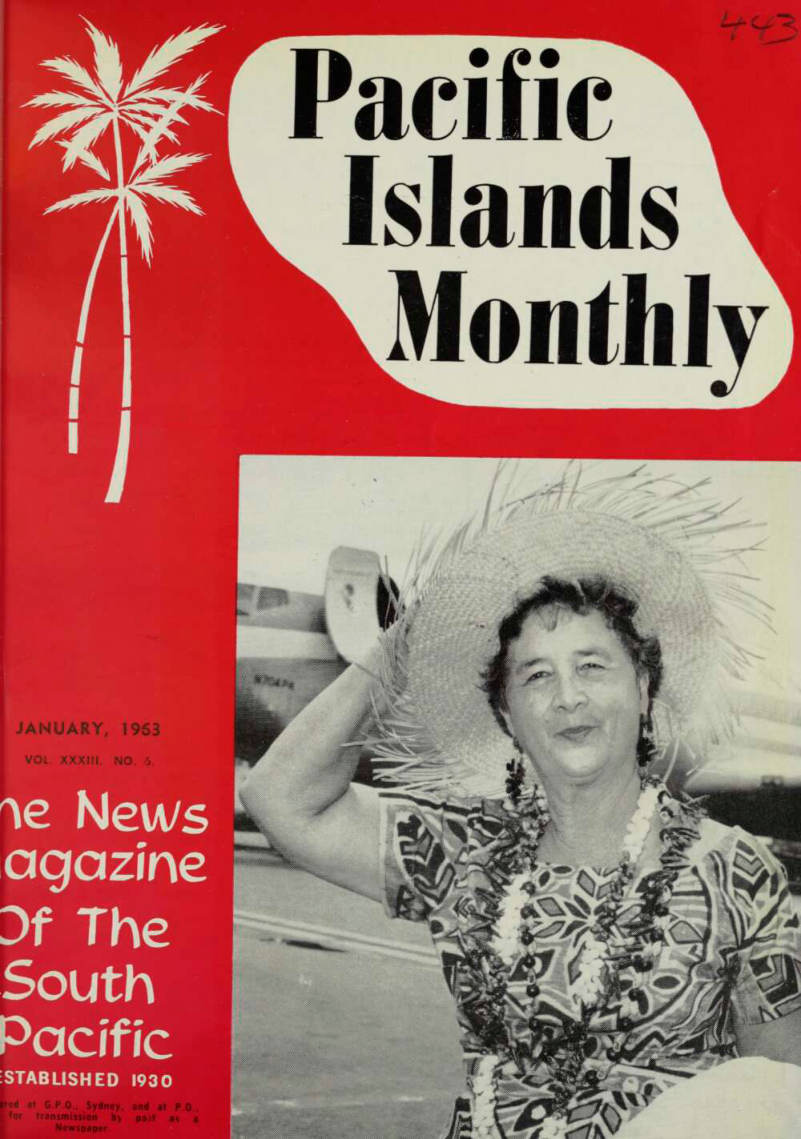 1
1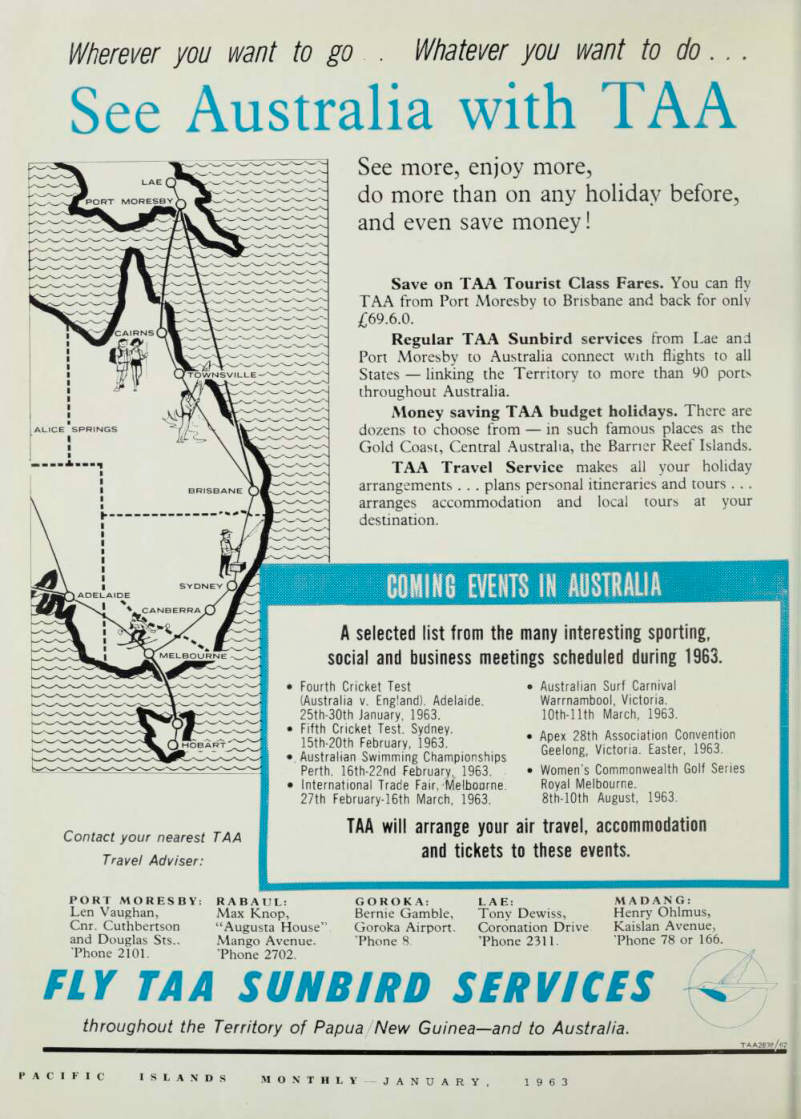 2
2 3
3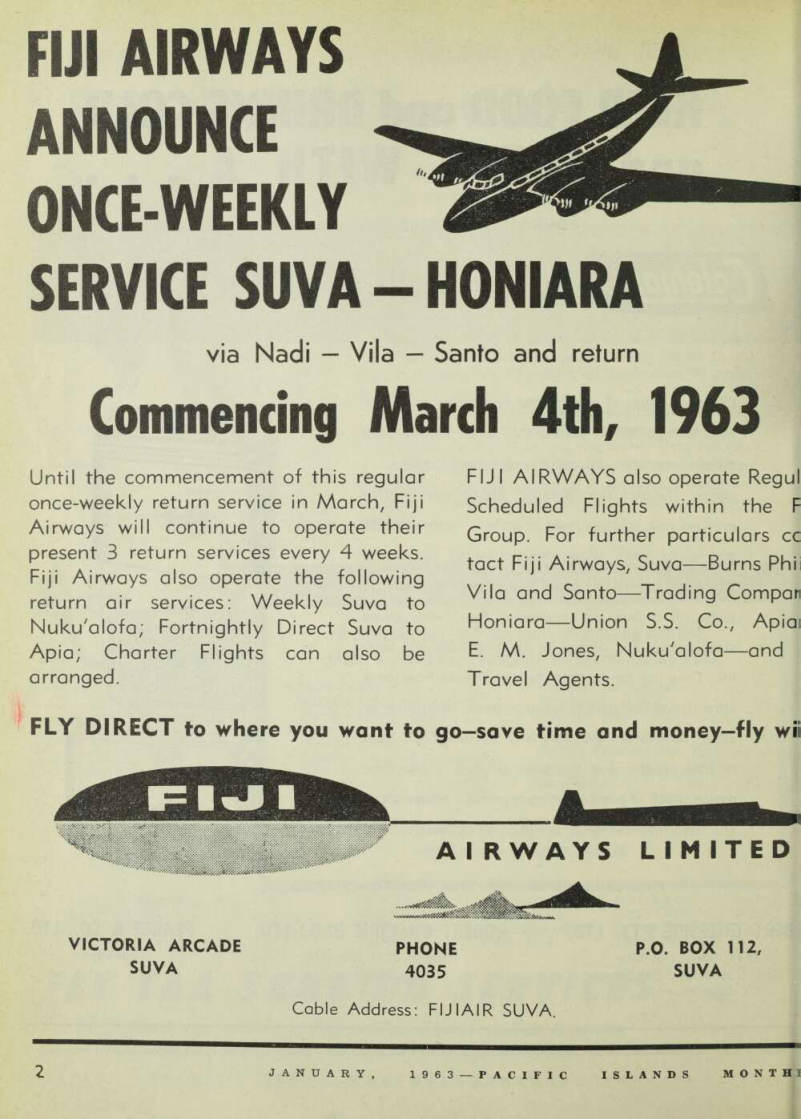 4
4 5
5 6
6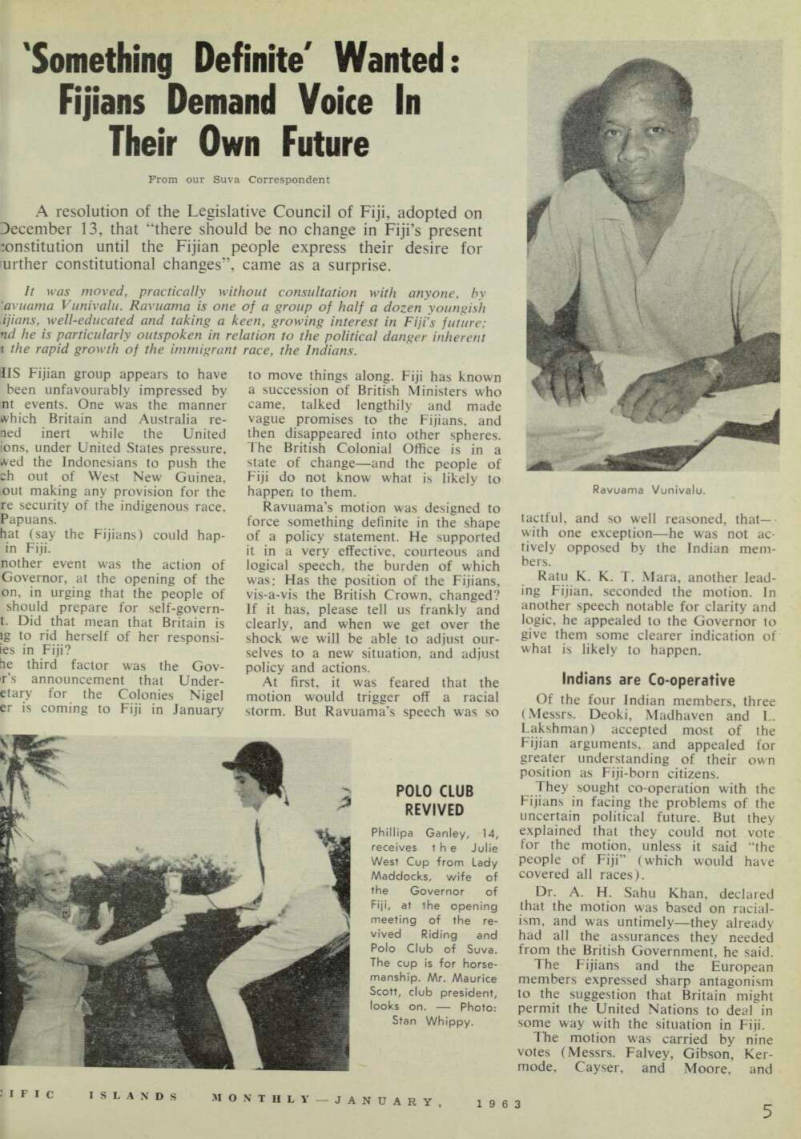 7
7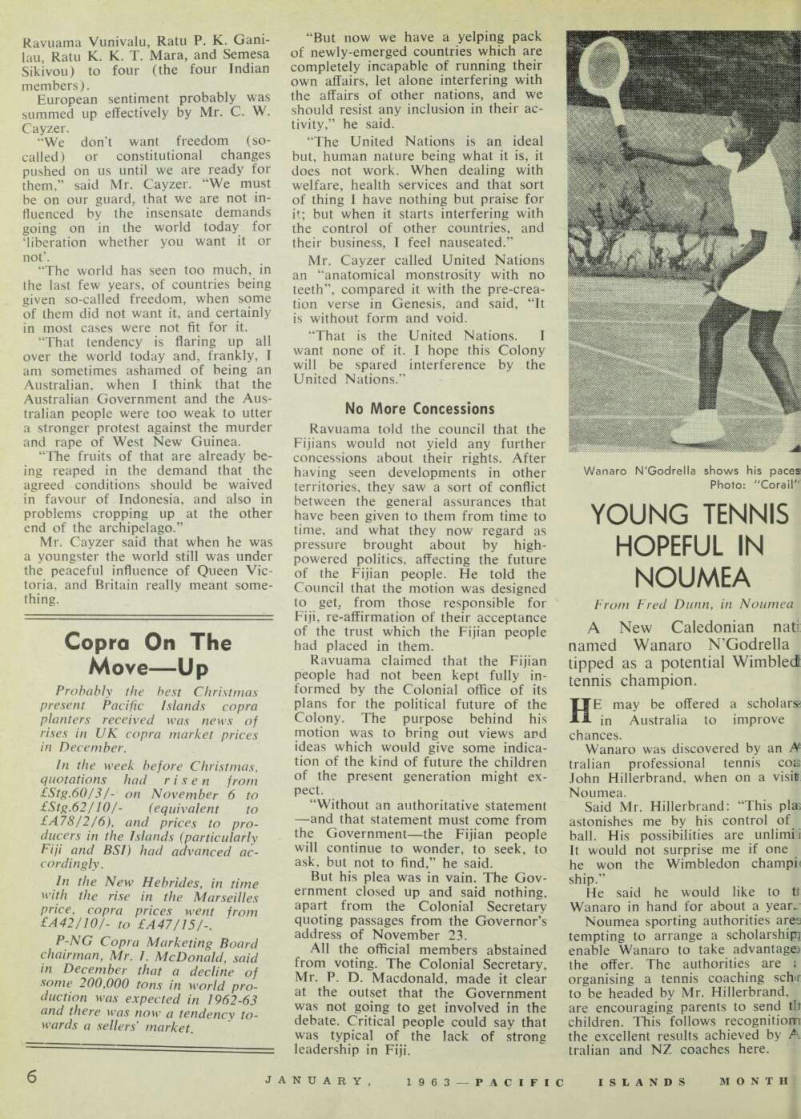 8
8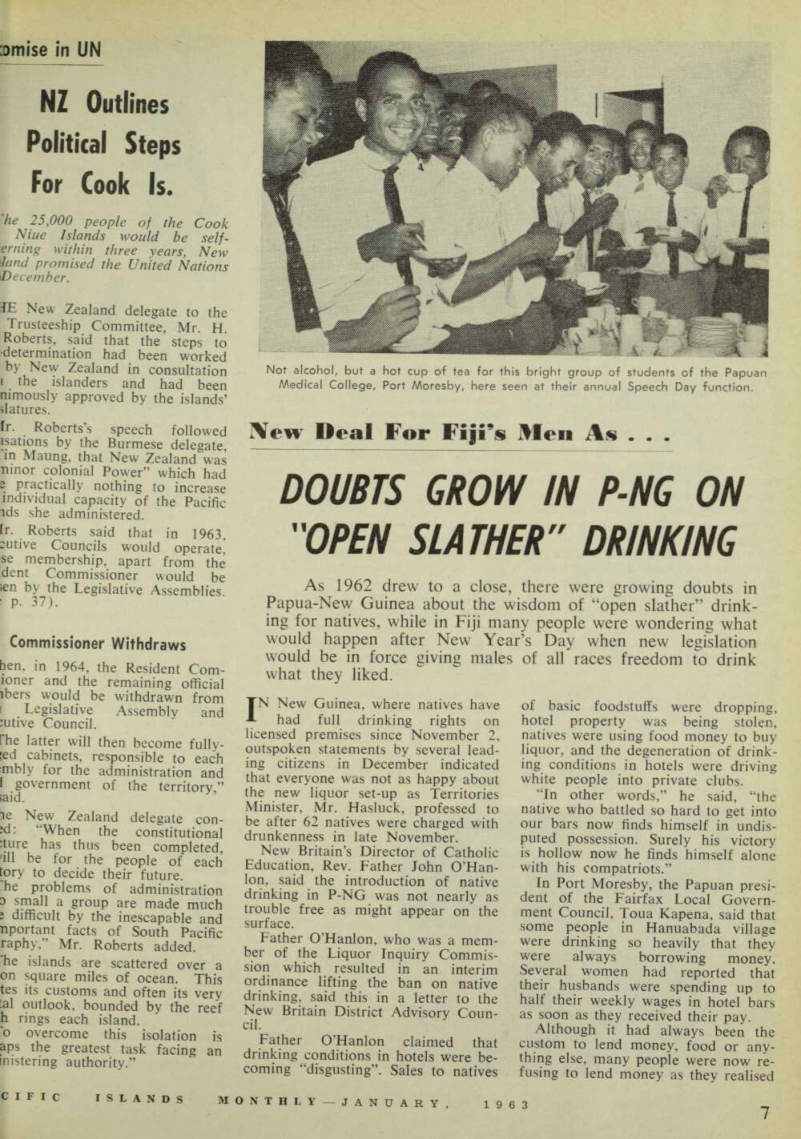 9
9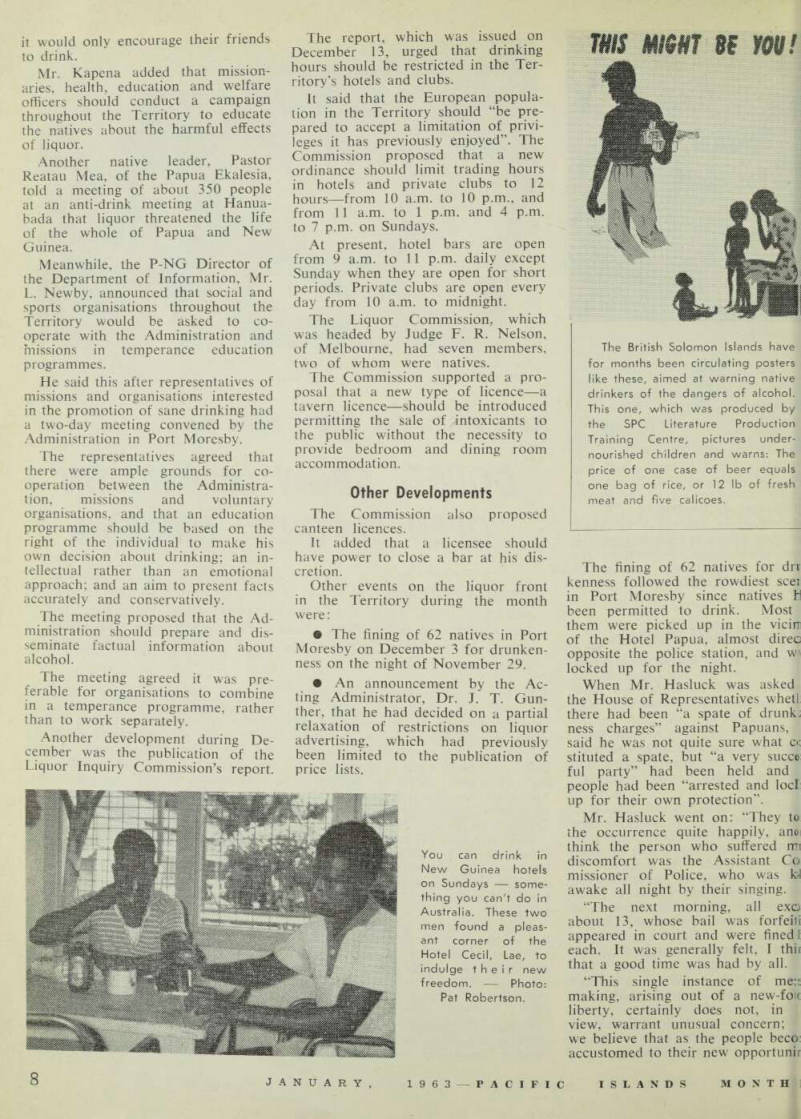 10
10 11
11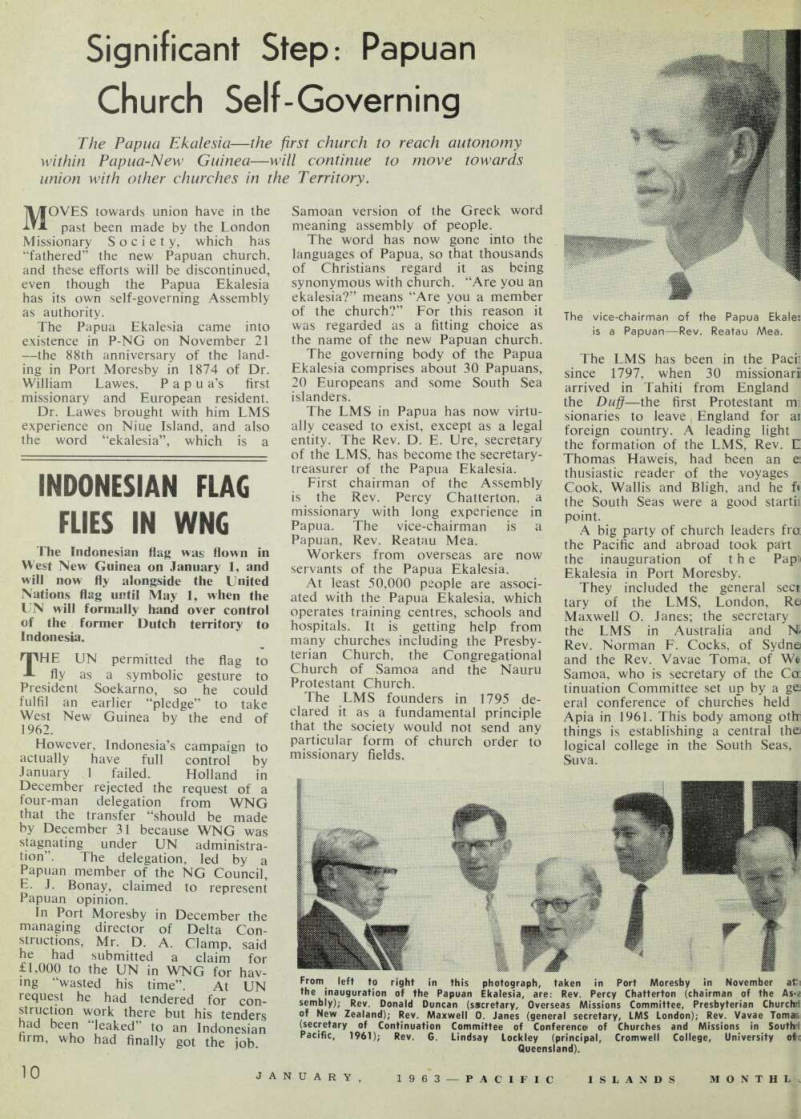 12
12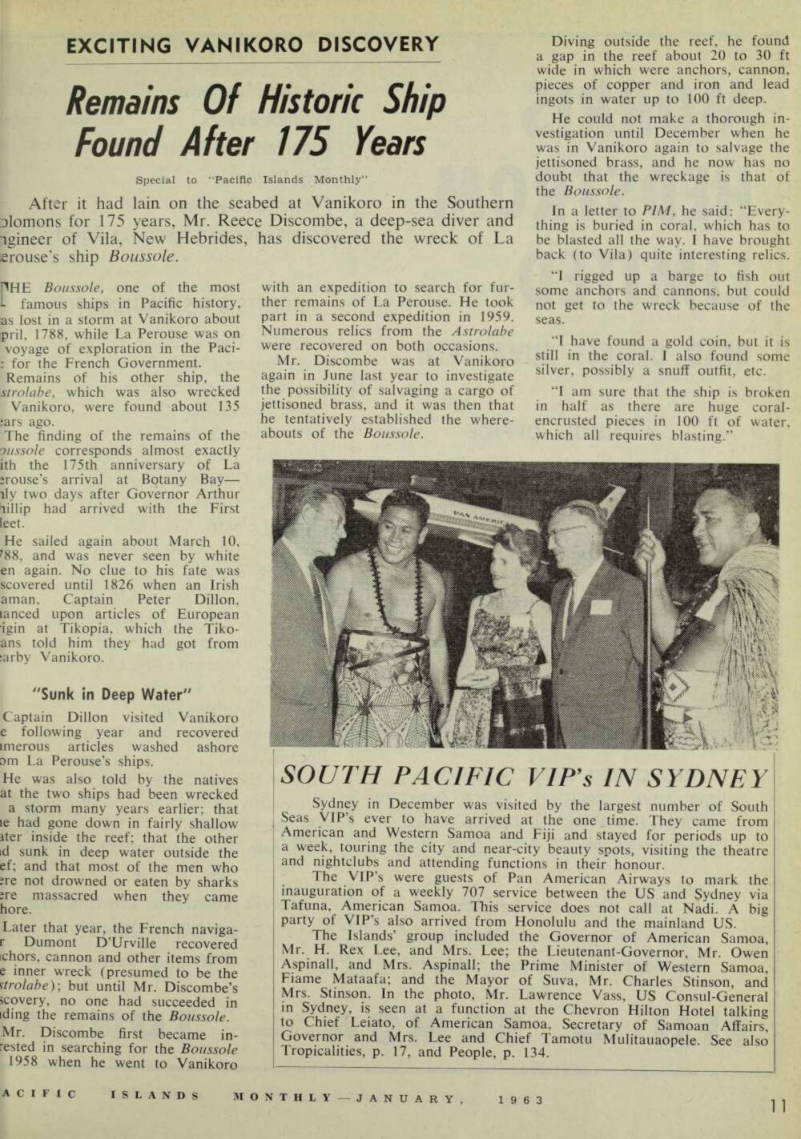 13
13 14
14 15
15 16
16 17
17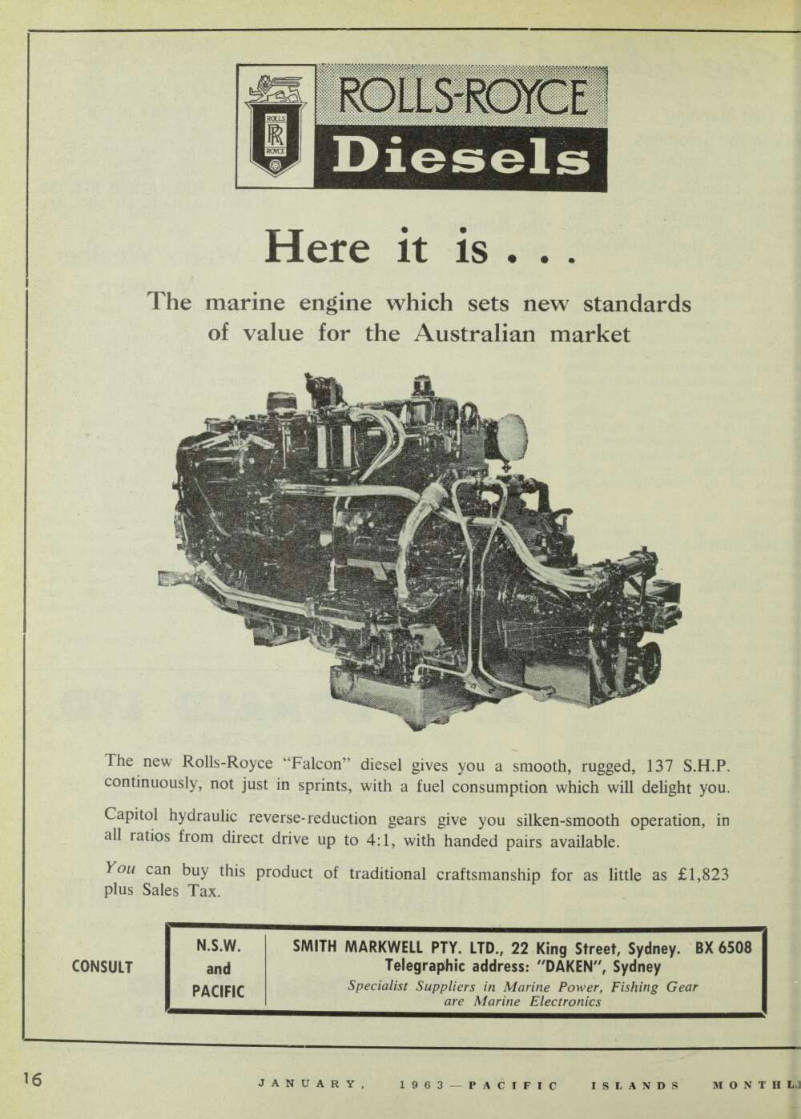 18
18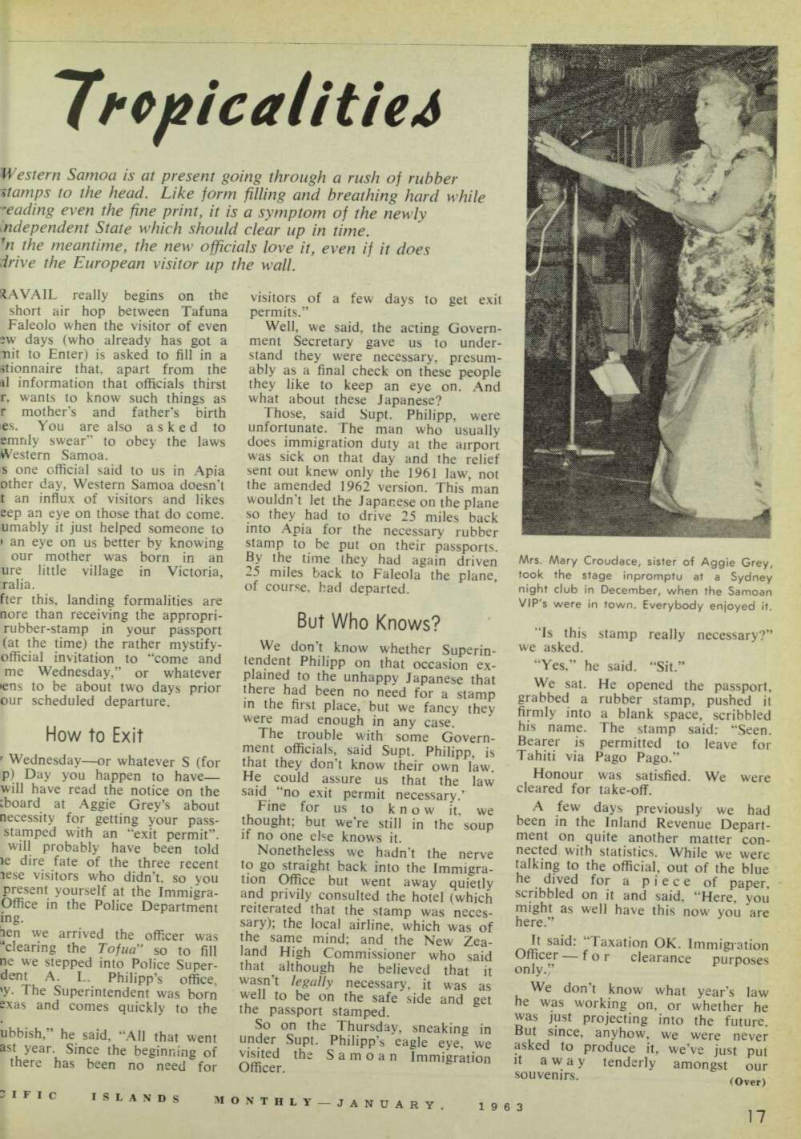 19
19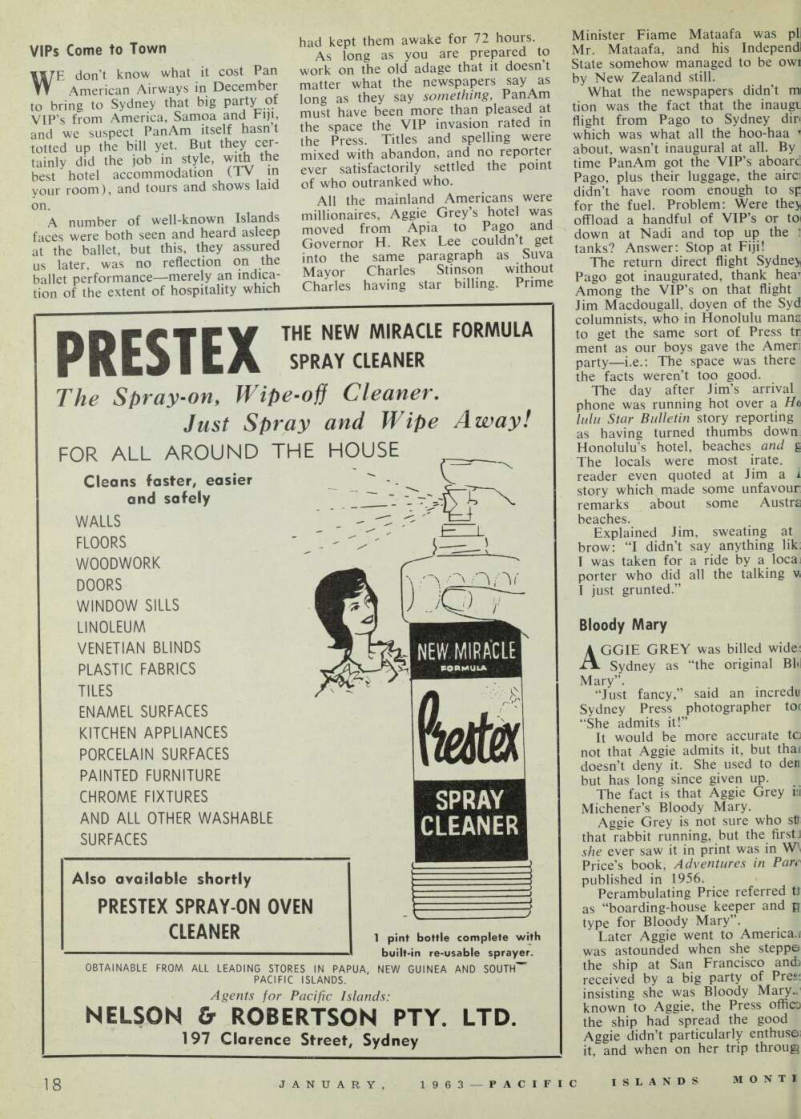 20
20 21
21 22
22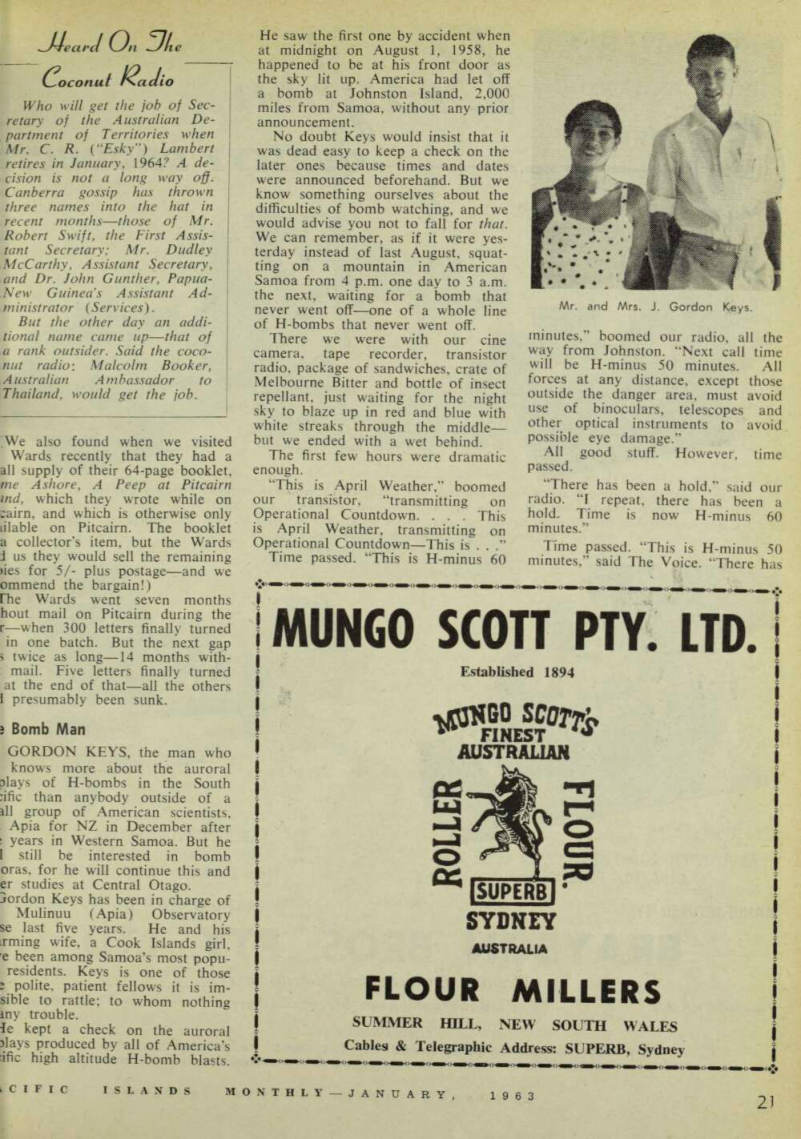 23
23 24
24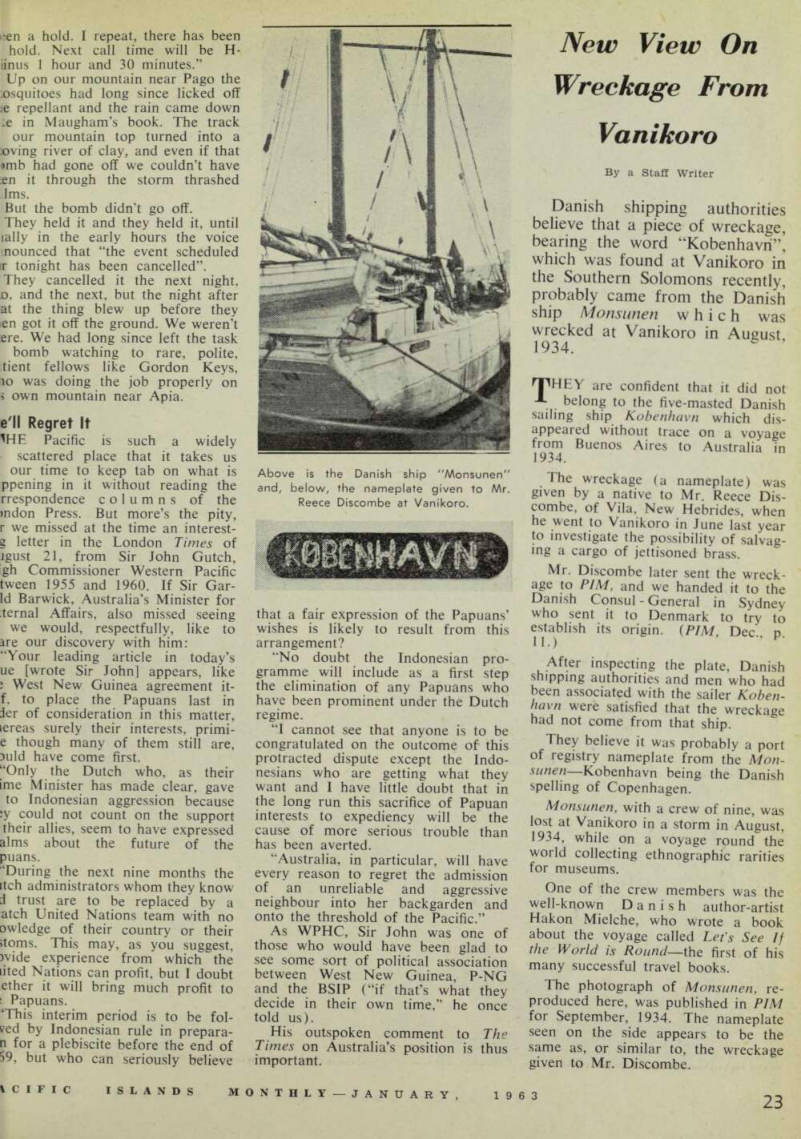 25
25 26
26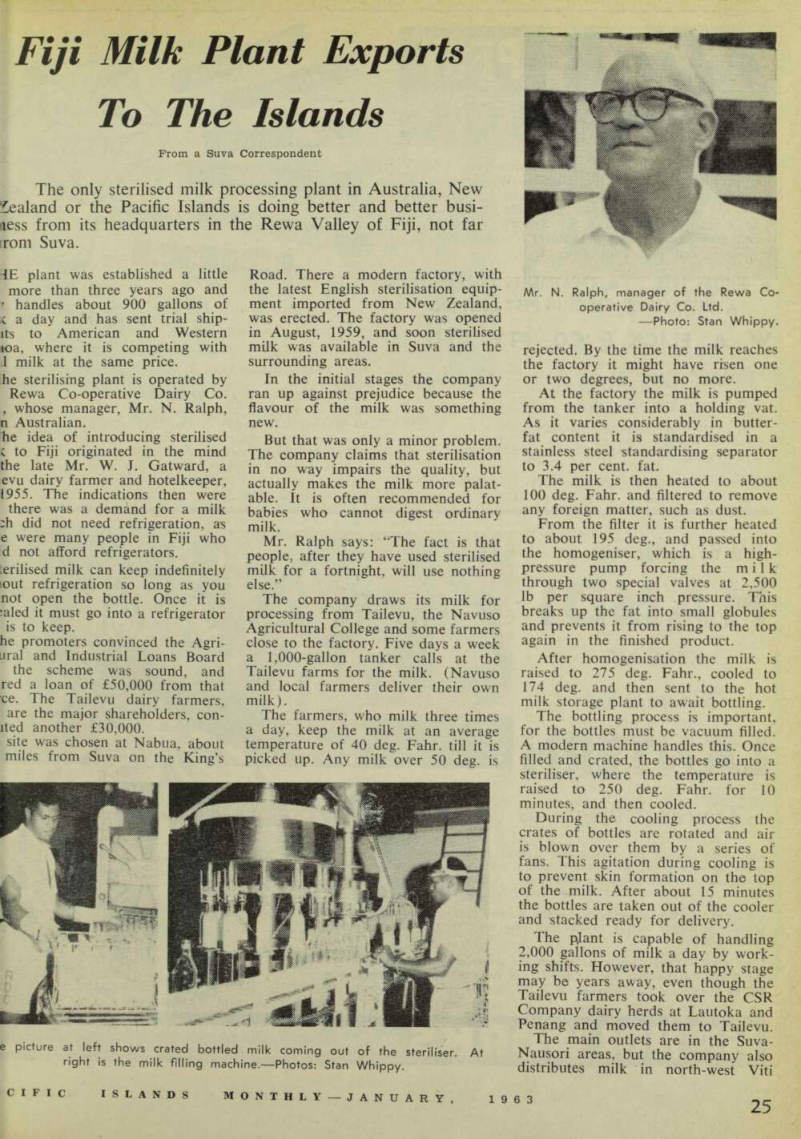 27
27 28
28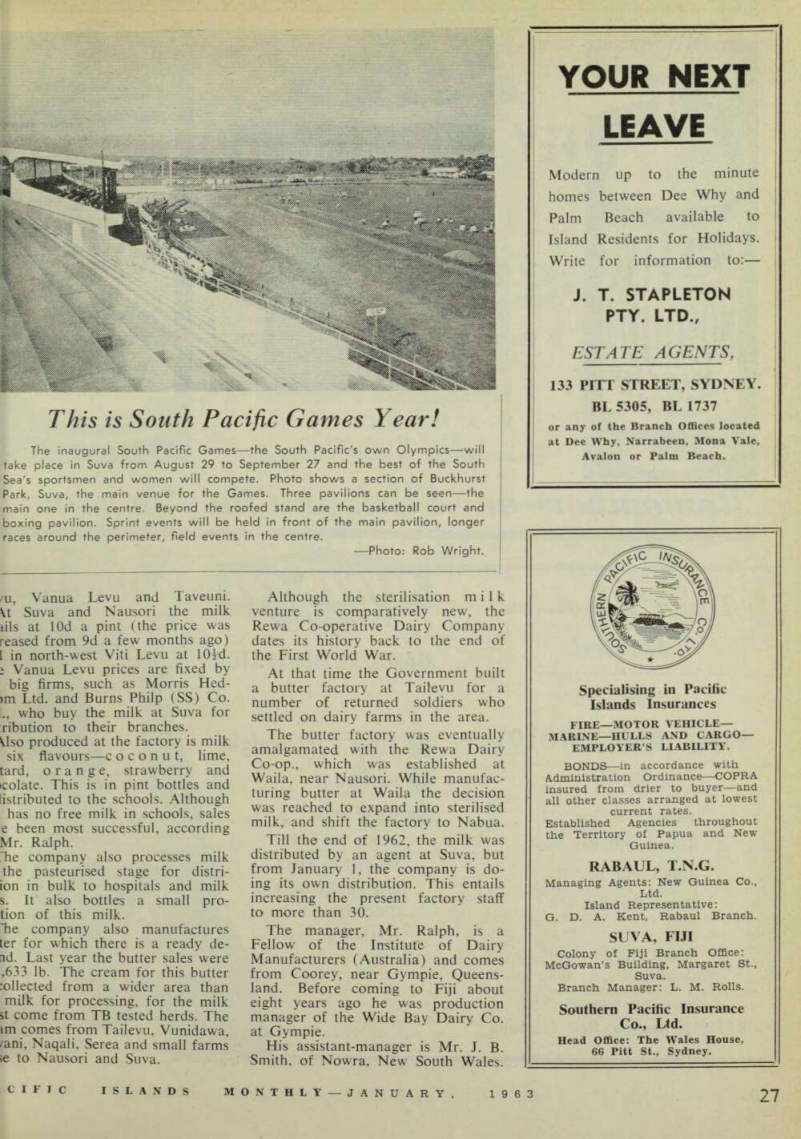 29
29 30
30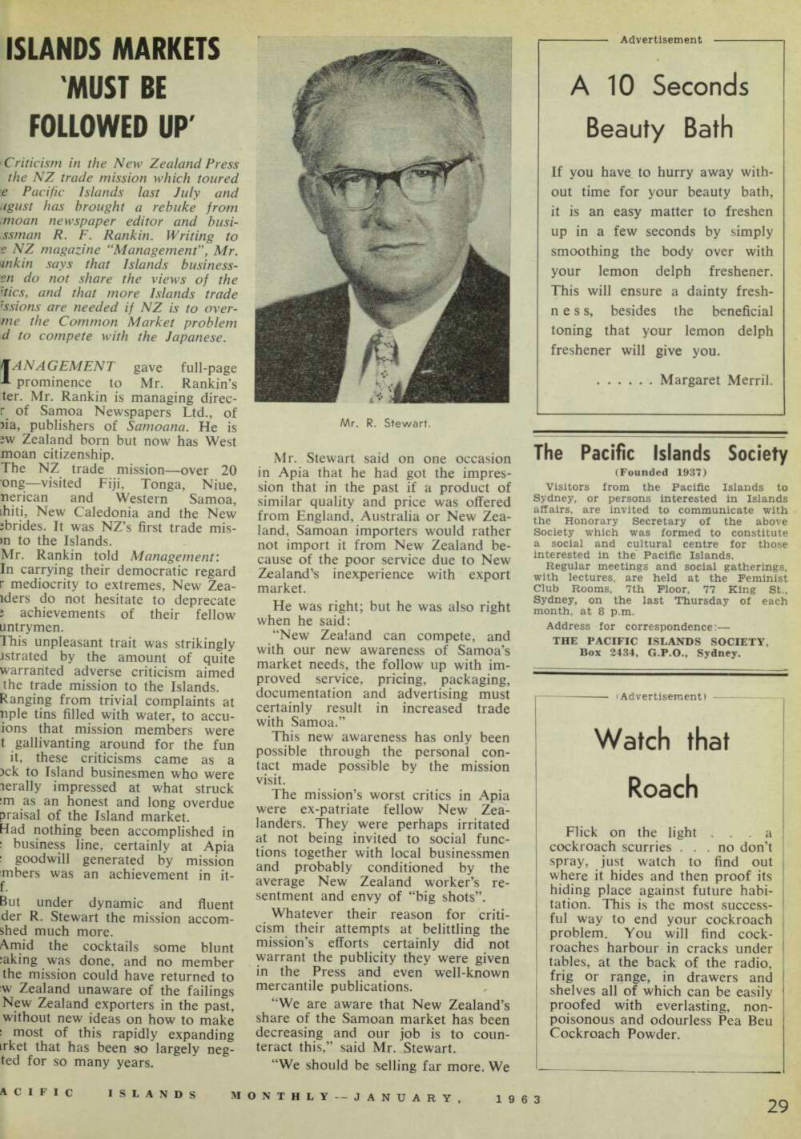 31
31 32
32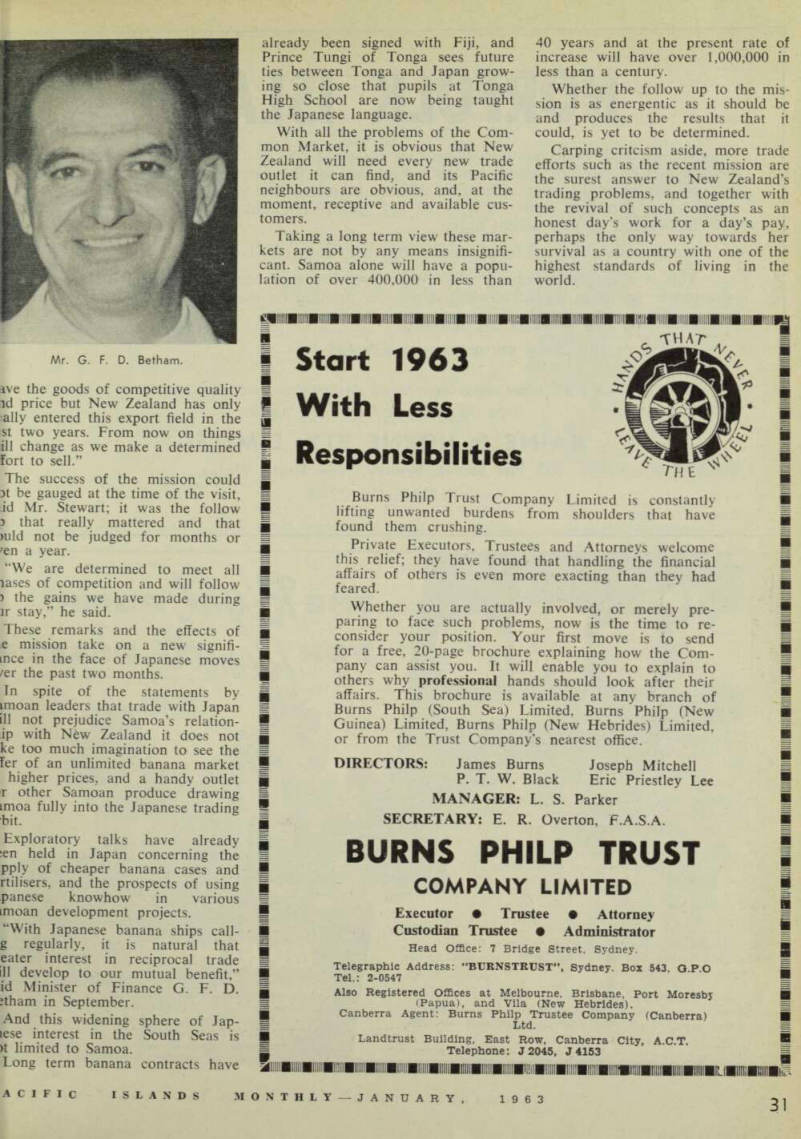 33
33 34
34 35
35 36
36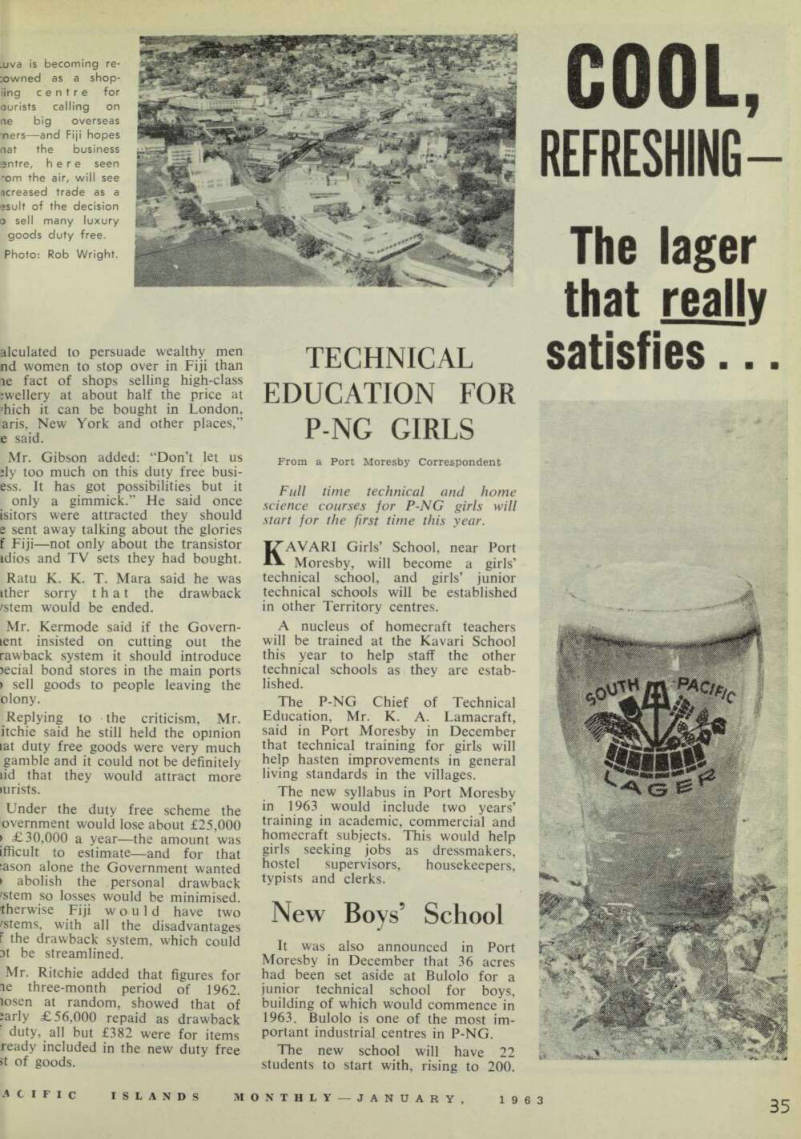 37
37 38
38 39
39 40
40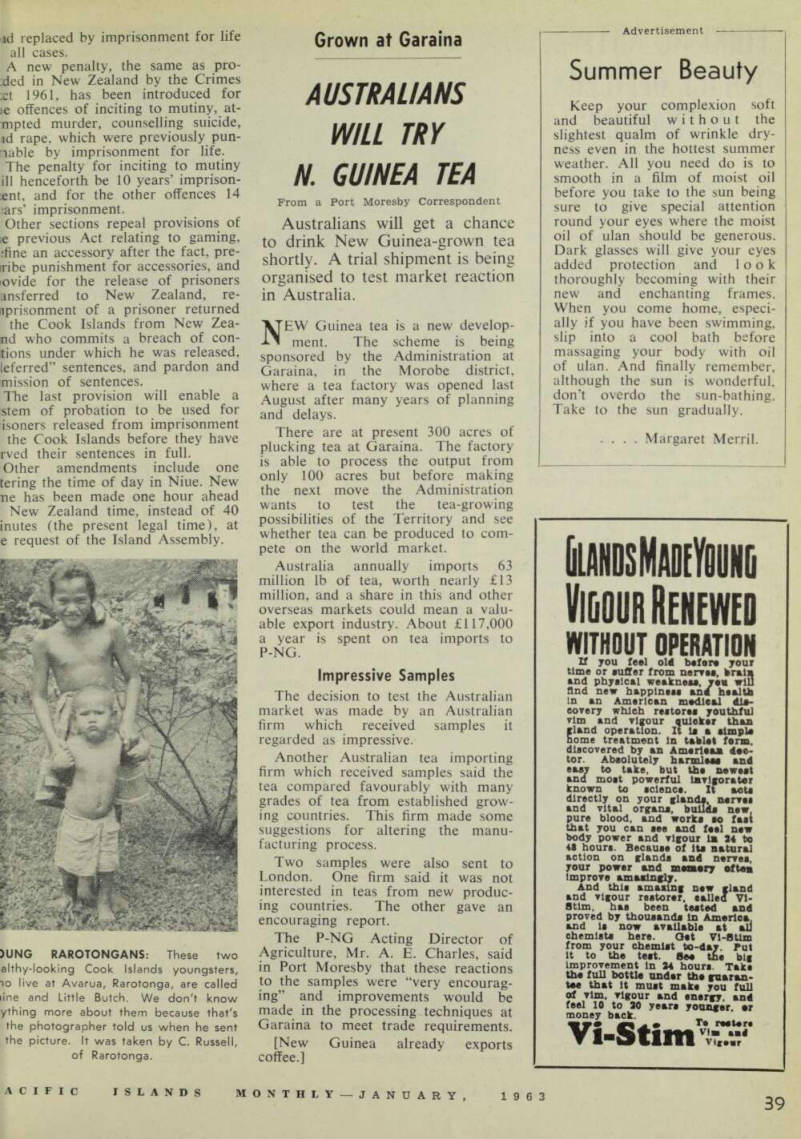 41
41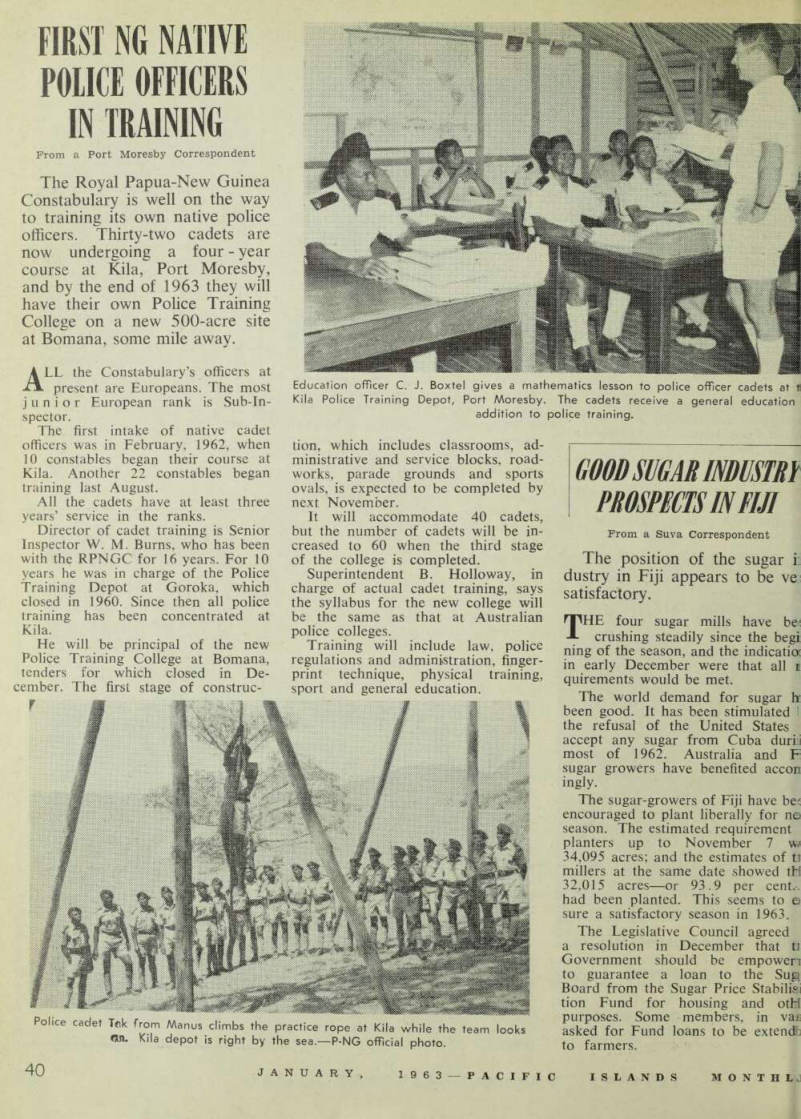 42
42 43
43 44
44 45
45 46
46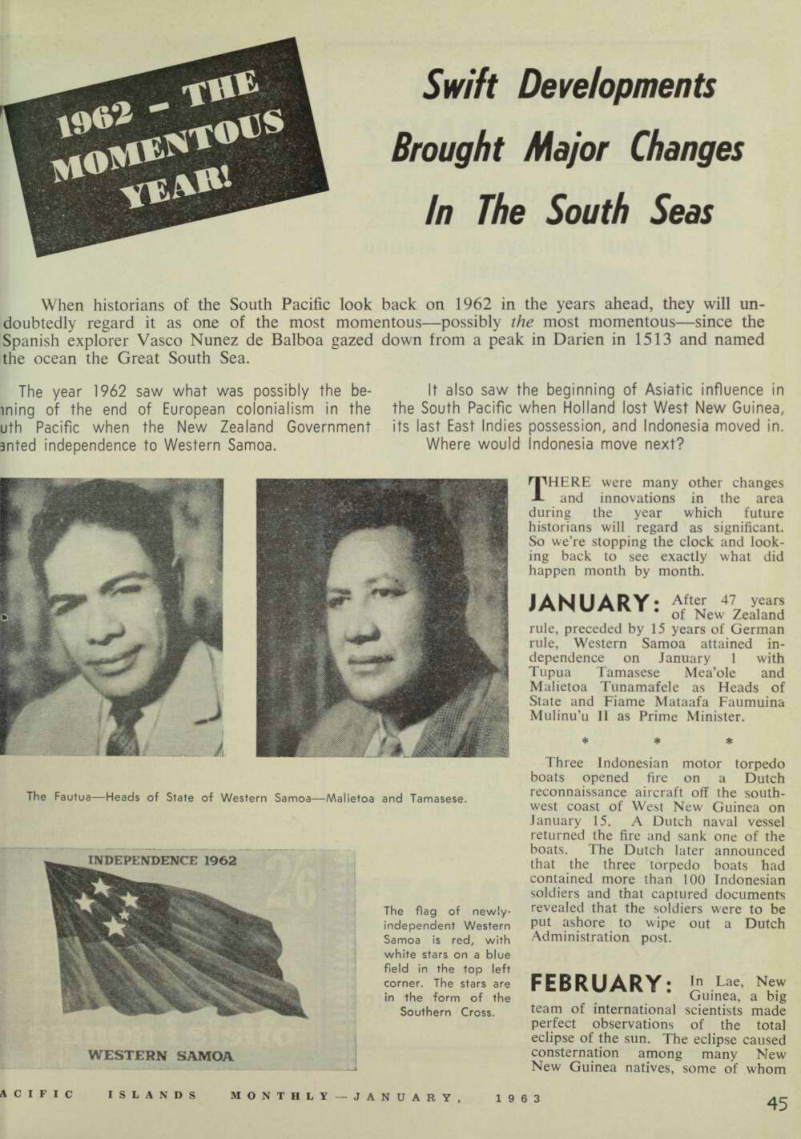 47
47 48
48 49
49 50
50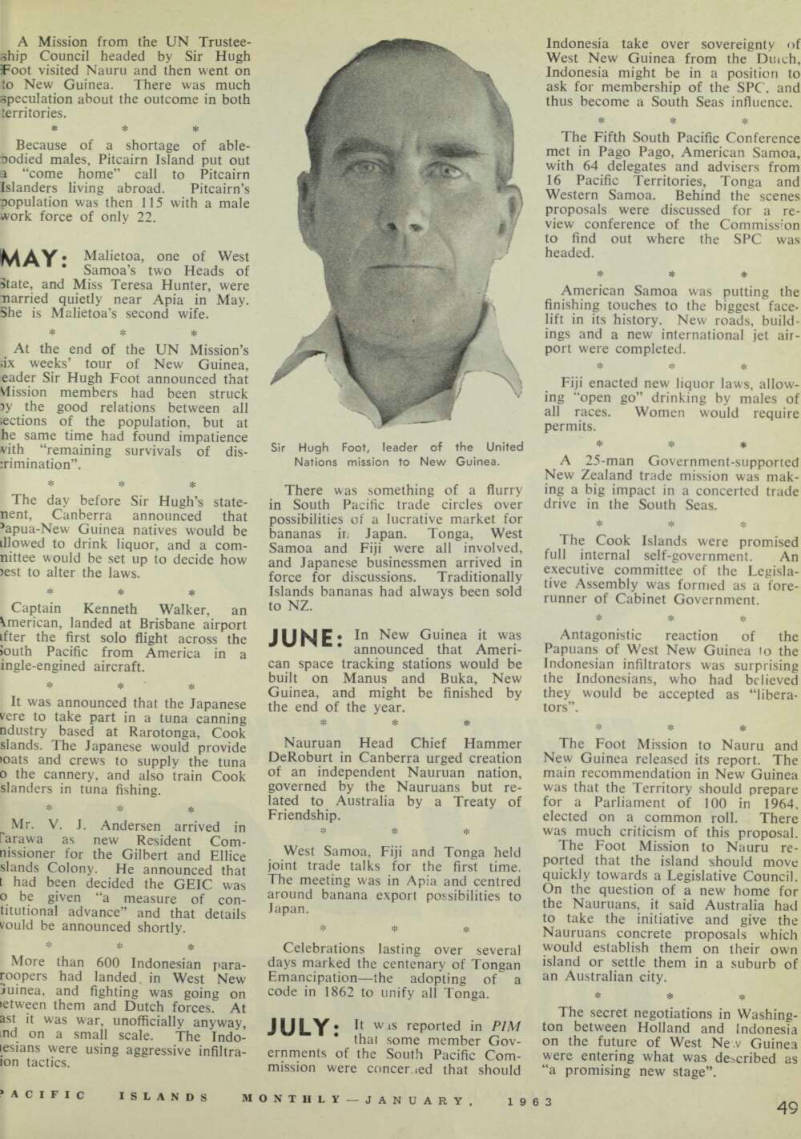 51
51 52
52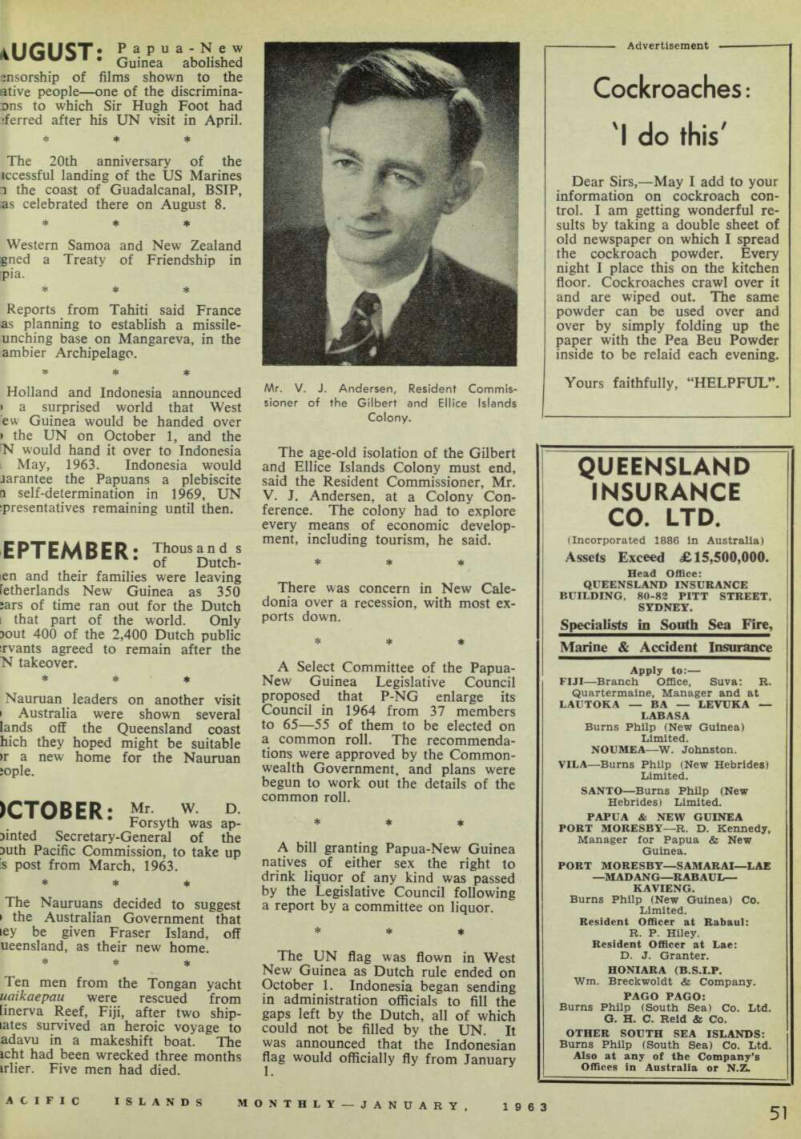 53
53 54
54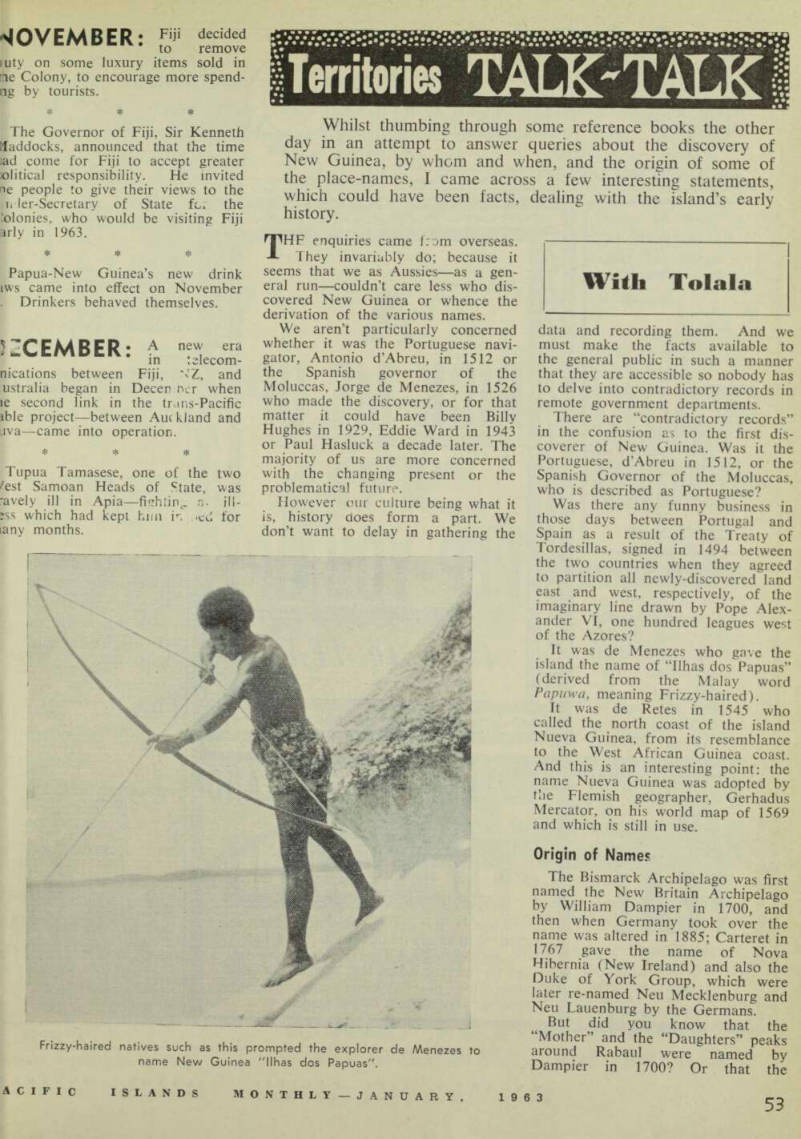 55
55 56
56 57
57 58
58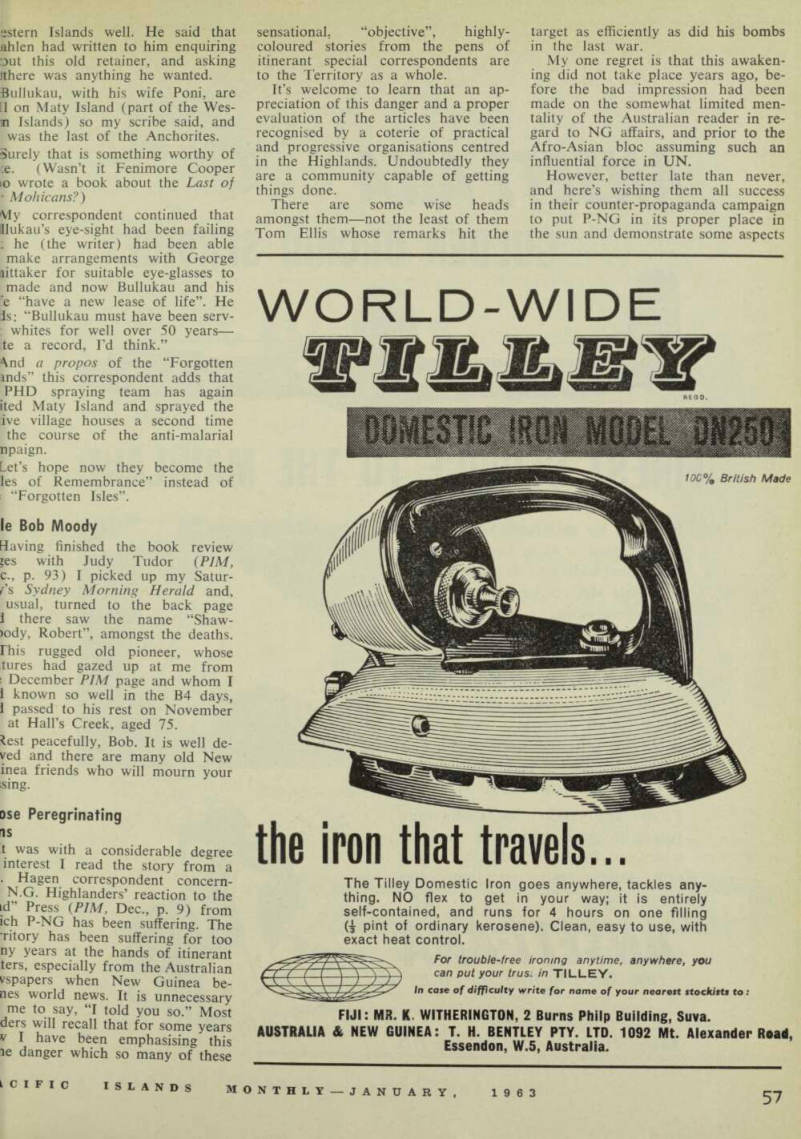 59
59 60
60 61
61 62
62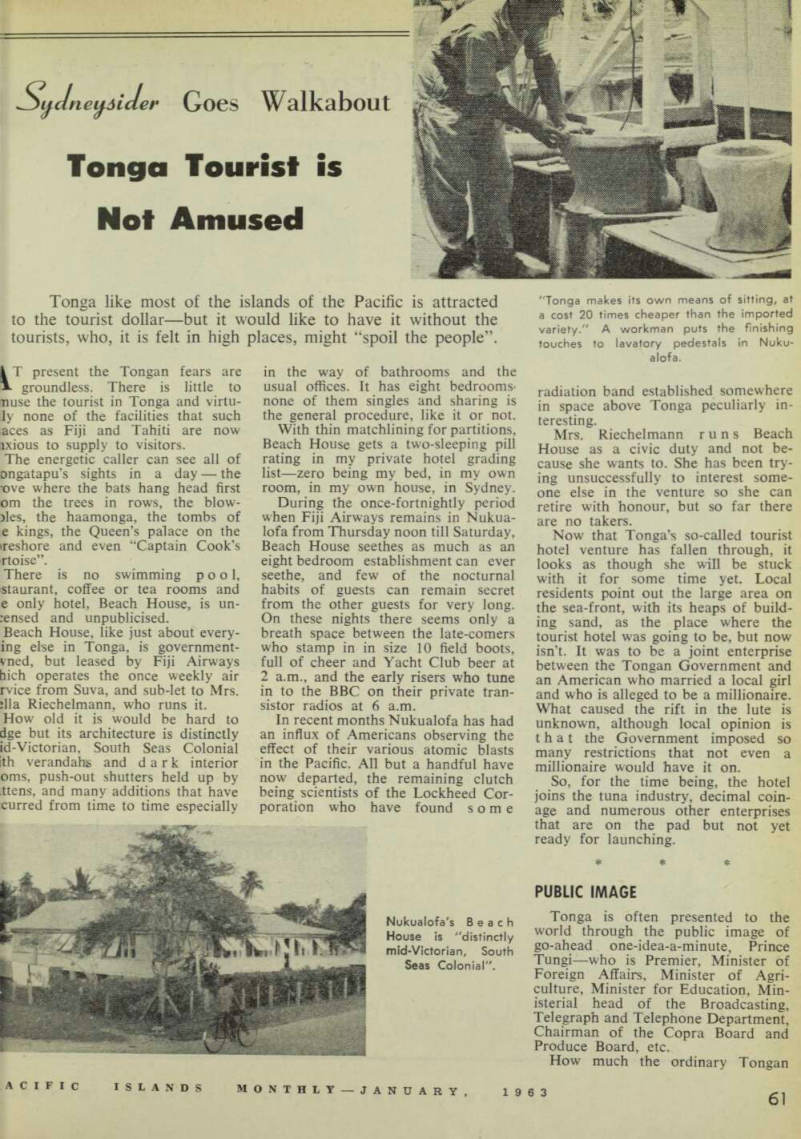 63
63 64
64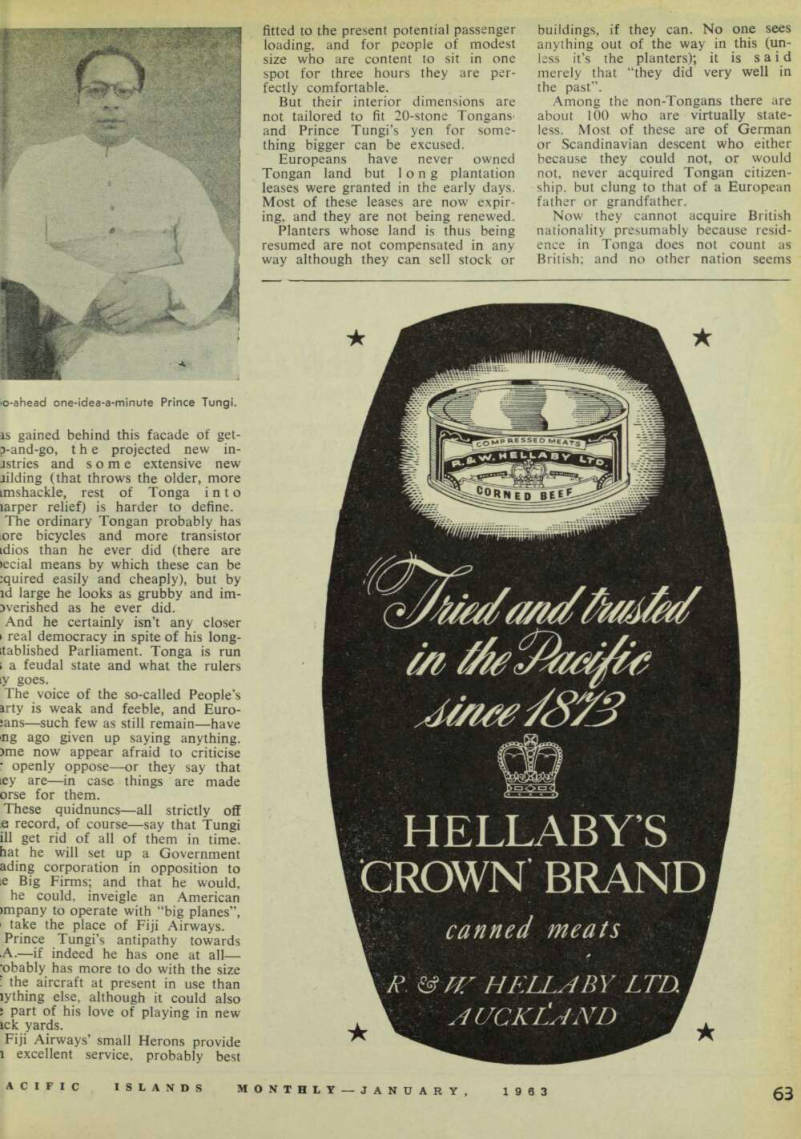 65
65 66
66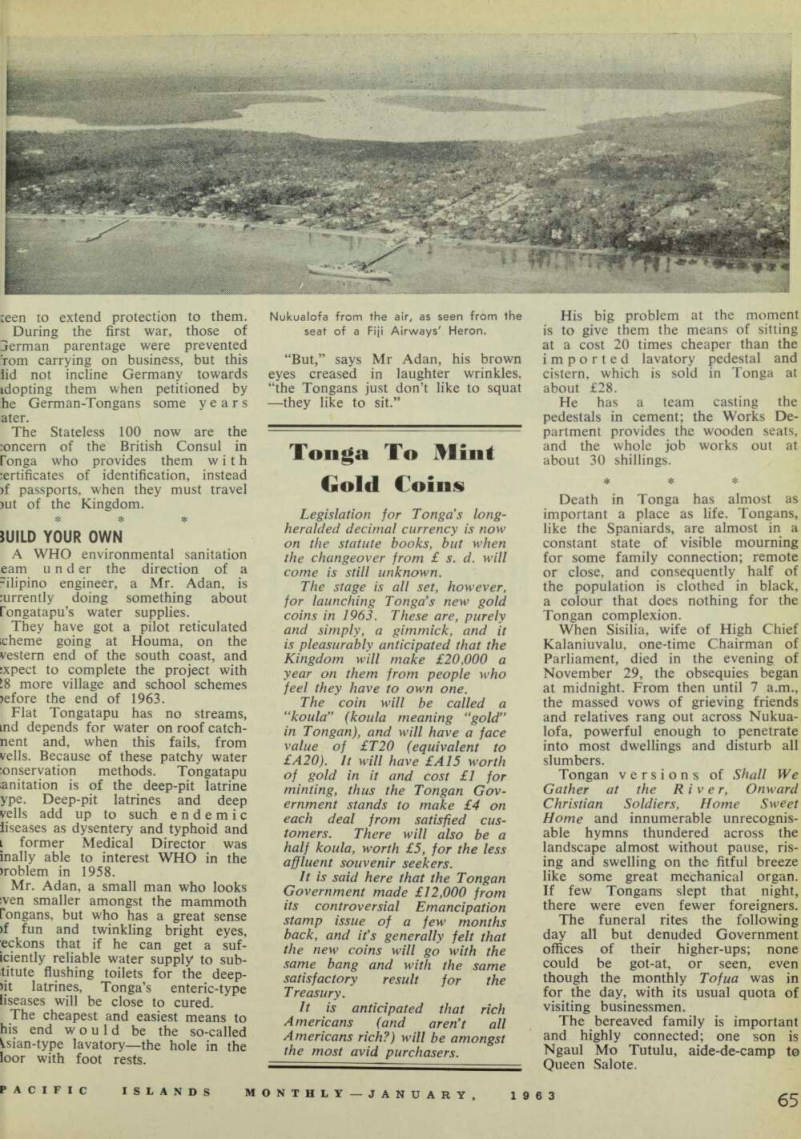 67
67 68
68 69
69 70
70 71
71 72
72 73
73 74
74 75
75 76
76 77
77 78
78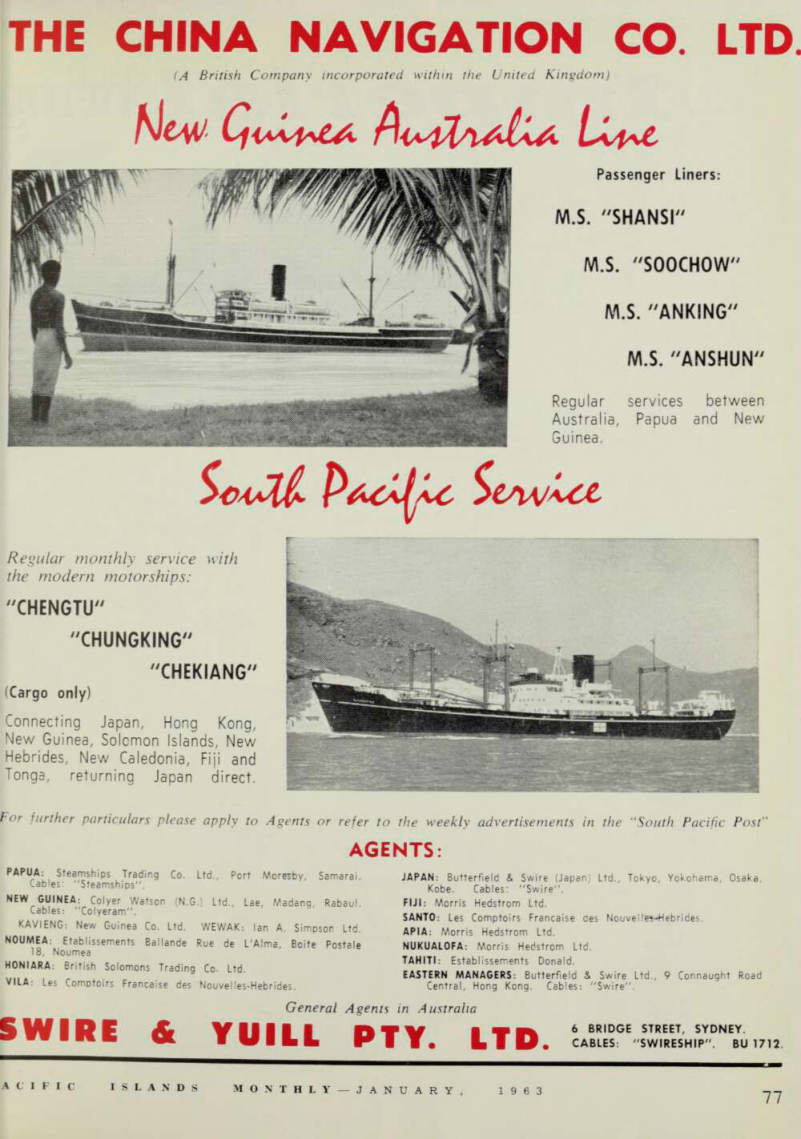 79
79 80
80 81
81 82
82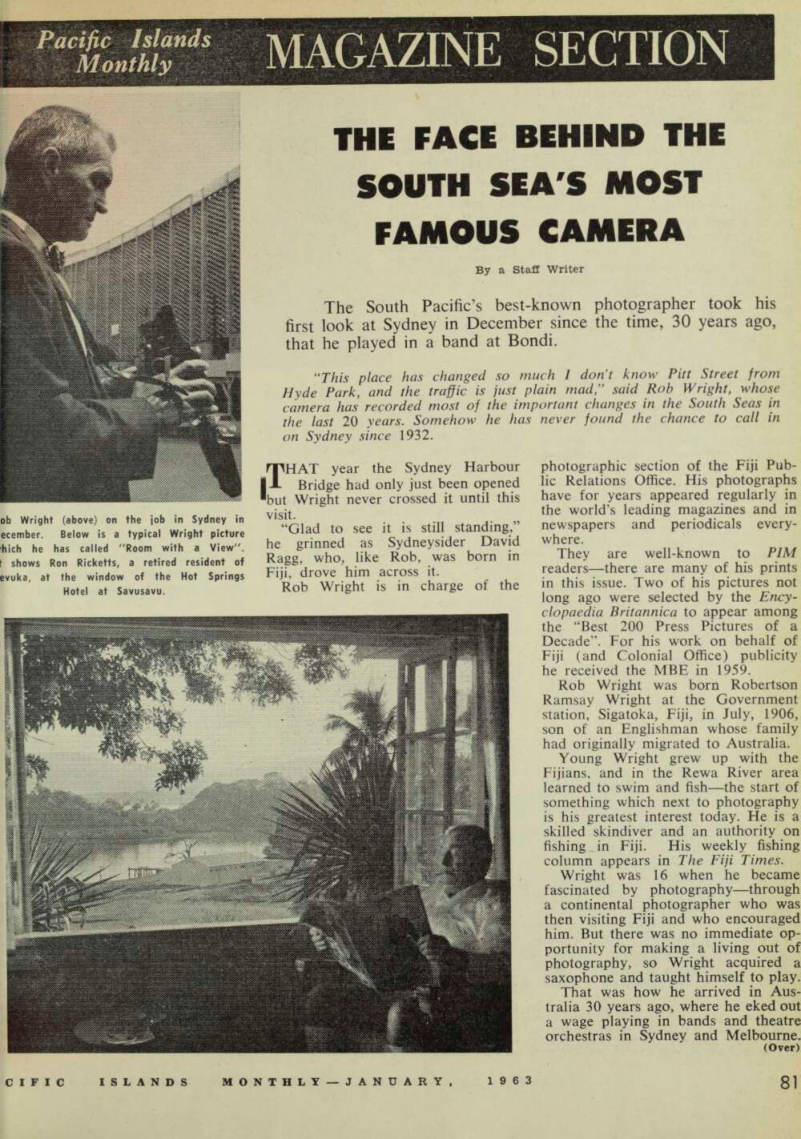 83
83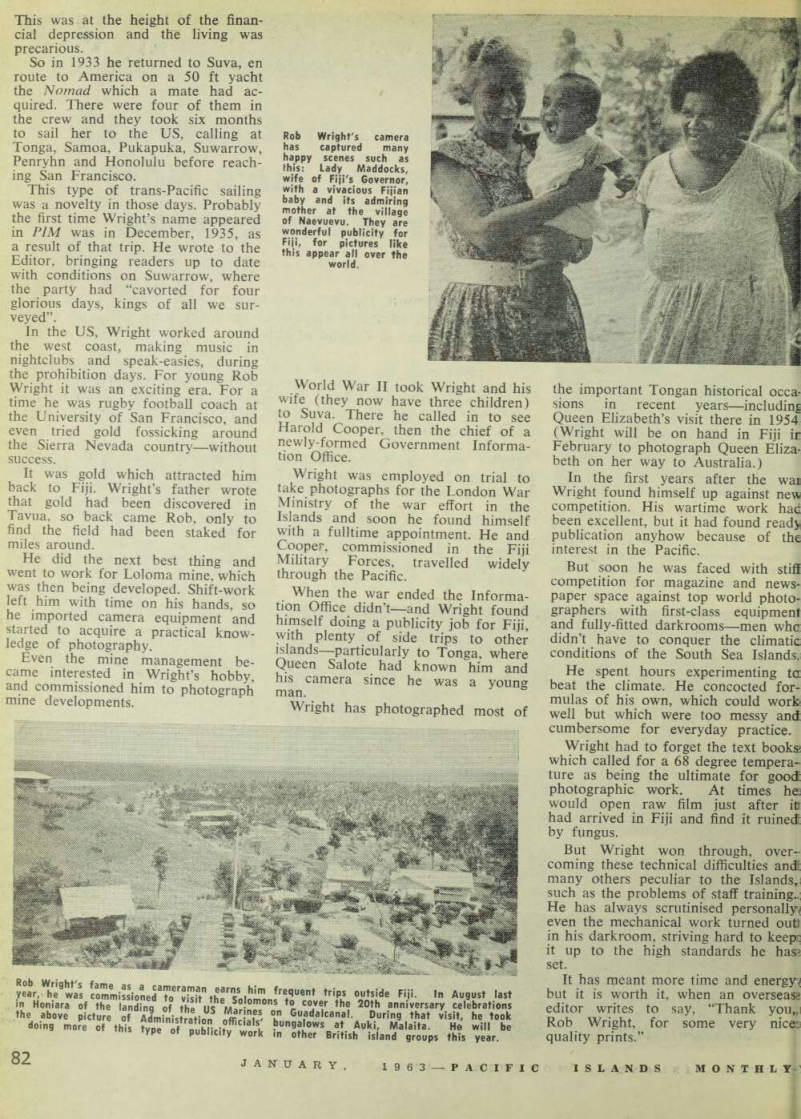 84
84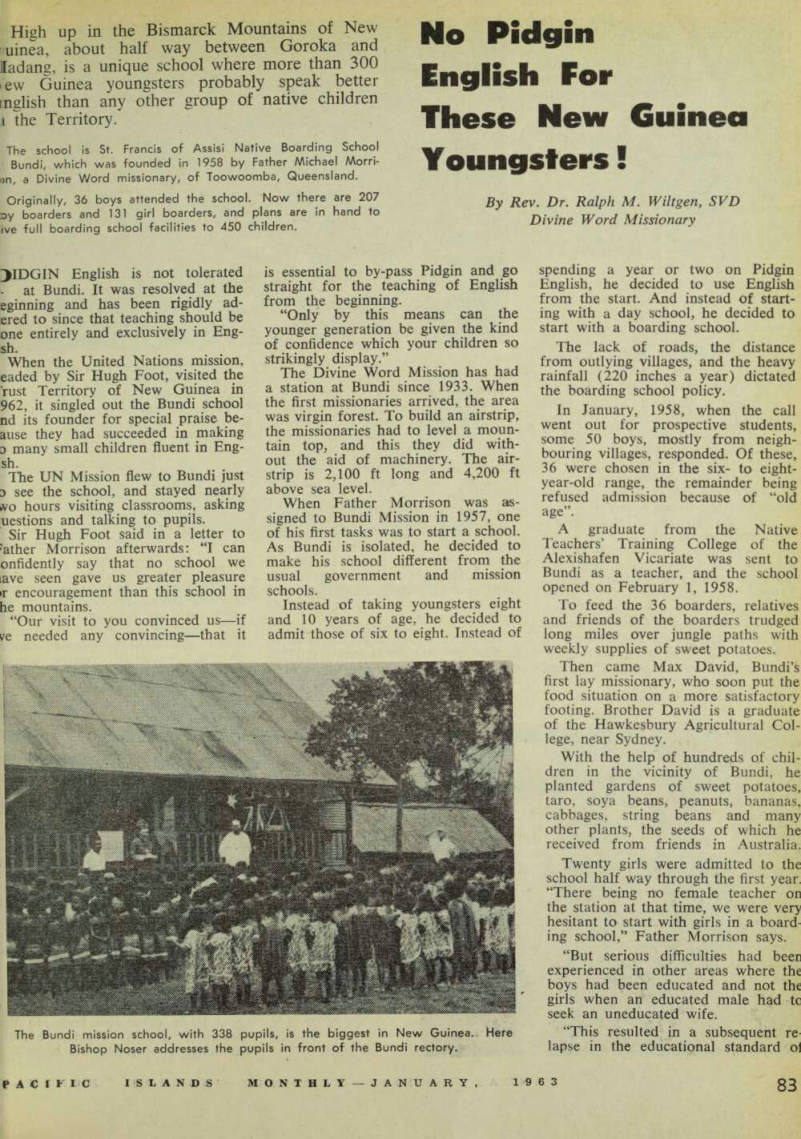 85
85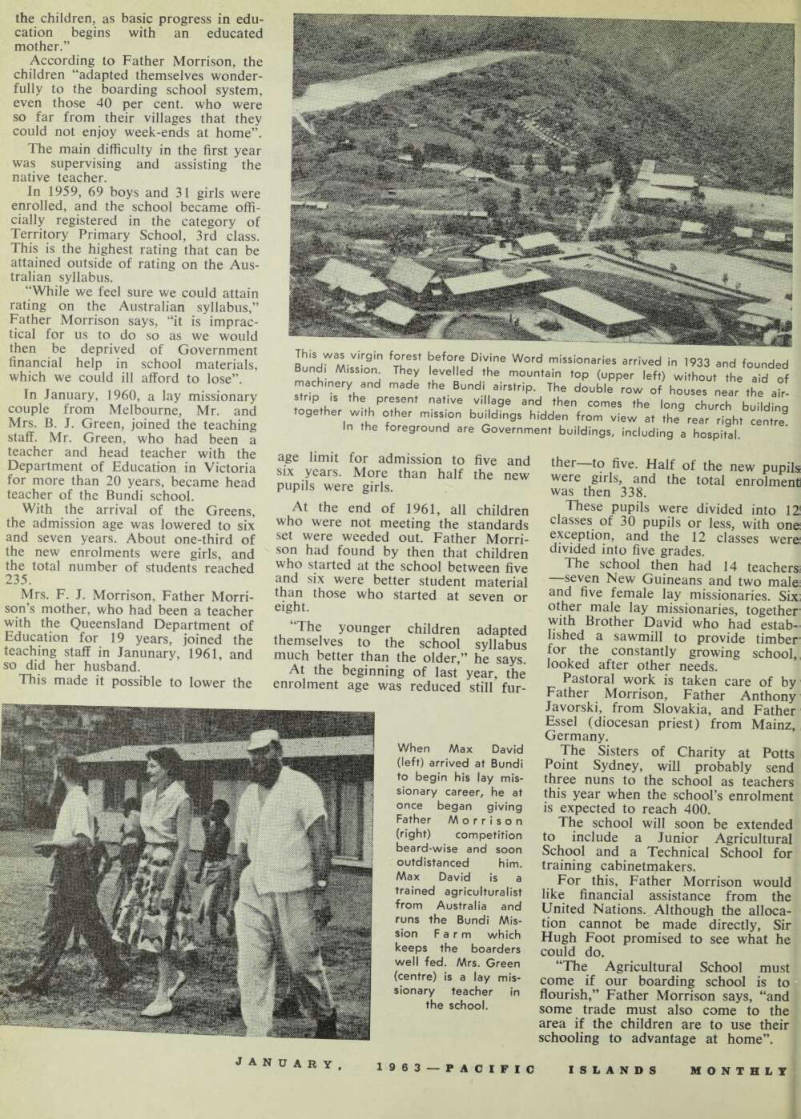 86
86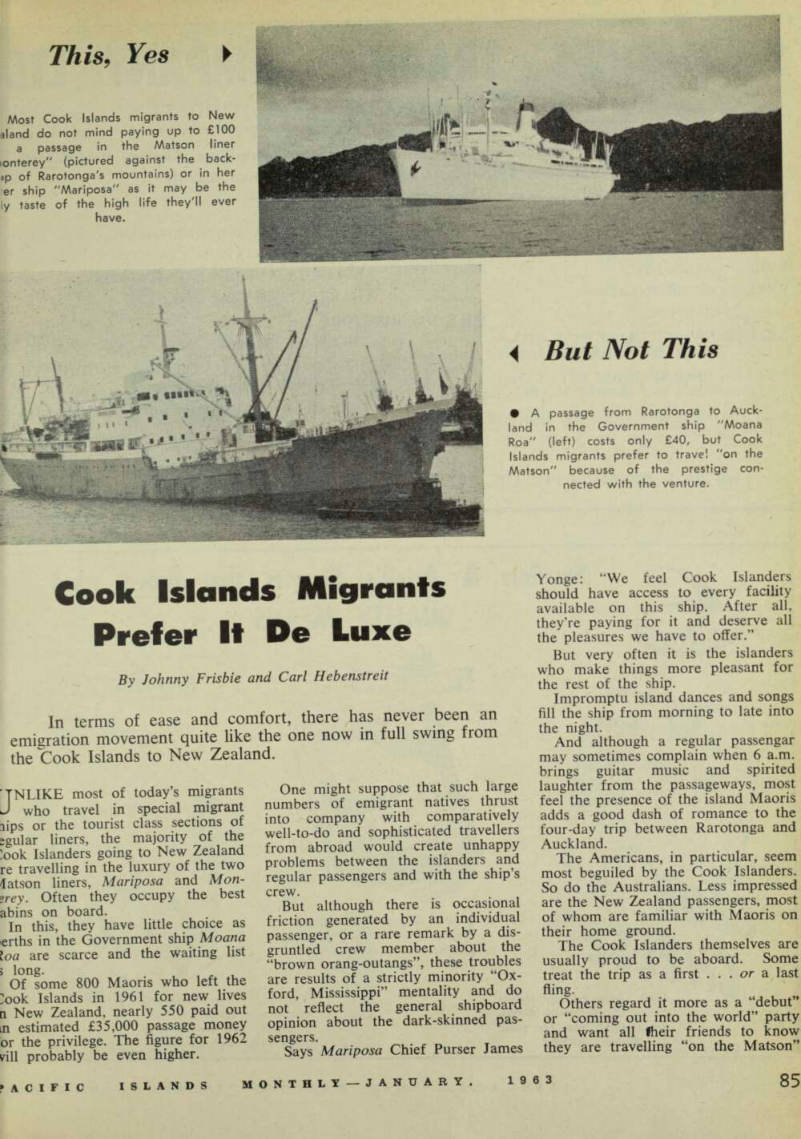 87
87 88
88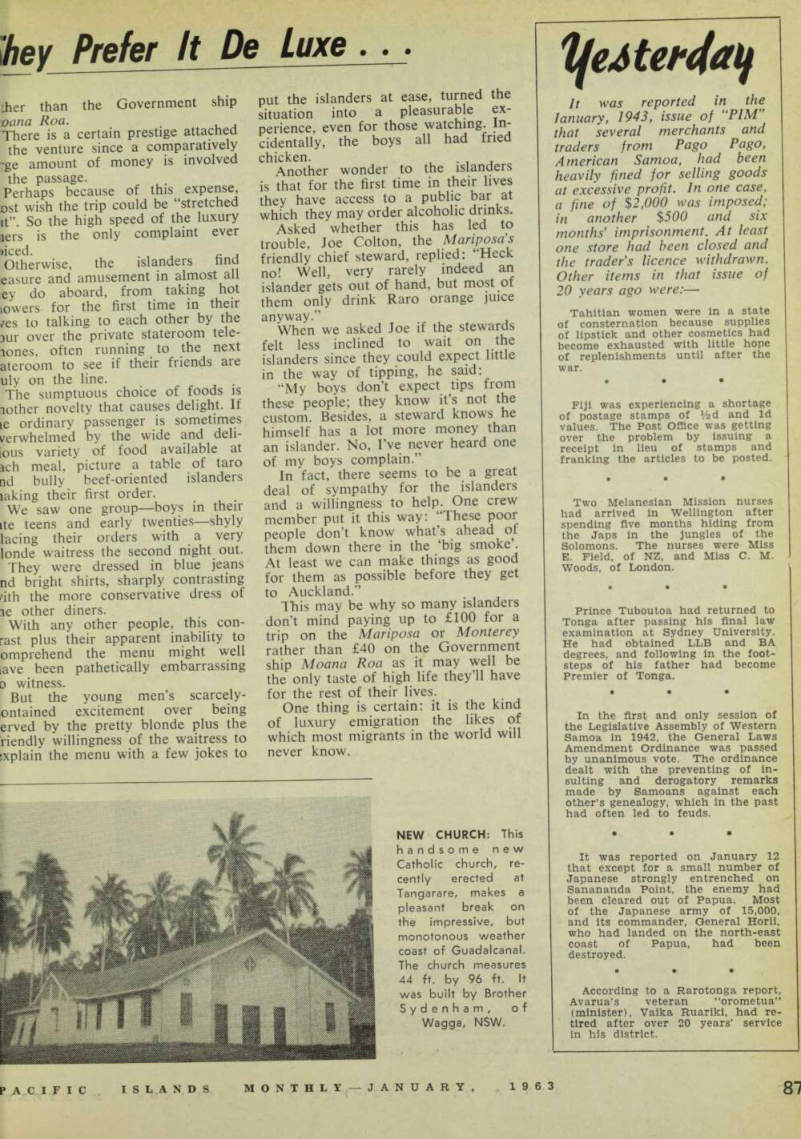 89
89 90
90 91
91 92
92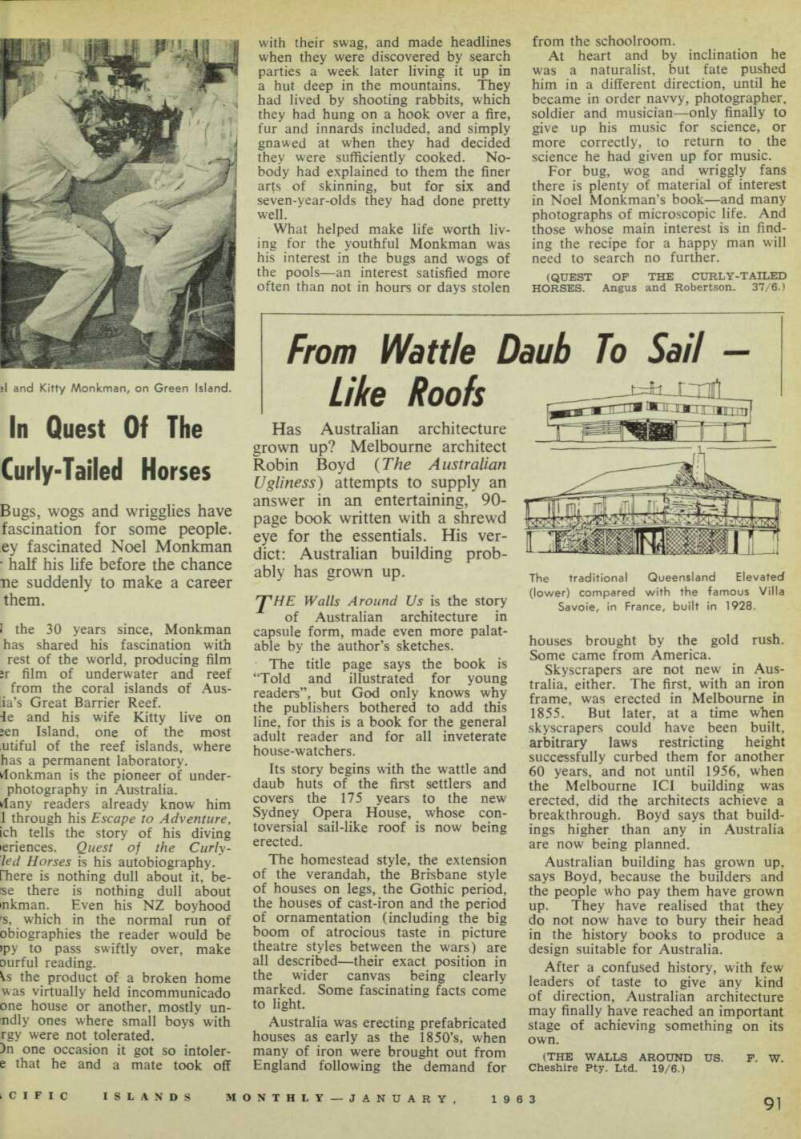 93
93 94
94 95
95 96
96 97
97 98
98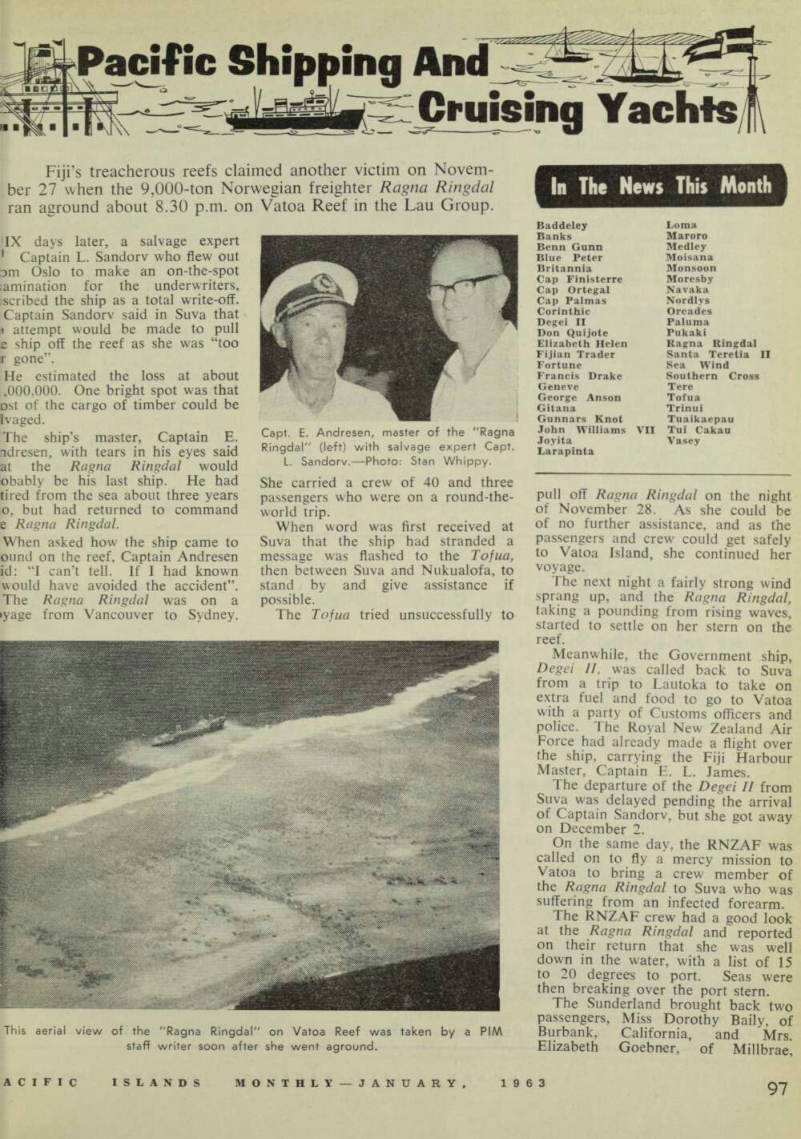 99
99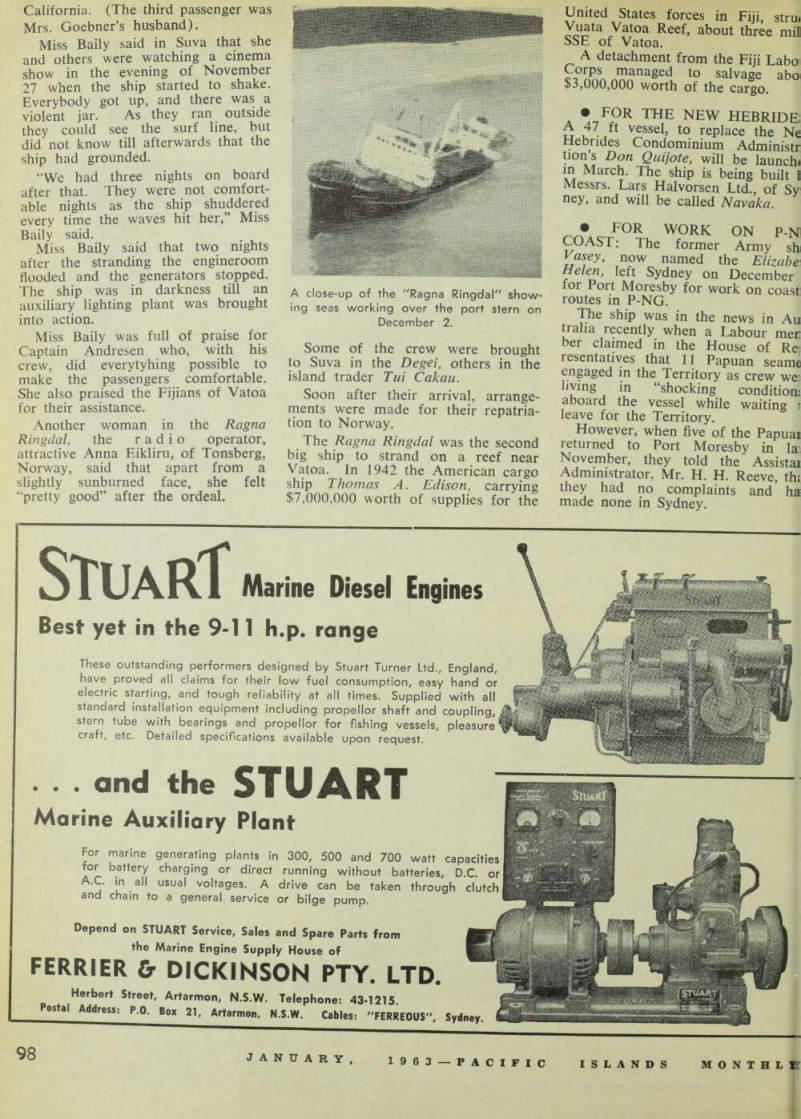 100
100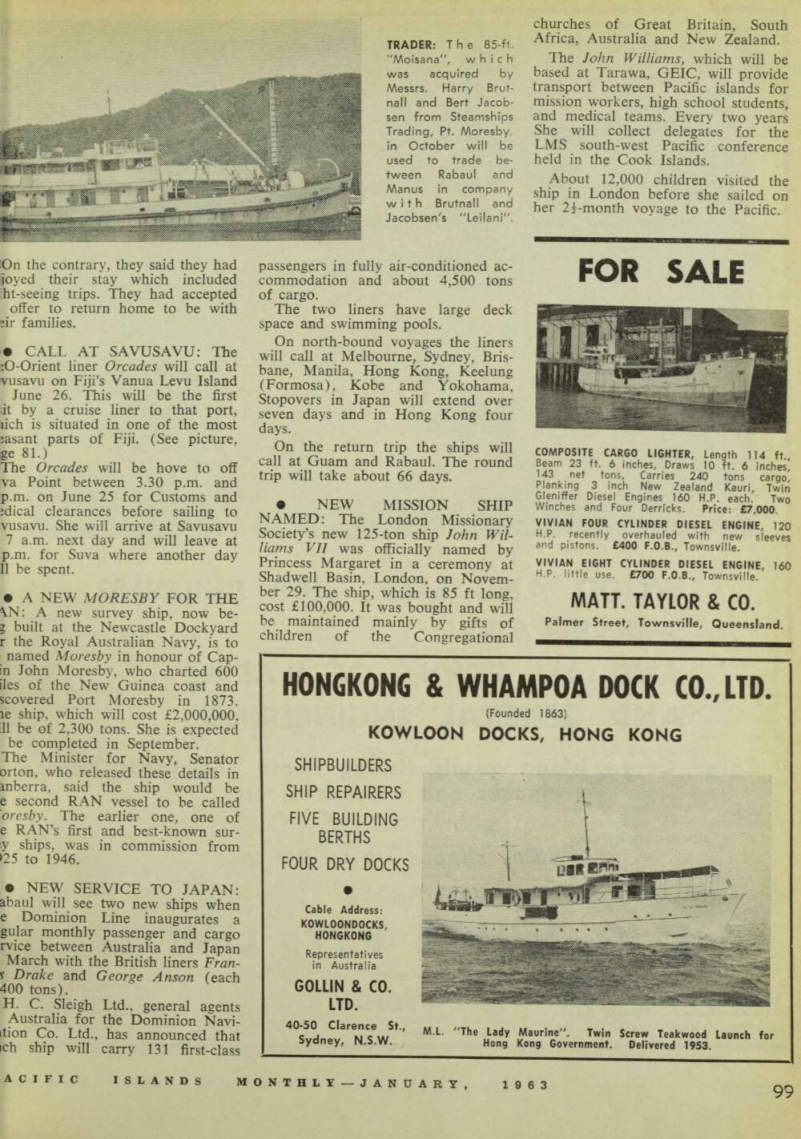 101
101 102
102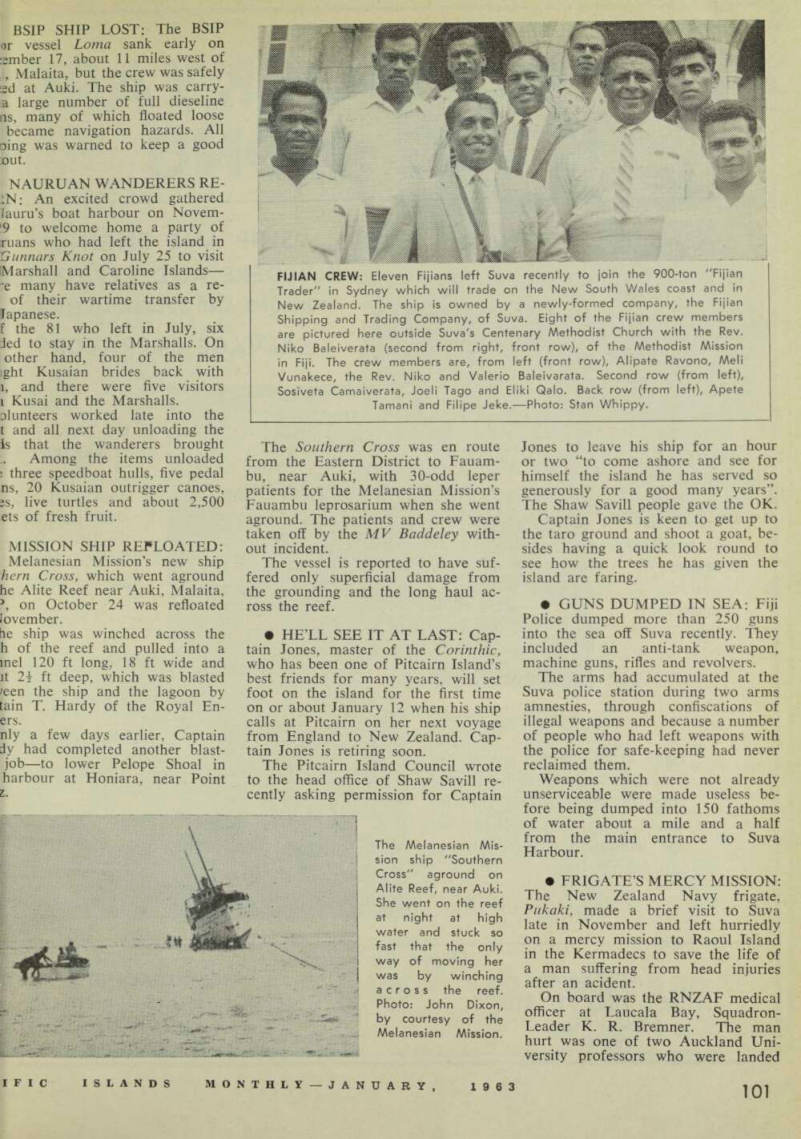 103
103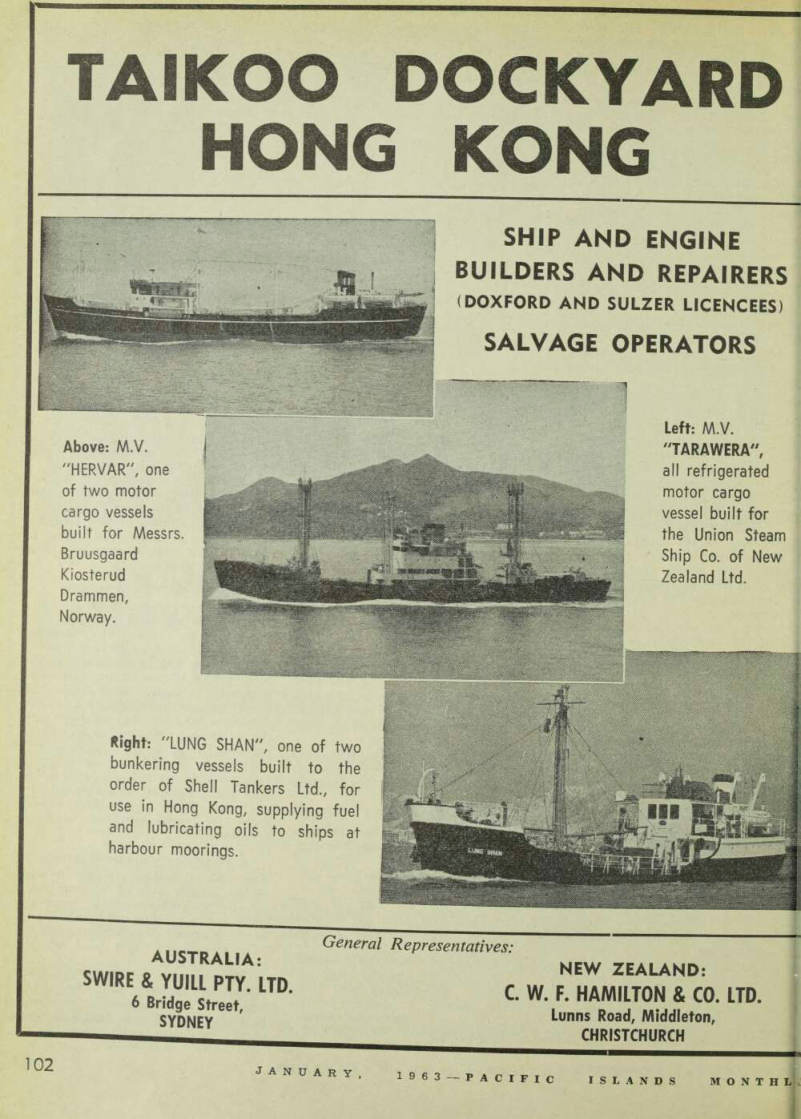 104
104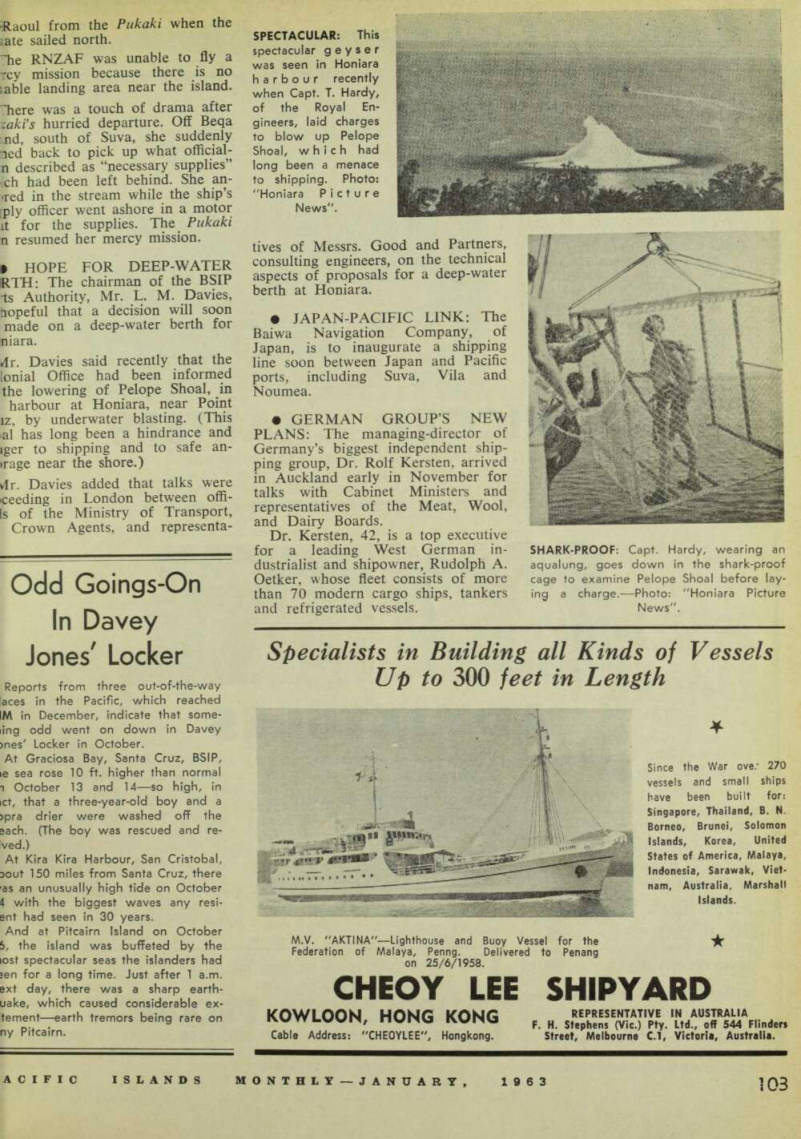 105
105 106
106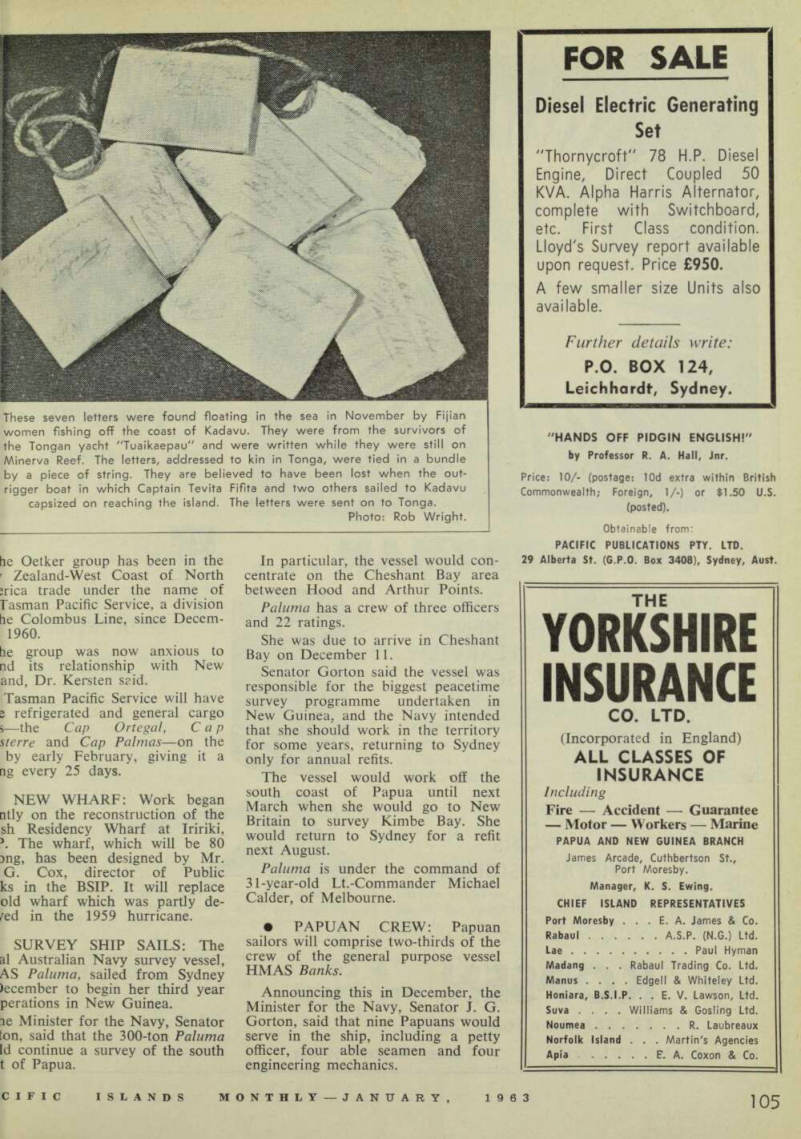 107
107 108
108 109
109 110
110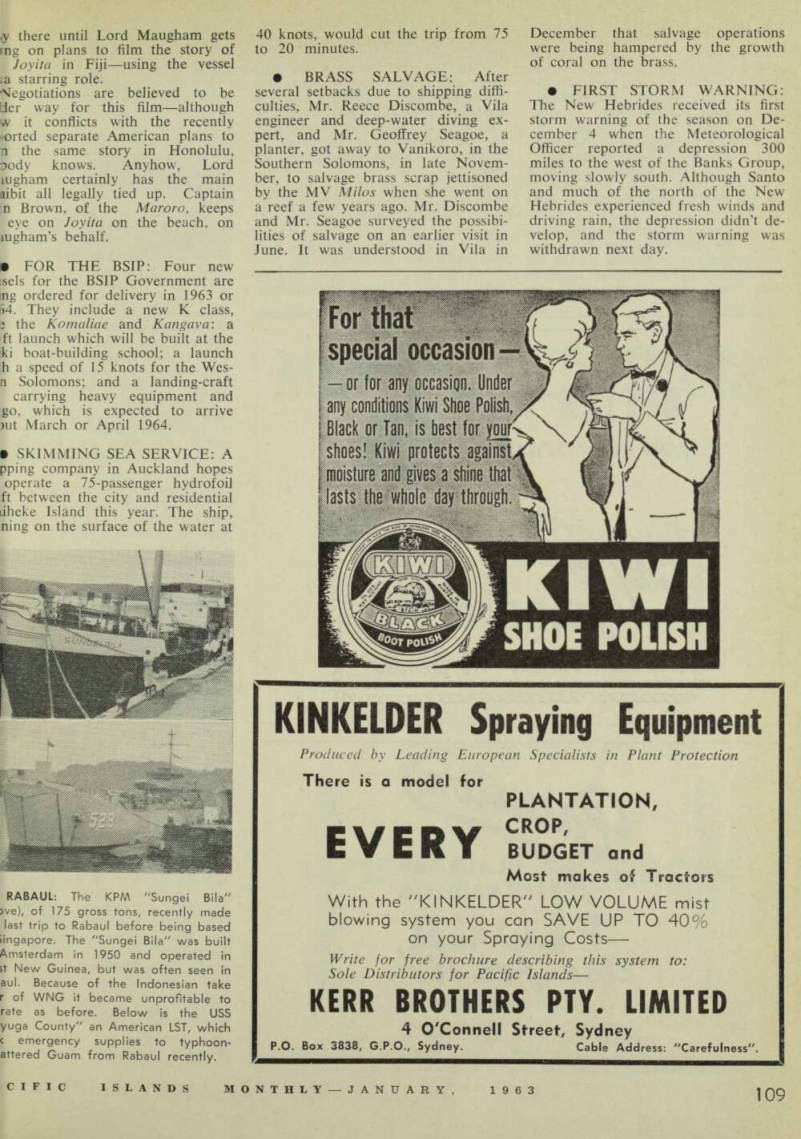 111
111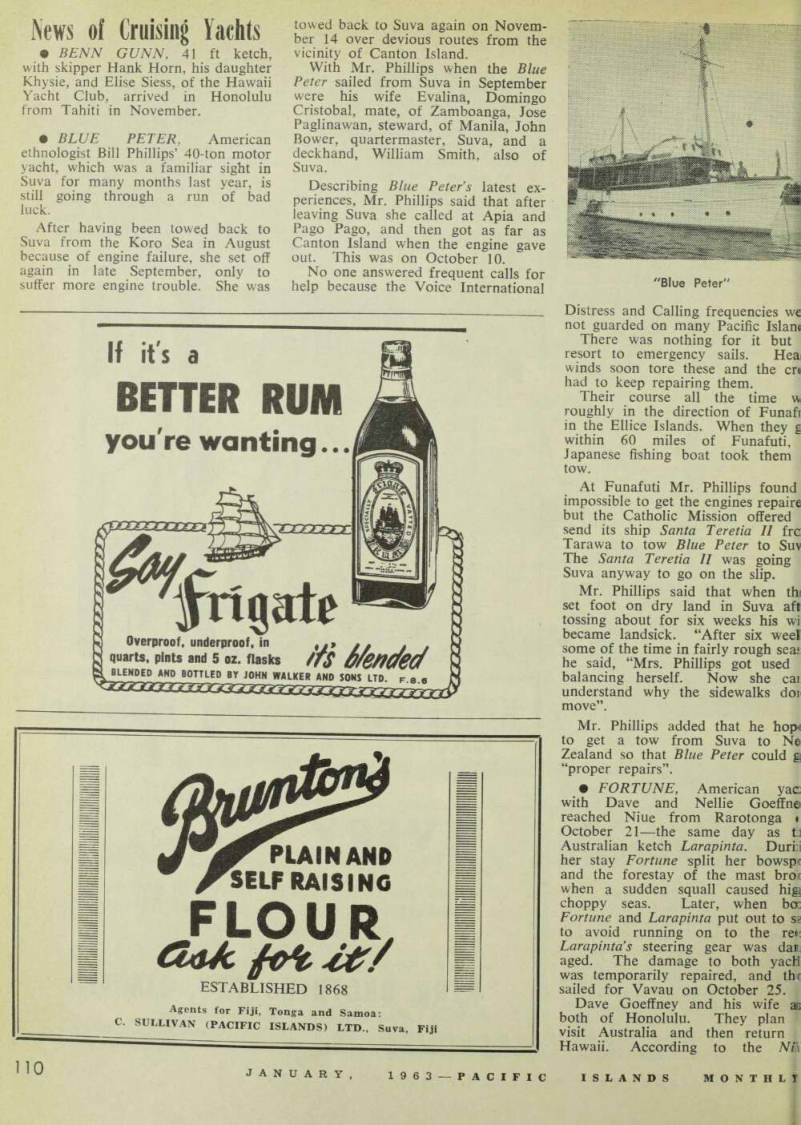 112
112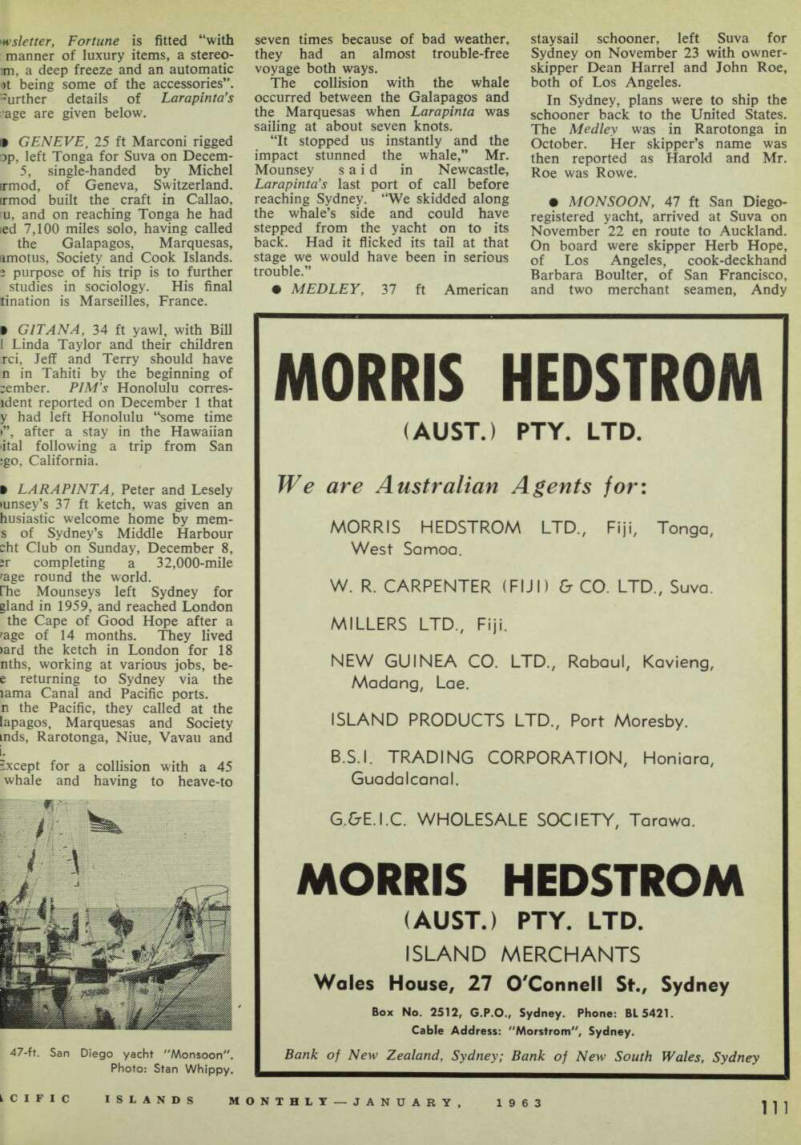 113
113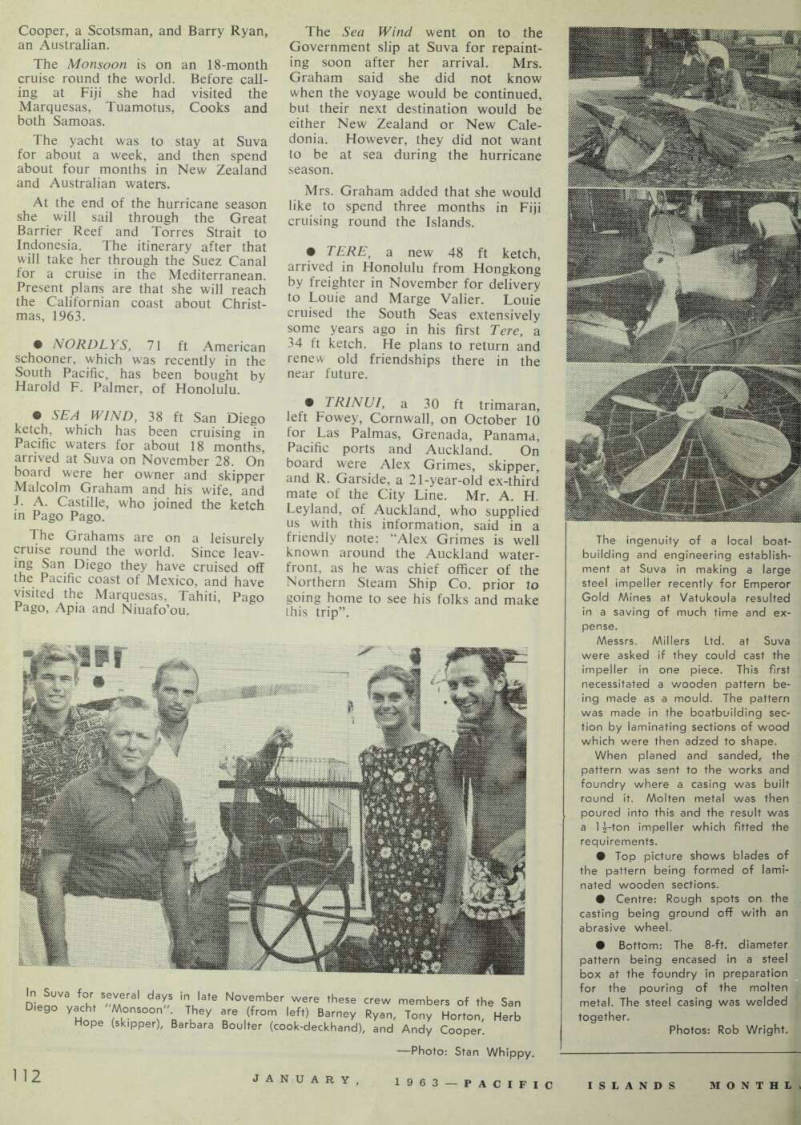 114
114 115
115 116
116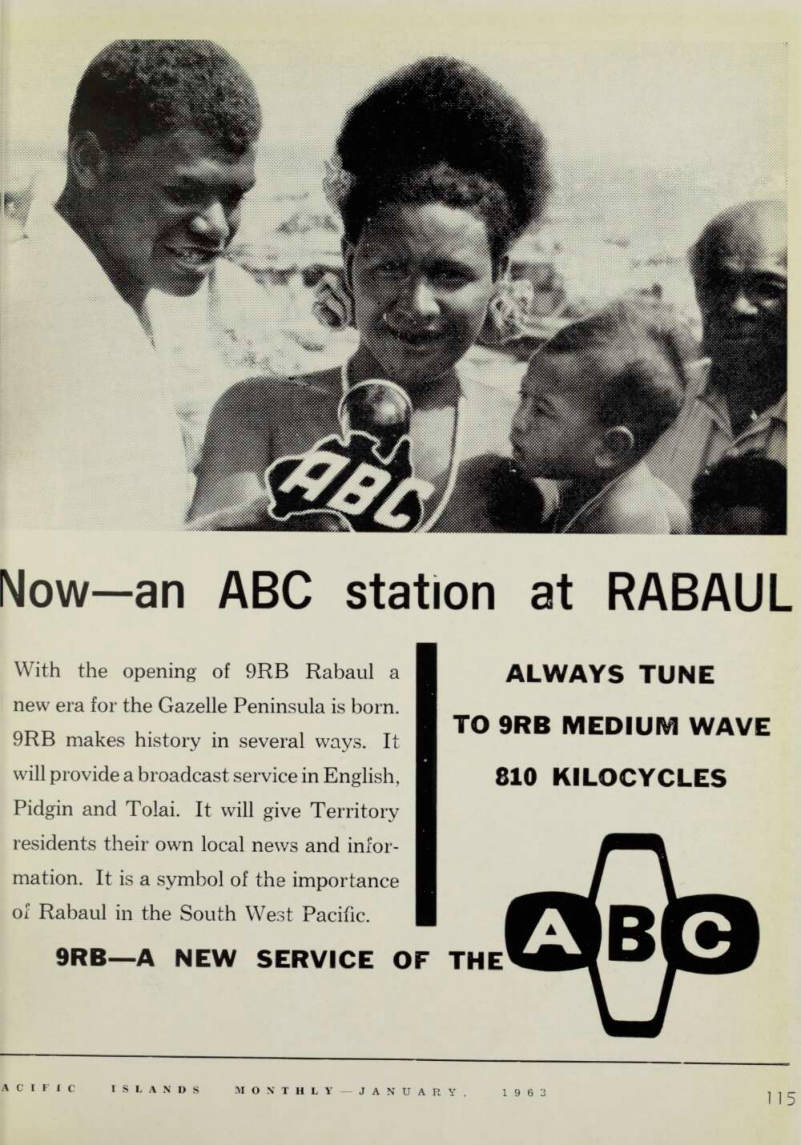 117
117 118
118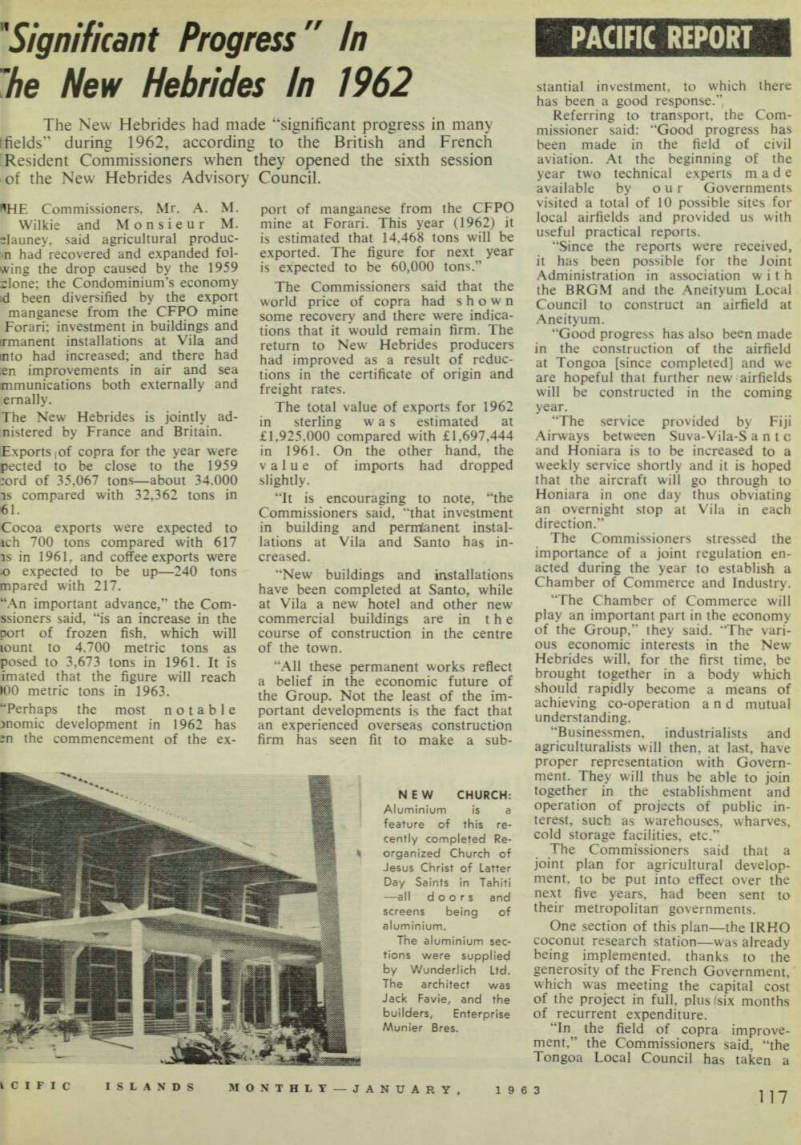 119
119 120
120 121
121 122
122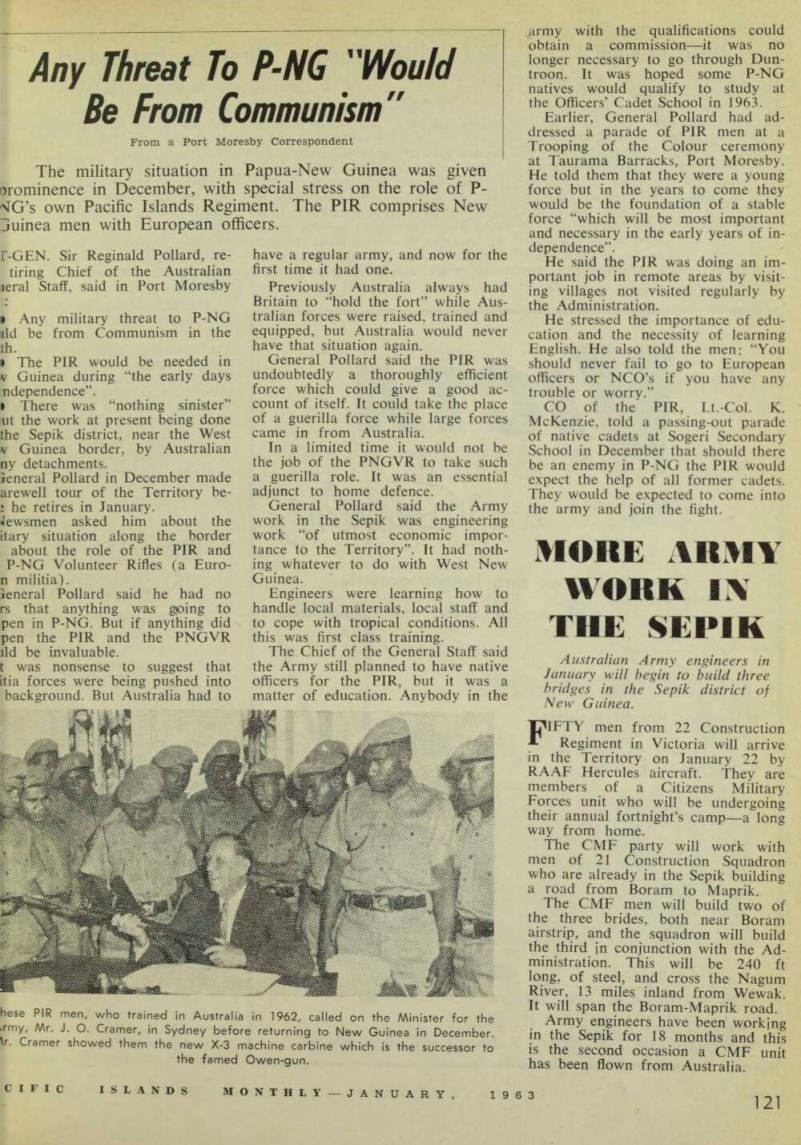 123
123 124
124 125
125 126
126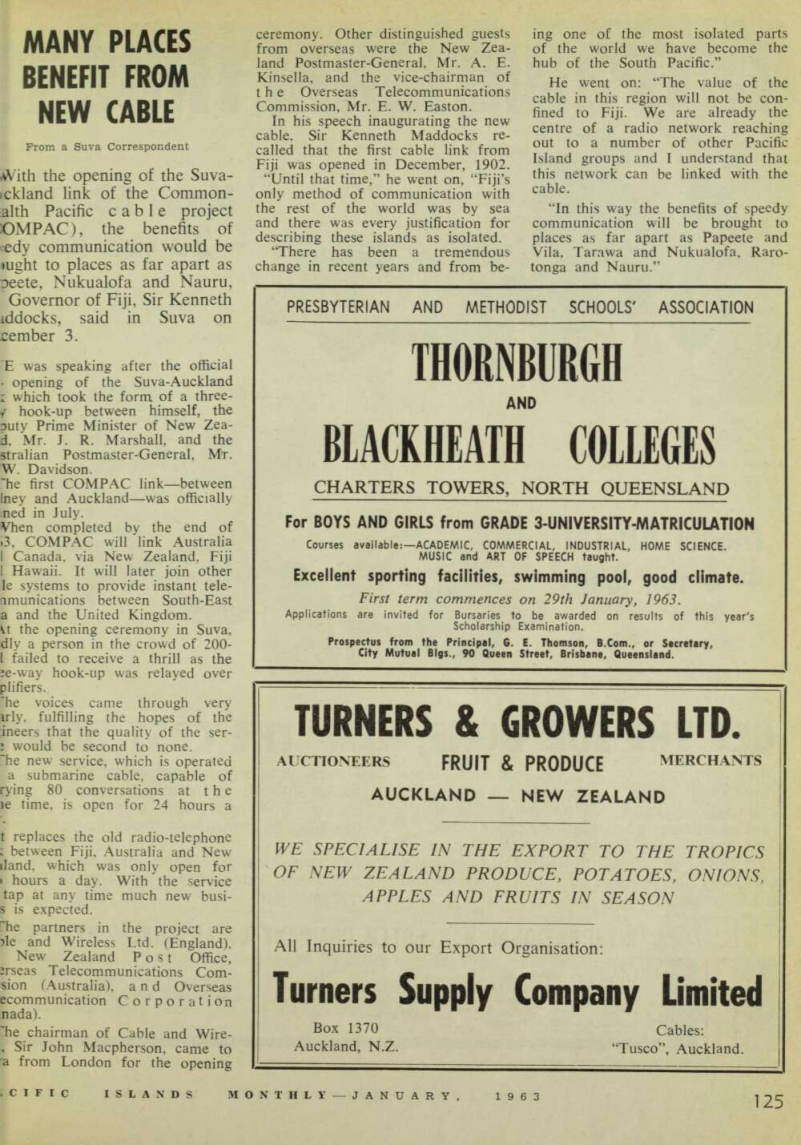 127
127 128
128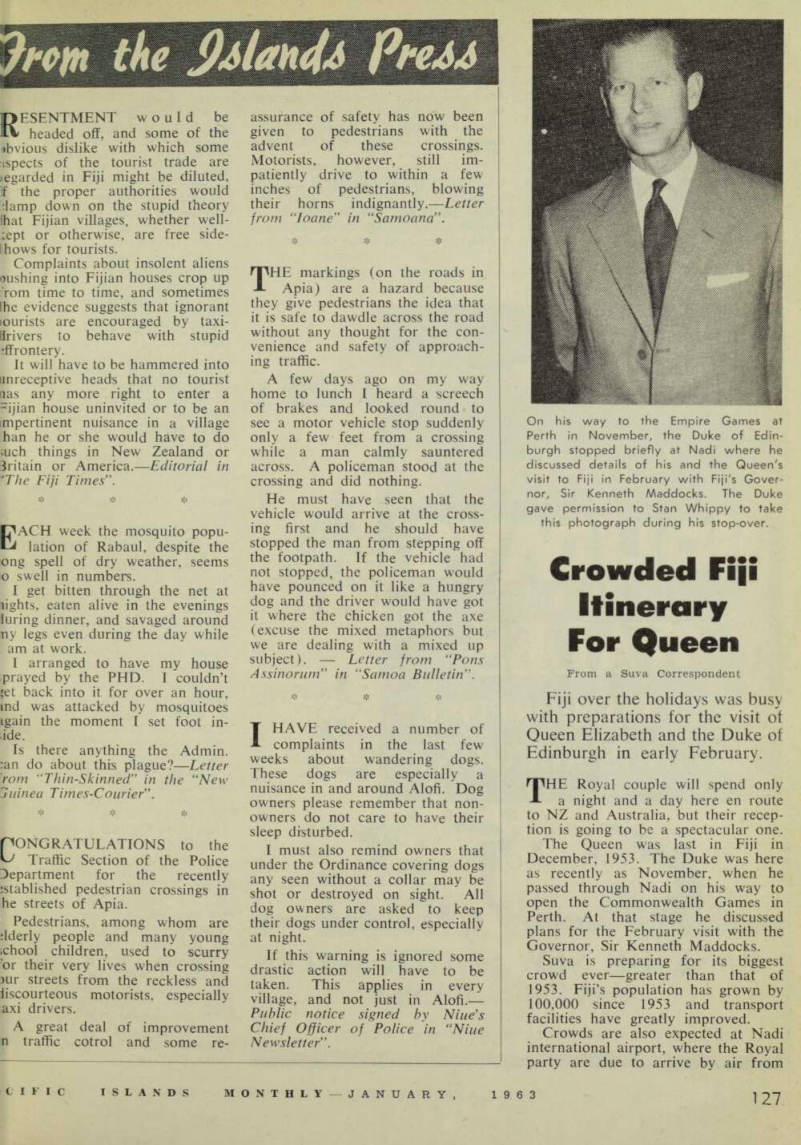 129
129 130
130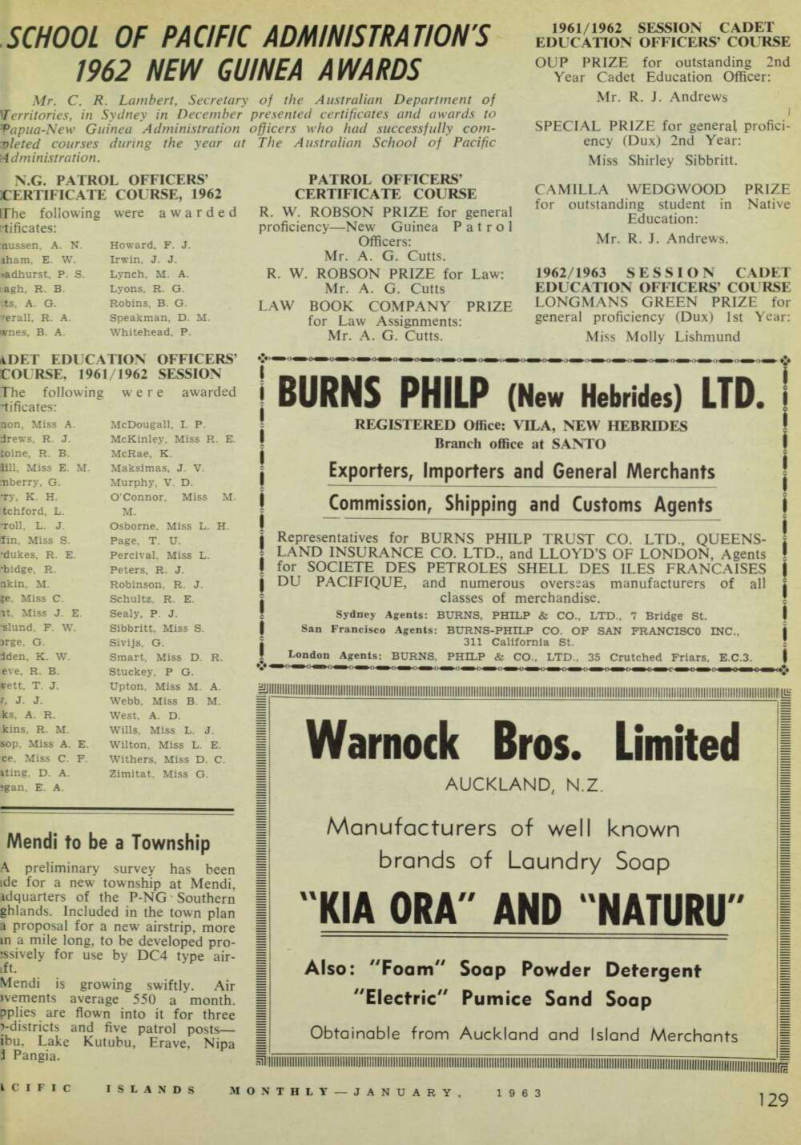 131
131 132
132 133
133 134
134 135
135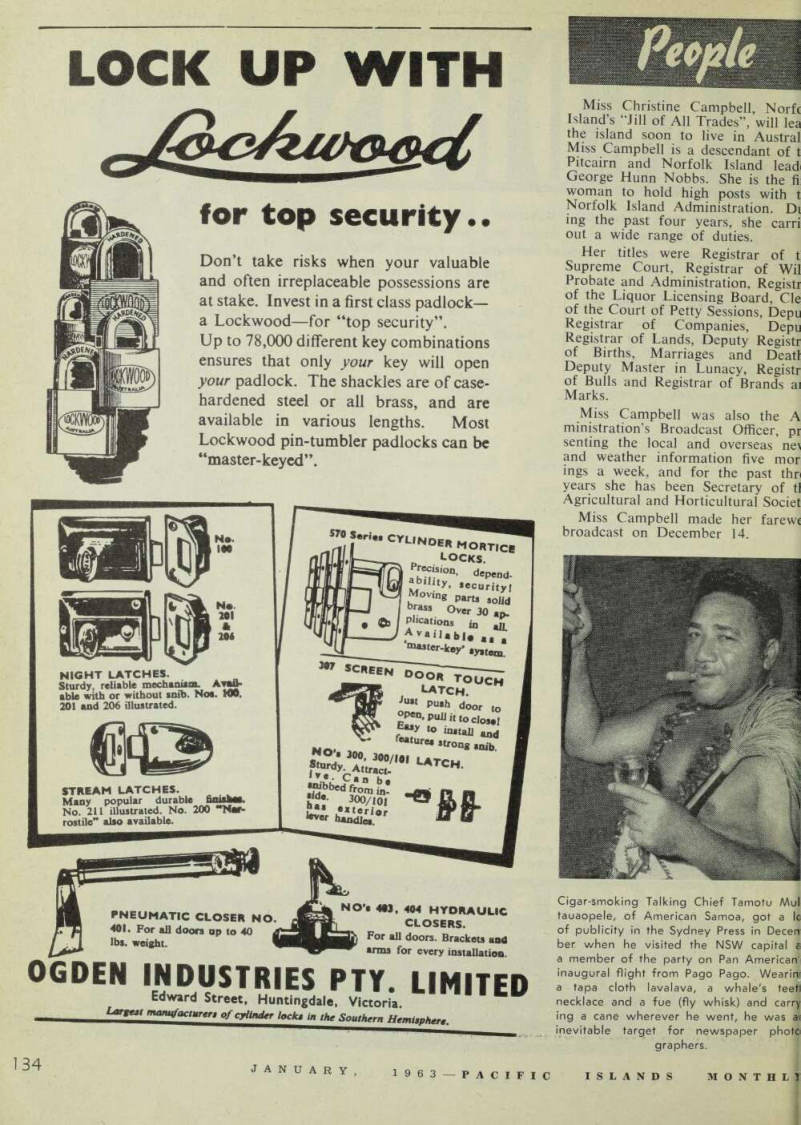 136
136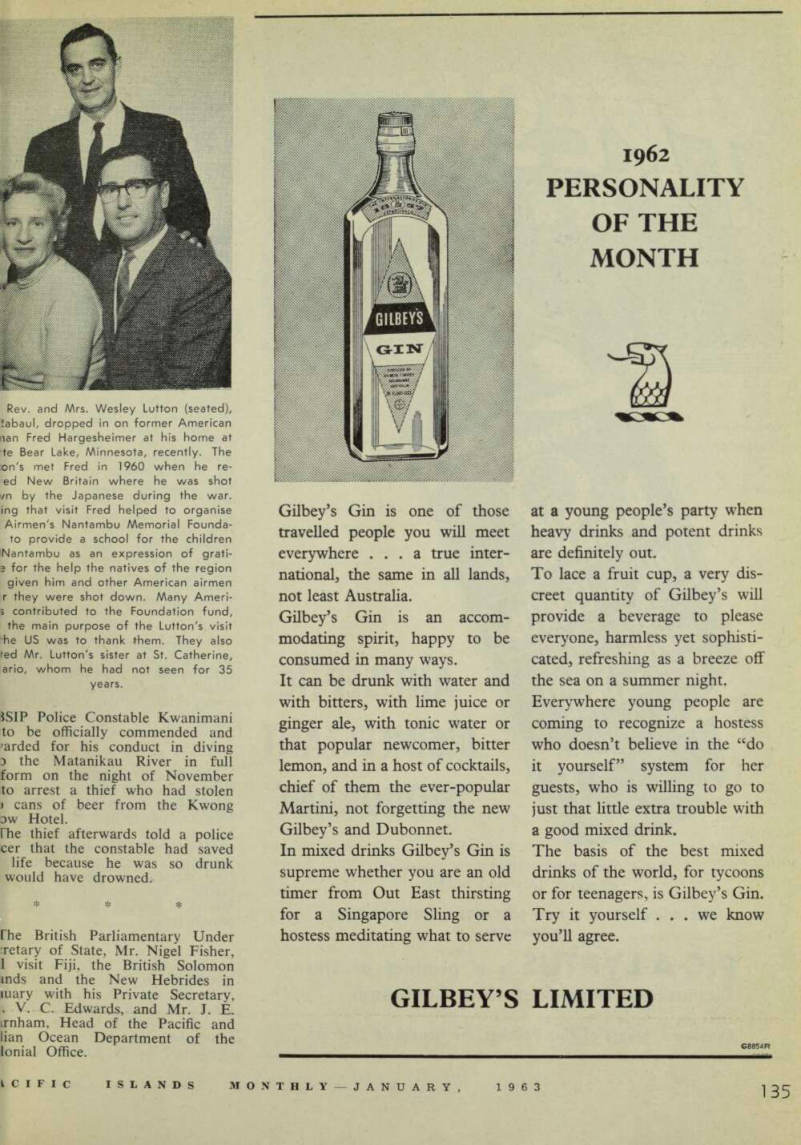 137
137 138
138 139
139 140
140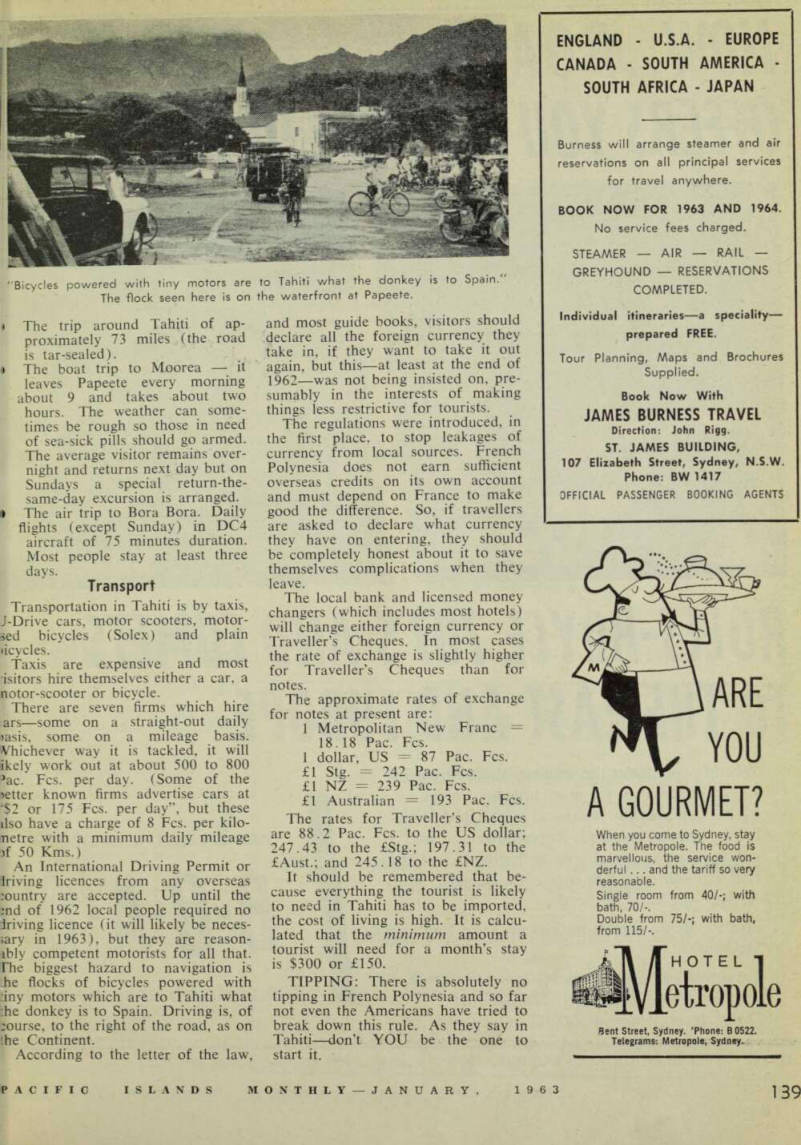 141
141 142
142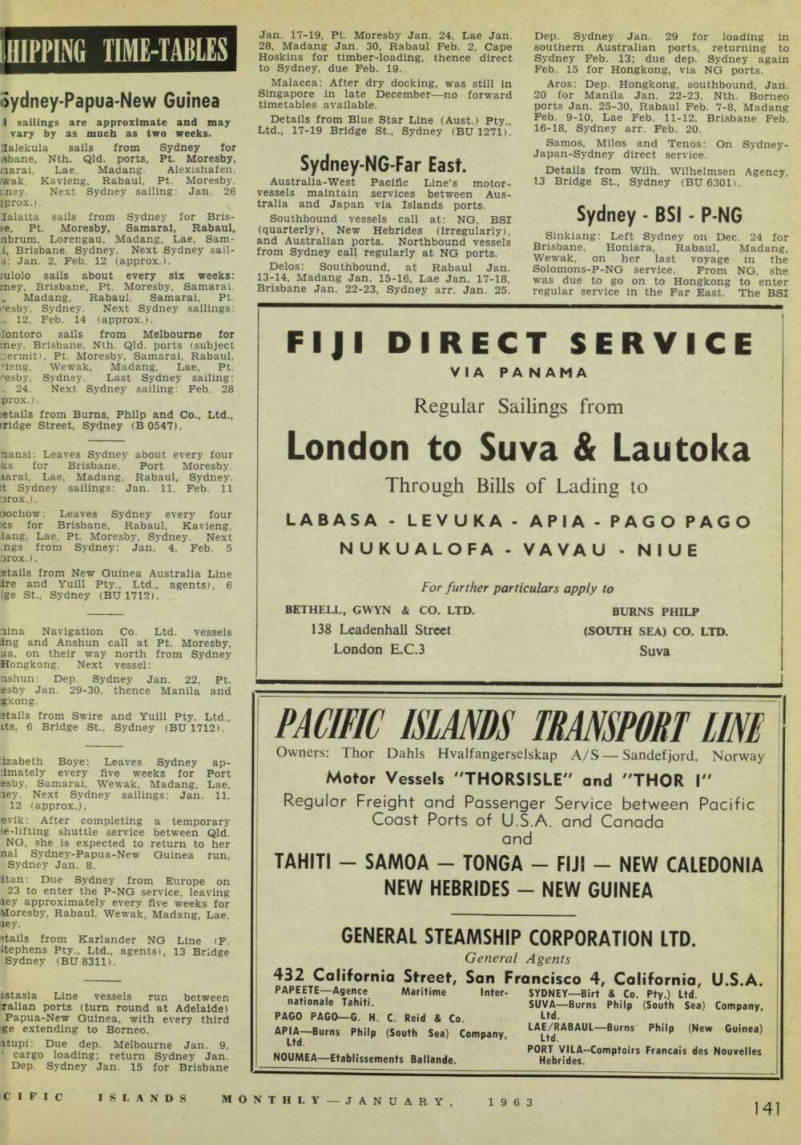 143
143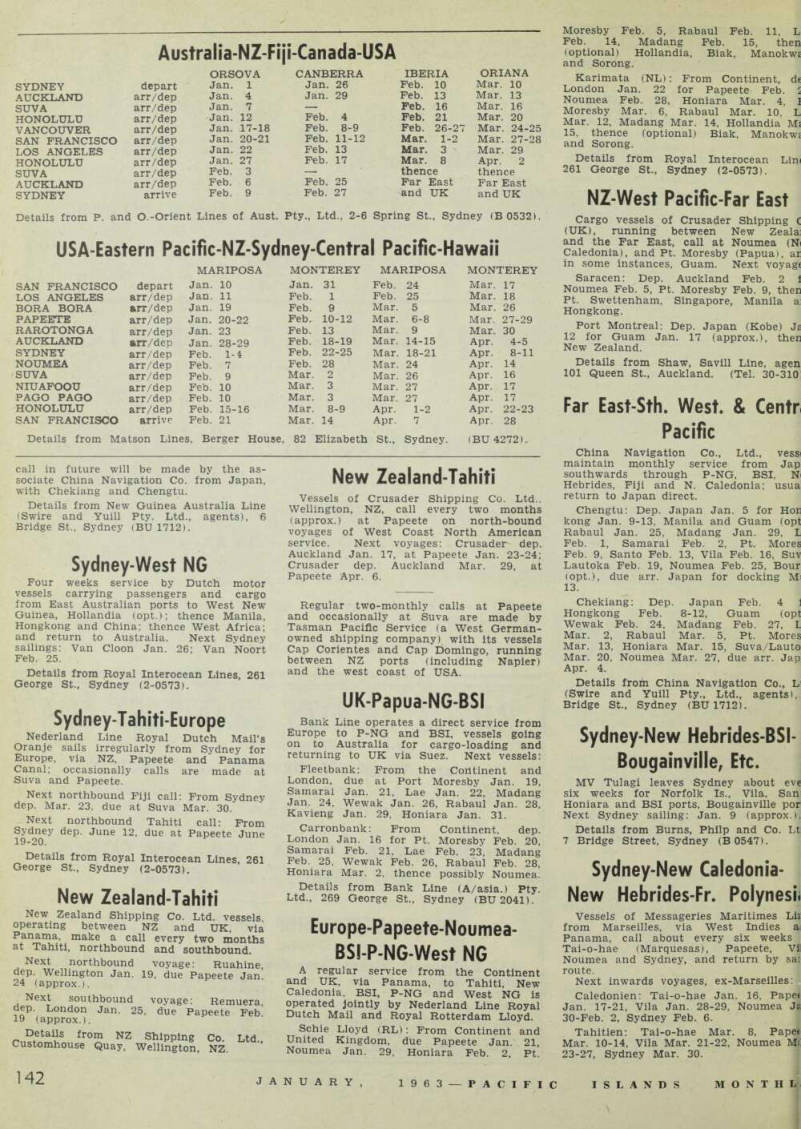 144
144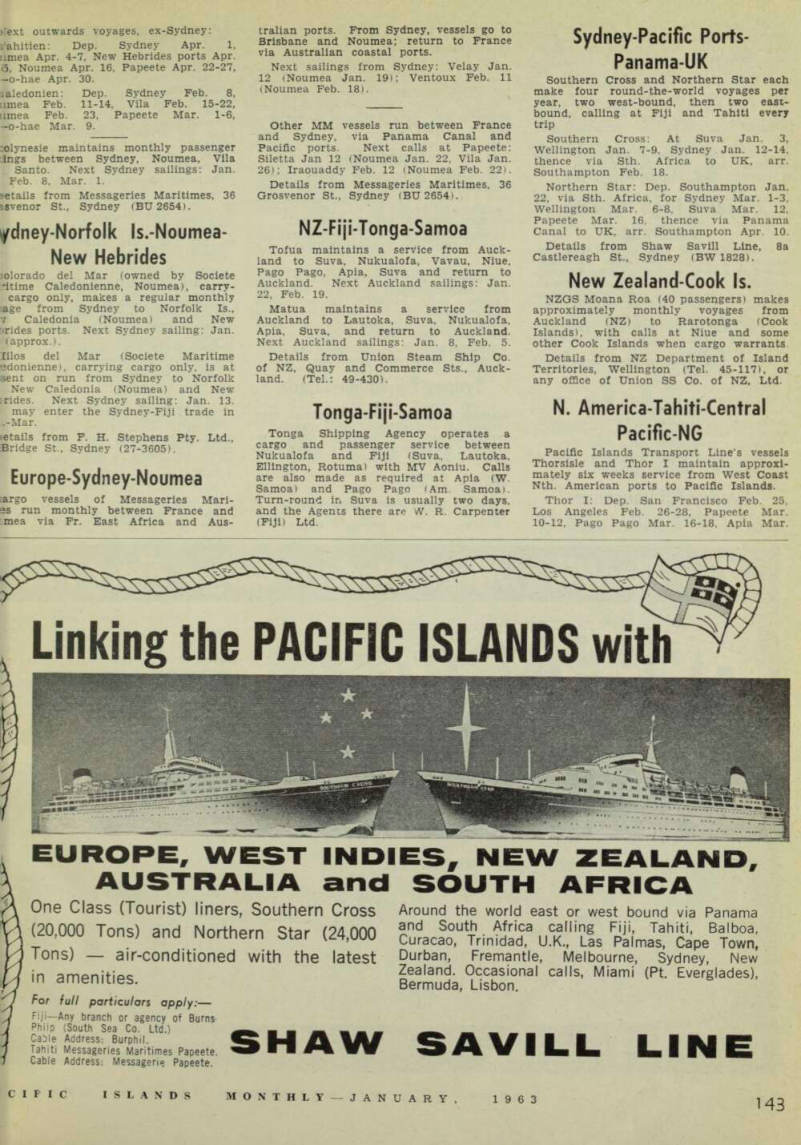 145
145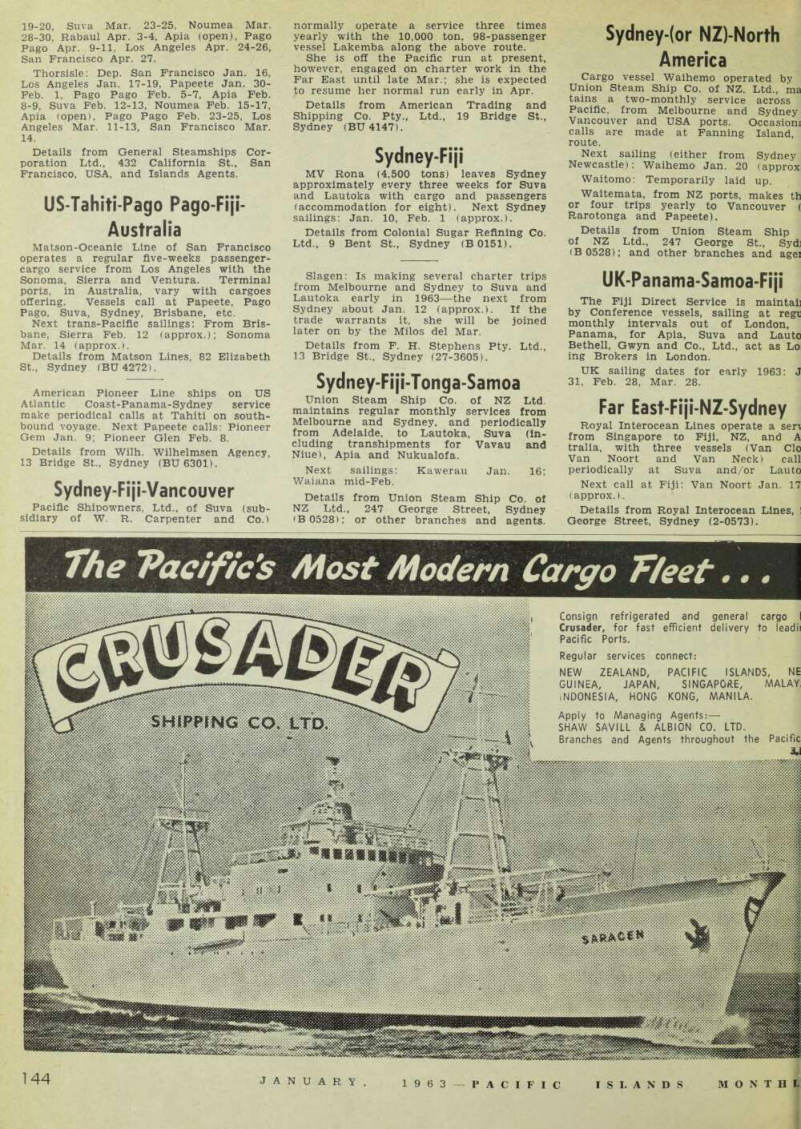 146
146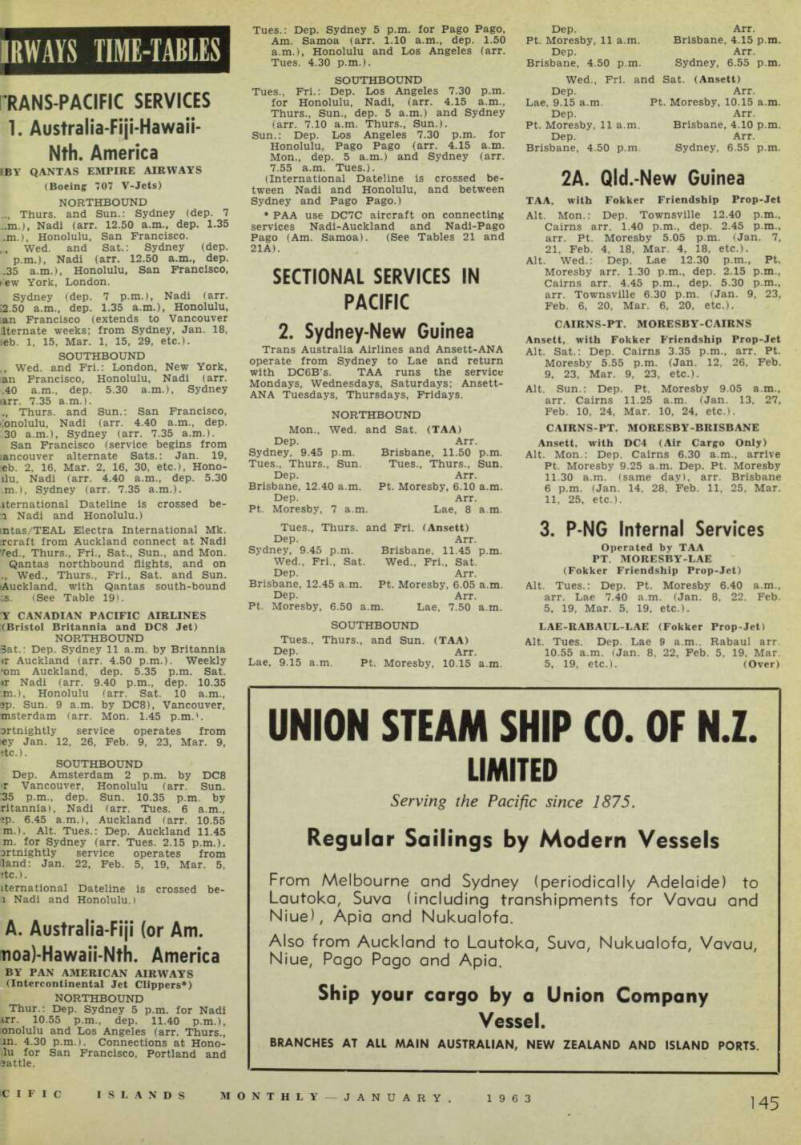 147
147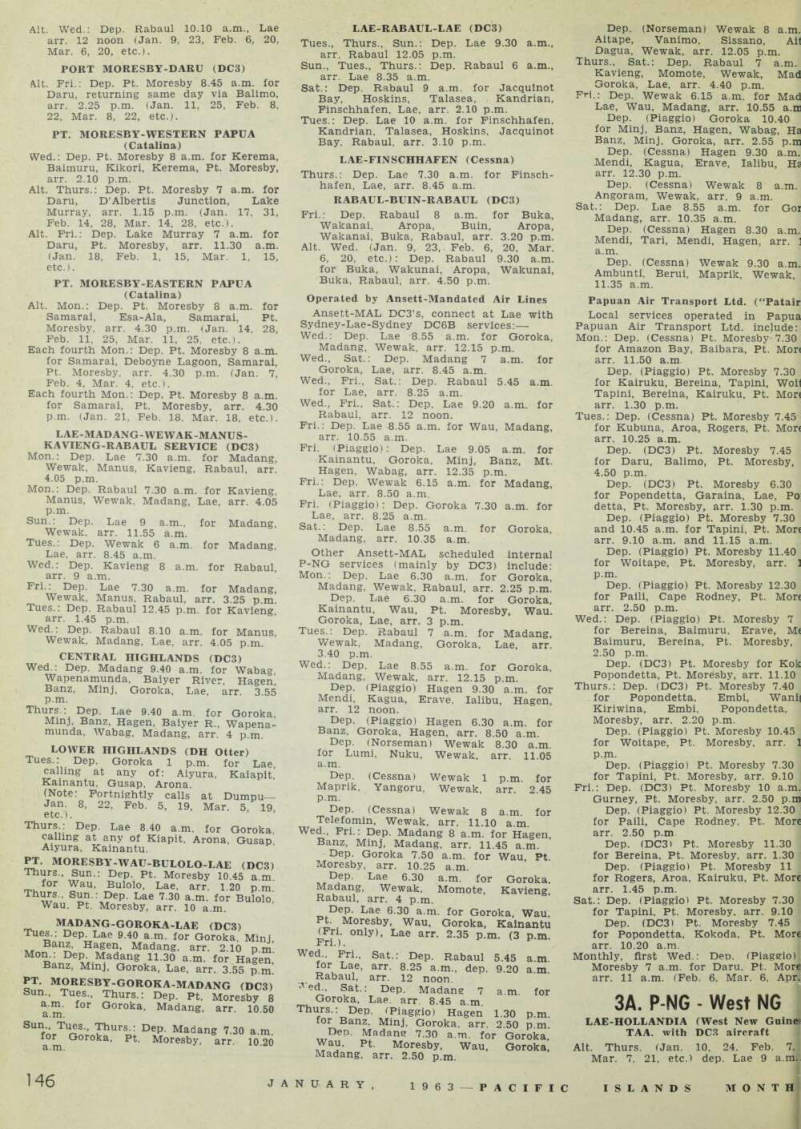 148
148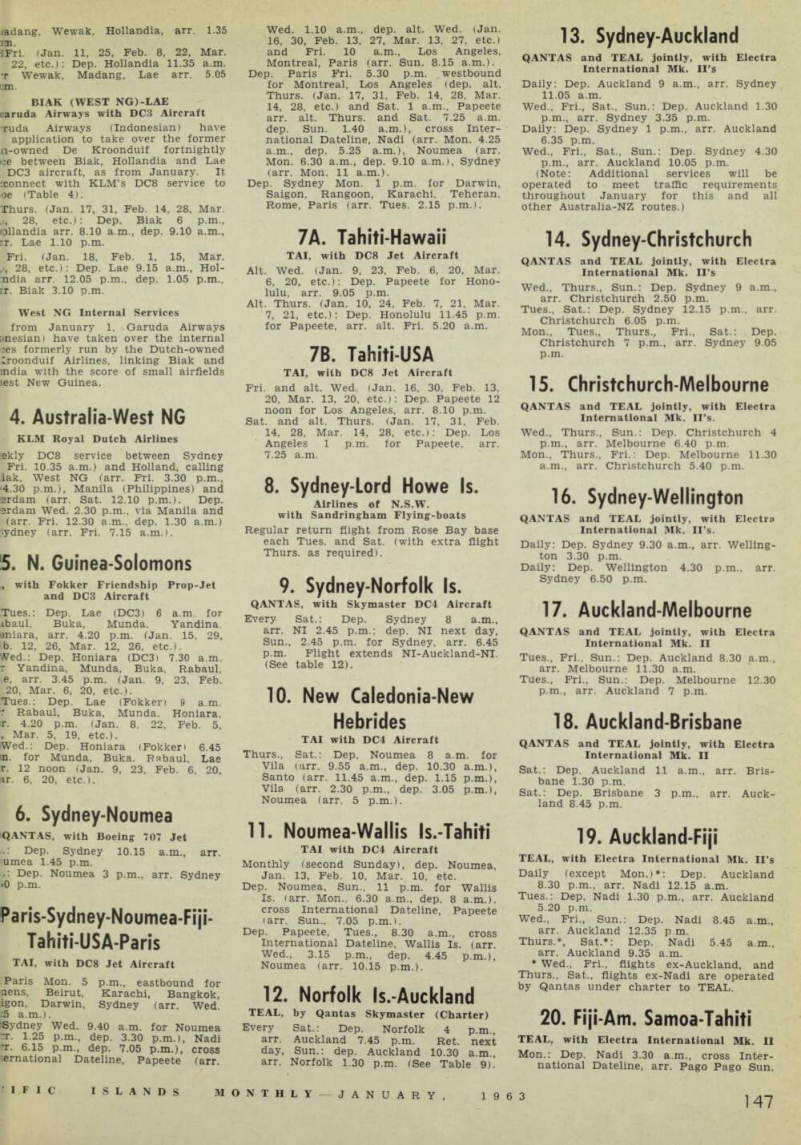 149
149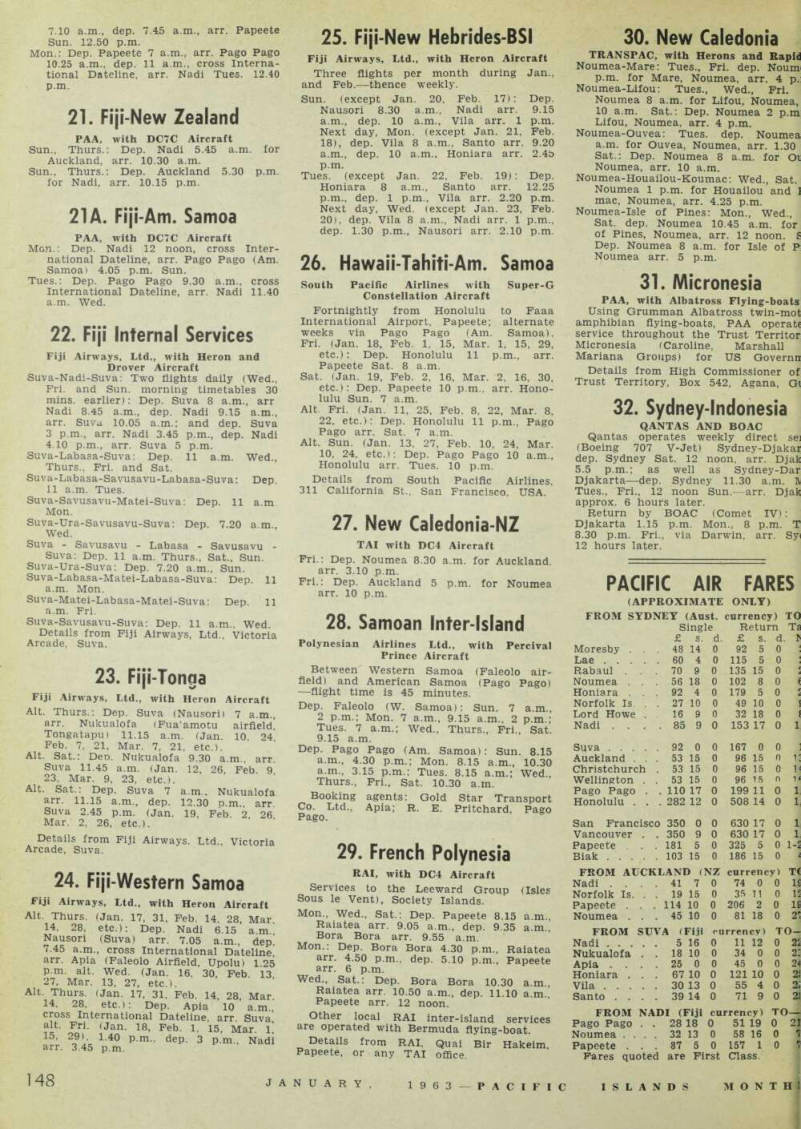 150
150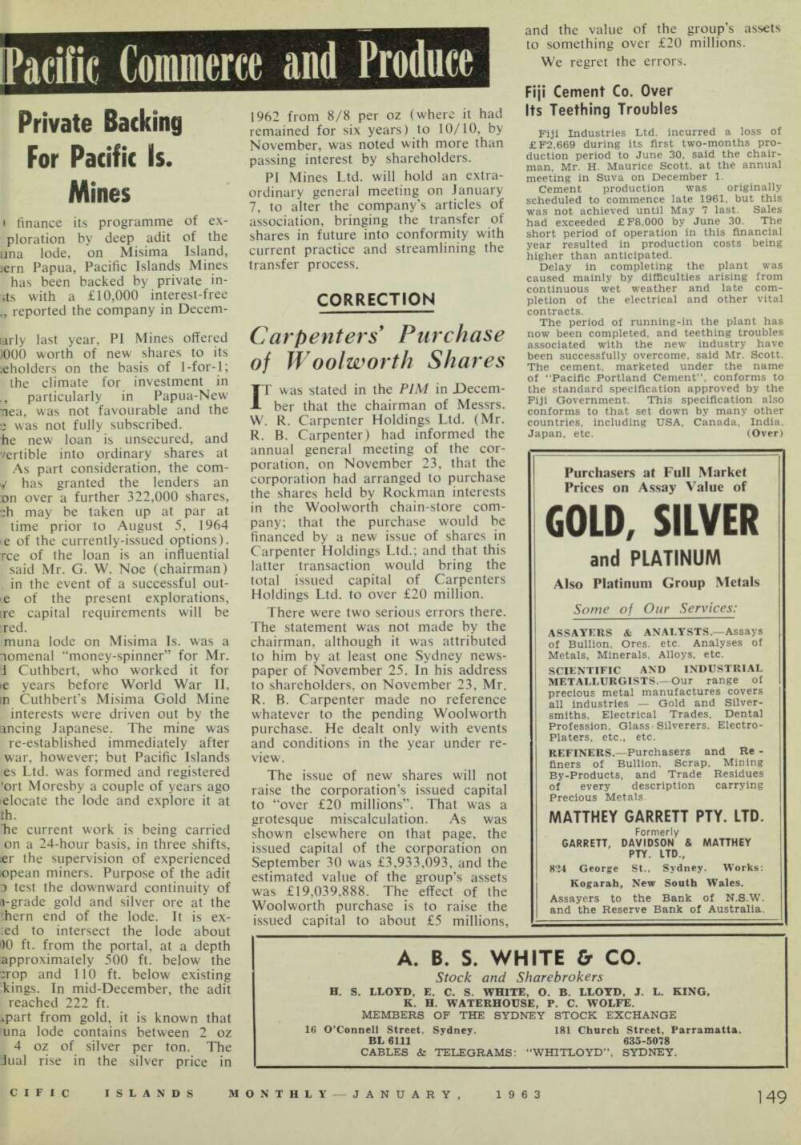 151
151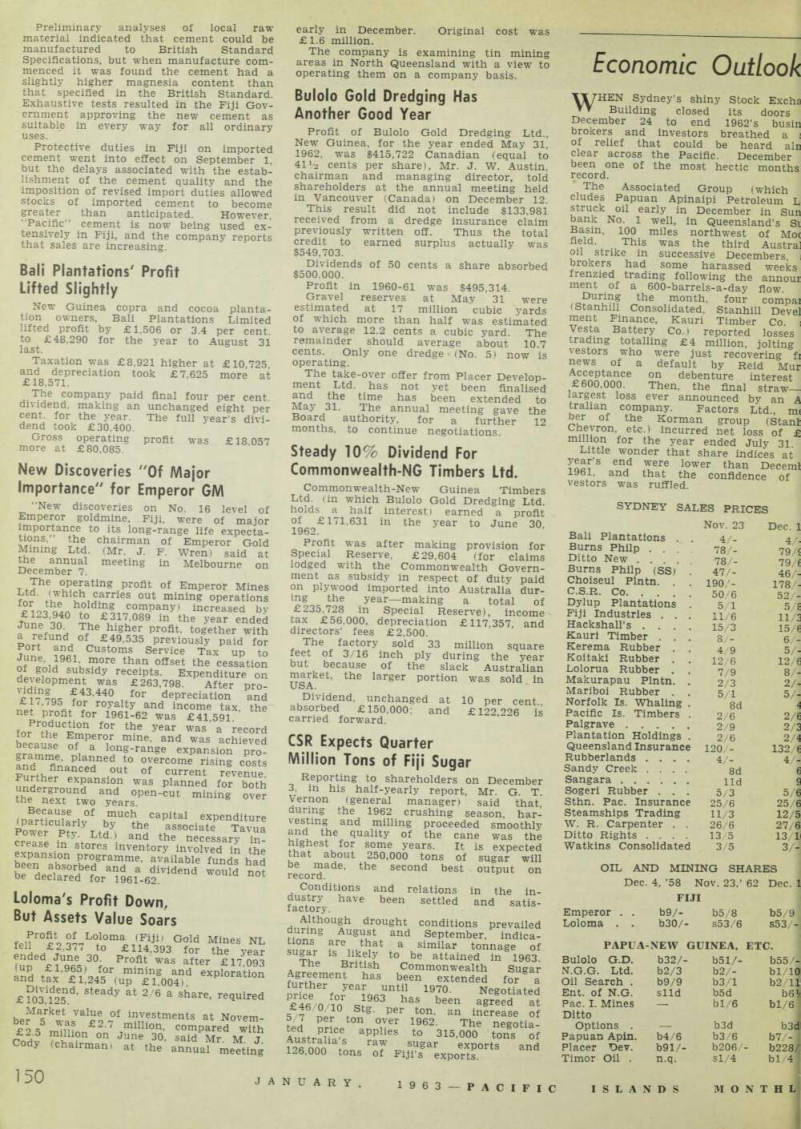 152
152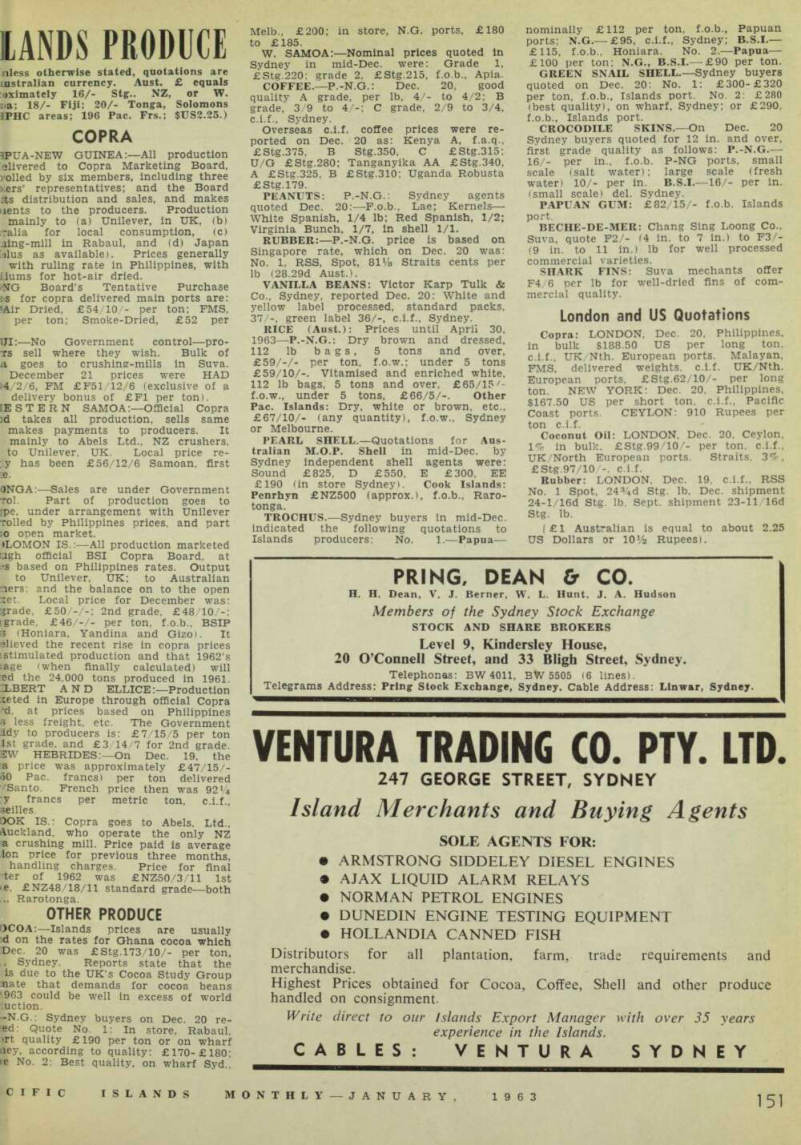 153
153 154
154 155
155 156
156 157
157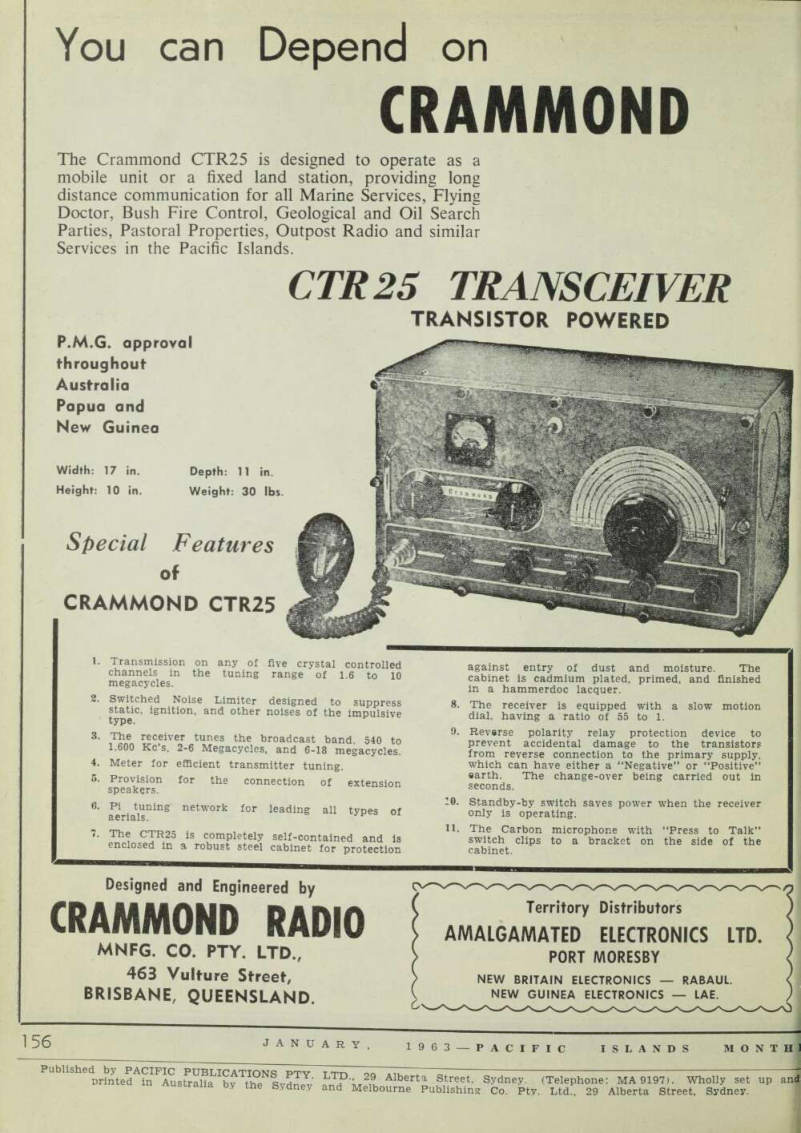 158
158 159
159 160
160