Monthly
Pacific Islands Monthly
December, 1962
Vol. Xxxiii. No. 5.
'le Neu/s agazine yf The South Pacific
Stablished 1930
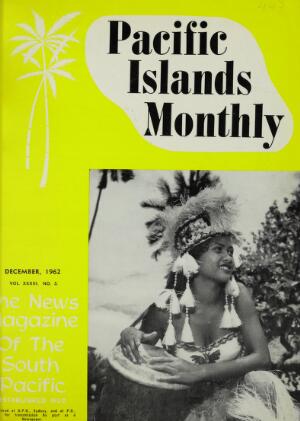
THE COVER: We had no special reason for putting this pretty girl on the cover except that we liked the look of her. Needless to say, she's a Tahitian, all togged-up for the Bastille Day festivities.—Studio Mackenzie Photo.
Advertisements & other items, pp. 1-4 (4 items)
tered at G.P.O., Sydney, and at P.0 ,
for transmission by post as a Newspaper.
See Australia with TAA
Wherever you want to go ... Whatever you want to ...
LAE
PORT MORESBY
BRISBANE
SYDNEY
ADELAIDE
\ I \
CANBERRA
MELBOURNE
A S
See more, enjoy more,
do more than on any holiday before,
and even save money!
Save on TAA Tourist Class Fares. You can fly TAA from Port Moresby to Brisbane and back for only £69.6.0.
Regular TAA Sunbird services from Lae and Port Moresby to Australia connect with flights to all States linking the Territory to more than 90 ports throughout Australia.
Money saving TAA budget holidays. There are dozens to choose from in such famous places as the Gold Coast, Central Australia, the Barrier Reef Islands.
TAA Travel Service makes all your holiday arrangements . . . plans personal itineraries and tours . . . arranges accommodation and local tours at your destination.
iii
AUSTRALIA
A selected list from the many interesting sporting, social and business meetings scheduled during 1962.
Contact your nearest TAA Travel Adviser: First Cricket Test, Brisbane. (Australia v England) 30th Nouember-sth December.
Davis Cup Challenge Round, Brisbane. 26th-28th December, 1962 1962 • Australian Surf Carnival, Warrnambool, Victoria.
March, 1963 • Second Cricket Test. Melbourne. (Australia v England) 29th December ’62-3rd January, ’63 • Australian Legal Convention, Hobart. 19th-27th January, 1963 TAA will arrange your air travel, accommodation and tickets to these events.
PORT MORESBY:
Len Vaughan, Cnr. Cuthbertson and Douglas Sts. ’Phone 2101.
RABAUL:
Max Knop, “Augusta House’
Mango Avenue, ’Phone 2702.
GOROKA:
Bernie Gamble, Goroka Airport, ’Phone 8.
LAE:
Tony Dewiss, Coronation Drive, ’Phone 2311.
MADANG:
Henry Ohlmus, Kaislan Avenue, ’Phone 78 or 166.
FLY TAA SUNBIRD SERVICES
throughout the Territory of Papua/New Guinea and to Australia.
/h a//tveoMess ...
Qqknm
Kerosene LANTERNS
Robert Gillespie’s bring to the Pacific Islands Coleman’s lightweight lanterns. These popular brand-name lanterns maintain a steady, dependable light in high winds and torrential rains. Triple nickel-plated with brass founts. Two models available: No. 237—up to 500 c.p.; No. 249—up to 300 c.p. .. . both tested to 200 lb. pressure. Quick to light . . . just preheat with methylated spirits. No need to repump each time lantern is lit . the positive shut-off valve keeps pressure in the fount.
Representatives for the Pacific Islands: • • L Col Easily serviced and spare parts readily available.
JERT GILLESPIE PTY. LTD. ROBERT GILLESPIE (N.G.) LTD. PEARCE & CO., LTD. 22 Young St., Sydney Rabaul, Port Moresby Suva 334 Queen St., Brisbane Lae, Madang Cable: "Robergill".
Lane's Nocweed 2,4,5-T contains 36% w/v 2,4,5-Trichlorophenoxyacetic acid as the aliphatic ester. For effective and economical control of guava and other bushy weeds, Nocweed 2,4,5-T is unsurpassed. Available in all sizes j to suit your individual requirements.
/VOCfVHP KILLS
A 4O or a 5O LANTANA
Lane's Nocweed A contains the amine salt of 2,4-D, and is available in two concentrations—4o% and 50%. Nocweed A has proved to be the best and most specific chemical to kill lantana. ''Premium Grade Nocweed A, a superior formulation giving better absorption and better weed control is also available but at slightly greater cost.
LANOKIL
NAN
KILLS FLIES
COCKROACHES
Lanokil is the safer insecticide for use in buildings, food processing plants, dairy barns, poultry houses, abattoirs, etc. It gives quick acting and long lasting kill of flies, cockroaches, fleas, ants, mosquitoes, spiders, bed bugs, carpet beetles, ticks, mites, weevils and other pests. * Trademark of The Dow Chemical Co., U.S.A.
W. R. CARPENTER & CO. (FIJI) HD. SUVA MOTORS LTD Rodwell Rd., Suva. G.P.O. Box 299 Telephone: SUVA 3801 Naviti St., Lautoka Telephone: LAUTOKA 7
1
CIFIC ISLANDS MONTHLY DECEMBER, 1962
2
DECEMBER, 1962-PACIFIC ISLANDS MONTI
Pacific Islands Monthly
A News Magazine Circulating in Australia, New Zealand And The Pacific Islands
Publisher: R. W. ROBSON.
Editors:
Judy Tudor Stuart Inder
Manager: SELWYN HUGHES.
Elephones: Ma9197, Ma7101,
MA 4369.
G.P.O. Box 3408, Sydney,
graphic Address: PACPUB, Sydney.
Annual Subscription Rates:
<\ust. currency; includes surface postage) frc Is. —P.-N.G., Fiji, Samoa, Norfolk, auru, B.S.I., Cook Is., Tonga, G.&E. rp., Niue, New Hebrides, and other r. Pacific Is £1 4 0 ch Pacific Territories and Dutch aw Guinea £1 7 0 ralia and N.Z £1 10 0 , British Commonwealth and Foreign 0/- Stg.) £2 10 0 A. and U.S. Pacific Territories 7.00 U.S.) £3 13 le Copies (postage extra) 2 6
Branch Office In Papua-Ng
fic Publications (NG) Ltd., Theatre ding. Fourth St., LAE. Tel.: 2577.
Miss Pat Robertson, Manager.
Branch Offices In Fiji:
i: Fiji Times Building, 20 Gordon St.
Tel.: 4043. oka: "Fiji Times" Office, Vidilo St. Tel.: 420.
Representative In N.Z.;
D. Whitcombe, P.O. Box 5179, Auckland.
Representative In Hawaii:
Z. Spencer, 203 Yap Bldg., 3465 ilae Ave., Honolulu. Tel.: 775538.
Representative In U.S.A.:
i. Craib, Box 1455, San Francisco California. Tel.: Mission 8-1075.
Representatives In U.K.:
D. Ashburn, 13 Rood Lane, London, C.3. Tel.; Mincing Lane 8633. . Mackenzie, 4A Bloomsbury Square, idon, W.C.l. Tel.: Holborn 3779.
BOURNE OFFICE: Newspaper House, 247 Collins St. Tel.: 63.7053.
NTS: All main trading firms and stores in the Pacific Islands. fic Publications Pty. Ltd., is the
Contents
5. Vol. Xxxiii.
December, 1962
A "New Look" New Guinea as the Bar-room Doors are Thrown Open for All 5 Opportunity Soon for Talks on Fiji Political Change 7 Fiji Introduces a Stay-put Budget ... 7 New Era in Trans-Pacific Telecom munications 8 NG Anger Over Press Reports 9 Rabaul Aids Battered Guam 10 New Tariff Gives Confidence to NG Coffee Industry 10 Move to Solve 34-Year-Old Sea Mystery 11
Commentary 13
Britain's Common Market Plan for South Seas 15 Indonesia Wants Earlier WNG Take over 16 Tropicalities 17 From the Islands Press 21 New Competition for South Seas Air Routes 23
Territories Talk-Talk 29
Fijian's Plea for a South Seas Colombo Plan 34 Sparks Fly Over Those Old Poly nesian Voyages 28 Bishop Strong New Archbishop of Brisbane 41
Protests Over NG Shipping Priorities 43 Brett Milder Profile 44 Emotional Welcome Home for Tongan Castaways 47 New P-NG Council Composition "Aimed at Future Needs" 51 £3-Million Loans Under NG Credit Scheme 55 One Million Samoans in 100 Years? 56 Another Trade Gap for Fiji 57 Red Interest in Samoan Politicians 57 Malaria is NG's Number One Health Problem 61 Uncle Sam Builds an Island "Para dise" 63 SPC Review Conference Next Year 65 New Training Centre Could Mean Dramatic Changes 71 Alfred Poroi, New Senator for French Polynesia 73 Fiji's Souvenir Business is Booming 75 Fiji Luxury Items Will be Duty Free 77 Fred Hargesheimer Says Thanks With a School 77 Raft Experiment Could Lead to Bonanza for Fishermen 78
Magazine Section 83
Pacific Ships And Yachts 99
PACIFIC REPORT (with Index) 117
Travel Talk 142
Shipping and Airways Timetables . 145 Commerce, Produce 153
Advertisements & other items, pp. 5-6 (3 items)
A Product of Pacific Publications Ptv. Ltd., 29 Alberta Street. Svdnev
4
DECEMBER, 1962 PACIFIC ISLANDS MONTH
Giossmasw
MANUFACTURED TO WITHSTAND AL
TROPICAL CONDITION
British Paints Limited
3 F a
GIOSSMASW
BRILLIANT GLOSS ENAMEL
v !!!•!•?
imt
i ri,is h Paints'LimM
COUEfiS
Bfi/LU*#' S3S Sis. s* «9«E51
GREATtS T
COLOUR
range One coot covers any colour.
For interior and exterior use.
Gloss-Masta is specially manufactured to stand up to the rigorous tropical climates. It dries overnight with a brilliant, luxurious, porcelain-like finish that looks and wears like baked enamel. In fact Gloss- Masta sets a new standard of exceptional brilliance ... the more you wash it the better it looks Gloss-Masta completely withstands boiling water, steam, grease and all cooking fumes.
So very easy to use . . . Gloss-Masta comes to you in the world's greatest colour range ... ask for your Gloss-Masta colour card at the nearest British Paints Limited depot or store.
pVPUR POS£
Undercoat
ma
ALL PURPOSE
UNDERCOAT
for
paints and enamels
SOLD AND RECOMMENDED BY:,
MAXIMUM RESISTANCE TO MOULD
AND FUNGUS IMPORTANT:
For maximum protection against fungus and mould growth always treat new or previously painted surfaces with British Paints Limited s anti-mould solution.
NEW GUINEA;
Burns Philp (New Guinea) Limited: Wau Burns Philp (New Guinea) Limited: Bulolo Burns Philp (New Guinea) Limited: Lae Burns Philp (New Guinea) Limited; Madang Burns Philp (New Guinea) Limited: Goroka Burns Philp (New Guinea) Limited: Wewak Burns Philp (New Guinea) Limited: Kavieng Burns Philp (New Guinea) Limited: Rabaul Burns Philp (New Guinea) Limited: Kokopo Burns Philp (New Guinea) Limited: Daru Burns Philp (New Guinea) Limited: Kainantu Kam Hong: Lae Scotts New Guinea: Lae fang Mow: Wewak Laurie Chan: Rabaul Wong You: Buka Passage—Bougainville
PAPUA:
Burns Philp (New Guinea) Limited: Port Moresby Burns Philp (New Guinea) Limited: Boroko Burns Philp (New Guinea) Limited: Samarai Burns Philp (New Guinea) Limited: Popondetta
HONIARA;
A. C. Blair Ltd.: Honiara Ho Kee: Honiara
FIJI:
Burns Philp (South Sea) Co. Ltd.: Suvs' Burns Philp (South Sea) Co. Ltd.: Laut*
NORFOLK ISLAND:
Burns Philp (South Sea) Co. Ltd.: Norfolk Island
As the Bar-room Doors
A 'New Look' New Guinea As the Bar-room Doors Are Thrown Open for All
From Correspondents in Papua-New Guinea Papua-New Guinea’s new liquor laws have brought about a big change in the Territory’s social habits—but no murders or mayhem. The first month of the new laws has ended with out any major incidents, but with a general quickening of drinking activity among the natives, who took the first week very quietly indeed.
According to some social workers there are signs that some families are going hungry while the men drink their wages, and there is apprehen sion that this practice will grow, causing domestic upsets. It is too early yet to report a trend. But people, particularly missionaries, with experience in other South Pacific islands where drink has been introduced, point out that the first few months are not really a test, as everybody is on their best behaviour. Trouble can develop later.
IHE new laws come into effect on November 2, the ordinance un r which they operate being a tem irary one. It will be reconsidered at other meeting of the P-NG Legis ;ive Council early in the new year.
The new laws lifted a total ban on ink for natives.
Both sexes, over 18, may drink ything they like on licensed pre ses, or on social occasions when jy are guests. But they may pur ase only beer to drink at home. ie laws apply to almost two mil n natives, but hundreds of thou ids of these are in wild areas icre they are never likely to be in ested in liquor.
The Acting Administrator, Dr. tin Gunther, went on the air on ; eve of D-Day to appeal to the od sense of the native population Dt to rush into hotels and drink to :ess just to use the new opportunity buy liquor.”
He also appealed to them to keep :ir liquor spending to a sum they ild afford without neglecting family ponsibilities. ‘There is nothing clever about be : able to drink,” he added.
Phe Secretary for Law, Mr. W. itkins, the same evening on the air dined the drinking laws and hours. told the new drinkers that hotels re open from 9 a.m. to 11 p.m. inday to Saturday and from 11 i. to 1 p.m. and 5 p.m. until 7 i. on Sundays.
Fie said stores with licences could 1 only a dozen bottles of beer at ime. Clubs “belonged to the mem ■s” and natives could not enter a
club unless they were members or invited by members. Clubs could re main open from 10 a.m. to 12 mid night daily.
He stressed that Legislative Coun cil members “would be interested in the way the native people were drink ing,” because they could alter the laws.
Most hotels in the main centres of Port Moresby, Lae and Rabaul re ported very quiet trading for the first day or two. On the first day at Rabaul a few natives wandered into the town’s two hotels, but at lunch-
time there was not a solitary one at the bars. Some filtered in after lunch and by late afternoon there were only a handful on one side of the bars, with Europeans on the other.
But trade picked up the first even ing, and after that Territory hotels reported a big increase in natives in the bars, while the Europeans re treated to the clubs.
Hardened topers line up at the bar and cling tooth and nail to their preferred positions while those in the back clamor for attention. The scene is little different from Sydney’s legendary “swill” except that these drinkers are mostly barefoot (except those who charitably share their foot wear around), regard their drinking utensils of thin plastic as being as disposable as a coconut, so that one hotel lost 2,000 in one week, and think it no social error to upthrow before company.
One hotel admits to closing for hours at a time so that the bar-room can be swabbed out for another session. They’ve also had to close because of shortage of stock and there’s no gainsaying the increased custom hotels are enjoying.
As one manager put it, “Our tak ings have gone up 200 per cent.—and we’ll never ever be short of silver again”.
Not so happy are other town busi nessmen who have noticed a falling off in native trade. Most affected are those who previously catered for the sly grog trade and for whom few have sympathy. Others mentally tot the value of beer cartons being
It's official now. He can drink. With a cold bottle and a plastic glass, this Rabaul Tolai is apparently satisfied with the new liquor laws.
put aboard homegoing village trucks and calculate this expediture means less to be spent on amusements such as picture shows and soft drinks, and clothing, etc.
Even hotelkeepers despair that their boom trade brings with it un mentionable bar-room manners and sheer “filth”.
“They must be taught how to drink,” is their despairing cry, and as yet no one body has taken on the task. When to stop drinking, not to slop, to stand aside for the other fellow, to observe the barest rules of hygiene, are matters of behaviour yet to be instilled into the native imbiber.
While dropping of the drink barriers was intended as a means of removing discrimination and thus transcending the gulf between white and brown it has in these early days worked in reverse.
Few Europeans have not got an opinion on the vital subject of native drinking, but most confine their feel ings in one sentence, “They’re the same as us now,” —their tone belying any such relationship.
Others predict worse to follow.
Even some seasoned police are begin ning to say that liquor could be the means of releasing pent-up tribal hatreds in the weeks ahead. But these are mere predictions.
Native Clubs?
Many native leaders for the first time seem to have become aware of the advantages of the clubs, and there are already moves for the natives to establish their own. One of the first to move was Port Moresby’s Hanuabada village after a councillor reported that he saw some bad feel ing among drinkers in Port Moresby hotels and he thought it would be better for people to drink in their own villages. There were similar moves in Rabaul.
The anti-drinking forces in the Ter ritory were planning for a combined onslaught by the end of the first month. They were led by the Ad ministration, which was organising a conference of Territory bodies for mid-December in Port Moresby. Ex pected to attend was Pastor Ernest Steed, of Sydney, a leading Seventh day Adventist and temperance organ iser.
The Administration is aiding Ter ritory organisations to conduct tem perance education. It is also giving financial assistance. There has been a temporary ban placed on liquor advertisements in the Territory Press.
The Administration wrote to 192 organisations and individuals through out P-NG in October, inviting them to assist in the education programme.
One new society formed was the SEVA—Society Encouraging Volun tary Abstinence —whose secretary is the Rev. Paul Parkin, of the Port Moresby United Church. More than 400 people of all races, including 30 Europeans, attended the first meeting in November, when it was announced that the society would extend through out P-NG. Missionaries of various churches addressed the meeting.
Mr. Parkin said that already people were going hungry in Port Moresby because food money was being spent on liquor.
Highlights of the month: • There was a battle of dress in the early stages. Hotels insisted native bar drinkers had to wear shirts and shoes, but this was impossible to police. Barmaids complained of stiff necks received from craning over the bar to check on thousands of feet.
Finally, bare feet were “in”. • Beer prices caused confusion when it was found hotels had no uniform standards. In Port Moresby the price of locally brewed beer was finally fixed at 4/3d a bottle, 2/3d a half, whether the bottle was drunk at the bar or taken away. There is to be a general review of Terri tory prices. • In Rabaul, many natives used to paying 5/- for a can of beer from their sly-grog suppliers were amazed
when they found they could buy carton of 24 cans for £2/7/-. Mar natives everywhere drank cold be< for the first time—and liked it. • P-NG parents were concernc about the possibility of young rm drinking when away at school. 11 Education Department made it cle; that even students over the age < 18 would not be permitted to tal liquor to schools and colleges < drink it there.
Free Glasses! • An Administration official one out-station told the natives the: was no need to wear shoes at tl local hotel. Later the hotel manag ment reported that drinkers were tai ing their shoes off and leaving the outside the hotel while they dran putting them on for the walk home • One European who forcibly ii pressed on his boy that he must suitably dressed at the hotel, foui himself left with two right she while the boy was at the pub wes ing the two left ones. • Many native drinkers believ\ they bought the glass with the be<; and the Lae Hotel lost six gross glasses the first fortnight. Mai hotels are now supplying plastic paper tumblers. • Concern was being expressed the amount of foodstuffs being 1J over from some weekend marke and the fact that natives were draE ing regular sums from their savin accounts.
Time: 4.10 p.m. Scene: Any P-NG hotel. At first the rule was that shoes must be worn in the bar, but the rule didn't last. Bare feet and betel nut are now accepted, so long as behaviour is good. And so far behaviour has been good.
of Life
The Hard Facts of Life
A European in Lae decided he would initiate his house boys in to the new art of hotel drinking.
He explained that he would buy the first drinks and after that it would be polite for them to “shout” the next two rounds.
They all downed their drinks, but when the time came for the shouting the boys didn’t feel so well. The boss suggested they sit out in his car until they felt bet ter while he shouted a round for himself.
He later came out to find them asleep. There was no work done in the house next morning, but both boys announced that if that was liquor they were on the water wagon for life.
Advertisements & other items, pp. 7-8 (2 items)
5
ACIFIC ISLANDS MONTHLY DECEMBER. 1962
6
DECEMBER, 1962 PACIFIC ISLANDS MONTH LI
On Fiji Political Changes
Opportunity Soon For Talks On Fiji Political Changes
From a Suva Correspondent A hint that there might be constitutional changes in Fiji was given by the Governor, Sir Kenneth Maddocks, when he addressed the Budget session of the Legislative Council late in November. He said it was unrealistic to suppose that the status quo could be maintained indefinitely—he did not believe it was in the interests of the Fijians or Fiji that it should.
»UT, the Governor emphasised, * the extent and timing of changes uld entail safeguarding legitimate ian interests, particularly of the nership of Fijian land and of ;quate Fijian representation in the il service.
Hie said that reluctance to accept mge (by the Fijians) meant also it the constitution of Fiji continued be based on a system not devised modern conditions.
Fiji had become an important itre in the Pacific with opportuni ; for education steadily improving, 1 more and more people from the lony were obtaining higher educa i overseas.
Economically, the Colony was pre ssing rapidly, and with that pre ss there came new standards, ler horizons, and more numerous Hems.
Greater Responsibility
'With these changing conditions, h within Fiji and in the outside rid, the time is approaching for people of Fiji to accept greater sensibility for the government of country,” Sir Kenneth said, le said that the Under-Secretary State for the Colonies, Mr. N. T.
Fisher, hoped to visit Fiji early t year. Mr. Fisher would want to m the views of all sections of the imunity about the future of the ony, "he Governor urged the public, members of the legislature, to ik seriously about the constitu lal question so that they could ce their considered views known Mr. Fisher.
"he five Fijian members of the incil listened intently to Sir Ken i. They are resolutely opposed to constitutional changes which ht jeopardise their land rights, are not wholly convinced that >e would be preserved if the
Colony were given a greater measure of self-rule.
The Council adjourned soon after hearing the Budget address of the Financial Secretary (see below) and was not expected to resume till about December 4.
Observers expect fireworks will start soon after.
This fine new hall, to be known as the Pioneer's War Memorial Hall, is being built in Rabaul by the parishioners of St. George the Martyr's Church, mainly with voluntary labour.
To the memory of industrial, commercial and agricultural pioneers, the hall will accommo date on its top floor an auditorium, stage, dressing rooms, kitchen and dining hall; on the ground floor will be two suites of air conditioned offices, manual arts workshop, toilets and free play area.
Fiji Introduces A Stayput Budget
From a Suva Correspondent Fiji s budget for 1963 is a “stayput” document with no changes in the main revenue producing heading of Customs and excise duty and income tax. The only handout will be a removal of duty on luxury items bought chiefly by tourists. The Financial Secretary, Mr H P Ritchie, later will introduce a motion into the Legislative Council setting out the items which can be bought duty-free.
MR. RITCHIE had budgeted for a recurrent budget deficit of £81,474. But he issued a stern warning about the dangers of deficit budgeting. He said the deficit could have been avoided by imposing additional taxation.
“But I consider that such a course would be incorrect at the present juncture,” he said.
The budget provides for recurrent expediture of £8,813,784, with four items over the £1,000,000 mark.
These are annual recurrent works at £1,344,845, education at £1,314,960, miscellaneous at £1,077,824 and medical at £1,015,291.
The capital budget of £3,108,078 makes the estimate of next year’s spending £11,921,862. Capital works at £1,168,134 is the biggest item in the capital budget.
Mr. Ritchie expects revenue for the recurrent budget to reach £8,732,310, of which Customs will provide £4,230,000, and internal revenue and licences £2,294,980. He
expects the capital budget revenue to be £3,027,536 with Colonial Development and Welfare funds at £1,458,836 and capital loans at £1,240,000 providing the bulk.
Commenting on the Government’s decision to remove duty on luxury items sought by tourists, which was made earlier than expected (see p. 77), The Fiji Times said: “Some tem porary reservations of praise are necessary until the list of goods affected reveals whether the matter has been approached boldly or half heartedly. If the full benefits are to be obtained, an aggressive boldness is needed on the part of all concerned.
“On an appointed day, the prices of the nominated goods should come down sharply and spectacularly in Fiji’s shops, and the full resources of the Fiji Visitors Bureau and any other source of publicity overseas should be applied "vigorously to spreading the news.
“The new system should be brought in as soon as possible, and certainly not later than January 1, 1963.”
Advertisements & other items, p. 9 (1 item)
7
CIFIC ISLANDS MONTHLY DECEMBER. 1962
Telecommunications
New Era In Trans - Pacific Telecommunications
A new era in telecommunications between Fiji, New Zealand and Australia will begin on December 3 when the second link in the Commonwealth Pacific Cable project (COMPAC) comes into operation.
THE new link will enable 12 high quality telephone conversations to be held simultaneously between Fiji and the other two countries. It will also provide facilities for the transmission of high-quality telegraphic and telex messages, and pictures The COMPAC project, estimated to cost £33 million, will eventually link Australia and Canada. When completed, it will provide 80 simultaneous two-way channels.
Each channel could alternatively be used for up to 60 telegraph or teleprinter channels or for the transmission of picturegrams, or music or voice broadcasts.
The first COMPAC link, between Auckland and Sydney, was officially opened on July 9 when the Australian Prime Minister, Mr. Menzies, and his New Zealand counterpart, Mr. Holyoake, spoke to each other by telephone.
The laying of the second cable link, between Suva and Auckland, began on October 17. It was carried out by the British Post Office cable ship Monarch and the repair ship Retriever, owned by Cable and Wireless Ltd.
The next two sections of the COM- PAC cable, between Fiji and Hawaii, and from Hawaii to Vancouver, will be laid by the newly-built British cable ship Mercury, which sailed for the Pacific in November.
These two sections of cable are expected to be put down by the end of 1963. The COMPAC cable will then
be connected by land-line across Canada to a new trans-Atlantic cable (CANTAT) between Canada and Great Britain, which was opened in November, 1961.
Following the completion of the COMPAC project, the cable ship Mercury will begin work on a £24 million project known as SEACOM.
This project will link Australia by cable with New Guinea, North Borneo, Singapore and Hongkong by 1967. .
The order of construction of SEA COM (South-East Asia-Common wealth) will probably give priority to the Singapore-North Borneo-Hong kong section.
From North Borneo (Jesselton), there will be a spur cable to Madang, New Guinea, which will link with a cable to Cairns, North Queensland, At Cairns, the system will be carried on a new inland route to Sydney, where it will join the COMPAC trans-Pacific system, The SEACOM cable will thus con nect the countries of South-East Asia not only with Australia but with New Zealand, Fiji, Hawaii, Canada and the United Kingdom, The opening of the Suva-Auckland link in this vast telecommunications project will mean the closure, after 60 years, of the Norfolk Island cable relay station.
The Norfolk Island station has been in use since December, 1902, when the first trans-Pacific cable came into operation.
This cable, which links Vancouver
with Australia and New Zeala through Fanning Island and Su splits at Suva—one section going Southport, Queensland, via Norf( Island and the other to New Zealai In the early days, the Norf< Island and other relay stations w< operated manually and signals wi copied and retransmitted along i next section of cable.
In the 1920’5, when the automs regenerator system was introduc the staff at repeater stations was c< siderably reduced, and for ma years Norfolk Island has emplo) only six key men at its station.
This staff has comprised manager, a supervising engineer a four watchkeeper-technicians. Lo Island staff have been employed outside maintenance. One vetei islander, Mr. J. D. Edward, has spi 27 years at the station. Only e watchkeeper will remain when station closes.
The closing of the station will Norfolk’s second economic setbi this year—the other being the curt ment of whaling from the island From December 3, the Departm of Civil Aviation and the Overs Telecommunications Commiss (Australia) will co-operate to prov a telegraphic service between N folk Island and Australia. The D' will provide the facilities and OTC will provide a telegraphist v will be stationed at the airport.
The service will operate from: a.m. to 12.30 p.m. and from Z p.m. to 5 p.m. Mondays to Frid and between 9 and 10 a.m. on Sat days. Telegrams may be lodged eitr at the airport or the Kingston p office.
There will be no increase in ti gram and cable charges.
The cable station at Norfolk Island, which will close down after 60 years' service on December 3.
Photo: Ken Mullen
Gravely III
Samoan Head of State Gravely III
Tupua Tamasese Mea’ole, one of the two Fautua who, as Heads of State, take the place of a monarch in the Constitution of Western Samoa (independent since January) is gravely ill in Apia.
He went to New Zealand dur the year, and underwent opera tions which involved the removal of one lung; but, although he rallied, he has not been able tc resume duty.
The other Head of State is Malietoa Tanumafele, who is considerably younger than Tama sese.
Advertisements & other items, p. 10 (1 item)
8
DECEMBER, 1962 PACIFIC ISLANDS MONTH
Newspaper Sensationalism
Anger In New Guinea Over Newspaper Sensationalism
From a Mt. Hagen Correspondent Moves are being made in the New Guinea Highlands to combat the bad “Press” that New Guinea has been getting in Australia.
HE moves have followed indigna tion and even anger in the High- Js over articles in the Australian fspapers by journalists who make ng visits to the Territory. 4uch of what these “objective, on spot” reporters have been writing he worst kind of sensationalism, :d with untruths and half-truths virtually inviting agitators to ry on the good work. /luch of it appears to be directed he “white man”. Readers of these cles—which would be all readers Australian newspapers because / are widely syndicated—could be used for thinking that “white i” is a dirty phrase in New inea. hey could be excused for think that white men are exploiters and tiers and that the native people just waiting for the opportunity dck them all out. n Mt. Hagen recently, the Ear ’s and Settlers Association, the Re icd Soldiers’ League and the Dis t Advisory Council have all dis ced this disturbing growth of sen sualism. he District Commissioner, Mr. n Ellis, recently went so far as to that if “this adverse and untruth publicity in mainland newspapers illowed to continue, a very real ger exists to the political future he Territory”. peaking to the Western Highlands nch of the RSL recently, Mr. s said one recent series of articles appeared as the W'est New nea question was “being fed for all it was worth as a •ce of danger to the security of mainland”.
Taken in this light,” Mr. Ellis , “the series constituted an attack the Australian Administration of Territory in so far as the articles e directed specifically and entirely ards trying to prove that there ted in this Territory a strong and espread undercurrent of dissatis ion and ill-feeling on the part of natives against Europeans.
The conclusion they attempted to
infer, with, I am afraid, a consider able amount of success, was that we had failed in our Administration and were disregarding these dangerous attitudes on the part of the natives, which could result in an outbreak of something akin to Mau-Mau.
“This may appear ridiculous to us with our intimate knowledge of the Territory and the actual conditions existing here, but to the average Aus tralian reading these articles and see ing these pictures, such a conclusion was not impossible to reach.”
Mr. Ellis said another conclusion that could easily be reached was that many newspaper articles were part of a campaign to decry Australia’s achievements in the Territory, dis credit Australia in the eyes of the world and thereby force its with drawal.
“We are the last ‘colonial’ ad ministrators,” he said, “and as such there are many eyes turned towards us from the newly created nations of Africa and South-East Asia and none of these is friendly.
“To these peoples the word colon-
ialism is a dirty one and I can assure you that in the course of the years immediately ahead of us these nations will attempt to exercise stronger and continuing pressure, through the UN, to oust us from this country, without reference to the wants and the needs of the native people and without consideration of the effects that such an untimely withdrawal would have.”
Mr. Ellis said he felt the time was ripe for a counter publicity campaign to be launched, to repair the damage and to “bring clearly and forcibly home to the Australian public that the conditions existing in this Terri tory are precisely opposite to that inferred by recent adverse publicity.”
He added that unless the publicity was combated swiftly the time would come quickly when the Australian newspaper readers would have ac cepted the false picture and the task of correcting it would be immeasur ably more difficult.
One suggestion that has come up as a result of public discussion of this dangerous and vicious Australian newspaper trend is that New Guinea organisations should group together and employ their own Press officer, or a journalist who would write a series of articles giving the correct story.
Such a man could point out that the New Guinea people are aghast at any suggestion that Australians should leave. The natives realise it is impossible for them to reach their economic destiny without the Aus tralians. The general feeling between the native people and the Europeans, especially in the Highlands, is one of friendliness and mutual respect.
Mr. Tom Ellis.
Advertisements & other items, p. 11 (2 items)
9
CIFIC ISLANDS MONTHLY DECEMBER, 1962
More Baby
Gardens
Bougainville’s Hahalas Welfare Society is still “baby gardening’’
That is, it is still selecting young women to give birth to children out of wedlock.
P-NG’s Acting Administrator, Dr. John Gunther, announced this in November after visiting Bougainville. The Hahalas “society’’ comprises a group of native heretics who came into prominence following the Buka riots earlier this year.
Said Dr. Gunther : “What we have to do, and do quickly, is to try to persuade the Hahalas people to give up their obnoxious, immoral practices and re-enter the church that has done so much for them.”
Rabaul Aids
Battered Guam
The US Navy LST “Cayuga County”, which has been working with an American geodetic survey team in New Britain, was involved in two mercy operations in Novem ber—first to rescue three fliers whose helicopter had crashed in the cloud shrouded Bainings mountains, then to take emergency supplies to typhoon-shattered Guam.
THE helicopter, which was attached to the Cayuga Country, was being used to ferry supplies from the ship in the Ataliklikan Bay area on the north coast of New Britain to a geodetic survey base camp being established in the Bainings. When it crashed it burst into flame.
First word of the disaster reached Rabaul when a Government surveyor in the Witu Group picked up radio messages from Cayuga County.
A civil air search was begun, and that night, a medical ground party headed by Dr. I. McCosker, of Nonga Hospital, travelled as far as New Massawa Plantation.
Meanwhile, Cayuga County had put ashore a ground party which began to work its way up to the camp site. Two Cs4’s, alerted at the USN base on Guam, flew to Rabaul next morning.
The party from the Cayuga County was the first to locate the crashed fliers, and they were brought down to the coast and taken in the Cayuga County to Rabaul, where they were temporarily admitted to Nonga Hospital, and next morning put aboard a C 54 and flown to Guam.
Cayuga County remained in Rabaul for a week to take aboard a new helicopter, but when typhoon Karen hit Guam on November 12 she was ordered to take emergency building supplies to the stricken island.
Altogether 100 tons of roofing iron, 10 tons of nails and 300 tons of sawn and dressed timber were taken aboard before Cayuga County sailed.
The Acting Governor of Guam, Mr. Manuel Guerrero, said in a message to President Kennedy that the “entire territory” had been devastated. Damage was estimated at $100,000,000 at least.
The typhoon unleashed winds of up to 172 miles an hour, leaving many of the 70,000 islanders home less, one dead, and hundreds injured.
Loading of building materials into the US Navy LSI "Cayuga County" for typhoc[?] shattered Guam went on day and night in Rabaul in November. Every available pie[?] of timber in the town was commandeered, every nail and sheet of roofing iron. T[?] picture shows the scene at Rabaul wharf during one of the night-loading sessio[?]
New Tariffs Give Confidence
To Nc Coffee Industry
By a Staff Writer
The Australian Tariff Board’s report on the New Guinea coffee industry has provided the industry with a heartening lift by guaranteeing it assistance for at least another two years.
IT removes the air of uncertainty in the NG industry and allows it to face the future with some con fidence.
The report was released in Can berra in November. Its recommenda tions provide for: • Raw coffee from P-NG to con tinue to enjoy duty-free entry into Australia. 9 Import duties on overseas coffee to be increased (from 3d to 5d per lb for raw or kiln dried; from 6d to 9d per lb for roasted;from 1/6 to 5/3 per lb for con centrated extracts, either soluble or instant).
The Australian Government an nounced when it released the report that the new tariffs would apply on the roasted and soluble coffee immediately.
The increase proposed for raw coffee will have to wait for overseas negotiations required under the GATT agreement. When it begins
Australian roasters who use frc 25 and up to 30 per cent. N< Guinea coffee will get a duty i mission of 2d a lb; if they use per cent, or more they will recei the full 5d remission.
Meanwhile, the present inter arrangements to assist the market! of NG coffee in Australia will cc tinue. Ordinarily, coffee from sour* other than P-NG pays 3d per duty, but this is temporarily waiv in the proportion of 72 units of ov' seas coffee for every 28 units Australian roaster buys from P-h' at the current agreed prices (rangi: from 4/2 to 2/9 per lb accordi to grade).
The new tariffs will be review in two years. But the Act.
Minister for Territories, Mr. Willi i McMahon, warned roasters that object of the tariffs was to ensu that a significant quantity of H coffee was sold, and unless this v done there would be a prompt revhi Australian instant coffee manuft
irers are the largest users of NG ;ans (last year 89 per cent, of the G crop went to Australia, Holland »ok about nine per cent.).
The Australian manufacturers have ;cently had to compete against a Dod of cheap imported solubles, ut the new steep rise in tariffs on lese will help sales of the two main ical producers (Nestles and Bushells) id consequently mean larger sales : NG beans.
By overseas standards the NG iffee industry is insignificant—the :cord 1960-61 output of 5,600,000 was a mere .6 per cent, of the orld production.
But it is of growing importance NG. It earns about £1,100,000 in cports, being fourth after copra, >conut oil and cocoa. Estimates of e capital investment in the NG )ffee industry range from £4,500,000 £6,500,000.
The Tariff Board began hearings to the NG industry in Sydney in ctober, 1961, and later visited NG. [ieir report was compiled last April.
Since then, a five-year inter itional coffee agreement has been ached among world coffee-growers, eluding NG. NG has been defined a “Trust Territory” and given emission for a quota-free export of 10,000 bags of 60 kilos (132 lb).
However, one of the conditions of e agreement will be the abandon ed of new coffee acreage; P-NG ill not be allowed to set aside rther land for coffee production— lich is what the Tariff Board fore w.
The decisions of the Tariff Board d the new international agreement 11 result in a certain amount of -organisation in the NG industry, it on the whole it has been given degree of security that it has not d before.
Advertisements & other items, p. 12 (1 item)
10
DECEMBER, 1962-PACIFIC ISLANDS MONTHII
[?]Ew Secretary Of
[?]Merican Samoa
New Secretary of American Samoa Mr. Owen S. Aspinall, the torney-General. He replaces the ;e Mr. Eric Scanlan, who was owned near Pago in August.
Mr. Aspinall, 35, comes from )lorado. For four years he was Deputy District Attorney at Grand nction, Colorado, where he also actised law. With his wife. Sherry, arrived in Samoa last January.
Also in November it was nounced in Pago Pago that Mr. mes C. Flannery had been pointed to the new post of Special jsistant to the Governor, H. Rex :e.
Paullette, young daughter of Mr. and Mrs.
Reece Discombe, of Vila, New Hebrides, holds the piece of wreckage which may have been a nameplate on a lifeboat of the five-masted Danish sailing vessel "Kobenhavn". The wreckage has now been sent to Denmark.
Sea Mystery
Move To Solve 34-Year-Old Sea Mystery
By a Staff Writer
Danish shipping authorities and Mr. Reece Discombe, of Vila, New Hebrides, are cur rently trying to get to the bottom of an intriguing sea mystery which PIM brought to public attention in November.
THE mystery concerns the origin of a piece of wreckage bearing the word “Kobenhavn”, which a native of Vanikoro, in the Southern Solomons, gave to Mr. Discombe earlier this year.
It is possible that the wreckage is a nameplate from a lifeboat, and that it may have come from the five masted Danish sailing ship Koben havn which disappeared without trace on a voyage from Buenos Aires to Australia in 1928. (PIM, Nov., p. 7).
Mr. Discombe, a deep-sea diver and motor engineer, who sent the wreck
age to PIM last month, obtained it when he went to Vanikoro in June to investigate the possibility of salvaging a cargo of jettisoned brass.
He has now returned to Vanikoro for the actual salvage job, and during this visit he will try to learn from the natives where and when the wreckage was found and in what circumstances.
Meanwhile, PIM in November handed the wreckage to the Danish Consul-General in Sydney, Mr. N. C.
Stenderup, and he has airmailed it to Denmark, where shipping authorities will try to establish whether it did, in fact, belong to the sailing ship Kobenhavn.
The Sydney Morning Herald, which gave front-page prominence to PlM’s story on November 9, quoted Mr. H, Huttemeier as saying that the name plate could have come from one of the Kobenhavn’s lifeboats. Mr.
Huttemeier is managing director in Australia for the East Asiatic Steam ship Co., of Copenhagen, the owners of the ship.
Mr. Huttemeier added that the nameplate could also have come from a lifeboat of a Copenhagen-registered ship sunk in World War II Kobenhavn being the Danish spelling of Copenhagen.
Drifted for 10 Years If the nameplate did belong to the sailer Kobenhavn it must have drifted thousands of miles, as the ship was last heard from when half way be tween Buenos Aires and Tristan da Cunha Island in the South Atlantic.
Proof that such a long drift is within the realm of possibility was provided recently when a US coast Guardsman picked up a medicine jug on a beach at Iwo Jima, which had been thrown overboard 10 years earlier from the Matson liner Lurline midway between Honolulu and San Francisco, more than 4,000 miles away.
The jug had been thrown over the side by a hospital attendant, James F. Hood, of San Francisco. In the jug was a copy of the ship’s news paper, dated August 8, 1952, and a message asking the finder of the jug to write to Hood.
John D. McCulloch, the Coast Guardsman who found the jug, wrote to Hood recently that the condition of the message and the newspaper was “excellent considering being bottled up for 10 years, one month and 21 days”.
Hood is now a hospital attendant in the Matson liner Monterey in the South Pacific cruise service.
Advertisements & other items, pp. 13-14 (3 items)
11
ACIFIC ISLANDS MONTHLY DECEMBER, 1962
12
DECEMBER, 1962 PACIFIC ISLANDS MONTHL
Morris
HEDSTROM
LIMITED
HEAD OFFICE: SUVA, FIJI
LONDON OFFICE
Morris Hedstrom Limited Barclay's Bank Buildings, 73 Cheapside,
LONDON, E.C.2.
AUSTRALIAN REPRESENTATIVE
Morris Hedstrom (Aust.) Pty. Limited Wales House, 27 O'Connell Street,
SYDNEY
REGISTERED CABLE ADDRESS:
DEUMBA—SUVA, MORRISHED —LEVUKA, MORSTROAA
SYDNEY, SUVAMARK—LONDON, MORRISCO
NUKUALOFA, DEUBA—APIA, CODES: ALL
For Friendly Service and complete satisfaction it's Morris Hedstrom Ltd. in General Merchants
Produce Buyers
Importers and Exporters
Ship Owners
Plantation Owners Commission and Insurance Agents
AGENTS & DISTRIBUTORS FOR:
Adhesive Tapes, Ltd.
Bush Radios, Ltd.
Bowater—Scott Corporation, Ltd.
China Navigation Co.
John Dewar Gr Sons, Ltd.
Electrolux Limited.
Evinrude Outboard Motors.
Ford Motor Co.
General Electric Co. Ltd.
Goodyear Tyre £r Rubber Co.
Guinness Exports, Ltd.
Hedley, Thomas & Co. Ltd.
Imperial Chemical Industries, Ltd.
Matson Navigation Company.
Mobil Oil Australia Pty. Ltd.
Max Factor Gr Co. Inc.
Parker Pen Company.
Ransomes, Simms Gr Jefferies, Ltd, Rootes, Ltd.
Smiths English Clocks, Ltd.
Tanqueray Gordon Gr Co. Ltd.
Taubmans, Ltd.
Yorkshire Imperial Metals Ltd.
Morris Hedstrom Limited are
LLOYD'S AGENTS
in Fiji and Samoa
FIJI - SAMOA - TONGA
Commentary
elated Awakening In
he Colonial Office
N issuing a warning that Fiji soon must move on to a greater easure of self-government, and ould prepare itself accordingly, overnor Sir Kenneth Maddocks erely gives official voice to some ing seen and discussed years ago r non-official folk. There is nothing iw in it.
But what is disconcerting is the mtinuing inability of the British Gonial Office—for one presumes at Sir Kenneth is its mouthpiece— prepare the Fijian communities r the pending, inevitable change.
The Colonial Office, in these rst-war years, has a heartbreaking cord of failure to prepare colonial oples adequately for self-govern ent. Unless something positive, d skilled, and imaginative—of lich there is no sign—is done soon, ji will be added to the unhappy t.
“I am aware that the Fijians are prehensive that any major change the status quo will be detrimental their interests,” said His :cellency.
Of course he is aware of it. So every adult person in the Colony, le younger Fijians leaders, a year o. left us in no doubt where they md.
“If the present system is to be anged by the British,” they said, effect, “then the British must hand ck to the Fijians the powers [rendered to them in 1874.”
But what has the Colonial Office ne about it? Nothing, except ack platitudes, and change its inisters and its Pacific Section top icials with bewildering frequency.
The Fijians are the friends and ill-wishers of the British. They >uld welcome consultation and re jurance at the highest level. They ve been treated like children.
The Indians, whose establishment Fiji is the major embarrassing :tor in a difficult situation, are in sense hostile to the British; and ;y also seek consultation and re jurance by Whitehall. They have nerally been ignored.
Both Fijians and Indians, in a litical sense, now are grown up. »th communities can contribute mething helpful to a solution of ; problem of Fiji’s future.
But, after 15 years of Colonial
Office fumbling, the Fijians and the Indians—as well as the Europeans who, sensing urgency, have tried repeatedly to get some intelligent action—feel a sense of frustration, and a growing fear of the future.
The community leaders should have been brought together years ago, and encouraged U study the common problems presented by any move towards self-government, and given the opportunity to find com promise on difficulties that now seem insurmountable. But nothing of that kind was done —and there still is no sign of anything practical being done.
All we are told is that “Mr. N. T.
L. Fisher, MC, Under-Secretary of State”, is coming out soon from London to look the Fiji situation over. What qualifications has he got for assessing administration problems like those associated with Fiji, Mauritius, and similar small, multi racial colonies?
No politician or bureaucrat, no matter how well-intentioned, should be allowed to fumble around with Fiji’s major problem unless and un til he knows the history of the Fijian race, and all that it implies.
The more complex the little colonies’ political and economic problems become, and the greater the call for an expert understanding of racial psychology, the more the products of the sheltered British Colonial Office are certain they have all the answers. In point of fact, as the events of the decade have shown, there are few classes more completely divorced from realities.
Why do not Fiji’s communities get together and give the Colonial Office a lead?
New Guinea In Need of
Public Relations
THE New Guinea residents who are angry at the type of publicity New Guinea has been getting in the Australian newspapers lately have reason to protest. Much of what is claimed to be “objective” report ing is more often than not a mess
of half-baked personal prejudices
wrapped up in a sensational head line.
This stuff is not the work of regu lar P-NG journalists. It is the specialty of the “glamour” writers of the mainland trade; the “man-on-the spot” men; the red-hot reporters who are flown anywhere at the drop of
a hat, and depart 24 hours later amid the crash of dropped bricks.
Their pieces are written in stark terms of black and white. There are no half-tones.
They make wild predictions for the future, but their pace is so fast and furious that they can’t stop in their verbal panic to look back and compare today’s New Guinea with yesterday’s, and so measure the re markable progress achieved.
Their stuff could be dismissed as something-nothing, designed as mere entertainment, if not for the fact that it is doing New Guinea and Australia a grave disservice. If it continues unchallenged it will help more than anything to deliver New Guinea into the hands of the enemy.
The affairs of New Guinea today need responsible reporting. They need honest interpretation by balanced writers.
New Guinea is a country in transition, where facts can be found to fit any preconceived notion a visitor cares to bring in with him.
From an objective, competent observer New Guinea has nothing to fear. The record is there, of economic and political progress and progress in human understanding.
The pointers for the future are bright, not evil; but sense, not stupidity, is needed.
New Guinea organisations should accept the counsel of Tom Ellis and appoint their own Press officer to help straighten the record.
A New NG Campaign
For Indonesia?
THE aggressive hate campaign, culminating in virtual war, which enabled Indonesia to get its hands on West New Guinea, left no doubt in the minds of most P-NG people about the kind of neighbour the Territory was getting. Any who had had any doubt left must have lost it as a result of Indonesia’s new cam paign to own West New Guinea by December 31, despite its agreement. (See p. 16).
What now? Will Indonesians in West New Guinea now launch a propaganda campaign across the Australian border, directed at the native people, inviting them to “join with their Papuan brothers to make the whole island of New Guinea one, and throw out colonialism”? Will there be infiltrations, organised by the Indonesian communists so that President Soekarno may officially look the other way?
How long have we, President Soekarno, before P-NG is where the Dutch were a few months ago?
Advertisements & other items, pp. 15-16 (3 items)
13
ACIFIC ISLANDS MONTHLY DECEMBER, 1962
14
DECEMBER, 1962 PACIFIC ISLANDS MONTHL’
Dun Lite
If II m
IS THE
ANSWER
TO ALL POWER AND
LIGHTING PROBLEMS
A.C.
POWER PLANTS
FROM 1 TO 60 KVA^U
Over 200 plants to choose from. Illustrated is 1.75 KVA single cylinder, Lister diesel powered plant, £3Ol. 4 KVA twin cylinder Lister diesel plant, £392. 6 KVA three cylinder Lister diesel, £498. 10 KVA Lister diesel, £616. (Plants also available with Ruston diesel engines.) Press button, remote or automatic control slightly extra.
Prices quoted—packed and delivered free main Pacific Ports.
DUNLITE BELT DRIVEN ALTERNATORS
The easiest and most inexpensive way to convert an existing engine or plant to 240 Volt AC.
Permits operation of radios, 'grams, projectors, AC household appliances. The Dunlite Alternator is simplicity to install —no intricate wiring—and easy to maintain. Available in 1 to 30 KVA single phase ... 6 to 60 KVA three phase.
2KVA £Bl 4
4KVA £lOO 16
6KVA £164 10
10KVA £196 14
Packed F.O OF
ALSO MANUFACTURERS
32V PETROL/DIESEL PLANTS.
BELT DRIVEN DC GENERATORS.
DC ELECTRIC MOTORS.
AC POWER PACKS.
Write for Free literature and Expert Advice . . . and has for over 30 years been Australia's specialist in supplying equipment for outlying areas not served by power mains. Dunlite power plants offer an economical and trouble free power supply for lighting, operating radios, radiograms, tape recorders, movie projectors, power tools, automatic appliances.
Every Dunlite plant is conservatively rated and robustly constructed for long life, economy and utmost efficiency . . . each is fully run-in, tropic proofed, thoroughly load tested before dispatch, and is a complete, ready-to-run, packaged unit with no special installation requirements.
The special 'Single Unit' construction means a compact power unit, permanently aligned, giving more years of service free operation, and can be safely maintained by unskilled labour.
DUNLITE WIND DRIVEN PLANTS
Packed F. 0.8.
Australia's finest "free-power' plants. Dunlite wind-driven geared plants are suitable for all conditions and all climates.
Operate even in a 7 m.p.h. breeze and bring all city comforts to the home. Charge batteries for all lighting and power needs. Fitted with automatic, variable pitch propeller for steady, continuous battery charging. Generators are totally enclosed, dust and waterproof, and are noted for their absolute reliability.
Models available in 12, 32, 50, 110 volt capacity . . . 300 to 1,500 watts.
DUNLITE HI-RATE BATTERY CHARGER
For 6 and 12 volt batteries This charger—especially designed for garage use —will charge 6 or 12V batteries at trickle charge, normal charge or high rate charge. Special design transformer and tapping gives complete control of charging currents without use of resistors. Simple to operate • Completely safe • Portable • Robust construction. £25 packed F. 0.8.
MANUFACTURED BY:
DUNLITE ELECTRICAL (0. LTD.
Tavistock St., Adalaide, Sth. Aust.
Telegrams: "DUNLITECO".
DISTRIBUTED BY:
Rural Services Pty. Ltd., 65 Ipswich Rd., Woolloongabba, Brisbane.
T.P.N.G.-Steamships Trading Co. Ltd., Port Moresby.
N.G.G. Trading Company, Lae.
New Britain Electrical Co., Rabaul.
Britain's Common
Market Plan For South Seas
By a Staff Writer
In his address at the W. R.
arpenter Holdings annual meet
g on November 23, chairman . B. Carpenter made some in resting comments on Islands
ading conditions. For example:
lIJI’s sugar industry has settled down to more stable conditions, d stores turnover in particular had own a recovery.
It was expected that the group’s incipal merchandising company, orris Hedstrom Ltd. (which trades Fiji, Tonga and Samoa) would re al in 1963 the reasonably success [ year it had in 1962, while the irpenter copra-mill in Fiji and the cific Island territories’ operations mid cause some concern, because Common Market possibilities.
“We believe it is the intention that ji and the Pacific Island territories der the Colonial Office administra n would be offered the opportunity joining as associated territories d obtaining the benefits to accrue >m such a decision should the ter ories become finally associated,” r. Carpenter said.
“In that event the production of ; mill would find ready access into ; British and Common Market untries at rates of duty which 3uld permit of a reasonable return ing won by the mill for its opera n.”
Mr. Carpenter said nothing about j Carpenter copra-mill in New linea. The question of whether the :w Guinea mill, being in Austra n Trust territory/ would enjoy ilonial Office protection like the ii mill, still has not been answered.
The chairman reported that the >up’s shipping operations again had en disappointing, and there was no n of changes which might improve ; outlook. It was indicated that jre would be no further purchases replacement of ships.
It was indicated that, following the Dup’s unsuccessful bid to take over jamships Trading Co. in Papua, ectors would pursue a policy of di rsification in investments, and prin >ally within Australia.
Advertisements & other items, pp. 17-18 (2 items)
15
ACIFIC ISLANDS MONTHLY DECEMBER, 1962
Meal Title year
F FRIENDS
OVERSEAS
HANDBOOK OF FIJI
(Ist Edition) —224 pages. Published August, 1962.
This new "Handbook" is as comprehensive and authoritative as our "Pacific Islands Year Book" and "Handbook of Papua and New Guinea", which are recognised as standard reference books.
The "Handbook of Fiji" contains all information about Fiji—history, geography, details of administration, taxes and tariffs, education, agriculture, industries, etc., etc.
There is a special TOURIST SECTION —what to see, where to stay, how to get there.
There are lists of Fijian Government officials, trading corporations, manufacturers and business firms, and social and sporting clubs and associations. Numerous sectional maps—together with a folding coloured map of the whole Group —are included; also a detailed index of place-names and subjects.
A handy reference book with a wealth of information on Fiji.
PRICE: 15/-, plus 1/3 postage, etc. (2/3 to foreign countries), or $2.00 U.S. (including postage). i Fcmß&FuMtmiu
HANDBOOK
OF FIJI
A FAMILY IN FIJI
By Lema Low —160 pages. Published September, 1962.
A delightful description of life on a small, isolated, coconut plantation on a beautiful island in the South Seas, Well illustrated — and a striking, artistic cover.
With charm, simplicity and great good humour. Daughter Lema describes the life and experiences of her family, from its arrival on a Fiji Plantation in 1928, through the Depression years of the '3o's, to the Yanawai gold discovery and the beginning of World War 11.
A Book for ALL the Family.
PRICE: 18/9, plus 1/3 postage, etc. (2/3 to foreign countries) or $2.50 U.S. (including postage).
A FAMIL
SINFUL.
m-
PACIFIC PUBLICATIONS PTY. LTD.
29 Alberta St., (G.P.O. Box 3408), Sydney, Aust.
that’s the number of creamy rich caramels you enjoy in every long packet of rs V
MAC. ROBERTSON’S
Columbines
BUY ENERGY RICH . . . GLUCOSE RICH
“COLUMBINES” TODAY . . .
SOLE PACIFIC AGENTS;
S. E. TATHAM & CO. PTY. LTD. 414 Collins Street, Melbourne Z 716
Indonesia Wants
Earlier Wng
Takeover
Indonesia in November was pres ing to take control of West Ne Guinea by December 31, in contr vention of its UN-sponsored agre ment with Holland for a takeov< next May.
T'HE earlier takeover is the pri< A Indonesia is demanding for permit to allow KLM to land Djakarta—one of the routes tl Dutch airline had before diplomat relations between Holland and Ind< nesia were severed in 1961. Rel tions are shortly expected to be r established.
Indonesia’s acting President, D Djuanda, said in November: “If bo: sides agree that the territory shou be transferred to us before May the should be no reason for the UN object.”
Indonesia, which has boasted th West New Guinea would be hers b fore the end of 1962, apparently co siders it a point of honour to tal possession in fact as well as in su stance.
Other West New Guinea develo ments during November; • All top administrative positioi in West New Guinea formerly he by the Dutch are now held by U appointees, and many other publ service positions are held by Ind nesians. • A new daily newspaper. Tje derawasih (Bird of Paradise) has ai peared in Hollandia. with Papus leader E. J. Bonay as Editor-in-Chie Official Indonesian sources said ; objective of the paper was the pr paration of the Papuans for “welcor ing the territory’s reintegration wii the rest of Indonesia”. Bonay latt led an official delegation of Papuai to Indonesia. • The serious cholera outbrei continued to rage in the Southe areas of West New Guinea, wii many deaths reported. Australi; Minister for External Affairs, S Garfield Barwick, said the outbre; had caused Australia concern. At II request Australia sent two Am helicopters to Merauke to help it strict the spread of the disease. • Indonesian Foreign Ministe Dr. Subandrio, said Papuan leads would be screened for pro-Indonesi;i or anti-Indonesian sympathies whi Indonesia took over.
Advertisements & other items, p. 18 (1 item)
16
DECEMBER, 1962 PACIFIC ISLANDS MONTH L.
Tropicslitirs
fhe decision by the Nauruans to ask Australia for Fraser sland for their new home has not at this time of writing been officially confirmed, although PIM reported the decision n November (p. 6.). The reason for the delay, we suppose, s that officialdom is just not sure how to handle the request’ and ve, let it be said, are rather sympathetic to officialdom’s plight.
Ve wouldn’t like to have to settle the matter ourselves, or whatever anybody does might well be wrong in Nauruan eyes.
VAURUANS appear to be talking in one voice, but the fact is that lere are many voices on Nauru, here are many Nauruans who (ould be quite happy to go to Aus ■alia to settle, on the basis proposed y the Australian Government—that i, to receive a house somewhere in le suburbs.
But officially the Nauruans have sked for an island home of their wn, where they would be self overning.
They want to be self-governing on raser Island, which is Queensland erritory and a forestry reserve, fiey want to have their own police irce, their own Customs, their own ealth department—their own every ting—and be related to Australia by Treaty of Friendship.
The Government appears to have lade it plain to the Nauruans that lis matter of wanting self-govern lent on Australian territory is rather tall order. It has told them that if n island were available off Australia
they would be allowed to run it the same way as a municipality is run in Australia, with the extra advantage that they could have control of “im migration”. That is, the Nauruans would be able to say who should live on their island and who should not. But matters of health, Customs, etc., would still be a matter for the Commonwealth Government.
If the Nauruans could be en couraged to accept an island on this basis then there is little doubt that the Australian Government would get what it unofficially hopes for in the long run—that is, final integration of the Nauruans with the Australian people. Nauruan youngsters on an island near the coast eventually would go to the bright lights to work and settle—the same way as Nor folk Islanders and even Pitcairners, now find their way to New Zealand and Australia. (Remote Pitcairn has in fact been suffering a serious man shortage as a result of the number of able bodied men who head west, never to return.) But the Nauruans have certainly forced officialdom’s hand in asking specifically for Fraser Island. The ball is now in officialdom’s court. For this tactic the Nauruans probably have to thank Mr. W. A. Baker, a Sydney union advocate, who has been able to give some of the Nauruan leaders quite a lot of advice lately.
And what does Queensland think about it all? The next step is awaited with interest!
The Bright Lights
BACK in the Solomons after see ing the bright lights of the US is Ben Kevu, of Wana Wana Lagoon.
It was Ben’s first time out of the Solomons, and every report we have makes it clear that the BSIP has had no better ambassador. He acquitted himself like the gentleman he is.
Ben is the man who took the mes sage from Australian Coastwatcher Reg Evans to PT boat captain J. F.
Kennedy in 1943, and then took Ken nedy back to a rendezvous with Evans. Ben, earlier this year, took part in the filming of the Kennedy saga by US TV man Jack Paar and he and Reg (who lives in Sydney) went off to the US in September, at Paar’s expense, for the premiere of the feature. After the show Ben and Reg met all the former crew mem bers of Kennedy’s PT boat except one man who had died since. It was quite a party. George Ross, third officer of PTIO9 the night the boat was rammed, was one who showed Ben around, and he re ported later that Ben took to getting up at one party and re citing a poem about a little flower— which made a great impact!
Ben called at the White House, where President Kennedy sat in his rocking chair and reminisced with him. He showed Ben the note on an OHMS envelope which Reg Evans had written to him and which Kevu had delivered. He also gave Ben a number of PT boat emblem tie clasps to give to Ben’s family. On the way out of the White House office J. F.
Kennedy introduced Ben to Austra lian Prime Minister Robert Menzies who was on his way in for an inter view with the President.
Only once was Ben stumped for the right thing to do during his US trip. That was when the Jack Paar show presented him with a gold watch and he complained later that he couldn’t wind it. Not surprising— it turned out to be the self-winding kind. (Over)
Reg Evans, now of Sydney.
Ben Kevu, of Wana Wana Lagoon, British Solomons, on his US trip. This photo was taken at the offices of the "Readers' Digest".
The Idealists WHETHER the Nauruans have heard of Bernard Stanbury and the Great Barrier Reef islands of Percy and Hummock Hill we don’t know, but perhaps all of them ought to get together.
We ourselves had never heard of Mr. Stanbury or those two islands until the other day when we got in the mail from London a roneoed handout from “S. Goodall (Press Officer) of Shepherds Bush” giving us the news that one of those two “warm, beautiful, exotic and fertile islands is to be the future home ol an international group of Idealists”, It seems that Mr. Bernard Stan bury, described as a London business man, and his wife, Sally, 24, an nounced last year in the persona! columns of The Times that they wen organising a small self-supporting community on a tropical island —i community in which (says the hand out) “money will be obsolete anc co-operation will replace competitior as the keynote in their lives”.
There are now 22 people in th( group and some of them will begii to head for either Percy or Hum mock Hill (the final decision hasn’ been made apparently) early nex year. But there are still vacancies fo: anybody mad enough to want to b< in it—which is the reason why th< public relations handout was hande( out to us. (They want people quali fied in agriculture, botany, medicine horticulture, diesel engineering, foo( processing and “teachers interested ii non-competitive education”, whateve that is.) What with independent nations am international groups of Idealists, th« Queensland coastline is not going t< be what it was.
Mister Sport
KEVAN GOSPER, former Olym pic runner (despite his fame h still gets his name incorrectly spellei with an “i”) is pretty pleased a being given the honour of managin the first Papua-New Guinea combine sporting team to compete interna tionally under the Territory’s ow banner—the team that competed a the Perth Commonwealth Games.
But it’s an honour he deserved, fc never has anybody so quickly am firmly established himself as a Guinea identity than Gosper, win had been in New Guinea less thai 12 months, when he was appointee Shell man in Rabaul.
“Kevan Gosper came just at th right time for New Guinea,” L© Michel told us while we drank
n and tonic together as the team ent through Sydney in early No ;mber. “He was the right man to ain our blokes and he got stuck to it. He’s worked remarkably ird in his own time. New Guinea’s cky.”
New Guinea is. But we couldn’t ;lp raising a smile at Les Michel’s Imiration for people who give up eir own time without stint. Michel mself didn’t earn his own title ! “Mr. Sport” for sitting behind his fice desk in Port Moresby.
Les Michel has been a sporting ime in New Guinea since 1949 hen he was discharged from the rmy there with rank of captain.
In Rabaul he was a leading light cricket, and he kept shining when 1951 he went to' Port Moresby, ir the last 10 years he has been esident of the Port Moresby ricket Association; but his interests in Ko Rugby League, swimming, nnis, athletics, basketball; just »out anything.
Eighteen months ago Michel was tending a dinner for the Port oresby Women’s Basketball Asse rtion, of which he is president, len Lady Cleland, wife of the P- G Administrator, made the remark at it would be “wonderful” if New uinea could send its own basket ill team to the Perth Games.
It was merely a dream. But Les
Michel decided that perhaps the dream could be a reality—P-NG to field its own team at international sport. A P-NG British Empire Games Association was formed—Les Michel as president—and everything fol lowed from there. The first success ful hurdle was to obtain interna tional recognition for P-NG.
In the last year P-NG sport has come of age—all as a result of that first dream. That shot at the moon unified the whole Territory, and in all the key centres sporting clubs and associations have been formed— boxing, weightlifting, athletic clubs (there are four athletic clubs in Port Moresby alone now) and a P-NG Athletic Association was established.
“Everything’s been the first because we started from nothing,” Michel told us.
The public kicked in with £B,OOO to send the Games team to Perth.
After Perth comes next year’s first South Pacific Games, in Suva, and after that—the Olympics perhaps.
When Les Michel is not being New Guinea’s “Mr. Sport”, he is secre tary of three Papuan rubber planting companies Kerema, Rubberlands and Maraboi.
The Hon. Peter AFRICA was something of an eye opener for the Hon. Peter Plow man, West Samoan MLA, who passed through Sydney in November on his way home to Apia after representing the independent state of Samoa at the British Commonwealth Parlia mentary Association convention at Lagos, Nigeria. Nigeria was most hospitable to the 141 delegates, who were shown all over the large West African State.
But on the way home, in Leopold ville, in the Congo, his group were held sternly incommunicado, mostly behind doors. “There is no doubt conditions are grim in the Congo,” he said.
In Bloemfontein, in South Africa, there was an unpleasant incident. Bad weather had forced their aircraft to land, but one member of their party, an educated American Negro with a medical degree, who as representative of a US organisation was distributing large gift sums for medical work in Africa, was segregated from the European party.
For the night he was allotted a grubby servant’s room at the back.
His fellow travellers were indignant, but the Negro shrugged philosophi cally and said it was a topsy turvy world.
Peter Plowman takes a keen in terest in West Samoa’s political and social affairs. He is chairman of the Public Accounts Committee and also has a Samoan title—he is High Chief Leilua Plowman, of Savaii. He has taken Western Samoan nationality.
Back home, High Chief Leilua Plowman will for awhile shed his official mantle to become plain Peter Plowman, successful trader and poultry farmer. His farm is supplying an increasing proportion of eggs con sumed in Samoa.
He is also specially interested in developing banana growing areas in Savaii for the Japanese trade. He says there is plenty of land, and what are needed are suitable port installa tions.
Fiji's Pretty Miss
ETA ULUVULA, Fiji’s “Miss Hibiscus” for 1962, seemed as if she had been used to reporters, photographers and TV cameramen all her life when she arrived at Sydney’s Kingsford Smith airport in November for her two-week holiday in Australia —one of her Miss Hibiscus prizes.
From the time she arrived at 8.30 a.m. until 10 a.m. she saw more flashbulbs and answered more ques tions than in any similar space of time before. But Eta remained un ruffled and charmed everyone.
We met Eta later at a big recep tion at the Pacific Hotel, Manly, her home for three days. The hospitality
[?]ew Guinea's “Mr. Sport"—Les Michel.
It's pronounced mish-shell.
Photo: "South Pacific Post."
Miss Hibiscus—Eta Uluvula.
Photo: Stan Whippy.
-eally was turned on by the organ sers—and Sydney Press and Public delations were left in no doubt that Eta had arrived.
She told us that during her free lours of the day she had intended ;oing swimming at one of Sydney’s leaches that she had heard so much ibout but “it was a bit too cold”, [hat says little for Sydney’s climate ompared with Fiji’s, as it was one »f the finest and warmest days for ome time.
Keeping a watchful eye on Eta i Sydney was Ratu Joni Vuiyasawa, Fijian law student at Sydney Uni ersity. Joni had been asked to be n hand to give Eta moral support ut he assured us she did not need ny. Joni and Eta are old friends, oni attended the Queen Victoria chool, brother school to the Adi 'akobau School, where Eta was edu ated.
Joni was also a judge in the Miss [ibiscus quest of 1960.
“In that year,” said Joni, “second lace was filled by Miss Wendt who as runner-up to Eta this year. Any ne who can defeat Miss Wendt really jserves to win the title.”
Ithy Islands Lucre PILTHY, evil-smelling and dilapi dated” is a description applied the Fijian 5/- and 10/- notes. The ►mplaint was recently voiced by the a Chamber of Commerce, whose embers had apparently had to put ) with growls of tourists about the ate of the money they were some nes asked to handle.
The Ba Chamber decided to ask e Fiji Visitors Bureau to ask the easury to do something about it. icy considered that such notes were poor advertisement for Fiji.
The Commissioners of Currency plied that in the past year 712,300 serviceable notes had been with awn by Fiji banks, and the reason ly dirty notes continued in circu ion was that they never reached ; banks.
Fiji should cheer up. Its problem is neral. An American banker we ran o in Apia recently told us that sst Samoan banknotes were the »rst he’d ever seen. Said the banker: /here I come from the average life a dollar bill is reckoned at six mths. In Samoa a banknote jrages about two months. But what i you do but keep pulling them
Advertisements & other items, pp. 19-22 (5 items)
17
ACIFIC ISLANDS MONTHLY DECEMBER, 1962
18
DECEMBER, 3 962- — PACIFIC ISLANDS MONTHLT
Drastically Reduced Export Prices
SURPLUS STOCKS
Offered at
115 volt, 250 watt D.C. "BRIGGS & STRATTON" ELECTRIC SETS with air-cooled Petrol Engine £25 Stg. 32 volt, 1500 watt D.C. "MOFFAT-VIRTUE" ELECTRIC SETS with 3 HP water-cooled Petrol Engine £BO Stg. 12-15 volt, 300 watt D.C. "BRIGGS AND STRATTON" ELECTRIC SETS with 1J H.P. aircooled Petrol Engine, with spares and tools £32 Stg. 27 volt, 400 watt D.C. "HOMELIGH" POWER PLANT with 120 volt 1400 watt Alternator and air-cooled Petrol Engine £24 Stg.
"BROCKHOUSE" 1 cylinder, 2 cycle PETROL ENGINES 1J H.P. at 2500 R.P.M., aircooled, weight 40 lbs £2B Stg.
"PETTER" 2 1 H.P. single cylinder, 4 cycle air-cooled PETROL ENGINES, 1800 R.P.M. weight 140 lbs £2B Stg.
"BURNOIL" 2 cylinder, 4 cycle DIESEI ENGINES, 6| in. Bore, 425 R.P.M., weight 4200 lbs. £250 Stg.
"GARDNER" ELECTRIC PLANT, 4 cylinder Kerosene Engine, 600 R.P.M. with 32 KW Alternator, 415 volt, with Exciter £2OO Stg.
"CADILLAC" V/8 ENGINE with 25 K.V.A., 415 volt, 3 phase Alternator, 1500 R.P.M. with Switchboard £l4O Stg.
"FORD" V/8 ENGINE with 20 K.V.A., 415 volt, 50 cycle Alternator, with Switchboard £BO Stg.
"HALL-SCOTT" 12 cylinder MARINE ENGINE, with water-cooled Exhaust Manifolds, Electric Starter, and equipment (excepting Reverse and Reduction gear and Generator) £5O Stg.
"STUART-TURNER" 4 H.P. PETROL ENGINES, 1800 R.P.M. Magneto ignition, fitted with automatic clutch £3O Stg.
ELECTRIC PROPULSION UNITS with 24 volt, 1| H.P. Electric Motor with Reduction Gear for anchors, fish traps nets, and life boats £3O Stg.
"HOOVER" A.C. ELECTRIC MOTOR 1/3 H.P., 400 volt, 3 phase, 50 cycles, fan cooled £3 Stg.
"LUCAS" 12 VOLT GENERATORS, for English Ford V/8, 2 brush, shunt wound £2 Stg.
"ROLA" i in. GEAR PUMPS with 3£ to 1 Reduction gear. Ball-bearings, weight 6 lbs £2 Stg, "VZ" ALTERNATORS, 80 volt, 12 amps Excitation: 24 volt D.C., weight 45 lbs. £2 Stg.
D.C. AMPLICfYNE MOTOR-GENERATORS (fan -cooled) Input: 27 volt, Oput; 60 volt £2 Stg.
"NEWAGE" 5.6 K.V.A. ELECTRIC GENERATING SETS. 230 volt, single phase, 50 cycles with 10 H.P. Ford Engine, Radiator and Switchboard £lBO Stg.
"THOMSON-HOUSTON" 12 volt, 500 watt GENERATORS type A—high speed service £3 Stg.
"8.T.H." 7 cylinder AIR-CRAFT Magnetos £2 Stg., "Leibing" Vacuum Governors £1 Stg.
R.H. BRONZE PROPELLERS, 3 blade, 26 in. diameter, taper bored for 1| in. shaft £9 Stg.
"CARTER" downdraft CARBURETTORS with speed control Vacuum Governor, U in.
Throat £3 Stg.
"ZENITH" 2\ in. CARBURETTORS with air-cleaner and flame arrester ex Hall-Scott Engines £9 Stg.
"CAPITOL" 2:1 REDUCTION GEARS removed from 12 cylinder, 200 H.P. "Hall-Scott"
Marine Engines £4O Stg. 25 H.P. Horizontal "IMPERIAL" DIESEL ENGINES, 600 R.P.M., weight 17 cwt. (supplied with a large assortment of spares) £3OO Stg. 500 PIECES of assortment of spares for SCHEBLER MODEL "D" CARBURETTOR for £5 Stg. 2.75 K.V.A. "COVENTRY-CLIMAX" 240-415 volt GENERATING SETS, 3 phase, 50 cycles with Radiator and Switchboard £B5 Stg.
"J.A.P." single cylinder, 2 stroke air-cooled PETROL ENGINES 35 m/m bore and stroke (1/3 H.P.), weight 12 lbs., for Lawn Mowers and many other application £ lO Stg. 94 K.V.A. "RUSTON-HORNSBY" ELECTRIC PLANT consisting of a 150 H.P. 4 cylinder diesel engine coupled to a 440 volt Alternator, weight about 12 Tons £BOO Stg. 69 K.V.A. "McLAREN-BRUSCH" Diesel Electric GENERATING PLANT, 440 volt, 3 phase, 50 cycles with 88 H.P. 4 cylinder Diesel Engine complete with all Accessories £l,OOO Stg.
Special illustrated Catalogues available for all the lines listed
(Posted Free )
INVINCIBLE MOTORS PTY. LTD.
53 North George Street, Sydney, N.S.W., Australia Telephone: BU 4044. Cables and Telegrams: VINCO-SYDNEY.
ADDRESS ALL COMMUNICATIONS TO: BOX 3104. G.P.0., SYDNEY.
The sign of Quality Products
BRAYBON
PETROL AND DIESEL SETS
• • • k «
2 K.V.A. 240 VOLT DIESEL SET
£312 F. 0.8. Sydney BATTERY CHARGING SET—I 2, 24 or 32 Volt £lOB/10/- F. 0.8. Sydney
MANUFACTURED BY:
2 K.V.A. 240 VOLT ELECTRIC START DIESEL SET £360 F. 0.8. Sydney
PORTABLE 240 VOLT PETROL SET—
-1,000, 1.500, or 2,000 Watts From £lOB/10/-
QUOTATIONS GIVEN WITHOUT OBLIGATION
BRAYBON BROS. PTY. LTD
Telephone: MA 6853.
Electrical Engineers and Manufacturers 27-33 Washington Street, Sydney Telegrams; "Braybonian", Sydney Distributed by: TUTT BRYANT (NG) LTD., Port Moresby, Rabaul, P-NG. L. T. STAPLES, P. 0., Rarotonga, Cook Islands.
Acific Islands Monthly December, 1962
20
DECEMBER, 1962 PACIFIC ISLANDS MONTHLH
From the Islands Press
Agreement between hotels and (the P-NG) Administra tion on standard prices of beer has a great deal to commend it.
But many people will regret the agreement which relaxes dress standards in bars.
Papuans and New Guineans who can afford to spend 10/- a week in bars can afford to appear properly dressed in public places which ask this of them. Dress requirements should surely be left to the discretion of each individual publican.
It is as wrong to ask all hotels to admit shoeless natives as it is for all hotels to insist on shoes being worn.— Editorial in the “South Pacific Post”, Port Moresby. * * * IREAD with interest the recent statement in the Press about the record number of yachts in (Rarotonga’s) Avatiu Harbour this year. There is no doubt that the yachts make a very beautiful picture in the harbour.
It is, however, an unfortunate fact that a good number of the crew members of the yachts visit ing here seem to think they can dress and behave in any way they please.
It is not unusual for unshaven, ragged males to be parading the streets in bare feet—and though this is less true of the womenfolk, many of them seem to think that anything goes.— Letter from ‘‘No Snob” in “Cook Islands News”. * * * IN any island group (such as Fiji) whose connecting links are inevitably set fundamentally in the sea, the importance of sea training and the maintenance of the sea tradition is of the very first importance.
The folly of the destruction of the Fiji Royal Naval Volunteer Reserve, and of the obstinacy with which those in authority in Fiji have aggressively opposed all efforts to have their actions re considered, becomes increasingly clear as time goes on.
If war or any other disaster on a great scale should affect the South Pacific, Fiji’s continued life would almost certainly depend on the sea—to move people and to provide and carry food.
It is not too late to revive the Reserve, and this should have a high place in any planning for the future of Fiji.— Editorial in “The Fiji Times”. % ❖ >;?
THE number of crimes which have been committed (in Western Samoa) during the last few months prompts the question, is the police force adequate?
It is impossible to prevent all crime but a strong active police force could prevent the com mission of many offences. The first requirement of a strong force is manpower.
It is too much to expect the Government to find all the money which would be required for the immediate establishing of an ideal force, but some money could be provided and some improvement could be made if the Govern ment would divert to the police force a part of the money which is wasted in futile enterprises.— Letter from “Observer” in “Samoa Bulletin”. * * * IAM very glad to see that the Department of Agriculture has imported three hives of honey bees for the benefit of the farmers and, in fact, the island (of Niue) as a whole. 1 would like to point out that honey b:es are good insects. They have been kept by man for over 5,000 years, not only for the honey they make, but for the good they do to our crops, for without them very little fruit, grass, or food crops would grow.
If any person should see any of these busy little bees work on any flowers, please don’t hurt them, but let the Department of Agriculture know about it.
Letter from P. J. Walsh in “Niue Newsletter”.
Advertisements & other items, pp. 23-24 (3 items)
Acific Islands Monthly December, 1962
22
DECEMBER. 1962-PACIFIC ISLANDS MONTH LJ
Resene
(gntinental Tyres
Famous throughout the World for Troublefree Service - High Mileage Outstanding Quality - Superior Comfort - Maximum Safety Proved under all climatic conditions on every kind of road in more than a hundred countries <3nlinenialGummi Werke Akliengesellschaft Hannover Largest and Leading Tyre Manufacturers in the Federal Republic of Germany
Sole Distributors:
Wm. Breckwoldt &
RABAUL
P.O. Box 222.
Tel.: 2143
HONIARA
P.O. Box 136.
Tel.: 84
SUVA
P.O. Box 369.
Tel: 3254
APIA
P.O. Box 47.
Tel: 76-3 R for New Hebrides contact: H. M. S. Wright.
NOUMEA
B.P. 352.
Tel: 3506
the 10
ST A \
INTERIOR SATIN FINISH*
year tested latex
RESENE
paint
Is a time tested and proven latex paint incorporating Polyvinyl Acetate resins (P.V.A.) and top grade pigments. Important features are: available as an interior Satin finish or a specially formulated exterior Semi-Gloss; bridges hair cracks in stucco; moisture and mould resistant.
Proven over 10 years, under tropical conditions. Used extensively by N.Z. Ministry of Works throughout the Islands.
Wraps buildings in a plastic cocoon yet retains elasticity to meet the extremes of heat and cold.
Specially suitable for masonry surfaces, concrete, asbestos, cement board and stucco. Light, fast and lime-fast colours.
PRINCIPAL AGENTS: Burns Philp, Suva; Angus MacDonald, Apia.
STIPPLECOTE
KAIWHARAWHARA
PRODUCTS LTD.
P.O, BOX 2288, WELLINGTON
New Competition For South
Seas Air Routes
From PIM Correspondents in Suva and Auckland There will be new pressures in South Pacific aviation next April when the BOAC flag flies in the South Seas for the first time.
BOAC Comet 4’s will cross the Tasman from Sydney to Auck land twice a week as an extension of the present London-Sydney Comet service. BOAC will thus compete with Qantas, TEAL and Canadian Pacific on Tasman services. Until last year the Tasman was a TEAL monopoly. PAA and TAI have yet to come in, but this is only a matter 3f time.
The BOAC decision means the first leg home in the British effort to get sack into the South Seas—an area hey left when BCPA was absorbed md when they dropped out of TEAL several years ago.
British airline chiefs have conceded n the last 12 months that Britain nade a mistake in getting out of the South Seas. The area now has one )f the quickest-growing tourist poten ials in the world, and Britain until low has had no aviation interest in t —except for Fiji Airways in a ninor way.
The new BOAC service will termi late at Auckland and follow the same oute home, via Australia. But there s no doubt that BOAC’s next bid vill be to bridge the gap between NZ md Honolulu, and thus get a round he-world service via the South Seas, ts present service between London md Honolulu, using Boeing 707’s, ►oes on to Tokyo and then round the vorld.
BOAC may run its own service icross the gap or else come to some find of charter arrangement with PEAL. The second scheme is the nost probable—TEAL will do the lying.
The key to it—as with all future
services through NZ—is completion of the big new jet airport at Mangere, serving Auckland. The £ 10-million scheme is expected to be finished in 1965.
BOAC will eventually replace the Comet with the Vickers VC 10, and BOAC has offered TEAL the charter of these aircraft. BOAC no doubt would like to see TEAL buy the VC 10 to replace the present TEAL Electras, but no public announce ments have been made by TEAL on its re-equipment programme.
PAA Plans Other important news in November was the announcement that PAA from early December would operate one of its three trans-Pacific jet ser vices a week through Pago Pago.
The aircraft, a 707, will fly Sydney- Pago-Honolulu, over-flying Nadi.
No announcement was made as to the reason for this, but PIM reported in September (p. 141) that PAA was planning to route its Pacific trunk services through Pago because land ing charges at Pago were lower and because the US Government wanted to encourage use of the big new jet airport, which was opened in July for day landings and which only re cently has ben operational at night.
PAA would eventually operate feeder services to Nadi.
With the advent of the new trunk service once a week, PAA will cease to operate the Honolulu-Pago leg of its weekly DC7c service between Honolulu and Auckland, The DC7c will in future be based at Auckland instead of Honolulu.
Pago airport, like Nadi airport, is
nothing but an airport, and through passengers will still have to take a ride to see any local colour.
However, at Nadi through passengers have no chance at all of seeing the Fiji capital of Suva, which is on the other side of the island, but Pago passengers may get the opportunity of a fast ride into town to see the capital, Pago, on its famous harbour. Earlier this year the Ad ministration put through a first-class sealed road between the airport and Pago, a distance of about 10 miles.
Pago’s new jet airport is very much like the new one at Faa’a, in Tahiti, in that it is built on coral on the coast.
Nadi's Future New Pacific air developments such as these have recently brought into prominence the future of Nadi as an international airport.
Millions have been spent on bring
A £NZ111,000 con tract has been let for this new operations building at Nadi air port. It will be
supervised by the NZ
Ministry of Works.
Nadi's new terminal (above) was com pleted in 1960.
mg the airport to its present state (and more money is planned) and some people have been asking whether it has been worth the expen diture. The answer should certainly be yes. Nadi will always be an in ternational airport of importance, de spite the bids for additional trunk services, at Nadi’s expense, being made by Faa’a (in Tahiti) and Pago, American Samoa.
With bigger and faster jets coming into service Nadi can be overflown, just as PAA plans to do. But Nadi is Fiji, and Fiji can’t be ignored.
As Governor H. Rex Lee, of American Samoa, said earlier this year ( PIM, Sept. p. 31), “Pago Pago Airport won’t be taking anything from anybody. We will be giving things. Air services need to work to gether and if people go through the South Pacific one way they will want to go back another,”
Those who want to see Fiji will still have transport to get them there —whether direct or as a feeder ser vice it probably doesn’t matter.
Direct trunk services go through Nadi so fast these days that nobody bene fits much anyhow, except the Gov ernment with its landing fees (which is just one of the reasons why PAA has decided to shift a service to Pago).
This fact was underlined by New Zealand Herald aviation correspon dent Dan Henderson in November, in an article he wrote for his paper after a fortnight’s visit to Fiji.
He drew attention to the £300,000 Nadi terminal building which was virtually deserted during daylight hours, and the fact that the terminal building shops were closing. He asked whether there was danger of Nadi airport becoming a white elephant.
Henderson pointed out that the major international airlines, Qantas and PAA, plus Canadian Pacific Air lines on their weekly flight, use Nadi only as a fuelling stop, lasting a maximum of one hour. Arrival and departure times are between 10 p.m and 2 a.m. northbound and 5 a.m and 8.30 a.m. southbound.
The feeder services provided by TEAL and Qantas (through New Zealand to Sydney or Melbourne) have to fit in with these schedules* Thus through-passengers rarely have more than an hour to fill in during refuelling. As disembarking passem gers usually go to one of the nearby hotels there is not much business of fering for the shops in the terminal building.
Some shops in the terminal build! ing are feeling the pinch, and some have closed. The banks have shui their airport agencies.
Advertisements & other items, pp. 25-26 (1 item)
at Forty
— (Advertisement)
Be Beautiful
The secret of a youthfully radiant complextion, even when first youth is past, is simple daily care. Start your personal beauty care at night by removing all make-up with a nourishing milk cleanser. Next work in a layer of rich ulan vitalising night cream massaging gently in a circular movement —always upwards and outwards—tissuing off any surplus. In the morning after brisk patting with toning lemon delph skin freshener give your skin the benefit of moist oil care and protection all through the day. Smooth on a film of oil of ulan before you make up—it will guard against the drying effect of weather and cosmetic pigments and feed your skin with lastingly youthful beauty. ... Margaret Merril.
4 P. */ Concentrated Germicide
ANTISEPTIC
DISINFECTANT
DEODORANT
Now available in the new one-pint ceramic labelled bottle Pic-a-lyptus is a non-poisonous, non-staining germicide PIC-A-LYPTUS » a product of the Piccaninny Manufacturing Company.
Renowned makers of Fine Polishes and Household Cleaners
The Solomons
The Air Road to The Solomons
Henderson said that matters are t likely to improve, as the airlines : unlikely to change their schedules, ich have been arranged for the ivenience of passengers arriving at Iney or Honolulu.
But he added that Nadi will always nain a convenient junction between ckland, Sydney, Noumea, Hono -11 and Tahiti.
Meanwhile, official figures tell an story. Air travel in the :ific, and through Nadi Airport in ticular, has grown spectacularly in last few years. For example, the nber of aircraft which entered Fiji reased from 1,763 in 1957 to 04 in 1961.
Vhile the number might not be remarkable, it is the tonnage of :raft which shows what is hap ling. In 1957 the tonnage was 700 and in 1961 it had risen as h. as 179,895, which showed that average size of aircraft had risen siderably. Nadi has been getting re and bigger aircraft. * as . t ;.y ear 68,287 passengers arrived Fiji, 19,275 to disembark and £92 in transit. Nadi accounted for bulk of the number, 67,594. isori Airport, 14 miles from Suva, :red for the remainder who ved by Fiji Airways from the P, Tonga and Western Samoa, by RNZAF and other planes. )f the aircraft which arrived in the ony 1,304 were British-owned, 900 were foreign. Most flight ar 1s were from the United States 4), New Zealand (566), and Aus ia (563). But the tonnage of air f from New Zealand was much Her—27,763, against 62,347 from United States and 61,129 from tralia. here was a considerable amount traffic from neighbouring island ips—l4l from Canton Island, 97 n Tahiti, 72 from American 10a, 42 from Tonga, 22 from the
Passengers on the colourful Fiji Air ways route between Fiji and the Solo mons, the frequency of which has just been increased (see p. 27), call at these places. Top is the main street of Vila, in the British-French Condominium of the New Hebrides. Centre is a street in Santo, next stopping place after Vila, before Honiara and its tree-lined Mendana Avenue is reached (below).
The poinciana trees blossom in Decem ber. The photographs were taken by Rob Wright, of the Fiji PRO.
Gilbert and Ellice Islands (mainl RNZAF) and 19 from Wester Samoa.
New Hebrides Moves In the New Hebrides, work is gc ing on to improve Bauer Field, Vila airstrip, and new airstrips have bee completed at Tangoa and Aneityum.
First job to be done at Baue which is a grass strip, is to impro\ the drainage. The field is still usiri drains put down by the Americai during the war.
Tongoa’s new airstrip is 670 yc long. The New Hebrides Airway Drover made the initial landing.
The Aneityum airstrip is 280 yarc and was built by the Condominiui Government—the first to be built s a joint effort. With its opening a southern New Hebrides islands no have strips.
During the construction of the aii field a number of relics and remaii of the old whaling station whic existed on Aneityum in the middl decades of the nineteenth centui were uncovered. They included tl graves of three Europeans, a mai woman and child, now re-interre: harpoons, pottery, the foundations ■ buildings and the pots in which tl whale blubber was rendered dow It is hoped some of these artifac will be put on show in the Vila Cu tural Centre.
The first permanent settlement t Aneityum was made by the notorioi Paddon of Sydney who established! station for the collection of sandr wood there in the late 1840’s, usi:i his ex-opium brig, the Brigand. B built up a small colony of about six people. The sandalwood was shippt direct from Aneityum to China.
A few years later, however, sa dalwood supplies dwindled as a resn of excessive exploitation and tl small colony of permanent settle turned their hand to whaling.
This area is being cleared for an airstri[?] on Malaita, BSIP. It is hoped a sma[?] internal air service will be developed[?] improve communications between the[?] island and the capital, Honiara. Preser communication and transport is by sma boat. —Photo: Rob Wright.
Since the 1880’s the number of vhales in New Hebridean waters is aid to have diminished. However, >aul Burton, of New Hebrides Air vays, has recently reported seeing rom the air whales in fairly large lumbers around the southern islands.
Easter Island Plans The prospects for construction of jet airport at Easter Island, some ,100 miles east of Pitcairn Island ,nd 2,200 miles west of Chile, were evived in mid-October when two big Jnited States Air Force Hercules jet irop transports flew to the island rom Chile.
One of the Hercules landed, the JS State Department said, and the ther returned to Chile. The reason or the second plane’s immediate re urn flight was not given.
Easter Island has a 4,000 ft air trip, unsealed, but US engineers have aid they can build a 9,000 ft strip lere. Easter Island would be an im ortant link in a new air route to outh America. This route was sur eyed by Sir Gordon Taylor in 1951.
Australia is taking close interest i negotiations for an airstrip at 'aster Island, which belongs to Chile, [owever the growth of trade between mstralia and South America “will be significant factor in deciding diether an air service from Aus •alia to South America will be insti lled, ’’ says the 1961-62 Australian )epartment of Civil Aviation report, fleased in November.
Qantas representatives travelled dth an Australian trade mission hich visited South America earlier lis year.
The report says that any routing to outh America “will almost certainly ivolve the solving of new and in vesting operational problems, and :tive consideration is being given to lese at present”.
NG Developments
Work continues in Papua-New iuinea on new airstrips and improve lents on old ones.
Two officers of the Department of ivil Aviation in November were irveying potential airstrip sites near le island of Samarai, headquarters F the Milne Bay district. The sites re on the mainland—one adjacent > Loani plantation, about 20 minutes tunch trip from Samarai, and an ther about the same distance away om Samarai, six miles distant, near le old plantation of Konabirubiru.
If an airstrip is built at either site, le four-to-five hour launch trip from amarai to Gurney airfield, at the far id of Milne Bay, would be iminated.
Milne Bay people have had poor
air services over the years, mainly due to the lack of suitable landing strips.
A Catalina flying-boat service was suspended some months ago when the aircraft crashed at Daru, at the op posite end of Papua, but a new ser vice has recently been resumed. The new airstrip sites should be capable of taking DC3 standard aircraft.
Mendi, in New Guinea’s Southern Highlands, in November greeted its first DC3. Its arrival created great excitement among the local natives.
The DC3 brought in a stone crusher which is being used to de velop Mendi from its present Cate
gory B (light aircraft) to Category
Advertisements & other items, pp. 27-28 (3 items)
Cl Fi C Islands Monthly December. 1962
26
DECEMBER, 1962 PACIFIC ISLANDS MONTHL
Kraft Processed
You enjoy the goodness of a
gallon of milk in every pound of
CHEDDAR CHEESE
AUSTRALIA’S FINEST PROCESSED CHEESE
HE mm m mm.
Available in 20z., 40z., 12oz. blue cans.
S Available in Boz. blue cartons
ICRAFT
I Sream Chefss I Spread Kraft Cheddar is made under the most hygienic conditions from creamy, dairy fresh milk. It takes one gallon of milk to make every pound of Kraft Processed Cheddar Cheese—that’s why it is the ideal food for health, strength and energy. Kraft Cheddar can be used in so many different and exciting ways ... sandwiches, salads, grilling or cooking. Kraft Cheddar Cheese keeps its mild, consistent flavour in all temperatures.
For quick-spreading sandwiches and savouries try
KRAFT SPREADS
4 Delicious Flavours • Blue Cheese Spread • Gorgonzola Cheese Spread • Cheddar Cheese Spread • Cream Cheese Spread All in slim re-usable glasses.
KR4378
Increased Fiji-BSIP
Air Services
From a Suva Correspondent The demand for air travel between Fiji and the Solomons has been so good that Fiji Airways on December 1 will step up their fortnightly service to three flights every four weeks.
From March 1, there will be a weekly service.
Announcing the additional service, Mr. Chris Ritchie, man ager of Fiji Airways, said the airline would require another aircraft so that it would guarantee the increased frequency.
It had sent its chief engineer, Mr.
K. P. Beohm, overseas to examine several aircraft before deciding on a selection.
Mr. Ritchie said the new aircraft would be another Heron, which would bring the fleet to four Herons, plus a Drover, and the single-engine Piper Caribbean bought from Korolevu Air Transport. The new Heron would be Series 2 type, with a retractable undercarriage. (The present Herons, Series 1, have fixed undercarriages).
The new Heron will be 30 mph faster than the Series 1 and will significantly reduce the time on the longer sections of Fiji-Solomons route.
With the increase in the services on December 1 there will be a rise in air fares. The new fares (Fijian currency), with the old fares in brackets for the various sections of the route, are: Suva-Nadi £4/14/- (£4/14/-); Nadi-Vila, £25/19/- (£2l/16/-); Vila-Santo, £9/1/- (£7/12/-); Santo-Honiara, £27/17/- (£23/8/-).
A (for DC3’s and Bristol Freighters).
Dry weather allowed the DC3 to land with the equipment.
At Mt. Hagen, in the Western Highlands, work is continuing on a new 5,200 ft airstrip at Kagamuga, about five miles from Hagen’s present strip, which is to be closed because it is too small.
The new strip will take DC3’s and Bristol freighters, said P-NG’s Direc tor of Works, Mr. J. Glen, in Nov ember, adding that it would be cap able of extension to take DC6 types.
The strip will have a top layer of four inches of packed clay brought from hills half a mile away. The topping will give a hard, impervious surface. Local labour has now exca vated 5,200 ft of black topsoil from the strip and this is being replaced by a sand and gravel mixture from nearby rivers.
Work is expected to be finished by the first quarter of next year.
Runway and apron improvements are to be made to Lae airstrip next year. Lae is an important interna tional strip in New Guinea, but there are no immediate signs that it is to be brought up to the importance it had not long after the war, when it completely overshadowed Port Moresby’s £2-million Jackson’s Air port.
There has been some agitation in Lae recently for the airstrip to be returned to its former glory.
An editorial in the New Guinea Times-Courier of November 14 pre dicted that when the Australian inter nal airlines replaced their Electras with Boeing 727 jets in 1964, the Electras would be used for the New Guinea service in place of the DC6B’s. But at present Jackson’s was the only New Guinea airport capable of handling the Electras, said the Courier.
Figures released in November show that Jackson’s handled most passen gers in New Guinea for the year ended June 30, 1962, with Lae, Rabaul and Madang following next in order. Port Moresby handled 64.000 passengers (7,431 aircraft movements) compared with Lae’s 62.000 (6,624 movements). In pas senger traffic Port Moresby ranked 20th in importance of all P-NG and Australian airports, and Lae ranked 28th.
However, Madang easily took the honours for the greatest number of aircraft movements per year in P-NG and the greatest amount of freight shifted. Madang had 11,150 move ments last year and carried 17,180 short tons of freight, compared with Port Moresby’s 4,202 tons and Lae’s 6,088 tons.
Advertisements & other items, pp. 29-30 (2 items)
27
ACIFIC ISLANDS MONTHLY DECEMBER, 1962
Westfield Freezing Co. Ltd.
s* i
“SALISBURY” and “PALM”
CAMMED MEATS ARE SPECIALLY PACKED FOR THE PACIFIC ISLANDS
CORNED BEEF
CORNED MUTTON
MEATREAT
SHEEP TONGUES
SAUSAGES & TOMATO
PAT DRIPPING
PAT LARD
SANDWICH PASTES
LAMB & GREEN PEAS
STEAK & KIDNEY PUDDING
Also KEGGED MEATS
FROZEN MEATS
SMALLGOODS
BULK DRIPPING AND LARD
Price Lists: We will be pleased to forward price lists on application
Westfield Freezing Co. Ltd.
Postal Address: Private Bag, C.P.0., Auckland, New Zealand Cables: "FILALORA", Auckland
territories TSLK-TALK
There is no doubt but that some of the enthusiastic servants of the public dream up odd words at times in order to em phasise, or stimulate, integration in P-NG.
HJT a brickbat to the cove who * thought up “expatriate” to desig te a non-native member of the Ter ory’s population; and a bouquet to . Brian Darcey, of the Rabaul iwn Advisory Council, for his in tinal fortitude in condemning its He is reported to have moved in iuncil that “the offensive word be )pped from official usage” saying it “to expatriate” meant “to tiish”. And he seems to have some ng there if one only stops to re mber one’s school days Latin: ex it of”, patria “native land”.
And yet . . . when one considers it the main idea of coining phrases P-NG is to avoid discrimination, y make the non-native people burnt offering for the Afro-Asian egates to UN? nds Across b Sea Fhat used to be a popular phrase loting international friendships, day it has become a bit out-moded I “Voices over the Air” is a more ilicable term.
Fhis in particular applies to John Troster (T.T., August) of Cali nia, who is a ham radio fan of mean dimension, and his letters me make me realise what wonder media these hams are in extend
ing international understanding which, of course, is the solid founda tion for friendship.
In a letter he mentions Danny Weil of the cruising yach Yasme 111 who, he says, “is now in the Manihikis” on his world cruise. Apparently John had not received his October issue of PIM when he wrote, for in that issue (Cruising Yachts, p. 120) Yasme rated a mention.
John writes: “He [Weil] is being supported by amateurs (hams) all over the world who have subscribed to the Yasme Foundation and who at their own discretion enclose a dollar when they send in their call-card after talking to him.” John was re cently talking to Tonga and “the operator there said one of his friends was the local correspondent for
Pim”.
Incidentally John remarked that as a result of a TT par. in June he had received a very interesting and in formative letter from Bruno Kroen ing, of Emirau, and hoped to hear from him again.
The mention of Bruno Kroening reminds me that I was speaking to him the other day on the phone.
He and his wife had come down from Squally, travelling in Malaita.
He was in Sydney on his way to Perth and the Games, travelling the hard way—by road.
[?]UT OF THE PAST: Can anyone identify any of these old New Guinea-ites? The [?]hotograph was taken outside the Government offices at Bwagaoia, Misima, about 1920. It was sent to "PIM" by a reader.
With Tolala
His wife, Olive, a well-known Ter ritorian artist (whose portrait of Paul Mason was entered in last year’s Archibald prize contest) has an entry in the coming Archibald contest. Her subject is that of Kevan Gosper, manager of the Territory’s Games team in Perth. I have heard some nice comments on her work. At least one does not have to stand on one’s head or go into a psychiatric trance to realise what she is painting. Good luck to her entry.
This Urge for
Integration
There is a saying that “the on looker sees most of the game” and I am inclined to think there may be some truth in it.
For some time now I have been observing (with as open a mind as possible for one with my natural dis advantages) the manoeuvres and machinations of implementing the official policy of integration—the eradication of racial consciousness.
The whole process has been some
Olive Kroening with the portrait of Kevan Gosper which she entered in the Archibald Prize contest.
what absorbing. There is now a generous scattering of professional and social titles amongst the indigenes; detailed reports in local newspapers of their social activities (weddings, coming-of-age parties, arrivals and departures); of their progress in the arts and crafts, to say nothing of their profound opinions on topical political questions, not forgetting the all-too-modern housing and amenities for the inmates of the Corrective Institutions. And now there is the open door for John Barleycorn and Mr. Booze.
Undoubtedly the papers, the police and the pubs will have to expand their respective pages, personnel and
premises to cope with the increased demand for news coverage, potential inmates of the luxurious institutions and the consumers of alcoholic liquor —boots or no boots, It is a great pity that global pres sure has been brought to bear to such an extent on Australia in re gard to P-NG conditions, and a greater pity that Australia has deemed fit to conform to this general pattern of acceleration of forcing Western civilisation (with all its faults) upon a still primitive people.
The day will come when this pre sent policy will be regretted. But now ... no stone may be left un turned to give an uplift to the native
ego, as rather subtly illustrated b the Hamori-design of the 2/3 Games stamp.
The stamp is one of the Commoi wealth Games series, issued on 0< tober 24, and depicts three runne] in a track race—two natives and or non-native—with one of the natrv runners well to the fore.
Enter John
Barleycorn
The letting-down of the colot barriers in the bars of Papua an New Guinea had such a general] good Press that it is to me sorrn what suspect. Be that as it may, a< cording to Press reports there wei no riots, clashes, rapes or botton pinching of females; at least, not i a curtain raiser. Time will tell.
No doubt the main participan were more or less well-seasoned tos pots who had learned their drinkir with the Army in the war.
It is to be hoped there will be n repetition of incidents that I sa amongst native drinkers during tl Japanese occupation of Rabaul whe; on many occasions, I was on the n ceiving end as native police, attache to the Kempei Tai, asserted the authority upon interned European “pulling no punches” (in a vei literal sense) whilst full of sake ar beer. That was a phase of alcohol dispensation in Rabaul which I d; not appreciate!
I have seen various phases Rabaul of the art of drinking. 1 German days the popular drinkir spots were the company clubs. Tl Neu Guinea Kompagnie, E. E. Fo sayth and Hernsheim & Cie had the premises where staff members co: gregated. The NGK club was locate in the premises which during tl 1914 military occupation became tl general canteen for the troops, ar when Civil Administration came in being became the offices of tl Crown Law Office in Mango Avenu opposite Park Street.
There was also a European hot) named “Frederichshof” and run, think, by the NDL. It was locat* in a two-storey building, later a quired by Cyril Gasgoine and usi for a time as the Masonic Temple its early years. In Chinatown the: were two hotels: Ah Chee’s ar Ching King’s, patronised mostly T the Chinese and Malays.
In the early twenties, after Ch Administration took over, there we: the Rabaul Hotel, run by Nelson Robertson, the two Chinese hote; the New Guinea Club (the old mit tary Sergeants’ Mess) and the RabaE Club (the old Officers’ Mess).
By that time the drinking popula >n had grown considerably; the :proboard was established (nearly ex-Diggers of War I) and the iministration staff had been stepped , with the usual public service ten ncy towards numerical strength.
There were no cinemas; no mixed cktail parties, the only relaxation nained in the pubs and the clubs. night it was the usual thing to : outside each club and pub gathering of house-boys, each ned with a hurricane lantern, squal id about waiting for the time when sir mastas would decide to go me, which meant a somewhat tor ms path in the dark to some chelor bungalow.
Rabaul night-life often had its flights. There were German old ie residents, still there, awaiting i finalisation of their affairs before iving for the homeland. Many of :m were somewhat desperate. They d lost the war, they had to leave i country, the future was most un ■tain. With old Omar Khayyam :y thought: Ah, fill the Cup—what boots it to repeat How time is slipping underneath our feet ; Unborn Tomorrow and dead Y esterday, Why fret about them if Today be sweet. that’s exactly what many of m did.
Fhere was pompous and very big x-foot-two and twenty stone) Herr the manager of one of the Big rman Firms, who used to come vn to Chinatown at night in ma culate evening dress and wearing J of those old-time collapsible ;ra hats. He was a most imposing are, full of good cheer and Girl and beer. After a session at Ah ee’s he would occasionally return his home in a wheel-barrow. . .
Then there was the inimitable old 1 Gevers, a long, lean cadaverous >king individual, who was native iour clerk for the HSAG. Bill was jovial soul; he never had trouble h his labour line; ships’ captains iw there would be no trouble with oading or loading while Bill was the job.
But there were times when he just 1 to relax. At night, after a pre dnary visit to Ah Chee’s, he would borrow or steal a T-Ford, com te with driver (a luxury in those fs) and invariably with the hood vn he would be driven through town slowly playing an old mophone. ’ don’t quite know why I am re-
calling these old-time identities.
There are few—very few—folk still alive who remember those Rabaul nights, and those who do are prob ably sitting back sedately, not the least eager to remember the nights when their house-boys guided them back to their bachelor flats.
And yet . . . it was a phase of Rabaul drinking before the advent of the cocktail parties, which fol lowed the coming of the women-folk with their social cliques and social symbols of maidenhair fern and polished brass and marital tropical triangles.
In Retrospect
In September PIM, I mentioned Australia’s first Expeditionary Force (AN&MEF) in War I and the speed with which it was organised and despatched to German New Guinea.
Came a letter the other day from a member of this same Force, com menting on some of the events and asking: “Can you remember the nick names given by the troops to the different forces and reinforcements as they arrived in Rabaul during the military occupation? I used to know them, but I’ve forgotten. Many of the names were not complimentary terms because some of the coves were pretty tough blokes”.
Replying to this old-timer it is needless to say the men were not hand-picked, and some of the characters amongst these willing Diggers were “weird mobs” and their behaviour startled the natives to no small extent. It is, however, interest ing to know the name by which the subsequent Forces and Reinforce
ments were popularly known, as suggested by the writer.
The Second Force, to arrive on December 7, 1914, was dubbed the “Druids”. They arrived with Colonel Pethebridge, who succeeded Colonel Holmes as Administrator on January 8, 1915.
The Third Force was called “The
This was Chinatown in Rabaul in the early 1930's. The photograph was published in one of the first issues of "PIM", which accounts for the black border around it —borders around pictures being the fashion in journalism in those days.
’omicals” and arrived on February , 1915; the First Reinforcements, rriving on November 29, 1915 were The Measlies”.
Over a year later, on December 4, 1916, came the Second Reinforce lents, “The Wallingfords”. In Ictober of the next year the Third ud Fourth Reinforcements arrived ud were respectively named “The orty Thieves” and “The War babies”. Finally, on June 22, 1918, ame the Fifth and final Reinforce lent, “The Hungry Hundred”.
And such were the component arts of “The Coconut Lancers” as ley were called by the civilian uropeans in New Guinea. One can raw certain inferences as to the eneral characteristics of the ersonnel from the titles, and there no doubt there were some tough abies amongst them. Nor did the other ranks” have a monopoly mongst the (Get Rich-Quick) /allingfords, the Forty Thieves or le Hungry Hundred. orrection To keep the record straight it lould be pointed out that in Lew riday’s article on the Duke of
Yorks {PIM, Nov. p. 93) there ap pears an error (most likely a typo graphical one) where it mentions “we came to Mioko or Port Hunter . . . the first Christian settlement in the whole of New Guinea”. This should have read Molot, not Mioko.
Means to An End About NG’s health; Only recently another letter came from an old-timer in which he was recalling some of the incidents in the early Twenties in an isolated NG area where, as was the usual custom, the DO had been transferred from the Military to the Civil Administration (which dated from May, 1921).
“The same Captain X,” wrote my friend, “had cornered the local market for tortoise-shell, the odd pearl, etc., and when he was trans ferred to the Kavieng district in 1923 he had the opposition of a young doctor there. This doctor had a brain-wave. He put a boy in every village with a few bandages, salts, etc., thus competing with the DO’s representative, the Tul Tul.
Thus were Medical Tul Tuls born, or that’s the way I heard it, anyway.”
I don’t suppose the official history of the NG Public Health Depart ment will agree that this personal acquisitiveness laid the foundation to the creation of this useful adjunct to the service. But it could have been so. There were queer things ’neath the Tropic Sun, around ninety hundred and twenty-one. . . . And there were some good things which have gone unsung: Tom Brennan sailing about in the Lady Betty amongst isolated island groups for weeks on end; Raphael Cilento checking up on health conditions in forgotten areas in the Boina. And then about the same time was the famed Dr. Sylvester Lambert on his hookworm campaign, with his well organised willing workers and their chenopodium.
No, when you really stop and think and then compare the work of
the P-NG PHD with both the Federal and States Health Depart ments in Australia (and in many other countries, too) with all their shillying and shallying and their astronomical expenditures, P-NG has done, and is doing, a very fine job.
And, to my mind, of the greatest importance.
Of what use is a literate nation if it is not healthy?
Roofs and
Earthquakes
That public relations man was a bit off beam in his statement ( PIM, Nov. p. 41) that ash and soil were piled 10 ft on the roofs of all build ings in town following the 1937 Rabaul eruption, adding “Most col lapsed . .
My first comment is “Hooey!” My second is to state that I doubt very much if even 10 inches of ash accu mulated on the roofs, and to my per sonal knowledge only one roof of a building collapsed—and that was the temporary office of the Bank of NSW in Mango Avenue.
Advertisements & other items, pp. 31-34 (5 items)
29
CIFIC ISLANDS MONTHLY DECEMBER, 1962
30
DECEMBER, H) 6 2 PACIFIC ISLANDS MONTHL
ill Saves
Australia's No. 1 portable cooler offers you: — • Exclusive 'Eskimo' insulation for permanent efficiency • Exclusive 'Drink Waiter' bottle-rack/ drinks-tray • Gold-anodised food tray • Tough steel body, zinc-chromate sprayed, finished in hard-wearing baked enamel • Airtight lid with permanent seal, locked firmly by handle O Handy bottle opener • In Red, Blue, Green or Yellow.
THE GENUINE
FOR TRADESMEN and HANDYMEN . .
MALLEYS
PORI ABOX
Robust multipurpose carrier box, made in Jl|| 22-gauge steel, J3||ll| durable enamel
ill Saves
j||P time, temper |r and tools.
MALLEYS TOOL BOX
Rugged con- Kuggeo construction, dur able enamel finish. Cantilever tray moves into lid when closed.
Holds screws small tools, etc., securely Order through your usual Islands’ Agents JbJ BUILT BETTER TO SERVE YOU BEST
SYDNEY • MELBOURNE
RISB A N E
ADELAIDE
For hot drinks and food anytime, anywhere . . .
MALLEYS PICNIC KETTLE. Holds enough water for 12 cups of tea. Burns any fuel twigs, paper, etc. Boils water in minutes, safely. Heats food, too. Only 14 ins. high.
THE
YORKSHIRE
INSURANCE
CO. LTD.
(Incorporated in England)
ALL CLASSES OF
INSURANCE
Including
Fire Accident Guarantee Motor Workers Marine
PAPUA AND NEW GUINEA BRANCH
James Arcade, Cuthbertson St., Port Moresby.
Manager, K. S. Ewing.
CHIEF ISLAND REPRESENTATIVES
Port Moresby . . . E. A. James & Co.
Rabaul A.S.P. (N.G.) Ltd.
Lae Paul Hyman Madang . . . Rabaul Trading Co. Ltd.
Manus ... Edgell & Whiteley Ltd.
Honiara, 8.5.1. P. . . E. V. Lawson, Ltd.
Suva ... Williams & Gosling Ltd.
Noumea R. Laubreaux Norfolk Island . . . Martin's Agencies Apia E. A. Coxon & Co.
Can Airwoods dry cocoa beans! These and 1,672,454 just like them in 24 hours, regardless of the weather!
If you prefer a longer drying time than 24 hours, no problem.
Airwoods Cocoa Drier is completely flexible—can deliver your ideal drying weather, tailored to your particular needs. Airwoods will even fit neatly into your present system. But you ought to write for our data sheet FI2. Fascinating reading, the drying time, weather headaches and labour costs you save with its modern, automatic operation. The Airwoods Drier’s built-in safety controls prevent overheating; the aluminium bed can’t taint the beans. Installation is easy, too, using your own labour. But there’s much more in folder Fl 2. Write for it now! Airwoods Limited, 66 Barrack St., Colchester, Essex; Tel.: Colchester 78484; Telegrams: Am woods Colchester.
A subsidiary of Woods of Colchester Limited
irwoo
31
iCIFIC ISLANDS MONTHLY DECEMBER, 1962
32
DECEMBER, 1962 PACIFIC ISLANDS MONTHL
Christmas Greetings
In Christian countries this par ticular time of the year is still re garded as symptomatic of peace and goodwill and originates, of course, from the message of the angels at the birth of Christ, And, despite the fact the promised peace and goodwill have not as yet eventuated, we still cling to the hope that by repeating the message, in various forms, we may attain those promised qualities.
Since my greetings last year, when I urged for tolerance, there have been several near-escapes from ominous global misunder standings. Let us sincerely hope that in the coming year we may, as nations, reach a greater under standing and tolerance which may ensure a peaceful living for all; for once that is attained then in ternational relations will become humanly peaceful and that, in turn, will be reflected in the daily life of each one of us.
Let us send up a wish, a prayer, a toast (whichever suits our need) at this Christmas-time for a better global understanding and toler ance, and may it be a happy Christmas-time for all of us.
Advertisements & other items, p. 35 (2 items)
33
ACIFIC ISLANDS MONTHLY DECEMBER, 1962
Pretty Hair
Advertisement
To have hair that is alive with glistening highlights, follow this simple plan. Always prepare the scalp for a shampoo by moist ulan oiling. Then, just before the hair is dry, pat on lemon delph freshener. This brings out the highlights because it removes film from the tresses. The freshener also aids setting and quicker drying of the hair. You will rejoice in pretty sparkling hair and a dandruff-free scalp.
Margaret Merril.
EXPORTERS TO SOUTH PACIFIC ISLANDS
Pareu Cloth, Irregular Pieces, Rents, Mosquito Nets, Rubber Beach Sandals, Bamboo Ware, Toys, Sun Glasses and General Merchandise.
Enquiries solicited. Please write:
JIRO MITSUZUMI & CO., LTD.
Kobe Port P.O. Box 479, Kobe, Japan
Fijian's Plea For A South
Seas Colombo Plan
By Ratu Joni Vuiyasawa
One has only to look at the more developed countries of the South Pacific—Western Samoa, Tonga, New Caledonia, Fiji —to find that one of the greatest barriers to their independence is economic under-development.
FIJI, for example, has wide potentials in the field of agriculture; but unless it has trained men and women capable of putting into practice scientific methods of agriculture the country will be soon struggling to feed its fast-growing population. At this moment it is of prime importance that Fiji produces enough to cut down as much as possible on its imports of foodstuffs.
In many of the Pacific Islands almost the only possible sources of income are copra and bananas.
But in Fiii and in Paoua-New Guinea there 3 are wider mAshould noAleft in the hands
Ah e nT
J“ D J'„ ! ‘A
of the Islands as a place of cheap lanour.
There is only one way to prepare for indigenous leadership in the scientific field and that is through tertiary education At present this is deplorably slow, nor can there be much change in the foreseeable future unless some such scheme as that advocated by the South Pacific Commission is implemented.
One of the serious problems confronting Fiji is racial, arising out of the presence of 200,000 Indians.
They are there because the Colonial Sugar Refining Company
wanted cheap and efficient labour, These indentured labourers were promised repatriation, but the neces sary provision was not made. In the meantime they were settled comfort ably in our country and, without any thought for the future, the CSR, as sisted by the Colonial Office, left this problem of two distinct races right in the lap of the Fijian people, The Indians have nothing in com mon with the Fijians. Ours is a chiefly society and, for the last 100 years, most of our people have been Christian. The Indian are chiefly Hm dus’ Wlth a P ercenta S e of Muslims. ‘“A iS entirely different We have to confess that they are far more thrift y than the Fijians, have a , re / dy cap t ure d a good deal of the local trade and there is h evidence that in this respect the Fijians have t take a se £ ondary j' ce in th ' eir own country .
So far, we have been able to avoid serious clashes between the two les is due chiefly> j belfeve , to the h and contente d tempera men( of the Eijians Not thought has been given to the problem of their living to gether. Like Topsy, the problem has “just growed”. So far, the Indians and Fijians have not even found a way of worshipping together.
Recent articles in "Pacific Islands Monthly" and "Fiji Times", describ ing the concern of the South Pacific Commission regarding future gov ernment in the South Pacific Terri tories, the need to train the in digenous people for self-govern ment, and the special problem presented by multi-racial Fiji, have been read with interest by Ratu Joni Vuiyasawa.
Ratu Joni is a young Fijian
student at Wesley College, Sydney.
He is a member of the well-known Sukuna family—his father is Ratu Charley, a brother of the late Sir Lala Sukuna.
Invited to write his opinions for "Pacific Islands Monthly", Ratu Joni gave us an article that is both forthright and notable for con structive thinking. Many will find it controversial.
No thinking has been done by th Government on this matter. It seem that, like most governments handlin undeveloped peoples, the onl method they know of preservim racial harmony is that of bayonet and tear gas. In 1943, and again I 1959, the Government resorted t these measures in clashes betwee; Fiji’s two peoples.
The services of trained Fijians an essential, if the two groups are tl live together in harmony. Foreig leadership is no answer to the prob lem. Leadership means training at th tertiary level.
One of the most unhealthy situ? tions in Fiji is the lack of an edu cated and independent Fijian voic* Most Fijians who have graduate either from Australia or from Ne T Zealand are civil servants. All thr
As the writer of this article says, Fiji now has 200,000 Indians, as a result of the early indentured labour system. The Indians shown here are cutting matured cane for the crushing mills.
7 ijian members of the Legislative Council today are civil servants. This, believe, is entirely unsatisfactory. do not have to come all the way rom Fiji to tell you what happens o Government people who “speak •ut of turn”. We need more people /ho are free to speak their mind.
At next year’s election, when the fijians, for the first time, will elect heir representatives to the Legislative Council, they will be able only to lect civil servants because there is ast no reliable independent Fijian oice outside the civil service.
The Indian people, however, have o such problem, because their raduates, without any exaggeration, utnumber the Fijians by almost 10 0 1.
A "Colombo Plan"
Do not for a moment think that tie Fijian is incapable of taking srtiary education. He is capable /hen given the opportunity. Our len and women have proved that hey can take their places with other aces. The opportunity can only come 1 New Zealand and Australia will be lore generous and establish a Co imbo Plan for the Pacific territories.
It is pointless to talk about giving tie peoples of the South Pacific more esponsibility in the work of the 'ommission, if you have not got le qualified men to do the highly jchnical work that would be re uired of them.
Each year the number of Fijian oys and girls who pass the equiva ;nt of your Leaving Certificate out umber those of any other race. Yet hen you look at the number of eople who come overseas from Fiji is usually the other way around.
This is because the Indian is :onomically stronger and is capable f sending his children overseas with ut seeking support. The Fijian, on le other hand, has always relied on le limited number. of Government holarships. This creates an im alance at home, and is continually jading to misunderstanding and mis ust and suspicion—an altogether un ealthy and unhappy state of affairs.
The fact that Fijians are mostly hristian does not, in itself, go far i the solution of the inter-racial roblem. “Thou shalt love thy neigh our as thyself”, has to be spelled in ;rms of social ethics—equal oppor mities in education and equal sc anty for family life.
In every country in the world to ay trained men and women are in estigating these matters for their
own peoples and governments. This should have commenced years ago in the Pacific Islands. But it must be postponed until more and more people can be given a university edu cation.
It is true that more and more post-graduate people from the Aus tralian universities are using our islands of the Pacific as happy hun ting-grounds for material for their doctorial theses; but little or no bene fits have accrued for our people out of these excursions.
Fiji's Debt to Neighbours
One further point, the Pacific Islands are linked to Australia and New Zealand in a very much closer way than are the countries of Asia.
Most of our trade has been with Aus tralia and, for our part, we have
much for which to thank Australia and New Zealand.
It has been largely due to your missionary effort that our people have been awakened to seek some better form of social life. We shall always be grateful for what you have done. But we do not want to go on through the years looking to you and depending on you for social progress or for the determination of our destiny as a people.
Therefore, having done much for us, do this one thing more: Make possible amongst us that training by which our people may be led to nationhood, independent and free and able to take our place in the wide family of nations. Into that family of nations, we believe, we have our tribute to bring; and one day we shall bring it with gratitude to you, and to God.
Advertisements & other items, pp. 37-39 (3 items)
Acific Islands Monthly December, 1962
BURNS PHILP (New Hebrides) LTD.
REGISTERED Office: VILA, NEW HEBRIDES
Branch office at SANTO
Exporters, Importers and General Merchants
Commission, Shipping and Customs Agents
Representatives for BURNS PHILP TRUST CO. LTD., QUEENS- LAND INSURANCE CO. LTD., and LLOYD’S OF LONDON, Agents for SOCIETE DES PETROLES SHELL DES ILES FRANCAISES DU PACIFIQUE, and numerous overseas manufacturers of all classes of merchandise.
Sydney Agents: BURNS, PHILP & CO., LTD., 7 Bridge St.
San Francisco Agents: BURNS-PHILP CO. OP SAN FRANCISCO INC., 311 California St.
London Agents: BURNS, PHILP & CO., LTD., 35 Crutched Friars, E.C.3.
THE UNIVERSITY OF SYDNEY
The Walter Mersh Strong Scholarship
The late Dr. Walter Mersh Strong, of Port Moresby, bequeathed his residuary estate to the University of Sydney for the purpose of encouraging education and research in subjects relating to Papua. From this bequest the University of Sydney has established the Walter Mersh Strong Scholarships to enable Papuan natives to undertake a course of study leading to a degree at the University of Sydney. A scholarship will be available in 1963.
QUALIFICATIONS: The Scholarship is open to Papuan natives who have qualified to matriculate in the University of Sydney.
VALUE: The Scholarship is valued at £7OO p.a. and also covers the scholar’s fees within the University. It is estimated that this stipend is sufficient to allow a scholar to live at one of the University Colleges while undertaking his course.
TENURE: The Scholarship will be tenable while the holder is considered to be making reasonably satisfactory progress towards his degree.
APPLICATIONS: Applications in which the candidate should state his full educational qualifications, the course he wishes to undertake and the names of referees should be lodged with the Registrar, University of Sydney.
Sydney, by January 25, 1963, along with an enrolment application form which is available from the undersigned. Candidates should at the same time apply for matriculation in the University of Sydney.
Sydney, M. A. TELFER, November, 1962 Registrar
NOW! 2 GREAT TRACTORS
m 9
McCORMICK
INTERNATIONAL B-275
... McCORMICK
NEW INTERNATIONAL 8414
McCORMICK n a m
INTERNATIONAL B-275 & 8414
Here s your opportunity to choose the tractor with the exact features you require for your farm or plantation. Both these McCormick International tractors, the B-275 and 8414 are built by the world's largest farm equipment and tractor manufacturers with the experience of over 60 years' manufacture of popular tractors.
The B-275 and 8414 are British-built, each with various different regular features as listed below. For further details of the McCormick International tractor that suits your requirements best, contact your local IH Distributor.
riiriTTii
B-275
TRACTOR
35 H.P. DIESEL ENGINE
10 SPEED GEARBOX
3-POINT LINKAGE
ENGINE DRIVEN HYDRAULICS
POWER-TAKE-OFF
DIFFERENTIAL LOCK
ADJUSTABLE WHEEL TRACKS
WATER-TIGHT DISC BRAKES
Additional Feature
HAND PARKING BRAKE
AUTOMATIC TRAILER HITCH
FRONT & REAR WHEEL WEIGHTS
TEMPERATURE GAUGE
FRONT & REAR LIGHTS
"DE-LUXE" SEAT
REMOTE HYDRAULIC COUPLING
LARGE CAPACITY RADIATOR
SWINGING DRAWBAR
5.50 x 16 4-ply front tyres 11.00 x 28 4-ply rear tyres
McCORMICK
INTERNATIONAL
NEW 8414 TRACTOR
40 H.P. DIESEL ENGINE
10 SPEED GEARBOX
3-POINT LINKAGE
"VARY-TOUCH" HYDRAULICS
(With Position & Draft Control)
POWER-TAKE-OFF
DIFFERENTIAL LOCK
ADJUSTABLE WHEEL TRACKS
WATER-TIGHT DISC BRAKES
HAND PARKING BRAKE
AUTOMATIC TRAILER HITCH
FRONT & REAR WHEEL WEIGHTS
TEMPERATURE GAUGE
FRONT & REAR LIGHTS
"DE-LUXE'’ SEAT
REMOTE HYDRAULIC COUPLING
LARGE CAPACITY RADIATOR
SWINGING DRAWBAR
6.00 x 16 4-ply front tyres 12.00 x 28 4-ply rear tyres
NTERNATIONAL HARVESTER
strict Sales Offices in Australian Capital Cities. Works: Dandenong, Geelong and Port Melbourne.
STRIBUTORS: NEW CALEDONIA: Agence Automobile, Noumea. FIJI: Niranjan's Service Station, va. PAPUA: Steamships Trading Company Limited, Port Moresby and Samarai. NEW GUINEA: w Guinea Goldfields Ltd., Wau; N.G.G. Trading Co., Lae; Colyer Watson (New Guinea) Ltd., baul. WEST NEW GUINEA: H. Englebert, n.v. Hollandia. SOLOMON ISLANDS: Solomon Motors Ltd., Honiara. TAHITI: Hintze & Company, Papeete. NEW HEBRIDES: Kerr Bros. Limited, Sydney.
P.I.M. 405/F.P.R.
37
iCIFIC ISLANDS MONTHLY DECEMBER, 1962
Sparks Fly Over Those Old
Polynesian Voyages
By a Staff Writer
One of the most fascinating pastimes in the field of an thropology is to try to figure how Polynesians and Micro nesians managed to populate their vastly scattered islands in the North and South Pacific.
SOME theorists hold the view that the islands were populated de liberately. They picture the Islanders as people with great courage, in curable curiosity and a wonderful knowledge of offshore seamanship, weather, etc.
These theorists maintain that the Polynesians and Micronesians set out to seek new islands when their own islands became over-populated, when they were driven from them through defeat in war, or when am bition urged them to look for pastures new.
Other theorists believe that the Pacific islands were populated by accident when storms, winds and con trary currents drove canoe-loads of people from one island to another.
The most noted protagonist of the accidental voyages theory in recent years is New Zealander Andrew Sharp, whose book, Ancient Voyagers
in the Pacific, first published in 1956, has won him many followers.
However, a movement now appears to be on foot to restore the deliberate voyages theory to favour and to take the wind out of Sharp’s sails.
In the latest (September) issue of the Journal of the Polynesian Society, the first part of a symposium has been published on Sharp’s accidental voy ages thesis.
The idea of the symposium was conceived about two years ago by Jack Golson, then editor of the Poly nesian Society’s journal.
In a foreword to the symposium, he says that when Sharp’s book was published few reviewers could be found who were competent enough to assess Sharp’s arguments, so it was decided to get a panel of reviewers to do the job.
The Polynesian Society’s panel oi reviewers comprises: • Mr. G. S. Parsonson, senioi lecturer in the Department ol History at Otago University, whc has been working on a history ol the New Hebrides since 1949. • Mr. G .M. Dening, a recent graduate with first-class honours of Melbourne University. • Dr. C. O. Bechtol, a University of California professor, with j lifelong interest in sailing boats • Captain G. H. Heyen, genera manager of the Australia] National Line, Melbourne, win has had long sea experience ii the Western Pacific. • Captain Brett Hilder, master o the Burns Philp ship Malaitc who is well known to PIA readers for his profiles of Pacifi personalities and other articles.
Only papers by Mr. Parsonso: and Captain Heyen have so far bee: published, but Mr. Golson says tha Captain Hilder is the only contribute who fully accepts Sharp’s accident voyages theory. (Captain Hilder put lished an article on these lines in th August issue of PIM, p. 67, and ther was a reply to it by Gordon Russe in the issue for November, p. 95.) Mr. Parsonson’s contribution to th symposium is a 53-page onslaught o Andrew Sharp’s theory. He sa> Sharp’s case for accidental voyage “omits and misinterprets materu evidence, selects whatever suits th
This is how Tahiti looked in the days of the early European explorers. The two[?] ships are Bougainville's "Boudeuse" and "Etoile", which visited the island in 1768.[?] A Tahitian ocean-going canoe is shown at right.
argument and leaves out or explains away what does not”.
“It quite inexcusably denies,” Mr.
Parsonson says, “no doubt in the in terests of uniformity, the most irre fragable testimony concerning long distance voyages in other seas in medieval times.”
He says: “Its basic assumptions are iften quite untenable, if not wholly llogical. The Atlantic islands, it flaims, though many of them were iesirable and near at hand, were all minhabited before being discovered ay accident or by systematic explora ion in and after the 15th century, md this presumably because early European seamen blown off course :ould always find their way back to heir extended coast.
“Why the ancestors of the Poly lesians did not also seek safety in luch circumstances in the land from vhere they had originally come, is, lowever, far from clear . . .
“Further (Sharp’s) book is quite mreliable on nautical matters: a veakness which reflects its preoccupa ion with theory rather than with fact, md overmuch reliance on secondary ources.
“It thus constantly exaggerates the lifficulties involved in oceanic sailing . . It becomes hard in the end to >elieve that the Polynesians could lave negotiated even the limited dis ances allotted to them.”
Mr. Parsonson says that the acci lental voyages theory owes its sur ival to such factors as: the incom ictence of the early explorers as ob ervers of native life; the sudden and Imost complete destruction of the ncient Oceanic culture in the great pidemics and civil wars of the 19th entury; and the comparative infancy if Pacific studies, notably of archae logy, which might eventually lead to tie solution of the problem.
Captain Heyen says in his paper: Andrew Sharp has made an excel mt study of the Polynesian problem, nd his argument in favour of acci ental voyages appears logical.
“But his logic does not explain the olonisation of all the islands, nor oes it disprove deliberate explora on.”
After discussing such matters as terms, winds, currents, waves and well, Captain Heyen says: “Surely in Oceania, early man had le same urge for adventure and ddening of knowledge that inspired arly exploration by other maritime copies.
“The men of Oceania today are ardy, brave and intelligent, and are ood weather-wise seamen. Con eivably, their forbears had the same
qualities, possibly to a greater degree.
Whether they were capable of ex ploratory voyages over long distances depended on various factors—know ledge of navigation, seamanship and weather-lore, and the sea-keeping quality of their canoes.”
Captain Heyen considers in detail the possibility of voyages by primitive navigators between Nukuhiva and Hawaii; Tahiti and Hawaii; Tahiti and New Zealand; Tongatapu and New Zealand; Kadavu and New Zealand; and Savaii and Hawaii— distances varying from 977 miles to 2,242 miles.
He concludes that voyages between all those points would have been
possible either from north to south or from south to north, or both ways.
“Undoubtedly many canoes would have been lost, but it is possible that some canoe captains did discover new lands and return to tell of their wanderings.” he says.
“How, otherwise, would tales still be told of Gilbertese journeys to Samoa, and Polynesian voyages to New Zealand? Sea traditions stem from hard fact, not fancy.”
Judging from the first instalment, readers interested in the settlement of Oceania can look forward to some further lively reading on the subject in the next two or three issues of the Journal of the Polynesian Society.
Advertisements & other items, pp. 40-42 (3 items)
38
DECEMBER. 1962 PACIFIC ISLANDS MONTHL
A Refreshing
Advertisement
Beauty Bath
Little attributes more to beauty than the full luxury of a beauty bath. Pour in a little of your favourite bath oil, relax in the water and dream of sweet loveliness. Add further to your luxury by bathing with a super fatted complexion soap—a good lemon toning soap is best —why shouldn’t your body be pampered occasionally as you would your complexion. Go further. Complete your beauty bath by smoothing in a film of oil of ulan from top to toe. A dusting of your talc and you’ll feel on top of the world. This will give you an aura of fragrance and a body of glorious smoothness. ... Margaret Merril.
When you travel
use the
DEPARTMENT
FOR •ITINERARIES
• TRANSPORT AND HOTEL BOOKINGS
• LOCAL AND OVERSEA TOURS
AND ADVICE ON m PASSPORTS, VISAS
AND TAXATION CLEARANCES
There is no extra charge for these services
BANK OF
NEW SOUTH WALES
FIRST BANK IN AUSTRALIA
(INCORPORATED IN NEW SOUTH WALES WITH LIMITED LIABILITY) P.S. & you are going to the British Commonwealth and Empire Games in Perth in November, the “Wales” can make all the arrangements for you. Enquire at any branch.
A 6218
NS te us
FAM
OR LD £ m i
Foster’s
Drink a beer that’s really beer Foster’s Lager. Enjoy its clean, keen, cold taste. Linger over its full-bodied sparkle and get a lift that makes you glad you’re thirsty. Foster’s Lager is a man’s drink which refreshes like nothing else can. Try it. You’ll understand, at once, why Australians and people the world over who know good beer drink Foster’s.
BREWED BY THE FAMOUS CARLTON & UNITED BREWERIES LTD., MELBOURNE.
IT’S AUSTRALIA’S —INDEED THE WORLD’S BEST BEER.
C 8.284.63
39
ACIFIC ISLANDS MONTHLY DECEMBER, 1962
[?]Ew Archbishop
Bishop Strong
Of Brisbane
Papua - New Guinea’s best own mission leader—Bishop ilip Strong—is to leave the rritory after 25 years as the shop of New Guinea. [E has been elected Anglican * Archbishop of Brisbane, in suc sion to Archbishop Halse, who d in August. fhe New Guinea mission scene ; won’t be the same without him. has seen great changes—and ped make many others—since he ived there in 1937 from England, le was Vicar of Sunderland when was offered the Bishropic of New Inea, and before he left for his lote area he was consecrated hop in St. Paul’s Cathedral in ober, 1936. He was then 37 and, now, unmarried.
'he new bop had n educated Worcester Cambridge at 18 ned the fal Engin s as a )nd lieuten- He was harged in 9, and was
ained in 1923, at Durham. He served in various English ishes. lishop Strong administers the Ang n mission throughout Papua-New nea, although his headquarters is Dogura, in eastern Papua. Dogura Dff the beaten track and conse ntly does not see a great number visitors. ut Bishop Strong has always elled a great deal—especially in early days when he would spend ks, by foot or by canoe, visiting ;ly posts. [e remained in New Guinea ng the war. He was a chaplain he troops and at times was under he early days of the war were ones for the Bishop. The lap se captured two Anglican priests, mission sisters and a lay mission tker from the Sangara mission beheaded them all at Gona in past, 1942. Two other women, ng from Gona mission with
Father James Benson, were also captured and murdered, although Benson himself escaped death (and died after the war).
Bishop Strong has never been a dramatic campaigner. His work for the Church has been notable for its quiet and steady progress—his utterances for their tolerance.
He has been a particularly keen supporter of native education and progress. It was because of this steady work that in 1960 Bishop Strong was able to present the Church with its first indigenous Bishop in the South Seas—the first native Bishop in any South Seas
Mission. Bishop George Ambo, a Papuan, is the Assistant Bishop of New Guinea.
Commenting on Bishop Strong’s new appointment, the Dean of Bris bane, the Very Rev. William Baddeley, said: “Bishop Strong is a real man of God, and will un doubtedly be the spiritual leader which the diocese and province needs. To my mind, no better choice could have been made, “It will be wonderful for the Papuan people to think that their bishop has been chosen to be Father in-God not only to them but to all the Province, too.”
Archbishop Strong.
Advertisements & other items, pp. 43-44 (3 items)
41
CIFIC ISLANDS MONTHLY DECEMBER, 1962
Thornburgh
PRESBYTERIAN AND METHODIST SCHOOLS' ASSOCIATION
AND
BLACKHEATH COLLEGES
CHARTERS TOWERS, NORTH QUEENSLAND
For BOYS AND GIRLS from GRADE 3-UNIVERSITY-MATRICULATION
Courses available:—ACADEMlC, COMMERCIAL, INDUSTRIAL, HOME SCIENCE.
MUSIC and ART OF SPEECH taught.
Excellent sporting facilities, swimming pool, good climate.
First term commences on 29th January, 1963.
Applications are invited for Bursaries to be awarded on results of this year's Scholarship Examination.
Prospectus from the Principal, G. E. Thomson, 8.C0m., or Secretary, City Mutual Bigs., 90 Queen Street, Brisbane, Queensland.
Warnock Bros. Limited
AUCKLAND, N.Z.
Manufacturers of well known brands of Laundry Soap
KIA ORA" AND NATURU
Also: "Foam" Soap Powder Detergent "Electric" Pumice Sand Soap Obtainable from Auckland and Island Merchants
WUNDERLICH
SETS THE MODERN TREND
IN WINDOWS AND DOORS
2* tj * v .1 M Wunderlich Aluminium Windows give you—The widest range of types • Beauty and economy 9 Easy installation 9 Trouble-free—no painting % Sliding picture windows for easy operation and smooth, noiseless action. All Wunderlich aluminium windows withstand all climatic conditions.
Horizontal sliding windows are maintenance-free. Give an abundance of light and ventilation.
Double hung windows are neat in appearance—rattle-free. Flyscreens available for window series—easily attached.
RANGE OF SLIDING DOORS INCLUDES . . .
A The finest aluminium residential sliding doors available.
These doors combine with today’s modern styling trends require no maintenance, no painting are completely weatherproof and save £’s on initial installation costs.
These doors slide easily, and there are sizes available for your present or future home.
Manufacturers of Australia’s largest range of
Building Materials
Visit exciting Metal Display at Modern Showroom. Write for Free Colour Catalogues . 4 I Head Office and Showroom: 83.CM.1. C9C- Cleveland Street, Redfern. 69-0366
42
DECEMBER, 1962 PACIFIC ISIAVDS MONTHI3
NG Shipping
Protests Over NG Shipping Priorities
By a Staff Writer
On Monday, September 10,
e Aros, of the Australia-West
icific Line, berthed at Lae,
ew Guinea, and began to dis
large cargo from the Far East. |N Wednesday, September 12, at * daylight, the Burns Philp liner alaita entered Lae; whereupon the "os was obliged to move out into e stream to allow Malaita to On Thursday, September 13, the alaita departed and Aros re rthed.
On Friday, September 14, at 1 n., the Aros again was obliged to dvc out into the stream to allow e Burns Philp liner Bulolo to berth.
Thereupon, the exasperated A-WP ople ordered the Aros to proceed Brisbane to meet her commit snts, although the liner still had 0 tons of cargo for discharge at ic.
That is a sample of conditions m e Papua and New Guinea ports, ncerning which a lively correspon nce has been going on for years tween the Swedish Minister in Aus dia and Messrs. Wilhelm Wilhelm ti Agency Pty. Ltd., on behalf of ; Swedish-owned Australian-North est Pacific Line, and the Australian apartments of External Affairs and :rritories, which control port regu ions in Papua and New Guinea.
The Swedish Line operates the ves ls Aros, Delos, Milos, Samos and -nos between Australia, the P-NG :rritory, and Far East ports. It thus ovides three services—namely a :ect express monthly (both ways) rvice between Australia and Japan; anthly sailings from Australia to anila, Hongkong and Japan, via P -3 ports; and monthly sailings from pan and Far East ports to Aus ilia, via Lae and (every third sail ?) the Solomons.
The managers of that shipping line ake the point that they provide astralia and the Australian Terri ry with a valuable and growing sight connection with developing arkets, especially in the Far East, d that they are obliged to plan d maintain fairly tight schedules, ley object very strongly to the
frequent dislocation of their timetables, as shown in the above instance.
The Australian authorities have given “priorities” to four vessels called “trunkships”, which run regularly from Australia to Papua and New Guinea ports—namely, the Bu- 1010 and Malaita, of the Burns Philp Islands line (which is subsidised by the Australian Government) and the Shansi and Soochow, of the New Guinea-Australia Line.
In reply to the protests of the Swedish Line interests, Canberra has said that the “trunkships” provide essential two-way services between
Australian and Territory ports; that the Territory depends on these ships for its more important supplies, and for marketing most of its products; and that it is vital to the Territory’s economy that the ships adhere to time-tables. Hence, they are given priority in the ports.
The Swedish Line has answered by quoting figures showing the quan tity and importance of the cargoes which it carries between the Terri tory and its markets, and the man ner in which this valuable trade has increased.
It is claimed that the Swedish Line gave invaluable service in the imme
diate post-war years, when ships were scarce, and that the owners co operated helpfully with Australia in developing Eastern trade (the Delos, for example, was fitted out and ran as an Australian trade-ship, at very low cost).
During the ’fifties, Canberra’s dic tum ruled the situation. But in very recent years the Territory’s trade has increased very much; the number of overseas shipping lines servicing the Territory has grown; and there now is strong pressure upon Canberra to share the Territory’s port facilities more liberally with the “non-trunk” ships.
Early this year, the Swedish Line presented its case to the Planters’ As sociation of New Guinea. The Asso ciation replied that, after considera tion, it fully supported the Line’s contention that the system of allotting berths in the ports should be “first arrived, first served” and priority to none.
Burns Philp & Co. Ltd., which has contributed so much to the Terri tory’s development over the last 50 years, and which now is suffering acutely from the competition of ship ping lines not on Australian articles (which means that the latter ships can be run more cheaply) has a strong case for continued Australian protection.
The other companies reply to that by pointing out that the protection given trunkships in the P-NG ports represents a situation not seen any where else in the shipping world.
The pressure upon Canberra, in this matter, may end by Canberra ordering an open inquiry into the whole situation
Advertisements & other items, p. 45 (2 items)
43
ACIFIC ISLANDS MONTHLY DECEMBER. 1962
Bish Limited
dutch
precision
& X c M/
ERRES
l*R\ P.0.80X 159 1 ■ AMSTERDAM ■ HOLLAND TAHITI: Paul Conscience. Papeete PAPUA & NEW GUINEA; Global Agencies (N.G.) Ltd., P. Moresby NOUVELLE GALE DON IE: Electric Radio. Noumea NOUVELLES HEBRIDES: Agence Pentecost. Port Vila WESTERN SAMOA; H. & J. Retzlaff, Apia RABAUL, N.G.: r-'y-r Watson (N.G.) Ltd.
FIJI: Ferko Radio - Lautoka Enquiries invited for Santo, N.H., longa, Solomon Ist.
BISH LIMITED
Registered Office: Suva, Fiji Cables and Telegrams: "BISH" Suva. G.P.O. Box 172.
Engineers, Structural Steel Workers, General Blacksmiths, Boiler Makers, Iron and Brass Founders, Metal Sprayers, Sole Distributors in Fiji for Southern Cross Diesel Marine and Stationary Engines, Generating Set, Windmills, Milking Machines, Pumps, Berkfeld Filters and Water Softeners, etc.
BISH LIMITED
ELIZA STREET, WALU BAY, SUVA
His Wife Paints
A Brett Hilder Profile
Bruno Plants While
BRUNO FREDERICK KROENING was born at Kieta, Bougainville, on July 27, 1914, only days before World War I started.
SINCE then several flags have flown over the island, and we wonder what the next one will be.
Bruno’s father was Dr. Bruno Karl Kroening, of the German Administra
tion, who arrived in the Territory about 1911. He was first stationed at Namatanai, New Ireland, under the famous Bulominski, and later set up a fine hospital at Kieta.
He relieved Captain Dellinger as District Officer about 1913. Bruno’s mother was Frances Highly, born in the Mortlocks, her father being English and his mother a Samoan member of “Queen Emma’s” group.
Emma gave the young couple her rights in the Mortlocks as a dowry, and they later bought Toboroi plan tation near Kieta.
Mrs. Highly remarried and became Mrs. Calder, and was well known in that part of the world until her accidental death in the Mortlocks about 1929.
When Australia occupied Bougain ville, Dr. Kroening, as a German official, was sent to Germany with his family. During the war years two daughters arrived to keep Bruno company, Irmgard, later Mrs. Jimmy Joyes, of Bougainville, and Beatrix (or “Muschi”) who is Mrs. James Tandy, of Sydney.
At the end of the war the Toboroi plantation was not expropriated be-
cause it belonged to Mrs. Calder as British subject.
The Kroenings’ fourth child, He mut, was born in Sydney in 192 While the parents and two younge children went to Bougainville, Irmgai and Bruno remained in Sydney ; school.
Bruno went to “Shore” in di course. He left school at 17 and afh six months at the Hawkesbury Agr cultural College went on to Bougab ville to join his father on the plant: tion.
In 1934 he moved up the coast 1 Raua, working under Fred Urban : the Rugenhaven Coffee estate, ar spent four very interesting years ther His next job was at Bulolo, wor] ing for BCD, and he was there whe the Japanese arrived on the coast.
Bruno had tried to enlist in tl NGVR, but failed medically. He le Bulolo with a group of civilian mostly miners, under John Murph for the long trek overland to tl South via Bulldog and so on to Yu Island and Moresby. They sailed f( Sydney in one of the last voyages ( the Macdhui.
In Sydney Bruno tried to enlist i the AIF and the American force but was rejected as an enemy aliei He worked in Sydney at a variety ( jobs until he could get back to Ne Guinea.
Then he took a job with Mic Leahy in Morobe Transport Con pany. After leave in Sydney he r turned to the Territory in the Malau in 1951, meeting and later marryir Miss Olive Rossiter at Madang.
Bruno was keen to get back t plantation life, so they went 1 Kayieng where he got a job wit Fred Patten on a plantation c Squally Island, owned by W. R. Ca penter. He has since bought tl property and is paying it off.
Apart from a few spells at Toborc Bruno and his wife recently cam South for their first leave since the were married. This included a vis to the Games at Perth.
Olive was born in Australia, bi spent most of her girlhood in Enj land. Four years ago she took u painting, at first in watercolours, an later in oils, and with her determin; tion and natural ability she hu achieved marvellous results.
Last year she had a portrait of Pai Mason accepted for the Archibal competition in Sydney, and a lan* scape of Kieta for the Wynne com petition This year her Archibald entry is portrait of Kevan Gosper, and whe it is exhibited a lot of people, as we as Bruno, are going to be very prouj of her.—BRETT HILDER.
Advertisements & other items, pp. 46-48 (3 items)
Shipping Priorities
44
DECEMBER, 1962 PACIFIC ISLANDS MONTHL
(Continued from page 43)
45
•ACIFIC ISLANDS MONTHLY DECEMBER 1962
Nes'ixe S
IDEAL
MILK
FULL C
EVAPORATED
The world’s biggest selling engines
Briggs&Stratton
I LWAUKEE .WIS.U.S. A.
Reliable power
for every purpose
Hrfl
In thd small-engine field, Briggs & Stratton has a world-wide reputation for advanced design,
quality, efficiency and reliability.
Here is the lightweight, air-cooled, portable
petrol engine at its best!
Modern four-cycle design and Briggs &
Stratton ignition system make starting easy and
SO MANY USES!
PUMPING UNITS
GRAIN AUGERS
CROP-SPRAYING
EQUIPMENT
SHEEP-SHEARING PLANT
CONCRETE MIXERS
WASHING MACHINES
POWER FLOATS
ROTARY ROLLERS
HAY BALERS
COMPRESSORS
GENERATOR AND
LIGHTING SETS
ROTARY SLASHERS
PORTABLE POST-HOLE
DIGGERS
WELDING SETS
FIRE-FIGHTING EQUIPMENT
BUILDING HOISTS
PORTABLE SAWS
FIXED SAWo AND MOST
OTHER SELF-POWERED
OR PORTABLE
EQUIPMENT
EDGIIQ
operation trouble-free at all speeds and under all conditions. Choice of rewind, shock-free
wind-up, rope or electric starting.
Australia-wide dealer sales, service and parts network now established in all city and rural communities. All Briggs & Stratton engines carry a 12-months’ Warranty.
' V 1 1 V i 'Hu mu
AUSTRALIAN NATIONAL
INDUSTRIES
A.N.I. PERKINS PTY. LTD.
N.S.W.: 16 Parramatta Road, Lidcombe 648-2951 VIC.; Capel and Queensberry Streets, North Melbourne. 30-2231 QLD.: 112 Montague Road, South Brisbane. 4-4141 S.A.: 154 West Terrace, Adelaide. 51-6074 W.A.: 265-267 Great Eastern Highway, Rivervale, Perth. 6-3316 TAS.: 125 Davey Street, Hobart. 2-5566
AESSAR
1915 Parallel
To Minerva Reef Drama
The stranding of the Tongan yacht "Tuaikaepau", on South Minerva Reef on July 7 and the sufferings of the 12 survivors of the crew of 17 had a parallel in June, 1915, when the cable ship "Strathcona", was wrecked on nearby North Minerva Reef on her maiden voyage.
The "Strathcona", built in Auck land at a cost of £lO,OOO, was an auxiliary fore and aft schooner, measuring 110 ft. overall.
Like their counterparts of 47 years later, the crew of 13 were stranded and lived in privation for five weeks.
After 16 days on the reef, the "Strathcona's" master. Captain William Robertson, decided to set out in the launch for Ono-i-Lau (one of Captain Tevita Fifita's tar gets in the outrigger "Malolelei"), 200 miles away. He took two men with him.
The second mate, left in charge, had orders to stand by until rescued, or, as a last resort, to put to sea in the 16 ft. whaleboat.
Misfortune overtook the cast aways soon after the captain left.
Much of their water leaked away from their damaged tank, and they suffered much from thirst.
Nineteen days after the captain left, the survivors were cheered to see on the horizon the smoke of the steamer "Iris", which had been sent from Auckland to search for them.
Captain Robertson had more luck than Captain Fifita for he reached Ono-i-Lau and chartered a small cutter to return to the reef. Not far from the reef He and his com panions were picked up by the "Iris".
A Captain Ross, of Auckland, later bought the wreck and stripped her of all her gear.
In 1947, Mr. Hamlet Garnett, of Fiji, went to the reef with Captain Henry Michael in the cutter "Ono-i- Lau" to see if any of the heavy lead keel remained, but little of the wreck was to be found.
Others who have since visited North Minerva say that there is now no sign of the "Strathcona".
For Tongan Castaways
Emotional Welcome Home For Tongan Castaways
From PIM Correspondents The makeshift outrigger canoe in which three castaways from the Tongan yacht Tuaikaepau made their heroic 300mile voyage from South Minerva Reef to Kadavu, Fiji, in October was shipped from Suva to Tonga early in November in the Tongan Government ship Aoniu.
IT will probably go on permanent display in Nukualofa as an example of Tongan craftsmanship in an emergency.
The outrigger, called Malolelei, was built from the timbers of a wrecked Japanese fishing boat which the 17 Tongan members of the Tuaikaepau found on Minerva Reef after their yacht went aground there and broke up on July 7.
The skipper of the Tuaikaepau, Tevita Fifita, his son, Sateki Fifita, and Tevita Uaise’e. a carpenter who designed Malolelei, set out from Minerva Reef in the outrigger on October 7 in the hope of bringing aid to their shipwrecked comrades after vainly awaiting rescue for three months. Sateki Fifita was drowned after the outrigger capsized a mile and a half off the Kadavu coast.
Captain Fifita later gave the outrigger to the people of Kadavu’s Nacamoto village, and the elders of the village refused to part with it
when Captain S. B. Brown, of the Maroro, went to Nacamoto to bring the vessel to Suva for shipment to Tonga. However, the younger men of Nacamoto said the boat should be sent to Suva, La * r . whl -n the Melanesia went to Nacamoto, the elders had reconciled their differences with the >' ou l n B. me " and allow ? d ‘ he outrigger to be handed over and taken to Suva.
About a fortnight earlier the 12 survivors of the Tuaikaepau who had rested in hospital at Suva after their ordeal on Minerva Reef had been taken back to Tonga in an RNZAF Sunderland.
The Sunderland touched down in the bay off Nukualofa at 2.30 p.m. on October 22 amid great excitement, The afternoon had been declared a public holiday and from midday people had been moving towards Faua Harbour, about a mile away from the main wharf, The harbour is used for small
Survivors of the "Tuaikaepau" step ashore from a landing barge at Nukualofa.
They are, from left, First Mate Ve'etutu Pahulu, wearing spectacles, Viliami Fa and Tevita Uaisele, who built the outrigger which he, Captain Tevita Fifita and his son, Sateki Fifita, set sail from Minerva Reef to get help. —Photo: Tulua Bros.
islal vessels and yachts, and it s from this harbour that the aikaepau sailed on July 4.
By two o’clock, the wharf and >le surrounding the harbour were :ked with people, and the road o town right up to the entrance the Royal Palace was lined with loolchildren.
Earlier the TSMV Kao, a landing ift type vessel, had sailed out into ; bay with close relatives of the vivors.
After the Sunderland touched wn, its passengers and crew were tied by dinghy to the Kao, where : survivors met their relatives.
Ehe vessel was dressed over-all as ; sailed up the channel into Faua irbour, and it was a silent and lotional crowd which greeted the urning men. It was a sad as 11 as a joyous occasion.
As the vessel touched the slip y, the Police Band played the mn “Deep Harmony”.
The survivors, still showing signs their three-month ordeal, were ;eted and welcomed by the Deputy ;mier, Prince Tu’ipelehake, on half of Queen Salote, the chiefs d the people.
In a speech, Prince Tu’ipelehake inked the New Zealand Govern ;nt and all concerned in the rescue erations. He commended the plain, the mate and the crew of : Tuaikaepau for the way they had irked together and lived up to their mgan traditions.
Although he recalled with sadness it some had given their lives, he s thankful that more had lived.
Members of the official party, binet Ministers and chiefs then Icomed the survivors.
Later, led by the Deputy Premier in his car, the castaways were driven down the coast road which was flanked by row upon row of school children.
At the mala’e (open ground out side the Palace), an enormous crowd had assembled to greet them as they passed into the Palace grounds for an audience with Queen Salote.
After the audience, the survivors were driven to the Vaiola Hospital, again through crowds lining the main street.
Early in November, they were still in hospital recuperating from their ordeal.
Queen Salote directed the hospital doctors and nurses to give her daily reports of the men’s progress.
Alapasita, wife of Captain Tevita Fifita, was staying at the hospital to nurse her husband back to health.
The survivors held daily prayer meet ings, as they did when they were living in the Japanese wreck. They used an old Bible which they had with them on the reef.
Big celebrations were planned for the men when they returned to their homes. Some of the men are from Haapai, some from Tongatapu and one is from Vavau.
A court of inquiry into the strand ing of the Tuaikaepau on South Minerva Reef was expected to begin during November.
On November 2, Olaf Ruhen, a noted Australian writer on Australian and Islands subjects, flew from Sydney to Tonga to gather material for a book on the Minerva Reef epic.
The book will be published by Angus & Robertson Pty. Ltd., of Sydney, in association with the Minerva Bookshop Pty. Ltd., of Auckland, about the middle of 1963.
In gathering his material, Olaf Ruhen will also have the assistance of the reporters and photographers of The Fiji Times whose coverage of the Minerva Reef drama was pub lished in newspapers throughout the world. The Fiji Times bought all rights to a book on the subject from the Tongan castaways, and obtained from them a log which they kept on Minerva Reef.
Members of the crew of the "Tuaikaepau" in the grounds of the Royal Palace at Nukualofa after their audience with Queen Salote. Captain Tevita Fifita is on the extreme right. —Photo; Tula Bros.
The outrigger "Malo leilei", in which Cap tain Tevita Fifita and two crew members of the "Tuaikaepau" sailed from Minerva Reef to Kadavu, was shipped to Tonga from Suva in the "Aoniu" on Novem ber 7. The outrigger is shown here just before she was taken aboard the "Aoniu".
Photo: Stan Whippy.
Advertisements & other items, pp. 50-52 (2 items)
fir ml
d A .vN 1:3 m if we s s: ■v : mm jfif m m % % Just for a little while. The truth is we like junior passengers. We like their chatter, their appreciation and their tuck-shop appetites. We like the way they find everything new and wonderful. All over the South Pacific from Tahiti to Australia, travelled families fly TEAL —and have been doing so for years. For details of students concessions see your travel agent or TEAL office.
NEW ZEALAND'S INTERNATIONAL AIRLINE
IN ASSOCIATION WITH QANTAS AND BOAC
AP97.86
ALUMINIUM FOIL IS THE BEST INSULATION OF ANY-
Through Floor Joists Over Rafters
LDUft
On Studs Over Ceiling Joists tvvtf* 0*
PABCO PRODUCTS PTY. LTD.
150 Wigram Road, Glebe, N.S.W., Australia
PABFOIL
IS THE BEST ALUMINIUM FOIL
BECAUSE IT • is a completely waterproof and permanent Malthoid sarking with a durable reflective insulation • is vermin, water and rot proof • does not swell with moisture • will not pull away from timber when nailed with largeheaded clouts • is unaffected by weather • comes in 54 lb. rolls, easily handled by one man.
KEEPS HEAT OUTSIDE
15° cooler inside PP90.47
% m
Flu
yoi-i-gr
a*** '* u MM ABLe HaHMt** 1 * n*
Flick
FLY AND MOSQUITO
KILLER
Instant action aerosol in 6 oz and 12 oz sizes.
More effective Flick formula! Fresh mint scent!
Non-stain spray—test it and see. Aluminium can leaves no rust rings.
A QUALITY PRODUCT OF W. A. FLICK & CO.—
AUSTRALIA'S PEST CONTROL LEADER
Write for catalogue of products and special export price schedule to: W. A. Flick & Co. Pty. Ltd., 73 Victoria Ave.,
CHATSWOOD, N.S.W., AUSTRALIA.
w
FLYe
IpKILUCf
’Remember—one Flick and they’re gone!”
49
* A C I F I C ISLANDS MONTHLY DECEMBER, 1962
New P-NG Council Composition
'Aimed At Future Needs'
From a PIM Correspondent in Port Moresby and AAP-Reuter There have been columns of space in the Territory Press recently over charges that the composition of the 65-member P-NG Legislative Council to be elected in 1964 is against the wishes of the native people.
f HADING the attack has been Mr.
I. L. Chipper, Rabaul business lan and MLC, and to the defence as come the Acting Administrator, )r. John Gunther.
The present Council has 37 mem ers—with Europeans in the majority.
Tie 65-member Council will have a ative majority. Only 10 of the new Council will be officials—the remain ig 55 will be elected, mostly on a ommon roll ( PIM, Nov., p. 5).
The decision to enlarge the Coun il was made by the Commonwealth jovernment after a select committee ad made a survey of Territory pinion and reported back to the legislative Council at a special sitting i October.
Mr. Chipper has charged that the elect Committee on Political De elopment ignored the native de lands for closer balance of Euro ean and native representation in the roposed new Council, and that lead ig Australian businessmen were reatly concerned over the proposed atio.
Tolai View Mr. Chipper purchased a full page i the new pidgin-language newspaper Ju Gini Toktok to present to natives is view that the Select Committee fas going against their own wishes.
In Rabaul, leading Tolai business lan Stanis Boramilat also criticised ie decision to allow a 4-to-l native lajority.
He said he felt there should be no lore than three natives to every two European members. He said some Australians might erroneously get the npression that “the native people /anted to throw the Europeans out”, tut the natives wanted the Australians a stay.
Boramilat said he would voice his pinions at a meeting of the Rabaul )istrict Advisory Council, of which ie was a member.
Dr. Gunther in reply said the lative people had generally asked for tie committee for a two to one majority of elected natives over the
elected Europeans, but the committee decided on a four to one native
majority.
He added: “We did this because we were looking forward to 1966, not just 1964, and we believed that it would be quite natural to the people to want to take more and more con trol over their own destiny.
“We believe we have correctly an ticipated the peoples’ wishes and this was a proper thing to do.
“We believe the people will want the kind of arrangement the Select Committee proposed for a very much longer period of time than they would want a situation where the Council, if you include official members, would have almost equal number of in digenous and non-indigenous groups.”
After quoting Mr. Chipper’s state ment that businessmen in Australia
: elt the committee’s recommendations vould cause loss of faith in the Tern ary by Australian investors, Dr. 3unther added, “This I strongly deny.
“I have said previously and I say igain that if the people continue to ;alk about insecurity, they beget in security.
“If the people continue to bring to ;he attention of Australian investors >uch things as whether a four-to-one Dr a two-to-one majority is the right Dne, they will create a doubt in the ninds of the Australian people.”
Dr. Gunther said that for some ;ime there had not been a large in low of capital into the Territory— but on the other hand, there had not Deen a great outflow of reinvestment :apital.
“A great deal of reinvestment is Saking place, clearly indicating that Australians here have faith in the future.”
He added: “If there is any way of measuring Australian opinion on Territory investment, I would suggest that we watch Steamships Trading Company shares, a company which bias all its investments in the Terri tory. Since the announcement of the proposals for the new Council, and the confirmation of these proposals by the Commonwealth Government, Steamships shares have done nothing more than react as the market has reacted to overseas events.
“If there had been such a loss of faith as Mr. Chipper claims, then one would have expected that Steamships shares would have reacted down wards. This is definitely not so.
“If everybody in the Territory shows that they have faith in the country, then I am certain that they will persuade people who do not live in the country also to have faith in it.”
Mr. J. L. Chipper.
Advertisements & other items, pp. 53-54 (2 items)
51
• ACIFIC ISLANDS MONTHLY DECEMBER, 1962
Yard Ley
Love the fragrance of
. \ >Jh2* ; vardley 1 PI April Violets Skin Perfume.
Lavender Perfume.
Red Roses Talc Lavender Hand Soap. ‘Bond Street* Perfume, •Bond Street* Skin Perfume.
YARDLEY • LONDON • SYDNEY • PARIS • NEW YORK
Such wonderful company
everywhere you go
PHILIPS
ALL-TRANSISTOR PORTABLE
Smart design, gay colours, and easy portability are matched by easy operation, superb reception of medium and short wave stations, and transistorised economy. Illustrated here is Model L3X9ST. .
V: X JM - : : ■ ■ ■ rj[au |w|PiMWaM ■ , i ii|g :X «»aHI mm 3J55%, 2!T— -■ - ■ I " ;; ' % Philips products include all-transistor portables and table radios, battery and mains radio gramophones, records, foodmixers, fans, coffee mills.
I t M
(DEX32S3A) (
For PHILIPS' AGENTS/DISTRIBUTORS, see page 55.
Investment Potential "Impressive"
From a Port Moresby Correspondent According to a representative of a big Australian hotel chain — Federal Hotels Ltd.—there is a growing interest among investors in Papua-New Guinea.
representative, Mr. John Spooner, the company’s pro motion manager, made a 10-day visit to the Territory in November to in vestigate possibility of long-term in vestment in P-NG hotels. Federal Hotels already has a hotel in Hobart, three in Melbourne, one in Sydney
with another being built, and three in Queensland.
Mr. Spooner said he was “most impressed” by the investment potential of the Territory. North American tourists would be the most profitable market for NG, but everything would depend on having high hotel standards to attract them.
Advertisements & other items, pp. 55-56 (2 items)
53
PACIFIC ISLANDS M O N T H L Y D E C E M B E R , 1962
frigate
For
RUM
at its best. .. say
frigate
9th 3 fended. % H^V
/ZCL
Overproof, underproof, in quarts, pints & Sox. flasks BLENDED AND BOXLED BY JOHN WALKER AND SONS LTD. y/ //v y 7 yyy /yyrry? t’TT' 6?
KINKELDER Spraying Equipment
Produced by Leading European Specialists in Plant Protection There is a model for
PLANTATION,
EVERY BUDGET and
Most makes of Tractors With the "KINKELDER" LOW VOLUME mist blowing system you can SAVE UP TO 40% on your Spraying Costs— Write for free brochure describing this system to: Sole Distributors for Pacific Islands —
KERR BROTHERS PTY. LIMITED
4 O'Connell Street, Sydney P.O. Box 3833, G.P.0., Sydney. Cable Address: "Carefulness".
EXPORTERS ... Catering to the South Pacific
C. SULLIVAN (EXPORT) PTY. LTD.
66 Pitt Street, Sydney (Corner of O'Connell and Pitt Streets) Telephone: 8L5071 (6 lines). Telegrams and Cables: CHASULL, Sydney.
C. SULLIVAN (Queensland) PTY. LTD. 318 Adelaide Street, Brisbane Telephone: B 4958. Telegrams and Cables; CHASULL, Brisbane.
C. SULLIVAN (N.Z.) LTD.
Windsor House, Queen Street, Auckland Telephone: 43-307. Telegrams and Cables: CHASULL, Auckland.
Offices at: London, San Francisco, Hong Kong, and at Suva and Lautoka, Fiji; Rabaul and Lae, New Guinea
BUYERS OF ISLANDS PRODUCE
See for Ourself...
whif MONO is qour best and
most dependable Pump Investment
EVER WONDER why it is that your Mono pump just keeps on pumping and pumping, and never packs up, even when concentrations of sand, silt, light weed, and solids in suspension are present in the line?
Well, here’s the reason. Mono features only one moving part the sturdy corrosion-proof rotor (seen at right) which turns continuously in its toughened rubber stator to create the most powerful, positive sucking action of any pump that’s made.
The result? A pump that operates continuously under all conditions, regardless of the proportion of air and water in the line. There’s a Mono Pump to suit all ship and shore applications.
MP62/40AF
4=^ M liiii , r 58 A H ft* : wm W: Q'LD: c/o Alfred Snashall, Anthon Pty. Ltd.
W.A.: c/o Atkins (W.A.) Ltd. lAS.: c/o J. R. Stephenson.
Agents throughout Papua, N.G., New Zealand and the Pacific.
MONO PUMPS
(AUSTRALIA) PTY. LTD.
® VICTORIA :
132 BURWOOD ROAD, BURWOOD
PHONE: 28 0291
• N. S. WALES :
982 ROCKY PT. ROAD, KOGARAH
PHONE: 584019
8 SOUTH AUSTRALIA :
119 WAYMOUTH ST., ADELAIDE
PHONE: 516766
[?]E3-Million Loans
{?]Under NG [?]Credit Scheme
From a Port Moresby Correspondent When applications for loans inder the New Guinea Ex ervicemen’s Credit Scheme losed on November 5 after be ng open for more than four r ears, nearly £3-million had been nade available. rHE money was paid out to a total of 246 applicants—l2B f them European ex-servicemen and 18 native people who had served dth the armed services in World Var 11.
Still being considered are another 1 applications received not long efore the deadline.
The ex-servicemen’s scheme, estab shed as a result of RSL agitation, as been a valuable practical contri ution by the Government towards sound economy for the future, he scheme without doubt has been success.
Loan money is paid to farmer jttlers progressively over the years, nd total cash advances so far mount to nearly £2,000,000. The laximum period of repayment is 25 ears from the initial granting of le loan money.
The loans were made for develop icnt of agricultural properties rang ig from 15 to 1,000 acres and one E 3,000 acres. The large blocks, owever, include considerable areas E unproductive land which could not e excluded from leases without reaking the useable acres into small dated pockets.
Requirements for obtaining a loan ere satisfactory military service and jsidence in the Territory for five ;ars before the credit scheme started i 1958. Applicants also had to ossess a knowledge and experience E agriculture.
Crops being grown by scheme dtlers include cocoa, coconuts, ibber, coffee and peanuts.
Farm settlement under this project concentrated mainly in the districts f New Britain, North Morobe, astern and Western Highlands, ladang, Sepik, Central, Milne Bay ad Bougainville.
A significant feature of the scheme that it has provided Papuans and tew Guineans with an opportunity
to acquire land under individual ownership, as distinct from the various types of communal ownership under native custom. This is particularly important with tree crops such as coconuts, rubber, cocoa and coffee which are a long term investment because they take from three to seven years to come into bearing, and then continue an economic yield from 30 to 70 years.
This greatly increases the value of the land, but under most traditional native systems of ownership, occupants have a land-use right only, and interest in any particular piece
does not pass to immediate members of his family.
The opportunity to acquire agri cultural property for development with the right to will it to a son or heirs of their own choice, has interested many natives in the Ex- Servicemen’s Credit Scheme, j n the Northern district 6,000 acres have been taken up under the scheme by natives. Near Lae, natives started coconut plantations on 30 blocks this year, and another 50 were settled at Talasea in September. Fifteen blocks are being developed by native farmers in the Sepik district.
Advertisements & other items, pp. 57-58 (1 item)
Fresh Fruit & Vegetables
Established Cable Address :
1870 “WEYSEAS, SYDNEY ”
Place yourselves in the hands of Specialists for your requirements in
FRESH FRUIT & VEGETABLES
POTATOES & ONIONS
★ We invite your inquiries WEYMARK & SON (Overseas) Pty. Ltd.
14-18 STEAMMILL STREET, SYDNEY, N.S.W.
quality prod
ucts
I PHItJPS
designed for your country,
your home, your family.
Representatives in the South Pacific area: B.N.Q. Trading Co. Ltd., Rabaul, Port Moresby, Lae, Burns Philp (New Guinea) Ltd., branches in Papua and NeW Guinea.
Burns Philp (Mew Hebrides) Ltd., Vila and Luganville.
Burns Philp (South Sea) Co. Ltd., Nuku Atofa, Vavau and Haapai. Tanga Islands, Burns Philp (South Sea) Co. Ltd., Pago Pago. Eastern Samba.
Max Haleck, Pago Pago, Eastern Samoa.
Bums Philp (South Sea) Co. Ltd., Ap*a, Western Samoa.
Burns Philp (South Sea) Ltd., Norfolk Wand.
Comptoirs Frangais des Nouvelles Hebrides, Vila and Luganville.
Etablissemenis Bailande, Noumea, New Caledonia, Fiji Trading Co. Ltd., Suva, Fiji islands.
Gilbert & Ellice Islands Colony Wholesale Society, Bctio, Gilbert Islands.
R. J. A. Ingram, Rarotonga, Cook islands. < Island Electrics Ltd., Honiara, Solomon Islands, Societe Franco Oceanlermo, Papeete, Tahiti, British Phosphate Commissioners, Nauru, Ocean island See Advertisement on Page 52.
m Make Christmas a truly memorable event, choose from many exciting musical gifts at Nicholson’s. Give countless hours of fun and musical enjoyment in the home, during outdoor leisure time.
Hohner "Soprano Melodica", quickly mastered, this 'pocket piano' plays single notes, chords. With playing instructions, 88/-. Also Hohner "Alto Melodica" at £5/5/-, and "Piano Melodica" with case, only £7/12/6.
Most popular of all, easy-to-ptay ukeleles, the ideal Christmas gift.
"Challenge" ukelele (at right) features highly polished wood body, nylon strings. Price only 30/-. Other ukeleles at 45/-. 55/- and 77/6. «9 Hohner "Super Chromonica", chromatic model from famous Hohner range, played by Larry Adler, 62/6.
Other mouthorgans 20-reed vampers from 7/6, 40-reed organtone from 19/6 and tremolo from 11/6.
"Musette", a real musical instrument anyone can learn to play quickly, it teaches the basic fingerings of all woodwind instruments. In several attractive colours, complete with instructions. Nicholson's price 8/6. ★ OVER 100 YEARS' SERVICE TO MUSIC. Now, as in years gone by, Nicholson s take pride in offering you the very best in music a wonderful range of imported and Australian merchandise, experienced, friendly service price lists sent without obligation! a % %T/j %
One Million
Samoans In 100 Years?
From PlM’s Apia Correspondent If the population increase of Western Samoa continues at the present rate, in less than 100 years there will be more than one
million Samoans, according to
the Samoan census commissioner, Mr. John Wendt, who has just tabulated the results of the 1961 census. 1951 to 1956 the average A yearly rate of increase was 2.8 per cent., but from 1956-61 this jumped to 3.3 per cent., to be among the highest in the world.
“The increase is due entirely to improved health services and the maintenance of a high reproduction rate,” Mr. Weldt said, adding that the Samoan woman produces seven children, three times as many as her New Zealand counterpart.
The earliest recorded estimate of Western Samoa’s population was made by Commodore Charles Wilkes, who was in charge of the United States exploratory expedition to Samoa in 1839.
Problems Intensify
He put the population at 47,000, but, with the introduction by Euro peans of epidemics and firearms and savage political wars, this figure de clined up till the end of the nine teeth century.
A recovery continued until the influenza epidemic of 1918, in which 7,000 Samoans perished out of a total population of 35,000. Over the last 44 years the population has more than quadrupled to reach 114,427.
This rapid increase has brought with it problems that will intensify over the next few years.
Young people outnumber elders so greatly that over the next 10 years there will be nine times as many males looking for employment as there will be males retiring.
Made up of two main islands and a few islets covering altogether just over 1,000 square miles, Western Samoa has considerable potential for agricultural development.
She exports each year about £3 million worth of copra, cocoa and bananas, but 40 years ago copra
production was higher than it is to day.
Population pressure make econo mic development an urgent necessity, but lack of trained personnel and finance and apathy by villagers who see no need for extra effort when there is still a bountiful supply of food available for the plucking, make the introduction of any development programme on the scale needed a di fficult task.
A United Nations sponsored team is now making a survey of Western Samoa’s economic resources and needs, and preparing recommenda tions to the Government for fuller economic development and the se quence of steps towards this develop ment.
It appears certain that the con tinued prosperity of this first inde pendent Polynesian State will depend upon the successful implementation of these recommendations within the next two or three years.
Samoan Politicians
Red Interest In West Samoan Politicians
From PlM’s Apia Correspondent
After a history of apparent indifference to political feeling within Western Samoa, Russia has seemingly decided that with independence Samoan politicians might be worth cultivating.
For the last three months each member of the Legislative Assembly, 46 in all, has been regularly receiving through the mail the weekly news bulletin of the Legation of the USSR in Wellington. This progaganda sheet gives the Russian slant on world events with extracts of speeches by Russian leaders, contains news of progress within Russia, and, of particular interest to Samoa, emphasises Russian concern for underdeveloped countries.
Earlier this year Prime Minister Mataafa (pictured), fearful of political implications, flatly denied any interest in aid from the Soviet. But if the development plan currently being drawn up with UN help does not come up to expectations there could be an expression of interest in closer relations with the Soviet by some Samoan politicians.
Where The Money Goes:
Another Trade Gap For Fiji
Prom a Suva Correspondent Fiji had a visible adverse trade balance of £6,766,000 in 1961, a gap which the Commerce and Industries Officer, Mr.
R. W. Parkinson, who is responsible for compiling trade statistics, described as “depressing”. But adverse trade gaps are nothing new in Fiji, for only in two of the last 10 years has the value of exports exceeded imports.
BUT the figure of £6,766,000 is re duced to £4,066,000 when re exports of £2,700,000 are taken into consideration. About half the re export trade is in petroleum products, the greater part of it for refuelling aircraft at Nadi, and ships’ stores.
Next in importance are textiles at £268,000, followed by vehicles £191,000, radio £119,000, metal manufactures £104,000 and clothing £90,000.
Exports in 1961 at £10,434,000 fell sharply from the 1960 figure of £12,780,000, mainly because of the drop in shipments of sugar (the 1960 sugar troubles caused this) from £8,700,000 to £5,900,000. Other ex ports generally were up in both value
and quantity, although the year was a poor one for commodity prices.
Coconut oil exports rose in quantity from 17,985 tons to 23,736 tons, but the value at a little more than £2,000,000 was only comparable with the 1960 return as the average return a ton dropped from £B9/14/- to £B5/18/-. Oil cake, a by-product of the coconut, was worth £202,000.
Copra exports which had fallen to almost negligible proportions in 1959 (84 tons) rose to 2,499 tons in 1960 and 5,893 tons last year. Last year’s copra exports, all of which went to Japan, were worth £338,000. Thus the total value of all products from coconuts was about £2,600,000 in 1961.
Gold was the third most important
individual export and rose from 71,677 oz in 1960 to 95,349 oz, worth £1,200,000 last year.
Three groups sugar, products from coconuts and gold accounted for 94 per cent, of all exports of
Dmestic production. Less important ;ms (but valuable nevertheless in a rained economy) were bananas at 240.000, biscuits £77,000, trochus id pearl shell £35,000, timber 53.000 and hides £19,000.
The metal exports, apart from gold, intinued their slump. Manganese as worth only £16,000 in 1961, impared with a substantial £450,000 i 1957, iron ore dropped from 100.000 in 1960 to £53,000, but in )57 the figure was only £5,000.
Clothing exports fell to only 15,500, after being at £30,000 to 55.000 in 1958, 1959 and 1960.
On the import side the figure was 17,200,000 —well up on the 1960 »ure of £16,400,000, but still behind ie record year of 1958 when Fiji »ent £17,600,000. With a growing Dpulation, import figures have gener ly risen steadily. Ten years ago the iports were a fraction less than ),400,000.
The food group at round the 5.500.000 mark has been more or ss static for the last five years ,and mges round 20 per cent, of total iports. Sharps was the main single ;m imported at £545,000, followed / flour at £386,000, and meat 545.000, Rice has fluctuated a lot in the st five years, ranging from 1,886 ms in 1957, to 8,092 tons in 1959, id down to 4,149 tons last year, ice imports last year were worth 288.000, Dairy products were worth 207.000, tea £191,000, potatoes 122.000, onions £83,000, pulses 51.000 and confectionery £66,000.
Beer Imports Drop The Fiji brewery (opened in 1958) id two cigarette factories (opened 1956) have had a considerable im ict on imports of beer, cigarettes id tobacco. Beer imports, worth 509.000 in 1958, last year had •opped to £133,000. Spirits im irts had been reasonably stable •ound 65,000 gallons, but rose fairly larply in 1961 to- 73,393 gallons, dued at 148,000. Whisky was the lost popular drink (£82,000) fllowed by gin (£28,000), rum £19,000) and brandy (£13,000).
Cigarettes and tobacco imports intinued to fall and are now only very minor item in the bill. The ?61 imports were worth only 14.000, whereas in 1955 they cost ie Colony £273,000. On the other md imports of unmanufactured ►bacco cost £152,000 in 1961, but lis was a drop of £42,000 on the ?60 figure.
Fuels make a big hole in overseas irnings and in 1961 they were valued
at £2,092,000. Most of these are petroleum products, but a large part is recoverable for the 1961 re-exports were worth £1,326,000.
Chemicals are a substantial item and in 1961 they cost £1,142,000.
The main import under this heading was fertiliser at £223,000, followed by medicinal and pharmaceutical products £19,000, paint products of various types £153,000, perfumery, and ,o,let preparations £ 12°,00 0 and soaps and cleansing materials ±.104,000.
Manufactured goods were generally dominated by the textile products of which rayon and other synthetics
accounted for £590,000. This group was £lOO,OOO up on 1960 and ap pears to be rising steadily. Cotton materials at £537,000 were £136,000 up on 1960.
Tyres and tubes £303,000, cement £247,000, and fabricated metals £611,000 (including £143,000 for corrugated sheeting) were other items to send the import bill up.
The machinery and transport was £- 3>193i 000 compared with £2,698,000 in 1960, and among the miscellaneous group the main import item was clothing at £545,000, well up on the 1960 figure of £480,252.
Advertisements & other items, pp. 59-62 (2 items)
The United
Insurance Co. Ltd.
(Inc. In New South Wales) m m
ISHtM
FIRE, MARINE AND ACCIDENT
INSURANCES EXPERTLY
ARRANGED
PAPUA AND NEW GUINEA
Branch; 18a Central Ave., Lae.
Q. V. Spurrier. Manager.
FIJI
Branch: McGowan Building, Thomson Street, Suva.
N. E. Ashmore, Manager.
Triple-wrapped
packets
w *» V C *» <*> N. <C <0 50 o * V r- C&* i
Vsh
A & K a
delicious buttered
or plain
Grnotts
FAMOUS
Biscuits
There is no Substitute for Quality K 303
MORRIS HEDSTROM
(AUST.) PTY. LTD.
i ... ...
We are Australian Agents for:
MORRIS HEDSTROM LTD., Fiji, Tonga,
West Samoa.
' W. R. CARPENTER (FIJI) & CO. LTD., Suva.
MILLERS LTD., Fiji.
NEW GUINEA CO. LTD., Rabaul, Kavieng, Madang, Lae.
ISLAND PRODUCTS LTD., Port Moresby.
8.5.1. TRADING CORPORATION, Honiara,
Guadalcanal.
G.0E.1.C. WHOLESALE SOCIETY, Tarawa.
MORRIS HEDSTROM
(AUST.) PTY. LTD.
ISLAND MERCHANTS
Wales House, 27 O'Connell St., Sydney Box No. 2512, G.P.0., Sydney. Phone: BL 5421.
Cable Address: "Morstrom", Sydney.
Bank of New Zealand, Sydney; Bank of~ New South Wales, Sydney
P 0 LA R 0 ID
ce i) 0 <»»
FOR YOUR PROTECTION
MAKE THIS UNIQUE TEST
This Control Filter Tog is attached to every pair of POLAROID SUN- GLASSES. Rotate before lens—it blacks out. This tag is supplied for your protection to demonstrate the polarizing properties of POLA-
ROID SUNGLASSES.
SUNGLASSES
u/edd under l/ie Sun/
POLAROID SUNGLASSES offer you the unique protection that only a Polarizing lens can provide.
POLAROID SUNGLASSES are different, they are better.
Polaroid and QD ore the registered trade marks of Polaroid Corporation, Cambridge, Mass., U.S.A.
60
DECEMBER, 1962 -- PACIFIC ISLANDS MONTHL
Number One
Malaria Is NG's Number One Health Problem
From a Port Moresby Correspondent The appalling statistics of
lalaria in Papua-New Guinea
ave recently been highlighted by
New Guinea medical officer, ffiey have come as a surprise to iany Europeans who take their
lalaria suppressives regularly—
s a mere routine of tropical liv
ig—without realising what a
courge the disease is. i/lALARIA is P-NG’s major public health problem.
Dr. J. J. Saave, P-NG’s Acting pecialist Malariology Officer, gave le facts in a paper presented to the ourth Asian Malaria Conference eld in Manila. The main points of le paper have been circulated with i P-NG by the Administration.
The paper covers the progress of le anti-malaria campaign in P-NG, om the first pilot projects in 1957, ) the current large-scale spraying perations which are going on in ight districts—New Ireland, Bou ainville, New Britain, Manus, lorobe, Madang, Sepik and Milne ay.
There are 213 people engaged in lese spraying operations.
About 1,300,000 people live in lalarious areas. The spraying so far as given protection to 341,783 eople, living in areas totalling 8,800 square miles.
Until spraying was done in the laprik area of the Sepik, 60 per ent. of all infants died before the ge of one, most of them from lalaria. After spraying the mortality ate fell to less than 10 per cent.
In Bougainville, the malaria in in ants before spraying started in 1960 fas 15.7 per cent. A year later, after ouses had been sprayed for the scond time, the percentage was down a 1.5.
Similar results have been achieved i other sprayed areas.
The official plan is to eliminate lalaria from at least the island areas f New Britain, New Ireland and tougainville and from the small off hore islands of the Territory.
Effective malaria control will ouble the people’s expectation of ife, and halve the infant mortality ate.
Among adults it will add 15 per
cent to the efficiency of the work force, and improve the aptitude of school children by up to 25 per cent.
The effectiveness of the spraying routine was proved through the earlier pilot projects, and then ex tended. The spraying method has since been combined with the use of drugs.
Currently at Maprik and in the Trobriand Islands a study is being made of the use of anti-malaria drugs in conjunction with the residual spraying of buildings.
Surveillance is an important part of the campaign, and blood slides
collected from fever cases are exam ined in the Malaria Laboratories es tablished at Rabaul, Port Moresby, Minj and Maprik.
Following a suggestion by the Right Rev. S. C. Francis, Moderator of the Presbyterian Church of New Zealand, and with the assistance of Monsieur J. Villemot, director of the CFTO, a church is to be built at Forari, on Efate, New Hebrides, which will be shared by both the Catholic Mission and the Presbyterian Church. The building, designed in Paris, will be hexagonal.
Advertisements & other items, pp. 63-64 (2 items)
61
ACIFIC ISLANDS MONTHLY DECEMBER, 1962
Nuts?
Unlike the monkey in our illustration, whose service is somewhat whimsical, we, at Colyer Watson, offer a service which you can thoroughly rely on.
Also, unlike the monkey, we are able to offer you a complete range of first class products to satisfy your every need. So, if you do want nuts, you can have them; but, if you want a car too (Humber, Hillman or Sunbeam) it's yours—through Colyer Watson, of course.
Our prices are most competitive, too!
A t
A fn
TS Colyer Watson for —Efficient Service—Top Quality Products
—FOR EVERYTHING YOU NEED
Distributors of: Humber, Hillman and Sunbeam Cars. Commer Trucks. Willys Jeeps and Trucks. Bentall Coffee Machinery. Coventry-Victor Diesel Engines. Metters Refrigerators. Sherwin- Williams Paints. Killrust Paints. Primus Appliances. Vaughan Radio-Telephones.
V.B.W. Tools. Rental Soap. British Ropes Ltd. Ushers Green Stripe Scotch Whisky.
COLYER WATSON LTD.
RABAUL • MADANG • GOROKA • LAE
GENERAL MERCHANTS
PLANTATION PROPRIETORS
SHIP OWNERS
ASSOCIATED WITH:
Colyer Watson Pty. Ltd., Sydney, Melbourne, Brisbane, Fremantle.
Colyer Watson & Co. Ltd., Wellington, Auckland, Christchurch.
Reach for Swallow & Ariell's
QUALITY BISCUITS
Z Windsor Shortbread crisp buttery shortbread.
Perfect for morning and afternoon teas.
Tic Toes are the children's special with the big adult appeal. Raspberry, vanilla, banana flavoured icing.
Saybon biscuits, with just a sprinkling of salt. The perfect savoury base with cheese and tomato.
AUSTRALIA-WEST
PACIFIC LINE
Linking
PACIFIC
M.V. "SAMOS’
with the FAR EAST and AUSTRALIA
Further particulars may be obtained from: WILHELMSEN AGENCY PTY. LTD., 13-15 Bridge St., Sydney. Phone: 27-6301. .Office at Melbourne: 51 William St. Phone: MA 3031. 4^ AL a l^?xt^ GENTS: Brisbane & Adelaide—Gibbs, Bright & Co. n T e^~ B ; J - &J ‘ R ‘ Back - Lae (New Guinea)—A. H. Bunting Ltd. Rabaul (New Britain)—Town Co (New FAR FASmv IrrS V,la < New Hebrides)—Burns Philp (N.H.) Ltd.
FAR EASTERN AGENTS: Japan and Hong Kong—Dodwell & Co. Ltd.
"Paradise" Without Ballyhoo
Uncle Sam Builds An Island "Paradise" Without Ballyhoo
Pacific resort promotions are announced almost as often as the tides change. Most, however, are not nearly as solvent as the ocean’s waters.
From Ralph Craib in San Francisco
NOW a brand new island “paradise” of exceptional quality has been developed—without any advertising or lavish four-colour brochures.
It offers two swimming pools, bowling alleys, air-conditioned living quarters, frequent air and sea con nections, a nine-hole golf course, superb skin-diving and fishing and first run movies at a series of theatres, and, last if not least, no income tax.
There is only one drawback. You have to be employed in the United States missile programme to get on the island.
This new “paradise” is at Kwajalein in the Marshall Islands, site of the bustling US Navy Pacific Missile Range Facility and now home for some 3,000 Americans, most of them civilians.
In 1959 the US Army decided the island was an ideal launching site to test its “anti-missile-missiles”.
Missile launch sites were con structed, as were huge radar stations.
But the spending did not stop there.
For married military personnel, there are permanent, air-conditioned houses, all with modern furniture and appliances.
For their children, there are air conditioned elementary and high schools, staffed by teachers from the US and providing instructional equal to that of the mainland.
Teachers, the Navy says, are “lured by high wages, no income tax and the vacation-like living of the tropics”.
The island’s 627 acres have been equipped with lavish recreational facilities. There are indoor bowling alleys, libraries, five theatres, four clubs, tennis and basketball courts, a nine-hole golf course, and softball and football fields. Cabin cruisers are available to take sportsmen marlin fishing in their off-duty hours.
Two regularly-scheduled Military Air Transportation Service flights arrive from the US weekly and two Military Sea Transportation Service ships arrive monthly. The ships bring food from the US, Hawaii and Far East.
A huge commissary store sells everything from cigarettes to wash ing machines at prices below those in the US.
Photos show a US Navy officer and his wife displaying their tuna catches after a fishing trip; (centre) an aerial view of the Nike Zeus acquisition radar com plex at Kwajalein; and (bottom) one of the two swimming pools at the base. —Official US Navy photographs.
Advertisements & other items, pp. 65-66 (2 items)
63
ACIFIC ISLANDS MONTHLY DECEMBER, 1962
I’m proud I picked DULUX
u
U
m jmA
liir-
: When you paint, make it worthwhile . . . give your
kitchen, bathroom or laundry tile-hard protection
and glossy beauty with DULUX Super-Enamel.
People who use DULUX (and that’s most people) are the ones who value quality and take pride in their homes. When you use DULUX Super-Enamel, inside or outside, you’re using the premium enamel with colour and character. DULUX Super-Enamel is the hardest, mirrorgloss finish you can buy. When you paint, make it worthwhile. Ask your DULUX Dealer for a free DULUX Super-Enamel colour card.
LINSEED OIL HOUSE PAINT
Specially designed for tropical and semi-tropical conditions, this paint has a special additive which makes it mould resistant and it clings effortlessly to rough sawn timber!
UNSEEP
OIL
House paint Give your home the distinction of DULUX Paints Made by BALM Paints Pty. Ltd. i
SPC Review
Conference Next Year
From a Special Correspondent The 24th session of the South s acific Commission, held in Noumea in October, was notable nore for the important matters liscussed informally than for any iecisions it arrived at officially. rHE official transcript of the pro ceedings has little to say about rrangement of finances following the /ithdrawal of the Netherlands from tie Commission, and nothing at all d say about Western Samoa’s parti ipation in the SPC, possible changes i the South Pacific Conferences and tie need for a review conference on tie work of the Commission. But all liese matters were discussed.
The most important informal dis ussions centred around the review onference. The member Govern lents have yet to finally agree on le details, but it seems likely the re iew conference will be held early ext year and probably in Wellington, JZ.
This conference will discuss the PC agreement and hammer out hanges that are necessary because of le march of time in the South Seas, 'he review conference will discuss illy a formula for admitting Wes ;rn Samoa to the SPC. It will dis uss a new arrangement of the nances and a new scheme which my result in the three-yearly South acific Conferences being given a ew direction.
In the interim, the five member rovernments that are left following le withdrawal of the Netherlands t the end of this year (for all prac cal purposes the Netherlands has Iready withdrawn), have agreed to lare the extra financial burden aused by the Netherlands’ depar ire. The Netherlands in the past as put in 15 per cent, of the an ual cost.
The review conference will give the inited States an opportunity to make nancial proposals. The US has made clear that it feels it ought to be [lowed to make a greater contribu on. The US also would like to see lore exchange of personnel between le US, US Pacific territories and le South Seas, and would like to ork out a satisfactory formula for achieving this.
One of the points to be discussed on the matter of Samoan membership is how a Government can have mem bership while not having any depen dent territories. If admitted under the present agreement Samoa would be a member Government yet pre sumably be entitled to benefit as a dependent territory at the same time.
At the 24th session Western Samoa was represented by the Hon. Afoa fouvale Misimoa, MLA, who was a member of the NZ delegation.
The most important public an nouncement following the conference was undoubtedly that of the appoint ment of Mr. W. D. Forsyth as Sec
retary-General in succession to Mr, T. R. Smith, of New Zealand ( PIM, Nov. p. 8).
Mr. Forsyth, an Assistant Secretary of the Australian Department of Ex ternal Affairs, will arrive in Noumea in March. He is already well-known and popular in Noumea, for he set up the SPC headquarters in Noumea as the Commission’s first Secretary- General in 1949.
The 24th session established the 1963 budget at a level of f5tg.293,000, which is about the same as was available for 1962. It approved a wide range of regional projects—some of them SPC-run
id others in co-operation with the >ecialised agencies of the UN.
Among the decisions were: • A conference on rural health ill be held in April, 1963. Internazmal specialists will attend. The SPC esearch Council will meet in Tahiti imediately following the confence. • The Commission will compile, to a practical textbook designed for immunity use, the findings of nutri- Dn research workers in the South acific. It will also continue to give lancial aid, and help such projects 1 th( : ca J, orie i ntak , e research recently impleted at Kundiawa in P-NG. • Ihe SPC will approach ternnes to see if they will be interested a survey to determine to what exnt urban living is resulting in nuitional deterioration, and to plan a irve yif ls agreeable. • The SPC agreed in principle to ■ganising inter-regional training or fr^v h l r „» C i OUrSeS :K laS fi ,i ?l fl ? m fOUr S‘X weeks, ,n the fields of preven- LTi , an s Public health. vet Mk / condu ,‘: ,ed °" c « y ln ’l w ° u dbe f 9 r auxiliary staff local health services. • The SPC stressed the impornce of collecting medical statistics id will invite territories to define eir needs for a medical statistician id will appoint a short term consulnt to see whether a full time ecialist is required. • The Commission said that it )ped that territories in malarial eas will seek help from the SPC id benefit from the experience
gained from the British Solomons where a malarial eradication pro gramme is being carried out. • More money will be spent in the coming year towards helping the Uni versity of Hawaii in its investigations on the toxicity of fish and into the courses of eosinophilic meningitis, • In 1963 the SPC will prepare a Directory of Agricultural Research and Experimentation in the Pacific and a Directory of Agricultural Training in the South Pacific. A tropical agriculturalist will also be appointed for a three-year period. Work win also go on next year on fisheries projects, and a Handbook Q n fisheries will be prepared, which w jjj include main fish species of economic importance in the South Pacific, fishing methods, and fishing craft adapted to South Seas condi tions. The possibility of organising fisheries training courses will also be looked into • Two new boat building courses, Nouvil e , New Caledonia and at ki Brit| ’ h Solomon Islands> wi|| be begun when the final dates are settled B with the territories concerned, ,„ . . • The Commission will ask tern tories to determine the type of ser vices they would like from the SPC for the improvement of forms of am husbandry; the results of the survey to be submitted to the next session together with a proposed
work plan.
• The SPC will recruit in mid -1963 an additional entomologist to search in South Africa for parasites
BEST BABIES. These bonny babies were the winners in the three sections of the annual baby show of the New Britain Women's Club held in Rabaul recently. The babies, each with their mothers, are from left to right: Anthony Williams (winner of under 6 months section), Riina Baldwin (1 to 2 years) and Vanessa Hayes (6 to 12 months). Riina was also the grand champion. Vanessa was runner-up.
Photo; Chin H. Meen
predators of the Rhinoceros tie and related insects. > An economist and an economist istician will be appointed in 1963. i The work of the Literature eau is to be reduced because of F circumstances, and the training research and inquiry functions of bureau will be progressively ged with the activities of com lity education. ► The Literature Production ining Centre at Honiara, BSIP, ch was established in 1960, and ch has been training staff to pro e Islands printed matter will finish he end of this year’s course —its k having been successful. t A report on library services for Islands made in 1962 by a ESCO library expert, Mr. H. V. my, was received by the session will be distributed to all terri es. The report is to be followed after the territories have given r opinion on it. t A second regional educational iinar (the first was in Brisbane in /ember, 1959) will be convened 1964. The theme and agenda will considered at the SPC’s next ses © The next session will also dis -5 a plan for the establishment of education research centre for the iy and development of new educa i techniques, I The SPC will help, with the
FAO and the Fiji Government, in establishing a homecraft training centre in Fiji as the first step in the development of a community educa tion centre for the South Seas (see P- 71). @ An Urban Local Government Technical Meeting is to be convened in 1964 to discuss responsibility of local government in the Pacific. ® The SPC will support a sug gestion by the BSIP for a study group on “The Development of Small-Scale Enterprise” to be held in Honiara in 1963, and it hopes that the group may visit P-NG. © In 1963 the Commission will also hold a conference on low-cost housing. The conference will be held in Fiji and will discuss such things as design, materials and finance. © The first South Pacific Games, to be held in Suva next September, will be helped by the SPC with its day-to-day organisational expenses and the Games will also get a grant towards technical equipment needed for its staging. © The Sixth South Pacific Con ference, the session decided, will be convened about May, 1965, but no topics for discussion or a site for the conference were discussed. Territories will be invited to suggest them.
Meanwhile, next year’s proposed SPC review conference may make deci sions altering the format of the con ferences.
GUARD OF HONOUR: Tongan schoolchildren lined the route from the Royal Palace to the Legislative Assembly building recently when Queen Salote drove from the Palace to deliver her address to close the Assembly sittings.
The Queen's car and its escort can be seen turning the corner past the Treasury office. —Photo: Tulua Bros.
Advertisements & other items, pp. 67-72 (5 items)
65
ACIFIC ISLANDS MONTHLY DECEMBER, 1962
FOUNTAIN Self-Raising FLOUR
iiII HRM TRS'IJS
The superior quality of Fountain
Self-Raising Flour is maintained
from the mill to your kitchen by
the special 3-individual wrap-
ping-for-the-tropics packs. 2 lb.
packets or 2 lb. and 7 lb. tins.
FOUNTAIN Self-Raising FLOUR
Fountain Self-Raising Flour is a FIRST
PRIZE WINNER at the ROYAL EASTER
SHOW, SYDNEY.
Try this Prize-Winning
Recipe for Scones
3 cups Fountain Self-Raising Flour 1 teaspoon of salt 1 teaspoon of butter, f pint of milk Sift flour three times with salt added. Rub in butter with fingertips. Mix with a knife.
Knead well and bake for 15 minutes in a moderate oven.
Other Famous
Fountain Products
Rich, Red
FOUNTAIN
TOMATO SAUCE
Vacuum sealed.
Vitamin-filled
FOUNTAIN
TOMATO JUICE.
FOUNTAIN
SOUPS, SPAGHETTI
and
BAKED BEANS
W. C. DOUGLASS LIMITED, FOVEAUX STREET, SYDNEY, AUSTRALIA.
Bakers and Merchants!
Since the 1920’5, WHITE ROSE products
W. f/
have been supplied throughout the Pacific...
l rv Be assured of quality and uniformity White Rose products: order these
“WHITE ROSE” BAKERS EXTRA
“SNOWSTREAM” STARCH-REDUCED
★ “UNRIVALLED”—THE PASTRYCOOKS’
FRIEND
+ “WHITE ROSE” WHEATMEAL
★ “LILAC” SHARPS
If you have any difficulty in obtaining supplies, please write to WHITE ROSE FLOUR MILLING CO. PTY. LTD. 349 Bulwara Road, Ultimo, Sydney, Australia
BAKERS EXTRA
4Q onor&>
WHITE ROSE
FLOUR
ISO IBS GROSS
WR.329.PIMHP
STEAMSHIPS TRADING COMPANY LTD.
PORT MORESBY, SAMARAI ond POPONDETTA
Wholesale and Retail Merchants, Shipowners, Planters, Sawmillers, Slipway Proprietors,
Engineers, Shipping, Customs and Insurance Agents
MANAGING AGENTS FOR:
COCOALANDS LTD.
MARIBOI RUBBER LTD.
RUBBERLANDS LTD.
KEREMA RUBBER LTD.
ARMSTRONG-HOLLAND PTY. LTD.
Earth Moving and Logging Equipment.
FOWLER ENGINEERING PTY. LTD.
Transportation and Material Handling Equipment.
WILL YS-OVERL AND EXPORT CORPORATION
Jeep Vehicles,
AGENCIES:
NEW GUINEA-AUSTRALIA LINE.
CHINA NAVIGATION CO. LTD.
LOLORUA RUBBER ESTATES LTD.
HARVEY TRINDER (N.G.) LTD.
SOLE DISTRIBUTORS for:
HILLMAN, HUMBER AND SUNBEAM CARS
INTERNATIONAL HARVESTER CO. OF AUST. LTD
International Motor Trucks.
International Industrial Tractors and Equipment.
McCormick-International Farm Tractors and Equipmenr
Australian Agents:
NELSON & ROBERTSON PTY. LTD., 197 Clarence St., Sydney and Stanley St., South Brisbane
COOL,
REFRESHING-
The lager that really satisfies... i
HOT PACKS
16-oz. Vegetables & Steak. 16-oz. Steak & Kidney Pudding. 16-oz. Irish Stew. 16-oz. Vegetables & Sausages. 8-oz. Irish Stew. 8-oz. Vegetables & Steak. 8-oz. Vegetables & Sausages.
COLD MEATS
i2-oz. Trim (Pork & Beef). 12-oz. Camp Pie. 12-oz. Corned Beef W/C 12-oz. Taper Corned Beef. 6-lb. Taper Corned Beef W/C. 6-lb. Taper Corned Beef. 12-oz. Taper Corned Beef W/C. 12-oz. Al-Tayib Halal Corned Mutton 12 oz. Al-Tayib Halal Curried Mutton. 16-ciz. 16-oz. 16-oz. 16-oz. 16-oz. 16-oz. 16-oz. 16-oz. 16-oz. 16-oz. 29-oz. 29-oz. 29-oz. 29-oz. 29- 30-
CANNED PRUITS
Peaches.
Pears.
Apricots.
Grapes Two froiis.
Cherries.
Loganberries.
Gooseberries Raspberries.
Solid Pack Apple.
Peaches.
Pears.
Apricots.
Two Fruits.
Grapes.
Crushed Apples.
FRUIT JUICES
16-oz. 30-oz. 16-oz. 30-oz. 16-oz. 30-oz. 16-oz. 30-oz.
"Berri" Tomato Juice.
"Berri" Tomato Juice.
"Berri" Orange Juice.
"Berri" Orange Juice.
"Berri" Grapefruit Juice.
"Berri" Grapefruit Juice.
"Berri" Apricot Nectar.
"Berri" Apricot Nectar.
MARGARINE
56-lb. 56-lb. boxes Cake Margarine, boxes Pastry Margarine.
SAUSAGES
Beef Sausages.
Oxford Sausages.
Cambridge Sausages.
Pork Sausages. 16-oz. Beef Sausages. 4-oz. Vienna Sausages. 8-oz. Frankfurters. 16-oz. 16-oz. 16-oz. 16-oz.
"RIVERMEDE" BUTTER
56-lb. boxes Bulk Butter. 1-lb. pats Butter. £-lb. Pats Butter. 12-oz. tins Butter. 16-oz. tins Butter.
DRIPPING
16-oz. Tins Dripping. 37-lb. Tins Dripping.
PEEK FREANS BISCUITS
TONGUES
12-oz. 12-oz. 12-oz. 12-oz. 2-lb.
Sheep Tongues.
Lamb Tongues.
Calves' Tongues Lunch Tongues.
Ox Tongues.
In 4-lb Tins and 8-oz Packets.
Caramel Crunch, Cheddar Crackers, Digestive Ovals, Ginger Slice, Honey Snaps, Lattice, Vita Wheat, Wafers, Dairy Milk Arrowroot, Wheat Crunch, Dainty Creams, Mocha Creams, Custard Creams, Coquette Creams, Petite Creams.
AGENCIES: EASTERN TASMANIA Nl
FISHERMAN'S CO.OP. SOCIETY. (Flair
Canned Fish). TONGALA MILK COMPANY,,
Victoria. ("Jersey Cow" and "Mont Blanc"
Condensed Milk). PORT HUON FRUIT-
GROWERS CO-OP. ASSOCIATION LTCf.,
Tasmania. ("Huoncry" Canned Fruit and
Jams). PEEK FRBAN (AUST.) PTY. LTD.
(Biscuit Manufacturers).
CONDENSED MILK
• 4-oz. Sweetened Condensed Milk.
Unsweetened Evaporated Milk. 12-oz. Chocream. 8-oz. Reduced Cream. 14-oz. Natural Milk. 7-oz. Tubes Sweetened Condensed Milk
CANNED FISH
12-oz. Flair Fish Cutlets.
MUSHROOMS
8-oz. Sliced Mushrooms.
THE JERSEY COW
POWDERED MILK
This fine quality full cream powdered milk is now available in the Pacific Islands. Economical and convenient for household, and cooking purposes. Wonderful as a food for infants. Another famous Tongala Product. m oA .1 Hu JkS *
W. ANCLISS
& CO. (AUS
— Advertisement
Cockroaches
Invited
Don't worry if you see a cockroach scurrying into your home as its life is strictly limited if you have properly cockroachproofed. Place everlasting, nonpoisonous and odourless Pea Beu Powder into all possible hideouts to ensure they are well proofed and your cockroach worries will be over. Place the powder on sheets of newspaper for floor treatment. It can then be lifted during the day and reused each night over and over again.
FINEST DUTCH
CIGAR EVER MADE
Direct from Importer Exceptionally light, slender AROAAO cigars . . . the new trend in smoking among doctors, solicitors, leading businessmen ... in fact, most connoisseurs in Europe.
The AROMO slender cigar is the finest cigar ever made . . . light and delightful . . . looks very distinguished . . . gives intensified smoking enjoyment . . . each cigar cellophane packed. In Europe alone thousands of smokers are changing to light cigars every day. To know HOW very enjoyable AROMO slender cigars really are, you will have to try them.
Once you've tried them, you and all your friends will smoke them . . . for that reason we make you a special introductory offer: Direct-from-importer prices are 12/6 for 10; 30/- per box of 25; 60/- per box of 50.
All in Cedarwood Boxes
TEMPORARY INTRODUCTORY
PRICES:
12/- per box of 10; 25/- per box of 25; 48/- five boxes of 10; 48/- per box of 50.
Freight free within Aust. postal territories.
Freight outside Aust. postal territories: 3/independent of size of order. Order cards for repeat orders will be enclosed with every packet. Send money order or cheque. If not fully satisfied, money back.
AROMO
Importers of Dutch Cigars
27 STURT ROAD, CRONULLA, N.S.W.
W. H. GROVE & SONS LTD.
Established 1896
Island Merchants
16-18 FANSHAWE STREET, AUCKLAND
Telegraphic and Cable Address; “Grove”, Auckland. P.O. Box 490, Auckland, New Zealand Entrust your requirements to the firm with more than 60 years' practical experience in the Island trade.
REPRESENTING MANUFACTURERS
THROUGHOUT FIJI, SAMOA, TONGA, NEW HEBRIDES, NEW CALEDONIA, SOLOMON ISLANDS, SOCIETY ISLANDS, COOK ISLANDS, NIUE, PAPUA,
NEW GUINEA, ETC.
SHIPPERS OF ALL CLASSES OF NEW ZEALAND MANUFACTURES AND PRODUCTS SPECIALLY PREPARED FOR THE ISLAND TRADE WE HANDLE ALL KINDS OF ISLAND PRODUCE IN FIJI as; W. H. GROVE & SONS (FIJI) LIMITED
fresh . ..
sparkling ...
cooling
RESCH’S
SPECIAL EXPORT
PILSENER
Specially brewed for tropical climates . . . never affected by even the hottest temperatures . . . refreshing . , . cooling . . . invigorating.
66
DECEMBER, 1962 PACIFIC ISLANDS MONTHL
67
ACIFIC ISLANDS MONTHLY DECEMBER, 1962
69
CIFIC ISLANDS MONTHLY DECEMBER, 1962
Dramatic Changes
New Training Centre Could Mean Dramatic Changes
From a Suva Correspondent "It is planned to collaborate with 40 and the Government of Fiji to tablish a homecraft training ntre as a first step in the develop ent of a community education train g centre for the region. A resi mtial course will begin in 1963 for e training of women’s interests area ganisers and homecraft field rsonnel.” tnTH these rather dry phrases, ▼ the Press statement which was leased after the recent South Pacific >mmission conference revealed a heme that should have dramatic [pact on the women of the South cific in the next few years.
Certainly, the 1960’5, so far, have aught a tremendous change in the es of many women in the area rticularly in territories like Fiji iere a Women’s Interests Officer, iss Ruth Robertson, began work th SPC’s WIO, Miss Marjorie ;wart, in 1960. But, with the ting up of a permanent training itre as envisaged in the Press ease, a new stage has been reached.
At the centre it is expected that ;ween 12 and 24 young women im all over the South Pacific will dertake a year’s training to fit m as “area organisers” on their urn home.
Fhe trainees who will all be re ired to have certain basic ilifications, will study a compre isive syllabus: Homecraft: (a) Food— mtrition, cooking, hygiene. (b) rhe House—care and maintenance, lantitation and furnishings. (c) Clothing—sewing and dressmaking, reservation, laundry, fabrics, (d) fhe Family relationships, be laviour, finance, thrift.
Health and Hygiene.
Child Care.
Food Cultivation.
Club Organisation.
Citizenship—the Community.
Accounts —Thrift—Co-operatives.
Teaching techniques and media.
Principles and practice of adult ducation.
Bursaries will be granted by FAO and the SPC and local organisations are being urged to sponsor a trainee, who at the completion of her course, would be employed by that oraginsa tion.
The employer of a trainee might be a Government, a local authority, voluntary organisation or a church, but everyone undertaking the course must have a guarantee of employment when the training is over, Fiji as host territory will provide classroom accommodation and it has already been arranged that the students will stay at Nawela Hostel.
It is hoped that the centre will open about the middle of 1963, according to Miss Marjorie Stewart who has been concerned with the preliminary planning for the centre, and who, with a home economics expert will be responsible for the running of the centre.
A welcome member of the staff— until a permanent appointment is made by FAO—will be Mrs.
Elizabeth Eden, a highly-qualified home economist from Scotland.
Mrs. Eden, who has had valuable experience in Ghana particularly in the training of women as homecraft teachers, will arrive in Noumea in January to join the South Pacific Commission.
Although her duties will be mani fold and cover the whole of SPC territories, it is planned that she should play a major role in the Homecraft Centre at Suva until the promised home economics specialist from FAO arrives.
That the young women completing the course will have their work cut out on their return to their home territories can be guessed from the “job analysis for area organiser” prepared in connection with the scheme.
Among other things, it will be their duty to survey the needs of the territory or area with regard to family, home and community and to work with administrative depart ments as well as local leaders, whether traditional, constitutional or church, in planning a programme of community improvement.
Another part of their job will be to link groups with each other, thus creating a national framework through which to establish and maintain links with relevant inter national women’s organisations.
It will also be their responsibility to encourage youth work and link youth groups with the appropriate national and international bodies.
Advertisements & other items, pp. 73-74 (3 items)
71
CIFIC ISLANDS MONTHLY DECEMBER, 1962
Filmo Depot
Introducing
CORRASCOPE FILMS
in Beautiful Colour!
50 ft. (Bmm.) £Stg. 2.5 100 ft. (16mm.) £Stg. 5.15
170 DIFFERENT SUBJECTS
Japan Hong Kong Philippines Vietnam Bangkok Singapore Borneo Ceylon India Teheran Greece France Italy Spain Switzerland Netherlands England U.S.A. Panama Peru Bolivia Honolulu Tahiti Fiji; Etc.
Catalogues Upon Request
FILMO DEPOT
313 Marina House, Hong Kong
QUEENSLAND
INSURANCE
CO. LTD.
(Incorporated 1886 in Australia)
Assets Exceed £15,500,000.
Head Office:
QUEENSLAND INSURANCE
BUILDING, 80-82 PITT STREET,
SYDNEY.
Specialists in South Sea Fire,
Marine & Accident Insurance
Apply to:— FIJI —Branch Office, Suva; R.
Quartermaine, Manager and at
LAUTOKA BA LEVUKA
LABASA
Burns Philp (New Guinea) Limited.
NOUMEA —W. Johnston.
VlLA—Burns Philp (New Hebrides) Limited.
SANTO—Burns Philp (New Hebrides) Limited.
PAPUA & NEW GUINEA
PORT MORESBY—R. D. Kennedy,
Manager for Papua & New Guinea.
PORT MORESBY—SAMARAI—LAE
—MADANG—RABAUL—
KAVIENG.
Burns Philp (New Guinea) Co.
Limited.
Resident Officer at Rabaul: R. P. Hiley.
Resident Officer at Lae: D. J. Granter.
HONIARA (8.5.1. P.
Wm. Breckwoldt & Company.
PAGO PAGO:
Burns Philp (South Sea) Co. Ltd.
G. H. C. Reid & Co.
OTHER SOUTH SEA ISLANDS:
Burns Philp (South Sea) Co. Ltd.
Also at any of the Company’s Offices in Australia or N.Z.
NEW —Smart • Modern - Soundly Engineered
CRAMMOND
BE SURE—WITH THE FINEST
EQUIPMENT AVAILABLE
This new CRAMMOND transceiver has been
specially designed for complete use in tropical areas. Ship-to-ship, ship-to-shore and Inter-
island.
CTR2B
TRANSISTOR POWERED H.F.
TRANSCEIVER
P.M.G.
Approval
throughout
Australia,
Papua and
New Guinea
Special Features of
CRAMMOND'S CTR 28
Transmission on any of five crystal controlled channels in the tuning range 1.6 to 10 megacycles, available at the turn of a switch.
The CTR2B having a PI tuning network will load into all types of aerials.
Standby switch saves power when receiver only is operating.
Netting switch enable accurate tuning of the receiver to the transmitter frequency in use. 5. Switched Noise Limiter designed to suppress static, ignition and other noise of the impulsive type. 6. Provision for the connection of extension speakers. 7. Cadium plated metal work finished in blue hammerdoc, combined with the black and silver anodised front plate and contrasting dial, speaker grille and satin chromed surround, combine to make a most attractive unit.
The carbon microphone with "press and talk" switch is made of tough fibreglass and clips to a stainless steel bracket on the side of the 9. The receiver with its edge lighted dial, tunes the broadcast band 530 to 1610 Kc's., 2 to 5 megacycles and 5 to 10 megacycles. 10. Meter for efficient transmitter tuning. he CTR2B comes to you complete with valves, crystals, microphones and input cable, spare fuses, dial lamp and instruction book.
Designed and Engineered by
CRAMMOND RADIO
MNFG. CO. PTY. LTD.,
463 Vulture Street,
BRISBANE, QUEENSLAND.
Territory Distributors
AMALGAMATED ELECTRONICS LTD.
PORT MORESBY
NEW BRITAIN ELECTRONICS RABAUL.
NEW GUINEA ELECTRONICS LAE.
72
DECEMBER, 1962 PACIFIC ISLANDS MONTHL
France Will Hear
A New South Seas Voice
From a Papeete Correspondent The election of Alfred T. roi to the position of Senator
France from French Polynesia,
.1 take to Paris one of the best own and well liked men of the nth Pacific. iNATOR Poroi, for the past 20 years, has been the popular yor of the city of Papeete, and still has three more years to serve his present term. The stability the political situation generally in liti and the French Polynesian nds is largely due to the liberal u.nce of this able man. ie is widely known throughout Pacific. For over 30 years he /ed the Union Steam Ship line, he was manager of the Union Co. branch in Papeete for about years. The French Government, recognition of these services, irded him the Gold Medal of lor for accomplishment in the r el and trade fields of the South ific. He now owns one of the ;cst importing firms here, the ince Tahiti Poroi.
The following are some of Senator and Mayor Poroi’s plans for the betterment and progress of French Polynesia: ® The construction of a beach front for Papeete, extending hundreds of yards from Avenue Bruat to Tipaerui River. This work will be continued a little way out of the town, where formerly the famous Blue Lagoon Hotel was located. The present swampy, coral-filled seashore will be properly filled in to form a beach. These sand-covered beach sections will markedly increase the attractions of Papeete as a holiday resort - • In conjunction with this beach development, a section of foreshore, nearer the business area, will be
filled in and reclaimed and devoted to shops, warehouses, etc., all now badly needed. • The tourist trade, upon which French Polynesia is depending more and more for livelihood, will be en couraged. This situation follows the decline of agricultural and mining production, • A f urthe r raising of the stan dard of living of the people of French Polynesia, and an increase in various social services.
Senator Poroi intends to present French Polynesia’s problems to the Government in Paris, and to stress importance of this area, He will make his first visit to France as a Senator in December.
Senator Poroi.
Advertisements & other items, pp. 75-76 (2 items)
73
3 I F I C ISLANDS MONTHLY DECEMBER, 1962
Export
i
GROCERY
ORDERS
FOR
EXPORT
... a specialty of Sydney's leading
Export Grocery and Provision House
GROCERY WHOLES
(FORMERLY TRADING AS McILRATH'S PTY. LTD.)
A comprehensive range of well-known brands always available All orders carefully assembled and packed by experienced personnel.
Write for a copy of our complete price list—it will be sent post free by return mail.
Prices are f.o.b. Sydney .. No buying commission or additional charges for ordinary cases or packing.
GROCERY WHOLESALERS Pfy. Ltd.
ROSS AND HEREFORD STREETS, GLEBE, SYDNEY, AUSTRALIA
'AUBMANS
kutex
NIGH GLOSS
house paint Butex is torture-tested to prove long-lasting protection.
This is the house-paint that makes a big impression. (On upkeep costs, neighbours, & real estate men.) Your place will be a Showplace with TAUBSV9ANS Butex in T8971E
Fiji’S Souvenir
Business Is
Booming
From a Suva Correspondent
In sophisticated city circles,
hat could be more U than de
inter tags for rum, sweet sherry
md even champagne!) from
irk grey or yellow mother-of ;arl? |R miniature hand carved “canni " bal forks” with masi-patterned indies, in three sizes for cocktail bits, sweet corn, seafoods and the rgest for spearing the occasional ive?
These are some of the latest gim icks in Fiji’s still small but sprout % souvenir industry.
The last couple of years have seen markable advances in local arts and afts in Fiji, mainly due to the agination and enterprise of a few ople who are not only determined produce a wider range of pro-
ducts, but are insisting on a high standard of quality and finish.
Gone are the days when the tourist’s choice of mementoes was limited to baskets, masi, mats or the not always inspired jewellery to be got at the markets.
Handpainted shirts, muu-muus and even serrated sulus, from the very amateurish to the very professional, are to be spied by the dozen during a stroll through Suva’s shopping area, while the always attractive raintree beckons from many a window in tables, trays and novelties and even from the store signs themselves, In one of the most popular haunts, particularly of the American tourists, butter “dishes” from the black-lipped “Mela Mela” shell with matching richly opalescent butter knives nudge all-shell cruet sets which have tiny spoons of mother-of-pearl.
In the same “studio”, the frivolous femme can choose earrings of Niusawas (small coconuts) or whale ivory (from a whale caught in Lau) while the male shopper may plump for a tortoiseshell comb inlaid in sterling silver. These combs are rather pricy so are usually only made to order. „ , . , ; , , Popular with locals and visitors alike are the hand-painted shirts, some sporting the Fijian coat of arms on the pocker, while one shop offers a variety of tropical designs from pineapples to masi patterns.
Here, also, can be found the maddest collection of headgear calculated to set the feminine heart a-flutter.
Mostly of voivoi, the hats are all shapes and sizes, from Mexican som breros with up to 16 voivoi pom poms, to tall deerstalkers with masi pugarees, to the more conventional Coolie shapes.
Some of the hats are sprayed in jet or gold to gild the lily that wears them even more, Muu-muus—-long, short, full or sli™—i n tropical prints or hand painted cottons, with an oriental or Hawaiian bent, are snapped up almost as soon as they appear on the racks. Particularly are they pounced on by locals going away who feel ,he folk ? at home wUI expect them to appear ln something tropical, Then there are bikinis in peach cotton with the gleam of a gold and white hibiscus, casual sunfrocks and shirtmakers with hand-painted de signs, and blouse and shorts sets in all ' he sunniest shades , u m °uf ri l tr f nc * or P^ ace mats as brought forth an array to be se^, n m . markets m woven voivoi mas h a nd in the stores fashioned P ar, d hand-painted linen a nd printed vilene. 1 an y number of shops oner pendants of the attractive local shells as well as brooches> earrings and bracelets contrived from local woods, shells and sometimes , oca , stone U ' s a n helping to make life more interesting—if more expensive—for the oft-tempted Fiji resident. But Christmas gifts are becoming less of a problem as the years go by.
[?]ical of the souvenirs now being produced Fiji are these gay hats and trinkets. The [?]kets include costume jewellery and miniature "cannibal forks".
Photos: Stan Whippy
24-Hour Fiji Visit For The Queen
The Queen and the Duke of Edinburgh will spend less than 24 hours in Fiji early in February when they pass through on their way to Australia and New Zealand. They will be at Suva for about five hours, and at Lautoka only long enough to meet civic dignitaries.
They are scheduled to arrive at Nadi Airport about 9.40 p.m. on February 1, and drive to Lautoka soon after disembarkation. After meeting the Mayor of Lautoka and town councillors they will embark in the Britannia, which is expected to arrive at Suva about 11 a.m. next day.
They will inspect a guard of honour mounted by the Fiji Military Forces, and, after presentations, will drive through the centre of Suva to Albert Park where a parade of youth will welcome them. If the weather is fine the Queen and the Duke will drive in an open vehicle through the ranks of the children.
From Albert Park they will go to Government House grounds where there will be a Fijian ceremony of welcome, open to the public. After lunch at Government House the Queen will hold an investiture. The Royal couple will then return to the Britannia, which is expected to leave for New Zealand about 4 p.m.
Advertisements & other items, pp. 77-78 (3 items)
75
ICIFIC ISLANDS MONTHLY DECEMBER, 1962
76
DECEMBER, 1962 PACIFIC XSLANDS MONTHLY
Camera Parade
Attention, Essence Users!
"BLUE ARK" ESSENCES WILL PRODUCE
A BETTER PRODUCT
Established 1882 Unsurpassed for—
★ AERATED WATERS AND CORDIALS
★ SYRUPS
★ CONFECTIONERY
★ CAKES, BISCUITS AND PASTRY
Orders should be placed through your usual Islands’ Agents
ALFRED LAWRENCE
& COMPANY PTY. LTD.,
437 Kent Street, Sydney, Australia World-wide Suppliers of Essences and Edible Colours * » G* * O cP u. •A err •n ki r y V u o u R
Give fun! Give a
KODM
CAMERA PARADE
m m 3
BROWNIE FLASH II OUTFIT
The all-purpose outfit, takes 8 super size snapshots black-and-white or colour. Comes complete with Camera, black-and-white film, flash aids and instructions.
KODAK PHOTO-HOBBY OUTFIT
The ideal do-it-yourself kit for those who wish to develop and print their own black-and-white films. Complete with instructions.
BROWNIE STARFLASH OUTFIT
The compact Star Hash Camera features its own built-in flash. Takes pictures any time, anywhere. Outfit complete with camera, film, flashbulbs and instructions.
From Kodak Dealers
throughout the Islands /
KODAK (Australasia) PTY. LTD.
Fiji Luxury Items 'Will Be Duty Free'
From a Suva Correspondent
Passengers in cruise liners to the South Pacific want to visit Suva, not to see Fijian villages or watch Fijian entertainment or admire the scenery, but because they want to shop. Mr. D. A. Graham, manager of the Union Steam Ship Co. Ltd. in Fiji, said this at the November meeting of the Fiji Visitors’ Bureau, during a discussion on the sale of goods under the drawback of duty.
Mr. Graham said his company had conducted a survey and had come up with the answer that Suva had a reputation as a shopping port. Thus shipping lines always had to include Suva in their itineraries.
Members of the FVB were in general agreement with Mr. Graham, and decided to continue their pressure on the Government to allow luxury items sought by tourists to be sold duty free. The luxury items envisaged include watches, transistor radios, cameras and photographic
equipment, jewellery, etc.
The Government is not unsympathetic, and is believed to be exerting pressure in Whitehall for approval of the FVB plans. The matter was thoroughly debated by the Legislative Council a few months ago, when it was explained that lifting the duty was not a simple matter.
Apart from protecting the revenue, the question of international agreements was involved.
It is confidently expected that duty-free sales of luxury items will be allowed, but that it will be many months yet before all the problems are ironed out.
Fred Hargesheimer
Says Thanks Nith A School
From Ralph Craib, in San Francisco Fred Hargesheimer, a forrrur American airman who was saved y the Nakanai people of New Britain after a World War II rash, has raised 10,000 dollars ar the Airmen’s Nantambu /Jemorial Foundation.
UfR. HARGESHEIMER reported »-£• this to PIM from his home at t. Paul, Minnesota.
The foundation, which he formed, sed the funds to build the Airmen’s lemorial School at Natambu as a isting expression of gratitude to the atives of the region.
Harstick Lundgren Associates, a 'ell-known American Mid-Western ngineering and architectural firm, esigned the school, stressing building mplicity so that native contractors ould erect it.
The project has a strong relieious nd idealistic bent. Promotional terature soliciting funds stressed that le aim of the school is to prepare he natives to live as Christians.
It also stressed that “it is not inconceivable to foresee the child who attends the Natambu school as an adult sitting in council at the United Nations determining the future of the world”.
The school was built under the direction of Davis To Kanur, a native contractor, and was scheduled to go into use about November, More than 300 Americans contri buted to the fund collection, with gifts ranging from one to 500 dollars.
Mr. Hargesheimer hopes to see the completed school in operation, but his plans to go back to New Britain, which he visited in 1960, are not definite.
Mr. Hargesheimer.
Advertisements & other items, p. 79 (2 items)
77
ACIFIC ISLANDS MONTHLY DECEMBER, 1962
Serviced
IF YOU HAVE A
WEED
PEST
PROBLEM
our local Agents
mms pkilp
(South Seas Ltd.) con obtain advice for you
DISTRIBUTORS FOR
IVON WATKINS LTD.
NEW ZEALAND
Manufacturers of
Agricultural Chemicals
TYPEWRITERS
£l5, £2O, £25 fo £44 Two Years' Guarantee Best Makes, New and Reconditioned, Table Models and Portables, suitable for every typing purpose in Business or Professional Office or for Home, Student, Traveller. Various carriage lengths and type faces.
J. C. WOOLF TYPEWRITERS
PTY. LTD.
7th Floor, 310 George St., Sydney Opposite Wynyard. Same address 25 years.
Furnished
Serviced
Suites
In Sydney
Kanimbia Hall, 19-29 Tusculum St., Potts Point, 5 minutes city, next Kings Cross, modern, 9 floors, harbour views, restaurant, S.C., furn. serviced suites with separate Lounge, Bed and Bath Rms. and Kitchenettes, Refrig., H.W., from £3/3/- daily for 1, plus £l/1/-extra per day for each extra person. Some leased flats for longer periods from £l7/17/- weekly. Write or Phone: FL 4141 (9 lines); after hours, FL 4149. Telegrams: ‘Kanimblahall”, Sydney.
Raft Experiment Could Lead
To Bonanza For Fishermen
An unusual experiment, carried out recently off the coast of Hawaii to observe the behaviour of fish, could provide a new and useful technique for estimating the abundance and composition of fish resources in the Pacific and elsewhere.
THE experiment, made with a 12 ft by 12 ft raft called Nenue, was the first attempt in Hawaiian waters to make direct observations of the communities of fish and other sea creatures which congregate under objects floating in the ocean.
The raft, which had an observa tion capsule underneath, drifted off the Kona coast of Hawaii for two weeks. Four scientists from the Honolulu biological laboratory of the US Bureau of Commercial Fisheries spent more than 100 hours in the capsule. They are John Magnuson, Reginald Gooding, Walter Matsu moto and Joseph Harada.
The scientists were enthusiastic about the opportunities which the raft afforded for sustained study of the behaviour and interactions of a variety of species.
But they admitted that more than 100 hours in the cramped capsule, concentrating on circling fish while the Nenue bobbed on the swells, had been a severe test of their stomachs’ devotion to science.
The research vesse/ Charles H.
Gilbert, skippered by Captain Wil liam Tanaka, launched the Nenue about 10 miles off Kealakekua Bay, on September 27 and stood by with in sight and walkie-talkie range of the raft for the next two weeks.
Nenue drifted north along the Kona coast unexpectedly fast, some times at four miles an hour, with the result that the Charles H. Gilbert had to pick the raft up four times to keep it from drifting ashore or out into rough channel waters.
Fish behaviourist Magnuson re ported that each time the Nenue was placed in the sea, small fish began to seek it out within five or 10 minutes.
The first arrivals were generally rudderfish, similar to the nenue for which the raft was named, and at times there were as many as 60 of this species under and around the raft.
Small triggerfish (close relatives of Hawaii’s famililiar humuhumunuku
nukuapuaa) were also numerous and regular members of the Nenue’s fol lowing.
Dolphins were often about the raft, sometimes as many as 30 at a time.
These colourful, fast-swimming mam mals would come in under the Nenue and rub their sides against its oil drum floats, then range out to the far periphery of the drifting com munity where, the scientists thought, they might have been picking off stragglers or intercepting new recruits attracted by the raft.
The dolphin mingled harmoniously with the triggerfish, but they vora ciously harried a stray jack, keeping it a prisoner under the raft for several hours. The jack finally escaped by joining the pilotfish escort of a passing whitetip shark.
From the windows of their obser vation capsule the biologists also saw porpoises, marlin, manta rays, barra cuda, opelu, wahoo and skipjack tuna. With the exception of the wahoo, these fish gave no indication that their behaviour was affected by the presence of the raft and remained in its vicinity only briefly.
When the Nenue was moored to the anchored Charles H. Gilbert, with a strong current running by, it failed
to attract even the rudderfish and triggerfish which were its almost con stant companions when it was drifting free.
Although the Nenue’s scientists knew that rafts were regularly used in the dolphin fishery in Japan, they did not expect so many dolphin to gather so quickly around their raft, particularly as it has commonly been thought that drift logs and othei flotsam do not attract large fish until they have been drifting long enough to accumulate a growth of seaweeds and a population of small inverte brate animals.
The unexpectedly wide variety ol fish species and large numbers ol individuals seen from the Nenue convinced the scientists that floating observation posts could provide a new and useful technique for esti mating the abundance and composi tion of the fish resources of an area The scientists noticed that there were definite changes in the make-up of the raft’s following as it drifted into different locations at varying distances from shore.
If further observations show these changes to be regular, they should give new insights into the relations between some commercially impor tant fish and their environment.
Many of the raftsmen’s observa tions were recorded in still and mov ing pictures, and numerous specimens were collected for identification anc for examination of their stomact contents.
Detailed analysis of these data and of similar observations made frorr the underwater viewing chambers ol the Charles H. Gilbert at various dis tances from the raft will furnish s basis for more sharply focused ex perimental work on future voyage; of an improved Nenue.
UNITED NATIONS DAY: About 3,000 schoolchildren marched through the streets of Rabaul on October 24 to celebrate the 17th anniversary of United Nations Day. At Queens Park, they were addressed on the significance of UN by the District Commissioner and other speakers. —Photo: Chin H. Meen.
Advertisements & other items, pp. 81-84 (3 items)
79
ACIFIC ISLANDS MONTHLY DECEMBER, 1962
M.S. "Soochow"
(A British Company incorporated within the United Kingdom)
Passenger Liners:
M.S. y/ SINKIANG /y
AA.S. "SHANSI"
M.S. "SOOCHOW"
Regular services between
Australia, Papua-New Guinea
and Solomon Islands.
Regular monthly service with
the modern motor ships:
"CHENGTU"
"CHUNGKING"
"CHEKIANG"
(Cargo only)
Connecting Japan, Hong Kong,
New Guinea, Solomon Islands, New
Hebrides, New Caledonia, Fiji and
Tonga, returning Japan direct.
For further particulars please apply to Agents or refer to the weekly advertisements in the “South Pacific Post”
PAPUA: Steamships Trading Co. Ltd., Port Moresby, Samarai.
Cables: "Steamships".
NEW GUINEA; Colyer Watson (N.G.) Ltd., Lae, Madang, Rabaul.
Cables: "Colyeram".
KAVIENG: New Guinea Co. Ltd. WEWAK: lan A. Simpson Ltd.
NOUMEA: Etablissements Ballande Rue de L'Alma, Boite Postale 18, Noumea HONIARA: British Solomons Trading Co. Ltd.
VILA: Les Comptoirs Francaise des Nouvelles-Hebrides.
General Agents JAPAN: Butterfield & Swire (Japan) Ltd., Tokyo, Yokohama, Osaka, Kobe. Cables: "Swire".
FIJI: Morris Hedstrom Ltd.
SANTO: Les Comptoirs Francaise des Nouvelles-Hebrides.
APIA: Morris Hedstrom Ltd.
NUKUALOFA; Morris Hedstrom Ltd.
TAHITI: Establissements Donald.
EASTERN MANAGERS: Butterfield & Swire Ltd., 9 Connaught Road Central, Hong Kong. Cables: "Swire". in Australia
6 BRIDGE STREET, SYDNEY.
CABLES: "SWIRESHIP". BU 1712
V. t ASK FOR IT AT YOUR FAVOURITE STORE
FRESH-SPARRCtHG
C *uiMchcJM^
ORANGE iWLEMON
FRUIT VRINKS
wmm r K a» mcnm i jEasagj n fi
D.A.K. BRAND
CANNED MEATS
SOBWB gQttfllSS %
MUD CORED 1
DANISH
PORK SHOULDER
PICNIC
PRODUCT Of DENMARK
D.A.K. BRAND
Quality canned meats are selected from Denmark's finest stock. They are packed under the most hygienic methods and open fresh and delicious at all times.
BEREC
f B A 0 ( MARK
B EREC
SattemA
u>ith
Xehffe/- Xt'lfe
A Sales Promotional Representatives for the South Pacific:
Shell House, 2-12 Carrington Street, Sydney
Cables: "DEMKAY", Sydney.
The management and staff of
DEMKA
pr V limit* 0
wish you and yours
a merry Christmas and a
happy and prosperous new year
also on behalf of the many manufacturers
represents such as
ADVANCE CONTAINERS PTY. LTD., Sydney.
SOCIETE D'ALIMENTATION DE PROVENCE, Fenouillet (France).
ALLUMETTIERE DE NINOVE, Ninove (Belguim).
AMSTEL BROUWERIJ N.V., Amsterdam (Holland).
ANGLO-DANISH BISCUITS CO. LTD., Copenhagen (Denmark).
ARMSTRONG CORK COMPANY LTD., Kingsbury, London (England).
KARL & MAX BABEL'S PINSELFABRIK, Burk (Western Germany).
W. H. BAXTER LTD., Leeds (England).
BEREC INTERNATIONAL LIMITED, London (England).
VAN BERKEL'S PATENT TRADING COMPANY, Rotterdam
(Holland).
THE BERKEL AUTO SCALE COMPANY LTD., London (England).
BERKELL & PARNALL'S SLICING MACHINE MFG. CO. LTD., Enfield (England).
S.A. DES BREVETS VAN BERKEL, Brussels (Belgium).
S.A.F. BERKEL, Paris (France).
BERKEL G.M.8.H., Duishburg (Western Germany).
BORSUMY-WEHRY N.V., 's Gravenhage (Holland).
BRITISH UNITED DAIRIES PTY. LTD. (Melbourne).
W J BUSH & CO. LTD., London (England).
W. J, BUSH & CO. (AUSTRALIA) PTY. LTD. (Melbourne/Sydney).
CASUAL HEADWEAR PTY. LTD. (Sydney).
CIMENTERIES & BRIQUETTERIES REUNIES, Brussels (Belgium).
COEXPO LTD., Copenhagen (Denmark).
D.A.K. MEAT PACKERS LIMITED, Roskilde (Denmark).
A.B ELECTROLUX (Penta Outboard Motors), Stockholm (Sweden).
EL & GASSVETSNING A. 8., Goteborg (Sweden).
ERIK EMBORG EXPORT A/S, Aalborg (Denmark).
A ESQUENET & FILS S.P.R.L., Kooigem (Belgium).
EXCELSIOR-MAZAWATTEE GROUP, London (England).
FIBRE CONTAINERS LIMITED (Sydney).
COMPAGNIE FRANCAISE DU GABON, Paris (France).
GODFREY PHILLIPS LTD., London (England).
HAYTERS (EXPORTS) LTD., London (England).
HEMPEL'S MARINE PAINTS, Copenhagen (Denmark).
HOLLANDSCHE MARGARINEFABRIEK N.V., Wychen (Holland).
HUSSMAN BRITISH REFRIGERATION LTD., London (England).
ISOBELEC S.A., Sclessin (Belgium).
C. JAMIN N.V., Oosterhout (Holland).
KENT ACCESSORIES PTY. LTD. (Sydney).
JOHS. DE KUYPER & ZOON, Schiedam (Holland).
LEECHMAN & CO. LTD., Colombo (Ceylon).
MAJOR INDUSTRIES PTY. LTD. (Sydney).
MILLARS MACHINERY CO. LTD,, Bishops Stortford (England).
MILLARS TIMBER & TRADING COMPANY LTD. (Sydney).
MULTIPLEX S.A., Paris (France).
NEEDHAM, VEALL & TYZACK LTD., Sheffield (England).
NOUVELLE USINE DE CONSERVES ALIMENTAIRIES S.A.,
Antwerp (Belgium).
OLYMPIC TYRE & RUBBER CO. PTY. LTD. (Melbourne).
PERMACEM PAINT COMPANY LTD., Reading (England).
PLASTALON OVERSEAS PTY. LTD. (Melbourne).
PORTA KOOL PTY. LTD. (Sydney).
R.W.G. LIMITED, London (England).
ROYAL CIGAR WORKS SMIT & TEN HOVE, Rotterdam (Holland).
E, VAN DE SANDT N.V.. Rotterdam (Holland).
BENJAMIN SHAW & SONS LTD., Huddersfield (England).
SKANSKA ATTIKFABRIKEN A. 8., Perstorp (Sweden).
SMALL & SHATTELL PTY. LTD. (Melbourne).
SVENSKA CELLULOSA A. 8., Sundsvall (Sweden).
UNITED CANNERS LTD., Roskilde (Denmark).
U.S. SLICING MACHINE COMPANY, INC., La Porte (U.S.A.).
VEREINIGTE PAPIERWERKE, Nuernberg (Western Germany).
VAN WAGENBERG-FESTEN N.V., Heusden (Holland).
JOHN WALLACE & COMPANY, Glasgow (Scotland).
JOE WHITE MALTINGS LTD. (Melbourne).
P. WIKSTROM JOR, Stockholm (Sweden).
W.K. WITT (W.A.) PTY. LTD. (West Perth).
JOHN ZEVENBOOM & CO. PTY. LTD. (Melbourne/Sydney).
Shell House, 2-12 Carrington St., Sydney. Cable: "DEMKAY", Sydney.
GENERAL MERCHANTS AND SHIPOWNERS
SHIPPING, CUSTOMS AND FORWARDING AGENTS
Fiji:—
SUVA. BA.
LEVUKA. SIGATOKA.
LAUTOKA. TAVUA.
LABASA. ROTUMA ISLAND
SAVU SAVU. TAVEUNI.
BRANCHES
Agents for:—
QUEENSLAND INSURANCE CO. LTD.
BURNS PHILP TRUST CO. LTD.
SHELL COMPANY (P. 1.) LTD.
Shipping Agents for:
THE NEW ZEALAND SHIPPING CO. LTD.
(Regular First Class. One Class and Tourist Class Passenger Service from NEW ZEALAND PORTS to UNITED KINGDOM, via PANAMA.)
SHAW SAVILL & ALBION CO. LTD.
(Regular First Class. One Class and Tourist Class Passenger Services from NEW ZEALAND PORTS to the UNITED KINGDOM, via PANAMA; and via AUSTRALIAN PORTS and SOUTH
AFRICA.)
PORT LINE LTD.
(One Class Passenger Service from NEW ZEALAND PORTS
to UNITED KINGDOM, via PANAMA.)
BANK LINE LIMITED
GENERAL STEAMSHIP CORPORATION LTD.
(Pacific Islands Transport Line. M.V. "Thor I" and M.V.
"Thorsisle".)
BLUE STAR LINE
(Regular One Class Passenger Service to UNITED KINGDOM.)
CUNARD LINE
(General Passenger Agents for Trans-Atlantic Services, Canada and U.S.A., to and from Europe.)
COMPAGNIE DES MESSAGERIES MARITIMES
(Regular First Class and Tourist Class Passenger Services from FRENCH OCEANIA to MARSEILLES, via PANAMA.)
BRITISH INDIA STEAM NAVIGATION CO. LTD.
ROYAL INTEROCEAN LINES
(Regular sailings to U.K./EUROPE, via PANAMA and SUEZ.
First Class, Tourist Class and One Class Passenger Services.)
AGENTS AND REPRESENTATIVES
FOR:-
N.V. Appelton Pty. Ltd. (Naco Sunsash Louvres).
Ardath Tobacco Co.
Bradford Insulation Industries Pty. Ltd.
Brush International Ltd.
A. J. Caley & Sons.
Dunlop Rubber Co. Ltd.
General Motors-Holden's Ltd.
Hercules Cycle & Motor Co. Ltd.
Charles Hope Ltd. (Cold Flame Refrigerators).
Huntley & Palmers Ltd.
Joseph Lucas (Exp.) Ltd.
Massey-Ferguson (Export) Ltd.
S. Maw Son & Sons (Surgical Dressings).
McAlpine Refrigeration Ltd.
McLeay Duff & Co.
Mu Ila rd (Overseas) Ltd.
O'Cedar Ltd.
Robinson, Thomas & Son Pty. Ltd.
S.F. Appliances Ltd.
Slazengers (Aust.) Pty. Ltd.
Sleepmakers Pty. Ltd.
Standard Motor Co.
Stewart & Lloyds (Aust.) Pty. Ltd.
INTERNATIONAL AIR TRANSPORT ASSOCIATION REPRESENTATIVES for
QANTAS EMPIRE AIRWAYS LTD. :: TASMAN EMPIRE AIRWAYS LTD.
TRANSPORTS AERIENS ALITALIA PAN AMERICAN AIRWAYS
Code Address: "BURNSOUTH"
81
ACIFIC ISLANDS MONTHLY DECEMBER. 1962
Magazine Section
Pacific Islands Monthly
Fortune In Coins May Await A Finder At Vanikoro
By Robert Langdon
After the famous French navigator La Perouse sailed out of Botany Bay in his ships Astrolabe and Boussole early in March, 1788, no white man ever saw him again and nearly 40 years passed before relics of his ships were found at Vanikoro in the southern Solomons, thus solving one of the greatest maritime mysteries of the age.
INCE those first relics were dis covered, many others have been ind from time to time—some by mbers of the Vanikoro Timber mpany, and some by expeditions rching specifically for remains of Perouse’s ships.
However, none of the people who ve searched for remains of the La rouse expedition recently seems to ve been aware that there may be substantial treasure at Vanikoro iting for a finder.
Fhe treasure, in the shape of two llion livres worth of coins, is not sntioned in the official account of Perouse’s voyage. But it is briefly scribed in a letter which an nerican naval officer, John Paul
Jones, wrote to Thomas Jefferson, the French Minister in Paris, in 1785.
Jefferson, who later became Presi dent of the United States, sent Jones to the French port of Brest in August, 1785, to “enquire into the circum stances relative to” La Perouse’s expedition.
La Perouse had already left Brest on his voyage of exploration to the Pacific by the time Jones arrived there, but Jones’ discreet enquiries enabled him to get an accurate idea of what La Perouse intended to do.
When he reported on his enquiries to Jefferson on October 5, 1785, he said among other things: “Each ship had on board a large shallop in frames and a million of French livres in the coins of different nations”.
Coins Found A few such coins, including those of Spain and Russia, are among the La Perouse relics that have been found at Vanikoro over the years, and it could well be that they formed part of the treasure that Jones described.
But whether the main body of treasure is still on the seabed where the Astrolabe and Boussole sank, whether it is buried on shore, or whether it existed at all may remain a mystery for all time as no one from the two ships lived to tell the tale — although there were two men who were narrowly prevented by Fate from doing so.
These two men, who lived on Vanikoro for 30-odd years after the Astrolabe and Boussole were wrecked, missed being rescued by passing ships on at least three occasions.
Their story is one of the many tragic facets of the drama of La
Perouse, which is, itself, one of the great epics of the sea.
After leaving Brest on his voyage of exploration, La Perouse rounded the Horn, visited Easter Island, Hawaii, Alaska, California, Macao, the Philippines, the Sea of Japan, and the Siberian port of Petro pavlovsk.
At Petropavlovsk, La Perouse put ashore the only Russian-speaking member of his crew to carry his journals to Paris. This man, 22-year old Jean-Baptiste Barthelmy de Lesseps (uncle of the builder of the Suez Canal), made the hazardous journey across Siberia, Russia and Europe in 11 months and thus be came the only member of the ex pedition to return to civilisation.
Meanwhile, La Perouse sailed for the island of Tutuila in what is now American Samoa. At Tutuila, 11 of his men, including his second-in command, Viscount de Langle, were killed in an affray with natives dur ing a watering expedition.
A long boat was also lost in this affray, and it was with the object of building another to replace it that La Perouse sailed for Botany Bay.
After the long boat was completed, La Perouse sent an officer to Governor Phillip at Port Jackson with dispatches, which Phillip undertook to send to France.
Among these was one in which La Perouse outlined his future course.
He said that after leaving Botany Bay, he intended to visit Tonga, New Caledonia, the Solomon Islands, and the Louisiade Archipelago of New Guinea, pass through Torres Strait and continue on home via Mauritius.
He said he expected to reach France within 18 months.
La Perouse.
When nothing had been heard of him by mid-1790, a young French man, Aristide Du Petit-Thouars, or ganised a private expedition to go in search of him. The result was disastrous.
Soon after leaving France in September, 1790, in the brig Diligent, many of Du Petit-Thouars’ crew fell sick, and on reaching the island of Fernando de Noronha, off the Brazilian coast, they were all im prisoned by the Portuguese Governor.
The Governor later sent them to Lisbon where they remained in prison until December, 1793.
Meanwhile, the French Govern ment had sent out an official ex pedition under Admiral Brunei D’Entrecasteaux. This expedition, in the ships Recherche and Esperance, left France on September 28, 1791, D’Entrecasteaux’s orders were to follow the route La Perouse had out lined in his dispatch from Botany Bay. However, when he reached Cape Town, he learned that two French merchant captains had brought news to Mauritius that natives of the Admiralty Islands, north of New Guinea, had been seen wearing red and blue French naval uniforms. The uniforms were pre sumed to have belonged to La Perouse’s men.
Instructions Ignored
Although D’Entrecasteaux doubted the accuracy of these reports, he felt he could not afford to neglect any clue that might lead to the discovery of La Perouse’s fate. So he decided to ignore his instructions and sail at once for the Admiralty Islands by the shortest course—across the Indian Ocean.
However, contrary winds compelled him to sail via Tasmania and up (but well clear of) the east coast of Aus tralia. When, at last, he reached the Admiralty Islands six months later, he was soon convinced that La Perouse had not been near them.
He then decided to follow his original instructions, but as the pre vailing winds prevented him from turning back to the Pacific, he was forced to almost circumnavigate Aus tralia before his search for La Perouse could begin.
By the time he reached Tonga, the first place mentioned in La Perouse’s dispatch, D’Entrecasteaux had been at sea for nearly two years and many of his men were down with scurvy and other complaints.
No trace of La Perouse was found on S a > nor New Caledonia, the Solomons and the Louisiade Archipelago which D’Entrecasteaux
subsequently visited.
In New Caledonia, D’Entre casteaux’s second-in-command died of consumption, and he, himself, died of scurvy off the Hermit Islands a few weeks later. The officers who succeeded to the command of the two ships then made for the Dutch port of Amboina as quickly as possible.
And there the expedition ended in confusion because of war between Holland and France.
It was probably because of D'Entrecasteaux’s illness that his ships failed to stop at an island in the Solomons which he named Recherche.
It was a tragic omission, for this island was Vanikoro, where some of La Perouse’s men, and possibly La Perouse himself, were still living.
A similar tragedy happened two years earlier when Captain Edward Edwards, of HMAS Pandora, passed Vanikoro while searching for Fletcher Christian and other mutineers of the Bounty. Although Edwards “saw smoke very plainly” (probably from signal fires lit by La Perouse’s men), he could not see any houses or people, and he therefore decided that the island was uninhabited and not worth investigating.
There was another similar omission in 1817 when the French navigator Captain Louis de Freycinet, who had been ordered, among other things, to seek traces of La Perouse, passed close to Vanikoro but did not think it worth a visit.
Nine more years passed before an Irish seaman, Captain Peter Dillon, chanced to discover the first clues to the mystery of La Perouse’s fate.
While crossing the Pacific from Valparaiso to Bengal in his ship St.
Patrick in 1826, Dillon was prompt by curiosity to call at the island Tikopia to find out what h happened to two men whom he h landed on that island at their requ< in 1813.
The two men were a Prussi; called Martin Buschart and a Lasc named Joe, both of whom car aboard his ship soon after the anch was dropped. While Dillon was tal ing to Buschart, the Lascar sold silver sword guard to one of the Patrick’s officers for a few fish hool When Dillon asked Buschart whe the sword guard had come froi Buschart told him that the Tikopia; had brought it from the island i Mallicollo (Vanikoro), about tv days’ canoe voyage to the westwar along with other articles of Europes origin.
On examining the sword guai minutely, Dillon saw, or thought II saw, the initials of La Perou; stamped on it. This made hi question Buschart, the Lascar ar some of the Tikopians more closell He then learned that, according j the Vanikorans, two large ships ha arrived at their island many yeaj previously and that both had bee wrecked in a storm soon afterward Some of the survivors were kills by the Vanikorans when they lande+ others, who escaped the massacr eventually built another boat and le: the island. Two of the Frenchmer however, had remained on the islam and, according to the Lascar, the had still been alive when he visits Vanikoro two years before Dillonr visit.
On hearing this, Dillon decided ft
La Perouse's ships “Astrolabe" and “Boussole" at anchor at Maui, Hawaii,
for Vanikoro at once in the hope escuing the two Frenchmen. But ral days of calms, a shortage of fisions and a leaky ship compelled to abandon this plan and make Bengal. n reaching Bengal, Dillon uaded the East India Company trovide him with a ship to go to ikoro to rescue the two French ; and ascertain beyond doubt that Perouse had been wrecked there. illon sailed from Calcutta in the Research in January, 1827. All ned set for a reasonably quick age. But on the way to Tasmania, on fell out with his medical :er, Dr. Tytler, and arrested him. (fiien the Research reached >art, Dr. Tytler sued Dillon for ult. The case came before the reme Court, and Dillon was enced to two month’s imprison it. However, Dillon was released r only a few days, after several iing residents had petitioned the 'ernment, urging the humanitarian ire of his voyage. >n reaching Vanikoro, after calling Fikopia and picking up Buschart a native interpreter, Dillon found was too late to rescue the two ihe had come for. One was d, and the other was said to have to another island. )illon remained at Vanikoro for
six weeks. During this time, he acquired numerous articles that the natives had obtained from one of the wrecks or had been washed up on shore.
Dillon’s inquiries on what had happened to the crews after the two ships were wrecked brought many contradictory replies, but, in general, the information he gathered was similar to what he had learned at Tikopia the previous year.
Search for Frenchmen On leaving Vanikoro, Dillon made unsuccessful inquiries at two neigh bouring islands for the Frenchman who was said to have fled from Vanikoro. He then abandoned the search because many of his crew were sicK.
After returning to Calcutta by way of Sydney, Dillon took the articles he had recovered to Paris. There, besides being presented to the King, lionised, made a Chevalier of the Legion of Honor and granted a pension of 4,000 francs a year for life, Dillon met the sole survivor of the La Perouse expedition, de Lesseps.
De Lesseps confirmed tbal the articles Dillon had brought back had belonged to La Perouse’s ships.
Meanwhile, another seaman, the French navigator Dumont D’Uiville,
had gathered further relics of La Perouse at Vanikoro.
D’Urville, who was in the Pacific on an exploring voyage, had called at Hobart seven months after Dillon and had there learned of Dillon’s expedition.
As he had been specifically instructed to search for traces of La Perouse, he was extremely jealous of what Dillon had learned at Tikopia the previous year, and in the hope of beating Dillon to the positive discovery of La Perouse’s fate, he sailed northwards immedi ately.
D’Urville, however, was too late to do anything more than gather some relics that Dillon had missed, erect a monument to his famous countryman’s memory, and gather further native stories on what had happened to La Perouse’s men.
One thing about D’Urville’s visit that seems significant in the light of John Paul Jones’ statement is that D’Urville made a point of showing European coins to the natives and asking them if they had ever seen such objects.
Unless he had been officially in formed that the Astrolabe and Boussole had been carrying a large number of coins it is hard to imagine why he would have troubled about inquiring after such small objects.
Advertisements & other items, p. 85 (1 item)
83
ACIFIC ISLANDS MONTHLY DECEMBER, 1962
Lohia Lives Quietly Now
By R. W. Robson
Back in the 1930'5, a young Papuan called Lohia was the personal servant and chauffeur of the late Sir Hubert Murray, Lieut.-Governor of Papua.
HE was efficient, good-looking, smartly uniformed, clever, spoke good English—an outstand ing example of what can be made of a Papuan, given a fair chance.
Sir Hubert was very fond of him.
Occasionally, when I was visit ing Port Moresby, Sir Hubert would send Lohia and his big black car to take me around; and I formed a warm regard for Lohia.
Recently, strolling through Hanuabada Village with Judge Gore, I noticed how cordially he was greeted by the old men there; and I suddenly thought of the Governor’s old servant. “I wonder
what became of Lohia”, I said.
The Judge smiled, took my arm, guided me into the centre of a little group and up to a rather small, shrunken, old man who had been quietly watching us. “Lohia”, said the Judge.
So I renewed an old friendship, and met an old Papuan who could talk in an informed, intelligent way about his people, and the numerous problems they now face.
Lohia lives quietly in Hanua bada on a small pension, takes a semi-tolerant, semi-humorous view of affairs, and remembers Sir Hubert Murray with affection and respect.
Lohia as he is today.
Advertisements & other items, p. 87 (1 item)
85
CIFIC ISLANDS M O N T H L Y - D E C E M B E R 1962
Hard And Easy Way
Governor Sees The Hard And Easy Way
Photographs by Rob Wright Excited Fijians watched in amazement recently as a jet boat roared up a river in the rugged and isolated interior of the mam Fijian island of Viti Levu.
ON board were the Governor, Sir Kenneth Maddocks, and Lady Maddocks who were making a strenuous four-day tour of the in terior.
Travelling at high speed, the boa skimmed over rapids and narrow!’ avoided rocks and other obstruction in places where the water was onl; three or four inches deep.
The boat was driven by its owner Mr. Jock Baker, of the Royal Suv: Yacht Club. It was chosen becausi it can travel over waters too shallov for other boats.
During their tour, the Governo and Lady Maddocks also travelled oi horseback and on foot over jungh trails in rugged mountainous country It is believed that Lady Maddock, was the first Governor’s wife to uni dertake the journey.
Also in the party were the Comi missioner Central, Mr. H. Halstead! and the Commissioner Western, Mr J. A. C. Hill.
The tour began at Naluwai, ter minus of the Sawani-Sorea Roadl where the Governor and Lady Madl docks boarded Mr. Baker’s boat to travel up the Wainimala River. The remainder of the party followeo slowly in conventional outboard] powered punts.
Branching off at a tributary to the river, the party made their first over night stop at the village of Wairua-j
The |et boat Waibula" skims over the water of a river in the interior of Viti Levu. At the is Mr . Jock Baker Beside him are Sir Kenneth and Lady Maddocks. Levu Seru, a Fijian from Korosuli, acts as pilot. The uniform was his own idea.
Sir Kenneth Maddocks leads his party up a mountain trail after having crossed a stream beyond Nailuva. Behind him are Jack Takala, District Officer, Ra, Lady Maddocks, Mr. Hill, Lieut. Sargent, and Mr. Halstead (watering horse).
Before the morning mists had red, they were off again, this : by horseback on a rough through rugged, mountainous ntry, most of it covered with >e rain forests. t the village of Nubumakita in Nalawa tikini, they were met by District Officer, Ra, Mr. Jack ala, and the Roko Tui Ra, Ratu 0 Komaitai, who accompanied the y for the remainder of the tour, his mountain village was once site of a hospital in the charge of European doctor, but it has long e been transferred to the coast.
L second overnight stop was made Nasau where traditional cere lies of welcome were accorded Governor. .t Nailuva in Saivou tikina, the rernor was impressed with the ini ve and enterprise shown by a ng Fijian, Samu Nabekuru, who formed a club named Suva tors, after a firm of motor en :ers in Suva. : was given this name because it formed of boys who had found lifficult to adjust themselves after dng school, and in Samu’s words, icy were spare parts who, formed \ a whole, were put on the road sound condition.” amu began his work in 1958 with ings of £53 and a little knowledge forestry work. He now has a up of 18 youths who have planted rly 14,000 cocoa trees, 1,400 pine ;s, and 9,000 yaqona, coffee, and er plants. a night spent at Nailuva, the ty pushed on to Namara. From re they visited the Nalaba District 001 before continuing on to otu near Viti Levu Bay. They re tied to Suva by car on the King’s ad. . fhe photographs at right show ae of the scenes during the Cov er's tour.
B TOP: Sir Kenneth Maddocks eives a tabua on arrival at Nasau age in Nalawa tikina. Nasau is a »e village on flat land on the iks of the Korovoh River. It has lispensary and a school. • CENTRE: An early morning ne at Nailuva village. Mist still ts out a view of the countryside, rses are tethered near bures to be hand for an early start. Bamboo terpipes convey water from a small jam to the centre of village. Co lut trees show depredations from noceros beetle. • BOTTOM; A seasea dance is ■formed by the women of Nailuva lage after traditional ceremonies of Icome had been accorded the Gov lor.
Advertisements & other items, p. 88 (1 item)
The Pacific Islands Society
WHITES PICTORIAL REFERENCE
OF NEW ZEALAND
A superb complete visual reference of New Zealand of over 400 pages of whole page representative aerial views of cities, towns and counties, with informative and useful text and
maps. DE LUXE PRESENTATION
BINDING £NZ7/7/-.
Coloured enlargements of New Zealand views available in all sizes —send for full price list.
WHITES AVIATION LTD.
C.P.O. Box 2040, AUCKLAND,
New Zealand.
'JSs.
Specialising in Pacific Islands Insurances
FIRE—MOTOR VEHICLE-
MARINE—HULLS AND CARGO-
EMPLOYER’S LIABILITY.
BONDS —in accordance with Administration Ordinance —COPRA insured from drier to buyer—and all other classes arranged at lowest current rates.
Established Agencies throughout the Territory of Papua and New Guinea.
RABAUL, T.N.G.
Managing Agents: New Guinea Co., Ltd.
Island Representative; G. D. A. Kent, Rabaul Branch.
SUVA, FIJI
Colony of Fiji Branch Office: McGowan’s Building, Margaret St., Suva.
Branch Manager: L. M. Rolls.
Southern Pacific Insurance
Co., Ltd.
Head Office: The Wales House, 66 Pitt St., Sydney.
The Pacific Islands Society
(Founded 1937) Visitors from the Pacific Islands to Sydney, or persons interested in Islands affairs, are invited to communicate with the Honorary Secretary of the above Society which was formed to constitute a social and cultural centre for those interested in the Pacific Islands.
Regular meetings and social gatherings, with lectures, are held at the Feminist Club Rooms, 7th Floor, 77 King St., Sydney, on the last Thursday of each month, at 8 p.m.
Address for correspondence:—
THE PACIFIC ISLANDS SOCIETY,
Box 2434, G.P.0., Sydney.
Scenes On Governor’S Tour
At left is "Gunantambu", the residence 60 years ago of "Queen Emma". The building was destroyed during World War 11, and now only the concrete piles remain. Below is the Ralum Club, which was built recently near the site of Gunantambu". Mr. John Aquiningo, the club' S presi dent, is standing in the fore ground
Advertisements & other items, p. 90 (1 item)
E. Tatham & Co. Pty. Ltd.
Columbine Caramels
SINCE 1974
★ Macßobertson's Confectionery Lifeguard Condensed Milk ★ Keidon Canned Meat Preservene Soap Products . . . ★ Mac's Lilydale Cider twisties Cheese Krackle Snaps ★ Wing Lee Chinese Foods Available at all Leading Stores throughout the Pacific Export Agents for Pacific Islands:
E. TATHAM & CO. PTY. LTD.
60 " 25 4,4 COLLINS STREET, MELBOURNE Cables: "Set", Melbourne and Shippers ★ Pacific Island Traders
Gillespie’s Anchor Flour is milled from selected high quality Australian wheats and is entoleted for purity. Its consistent high quality has made it the best-known, most asked-for brand of flour in the Islands. (Entoletion is a special purifying process which reduces the risk of insect infection).
GILLESPIE'S
GILLESPIE BROS. PTY. LTD., ANCHOR FLOUR MILLS, SYDNEY Cable Address: Gillespie, Sydney.
Queen Emma’s” Empire Now
Little But A Memory
Over 60 years ago, before the turn of the mtury, Ralum, just north of Kokopo, on impsonhaven, New Britain, was a notable place.
VHARVES extended from the beach out into the deep water of the bay, and behind them were many uildings, mostly stores and offices.
Half a mile away, on top of the point, was an npressive residence, “Gunantambu”, surrounded by iwns and gardens, and backed by huge coconut planta ons.
This was the headquarters of E. E. Forsayth and Company, merchants, planters and shipowners. The :tive head of the big, rich organisation was Mrs. Paul ’olbe, formerly Mrs. Emma Eliza Forsayth, and still jmembered in the South-west Pacific as “Queen Emma”.
For many years, during the “German time”, she eld court in “Gunantambu”, once famous in three antinents for its lavish hospitality.
Every morning, she left her beautiful house, descended series of very wide concrete steps to her waiting arriage, and was driven to her big offices behind Ralum 'harf.
She was a financial and political power in German lew Guinea. Although she then was in her forties, n aura of romance still clung to her, for “Queen !mma”, in her youth, was the very beautiful Emma
Coe, who cut a mighty social swathe in the Samoa of the ’Seventies.
This writer recently explored the area. Of “Gunantambu”, nothing remains except some cement piles, and the massive cement steps which led down to the beach.
The house stood until 1942, when the Jap invaders destroyed it. Ine road from the stairway to Ralum is completely lost, overgrown.
There is scarcely a trace left of the wharves and buildings which constituted Ralum—only a collapsed stone wall leading into the water, and the ruins of a wharf (see photograph).
Sic transit gloria mundi.
Once “Gunantambu” was surrounded by exotic trees.
Emma’s brother-in-law, R. H. Parkinson, a famous botanist, successfully established beautiful trees and shrubs from other tropical countries.
Many are there still. Others, which he introduced, now shelter his lonely, forgotten grave, some miles away, near the RabauTKokopo Road.
After “Gunantambu” was destroyed, a smaller house was built there by the Rowe family, which owned the plantation after World War 11. But in recent months that house was dismantled and re-erected a couple of hundred yards away to become the home of the all races Ralum Club, directed and managed by Mr. John Aquiningo (see photograph).
One hopes that this enterprising man and the mem bers of his club will preserve there something to show the glory that once was Ralum, and something that will remain as a permanent memory of “Queen Emma”.
Rwr.
his is all that remains of the once flourishing establishment ailed Ralum, on the shores of Simpsonhaven, New Britain.
Advertisements & other items, p. 91 (1 item)
89
ACIFIC ISLANDS MONTHLY DECEMBER, 1962
Yesterday
Tokyo Radio claimed on
December 9, 1942, that
Japanese planes had bombed
Suva’s port and aerodrome and had sunk two United States destroyers and set fire to
another. “PIM” for that month
said the report was officially denied in Suva. Other items in that issue of 20 years ago were: — Lantana, introduced into Tahiti round the turn of the century by an enthusiastic gardener, had be come a major agricultural threat pn the island. It was being attacked by an imported insect, “Teleonemia Lantanae”, which devoured the plant’s leaves and flowers, causing the lantana to die. * * * Australian troops in New Guinea had captured the Wairopi Crossing of the Kumusi. After bitter fight ing they had occupied Gona for the third time. * * • Tonga was riding on a wave of prosperity, brought about by high copra prices and keen demand for food by armed forces in Fiji and New Zealand. The Tonga Methodist Mission had benefited to the tune of £6,500. * * » The French Administration in Tahiti announced that it would strictly enforce a law of 1917 forbidding the sale of beer, spirits and wines in street-side open-air cafes in Papeete. Reporting this, “PlM’s” Tahiti correspondent said “ The population of Tahiti is so mixed that this kind of regulation appears to be necessary”. * * * The general manager of the West Samoan Reparation Estates, Mr. D.
R. Eden, said in a Press interview that rubber production in Western Samoa had increased during the previous decade. He said the yield in 1941-42 was 173,157 lb com pared with 97,110 lb in 1935-36. * * * Twelve months’ imprisonment, or a fine of £2OO, or both were pre scribed under a new Fiji regulation for anyone possessing any utensil for distilling or making spirits or disposing of illicitly made spirits.
These penalties seem drastic enough to discourage the most persistent home-brewer”, “PIM” commented, “but up to date no punishment has served to stamp out this old Fijian custom”.
Youn6 Cook Islanders
Youth Clubs Keep
Out Of Mischief
From W. H. Percival, in Rarotonga While juvenile delinquency seems to be on the increase in Britain, Australia, New Zealand and the US, serious crimes among Cook Islands teenagers are rare, there are no beatniks m the Cook Group and vicious teenage street gangs are un known here.
THIS, on the surface, may seem surprising as most of the con ditions exist in the Cook Islands for the breeding of juvenile delinquency.
Most Cook Islanders’ homes are poor, lacking privacy, good lighting, and a room where children can read and write.
In many cases the entire family lives in a single room, regardless of age or sex, and children witness the most intimate of family relationships.
Many homes are overcrowded, often due to the widespread practice of adopting children or caring for the illegitimate offspring within the family circle.
With too many children there is lack of parental control.
The chief reason why these con ditions have not produced the same youth problems as in metropolitan countries is that the Cook Islands have several well-established youth
organisations to keep their youngste out of mischief.
Besides the Boys’ Brigade, B< Scouts and Girl Guides, there is strong Youth Club Movement d signed to provide healthy outlets f the physical and mental energy i Cook Islands’ youth, to bui character and facilitate adjustme to adult life.
The Youth Club Movement w; formed in 1955 in an effort to he teenagers who had left school bi were too old to be catered for 1 other youth organisations.
The movement was planned ar launched by Mr. J. Lyall Noake Director of the Government’s newh formed Social Development Depar ment.
Mr. Noakes enlisted the sympath and support of responsible paren and village elders by stressing ths the clubs were merely an old Coo Islands’ custom revived in moder form.
Before the advent of the missior aries and the introduction of a cor stitutional form of government, tribal and community system was ii force.
Social behaviour was strictly cor trolled by the chiefs and great irr portance was placed on the trainim of youth.
In special schools known as Ar Karioi, boys were taught subsistenc: agriculture, fishing, and house build ing. The girls learned to cook, mak: mats and clothing, and care fa children.
Under European influence thi power of the chiefs declined and thi traditional way of life broke down.
The Are Karioi disappeared, an* there was no organised effort to helf teenagers until the introduction of thu Youth Clubs.
The three main objects of tht Youth Clubs are to: • Teach youth to work together foi mutual benefit;
Mr. J. Lyall Noakes, Director of the Cook Islands Government's Social Development Department, who planned and launched the Youth Club Movement.
Promote knowledge; Teach youth about their duties and responsibilities as adults. lewly formed clubs met in village iion houses and fruit packing Is but were encouraged to build r own centres. illage elders and community de pment officers advised them, but were urged to find the money do the work themselves, he young people faced the chal e. raising money through bazaars dances. They then went ahead built their own centres, wenty-seven clubs have now been led throughout the Cook Islands, he clubs are run on democratic ciples. Each member has only vote, irrespective of social status amily wealth.
Must Be Present t least half the registered mem of a club must be present at tings when important decisions made. This is to prevent am >us minorities from seizing con lub members elect their own etaries, chairmen and treasurers, b club has four or five advisers— Its of good reputation who do not i a vote. lembers study the subjects that rest them most. Most boys choose 'entry, bookkeeping and further y of English. Many girls also v interest in bookkeeping and lish, besides typing, cooking, smaking and homecraft, ffien the movement was well blished, selected boys from all lh clubs formed the Combined th Centres Radio Club in Raro ;a. iter a little more than two years’ uction they were building their radio sets. Some of the more meed students have gained full es for their amateur radio •ator’s certificate. lost clubs have " table tennis, :etball and Rugby teams which pete with each other and the is from Government departments the trading companies, ther club activities are debating, tiding lectures given by visitors to islands, and viewing educational s. very fortnight a special news ion is broadcast from Radio Raro »a to clubs in the outer islands, tig news of other clubs and advice dub matters. line of the clubs are run by the tbined Protestant churches, aided
by the Social Development Depart ment.
Because of its sense of civic re sponsibility and generosity, the Aitutaki Youth Social Club deserves special mention.
It is composed of Aitutaki teen agers living in Rarotonga, and is keenly interested in the preservation and performance of Aitutaki songs and dances.
Other aims are to raise money for Cook Islands’ charities and develop club members’ pride in their home island.
The club has assisted the Hospital Comforts Fund and the Crippled Childrens’ Association with money raised at dances.
When the Matson Line’s cruise ships, Mariposa and Monterey, began to call regularly at Rarotonga on their south-bound voyages to New Zealand, the youth clubs provided dancing teams to go on board and entertain the passengers.
Competition between the clubs for this honour has been keen and so a
high standard of performance has been maintained.
The teams give a well balanced programme of drum dances, action songs and legends and the proceeds are used for the good of all.
Matson advertised some time ago that the best singing and dancing groups in the Pacific were to be found at Rarotonga.
Although Cook Islanders are gradu ally working towards self-government, they currently lack leaders in many fields.
It may well be that the youth clubs, which are doing a fine job of character building, will provide the future leaders.
Members of the Takuvaine Youth Club of Rarotonga (above) photographed after returning from the Matson cruise ship "Monterey" where they entertained pas sengers. Below: Hula dancers from the same club put on an item on Avarua wharf. —Photos: R. Johnson.
Advertisements & other items, pp. 93-94 (3 items)
91
CIFIC ISLANDS MONTHLY DECEMBER, 1962
92
DECEMBER, 1962 PACIFIC ISLANDS MONTHLT
Bo'ac
NOW.. BMC
Of HRS YOU mitt OHns
m ' I . <> K 5... ' ■ <’ * «. % ; u
ms-itora ms m mas
TO m EAST MB EUROPE
Whether you prefer the spacious Rolls-Royce 707 Intercontinental or the more intimate Comet, BOAC can give you what you want. Both these luxury jetliners are Rolls-Royce-powered. And which ever way you choose to fly, BOAC cabin staff win you over with courteous, efficient service—the finest in the air.
Five services a week from Sydney, three from Melbourne.
For details of BOAC services , stopover facilities , and ‘Fly Now—Pay Later ” plan , see your Travel Agent , Airline or BOAC.
ALL OVER THE WORLD
BO'AC
TAKES GOOD CARE OF YOU
A99AU.B6. IQOSc.
BRITISH OVERSEAS AIRWAYS CORPORATION in association with Air-India, Qantas and TEAL.
Among Bulldust
The Month's New Reading
With Judy Tudor
Journey With Artists Among Bulldust And Mulga
Sudden marriages of two arts have recently resulted in Journey nongst Men by Jack Marshall and Russell Drysdale and Outback, what might be regarded as the husband and wife team of Nolan.
OTH are about the Australian 1 inland and, because of their ce, both are aimed at the carriage de and, probably, an audience /ond Australia.
Fhe thing that makes both books :erent from other accounts of rneys in the outback is that they illustrated by famous Australian ists —Russell Drysdale in the case Journey Among Men; and Sidney lan in the case of Outback, which written by his wife Cynthia.
Both journeys were of some lusands of miles; and both covered ich the same sort of country. It up to the reader to decide whether prefers bulldust* and mulga ough the eyes of a somewhat jttante female who dislikes the it, flies and snakes—although in ; end she concludes that she is ad that she went”; or through the ;s of artistic scientists (if there is :h a thing), to whom primeval Aus lia has a fundamental appeal. [n brief, while one book is female, : other is all male, and Australian ile at that.
Professor A. J. Marshall, head of : Dept, of Zoology at Monash Uni •sity, Melbourne, and Russell ysdale whose paintings of the Aus lian outback have brought him ne at home and abroad, were two mbers of a party that travelled ht across Australia and back with ; main purpose of collecting itiles, mammals and birds for some entific purpose.
Presumably what was scientifically covered on that journey has be ne the subject of learned papers, is book, which is a collabora n between the scientist (who is
luUdust: Australianism for the vicious it of the Inland.
also an entertaining writer as readers of his Black Musketeers, Men and Birds of Paradise, etc., will remem ber), and the artist, is a by-product.
It delves into the unusual fauna of these desert and semi-desert regions but mostly it is, as the title indicates, an account of the men (and some women), brown, white and in-between, who voluntarily live in the vast land beyond the Aus tralian civilised fringe.
As the authors indicate, by their very act of isolation from most of the amenities that suburban man demands, the people they describe are “characters”—just as a generation ago (but no longer), most of the people who lived in the Pacific Islands were also characters.
Professor Marshall’s acid wit and astringent cynicism (after the pattern of his Australia Limited); his small hope that those who shape Australia’s destinies will ever be anything but muddlers, seep in here and there, but over-all it is an amusing account of the journey, the people and the places encountered.
Realism Drysdale’s 50 or so black and white drawings alone are worth the price of admission. In these he has forsaken the more exaggerated techniques of some of his later paint ings and settled for realism.
Cynthia and Sidney Nolan and their six-year-old daughter made their outback journey in 1948, before Sidney had hit the art jackpot in London and become the rage of the art galleries there.
Cynthia is Tasmanian-born but has spent a great deal of her life abroad, taking an interest in the arts, con temporary painting and ballet. She has written two novels before this
account of the family peregrination in the Australian outback.
She has an unadorned style of writing that leaves your uncultured reviewer merely wondering if it is an exercise in simplicity or whether it is, in itself, an art-form, in keeping with the simple “squiggle” technique adopted by her husband in his five illustrations. (See p. 94).
The journey covers a lot of the same ground as the Marshall- Drysdale party, but while theirs was a robust masculine indentification with the people and the country, with Cynthia you mentally hold aloof from the Inland life and mentally breath a sigh of relief when she lands back, safely if surprised, in Sydney.
The book nonetheless has its moments of humour and realism and the author a penetrating if non aligned sympathy with the people and problems of a demanding land. (JOURNEY AMONG MEN. Published by Hodder & Stoughton. 52/-; OUTBACK.
Published by Methuen. 44/9.)
Old New Guinea hands will recognise this "character" —one of the many written about and drawn by Jock Marshall and Russell Drysdale in their book "Journey Amongst Men".
This is Bob Moody (they call him Rob Moody), pre-war, a well known miner in the Sepik and Morobe areas of New Guinea, now owner of the pub at Hall's Creek, north-west Aus tralia. Of him they say "At the age of 18 he accompanied Canning when he surveyed the Canning Stock Route, one of the most pitiless cattle trails in the west. It leads 1,000 miles from Hall's Creek to Wiluna across swelling, fixed sand-dunes, desert and mulga . . . Most of Moody's life has been spent in wild places".
Advertisements & other items, p. 95 (1 item)
93
LCIFIC ISLANDS MONTHLY DECEMBER, 1962
The Oldest Australians
Seekers after truth about the Australian aborigine have two choices this month: They can take it from a Darwin journalist, or from a Sydney anthropologist.
DR. M. J. MEGGITT, of the De partment of Anthropology, Syd ney University, is the author of Desert People, a study of the primi tive Walbiri tribe of Central Aus tralia; and Douglas Lockwood, journalist, is author of I, the Abori ginal, a story of a civilised native from the Roper River country of the Northern Territory. (This book won Lockwood the Advertiser, £1,250, Adelaide Festival of Arts Award. 1962.) For his exercise Dr. Meggitt lived for a year in close contact with the Walbiri people and his book is re garded by experts as the first full length study of aboriginal life since Professor A. P. Elkin’s The A ustra lian Aborigines, which was published in 1937.
Mrs. Meggitt accompanied her hus band on this expedition and was able to make investigations amongst the women of the tribe that would nor mally be a closed book to a male researcher.
The writer makes a thorough an thropological field-work job of it and in delving into the lives of these pri mitive people, leaves no sex pattern, cultural contact or kinship system un turned.
It is obviously aimed at readers with a more than amateur in terest in primitive cultures; the lay man and general reader will probably find Lockwood’s effort more to their taste.
For the purpose of his book, he speaks in the first person through a Roper River sophisticated aborigine, Waipuldanya, also known as Phillip Roberts. Phillip is a real person who spent his youth as a member of a nomadic tribe which lived exactly as their primitive forefathers had done for centuries.
Phillip, however, unlike all the generations that went before, was made to attend a mission school which taught him English of a sort, and how to read and write. He was— at least at first—no enthusiastic pupil but it allowed him to ride a special tide in his life when, in 1953, a white doctor appointed him his driver.
Since then Phillip has worked as an orderly amongst the people, black
and white, of the North using his knowledge of native herbs and tribal medicines as well as the white man’s sulphas and penicillin.
In 1957, although from the ranks of the Oldest Australians, the Aus tralian Government at last granted him citizenship.
Douglas Lockwood draws upon his 22 years in Northern Australia—most of them as a correspondent for Southern newspapers and as a writer of books and articles—to provide the background of this book. He also spent 100 hours interviewing Phillip.
If he uses his story also as a sort of social document in indict ment of the European’s use, or mis use, of the aborigine, it is only in keeping with the spirit of the times.
After about 180 years, white Aus tralians are beginning to have fear ful pangs about the place in society to which they have relegated the aborigines. Whether the aborigines will be any happier once they are completely “assimilated” is some thing about which neither the Meg gitts nor the Lockwoods have yet provided an adequate answer. (DESERT PEOPLE. Published by Angus and Robertson Ltd. 52/6; I, THE ABORIGINAL. Published by Rigby Ltd. 28/6.)
Sidney Nolan's "Travelling by Truck" one of the illustrations in his wife Cynthia's "Outback", reviewed on the previous page.
Australia 's
Book Week
November 10-17 was “Aus tralian Book Week” and our reviews this month certainly reflect the fact.
In the last decade, Austra lian book publishing has grown up; so have many Australian writers. In the course of a year, hundreds of books are published about Australia— some by Australian, some by overseas publishers.
Some authors—like Alan Moorhead, Jon Cleary, Patrick White and Morris West—are now internationals; others write mainly for Australian consumption, but overall the standard of writing has im proved in a fantastic manner.
One reason why more books are being written about Aus tralia or by Australians is the larger and more appreciative home market. At one time Australians who believed they were “cultured” refused to read Australian books. They have now seen the error of their ways although some still con demn Australian writers’ pre occupation with gum-trees and wide open spaces.
Be that as it may, it is in teresting to note that no less than four of the important Australian books reviewed this month are based on the Aus tralian outback.
Advertisements & other items, p. 96 (1 item)
94
DECEMBER, 1962 PACIFIC ISLANDS MONTHII
Four New
Stories
MERICANS who take strips of barren sand and turn them into rist resorts never seem quite sane prosaic Britishers —as witness the controversy we have had recently PIM (September and November es), over making Palmyra island » a “paradise of the Pacific”, ames Ramsay Ullman in his new novel, Island Below the Wind, / enters the same sort of contro jy over a fictionalised situation— of which adds up to the fact that ericans sometimes do these things sometimes get away with them.
Jllman imagines a group of islands like American Samoa that it Ices no difference; and an Ameri organisation that sets out to de >p a resort hotel on one of the lotest of them. For the engineer a there is an added complication ;hat he had been there during the ■, had a passionate affair with one the local girls and is greeted on val by his half-caste son, although her realise the relationship until :h further on. :he local inhabitants of the island divided over the hotel—some of progressives are for it but the servatives are so against it that y try to clear out in the Polynesian lition of 1,000 years ago to settle another island.
'his culture-clash is the back und of the novel and although le sort of compromise is worked in the end, at no stage is it sug ted that the hotel should be re ved: Civilisation must prevail! [Jllman has a long list of novels lis credit—some of them based on untaineering, which is one of his i interests.
'he background to this Polynesian el is authentic, which shows that is either a good researcher or has nt some time in the Pacific.
[Sland Below The Wind. Pub
ed by Collins. 22/6.) HE very small novel, Coronation , might be regarded as one of il Gallico’s modern fairy story :es, although the situations and racters are sturdily British. -or it he harks back to June, [3, when Britain was to crown a v Queen and when a feeling of ('airy more intense than anything for 300 years was suffusing the itlemen of England. Some people ught that it was the dawn of a v Elizabethan age.
Gallico tells his story through a North Country family, mum, dad, two kids and Granny, who gave up their two weeks “annual” at More cambe Bay to buy five seats in a window at Hyde Park Corner. Un fortunately the tickets turned out to be a swindle and the window seats non-existent on a bombed-out site.
It is what happened thereafter that can be regarded as a latter-day fairy story. (CORONATION. Published by Heine mann. 10/9.) ADMIRERS of J. D. Salinger’s The Catcher in the Rye —which was a very clever book—will be dis appointed with Franny and Zooey.
Franny and Zooey are brother and sister in a narrative series on a New York family, the Glasses. Both stories were originally published in the New Yorker. There is some first-rate conversational material in these two short stories but they are too slight to interest most of Salinger’s admirers in this part of the world. (FRANNY AND ZOOEY. Published by Heinemann. 20/-.) WITH But Still the Stream, Austra lian writer Nancy Cato completes the trilogy begun with All the Rivers Run and Time, Flow Softly. Like the others it concerns the Rivery Murray and it brings Delie Edwards, the heroine, up to and beyond 1915. She has temporarily forsaken a career as an artist to become that most extra others it concerns the River Murray man’s world —the skipper of a paddle-boat on the river.
She pursues paddle-boating with the single purpose she once gave to
art, in order to support her invalid husband (whom she no longer loves) and four children. The story is not without romantic interest, however, in the shape of a Canadian engineer and an Australian wool-buyer-cum art connoisseur.
Miss Cato, incidentally, is included amongst John Hetherington’s 42 pro files of Australian writers, also re viewed this month. (BUT STILL THE STREAM. Published by Heinemann. 22/6.)
• Unless otherwise stated, all book prices are in Australian currency.
Hair Glow
Makes The Hair Glow
The hair takes on a delightful glow after using a new type of shampoo. It is not a glitter or a shimmer—but it enables you to look into the hair like looking into amber and you see the beauty of the hair’s colour at depth. Grandma tried to pro duce this glow by giving the hair 100 brushes a day but now the “Peek-In” glow as it is called, is achieved by just one shampoo. This new Lemon and Vinegar Shampoo by Delph, which imparts the “Peek-In”
Glow, was perfected in Europe, and is now available from our chemists and toilet counters.
Advertisements & other items, p. 97 (2 items)
95
CIFIC ISLANDS MONTHLY DECEMBER, 1962
Books For Christmas
We search the world successfully for rare and out of print books.
FLOWER ARRANGEMENT CALENDAR 1963 (Helen van Pelt Wilson) —profusely, illust., 16/3. Post 1/3.
VERY STRANGE TALES (Bill Wannan) —Turbulent Times of Samuel Marsden, £l/15/-.
Post 1/9.
GONE FISHIN’ (Nino Culotta) —another slice of Australian humour, 18/9. Post 1/6.
I, THE ABORIGINAL (Douglas Lockwood) —an account of a native’s experiences in two worlds, illust., £l/8/6. Post 1/6.
MY OWN DESTROYER (S. J. Baker) —Biography of Capt. Matthew Flinders, £l/9/6.
Post 1/6.
SPOTLIGHT ON AUSTRALIA (Aust. Publicity Council) —col. & B/W plates, £2/12/6.
Post 3/6.
Also new and secondhand books on Australia, Art, Natural History, Gardening, Orchids, Biographies & General Literature. Lists free.
We are Specialists in Microscopes, Prismatic Binoculars, Telescopes, Magnifiers, Compasses, Barometers, etc.
N. H. SEWARD PTY. LTD.
457 Bourke Street, Melbourne, Australia. MU 6129.
To Lucia
From Sun Aria To Lucia Di Lammermoor
We are used to Russell Braddon writing about war and war heroes— first with his own experiences as a Japanese POW in “Naked Island” — but he goes into his latest literary job with the gusto and expertise of a veteran who has spent his entire life amongst the crotchets and quavers in some conservatorium of music. This biography of Australia’s “Joan Sutherland” proves his versatility no less than that of the opera star.
LIKE Sutherland and her husband, Richard Bonynge, Braddon is an expatriate Sydneysider and an essential Australianism in the book and the people it concerns does much to bring it down out of the rarefied atmosphere of art and make it the very human story that it is.
Music, and particularly the sort of music Joan Sutherland makes, is the entire existence of the team of Sutherland and Bonynge but the story makes it clear that they engage in it because it is their life and something they want to do superlatively well, rather than because they consider themselves God’s gift to man.
Apart from a voice, few women could have been endowed with fewer of the attributes of a great opera star than Sutherland. The book soon makes it abundantly clear that being able to hit the right notes is only part of the business of becoming a prima donna.
When Joan Sutherland arrived in the United Kingdom in 1951 (on the proceeds of an Australian musical award) she weighed 16 stone, was plain, dowdy with no dress sense; was completely devoid of stage craft; suffered from acute sinus infection, was prone to colds, had incipient rheumatism, a frightful Australian accent and bad teeth.
In the next nine years she con quered every one of these disabilities, to more or less degree, except the Australian accent which is still with her to the extent that she refuses to speak lines on the stage even when the original libretto demands it.
There is almost as much space given in this story to the troubles over Joan’s teeth, which she finally overcame at the cost of £7OO Stg., and the terrifying ordeals and opera tions resulting from her sinus trouble, as to her high notes.
To write this book Braddon spent two years in the company of Suther land and her husband. He is able to describe intimately her triumphs, disappointments, work and more work, in and out of the great opera houses of Europe and the United States; her final break through at Covent Garden, 1959, in Lucia di Lammermoor; and her happy, if tempestuous, domestic life with husband, small son and international friends.
Even readers who don’t know one end of a scale from the other will find much to interest them in this story of a woman with a great gift, high courage and the Australian habit of usually doing what her husband tells her. With 16 black and white photographs. (JOAN SUTHERLAND. Published by Wm. Collins. 28/-.)
Two For The Kids
WE don’t know what Ruth Park— better known for her adult novels about Sydney slum life— knows about the Cook Islands but no doubt her The Road Under the Sea will find enthusiastic readers amongst the youngsters for whom it is designed.
According to Ruth the sea around the Cook Islands is dark blue as ink and hisses and plumes about the shores of clouds of miniature islets whose only inhabitants may be a coconut palm, a crimson butterfly or a resting seabird like a flake of snow!
However, in spite of all this, four youngsters solve the mystery of a missing schooner and find an undersea city which (according to the illustra tion) is something more likely to be found in the Aegaen than the Pacific.
But it’s all good fun.
(The Road Under The Sea. Pub
lished by Ure Smith. 18/9.) A little bit more of this earth and for slightly older children is The Mystery of Secret Beach, by George Finkel.
It all begins when a schoolboy finds a strange cylinder washed up on a southern NSW beach and it goes on to describe the doughty deeds of a young Navy lieutenant in his efforts to save Australia from the evil intentions of a foreign Power.
(The Mystery Of Secret Beach.
Published by Angus and Robertson Ltd. 18/6.)
Paperbacks
Best Of The
The Devils Advocate, By M
West. The novel that put this Austr author in an unassailable position at top of the literary tree. The story o academic ecclesiastic, and English to I; who emerges from his dusty archive Vatican City, only when he is a dying i His last task is to decide whether a hero, who was shot during the N Italian campaign, was or was nc potential saint, and thus in the last months of his life he comes to grips the earthy problems of human bei An extraordinary plot that needed ge to put it over. (Pan Giant.) Also Morris West, his factual account of post-war waifs of Naples, CHILDREN THE SUN. (Great Pan.)
Fuel For The Flame, By Ev
Waugh. A fitting successor to writer's "Island in the Sun"—this about an imaginary oil island in the Si China Sea. Waugh is at his best v\ mixing a literary cocktail from Br colonialism and modern political pressi (Pan Major.) THE MAN NEXT TO ME, by Anti- Barker. A factual account by a yo doctor who chose to work on a na reservation in Zululand, a place w the great national issues of Africa are decided —that is left to the more soph cated people in the towns and big ci A medical and human interest story though published in the Fontana relig series.
The Hosts Of Rebecca, By Alexar
Cordell. The reappearance of the Me mers, the 19th century Welsh family ’ dominated his earlier novel "Rape of Fair Country". In this story they II moved their location to south-west Wi but their capacity for trouble remains same. (Pan Giant.) THE CONQUEROR, by Georgette He One of this writer's more serious histoi novels, based on the life, disappointmi and triumphs of William the Bastard Normandy, more favourably known on other side of the Channel as William Conqueror. First published in 1931 it more recently been made into a f (Pan Giant.) THE GRAND SOPHY, a nev Regency comedy by the same am appears simultaneously. (Pan Giant.) THE DEVIL INSIDE, by Stephen Coui A novel based on the life of Fyo Mikhailovich Dostoevsky, one of the nr fantastic characters in which Rl. specialised in the 19th century. C spiritor, rake, gambler and writer i escaped the scaffold, survived Siberia always fell victim to his own tortu character. (Pan Major.) (0<
: CONSUL AT SUNSET, by Gerald y. This writer is credited with being erday Kipling, and this novel con the problems of governing natives British North African colony. Pub- I only in 1951, the problems Hand characters faced are now almost as mic as those of Kipling's heroes, ma.) REASONABLE DOUBT, by Juilian ns, who usually writes detective i but here turns to analysing some nurder cases. (Pan Giant.)
This Month in Crime
LOMON'S VINEYARD, by Jonathan gr. American private eye stuff, t Pan.) N'T OPEN THE DOOR, by Anthony rt. British-type suspense . (Fontana.)
= Case Of The Runaway Corpse,
irl Stanley Gardner. Perry Mason, of g. (Great Pan.) E LETHAL SEX—IO short thrillers by F America's top Whodunnit writers, ma.) E ABANDONED DOLL, by Laurence ell. Slick dialogue goes with it. ma.) E LADY VANISHES, by Ethel Lina !. The thriller from which Hitchcock his most famous film. (Fontana.) E MIND OF MR. J. G. REEDER, by ■ Wallace. Vintage piece. (Great E DARK ROAD, by James Cross.
Advertisements & other items, p. 98 (1 item)
96
DECEMBER, 1962 PACIFIC ISLANDS MONTH
Australian Writers Sunny Side Up
Probably the most fitting contribution to Australia's “Book Week”, November 10-17, is journalist John Hetherington’s “Forty- Two Faces”—profiles of that many living Australian writers.
Most of these pieces have already appeared in the Melbourne Age, but students, journalists and just the ordinary, interested by stander will like to have the collection in one neat volume.
While the 42 can’t be considered the last word on who are the top Australian writers—there are a few obvious applicants missing —the cross-section is comprehensive and the writers range in age from the doyen of the group, Walter Murdoch, 88, to the baby, 27-years-old Randolph Stow (To the Islands, etc.).
Kylie Tennant is there, and lon Idriess, Arthur Upheld, Colin Simpson, Morris West, Olaf Ruhen, Alan Moorehead, Jon Cleary, and husband and wife team, D’Arcy Niland and Ruth Park.
But by no stretch of the imagination can the biographies be called critical. Possibly because they first saw the light of day as newspaper feature articles, they determinedly turn the sunny side of each character to the viewing public.
If the world henceforth sees Australia’s leading penmen as untemperamental characters of sterling worth, with never a mood or a kink, and logical even in their idiosyncrasies, it is not the fault of their friend and colleague, John Hetherington.
Nonetheless this glimpse into the backgrounds of some of the people who have given others many hours of entertainment and pleasure is well worthwhile. It has 42 pictures of the 42 faces. (FORTY-TWO FACES. Published by F. W. Cheshire. 35/-.)
A NEW Upfield
Whodunnit
THUR UPFIELD and his in fallible aboriginal sleuth Det.ictor Napoleon Bonaparte move to the wild lands of North West ralia for their newest in outback i. The Will of the Tribe. hen a dead stranger is found at >ottom of a crater carved out by ling meteor at the beginning of :entury it was a firsj rate mystery e neighbouring country. ie man, it was felt, might well fallen from outer space. No :s lead in or out of the crater; no could move in that sparsely lated country without it being —not only on the real wireless on the even more efficient bush ess of the aboriginal tribes, i the face of it, an insoluble lem for Bony but one which he tually unravels while allowing his or to display his unique under ling of this strange country and eople.
Ie Will Of The Tribe. Pub
lby Heinemann. 17/6.)
Background in East and West Germany. (Great Pan.) CONQUEST GOES WEST, by Berkeley Gray. Another Norman Conquest epic. (Fontana.) AIRLINE DETECTIVE, by Donald Fish.
Fish is a real detective, now retired, whose job was to prevent international crime being carried on through inter national airlines. This is his story, with pix. Now made into a TV series. (Fon tana.) ARTISTS IN CRIME, by Ngaio Marsh. A Roderick Alleyn story that has the dis tinction of beginning in the old "Niagara" at Suva wharf. (Fontana.) THE GALTON CASE, by John Ross Mac donald, the American crime writer who finds favour in the British Isles. (Great Pan.)
The Saint On The Spanish Main,
by Leslie Charteris. (Great Pan.)
The Spinster's Secret, By Anthony
Gilbert. Suspense and a 74-year-old sleuth. (Fontana.)
For Other Tastes
THE OFFENDERS, by R. H. Ward. Young love, in the meadow. (Great Pan.) THE FIERY FURNACE, by Lawrence Wiliams. Novel about a pyromaniac. (Pan Giant.) STAND ON ME, by Frank Norman, the ex-convict author of "Fings Aint Wot They Used T'Be". (Great Pan.) WHAT SORT OF GIRLS WERE THEY, by
Petrea Leslie. All about strippers and tan dancers, with drawings. (Great Pan.)
Shadow Of A Stranger, By Anne
Maybury. Love, etc. (Fontana.) MY FRIEND MONICA, by Jane Duncan. (Great Pan.) BOOMERANG JAIL, by Frank C. Robert son. American cowboy, in spite of the name. (Fontana.) (Our copies from William Collins (Over seas) Ltd. Fontanas and Great Pans, 4/-; Pan Giants, 5/6; Pan Majors, 7/6.)
Colourful Australia
OBVIOUSLY designed for the Aus tralian Christmas trade (for overseas friends who can’t be fobbed off with a Christmas card), Ure Smith’s Australia—Land of Colour contains 32 full colour plates of paintings by famous Australian artists and a description of the scenes they represent by Rosemary Dobson.
The painters include realists like Sir Arthur Streeton of the old school and more contemporary numbers by Douglas Annand, Sali Herman and Russell Drysdale, Sidney Nolan is also represented—with what is likely one of his earlier works as it is strictly in the Namatjira tradition.
The small book is an excellent way of learning something about Australia and about Australian artists. (Published by Ure Smith. 12/6.)
Advertisements & other items, pp. 99-100 (3 items)
97
I F I C ISLANDS MONTHLY DECEMBER. 1962
98
DECEMBER, 1962 PACIFIC ISLANDS MONTH L.
Taikoo Dockyard
HONG KONG
1 *k Above: AA.V.
"HERVAR", one of two motor cargo vessels built for Messrs.
Bruusgaard Kiosterud Drammen, Norway.
SHIP AND ENGINE
BUILDERS AND REPAIRERS
(DOXFORD AND SULZER LICENCEES)
SALVAGE OPERATORS
Left: M.V.
"TARAWERA",
all refrigerated motor cargo vessel built for the Union Steam Ship Co. of New Zealand Ltd. ■ Right: "LUNG SHAN", one of two bunkering vessels built to the order of Shell Tankers Ltd., for use in Hong Kong, supplying fuel and lubricating oils to ships at harbour moorings. ill
AUSTRALIA:
SWIRE & YUILL PTY. LTD.
6 Bridge Street,
SYDNEY
General Representatives:
NEW ZEALAND:
C. W. F. HAMILTON & CO. LTD.
Lunns Road, Middleton,
CHRISTCHURCH
Pacific Shipping And Cruising Yachts
Cruising Yachts
Burns Philp (SS) Co. Ltd. has bought the London Missionary iety’s ship John Williams VI and will probably send her to the n Hebrides to replace the Yanawai which was wrecked off Aoba, r Santo, last March. The London Missionary Society will obtain mailer ship from England.
IE new LMS ship, to be called John Williams VII, is of 120 ;—about a quarter the size of John Hams VI. She will be equipped i the latest navigational devices, in ling radar, echo-sounding equip it and automatic steering, rincess Margaret was due to ich and name the John Williams at Shadwell Basin, London, on ember 29. The ship was built xiwestoft. She is a wooden vessel her hull is sheathed with nylon, he John Williams VII will be :d at Tarawa, GEIC, but if she re es a major overhaul she will have 50 to Suva. The John Williams was based on Suva, aptain J. McK. Arnott, until re ly master of the John Wiliams VI, t to England some time ago for s of the new ship, he second mate, Mr. John Price, avusavu, Fiji, and eight Gilbertese nen from the John Williams VI for England in November to take new ship to Tarawa, had been hoped that the new ship Id be at Tarawa by Christmas, because of a strike at Lowestoft,
her delivery was delayed. She is now due at Tarawa early in 1963.
The John Williams VI carried out much useful work for the LMS. She visited numerous mission stations in the Gilbert and Ellice Group, taking missionaries, local pastors, and their wives and families from one island to another, and students to and from the theological college at Beru. She also carried stores and buildings to various islands from Suva, and as she then carried mail her arrival was al ways keenly awaited.
She has visited Apia, Rarotonga, Niue, Tahiti and Ocean Island. • RECORD YEAR: The year 1961 was a record year for tonnage and the number of foreign-going ships which entered Fiji. The number was 363, with a total tonnage of 1,203,350.
This compared with 343 ships and 1,163,934 tons in 1960.
The growth of shipping has been continuous over the last 10 years. In 1952, for example, only 171 ships (553,663 tons) entered Fiji.
Thirteen nationalities were repre sented last year, but ships of British
registry (227) were by far the most numerous, followed by Japan (58), the United States (27), Norway (16) and the Netherlands (11).
On the other hand, the cargo handled was not particularly heavy.
In fact, it was the lowest' for five years—s6o,s32 tons. This compared with 649,845 tons in 1960 and an average of 619,500 tons over the last four years.
The lower 1961 figure was largely due to lower sugar exports—l3s,so6 tons compared with an average of 190,000 tons in the four preceding years.
Lautoka handled the biggest per centage of cargo tonnage shipped— -189,108 tons against 76,686 tons at Suva. The Lautoka figure was made up mainly of sugar, molasses and gold.
A shipment of 2,264 tons of cargo was made from Levuka—the first cargo shipped from there in four years.
Cargo landed at all ports was 229,474 tons, compared with 280,255 in 1960 and 201,797 in 1952. The tonnage landed at Suva was 177,292 and at Lautoka 115,182.
The most active flow of shipping was between New Zealand. Sixty seven ships (of 440,000 tons) entered Fiji from there, and 80 ships (336,000 tons) were cleared to NZ.
The crews of ships calling in Fiji
ohn Williams VI", the IMS ship which has been bought by Burns Philp to re place the "Yanawai".
imbered 36,237. Although they are >t recorded as tourists, the money ey spend has the same effect as that aich a tourist spends. They leave ihind them in Fiji ports considerable ms of money.
• Training Course: A Three
onth course of advanced training r Papuan and New Guinea seamen 11 start at the Napa Napa Ad inistration Nautical Training School, )rt Moresby, early next year.
Announcing this in November, the NG Director of Trade and In istry, Mr. G. D. Cannon, said 12 perienced seamen would be chosen r the course, which would train perienced seamen for Certificates of Dmpetency or Local Master’s cence examinations.
Mr. Cannon said plans were also ing made to admit up to 30 ad tionai trainee seamen to Napa Napa xt year. They would do a two ar course to qualify as Grade One amen.
The first 12, enrolled when the hool opened in May, would com ete tneir training next April.
They were now building a 10 ft.
scale model of the MV Kalili to be used for instruction on navigation, cargo stowing and operation of derricks.
• German Captain Likes
RAROTONGA: A keen fan of the island of Rarotonga is Captain Klemm, master of the ship Cap Domingo, which called there last year.
In an article, “Visit to a South Seas Paradise”, written for a German publication, he said Rarotonga was “the most beautiful place I have had the pleasure of visiting during my seafaring career.
“The climate is excellent and a
pleasant sea breeze maintains reason able temperature in the houses.”
He described Rarotongan hospi tality as “gracious and charming”.
“In tne afternoon sport was on the programme, and at night hula danc ing and singing,” Captain Klemm said. “The unavoidable flower neck laces were put around the necks of my officers and seamen by the beauties of the island.
“The women wore flowers in their hair; the young girls had a flower behind an ear. On the right side it meant: T am still free’. Worn on the left side it meant: ‘Sorry, already be spoken’.
“This habit we found very practical
In The News This Month
Abacus Asahi Maru No. 8 Baddeley Cap Domingo Cook, HMS Coral Princess Coral Queen Fortune Doubloon Driftwood Enticer Faith II Fortune Craig J II Gascoyne, HMS Gerard Jeanne d’Arc John Hanna John Williams VI John Williams VII Joyita Kalili
Kavieng Trader Iris Larapinta Mariner© Medley Okeanos Ondine Ontario, HMCS 00100100 00100100 Too Runic Sea Wind Southern Cross Takohe Te Matangi Tuaikaepau Victor Schoelcher Wanganella White Lady Yanawai Yasme 111 Yuyo Maru
Advertisements & other items, pp. 101-102 (3 items)
99
CIFIC ISLANDS MONTHLY DECEMBER, 1962
100
DECEMBER, 1962 PACIFIC ISLANDS MONTHD
Builders of all types of Islands Ships
Delivered by our own crews. Plans, specifications, and quotations prepared.
Photo shows “KENDEC", second Pilot vessel to be built and delivered to The Pilot’s Association, Noumea. m KM t
CAPRICORN CHARTERS
BOATBUILDERS Established 1930.
MARYBOROUGH, QUEENSLAND, AUSTRALIA
Marine Diesel Engines
Best yet in the 9-11 h.p. range These outstanding performers designed by Stuart Turner Ltd., England, have proved all claims for their low fuel consumption, easy hand or electric starting, and tough reliability at all times. Supplied with all standard installation equipment including propeller shaft and coupling, stern tube with bearings and propeller for fishing vessels, pleasure craft, etc. Detailed specifications available upon request.
. . . and the STUART
Marine Auxiliary Plant
For marine generating plants in 300, 500 and 700 watt capacities for battery charging or direct running without batteries, D.C. or A.C. in all usual voltages. A drive can be taken through clutch and chain to a general service or bilge pump.
Depend on STUART Service, Sales and Spare Parts from the Marine Engine Supply House of
PERRIER & DICKINSON PTY. LTD.
Herbert Street, Artarmon, N.S.W. Telephone: 43-1215.
Postal Address: P.O. Box 21, Artarmon, N.S.W. Cables: "FERREOUS", Sydney.
Castaways’ Letters
Turn Up at Kadavu
Seven letters written by sur vivors of the Tongan yacht ‘I,aJ cepau’, which n vi\c d on South Minerva Reef in July, turned up in Fiji in November and were sent on to Tonga. Fijian women, fishing at Kadavu, found the letters and handed them to an employee of the Kadavu Timber Company, who in turn passed them over to the Commissioner, Eastern, Ratu K. K. T. Mara.
All the letters were written in uencil and were addressed to relatives and friends in Tonga.
Each bore the address, “Minerva Reef, 285 W of Ata Island".
The letters were written on September 9 and 10, about five weeks before the men were rescued by an RNZAF Sunderland Hying-boat.
When found, the letters were hound together with string. It was thought in Suva that they had been tied to a piece of wood or something else which would float. • See “Emotional Welcome Home for Tongan Castaways", p. 47.
jse nobody could get into trouble icking flowers in somebody else’s ;n. ; is seldom that a ship’s crew on ng a port looked so sad as the of the Cap Domingo when we Rarotonga disappear over the on.”
Runic Salvage: The 300-
schooner Gerard returned to ey early in November with its load of scrap from the British iter Runic. The 13,8 57-ton c ran aground on Middleton 440 miles north-east of Sydney ;bruary, 1961.
Frigate On Reef Hunt:
Royal Australian Navy frigate lS Gascoyne sailed from Sydney 2 end of October to inspect some efs, islands and island groups off lorth-east coast of Australia, e Minister for the Navy, Senator 3n, said the frigate would steam al of 6,500 miles on a reconnais : survey in the Coral Sea and the > of Papua and Carpentaria, r drographic work it would do in d the investigation of several fe reefs, which the Navy was not need should be on navigational s. The Gascoyne’s task would be e if they actually existed. The would also chart mountains be i the sea off the north-east coast astralia. ider the command of Lieutenant mander R. J. Rust, the Gascoyne
was due to return to Sydney on December 3.
• Mission Ship Aground:
The Melanesian Mission ship, Southern Cross, ran aground on the Alite Reef, between Malaita and Gela in the BSIP, on October 24. Accord ing to a mission spokesman at Auck land the captain reported there was no structural damage, and although salvage might take some time, it was expected to be successful.
The BSIP Government ships Coral Queen and Coral Princess and the mission ship Baddeley stood by in case the Southern Cross required help.
The ship is the ninth Southern Cross to be owned by the Melanesian Mission. She was built by S. G. White Pty. Ltd. at Ballina, NSW, and began service less than a year ago. She is about 85 ft. long and has a beam of 25 ft.
The Southern Cross series certainly has bad luck.
The eighth Southern Cross was driven aground and abandoned at Maravovo, north-west of Guadalcanal in April, 1960. She was then only a new vessel, built especially for the work. There was much inconvenience while the latest vessel was being built.
• New Glass - Bottom
Launch For Fleet: Storck
Cruises, of Suva, are to add another glass-bottomed launch to their fleet.
It will be named 00100100 Too. (There is already an Oolooloo.) The
launch is expected to be completed next March. It will have a tunnel stern to enable it to manoeuvre in shallow water and will have two 6 ft. viewing panels to enable passengers to see the coral. Mr. Vince Storck said recently that the new launch, which would carry between 40 and 45 passengers, was designed to cope with an increasing number of tourists who wanted to see the coral gardens.
[?]'Southern Cross" in Sydney on the [?]ion of her dedication last May by the [?]te of Australia, Archbishop H. R.
Gough.
New Japanese Fisher:
of the newest additions to the nese South Pacific fishing fleet ed in Suva in late October on her visit. She is the mother ship 0 Mam which was launched in and has a gross tonnage of 4.
BACK AGAIN: The French y’s “floating officers’ college” ne d’Arc will visit the Pacific n soon. The ship, escorted by the ette Victor Schoelcher, was due eave France in early November, two ships will call at the West es, Balboa, Callao (Peru), Tahiti, Wallis Islands, Noumea, Guam, gkong, Saigon, Bangkok, and mese ports. They were in Noumea er this year.
Kavieng Trader In
EST: An inquest began in Rabaul November 13 into the deaths of men who died from injuries >wing three explosions in the 70fuel tanker Kavieng Trader off coast of New Ireland in Septem he two men were the ship’s en ;er, Willy Lee, and.. Paul Moso, a iser. The Rabaul Coroner, Mr.
D’Connell, SM, conducted the in -st.
Tie skipper of the Kavieng Trader, »tain Frederick Charles Matthies, Rabaul, told the Coroner that the losion occurred while the ship was hored off the New Ireland coast. : crew was degassing and cleaning tanks after discharging a cargo of :01.
'aptain Matthies, whose face and ids are fire-scarred, said Willy Lee 1 handling a water hose which ick an electric light bulb on a lead pended above the main deck.
Three explosions and a fire fol lowed.
The ship’s owner, William Francis Carruthers, of Rabaul, said the clean ing and degassing procedures met the requirements of the Rabaul port authorities.
Other witnesses told how Captain Matthies, burned and half-blinded after the explosions, dived from the burning ship to rescue Lance Atkin son, a passenger, who was badly burned and fell into the sea.
9 Record Sounding: Thn
Royal Navy survey ship HMS Cook reported in November that she had measured the world’s greatest known ocean depth. In an undersea ravine
off the Philippine Islands, the ship re corded a depth of 6,297 fathoms, or nearly seven miles.
The new sounding is 263 fathoms deeper than the previous greatest known depth—in the Marianas Trench, north of Guam. The Cook’s discovery has been named the Cook Trench.
The survey ship will return to Fiji about December 17 to continue her survey of the islands.
• First Since The War:
The first passenger liner to visit Norfolk Island since the end of
For Research
WORK: The Tongan ocean - going tug "Hifofua", which has been hired by a US research team on radio-active fall-out, beside Vanua Wharf, Nukualofa, recently just before she left for duty. The plat form, which has been newly erected, will be used to send up balloons for checking weather in formation. —Photo: Tulua Bros.
Id War II dropped anchor in ade Bay on October 17. She the Wanganella, veteran of the i-Tasman. She was making a i-day cruise from Sydney to : olk Island and return, her heavy rain, Norfolk sparkled farm sunshine and most of the passengers landed at Cascade to make the most of a 12-hour le enterprising shopkeeper pro ! free transport to the shopping where tourists fell like locusts Norfolk’s ample supplies of >s, cameras, etc. long the Burnt Pine shopping ■e, cash registers clattered as the visitors snapped up hundreds ounds worth of imported items h — so they said—were consider cheaper than those provided by ganella’s duty-free shop. the afternoon, many passengers id the island’s community hall e the Administrator, Major ;ral Wordsworth, opened the lal Agricultural and Horticultural v. le quality of exhibits was very and the tourists were impressed he wide variety of produce on ay. anganella left for Sydney at it and the captain later radioed Administrator expressing his eciation “for the excellent igements for my passengers’ con nce and reception, and the out ling effort of Norfolk’s boatmen”,
Search For New Ocean
IFT: Matson Lines has joined the glas Aircraft Company in efforts reduce a new trans-ocean craft bining features of aircraft and Matson Press release says the are known by several names— cushion vehicle, surface effect :le or ground effect machine— -1 for short. Several craft using 5 principles have been built and d in the United States and other tries.
Sydney recently, Matson’s vice dent in the South Pacific, Mr. iam F. Meeske, said Douglas been engaged for about 20 ths in a research programme to lop an efficient and practical ice effect vehicle for primary over water. 5 said: “Since the commercial of such a craft would depend ts ability to fit into the pattern xisting sea commerce, which it d supplement, Douglas engineers Long Beach, California, have
broadened their studies to include collaboration with the steamship experts at Matson.
“As currently envisaged, the
vehicle would be supported on water by a hull and would rise a short distance above the surface as it attains speed. The distance above the surface is governed by the size of the machine.
“One design under investigation
calls for a vehicle about 200 ft long and 130 ft wide. It would accommodate 300 passengers or 25 tons of cargo and would glide 15 ft above the surface at about 100 knots.”
• Grant For Work At
TULAGI: A supplementary grant of £A2,000 from the BSIP allocation of
Colonial Development and Welfare funds has been approved for the completion of the Government slip way and cradle at Tulagi, including provision for a small mooring dolphin and a catwalk between the dolphin and the shore, which were not included in the original scheme, The slipway is expected to be ready soon, the total cost being about £A3 5,000.
A Colonial Development and Welfare Scheme approved this year provided £A 1,800 as grants to local councils for the construction of wharves, up to a maximum grant of £A2OO or one-third of the cost of the wharf.
The issue of grants will be authorised by the Commissioner of
s if he is satisfied that the con s justifying a grant have been ed. The assessed cost will in the actual cost as shown in the :il’s accounts, plus the estimated of materials or labour contri free in the course of the con ion of the wharf, exact specifications have been down, but a wharf which ies for a grant should be capable king the RCS Coral Queen or Princess alongside and should a minimum depth of 13 ft at ide. RCS Coral Queen is 110 g and Coral Princess is 87 ft.
Pelope Shoal Lowered;
of Pelope Shoal, in the harbour oniara, near Point Cruz, was ed by underwater blasting tly. ope Shoal covers an area of 210 square feet. Its height has been a hindrance and danger to ing and to safe anchorage near lore. th a view to removing part of loal to give at least 26 ft clear and possibly 30 ft, the BSIP rnment obtained the services of u’n T. Hardy, RE, who arrived oniara on October 22. ptain Hardy is in command of tachment of Royal Engineers ing in the Gilbert and Ellice Is Colony to improve reef pass to several islands.
Wearing aqualungs, Mr. L. M.
Davies, chairman of the Ports Authority, and Captain Hardy went down in a wire cage to examine Pelope Shoal. They found it nearly all flat apart from a few craters.
After this inspection. Captain Hardy decided to use a 400 lb charge as a test. Later, 800 lb charges were used, and for three days Honiara shook under the blasting.
The MV Iris dragged a steel bar on 30 ft ropes over the whole area on the third day and it was free in all places. When lowered a further six inches it touched at one point.
This was located and a charge laid.
The charge did not go off as the cable connecting the detonater with the TNT worked loose. So Captain Hardy dived and reset it (all in a day’s work!), and this time the cable broke.
Diving again, he put more gelignite with a new line of cable and wedged it in place, then surfaced and set a four-minute fuse which detonated the charge. It took t\o and a half tons of TNT to complete the work.
There has been some discussion over the years about the real value of the shoal. Some masters insist it has an important bearing on harbour currents.
AND DRY: The motor vessel [?]a", which has been bought by a [?]n syndicate, was still high and dry [?]asova, Levuka, Fiji, recently when grapher Stan Whippy took this snap.
> Japanese Ship Re
LATED: For the first time since went aground on the reef near itoka in February, the Asahi Maru 8 was afloat early in November, alvage work on the vessel, a anese fish catcher, has been ied out by Mr. Barry Philp, of otogo, and Mr. G. Dewes, of toka, who bought the vessel from owners in May. /ork has progressed continuously e June when it was decided to mpt to refloat the ship in a lagoon :h is inside the main reef. . 1,000-yard channel was blasted bulldozed in the reef leading to lagoon and at each high-tide the age workers using winches and ship’s anchors slowly eased the along. . series of high tides in mid- Dber saw the vessel moved over yards from her original position re she first went aground and 11 gains were made up to the nd week-end in November. high tide on November 9 en d further progress in the winching •ations and she was moved over yards towards the lagoon along channel, reaching a point where channel makes an awkward right J turn into deeper water, nother good tide next day aided team in moving the Asahi Maru 8 a further 70 yards and safely md the bend, was at this point that the vessel ;ed clear of the reef for the first : since she ran on the reef in ruary. was then thought that two more ; of favourable tides could see Asahi Maru No. 8 permanently it.
Advertisements & other items, pp. 103-112 (11 items)
101
ACIFIC ISLANDS MONTHLY DECEMBER. 1962
paddling—
Stop
B-22 is the motor for you! 12 h.p., 21 cu. in. (345 c.c.) 3,000 r.p.m.
BRONZE
in the water.
A SWEDISH PRECISION, SLOW-REVVIN
MOTOR SPECIALLY MADE FOR TROPICA
CONDITIONS.
EXPORT PRICE: £l5O Australian F. 0.8. under Bond, Sydney.
Pacific Islands Agents:
NELSON & ROBERTSON PTY. LTD.
Dl JO mljoLi AM U 1 CkJma..
"Plantation House", 197 Clarence Street, Sydney.
motorize
with
tnmimoEi
paddling—
BX 2871.
Cables: "IVAN", Sydney.
fit
HR”
has extremely
good cargo capacity
due to the compact
dimensions of its
high power output
ms
CUMMINS DIESEL
MARINE ENGINE
THIS IS "HIRI'S 1
CAPACITY
THIS IS "HIRI'S" FUEL ECONOMY
with CUMMINS DIESEL
600 bags of copra, 300 cubic feet refrigeration, 1,100 gallons of bulk fuel, 500 gallons of bulk kerosene.
Fully laden on her delivery voyage from Ballina to Port Moresby, “Hiri” averaged 7% knots with main engine driving refrigeration compressor through Twin Disc front power take-off. Total fuel consumption, including auxiliary engine, was 4.8 GALLONS PER HOUR.
CUMMINS
MODEL NH-220-M, fitted with Twin Disc hydraulic marine gear and 34-h.p. front power take-off. Hydraulic-starting “Hydrotor”
American Bosch.
Ratings: Pleasure boat, 220 b.h.p. @ 2,100 r.p.m.
Work boat, 150 b.h.p. @ 1,800 r.p.m.
Bore and Stroke: SVs" x 6".
Displacement: 743 cu. ins.
Main bearing diameter: 4 1 / 2 ".
Big end bearing diameter; “Hiri”
Engines are available in approximately the same length (85 inches) as this one powering the “Hiri," with ratings up to 875 b.h.p.
Conventional four-cycle design • Hand hole covers Cummins exclusive P.T. fuel system gives exceptional economy 12 months or 3,600 hours warranty Service exchange engines. was designed by A. N. Swinfield, M.R.1.N.A., Sydney, and built by Ballina Slipway & Engineering Co.
CUMMINS DIESEL "C" AND "J" SERIES ENGINES ARE MANUFACTURED BY CUMMINS DIESEL AUSTRALIA AT RINGWOOD, VIC.
PORT MORESBY REPRESENTATIVE — BRUCE A. LAMONT. 'Phone: 5502 CUMMINS DIESEL SALES & SERVICE (AUSTRALIA) PTY. LIMITED
FOR SALE
COMPOSITE CARGO LIGHTER, Length 114 ft..
Beam 23 ft. 6 inches. Draws 10 ft. 6 inches, 143 net tons. Carries 240 tons cargo.
Planking 3 inch New Zealand Kauri, Twin Gleniffer Diesel Engines 160 H.P. each. Two Winches and Four Derricks. Price: £7,000
VIVIAN FOUR CYLINDER DIESEL ENGINE, 120
H.P. recently overhauled with new sleeves and pistons. £4OO F. 0.8., Townsville.
VIVIAN EIGHT CYLINDER DIESEL ENGINE, 160
H.P. little use. £7OO F. 0.8., Townsville.
MATT. TAYLOR & CO.
Palmer Street, Townsville, Queensland.
Specialists in Building all Kinds of Vessels
Up to 300 feet in Length
★ Since the War over 270 vessels and small ships have been built for: Singapore, Thailand, B. N.
Borneo, Brunei, Solomon Islands, Korea, United States of America, Malaya, Indonesia, Sarawak, Vietnam, Australia, Marshall Islands. ★ 1 f j •run >"%n ■* •> « IS* • V w mm* Ferry "PULAU AMAN", launched February, 1959, for Penang, Malaya. Seats 460 passengers, 32 cars. Voith-Schneider propulsion.
CHEOY LEE
KOWLOON, HONG KONG
Cable Address; "CHEOYLEE", Hongkong.
SHIPYARD
REPRESENTATIVE IN AUSTRALIA
F. H. Stephens (Vic.) Pty. Ltd., off 544 Flinders Street, Melbourne C.l, Victoria, Australia.
■nr Ballina, Richmond River, N.S.W.
WOOD AND STEEL SHIP BUILDING
SHIP REPAIRS
AND ALL FORMS OF MARINE
AND GENERAL ENGINEERING
Cargo, Copra, island vessels, fishing boats and yachts, cargo winches and windlasses, etc.
QUOTATIONS INVITED
Ships slipped up to 300 tons Owned by:
S. G. WHITE PTY. LIMITED
Diesel and General Engineers
WORKS: CITY OFFICE:
10 Lookes Ave., Balmain, N.S.W. J I UMC I 30 Grosvenor St., Sydney.
Phones: W 82170, WB 2171, W 82119 Phone. BU 5062
Advertisement
Avoid Cockroach
Poisons
The latest method of cockroach control eliminates constant spraying and the possibility of contamination of food by residual poisons: A non-poisonous, odourless and everlasting cockroach proofing powder should be used so that health is not endangered.
Crevices in the building as well as in furniture can be proofed and made completely immune from cockroach habitation. This method of killing cockroaches plus proofing is far better than trying to poison them through their hard shells. Proofing is economical and easy as the Pea Beu Cockroach Powder never loses its effective killing action.
A. B. DONALD LTD.
AUCKLAND, NEW ZEALAND
Cables and T'grams.: "KINGDOM" Auckland. P.O. Box 1509.
Fruit, G' ain and Produce Merchants. General Merchants. Shopowners and Island Traders
PACIFIC ISLANDS BRANCHES
General Merchants (Wholesale & Retail) & Shipowners Importers & Exporters
ETABLISSEMENIS DONALD TAHITI
QUAI DU COMMERCE, PAPEETE. Teleg-aphic address: "DONALD, PAPEETE"
Branches throughout the Marquesas Islands
A. B. DONALD LTD.
RAROTONGA COOK ISLANDS
Branches throughout the Cook Islands
For all kinds of
ISLANDS VESSELS
New and Second Hand Please Contact
BJARNE HALVORSEN LTD.
JOHN STREET, NORTH SYDNEY, N.S.W.
Coble Address: "BERRYSBOAT", Sydney.
Wfe have been providing efficient:
WE specialise in the requirements of the Pacific Islands.
The experience of 70 years blended with the vigour of youth offers YOU a world-wide buying and selling network which cannot be excelled.
INC
d SELLI
W. S. TAIT & CO
PTY. LTD.
22 Jamison Street, Sydney Cables: "SUCCESS
SERVICE
Since 1890
PLAIN AND
SELF RAISING
F LO UR.
dak f#*C 4#/
ESTABLISHED 1868
Agents for Fiji, Tonga and Samoa: C. SULLIVAN (PACIFIC ISLANDS) LTD., Suva, Fiji
HONGKONG & WHAMPOA DOCK CO., LTD.
(Founded 1863)
KOWLOON DOCKS, HONG KONG
SHIPBUILDERS
SHIP REPAIRERS
FIVE BUILDING
BERTHS
FOUR DRY DOCKS
Cable Address:
KOWLOONDOCKS,
HONGKONG
Representatives in Australia
GOLLIN & CO.
LTD.
; T- -40-50 Clarence St., w v "Kion Seng No. 3". Twin Screw Timber Carrier for Kion Sydney, N.S.W. Seng Milling Company, Kuching, Sarawak. Delivered 1961.
MARINE
ROPULSIO>
I MARINE
AUXILIARY
DIESEL
ENGINES
V The GARDNER BL3B Marine Diesel Engine, 200 b.h.p. at 1,000 r.p.m.
FOR IMMEDIATE DELIVERY
A GARDNER 6LX Series 110 b.h.p. at 1,300 r.p.m.
GARDNER LW Series GARDNER 6L38 Series 28 to 94 b.h.p. 150 b.h.p. at 1,000 2 to 6 cylinders. r.p.m.
COMPLETE STOCKS OF SPARE PARTS AND REPLACEMENTS FOR ALL GARDNER MARINE
DIESEL ENGINES— IMMEDIATELY AVAILABLE.
Sole Agents for N.S.W., Papua, New Guinea and South West Pacific Islands
FERRIER & DICKINSON
Telegrams: "FERREOUS", Sydney. PTY. LTD • Telephone; 43-1215.
SALES SERVICE SPARE PARTS: POSTAL ADDRESS:
Herbert Street, Artormon, N.S.W., Australia P.O. Box 21, Artarmon, N.S.W. Austro
SHIPWRIGHTS AND SAILMAKERS
ENGINEERS AND BOILERMAKERS
MOTOR DEALERS AND MECHANICS
HARDWARE MERCHANTS
JOINERY AND FURNITURE MANUFACTURERS
TIMBER MERCHANTS
BUILDING CONTRACTORS
PLUMBERS
No job is too big nor too small jor
us to tackle
A KEEN PRICE AND FIRST-CLASS
GUARANTEED
Sole Distributors for
Vauxhall Cars Bedford Trucks Chevrolet Cars Rover Cars Land Rovers Frigidaire Refrigerators Johnson Outboard Motors Firestone Tyres Vesta Batteries Coseley Prefab, Buildings Allis Chalmers Tractors McKinnon Rice, Cocoa, Coffee and Sugar Milling Machinery Nu-Swift Fire Extinguishers Pioneer Chain Saws Telehoist Tipping Gear Cressi Underwater Gear Priestman Excavators Coles Diesel Electric Cra''e' Galion Graders Arborite Panels Broomwade Compressors Ruston & Hornsby Engines Hoover Appliances Belling Electric Stoves B.A.L.M. Paints Pye Radios S.K.F. Ball Bearings
MILLERS LIMITED, Suva & Lautoka, Fiji
G.P.O. Box 296, Suva Cables; "LUMBA", Sov*
I
Here it is . . .
The marine engine which sets new standards
of value for the Australian market
4 m The new Rolls-Royce “Falcon” diesel gives you a smooth, rugged, 137 S.H.P. continuously, not just in sprints, with a fuel consumption which will delight you.
Capitol hydraulic reverse-reduction gears give you silken-smooth operation, in all ratios from direct drive up to 4:1, with handed pairs available.
You can buy this product of traditional craftsmanship for as little as £1,823 plus Sales Tax.
102
DECEMBER, 1962 PACIFIC ISLANDS MONTHL
103
I F I C ISLANDS MONTHLY— DECEMBER. 1962
104
DECEMBER, 1962 PACIFIC ISLANDS MONTH
105
C i p i (< ISLANDS MONTHLY DECEMBER. 1962
106
DECEMBER, 1 9 6 2 PACIFIC ISLANDS MONTHL
107
I F I C ISLANDS MONTHLY DECEMBER, 1962
108
DECEMBER, 1962 PACIFIC ISLANDS MONTH
109
lIFIC ISLANDS MONTHLY DECEMBER, 1962
110
DECEMBER, 1962 PACIFIC ISLANDS MONTH H
[?]ews of Cruising Yachts
ABACUS, Park and Gloria •those’s yacht, arrived in Suva on )ber 28 from Tahiti. Mrs. •those says in a friendly note that was “surprised” to read in the ember issue of PIM that Abacus been hauled up in Tahiti to “re e planks due to worms”, le adds: “The Abacus does not worms and will never have i if we have anything to do with fter noting that PlM’s report e from Mr. C. K. Wing, of the h, John Hanna, who was in the quesas in July, she goes on: “The ment sent from the John Hanna actually about another boat :h was in Tahiti at the same time vere”. fhere was a misunderstanding.
I am sure the John Hanna sailors meant no harm in writing this to you, but it may serve as a reminder that much of what is written is pure hearsay.”
PIM apologises to Mr. and Mrs.
Shorthose for the incorrect report on the Abacus. We point out that in trying to keep track of the cruising yachts in the Pacific it is sometimes necessary for us to rely on second hand information, which we have no means of verifying.
We could ensure 100 per cent, accuracy if every cruising yachtsman dropped us a card each time they arrived in port, telling us where they have been, where they are going next and anything new about their crews.
Many yachtsmen already do this.
PlM’s yachting columns are for the convenience of yachts cruising the South Pacific, and for years they have been a post office whereby cruising yachtsmen keep in touch with each other. • DOUBLOON, a 40 ft sailing catamaran, was due to leave Ontario, Canada, in October for Auckland with Rear-Admiral (retd.) John Littler, his wife and four children, of Grimsby, Ontario. Rear-Admiral Littler, who built the catamaran himself, intends to visit the West Indies, the Marquesas, the Society Islands, Tonga and Fiji. He will settle near Auckland at the end of
trip. Rear-Admiral Littler is known to many people in Suva mse, as Captain Littler, he visited city as commander of the cruiser CS Ontario. He says Doubloon ‘not a bad name” for his boat en you think of how I read tical stories in my youth and dream of Spanish gold and sure trove”. • DRIFTWOOD, an American it, which was briefly aground on reef while trying to enter Avarua hour in August, was still in otonga at the beginning of )ber. i ENTICER, 46 ft ketch, was nd from Apia to Suva in late jber after visiting Tahiti and the ety Group, Rarotonga, Niue and d Pago. On board are owner p r Carl Gillette, Joyce Gillette William Kalinowski, of Hono , and J. A. Castille, of Houston, as. The Enticer, a diesel liary, was built in Kobe, Japan. 959. After a voyage from Hono to Tahiti and back in June and , the ketch headed south again e^c u Tahiti after a 12-day age. She then cruised among the ety Group—everyone on board g struck by the friendly reception Tahaa. On September 19, the h arrived at Rarotonga, where stayed 12 days before going on 4iue. She then went on to Pago
d and Apia before heading for
a. i FAITH 11, 31 ft 6 in. ketch,
i owner-skipper Mick Orchard
crew members Allan McDonald
and C. Orchard (the skipper’s father), returned to her home port of .a uan , Je v /L.ea nd, on October 20 after a 7,000-mile cruise of the Pacific lasting six months. Hundreds of people lined the wharf to welcome the ketch home. Faith II left Whakatane last May for Tahiti. She later visited American and Western Samoa, Tonga and Fiji. She was in Suva in September for the Hibiscus Festival. 9 MARINERO, Floyd Christen son’s 38 ft Californian ketch, was
still in Rarotonga at the beginning ot October. She arrived there on July 1. 9 OKEANOS, Joe Pachernegg’s 39 ft staysail schooner ( ex-Kona and Moonfleet) left San Diego, Cali fornia, on October 7 for Nukuhiva, the Tuamotus and Tahiti. Travelling with Joe are his fiancee. Miss Benita E. Burge, a former New Guinea nurse, and Albert Blanchette. In a note to PIM from San Diego, Joe said he hoped to arrive at Papeete by the beginning of December.
Pachernegg's yacht "Okeanos" which
[?]sxpected to reach Tahiti from San ego, California, early in December.
• ON DINE, 57 ft American aluminium yawl, left Tahiti at the end of October for Sydney on the last leg of a 1,500-mile voyage to take part in the Sydney-Hobart yacht race, which begins on December 26.
Ondine was recently awarded the Northern Ocean Racing Trophy, America’s annual prize for the best blue-water yacht of the season. She will be the first genuine international entry in the Sydney-Hobart race.
Several other overseas yachts have competed in the 18 previous races, but always with Australian crews.
Ondine will have an all-American crew. Ondine’s owner is Mr. S. A.
Long. • SEA WIND, 38 ft ketch, owned and sailed by Malcolm and Muff Graham, arrived in Pago Pago in October after a 13-day voyage from Papeete. The Grahams were en route to Fiji. They had been in Papeete since May. Their home port is San Diego. • TAKOHE, 40 ft yawl, with owner-skipper Lance “Snow” Gate house, his brother Trevor, Ron Mitchell and Bob Daniel, arrived back in Auckland on October 23 after a three-month, 5,500-mile voyage to Tahiti and back. Takohe left New Zealand on July 31. On the trip to Tahiti the craft covered 3,150 statute miles because she was beating to windward most of the way. “Snow” Gatehouse described the trip back as “quiet” and “down hill all the way”. Now he is itching to get back to Tahiti as soon as he can. “Tahiti is just great; we didn’t want to leave”, he told the Press in Auckland. He said Tahiti was a yachtsman’s mecca and that the number of yachts that called there— mostly American—was “fantastic”. • TE MATANGI, a Block Island class ketch, with American Jack Ferguson and his wife, arrived at Whangarei, NZ, on October 30 from Suva, The Fergusons, who have spent 15 years cruising the Pacific, and are well known to PIM readers, built Te Matangi in the interior State of Nevada. Mr. and Mrs. Ferguson have done much of their cruising among the Pacific Islands, and after they leave New Zealand they intend to “do” them all again. Mr. Ferguson, a biologist, says he has been sailing so long he is now incurable. • WHITE LADY, 32 ft ketch, with Joe and Ellen Hart and their seven-year-old son Joey, was bound from Pago Pago to Honolulu in mid- October.
• YASME 111, Danny Weil’s 51 ft yacht, sailed from Rarotonga on October 8 for Suwarrow to take stores to the island’s only inhabitant.
New Zealander Tom Neale. Weil and his wife, who is sailing with him, are on a voyage round the world.
They had been in Rarotonga since July 27.
Yasme 111 reached Suwarrow on October 11 after a voyage of 3i days.
Despite a rough sea they went straight through the passage and anchored in the lagoon. Tom Neale was in the best of health and was very pleased to receive fresh supplies.
Weil, who is an amateur radio enthusiast, set up a station, ZKIBY, on shore and broadcast from the island in the afternoons. Yasme 111 intended to stay at Suwarrow until about October 25 before going on to Pago Pago and Apia. (See “Hermit Tom Neale Gets a Visitor”, elsewhere in this issue).
Yasme 111, has a powerful auxiliary engine, three radio transmitters, five receivers, three depth-finders, three direction-finders, two automatic pilots, one 110-220 volt a.c. generator and other electrical and mechanical gear. • MEDLEY, a 37 ft American staysail schooner, arrived in Raro tonga from Bora Bora on October 7 with owner-skipper Dean Harold, John Rowe, L. Stone and G. Saint Pierre. Her arrival brought the num ber of yachts in Rarotonga’s Avatiu
Harbour to seven—the others be; Marinero, Yasme 111, Driftwo < Takohe, Larapinta and Fortu There were also three local trad; vessels in the harbour at the tir From Rarotonga, Medley was to on to Tonga en route to Austral! • LARAPINTA, 37 ft ket which left London on July 17, 19' with Peter and Lesley Mouns; arrived in Rarotonga from Bora Be early in October en route to Ni Larapinta is on the last stages ol voyage round the world. She sal to England via the Cape of Gc Hope about three years ago voyage which took 14 months. T Mounseys then lived aboard th ketch in London for 18 months. • CRAIG J 11, 20 ft ketch, w D. J. La Londe, of Los Angeles, loi handing it, left Wanganui, Nl Zealand, in October for Los Ange via Papeete. Mr. La Londe lost his possessions in March, 1961, wh his 20 ft yacht Craig J was wreck on Cape Karikari in the extrei north-east of New Zealand. Craig was one of the smallest yachts cross the Pacific in recent years. • FORTUNE, American yac; which left Honolulu for Tahiti in Jir with Dave and Nellie Goeffnti arrived at Rarotonga from Bora Bo on October 6. From Rarotonj: the Goeffneys intended to go on Niue.
IN RABAUL: About 1,200 tourists on a Far East cruise visited Rabaul on October[?] 21 in the liner "Orcades". Among the passengers were more than 500 Romai[?] Catholics on the fifth Australian National Pilgrimage to Catholic shrines in the Fa[?] East. These spent most of the day at Vunapope. Special services were held a[?] St. Francis Xavier Catholic Church in Rabaul. The picture shows a party of th( tourists coming ashore. —Photo: Chin H. Meen.
Advertisements & other items, pp. 113-118 (5 items)
111
MFIC ISLANDS MONTHLY— DECEMBER, 1962
The
Cuts fine lawn and jungle growth with equal ense!
• Instant Height Adjustor
• Foldaway Handle • Safety Ring Guard • 3.6 H.P. Victa Engine Obtainable from: SUVA MOTORS LTD., Suva, Lautoka.
ISLAND PRODUCTS LTD., Port Moresby.
NEW GUINEA CO. LTD., Rabaul, Madang, Lae, Kavieng, Kokopo.
"San Freshin" DEPTH SOUNDER
& FISH FINDER
Model FR622. A boon to navigators, professional and private fishermen! No need to guess—you KNOW the real depth of water beneath your vessel with a "San Freshin".
You'll always find your way safely through the reefs and patches of the Group, when you rely on a "San Freshin".
TRANSISTORISED TO
REDUCE BATTERY
CONSUMPTION!
The San Freshin" is designed by Japanese electronic experts to give you unfailing good service; it's robust, completely reliable, and so easily installed on any boat.
Additionally, it's simplicity itself to operate.
Inspect it at Carpenter’s or write for detail and specifications. It’s so reasonably priced, too!
W. R. CARPENTER & CO. (FIJI) LTD.
P.O. Box 299, SUVA, FIJI. RODWELL ROAD, SUVA. Cables: Camohe, Suva
m
NOW ON SALE
1962-63 Edition
Power Farming Technical Annual
508 pages of valuable data on tractors and plantation machinery—the most comprehensive reference book of its type ever published. Completely indexed for quick reference —illustrated —17/6 post free.
Order from "POWER FARMING", G.P.O. Box 1813, Sydney, Aust.
r e fM A HEALTHY CHILD . . .
THANKS TO GLAXO BABY FOOD
Glaxo milk-food gave me the right start to a healthy, happy childhood.
It’s pure, nourishing and easily digested. There’s no check to baby’s steady progress with Glaxo. =3
WaSo
PERFECT MILK-FOOD FOR BABY
GLAXO LABORATORIES (N.Z.) LTD.. PALMERSTON NORTH. N.Z.
OcS
IT®
£cu> CcJt
Electrolux
SWEDISH
pecially designed to give more cooling power from less lectricity, the new range of Electrolux refrigerators is the leal choice. hese elegant refrigerators have many luxury features and II are fitted with the economical new Electrolux Doling unit to keep down running costs. .nd there's a size of cabinet in this superb lectrolux range that's just right for you — Dme to our showrooms and choose it now! also have available a full range of Swedish ectrolux electric and kerosene operated refrigerators 5 well as a complete range of household appliances.
Distributed by:
Iff
& * Sf Q, NEW GUINEA CO. LTD. ISLAND PRODUCTS LTD.
Rabaul, Madang, Lae, Kavieng, Kokopo 5.C.1.E., Noumea
BURNS PHILP (N.H.) LTD., Vila, Santo
Port Moresby 8.5.1. P. TRADING CORP., Honiara, Gizo F.J.R. SIMMONDS, Norfolk Island
f L O' r □ r r- < \ L &• f*.
'if \
Now you can buy
this fresher, livelier tea!
Kinkara Tea is famous for its fresher, livelier flavour. - A wonderfully satisfying tea with flavour that stays fresh cup after cup. Look for this distinctive pack .. you’ll find it at all main stores. Try Kinkara Tea and you’ll always “Start the day well u % with Kinkara.” 1/
best for the Tropics!
Now that you can buy Mother’s Choice Flour, your baking will be even more successful. Mother’s Choice contains a special raising ingredient perfected for the Tropics. Use Mother’s Choice Flour for better baking.
mother
Choice.
■ MC
mother Choice, “floor
113
CIFIC ISLANDS MONTHLY DECEMBER, 196?
114
DECEMBER, 1962 PACIFIC ISLANDS MONTH LJ
115
ACIFIC ISLANDS MONTHLY DECEMBER, 1962
Norfolk's Weather Gives
"Wanderer's" Wanderers The Run - around
From Ken Mullen on Norfolk Island Fickle weather at Norfolk Island caused the 36 ft. New Zealand cutter Wanderer to live up to her name when she visited the island in November to examine the possibility of establishing a yacht racing course between Norfolk and New Zealand.
IREWED by four members of the ' Royal Akarana Yacht Club, anderer left Auckland on Novem r 3 and arrived at Norfolk six ys later.
The crew were Tom Buchanan, ipper, Des Seager, Len Migounaff d Ken Pragnell.
Interviewed soon after his arrival, ipper Buchanan said the projected :e would be non-stop from Auck id and return and that an observer mid probably be stationed briefly Norfolk Island to check passing chts. “It would be an excellent test navigation,” he said.
However, after experiencing some Norfolk’s Jekyll and Hyde weather tterns, the crew of the Wanderer ly now view the proposed race with somewhat jaundiced eye.
Late in the afternoon of the day :er their arrival, the weather de corated while the Wanderer was Dored off Kingston, and Tom ichanan, who was ashore with two his shipmates, went out in a aghy to join Pragnell who had lyed on board.
That night, a strong south-easterly gw up with heavy rain squalls and
continued overnight. Early next morning, Wanderer lost her anchor and the two men aboard had to put out to sea.
After circling the island, they put into Anson Bay and Pragnell rowed ashore in the dinghy to find his ship mates. However, when he was 50 yards from the beach, the dinghy grounded on a sand bar and turned turtle.
Pragnell then swam ashore, enlisted the aid of a man fishing on the beach and managed to salvage the dinghy.
But when he tried to return to the Wanderer, he could not get the dinghy through the breakers.
After being dissuaded from swim ming to the cutter (Anson Bay beng a favoured cruising ground for sharks at this time of year), he harnessed some local manpower to take the dinghy to a nearby fishing spot known as Jacobs Rock, where it could be launched into clear water.
The dinghy was manhandled up
300 ft cliffs and manoeuvred half a mile round the coast.
However, on seeing the dinghy be ing carted up the cliff, Skipper Buchanan assumed that the men were heading for Kingston, so he decided to go there too.
The irate dinghy-wallahs lit a fire on top of the cliffs to try to attract his attention—but without success.
When Buchanan reached Kingston and found that the dinghy had not arrived, he sailed back to Anson Bay where he remained until the follow ing day.
Meanwhile, the dinghy was launched in rough weather at Puppy’s Point, and Des Seager scrambled aboard and cast off while the craft was held on a line by his two ship mates.
After reaching the Wanderer.
Seager and Buchanan put out into deeper water as the south-easterly was still chopping up big seas.
When night fell, Migounaff and Pragnell asked the Department of Civil Aviation to turn on the revolv ing beacons on top of Norfolk’s Mount Pitt and Mount Bates as navi gational aids for their two mates at sea.
Next morning, when the two crewmen on shore drove round the island in search of the Wanderer, she was not to be seen.
Calling at the TEAL agency, they ruefully booked seats on the next sky master for New Zealand; but next day, in better weather, the Wanderer turned up again and the two men were able to get aboard.
They sailed for New Zealand the same afternoon—without making fur ther comments on the possibility of the New Zealand-Norfolk race.
AT OPENING OF SHOW: The Administrator of Norfolk Island, Major-General Words worth (second from left) officially opened Norfolk's annual Agricultural and Horti cultural Show on October 17. He is shown here arriving for the opening with his wife, Mrs. Greg Quintal (left) and Mr. Quintal, who is president of the Show Society. (For report, see p. 105.) —Photo: Ken Mullen.
Pacific Report
"Wanderer In Trouble" 117 Visitors for Suwarrow's Hermit 119 Fish-flake Industry in BSIP 121 Pitcairn's Big Construction Job 123 West Samoan Round-up 125 NG Zebu Scheme 128 GEIC Civil Servants' Salaries 129 US Oil Interests In Papua 131 BSIP Workers Back After Strike 133 In a Nutshell 134 People 137
Advertisements & other items, pp. 119-120 (2 items)
117
MONTHLY DECEMBER, 1962
ACIFIC ISLANDS
R. & W. Hellaby Ltd
NEDERLAND LINE ROYAL DUTCH MAIL
AMSTERDAM, HOLLAND
ROYAL ROTTERDAM LLOYD
ROTTERDAM, HOLLAND
Regular sailings by Fast, Modern, Cargo Vessels from
EUROPEAN PORTS and U.K. via PANAMA
PAPEETE, NOUMEA, HONIARA, PORT MORESBY, RABAUL
LAE and MADANG
Vessels are equipped with refrigerated and (deep) freezing cargo space Also equipped with facilities for self-loading and discharging of heavy cargo of up to 240 tons.
Most vessels are equipped with comfortable, air-conditioned, passenger accommodation. to
ETS. DONALD TAHITI, AGI
Papeete.
WM. BRECKWOLDT & CO.,
For further particulars apply to Agents —
AGENCE MARITIME PENTECOST, BURN
Noumea.
BURNS PHILP (NEW GUINEA) LTD.,
Port Moresby and Lae.
Honiara.
NEW GUINEA COMPANY LTD.,
Rabaul and Madang.
ICE CREAM
and
HIP
NEW ZEALAND'S
- THE PACIFIC'S
*1 Master Agents for Papua, New Guinea and the Pacific Islands
R. & W. HELLABY LTD
AUCKLAND, N.Z.
A Couple Of Visitors
Suwarrow’s Hermit Gets A Couple Of Visitors
From a Rarotonga Correspondent New Zealander Tom Neale, who has lived alone on Suwarrow atoll in the Northern Cooks since November, 1960, had one of his rare visits from the outside world in October when Mr. and Mrs. Danny Weil arrived at the atoll from Raro tonga in their yacht Yasme 111.
T'HE Weils, who are on a voyage J- round the world, brought Tom some welcome supplies. They found him in perfect health, although at 50-odd he is beginning to feel he is getting too old for the hermit’s life, Tom is now doing his second spell in solitude on Surarrow. His first stay was from October, 1953, to fune, 1954, but for part of that time i party of shell divers was also itationed there.
He went there aeain as Governnent overseer with another team of livers for two months in 1956; and >e began his present period of resilence in April, 1960, when he Sty severaf'days'” 8 t6am ‘° lion oy several days.
The divers left on November 6, 960, and Tom has seen few human aces since then. His first visitors /ere the crew of a US Navy heliopter, who dropped in on Decern-
ber 10, 1960, and caught him in his “Suwarrow clothes”—his birthday suit.
The crew of the helicopter, which came from the USS Glacier, an ice breaker bound for the Antarctic, put T om * n wor l ( l’s headlines when they re P° r t e d having found him wandering stark naked on “Stravenof Island”, 600 miles east of Samoa. f° u . r months later, this unsought publicity brought Tom a visit from an English journalist, Noel Barber, phot ° grap J lers > £ h ° a " d pl ? tu , res ey a „ y :? ,L, t,- t Rarot0 ”® a took ".ores months ago? SQ thfi Weils are only the fourth lot of people to interrupt his solitude in 23 months, The Weils’ visit enabled Tom to speak by radio with Rarotonga for the first time. Danny Weil, who is
an amateur radio enthusiast, has three transmitters and five receivers aboard Yasme 111, and soon after his arrival at Suwarrow he set up a radio station, ZKIBY, on Anchorage Islet, where Tom lives.
ZKIBY broadcast from the atoll each afternoon, mostly in morse on 20 metres. On the night of October 17, the Cook Islands News, the roneoed daily news-sheet issued by the Social Development Department in Rarotonga, showed its journalistic enterprise by interviewing Tom on
Zkiby.
In an excellent report of the interview published next day, the news-sheet said that Tom intended to leave Suwarrow for good next year if shell diving operations were carried out then.
Tom said he could not possibly come off in a ship that just called there for a few days as it would take several weeks to pack his belongings!
The most exciting pieces of news that Tom had to report were that: • He had a bad accident last year which nearly cost him his life. • He had picked up a bottle on the beach on May 29 this year con taining a piece of paper with the address of an American couple from Los Angeles. The couple had thrown the bottle overboard from the Mariposa en route to New Zealand. • He had picked up more than 40 Japanese glass fishing floats on the beach.
Regarding his accident, Tom said he was out on the lagoon one day when a squall came up which over turned his sailing boat and toppled him into the sea where the water was 100 ft deep.
He was badly hurt, but with the aid of a glass float and with much effort he eventually got the boat upright, although full of water. He bailed frantically with his hands, and
Hermit Tom Neale generally wears his “Suwarrow clothes" when he goes out fish ing. The photograph was taken by James S. Rockefeller, Jr., who spent some time with Tom several years ago and wrote about him in his book "Man on His Island".
Suwarrow Island
'as just beginning to give up hope 'hen the wind eased and the sea ropped.
He lay exhausted for a while, nd then made a slow trip back to le beach—having been in the water ■om early morning until midday.
Tom said the pearl shell in the goon was maturing well, and he redicted a good season for divers if team should go to Suwarrow next ;ar.
He said the atoll (which is a bird nctuary) was now swarming with rds, and estimated that at least >O,OOO tern were nesting there, and at there were about 10,000 frigate rds.
Turtles (which are also protected) -re increasing in numbers. On the her hand, the rat population had creased amazingly, thanks to his ts.
As for pigs, Tom said he had now ped them out entirely—a fact lich pleased him very much, as ey had caused much havoc in his dl-cared-for gardens.
Tom told the Cook Islands News at the only time he felt lonely was r four or five days after the parture of a ship. After that, he >uld settle down to the existence he sferred —communing with Nature.
Tom said he rose early each day d his first job was to light a fire. ‘ then went to his “House of sditation”, after which he washed d prepared himself some coffee.
Egg Production Record His next job was to feed his vis. He said he had quite a flock these, which he kept behind wire i only let them out at 3 p.m. each Y- (In September, they had pro led him with a record of 284 eggs).
Aiter a leisurely breakfast, Tom d he gathered firewood and uto )conut apple), of which he ate a at deal.
Fhen there was the ritual of ndering down to the beach to see any ships were in sight, followed inspections of his fowls and dens. Also on his programme s the job of visiting the nearby tus to see how the trees he had nted were faring. fom said he had planted trees of ious types on most of the islets, e type, the anu, was thriving, and re was about half an acre of lanu. lowever, he had had a lot of jble with coconut trees because the onut crabs stripped the trees of their young leaves and never gave m a chance to develop. Termites
were also a pest in about 10 to 15 per cent, of the trees.
Tom said he was very grateful to Mr. Jack Best, of Rarotonga, for sending him food, seeds and reading material in Yasme HI. He added that he would like some new posts for his buildings as the old ones were rotten.
According to the Cook Islands News, the Weils intended to stay at the atoll until about October 26, when they would leave for Apia with some mail from Suwarrow’s celebrated recluse, including a report on the atoll for the Cook Islands Resident Commissioner, Mr. A. O. Dare.
Advertisements & other items, p. 121 (1 item)
119
ACIFIC ISLANDS MONTHLY DECEMBER, 1962
Baby Needs This Help
To Keep Happy & Well!
Unhappy babies can’t tell you what makes them cry with pain and discomfort. Even the most attentive mother sometimes is at a loss to knowhow to comfort her little one. So frequently it’s teething trouble that causes crankiness, feverishness and other distressing symptoms. You can relieve these troublesome upsets by giving your baby Fisher’s Teething Powders. Since 1876 mothers all over Australia have found Fisher’s Teething Powders the most effective and soothing aid to baby’s sore gums, digestive disturbances and intestinal upsets duel to teething. The original Formula is further improved in accordance with the latest medical knowledge, further improved in accordance with the latest medical knowledge.
Another great virtue of Fisher’s Teething Powders is their safety. They do not contain Calomel.
Opiates, Bromides or any harmful substances. Even if the babe by mischance should eat several, they could do no harm.
By giving your baby a Fisher’s Teething Powder as needed, you not only keep the little one happy and well, but save yourself all those upsets and nervous tensions that beset a mother when her baby suffers distress. Be sure to get a supply of Fisher’s Teething Powders from your chemist or store. Only 2/6 for 20. If you have any difficulty buying Fisher’s Teething Powders, write direct to Fisher & Co., Manufacturing and Pharmaceutical, Chemists, 554 George Street, Sydney., Australia.
Advertisements & other items, p. 122 (1 item)
& Sons Ltd.
W. H. GROVE
Established 1896
P.O. BOX 490, AUCKLAND,
NEW ZEALAND.
ISLAND
MERCHANTS
REPRESENTING
MANUFACTURERS
THROUGHOUT THE
PACIFIC ISLANDS
In Fiji as
W. H. GROVE & SONS
(FIJI) LTD.
Ex-Territorian
Paints Abroad
Mrs. Lucie Brodie, who was well known in New Guinea before the war—first as the wife of a planta tion manager, and later, as the owner of a successful bakery busi ness in Rabaul—is now per manently settled in London, and has gained quite a lot of atten tion with her painting. Mrs. Brodie did not even put a brush to canvas until she was past 60 years of age, but in recent times she has had her pictures accepted for display in various small London exhibitions, and has sold some quite profitably.
She is now a matron at the Toe H Club in Notting Hill Gate, and has a good deal of spare time; and she apparently travels freely in England and on the Continent, seeking subjects for her canvases.
Mrs. Brodie's eldest daughter, Joan, and her family live in Rabaul. Two younger children, Ken and May, are married and are residents of Brisbane. The photo shows Mrs.
Brodie with a fellow-artist in the streets of Paris.
Industry Started
Dried Fish Flakes Industry Started At Kia, BSIP
From PlM’s Honiara Correspondent The people of Kia, in the
Western Solomons, are making
an all-out effort to establish a processing factory for the pro duction of dried fish flakes.
THEY are working under the guid ance of Mr. M. L. Aylett, Fisheries Officer in the Solomons, and the Co-operative Societies Officer, Mr.
M. B, Hamilton.
The Kia people put up a building surrounded by fly wire, and the Government provided a stove and boiler made from 44-gallon drums.
The first large quantity of dried fish was produced from a catch of the Government fishing vessel, San Juanita.
After boiling the fish, which were held in wire baskets in the water, they were spread out on trays.
The bones, skin and scales were taken out by hand to avoid waste.
Then the flesh was finely crumbled and dried for about two hours.
After drying, the flakes were placed in bags made from polythene tubing.
A metal clamp pinched the edges to gether and they were finally sealed by a small kerosene lamp (from an old ship’s navigation light) running along a slide.
Fifty pounds of dried flakes were sent into Honiara for distribution as samples. They were made from 312 lb of dressed fish.
The flakes must be soaked in water before use or they can be put straight into soups or stews.
If a market for the flakes develops the women of Kia will do all the processing at the factory. Even the young girls are very adept at drying and packaging the flakes.
The catching of the fish will be left to the men.
It seems to be quite a good enter prise, but whether it will catch on with the native market remains to be seen.
It only needs a few buyers to ex press a dislike for the product and the whole business will flop.
The experiments have been with tuna, mackerel and trevally. Sharks have not been used, but will be used later as a further experiment.
Advertisements & other items, pp. 123-124 (2 items)
121
CIFIC ISLANDS MONTHLY DECEMBER, 1962
Goodyear
WHEN YOU MOVE ON WHEELS—GOODYEAR MAKES THE TYRES YOU NEED . ;•••■*
Built with
SAFETY-ACTION TREAD
and REAUY TOUCH
SIDEWALLS
3«T Tyres by
One look at the deep, tough tread of a Goodyear tyre shows why it grips better for starts, stops and swinging round a sweeping curve, even at speed. The best combination of tread rubber and tread design ensures grip, safety and long mileage. The 3*T Cord body— and only Goodyear has 3*T —means freedom from sidewall cracks, resistance to bruisebreaks and blowouts, greater strength and more retreads. And they cost no more than ordinary tyres! Your best—and most economical —tyre buy is Goodyear. See your Motor Tyre Service Store, your Goodyear Dealer, or Garages or Service Stations with the Goodyear sign.
GOODYEAR
MORE PEOPLE. THE WORLD OVER, RIDE ON GOODYEAR TYRES THAN ON ANY OTHER MAKE
Their Biggest
Pitcairners To Tackle Their Biggest Construction Job
The biggest construction programme ever at tempted on Pitcairn Island at one time since the Bounty mutineers settled there 173 years ago will begin in January when the Bounty Bay landing and an area known as The Square will be transformed.
FN The Square, the present separate L buildings housing the post office nd dispensary will be replaced by a ngle building, which, besides providig space for the postal and medical epartments, will include a room for se as a library and museum. The ew building will be 40 ft. long by 4 ft. wide, and will have a verandah ft. wide along the front.
Rooms for the dispensary and post ffice will each measure 24 ft. by 4 ft. The library, which will be stween these rooms, will be 24 ft. y 12 ft.
The new building will be made of mber and will have a concrete aor and an iron roof.
A new skidway and boat shed will ; built at The Landing at Bounty ay. The skidway will be 143 ft. mg, and over 75 ft. of this the new 3at shed will be erected.
The shed will house the three 3ats now in use. It will be an opended building, 20 ft. wide, with a ible roof of corrugated iron.
The present winch, which is used
for hauling up the boats, will be re placed. It has been worn out for years, and only the ingenuity of the local engineers has kept it in work ing order.
The new winch will not only haul up the boats, but, by the use of a warping block, will also haul them down. When it is in use, the familiar cry at The Landing—“one, two, three, haul!”—will be a thing of the past, The flying fox, which, like the winch, has seen better days, will also be pensioned off as a new engine and overhead gear are to be installed.
The islanders will also work on extensions for their radio station and a new launch.
The construction programme will be under the supervision of Mr. F.
E. D. Bradnam, of Fiji, who visited Pitcairn last year to supervise the first stage of what the islanders call the Bounty Bay Development Scheme.
However, because of ill-health, Mr.
Bradnam had to leave before the job was completed. (P/M, Oct., 1961, p. 47.)
This unusual photograph of a whale boat entering Pitcairn's Bounty Bay was taken by a BP official, when the 15,000-ton tanker "British Curlew" stopped at Pitcairn en route to New Zealand to deliver some 1,600 gallons of kerosine, light diesel oil, petrol and lubricating oil from BP's Kent refinery. After waiting 24 hours for a heavy swell to subside, the oil—in 10 and 12½ gallon drums—was landed into Pit cairn's whale boats and ferried ashore.
Below is Pitcairn's post office, which is soon to be replaced. The picture was taken soon after it was opened in 1941.
Advertisements & other items, pp. 125-126 (2 items)
123
ACIFIC ISLANDS MONTHLY DECEMBER. 1962
Lae : Port Moresby
. i i
REGD. TRADE MARK
SALES • PARTS • SERVICE
CATERPILLAR
No. 12. SERIES E
MOTOR
GRADER
HASTINGS PEERING (NEW GUINEA) PTY. LTD,
Are You a Regular Subscriber?
PACIFIC ISLANDS MONTHLY
. . . keeps you abreast of news and developments in all the Islands Territories. Recognised as THE News-Magazine of the South Seas, RIM provides a complete coverage of affairs and events, and presents their significance against the wider background of the entire Pacific scene.
Place your order with:
PACIFIC PUBLICATIONS PTY
Technipress House, 29 Alberta St., Sydney, Australia, G.P.O.
ANNUAL SEAMAIL
SUBSCRIPTION RATES:
British Pacific Islands, 24/- Aust.; Australia and New Zealand, 30/- Aust.; French Pacific Territories and Dutch New Guinea, 27/- Aust.; U.S.A. and U.S. Pacific Territories, $7 U.S.; Elsewhere, 50/- Aust. (40/- Stg.).
LTD.
Box 3408, Sydney
Shipping Causes
W. Samoan Round-Up
Ap. Banana Upset
From our Apia Correspondent Shipments of Samoan bananas • Japan under the new long term mdling contract with the sole
rents —Tojirushi Tokyo Seika
o. —have not got away to a very ippy start. Three changes in ipping arrangements created
•nfusion and disappointment
long growers. f was announced early in October that 6,000 cases and 12,000 bunches uld be shipped in the Turakina vards the end of that month. Later s was reduced to 6,000 bunches, 1 agriculture field workers in :cted and marked most of the iches ready for shipment. Then : week before the Turakina was ; it was announced that because lack of shipping space the Tura a would have room for only 2,500 es. dr. F. Hirai, director of foreign le for the Japanese company, was Apia at the time and he made a die announcement regretting the c of space and promising better igs for the future, tananas continue to be one of loa’s biggest businesses. In the five rs since the Agriculture Depart it took over the marketing of ba as, Samoa has shipped 3,608,000 ;s, said Director of Agriculture, E. V. Parham. Mr. Parham has i the driving force behind the lational progress of the banana ness. hipments this year will be over ,000 cases, worth over £870,000. » compares with shipments of ,156 cases worth £644,133 last . Record shipment was in 1958 n 884,000 cases were exported to fhis tremendous output has only i possible through the co-opera spirit of all involved,” said Mr. lam recently. tiere are now 6.000 banana grow and the Agriculture Department 5 personally with each one. lipping companies with an in it in Samoa were taken aback ntly by the announcement that a oan group was considering get a vessel built in Japan especially
for the carriage of Samoan bananas to New Zealand and Japan.
Harbour Master Captain Harry Moors said that it was hoped to find sufficient local capital to finance the scheme. Already plans for two ves sels had been received from Japanese shipyards.
“Japanese shipyards require only 15 per cent, down payment and the balance over seven years,” said Cap tain Moors. He said that this would mean about £lOO,OOO would be needed for the initial payment on a vessel of the type needed. * * * Samoan Members of Parliament want more pay. A motion recom mending “that the Government give immediate consideration to the setting up of a Commission of Enquiry to enquire into the possibility of paying a fixed salary of £6OO per annum to each Member of Parliament, other than the Honorable Ministers and Mr. Speaker, in lieu of the salary and allowances now paid to them” was passed on a vote by 26-15 recently.
This has not been a very popular motion among the public in view of the austerity conditions now pre vailing in Samoa.
Working on last year’s figures, £6OO a year would give members an extra £5O, but because so little legis lation has been dealt with this year, the increase would be much greater
over the present year.
Significantly the Prime Minister and his whole Cabinet voted against the motion—another good example of the difficulties of government with no party system and no majority for the Government. * * * Acording to NZ agricultural scien tist Charles Wright, the Samoan far mer has come a long way in the last five years in the understanding of his importance to the economy and the purpose of agricultural improvement efforts.
Mr. Wright, who made a soil and land use survey of Samoa five years ago, called at Samoa for a week during October on his way to NZ from Chile where he is working with
Fao.
“P e °pl e are feeling more respon sibility and getting an intelligent ap preciation of the problems facing Samoa to an extent I wouldn’t have thought possible five years ago,” said Mr. Wright, who renewed old aquain tances among Samoan agriculturalists in both Savaii and Upolu during his brief return visit.
“The agricultural extension pro gramme has been amazingly success ful in reaching the imagination of farmers, and many farmers are now showing real integrity of purpose honestly doing their best by the soil and for their crop,” said Mr. Wright.
GIFT TO PRESIDENT: Richly woven American Samoan ceremonial mats—at one time the currency of the area—were presented recently in Washington, DC, to President Kennedy and other Administration officers and politicians who are considered "friends of the Samoan people". President Kennedy's mat was presented to an aide on the White House lawns by Mr. and Mrs.
Salofi Sotoa (third and fourth from left). Also in the picture are (from left) Senator Oren Long, of Hawaii; Congressman Wayne Aspinall; Mr. Claude J.
DeSautels, Assistant to the President; and Mr. John A. Carver, Jr., Assistant Secretary, Department of the Interior.
He attributed much of the in eased understanding to improved dio and Press services.
Commented one field officer; “Mr. r right is correct to some extent, but 5 strikes me as a bit over enthusias ; and optimistic.” * * * After one of the closest competi >ns for years Hospital won Western moa Inter-Club tennis champion ips in a play-off with Anglican and Dia only one point behind. The team was G. Keil (Cap ri), M. Fepuleai, T. Faaiuaso, R. hren (ladies), M. Lam, J. Pryor, . Karene and N. Rasmussen. * * * More developmental land has been ened up as a result of completion the Salani-Sapunaoa road at the d of October. The 4i mile link was tried two years ago and completes 80 mile circuit around the main and of Upolu. With two bridges Sapunaoa and Salani it cost about 1,500.
The road has wide sweeping curves 1 spectacular cuttings approaching ; bridges, one of which is 80 feef Dve water level and has a drop o' ft a few yards further on. ■‘Construction would not have been
ssible without the D 8 caterpillar
ich eliminated the need for de ius approaches,” said Assistant En eer K. M. Owen who supervised istruction of the road and bridges. ‘Besides opening up new land, the ite around the island will most tainly be a real tourist attraction,” d Director of Works A. Ferry, who Limed to New Zealand on expiry his term a few days before the cial opening. * * * completing a two-week sur . Principal of Lincoln Agricultural lege in New Zealand and Chair n of the Council of Scientific and ustrial Research, Dr. M. M. ns, was enthusiastic about the sibilities of up-grading Avele icultural College into a post mdary tropical agricultural college a regional training and research tre for the whole of the South ific. )r. Burns’ visit came about as a fit of a request by Prime Minister taafa to the New Zealand Gov ment for a qualified person to re t on the desirability, possibility costs of such up-grading. He un ook a similar survey in Malaya years ago.
The provision of advanced agri
cultural training and research facili ties in Western Samoa is a matter of urgency,” he said. “I am hopeful that the establishment of such a centre would serve not only Samoa but also other Pacific islands already asso ciated with Avele.”
Dr. Burns said that the level of agriculture in Samoa was in general quite good, but that there were some extremely important problems to which solutions had to be obtained in the very near future.
He said that the major problem lay in finding the most efficient use of fertiliser in relation to different levels of soil fertility and soil types so that a continuing production of foodstuffs
and export crops can be maintained in the limited area of lowland soils.
“The Samoan farmer simply can not carry on breaking in new land, cropping it briefly, then leaving it to break in more new land,” he said.
Dr. Burns said that the facilities at Avele were no longer sufficient to provide for a group of young gradu ates to take responsible positions.
“The policy of the Government in acquiring Nafanua and Avele in close proximity promotes an opportunity to build up an agricultural centre which could serve as headquarters not only for teaching at an advanced level of tropical agriculture, but also for agri cultural research,” said Dr. Burns.
Advertisements & other items, pp. 127-130 (4 items)
125
CIFIC ISLANDS MONTHLY DECEMBER, 1962
126
DECEMBER, 1962 PACIFIC ISLANDS MONTH L
Only One Gasoline
L a m
MER 6216.48
PUBLICLY PROVES ITS POWER
Ihe 7th Mobil Economy Run —1,500 miles from Adelaide to Newcastle is public proof that Mobilgas Special will give peak power and economy in your car. Compare these results, all achieved through good, safe, sensible driving using Mobilgas
Special; and reliable, trustworthy service.
Austin Freeway 32.97 m.p.g.
Borgward Isabella (Women) 39.76 m.p.g.
Chrysler Valiant 33.53 m.p.g.
Chrysler Valiant (Auto.) 29.89 m.p.g.
Chrysler Royal V 8 21.59 m.p.g.
Citroen ID 19 38.56 m.p.g.
Daimler Major 24.53 m.p.g.
Datsun 38.46 m.p.g.
Fiat 1500 38.78 m.p.g.
Ford Anglia 51.86 m.p.g.
Ford Falcon 170 32.33 m.p.g.
Ford Falcon 170 (Women) 32.71 m.p.g.
Falcon Fordomatic 29.45 m.p.g.
Ford Fairlane 26.25 m.p.g.
Ford Zephyr 32.98 m.p.g.
Holden 31.81 m.p.g.
Holden (Women) 30.02 m.p.g.
Holden Hydramatic .. .. 29.30 m.p.g.
Morris Major Elite 37.75 m.p.g.
Morris Mini-Cooper 54.10 m.p.g.
Morris 850 (Women) . 57.78 m.p.g.
Peugeot 403 46.54 m.p.g.
Rambler Classic 27.46 m.p.g.
Renault Gordini 59.72 m.p.g.
Renault Gordini (Women) 55.93 m.p.g.
Skoda 41.66 m.p.g.
Standard Vanguard 34.63 m.p.g.
Triumph Herald 1200 51.02 m.p.g.
Vauxhall Victor 35.51 m.p.g.
Volkswagen 48.18 m.p.g.
Volkswagen (Women) .. 43.91 m.p.g.
Volvo 43.76 m.p.g.
Wolseley 24/80 31.16 m.p.g.
YOU CAN TRUST YOUR MOBIL DEALER.
THE RUN WAS OFFICIALLY
OBSERVED BY THE R.A.C.V. AND
THE R.A.A.S.A.
Mobil
& • M 0 V
HELLABY’S
CROWN BRAND
canned meats
R &AY HELLA BY LTD.
AUCKLAND
MUNGO SCOTT PTY. LTD.
Established 1894
AUSTRALIAN
o c U 4 mm
SYDNEY
AUSTRALIA
FLOUR MILLERS
SUMMER HILL, NEW SOUTH WALES
Cablesi & Telegraphic Address: SUPERB, Sydney
SKIN
BALM
JA*S
ruse or
your hands
deserve the
PROTECTION of
PARKE-DAVIS
SKIN BALM
Available from Your Chemist
127
CIFIC ISLANDS MONTHLY DECEMBER, 1962
Grant W Help
Ng Zebu Scheme
Again this year the Reserve Bank of Australia has made a grant to Papua-New Guinea from its Rurd Credits Development Fund. Of th\ total grant of £2,505, the sum o\ £1,730 is for cattle projects, and £775 is to provide prizes for Papuat and New Guinea group exhibits a\ Territory Agricultural Shows.
THE cattle promotion grant in, eludes £1,230 for the of a low temperature storage cabine! for cattle semen imported from Aus tralia which will enable the Agri cultural Department to establish ai artificial insemination programme. I Following the Department’s succesi in introducing Zebu-type species i| the beef cattle of the Territory, it i now proposed to add a Zebu strail to the dairy herds of Papua and Ne\ Guinea. Due to quarantine dil Acuities the required dairy-typj Zebu stock cannot be brought inti the Territory, but can be introduce* through artificial insemination. Thi storage cabinet will allow the Agri cultural Department to bring i: semen from Zebu dairy stock own& by the CSIRO in Australia for use i: Administration cattle breeding pre grammes.
The cross breeding of existini Territory dairy herds with Zeb milking strains should considerabl! improve milk production under th tropical conditions existing in Papui and New Guinea. The equipmen will be available to store limite: supplies of semen for use in ai parts of the Territory.
The Reserve Bank’s grant als includes £5OO to assist in establisß ing five additional pilot cattl projects for native farmers. Th first pilot projects were started i 1960, and last year the Reserve Barr financed 10 more from its Run Credits Development Fund grant. ; The money made available thi year will go to two cattle projec: in the Markham Valley, and til other three in the Eastern an Western Highlands.
In acknowledging the grants II the Reserve Bank of Australia, tH Acting Assistant Administrator f< Economic Affairs Mr. F. C. Hende son, said this very practical form J assistance was greatly appreciated H the Administration. It showed tl Bank’s keen interest in the develoc ment of primary industries, and the general economic advancement j the Territory.
Advertisements & other items, p. 130 (1 item)
128
DECEMBER, 1962 PACIFIC ISLANDS MONTHL
Over Salaries
New From The Geic
Civil Servants Discontented Over Salaries
The GEIC Civil Servants’ As- Dciation has asked the Govem lent to set up a local commission
) investigate members’ salaries
nd to make a public report ithin three months because of
issatisfaction over increases in
le recently - announced Mayle
alaries Revision Award.
TOE Mayle Award, which also - covers the BSIP, was prepared r a Mr. Mayle, of the British alonial Office, who visited British rritories in the Pacific about two sars ago. It has caused similar in the BSIP.
The GEIC Civil Servants’ Associa >n held an extraordinary general eeting on November 12 and agreed accept the award, but with great luctance.
At the meeting, a resolution was ssed stating that the award was cepted only as an interim award r six months, and that the Govern ;nt should set up a local com ssion to study its defects and the use of dissatisfaction over it.
A few days earlier, Government icers addressed workers at three >lony headquarters stations about a ivernment proposal to set up work l committees to submit fresh :ommendations for the Colony’s ge structure.
Unestablished staff agreed at a iss meeting at Tarawa on Novem r 12 to end a two-day strike which d caused some disruption of ential services. * * * Islands in the Central and Southern Iberts were suffering from a mild )ught, the GEIC Resident Com ssioner, Mr. V. J. Andersen, said his return to Tarawa recently after tour of the area.
Sir. Andersen’s tour, which began October 29, took in Abemama, nouti, Beru, Nikunau, Tamana, Jth and North Tabiteuea, Aranuka 1 Maiana. Mr, Andersen has now ited all 16 islands in the Gilberts. re Tabunawati Takoa, an Assis t Administrative Officer in the
GEIC Administration, was made a member of the Civil Division of the Order of the British Empire at an investiture at Buckingham Palace on November 6.
Te Tabunawati Takoa, who is 38, has 21 years of Government service to his credit. He is at present taking a public administration course in England. * * * A Royal Engineers reef blasting team, which has been working in the GEIC improving passages at 12 outer islands, has now completed its task.
The team returned to Tarawa in late October and was to fly to New Zealand in an RNZAF Sunderland on November 21. * * * Mr. Justice D. R. Barwick sen tenced a native to three years’ imprisonment in the GEIC High Court recently for causing malicious damage to the Betio Club.
The native, Te Bwebwenibeia Kararaua, had been found guilty of setting fire to the thatched roof of the club on the evening of September
Advertisements & other items, pp. 131-132 (3 items)
129
% C 1 F I C ISLANDS MONTHLY— DECEMBER, 1962
Turners Supply Company Limited
TURNERS & GROWERS LTD.
AUCTIONEERS FRUIT & PRODUCE merchants
AUCKLAND NEW ZEALAND
WE SPECIALISE IN THE EXPORT TO THE TROPICS
OF NEW ZEALAND PRODUCE, POTATOES, ONIONS,
APPLES AND FRUITS IN SEASON
All Inquiries to our Export Organisation:
Turners Supply Company Limited
Box 1370 Cables: Auckland, N.Z. “Tusco”, Auckland.
FOR OVER
FOR OVER 50 YEARS
rough, reliable S. & L.
PIPES and FITTINGS have been specially made for gas, water, steam, etc.
STEEL MERCHANTS and
DISTRIBUTORS also of
GALVANISED IRON
: plain or corrugated
ELECTRODES and WELD-
ING EQUIPMENT JOHN
VALVES and SAUNDERS
VALVES (specially suited for difficult fluids).
50 YEARS
STEWARTS AND LLOYDS
(DISTRIBUTORS) PTY. LIMITED
Vjffiti for N. • Gu.rr.i Irir.f
Burns Fhilp (N.G.) Ltd.
Walpamur paint made in Port Moresby
is so different from the paint
we make in Perth...
or the paint we make in Dublin or Durban, for that matter! Every part of the world has its own set of requirements and we produce special paints to meet them. At the Walpamur plant in Konedobu, Port Moresby, we have developed paints for tropical conditions, containing mould-resisting fungicides.
For example, Walpamur Coloramic Gloss is a superb alkyd enamel with a brilliant gloss finish, of outstanding durability for both outside and inside. It flows smoothly and evenly, comes in 32 captivating colours, and has a covering capacity of 800 sq. ft. per gallon! Then there’s Walpamur Coloramic Satin, a semi-gloss finish for interior use. Steam-resistant, washable, quick-drying, this is an ideal paint for children’s rooms, kitchens and bathrooms. In fact, Walpamur makes quality paint for every purpose! % » » t m Write for free colour cards and information to THE WALPAMUR CO. (N.G.) LTD ■ I Lawes Road, Konedobu, Port Moresby.
A MEMBER OF THE WORLD-WIDE WALPAMUR GROUP OF PAINT COMPANIES
WPT
130
DECEMBER, 1 9 6 2 -PACIFIC ISLANDS MONTHLE
Papua
Exploration Plan
New US Oil Interest In Papua
Three American oil companies an mnced in November they had quired petroleum exploration rights an 8,740 square mile area along e southern coast of Papua.
MERADA Petroleum Corpora * tion of Australia Ltd., Continen- Oil Company of Australia Ltd., d Marathon Petroleum, Australia d., said the exploration rights in ; area had been taken over from Australian group which would, wever, hold “an over-riding royalty erest”.
In the Australian group are Papuan •inaipi Petroleum Company Ltd., sociated Australian Oilfields NL, i Associated Freney Oil Fields NL.
Transfer of the title involves per t No. 22 which extends for )ut 125 miles along the southern ist of Papua, west of Port Moresby 3 the Purari River delta.
No Commercial Production ‘The associated group has carried exploratory work in the permit a for some years but to date no nmercial production has resulted,” company statement said.
The American companies will un take further exploration of the mit, bringing many years of ex ience in petroleum discovery and elopment to this challenging a.” he Papua-New Guinea Assistant ninistrator for Economic Affairs, F. C. Henderson, said in Port resby that entry of the American ipanies was a most encouraging elopment which would give im is to oil exploration and consider ' extend the Territory’s prospects the discovery and development of □mmercial petroleum industry. imerada, Continental and Mara i describe themselves as “sub aries of prominent American cor ations active throughout the Id in petroleum exploration, pro tion, and marketing,” with recent :ess in the discovery and develop it of major oil reserves in Libya.
AP-Reuter.
Advertisements & other items, pp. 133-134 (2 items)
131
CIFIC ISLANDS MONTHLY DECEMBER, 1962
Malaria
PARKE-DAVIS
CAMOQUIN „. lm
Effective Single Dose Treatment for
MALARIA
SPECIALLY FLAVOURED TABLETS AVAILABLE FOR
CHILDREN
Adult Dose —2 Tablets to be taken on the same day of every week.
CHILDREN:
Infants and Toddlers— Up to 2 years of age— V2 tablet (50 mgm) of INFANT FORMULA CAMOQUIN, as a single weekly dose. —From 3 to 4 years—l tablet (100 mgm) of FORMULA CAMOQUIN, as a single weekly dose.
INFANT
Older Children —7 to 10 years—l ADULT FORMULA Tablet as a single weekly dose. —ll to 16 years— lV 2 ADULT FORMULA Tablets as a single weekly dose. —Over 16 years—2 ADULT FORMULA Tablets as a single weekly dose.
IMPORTANT:—CAMOQUIN should be taken immediately after or during a full meal.
Obtainable from all chemists and suppliers of
PARKE-DAVIS products
PARKE, DAVIS & CO., SYDNEY
i V mm m m m I CB^ srmviJZßO . Prepared in
BSIP Workers
Back at Work After Strike
After having been on strike /er wages for three days, most the 1,100 native workers em oyed by the Government and ivate enterprise in Honiara turned to work early in ovember after the Government omised increased wages and
iproved conditions.
IHE strike began when 930 Gov . eminent labourers and others on y rates walked out in protest at the iv Mayle wage schedule for all wernment staff. About 200 workers ployed by private enterprise Iked out in sympathy.
Fhe strike was the culmination of veek of unrest during which an air resentful discontent built up. Dur the strike, some strikers blocked road with oildrums and threatened overturn cars.
Jnder the new wage schedule, ex piate officers received a 20 per cent, rease in salaries, local staff 13 cent, and day rate workers 10 per t. The increases for expatriate and d staff were retrospective to April, 1, but day workers were not nted retrospectivity. reviously labourers’ wages were a day.
The Mayle award offered sixpence a day increase.
The strike was eventually settled at 6/- a day, which was regarded in Honiara as a win for the strikers.
Private enterprise labour received similar increases.
The decision to strike was made on October 27, when natives employed by the Public Works Department met to discuss the salary revisions.
Speakers claimed that the revisions were not fair to all workers.
On October 30, the Secretary for Protectorate Affairs, Mr. M. A. An drew, met about 200 representatives of the workers, and a committee of six men was chosen to explain the workers’ grievances.
Mr. Andrew and Mr. A. H. Pick wood met the committee on Novem ber 1 and 2 for negotiations.
At these meetings, the six repre sentatives were informed that on the question of accident pay, which had been raised, the Government was pre pared to offer full pay for three months, followed by half-pay while a man remained in hospital.
Labourers would be entitled to three days’ sick pay a month for the first six months of their service; after that, they would receive 21 days’ paid sick leave a year, which was the same as the sick leave for classified workers.
Although there was some appre hension earlier in the week among workers who were not striking, and police investigated several stories of intimidation, investigations proved that the stories were not true.
By the end of that week, Mr. E.
Evans’ labour force was back at work, and a few classified workers had begun to drift back to their jobs.
Of the 431 classified workers and labourers employed by the Public Works Department, all but 12 were back at work by November 9, and other Government departments were also normal.
Most of the men employed by private enterprise returned to work during the week.
Exceptionally high spring tides recently caused minor disrup tions to traffic in coastal areas on the south-west coast of Viti Levu, and flooded a number of Fijian villages. At Naboutini, a village about 57 miles from Suva on the Queen's Road, the high tides flooded right through the village, but did not deter a Fiijan mother from giving her young son a bath under th e village tap. Photo; Rob Wright.
Fiji's athletes who competed in the Empire Games in Perth in November got a taste of some of the com petition they will be up against when the first South Pacific Games are held at Suva's Buckhurst Park next year. The three athletes shown here were pictured with their manager, Mr. W.
P. Ragg (extreme left), and the Governor of Fiji, Sir Kenneth Maddocks, on the eve of their departure for Perth. The athletes (from left) are Maca Vakalala, Sitiveni Moceidreke and the
Rev. Viliame Liga.
There were 15 members in Fiji's Perth Games team. P-NG sent 22.
Photo: Rob Wright
Advertisements & other items, p. 135 (1 item)
133
' 1 F 1 C ISLANDS MONTHLY DECEMBER, 1962
Nutshell
In A ft Nutshell
A SHIPMENT of nine tons oft candlenuts from Rarotonga to!
New Zealand in October could result] in a profitable new industry for the) Cook Islands.
The shipment—made under al project financed by the Cook Islands Co-operative Bank Ltd.—was con-| signed to an important NZ oil manu-j facturing firm, which ordered the) nuts for a trial extraction of oil.
New Zealand now pays nearly] £200,000 a year for candlenut oil) most of which comes from Europe!
However, several years ago thq Imperial Institute of the Uniteq Kingdom found that oil extracted from Cook Islands candlenuts com! pared favourably with the oil novtf imported into New Zealand. * * * A three-storey building to ac] commodate nearly 300 Papuan andl New Guinean nurses is being builti at the Papuan Medical College, Port Moresby. The building will be largest brick and concrete building in the Territory, and will cosl approximately £347,000.
Supervising architect of construe) tion for the Commonwealth Depart! ment of Works is Mr. A. Jones, whq said in Port Moresby in November that the nurses’ home should be finished next October. * * * Mr. Kenneth Mills, a former Resill dent Agent at Mauke, has beei appointed architect to the CooH Islands Government. The Coo?
Islands Assembly recently decided that the appointment of an architect to be stationed in Rarotonga, wajj essential if progress on major build; ing jobs was to be made.
Mr. Mills, who has recently bee| working with New Zealand?
Ministry of Works, drew the plans-| without charge—for the publiii library and museum to be built ill Rarotonga. ( PIM, Nov., p. 141 X He visited Rarotonga briefly earlie this year to discuss the plans with thif Library Committee.
Mr. Mills and his wife were dui to arrive in Rarotonga in latt October.
The Nauru Administration recently >mpleted the scaling of the main tad on the island, so that it is now jssible to drive right round Nauru i bitumen. * * * Four Papuans and New Guineans ill be chosen soon to attend a two :ar boat-building course at Auki, alaita, BSIP. The course, the cond of its type, will start on arch 4, 1963, and will last for two ars.
The courses are organised jointly r the South Pacific Commission and ie United Nations, with the assis nce of the BSIP Administration, ie purpose of the course is to im ove the standard of boat building the South Pacific, * * * A research economist estimated re ntly that Papuans and New uineans had between £1.5 and million in saving bank accounts, ie economist, Mr. John Phillips, of e Reserve Bank, said at least ,000 natives had opened savings nk accounts in the past 12 months, ; estimated that native savings bank positors had saved an additional 50,000 during the last 12 months, * * ♦ Two Papuans were missing, pre med drowned, when the Tagari ver Bridge, near Tari, NG, col led in November while a three i truck was crossing it. The truck apped into 20 ft of water. * * * Samples of tea from the P-NG Ad nistration’s pilot commercial tea mtation at Garaina, in the Morobe itrict, were sent to tea importers in itain in November. They will be ted for taste, blending, colour and )ma. Similar tests are at present ing made in Australia. * * ♦ Surveyors have been working on a m for a big expansion of Kwikila 3-district station in the Rigo area Papua. Kwikila will become a vn, with houses, schools (including technical and secondary school), a al, shopping centre and sports >und. The LMS Church has already rted building a teacher training liege on 45 acres there—to be led Ruatoka College. The Roman tholic mission is building a brick iool about two miles away and will er add a convent, church and girls’ look
Statistics released in Port Moresby in November put P-NG population at 1,972,361 —1,947,031 native people, and 25,330 people of other races.
There was an overall population in crease for the year of 68,185 people. * * * P-NG Mission leaders are prepar ing a hymn book that can be used at all religous meetings throughout P-NG. The book will have about 200 well-known hymns. * * * About 3,000 natives in the Bainings area of New Britain have agreed to the P-NG Administration resettling them. The Administration plans to
move them to 12,000 acres in the Malasait-Mainem area, but a bridge will have to be built across the Vudal River. The Bainings people suffered heavily during the war and popula tion since the war has declined. * * * Widespread damage is being caused in Lae, NG, by the giant white ant— biggest white ant in the world— which was found for the first time in NG last year. It grows to a length of three-quarters of an inch. Pre viously it had been known to exist only in Queensland, but Dr, J. Szent- Ivany, P-NG’s Senior Entomologist,
thinks it got into the Territory during the Pacific War. In November, Pro fessor A. Emerson, of the University of Chicago, arrived in Port Moresby to advise on methods of controlling this giant and also to study all types of P-NG termites. * * * Dr. Chester Williams, 43, al UNESCO educational consultant, has arrived in Western Samoa to help formulate the State’s educational pro gramme. He will be in Samoa for two years. Dr. Williams is a Yale graduate and is now Professor of| Education at the College of Educa tion, University of Wichita, Kansas.
In 1958 he visited Russia to study Soviet education.
Native women at Kerema, in the Gulf district of Papua, have started a sewing business.
They have formed a company of 23 shareholders and six directors.
Share price, open to anyone who; works in the business: 10/- Aus tralian. The women guarantee to: fill bulk orders for eight types of clothing including women’s and children’s underwear, boys’ shorts and girls’ skirts. $ $ $ Although Road Rates and Bicycle Taxes for 1962-63 were due to be paid on April 1 this year, 1,500 bike riders in Rarotonga had still not paid up by mid-October. However, a stern notice in the Cook Islands News on October 16 reminded defaulters that proceedings would be taken against all those who had not paid by October 29. * * * The West Samoan census report] is available at the Treasury, Apia, for £Stg.l a copy. The census was taken in September, 1961, and the re port contains an account of the; trends in Samoan population since 1839. * * * The first sheet of a new series of large-scale maps of Western Samoa; was released in Apia in October. This sheet covers the main island from Faleolo in the west to Le’auva’a in the east and extends south as far as Tanumalala. It costs 7/6 per copy.
Two more maps in the series will be published within the next six months —a further four maps will follow.
Advertisements & other items, pp. 136-138 (3 items)
Lock Up With
MSS
wwte
for top security..
Don’t take risks when your valuable
and often irreplaceable possessions are
at stake. Invest in a first class padlock —
a Lockwood —for “top security’’.
Up to 78,000 different key combinations
ensures that only your key will open your padlock. The shackles are of casehardened steel or all brass, and are
available in various lengths. Most
Lockwood pin-tumbler padlocks can be
“master-keyed”.
No.
C too No 201 206 Sti?dV T reH?bl? mcchamsm Available with or without stub. Nos. 100. 201 and 206 illustrated.
No 211 illustrated. No. 200 not rostile” also available.
SW CYLINDER MORTICE
LOCKS.
Precision, dependa bility, security!
Moving parts solid brass Over 30 applications in all Available as a ‘master-key* system. 307 latch. •lust push door to open, puli it to close!
Easy to install and features strong snib.
NO’s 300, 300/101 LATCH
Sturdy. Attract- ,v .e. Can be •rubbed from in- »ide. 300/101 i * exterior lever handles.
PNEUMATIC CLOSER NO.
401. For all doors up to 40 lbs. weight.
NO’s 403. 404 HYDRAULIC
CLOSERS.
For all doors. Brackets and arms for every installation.
OGDEN INDUSTRIES PTY. LIMITED
Edward Street. Huntingdale, Victoria.
Largest manufacturers of cylinder locks in the Southern Hemisphere.
Acific Islands Monthly December, 1962
From Worry
Take
A Holiday
, that- .
AT* the The more assets you own, the more your assets can own you. Fortunately, you can arrange for Burns Philp Trust Company Limited to handle your affairs for short or long periods. As your Attorney, the Company assumes full responsibility while you travel abroad on business or pleasure. You gain similar advantages when the Company relieves you of your duties as Executor or Trustee.
The helpful, highly specialised services offered by Burns Philp Trust Company Limited are fully explained in a 20-page brochure.
Ask for your complimentary copy at any branch of Burns Philp (South Sea) Limited, Burns Philp (New Guinea) Limited, Burns Philp (New Hebrides) Limited or write to the Trust Company’s nearest office.
DIRECTORS: James Burns Joseph Mitchell P. T. W. Black Eric Priestley Lee MANAGER; L. S. Parker
SECRETARY: E. R. Overton, F.A.S.A.
BURNS PHILP TRUST
COMPANY LIMITED
Executor • Trustee • Attorney Custodian Trustee • Administrator Head Office: 7 Bridge Street, Sydney.
Telegraphic Address: “BURNSTRUST”, Sydney. Box 543 opo Tel.: 2-0547 Also Registered Offices at Melbourne. Brisbane, Port Moresbv (Papua), and Vila (New Hebrides).
Canberra Agent: Burns Philp Trustee Company (Canberra) Ltd.
Landtrust Building, East Row, Canberra City, ACT Telephone: J 2045, J 4153
VEGEMITE
Nature’s richest source of
VITALITY
so good in SO many ways
Spreads so smoothlyon toast and biscuits So nourishing in sandwiches m % Makes a delicious hot drink Enriches gravies and soups Vegemite is the only pure concentrated yeast extract, and yeast is Nature’s richest source of precious B group vitamins —the vitality vitamins.
The body cannot store up these vitamins —it needs a fresh supply daily to build healthy nerves, firm body tissues and clear skin. That’s why Vegemite should be an essential part of the family diet every day!
KR43B
People
l retired US Navy man and his v Zealand wife have settled nanently on Norfolk Island as a It of learning from the Pacific nds Year Book that the island : ree of the Anopheles (malaria ying) mosquito. he couple, Mr. and Mrs. Max ;elman, paid a short visit to folk some time ago in search of lace to live after reading about folk’s lack of Anopheles, ressed by what they saw, they : now returned for good. [r. Diegelman, who spent some s in Antarctica with Operation spfreeze”, is a photographer of iderable skill. A recent display is Antarctic studies aroused keen •est. r. Diegelman’s wife, Thelma, is tig up a hair styling business on island which is expected to prove ilar with local belles.
;amships Trading Company, iting in Papua and New Guinea, has an issued capital of over millions, earns over £250,000 per m after providing for the Terri > healthy income tax, and has re s, including unappropriated pro )f about £li millions, e original compounder of this morsel was Captain A. S. Fitch, took his old steamer Queenscliff ig on the coast of Papua about r ears ago, and began planting jr-trees north and east of Port :sby. He retired a few years after d War II and, fit and well, still
[?]g a shot in the arm was no bogey [?]abaul's Tolais recently when they [?]ed, via the radio and Press that it [?]wise to have a smallpox injection, [?]tolais turned up in their thousands [?]Tabaul's clinic. Medical assistants [?]d down long lines of natives apply [?]ypodermics and only the very young [?]orotested at the needle's prick.
wanders around the world, with occa sional spells at home in Sydney. He was followed by Mr. E. V. Crisl who added rich icing to “Cappy’
Fitch’s cake, and also retired ver) comfortably to Australia at the em of 1960.
“Steamies” board had a certal amount of hesitation in selecting I new chairman and managing directJ but eventually the choice fell 01 young H. D. Underwood, who ha been the company’s accountant am secretary for some time. In the pa* year he has handled like a vetera a finance reconstruction, a take-ovf bid and the absorption of another bi company. If shareholders’ commenl at last month’s annual meeting ai any guide, the Underwood photc graph is destined to hang on th board-room wall beside those c Fitch and Crisp.
A descendant of that notable W. liam Beddows, who was born I Levuka over 100 years ago, w married in Sydney on November t She was Miss Margot Bart® daughter of well-known Mr. and Ml W. A. Barton —he was merchandisi manager for Messrs, Morris He strom Ltd., Suva, for many yea?
Margot, who was born in Su|
Ra haul's Little Theatre group recent[?] came out of a three-year retirement stage a new presentation, which was p[?] on for two nights in Rabaul and o[?] night at Kokopo. The show was app[?] priately called "Back on the Boas[?] Again". Its producer was Geoff Absolot[?] Rabaul people are hoping to see mc[?] shows of a similar calibre. The nati[?] "sandwich man" shown here is advert[?] ing the second night of the Rabaul p[?] duction.
rried Mr. Cecil Paterson, an Irish sinessman, and has gone to live in land. jreat-grandfather William Bed vs, while still a young man, be i planting cotton in Fiji in the j ’seventies, but later moved over Taveuni and operated a succession coconut plantations—Mataua, Lau a and Vani Vanu, in North Tave . There have been members of the idows family in Fiji ever since.
fhe transfer back to New Zealand Fiji service chiefs and the names their replacements were announced October. Colonel R. McK erson, who has been commander the Fiji Military Forces for the ; two years, will be replaced by lonel W. R. K. Morrison. These ) will be swapping appointments Colonel Paterson is going to liouru in the middle of the North
[?]cher Christian, 18-year-old great-great [?]at grandson of the leader of the [?]unty" mutiny, left Auckland by TEAL [?]ntly to attend the world premiere of "Mutiny on the Bounty" film in [?]w's State Theatre, New York, on [?]ember 8. The young Christian's trip [?] sponsored by Metro-Goldwyn-Mayer, [?]ch made the film in Tahiti. Marlon [?]ido, who takes the part of the original [?]cher Christian, met the great-great [?]at grandson in Tahiti and that's how ng Fletcher Christian's trip started. He stay at least a month in the US, at [?]ding various openings of the film [?]ughout the country, making TV ap [?]rances and giving Press and radio [?]rviews. Fletcher Christian now lives [?]Vellington, New Zealand. Photo shows cher checking his plane tickets in Auck [?]nd with TEAL receptionist Janet Ross.
Island to replace Colonel Morrisoi as Camp Commandant there.
Group-Captain J. J. McDowell, of RNZAF Headquarters, Wellington, is to succeed Group-Captain J. D.
Robins as head of the RNZAI station at Laucala Bay. Groun Captain Robins on his return to New Zealand will take over command of the RNZAF station at Wigram, neai Christchurch. He has been in Fij since December, 1960.
A New Guinea motor mechanic Joel Tade, of Rabaul, recently work ing at Sohano, Bougainville, saved two lives in two days. He took pari in a search for a missing man and found him hanging by a rope on a tree. He cut him down and the marj recovered. The next day Tade wa| on the wharf at Sohano, when he dived in to save a schoolboy from drowning.
Rev. J. J. Jesudason, a clergymal of the Church of South India, wJ visiting Papua-New Guinea in N« vember. He visited the grave of I colleague, Rev. Suttya Joseph, whl died in 1955 while working with tli London Missionary Society a Gavuone, Papua. Mr. Jesudason sail the Church of South India took I great interest in mission work in New Guinea and had provided scholar ships to train two Papuans as mi* sionaries.
Rev. Setareki Tuilovoni, the firi Fijian to be installed as chairman d|i the United Synod of the Methodi* Church in Fiji, recently took ove): from an Australian minister, the Rew.
L. D. Fullerton, who had been actinl chairman.
During a recent visit to NZ, Tonga's[?] Premier, Prince Tungi (left), paid a call[?] in Wellington on the NZ Minister o[?] Island Territories, Mr. F. L A. Gotz. One[?] of the objects of his NZ visit was to [?] explore marketing prospects for desiccated[?] coconut being produced at a new factor[?] in Tonga.
Advertisements & other items, pp. 139-142 (5 items)
137
I F I C ISLANDS MONTHLY DECEMBER, 1962
Tarnation
x\i)UL,
kj I
[vjud W<\ik gg
Tarnation
S /jo c*dy .. . yur — Here’s the easiest way to give your family lots of pure, fresh milk every day. Stock up with Carnation!
Carnation is pure, fresh cow’s milk reduced to extra creaminess. It needs only H times its own volume of water to bring it back to normal-strength, high-grade milk.
Carnation Milk is canned just as it comes from the cow. Nothing is added only some of the water is removed.
For your protection Carnation is pasteurised and sterilised after the cans have been sealed.
Unopened, it keeps indefinitely.
In handy 6 oz. or economy 14J or. cans, 48 to the carton
(arnation Milk
from contented cows.
MILK IN ITS MOST CONVENIENT FORM
GIN
Gilbey’s Gin is one of those travelled people you will meet everywhere ... a true international, the same in all lands, not least Australia.
Gilbey’s Gin is an accommodating spirit, happy to be consumed in many ways.
It can be drunk with water and with bitters, with lime juice or ginger ale, with tonic water or that popular newcomer, bitter lemon, and in a host of cocktails, chief of them the ever-popular Martini, not forgetting the new Gilbey’s and Dubonnet.
In mixed drinks Gilbey’s Gin is supreme whether you are an old timer from Out East thirsting for a Singapore Sling or a hostess meditating what to serve 1962
PERSONALITY
OF THE
MONTH
at a young people’s party when heavy drinks and potent drinks are definitely out.
To lace a fruit cup, a very discreet quantity of Gilbey’s will provide a beverage to please everyone, harmless yet sophisticated, refreshing as a breeze off the sea on a summer night.
Everywhere young people are coming to recognize a hostess who doesn’t believe in the “do it yourself” system for her guests, who is willing to go to just that little extra trouble with a good mixed drink.
The basis of the best mixed drinks of the world, for tycoons or for teenagers, is Gilbey’s Gin.
Try it yourself ... we know
you’ll agree.
GILBEY’S LIMITED
G8854R
AUSTRALIA
FOR HOLIDAYS?
A UNIQUE OPPORTUNITY
is offered by KRIEWALDT’S
if your Holidays are around
the corner!!
if a car will be an advantage whilst you are in Australia for your holidays see Kriewaldt’s and they will guarantee you the happiest holiday deal. Kriewaldt’s plan works like this. On reaching Sydney or Adelaide, you purchase a Warranty “K” used car from Kriewaldt’s, and travel where you will.
Kriewaldt’s Warranty covers all parts and labour for the first month, even if your vehicle is on Hire Purchase.
WARRANTY« If » USED CARS
from KRIEWALDT’S
At the end of your holiday, whether it be one month or four, your car valued at under £6OO will be repurchased by Kriewaldt’s at the original purchase price, less £35 for each month used. If your Warranty “K” car is valued at over £6OO, the depreciating figure is £45 each month. With Kriewaldt’s you can have any car you want—be it Renault, Puegeot, Holden or VW. No mileage restrictions are set—£3s or £45 per month is all you pay for the car. Further, if necessary you can leave your car in Adelaide or Sydney, regardless of the city in which you purchased it. 7
RIEWALDT3
191 WILLIAM ST., SYDNEY
PHONE 31-8292
430 KING WILLIAM ST., ADELAIDE
PHONE 8-2043
5969/82
\ K L
UrYS
• . . because there is a glass and a half of pure, fresh, full-cream milk in every half pound of Cadbury’s Dairy Milk Chocolate
MD2S/2FC/9
138
DECEMBER, 1962 PACIFIC ISLANDS MONTH ty
139
LCIFIC ISLANDS MONTHLY DECEMBER, 1962
140
DECEMBER, 1962 PACIFIC ISLANDS MONTHLK
Deaths Of Islands People
Sir Alfred Clarke Turnbull r Alfred Clarke Turnbull, KBE, Drmer Administrator of Western oa, died in Stamford Hospital, necticut, USA, recently, r Alfred was in Western Samoa i 1930 until his retirement early 946. He experienced many diflfi and trying years, e was there first as Government etary while there was much poli turmoil over the Mau troubles; from 1934 to 1943, he knew all uneasiness of being Acting Ad strator the New Zealand >ur Government refusing for ; reason to give him the full al title. hen at last he was given the full in 1943, he had to carry the y burdens and embarrassments ar. One of his most embarrassing was to order the internment of / long-resident German nationals le territory, some of whom were Tiends and acquaintances. ic fact that Samoan affairs were )letely calm and harmonious 1936 onwards was largely due ir Alfred’s great patience and tact. This, together with the athy and understanding of the Zealand Government, led to a measure of self-government be »ranted in 1948 and to the in idence of Western Samoa on ary 1 this year.
Alfred’s services were rewarded a knighthood in the 1946 New s Honours List, just before his ment. PIM said at the time: “In listory of the Pacific Territories, men have more completely d the distinction of knighthood Sir Alfred Turnbull.” ter his retirement. Sir Alfred and Turnbull moved to the US to ;ar their daughter Ruth, who had tly lost her husband, an Ameri airman.
Alfred is survived by his widow daughter.
i/lr. George A. Whitehouse
e death occurred recently of Mr. ge Augustus Whitehouse, aged t Mosman, Sydney. He was in lank of New South Wales ser in Fiji for many years and he ed Miss Ivy Milne, in Suva, in and had one son. He was ap sd to Suva in 1912; became ac ant there in 1918, and was ger in Levuka in 1919. He was
manager in Auckland when he re tired. For a period, in World War I, he served in the Suva Garrison, and, among other experiences, he had custody of Count Felix von Luckner for a period.
Mr. Toka Gaudi A well-known Papuan, who helped the work of the Boy Scouts’ Associa tion in the Territory for 36 years, died in Port Moresby on November 21. He was Mr. Toka Gaudi of Pari, who lived at Hanuabada village, near Port Moresby. He was 47.
In a tribute, the secretary of the Boy Scouts’ Association, Mr. J. Gwil liam, said Mr. Gaudi’s passing was a great loss to the association and to the community.
Mr. Gaudi joined the Scout move ment in 1926 and was engaged in scouting activities until his death. He was a member of the Territory Boy Scouts’ Council and was recently elected Territory representative of the Australian Boy Scouts’ Council.
Mr. Gaudi represented Territory scouts at a meeting of the Council at Canberra in 1961, and again at Hobart last month.
He was employed by the Adminis tration for nearly 33 years with the Electrical Undertakings Branch; he was one of two Papuans on the com mittee of the Port Moresby branch of the Public Service Association; and was recently elected to the Church Council of the London Missionary Society. More than 600 people at tended his funeral.
Mr. Gaudi left a widow, a married son and a daughter.
Colin George Hodgson
The death occurred at the Repat riation Hospital, Concord, New South Wales, on November 11 of Mr. Colin George Hodgson, a well-known resi dent of Bulolo before and after the war. He was 48.
Mr. Hodgson first went to Bulolo in the late ’thirties where he worked in the machine shop on the dredge repair gang until the start of the Japanese war. He then served with the NGVR and ANGAU, returning to Bulolo after the war.
Mr. Hodgson was a keen sports man. Before going to New Guinea he represented NSW as a Rugby Union five-eigth.
He is survived by his widow, Rachel, and son, Geoffrey.
Advertisements & other items, p. 143 (2 items)
Ific Islands Monthly December, 1962
Your Next
Advertisement
For a Lovely
Neck
You will be amazed how the appearance of your neck will improve by this simple toning and smoothing method. First pat the lemon delph freshener over the neck to wipe away all traces of dullness. Then just smooth on your moist oi! of ulan. The toning, fairing and smoothing effect of this treatment will make your neck one of your finest features. It will give the skin that becoming dewy look and will protect against wrinkle dryness.
Margaret Merril.
"HANDS OFF PIDGIN ENGLISH!"
by Professor R. A. Hall, Jnr.
Price: 10/- (postage: lOd extra within British Commonwealth; Foreign, I/-) or $1.50 U.S. (posted).
Obtainable from:
PACIFIC PUBLICATIONS PTY. LTD.
29 Alberta St, (G.P.O. Box 3408), Sydney, Aust.
YOUR NEXT
LEAVE
Modern up to the minute homes between Dee Why and Palm Beach available to Island Residents for Holidays.
Write for information to:—
J. T. STAPLETON
PTY. LTD.,
ESTATE AGENTS,
133 PITT STREET, SYDNEY.
BL 5305, BL 1737
or any of the Branch Offices located at Dee Why, Narrabeen, Mona Vale, Avalon or Palm Beach.
Travel
Talk
Cheaper Than Staying At Home
A New Guinea reader, Mr. Owen G. Nott, who has re cently returned to the Territory after a European holiday, con tributes a couple of ideas for travel bargain-hunters. The prices he quotes seem fantastic but we have his assurance that this is no dream.
HIS number-one “find” is Chalet Vagabond, at Leysin, at the eastern end of Lake Geneva and about 35 miles from Lausanne. It is right in the middle of the best ski ing areas of the Bernese Ranges.
The Chalet Vagabond is run by a Rhodesian, Mr. Ken Tait, and a Can adian, Mr. Allan Rankin; it has ac commodation for 80 in two and three-bedded rooms. It has a fully licensed bar, hot showers, central heating, and customers can either cook for themselves or have their meals provided by the establishment.
The tariff—believe it or not—is £2/10/- per week per person for room only; £5 per week with break fast and dinner included. In sum mer a room is only £2 per week, with meals available on request.
There are nine ski-lifts in the area —for which you can get a special sports card which allows you to use them at low cost; there are also faci lities for hiring skis and learning how to use them. As well as skiing, skat ing, sleighing and ice-hockey are also available.
During the summer there is golf, mountain climbing (the Matterhorn is within a few hours’ drive), horse back riding, fishing and swimming—
all in with a fine alpine climate (the Chalet is at 4,700 ft.).
Says Mr. Nott: “The Vagabond is one of the few English-speaking chalets in this French-speaking part of Switzerland, a feature which tends to make it a language oasis for Aus tralians. A multilingual staff who keep the conversation going at night over the log fires or nightly dances help to make the chalet a real find in an expensive foreign country . . . it is a meeting place for globe-trotting Australians, Canadians, South Afri cans and New Zealanders but a host of guests of other nationalities keep it interesting. It can be reached by car or rail in all seasons.”
Intending guests should write direct to the owners: Chalet Vagabond, Leysin, Switzerland.
Mr. Nott’s other find was at Ali cante on the south-east coast of Spain. Called the Casa Campello, this is run by an Australian couple.
Hostel type accommodation is pro vided and costs only a few shillings a day. Cooking facilities are avail able and the attractions are Spanish- Mediterranean scenery, good climate, sunshine, fishing, swimming and cheap living.
European Snow
Season is On ONOW is becoming just as profitable a selling gimmick in Europe as sunshine and France has them both. The French Tourist Dept, recently has been boosting its re
sorts in Savoy and visitors to Europj who want a snow holiday might gs further and fare worse than b settling for this most beautiful pa:t of France.
The ski resorts in this area have as the ski-lifts, cable cars and othei mechanical aids demanded by tH modern skier; and the hotels come i the full range from luxury to modes; From this High Savoy countri even in winter, it is easy to put yoin car on a train, pop through a tunnr in the Alps into Italy and be dowv on the Mediterranean within hoursz
Kuala Lumpur's 1963 Pacific Cruise Programme WHILE the Kuala Lumpur, 12,50 c ton vessel owned by the Chiii Navigation Co., has just her first Pacific-Far East cruise-3 Australian ports, Rabaul, Manilii Hongkong and Bali—the cruise pm gramme for next year has been as nounced. This will allow prospectih travellers to make their plans well I advance.
This vessel is normally in tit Malaya-Middle East service but it t
anned to detach her each year for aising in the Pacific.
Two cruise round-voyages will be ide next year, the first originating Singapore August 10, calling at emantle, WA, Melbourne, Sydney mgust 26-27), Rabaul (Sept. 2), )kohama (Sept. 11-14), Kobe (Sept. -18), Hongkong (Sept. 23-26), anila (Sept. 28-29), Port Moresby »ct. 7), Sydney (Oct. 12-13). The yage will terminate in Melbourne October 15.
The vessel will leave four days er on her second cruise. This will ;lude the following ports: Sydney »ct. 21-22), Auckland (Oct. 26-27), va (Oct. 31-Nov, 2), Apia, West moa (Nov, 4-6), Vavau, Tonga k)v. 7), Nukualofa, Tonga (Nov. >), Auckland (Nov. 14), Sydney iov. 18), The vessel will then re ft to base at Singapore via Mel anie, Sydney and Hongkong, This ship carries only first-class ssengers and not more than 200 in mber. All cabins and public rooms - air-conditioned; there is a large imming pool; a hair-dressing shop i all other amenities. The vessel 5 European officers and Chinese w.
Sydney booking office is Swire and ill Pty. Ltd.; enquiries may be de through this company or ough Islands agents of the China vigation Co. w, What and
lere by PATA
COLOURFUL wallet of informa • tion prepared by the Pacific sa Travel Association and distri ed through travel agents, etc., luld prove popular with American fists to the Pacific.
As well as the usual brochures of each country in PATA’s orbit, there are separate booklets dealing with such subjects as shopping and the best buys in each of the countries; the food and drink specialties; a guide to airline and shipping; and what to take along in the way of clothes and other gadgets.
In addition there is a “Pacific Ex plorer’s Log Book”, maps and, finally, a Pacific area “Currency Converter” that painlessly turns £’s, pesos, CPF francs and other troublesome items into US dollars and cents.
Intending North American visitors to the Pacific should ask for these little booklets—they contain a wealth of useful information.
New Way to
Holiday by Road
SOMETHING new in drive-yourself ideas has recently been intro duced in Sydney. It’s called a Travel van and is, in essence, a more com pact way of caravanning.
The Travelvan is a Commer panel van converted so that three adults and a child are provided with bunks at night while by day it has interior seating, cooking and eating arrange ments for up to eight people. Petrol consumption of the van is approx, 25 miles per gallon.
The vans are hired out complete with all gear, including blankets and sheets and cost £A7 per day. This sounds expensive but less so when you consider that you are hiring transport plus accommodation.
Bookings are through the NSW Government Tourist Bureau, 8 Mar tin Place, Sydney. The Bureau will also send you brochures which give all details of the scheme.
The 12,500-ton liner "Kuala Lumpur" which will be seen in the Pacific next year.
Advertisements & other items, pp. 144-146 (4 items)
142
-3ECEMBER, 1962 PACIFIC ISLANDS MONTH
Travel “Find?”
Have You A
“PIM” readers are amongst the world’s most industrious travellers and they are hereby invited to do as Mr. Owen G.
Nott has done this month—tell us about some of your “finds” in Pacific and overseas travel.
Mr. Nott’s items were on budget-travel; but don’t let this stop those who prefer it de luxe.
If you have discovered something special in hotels, a new variation in an old travel idea, a new route, a new country, something unusual to buy, our other readers might like to hear about it.
Remember—we don’t want romantic descriptions so much as practical details: how to get there, how much it costs, who to write to; where to look.
ENGLAND - U.S.A. - EUROPE
CANADA - SOUTH AMERICA -
SOUTH AFRICA - JAPAN
Burness will arrange steamer and air reservations on all principal services for travel anywhere.
BOOK NOW FOR 1963 AND 1964.
No service fees charged.
STEAMER AIR RAIL
GREYHOUND RESERVATIONS
COMPLETED.
Individual itineraries—a speciality— prepared FREE.
Tour Planning, Maps and Brochures Supplied.
Book Now With
JAMES BURNESS TRAVEL
Direction: John Rigg.
ST. JAMES BUILDING,
107 Elizabeth Street, Sydney, N.S.W.
Phone: BW 1417
OFFICIAL PASSENGER BOOKING AGENTS
9 0,0 '/
to M
be PAMPERED?
In Sydney, stay at the Metropole. For wonderful service, fine food, comfort... the best of everything at budget rates...
ROOM TARIFF —Single from 40/-; with bath, 70/-.
Double from 75/-; with bath, from 115/-.
Bent Street, Sydney. 'Phone: 80522.
Telegrams: Metropole, Sydney.
ANSCTTANA
GOLDEN ORCHID SERVICE
mt&vJk
FINEST SERVICE TO THE MAINLAND
\ Flying to the mainland? One ticket is all you need when you fly Ansett- ANA. Just walk into any Ansett-ANA or Ansett MAL office and they’ll take care of everything. You get one ticket and it takes you from any point in Papua/New Guinea to any port on Ansett-ANA’s vast mainland system.
You’ll enjoy the luxury of big Ansett- ANA DC6B airliners three flights weekly to Brisbane and Sydney. Plus speedy prop-jet Friendship services to Cairns and Townsville.
From reservation to destination, you’re in good hands all the way when you fly Ansett-ANA . . . with extra service, extra attention, extra experience.
ANSETT-ANA
GOLDEN ORCHID SERVICE
Corner 4th St. and Coronation Drive.
Lae. Phone 2291 Champion Parade , Port Moresby. Phone 2113
.^odhands^
r
J '°UflyANS^
143
CIFIC ISLANDS MONTHLY DECEMBER, 1 9*7
144
DECEMBER, 1962 PACIFIC ISLANDS MONTH
Shipping Time-Tables
Sydney-Papua-New Guinea
■ All sailings are approximate and may vary by as much as two weeks.
Malekula sails from Sydney for Brisbane, Nth. Qld. ports, Pt. Moresby, ilamarai, Lae, Madang, Alexishafen, (Vewak. Kavieng, Rabaul, Pt. Moresby.
Sydney. Next Sydney sailing: Jan. 26 s approx.).
Malaita sails from Sydney for Bris sane, Pt. Moresby, Samaral, Rabaul, ►lOmbrum, Lorengau, Madang, Lae, Sam irai, Brisbane. Sydney. Next Sydney sail ngs: Dec. 24, Feb. 5 (approx.).
Bulolo sails about every six weeks: ;ydney, Brisbane, Pt. Moresby, Samarai, ;ae, Madang, Rabaul. Samarai, Pt.
Horesby, Sydney. Next Sydney sailing; ian. 5 (approx.).
Montoro sails from Melbourne for ydney, Brisbane. Nth. Qld. ports (subject d permit i, Pt. Moresby, Samarai, Rabaul, lavieng, Wewak, Madang, Lae, Pt.
Horesby, Sydney. Next Sydney sailing; tec. 29 (approx.).
Details from Burns, Philp and Co., Ltd., Bridge Street, Sydney (80547).
Shansi: Leaves Sydney about every four eeks for Brisbane, Port Moresby, amarai, Lae, Madang, Wewak, Rabaul, t. Moresby, Sydney. Next Sydney sail igs: Dec. 11, Jan. 11 (approx.).
Soochow: Leaves Sydney every four eeks for Brisbane, Rabaul, Kavieng, [adang, Lae, Pt. Moresby, Sydney. Next tiling from Sydney: Dec. 7 (approx.).
Details from New Guinea Australia Line Swire and Yuill Pty., Ltd., agents). 6 ridge St., Sydney (BU1712).
China Navigation Co. Ltd. vessels nking and Anshun call at Pt. Moresby, apua, on their way north from Sydney ' Hongkong. Next vessel: Anking: Dep. Sydney Dec. 20, Pt. oresby Dec. 26-28, thence Manila and ongkong.
Details from Swire and Yuill Pty. Ltd., rents, 6 Bridge St., Sydney (BU1712).
Elizabeth Boye: Leaves Sydney ap oximately every five weeks for Port oresby, Samarai, Wewak, Madang, Lae, r dney. Next Sydney sailing; Jan. 2 pprox.).
Sleyik; Temporarily on cattle-lifting uttle service between Townsville and tbaul. Next trips: Dec. 5, 17.
Slitan: Will shortly enter the service, iving Sydney approximately every five seks for Pt. Moresby, Rabaul, Wewak adang, Lae, Sydney. First Sydney iling expected to be Dec. 30 (approx.).
Details from Karlander NG Line (F.
Stephens Pty., Ltd., agents), 13 Bridge . Sydney (BU8311).
Austasla Line vessels run between istrallan ports (turn round at Adelaide) d Papua-New Guinea, with every third yage extending to Borneo.
Matupi: From Sydney, due Pt. Moresby c. 6, Lae Dec. 11, Madang Dec. 13 haul Dec. 16, Cape Hoskins (timber idmg) Dec. 16, thence direct to Sydney r. Jan 1; dep. Sydney Jan. 5, for :go loading Melbourne Jan. 7-11, return dney Jan. 13. Dep. Sydney Jan. 16 for
Brisbane Jan. 18-19, Pt. Moresby Jan. 24, Lae Jan. 29, Madang Jan. 31. Rabaul Feb. 3, Cape Hoskins (if inducement), thence direct to Sydney.
Malacca; Undergoing dry dock survey and repairs in Singapore in late Novem ber—no forward timetable available.
Details from Blue Star Line (Aust.) Pty , Ltd., 17-19 Bridge St., Sydney (BU1271).
Sydney-NG-Far East.
Australia-West Pacific Line’s motor vessels maintain services between Aus tralia and Japan via Islands ports.
Southbound vessels call at: NG, BSI (quarterly), New Hebrides (irregularly), and Australian ports. Northbound vessels from Sydney call regularly at NG ports.
Delos: From Sydney, at Lae Dec. 11-12,
Madang Dec. 12-13, Rabaul Dec. 14-15, Manila Dec. 21-22, Hongkong arr. Dec. 24; omitting Japan, due dep. Hongkong Dec. 26 for Nth. Borneo ports Dec. 29-Jan 3 Madang (opt.), Rabaul Jan. 9-10. Lae Jan. 11-12, Brisbane Jan. 16-17, Sydney arr. Jan. 19 (approx.).
Aros: Dep. Sydney Dec. 12 for loading in southern Australian ports; returns Dec. 23. Due dep. Sydney Dec. 28 for Bri>bane Dec. 30-31, Lae Jan. 4-6, Madang Jan. 7-8, Rabaul Jan. 9-10, Manila Jan. 16-17, Hongkong arr. Jan. 19: omitting Japan, due dep. Hongkong Jan. 2J for Sydney via Borneo and P-NG ports.
Milos: From Japan, at Madang Dec. 10-11, Lae Dec. 12-13, Rabaul Dec. 14-15 Honiara Dec. 17, Vanikoro Dec. 19-22 Santo Dec. 23-24, Vila Dec. 25-26. Bris bane Dec. 29-Jan. 2, Sydney arr. Jan. 4.
Due dep. Sydney Jan. 7 for loading in southern Australian ports; returns Jan. 20,
Aostralia-NZ-Fiji-Canada-USA
USA-Eastern Pacific-NZ-Sydney-Central Pacific-Hawaii
sailing Jan. 23 for Brisbane Jan. 25-26, thence direct to Japan.
Samos and Tenos: On Sydney-Japan- Sydney direct service.
Details from Wilh. Wilhelmsen Agency, 13 Bridge St., Sydney (BU 6301).
Sydney - BSI - P-NG
Sinkiang: Leaves Melbourne approxi mately every five weeks for Sydney, Bris bane, Honiara, Rabaul, Wewak, Madang, Lae, Pt. Moresby, Sydney, Melbourne.
Next Sydney sailing; Dec. 21 (approx.).
Details from New Guinea Australia Line (Swire and Yuill Pty. Ltd., agents), 6 Bridge St., Sydney (BU 1712).
Sydney-West NG
Four weeks service by Dutch motor vessels carrying passengers and cargo from East Australian ports to West New Guinea (optional ports: Hollandia. Biak, Sorong); thence Manila, Hongkong and China; thence West Africa; and return to Australia. Next Sydney sailings; Van Neck Dec. 17, Van Cloon Jan. 25 (approx.).
Details from Royal Interocean Lines, 261 George St., Sydney (2-0573).
Sydney-Tahiti-Europe
Nederland Line Royal Dutch Mail’s Oranje sails irregularly from Sydney for Europe, via NZ, Papeete and Panama Canal; occasionally calls are made at Papeete on southbound trips.
Present southbound voyage: At Papeete Dec. 7-8.
Next northbound Tahiti call; Prom Sydney due dep. June 12, due at Papeete June 19-20.
Details from Royal Interocean Lines, 261 George St., Sydney (2-0573).
New Zealand-Tahiti
New Zealand Shipping Co. Ltd. vessels, operating between NZ and UK, via Panama, make a call every two months at Tahiti, northbound and southbound.
Next northbound voyage: Rangitane, dep. Wellington Dec. 14, due Papeete Dec. 20 (approx.).
Next southbound voyage: Rangitoto dep. London Dec. 28, due Papeete Jan. 22 (approx.).
Details from NZ Shipping Co. Ltd., Customhouse Quay, Wellington, NZ.
New Zealand-Tahiti
Vessels of Crusader Shipping Co. Ltd., Wellington, NZ, call every two months (approx.) at Papeete on north-bound voyages of West Coast North American service. Next vessels: Norefjell dep.
Auckland Dec. 6, at Papeete Dec. 12; Crusader dep. Auckland Jan. 17, Papeete Jan. 23-24.
Regular two-monthly calls at Papeete and occasionally at Suva are made by Tasman Pacific Service (a West German owned shipping company) with its vessels Cap Corientes and Cap Domingo, running between NZ ports (including Napier) and the west coast of USA.
UK-Papua-NG-BSI
Bank Line operates a direct service from Europe to P-NG and BSI, vessels going on to Australia for cargo-loading and returning to UK via Suez. Next vessels; Cloverbank: From Continent and London due at Port Moresby Dec. 19, Samarai Dec. 21, Lae Dec. 22, Madang Dec. 24, Wewak Dec. 26, Rabaul Dec. 27, Kavieng Dec. 29, Honiara Dec. 31, thence possibly Noumea.
Fleetbank; From Continent, dep. London Dec. 13 for Pt. Moresby Jan. 19, Samarai
Jan. 21, Lae Jan. 22, Madang Jan. 24,, Wewak Jan. 26, Rabaul Jan. 28, Kavieng* Jan. 29, Honiara Jan. 31.
Details from Bank Line (A/asia.) Pty..
Ltd., 269 George St., Sydney (BU2041).
Europe-Papeete-Noumea-
Bsi-P-Ng-West Ng
A regular service from the Continent and UK, via Panama, to Tahiti, New; Caledonia, BSI, P-NG and West NG is operated jointly by Nederland Line Royaj Dutch Mail and Royal Rotterdam Lloyd.
Rotti (NL): From Continent and United Kingdom due Papeete Dec. 271 Noumea Jan. 5, Honiara Jan. 10, Pea Moresby Jan. 13, Rabaul Jan. 17, Lae Jam 19, Madang Jan. 21, Alexishafen Jan. 22S Hollandia Jan. 23, thence (optional], Biak, Manokwari and Sorong.
Schie Lloyd (RL): From Continent, depc London Dec. 22 for Papeete Jan. 21i Noumea Jan. 29, Honiara Feb. 2, Pti Moresby Feb. 5, Rabaul Feb. 9, Lae.
Feb. 11, Madang Feb. 13, Hollandia Febc 14, thence (optional) Biak, Manokwan and Sorong.
Details from Royal Interocean Lines 261 George St., Sydney (2-0573).
NZ-West Pacific-Far East
Cargo vessels of Crusader Shipping Co (UK), running between New Zealana and the Far East, call at Noumea (Nevi Caledonia), and Pt. Moresby (Papua), and) in some instances, Guam, on their northc bound run. Next voyages; Saracen: Dep. Auckland Dec. 7 ioo Noumea Dec. 10, Rabaul Dec. 13, Pl‘ Moresby Dec. 15, thence Pt. Swettenham Singapore, Hongkong and Manila. Follows ing voyage, due dep. Auckland Jan. 15.
Port Montreal: Dep. Auckland Dec. 11 for Guam Dec. 24, thence Japan.
Details from Shaw, Savill Line, agent! 101 Queen St., Auckland. (Tel. 30-310). (
Far East-Sth. West. & Centra
Pacific
China Navigation Co., Ltd., vessee maintain monthly service from Japas southwards through P-NG, BSI, Ne 9 Hebrides, Fiji and N. Caledonia; usual! return to Japan direct.
Michael Jebsen: Dep. Japan Dec. 16 f«i Hongkong Dec. 21-23, Madang Jan. 2, Ls l Jan. 5, Rabaul Jan. 8, Pt. Moresby Ja;£ 15, due arr. Japan Jan. 25.
Chengtu: Dep. Japan Dec. 31 for Honjr kong Jan. 4-8, Manila and Guam (opt.J Rabaul Jan. 20, Madang Jan. 24, Ls..
Jan. 27, Samarai Jan. 30, Pt. Moreslfa Feb. 2, Santo Feb. 8, Vila Feb. 11, Suvn Lautoka Feb. 14, Noumea Feb. 20, Bourse (opt.), due arr. Japan for docking Ms] 8.
Chekiang: Dep. Japan Jan. 25 ft Hongkong Jan. 29-Feb. 2, Guam (opt!
Wewak Feb. 14, Madang Feb. 17. LJ Feb. 20, Rabaul Feb. 23, Pt. Moresla Mar. 2, Honiara Mar. 5, Suva/Lautolo Mar. 10, Noumea Mar. 17, due arr. Japsq Mar. 31.
Details from China Navigation Co., Ltd (Swire and Yuill Pty., Ltd., agents), , Bridge St., Sydney (BU1712).
Sydney-New Hebrides-BSI-
Bougainville, Etc.
MV Tulagi leaves Sydney about six weeks for Norfolk Is., Vila, Sann
Arcadia
Orsova
Canberra
Iberia
Sydney
Auckland
depart arr/dep Dec. 7 Dec. 10 Jan. 1 Jan. 4 Jan. 26 Jan. 29 Feb. 10 Feb. 13 Feb. 16 Feb. 21 Feb. 26-27 Mar. 1-2 Mar. 3 Mar. 8 thence Far East and UK
Suva
Honolulu
Vancouver
San Francisco
Los Angeles
Honolulu
Suva
Auckland
Sydney
arr/dep arr/dep arr/dep arr/dep arr/dep arr/dep arr/dep arr/dep arrive Dec. 13 Dec. 18 Dec. 23-24 Dec. 26-27 Dec. 28 Jan. 2 Jan. 9 Jan. 12 Jan. 15 Jan. 7 Jan. 12 Jan. 17-18 Jan. 20-21 Jan. 22 Jan. 27 Feb. 3 Feb. 6 Feb. 9 Feb. 4 Feb. 8-9 Feb. 11-12 Feb. 13 Feb. 17 Feb. 25 Feb. 27 Details from P. and O.-Orient Lines of Aust.
Pty., Ltd., 2-6 Spring St., Sydney (B 0532).
Mariposa
Monterey
Mariposa
Monterey
San Francisco
depart From Dec. 16 Jan. 10 Jan. 31
Los Angeles
arr/dep
Usa
Dec. 17 Jan. 11 Feb. 1
Bora Bora
arr/dep Dec. 4 Dec. 25 Jan. 19 Feb. 9
Papeete
arr/dep Dec. 5-7 Dec. 26-28 Jan. 20-22 Feb. 10-12
Rarotonga
arr/dep Dec. 8 Dec. 29 Jan. 23 Feb. 13
Auckland
arr/dep Dec. 13-14 Jan. 3-4 Jan. 28-29 Feb. 18-19
Sydney
arr/dep Dec. 17-20 Jan. 7-10 Feb. 1-4 Feb. 22-25
Noumea
arr/dep Dec. 23 Jan. 13 Feb. 7 Feb. 28
Suva
arr/dep Dec. 25 J an. 15 Feb. 9 Mar. 2
Niuafoou
arr/dep Dec. 26 Jan. 16 Feb. 10 Mar. 3
Pago Pago
arr/dep Dec. 26 Jan. 16 Feb. 10 Mar. 3
Honolulu
arr/dep Dec. 31-Jan. 1 Jan. 21-22 Feb. 15-16 Mar. 8-9
San Francisco
arrive Jan. 6 Jan. 27 Feb. 21 Mar. 14 Details from Matson Lines, Berger House, 82 Elizabeth St., , Sydney. (BU 4272).
qniara and BSI ports, Bougainville ports. :Sxt Sydney sailing: Jan. 5 (approx.).
IDetails from Burns, Phllp and Co. Ltd., [Bridge Street, Sydney (80547).
Sydney-New Caledonia
llew Hebrides-Fr. Polynesia
Wessels of Messageries Maritimes Line, om Marseilles, via West Indies and mama, call about every six weeks at :.i-o-hae (Marquesas), Papeete, Vila, •umea and Sydney, and return by same ute.
INext inwards voyages, ex-Marseilles: Ealedonien: Tai-o-hae Jan. 16, Papeete in. 18-21, Vila Jan. 28-29, Noumea Jan. -Feb. 2, Sydney Feb. 6.
Tahitian: Tai-o-hae Mar. 8, Papeete ar. 10-14, Vila Mar. 21-22, Noumea Mar. -27, Sydney Mar. 30.
Next outwards voyages, ex-Sydney: Melanesien: Dep. Sydney Dec. 19, '■umea Dec. 22-26, Vila Dec. 27-Jan. 4, ipeete Jan. 11-16, Tai-o-hae Jan. 19.
Ealedonien: Dep. Sydney Feb. 8, umea Feb. 11-14, Vila Feb. 15-22, umea Feb. 23, Papeete Mar. 1-6, :i-o-hae Mar. 9.
Polynesia maintains monthly passenger lings between Sydney, Noumea, Vila d Santo. Next Sydney sailings: Dec. 21, a. 18, Feb. 8.
Details from Messageries Maritimes, 36 osvenor St., Sydney (8U2654).
ydney-Norfolk Is.-Noumea-
New Hebrides
Dolorado del Mar (owned by Societe iritime Caledonienne, Noumea), carry
ing cargo only, makes a regular monthly voyage from Sydney to Norfolk Is., New Caledonia (Noumea) and New Hebrides ports. Next Sydney sailing: Dec. 20 (approx.).
Milos del Mar (Societe Maritime Caledonienne), carrying cargo only, will make a trip from Sydney to New Cale donia (Noumea) and New Hebrides (Forari), dep. Sydney Dec. 29 (approx.).
She is expected to go into the Sydney-Fiji trade in January.
Details from F. H. Stephens Pty. Ltd., 13 Bridge St., Sydney (27-3605).
Europe-Sydney-Noumea
Cargo vessels of Messageries Mari times run monthly between France and Noumea via Fr. East Africa and Aus tralian ports. From Sydney, vessels go to Brisbane and Noumea; return to France via Australian coastal ports.
Next sailings from Sydney: Vanoise Dec. 19 (Noumea Dec. 26); Velay Jan. 14 (Noumea Jan. 21).
Other MM vessels run between France and Sydney, via Panama Canal and Pacific ports. Next calls at Papeete: Shropshire Dec. 13; Siletta Jan. 12.
Details from Messageries Maritimes, 36 Grosvenor St., Sydney (8U2654).
NZ-Fiji-Tonga-Samoa
Tofua maintains a service from Auck land to Suva, Nukualofa, Vavau, Niue, Pago Pago, Apia, Suva and return to Auckland. Next Auckland sailings; Dec. 24, Jan. 22.
Matua maintains a service from Auckland to Lautoka, Suva, Nukualofa,
Apia, Suva, and return to Auckland.
Next Auckland sailings: Dec. 11, Jan. 8.
Details from Union Steam Ship Co. of NZ, Quay and Commerce Sts., Auck land. (Tel.: 49-430).
Tonga-Fiji-Samoa
Tonga Shipping Agency operates a cargo and passenger service between Nukualofa and Fiji (Suva, Lautoka, Ellington, Rotuma) with MV Aoniu. Calls are also made as required at Apia (W.
Samoa) and Pago Pago (Am. Samoa).
Turn-round in Suva is usually two days, and the Agents there are W. R. Carpenter (Fiji) Ltd.
Sydney-Pacific Ports-
Panama-UK
Southern Cross and Northern Star each make four round-the-world voyages per year, two west-bound, then two east bound, calling at Fiji and Tahiti every trip.
Southern Cross: From Southampton via Panama Canal, at Papeete Dec. 28-29, Suva Jan. 3, Wellington Jan. 7-9, Sydney Jan. 12-14, thence via South Africa to UK, arr. Southampton Feb. 18.
Northern Star: Dep. Southampton Jan. 9, via Sth. Africa, for Sydney Feb. 14-18, Wellington Feb. 19-21, Suva Feb. 25.
Papeete Mar. 1-2, thence via Panama Canal to UK, arr. Southampton Mar. 26.
Details from Shaw Savill Line, 8a Castlereagh St., Sydney (BW 1828).
New Zealand-Cook Is.
NZGS Moana Roa (40 passengers) makes approximately monthly voyages from
Auckland (NZ) to Rarotonga (Cook Islands), with calls at Niue and some other Cook Islands when cargo warrants Details from NZ Department of Island Territories, Wellington (Tel. 45-117), or any office of Union SS Co. of NZ, Ltd.
N. America-Tahiti-Central
Pacific-NG
Pacific Islands Transport Line’s vessels Thorsisle and Thor I maintain approxi mately six weeks service from West Coast Nth. American ports to Pacific Islands.
Thor I: At Papeete Dec. 7-10, Pago Pago Dec. 14-17, Apia Dec. 18-19, Suva Dec. 22-23, Noumea Dec. 25-27, Rabaul Dec. 31-Jan. 2, Townsville Jan. 5-8, Apia (open), Pago Pago Jan. 15-17, Los Angeles Jan. 30-Feb. 1, San Francisco Feb. 2.
Thorsisle: Dep. San Francisco Jan. 16, Los Angeles Jan. 17-19, Papeete Jan. 30- Feb. 1, Pago Pago Feb. 5-7, Apia Feb. 8-9, Suva Feb. 12-13, Noumea Feb. 15-17, Apia (open), Pago Pago Feb. 23-25, Los Angeles Mar. 11-13, San Francisco Mar. 14.
Details from General Steamships Cor poration Ltd., 432 California St., San Francisco, USA, and Islands Agents.
US-Tahiti-Pago Pago-Fiji-
Australia
Matson-Oceanic Line of San Francisco operates a regular five-weeks passenger cargo service from Los Angeles with the Sonoma, Sierra and Ventura. Terminal ports, in Australia, vary with cargoes offering. Vessels call at Papeete, Pago Pago. Suva. Sydney, Brisbane, etc.
Next trans-Paciflc sailings; From Bris
bane, Ventura Dec. 28 (approx.); Sierra Feb. 23 (approx.).
Details from Matson Lines, 82 Elizabeth St., Sydney (8U4272).
American Pioneer Line ships on US Atlantic Coast-Panama-Sydney service make periodical calls at Tahiti on south bound voyage. Next Papeete calls: Pioneer Isle Dec. 28; Pioneer Gem Jan. 11.
Details from Wilh. Wilhelmsen Agency, 13 Bridge St., Sydney (BU 6301).
Sydney-Fiji-Vancouver
Pacific Shipowners, Ltd., of Suva (sub sidiary of W. R. Carpenter and Co.) normally operate a service three times yearly with the 10,000 ton, 98-passenger vessel Lakemba along the above route.
She is off the Pacific run at present, however, engaged on charter work in the Far East until Mar., 1963.
Details from American Trading and Shipping Co. Pty., Ltd., 19 Bridge St., Sydney (8U4147).
Sydney-Fiji
MV Rona (4,500 tons) leaves Sydney approximately every three weeks for Suva and Lautoka with cargo and passengers (accommodation for eight). Next Sydney sailings: Dec. 22, Jan. 15 (approx.).
Details from Colonial Sugar Refining Co.
Ltd., 9 Bent St., Sydney (B 0151).
Slagen; Is expected to make several trips on charter from Melbourne and Sydney to Suva and Lautoka during the next couple of months—the first from Sydney about Dec. 3 (approx.). If the trade warrants it, she will be joined in January by the Milos del Mar.
Details from F. H. Stephens Pty. Ltd., 13 Bridge St., Sydney (27-3605).
Sydney-Fiji-Tonga-Samoa
Union Steam Ship Co. of NZ Lt< maintains regular monthly services fro< Melbourne and Sydney, and periodical] from Adelaide, to Lautoka, Suva (li eluding transhipments for Vavau an Niue), Apia and Nukualofa.
Next sailing: Kawerau Jan. ] (approx.).
Details from Union Steam Ship Co. ■ NZ Ltd., 247 George Street, Sydne (B 0528); or other branches and agent)
Sydney-(or NZ)-North
America
Cargo vessels Waihemo and Waitomr operated by the Union Steam Ship C of NZ, Ltd., maintain a two-monthr service across the Pacific, from Melboun and Sydney to Vancouver and USA port Occasionally calls are made at Fannii Island, en route.
Next sailing: Waihemo Jan. ; (approx.).
Waitemata, from NZ ports, makes thr or four trips yearly to Vancouver (w Rarotonga and Papeete).
Details from Union Steam Ship C of NZ Ltd., 247 George St., Sydnu (B 0528): and other branches and agent.
UK-Panama-Samoa-Fiji
The Fiji Direct Service is maintain! by Conference vessels, sailing at regull monthly intervals out of London, w Panama, for Apia, Suva and LautobJ
fhell, Gwyn and Co., Ltd., act as Load- Brokers in London.
UK sailing dates for early 1963; Jan. £3l, Feb. 28, Mar. 28.
Far East-Fiji-NZ-Sydney
ioyal Interocean Lines operate a service :m Singapore to Fiji, NZ, and Aus lia, with three vessels (Van Cloon, n Noort and Van Neck) calling iiodically at Suva and/or Lautoka, Uext calls at Fiji: Van Cloon Dec. 20-21, n Noort Jan. 14-15 (approx.).
Details from Royal Interocean Lines, 261 orge Street, Sydney (2-0573).
Advertisements & other items, pp. 147-150 (5 items)
Ici F I C Islands Monthly December, 1962
Pacific Isiams Transport Um
Owners: Thor Dahls Hvalfangerselskap A/S Sandefjord, Norway Motor Vessels "THORSISLE" and 'THOR I"
Regular Freight and Passenger Service between Pacific Coast Ports of U.S.A. and Canada and
TAHITI SAMOA TONGA FIJI NEW CALEDONIA
NEW HEBRIDES - NEW GUINEA
GENERAL STEAMSHIP CORPORATION LTD.
General Agents PA 3 p?PT? a A lif ° rn,a SfTeet ' San Francisco 4, California, U.S.A.
Maritime inter- SYDNEY—Birt & Co. Pty.) Ltd.
Inter- PAPEETE—Agence nationale Tahiti.
PAGO PAGO—G. H. C. Reid & Co.
APlA—Burns Philp (South Sea) Company, Ltd.
NOUMEA—Etablissements Ballande.
SUVA—Burns Philp (South Sea) Company, Ltd.
LAE/RABAUL—Burns Philp (New Guinea) Ltd.
PORT VILA-Comptoirs Francais des Nouvelles Hebrides.
FIJI DIRECT SERVICE
VIA PA N AMA
Regular Sailings from
London to Suva & Lautoka
Through Bills of Lading to
LABASA - LEVUKA - APIA - PAGO PAGO
NUKUALOFA - VAVAU ■ NIUE
For further particulars apply to
BETHELL, GWYN & CO. LTD.
138 Leadenhall Street London E.C.3
BURNS PHILP
(SOUTH SEA) CO. LTD.
Suva
iiitliii ;• WlMm ♦ ♦♦ '* ■
EUROPE, WEST INDIES, NEW ZEALAND
AUSTRALIA and SOUTH AFRICA
One Class (Tourist) liners, Southern Cross (20,000 Tons) and Northern Star (24,000 Tons) air-conditioned with the latest in amenities.
For full particulars apply: — Fiji—Any branch or agency of Burns- Philp (South Sea Co. Ltd.) Cable Address: Burphil.
Tahiti Messageries Maritimes Papeete.
Cable Address: Messagerie Papeete.
Around the world east or west bound via Panama and South Africa calling Fiji, Tahiti, Balboa, Curacao, Trinidad, U.K., Las Palmas, Cape Town, Durban, Fremantle, Melbourne, Sydney, New Zealand. Occasional calls, Miami (Pt. Everglades), Bermuda, Lisbon.
SHAW SAVILL LINE
The "Pacific's Most Modern Cargo ..,
Consign refrigerated and general cargo bd Crusader, for fast efficient delivery to leadinn Pacific Ports.
Regular services connect:
NEW ZEALAND, PACIFIC ISLANDS, NEV
GUINEA, JAPAN, SINGAPORE,
INDONESIA, HONG KONG, MANILA.
MALAYA
$ m mmmm co
LTD
m
f&t .yC\\j: x 7 fefo-5111 7'^^Jh
w ill ill mmm sis *
Eroy
IHi
um m St 1
146
DECEMBER, 1962 PACIFIC ISLANDS MONTH LJ
147
I C I F I C ISLANDS MONTHLY DECEMBER, J 9 6 2
148
DECEMBER, 1962 PACIFIC ISLANDS MONTHLJ
[?]Irways Time-Tables
Trans Pacific Services
1. Australia-Fiji-Hawaii-
Nth. America
By Qantas Empire Airways
(Boeing 707 V-Jets)
Northbound
:s., Thurs. and Sun.; Sydney (dep. 7 p.m.), Nadi (arr. 12.50 a.m., dep. 1.35 a.m.), Honolulu, San Francisco, x, Wed. and Sat.: Sydney (dep. 7 p.m.), Nadi (arr. 12.50 a.m., dep. 1.35 a.m.), Honolulu, San Francisco, New York, London. ; Sydney (dep. 7 p.m.), Nadi (arr. 12.50 a.m., dep. 1.35 a.m.), Honolulu, San Francisco (extends to Vancouver alternate weeks; from Sydney, Dec 21, Jan. 4, 18, Feb. 1, 15, etc.).
Southbound
x. Wed. and Fri.; London, New York, San Francisco, Honolulu, Nadi (arr. 4.40 a.m., dep. 5.30 a.m.), Sydney (arr. 7.35 a.m.). s., Thurs. and Sun.: San Francisco, Honolulu, Nadi (arr. 4.40 a.m., dep. 5.30 a.m.), Sydney (arr. 7.35 a.m.). ; San Francisco (service begins from Vancouver alternate Sats.: Dec. 22, Jan. 5. 19, Feb. 2, 16, etc.), Honolulu, Nadi (arr. 4.40 a.m., dep. 5.30 a.m.), Sydney (arr. 7.35 a.m.). [nternational Dateline is crossed be en Nadi and Honolulu.) antas/TEAL Electra International Mk. drcraft from Auckland connect at Nadi Wed., Thurs., Fri., Sat., Sun., and Mon. i Qantas northbound flights, and on 1., Thurs., Fri., Sat., Sun. and Tues.
Auckland, with Qantas south-bound its. (See Table 19).
By Canadian Pacific Airlines
(Bristol Britannia and DCS Jet)
Northbound
Sat.: Dep. Sydney 11 a.m. by Britannia for Auckland (arr. 4.50 p.m.). Weekly from Auckland, dep. 5.35 p.m. Sat. for Nadi (arr. 9.40 p.m., dep. 10.35 j.m.), Honolulu (arr. Sat. 10 a.m., iep. Sun. 9 a.m. by DCS), Vancouver, Amsterdam (arr. Mon. 1.45 p.m.'. fortnightly service operates from ney Dec. 15, 29, Jan. 12, 26, Feb. 9, etc.).
Southbound
Dep. Amsterdam 2 p.m. by DCS or Vancouver, Honolulu (arr. Sun. >.35 p.m., dep. Sun. 10.35 p.m. by Britannia), Nadi (arr. Tues. 6 a.m., iep. 6.45 a.m.), Auckland (arr. 10.55 i. Alt. Tues.: Dep. Auckland 11.45 j. for Sydney (arr. Tues. 2.15 p.m.).
(Fortnightly service operates from Auckland: Dec. 11, 25, Jan. 8, 22, Feb. 5, 19, etc.). (International Dateline is crossed be tween Nadi and Honolulu.)
IA. Australia-Fiji (or Am.
Samoa)-Hawaii-Nth. America
By Pan American Airways
(Intercontinental Jet Clippers*)
Northbound
Sun., Thur.: Dep. Sydney 5 p.m. for Nadi (arr. 10.55 p.m., dep. 11.45 p.m.), Honolulu and Los Angeles (arr. Thurs., Sun. 4.30 p.m.). Connections at Hono lulu for San Francisco, Portland and Seattle.
Tues.: Dep. Sydney 5 p.m. for Pago Pago, Am. Samoa (arr. 1.10 a.m., dep. 1.50 a.m.), Honolulu and Los Angeles (arr.
Tues. 4.30 p.m.).
Southbound
Tues., Fri.: Dep. Los Angeles 7.30 p.m. for Honolulu, Nadi, (arr. 4.15 a.m., Thurs., Sun., dep. 5 a.m.) and Sydney (arr. 7.10 a.m. Thurs., Sun.).
Sun.: Dep. Los Angeles 7.30 p.m. for Honolulu, Pago Pago (arr. 4.15 a.m.
Mon., dep. 5 a.m.) and Sydney (arr. 7.55 a.m. Tues.). (International Dateline is crossed be tween Nadi and Honolulu, and between Sydney and Pago Pago.) • PAA use DC7C aircraft on connecting services Nadi-Auckland and Nadi-Pago Pago (Am. Samoa). (See Tables 21 and 21A).
Sectional Services In
Pacific
2. Sydney-New Guinea
Trans Australia Airlines and Ansett-ANA operate from Sydney to Lae and return with DC6B’s. TAA runs the service Mondays, Wednesdays, Saturdays; Ansett- ANA Tuesdays. Thursdays, Fridays.
Northbound
Mon., Wed. and Sat. (TAA) Dep. Arr.
Sydney, 9.45 p.m. Brisbane, 11.50 p.m.
Tues., Thurs., Sun. Tues., Thurs., Sun.
Dep. Air.
Brisbane, 12.40 a.m. Pt. Moresby, 6.10 a.m.
Dep. Arr.
Pt. Moresby, 7 a.m. Lae, 8 a.m.
Tues., Thurs. and Fri. (Ansett) Dep. Arr.
Sydney, 9.45 p.m. Brisbane. 11.45 p.m.
Wed., Fri., Sat. Wed., Fri., Sat.
Dep. Arr.
Brisbane, 12.45 a.m. Pt. Moresby, 6.05 a.m.
Dep. Arr.
Pt. Moresby, 6.50 a.m. Lae. 7.50 a.m.
Southbound
Tues., Thurs., and Sun. (TAA) Dep. Arr.
Lae, 9.15 a.m. Pt. Moresby, 10.15 a.m.
Dep. Arr.
Pt. Moresby, 11 a.m. Brisbane, 4.15 p.m.
Dep. Arr.
Brisbane, 4.50 p.m. Sydney, 6.55 p.m.
Wed., Fri. and Sat. (Ansett) Dep. Arr.
Lae, 9.15 a.m. Pt. Moresby, 10.15 a.m.
Dep. Arr.
Pt. Moresby, 11 a.m. Brisbane, 4.10 p.m.
Dep. Arr.
Brisbane, 4.50 p.m. Sydney, 6.55 p.m.
2A. Qld.-New Guinea
TAA, with Fokker Friendship Prop-Jet Alt. Mon.: Dep. Townsville 12.40 p.m., Cairns arr. 1.40 p.m., dep. 2.45 p.m., arr. Pt. Moresby 5.05 p.m. (Dec. 10, 24, Jan. 7, 21, Feb. 4, 18, etc.).
Alt. Wed.: Dep. Lae 12.30 p.m., Pt.
Moresby arr. 1.30 p.m., dep. 2.15 p.m., Cairns arr. 4.45 p.m., dep. 5.30 p.m., arr. Townsville 6.30 p.m. (Dec. 12, 26, Jan. 9, 23, Feb. 6, 20, etc.).
Cairns-Pt. Moresby-Cairns
Ansett, with Fokker Friendship Prop-Jet Alt. Sat.: Dep. Cairns 3.35 p.m., arr. Pt.
Moresby 5.55 p.m. (Dec. 15, 29, Jan. 12. 26, Feb. 9, 23, etc.).
Alt. Sun.: Dep. Pt. Moresby 9.05 a.m., arr. Cairns 11.25 a.m. (Dec. 16, 30, Jan. 13, 27, Feb. 10. 24, etc.).
Cairns-Pt. Moresby-Brisbane
Ansett. with DC4 (Air Cargo Only) Alt. Mon.: Dep. Cairns 6.30 a.m., arrive Pt. Moresby 9.25 a.m. Dep. Pt. Moresby
11.30 a.m. (same day), arr. Brisbane 6 p.m. (Dec. 17, 31, Jan. 14, 28, Feb. 11, 25, etc.).
3. P-NG Internal Services
Operated by TAA
Pt. Moresby-Lae
(Fokker Friendship Prop-Jet) Alt. Tues.: Dep. Pt, Moresby 6.40 a.m., arr. Lae 7.40 a.m. (Dec. 11, 25, Jan. 8, 22, Feb. 5, 19, etc.).
LAE-RABAUL-LAE (Fokker Prop-Jet) Alt. Tues. Dep. Lae 9 a.m., Rabaul arr. 10.55 a.m. (Dec. 11, 25, Jan. 8, 22, Feb. 5, 19, etc.).
Alt. Wed.: Dep. Rabaul 10.10 a.m., Lae arr. 12 noon (Dec. 12, 26, Jan. 9, 23, Feb. 6, 20, etc.).
Port Moresby-Daru (Dcs)
Alt. Fri.; Dep. Pt. Moresby 8.45 a.m. for Daru, returning same day via Balimo, arr. 2.25 p.m. (Dec. 14, 28, Jan. 11, 25, Feb. 8, 22, etc.).
Pt. Moresby-Western Papua
(Catalina) Wed.: Dep. Pt. Moresby 8 a.m. for Kerema, Baimuru, Kikori, Kerema, Pt. Moresby, arr. 2.10 p.m.
Alt. Thurs.; Dep. Pt. Moresby 7 a.m. for Daru, D’Albertis Junction, Lake Murray, arr. 1.15 p.m. (Dec. 20, Jan. 3, 17, 31, Feb. 14, 28, etc.).
Alt. Fri.: Dep. Lake Murray 7 a.m. for Daru, Pt. Moresby, arr. 11.30 a.m. (Dec. 7, 21, Jan. 4, 18, Feb. 1, 15, Mar. 1, etc.).
Pt. Moresby-Eastern Papua
(Catalina) Alt. Mon.; Dep. Pt. Moresby 8 a.m. for Samarai, Esa-Ala, Samarai, Pt.
Moresby, arr. 4.30 p.m. (Dec. 17, 31, Jan. 14, 28, Feb. 11, 25, etc.).
Each fourth Mon.; Dep. Pt. Moresby 8 a.m. for Samarai, Deboyne Lagoon, Samarai, Pt. Moresby, arr. 4.30 p.m. (Dec. 10, Jan. 7, Feb. 4, etc.).
Each fourth Mon.: Dep. Pt. Moresby 8 a.m. for Samarai, Pt. Moresby, arr. 4.30 p.m. (Dec. 24, Jan. 21, Feb. 18, etc.).
Lae-Mad Ang-Wewak-Manus
Kavieng-Rabaul Service (Dcs)
Mon.: Dep. Lae 7.30 a.m. for Madang, Wewak, Manus, Kavieng, Rabaul, arr. 4.05 p.m.
Mon.: Dep. Rabaul 7.30 a.m. for Kavieng, Manus, Wewak, Madang, Lae, arr. 4.05 p.m.
Sun.: Dep. Lae 9 a.m., for Madang, Wewak. arr. 11.55 a.m.
Tues.: Dep. Wewak 6 a.m. for Madang, Lae. arr 8.45 a.m.
Wed.: Dep. Kavieng 8 a.m. for Rabaul, arr. 9 a.m.
Fri.: Dep. Lae 7.30 a.m. for Madang, Wewak, Manus, Rabaul, arr. 3.25 p.m.
Tues.: Dep. Rabaul 12.45 p.m. for Kavieng, arr. 1.45 p.m.
Wed.: Dep. Rabaul 8.10 a.m. for Manus, Wewak, Madang, arr. 4.05 p.m.
Central Highlands (Dcs)
Wed.: Dep. Madang 9.40 a.m. for Wabag.
Wapenamunda, Baiyer River, Hagen, Banz, Minj, Goroka, Lae, arr 355 p.m.
Thurs.; Dep. Lae 9.40 a.m. for Goroka Minj, Banz, Hagen, Baiyer R., Wapena munda, Wabag, Madang, arr. 4 p.m.
Lower Highlands (Dh Otter)
Tues : Dep. Goroka 1 p.m. for Lae, calling at any of: Aiyura, Kaiapit, Kainantu. Gusap, Arena. (Note: Fortnightly calls at Dumpu— Dec 11, 25, Jan. 8, 22, Feb. 5, 19, etc.).
Th^®-: De P- Lae 8 - 4 0 a.m. for Goroka, calling at any of Kiapit, Arena, Gusap Aiyura, Kainantu. P
Pt. Moresby-Wau-Bulolo-Lae (Dcs)
Thurs., Sun.: Dep. Pt. Moresby 10.45 a.m. for Wau, Bulolo, Lae, arr. 1.20 p.m.
Thurs., Sun.: Dep. Lae 7.30 a.m. for Bulolo, Wau, Pt. Moresby, arr. 10 a.m.
Madang-Goroka-Lae (Dcs)
Tues.: Dep. Lae 9.40 a.m. for Goroka, Minj, Banz, Hagen, Madang, arr. 2.10 p.m.
Mon.: Dep. Madang 11.30 a.m. for Hagen, Banz, Minj, Goroka, Lae, arr. 3.55 p.m.
Pt. Moresby-Goroka-Madang (Dcs)
Sun., Tues., Thurs.; Dep. Pt. Moresby 8 a.m. for Goroka, Madang, arr. 10.50 a.m.
Sun., Tues., Thurs.: Dep. Madang 7.30 a.m. for Goroka, Pt. Moresby, arr. 10.20 а.
Lae-Rabaul-Lae (Dcs)
Tues., Thurs., Sun.: Dep. Lae 9.30 a.m., arr. Rabaul 12.05 p.m.
Sun., Tues., Thurs.: Dep. Rabaul 6 a.m., arr. Lae 8.35 a.m.
Sat.: Dep. Rabaul 9 a.m. for Jacqulnot Bay, Hoskins, Talasea, Kandrian, Finschhafen, Lae, arr. 2.10 p.m.
Tues.: Dep. Lae 10 a.m. for Finschhafen, Kandrian, Talasea, Hoskins, Jacquinot Bay, Rabaul, arr. 3.10 p.m.
Lae-Finschhafen (Cessna)
Thurs.: Dep. Lae 7.30 a.m. for Finsch hafen, Lae, arr. 8.45 a.m.
Rabaul-Buin-Rabaul (Dcs)
Fri.: Dep. Rabaul 8 a.m. for Buka, Wakanai, Aropa, Buin, Aropa, Wakanai, Buka, Rabaul, arr. 3.20 p.m.
Alt. Wed. (Dec. 12, 26, Jan. 9, 23, Feb. б, 20): Dep. Rabaul 9.30 a.m. for Buka, Wakunai, Aropa, Wakunai, Buka, Rabaul, arr. 4.50 p.m.
Operated by Ansett-Mandated Air Lines Ansett-MAL DC3’s, connect at Lae with Sydney-Lae-Sydney DC6B services;— Wed.: Dep. Lae 8.55 a.m. for Goroka, Madang, Wewak, arr. 12.15 p.m.
Wed., Sat.: Dep. Madang 7 a.m. for Goroka, Lae, arr. 8.45 a.m.
Wed., Fri., Sat.; Dep. Rabaul 5.45 a.m. for Lae, arr. 8.25 a.m.
Wed., Fri., Sat.; Dep. Lae 9.20 a.m. for Rabaul, arr. 12 noon.
Fri.: Dep. Lae 8.55 a.m. for Wau, Madang, arr. 10.55 a.m.
Fri. (Piaggio); Dep. Lae 9.05 a.m. for Kainantu, Goroka, Minj, Banz, Mt.
Hagen, Wabag. arr. 12.35 p.m.
Fri.: Dep. Wewak 6.15 a.m. for Madang, Lae, arr. 8.50 a.m.
Fri. (Piaggio): Dep. Goroka 7.30 a.m. for Lae, arr. 8.25 a.m.
Sat.: Dep. Lae 8.55 a.m. for Goroka, Madang, arr. 10.35 a.m.
Other Ansett-MAL scheduled internal P-NG services (mainly by DC3) include; Mon.; Dep. Lae 6.30 a.m. for Goroka.
Madang, Wewak, Rabaul, arr. 2.25 p.m.
Dep. Lae 6.30 a.m. for Goroka, Kainantu, Wau, Pt. Moresby, Wau.
Goroka, Lae, arr. 3 p.m.
Tues.: Dep. Rabaul 7 a.m. for Madang, Wewak, Madang, Goroka, Lae, arr. 3.40 p.m.
Wed.: Dep. Lae 8.55 a.m. for Goroka, Madang, Wewak, arr. 12.15 p.m.
Dep. (Piaggio) Mt. Hagen 9.30 a.m. for Mendi, Kagua, Brave, lalibu, Mt.
Hagen, arr. 12 noon.
Dep. (Piaggio) Hagen 6.30 a.m. for Banz, Goroka, Hagen, arr. 8.50 a.m.
Dep. (Norseman) Wewak 8.30 a.m. for Lumi, Nuku, Wewak, arr. 11.05 a.m.
Dep. (Cessna) Wewak 1 p.m. for Maprik, Yangoru, Wewak, arr. 2.45 p.m.
Dep. (Cessna) Wewak 8 a.m. for Telefomin, Wewak, arr. 11.10 a.m.
Wed., Fri.: Dep. Madang 8 a.m. for Mt.
Hagen, Banz, Minj, Madang, arr. 11.45 a.m.
Dep. Goroka 7.50 a.m. for Wau, I Moresby, arr. 10.25 a.m.
Dep. Lae 6.30 a.m. for GoroH Madang, Wewak, Momote, Kavien Rabaul, arr. 4 p.m.
Dep. Lae 6.30 a.m. for Goroka, Ws Pt. Moresby, Wau, Goroka, Kainan (Fri. only), Lae arr. 2.35 p.m. (3 p..
Fri.).
Wed., Fri., Sat.: Dep. Rabaul 5.45 a.. for Lae, arr. 8.25 a.m., dep. 9.20 a..
Rabaul, arr. 12 noon. ’ ed., Sat.: Dep. Madang 7 a.m. 1 Goroka, Lae, arr. 8.45 a.m.
Thurs.; Dep. (Piaggio) Hagen 1.30 p.. for Banz, Minj, Goroka, arr. 2.50 p..
Dep. Madang 7.30 a.m. for GoroH Wau, Pt. Moresby, Wau, GoroH Madang, arr. 2.50 p.m.
Dep. (Norseman) Wewak 8 a.m. 1 Aitape, Vanimo, Sissano, Aitaj, Dagua, Wewak, arr. 12.05 p.m.
Thurs., Sat.; Dep. Rabaul 7 a.m. 1 Kavieng, Momote, Wewak, Madai Goroka, Lae, arr. 4.40 p.m.
Fri.: Dep. Wewak 6.15 a.m. for Madai Lae, Wau, Madang, arr. 10.55 a.m.
Dep. (Piaggio) Goroka 10.40 a.. for Minj, Banz, Hagen, Wabag, Hag»: Banz, Minj, Goroka. arr. 2.55 p.m.
Dep. (Cessna) Mt. Hagen 9.30 a. for Mendi, Kagua, Brave, lalibu, M Hagen, arr. 12.30 p.m.
Dep. (Cessna) Wewak 8 a.m. 1 Angoram, Wewak, arr. 9 a.m.
Sat.; Dep. Lae 8.55 a.m. for GoroL Madang, arr. 10.35 a.m.
Dep. (Cessna) Mt. Hagen 8.30 a., for Mendi, Tari, Mendi, Mt. Hagt; arr. 11.45 a.m.
Dep. (Cessna) Wewak 9.30 a.m. ; Ambunti, Berui, Maprik, Wewak, a£ 11.35 a.m.
Papuan Air Transport Ltd. (“Patair’T Local services operated in Papua Papuan Air Transport Ltd. include: Mon.: Dep. (Cessna) Pt. Moresby 7.30 a.j for Amazon Bay, Baibara, Pt. Mores'e arr. 11.50 a.m.
Dep. (Piaggio) Pt. Moresby 7.30 a,i for Kairuku, Bereina, Tapini, Woitar Tapini, Bereina, Kairuku, Pt. Moress arr. 1.30 p.m.
Tues.: Dep. (Cessna) Pt. Moresby 7.45 a.i for Kubuna, Aroa, Rogers, Pt. Moress arr. 10.25 a.m.
Dep. (DCS) Pt. Moresby 7.45 su for Daru, Balimo, Pt. Moresby, as 4.50 p.m.
Dep. (DCS) Pt. Moresby 6.30 a* for Popendetta, Garaina, Lae, Pop«c detta, Pt. Moresby, arr. 1.30 p.m.
Dep. (Piaggio) Pt. Moresby 7.30 a* and 10.45 a.m. for Tapini, Pt. Moresa arr. 9.10 a.m. and 11.15 a.m.
Dep. (Piaggio) Pt. Moresby 11.40 as for Woitape, Pt. Moresby, arr, 122 p.m.
Dep. (Piaggio) Pt. Moresby 12.30 pq for Paili, Cape Rodney, Pt. Moresa arr. 2.50 p.m.
Wed.: Dep. (Piaggio) Pt. Moresby 7 ae for Bereina, Baimuru, Brave, Mem Baimuru, Bereina, Pt. Moresby, s 2.50 p.m.
Dep. (DCS) Pt. Moresby for Kokoo Popondetta, Pt. Moresby, arr. 11.10 as Thurs.; Dep. (DC3) Pt. Moresby 7.40 as for Popondetta, Embi, Kiriwina, Embi, Popondetta, Moresby, arr. 2.20 p.m.
Dep. (Piaggio) Pt. Moresby 10.45 as for Woitape, Pt. Moresby, arr. 12. p.m.
Dep. (Piaggio) Pt. Moresby 7.30 as for Tapini, Pt. Moresby, arr. 9.10 as Fri.: Dep. (DCS) Pt. Moresby 10 a.m. , Gurney, Pt. Moresby, arr. 2.50 p.m. .i Dep. (Piaggio) Pt. Moresby 12.30 pq for Paili, Cape Rodney, Pt. Moress arr. 2.50 p.m.
Dep. (DCS) Pt. Moresby 11.30 as
for Bereina, Pt. Moresby, arr. 1.30 p.m.
Dep. (Piaggio) Pt. Moresby 11 a.m. for Rogers, Aroa, Kairuku, Pt. Moresby, arr. 1.45 p.m. t.t.; Dep. (Piaggio) Pt. Moresby 7.30 a.m. for Tapini, Pt. Moresby, arr. 9.10 a.m.
Dep. (DCS) Pt. Moresby 7.45 a.m. for Popondetta, Kokoda, Pt. Moresby, arr. 10.20 a.m. onthly, first Wed.: Dep. (Piaggio) Pt.
Moresby 7 a.m. for Daru, Pt. Moresby, arr. 11 a.m. (Jan. 2, Feb. 6, Mar. 6, etc.).
3A. P Ng - West Ng
ILAE-HOLLANDIA (West New Guinea) TAA, with DCS aircraft It. Thurs. (Dec. 13, 27, Jan. 10, 24, Feb. 7, 21, etc.) dep. Lae 9 a.m. for Madang, Wewak, Hollandia, arr. 1.35 p.m.
It. Fri. (Dec. 14, 28, Jan. 11, 25, Feb. 8, 22, etc.): Dep. Hollandia 11.35 a.m. for Wewak, Madang, Lae arr. 5.05 p.m.
Biak (West Ng)-Lae
De Kroonduif with DCS Aircraft IDe Kroonduif NV maintains a fort ghtly service between Biak. Hollandia d Lae with DCS aircraft. It connects ith KLM’s DCS service to Europe (Table It. Thurs. (Dec. 20, Jan. 3, 17, 31, Feb. 14, 28, etc.): Dep. Biak 6 a.m., Hollandia arr. 8.10 a.m., dep. 9.10 a.m., arr. Lae 1.10 p.m. t. Fri. (Dec. 21, Jan. 4, 18, Feb. 1, 15, etc.): Dep. Lae 9.15 a.m., Hol landia arr. 12.05 p.m., dep. 1.05 p.m., arr. Biak 3.10 p.m.
West Ng Internal Services
De Kroonduif Airlines DCS aircraft link Biak with Hollandia je above), Sorong, Merauke, Tenah ;rah, Kaimana, Manokwari, Kebar, amena, Ransiki, Genjem; Twin Pioneer Seroel, Steenkool, Manokwari, Noem jr, Inawatan, Teminabuan, Sorong, asior, Nabiri, Wissel Lakes, Kokanao; aver to Fakfak, Kaimana, Teminabuan, amaroe, Inawatan.
4. Australia-West NG
KLM Royal Dutch Airlines Weekly DCS service between Sydney ep. Fri. 10.35 a.m.) and Holland, calling Biak, West NG (arr. Fri. 3.30 p.m., p 4.30 p.m.), Manila (Philippines) and asterdam (arr. Sat. 12.10 p.m.). Dep. asterdam Wed. 2.30 p.m., via Manila and ak (arr. Fri. 12.30 a.m., dep. 1.30 a.m.) f Sydney (arr. Fri. 7.15 a.m.).
DCS aircraft dep. Biak Mon. and Fri. p.m.) for Japan en route to Am irdam (arr. Tues. and Sat. 7.55 a.m.), ip. Amsterdam Wed. (2.15 p.m.) and t. (6.30 p.m.) for Japan and Biak, arr. mrs. (11.30 p.m.) and Mon. (3 a.m.).
5. N. Guinea-Solomons
AA, with Fokker Friendship Prop-Jet and DCS Aircraft fc. Tues.: Dep. Lae (DC3) 6 a.m. for Rabaul, Buka, Munda. Yandina, Honiara arr. 4.20 p.m. (Dec. 18, Jan. 1, 15, 29, Feb. 12, 19, etc.), b. Wed.: Dep. Honiara (DC3) 7.30 a.m. for Yandina, Munda, Buka, Rabaul, Lae arr. 3.45 p.m. (Dec. 12, 26, Jan. 9’, 23, Feb. 6, 20, etc.), t. Tues.: Dep. Lae (Fokker) 9 a.m. for Rabaul, Buka, Munda, Honiara arr. 4.20 p.m. (Dec. 11, 25, Jan. 8, 22, Feb. 5, 19, etc.), t. Wed.: Dep. Honiara (Fokker) 6.45 a.m. for Munda, Buka, Rabaul, Lae arr. 12 noon (Dec. 12, 26, Jan. 9, 23.
Feb. 6, 20, etc.).
6. Sydney-Noumea
QANTAS, with Boeing 707 Jet Thurs.: Dep. Sydney 10.15 a.m., arr.
Noumea 1.45 p.m.
Thurs.: Dep. Noumea 3 p.m., arr. Sydney 4.50 p.m.
7. Paris-SydneyNoumea-Fiji-
Tahiti-USA-Paris
TAI, with DCS Jet Aircraft Dep. Paris Mon. 5 p.m., eastbound for Athens, Beirut, Karachi, Bangkok, Saigon, Darwin, Sydney (arr. Wed. 8.25 a.m.).
Dep. Sydney Wed. 9.40 a.m. for Noumea (arr. 1.25 p.m., dep. 3.30 p.m.), Nadi (arr. 6.15 p.m., dep. 7.05 p.m.), cross International Dateline, Papeete (arr.
Wed. 1.10 a.m., dep. alt. Wed. (Dec. 19, Jan. 2, 16, 30, Feb. 13, 27, etc.) and Fri. 10 a.m.), Los Angeles, Montreal, Paris (arr. Sun. 8.15 a.m.).
Dep. Paris Fri. 5.30 p.m. westbound for Montreal, Los Angeles (dep. alt.
Thurs. (Dec. 20, Jan. 3. 17, 31. Feb. 14, 28, etc.) and Sat. 1 a.m.), Papeete (arr. alt. Thurs. and Sat. 7.25 p.m., dep. Sun. 1.40 a.m.), cross Inter national Dateline, Nadi (arr. Mon. 4.25 а. dep. 5.25 a.m.), Noumea (arr.
Mon. 6.30 a.m., dep. 9.10 a.m.), Sydney (arr. Mon. 11 a.m.).
Dep. Sydney Mon. 1 p.m. for Darwin, Saigon, Rangoon, Karachi, Teheran, Rome, Paris (arr. Tues. 2.15 p.m.).
7A. Tahiti-Hawaii
TAI, with DCS Jet Aircraft Alt. Wed. (Dec. 12, 26, Jan. 9, 23, Feb. б, 20, etc.); Dep. Papeete for Hono lulu, arr. 9.05 p.m.
Alt. Thurs. (Dec. 13, 27, Jan. 10, 24, Feb. 7, 21, etc.): Dep. Honolulu 11.45 p.m. for Papeete, arr. alt. Fri. 5.20 a.m.
78. Tahiti-USA
TAI, with DCS Jet Aircraft Fri. and alt. Wed. (Dec. 19, Jan. 2, 16, 30, Feb. 13, 20, etc.): Dep. Papeete 12 noon for Los Angles, arr. 10.10 p.m.
Sat. and alt. Thurs. (Dec. 20, Jan. 3, 17, 31, Feb. 14, 28, etc.): Dep. Los Angeles 1.30 p.m. for Papeete, arr. 7.55 a.m.
8. Sydney-Lord Howe Is.
Airlines of N.S.W. with Sandringham Flying-boats Regular return flight from Rose Bay base each Tues. and Sat. (with extra flight Thurs. as required).
9. Sydney-Norfolk Is.
QANTAS, with Skymaster DC4 Aircraft Every Sat.: Dep. Sydney 8 a.m., arr. NI 2.45 p.m.; dep. NI next day, Sun., 2.45 p.m. for Sydney, arr. 6.45 p.m. Flight extends NI-Auckland-NI. (See table 12).
10. New Caledonia-New
Hebrides
TAI with DC4 Aircraft Thurs., Sat.: Dep. Noumea 8 a.m. for Vila (arr. 9.55 a.m., dep. 10.30 a.m.), Santo (arr. 11.45 a.m., dep. 1.15 p.m.), Vila (arr. 2.30 p.m., dep. 3.05 p.m.), Noumea (arr. 5 p.m.).
11. Noumea-Wallis Is.-Tahiti
TAI with DC4 Aircraft Monthly (second Sunday), dep. Noumea, Dec. 9, Jan. 13, Feb. 10, etc.
Dep. Noumea, Sun., 11 p.m. for Wallis
Is. (arr. Mon., 6.30 a.m., dep. 8 a.m.), crosses International Dateline, Papeete (arr. Sun., 7.05 p.m.).
Dep. Papeete, Tues., 8.30 a.m., crosses International Dateline, Wallis Is. (arr.
Wed., 3.15 p.m., dep. 4.45 p.m.), Noumea (arr. 10.15 p.m.).
12. Norfolk Is.-Auckland
TEAL, by Qantas Skymaster (Charter) Every Sat.: Dep. Norfolk 4 p.m., arr. Auckland 7.45 p.m. Ret. next day, Sun.: dep. Auckland 10.30 a.m., arr. Norfolk 1.30 p.m. (See Table 9).
13. Sydney-Auckland
QANTAS and TEAL jointly, with Electra International Mk. ll’s Daily: Dep. Auckland 9 a.m., arr. Sydney 11.05 a.m.
Fri., Sat., Sun.: Dep. Auckland 1.30 p.m., arr. Sydney 3.35 p.m.
Daily: Dep. Sydney 1 p.m., arr. Auckland 6.35 p.m.
Fri., Sat., Sun.: Dep. Sydney 4.30 p.m., arr. Auckland 8.05 p.m. (Note: Additional services will be operated to meet traffic requirement throughout December for this and all other Australia-NZ routes.)
14. Sydney-Christchurch
QANTAS and TEAL jointly, with Electra International Mk. ll’s Wed., Thurs., Sun.: Dep. Sydney 9 a.m., arr. Christchurch 2.50 p.m.
Sat.: Dep. Sydney 12.15 p.m., arr. Christ church 6.05 p.m.
Mon., Tues., Thurs., Fri., Sat.: Dep.
Christchurch 7 p.m., arr. Sydney 9.05 p.m.
15. Christchurch-Melbourne
QANTAS and TEAL jointly, with Electra International Mk. ll’s.
Wed., Thurs., Sun.: Dep. Christchurch 4 p.m., arr. Melbourne 6.55 p.m.
Tues., Fri.; Dep. Melbourne 11.30 a.m., arr. Christchurch 5.40 p.m.
16. Sydney-Wellington
QANTAS and TEAL jointly, with Electra International Mk. ll’s.
Daily; Dep. Sydney 9.30 a.m., arr. Welling ton 3.30 p.m.
Daily: Dep. Wellington 4.30 p.m., arr.
Sydney 6.50 p.m.
17. Auckland-Melbourne
QANTAS and TEAL jointly, with Electra International Mk. II Tues., Fri., Sun.: Dep. Auckland 8.30 a.m., arr. Melbourne 11.30 a.m.
Tues., Fri., Sun.: Dep. Melbourne 12.30 p.m., arr. Auckland 7 p.m.
18. Auckland-Brisbane
QANTAS and TEAL jointly, with Electra International Mk. II Sat.: Dep. Auckland 11 a.m., arr. Bris bane 1.30 p.m.
Sat.: Dep. Brisbane 3 p.m., arr. Auck land 8.45 p.m.
19. Auckland-Fiji
TEAL, with Electra International Mk. ll’s Daily (except Mon.)*: Dep. Auckland 8.30 p.m., arr. Nadi 12.15 a.m.
Tues.: Dep. Nadi 1.30 p.m., arr. Auckland 5.20 p.m.
Wed., Fri., Sun.; Dep. Nadi 8.45 a.m., arr. Auckland 12.35 p.m. (Over)
Thurs.*, Sat.*: Dep. Nadi 5.45 a.m., arr. Auckland 9.35 a.m. * Wed., Fri., flights ex-Auckland, and Thurs., Sat., flights ex-Nadi are operated by Qantas under charter to TEAL.
20. Fiji-Am. Samoa-Tahiti
TEAL, with Electra International Mk. II Mon.: Dep. Nadi 3.30 a.m., cross Inter national Dateline, arr. Pago Pago Sun. 7.10 a.m., dep. 7.45 a.m., arr. Papeete Sun. 12.50 p.m.
Mon.: Dep. Papeete 7 a.m., arr. Pago Pago 10.25 a.m., dep. 11 a.m., cross Interna tional Dateline, arr. Nadi Tues. 12.40 p.m.
21. Fiji-New Zealand
PAA, with DC7C Aircraft Sun., Thurs.; Dep. Nadi 5.30 a.m. for Auckland, arr. 10.15 a.m.
Sun., Thurs.: Dep. Auckland 5.30 p.m. for Nadi, arr. 10.15 p.m.
21A. Fiji-Am. Samoa
PAA, with DC7C Aircraft Mon.; Dep. Nadi 12 noon, cross Inter national Dateline, arr. Pago Pago (Am.
Samoa) 4.05 p.m. Sun.
Tues.: Dep. Pago Pago 9.30 a.m., cross International Dateline, arr. Nadi 11.40 a.m. Wed.
22. Fiji Internal Services
Fiji Airways, Ltd., with Heron and Drover Aircraft Suva-Nadi-Suva: Two flights daily (Wed., Fri. and Sun. morning timetables 30 mins, earlier)* Dep. Suva 8 a.m., arr Nadi 8.45 a.m., dep. Nadi 9.15 a.m., arr. Suva 10.05 a.m.; and dep. Suva 3 p.m., arr. Nadi 3.45 p.m., dep. Nadi 4.10 p.m., arr. Suva 5 p.m.
Suva-Labasa-Suva: Dep. 11 a.m. Wed., Thurs., Fri. and Sat.
Suva-Labasa-Savusavu-Labasa-Suva: Dep.
11 a.m. Tues.
Suva-Savusavu-Matei-Suva: Dep. 11 a.m.
Mon.
Suva-Ura-Savusavu-Suva: Dep. 7.20 a.m., Wed.
Suva - Savusavu - Labasa - Savusavu - Suva: Dep. 11 a.m. Thurs., Sat., Sun.
Suva-Ura-Suva: Dep. 7.20 a.m., Sun.
Suva-Labasa-Matei-Labasa-Suva; Dep. 11 a.m. Mon.
Suva-Matei-Labasa-Matei-Suva: Dep 11 a.m. Fri.
Suva-Savusavu-Suva; Dep. 11 a.m., Wed Details from Fiji Airways, Ltd., Victoria Arcade, Suva.
23. Fiji-Tonga
Fiji Airways, Ltd., with Heron Aircraft Alt. Thurs.; Dep. Suva (Nausori) 7 a.m., arr. Nukualofa (Fua’amotu airfield Tongatapu) 11.15 a.m. (Dec. 13 27 Jan. 10, 24, Feb. 7, 21, etc.).
Alt. Sat.: Dep. Nukualofa 9.30 a.m., arr oc V^,l l - 45 am - (Dec - 15 > 29 > Jan. 12, 26, Feb. 9. 23, etc.).
Alt. Sat.: Dep. Suva 7 a.m., Nukualofa arr. 11.15 a.m., dep. 12.30 p.m., arr ieb Va 2 2 '2 5 6, P etc... <DeC ' 22> Jan ' 5 ’ 19 - Detans from Fiji Airways, Ltd., Victoria Arcade, Suva.
24. Fiji-Western Samoa
Fiji Airways, Ltd., with Heron Aircraft Alt ‘i4 ThU 9 r «- (1 ? ec ; 2 °; Jan - 3 ’ 17 > 31 > Feb -14, 28, etc.): Dep. Nadi 6.15 am Nausori (Suva) arr. 7.05 a.m., dep’. 7.45 a.m., cross International Dateline
arr. Apia (Faleolo Airfield, Upolu) 1.25 p.m. alt. Wed. (Dec. 19, Jan. 2, 16, 30, Feb. 13, 27, etc.).
Alt. Thurs. (Dec. 20, Jan. 3, 17, 31, Feb. 14, 28, etc.): Dep. Apia 10 a.m., cross International Dateline, arr. Suva, alt. Fri. (Dec. 21, Jan. 4, 18, Feb. 1, 15, Mar. 1), 1.40 p.m., dep. 3 p.m., Nadi arr. 3.45 p.m.
25. Fiji-New Hebrides-BSI
Fiji Airways, Ltd., with Heron Aircraft Three flights per month during Dec., Jan., and Feb.—thence weekly.
Sun. (except Dec. 23, Jan. 20, Feb. 17): Dep. Nausori 8.30 a.m., Nadi arr. 9.15 a.m., dep. 10 a.m., Vila arr. 1 p.m.
Next day, Mon. (except Dec. 24, Jan. 21, Feb. 18), dep. Vila 8 a.m., Santo arr. 9.20 a.m., dep. 10 a.m., Honiara arr. 2.45 p.m.
Tues. (execpt Dec. 25, Jan. 22, Feb. 19): Dep. Honiara 8 a.m., Santo arr. 12.25 p.m., dep. 1 p.m., Vila arr. 2.20 p.m.
Next day, Wed. (except Dec. 26, Jan. 23, Feb. 20), dep. Vila 8 a.m., Nadi arr. 1 p.m., dep. 1.30 p.m., Nausori arr. 2.10 p.m.
26. Hawaii-Tahiti-Am. Samoa
South Pacific Air Lines with Super-G Constellation Aircraft Weekly from Honolulu to Faaa Inter national Airport, Papeete; fortnightly via Pago Pago (Am. Samoa).
Wed.: Dep. Honolulu 11 p.m., arr. Papeete Thurs. 8 a.m.
Thurs.; Dep. Papeete 10 p.m., arr. Hono lulu Fri. 7 a.m.
Alt. Sun. (Dec. 23, Jan. 6, 20, Feb. 3, 17, etc.); Dep. Honolulu 11 p.m., Pago Pago arr. Mon. 7 a.m.
Alt. Tues. (Dec. 25. Jan. 8, 22. Feb. 5, 19, etc.): Dep. Pago Pago 10 a.m., Honolulu arr. Tues. 10 p.m.
Details from South Pacific Air Lines, 311 California St., San Francisco, USA.
27. New Caledonia-NZ
TAI with DC4 Aircraft Fri.: Dep. Noumea 8.30 a.m. for Auckland, arr. 3.10 p.m.
Fri.: Dep. Auckland 5 p.m. for Noumea arr. 10 p.m.
28. Samoan Inter-Island
Polynesian Airlines Ltd., with Percival Prince Aircraft Between Western Samoa (Faleolo air field) and American Samoa (Pago Pago) —flight time is 45 minutes.
Dep. Faleolo (W. Samoa): Sun. 7 a.m., 2 p.m.; Mon. 7 a.m., 9.15 a.m., 2 p.m.; Tues. 7 a.m.; Wed., Thurs., Fri., Sat. 9.15 a.m.
Dep. Pago Pago (Am. Samoa): Sun. 8.15 a.m., 4.30 p.m.; Mon. 8.15 a.m., 10.30 a.m., 3.15 p.m.; Tues. 8.15 a.m.; Wed., Thurs., Fri., Sat. 10.30 a.m.
Booking agents; Gold Star Transport Co. Ltd., Apia; R. E. Pritchard, Pago Pago.
29. French Polynesia
RAI, with DC4 Aircraft Services to the Leeward Group (Isles Sous le Vent), Society Islands.
Sun., Mon., Tues., Fri.: Dep. Papeete 7.30 a.m., Raiatea arr. 8.20 a.m., dep. 8.50 a.m., Bora Bora arr. 9.10 a.m., dep. 4.30 p.m., Raiatea arr. 4.50 p.m.! dep. 5.10 p.m., Papeete arr. 6 p.m.
Thurs.: Dep. Papeete 7.20 a.m., Bora Bora arr. 8.20 a.m., dep. 8.50 a.m., Raiatea arr. 9.10 a.m., dep. 9.30 a.m., Papeete arr. 10.20 a.m.
Thurs.: Dep. Papeete 1.30 p.m., Raiate; arr. 2.20 p.m., dep. 2.40 p.m.. Bon Bora arr. 3 p.m., dep. 4.30 p.mi Raiatea arr. 4.50 p.m., dep. 5.10 p.mi Papeete arr. 6 p.m.
Other local RAI inter-island service are operated with Bermuda flying-boat.
Details from RAI, Quai Bir Hakeira Papeete, or any TAI office.
30. New Caledonia
TRANSPAC, with Herons and Rapides Noumea-Mare: Tues., Fri. dep. Noumea p.m. for Mare, Noumea, arr. 4 p.m.
Noumea-Lifou: Tues., Wed., Fri. den Noumea 8 a.m. for Lifou, Noumea, arr 10 a.m. Sat.: Dep. Noumea 2 p.m. fc Lifou, Noumea, arr. 4 p.m.
Noumea-Ouvea: Tues. dep. Noumea II a.m. for Ouvea, Noumea, arr. 1.30 p.nr Sat.: Dep. Noumea 8 a.m. for Ouves Noumea, arr. 10 a.m.
Noumea-Houailou-Koumac: Wed., Sat. dei Noumea 1 p.m. for Houailou and Kou mac, Noumea, arr. 4.25 p.m.
Noumea-Isle of Pines: Mon., Wed., Frit Sat. dep. Noumea 10.45 a.m. for Isli of Pines, Noumea, arr. 12 noon. Suni Dep. Noumea 8 a.m. for Isle of Pine:!
Noumea arr. 5 p.m.
31. Micronesia
PAA, with Albatross Flying-boats Using Grumman Albatross twin-motores amphibian flying-boats, PAA operates service throughout the Trust Territory o Micronesia ( Caroline, Marshall anr Mariana Groups) for US Government Details from High Commissioner of thd Trust Territory, Box 542, Agana, Guam
Advertisements & other items, pp. 151-153 (4 items)
149
iCIFIC ISLANDS MONTHLY DECEMBER, 1962
Union Steam Ship Co. Of N.Z.
LIMITED
Serving the Pacific since 1875.
Regular Sailings by Modern Vessels
From Melbourne and Sydney (periodically Adelaide) to Lautoka, Suva (including transhipments for Vavau and Niue), Apia and Nukualofa.
Also from Auckland to Lautoka, Suva, Nukualofa, Vavau, Niue, Pago Pago and Apia.
Ship your cargo by a Union Company Vessel.
BRANCHES AT ALL MAIN AUSTRALIAN, NEW ZEALAND AND ISLAND PORTS.
150
DECEMBER, 1962 PACIFIC ISLANDS MO NTH II
151
ACIFIC ISLANDS MONTHLY DECEMBER, 1962
Pacific Air Fares
(Approximate
Only)
From Sydney
(Aust. currency) TO— Single Return Table £ s. d. £ s. d.
No.
Moresby . . . 48 14 0 92 5 0 2 Lae 60 4 0 115 5 0 2 Rabaul . . . 70 9 0 135 15 0 2, Noumea . . . 56 18 0 102 8 0 6, Honiara . . . 92 4 0 179 5 0 2, Norfolk Is. 27 10 0 49 10 0 9 Lord Howe 16 9 0 32 18 0 8 Nadi . . . . 85 9 0 153 17 0 1, U.
Suva 92 0 0 167 0 0 i-2;s Auckland , . . 53 15 0 96 15 0 13 Christchurch . 53 15 0 96 15 0 14 Wellington . . 53 15 0 96 15 0 16 Pago Pago . . 110 17 0 199 11 0 1, U.
Honolulu . . . 282 12 0 508 14 0 1, U.
San Francisco 350 0 0 630 17 0 1. 1 1.
Vancouver . . 350 9 0 630 17 0 1, 111 Papeete . . . 181 5 0 325 5 0 1-20, , Biak 103 15 0 186 15 0 4
From Auckland (Nz
currency) TO— Nadi ... 41 7 0 74 0 0 19 Norfolk Is. . . 19 15 0 35 11 0 12 Papeete . . . 114 10 0 206 2 0 19-2(S Noumea . . . 45 10 0 81 18 0 27
From Suva (Fiji
currency) TO— Nadi 5 16 0 11 12 0 22 Nukualofa . . 18 10 0 34 0 0 23 Apia ... 25 0 0 45 0 0 24 Honiara . . . 67 10 0 121 10 0 25 Vila 30 13 0 55 4 0 25 Santo ... 39 14 0 71 9 0 25
From Nadi (Fiji
currency) TO— Pago Pago . . 28 18 0 51 19 0 21A 1 Noumea ... 32 13 0 58 16 0 7 Papeete . . . 87 5 0 157 1 0 7. t Pares quoted are First Class.
Advertisements & other items, p. 154 (1 item)
152
DECEMBER. 1962 PACIFI'C ISLANDS MONTHL'
Pacific Commerce and Product
Remarkable Growth Of W. R. Carpenter Empire
The consolidated balance sheet
: W. R. Carpenter Holdings
ltd. for the year ended Septem er 30 last shows that assets now ;ach the staggering total of 119,039,888 an increase of sarly £5 million in one year.
IHIS is another of the Australian - corporations which commenced eir trading in the South Pacific lands and which, as the result of xewd management, plus the in itionary movements following two arid wars, have grown enormously strength and influence. Sydney erchants, more than any other single ctor, established Australia’s domina )n in the South Pacific during the st half-century.
For comparison, we reproduce Jow the figures of W. R. Carpenter Co. Ltd. for the year ended June >, 1934; in the table, we have placed em beside the figures for the whole arpenter group for the year ended spt. 30, 1962: During the year, the Holdings ampany took over Claude Neon In- Estries Ltd., for a share issue of ,126,409.
The company made a net profit, ter tax, of £702,687, and paid a vidend of 15 per cent, on its issued pital.
Directors of the Holding Company •w are Messrs. R. B. Carpenter hairman and managing director), H. V. Carpenter (vice-chairman d managing director), W. S. snnett, B. B. Perriman. W. G. hnson, C. D. Brownhill, H. E. ell, G. C. Remington and W. A. ce.
Subsidiaries Of Carpenter
Holdings Ltd.
In Australia
W. R. Carpenter & Co. Ltd Southern Pacific Insurance Co. Ltd.
Morris Hedstrom (Aust.) Pty. Ltd.
American Trading & Shipping Co.
Pty. Ltd M. G. B. Jefferson Pty. Ltd Claude Neon Industries Ltd Claude Neon Ltd Claude Neon Lights (Vic.) Ltd. ..
L. G. Burley Pty. Ltd Marvelcraft Pty. Ltd Scanlans New Neon Ltd Neon Holdings Ltd Consolidated Neon Ltd Endurance Electric Pty. Ltd Motor Services (Gladesville) Pty.
Ltd lonlite (Queensland) Pty. Ltd.
Neon Supplies Pty. Ltd.
Neon Luminous Products Pty. Ltd. , .
Neon Signs Ltd W. R. Carpenter & Co. (Solomon Is.) Pty. Ltd J. B. Carpenter & Sons Ltd. (Non-op.) Artcraft Neon Signs Pty. Ltd T. E. Page & Company Ltd On Chong & Company Ltd. (Non-op.)
In Papua And New Guinea
Pacific Trading Co. Ltd New Guinea Co. Ltd Coconut Products Ltd Island Estates Ltd Garua Plantations Ltd Tovaruru Plantations Ltd Repairs & Sales Ltd W. R. Carpenter (New Guinea) Ltd. (Non-op.) W. R. Carpenter Oversea Shipping Ltd. (Non-op.) Island Transports (New Guinea) Ltd. (Non-op.) Island Products Ltd Southern Cross Marine Insurance Co.
Ltd
Issued capital Reserves and unappropriated profits Internal reserves 1962 12,341,605 2,178 185 1934 339,788 252,000 Land and buildings 4 819 416 Shipping property, motors Investments Trade Debtors Branch balances 1,660,388 4,891,540 2,593,734 28,155 140,617 21,284 418,667 Stocks 4,412,762 Total assets 19,039,888 609,999
Carpenters' Share
In Woolworths
The W. R. Carpenter chair man, Mr. R. B. Carpenter, an nounced at the annual meeting on November 23 that Carpen ters are purchasing the shares held by Rockman interests— about 5,000,000 —in the Wool worth chain-store company and are issuing some new capital to take care of the deal—which might require £3 million. The price being paid for each 57share was not stated—some fi nancial writers guess it is about 12/-, compared with the current market price of around 13/6.
The deal will bring the Carpen ter issued capital to over £2O millions.
It is a curious coincidence that the two biggest Islands trading corporations—Burns Philp and Carpenters—will now be large shareholders in Australia’s two largest chain store companies— Burns Philp in Coles, and Car penters in Woolworths; and in each case the holding is around 10 per cent.
Advertisements & other items, p. 155 (2 items)
153
ACIFIC ISLANDS MONTHLY DECEMBER, 1962
In Fiji
Pacific Products Ltd. .
Morris Hedstrom Ltd.
Island Industries Ltd.
W. R. Carpenter & Co.
Millers Ltd Suva Motors Ltd.
Pacific Shipowners Ltd.
The Lau Traders Ltd.
Fiji Pastoral Co. Ltd.
Cicia Plantations Ltd.
Kanacea Ltd Austral Motors Ltd. . .
Island Transport Ltd.
Fiji Hire-Drive Ltd. (In (Fiji) Ltc Liq.)
IN NEW ZEALAND
Paramics Ltd.
IN WESTERN SAMOA
A. G. Smyth Ltd. (In Liq.) . .
IN CANADA
B. Ship Chartering Co. Ltd.
IN UNITED KINGDOM
W. R. Carpenter & Co. (London) Ltd
the Up-and-Up
Steamships on the Up-and-Up
THE annual accounts and the report of the chairman (Mr. H. D.
Underwood) of Steamships Trading
Co. Ltd., of Papua, indicate that this 39-years-old trading and planting corporation is going on from strength to strength. It made a record profit of £263,454 in the year ended June 30, and it has increased its dividend from 12i to 13-1/3 per cent. What it lost on the depressed copra swings, it gained on the rubber and general
trading merry-go-rounds.
The holders of the old 7 per cent, cumulative preference shares were invited to the picnic. They were allowed to convert their Prefs to Ordinaries on the basis of 5 Prefs for 4 Ords which, under present con ditions, doubled their earning power.
The issued capital of the Company at the close of accounts was £1,289,316 in ordinary shares, and this since has been increased by £192,709 of new shares issued for the purchase of Colyer Watson (New
Guinea) Ltd.
The chairman disclosed that the Company’s assets recently had been re-valued, and it appeared that the assets were £685,500 greater than appeared in the balance-sheet.
Little wonder that the shareholders at the meeting on October 29 refused to be perturbed by the political horrors with which the seat of their enterprise (Papua and New Guinea) is supposed to be surrounded. Their £1 share in March last was quoted at 39/6. Four 5/- units today are— despite slumps in the share market worth around 46/6.
NG Goldfields Ltd. Shows
40 Per Cent. Profit Rise
In the year to June 30 last, New Guinea Goldfields Ltd. made a net profit of £84,922—a lift of £24,315 (40 per cent.) on the 1961 profit of £60,607. Profit was after providing for directors’ fees £2,500, depreciation £19,447, and P-NG income tax £2,700.
Goldmining returned a profit of £40,621, but trading profit declined from £65,394 to £44,514. Gold subsidy for the year was £28,874.
Dividend of 3d per share, payable on December 14, will absorb £55,904.
Papuan Apinaipi In
A Wide Field
The services of a patient stockbroker cum-accountant would be needed to explain fully the present structure of Papuan Apinaipi Petroleum Co. Ltd., whose annual report for year ended June 30 has just been circulated.
Papuan Apinaipi was formed in the ’thirties, to drill for oil in a small area in Papua, northwest of Port Moresby.
Operations produced much optimism, but no payable oil, and most people supposed that would be the end of the enterprise.
But the directors proved to be tenacious people, and they kept the company alive through many years of tribulation: and in more recent times they have teamed up with other oil-seeking enterprises, through a series of agreements.
A map published in the last annual report shows that the Company’s interests now cover not only an extended area in central Papua, but also about 10 large areas in Queensland, Northern Territory, New South Wales and West Australia, where searches for oil are either proceed ing, or contemplated. A very wide field now is covered by Papuan Apinaipi; but the chances of hitting the oil jackpot are of course correspondingly increased.
The Company’s issued capital is shown as £1,890,000 in 5/- shares; and the hopes of the organisation are reflected in the Stock Exchange quotations—the 57shares there are valued at between 3/and 4/-.
Bali Plantations To
Try Share-Split Again
Last December, Bali Plantations Ltd., cocoa and copra planters, New Guinea, held two extraordinary meetings on the 15th and 29th to split the 10/- shares into 5/- stock units—and Sydney Stock Exchange has been quoting on the basis of 5/- ever since. It now transpires that the plan to split the shares was void
because, under the P-NG compani ordinance, 14 clear days were required b tween the meetings. So Bali will n< hold another two extraordinary meeting wider spaced, to make the share-sp valid. In the meantime, Sydney Sto Exchange is regarding the shares as pa to 5/-.
Depressed Rubber Prices
Lower Maribor's Profit
The present depressed price of Papa rubber lowered Mariboi Rubber Ltd profit for the year to June 30, 1962, frc £47,530 to £30,588 —the average pri realised by the company was 29.07 d e lb. c.i.f., Australian port, a decrease 6Vzd lb against the previous year.
Rubber production during 1961-62, ho ever, was a record 1,009,632 lb, said IV H. D. Underwood (chairman) at t annual meeting in Port Moresby i October 19.
Economic Outlook
THE passing of the immediate thre of an East-West shooting war ov Cuba and the end of the US Navy’s fo weeks blockade eased international tens! in late November, but world stock marke showed no immediate reaction to t situation.
Sydney Stock Exchange trading has bei slow and uncertain throughout the monl Because a number of blue-chip stoc are down to low levels, some stockbroke have been advising clients to buy in current prices, and market observe predict that a sustained rally may not far away.
Sydney Sales Prices
Oct. 22 Nov. 22 Ball Plantations . . 4/- 4/- Burns Phllp ... 95/- 78/4 Ditto New ... — 78/-J Burns Phllp (SS) . 47/- 47/-1 Cholseul Plntn. . . 200/- 190/-1
C.S.R. Co
54/- 50/6 Dylup Plantations 5/6 5/1 FIJI Industries . . . 12/- 11/6 Hackshall’s ... 14/3 15/3 Kauri Timber . . . 6/3 8 - Kerema Rubber . . 5/- 4/9 Koltakl Rubber . . 12/4 12/6 Lolorua Rubber . . 8/- 7/9 i Makurapau Plntn. . 2/1 2/3 Mariboi Rubber . . 5/2 5/1 Norfolk Is. Whaling . 8V 2 d 8o; Pacific Is. Timbers . 2/6 2/6 j Palgrave 2/4 2/9- Plantation Holdings . 2/10 2/6 Queensland Insurance 115/- 120/- Rubberlands ... 4/6 4/- Sandy Creek ... 8d 8o Sangara 6d llo.
Sogeri Rubber . . . 5/6 5/3 i Sthn. Pac. Insurance 23/3 25/6 i Steamships Trading 11/3 11/3 W. R. Carpenter Hold 31/3 26/6 i Ditto Rights ... — 13/5 Watkins Consolidated 3/9 3/5 i
Oil And Mining Shares
Dec. 4, ’58 Oct. 22 Nov. 23!
Emperor . . b9/b5/3 b5/8 Loloma . . b30/b51/- S53/63 Bulolo G.D. b32/- S54/b51/— N.G.G. Ltd. b2/3 bl/9 b2/- Oil Search . b9/9 b2/10 b3/l Ent. of N.G. slid b4d b5d Pac. I. Mines — bl/2 bl/6 i Ditto Options . — — b3d Papuan Apin. b4/6 b3/b3/6 i Placer Dev. b91/bl97/bl28 A i Timor Oil . n.q. bl/9 Sl/4 :
Advertisements & other items, p. 156 (2 items)
154
DECEMBER, 1962 PACIFIC ISLANDS MONTHL
Clarence Degenhardt & Co.
Stock & Share Brokers
J. W. DUNCAN
MEMBER OF THE SYDNEY STOCK EXCHANGE
Mercantile Mutual Building, 117 Pitt Street, Sydney.
Telephones: BW 1751 (5 lines). BL 3327 (3 lines) Telegrams: WARDANKO. Sydney. Cable Address: OGIANI, Sydney
A. B. S. WHITE & CO.
Stock and Sharebrokers H. S. LLOYD, E. C. S. WHITE, O. B. LLOYD, J. L. KING,
K. H. WATERHOUSE, P. C. WOLFE.
MEMBERS OF THE SYDNEY STOCK EXCHANGE
16 O’Connell Street. Sydney BL 6111
CABLES & TELEGRAMS
181 Church Street, Parramatta. 635-5078
WHITLOYD”, SYDNEY.
[?]Slands Produce
lUnless otherwise stated, quotations are l Australian currency. Aust. £ equals :«roximate!y 16/- Stg.. NZ, or W. raoa; 18/- Fiji; 20/- Tonga, Solomons JWPHC areas; 196 Pac. Frs.; $U52.25.)
Copra
,'APUA-NEW GUINEA:—AII production (delivered to Copra Marketing Board, (trolled by six members, including three raters’ representatives: and the Board sets distribution and sales, and makes 'ments to the producers. Production >s mainly to (a) Unilever, in UK, (b) itralia for local consumption, (c) ishing-mill in Rabaul, and (d) Japan irplus as available). Prices generally ;y with ruling rate in Philippines, with imiums for hot-air dried. ’-NG Board’s Tentative Purchase :ies for copra delivered main ports are: ;-Air Dried, £54/10/- per ton; FMS, 3 per ton; Smoke-Dried, £52 per TJI: —No Government control—pro pers sell where they wish. Bulk of ira goes to crushing-mills in Suva.
November 24 prices were HAD ’49/5/-, FM £F46/15/- (exclusive of a a delivery bonus of £FI per ton).
WESTERN SAMOA;—Official Copra ird takes all production, sells same 1 makes payments to producers. It s mainly to Abels Ltd., NZ crushers. 1 to Unilever, UK. Local price re tly has been £56/12/6 Samoan, first de.
ONGA:—Sales are under Government trol. Part of production goes to ope, under arrangement with Unilever trolled by Philippines prices, and part to open market.
OLOMON IS.:—All production marketed lugh official BSI Copra Board, at :es based on Philippines rates. Output 3 to Unilever, UK; to Australian shers; and the balance on to the open :ket. Local price for November was grade, £4B/-/-; 2nd grade, £46/10/-; grade, £44/-/- per ton, f.0.b., BSIP ts (Honiara, Yandina and Gizo).
TLBERT AND ELLlCE:—Production •keted in Europe through official Copra rd, at prices based on Philippines :s less freight, etc. The Government sidy to producers is: £7/15/5 per ton Ist grade, and £3/14/7 for 2nd grade.
EW HEBRIDES:—On Nov. 28, the fa price was approximately £42/10/- 00 Pac. francs) per ton delivered ,/Santo. French price then was 85 V 2 vy francs per metric ton, c.i.f settles.
OOK IS.; Copra goes to Abels, Ltd., Auckland, who operate the only NZ •a crushing mill. Price paid is average don price for previous three months, handling charges. Price for final rter of 1962 is £NZSO/3/ll Ist ie, £NZ4B/18/11 standard grade—both )., Rarotonga.
Other Produce
OCOA: —lslands prices are usually (d on the rates for Ghana cocoa which Nov. 22 had recovered to 'g-168/10/- per ton, c.i.f., Sydney. -N.G.: Sydney buyers on Nov. 22 re ed: Quote No. 1: In store, Rabaul >rt quality £2OO per ton or on wharf ley, according to quality: £lBO-£200; •e No. 2: Best quality, on wharf Syd ’ 3.. £190; in store, N.G. ports, £l7O £lBO. . SAMOA:—Nominal prices quoted in ley in mid-Nov. were: Grade 1 ;g.220; grade 2, £Stg.2ls, f.0.b., Apia!
COFFEE.—P.-N.G.: Nov. 23, good quality A grade, per lb, 4/- to 4/2; B grade, 3/9 to 4/-; C grade, 2/9 to 3/4, c.i.f., Sydney.
Overseas c.i.f. coffee prices were re ported on Nov. 22 as: Kenya A, f.a.q., £Stg.37s, B £ 5tg.325, C £Stg.3ls; U/G £ Stg.26o; Tanganyika AA £Stg.34o, A £ 5tg.325, B £Stg.3lo; Uganda Robusta £Stg.l74.
PEANUTS: P.-N.G.: Sydney agents quoted Nov. 23:—F.0.b., Lae; Kernels— White Spanish, 1/4 lb; Red Spanish, 1/2; Virginia Bunch, 1/7, in shell 1/1.
RUBBER:—P.-N.G. price is based on Singapore rate, which on Nov. 22 was: No. 1, RSS, Spot, 80 V 2 Straits cents per lb (27.07 d Aust.).
VANILLA BEANS: Victor Karp Tulk & Co. Sydney, reported Nov. 23: White and yellow label processed, standard packs, 38/-, green label 37/-, c.i.f., Sydney.
RICE (Aust.): Prices until April 30, 1963 —P.-N.G.: Dry brown and dressed, 112 lb bags, 5 tons and over, £59/-/- per ton, f.0.w.; under 5 tons £59/10/-. Vltamlsed and enriched white, 112 lb bags. 5 tons and over, £65/15'f.0.w.. under 5 tons, £66/5/-. Other Pac. Islands: Dry, white or brown, etc., £67/10/- (any quantity), f.0.w., Sydney or Melbourne.
PEARL SHELL.—Quotations for Aus tralian M.O.P. Shell in mid-Nov. by Sydney independent shell agents were: Sound £825, D £550, E £3OO, EE £l9O (in store Sydneyi. Cook Islands: Penrhyn £NZSOO (approx.), f.0.b., Raro tonga.
TROCHUS.—Sydney buyers in late Nov. indicated the following quotations to Islands producers: No. I.—Papua nominally £ll5 per ton, f.0.b., Papuan Ports; N.G. — £95, c.i.f., Sydney: 8.5.1. £ll5, f.0.b., Honiara. No. 2. —Papua—
£lOO per ton; N.G., 8.5.1. — £9O per ton.
GREEN SNAIL SHELL.—Sydney buyers quoted on Nov. 23: No. 1; £3OO-£320 per ton, f.0.b., Islands port. No. 2: £2BO (best quality), on wharf, Sydney; or £290, f.0.b., Islands port.
Crocodile Skins.—On Nov. 23
Sydney buyers quoted for 12 in. and over, first grade quality as follows: P.-N.G.— 16/- per in., f.o.b. P-NG ports, small scale (salt water); large scale (fresh water) 10/- per in. 8.5.1.—16/- per in. (small scale) del. Sydney.
PAPUAN GUM: £B2/15/- f.o.b. Islands port.
BECHE-DE-MER: Chang Sing Loong Co., Suva, quote F 2- (4 in. to 7 in.) to F3/- (9 in. to 11 in.) lb for well processed commercial varieties.
SHARK FINS: Suva mediants offer F4/6 per lb for well-dried fins of com mercial quality.
London and US Quotations
Copra: LONDON, Nov. 22, Philippines in bulk $176 US per long ton,’ c.i.f., UK/Nth. European ports. Malayan, FMS, delivered weights, c.i.f. UK/Nth!
European ports,, not quoted on London market since late Oct. when price was £Stg.6o/10/- per long ton. NEW YORK: Nov. 22, Philippines, $156 US per short ton, c.i.f., Pacific Coast ports. CEYLON; 870 Rupees per ton c.i.f.
Coconut Oil: LONDON, Nov. 22. Ceylon 1% in bulk, £Stg.9s/10/- per ton. c.i.f.!
UK/North European ports. Straits, 3%! not quoted on London market since late Oct. when price was £Stg.9l, c.i.f.
Rubber: LONDON. Nov. 22, c.i.f., RSS No. 1 Spot, 24d Stg. lb (nominal l.
Dec. shipment 23-13/16d. Stg. lb. Sept shipment 23*/ 2 d. Stg. lb. (£1 Australian Is equal to about 2.25 US Dollars or 10V 2 Rupees).
Advertisements & other items, pp. 157-158 (3 items)
155
CIFIC ISLANDS MONTHLY DECEMBER, 1962
Ventura Trading Co. Pty. Ltd.
RALPH W. KING & YUILL
Members of Sydney Stock Exchange W. KEITH YEILL—KEITH C. PHILLIPS—IAN C. WALTON
CORDON G KING—WALTER I. SUMMONS
WILLIAM S. SHUGG
O. „ 33 BL IGH STREET. 2-0137 84 William St., Melb. 67-5089. 340 Queen St., Brisbane. 31-2191 Telegrams and Cables: "Ralphking”
Sydney, Melbourne, Brisbane, Grafton and Tamworth
VENTURA TRADING CO. PTY. LTD.
247 GEORGE STREET, SYDNEY
Island Merchants and Buying Agents
SOLE AGENTS FOR:
ARMSTRONG SIDDELEY DIESEL ENGINES
AJAX LIQUID ALARM RELAYS
NORMAN PETROL ENGINES
DUNEDIN ENGINE TESTING EQUIPMENT
HOLLANDIA CANNED FISH
for all plantation, farm, trade requirements Distributors merchandise.
Highest Prices obtained for Cocoa, Coffee handled on consignment.
Write direct to our Islands Export Manager with over 35 years experience in the Islands.
CA BLES: VENTURA SYDNEY
and Shell and other produce
Classified Advertisements
Per line, 4/3; Minimum rate, 4 lines.
TENDERS FOR LAND
TENDERS are invited from persons eligible under regulation 46 of the Treaty of Peace Regulations for the cash pur chase of a block of land known a, “Kavavar”, formerly used as a trading The land has an area of 55 acres, 17 square metres more or less and is situated in the Rakunai District on the Gazelle Peninsula about 14 miles from Rabaul on the western boundary of the road from Rakunai to Kurakakaul distant approximately 150 metres northerly from its junction with the road from Rakunai to Kabaira. Further particulars as to location may be obtained from the District umce, ixauaui.
Title: A freehold title has been restored under the New Guinea Land Titles Restoration Ordinance in the name of the Custodian of Expropriated Property.
Terms: The property will be sold, subject to the consent of the Administrator of the Territory of Papua and New Guinea.
A tender shall be accompanied by a remittance representing ten per centum of the tender price as a deposit. The balance of the purchase money shall be paid within one month of the acceptance of the offer.
Each tender shall contain a statement that the tenderer is prepared to purchase the property with all its faults (if any).
On payment of the full amount of the purchase money, a proper transfer and title to the property will be executed to the purchaser at the expense of the purchaser.
The highest or any tender will not necessarily be accepted.
A tender shall be enclosed in a sealed envelope endorsed “Tender-Kavavar”, and should reach the Custodian of Expropriated Property, Canberra, A.C.T., by 12 noon, on February 1, 1963. (C. R. Lambert), Custodian of Expropriated Property Regulation 46 of the Treaty of Peace Regulations reads as follows: — “. . . the Custodian shall not unless by direction of the Governor-General, sell any property to any purchaser other than to — (a) A person who is an Australian soldier, or who is a natural-born British subject; (b) A company in which at least twothirds of the shares issued by the company are held by persons who are natural-born British subjects and of which the Articles of Association contain a provision prohibiting the sale or transfer of shares in the company to persons who are not natural-born British subjects; (c) A company registered in any part of Her Majesty’s Dominions, in which at least two-thirds of the shares issued by the company are held by persons who are natural-born British subjects and which is approved by the Attorney-General.”
FOR SALE
SHIPBROKERS (AUCKLAND) LTD. Sale
and Purchase Brokers for Island passenger and trading craft, tugs, lighters and pleasure craft. Box 1679, Auckland.
Cables: “Shipsales”. T. B. Blakey, Agent, Phone 4850, Suva.
FOR SALE
FLEETS, new 32 ft. workboat hull, planked, decked, wheelhouse fitted, no machinery, £1,400. 66 ft. landing barge, 50 ft., 60 ft., 66 ft. diesel workboats tugs, cargo ships, all tonnage. FLEETS, Rowe’s Bldg., Edward St., Brisbane, Qld., Australia. Cable: “Fleets”, Brisbane.
“SAMOAN SONGS OF LOVE AND
DANCING”. 33-1/3 LP record containing 14 of the most melodic Samoan songs— recorded in Apia. £2/10/- Samoan currency, post paid. Samoa Records, P.O.
Box 139, Apia, Western Samoa.
REFRIGERATORS guaranteed completely reconditioned Kerosene Electrolux, Hallstrom, 12 months free service. Electric SEALED units only, four years free service from £24/10/-, Aust., F. 0.8.
Leaflets EAST COAST AGENCY PTY.
LTD., Box 4809, G.P.0., Sydney.
FIJI ISLANDS. —Delightful beach residence, 3 miles along main road from famous “Beachcomber” Tourist Hotel, Deuba. Recently completed from specially selected durable Fijian timber on concrete, 1,400 sq./ft. Large lounge, 3 bedrooms, kitchen, bathroom, and toilet. Completely furnished, including gas stove, large ’fridge, and electric light. Out buildings: boathouse (boat with outboard engine), wash-house, garage/workshop. %-acre garden. 75 years lease. Excellent sea, underwater fishing and fascinating coral gardens on the doorstep. Photographs supplied on request. A sound investment at £F5,000, or best offer. Owner transferred. Enquiries to: J. Derbyshire, Forestry Dept., Suva, Fiji.
STEEL CARGO VESSEL, 387 tons d.w.,
length 142.2 ft. by 27 ft. by 8.5 ft. beam. 250 bhp diesel engine—£Stg.22,loo. Steel cargo vessel, 1.462 tons d.w., 148 ft. x 27 ft. x 11 ft. Diesel engine—£Stg.2o,soo.
Steel cargo vessel, 1,648 tons d.w., 163.8 ft. x 26.4 ft. x 11.1 ft. Diesel engine 400 bhp—£ 5tg.33,000. For further particulars write to: A. Jalil Brothers, P. 0., Tavua, Fiji Islands.
STAMPS
TOP PRICES PAID FOR ISLAND
STAMPS. Current issues, old accumulations (used or unused), covers, collections.
Seven Seas Stamps Pty. Ltd., Sterling Street. Dubbo, N.S.W., Aust.
TRADE ENQUIRIES
MAIL ORDER. Whatever you might w from Hong Kong (Photographic and C Equipment, Transistor Radios, Housefc Appliances, Chinese Brocades, Pla Flowers, Cultured Pearls, etc.) we supply you. Right prices and perse care assured. Please write us quotations. Filmo Depot Ltd., I Marina House, Hong Kong. Establisi in Hong Kong since 1936.
WANTED TO BUY. Native Art, hai crafts, weapons, musical instruments, shells, etc., from Pacific area. Cents South Pacific Traders, Box 127, Broads Sydney, Australia.
MERCANTILE TRADING CO., 10th PL
Alexandra House, Hong Kong, accept r purchases, camera, transistor, binoex and general merchandises, wholesale pr C. S. & JOHNSON YOUNG CO., P.O. 3038. Hong Kong. Export Hong K Chinese manufactured goods. Imj Island produce. Enquiries welcome.
ACCOMMODATION
FURNISHED FLATS, Cremorne, Sydi Water frontage, large, comfortable, bedrooms, linen and cutlery. 10 minx to city. Enquiries; Nelson & Robert Pty. Ltd., Q.P.O. Box 5316, Sydney. A
SEA SHELLS
WANTED TO BUY good quality specir shells for collectors, make offer, v prices and quantity. Enquiries; No.
C/- Box 3408, G.P.0., Sydney, Austrs
BOOKS, MAGAZINES
ALL BOOKS AND JOURNALS ON At
TRALASIA AND THE PACIFIC BOUG
AND SOLD. Catalogues issued and t free on application. Correspondence vlted. Berkelouw. 114 King St., Sydil Telephone; BW 7874,
POWER FARMING TECHNICAL ANNU
Just issued. Complete data on your p tation machinery in 1962-63. 508 page fully illustrated. 17/6 per copy, post fl
ORDER FROM "POWER FARMING",
G.P.O. BOX 1813, SYDNEY.
WANTED
BUTTERFLIES AND THE LARGER MOTHS
From all Islands in INDO-AUSTRALIA, NEW GUINEA/
INDONESIA, BORNEO, AAALAYA, CELEBES ISLANDSS
INDIA, PHILIPPINES, or any FAR OFF ISLANDS. Those; interested, please write for free instruction on hovw to earn money in spare time collecting butterflies for us name and address clearly.
A. GLANZ, BUTTERFLY WORLD
295 East 98th Street, Brooklyn. 12., N.Y., U.S.A.
Please write youu
156
DECEMBER, 1962 PACIFIC ISLANDS MONTH
Index to Advertisers
ams Industries 23, 33, 38, 69, 95, 105, 141 moods Ltd 32 gliss, W. & Co 60 sett-A.N.A 144 nott, Wm. Pty. Ltd. .. 58 ♦mo Cigars 69 stralian National Industries 46 strimex (Nederland) NV .. 43 k.L.M. Paints Pty. Ltd. . . 64 Hina Slipway & Eng. Co. 104 11k of N.S.W 39 ice 80 Ihell, Gwyn & Co. Ltd. 145 i.A.C 92 ybon Bros. Pty. Ltd. .. 20 ickwoldt & Co., Wm. . . 22 h Ltd 43 tish Paints Ltd 4 inton & Co 107 .. 35, 82, 135, cov. iii •ness, J. (Travel) Pty. Ltd. 143 Ibury-Fry-Pascall Pty. Ltd. 140 Iton & United Breweries td 40 nation Company Pty. Ltd. 137 penter. Ltd. 112, 115, 160, cov. iv iricorn Charters ..100 ■oy Lee Shipyard .. ..103 yer Watson (NG) Ltd. .. 61 mmond Radio Co 72 sader Shipping Co. . . 148 imins Diesel Sales & ervice (Aust.) Pty. Ltd. 102 •K 80 lenhardt, C., & Co. ..154 ika Pty. Ltd 81 aid, A. 8., Ltd 105
Douglass, W. C. Ltd 65 Dunlite Electrical Co. Ltd. 14 Ferrier & Dickinson Pty.
Ltd 100, 108 Filmo Depot Ltd 71 Fisher & Co 120 Flick, W. A. & Co. Pty. Ltd. 50 Frigate Rum 53 Gilbey, W. & A., Ltd. .. 138 Gillespie Bros. Pty. Ltd. . . 88 Gillespie, R., Pty. Ltd. .. 1 Glaxo Lab. (NZ) Ltd. .. 113 Goodyear Tyre & Rubber Co. (Aust.) Ltd 122 Grocery Wholesalers Pty.
Ltd 73 Grove, W. H. & Sons Ltd 70, 120 Halvorsen, 8., Ltd 106 Handi-Works Co 157 Hastings, Peering Ltd. .. 124 Hellaby, R. & W., Ltd. 75, 127 Hongkong & Whampoa Dock Co. Ltd 107 Hotel Metropole 143 International Harvester Co 36, 37 Invincible Motors Pty. Ltd. 18 Kanimbla Hall 77 Kerr Bros. Pty. Ltd 53 King, Ralph W. & Yuill .. 155 Kodak (A'sia.) Pty. Ltd. . . 76 Kopsen & Co. Pty. Ltd. .. 159 Kraft Foods Ltd. .. 26,136 Kriewaldt, E. E. & Co. Ltd. 139 Lane's Pty. Ltd 2 Lawrence, Alfred, & Co. P/L 76
Love, J. R., & Co. Pty. Ltd. 116 Mac. Robertson Pty. Ltd. .. 16 Mai leys Ltd 30 Matt Taylor & Co 103 Millers Ltd 109 Mitszumi, Jiro & Co. Ltd. 33 Mobil Oil Aust. Pty. Ltd. .. 126 Mono Pumps (Aust.) Pty. Ltd. 54 Morris Hedstrom Ltd. . 12, 59 Mungo Scott Pty. Ltd. .. 128 Nederland Line & Royal Rotterdam Lloyd .. 118 Nelson & Robertson Pty. Ltd. 101 Nestle Co. (Aust.), The 45, 132 N.G. Aust. Line 79 Nicholson's Pty. Ltd 56 Ogden Industries Pty. Ltd. 134 Pabco Products Pty. Ltd. .. 50 Pacific Islands Society .. 86 Pacific Islands Transport Line 145 Parke, Davis & Co. .. 128,131 Philips Electrical Industries Pty. Ltd 52, 55 Piccaninny Manufacturing Co. 24 Polarizers International Ltd. 60 Qantas 158 Qld. Insurance Co. Ltd. .. 71 Seward Ltd 95 Shaw Savill & Albion Co.
Ltd 147 Shipbrokers (Auckland) Ltd. 156 Smith, Markwell Pty. Ltd. .. 110 South Pacific Brewery . .. 67 Stapleton, J. T., Pty. Ltd. . . 141 Steamships Trading Co. Ltd. 66 Stewarts & Lloyd Pty. Ltd. 129
Stipplecote Products Ltd. .. 22 Sthn. Pac. Ins. Co 86 Sullivan Ltd 54 Suncharm 80 Swallow's Biscuits Pty. Ltd. 62 T.A.A cov. ii Taikoo Dockyard 98 Tait, W. S. & Co. P/L ..106 Tatham, S. E., & Co. P/L . . 88 Taubman's Ltd 74
T.E.A.L 48
Tooth & Co. Ltd 70 Thornburgh & Blackheath Colleges 41 Turners Supply Co. Ltd. .. 129 United Insurance 57 Union Steam Ship Co. of N.Z. Ltd 149 University of Sydney . . 35 Ventura Trading Co. P/L .. 155 Victa Mowers 11l Walpamur Co. (NG) Ltd., The 130 Watkins, Ivon Ltd 77 Warnock Bros. Ltd 44 Westfield Freezing Co. Ltd. 28 Weymark Pty. Ltd 55 Whites Aviation 86 White Rose Flour & Milling Co. Pty. Ltd 66 White, A. B. S., & Co. .. 154 Wilhelmsen, W., Agency, P/L 62 Woolf, J. C., Typewriters, Ptv, Ltd 77 WunucWch Ltd 42 Yardley of London (Aust.) Pty. Ltd 51 Yorkshire Insurance Co. Ltd. 31
Advertisements & other items, pp. 159-164 (6 items)
157
iCIFIC ISLANDS MONTHLY—D E C E M B E R , 1962
Hand!
‘ * le'd do better with a
KERO-PET
Stormproof
LANTERN ■
Twice as bright as electric light! °n t Put up with dim, eye-straining light get a HANOI Pressure intern for brilliant 300 candle-power lighting in your home, caravan )r fishing, boating ANYWHERE! ives you approximately 12 hours of brilliant lighting. ie HANOI is completely stormproof, easy, safe to use and one filling eautifully finished, rustproofed. You can pay a lot more for a lantern ut you can't buy better.
AVAILABLE IN KEROSENE AND PETROL MODELS
ther HANOI quality products include: The HANOI Portable Twinurner Stovette and the HANOI Pumpless Petrol Iron. Ask for HANOI!
M mm i \ i I \ i \ ✓
HANOI WORKS Viy.LH
Compo Road, Rocklea, Phone 47 2121
BRISBANE QUEENSLAND AUSTRALIA
If M -■ 1
IfWillT
i ;>7T» * -* .♦• * -vmwm ■P * » M
gill H. ■ A
C>* «
FLIGHTS A TO
Qanfas, In association with Air India. 8.0.A.C.. 5.A.4 and TEAL.
Q 81.84.32
ISLAND WORKBOAT
** VV ' ~4> ■ M
: : '"I .
" * < -: $ m m i
BOATMAN
THE 22 FOOT
KOPSEN WORKBOAT
The ideal Rugged workboat built especially for the Islands — with —
• STORAGE SPACE FOR 2 TONS
• PLUS 10 PASSENGERS
It has a draught of 2 ft. and a beam of 8 ft. It can be installed with Petrol or Diesel Marine Engine and extras are available. •. ■ I (1)
HENDERSON PUMPS
The high capacity marine bilge pump capable of dealing with 7i gals, of water per minute.
An English diaphragm pump that is self-priming, lightweight and non-corrosive. Approved for lifeboats and small boats.
3) TRAKMARK:
ne unique canvas-backed, embossed plastic sheeting for xks and cabin top. New deck covering from the U.K.
AUSTRALIA'S LEADING MARINE SPECIALISTS
W. KOPSEN
& CO. PTV. LTD.
(2)
SEKURA
LIFEBUOYS
Super lightweight plastic foam, canvas covered Lifebuoys that supersede cork. Sizes: 24 in., 28 in. German made. Approved.
(4) PAINS DISTRESS SIGNALS
For safety on your boat you need a set of Pains distress rockets and flares. Approved.
W. KOPSEN
& CO.
PTY. LTD.
376-382 Kent St. Sydney
hone: 29-6331 (11 lines). Cables: // Kopsen Sydney. r
COUPON
Please post further details on: The K Workboat or Item Nos. 1[ ]2[ ] 3 [ ] 4 [ ] to
NAME
ADDRESS
P.I.M.
Electrolux
Kerosene
Deep Freezer
Electrolux kerosene-operated deep freezer conserves up to 100 lb. dry weight of pre-frozen packaged foods for many weeks in tropical ambient temperatures as high as 100 deg. Fahr. (38 deg. Cent.) or even higher, provided there is a drop at night. Even fresh foods (meat, game, fish, vegetables, butter, etc.) may be kepi for several weeks or many times longer in C 80 than in an ordinary refrigerator Uses no ice or electricity. The Electrolux C 80 operates anywhere by kerosene, economically and with high efficiency.
Anywhere
in the
Tropics . .
I I % r // \?.S k I N & D
NEW GUINEA CO. LTD.
Rabaul, Madang, Lae, Kavieng, Kokopo 5.C.1.E., Noumea
BURNS PHILP (N.H.) LTD.,
Vila, Santo
ISLAND PRODUCTS LTD
Port Moresby
8.5.1. P. TRADING CORP., Honiar =
Gizo F.J.R. SIMMONDS, Norfolk Islan 160
DECEMBER
1962 PACIFIC
ISLANDS MONTHL
BURNS PHILP (NEW GUINEA) LTD
GENERAL MERCHANTS
GENERAL SHIPPING
& CUSTOMS AGENTS
Agents for: Burns Philp (South Sea) Co. Ltd Burns Philp (New Hebrides) Ltd.
Burns Philp Trust Co. Ltd.
Queensland Insurance Co. Ltd. fhe Shell Co. of Australia Ltd. .loyds of London >tewarts & Lloyds (Distributors) Pty. Ltd.
Australian Agents: Sums, Philp & Co. Ltd. (All States) London Agents: kirns Philp & Co. Ltd., London, E.C.3.
San Francisco Agents: lurns Philp Co. of San Francisco
EXPORTERS OF:
IOFFEE BEANS, COCOA
SEANS, PEANUTS, RUBBER
md TROCAS SHELL
OVERSEAS
TRADE
ENQUIRIES
NVITED
DEPOTS:
Kainantu Popondetta For service throughout the Islands
HEAD OFFICE:
PORT MORESBY
BRANCHES;
Port Moresby Kainantu Samarai Madang Kavieng Kokopo Wewak \ Goroka / \ Robaul / \ Bulolo /
\ Daru /
\VWau
\ Lae * Buto fertiliser no^ «/> G o °o 5$ BP
ELECTRICAL
GOODS
TRACTORS
AND
MACHINERY
STATIONERY
°R.
Sa
FLOOR
COVERINGS
Sugar
IURNS PHILP (NEW GUINEA) LTD.
BV OP A 0 v A v 196 Z Q
CAPITAL £ 10,000,000
GENERAL MERCHANT!
Forty-eight years of Development and Service in the Pacific Islands Wholesalers and Retailers.
Buyers for Island trade of all classes of merchandise from World Markets.
Buyers of Island Produce; Copra, Cocoa and Coffeebeans, etc.
Agents for Australian European and America Manufacturers includin Electrolux, Chrysler, Eon McCallum's Whisky, Vic: Mowers, Enfield Engine
BUYING ENQUIRIES
LONDON: Morris Hedstrom Ltd., 73 Cheapside, London, E.C.2.
SYDNEY: Morris Hedstrom (Australia) Pty. Ltd., 27 O'Conm St., Sydney.
W. R. CARPENTER & CO. LIE
27 O'Connell St., Sydney, Australia Cable Address;
"CAMOHE"
Telephone: BL 5421 Postal Address: G.P.O. Box 168, Sydb
158
DECEMBER, 1962 PACIFIC ISLANDS MONTHI
159
4 c I F I c ISLANDS MONTHLY DECEMBER, 1962
he lirfnted A in IF Aus^Yi?i jI h AT Hf >N Q ? TY ‘ LTD ” 29 Alber ta Street, Sydney. (Telephone: MA9197). Wholly set up and onnted m Australia
onnted m Australia by the Sydney and Melbourne Publishing Co. Pty. Ltd. 29 Alberta Street. Sydney.
Pacific Islands Monthly-D E C E M B E R , 1962
Page scans (164)
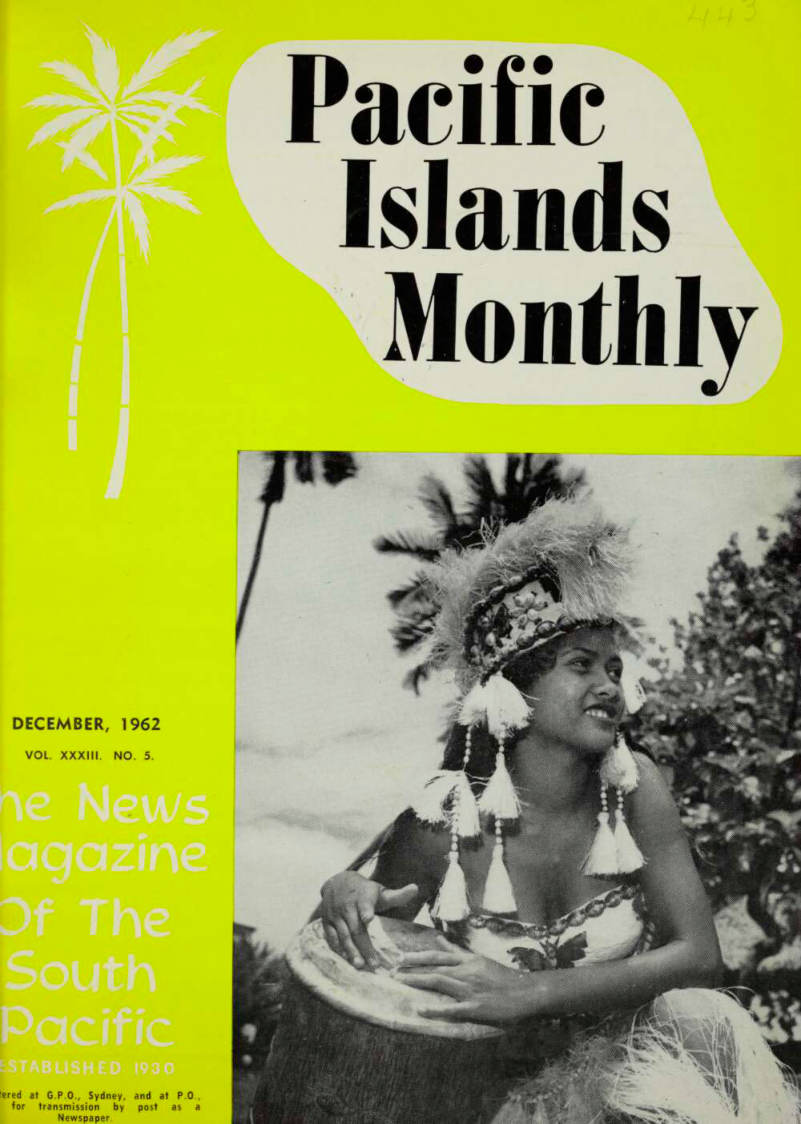 1
1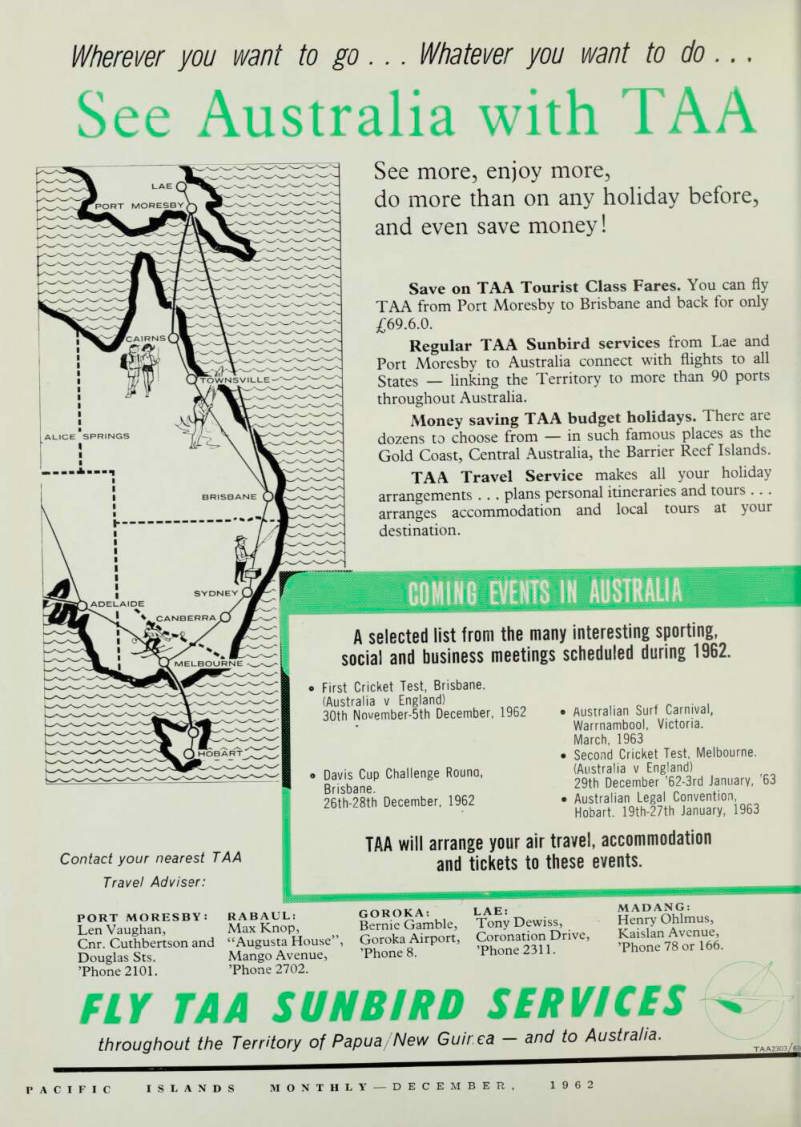 2
2 3
3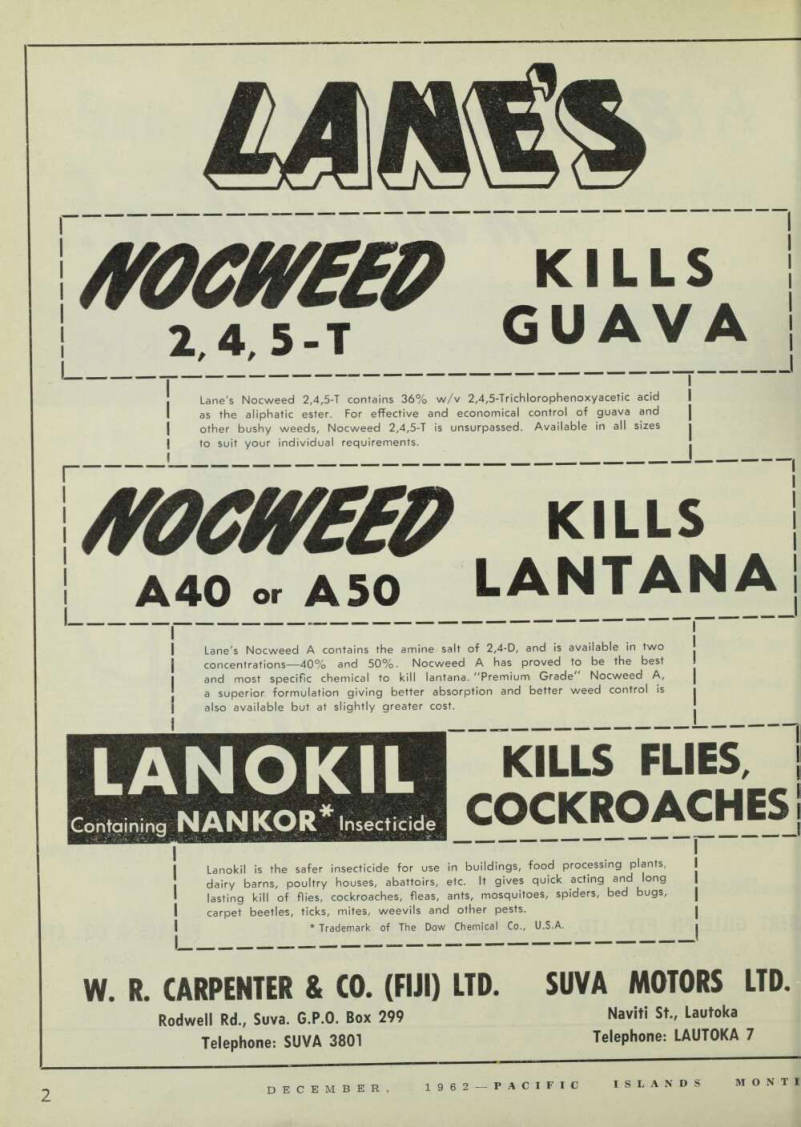 4
4 5
5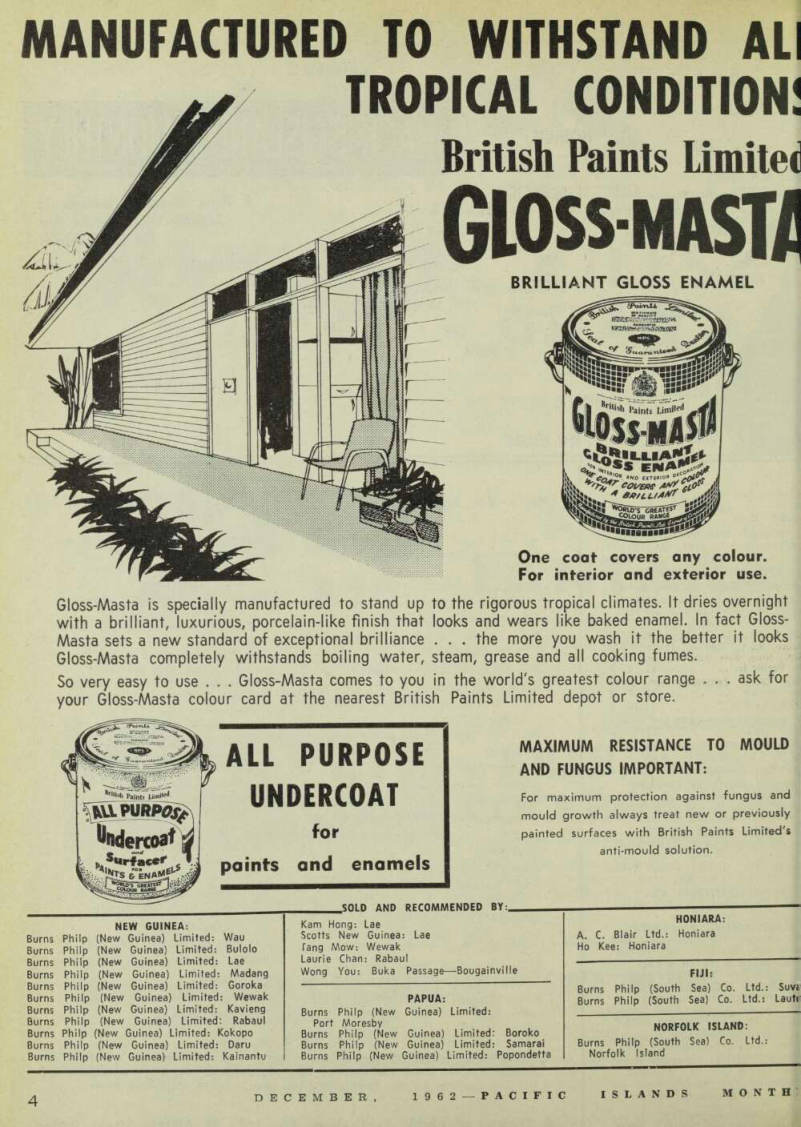 6
6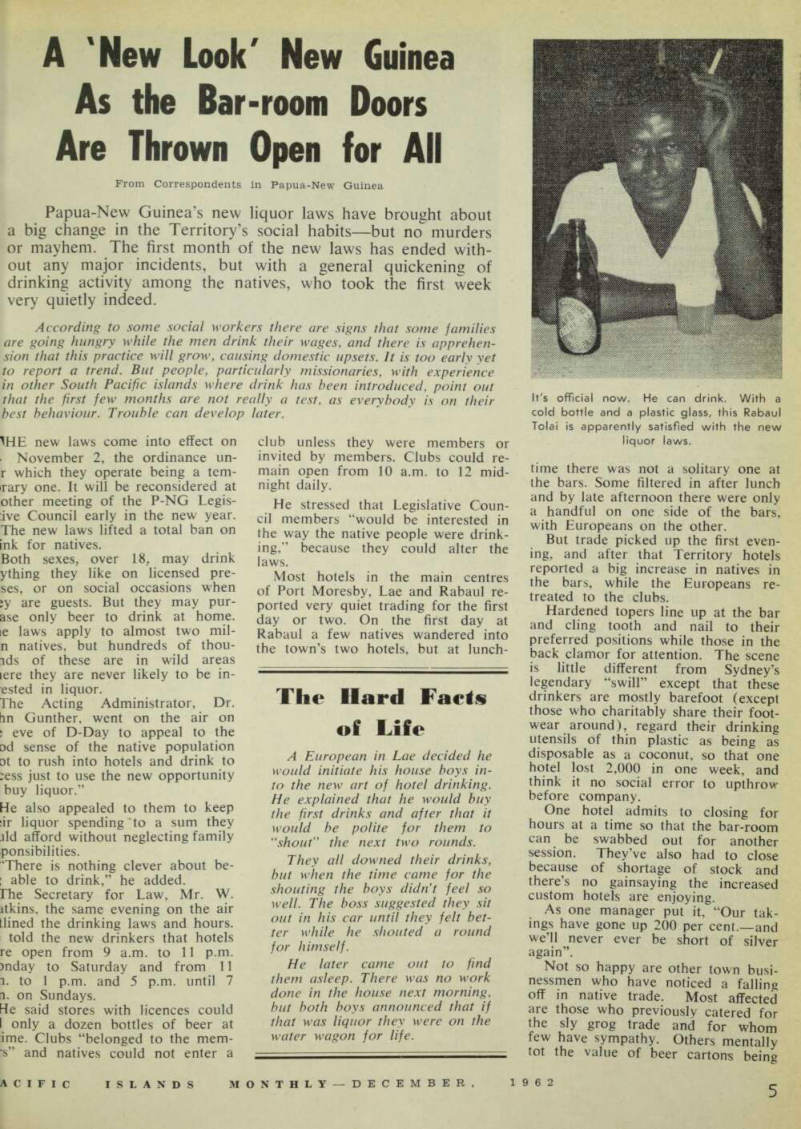 7
7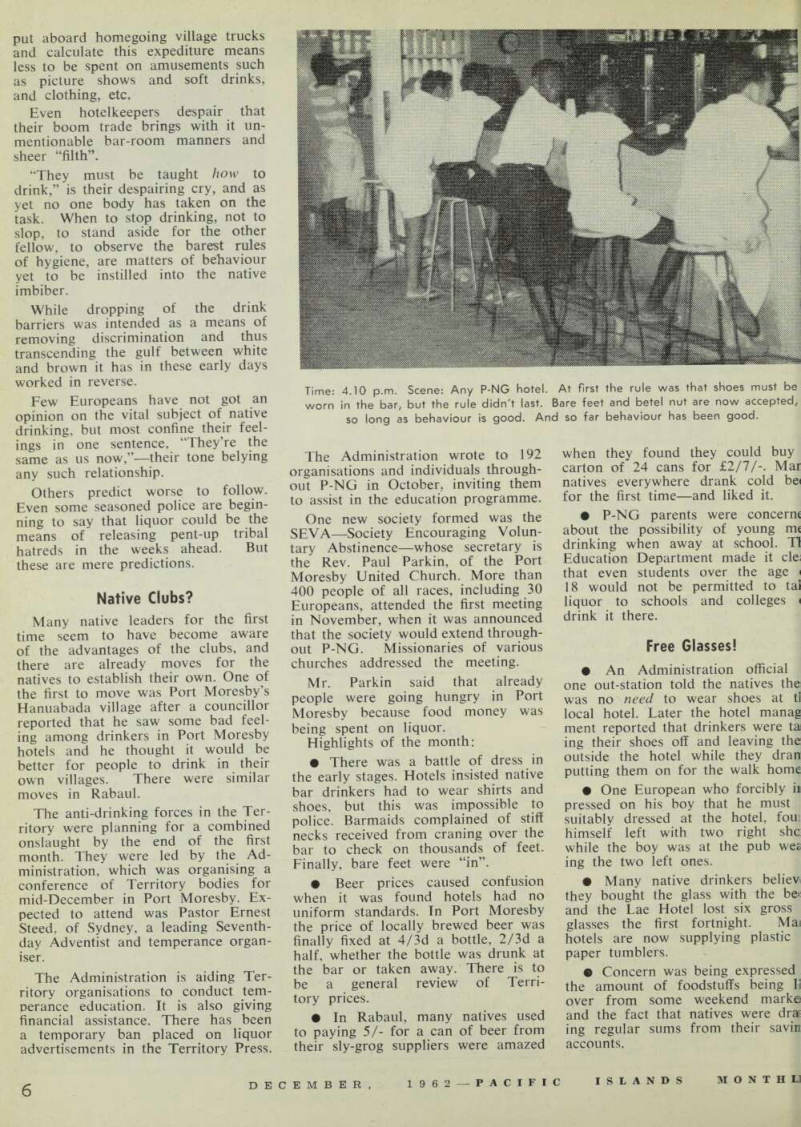 8
8 9
9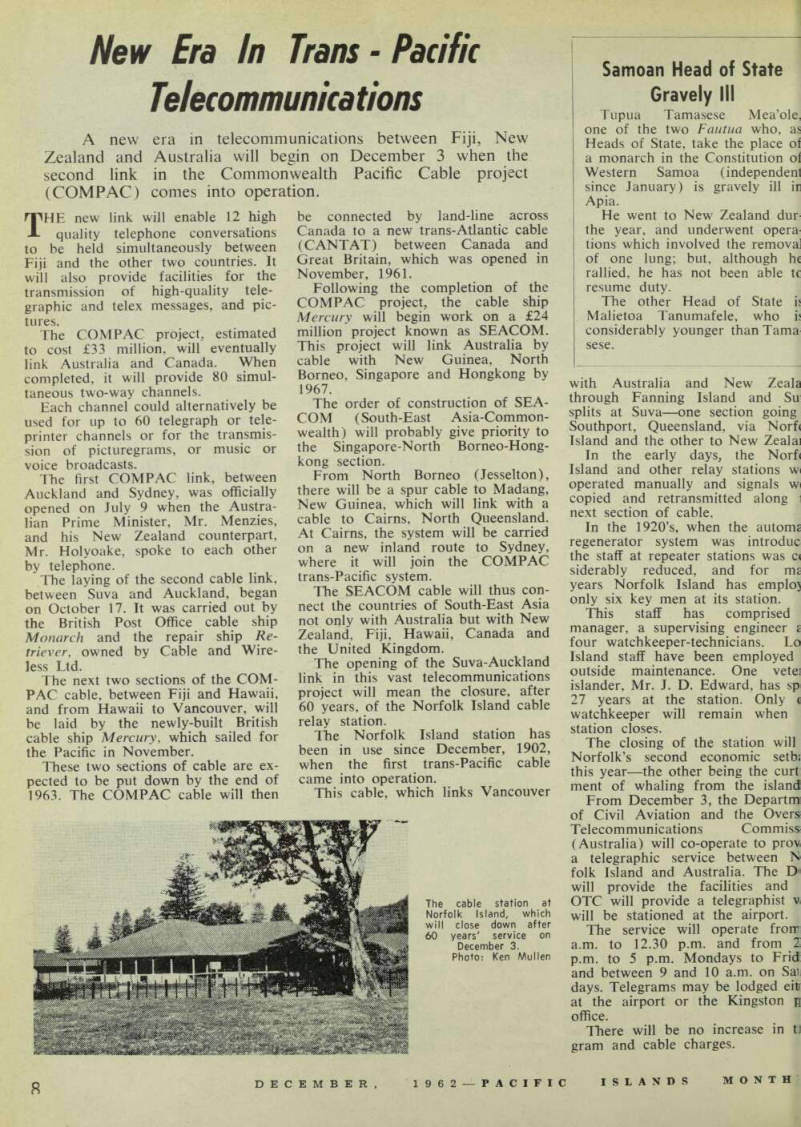 10
10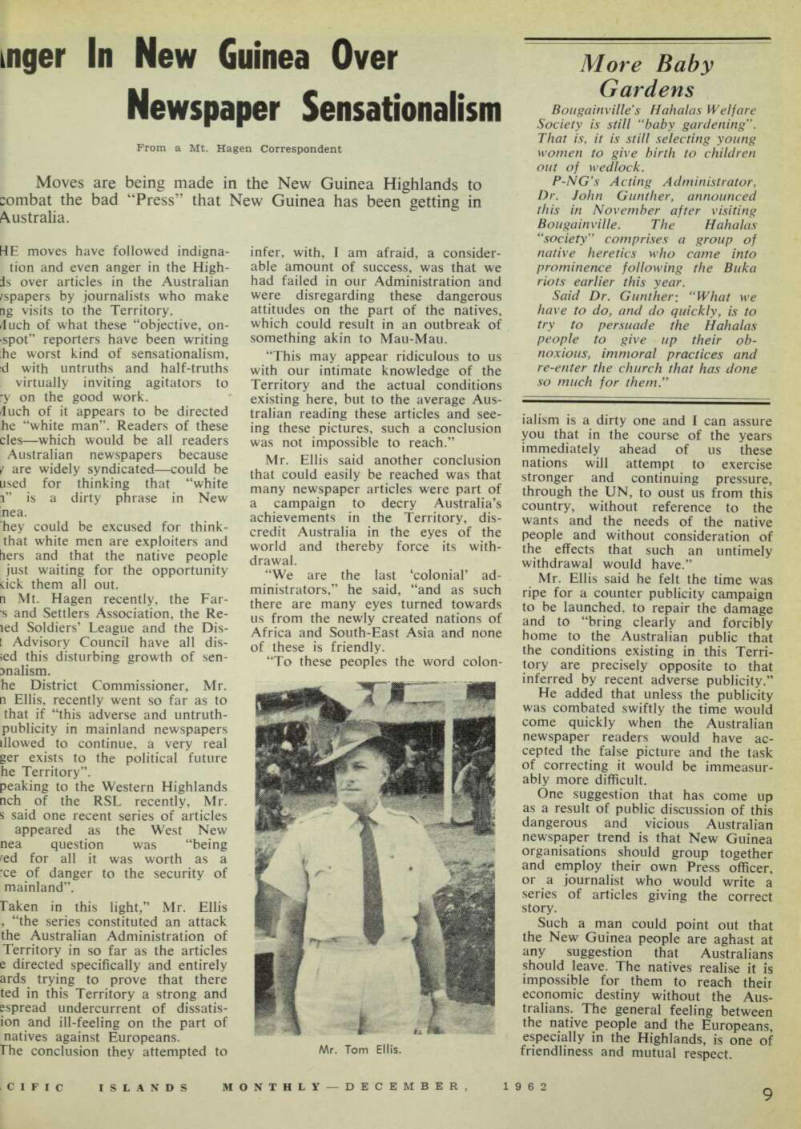 11
11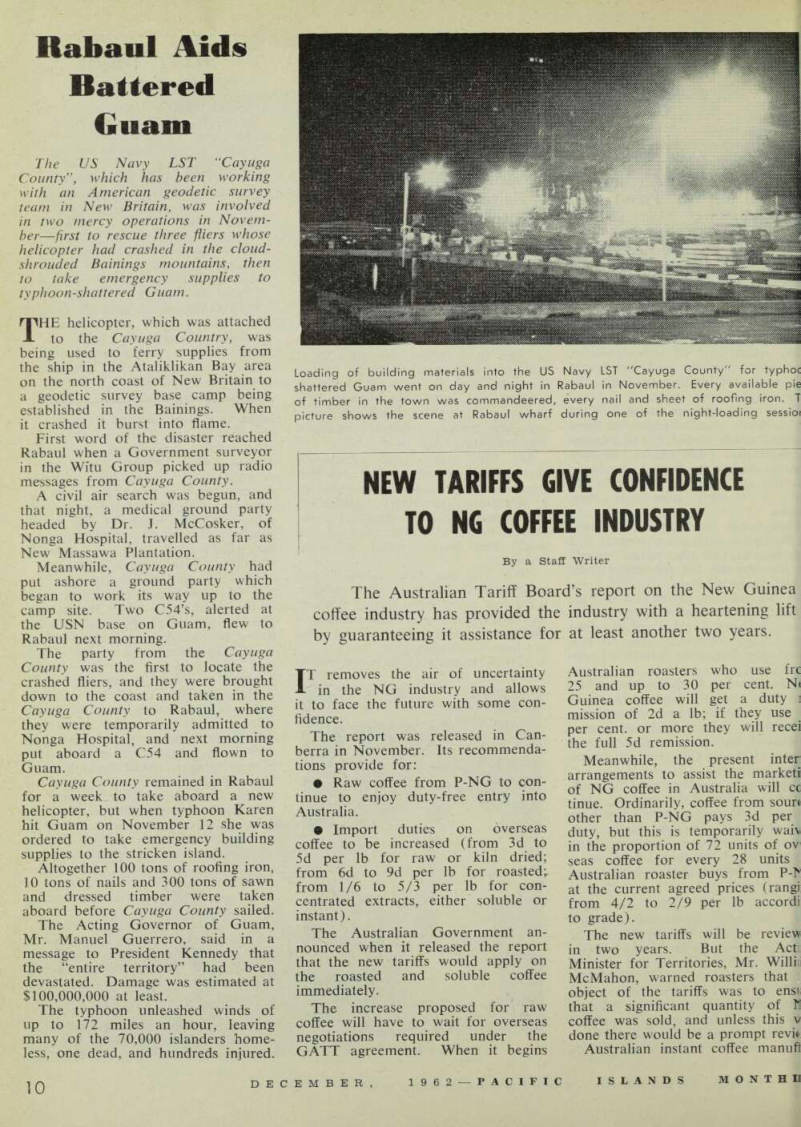 12
12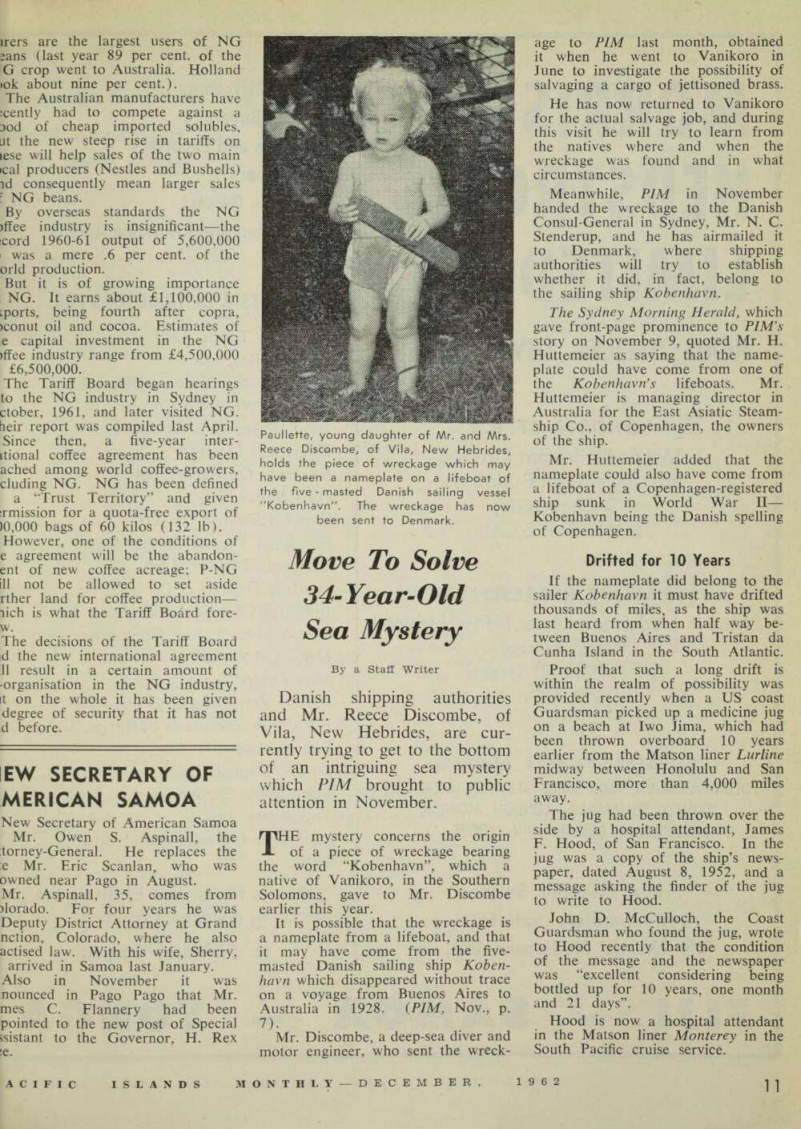 13
13 14
14 15
15 16
16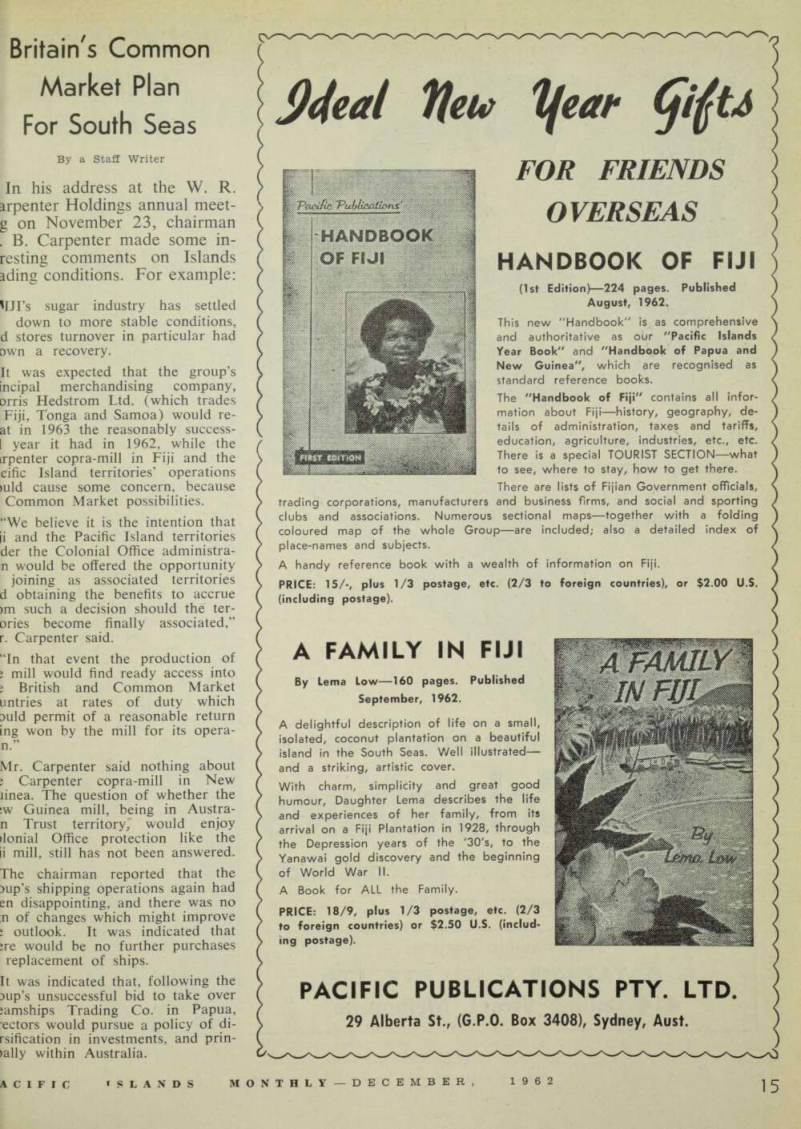 17
17 18
18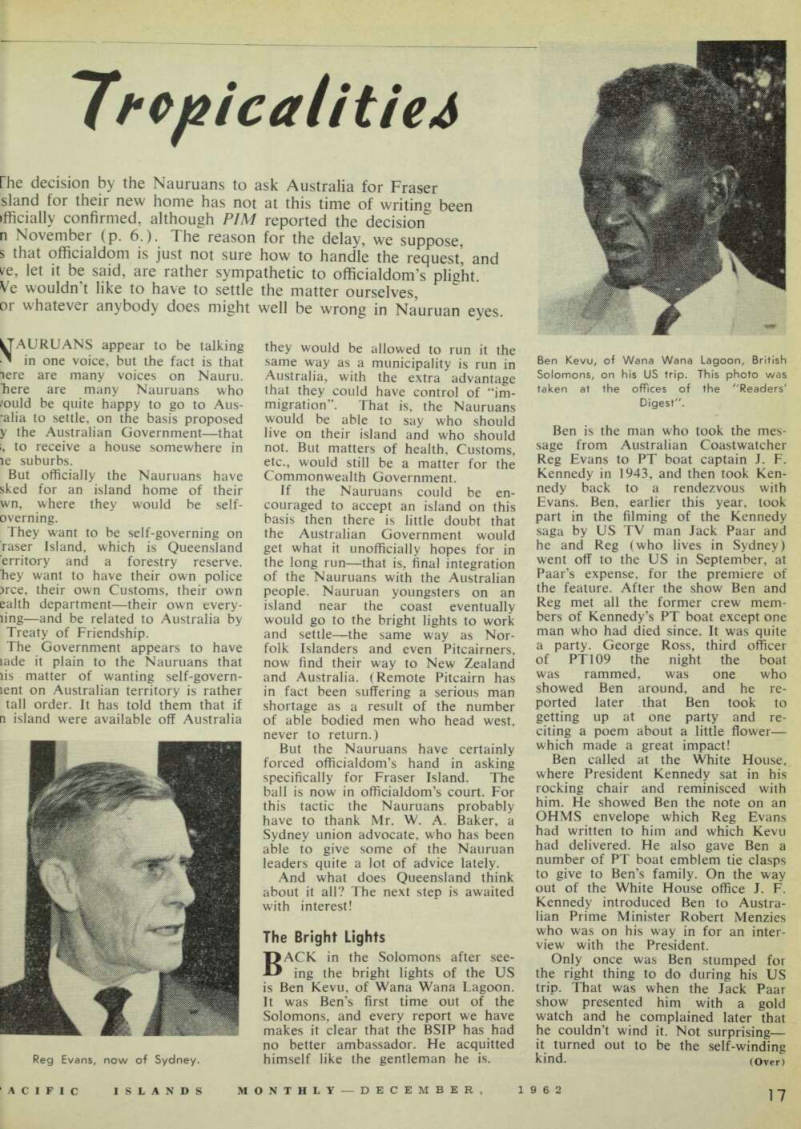 19
19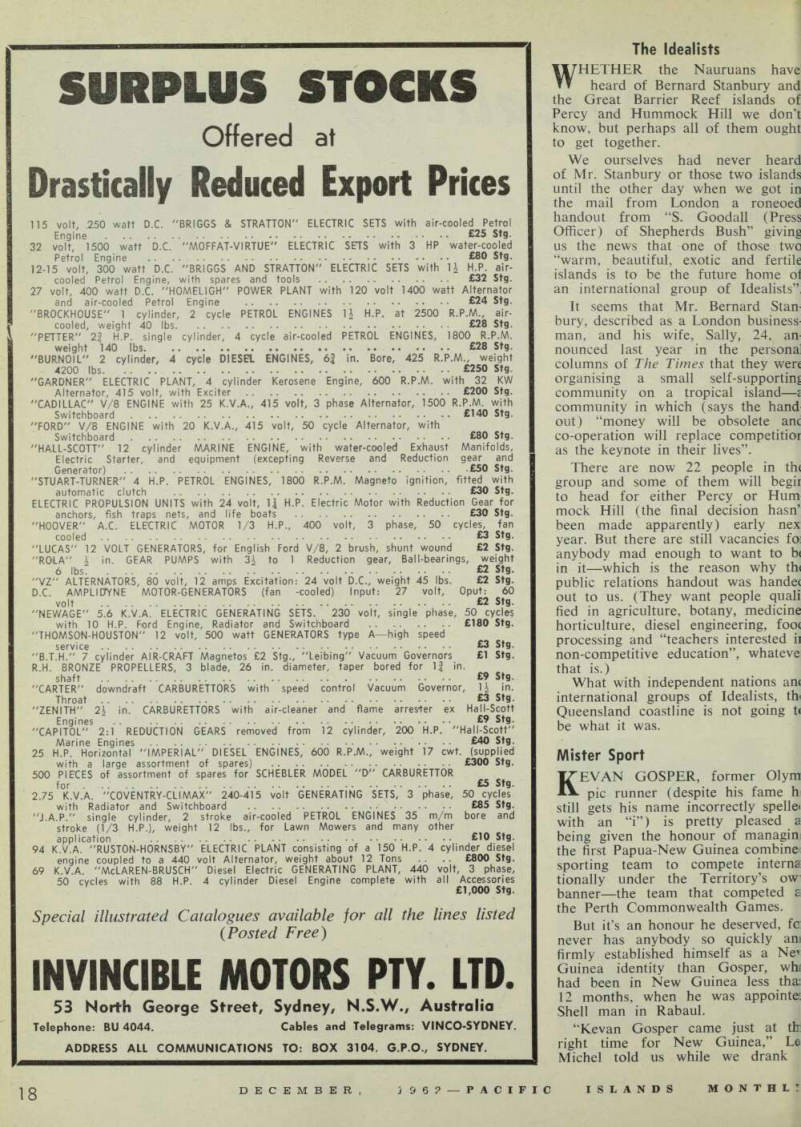 20
20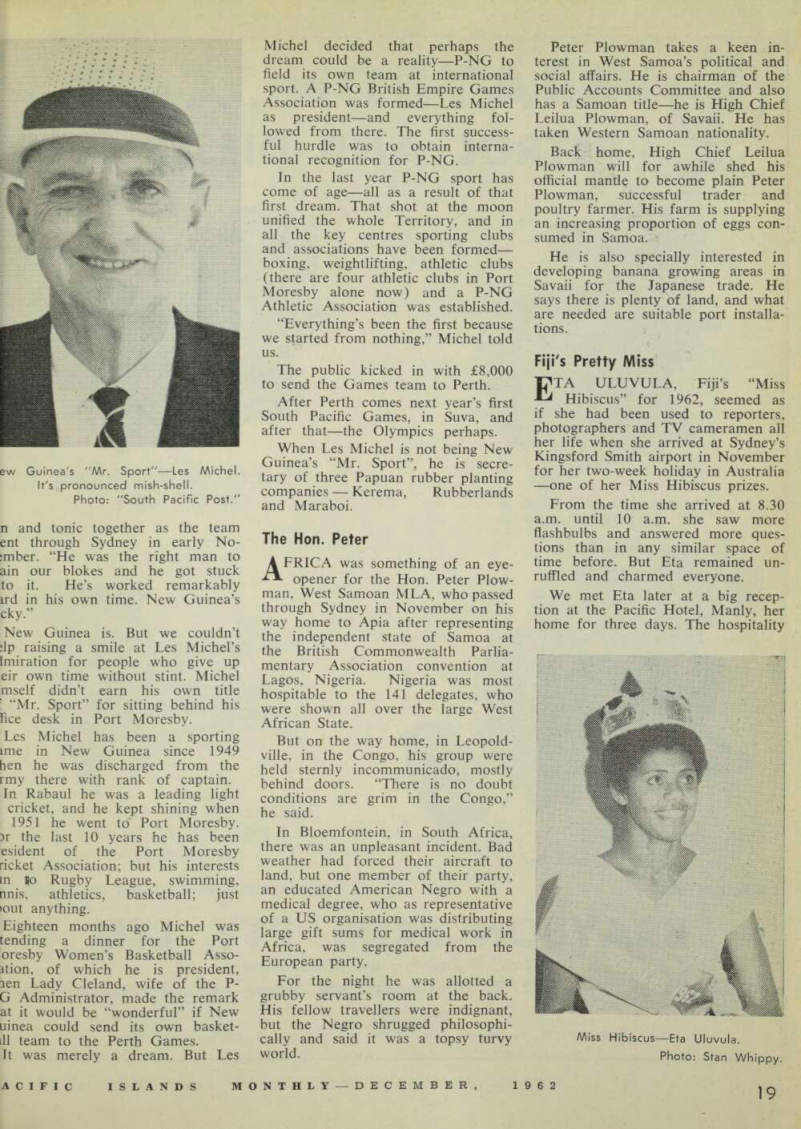 21
21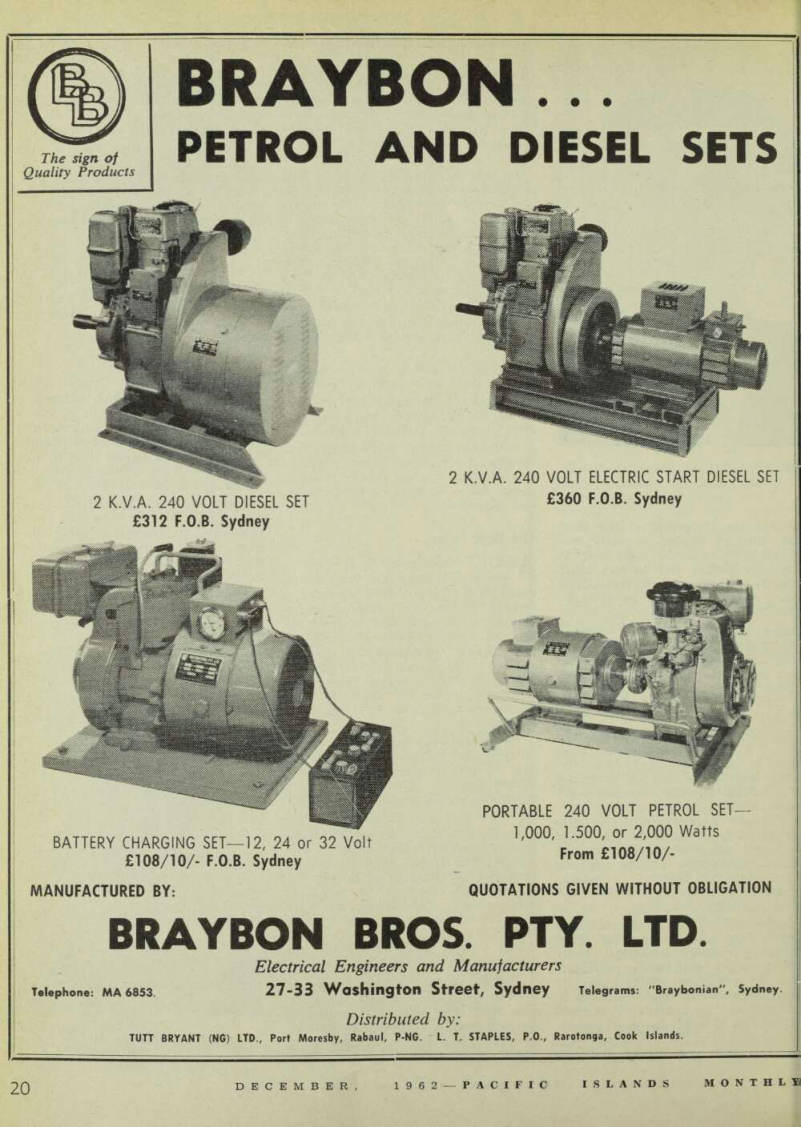 22
22 23
23 24
24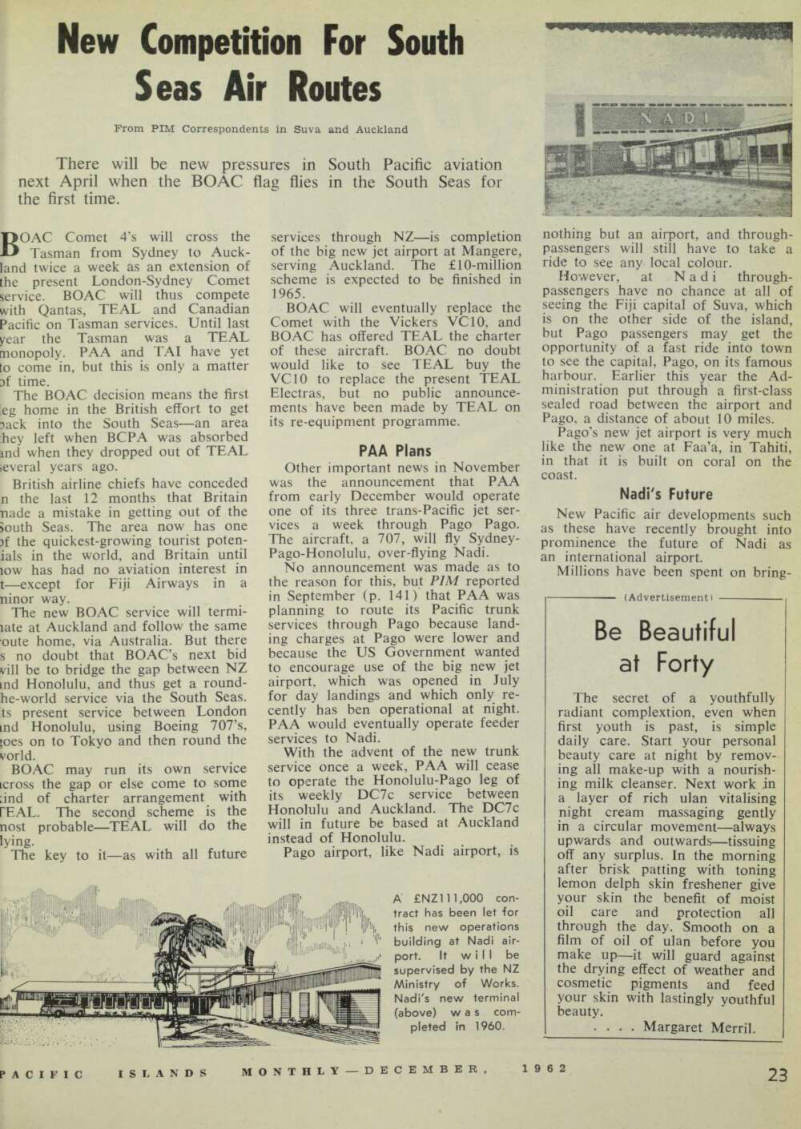 25
25 26
26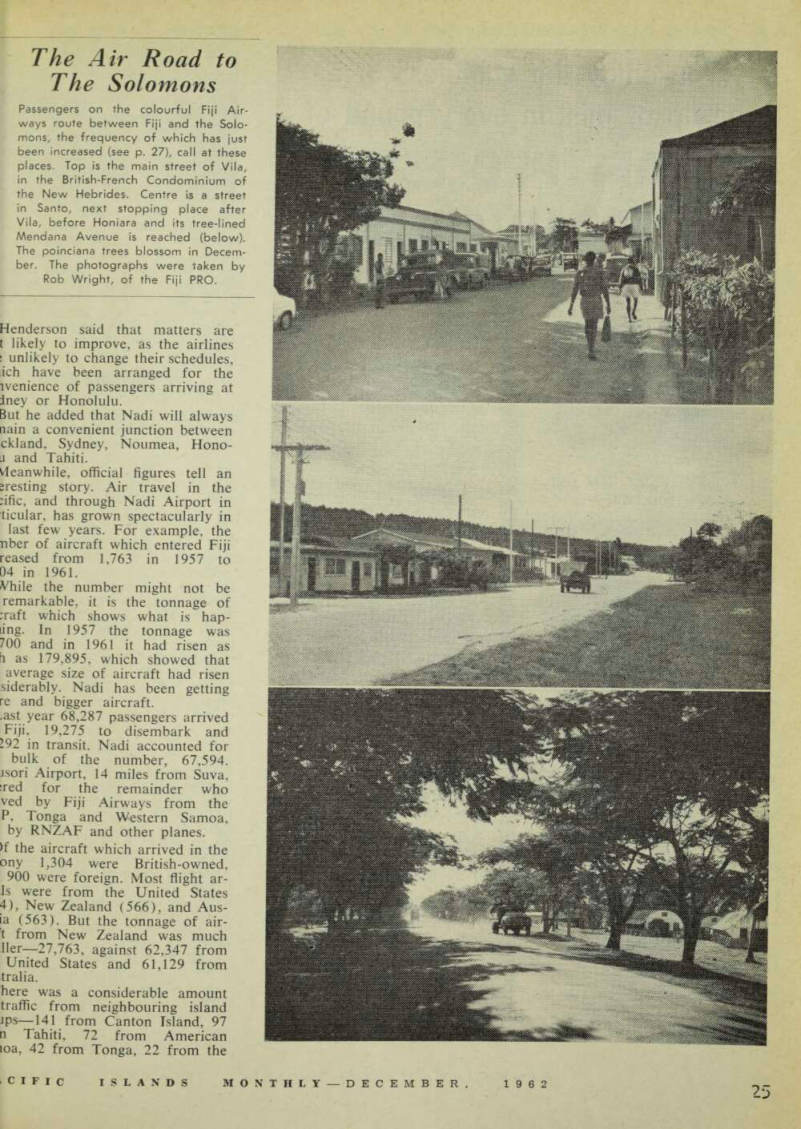 27
27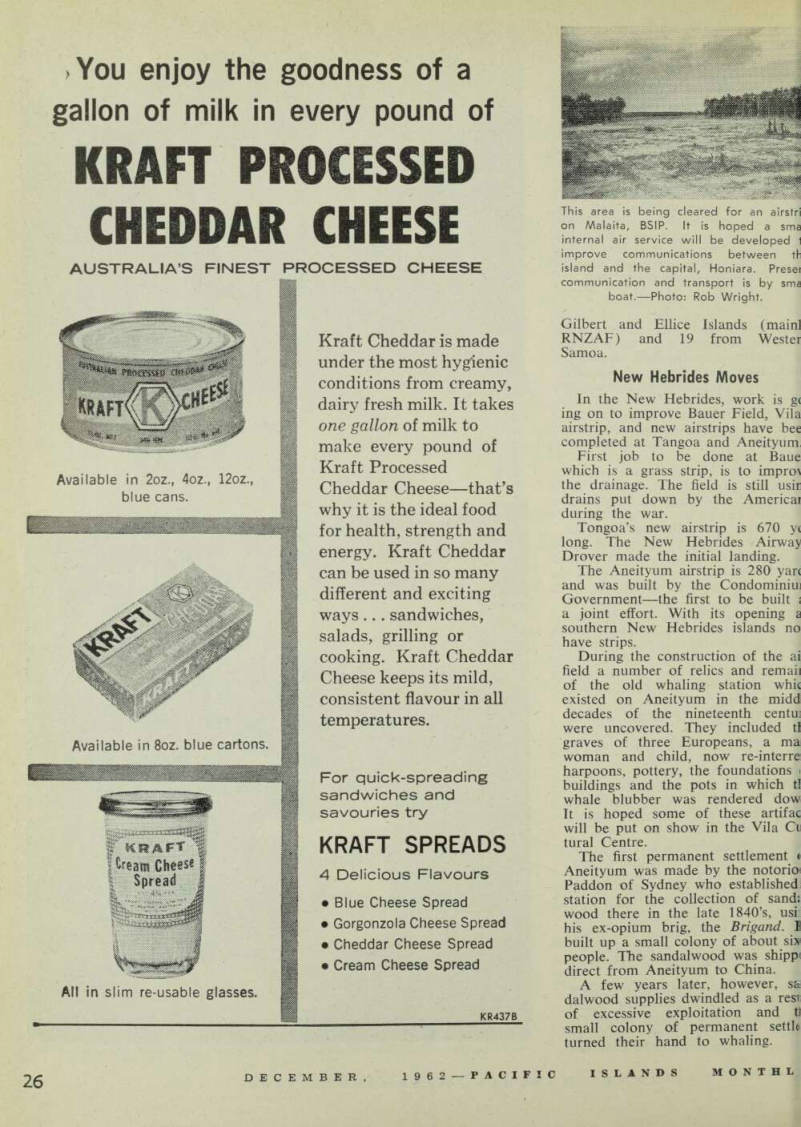 28
28 29
29 30
30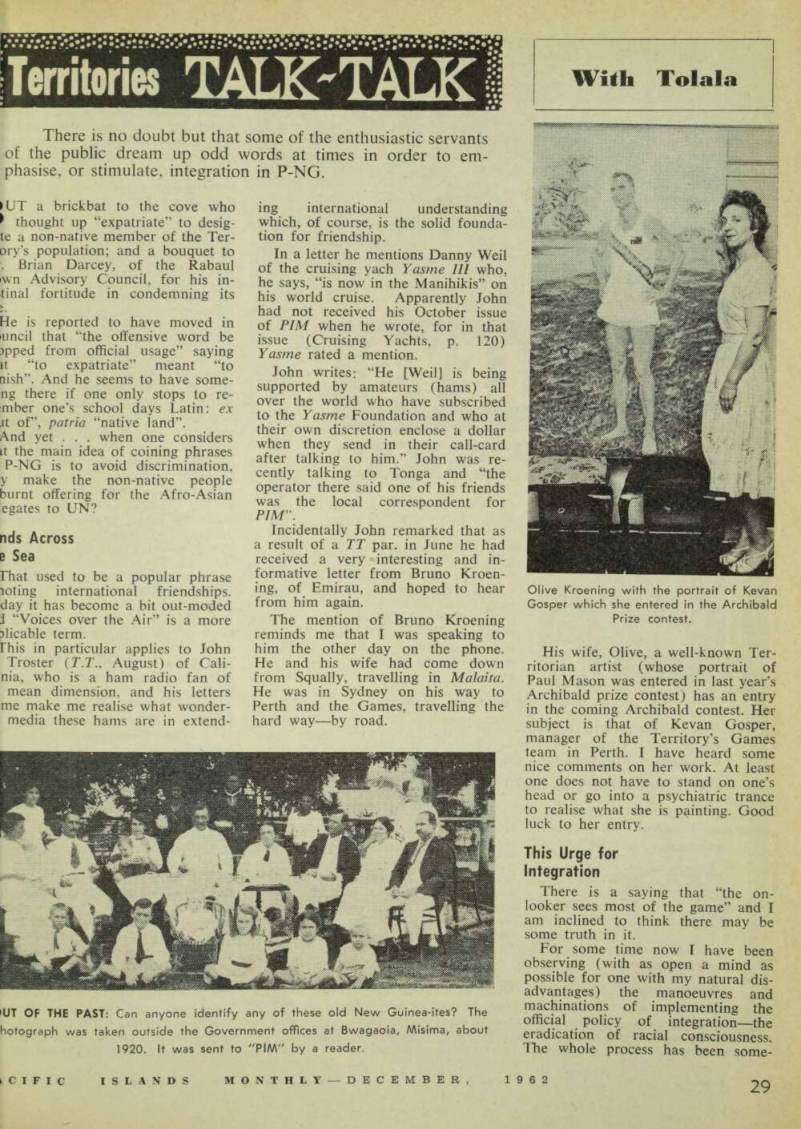 31
31 32
32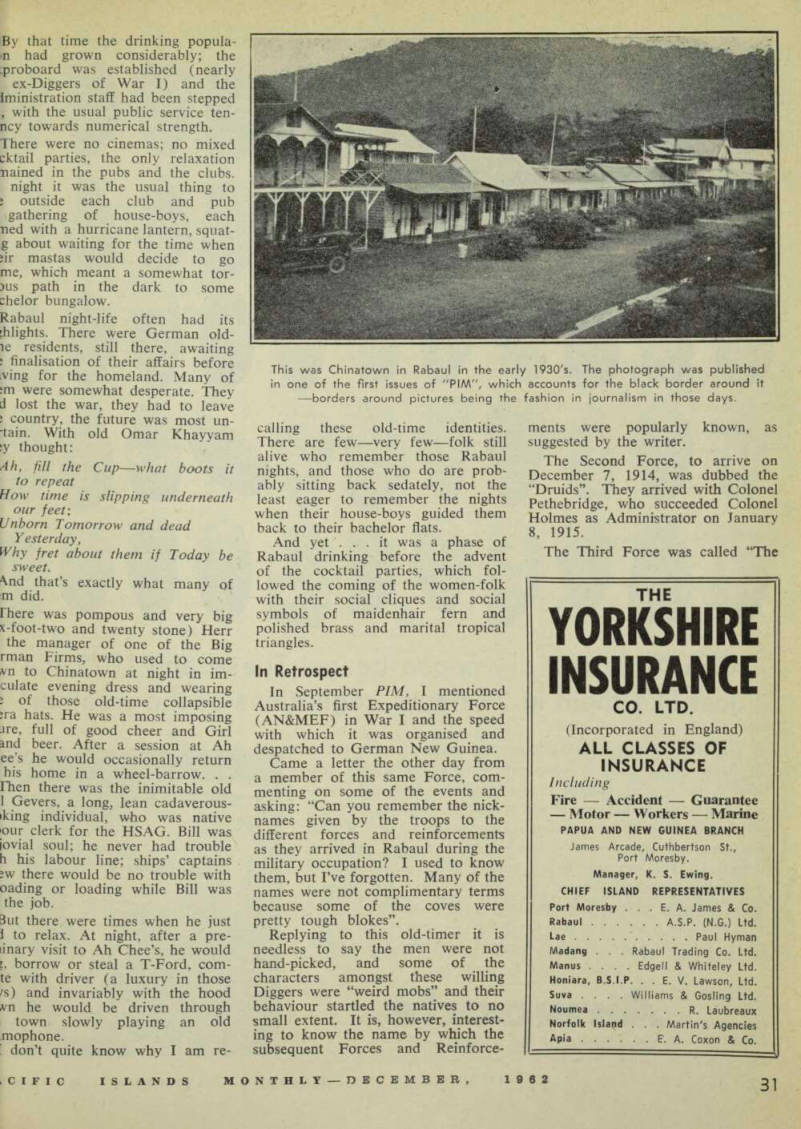 33
33 34
34 35
35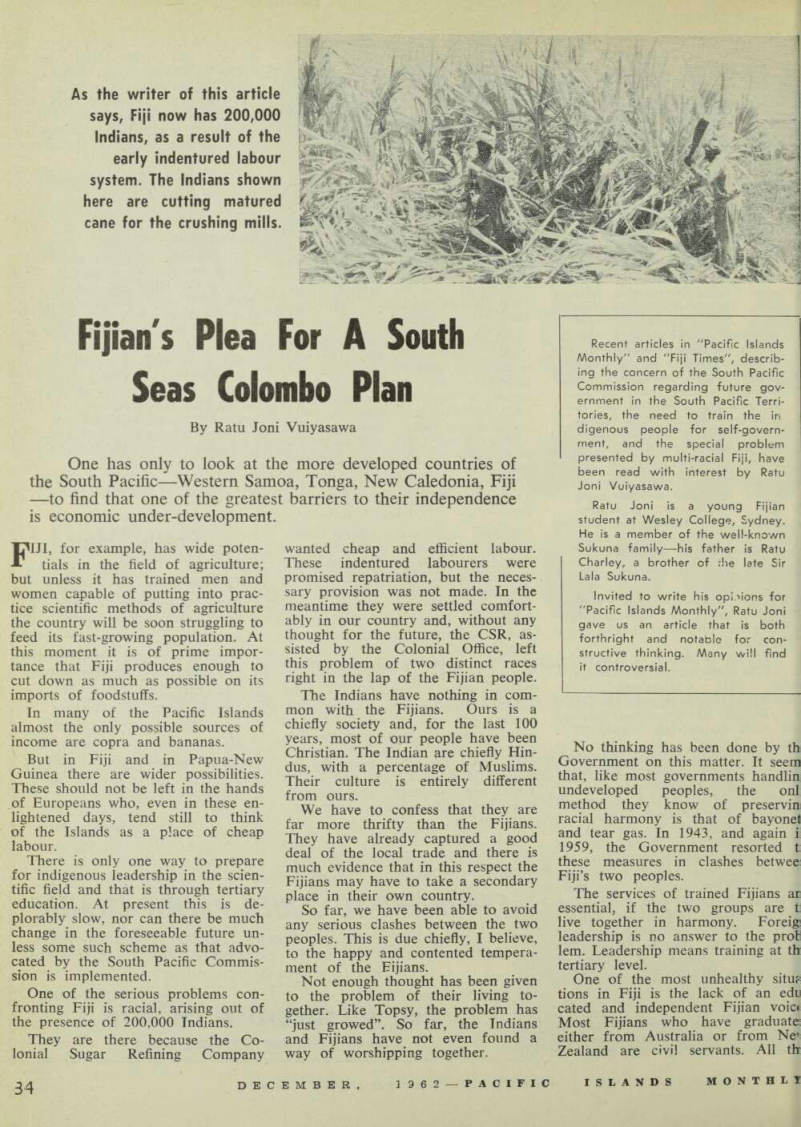 36
36 37
37 38
38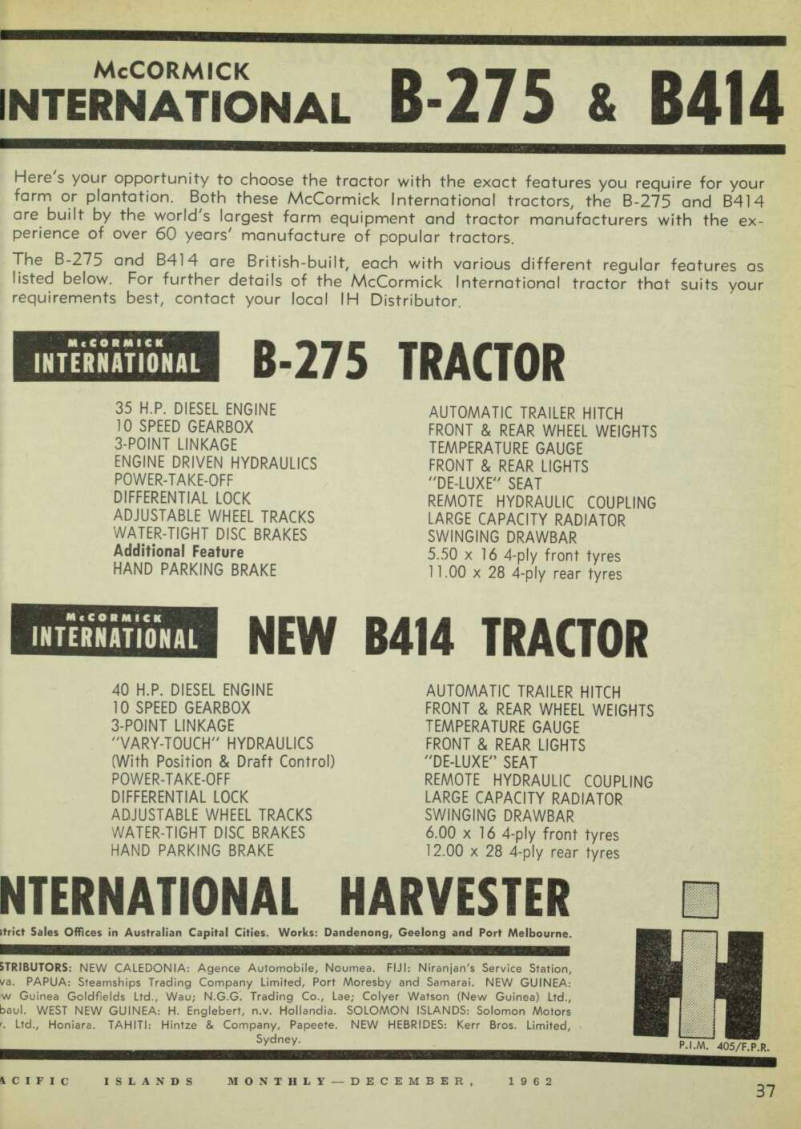 39
39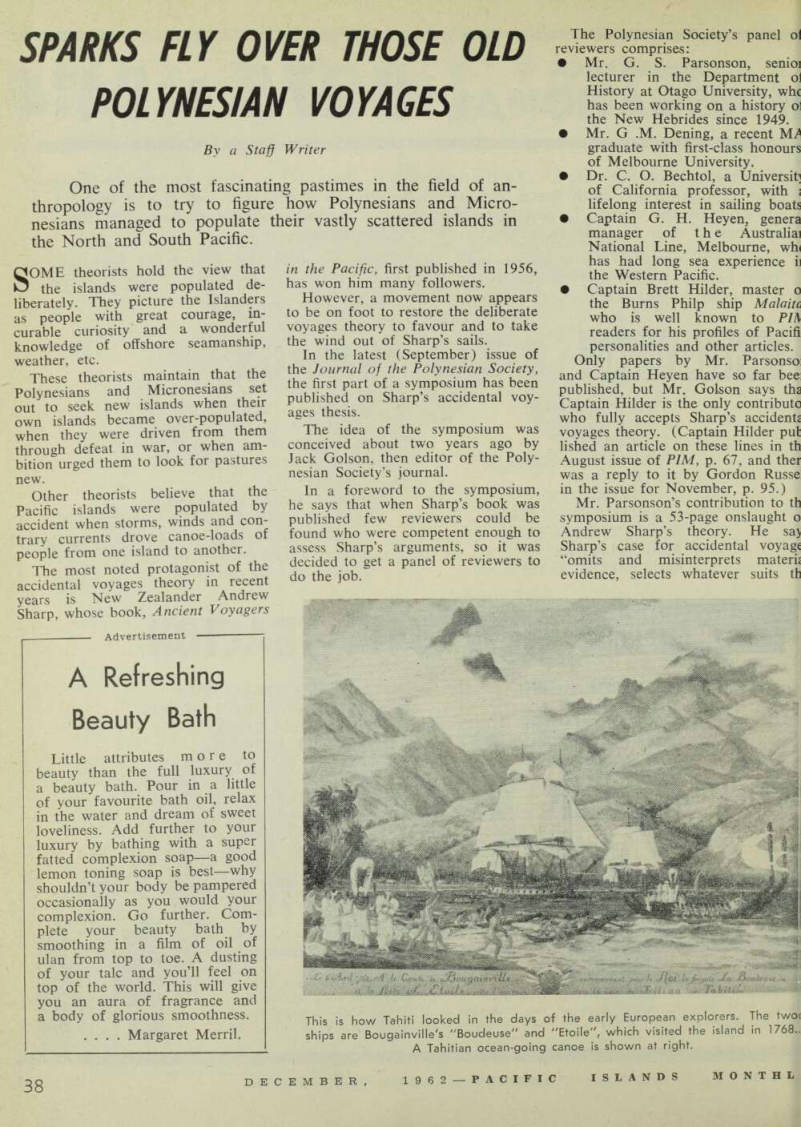 40
40 41
41 42
42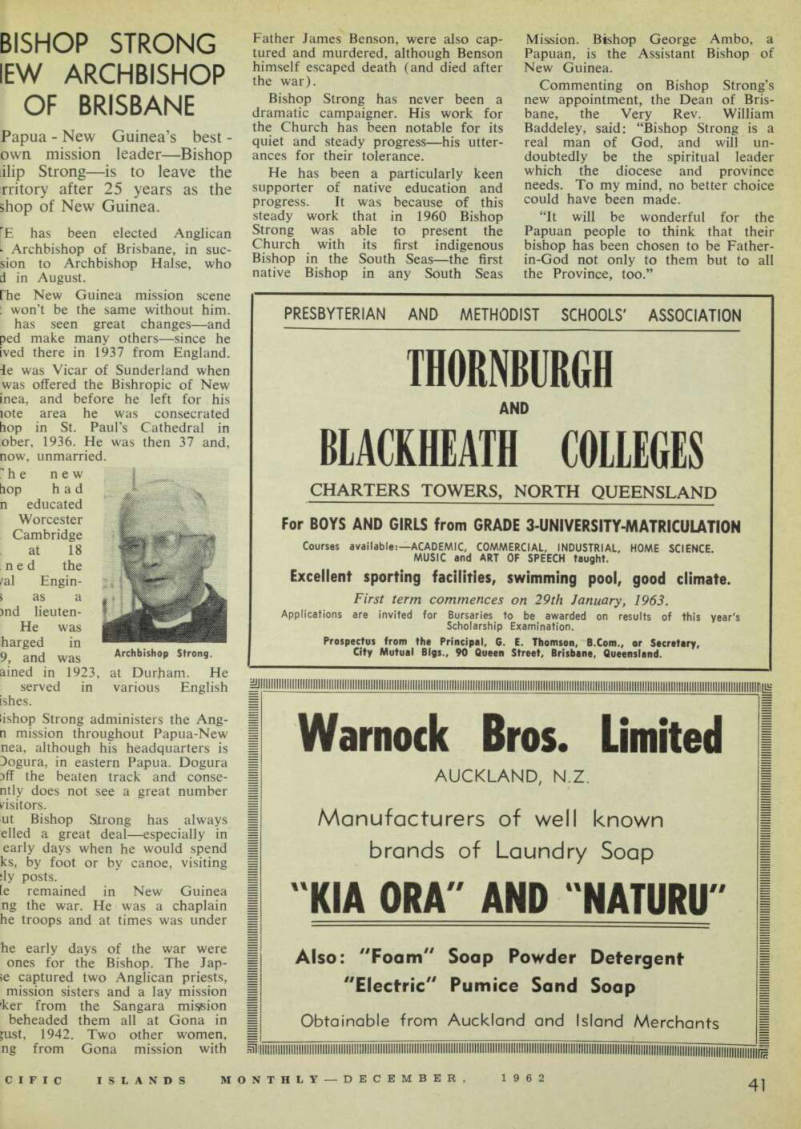 43
43 44
44 45
45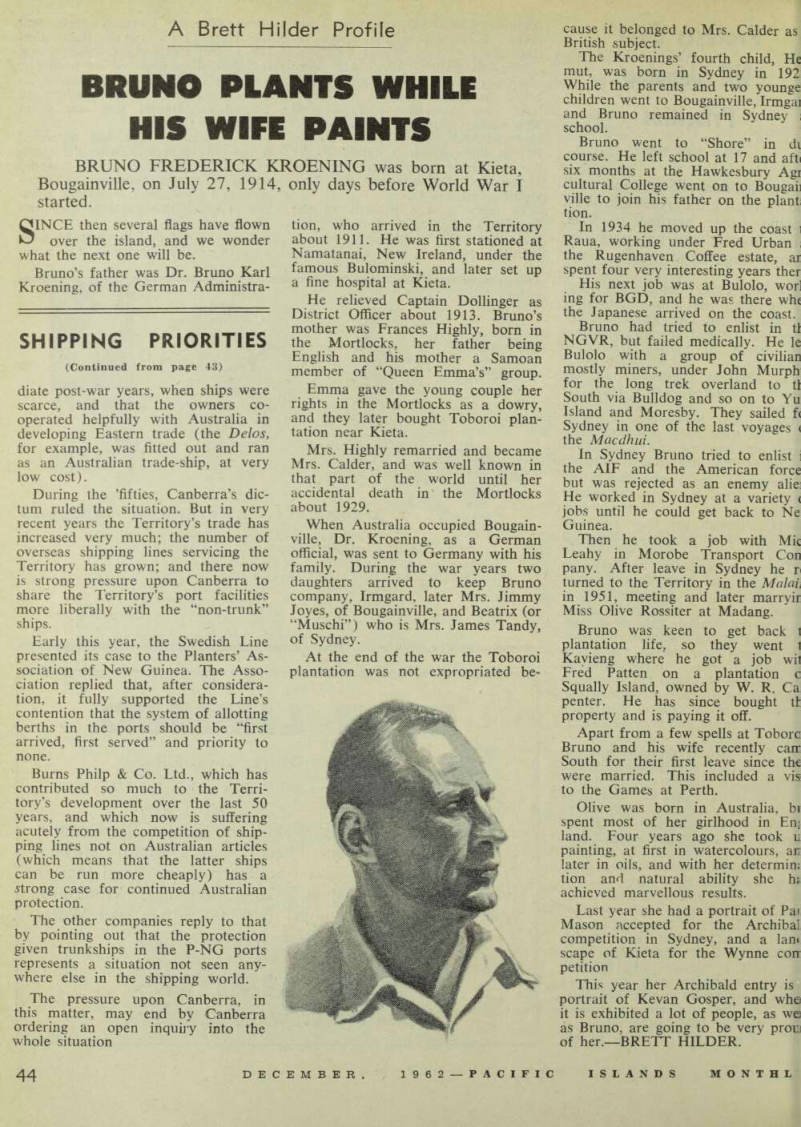 46
46 47
47 48
48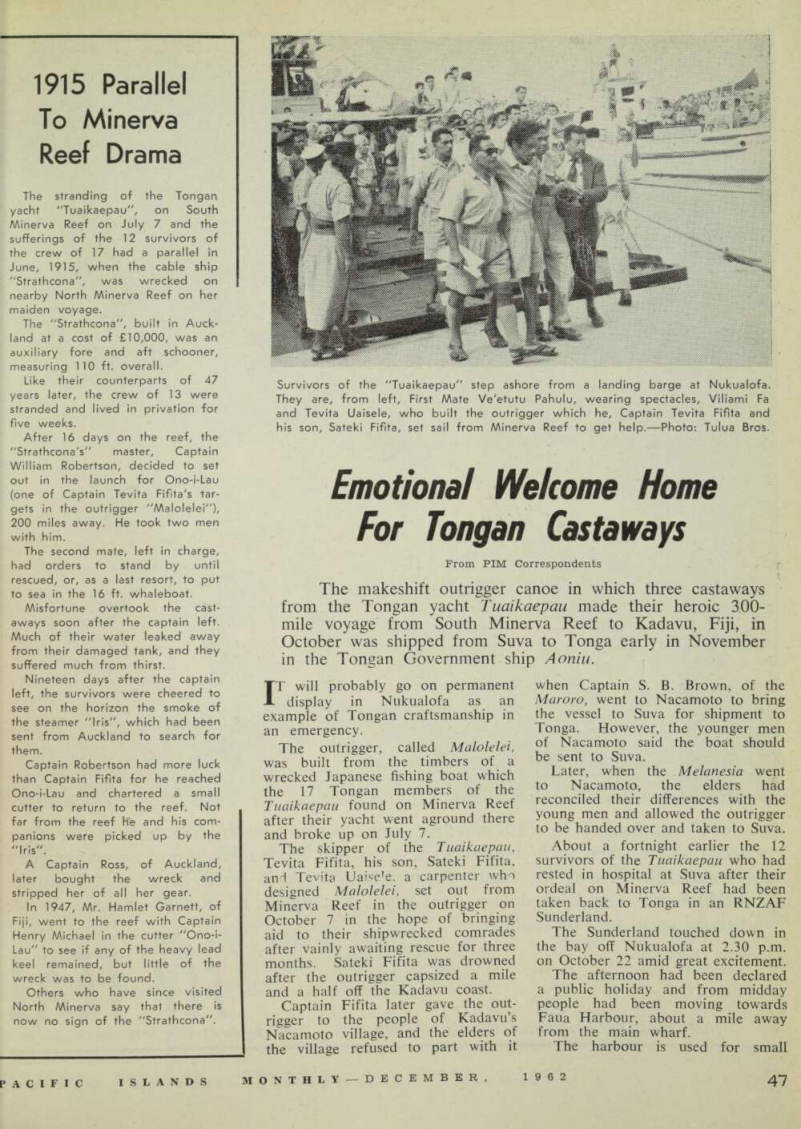 49
49 50
50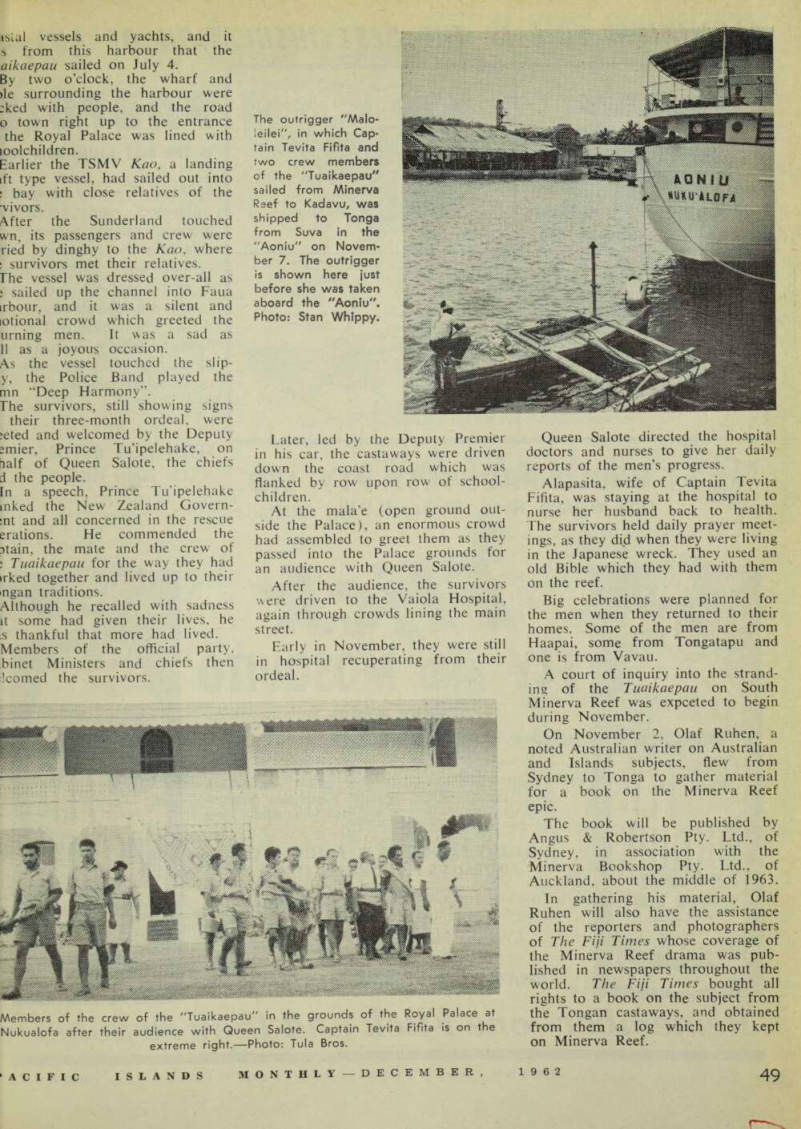 51
51 52
52 53
53 54
54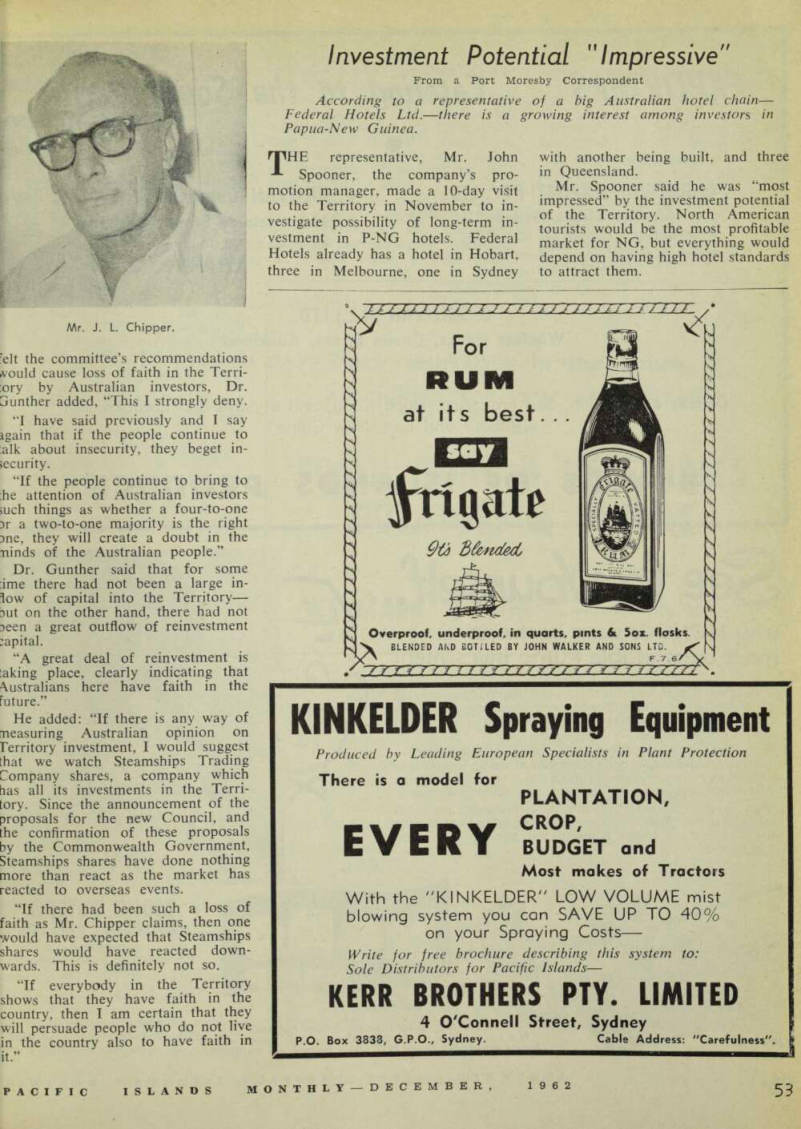 55
55 56
56 57
57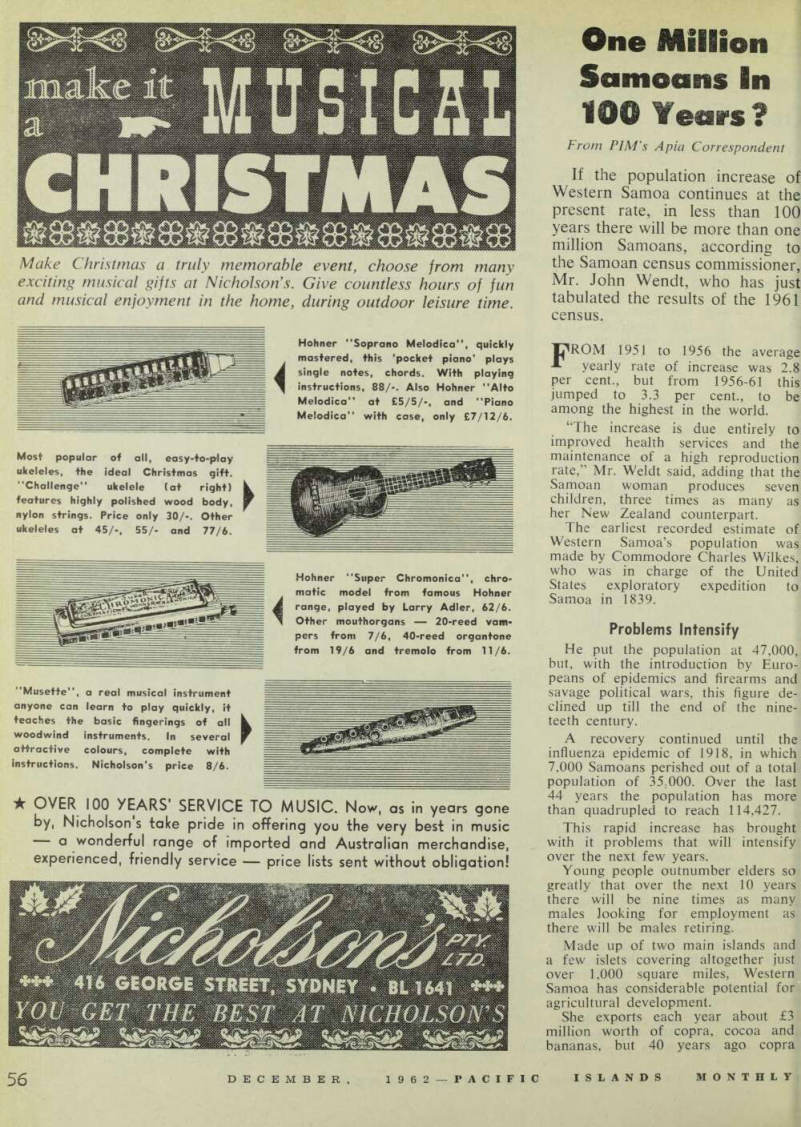 58
58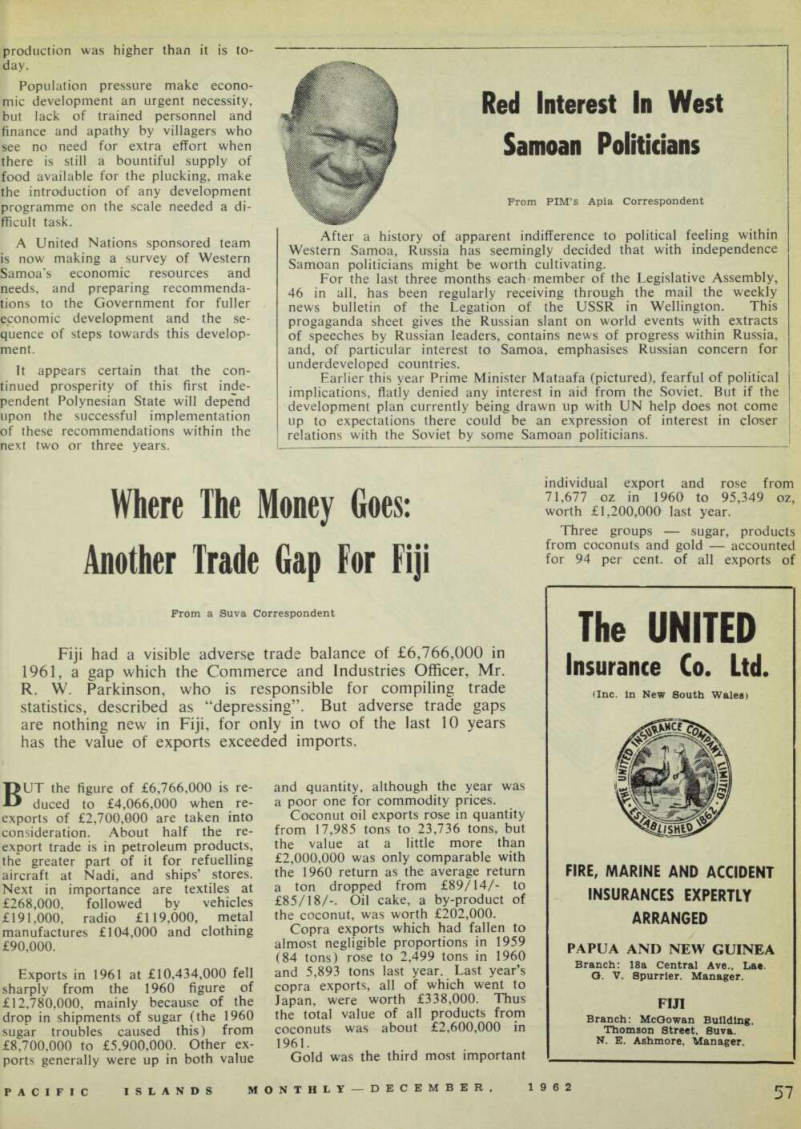 59
59 60
60 61
61 62
62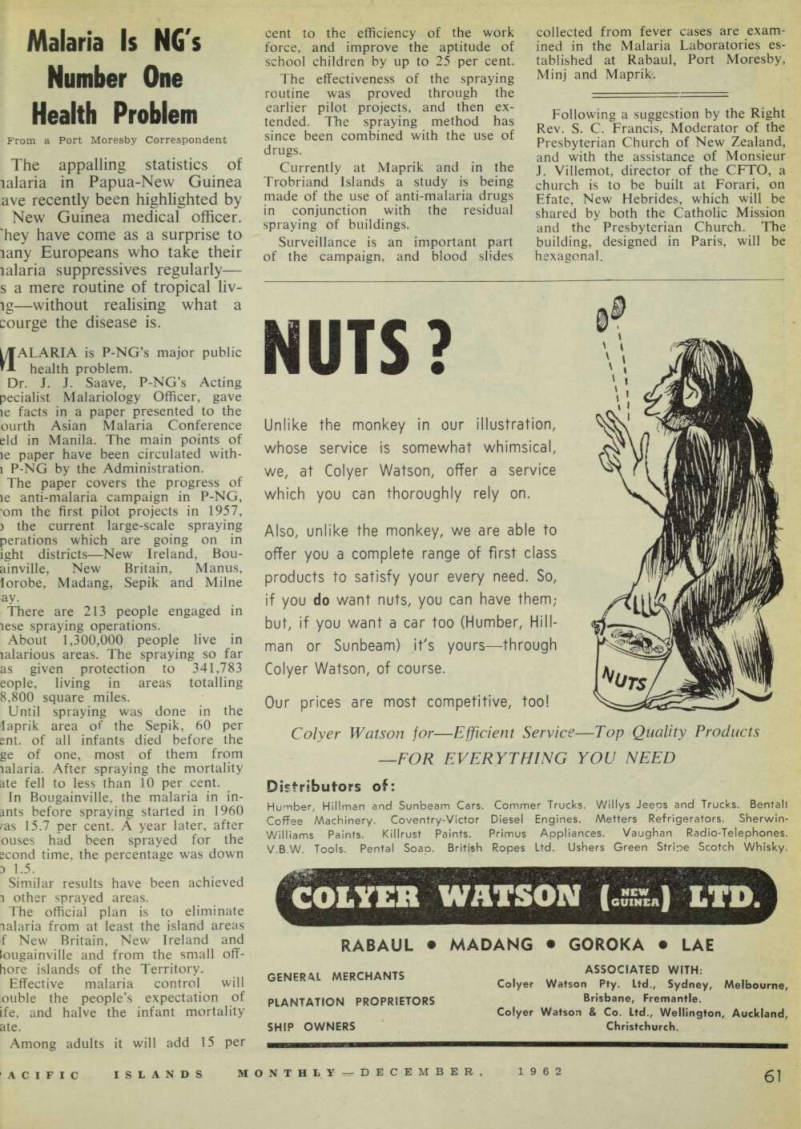 63
63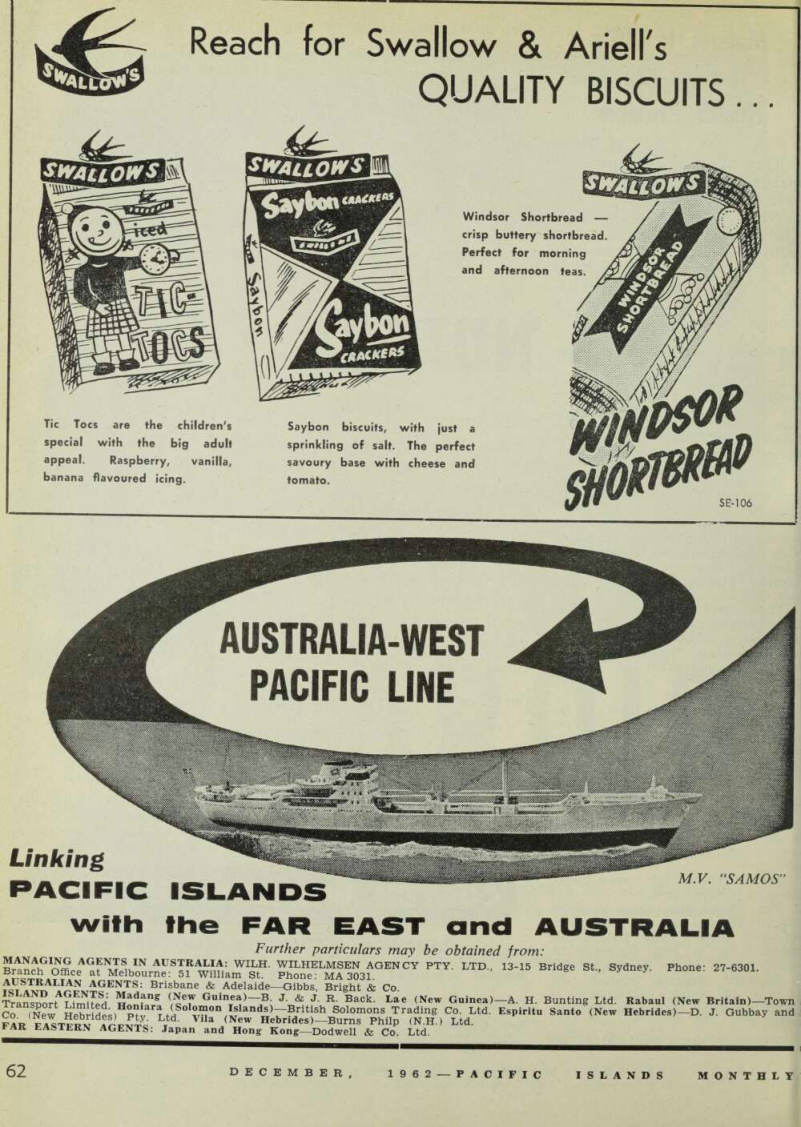 64
64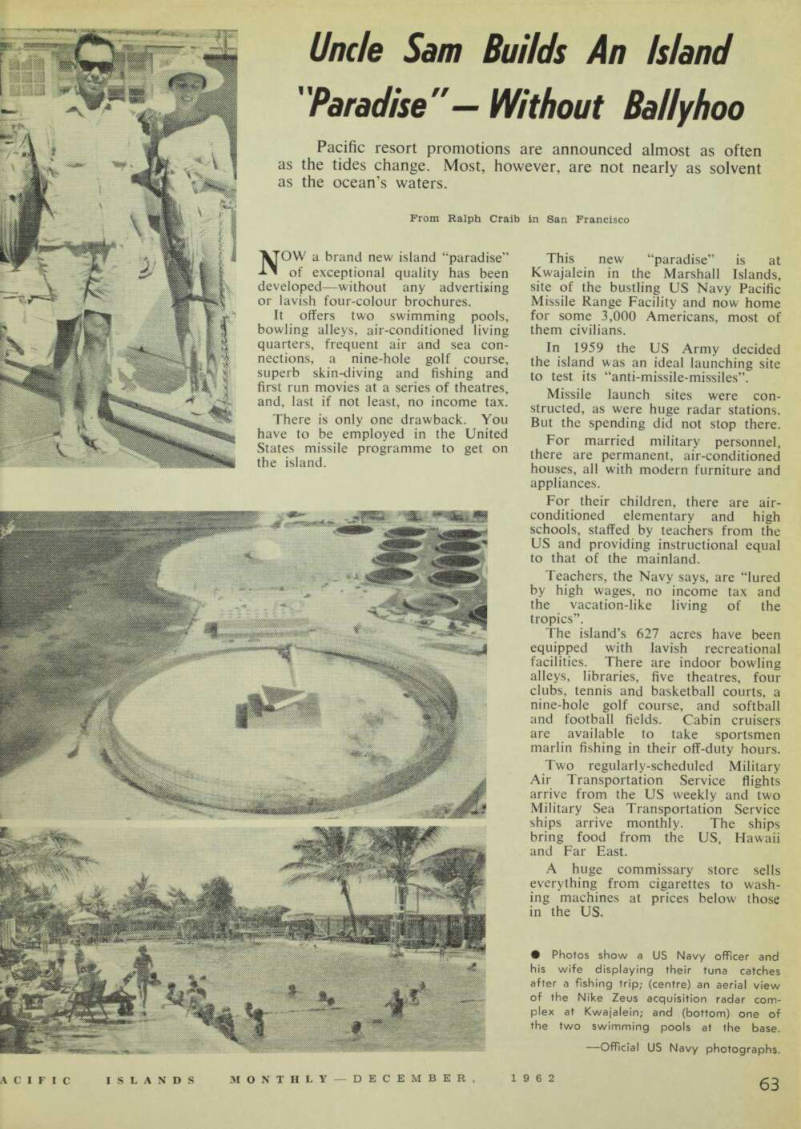 65
65 66
66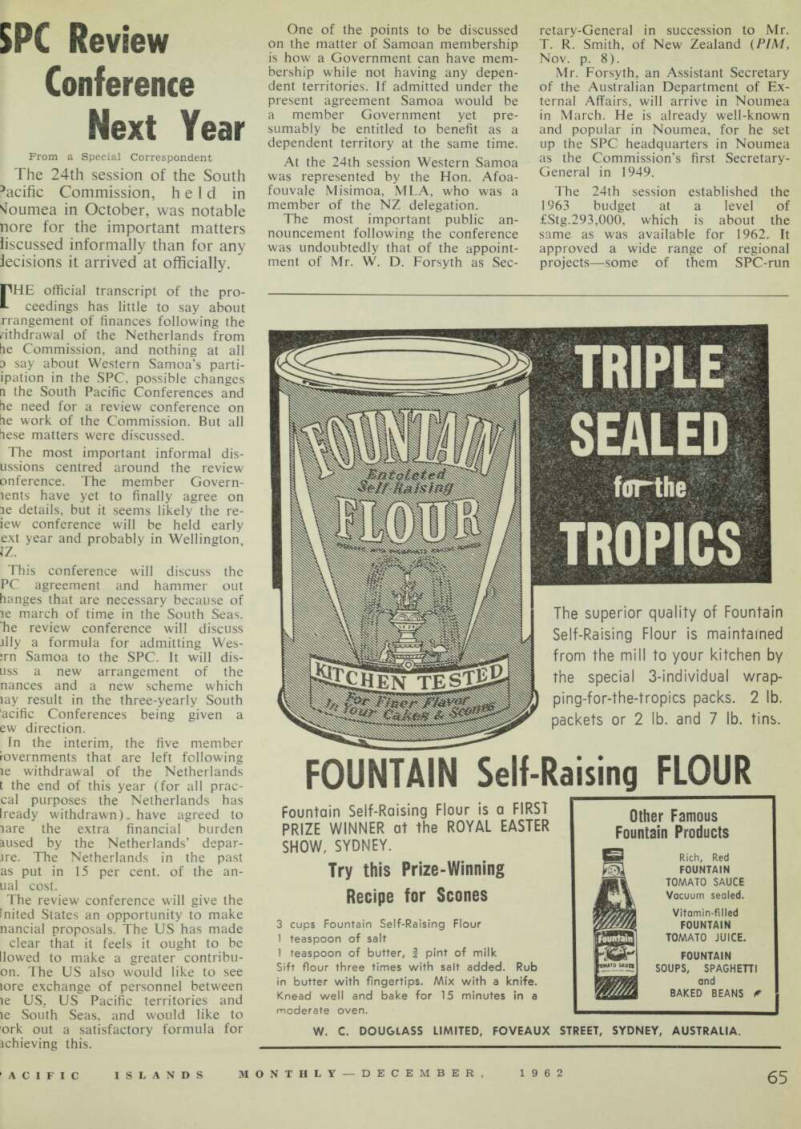 67
67 68
68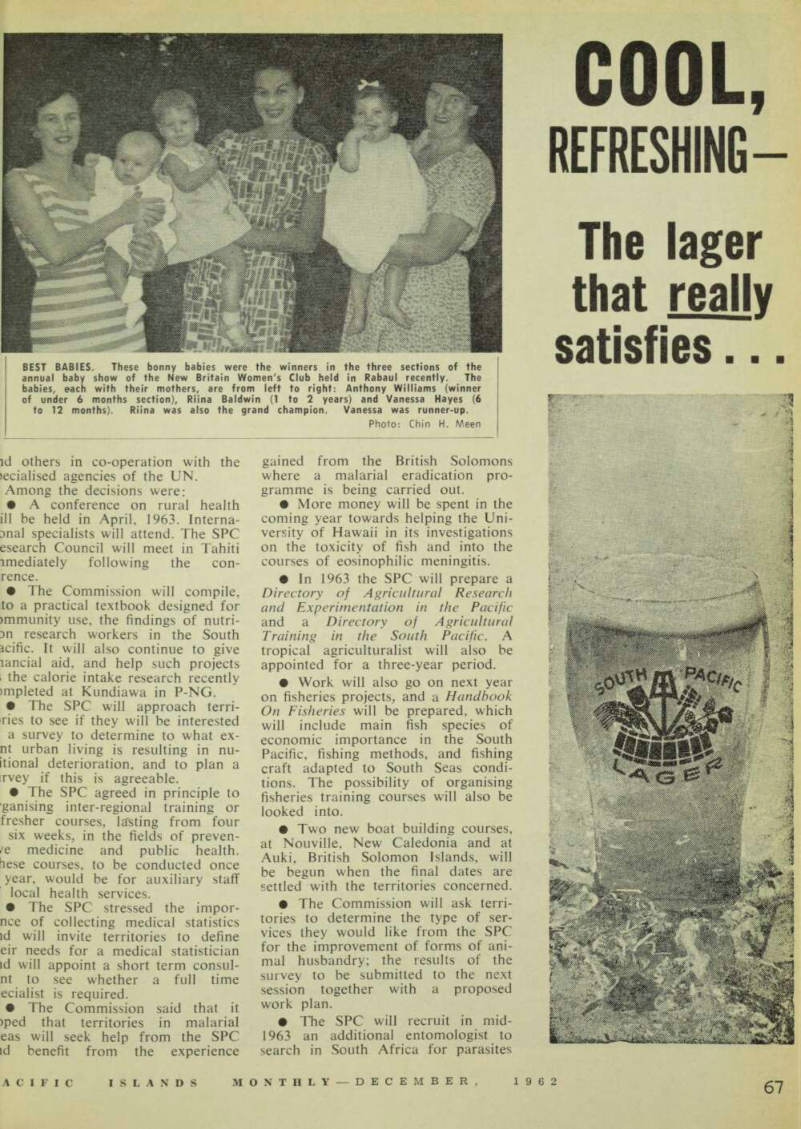 69
69 70
70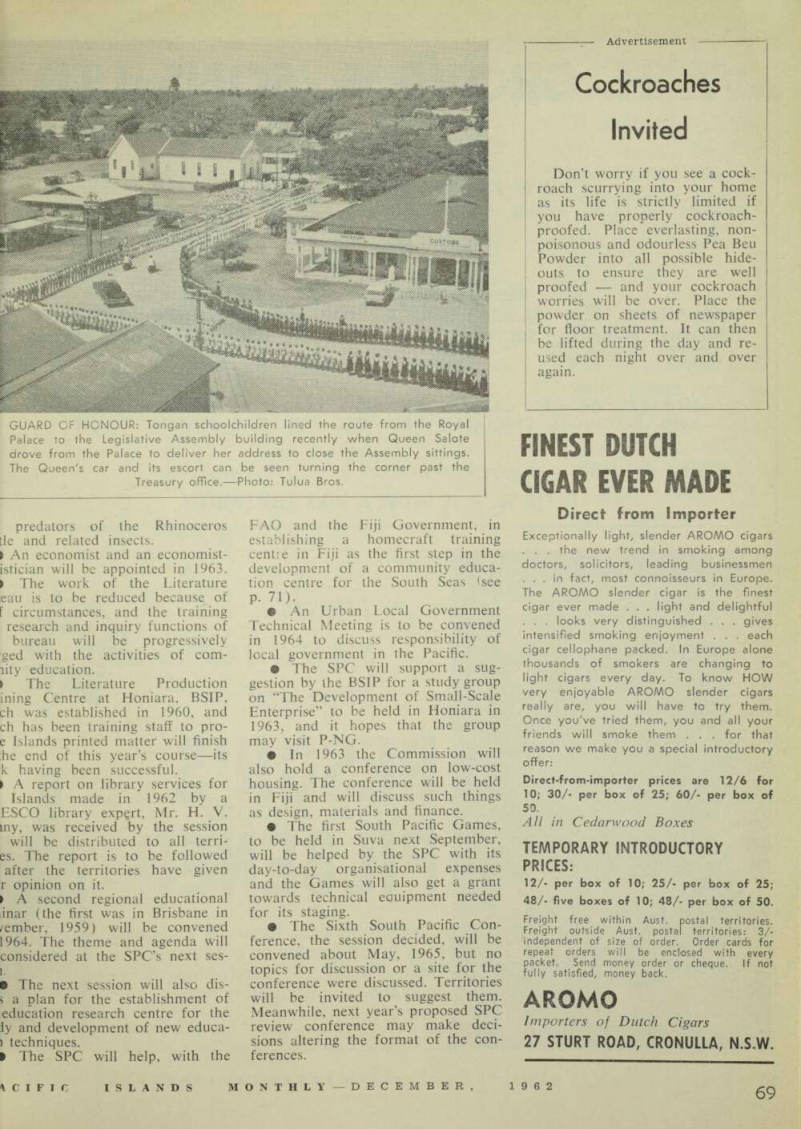 71
71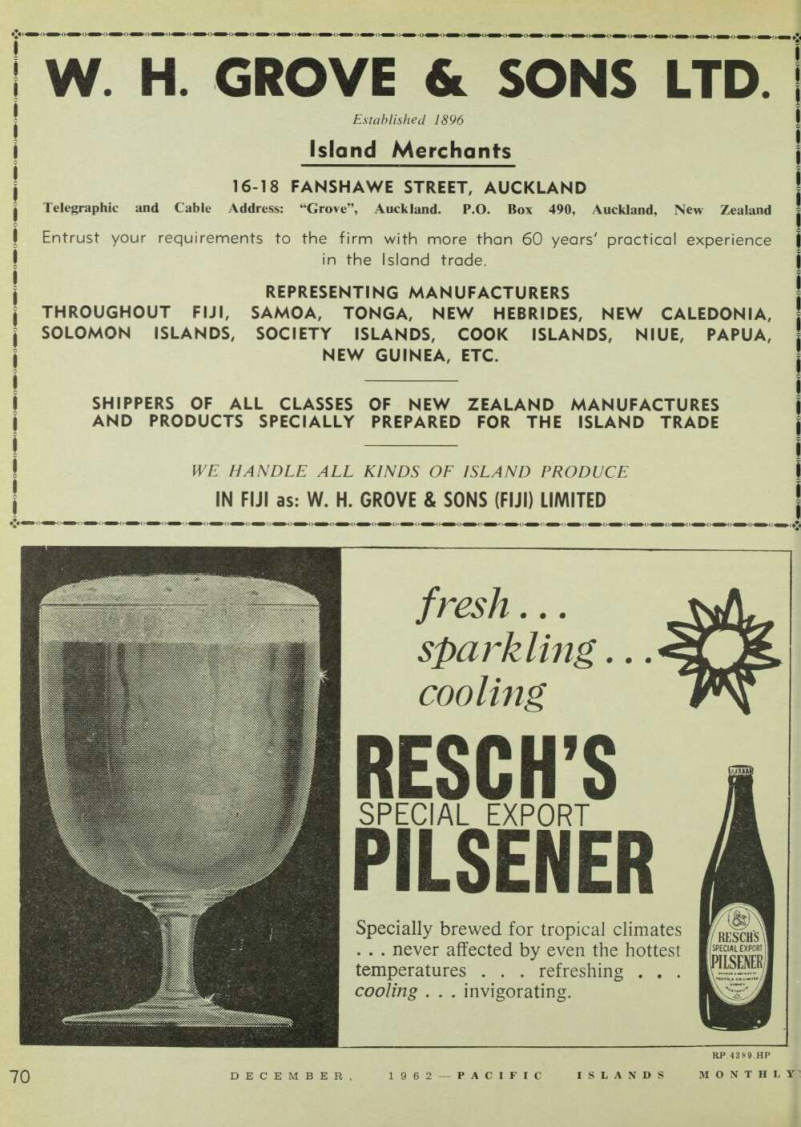 72
72 73
73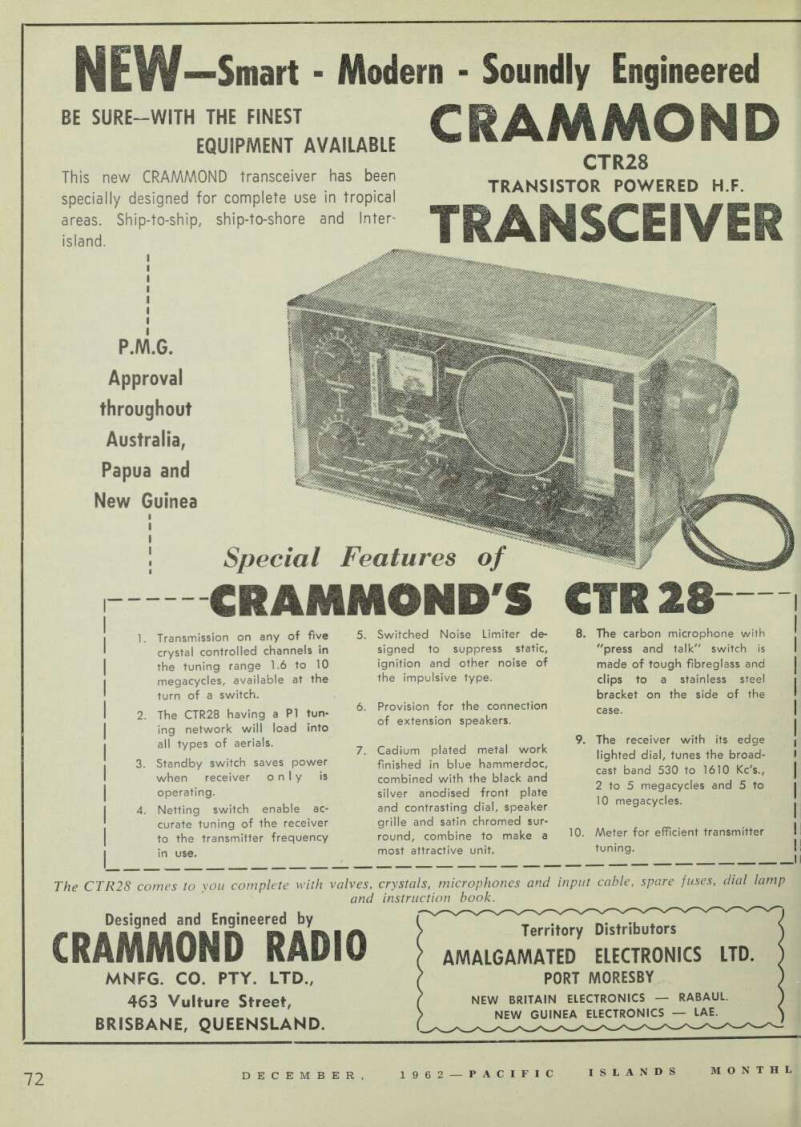 74
74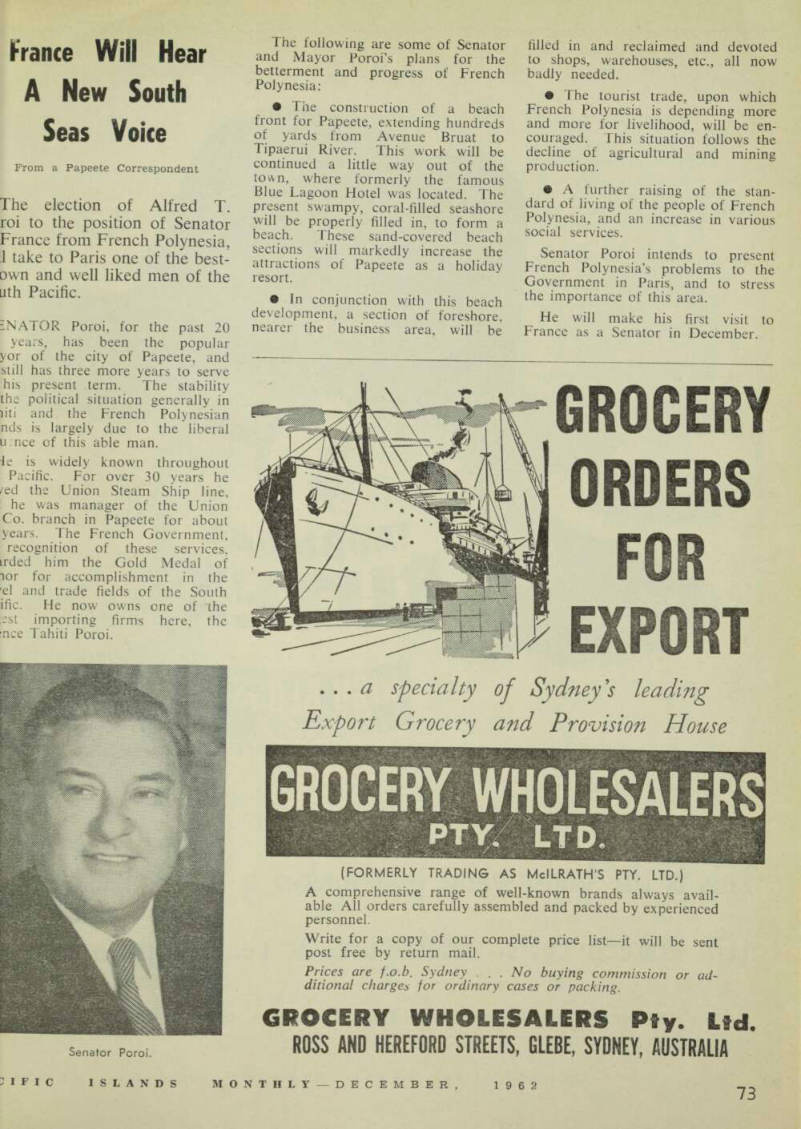 75
75 76
76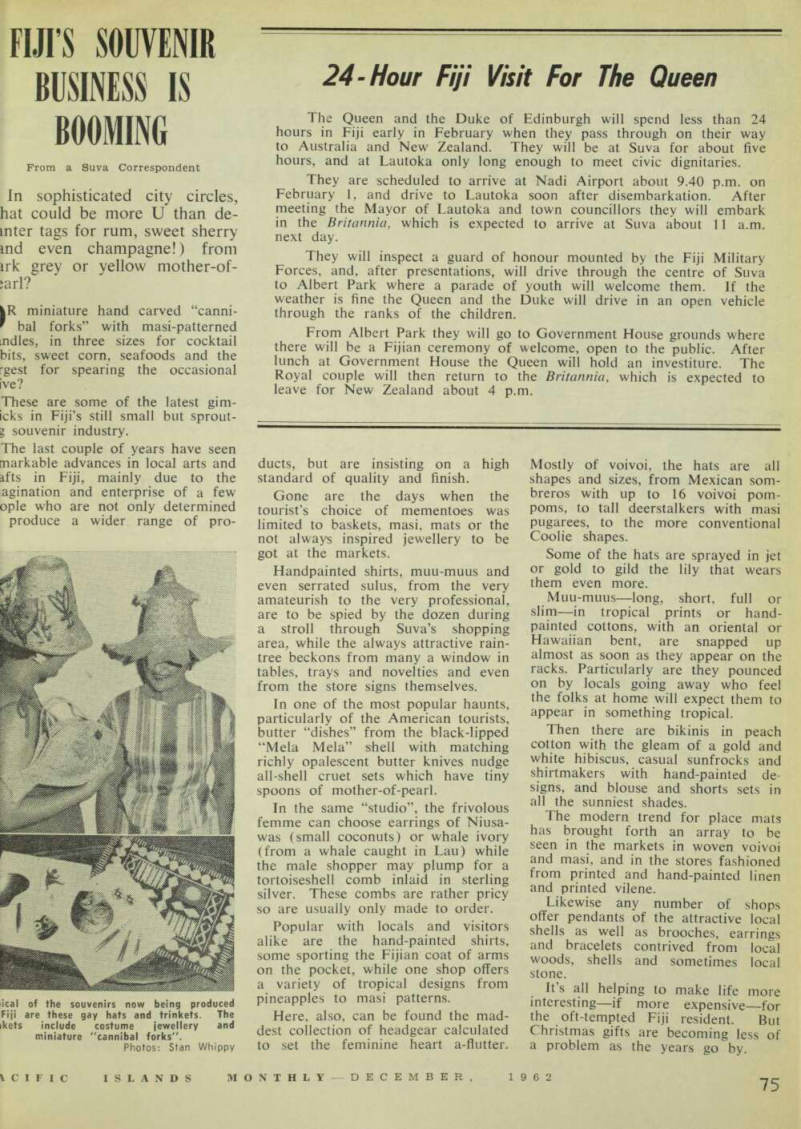 77
77 78
78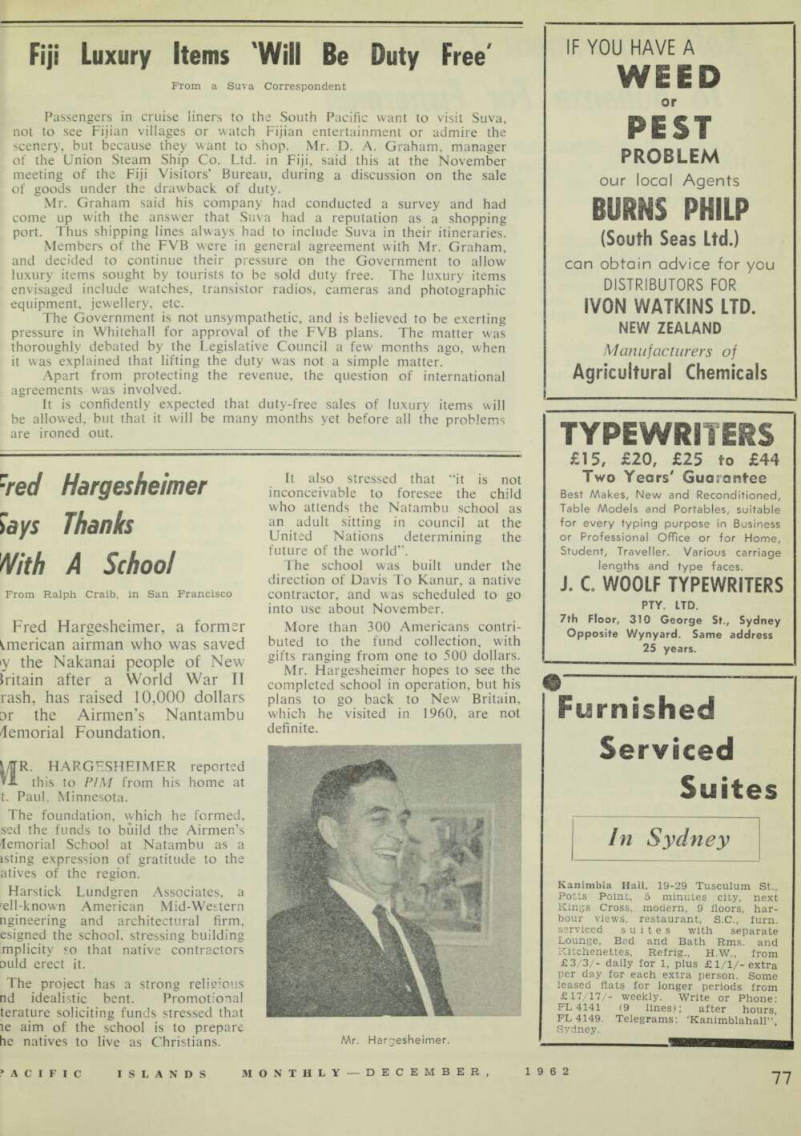 79
79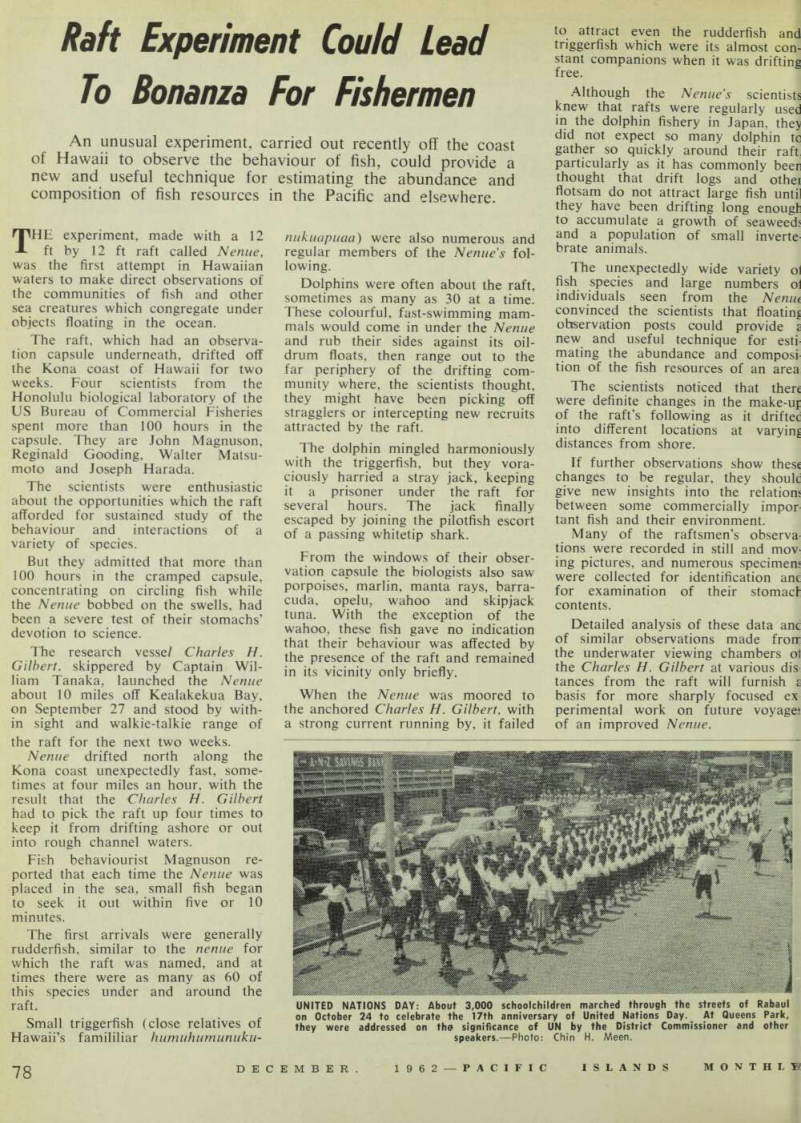 80
80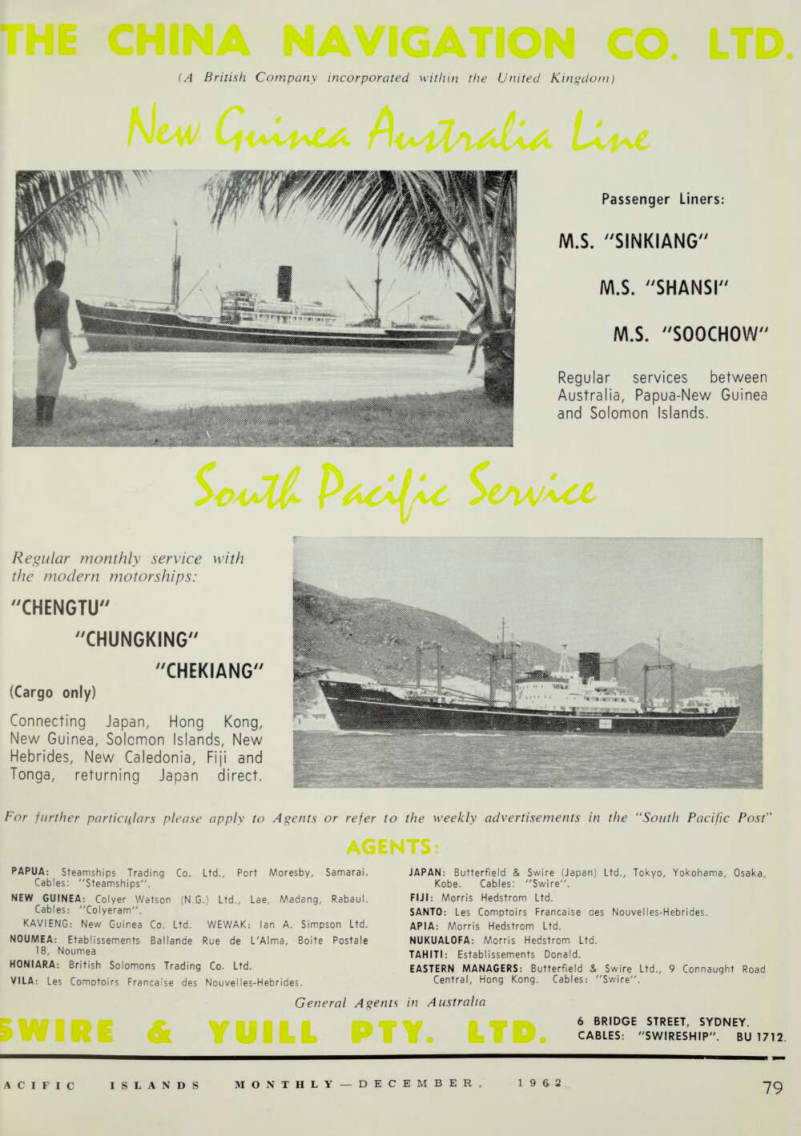 81
81 82
82 83
83 84
84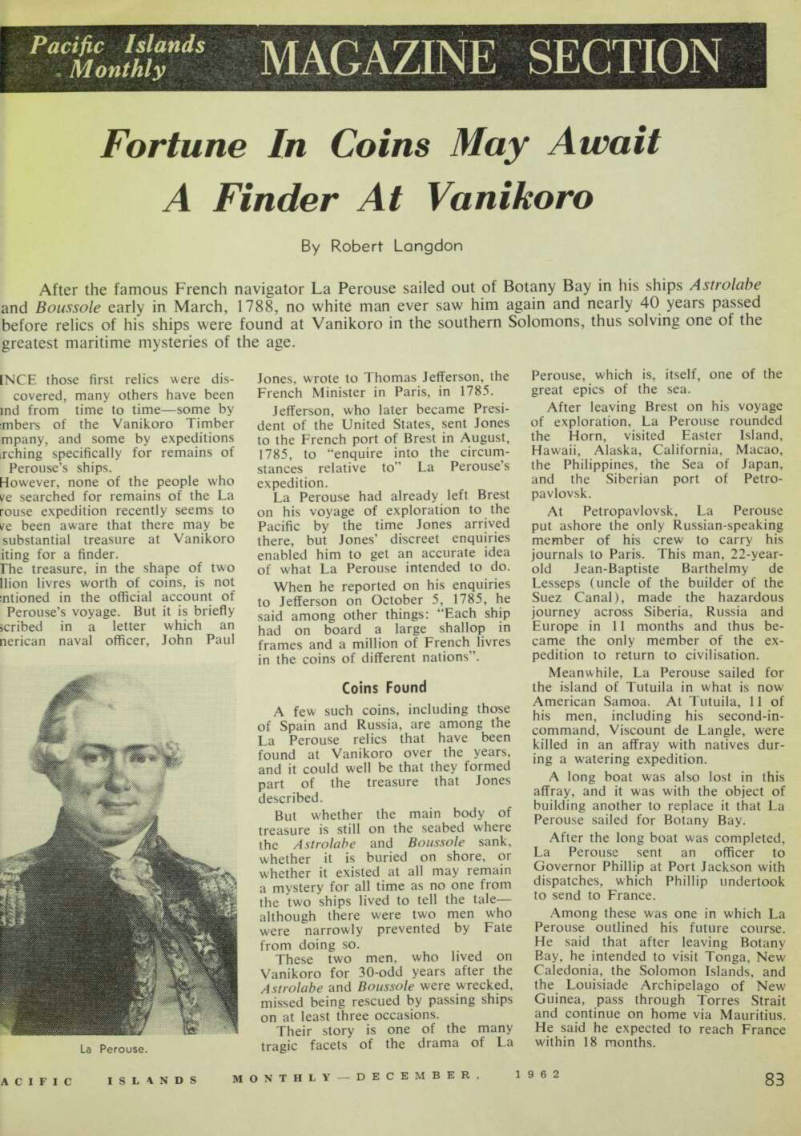 85
85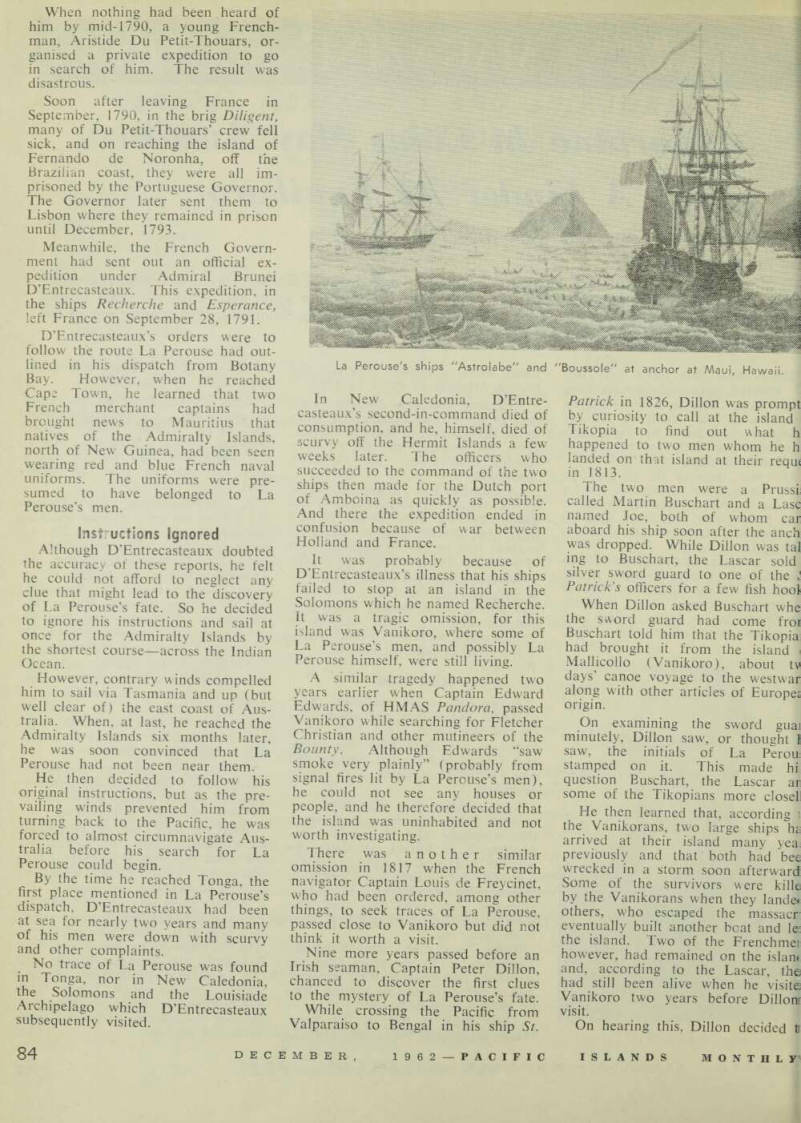 86
86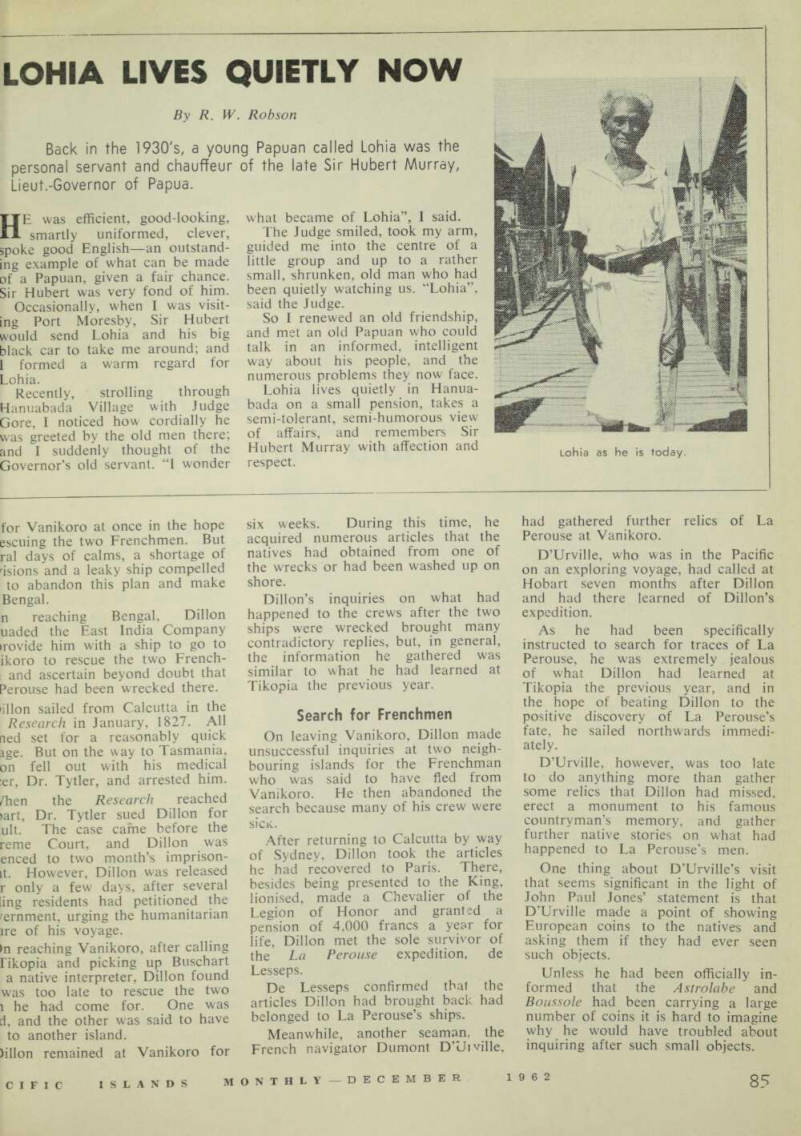 87
87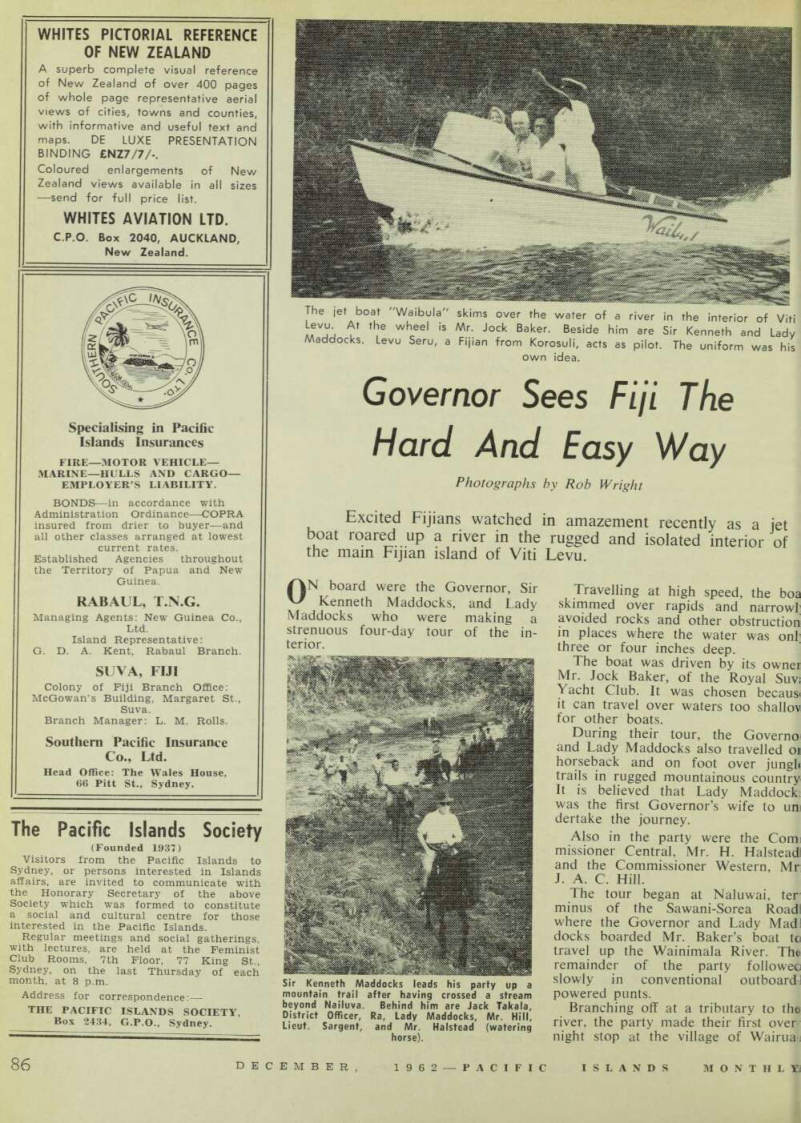 88
88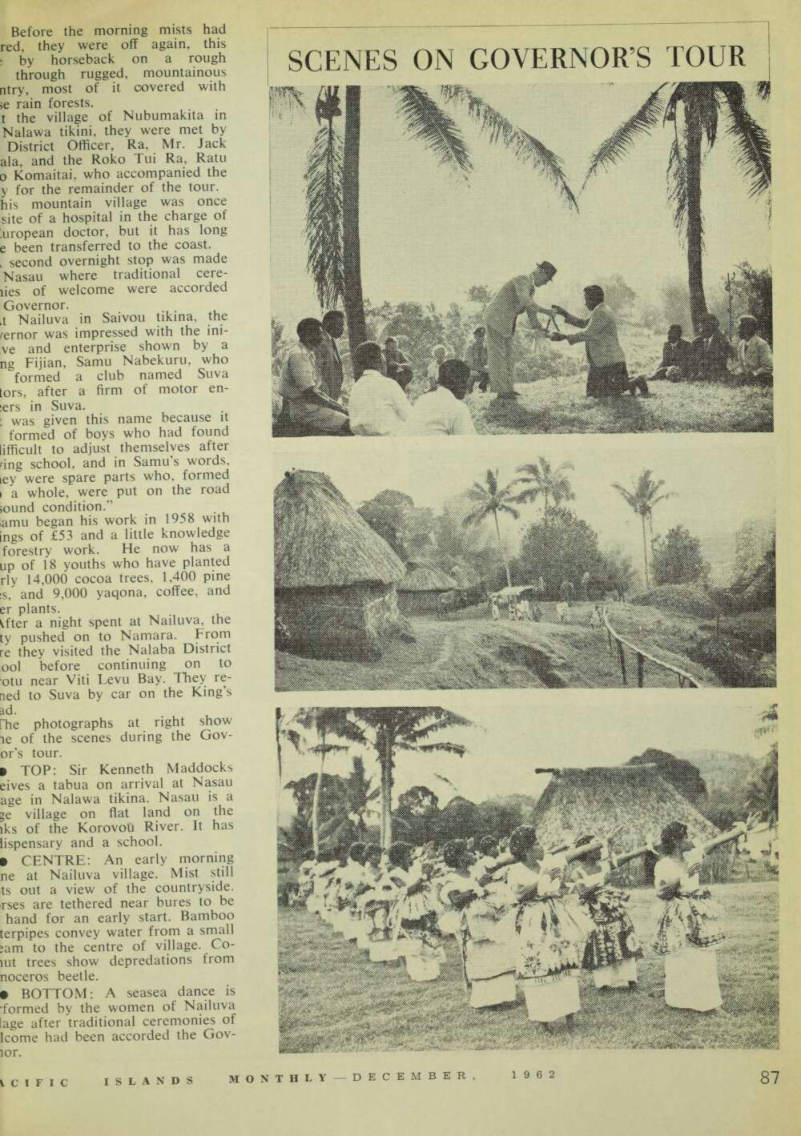 89
89 90
90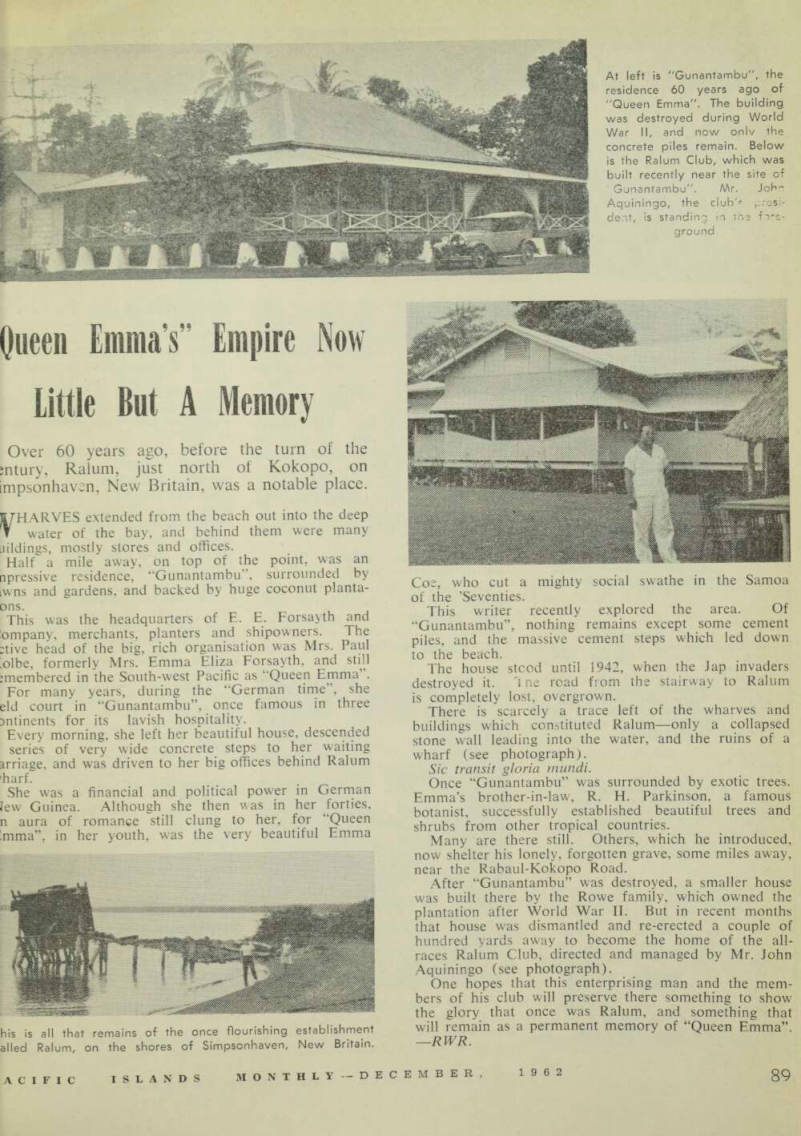 91
91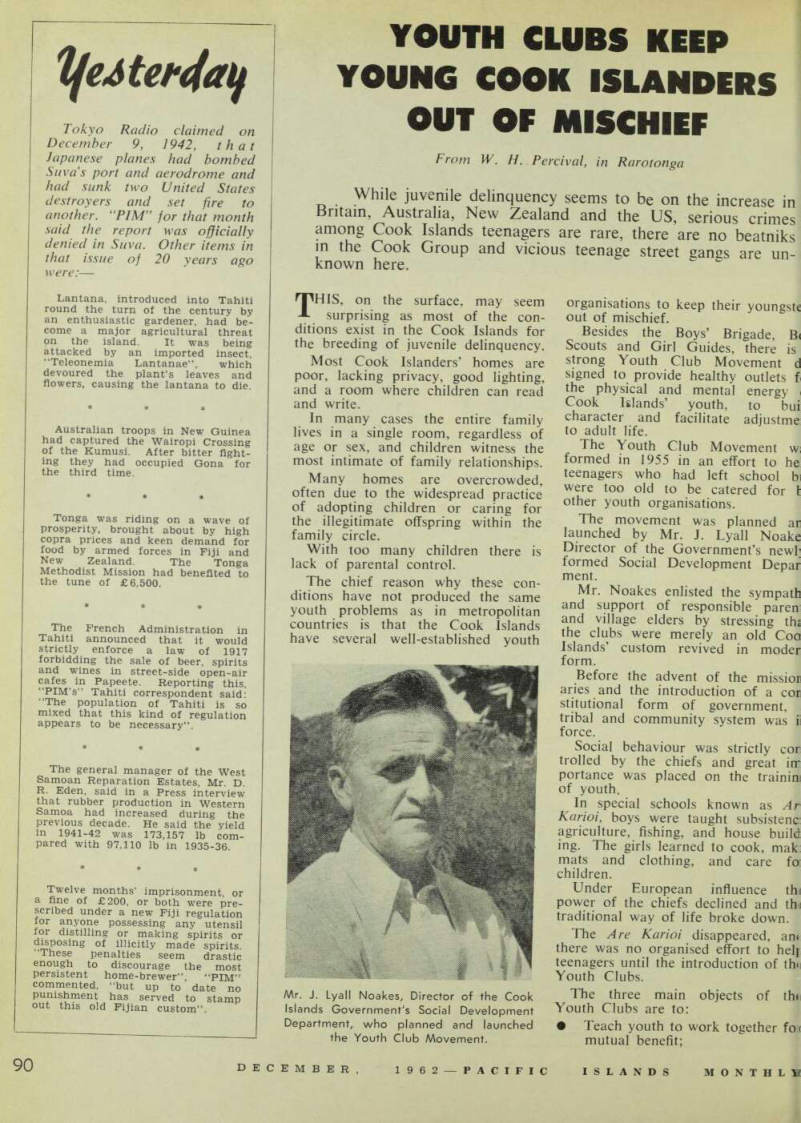 92
92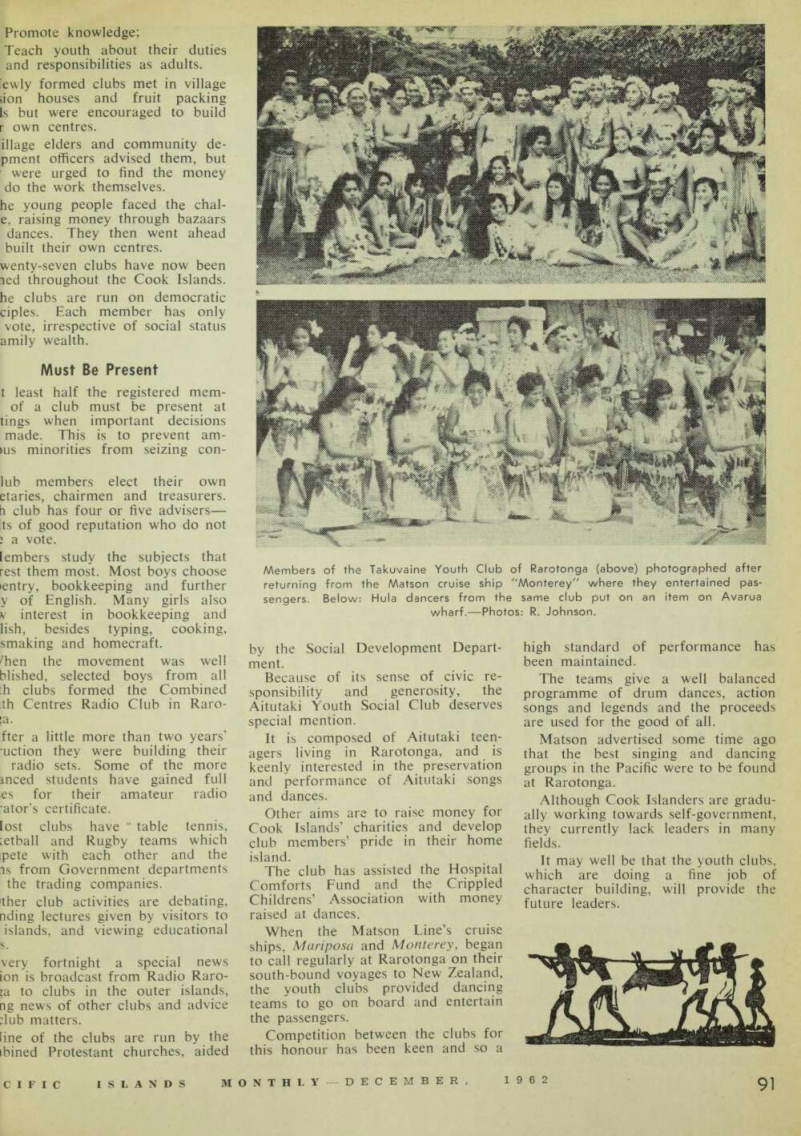 93
93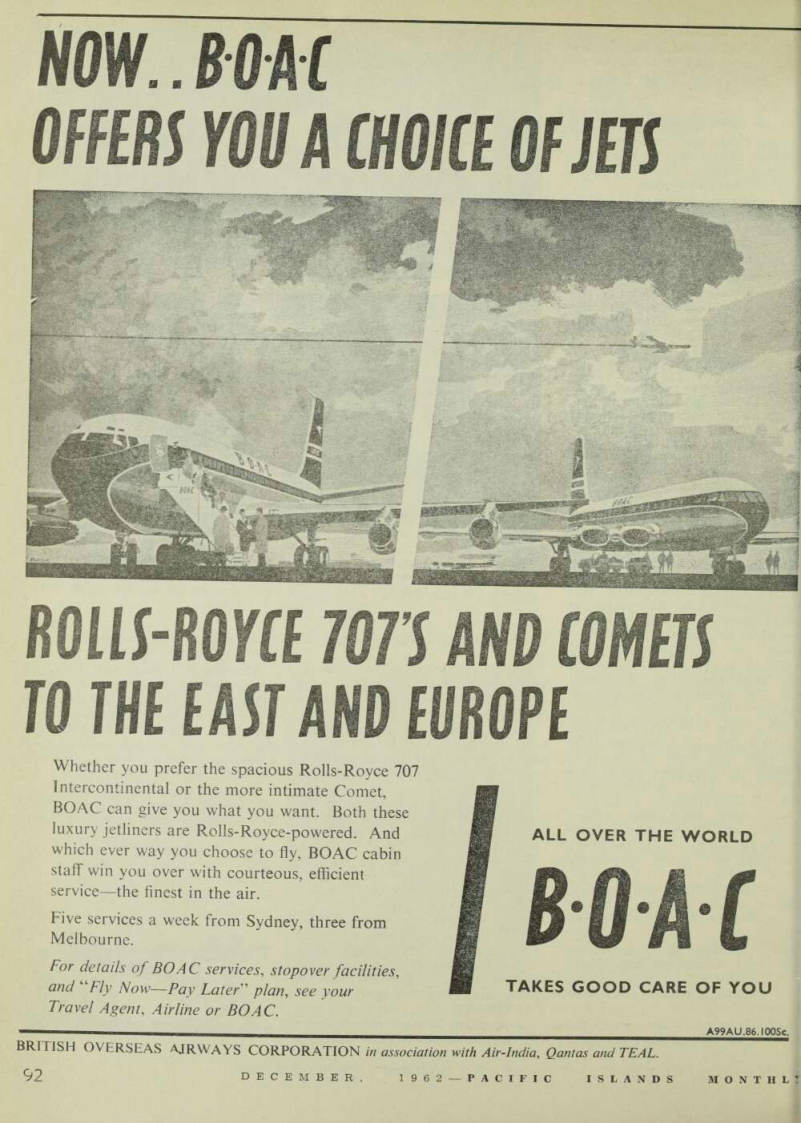 94
94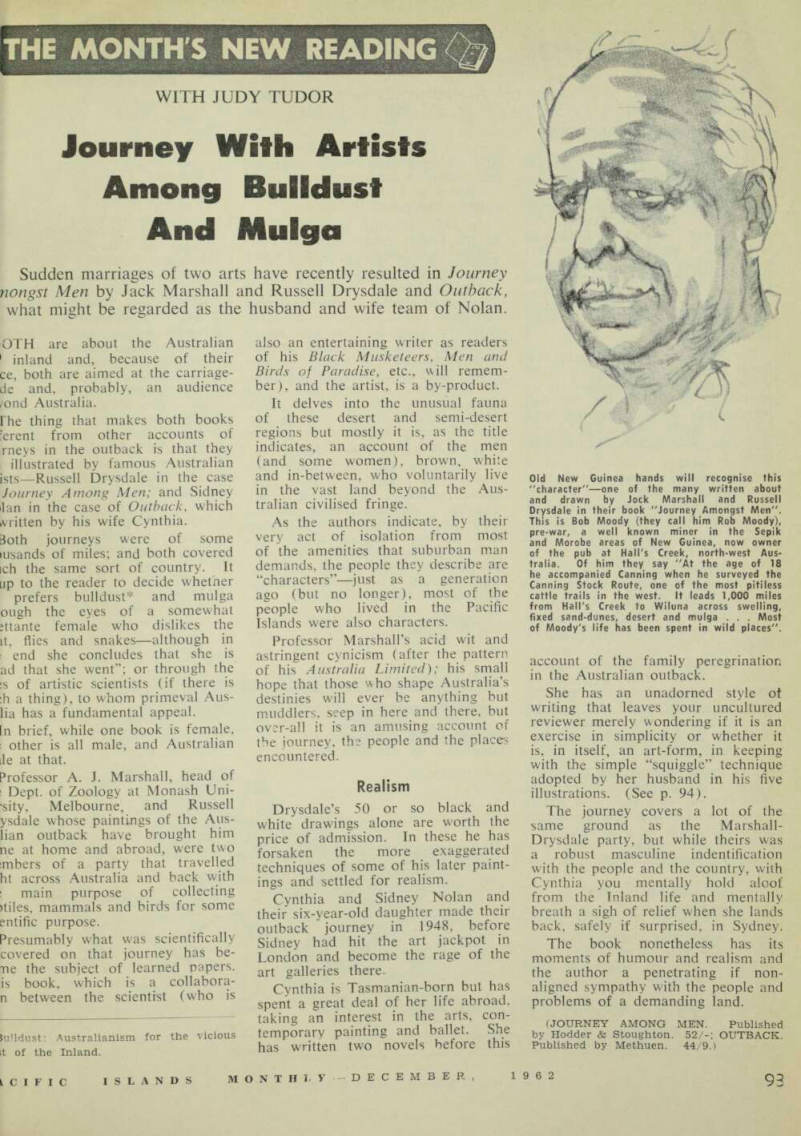 95
95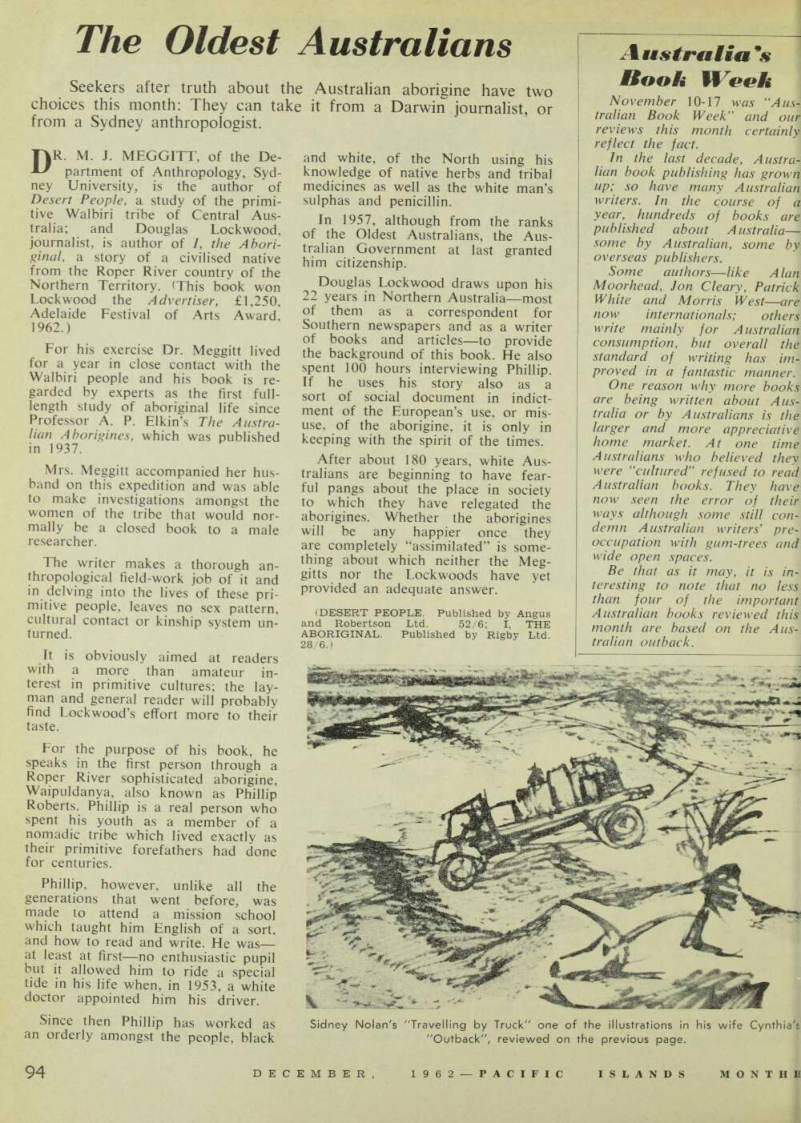 96
96 97
97 98
98 99
99 100
100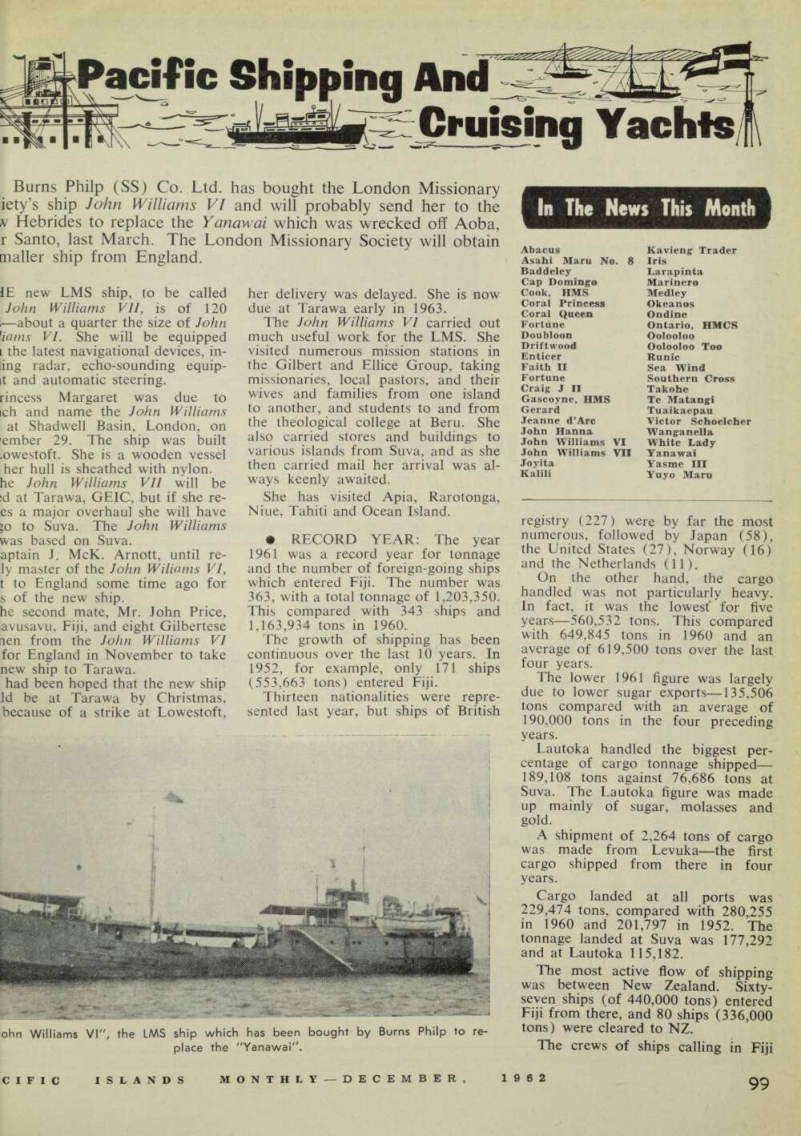 101
101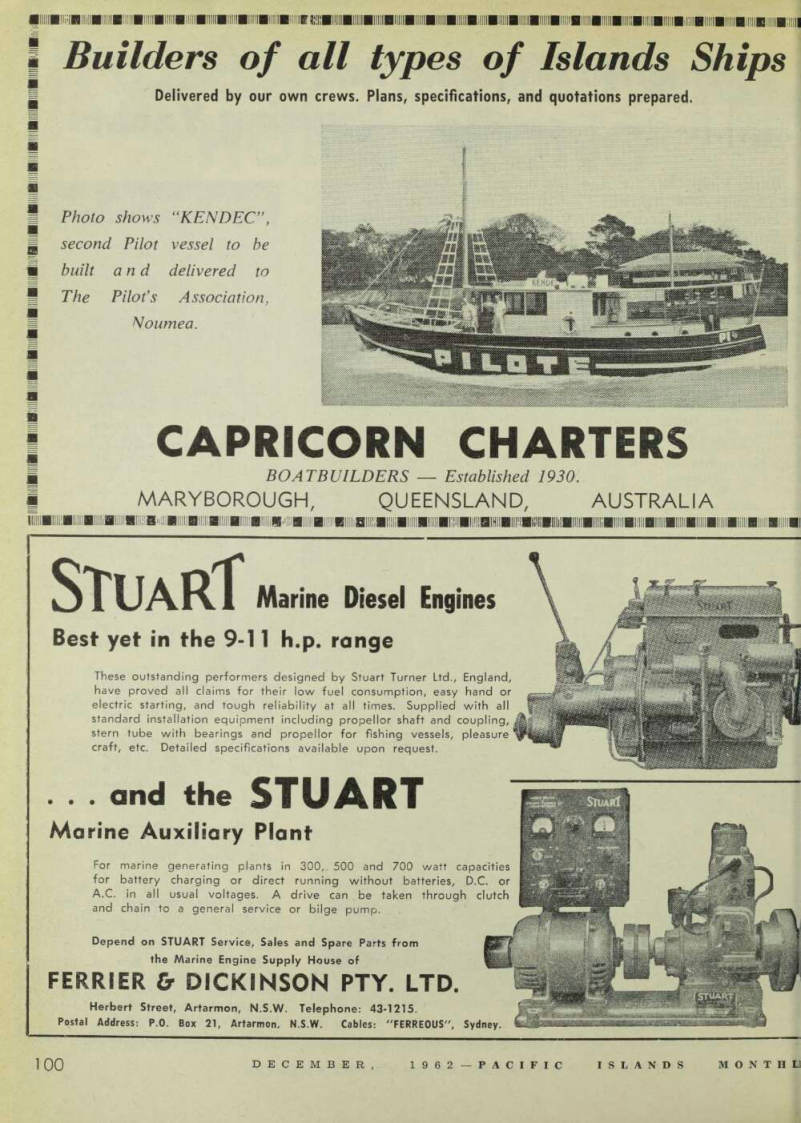 102
102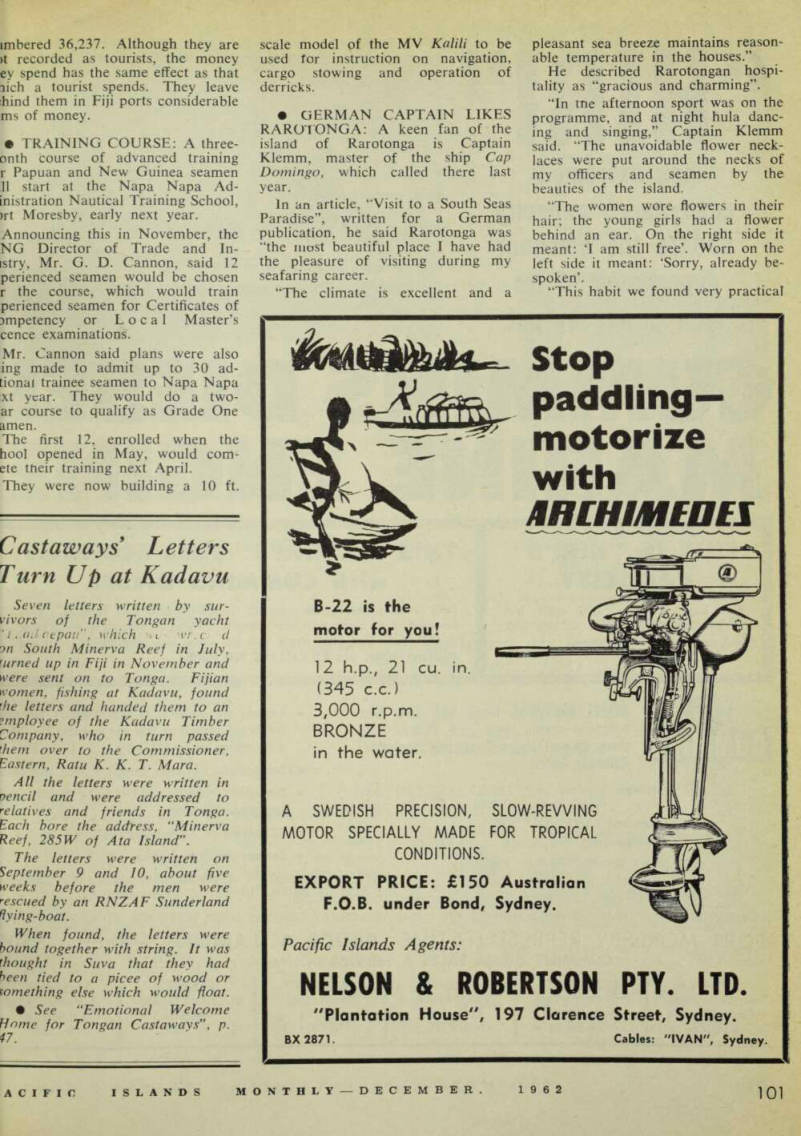 103
103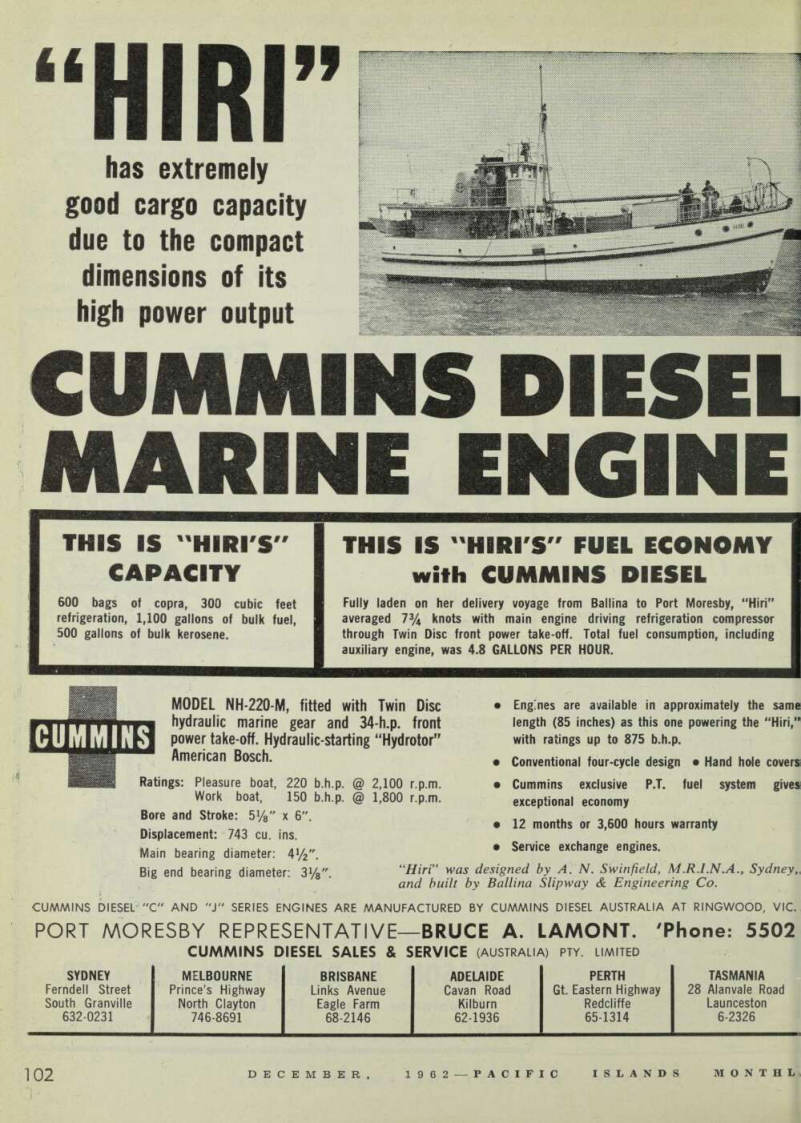 104
104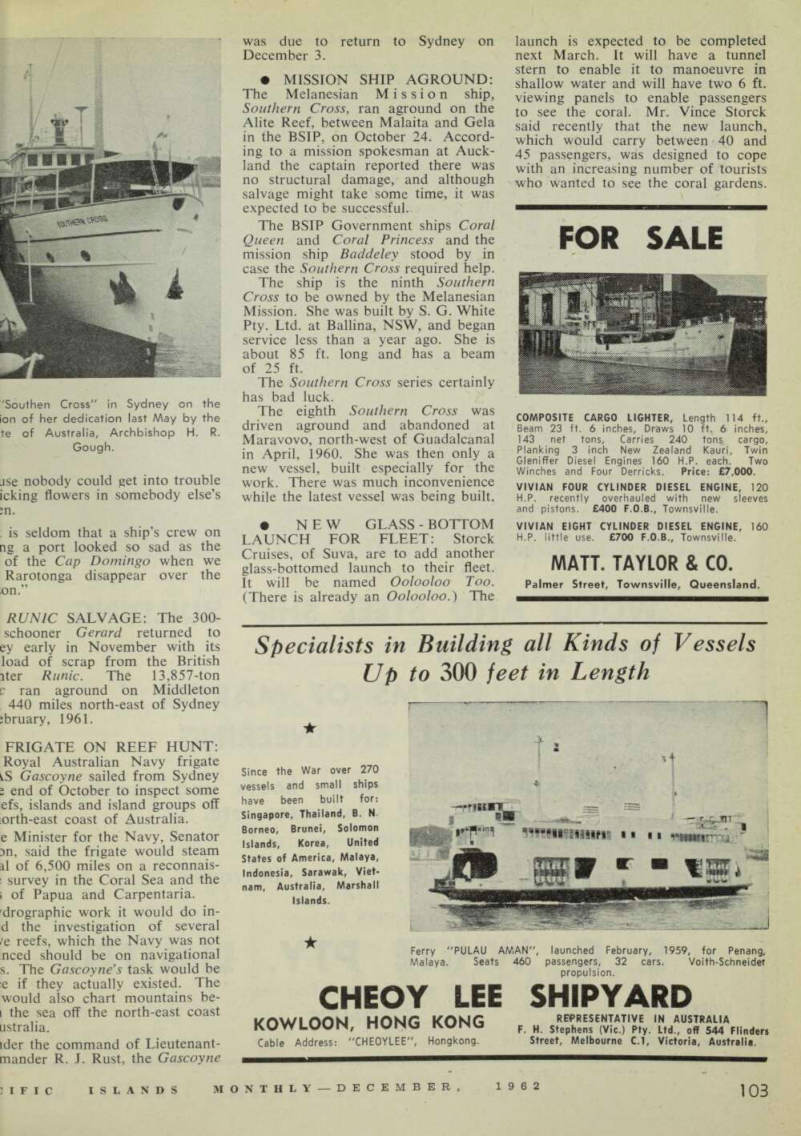 105
105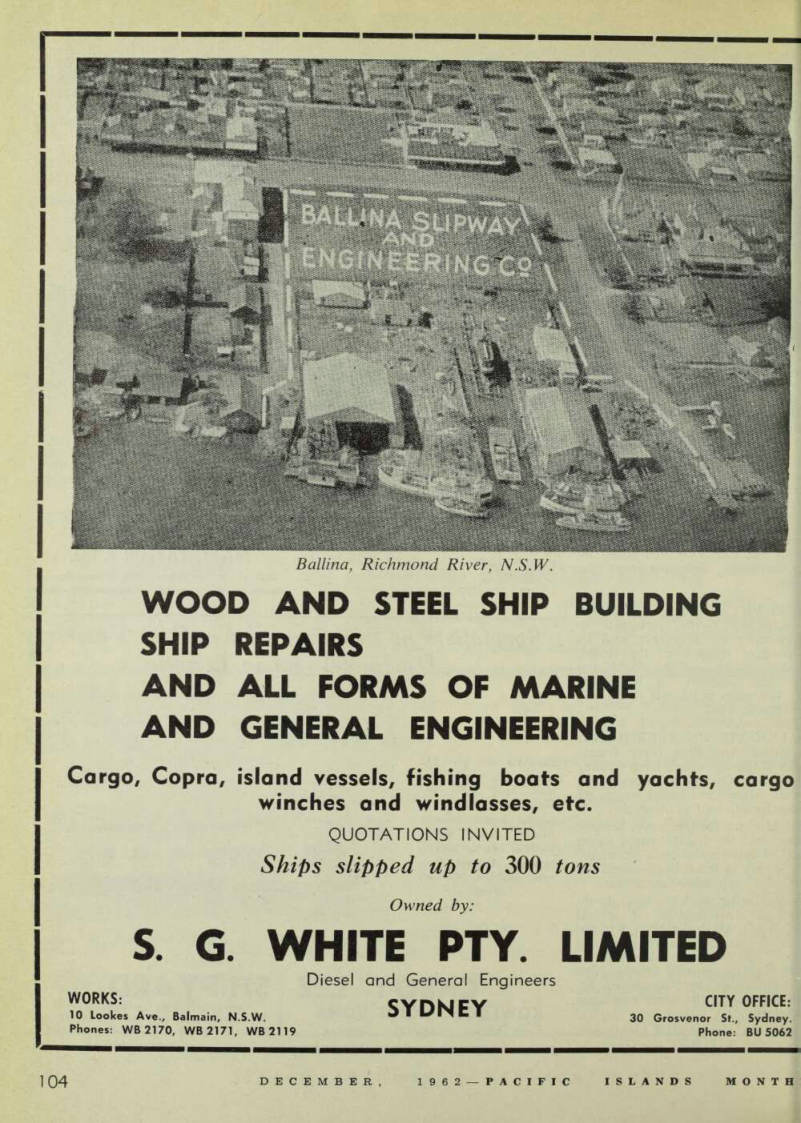 106
106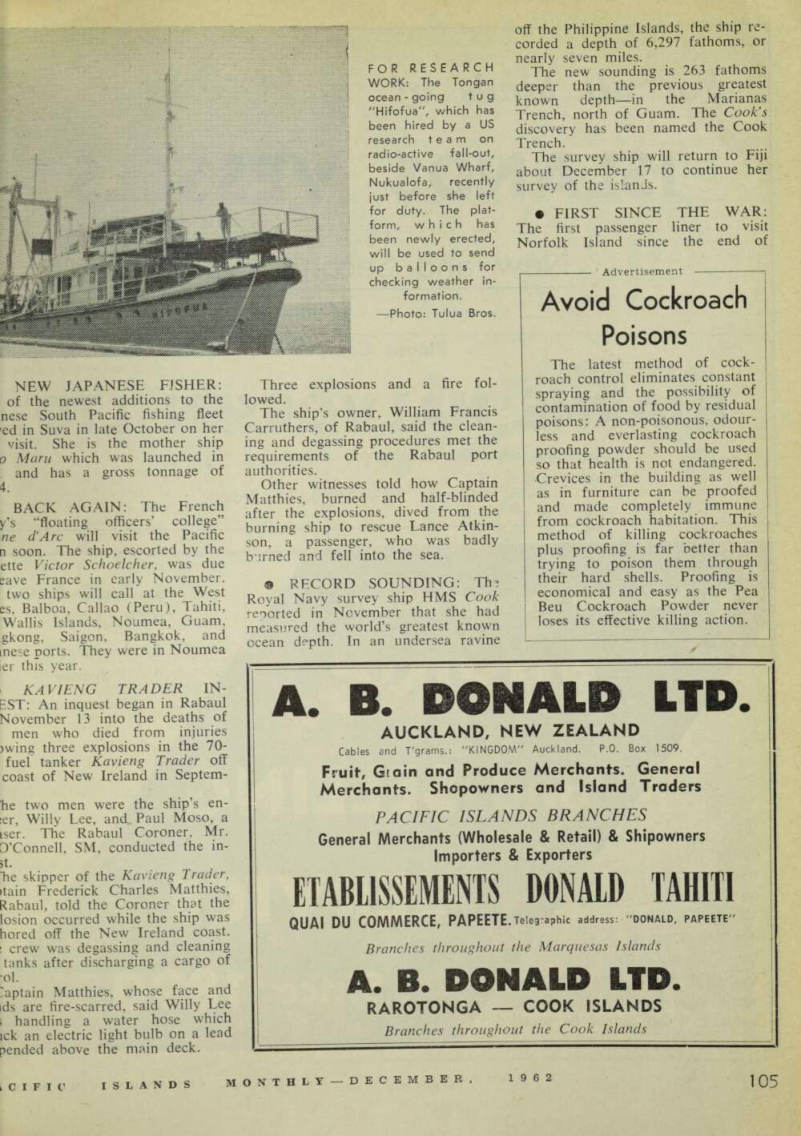 107
107 108
108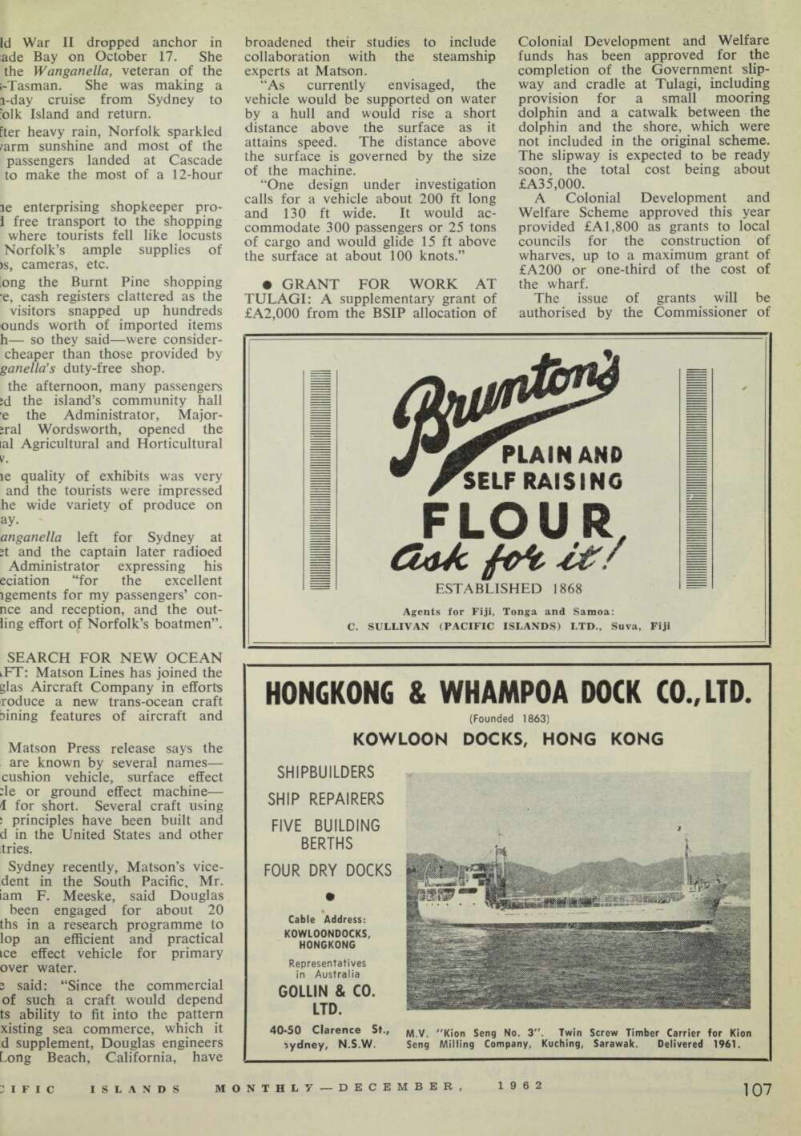 109
109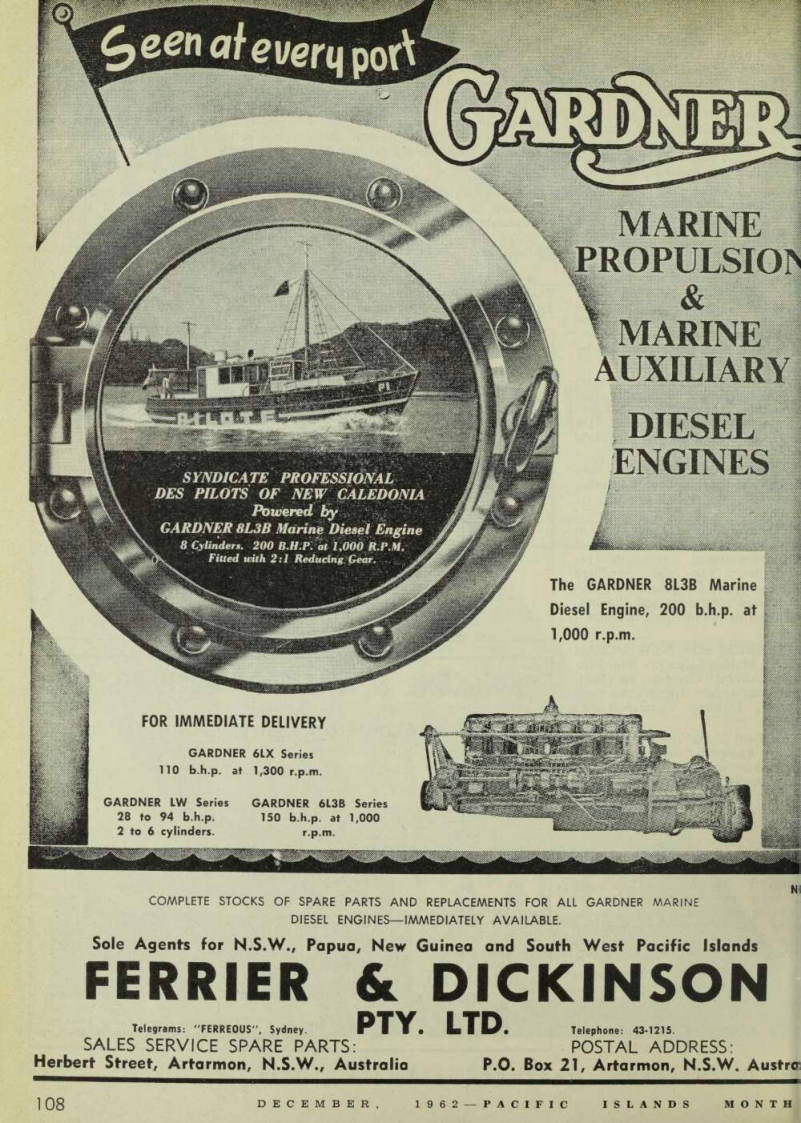 110
110 111
111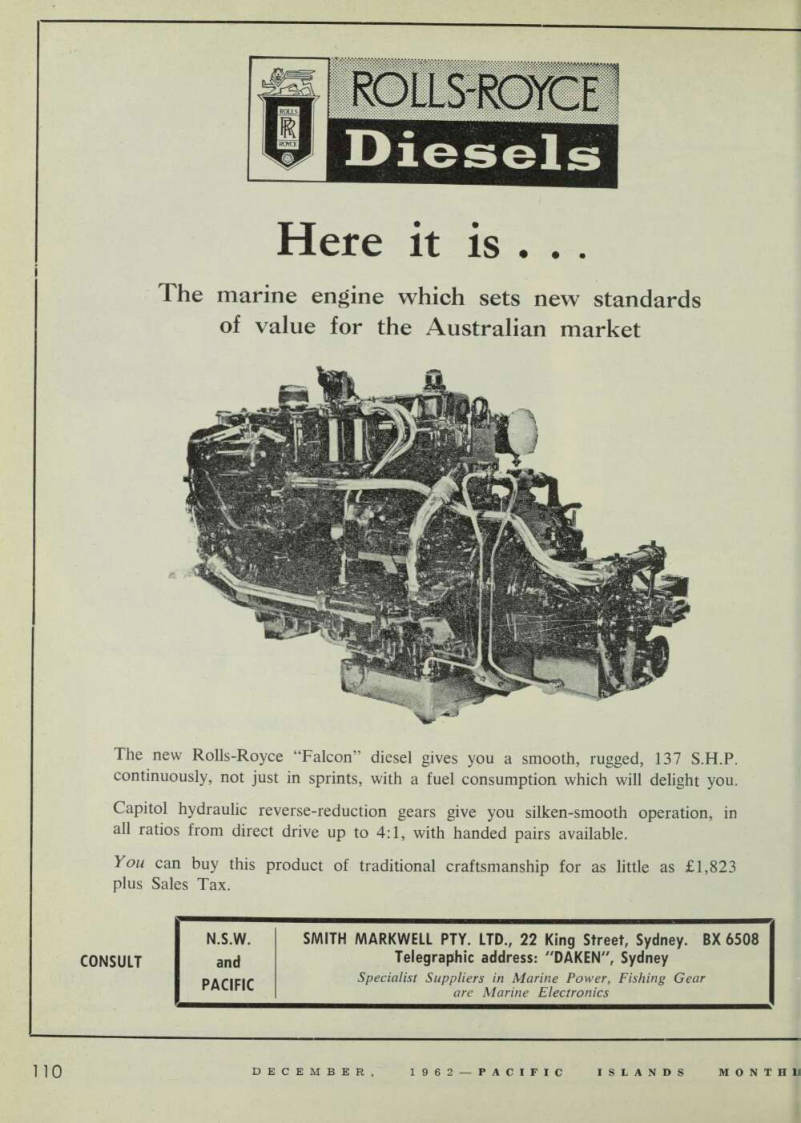 112
112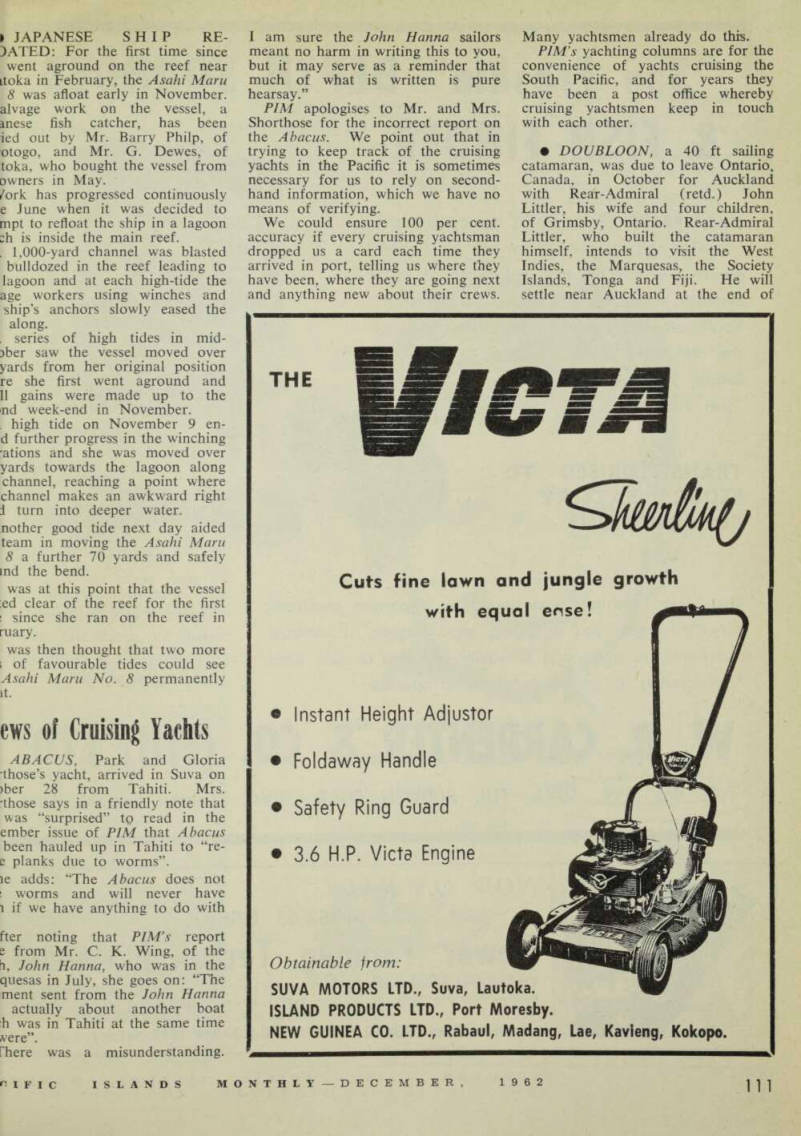 113
113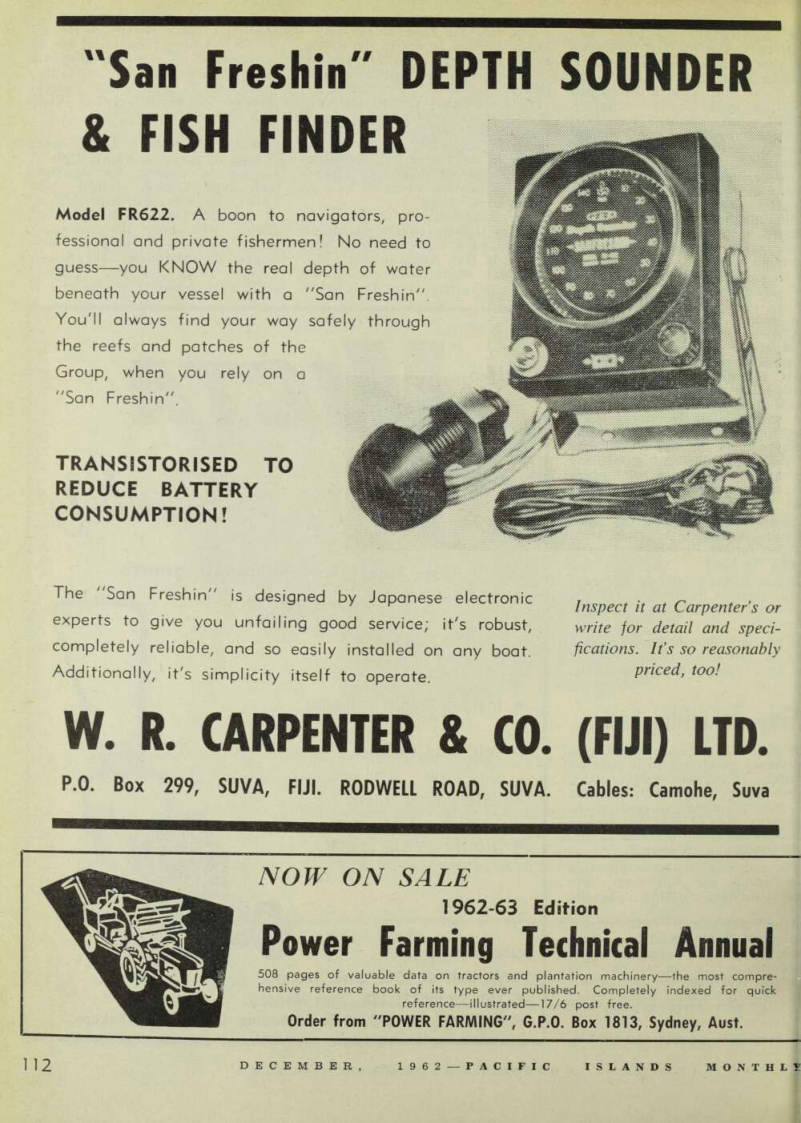 114
114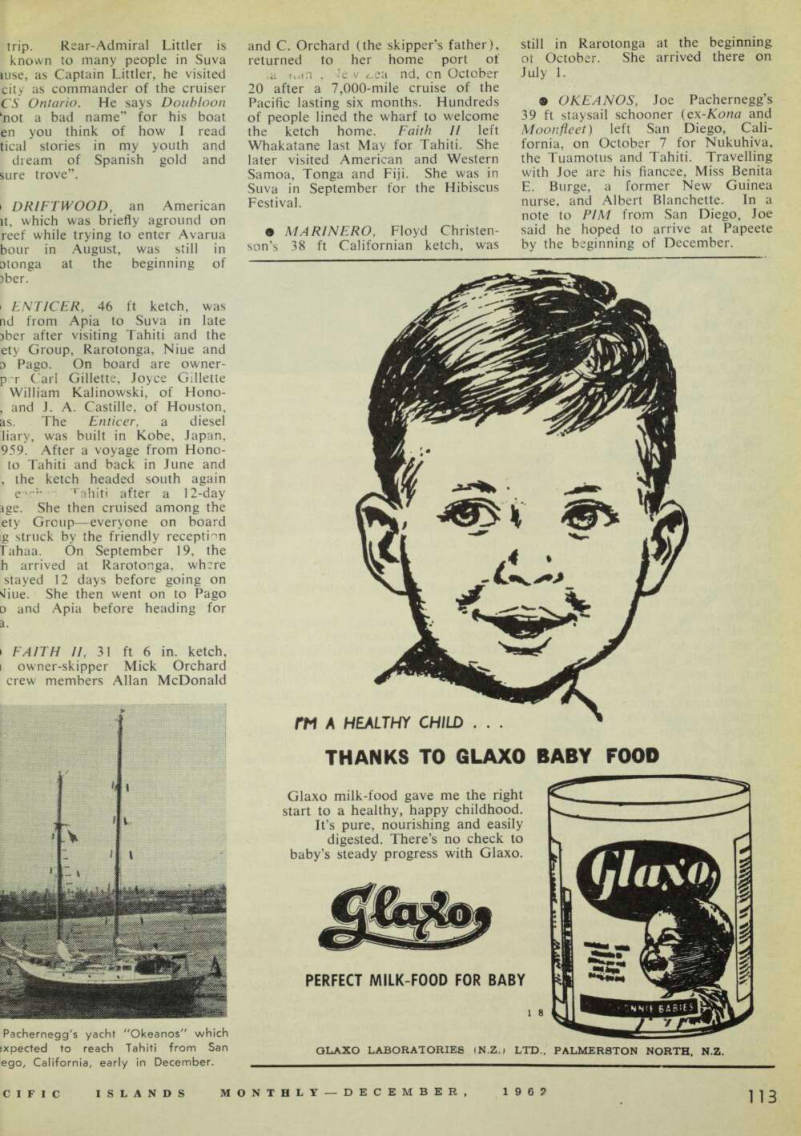 115
115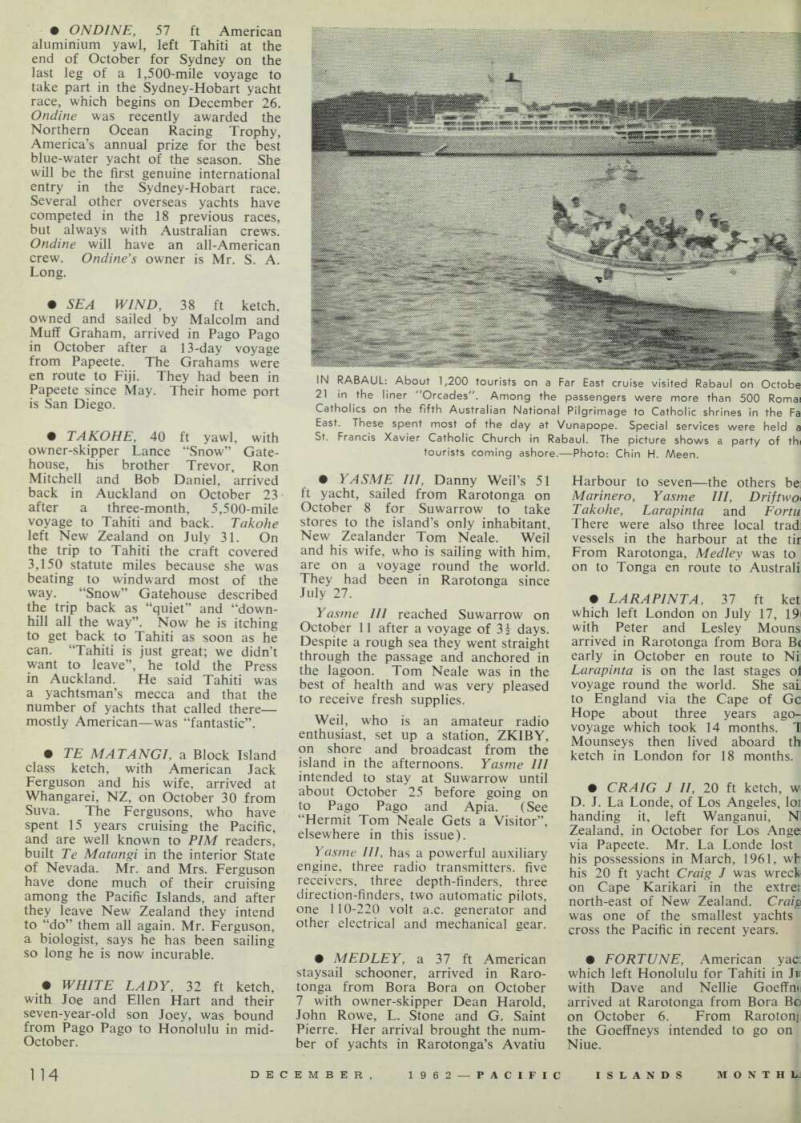 116
116 117
117 118
118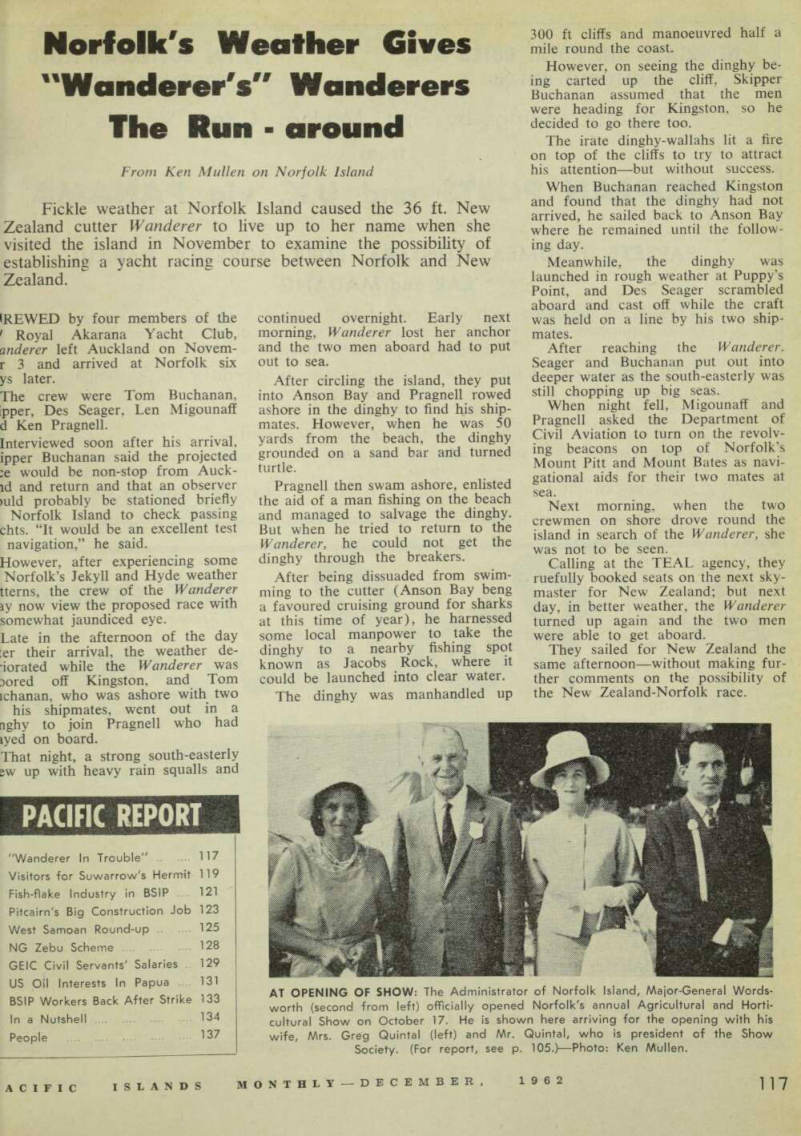 119
119 120
120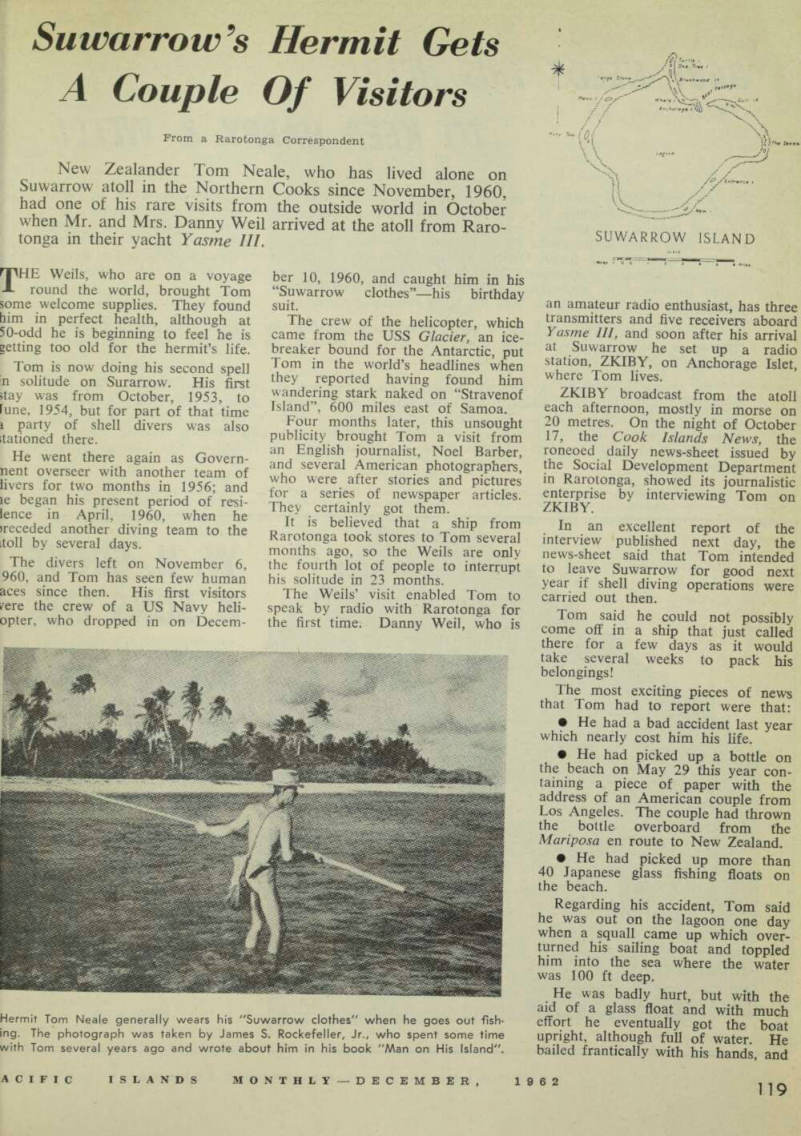 121
121 122
122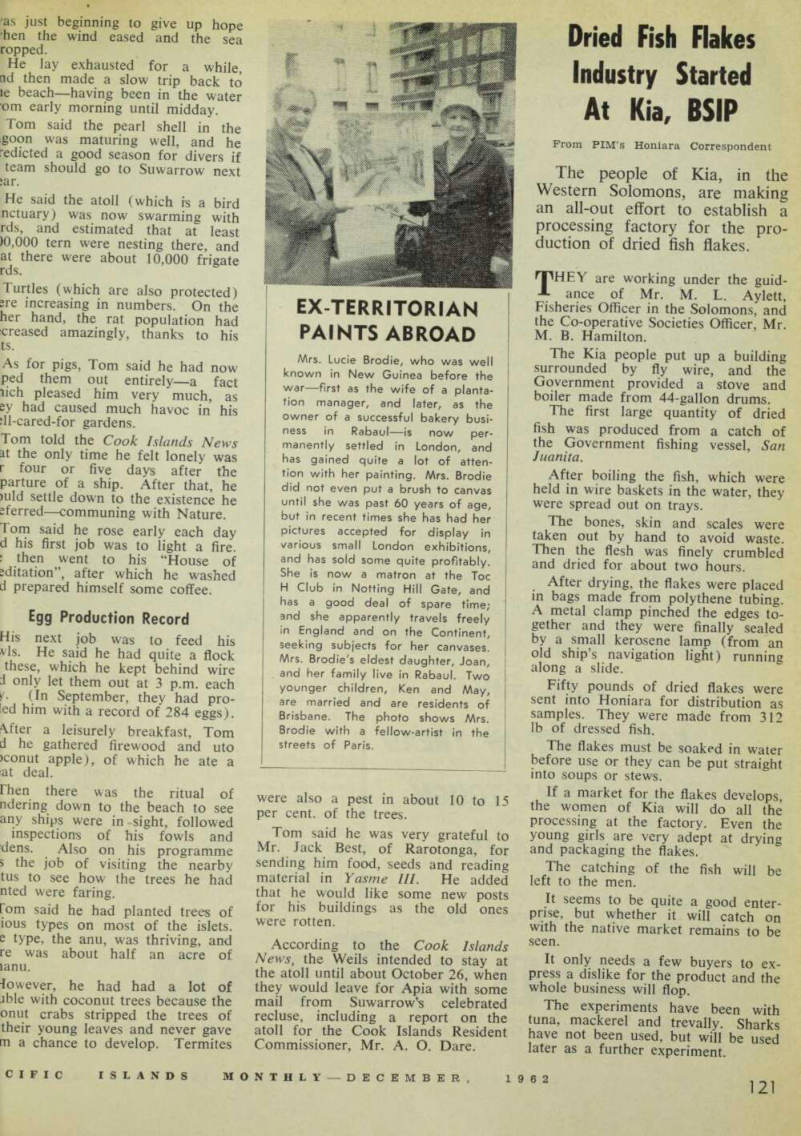 123
123 124
124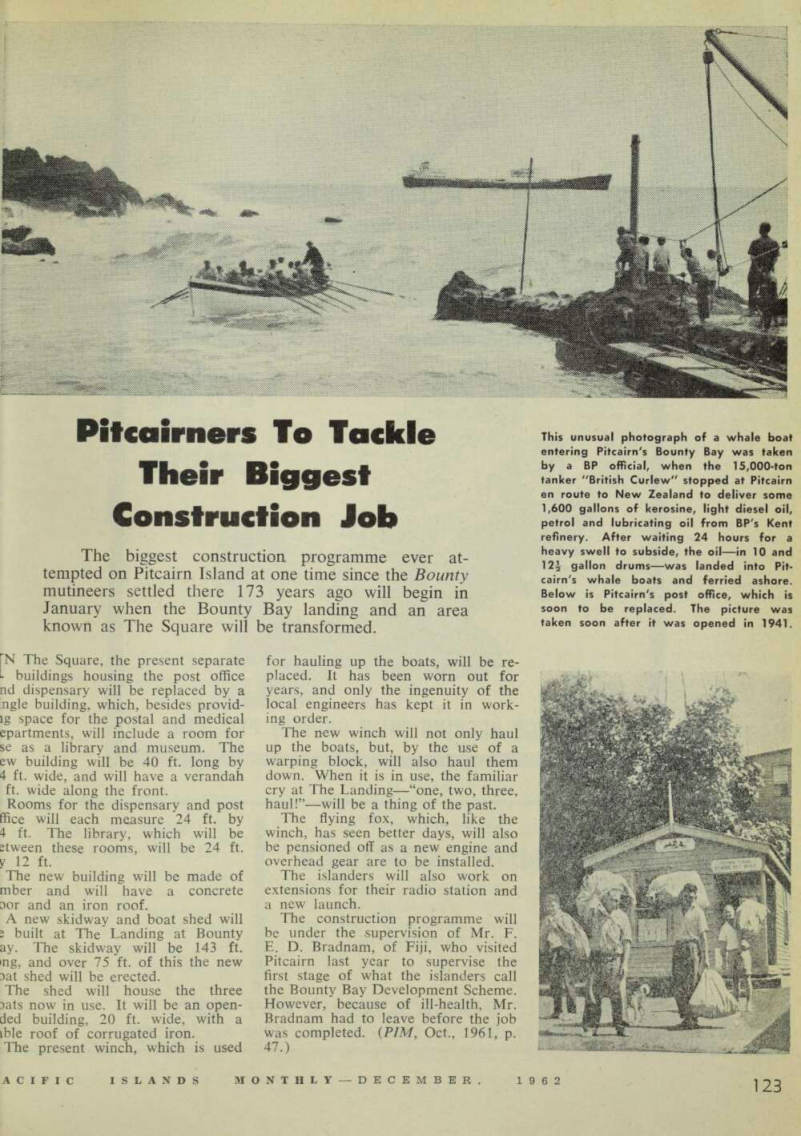 125
125 126
126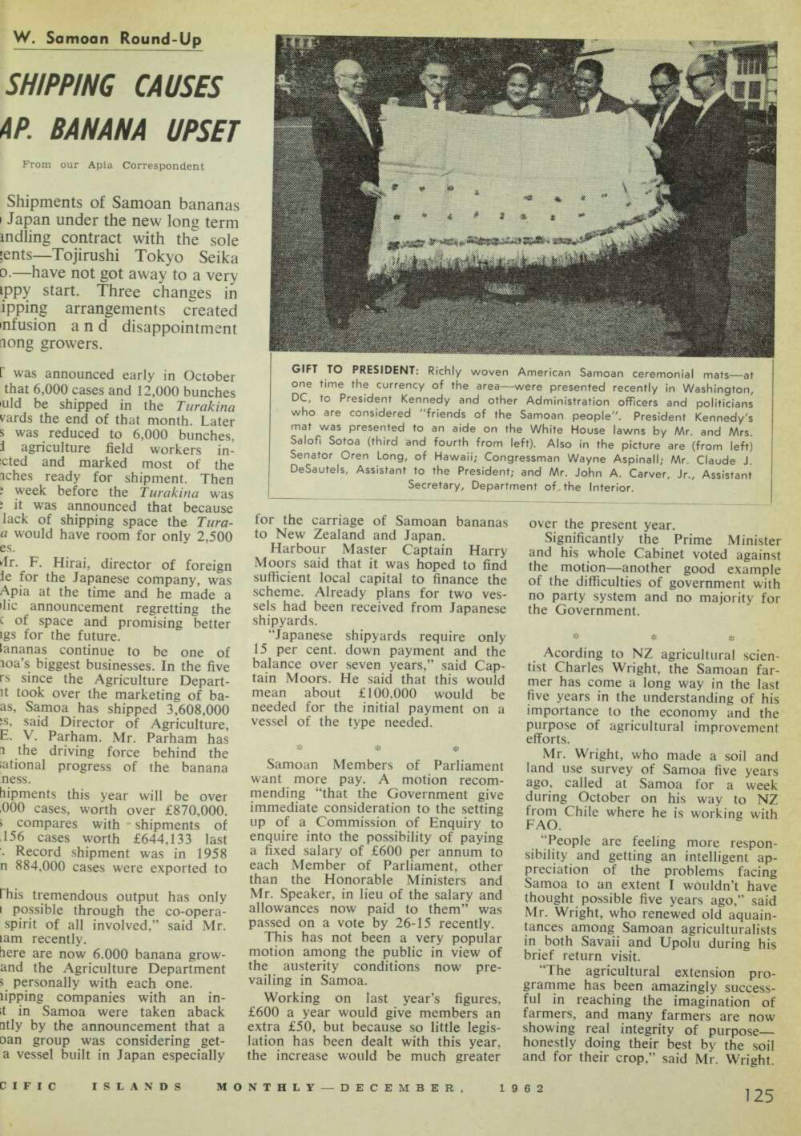 127
127 128
128 129
129 130
130 131
131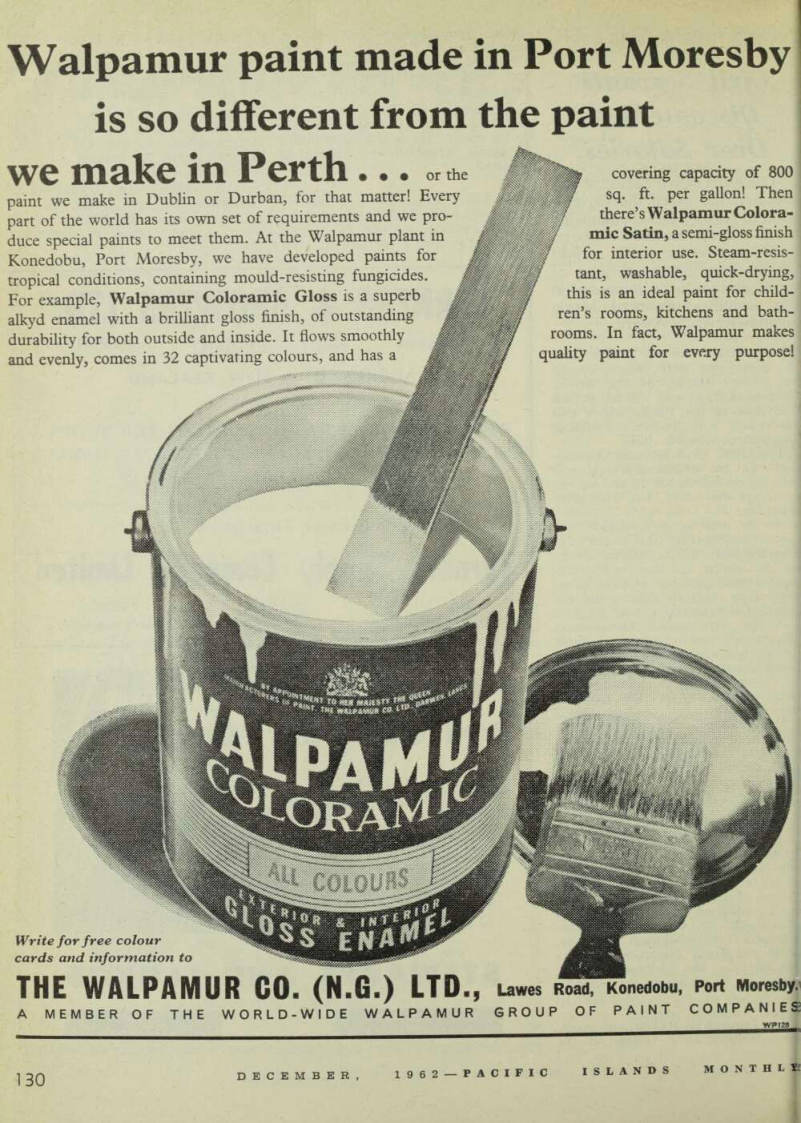 132
132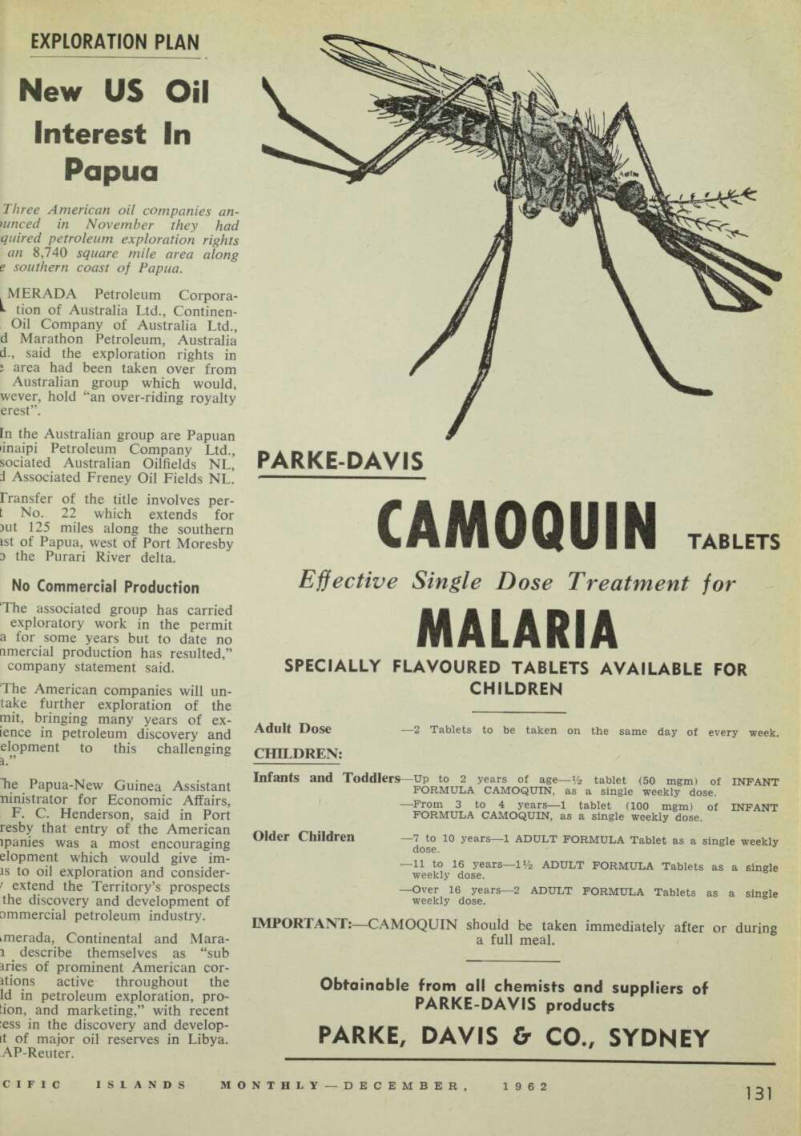 133
133 134
134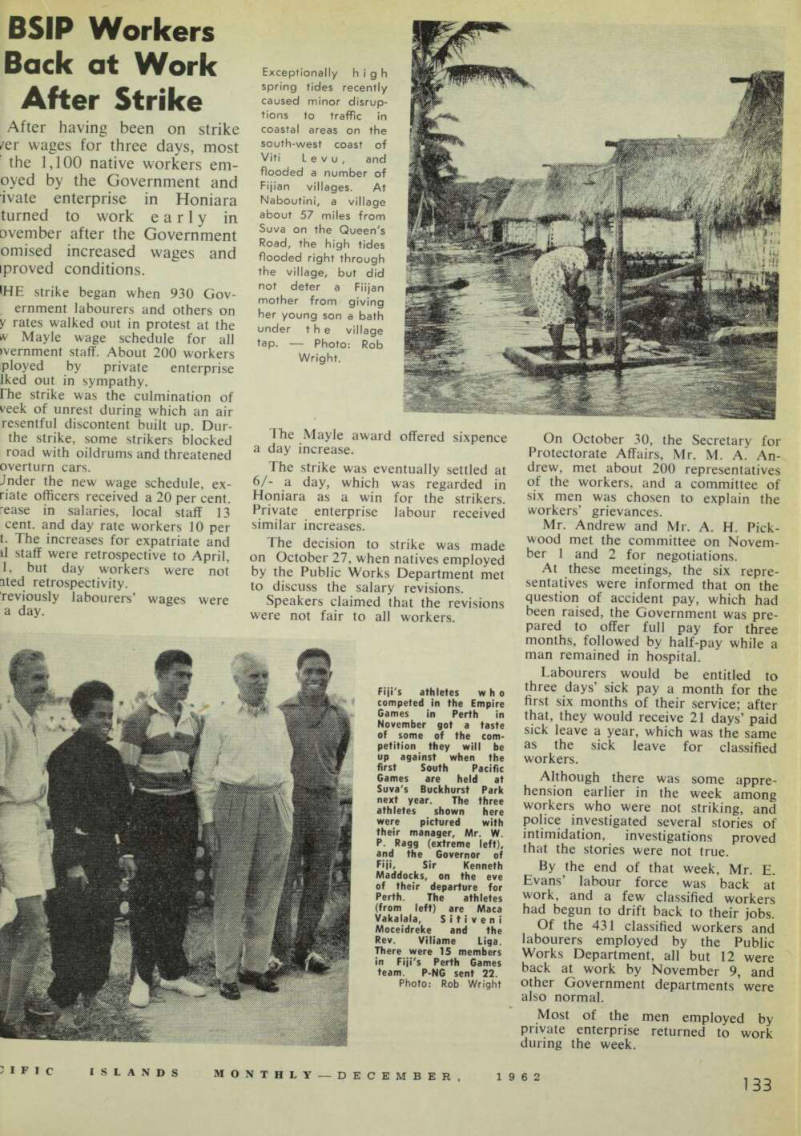 135
135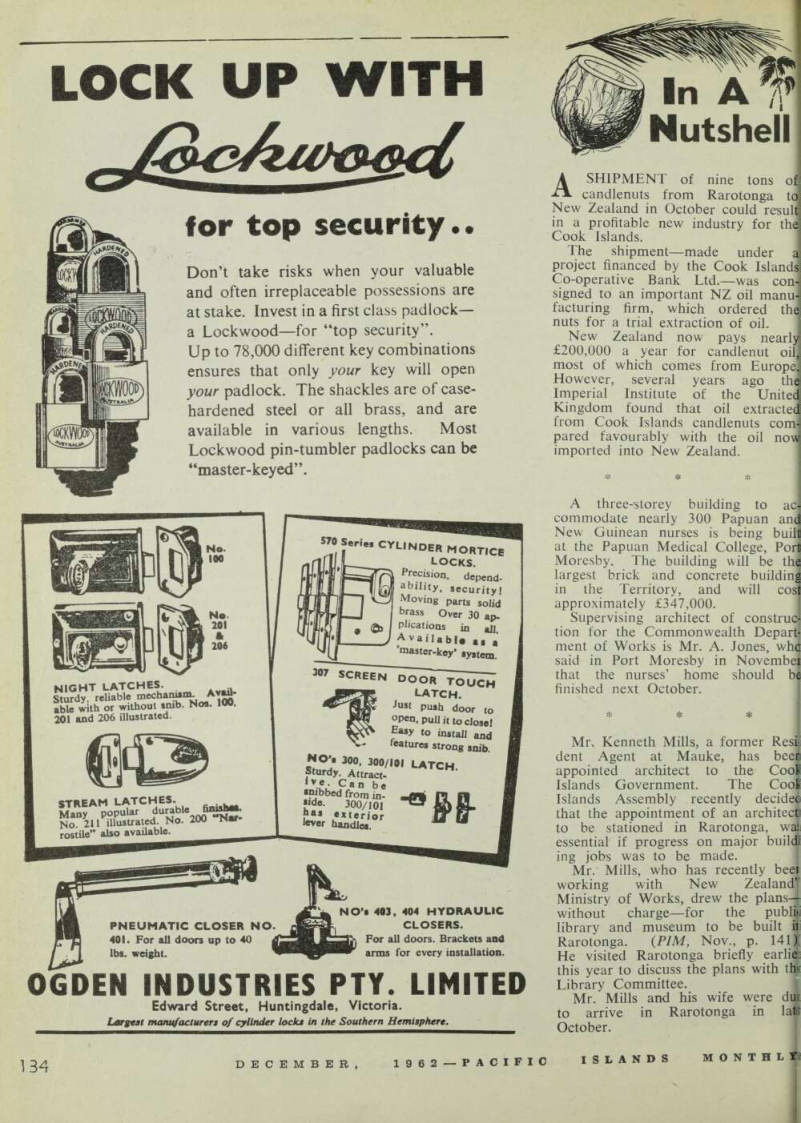 136
136 137
137 138
138 139
139 140
140 141
141 142
142 143
143 144
144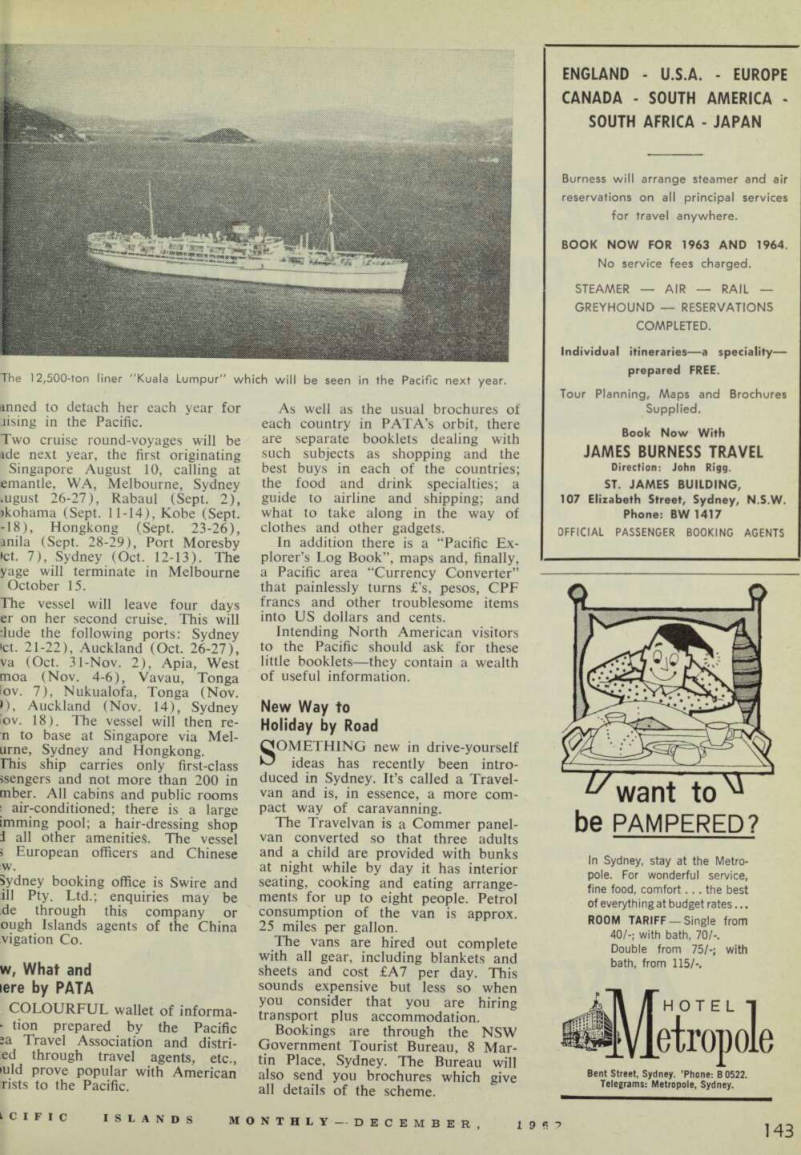 145
145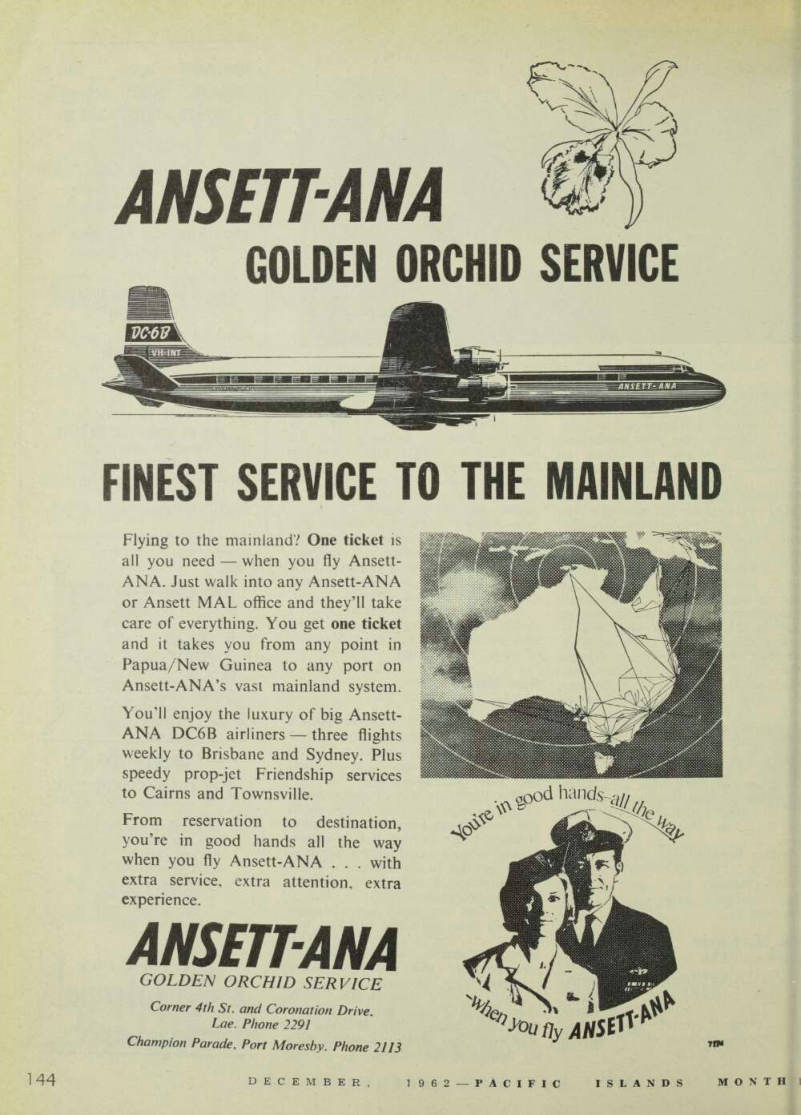 146
146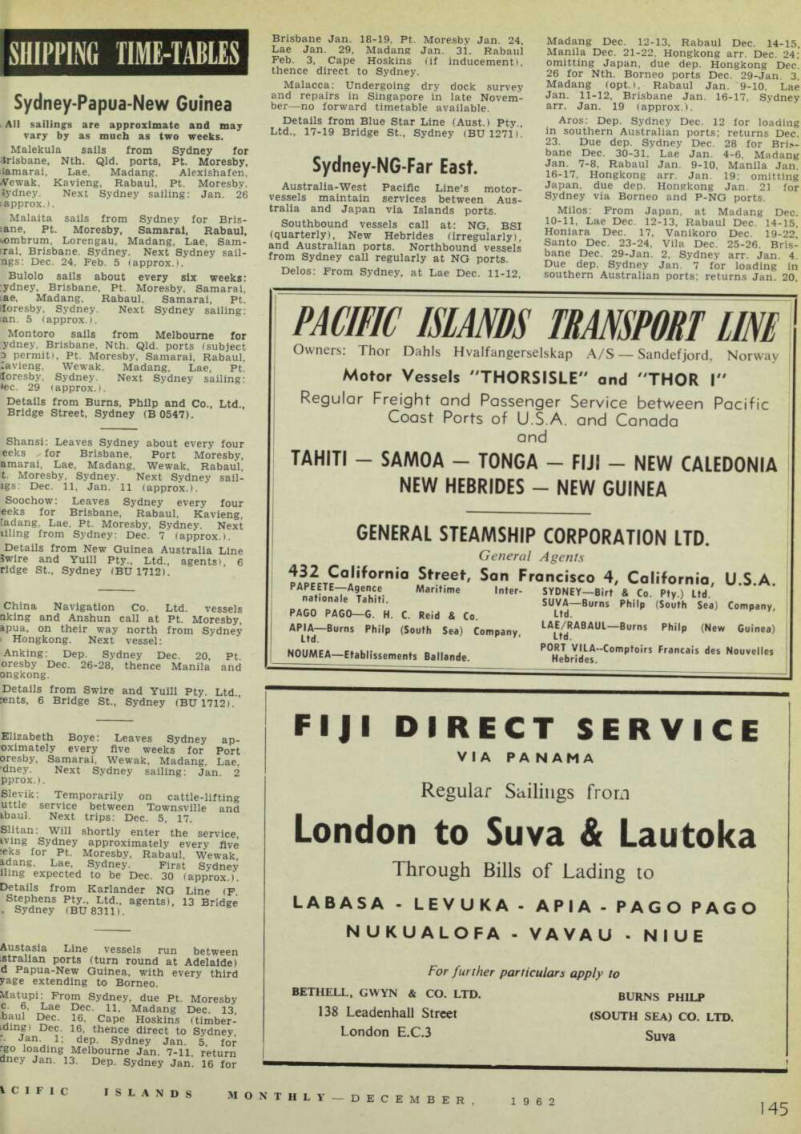 147
147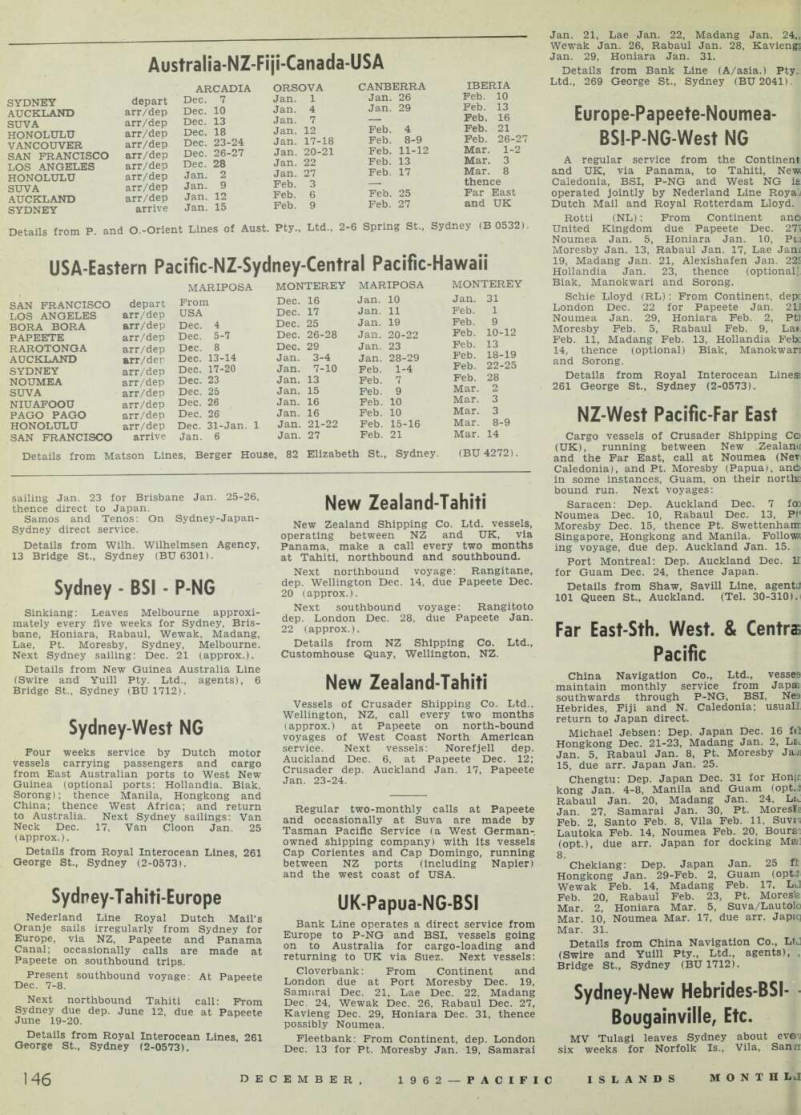 148
148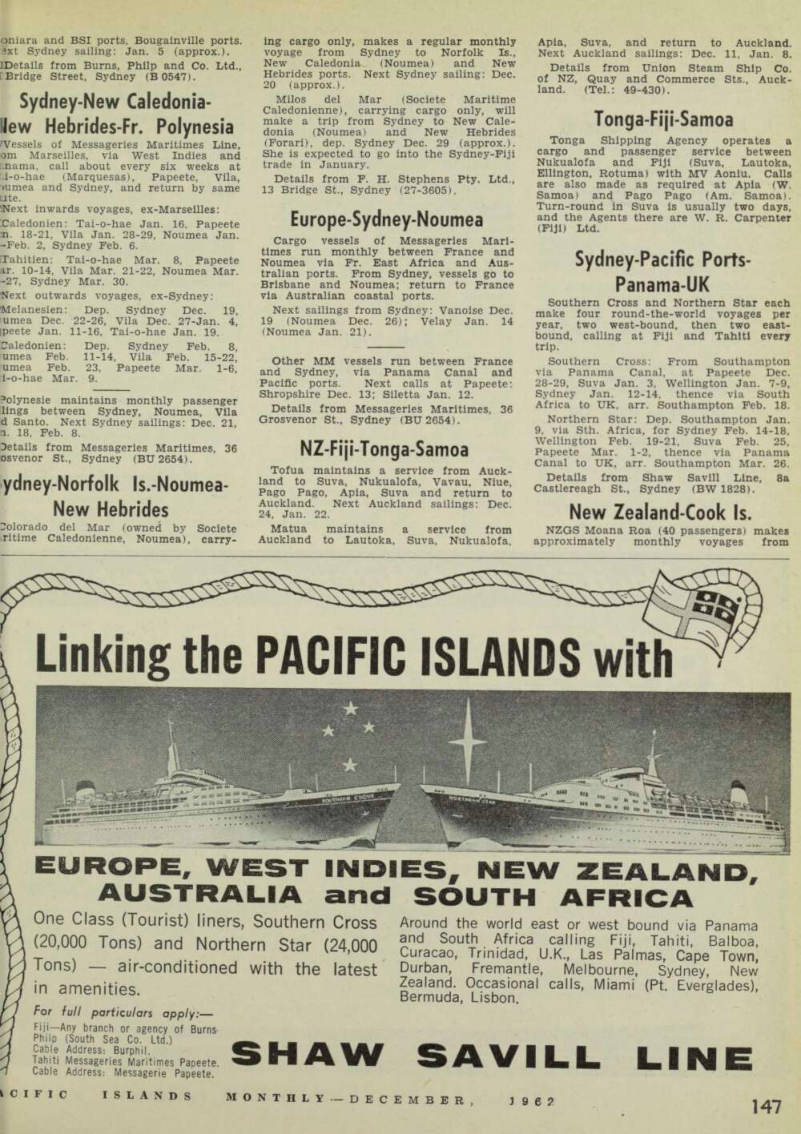 149
149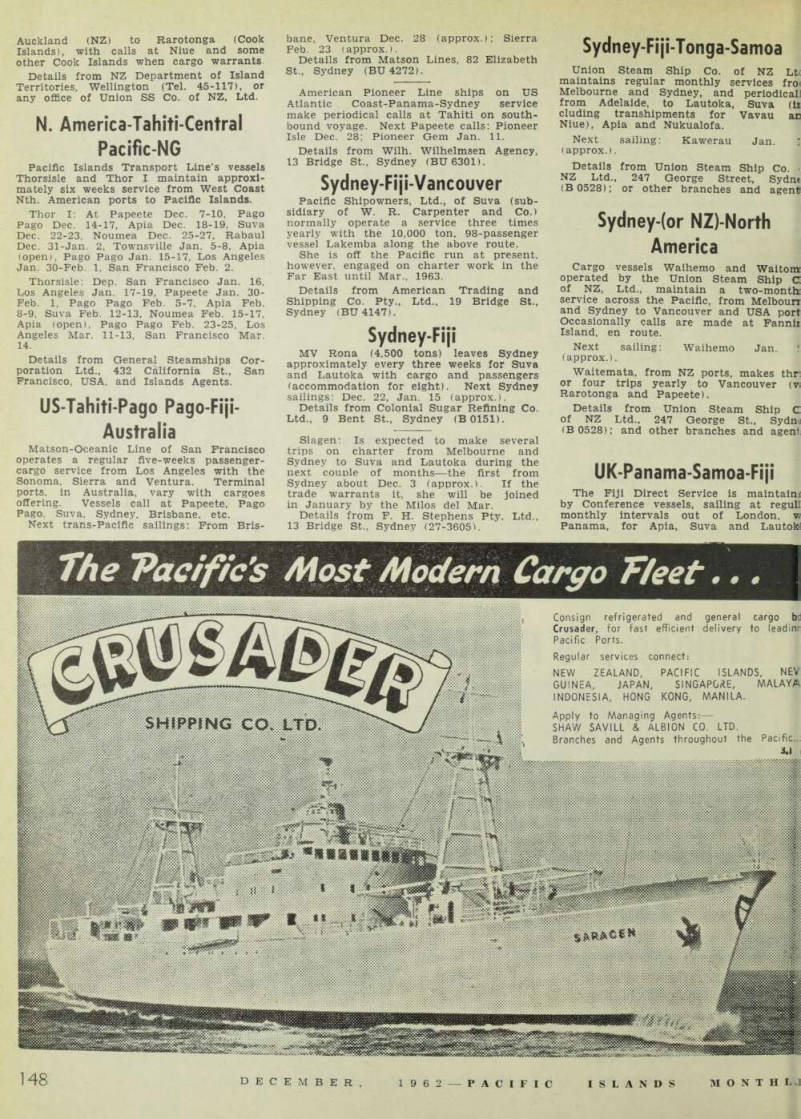 150
150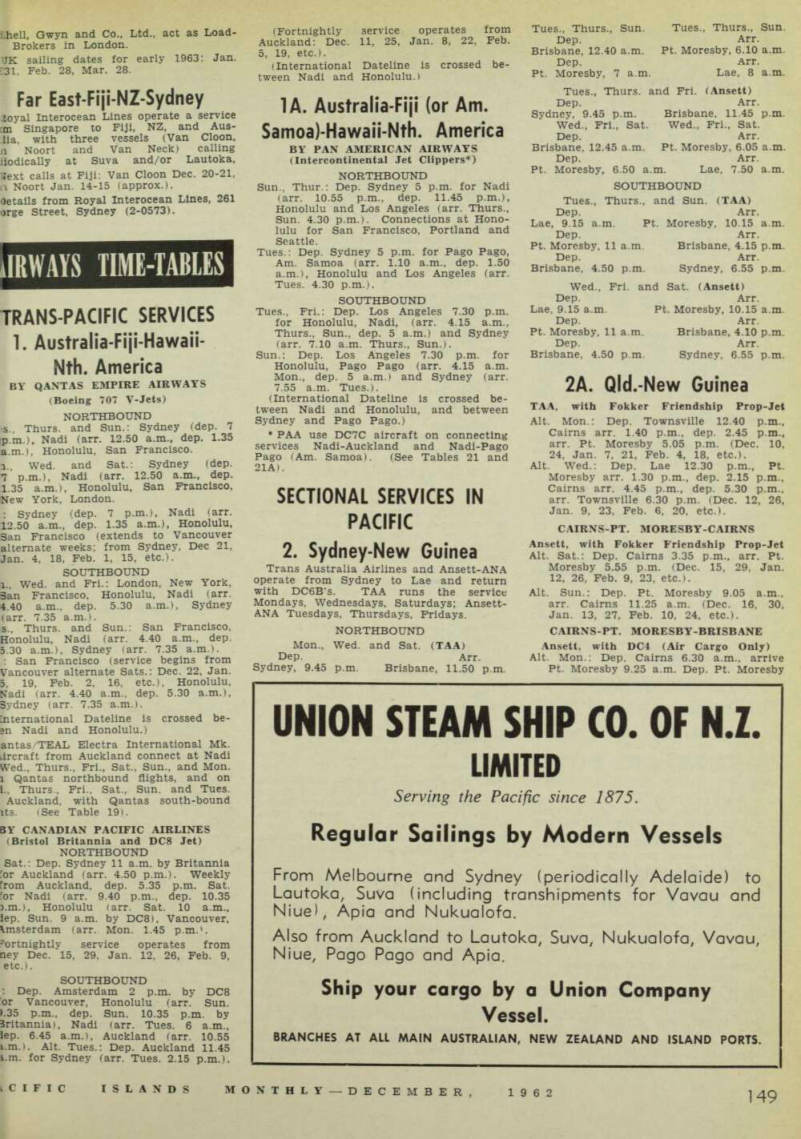 151
151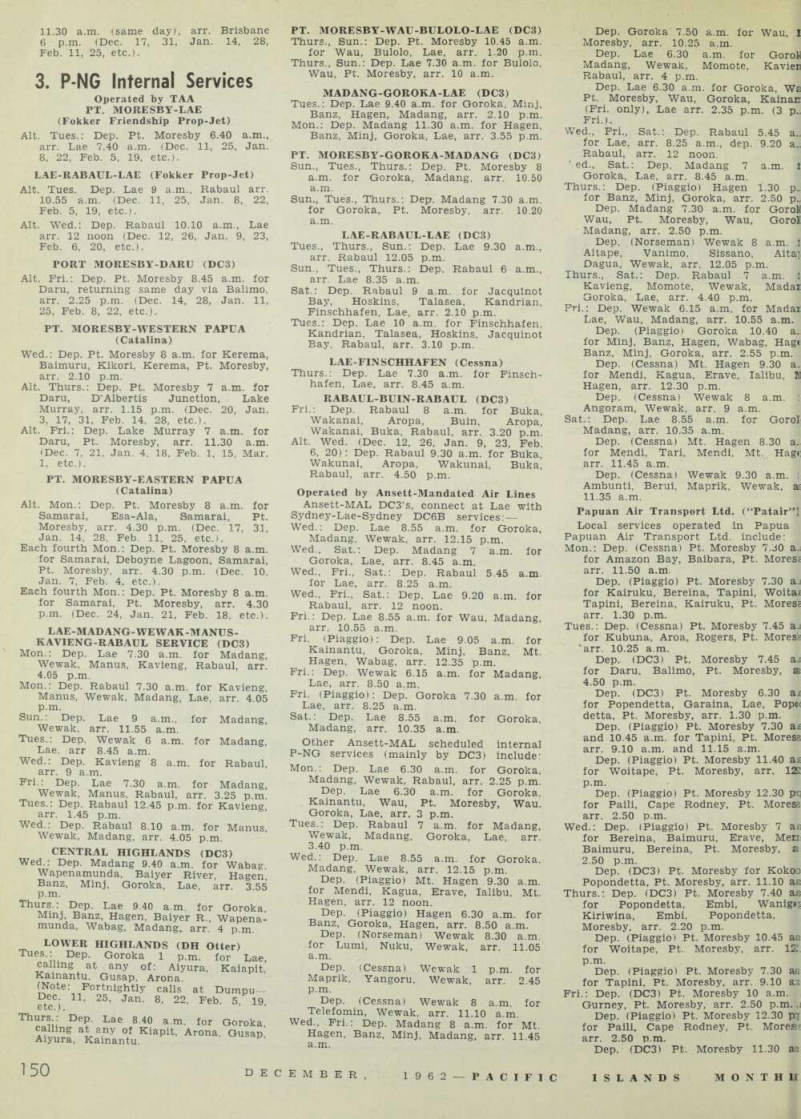 152
152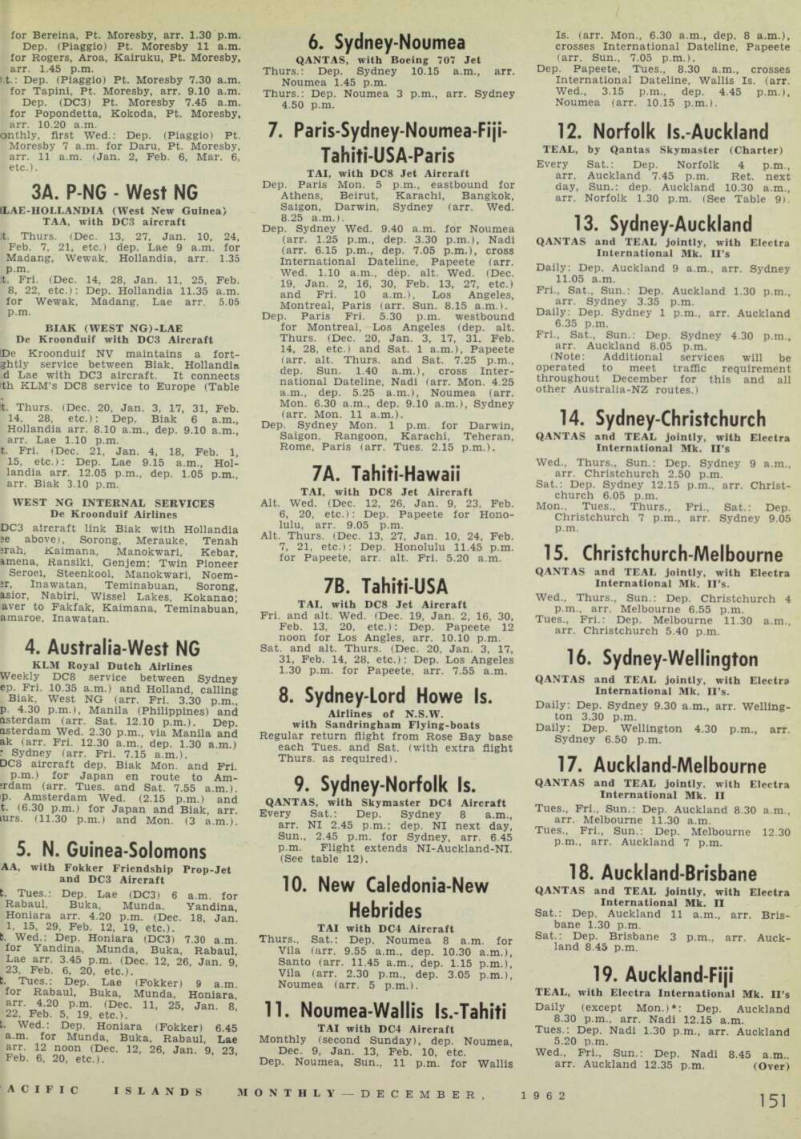 153
153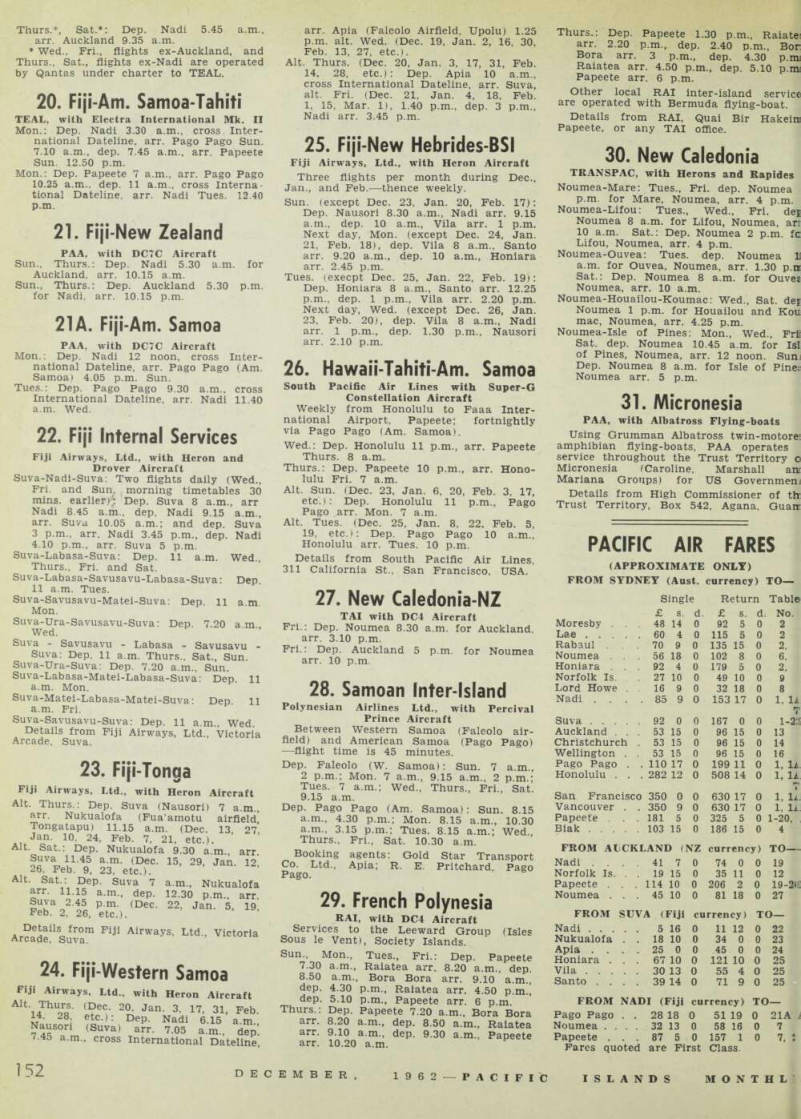 154
154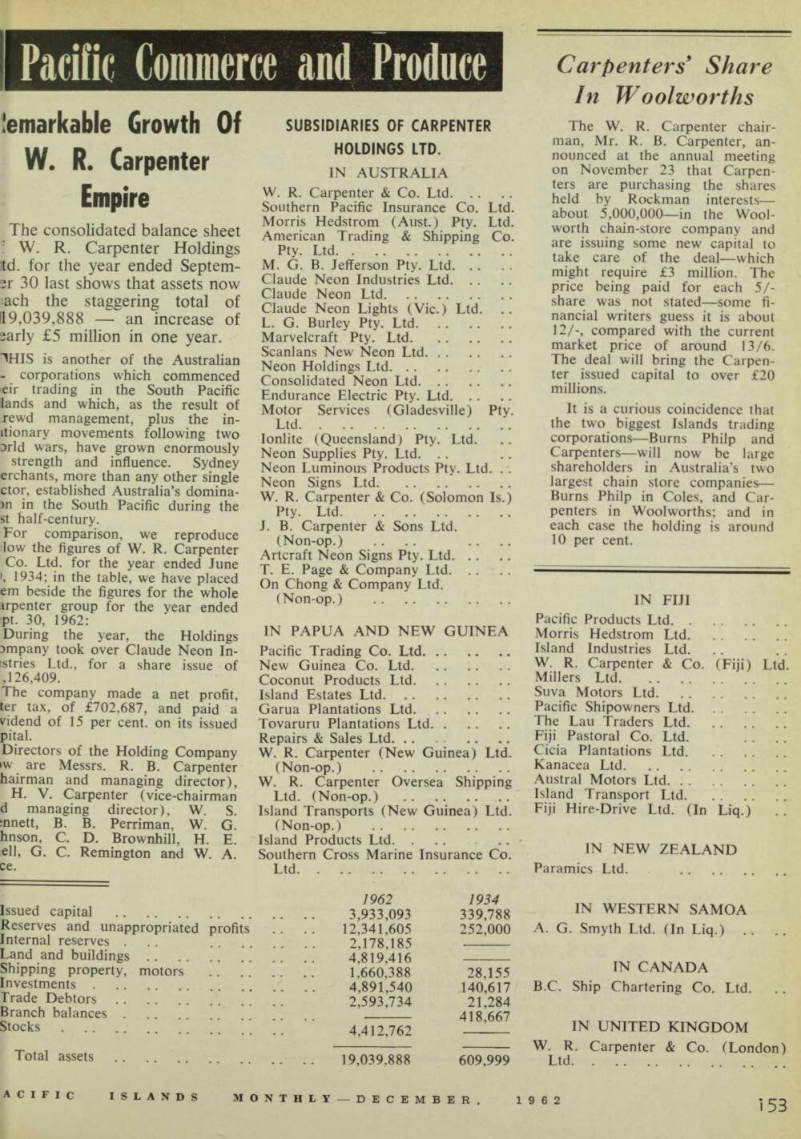 155
155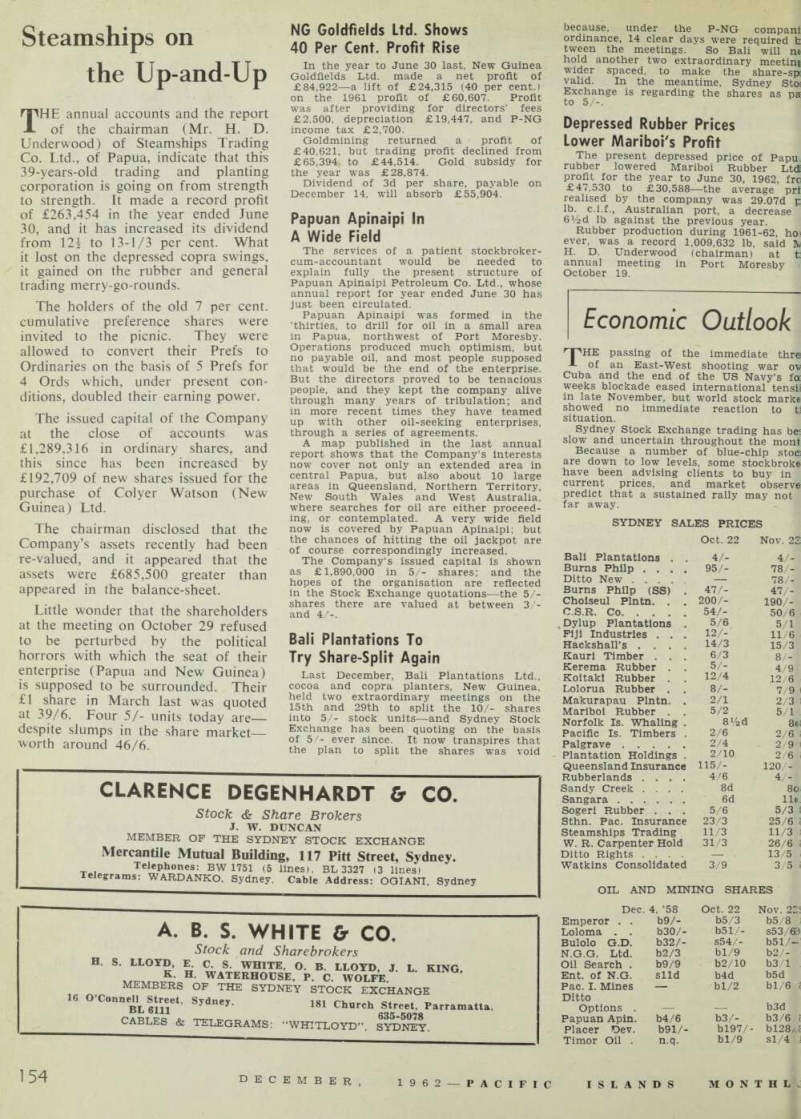 156
156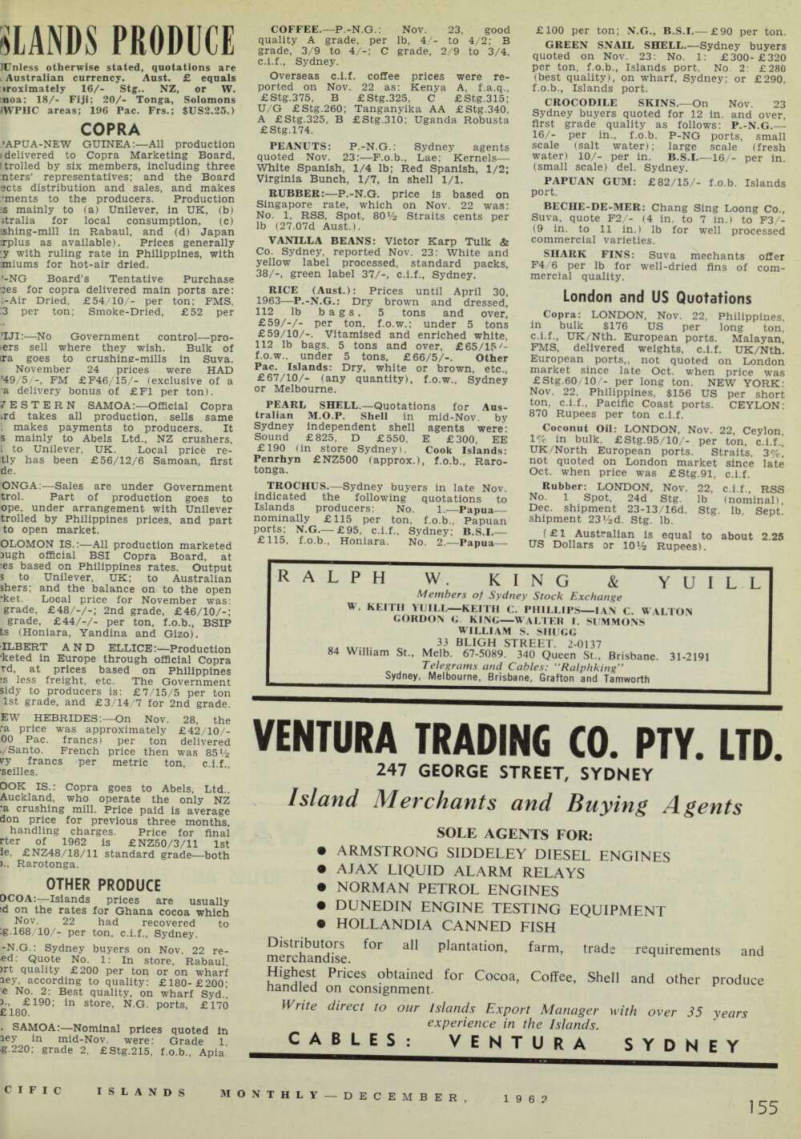 157
157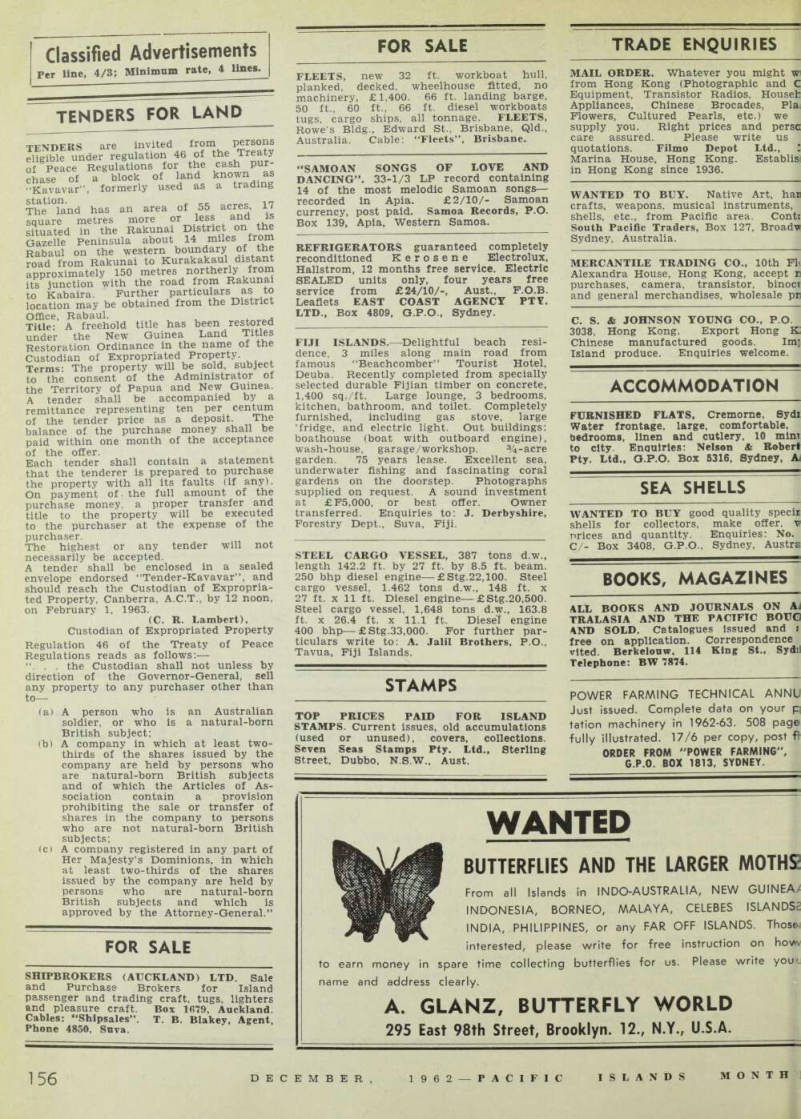 158
158 159
159 160
160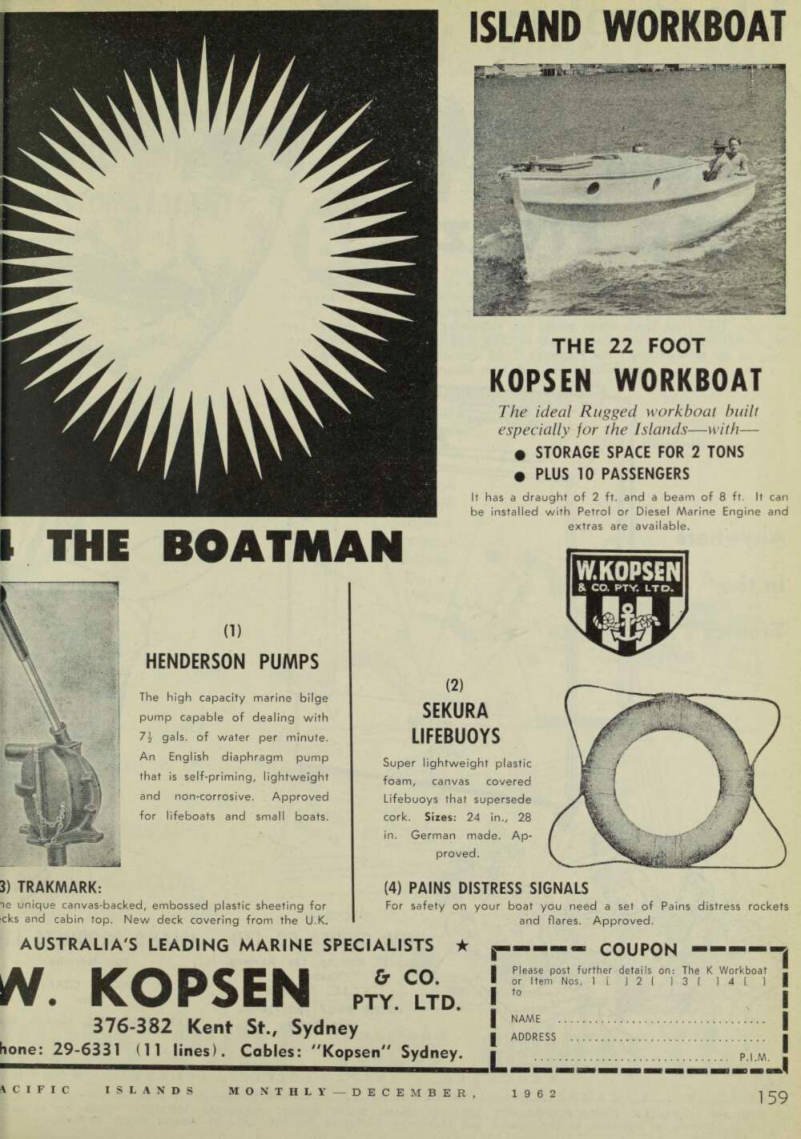 161
161 162
162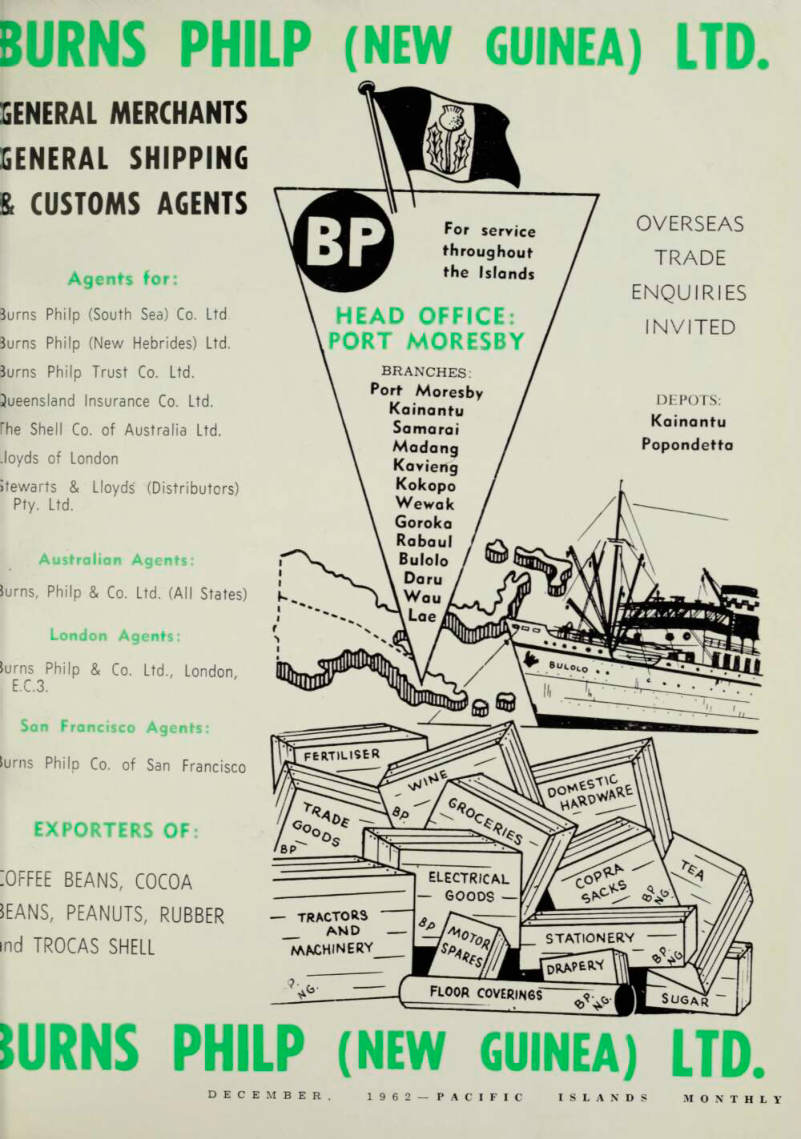 163
163 164
164