Wreckage From
p. 25 · Read in the full issue
New View On Wreckage From Vanikoro
By a Staff Writer
Danish shipping authorities believe that a piece of wreckage,
bearing the word “Kobenhavri”,
which was found at Vanikoro in the Southern Solomons recently, probably came from the Danish ship Monsunen which was wrecked at Vanikoro in August 1934. 5 ’
'PHEY are confident that it did not . . belong to the five-masted Danish sailing ship Kobenhavn which dis appeared without trace on a voyage from Buenos Aires to Australia in 1934.
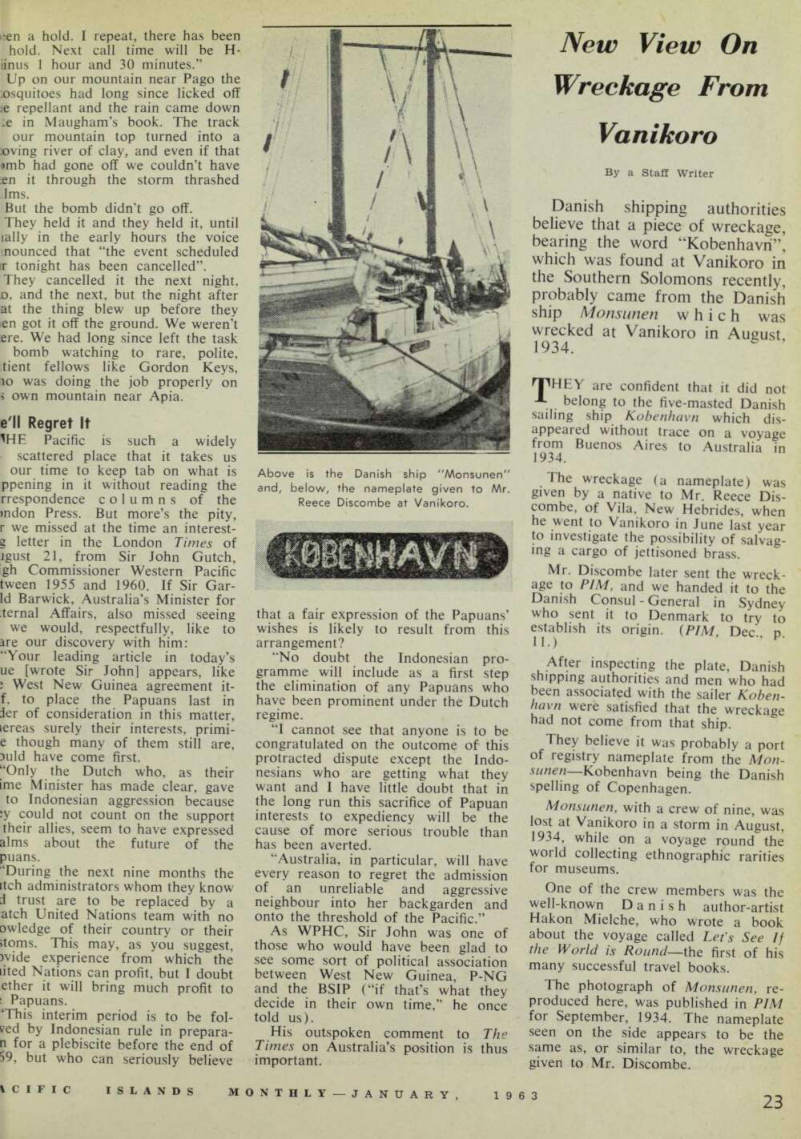
The wreckage (a nameplate) was given by a native to Mr. Reece Dis combe, of Vila, New Hebrides, when he went to Vanikoro in June last year to investigate the possibility of salvag ing a cargo of jettisoned brass.
Mr. Discombe later sent the wreck age to PIM, and we handed it to the Danish Consul-General in Sydney who sent it to Denmark to try to establish its origin. {PIM, Dec., p.
After inspecting the plate, Danish shipping authorities and men who had been associated with the sailer Koben havn were satisfied that the wreckage had not come from that ship.
They believe it was probably a port of registry nameplate from the Mon sunen—Kobenhavn being the Danish spelling of Copenhagen.
Monsunen, with a crew of nine, was lost at Vanikoro in a storm in August, 1934, while on a voyage round the world collecting ethnographic rarities for museums.
One of the crew members was the well-known Danish author-artist Hakon Mielche, who wrote a book about the voyage called Let’s See If the World is Round— the first of his many successful travel books.
The photograph of Monsunen, re produced here, was published in PIM for September, 1934. The nameplate seen on the side appears to be the same as, or similar to, the wreckage given to Mr. Discombe.