Islands Markets
pp. 31-33 · Read in the full issue

'Must Be
Followed Up'
I Criticism in the New Zealand Press the NZ trade mission which toured e Pacific Islands last July and agust has brought a rebuke from ;moan newspaper editor and busi ssman R. F. Rankin. Writing to s NZ magazine “Management”, Mr. \mkin says that Islands business en do not share the views of the i 'tics, and that more Islands trade issions are needed if NZ is to over me the Common Market problem d to compete with the Japanese.
I Management gave full-page A prominence to Mr. Rankin’s ter. Mr. Rankin is managing direc ts of Samoa Newspapers Ltd., of )ia, publishers of Samoana. He is -w Zealand born but now has West moan citizenship.
The NZ trade mission—over 20 ong—visited Fiji, Tonga, Niue, Tierican and Western Samoa, ihiti, New Caledonia and the New jbrides. It was NZ’s first trade mis >n to the Islands.
Mr. Rankin told Management : In carrying their democratic regard r mediocrity to extremes, New Zea iders do not hesitate to deprecate ; achievements of their fellow imtrymen.
This unpleasant trait was strikingly istrated by the amount of quite warranted adverse criticism aimed the trade mission to the Islands.
Ranging from trivial complaints at nple tins filled with water, to accu ions that mission members were t gallivanting around for the fun it, these criticisms came as a ick to Island businesmen who were lerally impressed at what struck :m as an honest and long overdue praisal of the Island market.
Had nothing been accomplished in business line, certainly at Apia goodwill generated by mission mbers was an achievement in it f.
But under dynamic and fluent der R. Stewart the mission accom shed much more.
Amid the cocktails some blunt :aking was done, and no member the mission could have returned to w Zealand unaware of the failings New Zealand exporters in the past, without new ideas on how to make : most of this rapidly expanding irket that has been so largely neg ted for so many years.
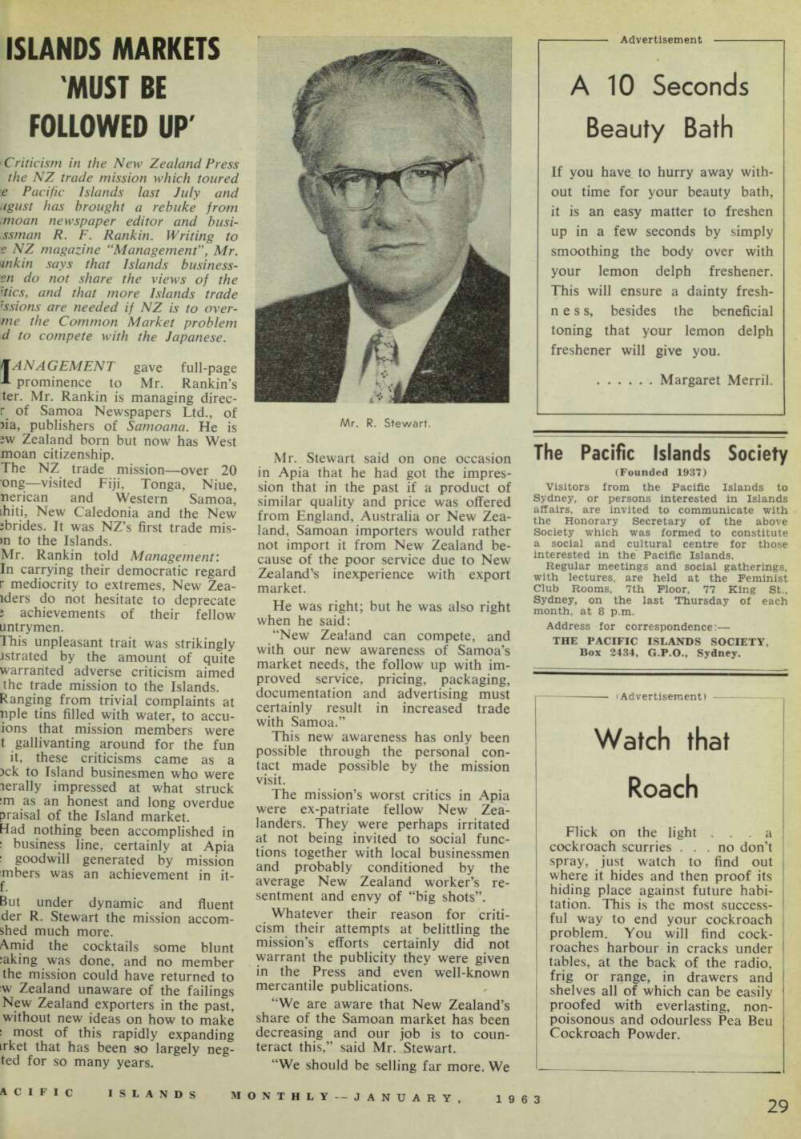
Mr. Stewart said on one occasion in Apia that he had got the impres sion that in the past if a product of similar quality and price was offered from England, Australia or New Zea land, Samoan importers would rather not import it from New Zealand be cause of the poor service due to New Zealand's inexperience with export market.
He was right; but he was also right when he said: “New Zealand can compete, and with our new awareness of Samoa’s market needs, the follow up with im proved service, pricing, packaging, documentation and advertising must certainly result in increased trade with Samoa.”
This new awareness has only been possible through the personal con tact made possible by the mission visit.
The mission’s worst critics in Apia were ex-patriate fellow New Zea landers. They were perhaps irritated at not being invited to social func tions together with local businessmen and probably conditioned by the average New Zealand worker’s re sentment and envy of “big shots”.
Whatever their reason for criti cism their attempts at belittling the mission’s efforts certainly did not warrant the publicity they were given in the Press and even well-known mercantile publications.
“We are aware that New Zealand’s share of the Samoan market has been decreasing and our job is to coun teract this,” said Mr. Stewart.
“We should be selling far more. We
Mr. R. Stewart.
ive the goods of competitive quality id price but New Zealand has only :ally entered this export field in the st two years. From now on things ill change as we make a determined fort to sell.”
The success of the mission could Dt be gauged at the time of the visit, .id Mr. Stewart; it was the follow i that really mattered and that >uld not be judged for months or 'en a year.
“We are determined to meet all lases of competition and will follow ) the gains we have made during ir stay,” he said.
These remarks and the effects of e mission take on a new signifi ince in the face of Japanese moves fer the past two months.
In spite of the statements by imoan leaders that trade with Japan ill not prejudice Samoa’s relation ip with New Zealand it does not ke too much imagination to see the Fer of an unlimited banana market higher prices, and a handy outlet r other Samoan produce drawing imoa fully into the Japanese trading bit.
Exploratory talks have already :en held in Japan concerning the pply of cheaper banana cases and rtilisers, and the prospects of using panese knowhow in various imoan development projects.
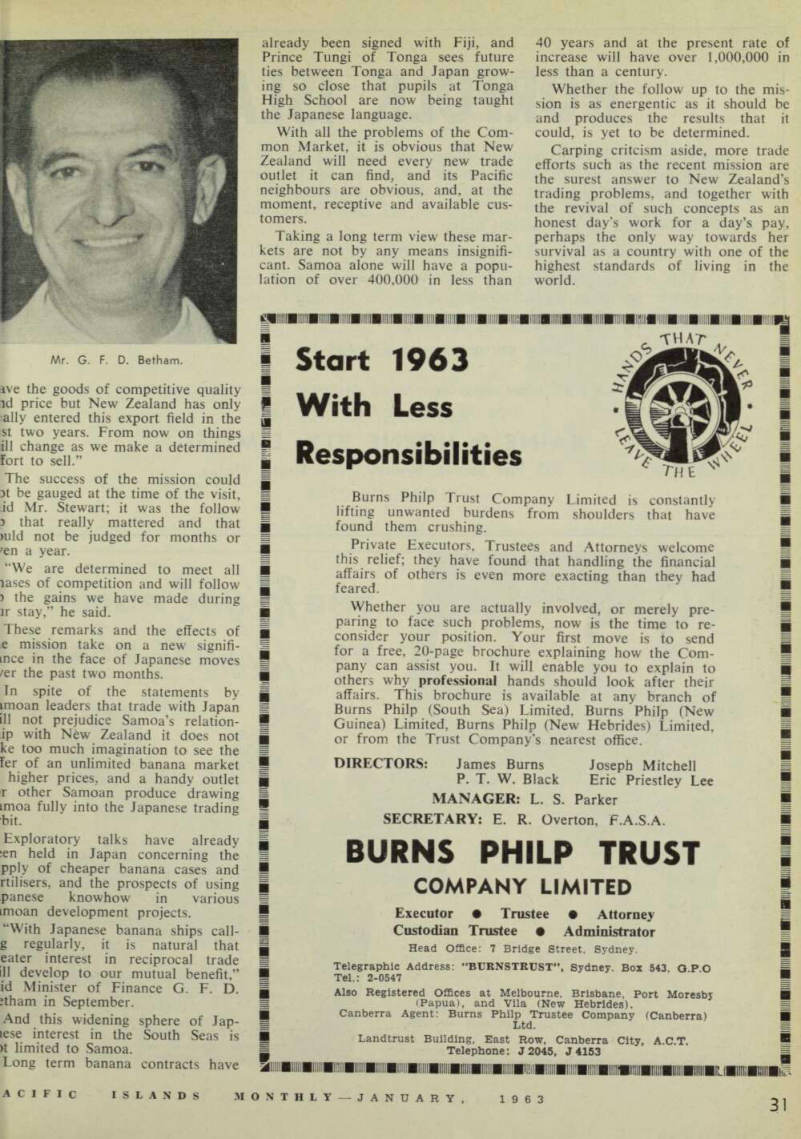
“With Japanese banana ships call g regularly, it is natural that eater interest in reciprocal trade ill develop to our mutual benefit,” id Minister of Finance G. F. D. itham in September.
And this widening sphere of Jap lese interest in the South Seas is >t limited to Samoa.
Long term banana contracts have
already been signed with Fiji, and Prince Tungi of Tonga sees future ties between Tonga and Japan grow ing so close that pupils at Tonga High School are now being taught the Japanese language.
With all the problems of the Com mon Market, it is obvious that New Zealand will need every new trade outlet it can find, and its Pacific neighbours are obvious, and, at the moment, receptive and available cus tomers.
Taking a long term view these mar kets are not by any means insignifi cant. Samoa alone will have a popu lation of over 400,000 in less than
40 years and at the present rate of increase will have over 1,000,000 in less than a century.
Whether the follow up to the mis sion is as energentic as it should be and produces the results that it could, is yet to be determined.
Carping critcism aside, more trade efforts such as the recent mission are the surest answer to New Zealand’s trading problems, and together with the revival of such concepts as an honest day’s work for a day’s pay, perhaps the only way towards her survival as a country with one of the highest standards of living in the world.
Mr. G. F. D. Betham.