Among Bulldust
p. 95 · Read in the full issue
The Month's New Reading
With Judy Tudor
Journey With Artists Among Bulldust And Mulga
Sudden marriages of two arts have recently resulted in Journey nongst Men by Jack Marshall and Russell Drysdale and Outback, what might be regarded as the husband and wife team of Nolan.
OTH are about the Australian 1 inland and, because of their ce, both are aimed at the carriage de and, probably, an audience /ond Australia.
Fhe thing that makes both books :erent from other accounts of rneys in the outback is that they illustrated by famous Australian ists —Russell Drysdale in the case Journey Among Men; and Sidney lan in the case of Outback, which written by his wife Cynthia.
Both journeys were of some lusands of miles; and both covered ich the same sort of country. It up to the reader to decide whether prefers bulldust* and mulga ough the eyes of a somewhat jttante female who dislikes the it, flies and snakes—although in ; end she concludes that she is ad that she went”; or through the ;s of artistic scientists (if there is :h a thing), to whom primeval Aus lia has a fundamental appeal. [n brief, while one book is female, : other is all male, and Australian ile at that.
Professor A. J. Marshall, head of : Dept, of Zoology at Monash Uni •sity, Melbourne, and Russell ysdale whose paintings of the Aus lian outback have brought him ne at home and abroad, were two mbers of a party that travelled ht across Australia and back with ; main purpose of collecting itiles, mammals and birds for some entific purpose.
Presumably what was scientifically covered on that journey has be ne the subject of learned papers, is book, which is a collabora n between the scientist (who is
luUdust: Australianism for the vicious it of the Inland.
also an entertaining writer as readers of his Black Musketeers, Men and Birds of Paradise, etc., will remem ber), and the artist, is a by-product.
It delves into the unusual fauna of these desert and semi-desert regions but mostly it is, as the title indicates, an account of the men (and some women), brown, white and in-between, who voluntarily live in the vast land beyond the Aus tralian civilised fringe.
As the authors indicate, by their very act of isolation from most of the amenities that suburban man demands, the people they describe are “characters”—just as a generation ago (but no longer), most of the people who lived in the Pacific Islands were also characters.
Professor Marshall’s acid wit and astringent cynicism (after the pattern of his Australia Limited); his small hope that those who shape Australia’s destinies will ever be anything but muddlers, seep in here and there, but over-all it is an amusing account of the journey, the people and the places encountered.
Realism Drysdale’s 50 or so black and white drawings alone are worth the price of admission. In these he has forsaken the more exaggerated techniques of some of his later paint ings and settled for realism.
Cynthia and Sidney Nolan and their six-year-old daughter made their outback journey in 1948, before Sidney had hit the art jackpot in London and become the rage of the art galleries there.
Cynthia is Tasmanian-born but has spent a great deal of her life abroad, taking an interest in the arts, con temporary painting and ballet. She has written two novels before this
account of the family peregrination in the Australian outback.
She has an unadorned style of writing that leaves your uncultured reviewer merely wondering if it is an exercise in simplicity or whether it is, in itself, an art-form, in keeping with the simple “squiggle” technique adopted by her husband in his five illustrations. (See p. 94).
The journey covers a lot of the same ground as the Marshall- Drysdale party, but while theirs was a robust masculine indentification with the people and the country, with Cynthia you mentally hold aloof from the Inland life and mentally breath a sigh of relief when she lands back, safely if surprised, in Sydney.
The book nonetheless has its moments of humour and realism and the author a penetrating if non aligned sympathy with the people and problems of a demanding land. (JOURNEY AMONG MEN. Published by Hodder & Stoughton. 52/-; OUTBACK.
Published by Methuen. 44/9.)
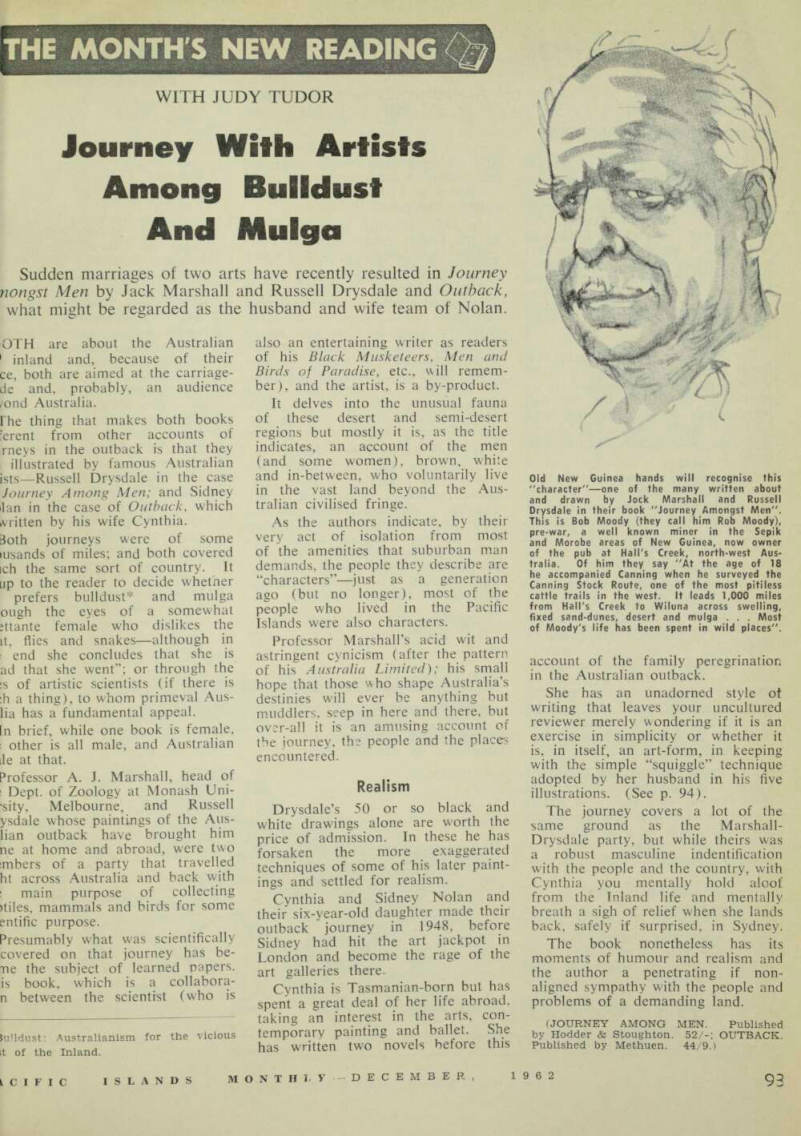
Old New Guinea hands will recognise this "character" —one of the many written about and drawn by Jock Marshall and Russell Drysdale in their book "Journey Amongst Men".
This is Bob Moody (they call him Rob Moody), pre-war, a well known miner in the Sepik and Morobe areas of New Guinea, now owner of the pub at Hall's Creek, north-west Aus tralia. Of him they say "At the age of 18 he accompanied Canning when he surveyed the Canning Stock Route, one of the most pitiless cattle trails in the west. It leads 1,000 miles from Hall's Creek to Wiluna across swelling, fixed sand-dunes, desert and mulga . . . Most of Moody's life has been spent in wild places".