The Oldest Australians
p. 96 · Read in the full issue
Seekers after truth about the Australian aborigine have two choices this month: They can take it from a Darwin journalist, or from a Sydney anthropologist.
DR. M. J. MEGGITT, of the De partment of Anthropology, Syd ney University, is the author of Desert People, a study of the primi tive Walbiri tribe of Central Aus tralia; and Douglas Lockwood, journalist, is author of I, the Abori ginal, a story of a civilised native from the Roper River country of the Northern Territory. (This book won Lockwood the Advertiser, £1,250, Adelaide Festival of Arts Award. 1962.) For his exercise Dr. Meggitt lived for a year in close contact with the Walbiri people and his book is re garded by experts as the first full length study of aboriginal life since Professor A. P. Elkin’s The A ustra lian Aborigines, which was published in 1937.
Mrs. Meggitt accompanied her hus band on this expedition and was able to make investigations amongst the women of the tribe that would nor mally be a closed book to a male researcher.
The writer makes a thorough an thropological field-work job of it and in delving into the lives of these pri mitive people, leaves no sex pattern, cultural contact or kinship system un turned.
It is obviously aimed at readers with a more than amateur in terest in primitive cultures; the lay man and general reader will probably find Lockwood’s effort more to their taste.
For the purpose of his book, he speaks in the first person through a Roper River sophisticated aborigine, Waipuldanya, also known as Phillip Roberts. Phillip is a real person who spent his youth as a member of a nomadic tribe which lived exactly as their primitive forefathers had done for centuries.
Phillip, however, unlike all the generations that went before, was made to attend a mission school which taught him English of a sort, and how to read and write. He was— at least at first—no enthusiastic pupil but it allowed him to ride a special tide in his life when, in 1953, a white doctor appointed him his driver.
Since then Phillip has worked as an orderly amongst the people, black
and white, of the North using his knowledge of native herbs and tribal medicines as well as the white man’s sulphas and penicillin.
In 1957, although from the ranks of the Oldest Australians, the Aus tralian Government at last granted him citizenship.
Douglas Lockwood draws upon his 22 years in Northern Australia—most of them as a correspondent for Southern newspapers and as a writer of books and articles—to provide the background of this book. He also spent 100 hours interviewing Phillip.
If he uses his story also as a sort of social document in indict ment of the European’s use, or mis use, of the aborigine, it is only in keeping with the spirit of the times.
After about 180 years, white Aus tralians are beginning to have fear ful pangs about the place in society to which they have relegated the aborigines. Whether the aborigines will be any happier once they are completely “assimilated” is some thing about which neither the Meg gitts nor the Lockwoods have yet provided an adequate answer. (DESERT PEOPLE. Published by Angus and Robertson Ltd. 52/6; I, THE ABORIGINAL. Published by Rigby Ltd. 28/6.)
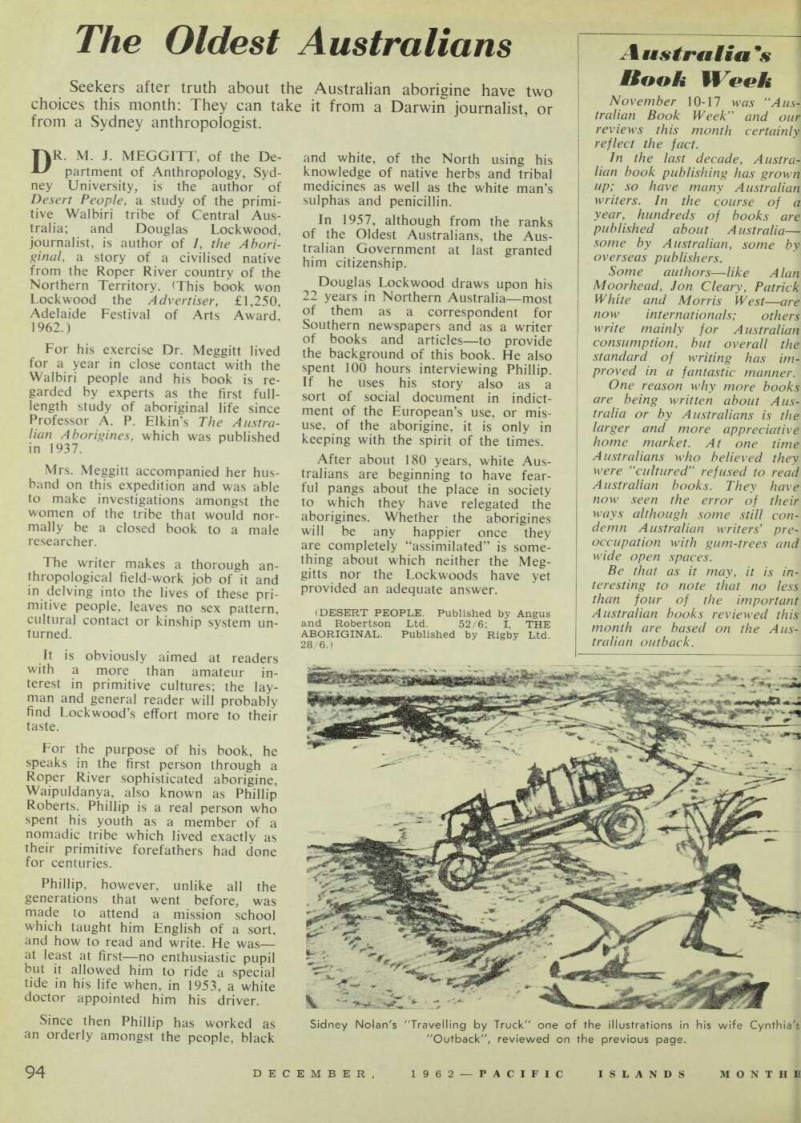
Sidney Nolan's "Travelling by Truck" one of the illustrations in his wife Cynthia's "Outback", reviewed on the previous page.