Youn6 Cook Islanders
pp. 92-93 · Read in the full issue
Youth Clubs Keep
Out Of Mischief
From W. H. Percival, in Rarotonga While juvenile delinquency seems to be on the increase in Britain, Australia, New Zealand and the US, serious crimes among Cook Islands teenagers are rare, there are no beatniks m the Cook Group and vicious teenage street gangs are un known here.
THIS, on the surface, may seem surprising as most of the con ditions exist in the Cook Islands for the breeding of juvenile delinquency.
Most Cook Islanders’ homes are poor, lacking privacy, good lighting, and a room where children can read and write.
In many cases the entire family lives in a single room, regardless of age or sex, and children witness the most intimate of family relationships.
Many homes are overcrowded, often due to the widespread practice of adopting children or caring for the illegitimate offspring within the family circle.
With too many children there is lack of parental control.
The chief reason why these con ditions have not produced the same youth problems as in metropolitan countries is that the Cook Islands have several well-established youth
organisations to keep their youngste out of mischief.
Besides the Boys’ Brigade, B< Scouts and Girl Guides, there is strong Youth Club Movement d signed to provide healthy outlets f the physical and mental energy i Cook Islands’ youth, to bui character and facilitate adjustme to adult life.
The Youth Club Movement w; formed in 1955 in an effort to he teenagers who had left school bi were too old to be catered for 1 other youth organisations.
The movement was planned ar launched by Mr. J. Lyall Noake Director of the Government’s newh formed Social Development Depar ment.
Mr. Noakes enlisted the sympath and support of responsible paren and village elders by stressing ths the clubs were merely an old Coo Islands’ custom revived in moder form.
Before the advent of the missior aries and the introduction of a cor stitutional form of government, tribal and community system was ii force.
Social behaviour was strictly cor trolled by the chiefs and great irr portance was placed on the trainim of youth.
In special schools known as Ar Karioi, boys were taught subsistenc: agriculture, fishing, and house build ing. The girls learned to cook, mak: mats and clothing, and care fa children.
Under European influence thi power of the chiefs declined and thi traditional way of life broke down.
The Are Karioi disappeared, an* there was no organised effort to helf teenagers until the introduction of thu Youth Clubs.
The three main objects of tht Youth Clubs are to: • Teach youth to work together foi mutual benefit;
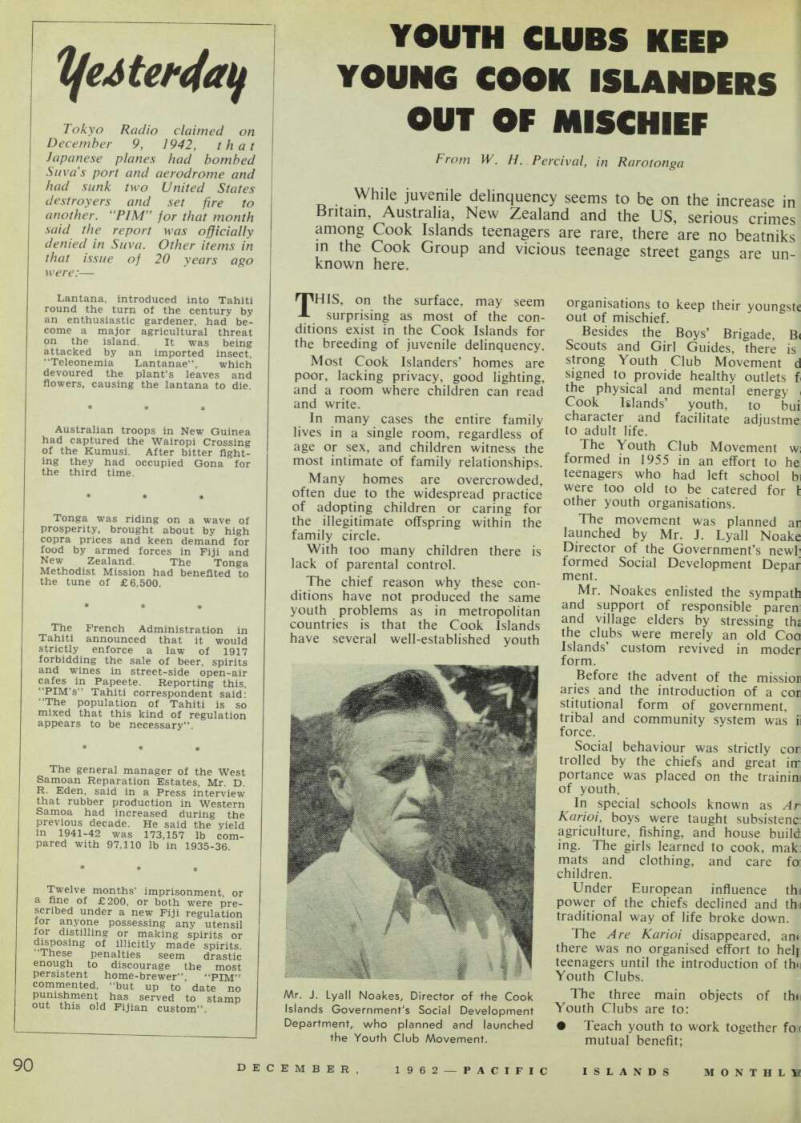
Mr. J. Lyall Noakes, Director of the Cook Islands Government's Social Development Department, who planned and launched the Youth Club Movement.
Promote knowledge; Teach youth about their duties and responsibilities as adults. lewly formed clubs met in village iion houses and fruit packing Is but were encouraged to build r own centres. illage elders and community de pment officers advised them, but were urged to find the money do the work themselves, he young people faced the chal e. raising money through bazaars dances. They then went ahead built their own centres, wenty-seven clubs have now been led throughout the Cook Islands, he clubs are run on democratic ciples. Each member has only vote, irrespective of social status amily wealth.
Must Be Present t least half the registered mem of a club must be present at tings when important decisions made. This is to prevent am >us minorities from seizing con lub members elect their own etaries, chairmen and treasurers, b club has four or five advisers— Its of good reputation who do not i a vote. lembers study the subjects that rest them most. Most boys choose 'entry, bookkeeping and further y of English. Many girls also v interest in bookkeeping and lish, besides typing, cooking, smaking and homecraft, ffien the movement was well blished, selected boys from all lh clubs formed the Combined th Centres Radio Club in Raro ;a. iter a little more than two years’ uction they were building their radio sets. Some of the more meed students have gained full es for their amateur radio •ator’s certificate. lost clubs have " table tennis, :etball and Rugby teams which pete with each other and the is from Government departments the trading companies, ther club activities are debating, tiding lectures given by visitors to islands, and viewing educational s. very fortnight a special news ion is broadcast from Radio Raro »a to clubs in the outer islands, tig news of other clubs and advice dub matters. line of the clubs are run by the tbined Protestant churches, aided
by the Social Development Depart ment.
Because of its sense of civic re sponsibility and generosity, the Aitutaki Youth Social Club deserves special mention.
It is composed of Aitutaki teen agers living in Rarotonga, and is keenly interested in the preservation and performance of Aitutaki songs and dances.
Other aims are to raise money for Cook Islands’ charities and develop club members’ pride in their home island.
The club has assisted the Hospital Comforts Fund and the Crippled Childrens’ Association with money raised at dances.
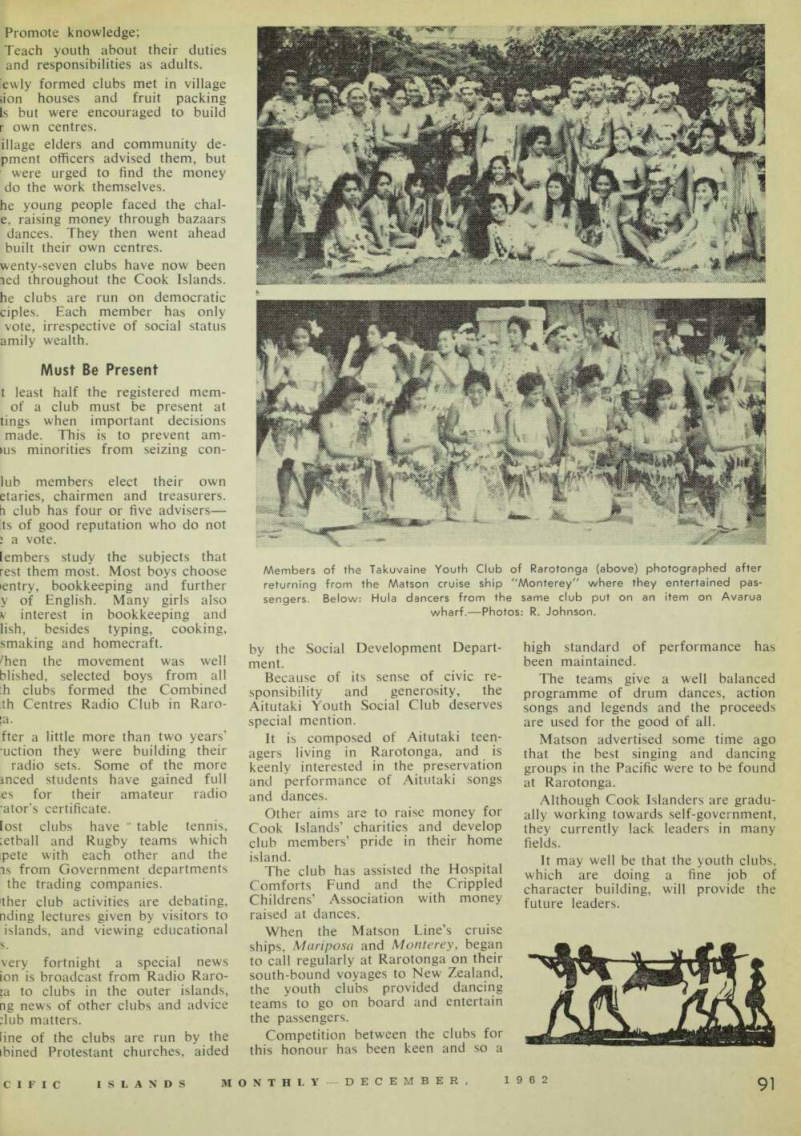
When the Matson Line’s cruise ships, Mariposa and Monterey, began to call regularly at Rarotonga on their south-bound voyages to New Zealand, the youth clubs provided dancing teams to go on board and entertain the passengers.
Competition between the clubs for this honour has been keen and so a
high standard of performance has been maintained.
The teams give a well balanced programme of drum dances, action songs and legends and the proceeds are used for the good of all.
Matson advertised some time ago that the best singing and dancing groups in the Pacific were to be found at Rarotonga.
Although Cook Islanders are gradu ally working towards self-government, they currently lack leaders in many fields.
It may well be that the youth clubs, which are doing a fine job of character building, will provide the future leaders.
Members of the Takuvaine Youth Club of Rarotonga (above) photographed after returning from the Matson cruise ship "Monterey" where they entertained pas sengers. Below: Hula dancers from the same club put on an item on Avarua wharf. —Photos: R. Johnson.