Ends In Disaster
p. 122 · Read in the full issue
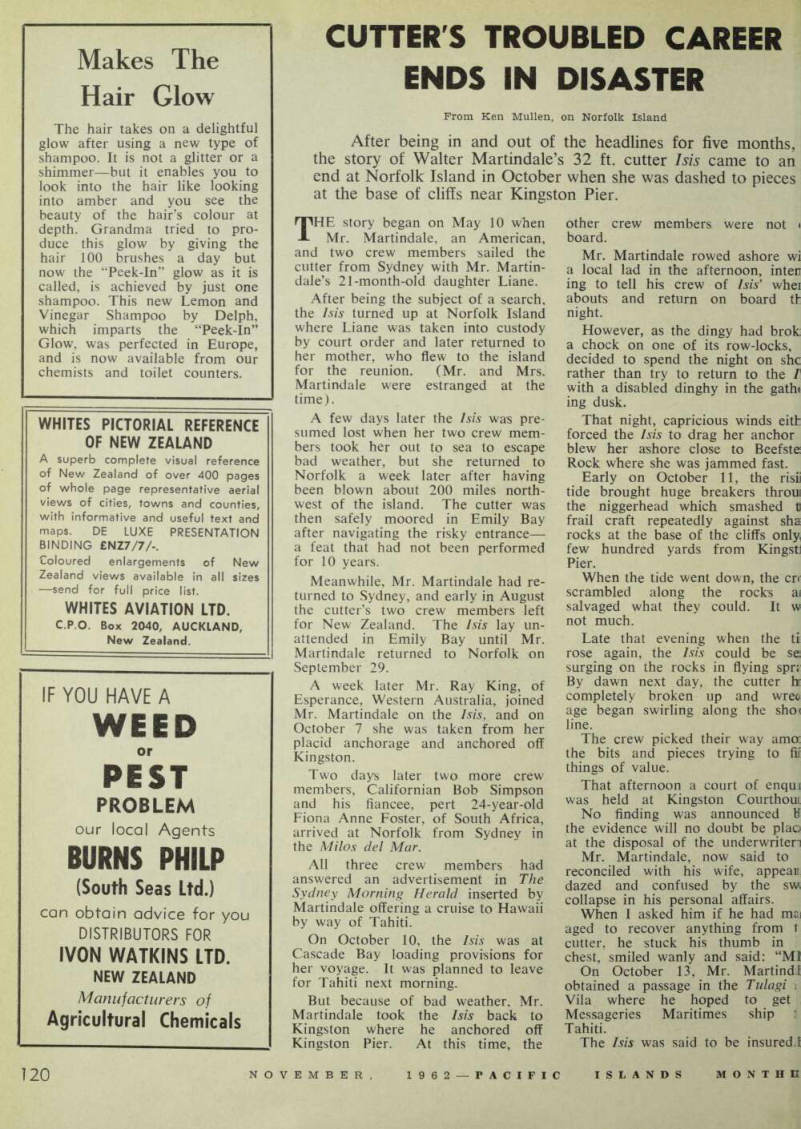
Cutter's Troubled Career
From Ken Mullen, on Norfolk Island After being in and out of the headlines for five months, the story of Walter Martindale’s 32 ft. cutter Isis came to an end at Norfolk Island in October when she was dashed to pieces at the base of cliffs near Kingston Pier.
THE story began on May 10 when Mr. Martindale, an American, and two crew members sailed the cutter from Sydney with Mr. Martin dale’s 21-month-old daughter Liane.
After being the subject of a search, the Isis turned up at Norfolk Island where Liane was taken into custody by court order and later returned to her mother, who flew to the island for the reunion. (Mr. and Mrs.
Martindale were estranged at the time).
A few days later the Isis was pre sumed lost when her two crew mem bers took her out to sea to escape bad weather, but she returned to Norfolk a week later after having been blown about 200 miles north west of the island. The cutter was then safely moored in Emily Bay after navigating the risky entrance— a feat that had not been performed for 10 years.
Meanwhile, Mr. Martindale had re turned to Sydney, and early in August the cutter’s two crew members left for New Zealand. The Isis lay un attended in Emily Bay until Mr.
Martindale returned to Norfolk on September 29.
A week later Mr. Ray King, of Esperance, Western Australia, joined Mr. Martindale on the Isis, and on October 7 she was taken from her placid anchorage and anchored off Kingston.
Two days later two more crew members, Californian Bob Simpson and his fiancee, pert 24-year-old Fiona Anne Foster, of South Africa, arrived at Norfolk from Sydney in the Milos del Mar.
All three crew members had answered an advertisement in The Sydney Morning Herald inserted by Martindale offering a cruise to Hawaii by way of Tahiti.
On October 10, the Isis was at Cascade Bay loading provisions for her voyage. It was planned to leave for Tahiti next morning.
But because of bad weather, Mr.
Martindale took the Isis back to Kingston where he anchored off Kingston Pier. At this time, the
other crew members were not • board.
Mr. Martindale rowed ashore wi a local lad in the afternoon, inten ing to tell his crew of Isis’ whei abouts and return on board tk night.
However, as the dingy had brok: a chock on one of its row-locks, decided to spend the night on she rather than try to return to the /’ with a disabled dinghy in the gatht ing dusk.
That night, capricious winds eith forced the Isis to drag her anchor blew her ashore close to Beefste: Rock where she was jammed fast.
Early on October 11, the risii tide brought huge breakers throui the niggerhead which smashed fl frail craft repeatedly against sha rocks at the base of the cliffs few hundred yards from Kingstl Pier.
When the tide went down, the ere scrambled along the rocks a < salvaged what they could. It w not much.
Late that evening when the ti rose again, the Isis could be se surging on the rocks in flying spn By dawn next day, the cutter hr completely broken up and wreo age began swirling along the sho< line.
The crew picked their way ama the bits and pieces trying to fir things of value.
That afternoon a court of enqui was held at Kingston Courthout.
No finding was announced U the evidence will no doubt be plao at the disposal of the underwriter!
Mr. Martindale, now said to reconciled with his wife, appean, dazed and confused by the sw collapse in his personal affairs.
When I asked him if he had rmi aged to recover anything from t cutter, he stuck his thumb in chest, smiled wanly and said: “Ml On October 13, Mr. Martind! obtained a passage in the Tulagi l Vila where he hoped to get Messageries Maritimes ship I Tahiti.
The Isis was said to be insured.!