Niue's Radioactivity
p. 127 · Read in the full issue
Be Useful In Industry”
The high degree of radioactivity on Niue Island could be of value to industry on the island when it was fully understood, Sir Ernest Marsden, New Zealand’s leading nuclear scientist, said in Niue recently.
IR ERNEST MARSDEN stayed at 1 Niue for six weeks to try to dis ver the origin of the island’s radio tivity and to determine its effects i the islanders. Parts of Niue are 20 ries more radioactive than normal.
Addressing the Niue Assembly, Sir nest said there were several other ices in the world that had radio tivity readings about as high as ue. These were an area in Brazil, 5 Travencore sands of India and a rt of Western Australia.
But in all these places, there were kV people and these few moved out considerably.
In Niue, on the other hand, the ople lived with radioactivity and d benefited by living with it.
“That is why,” Sir Ernest said, “the lole world is interested in Niue just w and wants to know why it is that ue is such a happy country, hough it has a little more radia n than usual.”
Sir Ernest said that before this Jiation could be harnessed for in stry, it was necessary to understand
where it came from, how it was dis tributed, how it moved and how much there was in each type of soil.
He said the radiation might emanate from rock beneath Niue’s coral.
“I am trying to find out what is underneath the coral which has built up from the sea on a great extinct volcano,” he said. “But we haven’t gone down deep enough to get into that rock.
“Perhaps some day we will be able to bore holes down to get below the coral and get a little of the rock to find if it is radioactive.”
Sir Ernest said that two doctors from England would visit Niue in May next year to try to determine what effect the radiation had on the islanders.
Asked by Assembly members if Niue would be able to export taro to New Zealand which had been found to be radioactive, Sir Ernest replied: “I am sure you will be able to export taro, but we will have to watch that it is of varieties that are not very active.”
Sir Ernest said tests he had made had revealed that only one or two types of taro might be harmful, and that it was necessary to determine “if any varieties pick up too much,”
Asked if Niueans might be affected by eating taro, bananas and yams, Sir Ernest replied: “The Niueans, be cause of their living in this area for so long, can quite safely eat any kind of taro. They have developed resis tance to radiation.
“Bananas pick up very little radia tion, and yams less than taro. Only certain rare types of taro are at pre sent under test and suspicion.”
Back in New Zealand in late Sep tember, Sir Ernest said radioactivity on parts of Niue was higher than previously thought, and there was evi dence that it had had an effect on part of the population.
“The work on the effects of radia tion at Niue Island is attracting world-wide attention and offers of specialised assistance have been re ceived from many countries,” Sir Ernest added.
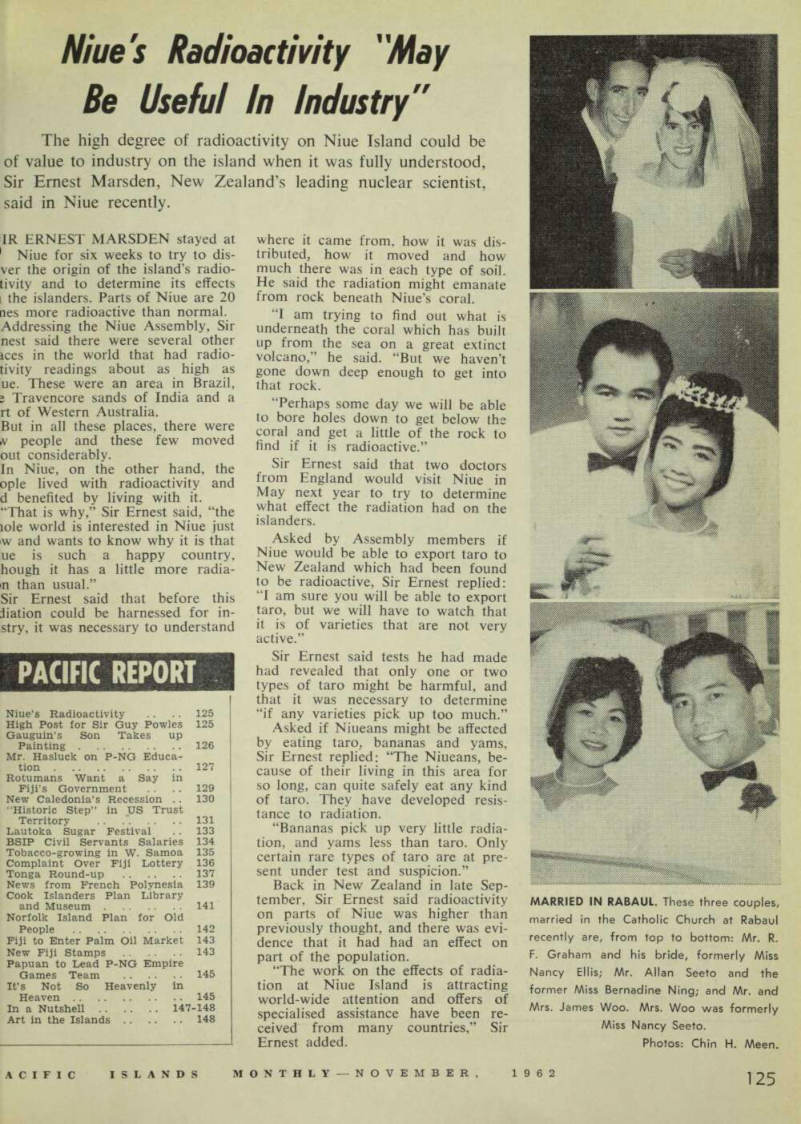
MARRIED IN RABAUL These three couples, married in the Catholic Church at Rabaul recently are, from top to bottom: Mr, R.
F. Graham and his bride, formerly Miss Nancy Ellis; Mr. Allan Seeto and the former Miss Bernadine Ning; and Mr. and Mrs. James Woo. Mrs. Woo was formerly Miss Nancy Seeto.
Photos: Chin H. Meen.