Pacific Shipping
pp. 107-121 · Read in the full issue
Cruising Yachts
Seventy-five-year-old Captain Andy Thomson, the last of the South Pacific’s colourful, old-time schooner masters, will re tire soon to his plantation on Rarotonga. Captain Andy com pleted his last voyage early in October when he brought A. B.
Donald Ltd.’s 50-year-old trading schooner Tiare Taporo from Rarotonga to Auckland for a refit.
IAPTAIN ANDY, who was born in l Brooklyn and still speaks with a •ooklyn accent, has spent most of s life sailing in trading schooners ound the Cook Islands. He figures a number of stories by such well lown authors as Charles Nordhoff id Robert Dean Frisbie.
After growing up on Long Island, aptain Andy served his apprentice ip on square-riggers in the Atlantic, e had a turn as a quartermaster on ips on the Great Lakes and made ►yages out of Seattle and San ■ancisco, including trips to Alaska, :fore coming to the South Pacific.
He first saw Rarotonga from the ;ck of a Boston barque when he was I and he fell in love with the place mediately. By the time he was 19, ; owned six acres of land at Raro nga, and he later married a Raro ngan. For a number of years be »re World War 11, he was master of . B. Donald Ltd.’s Tagua.
Captain Andy took command of e Tiare Taporo in 1939 and has ;en her skipper ever since, except ir a period between 1949 and 1959 hen she was under the control of ie French branch of Donalds, the tablissements Donald Tahiti, trading ound French Polynesia.
During this break, Captain Andy was master of another Donald ship, the 250-ton motor ship Charlotte Donald.
In the reef-strewn Pacific, Captain Andy is probably unique. He has never lost a ship or even run one aground. Nor has he ever lost a man overboard, although plenty of his men have fallen overboard.
On one occasion when a chicken fell overboard, Captain Andy put the ship about and posted look-outs up the mast. When the chicken was rescued half an hour later, Captain Andy explained that he went to this trouble over a chicken both for practice and to impress on his crew that if they were washed overboard, even at night, they should, like the chicken, keep treading water until he found them.
Mr. William Boustead, of the NSW Art Gallery, who knew Captain Andy several years ago, described him to PIM as a “terrific personality and a
wonderful yarn-spinner”.
“Until you get to know him, you are a bit frightened of him because he is a bit rough and has a wonder ful flow of invective,” he said. “But underneath he has a heart of gold— just like his smile.” (Captain Andy
has a lot of gold capped teeth. Eleven of his teeth were broken on a rail way construction job in Alaska 51 years ago.) Mr. S. Bennett, island inspector for A. B. Donald Ltd., said in Auck land recently: “Andy is one of those men who can always be depended on to bring a ship home. He has never, during the whole of his career with the firm, given us a moment’s anxiety.”
The Tiare Taporo, which was built for A. B. Donald Ltd. in Auckland, was the last schooner built in that port especially for the Islands trade.
After completing her present refit, she will return to Rarotonga under Cap tain A. J. Pickering, previously the mate.
• Another Japanese Ship
WRECKED: At 3 a.m. on September 24, the 158-ton Iwakuni Maru be came the third Japanese fishing vessel operating from Pago Pago, American Samoa, to be wrecked in the Cook Islands. The first was the Taiyo Maru, wrecked at Pukapuka in October, 1957, and the second the Tsuru Maru, wrecked at Nassau in November, 1958. The Iwakuni Maru
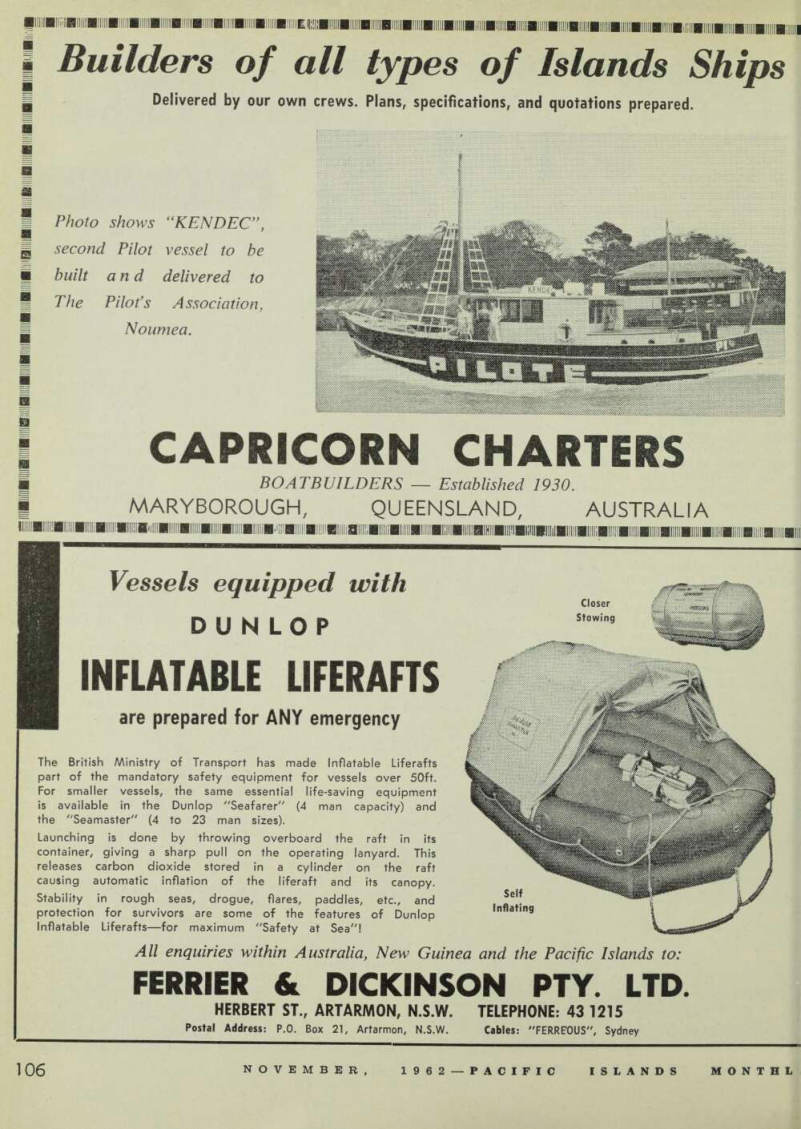
The 173-ton 50-year old trading schooner "Tiare Taporo", long commanded by Capt.
Andy Thomson, is 90 ft. long, 23 ft. 4 in. wide and draws 7 ft.
Her name means "lime blossom".
is stranded at Muri, on Rarotonga’s jth-east coast.
A faulty compass is believed to ve caused the wreck. The vessel d a crew of 22 commanded by L ptain Mikawa, and had been at i about 42 days. Her long lines :re still out for tuna when she uck the reef bow on.
The vessel was badly holed, but no es were lost although heavy seas mpered rescue work and further maged the ship.
At first light canoe loads of lagers from the Ngatangiia district ached the wreck but were unable go on board because of heavy seas, ley helped to erect a breeches buoy ' which the crew, with their per nal belongings and bedding, were msferred to the reef. From there ey were ferried ashore.
Mr. A. O. Dare, Resident Com issioner, was one of the first on the ene. He directed shore operations, ranged for the accommodation of e shipwrecked men, and asked aptain Mikawa to send 50 albacore hore for the voluntary helpers.
One of the crew sustained minor juries on the reef and received eatment at Rarotonga Hospital. By .30 that evening all the Japanese ere ashore. They were billeted in ie fruit packing shed at Ngatangiia llage.
The Iwakuni Maru had 80 tons of ibacore on board, a variety of tuna lat fetches the highest price on the merican market.
On September 25, the Suwa Maru, modern 300-ton fishing vessel, also orking for the Van Camp Tuna Company, at Pago Pago, arrived at .arotonga to repatriate the ship- Tecked men.
Next day, salvage operations really ot under way and hundreds of eople crowded the beach and the ;ef at Muri lagoon. Tons of albacore rere brought ashore by Public Works angs, some of which was transhipped d the Suwa Maru, some sold on the each, and some sent to the Govern icnt Freezer in Avarua for sale. Al acore was on the menu of most larotongan homes for many days fterwards.
A great quantity of fishing gear nd glass floats were salvaged, and he Suwa Maru's holds were cleared »f bait to make room for the salvaged argo.
This special bait consists of housands of small, frozen, Japanese ish —of a type unknown in the Cook slands.
The bait was given to the Cook islands’ Fisheries Division.
The women of Ngatangiia cooked
and laundered for the castaways dur ing their brief stay and, as a parting gesture, the Ngatangiia people gave the Japanese a truck load of fruit.
On the evening of September 26, the 40 crew members of the Suwa Maru attended a dance in Avarua.
Sailing time was 9 p.m., but at that hour six of the Japanese were miss ing. They were finally located in various districts and, at midnight, the vessel sailed for Japan with both on board.
A Public Works team later re moved useful fittings from the wreck which had been abandoned by its owners to the Cook Islands’ Govern ment.
• New Submarine Base:
The United States Navy has an nounced that the island of Guam is to become a Polaris missiles sub marine base. A submarine tanker carrying 1,500 men and capable of servicing nuclear submarines is ex pected to be based at Guam from late next year. The Navy announce ment said the new base would be similar to an American base in England.
• Whale Of A Jolt: The
passengers and crew in the Seventh day Adventist ship Laoheni thought they had gone on a reef when they felt a severe bump and the ship
:hed during a recent voyage from laita to Honiara, BSIP. But it was y a whale that got in the way. s look-out man saw the whale as it ne up on the port side moving oss the ship’s course. He shouted it to get out of the way. The ale, however, took no notice. After collision, the whale moved slowly and disappeared. The crew said it not seem perturbed by the in ent. • HONIARA VISIT: The liner wva, which carries 1,275 passen s, will call at Honiara, BSIP, on ly 15 next year in the course of ourist cruise.
• Back In December: The
Hon Royal Australian Navy ■vey ship HMAS Paluma, now be ; refitted in Sydney, is due to re n to New Guinea in December to >in the third year of a survey pro imme in the area. The Paluma left j waters in August after nine ►nths’ work.
Lhe Minister for the Navy, Sena- Gorton, said recently that the luma had carried out a number of •veys that were essential to the de opment of New Guinea.
One of her major tasks had been New Britain, surveying in Rabaul irbour, and the associated waters of mche Bay and Matupi Harbour, to ist the recovery of Rabaul as a tjor port.
Faluma’s survey pinpointed seven ?anese ships and 34 smaller wrecks the harbour bed. The smaller ecks could have been planes or iding craft.
Senator Gorton said that during r survey, Paluma also found that: • The bottom of Matupi Harbour d risen 35 feet since the last survey years ago.
• The Matupi coastline was still hot as a result of volcanic activity, and the surveyors suffered from “hot feet”. • The Beehives, an important landmark in Rabaul Harbour was the victim of subsidence or erosion. Its height had been reduced by 25 feet. (The Beehives arose from the sea bed during a volcanic disturbance in the 19th century.) The last detailed survey in the Rabaul area was made by German hydrographers before the start of World War I. In some places in Papua, Paluma is making charts to
replace those based on data gathered by Captain Owen Stanley 110 years ago.
• New Berth Sought At
LAUTOKA: Fiji’s Director of Pub lic Works, Mr. J. Common, is taking up the question of a new berth at Lautoka wharf with the Fiji Govern ment, At present, Lautoka’s wharf can only accommodate one overseas vessel —on its west face. Members of the Lautoka Chamber of Commerce believe that another berth could be provided on the north face if the harbour was dredged to a depth of
AR RELICS: Uncovering wartime bombs a regular habit of people in Rabaul, t sea mines are not found so often, e two shown here are believed to have en used by the Japanese in shallow [?]ter. They will receive the attention of Army demolition expert on his next call at Rabaul.
ft. The estimated cost has been at £lO,OOO. deputation from the chamber ; Mr. Common in September to mss the provision of an additional th. The chamber’s president, Mr.
Bygrave, who led the deputation, I Mr, Common that the Lautoka arf handled 115,000 tons of im ts last year—nearly double the 16 figure. dr. E. Horne, manager of the itoka branch of the Union Steam p Co., said it had become com n for two ships to be demanding arf space at the same time. His npany had often had to divert 3s to Suva because berthage was available, dr. Cleary, of Burns Philp’s ship g department (acting for the Con ;nce Lines and other companies), 1 Mr. Common that his company I also had to divert ships to r a. This had not always been con it.
I Runic Salvage: The 120
auxiliary schooner Gerard sailed m Sydney for Middleton Reef ly in October on her first voyage salvage scrap metal from the 587-ton freighter Runic which ran ound on the reef in February, il. ( PIM, Oct., p. 113.)
» Progress On New
LARF; About 1,200 feet of the v King’s Wharf at Suva have now :n completed and are available to pping. Work on a further 900 ft going on, fhe new wharf is actually an ex sion of the old wharf built about 14, which, with its timber decking, i long been in need of extensive iair or reconstruction. An earth-
quake and tidal wave in 1953 caused the whole face of the wharf to shift.
The new wharf, which will cost £2i million, is being built out 30 ft in front of the old. The total length of the new face will be about 1,600 ft. An extension into Walu Bay, completed in May, provides further berth space of 600 ft.
The new wharf consists of 895 hollow, prestressed concrete piles, varying in length from 76 to 140 ft.
The piles have an outer diameter of 30 inches and a wall thickness of 4i inches. They are driven in five rows immediately in front of the old wharf.
The 140 ft piles are among the
longest ever precast. It has been necessary to use them because of the depth of the bay (34 ft at low tide) and the soft soapstone seabed.
• Vessel Chartered: The
Tongan Government dispatch vessel Hifofua, which is used in inter-island services, left Nukualofa on Septem ber 5 for Pago Pago under charter for three months to the Armour Re search Foundation of Chicago. The vessel will be used in research work off Tonga. The charter provides that Hifofua may be used when required to tow the oil barge Lolomaanaia with fuel supplies from Suva to Nukualofa —one of its most impor tant normal jobs.
• Salvage Expedition:
Vila engineer and deep-water diving expert Reece Discombe and Geoffrey Seagoe, a planter, are due to leave Vila for Vanikoro early in November to try to salvage a cargo of brass jettisoned by the MV Milos about two years ago when she went on a reef. Discombe and Seagoe surveyed the possibility of salvaging the brass in June. They have chartered Mr.
Athol Rusden’s motor vessel Sorana del Mar for the salvage job and ex pect to be at Vanikoro for about four weeks. • NEW OWNERS: The 9,765-ton Port Halifax, one of the oldest Port Line ships, has been sold to Liberian buyers.
• Move For Safer Ships:
Pending the enactment of a new shipping ordinance, the Cook Islands Legislative Assembly recently issued
The King's Wharf at Suva, showing the extensions.—Photo: Stinson's.
This peaceful scene, showing small craft anchored in the boat harbour at Point Cruz, Honiara, BSIP, was photographed recently by Rob Wright.
atement of policy to control inter id shipping. For some years the 'eminent has been concerned at the safety of inter-island ships also the need for an adequate ice between the Cook Islands, he statement of policy said that ihips operating for the carriage of 0 and/or passengers should be ised and that licences would be icted to three. Each vessel must classified by Lloyds or Bureau tas, have a cargo capacity of at ; 100 tons, be acceptable to the slative Assembly, be capable of ying not less than 12 cabin pas ers and have “suitable provision” leek passengers, have refrigerated e for carrying meat, butter, etc., le outer islands, be capable of ing a single lift of three tons, be capable of an average cruis speed of eight knots in normal her, le licensees of such ships must irepared to transport fresh fruit the outer islands to Rarotonga Island Foods Limited and for shipment to New Zealand, and rovide a reasonable number of for all islands of the Cook ip. fences would be offered in the instance to A. B. Donald Ltd.. 1 Brown and Messrs. Silk and L a proposed licensee declined the or had not done anything to ire a ship for early delivery n six months, the offer might be Irawn and made to others, bject to satisfactory performance.
Legislative Assembly would pay ich licensee an annual grant of )0 from the date of arrival of his in Rarotonga and for three years after, when the grant would be wed. In the case of Mr. D. C. m, a grant of £3,500 a year had dy been approved for the ship mi. vners of unclassified vessels d be given notice that their
vessels would not be permitted to operate after December 31, 1963, although this stipulation might be reviewed if three classified vessels were not operating by then.
The policy statement added: “While the Assembly believes that three classified vessels should be able to render satisfactory service to all the Cook Islands for some years, it reserves the right to issue further licences if it is satisfied that three classified vessels are not enough to render an adequate service”.
• Another Cruiser For
INDONESIA; Indonesia will get her second Russian cruiser next year.
This was announced early in October by an Indonesian Navy spokesman at the formal reception of a 19,000ton Sverdlov-class cruiser and two Riga-class frigates in Djakarta.
Russia is equipping the Indonesian
fleet under a multi-million US dollar agreement signed two years ago when the Netherlands sent the aircraft carrier Karel Doorman to West New Guinea, It is understood two more Riga frigates will arrive before the end of this year. Indonesia already has five Skoryi fleet destroyers, at least 12 W-class long-range submarines and a large number of Soviet torpedo boats, supply and depot ships and amphibious craft.
panui" 296-ton German-built coaster, arrived in the Cook Islands in April, 1961. he was the first vessel in class with Lloyds to enter the Cooks inter-island trade.
Fares Revised: P And O
nt Lines have revised their fares the Pacific, United Kingdom via ima and round-the-world voyages, e fares have been increased and i reduced, but many remain the le new fares came into force on iber 1, but bookings held on iber 1 will be honoured at the rates where increases apply, and re a reduction has been made this be passed on to the passenger, rst and tourist class between i and Honolulu and the Pacific st, and between Suva and the ed Kingdom have been increased, lere have also been increases in Suva-Bombay fares, but most » between Suva and Auckland and i and Sydney, particularly in Ist class, are lower, samples of the fares in sterling, the old rates in brackets, are: iva-Auckland First class, A le, £43 (£52); E Grade, £3O 0; tourist class, £22 (£22). iva-Sydney First Class, A le, £76 (£95); E Grade, £6O )); tourist class, £43 (£43). iva-Honolulu First class, A le, £153 (£138); E Grade, £92 0; tourist class, £7O (£63). iva-San Francisco (or Van rer) —First class, A Grade, £235 !5); E Grade, £l4B (£145); Ist class, £ll3 (£107). iva-United Kingdom (via ima) —First class, A Grade, £470 16) E Grade, £296 (£289); Ist class, £227 (£215). iva-United Kingdom, via Sydney Suez—First class, A Grade, £434 12); E Grade, £297 (£270); ist, £197 (£163). iva-Bombay First class, A le, £240 (£253); E Grade, £l7l 17) tourist class, £ll6 (£B9).
Grade is maximum rate first accommodation, and E Grade is minimum rate in first class. 11 tourist fares given are the mum tourist class rates.
Aground In Solomons:
Japanese vessel Ttiga Maru No. m aground at Santa Anna on ember 4. Her crew was taken >y another Japanese fishing vessel September 6. The District Com ioner, Eastern Solomons, was ►inted receiver of wreck. Some pment and stores were salvaged.
Oil Pollution: The Suva
our authorities for some time ; been troubled with oil pollution, have rarely been able to trace problem to its source. However, found a scapegoat last month Japanese fishing ship, which had
discharged bilge water containing diesel oil into the harbour while berthed at the King’s Wharf.
The ship’s master, Isao Chida, appeared in court at Suva, and was fined £4O. The magistrate said that the maximum penalty of £5O was out of date. He told the court interpreter to inform other Japanese captains of the offence and the penalty.
The ship, the Eiko Maru, is the mother ship of a large fishing fleet. • SHIP SINKS: The former Gilbert and Ellice Islands Colony ship Te Matapula, sold last year to a Majuro (Marshall Islands) firm, sank 30 miles south of Majuro on September 2. It was not reported whether there were any casualties.
Te Matapula was en route to Tarawa to look over the Wholesale
Society vessel Tungaru which was up for sale. Later, an offer by Carlos Etscheit, of Ponape, for the Tungaru was accepted.
A colony crew was due to leave Tarawa on October 3 to deliver the Tungara at Majuro. A message from Tarawa says there are no immediate plans to replace the Tungara.
• Shipwrecked Men
REACH SAFETY: Two starving, emaciated men, who said they were survivors of the 45 ft yacht Tuaikaepau, reached the safety of Kandavu Island, 75 miles south of Suva, on a primitive raft on October 15. The men, who could scarcely speak, told Kandavu Islanders that 13 other men were stranded and starving on Minerva Reef in the far south-east of the Fiji Group.
A third companion had b« drowned as they were swimmi ashore after their 350-mile u voyage They said their ship H grounded on a reef. A flying-b< with food and medical supplies I Suva on October 16 for Mine Reef.
The Tuaikaepau, owned by T Ramsey, of Nukualofa, left Tonga July 4 on a voyage to Aucklai When she failed to turn up, an successful air search for her v made early in August. (For la details, see elsewhere in this issu
News of Cruising Yachts
• SEAFIRE, of Vancouver, al an attempted passage from Acapul Mexico, to the Marquesas arrived!
Honolulu in September, 70 days from Acapulco. She had been fu trated in reaching the Marquesas 21 days of doldrums.
Two Vancouver families w aboard the vessel—Gordon and Mi Pyke and their 9-year-old daugH Sandra, and Alan and Grace Sm and 3-year-old Michelle. They p to spend the winter in Hawaii. • SEA CHANTY, 36-ft. cruii has been sold in Honolulu to a Marine captain, W. K. Mac Nut after several years cruising in South Pacific. Canadian Lyle M« and New Zealander Jack Bauer, \t sailed Sea Chanty from New Zeal;! to Honolulu via the Marquesas, hr not decided on their next move. • AOTEA, 28-ft. ketch with Frenchmen, Rene Vermande, 30, ; Lucien Bouchet, 40 was abandot 350 miles south-east of Sydney in September after a nightmare drift
"Sea Chanty."
lays with a broken rudder. Aotea on her way from Sydney to mea when the rudder snapped ■ five days at sea. During the 21drift, the vessel was battered by torms. ie two crewmen shaved every nd day to keep up morale and ; finally sighted by Giorgio mba, the Chief Officer, of the Fairsea. After unsuccessful npts to haul Aotea aboard the sea and take her in tow, the h was abandoned. The two ichmen were taken in the Fairsea Auckland, and later went on to mea. le abandoned ketch is not to be used with Trevor Riley’s 32-ft.
I Aotea which made an unsuccess ittempt to cross the Tasman from r Plymouth, NZ, to Sydney in (PIM, Sept., p. 113).
UVA: The 63-ton motor yacht "Blue pictured above with her owner, Sill Phillips, ethnologist, of San Diego, been a familiar sight in Suva since She was expected to leave Suva for [?]a, the Wallis Group, Western and rican Samoa, the Phoenix Islands, aii and then home to San Diego early eptember, but early in October she still there. She is registered in ma. Mr. Phillips and his wife, who is lling with him, have both been back [?]e US since "Blue Peter" arrived in Fiji.—Photos: Stan Whippy.
9 DESTINY, 34-ft. yawl, with Frank Berberich and wife, arrived in Honolulu recently 35 days out of San Diego. Storms drove Destiny to Guadaloupe Island off the Mexican coast, where she stayed a few days before going on west. • GITANA, 34-ft. yawl, with Bill and Marci Taylor and their children Jeff, Teri and Linda, has reached Honolulu from Long Beach, Cali fornia. The Taylors had intended go ing to the Marquesas, but were turned north by gales in about 20 deg. North Latitude. • GREY DRAGON, 26 ft. ketch, was pounded to pieces on rocks at
Hicks Bay, near Gisborne, New Zealand, on September 18, two days after completing a 12-month voyage from England. The crew, William Corbett, of Yarmouth, Isle of Wight, John Rogers, of Queensland, and Douglas Duffy, of South Australia, watched helplessly as the vessel was destroyed. The crew had anchored the ketch in Hicks Bay after a 26day battle with southerly storms be tween Vavau and New Zealand. They were ashore when the ketch dragged her anchor and grounded on sand.
They tried to run an anchor line to sea, but heavy seas worked the ketch closer to the rocks and she was smashed against them in a rising tide.
The crew had put all their savings
into the ketch, which was not sured. 9 KOONYA, of Sydney, w skipper Les Squires, was en ro to California from Hawaii in ea October. • LODESTAR, an American maran with owner-skipper A. Pii and I. Daigneault, arrived in Am land on October 3 after a 10,000-ni voyage from San Francisco. 1 craft is 35 ft. long, 20 ft. wide s draws only 30 inches of water. Exc for a small outboard which is used get in and out of ports, she is s< powered.
Mr. Fiver, one of the world’s le ing trimaran designers, built Lodes in his garage in nine months $4,000. Mr. Fiver is a former ; craft designer, and he used principles of aircraft designing building the trimaran. The result that Lodestar sometimes comes ell to flying.
The craft left San Francisco Hawaii in May, 1961. There the t original crew members left and I Daigneault joined her. From Haw; Lodestar sailed for Rarotonga soi times reaching speeds of 20 knots, one stage on this voyage she did * miles in a day.
Lodestar is a larger version of trimaran Nimble which Mr. Pi sailed across the Atlantic in IS She was due to stay in Auckland several weeks and then return to I Francisco via the Society Islands. ’
FESTIVAL VISITOR: This smart y "Faith II", owned by Mr. M. Orchi[?] Whakatane, New Zealand, was in Su[?] September for the Hibiscus Festival. .
Orchid, a motor mechanic, built the [?] himself. He also built the original which he sold in New Zealand aftt voyage to Australia. Mr. Orchard's f[?] was also aboard "Faith II".
Photo: Stan WI
er hoped to get a crew in Auck d for the return voyage, dr. Daigneault told the Press in :kland that the craft was very my and comfortable and had ths for seven. An amazing feature ! the small roll. “On this boat you put your things down and they 1 stay there,” he said.
I VARUA, William Albert Robin ’s beautiful brigantine, was head back to Tahiti from Honolulu ly in October. Robinson, an icrican resident of Tahiti, is well iwn to yachting enthusiasts as the dor of Deep Water and Shoal, page to Galapagos and To the ’.at Southern Sea. » SIESTA, 35-ft. cutter from :kland with a crew of six Kiwis, :hed Brisbane from Noumea on ober 2 after a hazardous 13-day age. The vessel arrived with its ine useless and no food or water. ; engine broke down 200 miles n land, and for the last two days <ta was becalmed 60 miles off the jensland coast.
Tie crew comprises owner-skipper in Piesse, 32, Andrew Jardine, 25, is Theed, 31, Bob Beauchamp, 22, Donaldson, 23, and Paul Schultz, Piesse said that for the last four s of their trip their only food a cup of watered soup every 24 irs. They had provisioned the iel for a five-day run from jmea to Brisbane, but head winds then calms had nearly trebled estimated time of the journey. t WHITE LADY, Joe Hart’s 32ketch, reported from Apia, stern Samoa, in mid-September r a month in the Fiji Group with is at Suva, Gnau, Koro, Vanua u and Taveuni. Joe said the :h ran into a blow at the western of Savaii and spent 16 days at average of eight miles a day inst strong south-east winds. Joe lailing with his wife Ellen, their ;n-year-old son Joey and a New land crew member. They planned ;o on to Pago Pago on September oe said that in Suva they met the dess, 40 ft. New Zealand sloop; ta, 35-ft. cutter (see elsewhere); Seeadler, a Vancouver sloop led by G. Gray and in from Pago o. In Apia, they met the 40-ft. ketch Tiburon from Pago Pago. uron later returned to Pago Pago.
> New Zealander Brian
ite, a well-known yachtsman in South Pacific, returned to Auck i in the Orsova from Honolulu in September after cruising the ific off and on for nearly 2i years.
W. A. Robinson's
brigantine "Varua"
cost $75,000 to build, is 66 ft. long, with a beam of 16 ft. 2 in. and a draft of 6 ft. 6 in.