Stone Axes Have Had
p. 81 · Read in the full issue
The Chopper In NNG
From Our Canberra Correspondent
The value of stone axes is rising in Netherlands New Guinea because the Papuans are no longer making them.
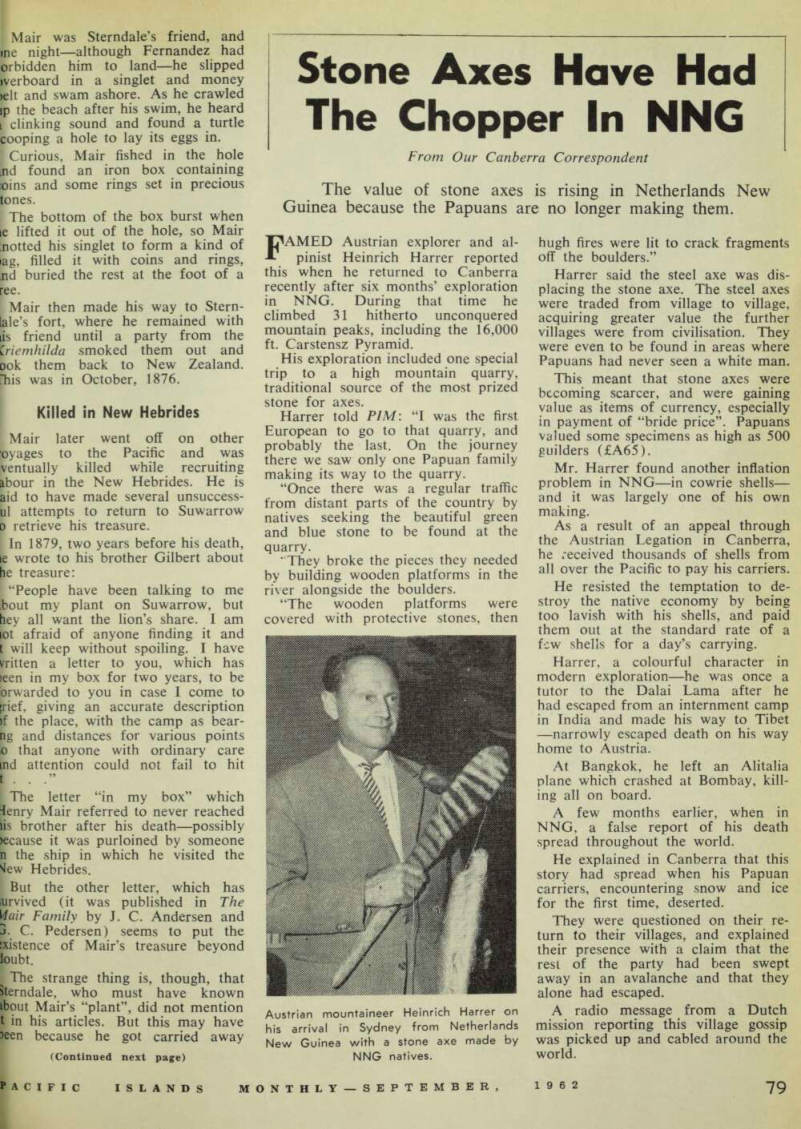
FAMED Austrian explorer and al pinist Heinrich Harrer reported this when he returned to Canberra recently after six months’ exploration in NNG, During that time he climbed 31 hitherto unconquered mountain peaks, including the 16,000 ft. Carstensz Pyramid.
His exploration included one special trip to a high mountain quarry, traditional source of the most prized stone for axes.
Harrer told PIM: “I was the first European to go to that quarry, and probably the last. On the journey there we saw only one Papuan family making its way to the quarry.
“Once there was a regular traffic from distant parts of the country by natives seeking the beautiful green and blue stone to be found at the quarry.
“They broke the pieces they needed by building wooden platforms in the river alongside the boulders.
“The wooden platforms were covered with protective stones, then
hugh fires were lit to crack fragments off the boulders.”
Harrer said the steel axe was dis placing the stone axe. The steel axes were traded from village to village, acquiring greater value the further villages were from civilisation. They were even to be found in areas where Papuans had never seen a white man.
This meant that stone axes were becoming scarcer, and were gaining value as items of currency, especially in payment of “bride price”. Papuans valued some specimens as high as 500 guilders (£A6S).
Mr. Harrer found another inflation problem in NNG—in cowrie shells— and it was largely one of his own making.
As a result of an appeal through the Austrian Legation in Canberra, he received thousands of shells from all over the Pacific to pay his carriers.
He resisted the temptation to de stroy the native economy by being too lavish with his shells, and paid them out at the standard rate of a few shells for a day’s carrying.
Harrer, a colourful character in modern exploration—he was once a tutor to the Dalai Lama after he had escaped from an internment camp in India and made his way to Tibet —narrowly escaped death on his way home to Austria.
At Bangkok, he left an Alitalia plane which crashed at Bombay, kill ing all on board.
A few months earlier, when in NNG, a false report of his death spread throughout the world.
He explained in Canberra that this story had spread when his Papuan carriers, encountering snow and ice for the first time, deserted.
They were questioned on their re turn to their villages, and explained their presence with a claim that the rest of the party had been swept away in an avalanche and that they alone had escaped.
A radio message from a Dutch mission reporting this village gossip was picked up and cabled around the world.
Austrian mountaineer Heinrich Harrer on his arrival in Sydney from Netherlands New Guinea with a stone axe made by NNG natives.