Weird Ceremony
pp. 82-83 · Read in the full issue
NSW Woman Puts Weird Ceremony On Record
By a Staff Writer
PEOPLE who collect the odd a> interesting in records and ' Territorial suffering from ac: nostalgia will be interested in j recording of music and rituals in Duke of York Islands recen released in Australia by EMI (A/ tralia) Ltd.
The recording, called “Music s Sounds of Melanesia”, was mades luly, 1961, by a NSW woman, IW Sandra Leßrun Holmes, during? three-months’ visit to New Britti and the Duke of York Islands w her film director husband and! cameraman to make documentfi films for the ABC and the Method Church.
Mrs. Holmes, known profession:: as Sandra Leßrun, has been study primitive dances, songs and myi since her early years am: aborigines in the Far West of M South Wales. Tape recordings has made of aboriginal songs ceremonies in outback Western A tralia have been used in radio television programmes.
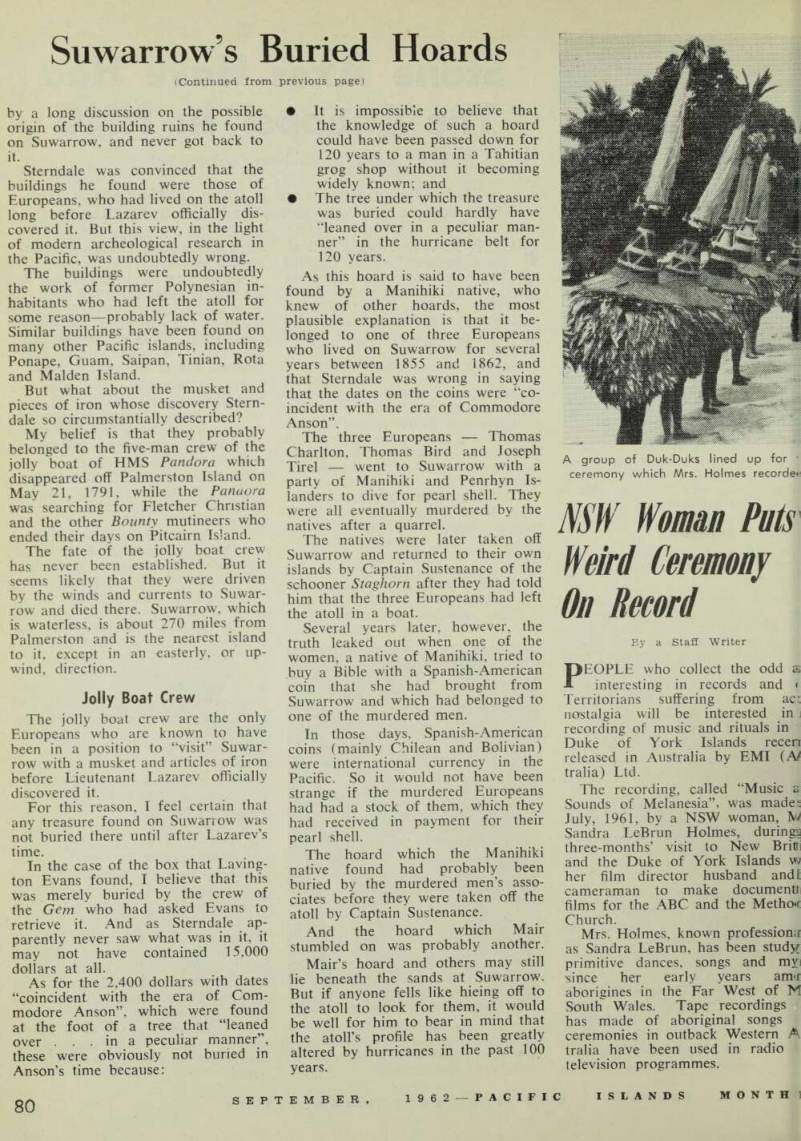
A group of Duk-Duks lined up for ceremony which Mrs. Holmes recorder
Her latest record, which retails at |2/6, includes Pidgin renderings of Did Black Joe”, “Hallelujah” and Onward Christian Soldiers”, Pidgin ongs by native composers, some raditional songs in the local dialect, nd a segment on the rarely seen )uk-Duk (pronounced “dook-dook”) eremony.
Mrs. Holmes believes that the Duk )uk ceremony, which is mainly to 0 with the initiation of boys, has ever previously been recorded.
The record is most interesting in s contrast between the traditional ative songs, which are distinctive but ametimes monotonous, and the lodern Pidgin jingles.
Most of the Pidgin songs are based n the idea of sadness at leaving ome to go to work on a plantation, r on the homesickness of labourers 'hile there. 1 But the rhythm is always foreign ) traditional New Guinea and is ased entirely on the clackity-clack f pure Hawaiian.
In this, of course, the modern NG omposer is not alone—every acific Islander has adopted the [awaiian beat as his own, and so alled modern “Islands” music is bout the one thing all Pacific ilanders now have in common.
Those who admire the ancient lelanesian chants and songs for their wn sake because they are genuine fight well curse the introduction of le trade-store guitar, which is lostly to blame for the evolution of fis music.
It is virtually impossible to sing le old laments, fighting or sing-sing mgs to its accompaniment, and for fis reason they tend to be forgotten.
Mrs. Holmes told PIM that the natives “did not seem very happy about letting us see the Duk-Duk ceremony”.
“They tell most white people that the ceremony is not held any more,” she said.
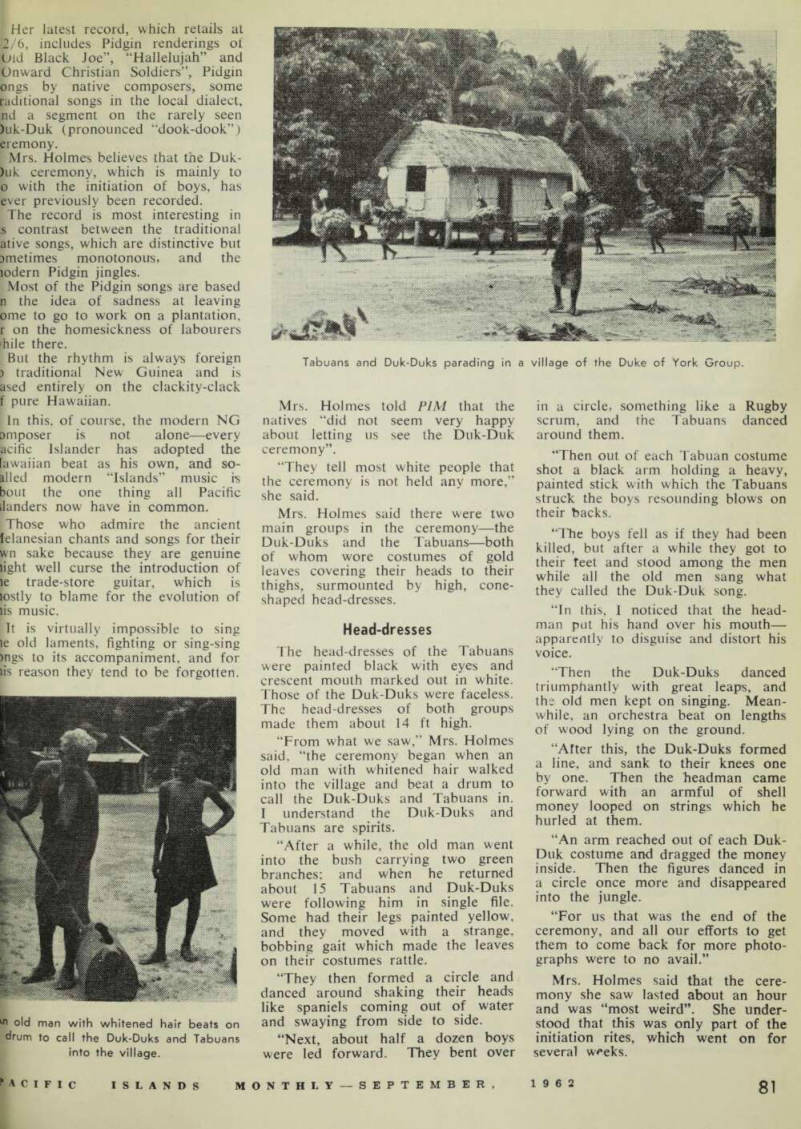
Mrs. Holmes said there were two main groups in the ceremony—the Duk-Duks and the Tabuans—both of whom wore costumes of gold leaves covering their heads to their thighs, surmounted by high, cone shaped head-dresses.
Head-dresses The head-dresses of the Tabuans were painted black with eyes and crescent mouth marked out in white.
Those of the Duk-Duks were faceless.
The head-dresses of both groups made them about 14 ft high.
“From what we saw,” Mrs. Holmes said, “the ceremony began when an old man with whitened hair walked into the village and beat a drum to call the Duk-Duks and Tabuans in.
I understand the Duk-Duks and Tabuans are spirits.
“After a while, the old man went into the bush carrying two green branches; and when he returned about 15 Tabuans and Duk-Duks were following him in single file.
Some had their legs painted yellow, and they moved with a strange, bobbing gait which made the leaves on their costumes rattle.
“They then formed a circle and danced around shaking their heads like spaniels coming out of water and swaying from side to side.
“Next, about half a dozen boys were led forward. They bent over
in a circle, something like a Rugby scrum, and the Tabuans danced around them.
“Then out of each Tabuan costume shot a black arm holding a heavy, painted stick with which the Tabuans struck the boys resounding blows on their backs.
“The boys fell as if they had been killed, but after a while they got to their feet and stood among the men while all the old men sang what they called the Duk-Duk song.
“In this, I noticed that the head man put his hand over his mouth— apparently to disguise and distort his voice.
“Then the Duk-Duks danced triumphantly with great leaps, and the old men kept on singing. Mean while, an orchestra beat on lengths of wood lying on the ground.
“After this, the Duk-Duks formed a line, and sank to their knees one by one. Then the headman came forward with an armful of shell money looped on strings which he hurled at them, “An arm reached out of each Duk- Duk costume and dragged the money inside. Then the figures danced in a circle once more and disappeared into the jungle.
“For us that was the end of the ceremony, and all our efforts to get them to come back for more photo graphs were to no avail.”
Mrs. Holmes said that the cere mony she saw lasted about an hour and was “most weird”. She under stood that this was only part of the initiation rites, which went on for several w#*eks.
[?]n old man with whitened hair beats on drum to call the Duk-Duks and Tabuans into the village.
Tabuans and Duk-Duks parading in a village of the Duke of York Group.