Smagazine Section
pp. 79-82 · Read in the full issue
Lonely Suwarrow Atoll May Still Guard Some Buried Treasure
By Robert Langdon
Five hundred-odd miles north-west of Rarotonga in the Cook Group and about 3,000 miles north-east of Sydney is the lonely, usually uninhabited atoll of Suwarrow. The atoll, comprising 12 main islets on a reef about 50 miles in circumference, is one of the most fascinating, from an historical viewpoint, in the South Pacific.
UNTIL 1814, when Lieutenant Mik hail Lazarev, of the Russian American Company’s ship Suvorov, liscovered it, the atoll was officially mknown to European navigators. It vas then uninhabited, and no Euro »ean is known to have lived on it >efore 1855.
Yet three times between the years 1855 and 1876, hoards of Spanish md Spanish American coins bearing lales as ancient as 1741 are alleged o have been found on it. [ A man who lived on Suwarrow in he 1860’s and 1870’s also claimed hat he had found an ancient musket,
Brothers, a prominent Tahiti trading firm of the time.
This firm had bought the wreck of an American whaling ship, the Gem, which had run aground on the reef at Suwarrow with its holds full of oil. (The crew had escaped in the ship’s boats to Samoa and had later gone on to Tahiti.) The Caroline Hort’s mission was to salvage the Gem’s cargo under the superintendence of the supercargo John Lavington Evans.
Sterndale said that after this mis sion was accomplished, Evans searched the atoll for six weeks and finally “dug up a box of specie, which, from its dimensions, could not have contained much less than 15,000 dollars”.
“Whether he had dreamed of its existence,” Sterndale said, “or upon what mysterious information he acted was only known to himself. But one fact is very remarkable—he was ac quainted from the day of his first landing with the precise spot, within a few rods, where this treasure had been concealed.”
Sterndale said that “some years after” the visit of the Caroline Hort, “another associate” of his unearthed 2,400 dollars at the foot of an old ironwood tree. This deposit was on a detached islet, about a mile from where the first cache had been found.
The finder of the second cache told Sterndale that he had been told about it many years previously by a man he met in a Tahitian grog-shop.
“This man,” Sterndale said, “pro fessed never to have been at the is land. but nevertheless was able to describe very circumstantially the place of concealment of the hidden treasure, the shape of the islet, and
several pieces or iron, some human skeletons and the remains of some ancient buildings which he thought were of European origin.
The man who claimed to have found these items and who reported the discovery of two of the treasures was Captain Bathurst Sterndale, a well-known personality in the Pacific in the second half of the last century.
In a series of articles in the Monthly Review of Wellington for 1890, Sterndale said that the first treasure was found when he visited Suwarrow in 1855 in the Caroline Hort, a vessel owned by Hort
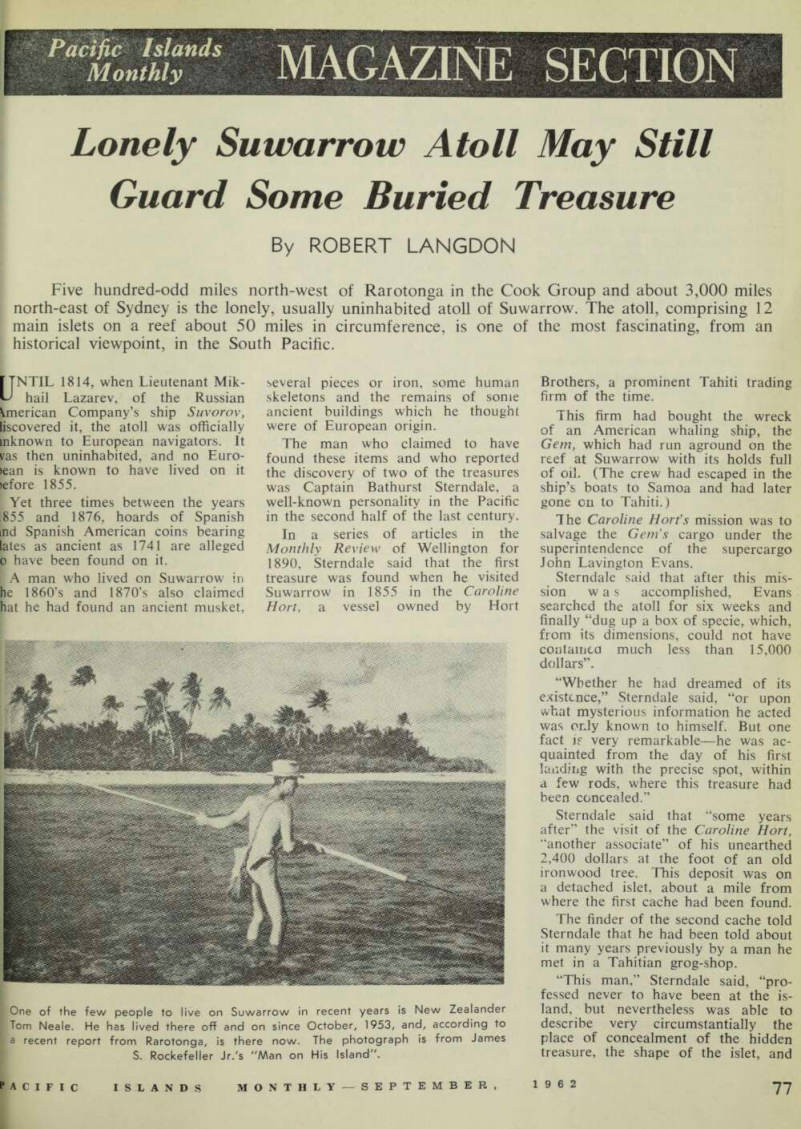
One of the few people to live on Suwarrow in recent years is New Zealander Tom Neale. He has lived there off and on since October, 1953, and, according to a recent report from Rarotonga, is there now. The photograph is from James S. Rockefeller Jr.'s "Man on His Island".
the form and appearance of the tree, which leaned over to the eastward in a peculiar manner.
“None of the coin was of this century; some of it was very old and black and of a date coincident with the era of Commodore Anson [about 1741].
“The finder possessed still further information (which he imparted to me very minutely) of other similar, but more valuable deposits; but fate did not afford him an opportunity of profiting by his knowledge for he died upon the island of Manihiki where he went to visit his wife shortly thereafter.”
Sterndale did not say in his articles whether he was on Suwarrow when the second treasure was found. He may have been.
According to a declaration he made in Tahiti in 1868, he was landed on the atoll by the schooner Traveller on October 16, 1867, to establish a depot of trade and to gather pearl shell, beche de mer and other island pro duce for the Pacific Island Trading Co. Ltd. This company had leased the atoll from the British Crown.
About 20 natives who had been picked up by the Traveller at other islands in the Cook Group were landed on Suwarrow with Sterndale.
Three men, including a native of Manihiki (who may have been the
one who found the treasure), were already living there.
Sterndale’s party stayed on Suwar row for six months, neglected by the trading company’s ships. In the end, starving and racked with scurvy, they were taken off by the notorious “Bully” Hayes, who chanced to put into the atoll in his brig Rona.
Despite this unhappy experience, Suwarrow apparently had an ir resistible attraction for Sterndale be cause 6i years later he went there again—this time to establish a trading station for the Auckland firm of Hen derson and Macfarlane with the aid of some natives who had been re cruited in Manihiki.
As soon as he arrived, Sterndale warned off at revolver point a Samoan cutter that was fishing for pearl shell in the lagoon and built a fort over looking the anchorage. The fort was armed with three small cannon that had been brought from Auckland.
Clear of Thicket This done, Sterndale settled down to clear some of the islets and plant crops. One of the islets he decided to clear was covered on its ou*er edges by a forest of banyan trees overgiown with creepers. But in the cerure was a circular space of several acres that was clear of thicket and of good soil.
“When laid bare,” Sterndale said in one of his articles, “the ground presented the appearance of a perfect level, with here and there what seemed like low lines of kerb-stones just appearing above the surface, also several funnel-shaped pits five or six feet deep, and some large flat rocks laid like tombstones.
“When proceeding with the clearing of the land I caused to be removed the heap of stones . . . and there under a great flat slab we found a musket of a very old fashion.
“The form of stock and barrel were still preserved, but too far de cayed to bear handling. The only part entire was portion of the breech and the flint, which was a white one, very large, and much worn.
“The appearance of the funnel shaped pits . . . was such as to cause me to suppose that they had been dug for water and with the same view I caused them to be cleared out again.
“To our great surprise, we per ceived them to be limekilns, in one of which still remained about three
feet of burnt lime, but so very ♦ as to have almost returned to i consistency of stone.
“Our next task was to remove rows of what appeared to be ke; stones, which resulted in a still nnj extraordinary discovery. They pro? to be the tops of sunken walls, bn of very large stones, in lines parai or at right angles to each other, s evidently intended as the outer f:5 of certain huge platforms, some feet long by 25 feet wide.
“The concrete was so solid th& caused it to be broken up in gn slabs and used as building stone; other works.
“Underneath it in one place I fou an iron bolt reduced to rust. It I been about 18 inches long and of thickness of a man’s arm.
“Also not far from thence w* found in a pit, three feet below surface, several skeletons; in the hai of one of which was clutched an ii bolt about nine inches in length byy inch in diameter.
“In the same pit was found iron tomahawk, rudely manufactuj from a shackle link of a las chain . . .”
Sterndale would possibly hd made all sorts of other discovea if he had stayed on Suwarrow several years. As it was, he taken off after less than two residence following a dispute withr employers, Henderson and Macs lane.
But Sterndale did not leave Suv row without a struggle. When Capq Tom Fernandez arrived at the s in the schooner Kriemhilda to 1 him off, he barricaded himself inn fort with his three small cannon.
A siege of several weeks ensia during which the Kriemhilda layj anchor in the lagoon. On board!
Kriemhilda was a young man cas; Henry Abbott Mair, a member off well-known Mair family of T 1 Zealand.
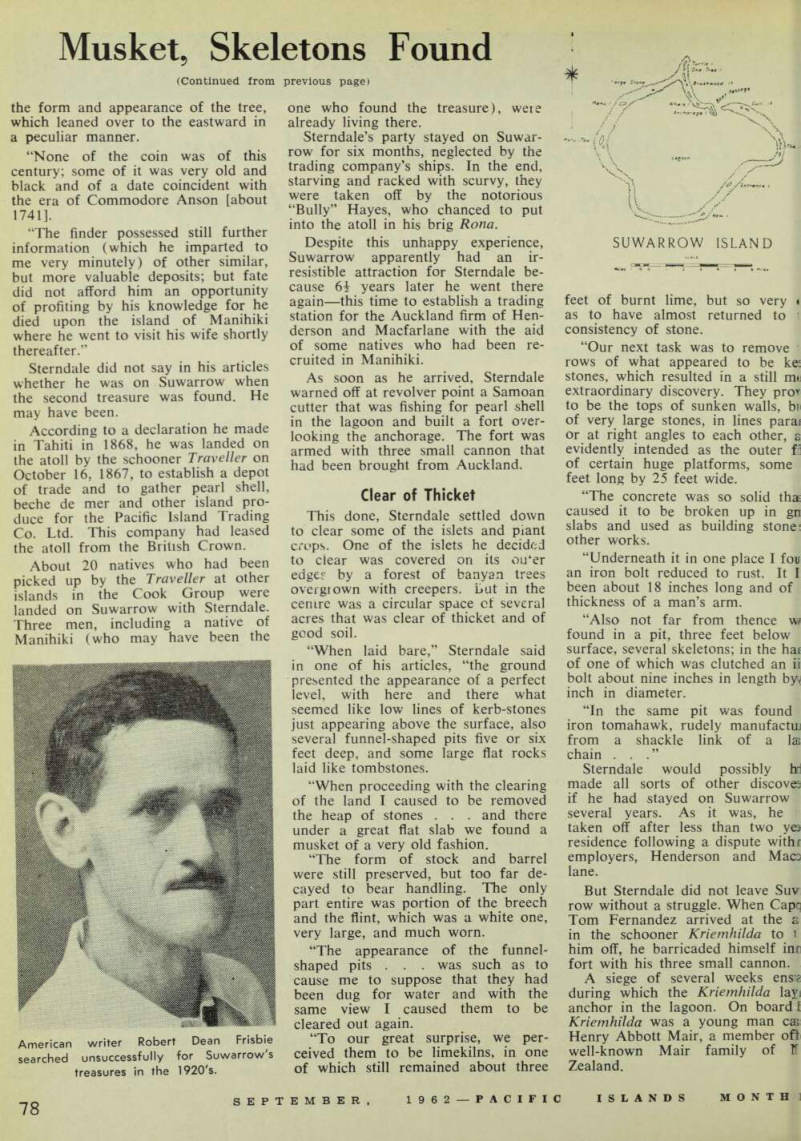
American writer Robert Dean Frisbie searched unsuccessfully for Suwarrow's treasures in the 1920's.
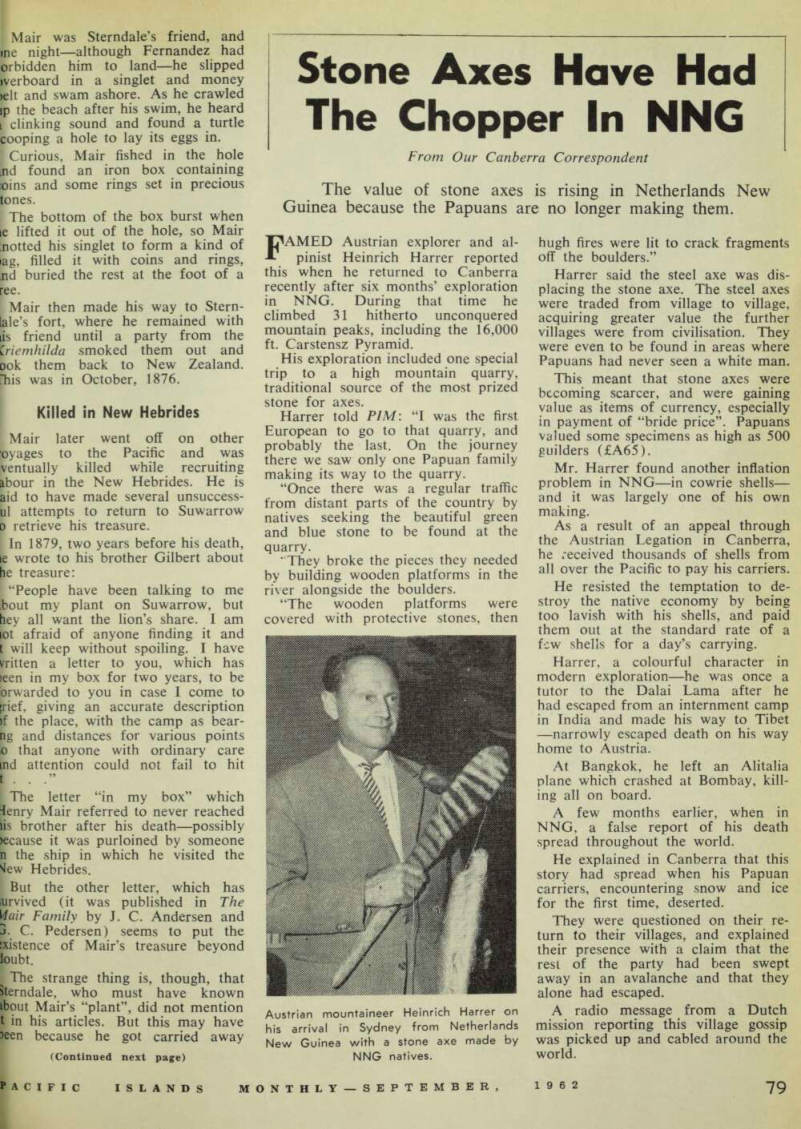
Suwarrow Island
Mair was Sterndale’s friend, and me night—although Fernandez had orbidden him to land—he slipped iverboard in a singlet and money »elt and swam ashore. As he crawled ip the beach after his swim, he heard clinking sound and found a turtle cooping a hole to lay its eggs in. [ Curious, Mair fished in the hole ind found an iron box containing ©ins and some rings set in precious tones. [ The bottom of the box burst when ic lifted it out of the hole, so Mair Hotted his singlet to form a kind of lag, filled it with coins and rings, nd buried the rest at the foot of a ree.
Mair then made his way to Stern lale’s fort, where he remained with lis friend until a party from the iriemhilda smoked them out and ook them back to New Zealand, [his was in October, 1876.
Killed in New Hebrides Mair later went off on other joyages to the Pacific and was ventually killed while recruiting abour in the New Hebrides. He is aid to have made several unsuccess ul attempts to return to Suwarrow p retrieve his treasure.
I In 1879, two years before his death, ie wrote to his brother Gilbert about he treasure: : “People have been talking to me bout my plant on Suwarrow, but hey all want the lion’s share. I am lot afraid of anyone finding it and i will keep without spoiling. I have written a letter to you, which has ►een in my box for two years, to be brwarded to you in case I come to [rief, giving an accurate description If the place, with the camp as bear ng and distances for various points 0 that anyone with ordinary care ind attention could not fail to hit t . . .” 1 The letter “in my box” which Jenry Mair referred to never reached lis brother after his death—possibly >ecause it was purloined by someone n the ship in which he visited the 'Jew Hebrides.
But the other letter, which has tirvived (it was published in The Hair Family by J. C. Andersen and j. C. Pedersen) seems to put the existence of Mair’s treasure beyond loubt.
The strange thing is, though, that Sterndale, who must have known ibout Mair’s “plant”, did not mention t in his articles. But this may have Jeen because he got carried away
(Continued next page)
by a long discussion on the possible origin of the building ruins he found on Suwarrow, and never got back to it.
Sterndale was convinced that the buildings he found were those of Europeans, who had lived on the atoll long before Lazarev officially dis covered it. But this view, in the light of modern archeological research in the Pacific, was undoubtedly wrong.
The buildings were undoubtedly the work of former Polynesian in habitants who had left the atoll for some reason —probably lack of water.
Similar buildings have been found on many other Pacific islands, including Ponape, Guam, Saipan, Tinian, Rota and Malden Island.
But what about the musket and pieces of iron whose discovery Stem dale so circumstantially described?
My belief is that they probably belonged to the five-man crew of the jolly boat of HMS Pandora which disappeared off Palmerston Island on May 21, 1791, while the Panuora was searching for Fletcher Christian and the other Bounty mutineers who ended their days on Pitcairn Island.
The fate of the jolly boat crew has never been established. But it seems likely that they were driven by the winds and currents to Suwar row and died there. Suwarrow, which is waterless, is about 270 miles from Palmerston and is the nearest island to it, except in an easterly, or up wind, direction.
Jolly Boat Crew The jolly boat crew are the only Europeans who are known to have been in a position to “visit” Suwar row with a musket and articles of iron before Lieutenant Lazarev officially discovered it.
For this reason, 1 feel certain that any treasure found on Suwarrow was not buried there until after Lazarev’s time.
In the case of the box that Laving ton Evans found, 1 believe that this was merely buried by the crew of the Gem who had asked Evans to retrieve it. And as Sterndale ap parently never saw what was in it, it may not have contained 15,000 dollars at all.
As for the 2,400 dollars with dates “coincident with the era of Com modore Anson”, which were found at the foot of a tree that “leaned over . . . in a peculiar manner”, these were obviously not buried in Anson’s time because:
• It is impossible to believe that the knowledge of such a hoard could have been passed down for 120 years to a man in a Tahitian grog shop without it becoming widely known; and • The tree under which the treasure was buried could hardly have “leaned over in a peculiar man ner” in the hurricane belt for 120 years.
As this hoard is said to have been found by a Manihiki native, who knew of other hoards, the most plausible explanation is that it be longed to one of three Europeans who lived on Suwarrow for several years between 1855 and 1862, and that Sterndale was wrong in saying that the dates on the coins were “co incident with the era of Commodore Anson”.
The three Europeans Thomas Charlton, Thomas Bird and loseph Tirel went to Suwarrow with a party of Manihiki and Penrhyn Is landers to dive for pearl shell. They were all eventually murdered by the natives after a quarrel.
The natives were later taken off Suwarrow and returned to their own islands by Captain Sustenance of the schooner Staghorn after they had told him that the three Europeans had left the atoll in a boat.
Several years later, however, the truth leaked out when one of the women, a native of Manihiki, tried to buy a Bible with a Spanish-American coin that she had brought from Suwarrow and which had belonged to one of the murdered men.
In those days, Spanish-American coins (mainly Chilean and Bolivian) were international currency in the Pacific. So it would not have been strange if the murdered Europeans had had a stock of them, which they had received in payment for their pearl shell.
The hoard which the Manihiki native found had probably been buried by the murdered men’s asso ciates before they were taken off the atoll by Captain Sustenance.
And the hoard which Mair stumbled on was probably another, Mair’s hoard and others may still lie beneath the sands at Suwarrow.
But if anyone fells like hieing off to the atoll to look for them, it would be well for him to bear in mind that the atoll’s profile has been greatly altered by hurricanes in the past 100 years.