Lively Trading
pp. 35-38 · Read in the full issue
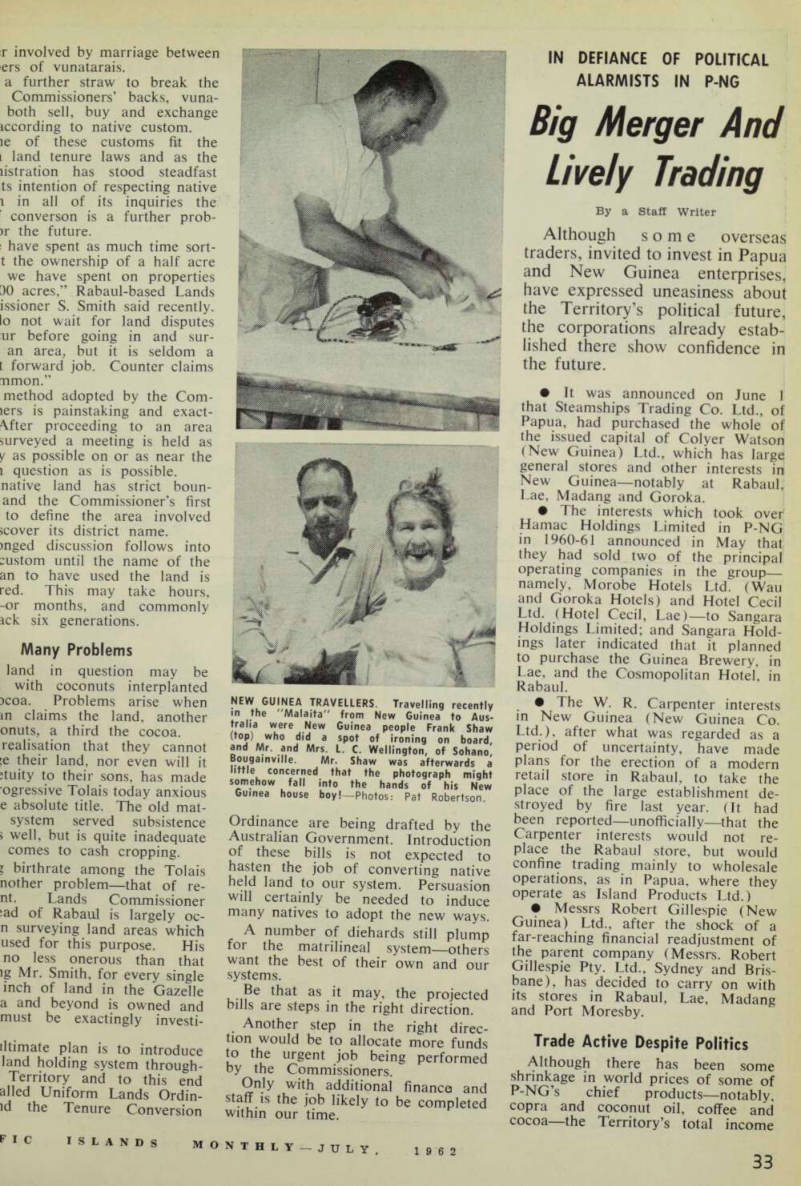
In Defiance Of Political
Alarmists In P-Ng
Big Merger And Lively Trading
By a Staff Writer
Although some overseas traders, invited to invest in Papua and New Guinea enterprises, have expressed uneasiness about
the Territory’s political future,
the corporations already estab
lished there show confidence in the future. • It was announced on June 1 that Steamships Trading Co. Ltd., of Papua, had purchased the whole of the issued capital of Colyer Watson (New Guinea) Ltd., which has large general stores and other interests in New Guinea—notably at Rabaul, Lae, Madang and Goroka. • The interests which took over Hamac Holdings Limited in P-NG in 1960-61 announced in May that they had sold two of the principal operating companies in the group— namely, Morobe Hotels Ltd. (Wau and Goroka Hotels) and Hotel Cecil Ltd. (Hotel Cecil, Lae) —to Sangara Holdings Limited; and Sangara Hold ings later indicated that it planned to purchase the Guinea Brewery, in Lae, and the Cosmopolitan Hotel, in Rabaul. • The W. R. Carpenter interests m New Guinea (New Guinea Co.
Ltd.), after what was regarded as a period of uncertainty, have made plans for the erection of a modern retail store in Rabaul, to take the place of the large establishment de stroyed by fire last year. (It had been reported—unofficially—that the Carpenter interests would not re place the Rabaul store, but would confine trading mainly to wholesale operations, as in Papua, where they operate as Island Products Ltd.) • Messrs Robert Gillespie (New Guinea) Ltd., after the shock of a far-reaching financial readjustment of the parent company (Messrs. Robert Gillespie Pty. Ltd., Sydney and Bris bane), has decided to carry on with its stores in Rabaul, Lae, Madang and Port Moresby.
Trade Active Despite Politics Although there has been some shrinkage in world prices of some of P-NG’s chief products—notably, copra and coconut oil, coffee and cocoa—the Territory’s total income
:arnings has not diminished; le Territory’s income from the ian subsidy (ranging between Hions and £l7 millions) tends squently, despite persistent alarms—such as the danger ig Indonesians on the western , and the threat of native self lent very soon—general trad *:NG is as lively and healthy it was. The big trading cor is maintain turnover and :omfortable profits; and all operators appear prosperous.
Administration’s “crash pro ” of preparing the natives for jrnment has been regarded by planters and traders as ling” and “depressing”, others realise that “Self icnt” means the increasing anisation” of the natives; and turn means that the natives )re and more of the European id manufactured goods which ers sell. e, the natives will create r n machinery of retail distri ■they are certainly being en- I by the Administration to more and more “co js”.
", the Chinese traders will ex ir operations to take care of business. It is interesting to at the Chinese from New are moving into Port ’s rapidly-growing eastern -there is an expanding f them now at the seaside f Koki, out beyond Ela where the trade is mainly PIM, Nov. ’6l, p. 21.)
STC-Colyer Merger
The announcement of the STC-
Colyer Watson merger, being ad
mirably brief and pointed, is worth
reproducing in full. The merger does
not affect Messrs. Colyer Watson
Pty. Ltd., of Sydney and Brisbane.
Joint statement by the chairman of directors of Steamships Trading Co. Ltd., Port Moresby, Mr. H. D. Underwood, and the governing director of Colyer Watson Pty. Ltd., Sydney, Mr. R, A. Colyer: It is announced that Steamships Trading Company Ltd. has acquired the whole of the issued capital of Colyer Watson (New Guinea) Ltd. The con sideration for the purchase will be the issue to the vendors of 192,709 fully paid £1 ordinary shares in Steamships Trading Company Ltd., plus a cash pay ment.
Colyer Watson (New Guinea) Ltd. will continue its operations and retain its separate identity, but as a wholly-owned sidsidiary of Steamships Trading Com pany Ltd.
The directors of Steamships Trading Company Ltd. will join the board of Colyer Watson (New Guinea) Ltd., and Messrs. R. A. and K. L. Colyer have agreed to remain on the board as consultants. This announcement desires to emphasise that this take-over of Colyer Watson (New Guinea) Ltd. is solely confined to the Colyer interests in New Guinea.
Further statement by Mr. R. A Colyer: The consideration for the pur chase of my interest in Colyer Watson (New Guinea) Ltd. was optional. I had the option of accepting either cash or shares; and I decided to accept shares as a confirmation to the Colyer Watson (New Guinea) Ltd. executives and staff, as well as to the public, of my faith in the future of the Territory and my continuing great interest in its develop ment.
Further statement by Mr. H. D.
Underwood; This move will give Steam ships Trading Company Ltd. its first direct participation in trading in the
Trust Territory of New Guinea, and represents a major change in the com pany’s policy, which has hitherto con fined its operations to Papua.
With stores and other interests in Rabaul, Madang, Goroka and Lae it is envisaged that the merchandising, shipping and other activities in those centres will be developed along the same progressive lines as has been followed in Port Moresby.
Re-alignments
The STC-Colyer Watson merger will have interesting repercussions. It means that STC emerges as Burns Philps’ biggest rival in the P-NG islands.
Hitherto, the opposition to Burns Philp was divided. In Papua, the Big Firm’s chief competitor was Steam ships Trading Co. But STC did not enter the Trust Territory. There, BP’s encountered three big retailers—Car penters, Colyer Watson and Gil lespies.
Now, the BP-STC battle will be joined in both Papua and New Guinea, with the powerful Carpenter interests apparently planning a full return to retail distribution in Rabaul, Madang, Lae and Kavieng.
Trading competition in the Terri tory is keen and ruthless. When the Gillespie headquarters organisation in Sydney got out of order, there was a sharp scramble by other traders for Gillespies’ more valuable Islands agencies. Philips, probably the biggest and best, decided to make a change; and in May it was given to Burns Philp. There was a rush for another valuable Gillespie agency, Coleman’s Lamps; but up to the end of June the big Canadian manufacturer had made no change. (Over)
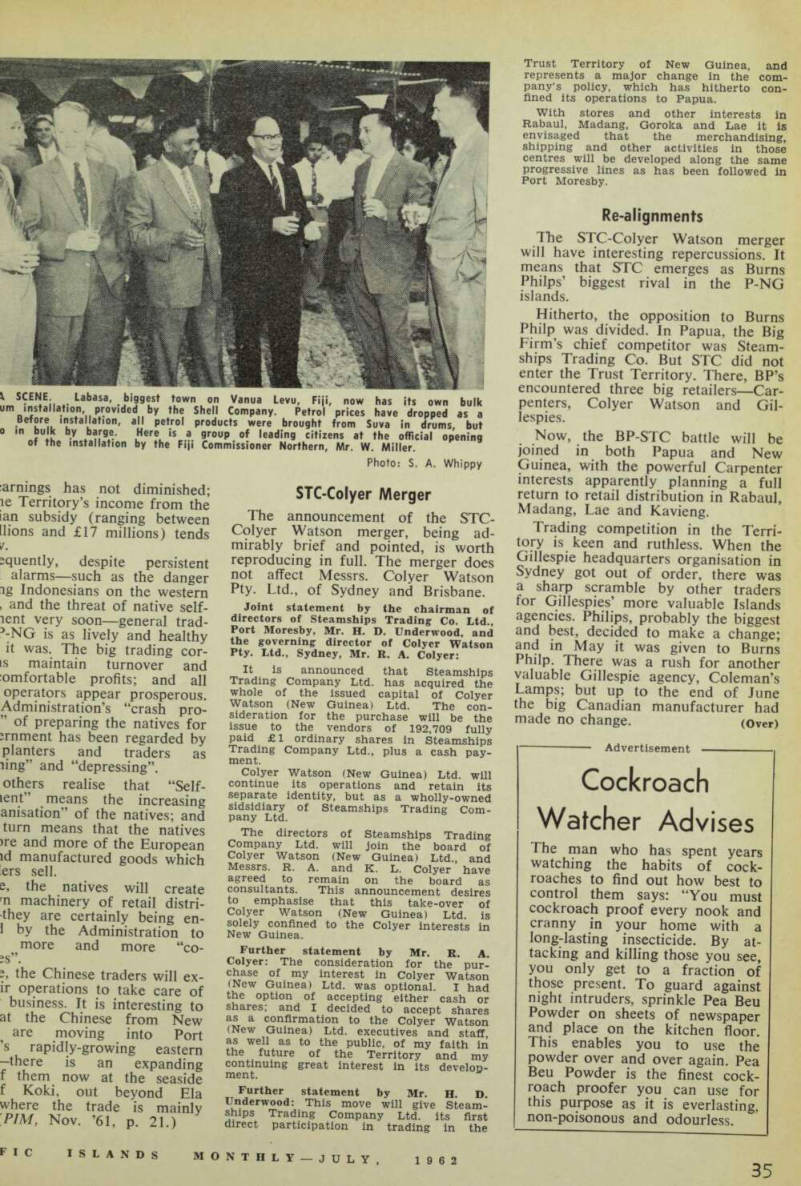
A SCENE. Labasa, biggest town on Vanua Levu, Fiji, now has its own bulk [?]um installation, provided by the Shell Company. Petrol prices have dropped as a Before installation, all petrol products were brought from Suva in drums, but [? ] in bulk by barge. Here is a group of leading citizens at the official opening of the installation by the Fiji Commissioner Northern, Mr. W. Miller.
Photo: S. A. Whippy
Robert Gillespie Group
It was indicated in May that Messrs. Robert Gillespie (New Guinea) Ltd. were still in the firing line, and that the Port Moresby branch was moving into Kriewaldt and Co.’s former large retail store premises in Douglas Street—Krie waldts having decided to give up their central retail store in order to concentrate on the automobile and transport business.
Mr. Robert Gillespie, whose illness early this year precipitated a financial crisis in the parent company (Robert Gillespie Pty. Ltd., Sydney and Bris bane), has made a good recovery, and has been living quietly in Sydney during reorganisation.
Meanwhile, the two Islands com panies (New Guinea and Fiji) have been carried on independently of the parent company’s troubles; and it is hoped to restore the little group to its customary vigour before the end of the year.
Development of Hotels Lively planning for the improve ment of the New Guinea hotels is under way, since Sangara Holdings Ltd. purchased the Lae, Wau and Goroka hotels from the Hamac sub sidiaries (PIM June, p. 157) and took over control of the Lae brewery.
The same group is now in control of the Cosmopolitan Hotel, Rabaul, through the Sandy Creek Company.
Hamac, in selling the three hotels, took £50,000 cash and £55,000 in Sangara shares, which means that Mr. L. F. McEachern, through Hamac, is interested in Sangara; and Mr. McEachern and Mr. Stitt re cently spread their Austro-New Guinea interests wider by buying sub stantially into Sandy Creek Gold Sluicing Ltd. Sandy Creek in May purchased the Cosmopolitan.
Attempts have been made to add the recently-renovated Madang Hotel to the Lae-Wau-Goroka-Rabaul chain; but views regarding price have differed widely.
As part of improvements now un der way, it is reported that the main structure of the Cosmopolitan Hotel is being altered, so as to open the bar and the western side to the cool har bour breezes; and that the annexe, Crossley House, is being remodelled so that there may be a selection of modern rooms, with air-conditioning and showers, available to travellers.
The same group, in developing a timber mill at Wanigela, Collingwood Bay, is planning a new hotel-motel there, as a special attraction for tourists who wish to see something of the wilder areas, and perhaps engage
in the tougher sports, like crocodile shooting.
This Sangara group announces that, as soon as the hotels have reached a certain standard, and the Markham Valley-Highlands road is through, it will “go after” the over seas tourist traffic, to which the unique attractions of New Guines can lay claim.
Security and 'Compensation'
Meanwhile, outside investors wit! a substantial stake in the Territory especially merchants and planters have been putting pressure on the Administration and the Departmen of Territories to make some sort o declaration of policy.
The Port Moresby Chamber o Commerce, in placing material be fore the visiting United Nations Mis sion in May, said: “Lack of Security:—private enter prise takes the view that with the ad vent of self-government there is th possibility that the system of privat enterprise, as we know it, may not b allowed to function according to it own free enterprise pattern.
“Accordingly, it is the consider opinion that some measure should bi implemented to ensure just am reasonable compensation in the even of any disturbance to democrat! rights.”
In simpler words, private enterprise seeks (a) an official assurance tha its rights will be protected agains losses through political development encouraged by the Administratioi and (b) in the event of such losse
occurring—i.e., from self-governmdb
or through invasion of Western Ne' Guinea by Indonesians —it may e* pect compensation from the Austtf Han-controlled Administration.
That request actually has been bt fore the Territories Minister I various forms in the past years. M the Minister —naturally—has bee very coy in the matter.
There is some anxiety, but ■
panic.
One or two corporations do sf some threat to the future of 1 Trust Territory, but they are coffl dent that there is security in PapJ which is basically an Australian ■ ritory, and which Australia dare* abandon.
“I think the Indonesians will con into West New Guinea,” said oi experienced observer. “But that woi be a good thing. It would mean tn European (Australian) control 01 Eastern New Guinea must contnf at all costs, and that we must tai care of the natives, even if it meai taking them into a political partite ship before they are ready for it. 1‘