Mountains, Gold
pp. 39-41 · Read in the full issue
And Railways
Moutainous Misima island, in Papua's Louisiade Archi go, could again become a fabulous producer of gold, >rding to reports in June. But will Misima's mountains one echo to the shriek of a train whistle, as they did when gold king there?
rain has run there since 1923, »en the railway was sold and e pulled up. And what a ! There were eight miles of half of this length was in the
hills with not a straight rail on it.
There were zigzags, a coral tunnel, 27 bridges (some with bends in them) and in the hilly section the line dropped from 800 ft in four miles like a switchback railway.
There are no railways anywhere in Papua-New Guinea these days, but there is still gold on Misima. Pacific Island Mines Ltd., at its annual meet ing in Sydney in June, announced that it shortly would begin develop ing “potentially rich” goldfields on Misima. The company had pros pected for two years and now was most optimistic over development (see Commerce, p. 180).
The annual meeting was told that part of the old rail route would be turned into a roadway soon.
The railway ran from Bwagaoia wharf to the mine terminal at Umuna. The Government station was at Bwagaoia, and the Block 10 Misima Gold Mines NL were at Umuna, in the hills.
Bwagaoia was established in 1920 by acting Resident Magistrate W. R.
Humphries, who was many years later killed in the Mount Lamington eruption of Papua. He moved the buildings from Woodlark Island.
Soon afterwards, A. H. Symons took
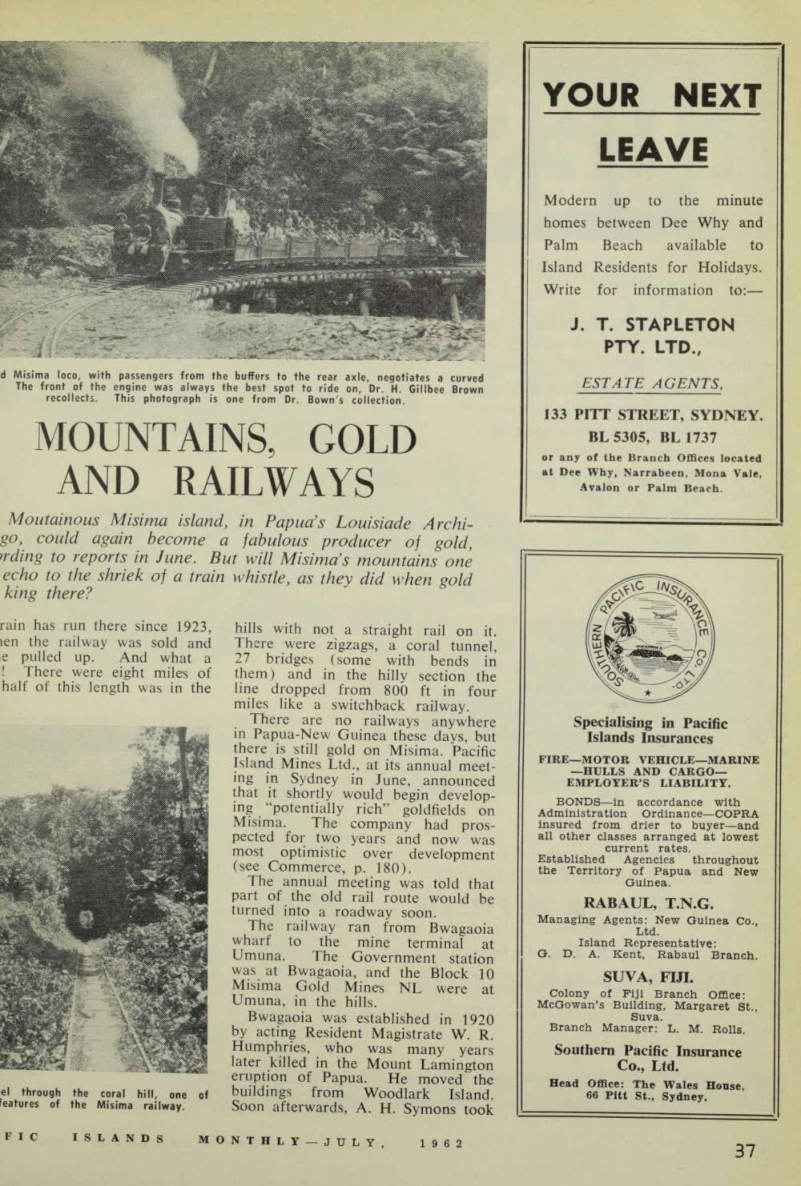
[?]d Misima loco, with passengers from the buffers to the rear axle, negotiates a curved The front of the engine was always the best spot to ride on, Dr. H. Gillbee Brown recollects. This photograph is one from Dr. Bown's collection.
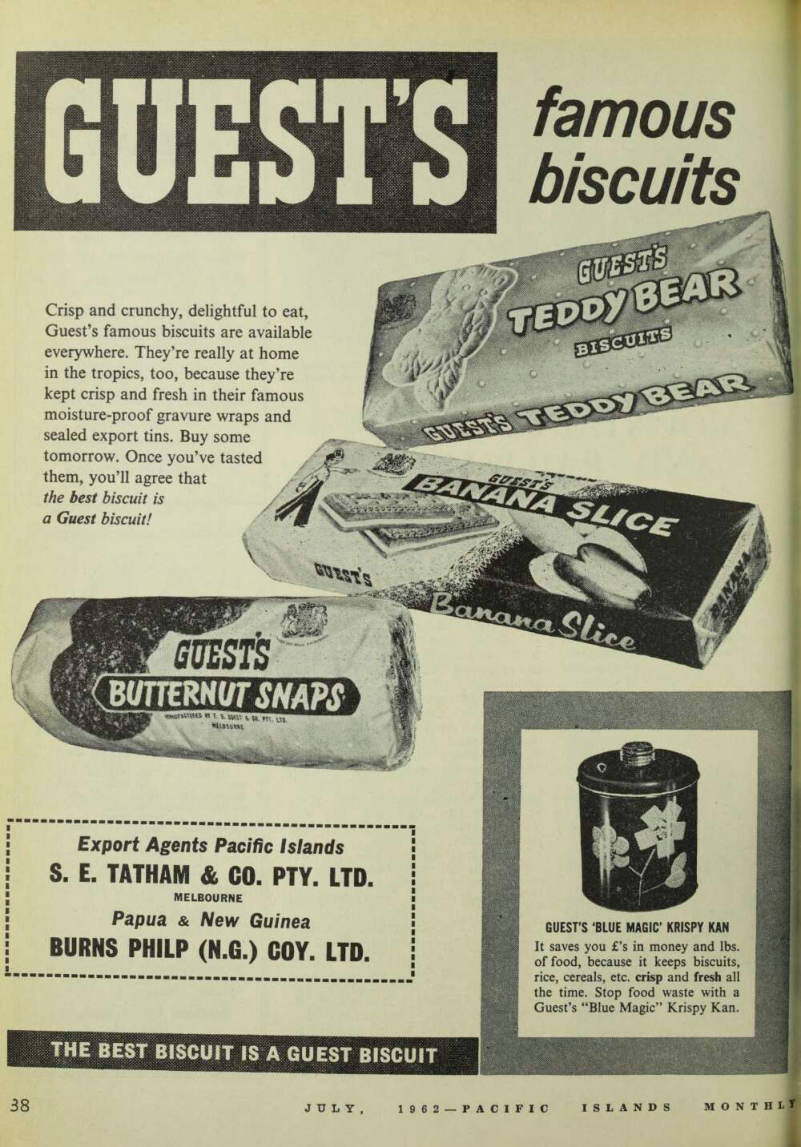
[?]el through the coral hill, one of features of the Misima railway.
as Resident Magistrate and idated the station. railway operated from 1920 3, when Block 10 closed down, line later got going again as irt’s, but this too closed and only in the last few years there been renewed—and ing—activity there by Pacific Mines. But there is no f.
H. Gillbee Brown, who was 1 officer with Block 10 in the iys, and who supplies these raphs from the big collection s of the railway in all its recalls that colourful railway railway carried coal for the furnaces, which had needed s of firewood a day until the 'as imported. It also trans food and general stores for line population, which was 800 native workers and 100 ans. ti the mine at Umuna to ii on the coast the line was r in the hills. From Lapapai igaoia was entirely along the passing through a tunnel in ral cliffs and finally curving
through a grove of coconuts to the small wharf in Bwagaoia Harbour.
Recalls Dr. Brown; “First-class passengers usually rode on the front buffer plate of the engine, with feet dangling in front of the cowcatcher.
This was the coolest spot, and it was also free of the sparks which burnt holes in the shirts of those who had to sit in the open trucks behind”.
At one time there was a guard on the train, put there by one of the mine managers, mainly to check on delays to the train’s schedule, which it was suspected were due to games of poker. But eventually he was removed. It was suspected that he, too, was taking part in the poker games.
The railway also used flat trolley cars in addition to the locomotive.
“A ride on one from Umuna, on the four-mile downhill run to the coast, was a greater thrill than Luna Park could provide,” recalls Dr.
Brown. “With a flat stick through the trolley platform as a brake, you endeavoured to slow down before it was too late.”
Dr. Brown revisited Misima in 1951, and walked the site of the old railway. He saw pieces of coal still „,. 0
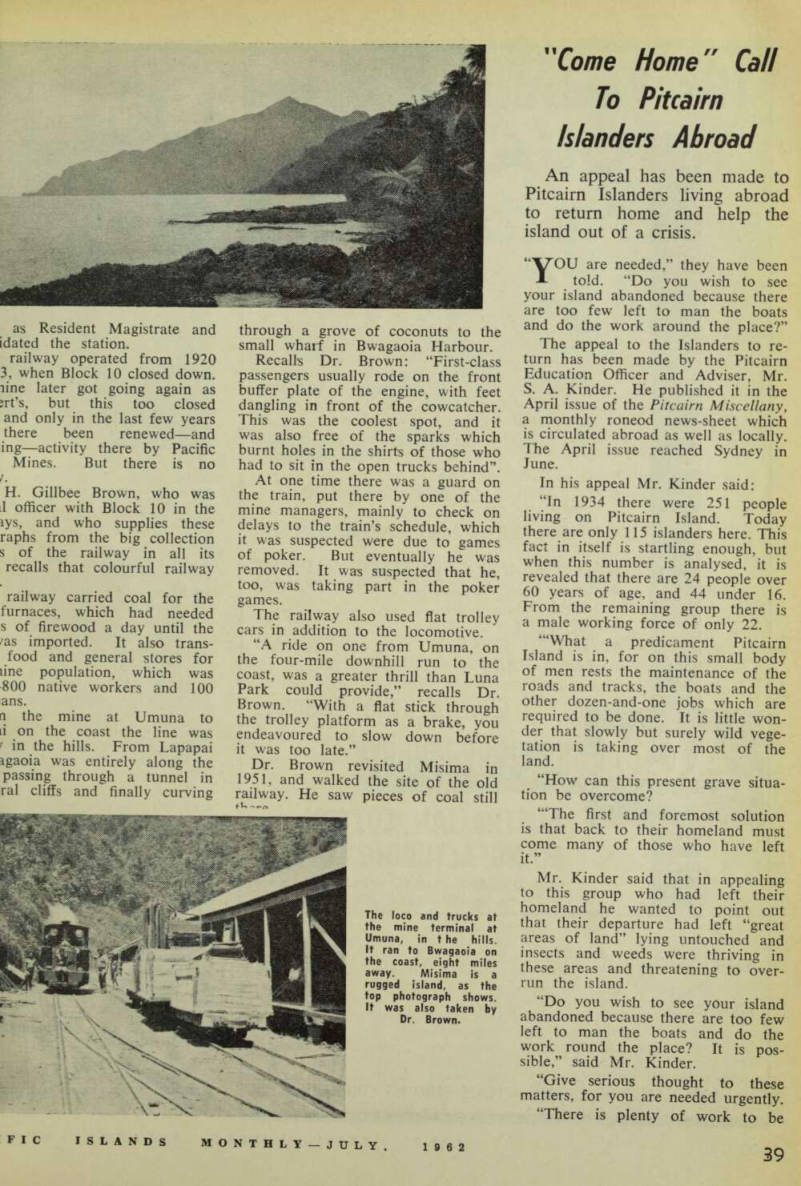
The loco and trucks at the mine terminal at Umuna, in the hills.
It ran to Bwagaoia on the coast, eight miles away. Misima is a rugged island, as the top photograph shows.
It was also taken by Dr. Brown.