Commissioners Have
pp. 34-35 · Read in the full issue
Not Much Money, Either New Guinea Land Commissioners Have A Herculean Task
From a Rabaul Correspondent A mere six men are attempt ing the herculean task of survey ing native-held lands in the NG Territory a job which the Assistant Administrator says is
the Territory’s “most important”.
THE frequent use of the term “native land tenure” in UN Mission discussions pinpointed inter est in this forgotten problem facing Australian Administration.
Forgotten— not by Administra tion who are acutely aware of the task before them—but forgotten apparently by those who hold the budget purse-strings.
The job of surveying communal land and sorting out the complexities of native land custom in New Guinea’s 93,000 square miles is be ing tackled by a mere six men. One, at most two, of these Lands Com missioners have the assistance of a cadet.
The work of ascertaining boun daries and recording ownership is regarded by Assistant Administrator John Gunther as “the most import ant” in the territory. It is also the job getting increasing prominence in Canberra.
The establishment of land titles and the surveying of boundaries are fundamental procedure in any ad vancing society but as Minister Has luck admitted in April, 1960, such work in the Territory would involve research by anthropologists and geo graphers and would take generations to complete.
Such is the work of specialists and no one denies the six Lands Commis sioners are the right men for the job. But the addition of genealogical and anthropological work to their general field work with its geographi cal and legal problems is prolonging the urgent job in hand.
Lack of uniform land laws, and a uniform language throughout the Territory, complicate their task to the point of confusion.
New Britain District Commis sioner, Mr. John Foldi, told the visiting Mission that no one law ap plied to land tenure in the Gazelle Peninsula—there were thousands, changing every mile or so.
This should not have been an eye opener to the Mission. They must have been aware of the nature of native land custom, if not in this Territory then in Africa where UN Missions have seen similar prob lems.
But it is doubtful if they became fully aware of the efforts being made, by so few, to sort out the tangled systems which prevail here.
In the Gazelle Peninsula, where most progress has been made, ap proximately 30,000 acres of com munal land of a total of 130,000 acres have been surveyed by the two resident Land Commissioners* This has been the work not of weeks—but of years. No possible target date can be set for comple tion of surveying work in the Penin sula, for progress is bringing more complications to upset the prevailing matrilineal system.
To the indigenes, Tolai land had little or no value prior to the intro duction of cash cropping. Sub sistence produce of the land was important and little trouble arose from the fact that all land was held communally in the vunatarai sys tem, the basic land-owning unit, fl A vunatarai could, and does, have rights to plots of land in other dis tricts and each member of a vuna tarai has rights over the land. The land is thus owned by a body of people who upon death automatically pass on ownership rights to the children of females —a matter
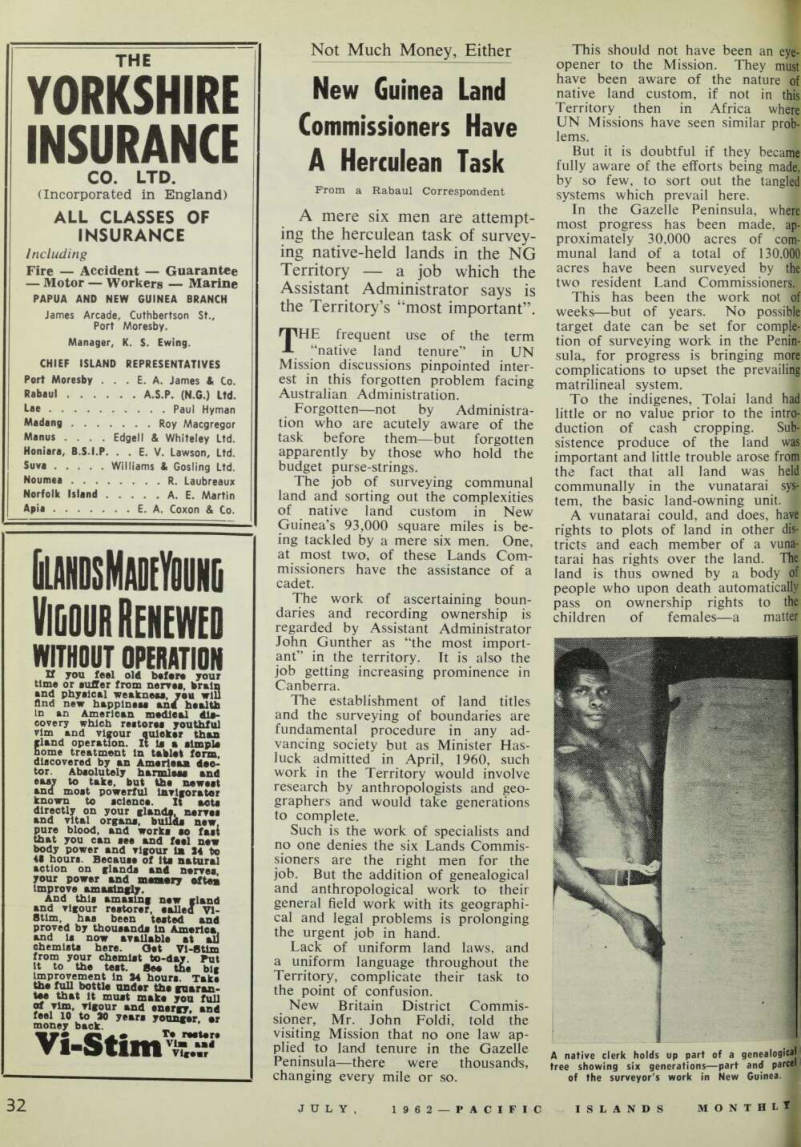
A native clerk holds up part of a genealogical tree showing six generations—part and parcel of the surveyor's work in New Guinea.
r involved by marriage between ers of vunatarais. a further straw to break the Commissioners’ backs, vuna both sell, buy and exchange iccording to native custom, ic of these customs fit the l land tenure laws and as the listration has stood steadfast ts intention of respecting native i in all of its inquiries the converson is a further prob >r the future. : have spent as much time sort t the ownership of a half acre we have spent on properties 30 acres,” Rabaul-based Lands issioner S. Smith said recently, lo not wait for land disputes ur before going in and sur an area, but it is seldom a t forward job. Counter claims Timon.” method adopted by the Cour iers is painstaking and exact- Mter proceeding to an area surveyed a meeting is held as y as possible on or as near the i question as is possible, native land has strict boun and the Commissioner’s first to define the area involved >cover its district name, mged discussion follows into custom until the name of the an to have used the land is red. This may take hours, -or months, and commonly ack six generations.
Many Problems
land in question may be with coconuts interplanted rcoa. Problems arise when an claims the land, another onuts, a third the cocoa, realisation that they cannot ;e their land, nor even will it jtuity to their sons, has made ogressive Tolais today anxious e absolute title. The old mat system served subsistence > well, but is quite inadequate comes to cash cropping.
I birthrate among the Tolais nother problem—that of re nt. Lands Commissioner :ad of Rabaul is largely oc n surveying land areas which used for this purpose. His no less onerous than that ig Mr. Smith, for every single inch of land in the Gazelle a and beyond is owned and must be exactingly investi iltimate plan is to introduce land holding system through- Territory and to this end ailed Uniform Lands Ordin id the Tenure Conversion
Ordinance are being drafted by the Australian Government. Introduction of these bills is not expected to hasten the job of converting native held land to our system. Persuasion will certainly be needed to induce many natives to adopt the new ways.
A number of diehards still plump for the matrilineal system—others want the best of their own and our systems.
Be that as it may, the projected bills are steps in the right direction.
Another step in the right direc tion would be to allocate more funds to the urgent job being performed by the Commissioners.
Only with additional finance and staff is the job likely to be completed within our time.
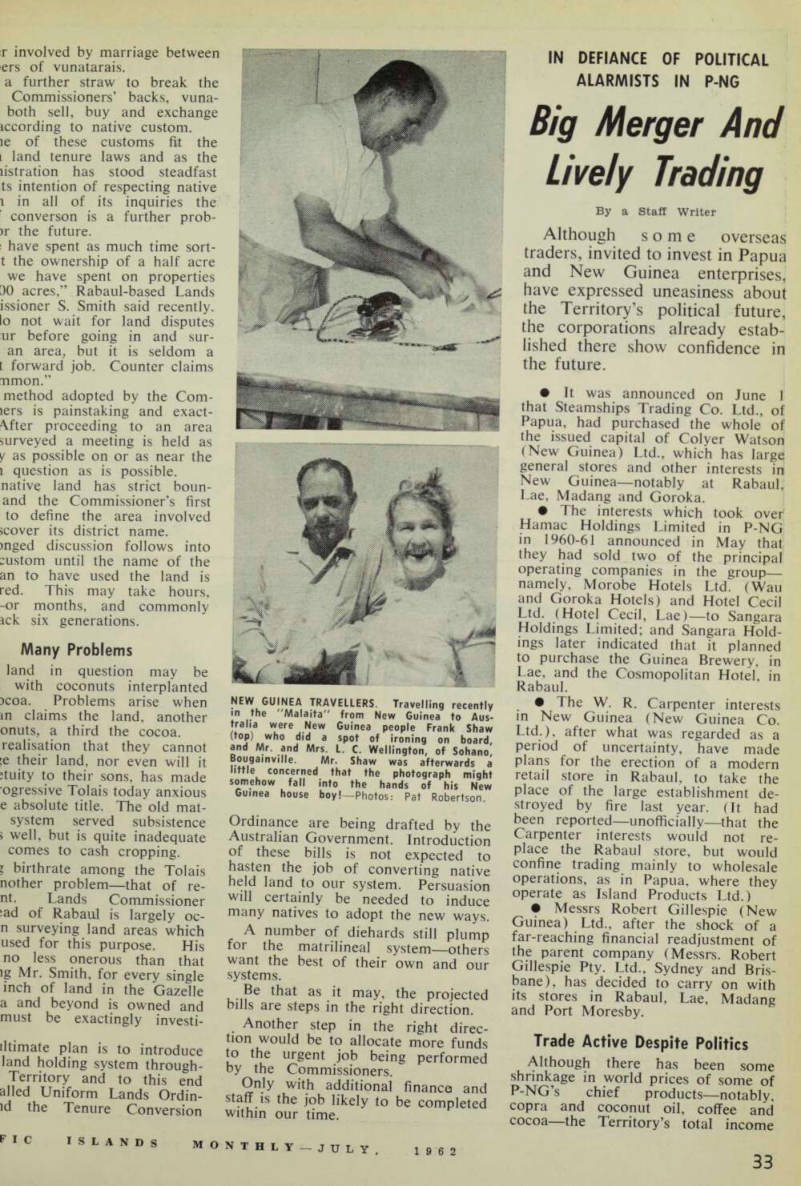
NEW GUINEA TRAVELLERS. Travelling recently in the "Malaita" from New Guinea to Aus tralia were New Guinea people Frank Shaw (top) who did a spot of ironing on board, and Mr. and Mrs. L. C. Wellington, of Sohano, Bougainville. Mr. Shaw was afterwards a little concerned that the photograph might somehow fall into the hands of his New Guinea house boy!— Photos: Pat Robertson.