Familiar
p. 82 · Read in the full issue
That Old
Story
, t From a Rabaul Correspondent Legion are the stories heard in the Islands of hidden trea-
sure, legendary goldfields, gems
without price sunken deep in the FOR months New Guinea people have been mystified by a legend much nearer home—that of a pearl bilong snake .
This almost certainly mythical miracle is alleged to be part of the lighting-up time equipment of a large jungle-dwelling snake, habitat New Britain.
Natives claim it is amphibious and can be found on land and in the sea * The story goes that the snake, a nocturnal reptile, slinks through the bush at night in search of food, and
that periodically it spits out a small pearl which glows with a bright luminous light.
Since it is attached by a tendon, the snake is able to haul it in again at will or step up the voltage as the light dims.
This at any rate is the story which is attested to by dozens of Tolais.
Many, it should be mentioned, are men of substance—and a certain amount of sophistication.
The “luminous” pearl became bathed in publicity about eight months ago when a brace of fast operators called on business man ager Cyril Holland in Rabaul and offered to sell him one such pearl for the ransom price of £13,000.
Cyril Holland promptly called in ex-Coastwatcher ‘Snowy’ Rhoades, who nowadays is with the Dept, of Agriculture, Stock and Fisheries.
Between them they interrogated the pearl hawkers at length and sub jected the bauble to intensive examination.
They found it to be a smallish sphere less than i in. in diameter, semi-translucent and with a milky hue, and girdled about by a slight groove, which admittedly looked as
though it might have been the atta( ment point of a tendon.
Consensus of opinion was that could have been a plastic bead fn the tail-light glass of somebod secondhand jeep.
The fortune-hunters depart! albeit glumly, and periodically sir that date Tolais have with hope! regularity been appearing with pe; “bilong snake”, offering them to t highest bidder.
And still, despite careful scruti by dozens of people, no one has a idea what they really are!
Mrs. E. East, wife of watchmai Ted East, took one with her recen on her southern leave and deliver it to the University of Queensla with the request that they try identify it.
The best the university could was to pronounce the pearl v decidedly of vegetable origin.
The local newspaper, havi printed the story on two occasioi finally got around to offering £1 the first Tolai who could bring a live snake so that the pearl coi be removed beneath the keen clc scrutiny of the Press.
Net result—several promises, : live snakes but a succession of hoj ful Tolais carrying “pearls”.
Old-timers in the Territory st£ they’ve heard the story for yet and that although natives a adamant there lives such a sna they’ve never had the good fortu to see one.
And the twinkle in their eyes they say this suggests they’re n likely ever to see the pearl snal It’s something strictly bilong Tol conman!
The Modern
Trend
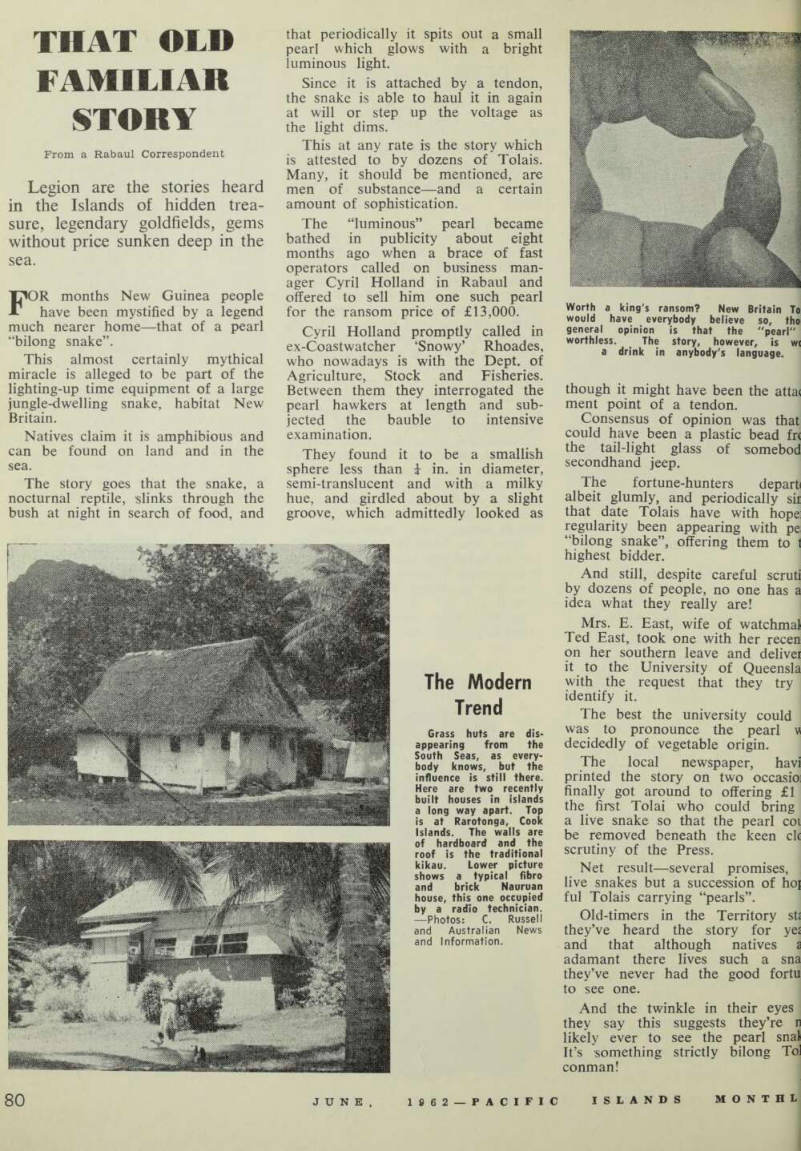
Grass huts are dis appearing from the South Seas, as every body knows, but the influence is still there.
Here are two recently built houses in islands a long way apart. Top is at Rarotonga, Cook Islands. The walls are of hardboard and the roof is the traditional kikau. Lower picture shows a typical fibre and brick Nauruan house, this one occupied by a radio technician.
Photos: C. Russell and Australian News and Information.
Worth a king's ransom? New Britain To would have everybody believe so, tho general opinion is that the "pearl" worthless. The story, however, is w[?] a drink in anybody's language.