Mutiny On The Brig "Cyprus"
pp. 87-89 · Read in the full issue
The Month's New Reading
With Judy Tudor
Whatever else might be said about The Pirates of the Brig Cyprus, the latest Frank Clune effort, it has at least brought Frank under the august notice of the reviewers of the Times Literary Supplement —but only, we suspect, because on this venture he was accompanied in collaboration by another Aus tralian writer, P. R. Stephensen.
OLLABORATOR Stephensen is better known these days as an tor and advisor on other people’s )ks, and you can see his hand te strongly in this one in its total k: of Clunisms. ?lune, on the other hand, was bably responsible for the histori research, which was considerable, 1 as usual good.
Australian history is Frank’s forte; emerges even through his home n folksy style which he usually ploys for the edification and in iction of other folksy Australian racters. n presenting the account of what pened to the convicts who seized brig Cyprus and sailed her across Pacific to China in 1829, the aborators mix fact and fiction. :y imagine the minor details and dialogue between the main racters in the story, and stick to umentary evidence in the larger es and the over-all picture.
And, although this is a difficult 'riage in the literary sense, they lage well enough; the characters’ versations are in accordance with it is actually known about them xcept perhaps for Swallow, the o of the piece, who manages ichow to emerge with a frag ited personality. wallow was born Walker and at ;r times went under the names Brown and Waldron. He was a arkable man and in the short 42 rs of his life had the distinction >eing transported to Van Dieman’s d thrice—once as Walker and :e as Swallow—and surviving all e experiences only to die of T.B. ’ort Arthur. le had been apprenticed to the as a youth and ultimately became faster on coastal vessels; then unemployed as a result of the ip during the Napoleonic Wars took to petty thieving and house iking to keep his wife and children n starving.
When caught he was sentenced to seven years’ transportation, made himself useful on the voyage and was afforded privileges when he arrived in Van Dieman’s Land.
Through these he stowed away on a ship, with the connivance of the Mate, reached England and undetected, rejoined his family and lived in and out of jobs and in and out of petty crime for some years, first as Brown, later as Swallow.
In 1828, when he was Swallow, the law caught up with him again. He was sentenced to death, but this was commuted to transportation for life.
The law was swift, simple and severe in those times—and not at all scientific. Neither Authority in
England nor Authority in Hobart then or later recognised Swallow, alias Brown, as Walker; there was no one to remark on the similarity °f his tactics during his second de portation with those of his first. For °n his second voyage out to Van Dieman’s Land he again made him seff indispensable to the Captain, arrived with the reputation of being a “good man” and was again soon planning to stow away on a vessel returning to England, In this he was discovered and for his efforts was sentenced to Macquarie Harbour, a notorious convict settle ment 40 miles up the wet, west coast of Tasmania. It was then he began
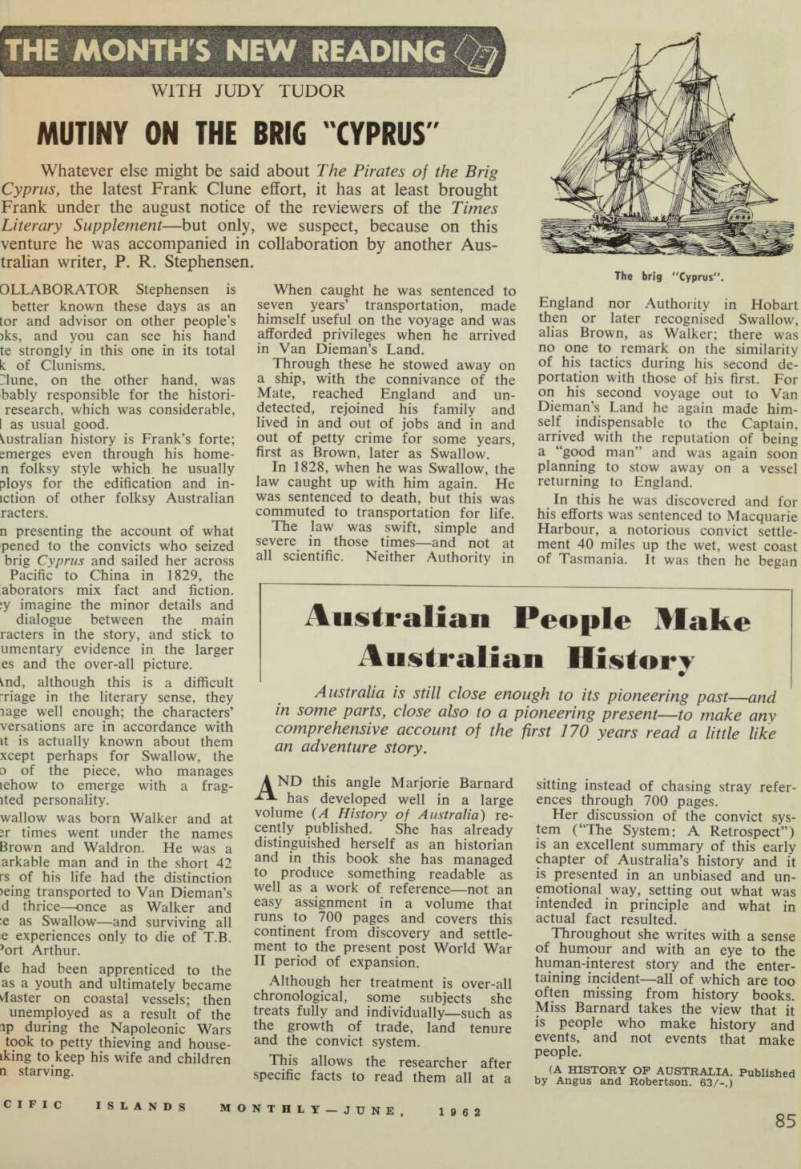
The brig "Cyprus".
to plan his excape on a more am bitious scale.
When the 80-ft. long brig Cyprus left Hobart for Macquarie Harbour on August 5, 1829, she had on board 31 convicts including Swallow; 12 crew; 13 soldiers, a medical officer, a woman, her two children and two servants, and enough stores to pro vision the settlement for months.
Eighteen of the convicts were deter mined that the brig would never
reach her destination and luck played into their hands when the vessel had to take shelter in Recherche Bay, just north of South East Cape. In the week that she lay there, Swallow perfected his plans with a long sightedness that permitted him an “out” when he finally had to face the music 12 months later.
The mutiny occurred on August 14, and after it 46 people were marooned on the lonely beach of the bay, and the 18 convicts sailed the brig eastwards with a sure couple of weeks head-start.
Of the 18 only a few were sailors and these Master Mariner Swal low (the only navigator) had to weld into a team capable of taking the vessel across thousands of miles of ocean to safety.
Where safety lay was arguable.
Some hoped for America, without any real idea of what this entailed. Swal low himself set his sights on Japan or China, mostly with the idea of getting passage from there back to England.
In the meantime, the idea was just to go, and this they did, first to New Zealand to replenish the water sup plies and then into the tropical Paci fic.
Even in those days the charms of Tahiti were well publicised and the pirates headed hopefully north-east only to be set off the land by con trary weather when it was in sight.
They turned then for Tongatabu, and came instead upon Niue, which shel tered them for a couple of months but otherwise marked the beginning of the end.
Was Niue Ever Like This?
Imperfect knowledge of where they were seems to have been trans mitted to the authors of this history and few people who know Niue un der today’s conditions would recog nise it from what is made to come out in the pirates’ conversation.
It is referred to throughout as part of Tonga, and the people as Tongans; and the island is described as “high volcanic”.
Niue is one of those odd islands of the Pacific that consist of upthrust terraces of limestone. On Niue there are two terraces—one 90 feet high and the other over 200, and it is on these that the villages are built —not on the non-existent beach amongst the coconuts, as writers Clune and Stephensen have it.
Nor is there a harbour nor even an anchorage as the writers seem to suggest. Ships today hang on and off the reef entrance to Alofi when loading and unloading—the Master usually doing a 24-hour watch on the
bridge, in anticipation of the first hit of treacherous weather.
Only surf boats and canoes us the narrow entrance through th reef that has been widened sine the Cyprus’ day. The first thin| that the traveller notices at Alofi ar the surf boats and canoes tucke into niches in the high cliff to pr( vent their being dashed to pieces o the rocky cliffs.
Yet Cyprus is supposed to hav sheltered for many weeks in “Niu Bay” while the 18 pirates took it i turn to carouse ashore with th “Tongans” and there is never a met tion of the sort of weather that hi made Niue a nightmare for seafarer When the time came, in Novembe 1829, to leave Niue, seven of th pirates elected to remain behind wit their “wives”. (Years later two c them were recaptured, but the othf five disappeared completely.) Those remaining on the Cypri began the long haul through th
ronesian islands to Japan and ul ately—spilling a convict here and e—to Canton. [ere the saga of the Cyprus ends not that of the men. By various ns five of them found their way c to England but because of the dieting tales they had told in na, the Law had been alerted was waiting to receive them, ntually the five were brought to t was called justice and here Swal plays the most remarkable part Js remarkable career. Using the sight he displayed at the time he mutiny in Tasmania, he was to talk his way out of the worst icquences of his folly, f the five men before the dock were found guilty and sentenced ang, while Swallow, born Walker, was the ring-leader in the ex and always the brains, was d not guilty of mutiny, e was nonetheless still an ped convict and as such was ned to Van Dieman’s Land to i his life sentence. ;hind the story of the mutiny J is the larger one of the ict transportation system. The >nal conscience has had various ms about this—at times being y troubled and at others trying whitewash the whole thing, was, of course, a barbarous sys but only slightly more so than in general for the lower orders urope at that time. For those survived the ordeal and adjusted was more in the new land than le slums of British cities—and niracle of it is that so many did ;t and live on to found a nation. »r those who did not—the so i “incorrigibles”—there was a road to the chain-gang, Mac e Harbour, Port Arthur or Nor- Island, and probably to a noose a long drop at the end of it. tough system but as one method fionising an unpromising land it rd to say that it failed.
E Pirates Of The Brig
US. Published by Rupert Hart-Davis. 26/6.)
stralian Poetry, 1961, without i your education on Australian re would not be complete, has Deen published. It is edited by Leonie Kramer, university er, ABC broadcaster and critic, e poems cover just about every t in the field, from the odd - orthodox, and even those who modern verse as hard to under as contemporary art will ibly discover one or two to liking. dished by Angus and Robertson 15/-.)