Peter-Of-All
p. 81 · Read in the full issue
A Brett Hilder Profile
Trades
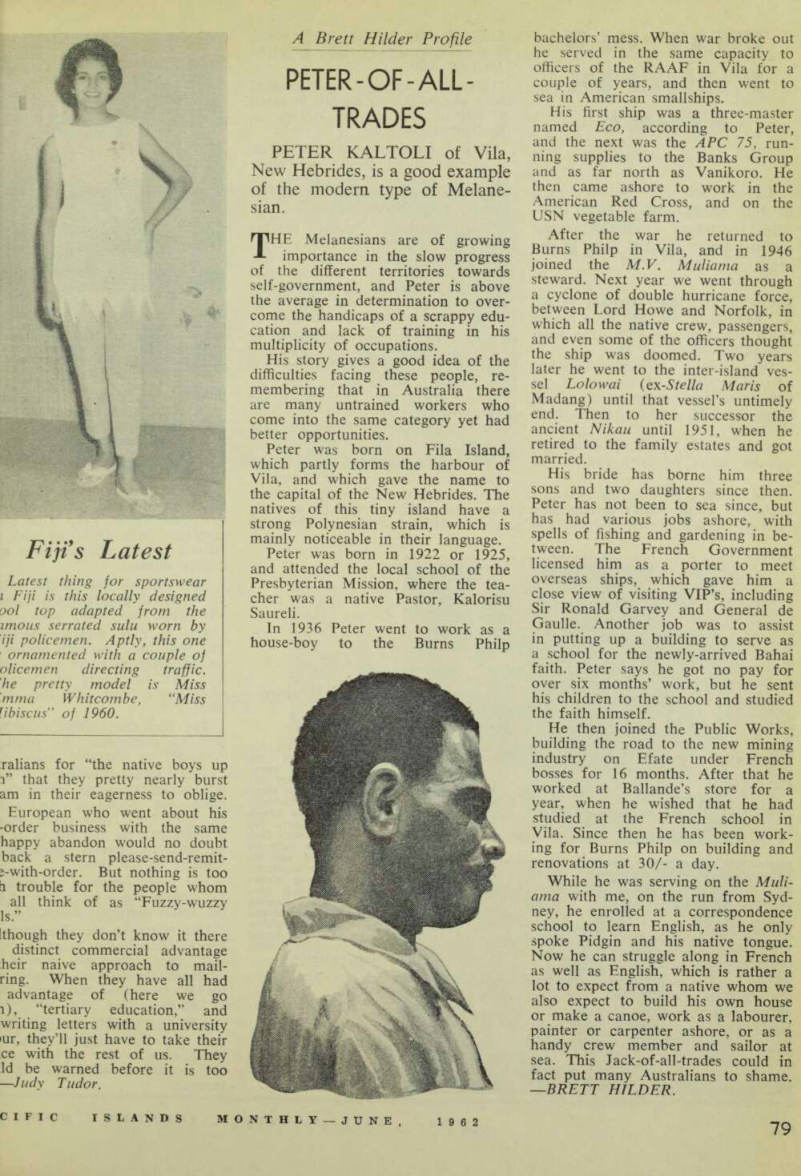
Peter Kaltoli Of Vila,
New Hebrides, is a good example
of the modern type of Melane sian.
THE Melanesians are of growing importance in the slow progress of the different territories towards self-government, and Peter is above the average in determination to over come the handicaps of a scrappy edu cation and lack of training in his multiplicity of occupations.
His story gives a good idea of the difficulties facing these people, re membering that in Australia there are many untrained workers who come into the same category yet had better opportunities.
Peter was born on Fila Island, which partly forms the harbour of Vila, and which gave the name to the capital of the New Hebrides. The natives of this tiny island have a strong Polynesian strain, which is mainly noticeable in their language.
Peter was born in 1922 or 1925, and attended the local school of the Presbyterian Mission, where the tea cher was a native Pastor, Kalorisu Saureli.
In 1936 Peter went to work as a house-boy to the Burns Philp
bachelors’ mess. When war broke out he served in the same capacity to officers of the RAAF in Vila for a couple of years, and then went to sea in American smallships.
His first ship was a three-master named Eco, according to Peter, and the next was the APC 75, run ning supplies to the Banks Group and as far north as Vanikoro. He then came ashore to work in the American Red Cross, and on the USN vegetable farm.
After the war he returned to Burns Philp in Vila, and in 1946 joined the M.V. Muliama as a steward. Next year we went through a cyclone of double hurricane force, between Lord Howe and Norfolk, in which all the native crew, passengers, and even some of the officers thought the ship was doomed. Two years later he went to the inter-island ves sel Lolowai ( ex-Stella Maris of Madang) until that vessel’s untimely end. Then to her successor the ancient Nikau until 1951, when he retired to the family estates and got married.
His bride has borne him three sons and two daughters since then.
Peter has not been to sea since, but has had various jobs ashore, with spells of fishing and gardening in be tween, The French Government licensed him as a porter to meet overseas ships, which gave him a close view of visiting VlP’s, including Sir Ronald Garvey and General de Gaulle. Another job was to assist in putting up a building to serve as a school for the newly-arrived Bahai faith. Peter says he got no pay for oyer six months’ work, but he sent his children to the school and studied the faith himself.
He then joined the Public Works, building the road to the new mining industry on Efate under French bosses for 16 months. After that he worked at Ballande’s store for a year, when he wished that he had studied at the French school in Vila. Since then he has been work ing for Burns Philp on building and renovations at 30/- a day.
While he was serving on the Muli ama with me, on the run from Syd ney, he enrolled at a correspondence school to learn English, as he only spoke Pidgin and his native tongue.
Now he can struggle along in French as well as English, which is rather a lot to expect from a native whom we also expect to build his own house or make a canoe, work as a labourer, painter or carpenter ashore, or as a handy crew member and sailor at sea. This Jack-of-all-trades could in fact put many Australians to shame.