Highway
pp. 65-69 · Read in the full issue


Hong The Hibiscus Highway
I remember that when the late Harold Gatty started his ji Airways 10 years ago the wise guys said: “Who’d travel those —at that price?” Today the answer is “Plenty”—in anes slightly different from those , at fares somewhat higher an they were 10 years back.
}HT now you can whip over in 50 minutes to Savusavu, on the rside of Vanua Levu, leaving ori, outside of Suva, heading out the sea across Ovalau, taking a hand turn when you hit the !S of Savusavu Bay and making ectacular approach to the air- You can pick up a car and lother hour be at Buca Bay, at ither end of the Hibiscus Highthe good old days, the journey these places to Suva was a sr of bucketing about for days nail cutters or local smallships probably being poured off at ;nd, half dead with seasickness.
Dr are the passengers all “rich” ters or even tourists; about 80 :ent. are Indians and Fijians. it in spite of the six-days-a-week
air service, the Hibiscus Highway (that most locals call a white elephant), and the new overseas wharf (that hasn t had an overseas ship in the several years of its existence), there is plenty about Savu savu that hasn’t changed since the Chiefs of Fiji ceded the Group to Britain in 1874. This is what most of the people who live there and the few unusual tourists who go there seeking peace and quiet, like about it, West along Savusavu Bay and east along the Hibiscus Highway from the township are strung out some of the oldest-established coconut plantations in the group, although you may fail to recognise them as such if you have been brought up to the Solomon Is.-Lever Bros., or New Guinea- German idea of what a plantation should look like.
In the BSIP and in P-NG planting is Big Business; at Savusavu, it’s a family affair, passed down over several generations. Nor is there any of those sissy ideas that coconuts should be planted in diagonal patterns of regimental straightness, so that whichever way you look there are your trees running off in lines, like guardsmen on parade.
Planted in the Dark With a few exceptions, Savusavu coconuts look as though they have been planted by a drunken sailor on a dark night. What’s more, hurri canes at various times have twisted them in the ground, and pushed the trunks into crazy shapes. Recurring copra depressions have resulted in nuts being allowed to germinate and grow where they fall; and underneath the lot of it, guava and other weeds grow in dense thickets. How to re trieve even half the nuts for copra cutting must be a recurring planters’ nightmare—or would be to anyone not bred to Savusavu conditions.
The “planted” plantations are, in fact, largely indistinguishable from the natural Fijian groves, and al though the parcels of land held by individuals may be as large as an average New Guinea plantation, only a fraction of it is usually planted up —mostly because, apart from the coastal verge, there is no really flat land anywhere. Production from an estate of even 500 acres may there fore be only 30 or 60 tons per year (not per month).
As many of these places are actu ally worked by a family or by Fijians on a sort of share-farming basis, in times of copra boom they are eco nomic units. In these circumstances, planters retire into the middle of their own green acres and sit mightily content. They listen to the world’s
Look, Cooking —No Gas!
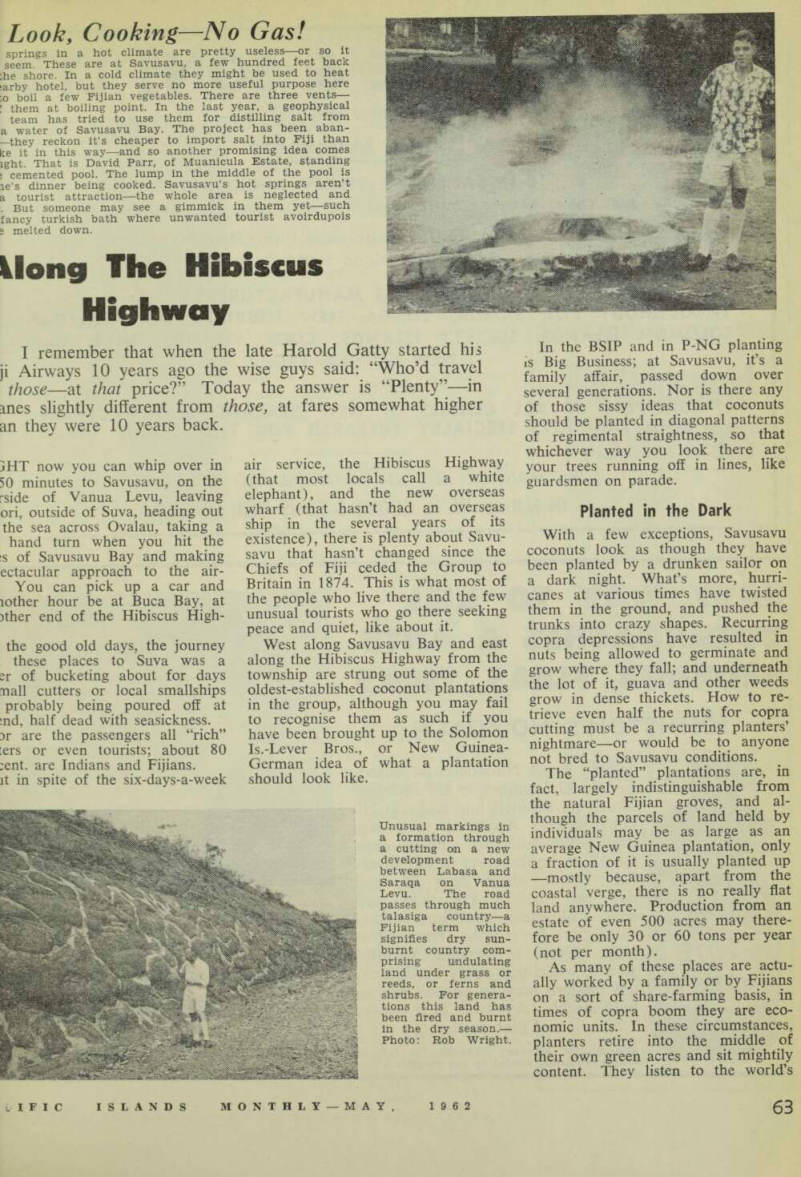
springs in a hot climate are pretty useless —or so it seem. These are at Savusavu, a few hundred feet back [?]he shore. In a cold climate they might be used to heat arby hotel, but they serve no more useful purpose here [?]o boil a few Fijian vegetables. There are three vents them at boiling point. In the last year, a geophysical team has tried to use them for distilling salt from a water of Savusavu Bay. The project has been aban —they reckon it’s cheaper to import salt into Fiji than ke it in this way—and so another promising idea comes nght. That is David Parr, of Muanicula Estate, standing s cemented pool. The lump in the middle of the pool is [?]e’s dinner being cooked. Savusavu’s hot springs aren’t a tourist attraction —the whole area is neglected and But someone may see a gimmick in them yet—such fancy turkish bath where unwanted tourist avoirdupois melted down.
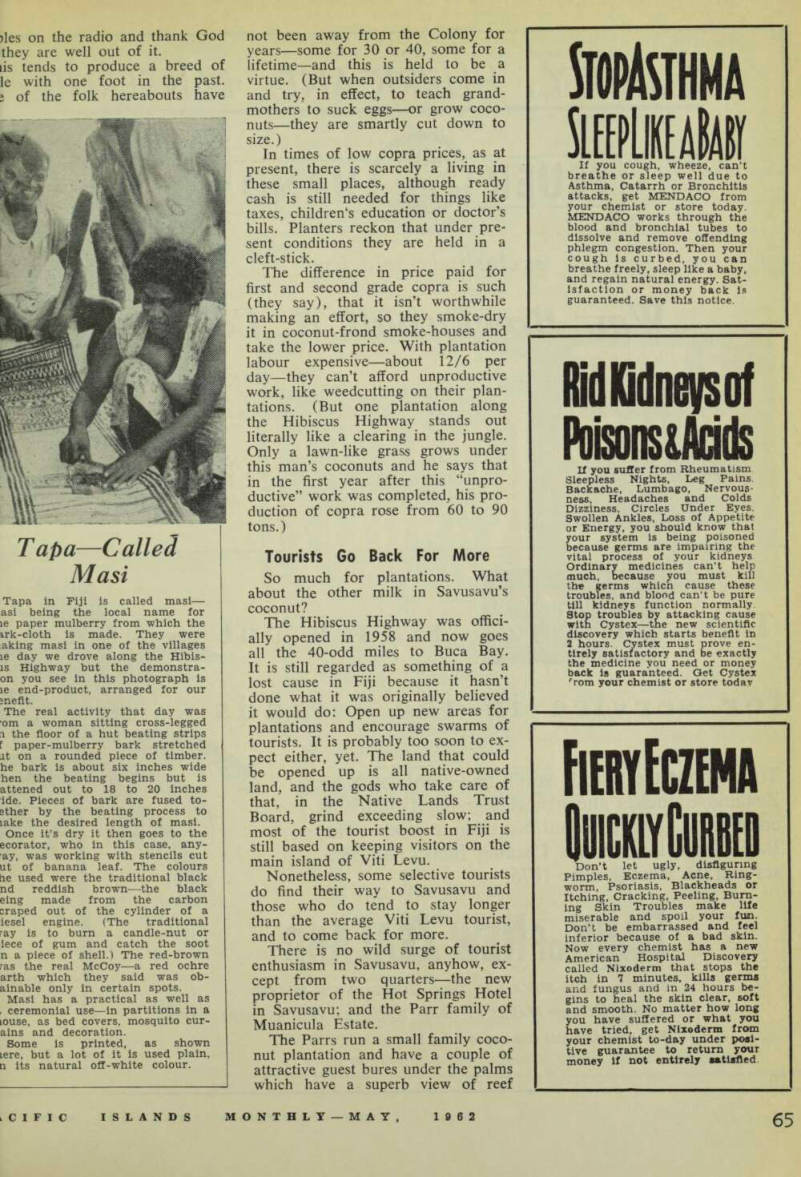
Unusual markings in a formation through a cutting on a new development road between Labasa and Saraqa on Vanua Levu. The road passes through much talasiga country—a Fijian term which signifies dry sun burnt country com prising undulating land under grass or reeds, or ferns and shrubs. For genera tions this land has been fired and burnt in the dry season.— Photo: Rob Wright.
)les on the radio and thank God they are well out of it. lis tends to produce a breed of le with one foot in the past. ; of the folk hereabouts have
not been away from the Colony for years—some for 30 or 40, some for a lifetime —and this is held to be a virtue. (But when outsiders come in and try, in effect, to teach grand mothers to suck eggs—or grow coco nuts—they are smartly cut down to size.) In times of low copra prices, as at present, there is scarcely a living in these small places, although ready cash is still needed for things like taxes, education or doctor’s bills. Planters reckon that under pre sent conditions they are held in a cleft-stick.
The difference in price paid for first and second grade copra is such (they say), that it isn’t worthwhile making an effort, so they smoke-dry it in coconut-frond smoke-houses and take the lower price. With plantation labour expensive—about 12/6 per day—they can’t afford unproductive work, like weedcutting on their plan tations. (But one plantation along the Hibiscus Highway stands out literally like a clearing in the jungle.
Only a lawn-like grass grows under this man’s coconuts and he says that in the first year after this “unpro ductive” work was completed, his pro duction of copra rose from 60 to 90 tons.) Tourists Go Back For More So much for plantations. What about the other milk in Savusavu’s coconut?
The Hibiscus Highway was offici ally opened in 1958 and now goes all the 40-odd miles to Buca Bay.
It is still regarded as something of a lost cause in Fiji because it hasn’t done what it was originally believed it would do: Open up new areas for plantations and encourage swarms of tourists. It is probably too soon to ex pect either, yet. The land that could be opened up is all native-owned land, and the gods who take care of that, in the Native Lands Trust Board, grind exceeding slow; and most of the tourist boost in Fiji is still based on keeping visitors on the main island of Viti Levu.
Nonetheless, some selective tourists do find their way to Savusavu and those who do tend to stay longer than the average Viti Levu tourist, and to come back for more.
There is no wild surge of tourist enthusiasm in Savusavu, anyhow, ex cept from two quarters—the new proprietor of the Hot Springs Hotel in Savusavu; and the Parr family of Muanicula Estate.
The Parrs run a small family coco nut plantation and have a couple of attractive guest bures under the palms which have a superb view of reef
sea. And here, although the it may be conscious that the daily ie to Suva can be caught just t miles away, he will otherwise in an atmosphere that hasn’t iged in essentials since this land originally acquired from the ms away back about the time of sion. his isn’t the place for people who manufactured pleasures seriously for those who like an occasional 1 of peace and tranquility, un
commercialised Fijian villages and happy, unspoiled people they could go further and fare worse. two pounds to my weight in as many days. While this may be no asset to calorie-counting tourists, for me it was not only good, but something like a miracle.
Savusavu may someday get its rightful quota of those 45,000 tourists a year that the Fiji Visitors Bureau expects, but in the forseeable future at least, this part of the Colony is likely to retain its own peculiar charm. An anachronism perhaps, but in this H-bomb age, anachronisms
are something we could use a lot more of! —Judy Tudor.
Land Settlement Scheme
p or Panna'c Gulf “ The P-NG Administration is to put in a pilot land settlement scheme at Murua, nine miles from Kerema, in Papua’s Gulf District. The land will be sub-divided into farm blocks for leasing to native farmers, and will be the first settlement project estab lished in the Gulf District. The Ad ministration plans to encourage simi lar settlements in other parts of the district.