Polynesian Origins
p. 63 · Read in the full issue
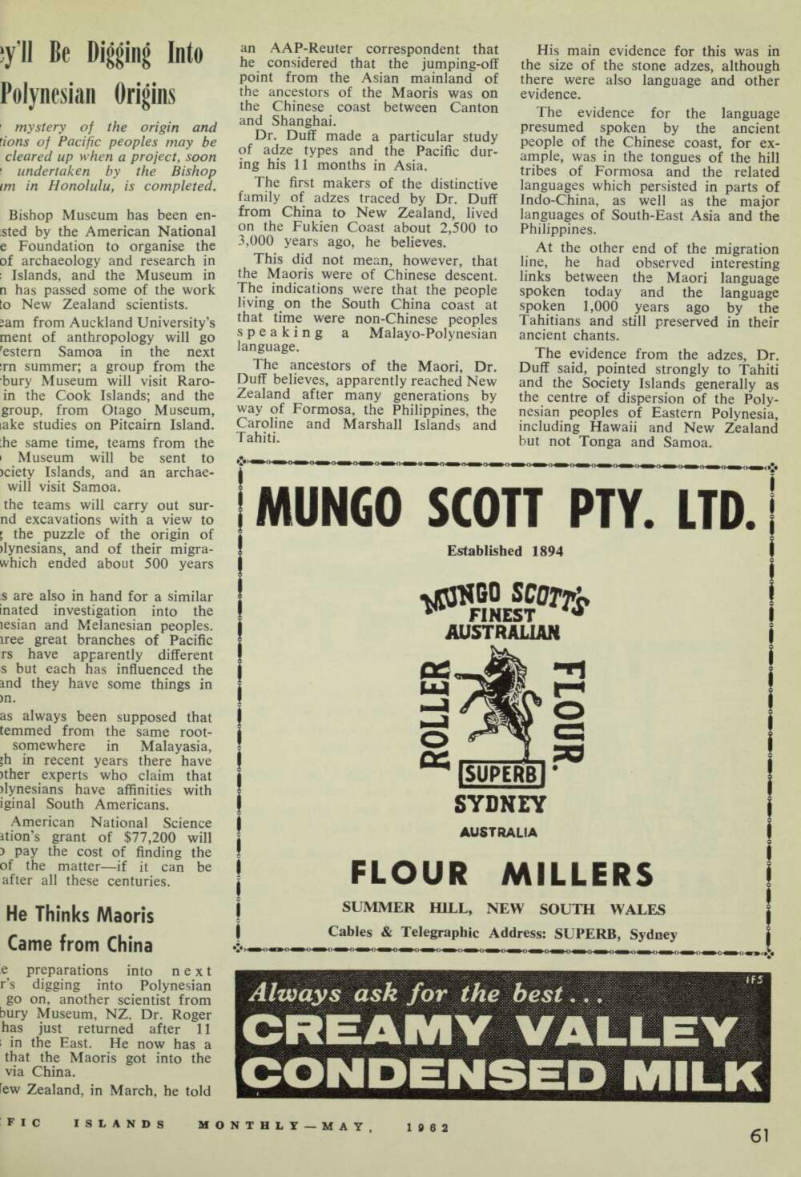
they'll Be Digging Into Polynesian Origins
■ mystery of the origin and Hons of Pacific peoples may be cleared up when a project, soon '■ undertaken by the Bishop im in Honolulu, is completed.
Bishop Museum has been en isled by the American National e Foundation to organise the of archaeology and research in ; Islands, and the Museum in n has passed some of the work to New Zealand scientists. 2am from Auckland University’s ment of anthropology will go r estern Samoa in the next :rn summer; a group from the bury Museum will visit Ram in the Cook Islands; and the group, from Otago Museum, lake studies on Pitcairn Island, the same time, teams from the • Museum will be sent to >ciety Islands, and an archae will visit Samoa, the teams will carry out sur nd excavations with a view to ; the puzzle of the origin of dynesians, and of their migra which ended about 500 years s are also in hand for a similar inated investigation into the lesian and Melanesian peoples, iree great branches of Pacific rs have apparently different s but each has influenced the and they have some things in >n. as always been supposed that temmed from the same root sqmewhere in Malayasia, ;h in recent years there have )ther experts who claim that dynesians have affinities with iginal South Americans.
American National Science ation’s grant of $77,200 will a pay the cost of finding the of the matter—if it can be after all these centuries.
He Thinks Maoris
Came from China
e preparations into next r’s digging into Polynesian go on, another scientist from bury Museum, NZ, Dr. Roger has just returned after 11 i in the East, He now has a that the Maoris got into the via China. few Zealand, in March, he told
an AAP-Reuter correspondent that he considered that the jumping-off point from the Asian mainland of the ancestors of the Maoris was on the Chinese coast between Canton , nf In/ ,E art p Ul? n St^ Udy hl*Q 1 ! y mnnthc d i th ® Pacific dur g Ins 11 months m Asia.
The first makers of the distinctive family of adzes traced by Dr. Duff from China to New Zealand, lived on the Fukien Coast about 2,500 to 3,°00 years ago, he believes.
This did not mean, however, that the Maoris were of Chinese descent.
The indications were that the people living on the South China coast at that time were non-Chinese peoples speaking a Malayo-Polynesian language.
Th e ancestors of the Maori, Dr.
Duff believes, apparently reached New Zealand after many generations by way of Formosa, the Philippines, the Caroline and Marshall Islands and Tahltl *
His main evidence for this was in the size of the stone adzes, although there were also language and other evidence.
The evidence for the language presumed spoken by the ancient People of the Chinese coast, for ex ample, was in the tongues of the hill tribes of Formosa and the related languages which persisted in parts of Indo-China, as well as the major languages of South-East Asia and the Philippines.
At the other end of the migration line, he had observed interesting links between the Maori language spoken today and the language spoken 1,000 years ago by the Tahitians and still preserved in their ancient chants.
The ev jj ence f rom t k e ac j zeSj Dr.
Duff said, pointed strongly to Tahiti and the Society Islands generally as the centre of dispersion of the Poly nesian peoples of Eastern Polynesia, including Hawaii and New Zealand but not Tonga and Samoa.